FS4 Conflict and displacement
Why war and its aftermath uprooted millions in Europe after 1945 and in Indochina after 1975, how the world responded, and how this focused study is studied and examined.
- IB History
- SL and HL
What FS4 covers
From the subject guide: what you need to know and be able to do.
Focused study: two paired examples, assessed through sources in paper 1.
2 subtopics in Conflict and displacement
Each one has its own page once something is published for it.
- FS4.1Post-war displacement in Europe (1945–1960)notes
- FS4.2Indochina refugee crisis (1975–1990)notes
An overview of FS4 Conflict and displacement
Conflict and displacement is a focused study of how wars, and the changes of regime and border that follow them, force people from their homes. Its two examples are the displacement of an estimated 40 million Europeans or more at the end of the Second World War (1945–1960) and the flight of about three million people from Vietnam, Cambodia and Laos after the communist victories of 1975 (1975–1990). Together they show how the modern international refugee system was created and then tested.
Two examples, three questions
The two examples are studied through the same three key questions, as the diagram of the focused study shows. The first question is about causes, the second about responses and the third about experiences.
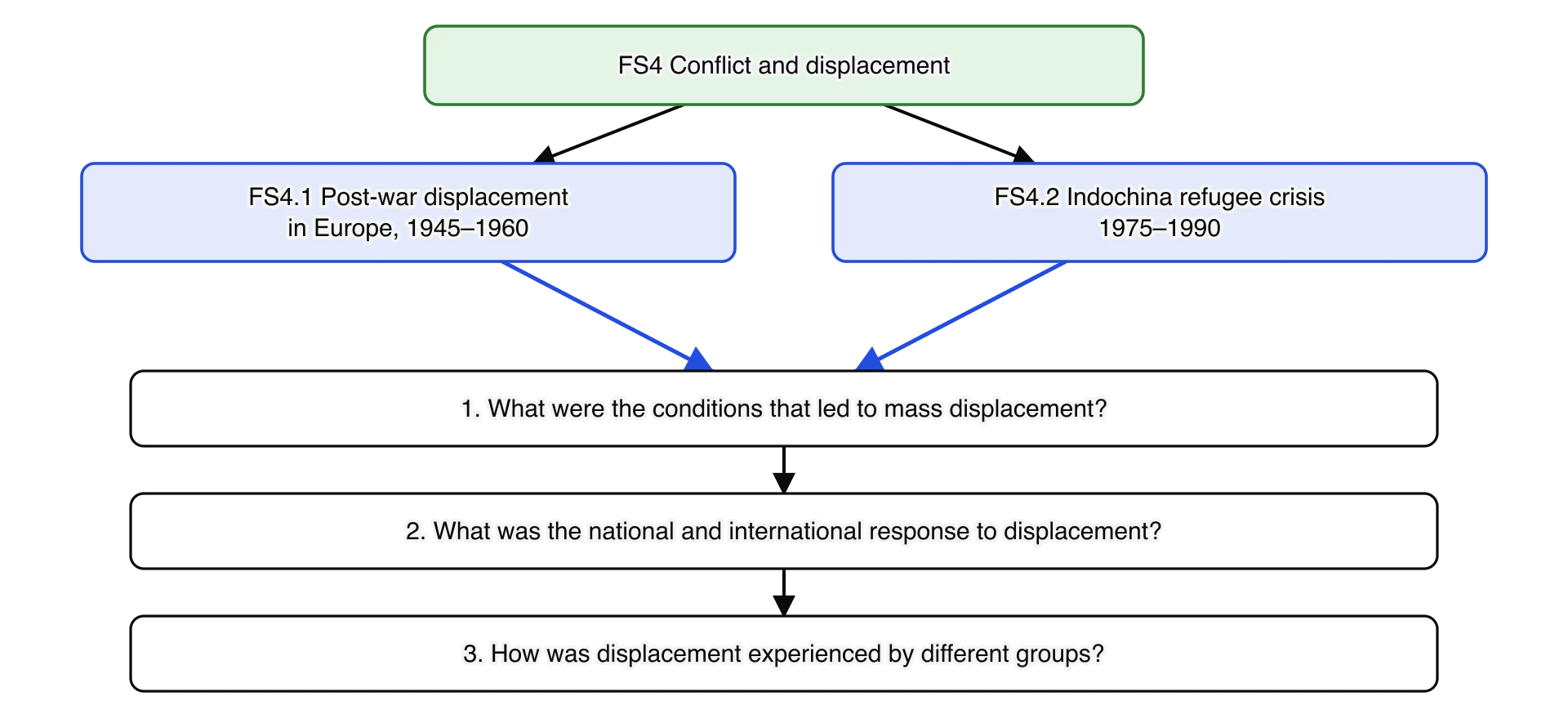
The table of the key questions summarises what each example covers under each question.
Key question | FS4.1 Post-war displacement in Europe (1945–1960) | FS4.2 Indochina refugee crisis (1975–1990) |
|---|---|---|
What were the conditions that led to mass displacement? | Combat operations and Allied victory; persecution and fear of reprisals, including the expulsion of 12 million Germans or more and fear of Soviet rule; economic collapse and the demand for labour abroad | Combat operations and communist victory in 1975 and the new wars of 1978–1979; persecution and fear of reprisals, including re-education camps and the expulsion of the Hoa; economic collapse |
What was the national and international response to displacement? | Displaced persons camps, repatriation, emigration and resettlement; Allied governments and voluntary organisations, including the International Red Cross; UNRRA, the IRO and the founding of UNHCR | Camps, first asylum, resettlement and repatriation; the roles of the United States and the Vietnamese government; UNHCR, including the Orderly Departure Programme (1979) and the Comprehensive Plan of Action (1989) |
How was displacement experienced by different groups? | Refugees and stateless persons; concentration camp survivors, including Jews and Roma; prisoners of war; former forces under German command | Vietnamese, including the Hoa, Montagnards, Hmong and Chams; Cambodians fleeing the Khmer Rouge; Laotians and the highland peoples of Laos |
Big ideas that run through the focused study
Both examples show that the end of a war can uproot as many people as the fighting. In Europe the war itself moved most people, but persecution, expulsion and fear kept millions from going home after May 1945. In Indochina the largest waves of flight came after the fighting had stopped, driven by the policies of the new governments and by fresh wars between communist states. Weighing war, persecution and economic motives against each other is the central causal question of the study, and the relative weight of these factors changed over time in both cases.
The responses tell a connected story. The agencies created for Europe (UNRRA, then the IRO, then UNHCR and the Refugee Convention of 1951) built the modern international refugee system, which at first applied only to Europe. Indochina was its largest test outside Europe. In both cases policy moved between sending people home and resettling them elsewhere, and in both the Cold War shaped who was helped and who was returned.
Experiences differed sharply between groups, so generalisations need qualifying. A Jewish survivor in a displaced persons camp, a German expellee and a Baltic soldier who had fought under German command were treated as victims, enemies or suspects. Among those leaving Indochina, educated evacuees flown out in 1975 had very different journeys from the boat people who faced storms and pirates, the Hoa expelled from Vietnam, Cambodians in the border camps or Hmong who had fought for the United States.
Perspectives and sources are central. Displaced people left testimony, letters and oral histories; governments, armies, UN agencies and charities left reports and statistics, each written for a purpose. Numbers themselves are contested, because they were counted by bodies with interests of their own.
How the focused study is studied and examined
All students, at SL and HL, take one of the five focused studies (Climate and innovation, Independence and identity, Political and economic transitions, Conflict and displacement, and Protest and change). Each has two examples, and both must be studied in full, in about 50 teaching hours.
The focused study is assessed by Paper 1 (1 hour 15 minutes, 24 marks; 30 per cent of the SL grade and 20 per cent of the HL grade), the same paper at SL and HL. Each session the paper is set on one of the two examples only. It gives an inquiry question and three sources (A, B and C), then three questions with fixed wording: how the content of Sources A and B can be used to answer the inquiry question (6 marks), how the context of Source C influences how it can be used (6 marks), and how the perspectives in all three sources can be used (12 marks). The IB's own published sample for this study uses the inquiry question "To what extent was persecution the main reason for post-war mass displacement in Europe?"
Carry on with FS4 in Augment
With a free account, Augment remembers where you stopped and what you have practiced.