Classify and compare farming systems, evaluate the Green Revolution, soil conservation, diets and strategies for sustainable food, and explain food security, waste and famine.
Each is in the ESS glossary, with every other term in the subject.
A chemical product used in agriculture, such as a synthetic fertilizer, pesticide, herbicide or growth regulator.
A land-use system in which trees or shrubs are grown together with crops or livestock on the same land, to gain from their interactions.
A farming system that grows crops, such as cereals, vegetables or oilseeds, on cultivated land rather than raising livestock.
A soil of hot deserts and dry shrublands, low in organic matter, often with layers of calcium carbonate, gypsum or salts because little leaching occurs.
Building low banks of earth or lines of stones along the contours of a field to trap run-off water and soil.
Meat from wild animals hunted for food, especially in tropical forests of Africa, Asia and South America, for household use or sale.
Farming in which crops or livestock are produced mainly for sale in markets to earn a profit, rather than for the farmer's own household.
A way of managing forest in which trees are harvested selectively or in small groups, so the canopy and soil are never fully cleared.
Explain why the finite area of farmland limits food production for a growing population, and why steep or nutrient-poor land is often used for livestock.
Classify agricultural systems by their inputs, outputs and purpose, and compare and contrast one pair of named contrasting systems.
Evaluate the sustainability of nomadic pastoralism and slash-and-burn agriculture at low and high population densities.
Discuss how insecure land rights make marginalised groups vulnerable, using a named example.
Evaluate the positive and negative consequences of the Green Revolution, including its dependence on synthetic nitrogen fertiliser.
Describe sustainable ways of maintaining soil fertility and classify soil conservation techniques by the problem they address.
Explain why food loss and waste occur along the supply chain and outline SDG target 12.3.
Calculate and explain why diets lower in the food chain need less land, and discuss the extent to which plant-based diets could make agriculture more sustainable.
Evaluate current strategies for a sustainable food supply and outline the regional extent of food security.
Compare agricultural choices on contrasting soils and evaluate alternative and high-technology farming approaches. (HL)
Evaluate the sustainability of diets, supply chains, wild harvesting and low-productivity food systems. (HL)
Explain how distribution and food quality cause malnutrition and famine, using the Irish and East African famines. (HL)
Agriculture is the managed production of crops and livestock for food, fibre and fuel. It is the largest human use of land on Earth, and the way food is grown, moved and eaten affects soils, water, the atmosphere and
The official deck for this part of the syllabus.
Why does the finite area of land limit food production?
About what percentage of the world's ice-free land is used for agriculture and forestry?
With a free account, Augment remembers where you stopped and what you have practiced.
Ploughing across a slope along its contours, so that each furrow slows run-off and reduces soil erosion by water.
A crop, such as clover, rye or vetch, grown mainly to cover and protect bare soil between main crops rather than to be harvested.
Growing a different crop on the same field in successive seasons in a planned sequence, often including a legume, to maintain fertility and break pest cycles.
The digestion of plant material by microorganisms in the gut of ruminant animals, which releases methane that the animals breathe out or belch.
Farming with low inputs of capital, labour or materials per unit area, usually spread over large areas and giving relatively low yields per hectare.
The practice of leaving farmland uncropped for one or more seasons so that soil nutrients, organic matter and structure can recover.
An extreme and widespread lack of food in a region, causing large numbers of deaths from starvation and disease, resulting from failures of food availability and access.
A substance added to soil or plants to supply nutrients, especially nitrogen, phosphorus and potassium, and so increase growth and yield.
The distance food travels from where it is produced to where it is eaten, used as a rough indicator of the environmental impact of food transport.
A situation in which all people at all times have physical and economic access to enough safe and nutritious food to meet their dietary needs for an active, healthy life.
Food fit to eat that is discarded at the retail, food-service or household stage; food lost earlier, during harvest, storage, processing and transport, is called food loss.
The direct alteration of an organism's DNA using biotechnology, for example by inserting a gene from another species, to give it a new characteristic.
A crop, often a legume, that is grown and then ploughed back into the soil to add organic matter and nutrients instead of being harvested.
The rapid rise in cereal yields in many low- and middle-income countries from the 1950s and 1960s, based on high-yielding varieties, irrigation, synthetic fertilizers and pesticides.
A crop variety bred to produce a high yield of grain per hectare when supplied with enough water, fertilizer and pest control.
Human faeces and urine composted at high temperature for long enough to kill pathogens, then used as an organic fertilizer.
A method of growing plants without soil, with their roots in a solution of water and dissolved mineral nutrients, often in greenhouses or indoor farms.
Farming with high inputs of capital, labour, energy, fertilizer or other materials per unit area, producing high yields per hectare.
The legal or customary rights of individuals or communities to own, use, control and pass on land and its resources.
Land sown with grass, often mixed with clover and herbs, for a few years as part of a rotation, grazed or cut, then ploughed for arable crops.
The addition of crushed limestone or other calcium compounds to acidic soil to raise its pH and make nutrients more available to plants.
A condition caused by a diet supplying the wrong amounts of energy or nutrients, including undernourishment, micronutrient deficiency and overnourishment leading to obesity.
Land of low agricultural value because of steep slopes, thin or poor soils, low or unreliable rainfall or other limits, where cultivation easily causes degradation.
A group pushed to the edge of society, with little power, wealth or voice in decisions, such as Indigenous peoples, people of a low caste or women farmers.
A farming system that combines growing crops with raising livestock on the same farm, often with crops feeding the animals and manure fertilizing the crops.
A grazing method in which a large herd is kept on a small paddock for a short time, then moved on, leaving each paddock a long rest to regrow.
A deep, dark, fertile soil of temperate grasslands, with a thick topsoil rich in humus and nutrients, widely used for cereals and grazing.
The growing of a single crop species, often a single variety, over a large area, sometimes for many years in succession.
Mutualistic associations between fungi and plant roots in which the fungus supplies water and mineral nutrients, especially phosphorus, and the plant supplies sugars.
A system of herding livestock that are moved between seasonal pastures and water sources, so that no area is grazed long enough to be degraded.
Any product other than timber gathered from forests for food, medicine, materials or sale, such as nuts, fruit, resins, honey and mushrooms.
A farming system that avoids synthetic fertilizers, pesticides and genetically modified organisms, relying on manure, compost, crop rotation and biological pest control.
A fertilizer made from plant or animal material, such as manure, slurry, compost or bone meal, that releases nutrients slowly and adds organic matter to soil.
Growing crops on the same land too often or too intensively, without returning nutrients or allowing rest, so soil fertility and structure decline.
Grazing by more livestock, or for longer, than the vegetation can withstand, so plant cover is lost and the soil is exposed to erosion.
A farming system based on raising livestock, such as cattle, sheep or goats, usually grazing grassland, for meat, milk, wool or hides.
A system of agricultural and settlement design that imitates the structure and relationships of natural ecosystems to produce food sustainably with few external inputs.
A chemical or biological substance used to kill or control organisms regarded as pests, including insects (insecticides), weeds (herbicides) and fungi (fungicides).
A mostly plant-based reference diet published by the EAT-Lancet Commission in 2019, designed to be healthy and to feed about 10 billion people within planetary boundaries.
A diet made up mostly or entirely of foods from plants, such as grains, vegetables, fruit, legumes and nuts, with little or no animal produce.
A food product made from plant proteins, such as soy, pea or wheat, processed to resemble meat in taste, texture and appearance.
The growing of several crop species together on the same land at the same time, such as intercropping, which increases diversity and ground cover.
An approach to farming that aims to rebuild soil organic matter, biodiversity and the water cycle, using zero tillage, cover crops, diverse rotations and managed grazing.
A form of shifting cultivation in which forest is cut and burned, cropped for a few seasons, then left as long fallow while vegetation and soil recover.
A material, such as lime, compost or manure, added to soil to improve its structure, pH, water-holding capacity or biological activity.
The set of practices that protect soil from erosion and degradation and maintain its fertility, structure and organic matter.
Growing alternate strips of a row crop and a close-growing crop or grass, often along contours, so that every second strip slows run-off and wind.
Farming in which crops or livestock are produced mainly to feed the farming household, with little or no surplus for sale.
Farming that meets present food needs while maintaining soil fertility, water, biodiversity and farm incomes, so that future generations can continue to farm the land.
A manufactured fertilizer containing soluble mineral nutrients, mainly nitrogen, phosphorus and potassium, that plants can absorb immediately.
A soil conservation technique that cuts a slope into a series of level steps held by walls, so water soaks in instead of running downhill.
Growing crops in stacked layers indoors, usually without soil and under artificial light, to obtain very high yields per unit of land area.
A row of trees, shrubs or a hedge planted to reduce wind speed near the ground, protecting soil from wind erosion and crops from damage.
A cultivation technique in which crops are sown directly into the undisturbed soil and residue of the previous crop, without ploughing.
A farm can be studied as a system with inputs (sunlight, water, seed, fertiliser, labour, energy), processes (growth, feeding, harvesting) and outputs (food, waste, emissions). Different perspectives lead to very different answers to the same question, from high-technology solutions to a return to traditional, low-input farming, and every choice involves a trade-off between feeding people now and keeping the land productive for the future, which is the core of sustainability.
Land is a finite resource, while the human population is still growing and needs feeding. Human use directly affects more than 70% of the global ice-free land surface, and agriculture and forestry account for most of that area. Very little high-quality farmland remains unused, so extra food must come either from higher yields on existing land or from clearing natural ecosystems such as forests and grasslands.
Sources: IPCC, Climate Change and Land, Summary for Policymakers (2019).
Not all land suits arable crops. Slopes that are too steep to plough, soils that are thin, stony, salty or poor in nutrients, and climates that are too dry or too cold for crops are often used for grazing animals instead. Cattle, sheep and goats are ruminants: their gut microbes digest the cellulose in grass and shrubs, which humans cannot digest, so grazing turns plants that grow on this land into milk, meat, wool and leather.
Agriculture and land use are also a major driver of global environmental change. In 2015 the global food system, from land clearing and farming to transport, packaging and waste, produced about 18 billion tonnes of CO₂-equivalent, roughly one-third of all human greenhouse gas emissions. Farming is the main cause of land-system change, one of the planetary boundaries already crossed, and the largest user of synthetic nitrogen and phosphorus.
Sources: Crippa et al., Nature Food (2021); IPCC (2019).
Agricultural systems vary greatly because soils and climates vary. A deep, fertile grassland soil in a temperate climate can grow wheat or maize year after year, while the leached soils of a tropical rainforest lose their fertility within a few seasons once the forest is cleared. Each biome therefore has its own crop potential, and the productivity of farming depends on temperature, rainfall, the length of the growing season and the soil.
Within those natural limits, farmers choose a system. The choice depends on physical factors (relief, soil, climate, water), economic factors (prices, markets, credit, subsidies, the cost of labour and machinery), social and cultural factors (tradition, diet, land inheritance, knowledge) and political factors (land ownership, government support, trade rules). These choices determine whether a farm is economically, socially and environmentally sustainable.
Basis | Types | Meaning |
|---|---|---|
Outputs | Arable farming, pastoral farming, mixed farming | Crops only; livestock only; crops and livestock on the same farm |
Outputs | Monoculture or diverse (polyculture) | One crop over a large area; several crops grown together or in rotation |
Purpose | Commercial farming or subsistence farming | Produce grown for sale; produce eaten mainly by the farming household |
Purpose | Sedentary or nomadic | Farmers live in one place; herders move with their animals |
Inputs | Intensive farming or extensive farming | High inputs of labour, capital or chemicals per hectare and high yields; low inputs per hectare over large areas, with lower yields per hectare |
Inputs | Irrigated or rain-fed | Water added artificially; water from rainfall only |
Inputs | Soil-based or hydroponics | Plants grown in soil; plants grown with roots in a nutrient solution, without soil |
Inputs | Organic farming or inorganic | Without synthetic fertilisers and pesticides; with synthetic inputs |
A real farm is described by combining these labels. A wheat farm in the Canadian prairies is commercial, arable, monoculture, extensive and rain-fed; a rice terrace in Bali is subsistence or semi-commercial, arable, intensive and irrigated. Classifying a system in this way makes it easier to predict its environmental impacts.
Intensity can be measured per unit of land or per worker, so the two can give different answers. A cattle ranch in Australia is extensive per hectare but uses very little labour per tonne of beef, while a smallholder rice farm in Bangladesh uses large amounts of labour per hectare but few purchased inputs.
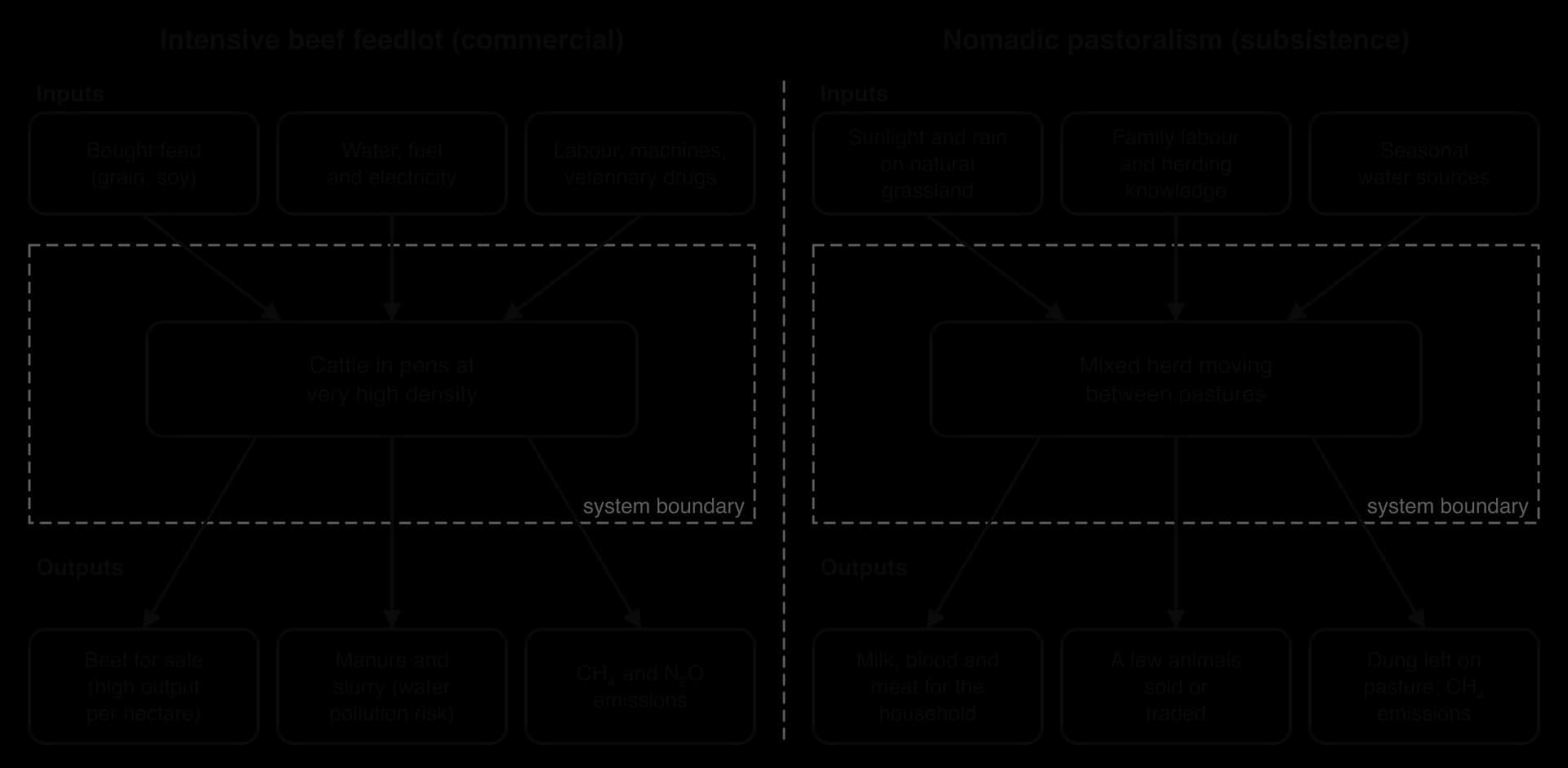
Drawing a farm as a systems diagram shows clearly why systems differ in sustainability. Inputs cross the system boundary from outside, the herd or crop is the main storage, and outputs leave as products, waste and emissions. Intensive systems rely on large external inputs, many of them made with fossil fuels, and produce concentrated wastes; extensive systems rely mainly on natural inputs such as sunlight, rain and grassland.
 YouTube
Beef and milk can come from very different systems. The Maasai of southern Kenya and northern Tanzania are semi-nomadic pastoralists whose way of life has centred on cattle, kept with goats and sheep on dry savanna grassland. Herds are moved between wet-season and dry-season pastures and water sources, and milk, blood and meat feed the household, with some animals sold or traded.
In the United States, most beef cattle spend their last months in feedlots: pens holding thousands of animals fed a mixed ration of grain, forage and supplements. A steer may spend about 200 days in a feedlot and gain 180–270 kg before slaughter, and feedlots finish more than 75% of the steers and heifers used for beef.
Sources: Wikipedia, “Maasai people” and “Feedlot”, and their sources (accessed October 2026).
Feature | Maasai nomadic pastoralism (Kenya, Tanzania) | US beef feedlot (e.g. Texas, Nebraska) |
|---|---|---|
Classification | Subsistence (partly commercial), pastoral, extensive, nomadic or semi-nomadic, rain-fed | Commercial, pastoral, intensive, sedentary, with bought feed grown on irrigated or rain-fed cropland |
Main inputs | Natural grassland, rain, family labour, herding knowledge | Grain and soy feed, water, fuel, electricity, veterinary drugs, machinery, hired labour |
Outputs | Milk, blood, meat, hides; animals as savings and social wealth | Large quantities of standardised beef for national and export markets |
Yield | Low per hectare and per animal | Very high per hectare of feedlot; high per animal |
Environmental impacts | Low inputs and pollution; overgrazing where herds are confined to smaller areas; methane | Manure and slurry pollute water and air; feed crops need land, fertiliser and water elsewhere; methane and nitrous oxide; antibiotic resistance risk |
Sustainability | Sustainable at low density with mobility; threatened by land loss and settlement | Economically efficient but depends on fossil fuels and distant cropland; high external costs |
Some of the oldest farming systems were sustainable for centuries because they matched low population densities and moved over large areas. Two are especially important: nomadic pastoralism in drylands and slash-and-burn agriculture in tropical forests. Both rely on mobility and on giving the land time to recover.
Mobility is the key to sustainability. When rain falls in one area, the grass grows there and the herd follows it; when the pasture is used, the herd moves on and the grass regrows. Pastoralists in the Sahel, the Horn of Africa, Mongolia and the Tibetan Plateau use land that is too dry or cold for crops. Their traditional ecological knowledge of grazing routes, water and animal health has been built over many generations.
Burning the cut vegetation releases nutrients in the ash, which fertilises crops for a short time. In tropical rainforest most nutrients are held in the vegetation rather than the soil, and heavy rain soon leaches the remaining nutrients away, so yields fall within a few seasons and weeds increase. The farmer then moves to a new plot. The old plot goes through secondary succession and, with a long enough fallow, the forest and soil fertility return. Fallow land is still used for fruit, timber, medicines and firewood.
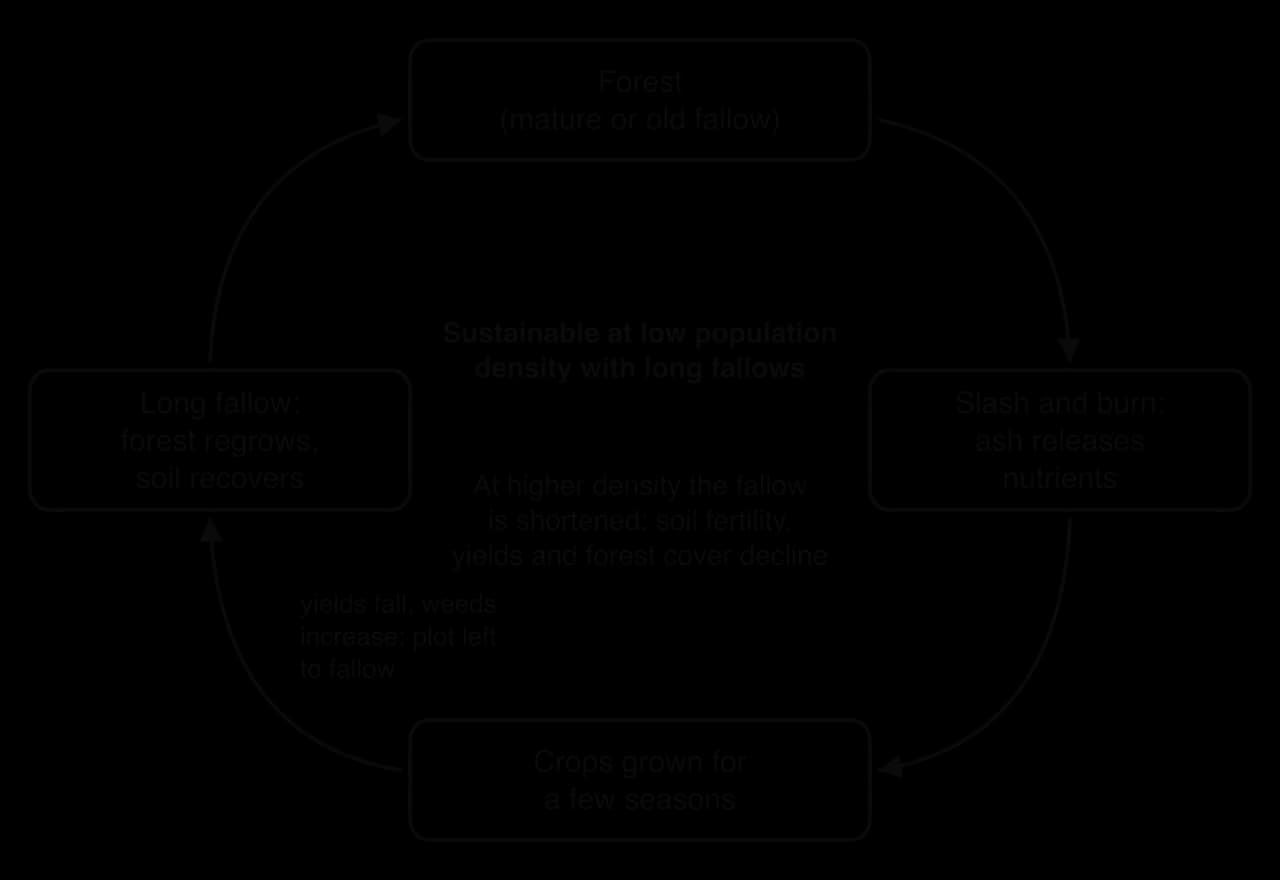
Both systems become unsustainable when the conditions that made them work change. With more people, or less land, the fallow is shortened: plots are recleared before the forest has regrown, soil fertility falls and erosion increases. When pastoralists are pushed onto a smaller area by ranches, crop farms, national parks or borders, or are encouraged to settle near wells and towns, the herd stays longer on the same pasture and overgrazing follows.
Maasai land has been reduced many times: by colonial land transfers in the first half of the twentieth century, and by the creation of wildlife reserves and parks such as the Maasai Mara, Amboseli and Serengeti. Modernisation adds further pressure through schooling, private land titles, fencing and the shift from milk and livestock to cash incomes. These outside pressures, more than pastoralism itself, explain most of the overgrazing now seen on Maasai land.
Higher population density shortens fallows and increases grazing pressure.
Fixed locations (settlement, fences, private titles) stop the movement that let pasture or forest recover.
Market pressure encourages larger herds or cash crops on the cleared plots.
Loss of knowledge as younger generations move to towns or schools weakens traditional management.
Who owns or controls land decides who can farm it, who benefits from it and who bears the costs when it changes use. Land rights can be formal (a registered title) or customary (recognised by a community through tradition), and customary rights are easily ignored when governments or companies want land for plantations, mines, dams or conservation.
Marginalised groups are more vulnerable when their needs are not considered in land-use decisions. Women produce a large share of the food in many low-income countries but often cannot inherit or register land, which makes it harder for them to obtain credit or invest in soil conservation. In India, many Dalit and Adivasi families farm as labourers or tenants without secure ownership. This is a question of environmental justice: the fair sharing of environmental benefits and burdens, and fair participation in the decisions that create them.
The Guarani-Kaiowá are an Indigenous people of the forests and plains of Mato Grosso do Sul in central-western Brazil and neighbouring Paraguay. Over the last century, and especially since the 1980s, waves of deforestation have turned most of their ancestral territory into cattle ranches and plantations of soy, maize and sugar cane, the last grown partly for Brazil’s biofuel ethanol market.
Many Guarani-Kaiowá now live on small, overcrowded reserves or in roadside camps beside the farms that occupy their former land. In the Dourados reserve, around 12,000 people live on little more than 3,000 hectares, too little land to hunt, fish or grow enough food, and malnutrition and violent conflict over land are common. Their claims depend on the slow process of official recognition of Indigenous territories.
Sources: Survival International, “The Guarani” (accessed October 2026); Wikipedia, “Guarani-Kaiowá”.
Perspective | How the land is valued | Typical position |
|---|---|---|
Guarani-Kaiowá communities | Ancestral territory with spiritual meaning, the basis of food, culture and identity | Recognition of their territories and return of land |
Commercial farmers and agribusiness | A productive asset that earns export income and jobs | Secure private titles; expand production |
National government | Source of export earnings and of food and fuel security | Balance growth with legal duties to Indigenous peoples |
Environmental groups | Remaining forest and savanna as habitat and carbon store | Halt further clearance; support Indigenous land management |
Applying different environmental value systems to the same land explains why the conflict is so hard to resolve. An anthropocentric view focused on national income favours expansion, while an ecocentric view and a rights-based view both favour returning land to the people who managed it sustainably for centuries.
By the 1950s and 1960s, rapid population growth and repeated food shortages in Asia and Latin America led governments, international foundations and scientists to look for ways to raise yields quickly. The answer was a package of technologies that became known as the Green Revolution, sometimes called the Third Agricultural Revolution.
The work began in Mexico in the 1940s, where the plant breeder Norman Borlaug developed short-stemmed (semi-dwarf), disease-resistant wheat at a research station funded by the Rockefeller Foundation. Mexico, which imported half of its wheat in 1943, was self-sufficient by 1956. Similar programmes produced high-yielding rice, and the package spread to India, Pakistan, the Philippines and other countries in the late 1960s. Borlaug received the Nobel Peace Prize in 1970.
Sources: Wikipedia, “Green Revolution” and its sources (accessed October 2026).
The four parts depend on one another, which is why the Green Revolution is best understood as a system. Each high-yielding variety is designed to turn extra inputs into extra grain, so without those inputs it gives little benefit.
High-yielding varieties (HYVs) put more of their energy into grain and less into stem. Their short, stiff stems can carry heavy heads of grain without falling over, so they respond to large doses of fertiliser.
Irrigation provides reliable water, allowing two or even three crops a year on the same land.
Synthetic fertilisers supply the nitrogen, phosphorus and potassium that the high yields remove from the soil each harvest.
Pesticides protect dense, genetically uniform crops from insects, fungi and weeds, which spread easily through monocultures.
Most synthetic nitrogen fertiliser is made by the Haber process, which combines nitrogen from the air with hydrogen made mostly from natural gas at high temperature and pressure. Ammonia production uses about 1–2% of the world’s energy and about 3–5% of its natural gas. The Green Revolution therefore made food production dependent on fossil fuels, and food prices sensitive to energy prices.
Sources: Wikipedia, “Haber process” and its sources (accessed October 2026).
Area | Positive consequences | Negative consequences |
|---|---|---|
Food security | Cereal yields doubled or tripled; famines in South Asia became much rarer; food prices fell | Diets narrowed towards rice and wheat, at the expense of pulses and millets rich in protein and micronutrients |
Economic | Higher incomes for farmers with land and water; national self-sufficiency and export earnings | High input costs led many small farmers into debt; benefits went mostly to larger farmers and irrigated regions |
Social and cultural | Rural employment in the early years; less dependence on food aid | Mechanisation later cut jobs for landless labourers; traditional varieties and knowledge were lost |
Environmental | Less forest cleared than would have been needed to grow the same food at old yields | Groundwater depletion, salinisation, soil degradation, eutrophication, pesticide pollution, loss of crop genetic diversity, more greenhouse gases |
The Green Revolution did not occur everywhere. It succeeded mainly where there was irrigation or reliable rain, roads to markets, credit and government support. Much of sub-Saharan Africa, with mostly rain-fed farming, varied staple crops such as cassava, sorghum and millet, and weaker infrastructure, gained far less, and dryland regions within India were also left behind.
Every harvest removes nutrients from the soil in the crop. If they are not replaced, yields fall. A fertiliser is any substance added to soil to supply plant nutrients, and the choice between synthetic and natural sources is one of the main differences between intensive and sustainable farming.
Synthetic fertilisers maintain high productivity in many intensive commercial systems because they are cheap per unit of nutrient, easy to apply and work fast. Their sustainability costs come from what happens to the nutrients that crops do not take up.
Soluble nitrate is leached into groundwater and rivers and, with phosphate in eroded soil, causes eutrophication in lakes and coastal seas.
Bacteria convert part of the nitrogen into nitrous oxide (N₂O), a powerful greenhouse gas, by denitrification.
Repeated use of ammonium fertilisers acidifies soils.
Fertilisers add no organic matter, so soil structure, water retention and soil life can decline over time.
Making and transporting them uses fossil fuels, and phosphate comes from rock that is a non-renewable resource.
Method | How it works | Example or limitation |
|---|---|---|
Fallowing | Land is left uncropped for one or more seasons so nutrients and organic matter build up naturally | Takes land out of production for a time |
Organic fertiliser from animals | Manure and slurry return nutrients and organic matter to the soil | Bulky; nutrient content varies; can pollute water if over-applied |
Humanure | Composted human faeces returns nutrients that would otherwise be lost to sewage | Must be composted hot and long enough to kill pathogens; cultural resistance |
Herbal mixed leys | Grass, clover and herbs are sown for a few years and grazed; clover fixes nitrogen and deep-rooted herbs bring up minerals | Part of a rotation with arable crops in mixed farms |
Mycorrhizae | Fungi living on and in roots extend the root system, taking up phosphorus and water in return for sugars | Damaged by heavy tillage and high fertiliser use |
Continuous cover forestry | Trees are harvested selectively, so the canopy and litter layer always cover the soil | Lower timber yield in the short term than clear-felling |
Agroforestry | Trees grown with crops or livestock add leaf litter, fix nitrogen (if legumes) and reduce erosion | Faidherbia albida in the Sahel |
Faidherbia albida, a nitrogen-fixing acacia-like tree of the Sahel, shows how agroforestry can work with crops instead of competing with them. The tree drops its leaves during the rainy season, when millet and sorghum are growing, so it does not shade them, and its fallen leaves add nitrogen and organic matter to the soil. It keeps its leaves in the dry season, when it provides shade and fodder for livestock.
Sources: Wikipedia, “Faidherbia” and its sources (accessed October 2026).
Soil conservation is the set of practices that protect soil from erosion and maintain its fertility and structure. Soil forms extremely slowly, so a soil lost to soil erosion or degraded by poor management is effectively a non-renewable loss on a human timescale. The processes of degradation are part of the study of soil; the techniques that prevent it fall into three groups.
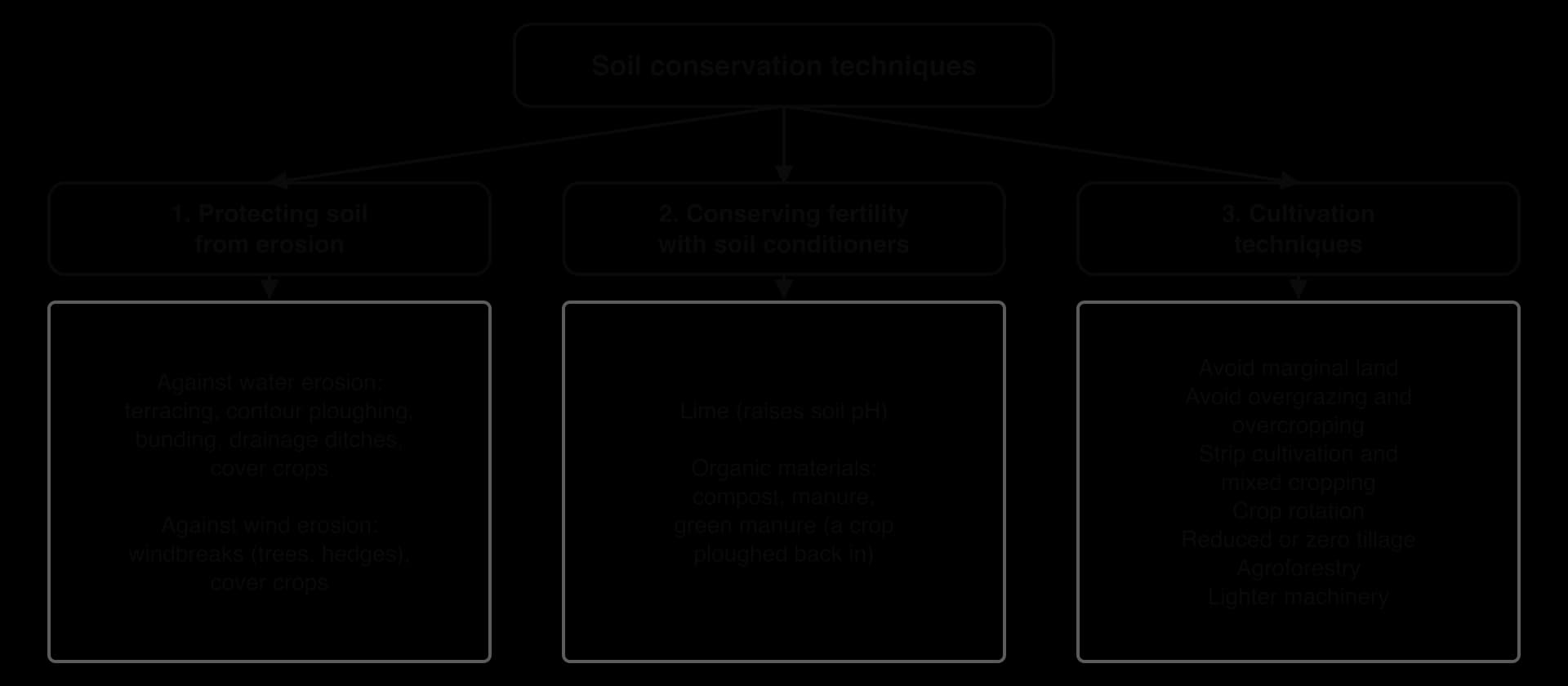
Water erosion is fastest where rain falls on bare soil on a slope, because raindrops detach particles and run-off carries them downhill. Most techniques against water erosion either slow the water or keep the soil covered.
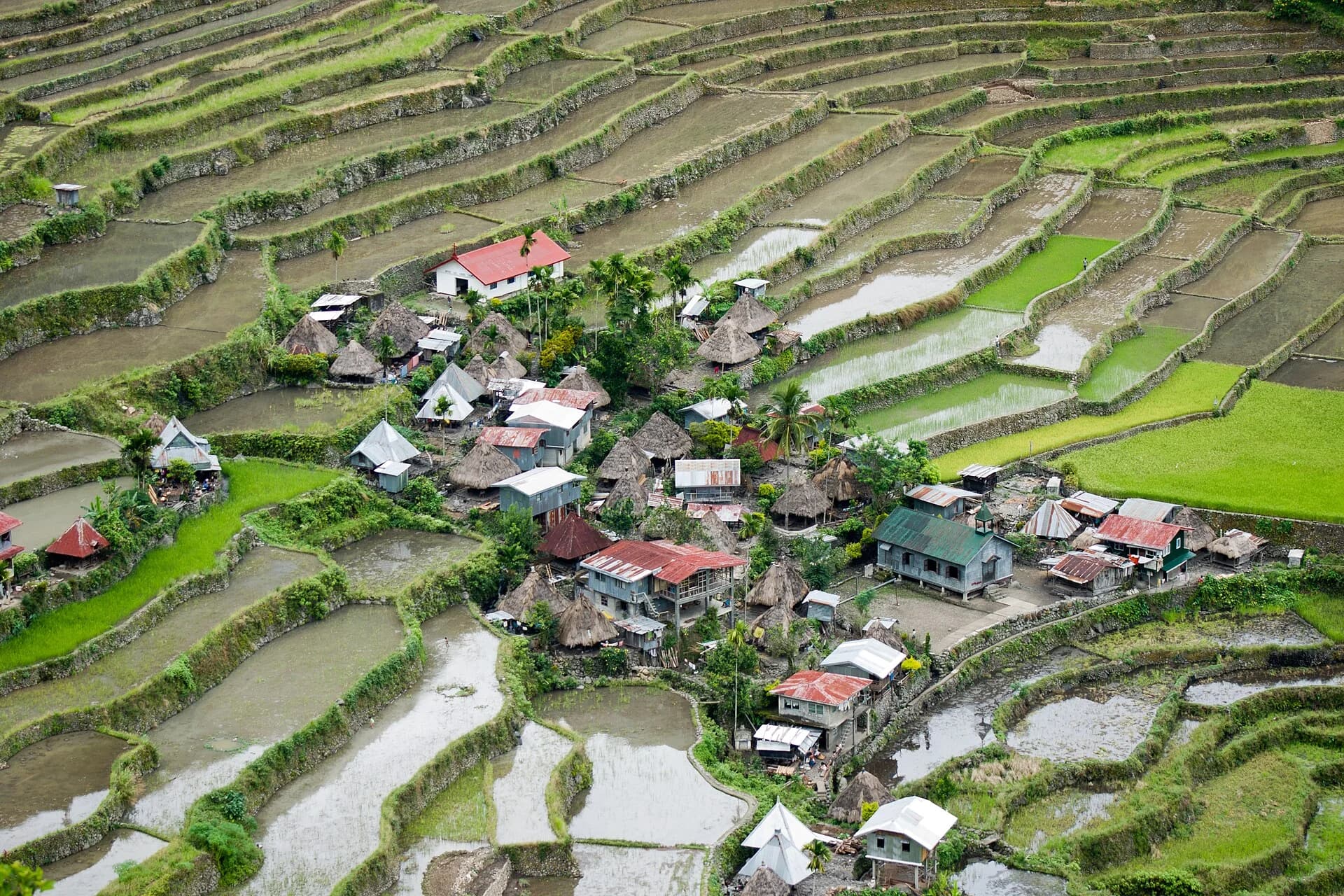
Terracing cuts a slope into a series of flat steps held by walls, so water soaks in on each step instead of running downhill. It allows farming on steep land, as in the rice terraces of the Philippines, Nepal and southern China.
Contour ploughing ploughs across the slope, following the contours, so each furrow acts as a small dam that slows run-off.
Bunding builds low walls or banks of earth or stones along the contours to trap water and soil.
Drainage ditches lead excess water away safely so it does not cut gullies.
Cover crops such as clover or rye are sown after the main harvest so the soil is never bare.
Wind erosion affects dry, bare, fine soils on flat open land. Windbreaks (rows of trees or hedges) slow the wind near the ground and trap blowing soil, and cover crops hold the surface. Windbreaks and contour ploughing were among the main responses to the Dust Bowl of the 1930s on the Great Plains of the USA.
A soil conditioner is a material added to improve the physical or chemical condition of soil rather than mainly to supply nutrients. Liming adds crushed limestone (calcium carbonate) to acidic soils, raising the pH, which makes nutrients such as phosphorus more available and is also used to counter acidification from fertilisers and acid deposition.
Organic soil conditioners such as compost, manure and green manure add organic matter and humus, which bind soil particles into crumbs, hold water and nutrients and feed soil organisms. Green manure is a crop, often a legume, that is grown and then ploughed back into the soil instead of being harvested.
Technique | What it does |
|---|---|
Avoiding marginal land | Leaves steep, thin or dry land under permanent vegetation, where cultivation would quickly cause erosion |
Avoiding overgrazing and overcropping | Keeps livestock numbers within what the pasture can support and avoids exhausting soil with repeated crops |
Strip cultivation | Alternates strips of a row crop with strips of grass or a close-growing crop, so run-off and wind are slowed by every second strip |
Mixed cropping | Grows several crops together, giving more continuous ground cover and a mix of root depths |
Crop rotation | Changes the crop on a field each year, often including a legume, which breaks pest cycles and restores nitrogen |
Reduced or zero tillage | Sows seed directly into the residue of the last crop, keeping the soil covered and its structure, fungi and organic matter intact |
Agroforestry | Tree roots bind soil, and litter adds organic matter |
Less heavy machinery | Avoids compaction, which reduces infiltration and increases run-off |
Zero tillage has trade-offs. It cuts erosion, fuel use and labour, and increases soil organic matter near the surface, but it often depends on herbicides to control weeds in place of the plough, which raises concerns about chemical use and herbicide-resistant weeds.
On the Loess Plateau of northern China, deep, fine wind-blown soil on steep slopes had become one of the most eroded regions on Earth. From 1999 the Grain for Green programme paid farmers to convert the steepest cropland to trees and grassland, while level terraces were built on gentler slopes for grain. The terraces kept food production going while the slopes recovered.
In the Sahel of West Africa, farmers have revived low-cost techniques. Zaï pits are small holes dug in hard, crusted soil and filled with manure or compost before the rains; they catch run-off and concentrate nutrients at the roots. Farmer-managed natural regeneration (FMNR) protects and prunes the tree stumps and shoots that regrow naturally in fields. By 2004 FMNR was practised on more than 5 million hectares, about half of Niger’s farmland.
Sources: Wikipedia, “Loess Plateau”, “Zaï” and “Farmer-managed natural regeneration” and their sources (accessed October 2026).
Benefit | Examples |
|---|---|
Environmental | Less erosion and sedimentation of rivers; more soil organic carbon; better infiltration and groundwater recharge; habitat in hedges and trees |
Economic | Higher and more reliable yields; lower fertiliser and fuel costs; extra products (fuelwood, fodder, fruit) from trees |
Sociocultural | Food security for the household; revival of traditional knowledge; community cooperation in building terraces or bunds |
World agriculture already produces enough food to feed more than eight billion people. Hunger persists because food is not distributed according to need: it goes to those who can pay for it, much of the world’s grain is fed to livestock or turned into biofuel, and a large share is lost or wasted between the field and the plate.
In 2021, 13.2% of the food produced worldwide was lost after harvest and during transport, storage, wholesale and processing. In 2022 a further 19% of the food available to consumers, about 1.05 billion tonnes, was wasted, and 60% of that waste came from households. Together, food loss and waste generate an estimated 8–10% of global greenhouse gas emissions, as well as wasting the land, water, fertiliser and energy used to produce the food.
Sources: United Nations, Sustainable Development Goals Report 2024 (Goal 12); UNEP Food Waste Index Report (2024).
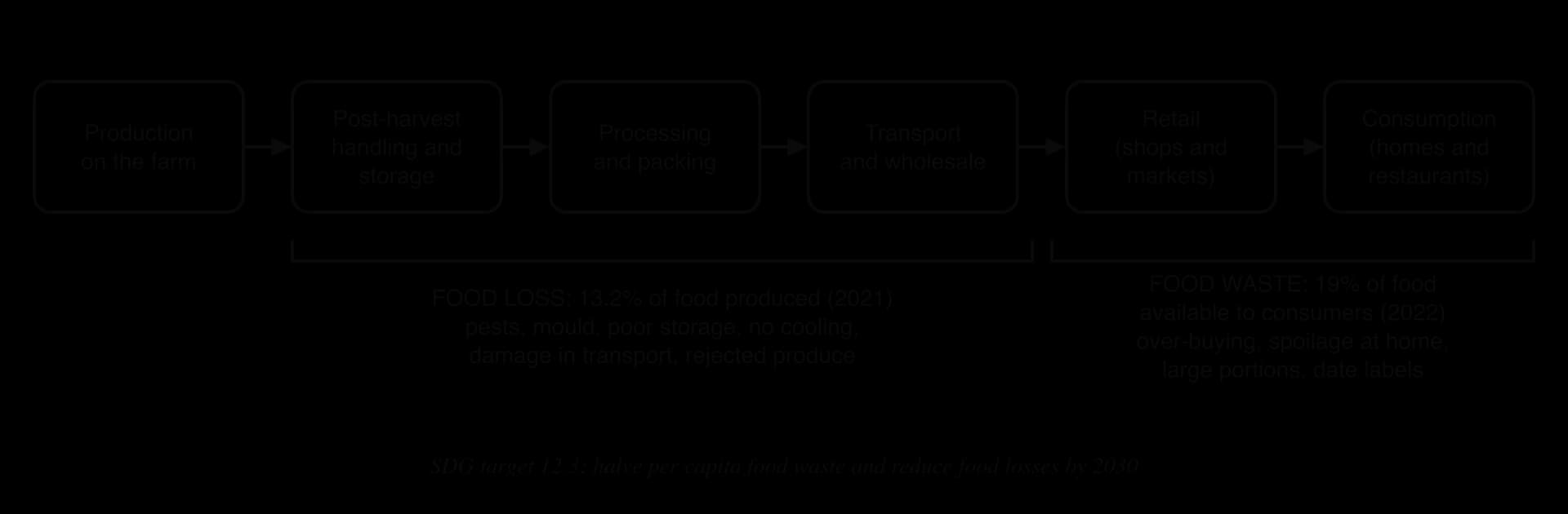
The causes differ with income. In many low-income countries, most losses happen early: grain is eaten by pests or spoils in poor storage, fruit and vegetables rot without refrigeration, and bad roads damage produce on the way to market. In high-income countries more food is wasted at the end of the chain: shops reject misshapen produce, over-stock shelves and discard food at its date label, and households buy and cook more than they eat.
Sustainable Development Goal 12 (responsible consumption and production) includes target 12.3: by 2030, halve per capita global food waste at the retail and consumer levels and reduce food losses along production and supply chains, including post-harvest losses. It links directly to SDG 2 (zero hunger) and SDG 13 (climate action).
Stage | Strategy to reduce loss or waste |
|---|---|
Farm and storage | Hermetic grain bags and metal silos; solar dryers; better harvesting; local processing |
Transport and wholesale | Cold chains (refrigerated storage and transport); better roads; packaging that protects produce |
Retail | Selling “imperfect” produce; clearer date labels; donating surplus food to food banks |
Households and food service | Planning meals and portions; freezing leftovers; composting or anaerobic digestion of unavoidable waste |
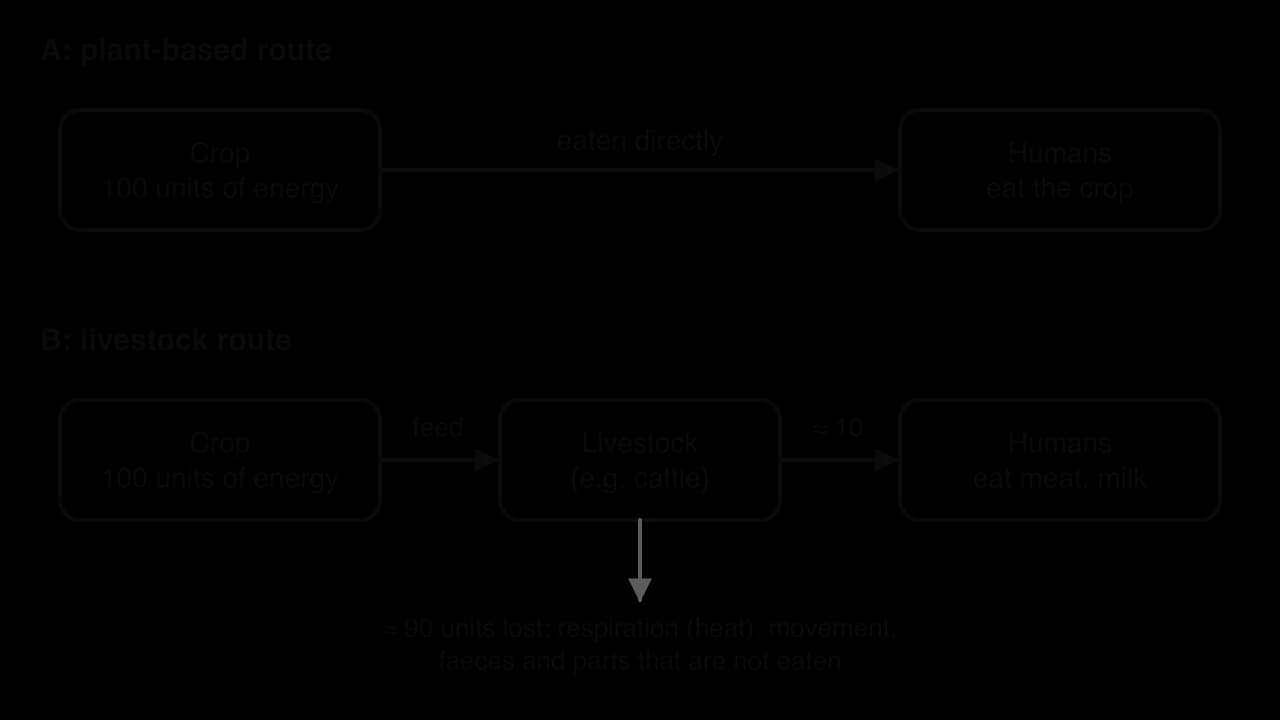
Humans are omnivores, eating fungi, plants, meat and fish. Where people feed in a food chain has a large effect on how much land, water and energy their food needs. Only about 10% of the energy at one trophic level is usually passed to the next, because most is lost as heat in respiration, used in movement or not eaten or digested. Eating plants directly therefore uses the energy fixed by crops far more efficiently than feeding the crops to animals first.
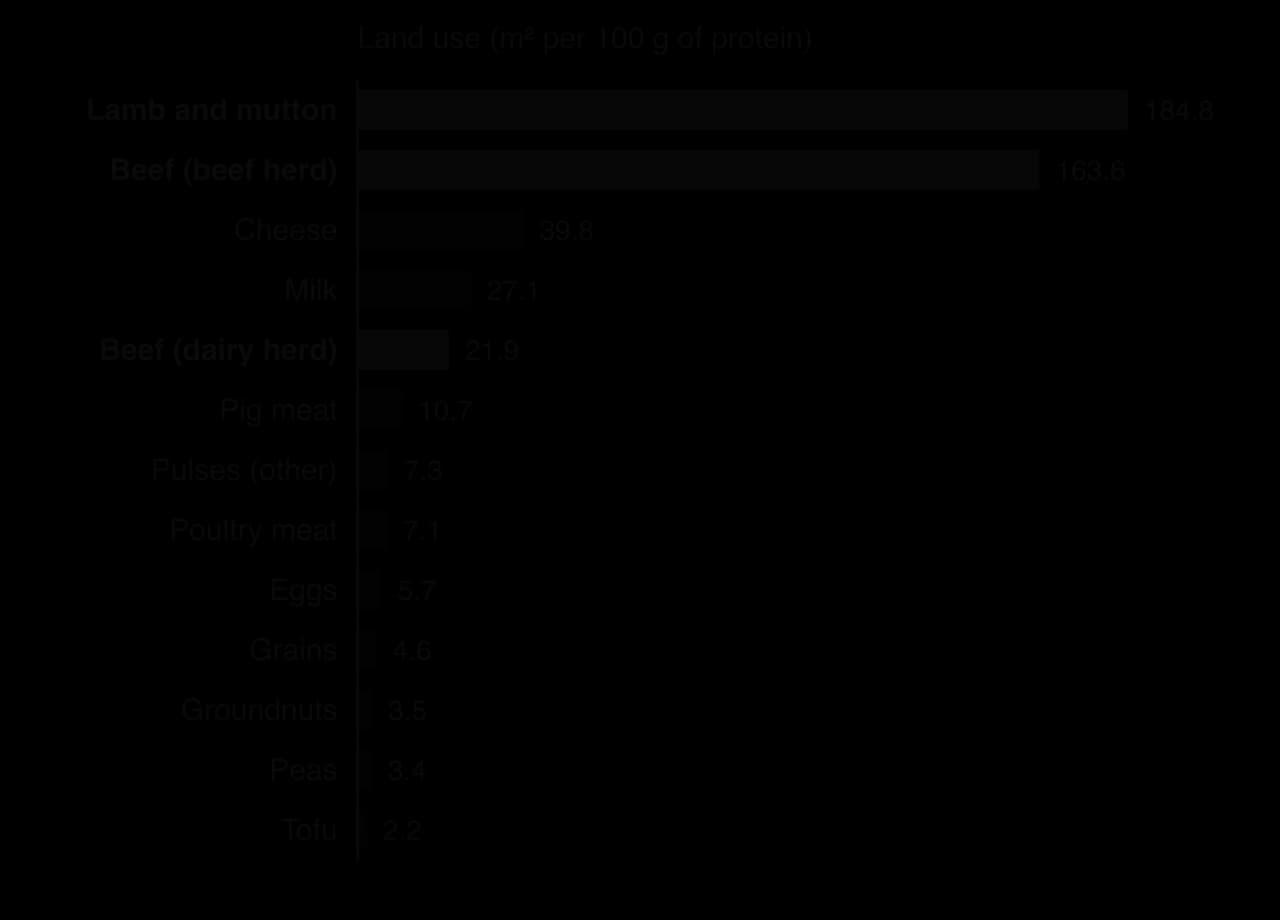
Real data support this. Measured per 100 g of protein, beef from dedicated beef herds needs about 164 m² of land and lamb about 185 m², while peas need about 3.4 m² and tofu about 2.2 m². The same foods also differ widely in greenhouse gas emissions: about 50 kg CO₂-equivalent per 100 g of protein for beef from beef herds, compared with less than 1 kg for peas and other pulses.
 YouTube
A plant-based diet is a diet made up mostly or entirely of foods from plants. A large shift towards such diets in high-income countries would free large areas of cropland now used for animal feed and pasture, cut methane and nitrous oxide emissions, and reduce water use and nutrient pollution. Land no longer needed could be returned to forest or grassland, storing carbon and supporting wildlife.
Strengths: much less land, water and fertiliser per unit of protein or energy; lower greenhouse gas emissions; less pressure to clear forests; health benefits from eating less red and processed meat.
Limitations: some grazing land (steep, dry or cold) cannot grow crops, so ruminants there turn inedible grass into food; livestock provide manure, draught power, savings and income for hundreds of millions of poor households; animal foods supply vitamin B₁₂, iron and zinc that are harder to obtain in poor diets; meat has deep cultural and religious meaning.
Context matters: the case is strongest for reducing beef and lamb in high-consuming countries, and weakest for pastoralists and undernourished children in low-income countries.
Current global strategies follow three main lines: reduce demand and food waste; reduce greenhouse gas emissions from food production; and increase productivity without expanding farmland into natural ecosystems. Each relies on a mix of technology, policy and changes in behaviour.
Methane from livestock comes mainly from enteric fermentation, the digestion of plant material by microbes in the stomachs of ruminants such as cattle, sheep and goats. Agriculture, forestry and other land use produced around 44% of human methane emissions and 81% of nitrous oxide emissions in 2007–2016. Reducing these emissions depends on changing animal diets and breeds, using feed additives that suppress methane-producing microbes, improving animal health so fewer animals produce the same food, and reducing the number of ruminants.
Flooded rice paddies are another large source of methane, because the waterlogged soil is anaerobic. Low-methane rice systems such as alternate wetting and drying (AWD) let the field dry out until the water level is about 15 cm below the surface before flooding it again. AWD can save around a third of the irrigation water without lowering yields, and the IPCC assumes it cuts methane by about 48% on average compared with continuous flooding.
Sources: IPCC, Climate Change and Land (2019); Wikipedia, “Alternate wetting and drying” and its sources (accessed October 2026).
Reducing nitrogen loss to the air cuts both nitrous oxide and the energy wasted in fertiliser. Methods include applying fertiliser in the right amount, at the right time and in the right place (precision farming), growing legumes, and, in future, making nitrogen fertiliser on or near the farm using small solar-powered units instead of large gas-fired Haber plants.
Genetic modification can raise yields or quality. Golden rice was engineered to produce beta-carotene, which the body converts to vitamin A, to reduce deficiency in rice-eating populations; trials have taken place in the Philippines and Bangladesh, but in 2024 a Philippine court halted its cultivation, citing scientific uncertainty. Supporters see GM as a technocentric way to grow more on less land; critics raise concerns about corporate control of seeds, genetic uniformity and ecological risks.
Sources: Wikipedia, “Golden rice” and its sources (accessed October 2026).
Plant-based meat products, made from proteins such as soy, pea or wheat to resemble meat, aim to reduce demand for animal products without asking people to give up familiar foods. Longer shelf life, through better packaging, cooling and processing, cuts waste along the chain. Both depend on consumer acceptance and price, and highly processed substitutes raise questions about nutrition.
Strategy | Main benefit | Main limitation |
|---|---|---|
Plant-based meat substitutes | Less land and fewer emissions per unit of protein | Price, taste and cultural acceptance; often highly processed |
Low-methane rice (AWD) | Less methane and irrigation water, similar yields | Only where fields can be drained; needs careful water management |
Reducing methane from ruminants | Large cut in a short-lived, powerful greenhouse gas | Additives must be fed daily; difficult for grazing herds |
Reducing nitrogen loss | Less N₂O, less eutrophication, lower costs | Needs knowledge, testing and sometimes expensive equipment |
Longer shelf life | Less food waste | Packaging waste; energy for cold chains |
Genetic modification | Higher yields, pest resistance, added nutrients | Public distrust; seed costs and corporate control; regulation |
Environmental value system | Preferred strategies | Reasoning |
|---|---|---|
Technocentric | GM crops, precision farming, vertical farms, methane-reducing feed additives, lab-grown meat | Technology can raise output and cut impacts without changing lifestyles |
Anthropocentric (managerial) | Regulation of fertiliser use, subsidies for conservation, waste-reduction targets such as SDG 12.3 | Careful management and policy can balance food needs and environment |
Ecocentric | Agroecology, organic farming, less meat, local food, protecting land rights and traditional systems | Food systems must work within natural limits and respect the intrinsic value of nature |
Food security has four dimensions. Availability is whether enough food is produced or imported. Access is whether people can obtain it, through income, prices, markets and land. Utilisation is whether the body can use it, which depends on a balanced diet, clean water and health. Stability is whether the other three are reliable over time, despite droughts, price spikes or conflict.
An estimated 645 million people faced hunger in 2025, and about 2.7 billion people could not afford a healthy diet. Hunger is very unevenly spread. In 2024 about one in five people in sub-Saharan Africa was undernourished, compared with fewer than one in forty in Europe, Northern America and Eastern Asia.
Sources: FAO, IFAD, UNICEF, WFP and WHO, The State of Food Security and Nutrition in the World (2025 and 2026).
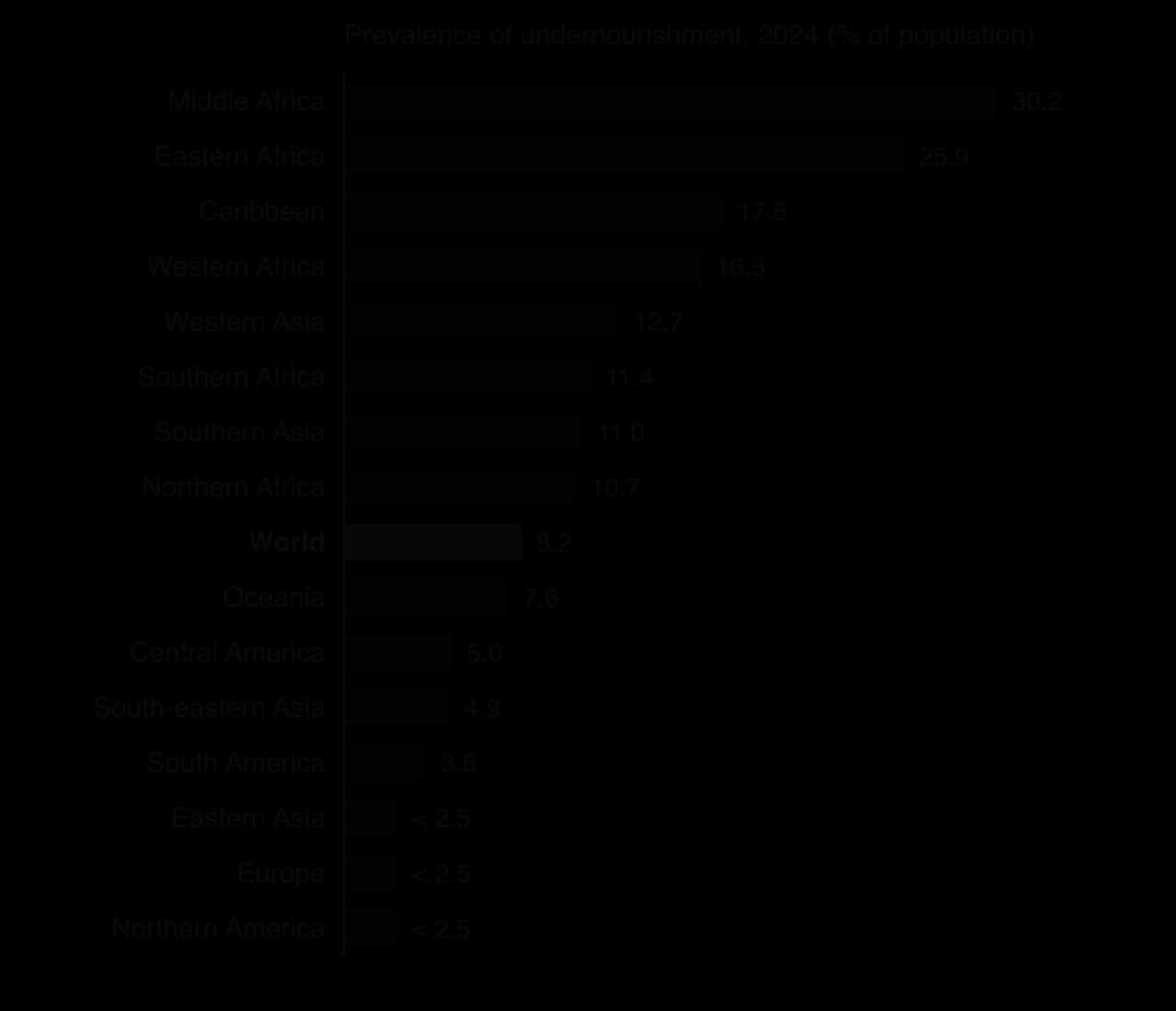
The regional pattern reflects the causes of insecurity. Middle and Eastern Africa combine poverty, rapid population growth, rain-fed farming exposed to drought, and armed conflict. Southern Asia has a large total number of hungry people despite high food production, because of poverty and inequality in access. Food security also depends on energy, since fuel prices affect the cost of fertiliser, transport and cooking.
Punjab is a state in north-west India on the fertile alluvial plain of the Indus river system, with shallow groundwater. In 1964–65 and 1965–66 two severe droughts caused food shortages across India, and the country depended on imported grain. The Green Revolution was introduced in Punjab in 1966–67, led in India by the agricultural scientist M. S. Swaminathan, with the minister C. Subramaniam as its political driving force.
Farmers adopted semi-dwarf wheat varieties from Mexico and high-yielding rice, supported by canals, large numbers of electric and diesel tube wells pumping groundwater, subsidised fertiliser and power, and guaranteed government purchase of grain at minimum support prices. A rice–wheat rotation replaced more varied traditional cropping: rice is grown in the wet summer season and wheat in the cool winter. The system is intensive, commercial, irrigated and dependent on inorganic inputs.
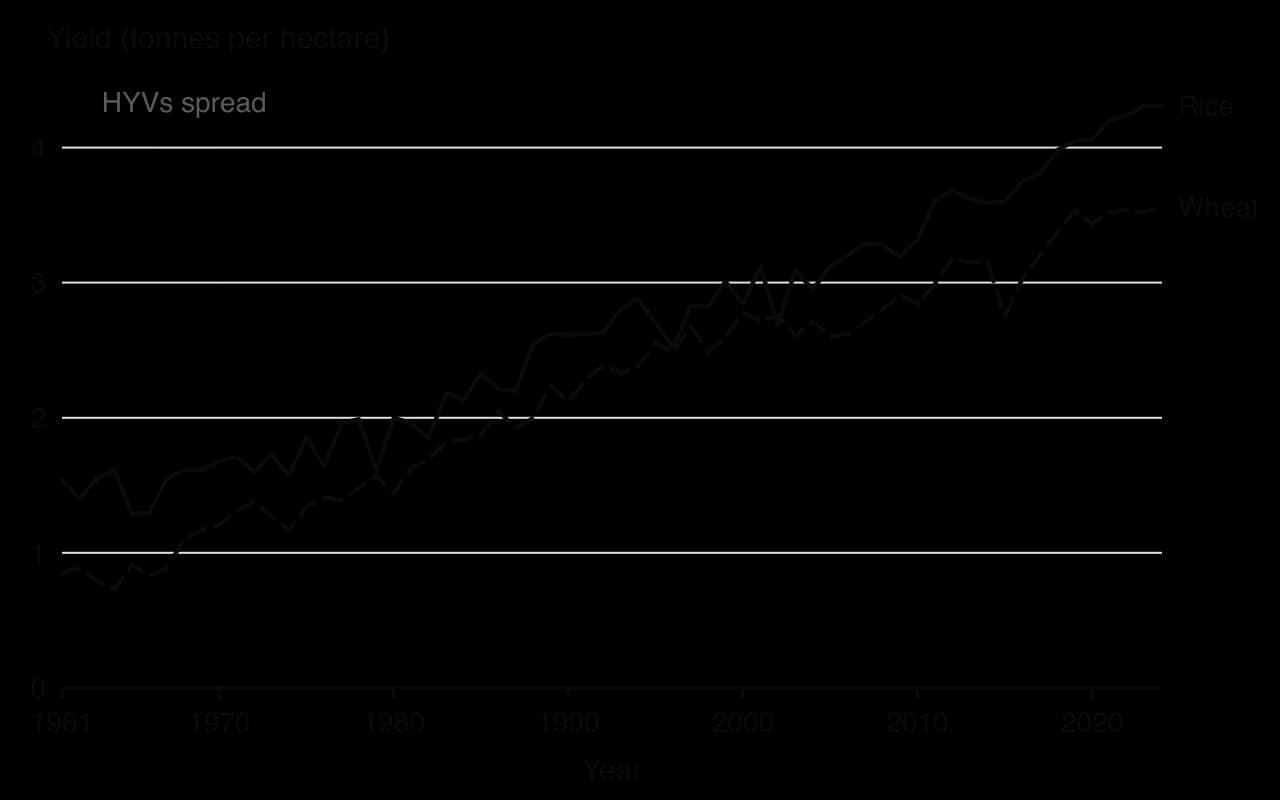
Yields rose fastest in Punjab and Haryana, which became the main suppliers of the national grain reserve. The inputs rose too. Nitrogen fertiliser use in India increased from under 2 kg per hectare of cropland in 1961 to about 122 kg in 2023, nearly eighty-fold.

Rice needs far more water than wheat, and rice was grown on a large scale in a semi-arid region where it was not traditional. Punjab now extracts much more groundwater than rain and rivers recharge. In the 2025–26 assessment the state extracted 26.32 billion m³ in a year against a recharge of 19.14 billion m³, of which about 17.3 billion m³ is considered available for extraction; extraction was therefore about 152% of the extractable resource, and 110 of its 153 blocks were classed as over-exploited. Water tables have fallen, so farmers drill deeper and pay more for pumping.
Sources: Central Ground Water Board, Dynamic Ground Water Resources of Punjab, as reported by Down To Earth (September 2026).
After the rice harvest, farmers have only a few weeks to sow wheat, so many burn the remaining straw. Each autumn farmers in Punjab, Haryana and Uttar Pradesh burn an estimated 35 million tonnes of crop residue, and the smoke adds to the severe air pollution in Delhi. Pesticide residues, falling soil organic matter and narrow crop genetic diversity are further concerns.
Sources: Wikipedia, “Green Revolution in India” and “Stubble burning” and their sources (accessed October 2026).
Government (technocentric and managerial): extending canal irrigation to replace groundwater; subsidies for machines such as the Happy Seeder, which sows wheat through the rice straw so it does not need burning; bans on stubble burning.
Crop diversification: encouraging maize, pulses, millets and cotton instead of rice, although guaranteed prices for rice and wheat make them the safest choice for farmers.
Farmers and civil society: some families have turned to organic and lower-input farming, cooperatives and direct marketing.
Perspective | Judgement |
|---|---|
National food security planners | A success: India became self-sufficient in grain and built reserves that protect against drought and famine |
Large irrigated farmers | Higher incomes in the early decades, now squeezed by rising costs and falling water tables |
Small farmers and labourers | Mixed: high input costs led to debt for many; mechanisation reduced work for landless labourers |
Environmental scientists | Unsustainable: groundwater is being mined, soils and air are degraded, and the system depends on fossil energy |
Critics such as Vandana Shiva | Replaced diverse, locally adapted farming with dependence on purchased seed and chemicals |
Judged by the three pillars, the Green Revolution in Punjab was economically and socially successful in the short term but is environmentally unsustainable in the long term. The core problem is a mismatch between a water-hungry crop and the natural water budget, kept in place by price and power subsidies. A more sustainable system would grow less rice, more crops suited to the climate and use water and fertiliser more efficiently, but making that change requires new markets and guaranteed prices for alternative crops.
Punjab shows that productivity and sustainability can diverge. HYVs, irrigation, fertiliser and pesticides raised food security quickly, but they made farming dependent on fossil fuels and on groundwater being used faster than it is replaced. It also shows that farmers’ choices are shaped by economic and political factors, such as guaranteed prices, as well as by soil and climate.
Sources: Wikipedia, “Green Revolution in India”; FAO via Our World in Data (2025); Central Ground Water Board via Down To Earth (2026).
Farmers on different soils make different choices even under similar climates, because soils differ in depth, organic matter, nutrient-holding capacity and drainage. The cation-exchange capacity (the ability of clay and humus to hold nutrient ions) is especially important: soils with high capacity keep fertiliser and natural nutrients near the roots, while those with low capacity lose them by leaching.
Soil and biome | Properties | Typical farming choices | Example |
|---|---|---|---|
Mollisols of temperate grassland (prairie, steppe, pampas) | Deep, dark A horizon rich in humus from grass roots; high nutrient-holding capacity; well-drained | Large-scale cereals (wheat, maize) on the flatter, wetter land; cattle ranching on drier or rougher land | North American prairies; Ukrainian and Russian steppe; Argentine pampas |
Oxisols of tropical forest and savanna | Deeply weathered, red or yellow from iron and aluminium oxides; low nutrient-holding capacity; phosphorus locked up by the oxides | Cattle ranching after clearance; soy where heavy lime and fertiliser inputs are affordable | Brazilian Amazon and Cerrado |
Aridisols of hot deserts and dry shrublands | Little organic matter; layers of calcium carbonate, gypsum or salts because little leaching occurs | Extensive ranching or nomadic herding; irrigated crops where water can be supplied, with a risk of salinisation | Hot deserts such as those of the south-western USA and the Middle East |
Brown earths of temperate deciduous forest | Moderately deep, well-mixed by earthworms, fairly fertile, slightly acidic | Mixed farming: arable crops in rotation with grass leys for livestock | Lowland England, France, Germany |
The Amazon and Cerrado show how an outside market can override the natural limits of a soil. Oxisols are poor for crops without large inputs, so cleared land was first used for extensive cattle ranching, and later, with lime, fertiliser and new soy varieties, for soy grown mainly for export as animal feed.
The Amazon Soy Moratorium of 2006, a voluntary agreement in which traders refused to buy soy from land cleared after 2008, broke much of the link between soy and new deforestation: from 2006 to 2023 more than 97% of Amazon deforestation was not associated with soy, while the area of soy in the biome grew fourfold. Brazil’s competition regulator ordered the moratorium suspended from January 2026.
Sources: Wikipedia, “Amazon Soy Moratorium”, “Oxisol”, “Mollisol” and “Aridisol” and their sources (accessed October 2026).
Many farmers and scientists argue that intensive farming has degraded soils, polluted water, cut biodiversity and made rural economies dependent on a few buyers and suppliers. Alternative approaches aim to restore and conserve soils, protect water quality, keep money and jobs in local economies and produce food more sustainably. They include soil regeneration, rewilding parts of farms, permaculture, non-commercial cropping such as community and home gardens, and zero tillage.
Regenerative farming is defined by outcomes (healthier soil) rather than by a fixed list of rules, so practices vary. Common elements are keeping the soil covered, disturbing it as little as possible, keeping living roots in the ground all year, increasing crop diversity and integrating livestock. Pigs or chickens can be used to clear vegetation and turn over the soil before planting, doing the work of a plough while adding manure.
Mob grazing concentrates a large herd of cattle or sheep in a small paddock for a short time, often a day or less, then moves it on and leaves each paddock to rest for a long period. The animals eat the top of the grass, trample the rest onto the surface as litter and leave dung evenly, while the long rest lets plants regrow deep roots. This imitates the movement of wild herds on grasslands.
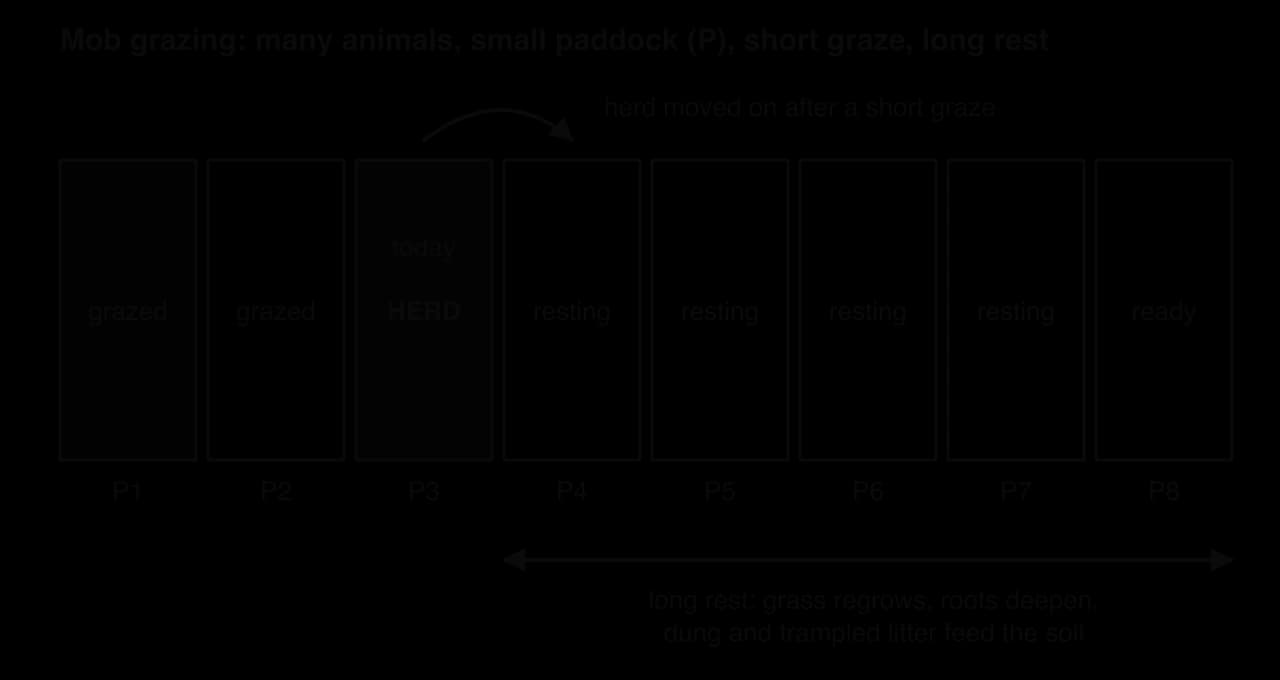
Supporters report better soil structure, more organic matter and more drought-tolerant pastures. The evidence is mixed: well-managed rotational grazing can improve soils on degraded land, but large claims that grazing alone can reverse desertification or offset the emissions of the animals are disputed, and results depend heavily on climate and management.
Permaculture is a design system for farms and settlements that copies the patterns of natural ecosystems. The term was coined in 1978 by Bill Mollison and David Holmgren in Tasmania, Australia. A permaculture plot places each element where it gives the most benefit to the others: perennial food trees and shrubs in layers like a forest, chickens that eat pests and fertilise the ground, ponds that store water and attract wildlife, and kitchen gardens near the house. The aim is a whole that is greater than the sum of its parts, with little waste and few external inputs.
Rewilding part of a farm is another response. On the Knepp Estate in southern England, former arable and dairy land was taken out of food production and left to free-roaming grazing animals, increasing wildlife but producing far less food per hectare, which raises the question of where that food is produced instead.
Advantages | Disadvantages | |
|---|---|---|
Regenerative farming | Rebuilds soil carbon and structure; less erosion and fertiliser; can stay commercially viable | Benefits vary by site and take years; no fixed standard, so open to greenwashing; zero tillage often needs herbicides |
Mob grazing | Improves pasture and soil organic matter; even manure spread; less bare ground | Needs fencing, water points and daily labour; benefits disputed in very dry regions; ruminants still emit methane |
Permaculture | High diversity and resilience; few external inputs; uses small and urban spaces | Labour-intensive and knowledge-intensive; hard to scale to staple grains for cities; lower yields of single crops |
These approaches fit uneasily with plant-based diets. Regenerative and mob-grazing systems often depend on livestock to cycle nutrients and manage grassland, while the strongest argument for plant-based diets is to reduce livestock numbers. One proposed compromise is to eat much less meat overall, but to produce what is eaten from animals that graze land unsuitable for crops or that recycle food waste.
Controlled-environment agriculture grows crops inside buildings where light, temperature, humidity, water, nutrients and carbon dioxide are all regulated. The Netherlands shows the potential. Although it is small and densely populated, it is the world’s second-largest exporter of agricultural products by value after the United States, earning €94.5 billion from agricultural exports in 2019. Much of this comes from glasshouses, including those of the Westland region near The Hague, and about a third of world exports of chillies, tomatoes and cucumbers pass through the country.
Sources: Wikipedia, “Netherlands” (economy and agriculture) and its sources (accessed October 2026).
Vertical farming, proposed in its modern form by Dickson Despommier in 1999, can be placed in or near cities, reducing transport and land use, recycling water and avoiding pesticides. It is increasingly important for urban food supply, especially in cities with little farmland. Its weakness is energy: plants that would use free sunlight outdoors need electric LED lighting, cooling and pumps, and if this electricity comes from fossil fuels a vertical farm can produce more emissions than a field or a conventional greenhouse.
Criterion | High-tech greenhouse or vertical farm | Field farming |
|---|---|---|
Yield per hectare | Very high, many harvests a year | Lower, seasonal |
Water use | Low, recycled in closed systems | Higher, much lost to evaporation and run-off |
Pesticides and nutrient pollution | Low, contained | Higher |
Energy | High (light, heating or cooling); sustainable only with low-carbon electricity | Low direct energy; sunlight is free |
Crops | Mostly leafy greens, herbs, tomatoes, peppers and soft fruit | Staple grains, pulses, oilseeds and roots |
Cost | High capital and running costs | Lower per tonne of staple food |
The sustainability of a diet depends on more than the food itself. It also depends on how efficient the supply chain is, how far food travels, the type of farming and techniques used to grow it, and how societies change what they eat over time.
A supply chain can be long in three ways: physical distance (kilometres travelled), economic distance (the number of traders, processors and retailers that take a share of the price) and social distance (how little consumers know about the people who grow their food). Short chains, such as farmers’ markets and box schemes, can return more of the price to farmers and build trust, but they are not automatically lower in emissions.
Year-round supply of fresh produce means that foods are flown or shipped from other hemispheres or grown in heated greenhouses out of season. Yet for most foods, transport accounts for less than 10% of greenhouse gas emissions, and for beef from beef herds only about 0.5%; land use and farm-stage emissions make up more than 80% of the footprint of most foods. What is eaten therefore matters far more than where it comes from, with the main exception of fresh food carried by air, such as some berries, asparagus and green beans.
Sources: Our World in Data, article on food choice and eating local, based on Poore and Nemecek (2020).
Diets change with income and culture. As incomes rise, people in many countries eat more meat, dairy, oils and sugar, a pattern sometimes called the nutrition transition. At the same time, a growing number of people in high-income countries are choosing vegetarian, vegan or flexitarian (mostly plant-based, occasional meat) diets for reasons of health, animal welfare or the environment. Attitudes to these choices can be studied with a values survey of a group’s food preferences and worldviews.
In 2019 the EAT-Lancet Commission, a group of scientists from 16 countries, published the planetary health diet: a reference diet designed to be healthy and to allow about 10 billion people to be fed within the planetary boundaries for climate, land use, freshwater, biodiversity and nitrogen and phosphorus. An updated report was published in 2025. The diet is flexitarian and mostly plant-based.
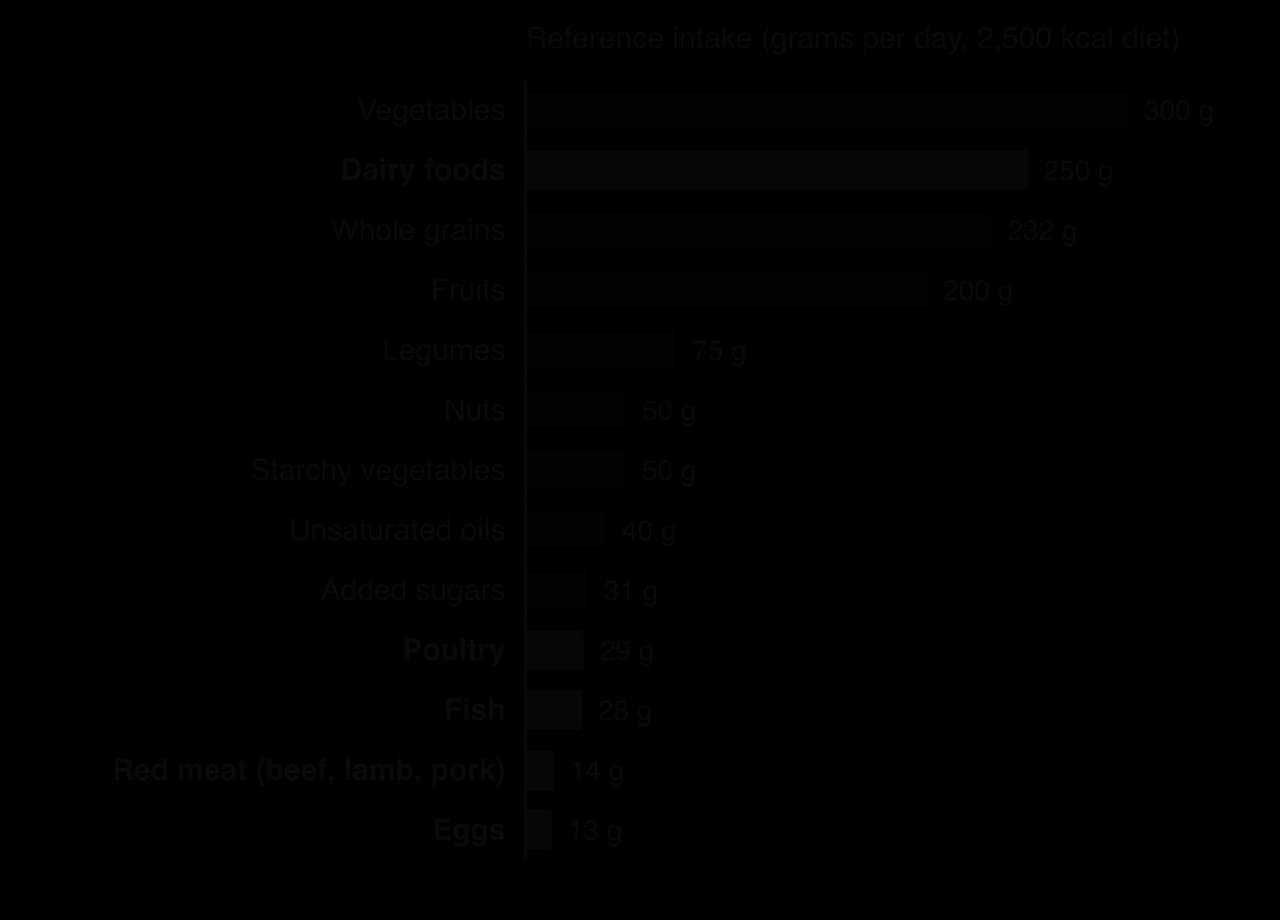
The Commission estimated that universal adoption would prevent about 11 million deaths a year from diet-related disease, and that it would require more than doubling global consumption of nuts, fruit, vegetables and legumes and more than halving that of red meat and sugar. Sixteen cities of the C40 network have committed to using it to guide their food policies. Critics point out that at least 1.58 billion people in low- and middle-income countries could not afford it, and that a single global diet may not respect local food cultures, while a coordinated social media campaign against the report was later linked to a livestock industry group.
Sources: Wikipedia, “Planetary health diet” and its sources (accessed October 2026).
Many foods are still gathered from the wild rather than farmed. Collecting non-timber forest products such as nuts, fruit, honey, mushrooms, bamboo shoots and edible insects keeps the forest standing, provides income and can be sustainable if harvests stay below the rate at which the species regenerate.
The Brazil nut tree, Bertholletia excelsa, grows in the Amazon forests of Brazil, Bolivia and Peru. It produces fruit almost only in undisturbed forest, because its flowers can be pollinated only by large-bodied bees that disappear from disturbed forest, and its seeds are dispersed by agoutis, large rodents that gnaw open the hard capsules and bury seeds. Plantations have proved uneconomic, so nearly all nuts are collected from the wild. World production was about 80,000 tonnes in 2024, 87% of it from Brazil and Bolivia.
Sources: Wikipedia, “Brazil nut” and its sources (accessed October 2026).
Brazil nut collection gives forest communities a reason and an income to keep the forest intact, which makes it a model of sustainable wild harvesting. Its limits are low income per hectare, dependence on world prices, and threats from logging, ranching and road building that can still make clearing the forest more profitable.
Wild harvesting is unsustainable when demand exceeds regeneration, or when it targets rare species. Bushmeat, the meat of wild animals hunted for food, is an important source of protein and income in parts of Central and West Africa and the Amazon, but commercial hunting for city markets has emptied many forests of large animals. Pangolins are believed to be the world’s most trafficked mammal; in 2016 all eight species were moved to Appendix I of CITES, banning international commercial trade. Wild meat trade also brings people into close contact with animals that can carry zoonotic diseases (diseases that pass from animals to people).
Product | Sustainable when… | Unsustainable when… |
|---|---|---|
Brazil nuts, honey, bamboo shoots | Harvest is below regrowth and the forest is protected | The forest is fragmented or logged |
Truffles and wild mushrooms | Collectors leave the fungal network intact | Raking the soil damages the network; overcollection for export |
Edible insects | Collected seasonally from abundant species | Habitats are cleared or pesticides are used |
Bushmeat | Subsistence hunting of fast-breeding species at low density | Commercial hunting for cities; slow-breeding or endangered species |
Pangolins and bears | Rarely, if ever | Almost always: they breed slowly and are endangered |
The claim that traditional wild harvesting is more sustainable than land conversion holds when the harvest depends on intact ecosystems and stays at a low level, as with Brazil nuts. It fails when markets grow, hunters use modern weapons and vehicles, or the target species is rare, as with pangolins. From an ecocentric view, harvesting also raises questions about the intrinsic value of the species taken.
Traditional and alternative systems often have clear environmental strengths: low inputs, high biodiversity, closed nutrient cycles, deep local knowledge and resilience to shocks. Some writers argue that a return to small-scale, low-input farming could resolve the unsustainability of global food production. The counter-argument is that these systems produce less food per hectare, so feeding more than eight billion people with them could require more land to be cleared, the opposite of what is intended.
Two strategies frame the debate. Land sparing grows food as intensively as possible on the best land and protects the rest as natural habitat. Land sharing farms less intensively over a larger area, keeping more wildlife within the farmland itself. The best choice probably varies by place: sparing may suit fertile plains near threatened forests, and sharing may suit densely settled, diverse regions where farms and wildlife have long coexisted.
Argument | For low-productivity systems | Against |
|---|---|---|
Land | Can be combined with lower food waste and less meat, so less land is needed overall | Lower yields mean more land per tonne if diets and waste do not change |
Environment | Fewer agrochemicals, more biodiversity, better soils | Clearing extra land releases carbon and destroys habitat |
Society | Supports smallholders, Indigenous rights and food sovereignty | Hard labour, low incomes and vulnerability to bad years |
Resilience | Diverse crops reduce the risk of total failure | Little surplus to store or trade when harvests fail |
A reasoned conclusion is that low-productivity systems alone cannot feed the world at current levels of consumption and waste. Combined with lower meat consumption in high-income countries, halving food waste and higher yields where yields are currently very low, many of their practices could make up part of a sustainable global food system.
Food biomass is not the same as nutritive value. A diet can be high in energy but low in protein, vitamins and minerals, especially when it relies on refined grains, sugar and highly processed foods produced cheaply by the global food industry. Around 2 billion adults are overweight or obese, while hundreds of millions are undernourished, and the two problems can exist in the same country, community or even household.
Sources: IPCC, Climate Change and Land, Summary for Policymakers (2019).
Famine is an extreme, widespread lack of food in a region that causes large numbers of deaths from starvation and disease. A crop failure or drought reduces the food available, but whether it becomes famine depends on whether people can still obtain food through income, markets, aid and fair government policy.

Before the famine, about 8.5 million people lived in Ireland, and over three million depended entirely on potatoes. A large share of the crop was a single variety, the Lumper, so it was genetically uniform. In 1845 potato blight, a disease caused by the fungus-like organism Phytophthora infestans, destroyed between a third and a half of the crop, and it returned in later years. Roughly one million people died and more than one million emigrated.
Distribution made the disaster far worse. Large quantities of grain, livestock and other food continued to be exported from Ireland while people starved, because the poorest tenants had no money to buy it. The British government, following a free-market approach, ended early relief measures and refused to ban exports, as had been done in earlier shortages, and evicted families lost their land. Historians still debate the scale of the exports, as grain imports were also large in 1847, but the famine is a clear case of a crop failure turned into mass death by poverty, land tenure and policy.
Sources: Wikipedia, “Great Famine (Ireland)” and its sources (accessed October 2026).
In 2011 two failed rainy seasons, linked to a strong La Niña, caused crop failures and livestock deaths across Somalia, Ethiopia, Kenya and Djibouti, and around 9.5 million people needed assistance. Famine was declared only in southern Somalia, on 20 July 2011. There, staple food prices had risen by up to 240%, the militant group Al-Shabaab controlled much of the area and blocked many aid agencies, and restrictions on aid imposed by Western governments had left people without support. A later study estimated about 260,000 deaths in Somalia. Drought-hit areas of Ethiopia and Kenya, where aid could reach people and markets kept working, did not reach famine.
Sources: Wikipedia, “2011 East Africa drought” and its sources (accessed October 2026).
Seen through an ethical lens, famine raises questions of responsibility and rights: whether people have a right to food, and whether governments and the wider world have a duty to protect it when markets fail.
Agriculture and food appear in every paper. Paper 1 often gives data on a farming region (yields, fertiliser use, water, land rights) and asks you to calculate, explain and evaluate. Paper 2 Section A uses short data-based questions on topics such as food waste, diets and soil conservation, and Section B essays ask you to evaluate farming systems or strategies for sustainable food production with named examples.
In evaluation questions, examiners look for both sides of an argument backed by named examples, and a judgement that depends on context. The Green Revolution, plant-based diets and soil conservation techniques all have clear strengths and limitations; give each with a reason.
Calculation items often use land-use or energy data. Show the formula, substitute with units and give the answer to a sensible number of significant figures.
The resource is hypothetical data for a district in a semi-arid region where farmers have adopted HYV wheat and rice with tube-well irrigation.
Year | Rice yield (t ha⁻¹) | Nitrogen fertiliser (kg ha⁻¹) | Depth to water table (m) | Households in debt (%) |
|---|---|---|---|---|
1970 | 2.0 | 25 | 4 | 20 |
1990 | 3.5 | 110 | 9 | 31 |
2010 | 4.2 | 180 | 18 | 48 |
2025 | 4.3 | 210 | 27 | 55 |
Land is finite: human use affects over 70% of ice-free land, and steep, dry or poor land is often used for grazing ruminants.
Farming systems are classified by outputs (arable, pastoral, mixed; monoculture or diverse), purpose (commercial or subsistence; sedentary or nomadic) and inputs (intensive or extensive, irrigated, hydroponic, organic).
Nomadic pastoralism and slash-and-burn are sustainable at low density with mobility and long fallows, but not when land is restricted or populations rise.
Marginalised groups such as the Guarani-Kaiowá lose out when their land rights are ignored in land-use decisions.
The Green Revolution raised yields with HYVs, irrigation, synthetic fertiliser and pesticides, but caused groundwater depletion, pollution, debt and fossil-fuel dependence.
Soil fertility can be kept with fallowing, manure, leys, mycorrhizae and agroforestry; soil conservation protects against erosion, conditions the soil and uses careful cultivation.
Enough food is produced for everyone, but 13.2% is lost before retail and 19% wasted at retail and home; SDG target 12.3 aims to halve food waste by 2030.
Diets lower in the food chain need far less land and emit less, though grazing land, livelihoods, nutrition and culture limit a full shift to plant-based diets.
Food security depends on availability, access, utilisation and stability; hunger is highest in Middle and Eastern Africa.
Soils such as mollisols, oxisols and aridisols lead to contrasting farming choices; regenerative farming, permaculture and vertical farms each have trade-offs. (HL)
Sustainable diets depend more on what is eaten than on food miles; the planetary health diet is mostly plant-based. (HL)
Wild harvesting can be sustainable when it needs intact ecosystems, and famine results from failures of distribution as much as of production. (HL)
I can explain why finite land limits food production and why marginal land is used for livestock.
I can classify farming systems and compare a named pair of contrasting systems.
I can evaluate the sustainability of nomadic pastoralism and slash-and-burn agriculture.
I can discuss how insecure land rights affect a named marginalised group.
I can evaluate the Green Revolution, using Punjab as an example.
I can describe sustainable ways of maintaining fertility and classify soil conservation techniques.
I can explain food loss and waste and state SDG target 12.3.
I can calculate the land saved by a lower-trophic-level diet and discuss plant-based diets.
I can evaluate strategies for a sustainable food supply and describe the regional pattern of food security.
I can compare farming on contrasting soils and evaluate regenerative, permaculture and high-tech farming. (HL)
I can evaluate sustainable diets, food miles, the planetary health diet and wild harvesting. (HL)
I can explain how distribution causes malnutrition and famine, using the Irish and East African famines. (HL)