5 Land
An overview of land: soil as a living system and the farming and food systems that depend on it, how the two subtopics connect, and what HL students add.
- IB Environmental Systems and Societies
- SL and HL
What 5 covers
From the subject guide: what you need to know and be able to do.
Soil and how we use land to grow food.
2 subtopics in Land
Each one has its own page once something is published for it.
- 5.1Soilnotes
- 5.2Agriculture and foodnotes
An overview of 5 Land
Land studies the thin layer of soil that covers the continents and the agricultural systems that use it to feed a population of more than eight billion people. It connects physical processes, such as weathering, decomposition and erosion, with human decisions about what to grow, how to farm and who has access to land and food.
Soil forms over centuries and can be lost in a few years, while the demand for food keeps rising. In 2015, about a third of the world’s soils were estimated to be moderately to highly degraded. Producing enough food without destroying the soil it depends on is one of the clearest tests of sustainability.
Sources: FAO, “Soil is a non-renewable resource”, International Year of Soils fact sheet (2015).
Questions the topic asks
What is soil made of, how does it form, and how does it work as a system with inputs, outputs and flows?
How do soils support plant growth, biodiversity and the cycling of water, carbon and nitrogen?
Why are some soils fertile and others poor, and why do some store far more carbon than others?
How do human activities degrade soils, and can the damage be reversed?
Why do farming systems differ so much around the world, and which of them can be sustained?
Why do people still go hungry when the world produces enough food, and how could food systems become more sustainable and fair?
The subtopics
Subtopic | What it covers |
|---|---|
5.1 Soil | Soil components; soil as a system with inputs, outputs, transfers and transformations; soil profiles and practical investigation; the roles of soil in plant growth, biodiversity and nutrient cycling; soil texture and productivity; soils as carbon sinks, stores and sources; soil degradation; a case study of erosion and restoration on the Loess Plateau, China |
5.2 Agriculture and food | Finite land and a growing population; land rights and marginalised groups; food production, distribution and waste; how agricultural systems are classified; traditional systems; the Green Revolution; soil fertility and soil conservation; diets and trophic levels; strategies for a sustainable food supply; food security; a case study of the Green Revolution in Punjab, India |
How the subtopics connect
The two subtopics form a loop. The soil sets limits on agriculture: its texture, nutrients, water-holding capacity and depth decide which crops and livestock a place can support and how much it can produce. Agriculture in turn changes the soil. Ploughing, overgrazing, irrigation and heavy machinery can cause erosion, salinisation, compaction and the loss of organic matter, while practices such as terracing, cover crops, crop rotation and adding organic matter conserve and rebuild it.
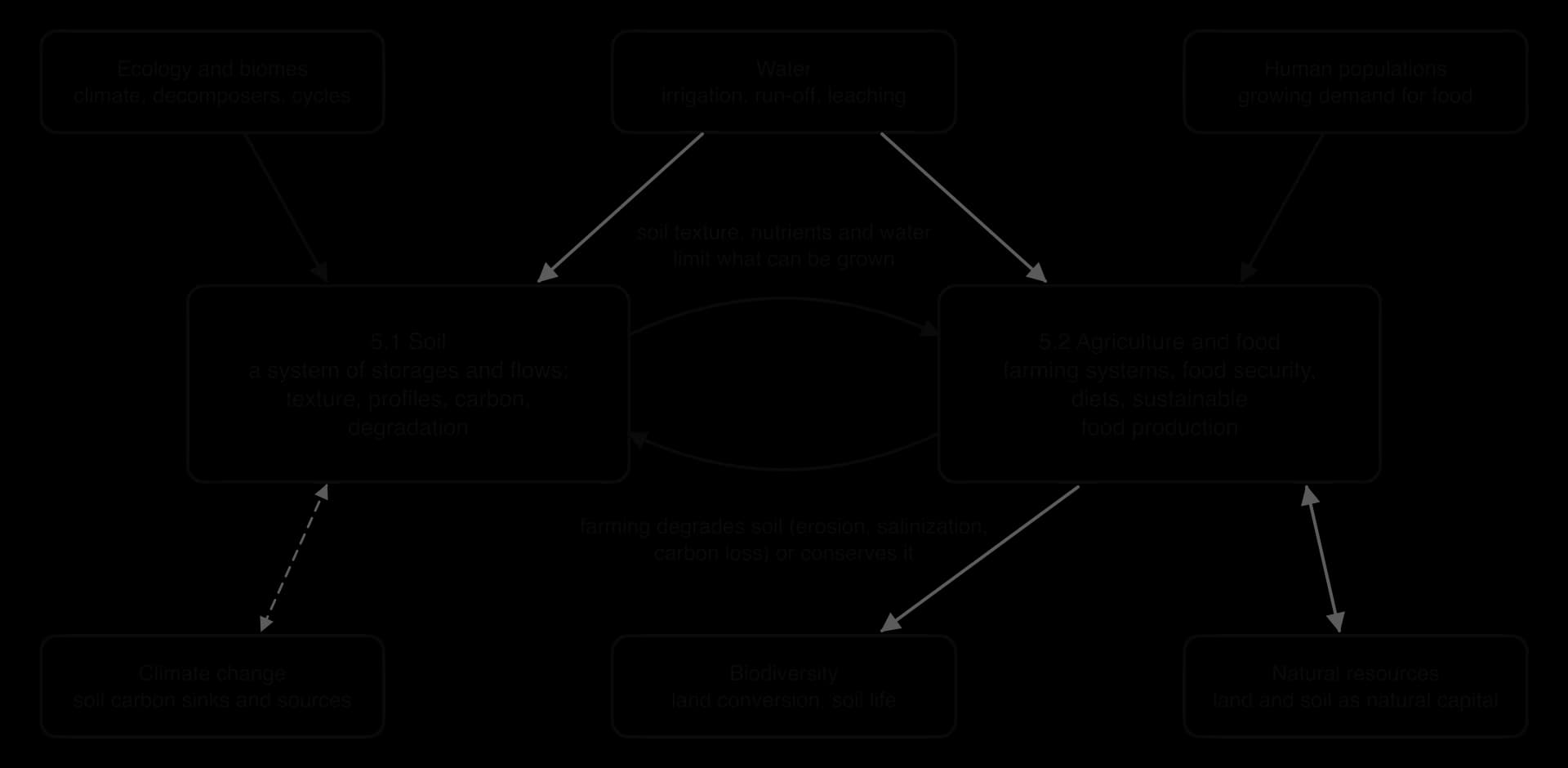
Soil degradation, such as soil erosion and salinisation, is explained with the soil system; the methods of soil conservation are evaluated with the farming systems that use them. Read together, the two subtopics show how the same piece of land can be farmed in ways that run down its natural capital or in ways that maintain it.
 YouTube
Perspectives, systems and sustainability
Perspectives. A technocentric view sees soil as a medium that fertiliser, irrigation or even soil-less vertical farming can improve or replace. An ecocentric view sees soil as a living ecosystem home to a large share of Earth’s species. Indigenous and traditional farming systems, and the land rights of the people who use them, bring further perspectives on how land should be used and by whom.
Systems. Soil is modelled as a system of storages and flows, and farms as systems with inputs (seed, fertiliser, water, energy, labour) and outputs (crops, livestock products, wastes and emissions). Positive feedback links vegetation loss, erosion and falling fertility, and can push land past a tipping point into a degraded state.
Sustainability. The topic applies the idea of natural capital to soil, which is effectively non-renewable on a human timescale. It links to SDG 2 (zero hunger), SDG 12 (responsible consumption, including halving food waste) and SDG 15 (life on land), and to the planetary boundaries for land-system change and nitrogen and phosphorus flows.
Land also draws on the rest of the course. Soil formation and food production depend on climate and biomes from ecology; nitrogen and carbon cycling link soil to the biogeochemical cycles; clearing land for farms is the main driver of biodiversity loss; irrigation and fertiliser run-off connect farming to water security and water pollution; soils and agriculture are both sources of greenhouse gases and possible sinks in climate change mitigation; and population growth drives the demand for food.
How SL and HL differ
SL and HL students study the same core content in both subtopics: soil as a system, profiles, texture, the roles of soil in ecosystems, soil carbon and soil degradation (5.1); and land use and population, land rights, food waste and distribution, agricultural systems, traditional farming, the Green Revolution, soil fertility and conservation, diets, sustainable food strategies and food security (5.2).
HL students also study HL-only understandings in both subtopics:
5.1 Soil: classifying soils by their profile and linking soil types to biomes (brown earths and oxisols); the O, A, B and C horizons and why the A horizon is the most valuable and most vulnerable; the five factors of soil formation, including calcareous and volcanic parent rocks; cation-exchange capacity; interpreting soil data with the soil texture triangle; and carbon release from soils, permafrost and methane clathrates as possible tipping points.
5.2 Agriculture and food: how local soils and climates lead to contrasting farming choices; alternative approaches such as regenerative farming, permaculture and rewilding; high-technology farming in greenhouses and vertical farms; the sustainability of diets and supply chains, including the planetary health diet; harvesting wild species; whether low-productivity systems can feed the world; and malnutrition and famine.
The three HL lenses apply across the topic. Environmental law appears in land rights and land-grab disputes, laws protecting soils and farmland, and international commitments such as the target to restore degraded land. Environmental economics appears in subsidies for fertiliser and farming, payments to farmers for soil conservation and carbon storage, and the hidden costs of cheap food. Environmental ethics appears in questions of who owns and controls land, the treatment of farm animals, the ethics of diets, and the duty to pass on fertile soil to future generations.
Assessment
Land is examined in Paper 1 and Paper 2 at both levels, and soils are one of the most practical topics for the internal assessment.
Paper 1 (unseen case study): resource booklets may describe a farming region or an area of degraded land, with data on soil properties, crop yields, fertiliser use, erosion or food supply. Typical questions ask students to read and calculate from tables and graphs, construct or complete a soil or farm systems diagram, explain the causes of degradation and evaluate a management strategy for that place.
Paper 2 Section A: short-answer and data-based questions on the soil system, profiles, texture, soil carbon, agricultural classifications, the Green Revolution and food security, often including a calculation such as percentage organic matter or a percentage change in yield.
Paper 2 Section B: structured essays that ask students to explain how soils or farming systems work and then evaluate the sustainability of food production, the reversibility of soil degradation or the role of diet change. HL essays are expected to bring in legal, economic and ethical angles where relevant.
Common investigation topics include comparing the organic matter, texture, infiltration or invertebrate diversity of soils under different land uses, and surveys of food choices and the values behind them.
Flashcards for 5
The official decks for this part of the syllabus.
- 5.1 Soil283 cards
- 5.2 Agriculture and food281 cards
Carry on with 5 in Augment
With a free account, Augment remembers where you stopped and what you have practiced.