Explain how values, worldviews and life experience shape environmental perspectives, model them as value systems, classify and evaluate them, and trace how perspectives and the environmental movement change.
Each is in the ESS glossary, with every other term in the subject.
A non-binding United Nations action plan for sustainable development agreed at the 1992 Rio Earth Summit, to be carried out by governments and organisations from the global to the local level.
An environmental perspective that views humankind as the central and most important element of existence, valuing nature mainly for what it provides to people; it includes careful management and stewardship views.
A graph that shows how a behaviour, such as smoking or meat eating, changes in a group over time, often annotated with the events or campaigns that may have influenced it.
Distress, worry or fear about climate change and its threat to the future, which can affect people's feelings, thoughts and daily functioning, especially among young people.
An environmental perspective that gives the natural world pre-eminent importance and intrinsic value, putting ecological processes and all living things ahead of human wants.
A person who campaigns publicly, through protest, advocacy, writing or direct action, to change attitudes, behaviour or policy on an environmental issue.
The broad social and political movement of individuals, groups and organisations that works to protect the natural environment and change human behaviour, policy and law towards it.
Define perspective, values and worldview, and distinguish between them.
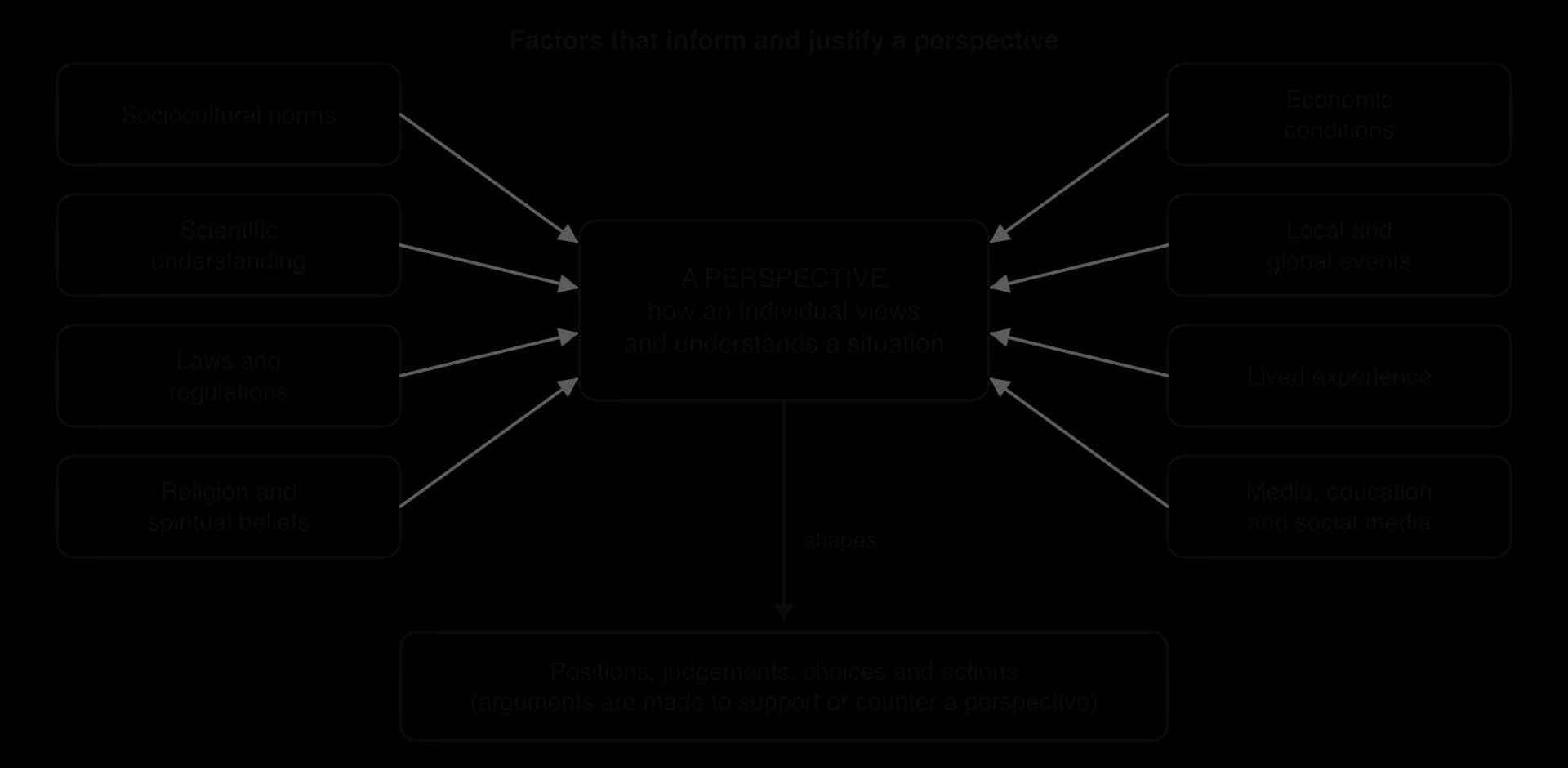
Outline the factors that inform and justify a person’s perspective on an environmental issue.
Distinguish between a perspective and an argument.
Explain how the values of individuals and organisations show in their communication and actions, and why they cause tensions.
Construct an environmental value system as a systems model with inputs and outputs.
Compare and contrast technocentric, anthropocentric and ecocentric perspectives, using examples.
Evaluate the usefulness of models that classify environmental perspectives.
Interpret behaviour–time graphs to explain how perspectives change over time.
Design a values survey, including its questions, sample and ethical safeguards.
Describe how individuals, literature, the media, disasters, international agreements, technology and scientific discoveries have influenced the environmental movement.
People who look at the same forest, river or coastline often see very different things: a source of jobs and income, a home, a sacred place, a habitat for rare species, or a store of carbon. These differences in perspectives explain why environmental issues are so often contested, and why the same scientific evidence can lead different groups to very different decisions.
Perspectives are the first of the three key concepts that run through Environmental Systems and Societies. The second, systems thinking, is used to model how perspectives are formed and how they lead to actions. The third, sustainability, is always judged from a perspective: what counts as a “sustainable” fishery or city depends on whose needs and values are taken into account.
The official deck for this part of the syllabus.
What is a perspective?
Why is a perspective described as partly personal and partly collective?
With a free account, Augment remembers where you stopped and what you have practiced.
A model of a person's or society's environmental perspective as a system, showing the inputs that shape it (such as education, media and worldviews) and the outputs that result (judgements, choices and actions).
The value something has as a means to an end, because it is useful to people, such as a forest valued for timber, water supply or tourism income.
An organisation whose members are national governments, set up by treaty to cooperate on shared issues, such as the United Nations Environment Programme (UNEP).
The value something has in and for itself, regardless of whether it is useful to people, as when a species is considered worth protecting simply because it exists.
A rating scale on which respondents show how strongly they agree or disagree with a statement, usually with five or seven points from strongly disagree to strongly agree.
A toxic organic compound of mercury that is absorbed easily by living things and becomes concentrated along food chains, damaging the nervous system; the cause of Minamata disease.
A not-for-profit organisation that operates independently of government, such as Greenpeace or WWF, often campaigning, researching or running projects on environmental and social issues.
The way an individual views and understands a situation, based on a mix of personal and collective assumptions, values and beliefs.
A set of written questions given to a sample of people to collect data on their knowledge, behaviour, attitudes or values, using open or closed questions.
The United Nations Conference on Environment and Development held in Rio de Janeiro in June 1992, which produced Agenda 21 and opened the climate change and biodiversity conventions for signature.
The shared, often unwritten rules and expectations of a society or cultural group about how people should behave, which influence individual perspectives and choices.
A person, group or organisation with an interest in an issue or decision because they affect it or are affected by it, such as residents, companies, governments or NGOs.
An approach to the environment in which people see themselves as responsible caretakers who manage natural resources carefully for others and for future generations.
An environmental perspective that assumes environmental problems can be solved through technology, scientific research and human ingenuity, so that growth in resource use can continue.
The knowledge, practices and beliefs about the relationships between living things and their environment built up by a community, often Indigenous, and passed down through generations.
Qualities or principles that people feel have worth and importance in life, which shape their priorities, judgements, perspectives and choices.
A survey designed to investigate the values and perspectives of a social group towards an environmental issue, usually with closed questions such as Likert-scale statements.
A lens shared by a group of people through which they perceive, make sense of and act within their environment, shaped by culture, philosophy, ideology, religion and politics.
A perspective is the way an individual views and understands a situation. It is built from a mix of personal and collective assumptions, values and beliefs, so it is partly unique to each person and partly shared with the groups the person belongs to. Two neighbours can share a language, a religion and a school, and still see a proposed wind farm on the hill above their town in different ways.
Perspectives matter because they give rise to the very wide range of positions people take on environmental and social issues. A position is a stance on a particular question: for or against a dam, a meat tax, a ban on single-use plastics or a new national park. The position then guides choices and actions, such as how a person votes, what they buy, which campaigns they join and how they behave at work.
The three building blocks of a perspective are different kinds of idea. An assumption is something accepted as true without being questioned, such as “economic growth always improves people’s lives”. A belief is something a person holds to be true, which may or may not be supported by evidence, such as “new technology will solve climate change”. A value is a principle a person considers worth upholding, such as fairness, freedom, security or respect for nature.
Most people are not fully aware of their own assumptions. One aim of studying perspectives is to make these hidden assumptions visible, both in others and in oneself, so that they can be examined and discussed rather than taken for granted.
A perspective is a way of seeing; an argument is a set of reasons put forward to persuade someone. People make arguments to support their own perspective or to counter someone else’s. For example, a farmer who sees a river mainly as a source of irrigation water may argue against a new limit on water abstraction by pointing to lost harvests and jobs. The farmer’s perspective is the underlying view of the river; the argument is the case made in a public meeting.
Keeping the two apart is useful in analysis. Arguments can be tested against evidence and logic, and a strong argument can be built on almost any perspective. Perspectives, by contrast, rest partly on values, which cannot be proved right or wrong by data alone.
No one is born with a perspective on deforestation or nuclear power. Perspectives are shaped throughout life by many influences, which inform them (provide the information they are built on) and justify them (provide reasons for holding them). The main influences are sociocultural norms, scientific understanding, laws, religion, economic conditions, local and global events, and lived experience, among others.
Sociocultural norms are the shared, often unwritten rules of a society about how people should behave: what to eat, how many children to have, whether to drive or cycle, how to dispose of waste. Norms change slowly and are learnt mostly from family, friends and the wider community. Where it is normal to eat meat every day, a meat-free diet can feel like a large personal statement; where vegetarianism is common, as among many Hindu and Jain communities in India, it is simply ordinary.
Scientific understanding informs perspectives by changing what people believe to be true about how the world works. Evidence that chlorofluorocarbons (CFCs) damage the ozone layer, or that greenhouse gases warm the planet, has changed many people’s views of products and fuels they once saw as harmless. Scientific findings rarely change perspectives on their own, however: how people interpret evidence depends on their values and on whom they trust.
Laws and regulations both reflect and shape perspectives. A law that bans smoking in public places, for example, follows a shift in public opinion and then helps make the new behaviour normal. Religion and spiritual beliefs shape views of humanity’s place in nature, from the idea of humans as caretakers of creation to the belief that rivers, mountains or forests are sacred or ancestral.
Economic conditions influence what people can afford to prioritise. A family that depends on charcoal burning for its income, or a country with high unemployment, may weigh the immediate benefits of resource use more heavily than a wealthy household with secure income. Local and global events, such as a flood, a drought or an oil spill, can shift views quickly, especially when people experience them directly. Lived experience, the sum of what a person has seen and done, gives perspectives their personal character: someone who grew up fishing on a polluted river may see pollution very differently from someone who has only read about it.
Values are qualities or principles that people feel have worth and importance in life. Honesty, fairness, freedom, security, tradition, prosperity, health and respect for nature are all values. Values affect priorities, judgements, perspectives and choices: when two values conflict, such as prosperity and respect for nature, the one a person ranks higher usually decides their position.
Values are held by individuals, but they are shared with and shaped by a community. Children learn values from parents, teachers, religious leaders and friends, and adults adjust them through work, travel, the media and experience. Because values are partly collective, groups such as a village, a company or a political party can be said to “hold” values too.
Environmental debates often turn on why nature matters at all. Two ideas are especially useful. Something has intrinsic value if it is valued in and for itself, whatever its usefulness to people. Something has instrumental value if it is valued as a means to an end, because it provides something people want, such as food, timber, clean water, income from tourism or a pleasant view.
A mangrove forest in Bangladesh can be valued in both ways. Instrumentally, it protects coastal villages from storm surges, provides fish nurseries and supplies wood and honey. Intrinsically, it is home to the Bengal tiger and many other species that some people believe deserve to exist whether or not they benefit anyone. Most real decisions combine both kinds of value, but people differ in how much weight they give to each.
A third idea, stewardship, describes people as responsible caretakers of nature. Stewards use resources, but carefully, so that the land, water and species remain healthy for others and for future generations. Stewardship appears in many religious and cultural traditions and in modern resource management, and it is a common middle ground between valuing nature only for its uses and valuing it only for itself.
Values cannot be seen directly, but they show in what people say and do. A person who values thrift and avoiding waste may repair clothes, buy second-hand and grow vegetables; a person who values convenience may prefer packaged food and fast delivery. What people choose when values compete, such as spending more on a train ticket rather than taking a cheaper flight, is often a better guide to their values than what they say in a survey.
Organisations show their values in their advertisements, their use of the media, their policies and, most reliably, their actions. A company’s advertising may stress care for the environment, while its spending and lobbying show that its priority is growth in sales of fossil fuels. A government may sign an international pledge to protect forests while subsidising the expansion of cattle ranching. Comparing what an organisation says with what it does is one of the most useful skills in analysing environmental issues.
Different values often cause tensions, both between individuals and between organisations. A plan to build a hydroelectric dam may set several stakeholders against each other: an energy company (which values reliable, low-carbon electricity and profit) against farmers downstream (who value water for irrigation), Indigenous communities whose land would be flooded (who value cultural continuity and ancestral land) and conservation groups (who value the river’s wildlife). Each group may accept the same facts and still disagree, because they rank values differently.
Stakeholder in a proposed river dam | Values they are likely to prioritise | Likely position |
|---|---|---|
Energy company | Profit, reliable supply, low-carbon electricity | Strongly in favour |
National government | Economic development, energy security, jobs, international reputation | In favour, with compensation schemes |
Farmers downstream | Secure water for crops, income, family land | Divided: fear lower river flow, may welcome irrigation canals |
Indigenous community on the flooded land | Ancestral land, cultural identity, self-determination | Strongly against unless they consent and share benefits |
Conservation NGO | Intrinsic value of species, intact river ecosystems | Against, or in favour of a smaller design with fish passes |
The table shows a hypothetical but typical pattern: no stakeholder is simply “for” or “against the environment”. Each weighs a different set of values, and the conflict lies in those priorities rather than in disagreement about the facts.
A worldview is a lens shared by a group of people through which they perceive, make sense of and act within their environment. Worldviews are broader and deeper than individual perspectives: they are formed by culture, philosophy, ideology, religion and politics, and they shape the values and perspectives of the people who share them. Examples include religious worldviews, political ideologies such as liberalism or socialism, and many Indigenous worldviews in which people are part of nature rather than separate from it.
Many Indigenous and local communities hold traditional ecological knowledge (TEK): knowledge, practices and beliefs about the relationships between living things and their environment, built up over many generations and passed on through stories, ceremonies and practice. TEK is closely tied to worldviews that see land, water and other species as relatives or ancestors, with whom people have duties as well as rights.
Aboriginal Australians have used controlled “cool” burning of vegetation for thousands of years, a practice often called fire-stick farming. In parts of northern Australia, the return of land to Aboriginal management and the revival of traditional burning have been linked to smaller areas being destroyed by late-season wildfires. In Aotearoa New Zealand, the Māori view of the Whanganui River as an ancestor helped lead to a 2017 law recognising the river as a legal person.
TEK is increasingly valued by scientists and governments because it often includes long-term observations that no scientific monitoring programme has collected. It also raises questions of perspective and power: who owns knowledge, who benefits when it is used, and whether communities have given their consent.
Until recently, most people formed their perspectives mainly from the worldview of their local community. The internet and social media now expose people, especially young people, to a far wider range of worldviews. A teenager in Lagos, São Paulo or Jakarta can follow climate scientists, Indigenous land defenders, fossil-fuel companies and environmental sceptics from every continent in a single afternoon.
This has two effects. It allows ideas and movements to spread across borders very quickly, as the youth climate strikes did from 2018. It also means that each person’s perspective is an increasingly individual mix of influences, which makes any simple classification of “what a group thinks” less accurate. People in the same family, school or town may hold very different views, and a single person may hold views that seem to come from different worldviews at once.
An environmental value system (EVS) is a way of describing a perspective on the environment as a system. It treats the person or society as a box: information and influences flow in as inputs, are processed by the person’s values and beliefs, and come out as outputs in the form of judgements, positions, choices and actions. The EVS is a model, a simplified representation of how perspectives form and act, and it uses the same storage-and-flow language as every other systems diagram in the course.
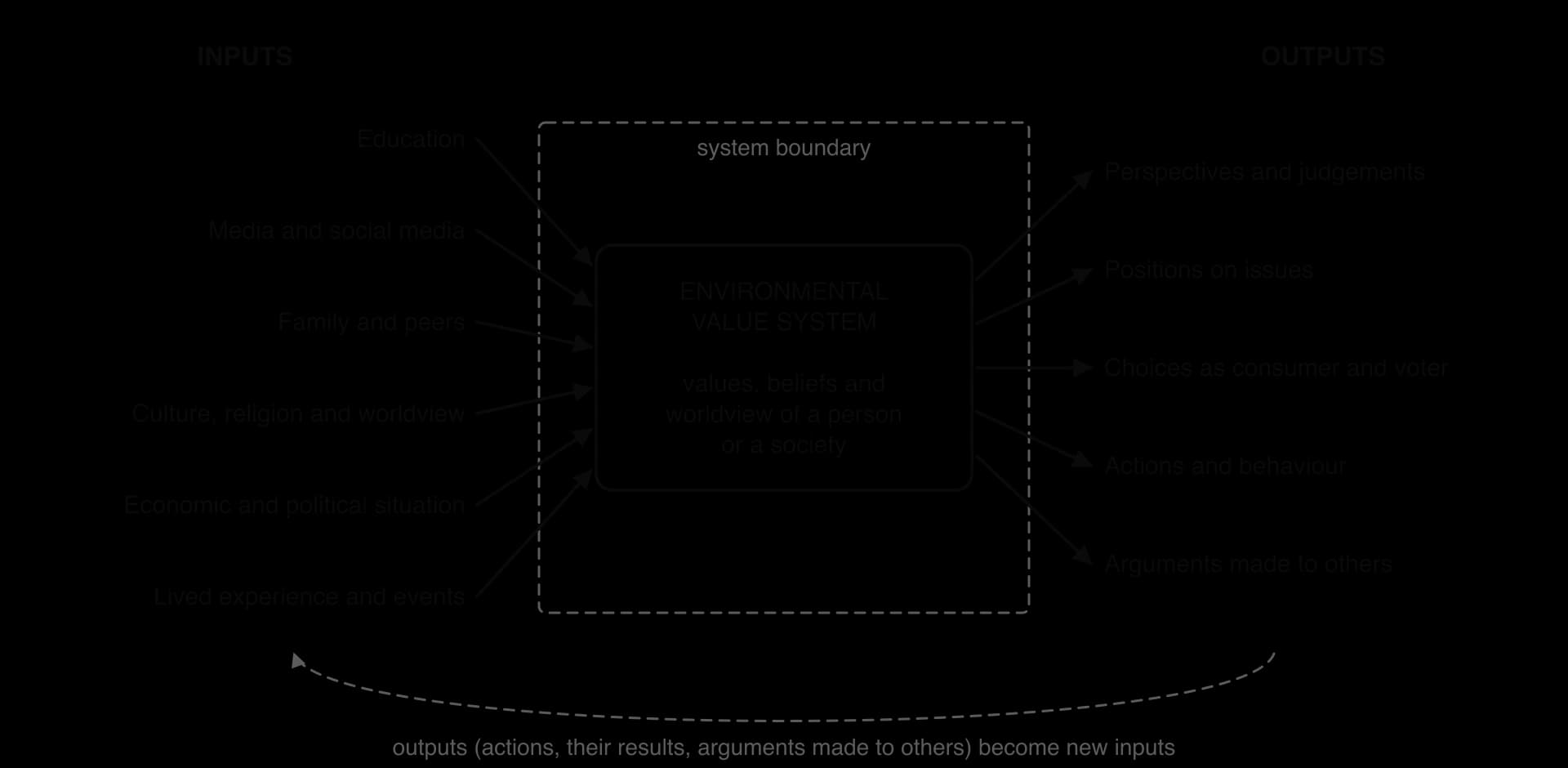
The inputs are everything that informs the value system: education, the news media and social media, family and friends, culture and religion, the economic and political situation, and personal experiences and events. They match the factors that inform a perspective. Some inputs are deliberately designed to change values, such as advertising, school curricula or campaigns by governments and pressure groups.
The outputs are what the value system produces: perspectives and judgements on issues, positions in debates, choices as a consumer and a voter, everyday behaviour, and arguments made to others. A person who supports a carbon tax, cycles to work and writes to a local newspaper about air pollution is showing three outputs of the same EVS.
An EVS can be described at different scales. An individual has one; so do a family, a company, a religious group, a political party or a whole society. At the scale of a society, the outputs include laws, policies and national patterns of consumption, which become inputs for the individuals who live in it.
Treating a perspective as a system shows that perspectives are not fixed. If the inputs change, for example through a new scientific finding, a disaster or a move to a new country, the outputs can change too. The model also includes feedback: the results of a person’s actions, and the reactions of others to their arguments, become new inputs. A person who installs solar panels and sees their electricity bill fall may become more open to other low-carbon changes.
Like every model, the EVS simplifies. It cannot show how strongly each input acts, why two people with the same inputs reach different outputs, or the role of emotion and identity. It is a tool for organising thinking about where a perspective comes from, not a way of predicting exactly what someone will do.
 YouTube
Environmental perspectives, also called environmental worldviews, can be classified broadly into three groups: technocentric, anthropocentric and ecocentric. The categories describe what a perspective puts at the centre: technology, humans, or nature. They are best thought of as regions on a spectrum rather than separate boxes, and the same person can sit in different places on different issues.
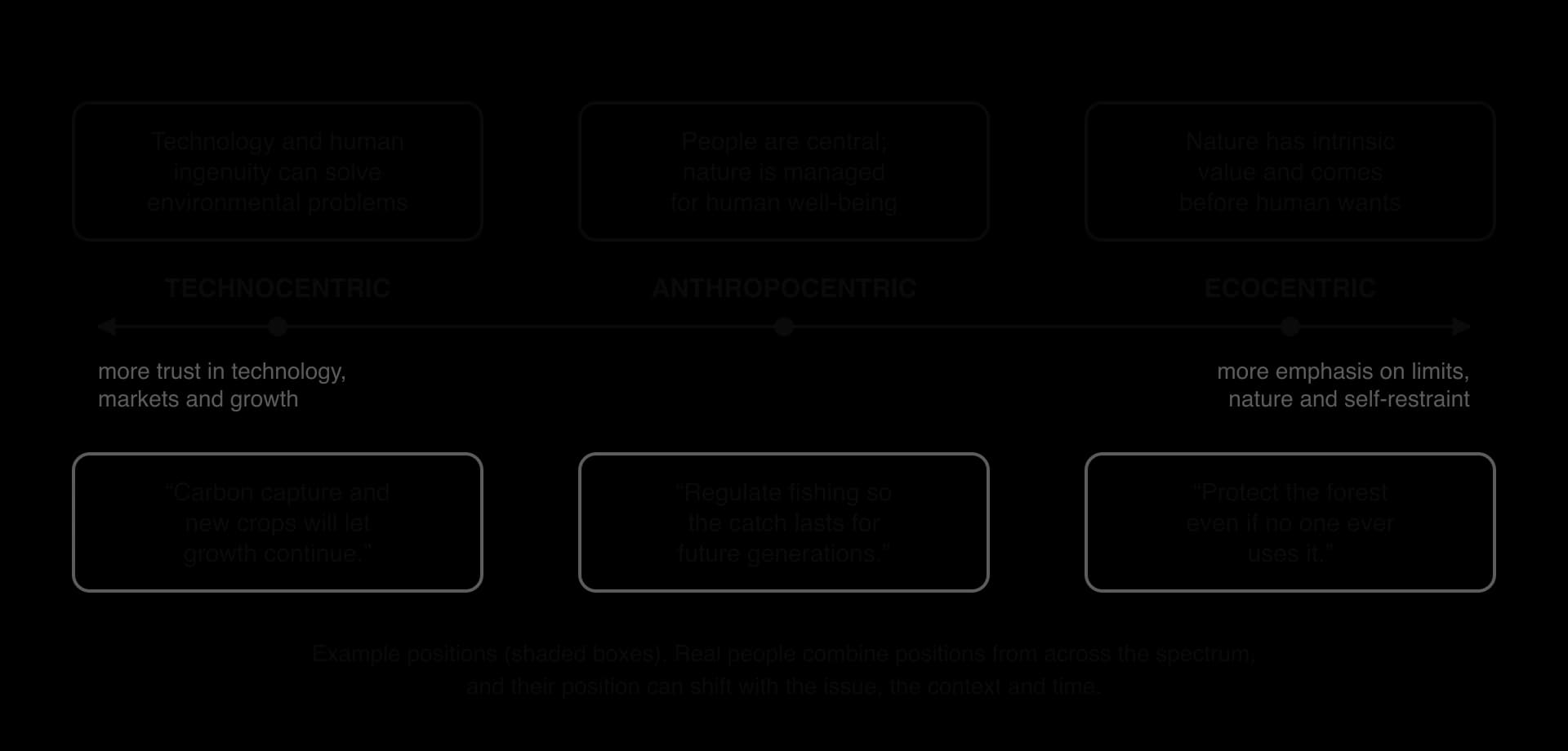
Technocentrism assumes that environmental problems can be solved through technology, scientific research and human ingenuity. On this view, resource shortages and pollution are problems to be engineered away: new energy sources, more efficient machines, genetically modified crops, carbon capture or desalination will allow people to keep raising living standards without running out of resources. Technocentrists tend to trust experts, markets and economic growth to deliver these solutions.
A technocentric response to water shortage is a large desalination plant; to climate change, carbon capture and storage or, at the extreme, geoengineering; to food shortage, higher-yield crop varieties. The strength of this view is its record of real achievements, such as the replacement of ozone-depleting chemicals and rapid falls in the cost of solar power. Its weaknesses are that new technologies often create new problems, and that relying on future inventions can be used as a reason to delay action now.
Anthropocentrism views humankind as the central and most important element of existence. Nature is valued mainly for what it provides to people, so the aim is to manage the environment well for human benefit, now and in the future. This is a very broad category that includes a wide variety of views, from those who would exploit resources as fast as possible to those who argue for careful regulation, sustainable yields and stewardship so that future generations can benefit too.
Typical anthropocentric responses are fishing quotas, environmental impact assessments, protected water catchments, taxes on pollution and international agreements to share resources fairly. Many governments and international organisations work from this perspective, because their task is to balance environmental protection with jobs, health and development.
Ecocentrism sees the natural world as having pre-eminent importance and intrinsic value. Ecosystems, species and natural processes deserve protection for their own sake, not only because they are useful. Ecocentrists usually stress the limits of the Earth, distrust large-scale technological fixes and argue that humans should reduce their consumption, live more simply and accept restraints on growth.
Ecocentric responses include large protected areas where human use is restricted, rewilding, granting legal rights to rivers and forests, and campaigns for lower consumption. The strength of this view is that it takes seriously the value of species and ecosystems that markets ignore. Its weakness, from other perspectives, is that it can seem to set the interests of nature against the needs of poor people who depend directly on natural resources.
Technocentric | Anthropocentric | Ecocentric | |
|---|---|---|---|
What is at the centre | Technology and human ingenuity | Human well-being | Nature and its processes |
How nature is valued | Instrumentally, as resources to be used efficiently | Mainly instrumentally, for present and future people | Intrinsically, as well as for its uses |
View of limits to growth | Limits can be overcome by innovation | Limits are real but can be managed | Limits are real and must be respected |
Trust in | Science, engineering, markets | Governments, regulation, careful management | Natural processes, local communities, self-restraint |
Typical response to declining fish stocks | Fish farming with new feed technologies | Catch quotas based on scientific stock assessments | Large no-take marine reserves; eat less fish |
Typical response to climate change | Carbon capture, nuclear power, geoengineering research | Carbon taxes, international agreements, adaptation plans | Lower consumption, protect and restore forests and peatlands |
 YouTube
The three categories are a model, and like all models they are useful but imperfect. They help to organise a complicated range of views, to predict how a stakeholder is likely to respond to a proposal, and to explain why groups disagree. They also give a shared vocabulary for discussion.
Their limitations are just as important. The categories are not exclusive: a person may support nuclear power (technocentric), fishing quotas (anthropocentric) and a national park with no roads (ecocentric) all at once.
Positions are also complex and change over time and with context; someone may become more ecocentric after a local river is polluted, or more technocentric after losing a job to an environmental regulation. Alternative classification schemes exist, for example ones based on attitudes to economic growth, to individual freedom or to the role of government. And the categories come mainly from Western environmental thought, so they may fit poorly with worldviews, including many Indigenous worldviews, that do not separate humans from nature in the first place.
Perspectives and the beliefs beneath them change over time in all societies. Change can be fast, after a disaster or a powerful image, or slow, over generations. Three drivers are especially important: campaigns by governments, campaigns by non-governmental organisations, and social and demographic change.
Governments change perspectives through education, public information campaigns, laws, taxes and subsidies. A health warning on cigarette packets, a tax on sugary drinks or a deposit on bottles is designed to change behaviour, and over time it can also change what people regard as normal. Intergovernmental organisations (IGOs), such as the United Nations Environment Programme (UNEP), founded after the 1972 Stockholm conference, spread ideas and set standards across many countries at once.
Non-governmental organisations (NGOs) are not-for-profit organisations that act independently of government. Environmental NGOs range from small local groups to international organisations such as Greenpeace, founded in Vancouver in 1971 to oppose a US nuclear weapons test, and WWF. They change perspectives through campaigns, protests, reports, lobbying and education, and some run conservation projects directly. Because NGOs choose their own causes, they often raise issues before governments are ready to act on them.
Perspectives also shift as societies change. As incomes rise, people often have more time and security to care about pollution and wildlife, and urbanisation can both distance people from nature and concentrate them where pollution is most visible. Each new generation grows up with different inputs: people who are now teenagers have known climate change as a fact of life and have grown up with social media, which spreads perspectives far beyond the local community. Migration brings people with different worldviews together, which can widen or challenge local perspectives.
Change can also run in the other direction. Traditional lifestyles in many Indigenous and rural communities, with their own knowledge and values, are being replaced by modern consumer lifestyles as roads, markets, schools and media arrive. A behaviour–time graph of, for example, the share of households in a village using firewood rather than bottled gas, or eating mainly local food rather than packaged food, would show this kind of change.
A behaviour–time graph shows how a behaviour in a group changes over time. Time goes on the horizontal axis and a measure of the behaviour (such as the percentage of adults who smoke, recycling rates or meat consumption per person) on the vertical axis. The graph is usually annotated with the events, campaigns or laws that may have caused changes in its slope, which makes it a way of linking changes in perspective to changes in behaviour.
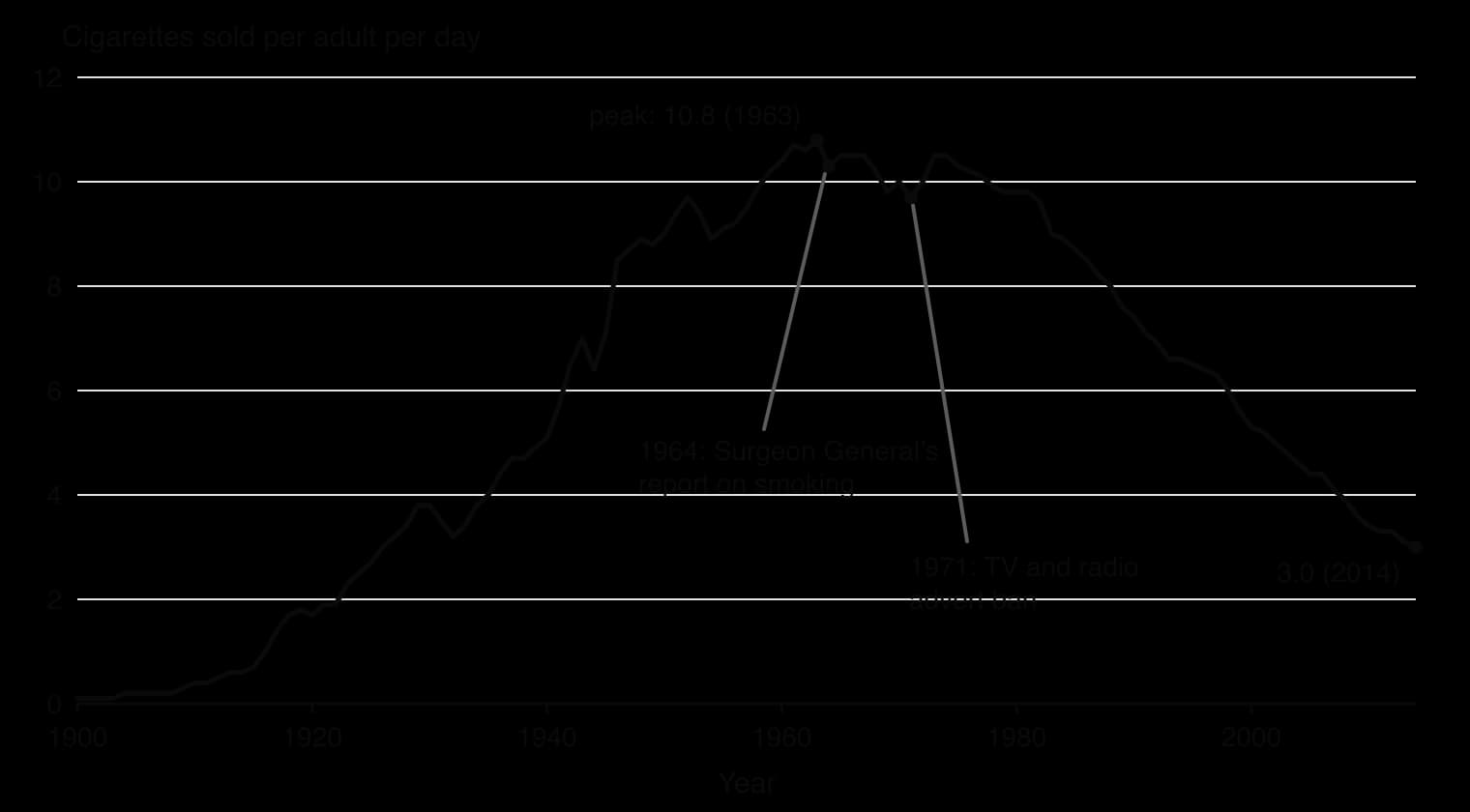
Smoking is the classic example. In the USA, sales of manufactured cigarettes rose from about 0.1 per adult per day in 1900 to a peak of 10.8 in 1963. The 1964 report of the US Surgeon General concluded that smoking increases the chance of lung cancer by 10 to 20 times, and laws followed: a cigarette labelling act in 1965 and a ban on cigarette advertising on television and radio from January 1971. Sales stayed high for more than a decade, then fell steadily to 3.0 per adult per day by 2014.
The long delay between the scientific evidence and the fall in sales is typical. Evidence changes some people’s perspectives quickly, but behaviour that is habitual, addictive or socially normal changes slowly, and sales fell further as taxes rose, smoking was banned in more workplaces and public places, and it became less socially acceptable. The same pattern of slow change after clear evidence appears in many environmental behaviours, such as reducing car use or meat consumption.
Sources: Our World in Data, “Sales of cigarettes per adult per day” (International Smoking Statistics, 2016); US Surgeon General’s Advisory Committee report (1964); Public Health Cigarette Smoking Act (1970).
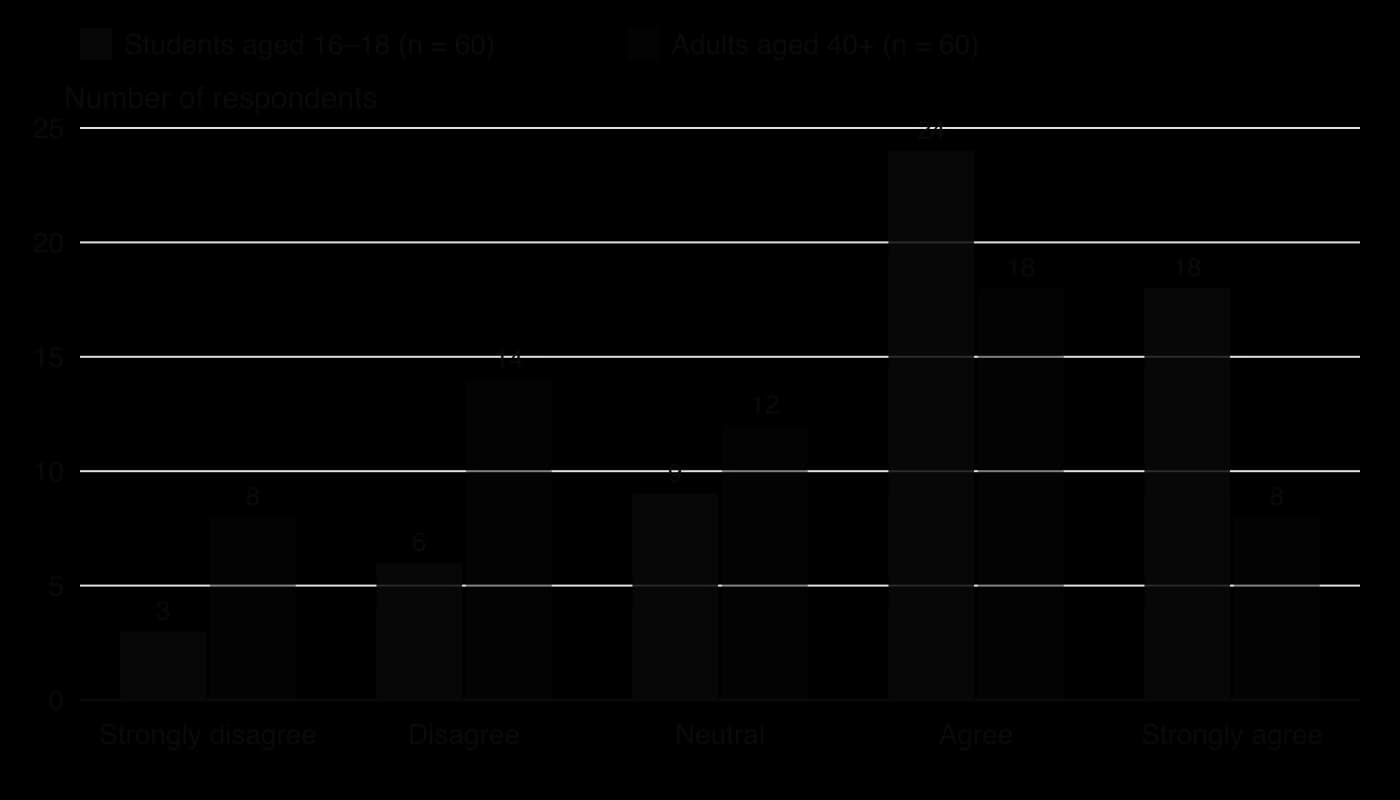
Perspectives can be studied systematically. A values survey investigates the values and perspectives of a social group towards an environmental issue, usually by asking a sample of people the same set of questions. Well-designed surveys can show how perspectives differ between groups (by age, income, location or occupation) and how they relate to attitudes and behaviour, such as support for a policy or willingness to change a habit.
Values surveys are usually carried out with a questionnaire, a set of written questions given to each respondent, or through structured interviews. Online collaborative tools make it easy to reach many respondents and to process the results in a spreadsheet. An effective survey accommodates the full range of perspectives on the issue, so that every respondent can find an answer that fits their view, and it is designed to show how those perspectives are likely to affect the issue.
Choose the issue and the research question, for example “Do students and adults in our town differ in their support for closing the main shopping street to cars?”
Identify and justify the target audience: who holds the perspectives that matter for the issue (residents, shopkeepers, commuters, students).
Write the questions. Closed questions give fixed answers that are easy to compare and analyse, such as multiple choice or a Likert scale. Open questions let respondents answer in their own words, which gives richer detail but is harder to analyse.
Choose the sampling method and size. Random sampling gives every person an equal chance of selection and reduces bias; convenience sampling (whoever is easy to reach) and volunteer sampling are quick but often biased; purposive sampling deliberately selects people with particular knowledge, such as fishers or farmers.
Address ethics. Keep responses anonymous, explain the purpose, obtain informed consent, and allow people to withdraw.
Pilot the survey with a few people to find confusing or leading questions before the main survey.
Analyse the data with a suitable statistical tool, for example a chi-squared test to test whether the pattern of answers differs between two groups, or Spearman’s rank correlation to test whether two ranked variables are related.
Likert items are popular in values surveys because they measure the strength of an attitude, not just its direction. A typical item reads: “Our town should close the main shopping street to cars. Strongly disagree / Disagree / Neutral / Agree / Strongly agree.” Several items on related statements can be combined into a score for each respondent.
The environmental movement is the broad social and political movement of individuals, groups and organisations working to protect the natural environment and to change human behaviour, policy and law towards it. It has no single leader or organisation. It includes local residents opposing a landfill, scientists publishing evidence, NGOs running campaigns, Indigenous communities defending their land and governments negotiating treaties.
The movement has grown in waves. Concern in the 1950s and 1960s was mostly local and national: pesticides, smog, polluted rivers and industrial poisoning. From the 1970s regional problems such as acid rain and the first global concerns, such as the ozone layer and climate change, came to the fore. By the 1990s the global scale of environmental change was widely recognised, and in the 21st century climate change, biodiversity loss and environmental justice have become central political issues. Seven kinds of influence have driven these changes.
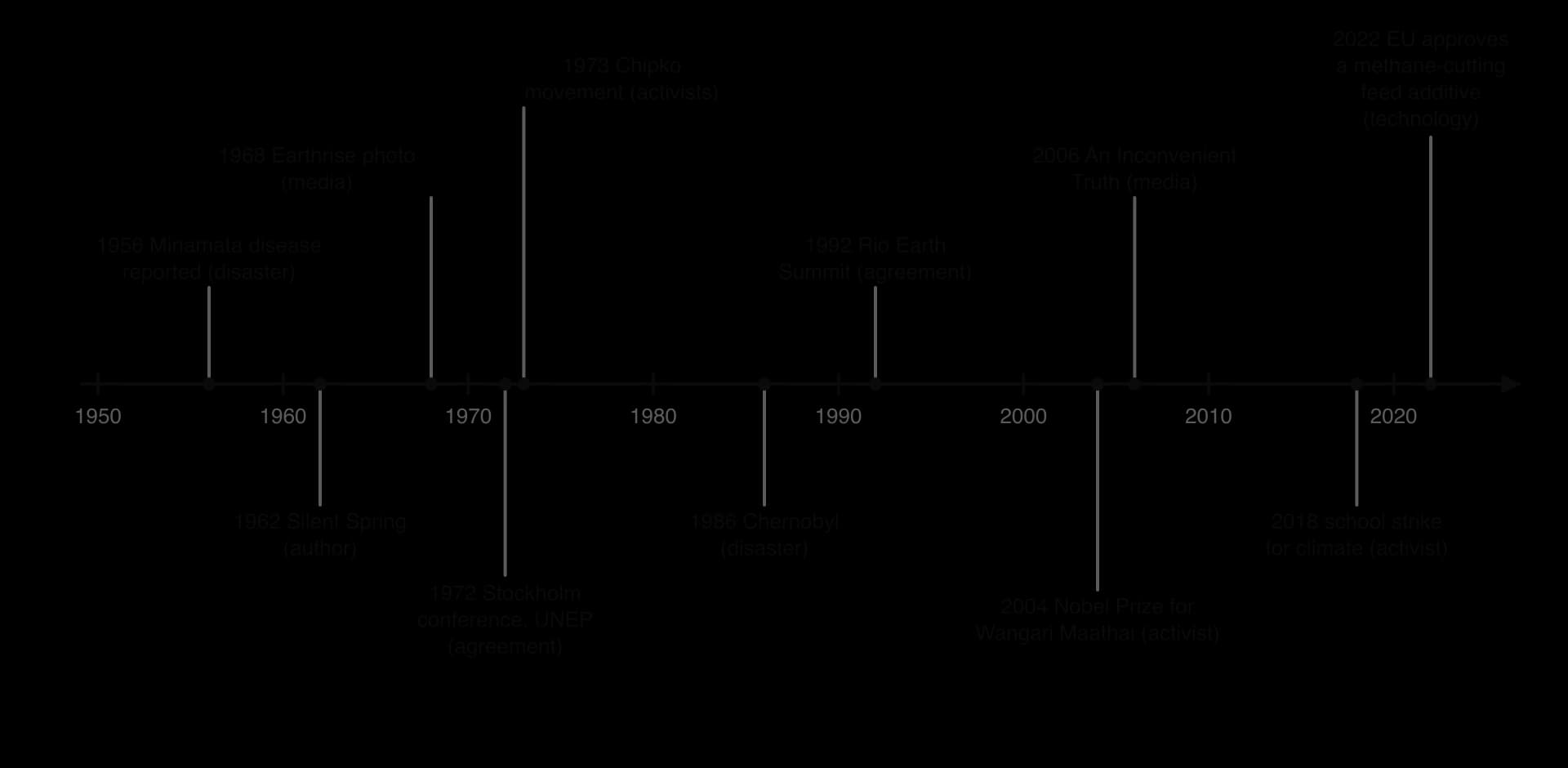
Individual environmental activists can change perspectives by giving a cause a face and a story. On 20 August 2018 Greta Thunberg, then 15, began a solo “school strike for climate” outside the Swedish parliament. Through social media the idea spread quickly: by December 2018 students in at least 270 cities had joined Friday strikes, and organisers reported that more than four million people took part in the global climate strike of 20 September 2019 alone. The movement became known as Fridays for Future.
Activists also attract strong opposition, which shows how deeply perspectives differ: Thunberg was praised by many as a voice for young people and criticised by others for her methods and her political statements. Earlier activists worked mainly through local organisation. In Kenya, Wangari Maathai founded the Green Belt Movement in 1977 and in 2004 became the first African woman to receive the Nobel Peace Prize, for her contribution to sustainable development, democracy and peace.
Collective action by ordinary people has been just as influential. In April 1973, in Mandal village in the Chamoli district of today’s Uttarakhand, India, villagers stopped loggers felling ash trees that the Forest Department had awarded to a sports-goods company, while refusing the same trees to the villagers’ own workshop. In March 1974, at Reni, Gaura Devi led 27 women who hugged the trees to stop the loggers. The Chipko movement combined local control of forests, livelihoods and non-violent protest, and in 1980 the Indian government banned tree felling in the Himalayan forests for fifteen years.
Books can change how a whole generation sees an issue. Rachel Carson’s Silent Spring, serialised in The New Yorker in June 1962 and published as a book in September 1962, argued that the indiscriminate use of DDT and other synthetic pesticides was harming wildlife and ecosystems and could harm people. Chemical companies attacked the book, but a 1963 report by the US President’s Science Advisory Committee largely supported its science. The book is widely credited with helping to create the modern environmental movement; the US Environmental Protection Agency was set up in 1970, and most uses of DDT in the USA ended in 1972.
Literature includes many forms beyond scientific non-fiction: novels, poetry and the writing of Indigenous authors have all shaped how readers value nature. Literature works mainly by changing the inputs to readers’ value systems: new information, new stories and new ways of seeing familiar places.
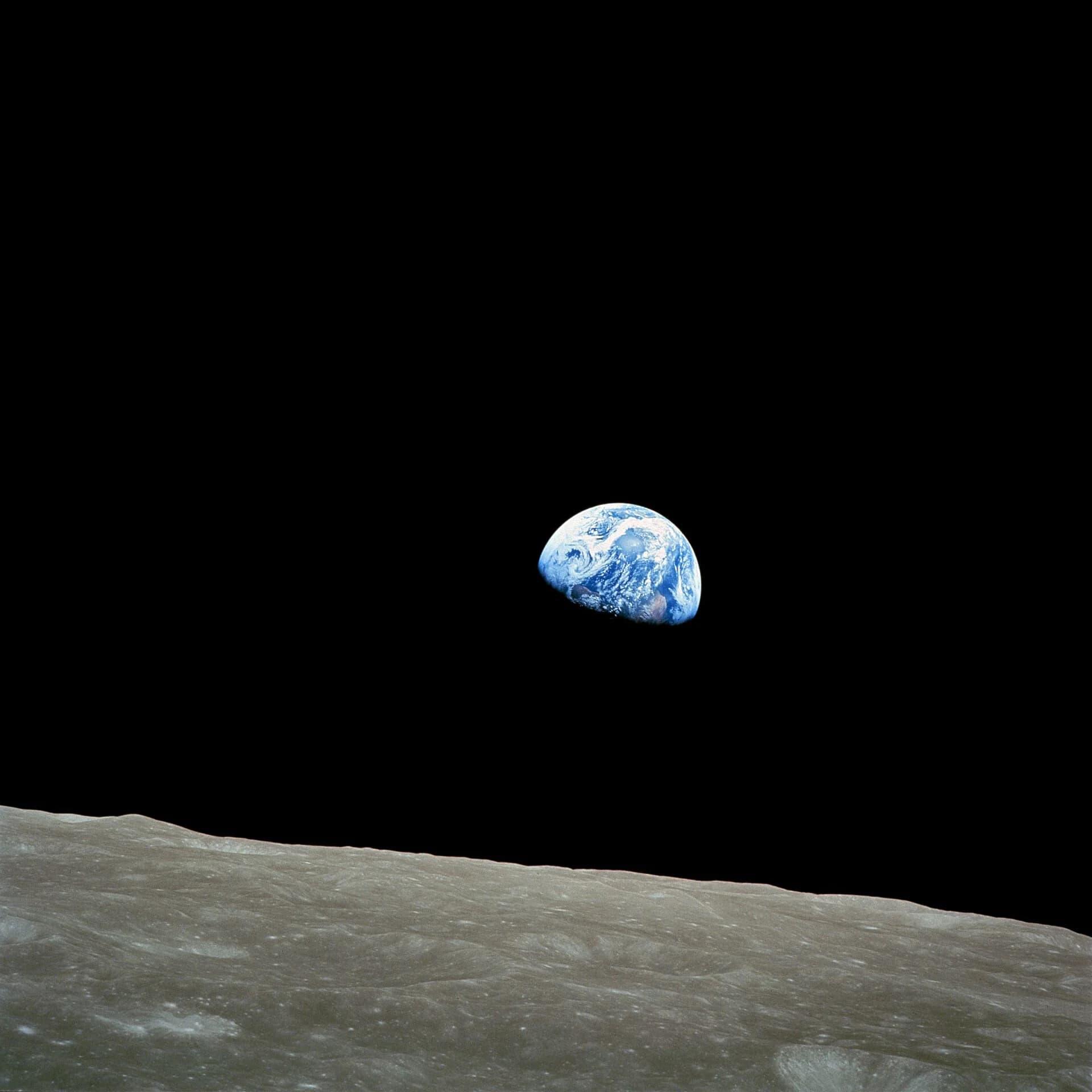
Films, photographs, television and social media reach far larger audiences than books. On 24 December 1968, astronaut William Anders photographed the Earth rising above the Moon’s horizon during the Apollo 8 mission. The image, Earthrise, showed the planet as a small, finite and fragile object, and the photographer Galen Rowell later called it “the most influential environmental photograph ever taken”.
Documentary films can reach mass audiences: Al Gore’s An Inconvenient Truth (2006) brought climate science to cinemas around the world, won the Academy Award for Best Documentary Feature, and Gore shared the 2007 Nobel Peace Prize with the Intergovernmental Panel on Climate Change. The film was also criticised: in 2007 a UK High Court judge ruled that schools showing it should explain nine statements that went beyond the mainstream science, while finding the film broadly accurate. The media influence perspectives powerfully, but they also simplify, dramatise and select, so they are inputs to be evaluated rather than simply accepted.
Disasters change perspectives because they make abstract risks real and visible. Minamata disease in Japan, caused by methylmercury discharged from a chemical factory between 1951 and 1968, changed attitudes to industrial pollution in Japan and later worldwide. The explosion at the Chernobyl nuclear power plant in Ukraine (then part of the Soviet Union) on 26 April 1986 led to the evacuation of about 135,000 people and a 30 km exclusion zone. Soviet authorities acknowledged the accident only after radiation alarms went off at a nuclear plant in Sweden two days later.
Chernobyl changed perspectives on nuclear power far beyond the Soviet Union. In Italy, voters backed three anti-nuclear proposals in a referendum in November 1987; the government decided in 1988 to phase out nuclear power, and the last two operating plants closed in 1990. A technology that many had seen as a clean, modern source of energy came to be seen by many others as an unacceptable risk, even though it produces very little carbon dioxide.
International agreements both reflect changing perspectives and spread them. The United Nations Conference on the Human Environment in Stockholm (June 1972), attended by 122 countries, is widely seen as a foundation of modern international environmental policy and led to the creation of UNEP, with its headquarters in Nairobi. Twenty years later, the Rio Earth Summit, the UN Conference on Environment and Development held in Rio de Janeiro from 3 to 14 June 1992, brought together 108 heads of state and government.
The Rio summit produced the Rio Declaration on Environment and Development, the Forest Principles and Agenda 21, a non-binding plan for sustainable development to be carried out from the global to the local level. It opened for signature the United Nations Framework Convention on Climate Change and the Convention on Biological Diversity, which later led to the Kyoto Protocol and the Paris Agreement. It helped make sustainable development a mainstream idea and spread principles such as the precautionary principle. Critics point out that many of its commitments, for example on poverty, were not met; a follow-up conference, Rio+20, took place in 2012.
New technologies change perspectives by changing what seems possible. The Green Revolution, the spread of high-yielding crop varieties, synthetic fertilisers and irrigation from the 1960s, persuaded many people that technology could feed a growing population, a strongly technocentric idea. More recent technologies aim to reduce environmental impacts directly. Plant-based meat products offer an alternative to livestock farming, and feed additives such as 3-nitrooxypropanol (sold as Bovaer) reduce the methane that cattle produce during digestion (enteric fermentation), by about 30% in many studies. Bovaer was approved in Brazil and Chile in 2021, in the European Union for dairy cattle in 2022 and in the USA in 2024.
Technology can also provoke resistance that shows how perspectives differ. When a UK dairy company announced trials of Bovaer in late 2024, some consumers called for boycotts and spread unfounded rumours about its safety, showing that trust in a technology depends on values and on trust in the organisations behind it, not only on scientific evidence.
Scientific discoveries provide much of the evidence on which the movement is built: the toxicity of pesticides and biocides, the loss of species and habitats, the thinning of the ozone layer and the rise in atmospheric carbon dioxide. A discovery changes perspectives only when it is communicated, trusted and connected to people’s values.
In May 1985, scientists of the British Antarctic Survey reported a deep seasonal loss of ozone over Antarctica; the discovery turned a theoretical risk into a visible one and helped bring about the Montreal Protocol of 1987, which phased out CFCs. The evidence on smoking and on DDT, by contrast, took many years to change behaviour and law, and scientific evidence on climate change has been available for decades while action has been slower.
Influence | Example | How it changed perspectives |
|---|---|---|
Individual | Greta Thunberg’s school strike (from August 2018) | Spread climate concern among young people worldwide through social media |
Literature | Rachel Carson, Silent Spring (1962) | Made pesticide harm a public issue; contributed to the 1972 US ban on most DDT uses |
Media | Earthrise (1968); An Inconvenient Truth (2006) | Showed the Earth as finite; brought climate science to mass audiences |
Disaster | Minamata (1956); Chernobyl (1986) | Turned opinion against unregulated industrial pollution and against nuclear power |
International agreement | Stockholm (1972); Rio Earth Summit (1992) | Created UNEP; made sustainable development a global goal |
Technology | Green Revolution (1960s); methane-reducing feed additives (2020s) | Supported the idea that technology can solve resource problems |
Scientific discovery | The Antarctic ozone hole (reported 1985); pesticide toxicity | Provided evidence for regulation, such as the Montreal Protocol (1987) |
Minamata is a small city in Kumamoto Prefecture on the island of Kyushu, in southern Japan, on the coast of the Yatsushiro Sea (also called the Shiranui Sea). In the 1950s many families around Minamata Bay lived by fishing, and fish and shellfish were a large part of their daily diet. The city was also a company town: the Chisso Corporation had opened a chemical factory there in 1908, and it was the main employer and source of local tax revenue.
From 1932 the factory made acetaldehyde, a chemical used to make plastics and other products, using mercury as a catalyst. Production grew from 210 tonnes in 1932 to 6,000 tonnes in 1951 and peaked at 45,245 tonnes in 1960, as Japan’s economy grew rapidly after the Second World War. In August 1951 the factory changed one of the chemicals used with the catalyst, and a side reaction began to produce methylmercury, a highly toxic organic compound of mercury. Wastewater containing it flowed into Minamata Bay until 1968.
Viewed as a system, the bay received an input of methylmercury from the factory’s outflow. The mercury was stored in the sediment and taken up by living things; because methylmercury is not easily excreted, it became concentrated in fish and shellfish and then in the cats and people who ate them. In February 1959, sediment near the factory’s drainage canal held about 2 kg of mercury per tonne.
On 1 May 1956 the director of Chisso’s factory hospital reported “an epidemic of an unknown disease of the central nervous system” after a five-year-old girl was examined at the hospital. By October 1956, 40 patients had been found, of whom 14 had died. Since about 1950 local people had also seen cats convulsing and dying. Researchers from Kumamoto University concluded in November 1956 that the illness was probably poisoning by a heavy metal, taken in through fish and shellfish.
The fishing community suffered first and hardest. Fish catches in the area fell by 91% between 1953 and 1957, and the consumption of fish from the bay was restricted from 1957. In September 1958, rather than stopping the discharge, Chisso redirected its wastewater into the Minamata River, which spread the poisoning to new coastal areas. In 1959 the company’s own hospital director began experiments on cats that produced the same symptoms, and on 12 November 1959 a government subcommittee, drawing on the Kumamoto University research, named an organic mercury compound as the main cause.
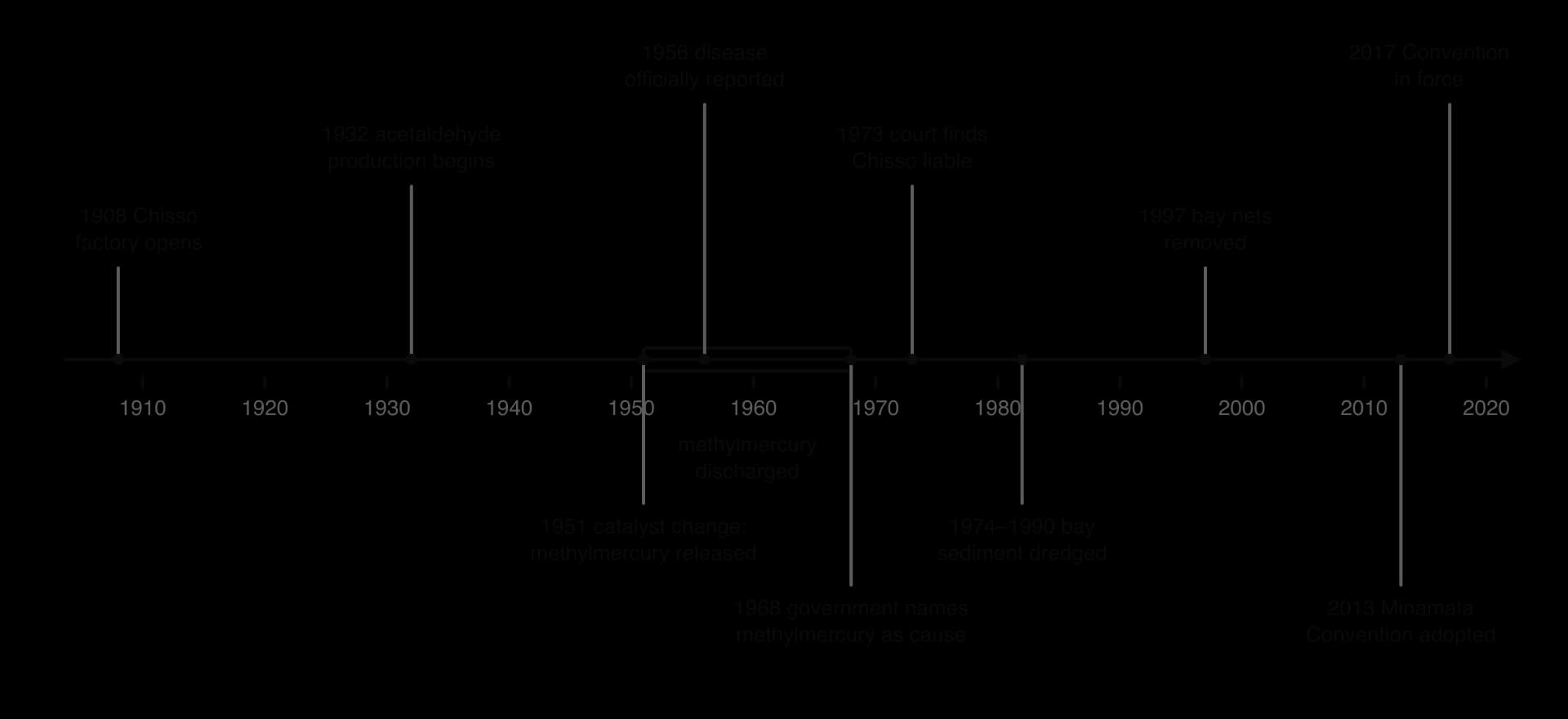
In December 1959, Chisso installed a wastewater treatment device, the “Cyclator”, and held an opening ceremony for it; later testimony showed that it did nothing to remove organic mercury. In the same year, patients’ families signed an agreement for “sympathy money”: ¥100,000 a year for an adult victim, ¥30,000 for a child and a one-off ¥320,000 for a death, paid only to officially certified patients and on condition that they made no further claims for compensation.
Fishers, angry at lost livelihoods, protested too: about 1,500 of them marched on the factory in October 1959, and a riot there in November caused about ¥10 million of damage.
Methylmercury continued to enter the bay until 1968. Children were born with congenital Minamata disease, poisoned in the womb. A second outbreak was reported in 1965 along the Agano River in Niigata Prefecture, caused by another company’s acetaldehyde plant. On 26 September 1968, twelve years after the first official report, the Japanese government officially identified methylmercury from the Chisso and Showa Denko factories as the cause.
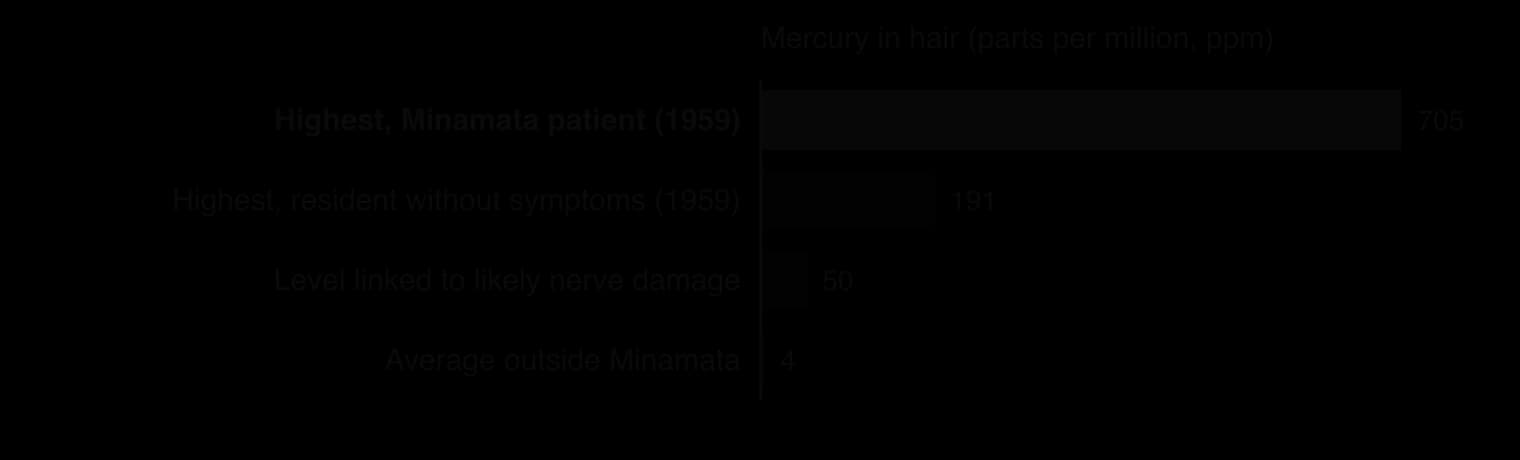
Hair samples showed how much methylmercury people had absorbed. In 1959 the highest level measured in an affected resident was 705 parts per million (ppm), and the highest in a resident without symptoms was 191 ppm, against an average of about 4 ppm outside Minamata. A survey in 1960–1961 linked levels above 50 ppm with likely nerve damage and found a highest value of 920 ppm.
Measure | Value |
|---|---|
Officially certified patients, Yatsushiro Sea (March 2001) | 2,265 |
Officially certified patients, Agano River, Niigata (March 2001) | 690 |
People who had applied for certification (Minamata, by 2001) | over 17,000 |
People compensated by Chisso (by 2001) | over 10,000 |
Uncertified victims in the 2010 settlement | 2,123 (¥2.1 million each, plus medical allowances) |
Contaminated sediment dredged from Minamata Bay (1974–1990) | about 1.5 million m³, creating 58 ha of reclaimed land |
Cost of the bay clean-up | ¥48 billion, of which Chisso paid ¥30.5 billion |
Responses came from many stakeholders, at different times and from different perspectives. Patients and their families organised, petitioned and, from 1969, took Chisso to court. On 20 March 1973 the Kumamoto District Court ruled that Chisso had been negligent, declared the 1959 “sympathy money” agreement invalid and ordered compensation of ¥937 million in total, about ¥16–18 million per patient. Japan introduced a relief law for pollution victims in 1970 and a compensation law in 1974.
The media played a large role in changing public perspectives. The American photographer W. Eugene Smith lived in Minamata from 1971 to 1973 and photographed patients and their families; he was attacked and injured by men employed by Chisso in January 1972. His photographs, published in the book Minamata in 1975, made the disease known around the world.
Cleaning up the bay took decades. Kumamoto Prefecture dredged about 1.5 million m³ of sediment containing more than 25 ppm of mercury from 1974 to 1990 and buried it in reclaimed land. Nets that kept fish from the contaminated part of the bay were finally removed in October 1997, ending restrictions on eating local fish that had applied, with interruptions, since 1956.
Internationally, the name of the city became a symbol. The Minamata Convention on Mercury was adopted in Kumamoto in October 2013 and came into force on 16 August 2017; by September 2025 it had 153 parties. It bans new mercury mines, required the phase-out of many mercury-containing products such as certain batteries, lamps and thermometers by 2020, and requires countries to reduce mercury use in small-scale gold mining and to control emissions.
Stakeholder | Perspective and values | Main inputs to their EVS | Position and action |
|---|---|---|---|
Chisso Corporation | Economic growth, production, protecting the company; technocentric trust that industry brings progress | Profits, national demand for chemicals, legal advice | Denied responsibility, diverted wastewater, paid small “sympathy money”; later paid compensation under court orders |
National and local government (1950s–60s) | Rapid industrial growth, jobs, national development: an anthropocentric, growth-first view | Economic plans, pressure from industry, scientific uncertainty | Delayed official recognition until 1968; later passed relief and compensation laws and funded clean-up |
Fishing families and patients | Health, livelihood, community, dignity; lived experience of illness | Direct experience of sick relatives and dead fish, cats and birds | Protests, petitions and lawsuits; demanded recognition and compensation |
Scientists (Kumamoto University) | Truth, public health | Field and laboratory evidence | Identified a heavy metal (1956) and organic mercury (1959) as the cause, often against official pressure |
Media and international public | Justice, human rights | Photographs, reports, court cases | Spread awareness worldwide; contributed to international law |
The twelve-year delay between the first report and official recognition shows how power and economic dependence shaped perspectives. Chisso dominated the local economy, and many residents, including some workers, saw criticism of the company as a threat to their jobs and town; some patients faced discrimination from neighbours. The national government gave priority to industrial growth. Scientific uncertainty also played a part: the methods available then for analysing very small amounts of chemicals were limited, and the company and some officials used uncertainty about the exact compound as a reason to delay action.
Judged overall, the response was partly successful. Discharges did stop, the bay was cleaned, local fish became safe to eat again and the victims eventually won large compensation. Japan’s pollution laws and the Minamata Convention have reduced mercury risks for people far beyond Japan. However, help came very late for those who were poisoned, the narrow rules for official certification left many sick people unrecognised for decades, and disputes over who counts as a victim continued into the 2010s. From an environmental justice perspective, the people with the least power, fishing families, paid most of the cost of growth that benefited others.
Methylmercury is absorbed easily and leaves the body slowly, so it builds up in organisms and becomes more concentrated at each step up a food chain. Large fish and shellfish therefore held much more mercury than the water around them, and the people who ate the most seafood every day, the fishing families, received the highest doses. The mechanism, biomagnification, is the same one that concentrates DDT in birds of prey.
Minamata shows that perspectives are formed by values, economic conditions and power as well as by scientific evidence: the same evidence was available to the company, the government and the fishing families, but they weighted it differently. It shows perspectives changing over time, through lived experience, scientific research, protest, court decisions and media images, from treating pollution as an acceptable price of progress to holding polluters legally responsible. It is a major example of a disaster that influenced the environmental movement and international law, and it shows why environmental decisions always involve the question of whose values and whose well-being are taken into account.
Sources: Wikipedia, “Minamata disease” and “Minamata Convention on Mercury” (accessed 2026); Ministry of the Environment, Japan, “Minamata Disease: The History and Measures” (2002).
Perspectives appear in every part of the assessment. Paper 2 Section A may ask you to define the key terms, outline an EVS, or interpret a behaviour–time graph or survey data. Paper 1 case studies almost always include stakeholders with different views, and questions ask you to identify, explain or evaluate them. In Paper 2 Section B essays, the highest markbands reward balanced analysis that considers several perspectives and reaches a supported judgement, so these ideas are useful in essays on every topic.
Short questions on the EVS model reward structure: say what goes in, what comes out, and link the two.
Data-based items often use a behaviour–time graph or survey results.
This practice resource is invented. It describes a coastal town where a company plans to build a seawall and a hotel resort on a mangrove-fringed bay.
Stakeholder (invented) | Statement |
|---|---|
Resort developer | “The seawall will protect the town from storm surges, and the resort will create 600 jobs. Modern engineering can protect the coast better than mangroves.” |
Town council | “We need jobs and tax income, but we will require the developer to replant mangroves elsewhere and limit the size of the resort.” |
Fishers’ cooperative | “The mangroves are where the fish breed. Without them our catches will fall, and the resort jobs are for outsiders.” |
Local conservation group | “The mangroves shelter rare birds and are part of our heritage. They should be protected whatever the economic cost.” |
Survey of 200 residents | Support for the resort: 74% of residents under 30, 41% of residents over 50. |
A perspective is how an individual views and understands a situation, based on personal and collective assumptions, values and beliefs; it leads to positions, choices and actions.
Perspectives are informed and justified by sociocultural norms, science, laws, religion, economic conditions, events and lived experience.
A perspective is not an argument: arguments are made to support one perspective or counter another.
Values are principles people feel are important; they show in communication and actions, and conflicting values cause tensions between stakeholders.
Nature can be valued intrinsically (for itself) or instrumentally (for its use); stewardship is careful management for others and the future.
Worldviews are shared lenses shaped by culture, philosophy, ideology, religion and politics; social media now expose people to many worldviews, so individual perspectives are complex mixtures.
An environmental value system is a systems model of inputs (education, media, culture, experience) and outputs (judgements, choices, actions), with feedback.
Perspectives are classified broadly as technocentric, anthropocentric and ecocentric; the categories are useful but not exclusive, change with context and time, and other schemes exist.
Perspectives change through government and NGO campaigns and social and demographic change; behaviour–time graphs show such changes.
Values surveys use questionnaires (often Likert scales), suitable sampling, ethical safeguards and a pilot, and are analysed with statistical tests.
The environmental movement has been shaped by individuals, literature, media, disasters such as Minamata, international agreements, technologies and scientific discoveries.
I can define perspective, values and worldview and explain how they are related.
I can outline the factors that inform a perspective, with an example of each.
I can distinguish between a perspective and an argument.
I can explain how the values of individuals and organisations show in their communication and actions.
I can draw an EVS as a systems diagram with inputs, outputs and feedback.
I can compare technocentric, anthropocentric and ecocentric perspectives and classify statements.
I can evaluate models that classify environmental perspectives.
I can interpret a behaviour–time graph using data.
I can design a values survey with suitable questions, sampling and ethics.
I can describe one example of each kind of influence on the environmental movement, including Minamata.