1 Foundation
Meet the three key concepts of Environmental Systems and Societies (perspectives, systems and sustainability), see how they connect and how the eight topics and three HL lenses build on them.
- IB Environmental Systems and Societies
- SL and HL
What 1 covers
From the subject guide: what you need to know and be able to do.
The ideas used across the course: environmental perspectives, systems and sustainability.
3 subtopics in Foundation
Each one has its own page once something is published for it.
- 1.1Perspectivesnotes
- 1.2Systemsnotes
- 1.3Sustainabilitynotes
An overview of 1 Foundation
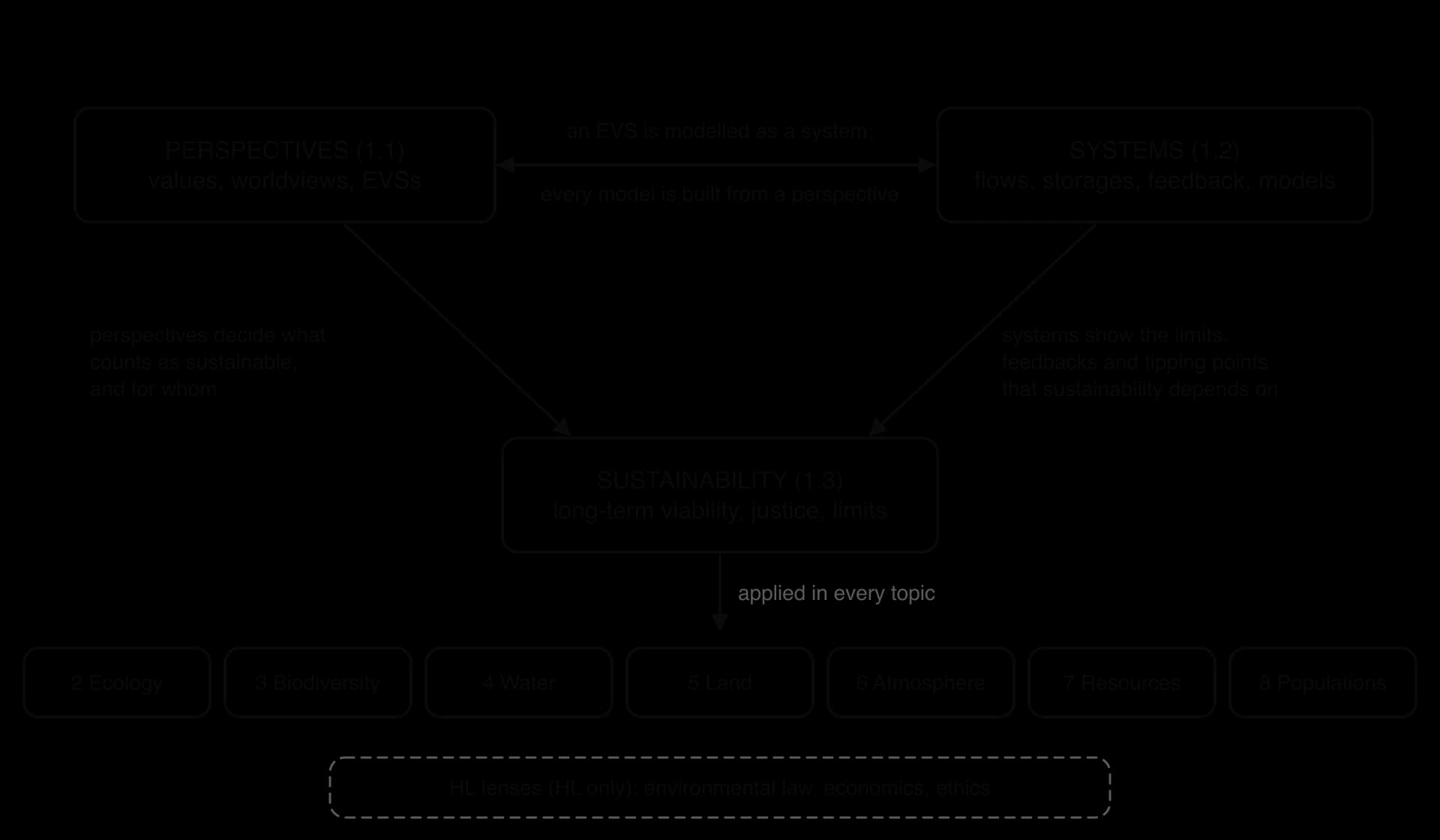
The Foundation topic introduces the three key concepts that Environmental Systems and Societies uses to study every environmental issue: perspectives, systems and sustainability. They are taught first because each later topic, from ecology to cities, applies them again to its own content.
Environmental Systems and Societies is interdisciplinary. It combines methods from the sciences (ecology, chemistry, physics) with methods from the social sciences and humanities (geography, economics, politics, law, ethics) to study how natural systems and human societies interact. Each of the three key concepts acts as a lens: a way of looking at an issue that brings certain questions into focus.
Questions the Foundation topic asks
Why do people and groups see the same environmental issue so differently, and how do their perspectives develop and change?
How can complex environmental situations be simplified and modelled as systems of storages, flows and feedback, and what are the limits of those models?
What does it mean for a practice, a city or a society to be sustainable, and how can sustainability be measured?
Who benefits and who pays when environments are used or damaged, and how are sustainability and environmental justice connected?
The three subtopics
Subtopic | What it covers |
|---|---|
1.1 Perspectives | Perspectives, values and worldviews; environmental value systems; technocentric, anthropocentric and ecocentric perspectives; values surveys and behaviour–time graphs; how individuals, the media, disasters, agreements, technology and science have shaped the environmental movement (case study: Minamata disease). |
1.2 Systems | Systems and the systems approach; storages, flows, transfers and transformations; open and closed systems; the Earth as a system, the Gaia hypothesis and Daisyworld; negative and positive feedback; equilibrium, tipping points and regime shifts; models and their limitations; emergent properties; resilience (case study: the northern California kelp forest collapse). |
1.3 Sustainability | Sustainability and its environmental, social and economic pillars; sustainable development; ecosystem collapse; GDP and green GDP; environmental justice; sustainability indicators; ecological, carbon and water footprints and biocapacity; citizen science; the SDGs, planetary boundaries, doughnut economics and the circular economy (case study: oil, sustainability and environmental justice in Ogoniland, Nigeria). |
Three lenses for the whole course
Perspectives
A perspective is how an individual views and understands a situation, shaped by values, beliefs, culture and experience. The same wetland may be seen as farmland waiting to be drained, a flood defence, a sacred place or a refuge for migrating birds. Studying perspectives explains why environmental decisions are contested, and it trains the habit of asking whose view is being represented and whose is missing. The environmental value system model and the spectrum from technocentric to ecocentric views give a vocabulary for this analysis that is used in every topic.
Systems
A system is a set of interacting or interdependent components. A systems approach looks at the whole set of interactions, the storages, flows, inputs, outputs and feedback loops, rather than one part at a time, which makes it a holistic approach. Systems thinking explains why a small change, such as extra nutrients in a lake or a little warming in the Arctic, can grow into a large one when positive feedback drives a system past a tipping point. Every topic builds its own systems diagrams: energy flow through ecosystems, the carbon, nitrogen and water cycles, soils, the atmosphere and cities.
Sustainability
Sustainability is the extent to which practices allow the long-term viability of a system. It has environmental, social and economic dimensions, and it is linked closely to environmental justice: a practice that harms the poorest people or future generations is not sustainable, even if it is profitable today. Models such as the planetary boundaries, doughnut economics and the circular economy give ways of judging whether human activity stays within the Earth’s limits while meeting everyone’s needs.
How the three connect
The three concepts are used together. A fishery, for example, is a system with an input of young fish and an output of catch; it is sustainable only if the catch does not exceed what the stock can replace; and what counts as an acceptable catch depends on the perspectives of fishers, consumers, governments and conservationists. Leaving out any one of the three gives an incomplete analysis.
 YouTube
How Foundation links to the rest of the course
After Foundation, the course moves through eight topics that apply the three lenses to particular parts of the Earth system and of human society:
Topic | What it studies | One example of the key concepts at work |
|---|---|---|
2 Ecology | Individuals, populations, communities and ecosystems; energy flow; biogeochemical cycles; biomes; succession | Ecosystems as open systems with flows of energy and matter |
3 Biodiversity and conservation | Biodiversity and evolution; human impacts; conservation and regeneration | Ecocentric and anthropocentric arguments for conservation |
4 Water | Water systems; access and security; aquatic food production; water pollution | Sustainable fishing yields and the tragedy of the commons |
5 Land | Soil; agriculture and food | Soil as a system; sustainable farming |
6 Atmosphere and climate change | The atmosphere; causes, impacts, mitigation and adaptation of climate change; stratospheric ozone | Climate feedbacks and tipping points; climate justice |
7 Natural resources | Resource use and management; energy; solid waste | Natural capital; the circular economy in practice |
8 Human populations and urban systems | Population; urban systems and planning; urban air pollution | Cities as systems; footprints and biocapacity |
Ideas from Foundation reappear throughout the course. Environmental value systems explain the positions of stakeholders in every case study. Feedback, equilibrium and tipping points are applied to populations, lakes, soils and the climate. Footprints, planetary boundaries and environmental justice provide measures against which human activities can be judged.
How SL and HL differ
Topic 1 is common content: SL and HL students study exactly the same material in 1.1, 1.2 and 1.3, and there are no HL-only sections in these three subtopics. The one exception is a short HL extension in 1.3: HL students use quantitative data to judge when, and whether, planetary boundaries have been crossed, and they do this again wherever a boundary appears later in the course.
From Topic 2 onwards the split changes. Almost every later subtopic has additional higher level understandings, which appear in sections marked “(HL only)” at the end of each subtopic, after the SL content and the case study. Only 7.3 Solid waste has none. SL students can stop before these sections; HL students study them in full.
HL students also study three HL lenses, each with its own page, and then apply them across topics 1–8:
HL lens | What it studies | Applied to Foundation |
|---|---|---|
HL.a Environmental law | Laws, constitutions, international conventions and courts that manage resources and pollution, and their strengths and limits | How agreements such as the Rio Earth Summit conventions, and laws on environmental justice, turn perspectives into binding rules |
HL.b Environmental economics | Market failure, valuing nature, the polluter-pays principle, and the debate between growth, decoupling and degrowth | GDP and green GDP, strong and weak sustainability, doughnut economics and the circular economy |
HL.c Environmental ethics | Intrinsic and instrumental value, moral standing and ethical frameworks | Links the technocentric, anthropocentric and ecocentric perspectives to formal ethical theories and deepens environmental justice |
In assessment, HL students are expected to bring these lenses into their answers, especially in extended essays, for example by naming a law or treaty, an economic instrument or an ethical argument.
Assessment
Foundation is examined in every component, often together with other topics, because its concepts are the tools used to analyse any issue.
Paper 1 is based on an unseen case study with data in many forms. Questions from Foundation ask students to identify stakeholders and their perspectives, construct or interpret a systems diagram of the case, identify feedback loops or tipping points, and evaluate how sustainable a practice is.
Paper 2 Section A contains short-answer and data-based questions, such as defining key terms (perspective, system, sustainability), drawing an EVS or a feedback loop, interpreting a behaviour–time graph or footprint data, and outlining the uses and limitations of a model such as the SDGs or the planetary boundaries.
Paper 2 Section B contains structured essays. Their final, markband-assessed parts reward balanced evaluation from several perspectives, systems reasoning and judgements about sustainability, so the Foundation concepts strengthen essays on every topic. HL answers are also expected to use the HL lenses.
The internal assessment, an individual investigation, asks students to describe a strategy that addresses an environmental issue and explain a tension between different perspectives that it creates, which draws directly on the study of perspectives.
Flashcards for 1
The official decks for this part of the syllabus.
- 1.1 Perspectives173 cards
- 1.2 Systems195 cards
- 1.3 Sustainability267 cards
Carry on with 1 in Augment
With a free account, Augment remembers where you stopped and what you have practiced.