
Classify robots and autonomous technologies, explain how they sense, reason, move and act with degrees of autonomy, trace their evolution, and evaluate their dilemmas for people and communities.
Each is in the Digital Society glossary, with every other term in the subject.
A component that turns a control signal into physical action, such as a motor that turns a wheel, a hydraulic cylinder that lifts an arm or a speaker that produces sound.
The attribution of human characteristics, emotions or intentions to non-human things, such as animals, objects, robots or software.
A self-operating machine that performs a fixed sequence of actions, usually driven by springs, weights, water or cams, often built to imitate a person or animal.
A digital system that can carry out tasks and make decisions in response to its environment without continuous human direction, whether or not it has a physical body that moves.
A vehicle that uses sensors, software and actuators to perceive its surroundings and drive itself, with the human role ranging from close supervision to none depending on its level of automation.
The degree to which a system can sense, decide and act on its own, without real-time human direction, within a given environment and set of tasks.
A field of robotics that designs robots with human- or animal-like cognitive abilities, such as perception, learning, reasoning and planning, so that they can act intelligently in complex and changing environments.
Define a robot and an autonomous technology, and distinguish between them.
Identify and describe the main types of robots (industrial and productivity, service and social) and of autonomous technologies (the Internet of Things, autonomous vehicles, drones and virtual assistants).
Explain how robots and autonomous technologies sense, reason and act, using the sense–think–act cycle.
Distinguish between degrees of autonomy, including the six levels of driving automation.
Outline the evolution of robots and autonomous technologies, from early automata and science fiction to industry, everyday life and debates about machine consciousness and robot rights.
Analyse the dilemmas these technologies raise: anthropomorphism and the uncanny valley, complex interactions with people and environments, uneven laws and governance, and the displacement of humans.
Evaluate the impacts and implications of robotaxis for people and communities in San Francisco, using concepts such as power, change and values and ethics.
Robots and autonomous technologies are digital systems that sense the world around them, process what they sense and then act on it with some independence from human control. They range from welding arms in car factories and vacuum cleaners in homes to delivery drones in Rwanda and driverless taxis in San Francisco, and they are changing how people work, travel, receive care and relate to machines.
These technologies draw on much of the course's content: they collect data through sensors, process it with algorithms and artificial intelligence, and often depend on networks. Their effects reach every context, from employment (economic) and elderly care (health) to city design (environmental) and the law (political). They raise questions through the concepts of change, power, identity, systems and values and ethics: who benefits when a machine replaces a worker, who is responsible when a driverless car causes harm, and whether a machine could ever deserve rights.
With a free account, Augment remembers where you stopped and what you have practiced.
A robot designed to work safely alongside people in a shared workspace, using sensors and limited force and speed so that it stops or slows when it touches a person.
An aircraft with no pilot on board, controlled remotely by a person, autonomously by onboard software, or by a combination of the two.
The study and design of how people and robots communicate, cooperate and affect each other, including trust, safety, social behaviour and the effects of robots on human users.
An automatically controlled, reprogrammable machine, usually a jointed arm, used in manufacturing for tasks such as welding, painting, assembly and packaging.
A six-level scale from 0 to 5, set out by SAE International, that describes how much of the driving task a vehicle's automated system performs, from no automation to full automation under all conditions.
A sensing method that fires pulses of laser light and measures how long they take to bounce back, building a precise three-dimensional map of nearby objects and their distances.
The idea, still hypothetical, that a machine could have subjective experience or awareness, rather than only processing information and imitating conscious behaviour.
The use of cameras and image-analysis software to let a machine detect, identify, measure or locate objects so that it can make decisions and act, for example in inspection, sorting or navigation.
A programmable machine with a physical body that senses its environment, processes that information and acts on the physical world, carrying out tasks with some degree of independence from direct human control.
The debate over whether robots, especially advanced or humanlike ones, should be given moral consideration or legal rights and status, and what such rights would mean for human responsibility.
A model of how robots and autonomous systems work, in which sensors gather data about the environment, software processes the data to choose an action, and actuators carry out the action, in a continuous loop.
A robot that performs useful tasks for people or equipment outside industrial manufacturing, such as cleaning, delivery, surgery, inspection or agriculture.
A robot designed to interact with people through social behaviours such as speech, gesture, facial expression or touch, often to provide companionship, education, therapy or customer service.
The control of a robot or vehicle by a human operator from a distance, using data sent back from the machine's sensors, so that the operator can act in places that are dangerous, remote or hard to reach.
A fictional set of rules devised by Isaac Asimov in 1942: a robot must not harm a human or allow a human to come to harm, must obey human orders unless this conflicts with the first law, and must protect itself unless this conflicts with the first two.
The hypothesis, proposed by Masahiro Mori in 1970, that robots or images that look almost but not exactly human cause unease or revulsion, so that comfort with a robot falls sharply just before it becomes fully humanlike.
A software agent, such as Siri or Alexa, that interprets voice or text commands and performs tasks or services for a user, often controlling other connected devices.
There is no single agreed definition of a robot, and engineers, lawyers and philosophers draw the line in different places. Most definitions share three ideas. A robot is a physical machine, it gathers information about its surroundings, and it uses that information to carry out actions in the physical world without a person controlling every movement.
The word "physical" matters. A chatbot can hold a conversation, but it has no body, so most definitions do not count it as a robot. A washing machine follows a fixed programme without richly sensing a changing environment, so it is usually classed as an automated appliance. The boundary is blurred, which is part of what makes the topic debatable.
Autonomous technologies are a wider group. They include robots, but also systems whose main work is deciding and responding rather than moving physical parts, such as a smart thermostat that learns a household's routine or a voice assistant that books a taxi.
Engineers often describe robots and autonomous systems with a simple model, the sense–think–act cycle. The system senses its environment with sensors, thinks by processing the data to decide what to do, and acts through actuators such as motors, wheels or speakers. The action changes the environment, producing new sensor data, so the cycle repeats, often many times per second.
The model is a form of feedback loop, an idea from the concept of systems. A robot vacuum cleaner shows the cycle at a small scale. Its bump and cliff sensors detect a wall or a staircase (sense), its software decides to turn or reverse (think), and its wheel motors change direction (act). A driverless car runs the same cycle with far more sensors, far more processing and far higher stakes.
The cycle also explains why robots fail, because a fault at any stage breaks the whole loop. A dirty camera lens is a sensing failure, a wrongly classified object is a thinking failure, and a slipping wheel on ice is an acting failure.
Robots and autonomous technologies are usually grouped by what they do and who they work with. The groups overlap: a delivery drone is an autonomous technology, and many people would also call it a service robot. Classification is still useful, because each type brings different impacts for different people and communities.

An industrial robot is a programmable machine, usually an arm with several joints, used in manufacturing to weld, paint, assemble, lift and package goods. Such robots work in structured environments where the parts, positions and tasks are predictable. They are fast, precise and tireless, but traditionally they are fenced off from workers because a heavy arm moving at speed can kill.
Productivity robots extend the same idea beyond the factory line to warehouses, laboratories and farms. Amazon began using wheeled robots that lift and carry whole shelves of goods to human pickers after it bought the robotics firm Kiva Systems in 2012, and in 2025 it reported deploying its millionth robot. Newer collaborative robots ("cobots") are lighter, slower and fitted with force sensors, so they can work beside people without safety cages. The Danish firm Universal Robots sold one of the first commercial cobots in 2008.
The use of industrial robots varies greatly between countries. Robot density, the number of industrial robots for every 10,000 manufacturing employees, shows how far each economy has automated its factories.
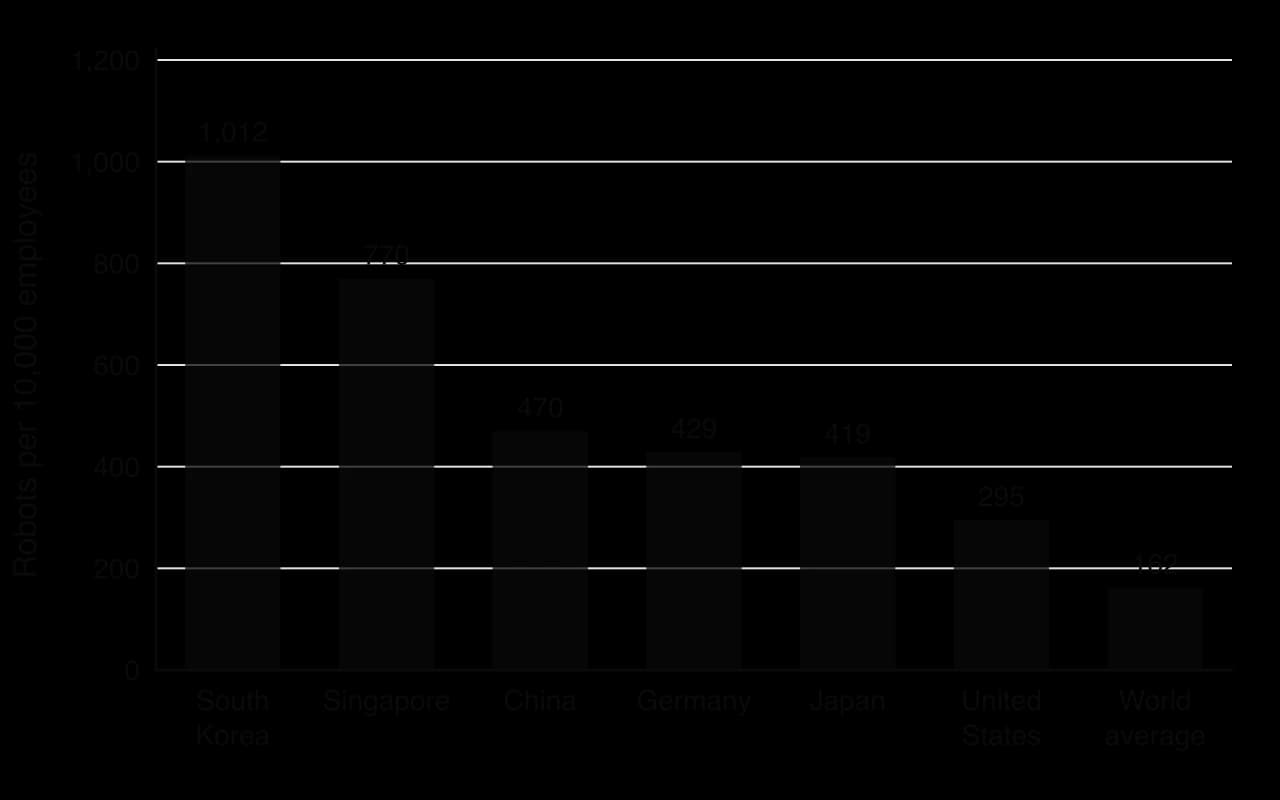
The pattern links robots to the economic context. Countries with ageing populations and high wages, such as South Korea, Japan and Germany, have strong reasons to automate. In many lower-income countries robot density is very low, because labour is cheaper than machines.
A service robot performs useful tasks for people outside industrial manufacturing. Professional service robots work in hospitals, hotels, farms, mines and warehouses; personal service robots work in homes. Examples include the iRobot Roomba vacuum cleaner (2002), the Starship delivery robots that carry food across university campuses and city pavements, and the da Vinci surgical system, which a surgeon controls from a console to perform keyhole operations.
Service robots work in less structured environments than factory robots: a pavement contains dogs, children and kerbs. They need richer sensing and more flexible software, and they meet members of the public who never agreed to work with a robot.
A social robot is designed mainly to interact and communicate with people in socially meaningful ways, through speech, facial expressions, gestures or touch. Its value lies in the relationship rather than in a physical task. PARO, a furry robotic baby seal developed at Japan's National Institute of Advanced Industrial Science and Technology, responds to touch and voice and is used in care homes, including with people living with dementia. Pepper, a humanoid robot made by SoftBank, has greeted customers in shops and banks in Japan and Europe.
In the social and health contexts, supporters point to reduced loneliness and agitation among older people. Critics ask whether it is ethical to give a vulnerable person a machine that imitates affection, and whether robots may become an excuse to cut care staff.
The Internet of Things (IoT) is the network of everyday physical objects fitted with sensors, software and connectivity so that they can collect and exchange data and respond automatically. Smart thermostats, smart meters, wearable fitness trackers, connected traffic lights and soil-moisture sensors in fields are all IoT devices. Each device is usually simple, but together they form systems that act without human input, such as a heating system that learns when a family is out and lowers the temperature.
IoT devices count as autonomous technologies because they close the sense–think–act loop automatically: a smart irrigation controller reads soil moisture and weather forecasts, then opens or closes valves. The autonomy is narrow but operates at huge scale and often unnoticed, which makes the IoT central to debates about surveillance in the home.
An autonomous vehicle is a vehicle that can sense its environment and move safely with little or no human input. The term covers self-driving cars and robotaxis, driverless trucks, autonomous buses and shuttles, and some trains, ships and farm tractors. Waymo, owned by Google's parent company Alphabet, runs fully driverless paid taxi services in several US cities, and Baidu's Apollo Go runs similar services in Chinese cities such as Wuhan.
A drone is an aircraft without a human pilot on board, flown by remote control, by onboard software or by a mix of both. Drones are used for aerial photography, mapping, crop spraying, infrastructure inspection, search and rescue, delivery and warfare. Since 2016 the company Zipline has used small fixed-wing drones to deliver blood and medical supplies to hospitals in Rwanda, dropping packages by parachute and cutting delivery times on roads that can take hours.
A virtual assistant is software that understands spoken or written requests and carries out tasks for its user, such as answering questions, setting reminders, playing music or controlling smart-home devices. Apple's Siri (2011), Amazon's Alexa (2014) and Google Assistant (2016) are the best-known examples. They rely on speech recognition and natural language processing, and they increasingly act as the control centre for IoT devices in the home.
A virtual assistant has no body, yet it is classed as an autonomous technology because it senses (through a microphone), interprets and acts (by speaking, sending messages or switching devices) without a person directing each step. The always-listening microphone also makes it a source of privacy concerns. In 2023 Amazon agreed to pay $25 million to settle charges from the US Federal Trade Commission that it had kept children's Alexa voice recordings in breach of children's privacy law.
Type | Main purpose | Typical environment | Real-world example | Key impact or dilemma |
|---|---|---|---|---|
Industrial and productivity robot | Manufacture, move or handle goods | Structured: factories, warehouses | Amazon warehouse robots | Productivity versus job displacement |
Service robot | Useful task for people | Semi-structured: homes, hospitals, pavements | da Vinci surgical system | Safety and responsibility in public spaces |
Social robot | Interaction and companionship | Homes, care homes, schools | PARO therapeutic seal | Deception and replacement of human care |
Internet of Things | Sense and respond automatically | Homes, cities, farms | Smart thermostats and meters | Constant data collection |
Autonomous vehicle | Transport without a driver | Roads, rail, sea | Waymo robotaxis | Safety, liability, drivers' jobs |
Drone | Fly without a pilot on board | Air: rural and urban | Zipline in Rwanda | Airspace rules, privacy, military use |
Virtual assistant | Carry out spoken or written requests | Phones, smart speakers | Amazon Alexa | Always-on microphones and privacy |
Robots and autonomous technologies share four characteristics. They take in sensory inputs, they reason with those inputs, they interact with and move in physical environments, sometimes remotely, and they show some degree of autonomy. Each characteristic maps onto part of the sense–think–act cycle.
Sensors give a machine three kinds of awareness. Spatial awareness is knowing where the machine is and where objects are around it. Environmental awareness is knowing the conditions around it, such as light, temperature, weather or sound. Operational awareness is knowing the state of the machine itself, such as its battery level, speed, joint angles or faults.
Kind of awareness | Question it answers | Typical sensors | Example |
|---|---|---|---|
Spatial | Where am I, and what is around me? | Cameras, lidar, radar, ultrasonic sensors, GPS | A robotaxi building a 3D map of cars and pedestrians |
Environmental | What are the conditions around me? | Thermometers, humidity and light sensors, microphones, gas sensors | A farm drone measuring crop health from reflected light |
Operational | What is my own state? | Battery monitors, wheel encoders, accelerometers, gyroscopes, force sensors | A cobot sensing an unexpected force and stopping |
Each sensor has strengths and weaknesses, which is why most autonomous vehicles combine several. Cameras see colour and read traffic lights but struggle in glare and darkness. Lidar measures distance precisely but is expensive and can be affected by heavy rain or fog. Radar works in bad weather and measures speed but gives a coarse picture. Combining their data, a process called sensor fusion, gives a more reliable picture than any one sensor alone.
Raw sensor data is only numbers: pixel values, distances and voltages. To act sensibly, a robot must turn that data into meaning, such as "a cyclist is about to turn left". Machine vision is the use of cameras and image-processing software to let machines identify, inspect and locate objects so that they can act on them. It applies the wider field of computer vision to machines that do physical work, from checking welds on a car body to guiding a picking arm to a parcel.
Older robots reasoned with hand-written rules: "if the bumper is pressed, reverse and turn 90 degrees". Rules work in predictable environments but fail when something new happens. Modern systems increasingly use machine learning, in which software learns patterns from large amounts of training data. A robotaxi's software learns from millions of kilometres of recorded driving to recognise objects and predict how they will move, and Amazon's Sparrow picking arm (2022) uses machine vision and machine learning to grasp items of many shapes and sizes.
Machine learning makes robots more flexible but less predictable. A system trained on sunny Californian streets may perform worse in snow, and engineers cannot always explain why it classified an object as it did, which links robots to the AI dilemmas of accountability and transparency.
Robots differ from most other digital systems because they act on the physical world. Industrial arms move within a fixed reach; mobile robots, vehicles and drones move through space; social robots interact through voice, faces and touch. This physical action is where both the benefits and the dangers are greatest, because a software error in a robot can break objects or injure people.
Some robots are controlled at a distance. In teleoperation a human operator directs a robot from another location, using cameras and sensors on the robot to see what it sees. Surgeons operate the da Vinci system from a console a few metres away; bomb-disposal teams send tracked robots towards suspected explosives; mining companies run underground vehicles from control rooms on the surface.
Remote control and autonomy often combine. NASA's Mars rovers receive instructions from Earth, but signals take several minutes each way, so the rovers drive themselves between waypoints and avoid hazards on their own.
Autonomy is the ability of a system to make decisions and act without human intervention. It is a spectrum, not a switch. A remote-controlled toy car has none; a robot vacuum has a little; a robotaxi with no one inside has a great deal, but only within an area and conditions its designers have tested.
One common way to describe degrees of autonomy is by the human's role. A person can be in the loop (the machine cannot act without human approval, as in teleoperation), on the loop (the machine acts but a human supervises and can intervene, as with a driver supervising a Level 2 driving-assistance system) or out of the loop (the machine acts with no real-time human involvement, as in a driverless robotaxi).
For vehicles, the most widely used scale is the levels of driving automation published by SAE International, an engineering standards body, in its standard J3016. It runs from Level 0 (no automation) to Level 5 (full automation). The key dividing line falls between Levels 2 and 3. At Levels 0–2 a human is always driving, even when features help with steering or speed. At Levels 3–5 the automated system is driving while it is engaged.

Level | Who steers and controls speed? | Who watches the road? | Who is the fallback if something goes wrong? | Real-world example |
|---|---|---|---|---|
0 | Human | Human | Human | Car with automatic emergency braking only |
1 | Human or system (one of the two) | Human | Human | Adaptive cruise control |
2 | System (both) | Human | Human | Tesla Autopilot |
3 | System | System, in set conditions | Human, when asked to take over | Mercedes-Benz Drive Pilot on some motorways |
4 | System | System | System, within its defined area | Waymo robotaxis in San Francisco |
5 | System | System | System, everywhere | No commercial example yet |
Robots and autonomous technologies have a long history: centuries of mechanical invention, stories and philosophical arguments about artificial beings, and, since the 1960s, rapid growth in industry and then in everyday life. The timeline shows the main milestones.
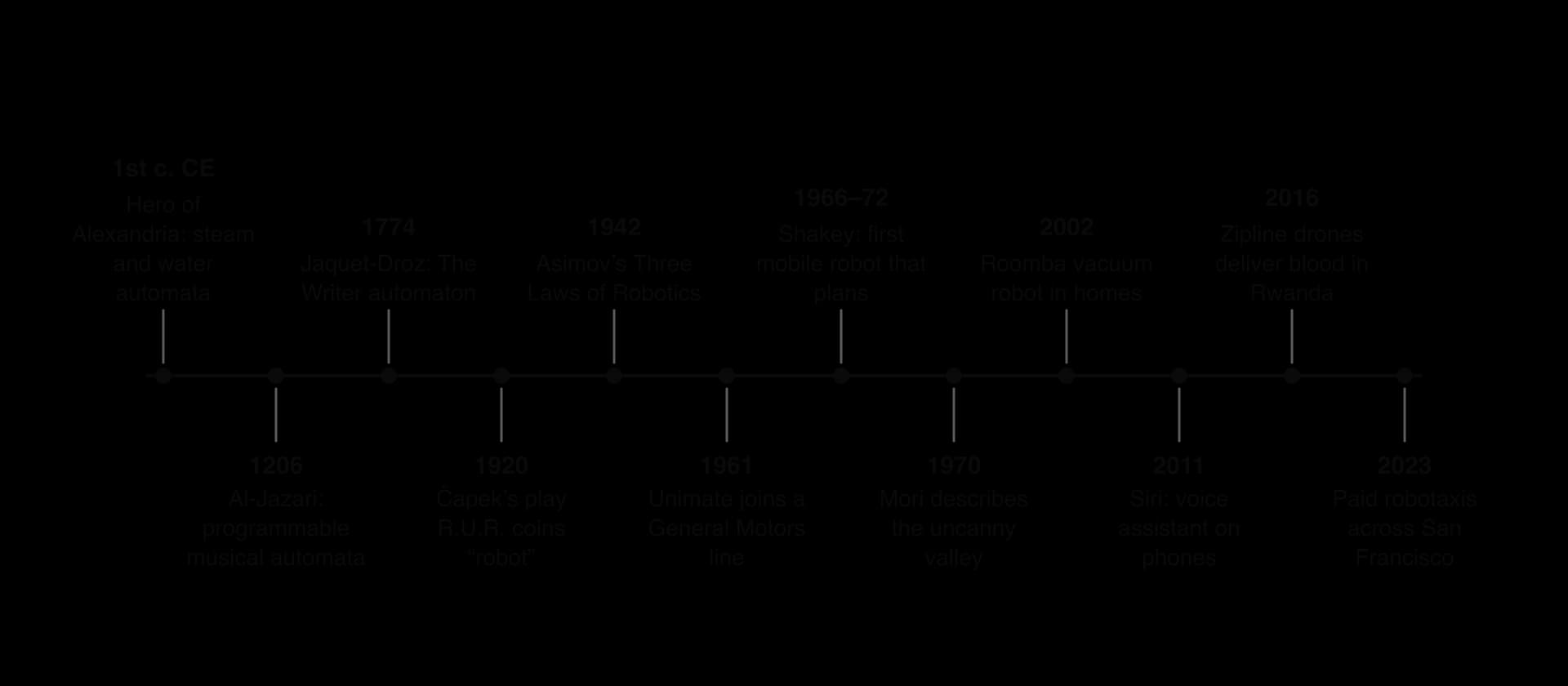
The earliest self-operating machines were automata: mechanical devices that perform a sequence of movements by themselves. In the first century CE, Hero of Alexandria described temple doors that opened when a fire was lit and figures moved by water and steam. In 1206 the engineer Ismail al-Jazari, working in what is now south-eastern Turkey, described a boat of mechanical musicians whose drum patterns could be changed by moving pegs on a rotating drum, an early form of programming. In the 1770s the Swiss watchmaker Pierre Jaquet-Droz built The Writer, a doll that dips a pen in ink and writes a text that can be changed by swapping cams.
Automata could move by themselves, but they could not sense their surroundings or change their behaviour in response. They had the "act" stage of the cycle without "sense" or "think". Later precursors added feedback: the centrifugal governor that regulated steam engines in the eighteenth century sensed engine speed and adjusted the steam supply automatically, an idea that the post-war science of cybernetics developed into a general theory of control.
The word "robot" comes from fiction. The Czech writer Karel Čapek used it in his 1920 play R.U.R. (Rossum's Universal Robots), taking it from the Czech robota, meaning forced labour. Čapek's robots are artificial workers made in a factory, and the play ends with them rising up against their human owners. From its first use, then, the idea of the robot was tied to questions of labour, exploitation and control.
Science fiction has shaped how people think about real robots ever since. In the 1942 short story "Runaround", Isaac Asimov set out his Three Laws of Robotics. The laws are fiction, not engineering rules, and Asimov's stories mostly explored how they fail, as rules that seem clear become contradictory or dangerous in real situations. Real robots follow safety standards (such as ISO 10218 for industrial robots) and product law. Films from Metropolis (1927) to The Terminator (1984) and WALL-E (2008) have spread both fear of and affection for robots, which shapes how the public responds to real machines.
Philosophers asked related questions long before working robots existed. In the seventeenth century René Descartes argued that animal bodies were machines but that human reason could not be produced mechanically; in 1747 Julien Offray de La Mettrie argued in L'Homme machine ("Man a Machine") that humans too are complex machines. The debate continues today: does a machine that behaves intelligently have a mind, or only imitate one?
The first industrial robot, Unimate, was invented by George Devol and developed with Joseph Engelberger. In 1961 it began work at a General Motors plant in New Jersey, lifting hot metal parts from a die-casting machine, a dangerous job for humans. Car makers in the United States, Japan and Europe adopted robots for welding and painting through the 1970s and 1980s, and Japan became the world's leading robot producer.
Industrial robots have since spread from car plants to electronics, metals, plastics, food and pharmaceuticals. Annual installations have more than doubled in ten years, and most new robots now go to Asia, especially China.
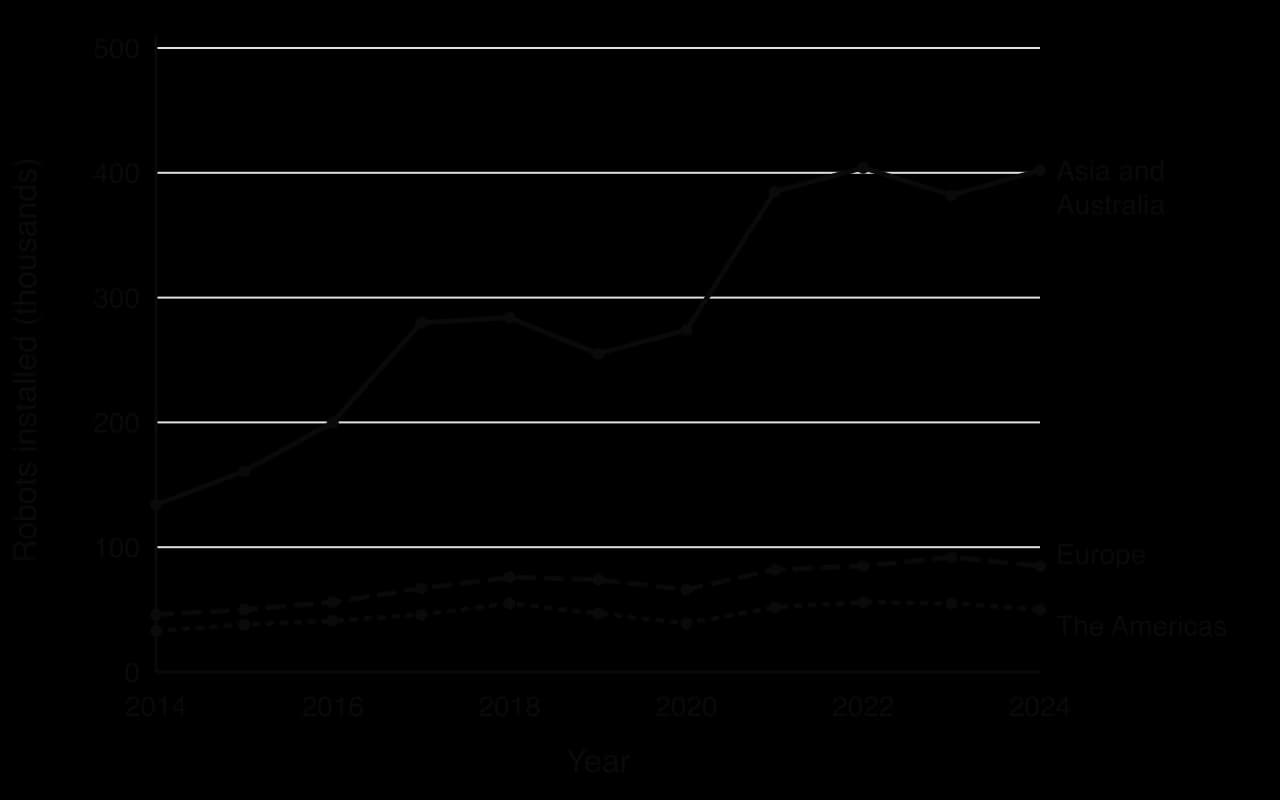
The chart shows a change in where things are made as well as how. Through the concept of change, robots are both a continuity (the long trend of mechanising production since the Industrial Revolution) and a discontinuity, because flexible, sensor-equipped robots can now do tasks that were once thought to need human hands and eyes.
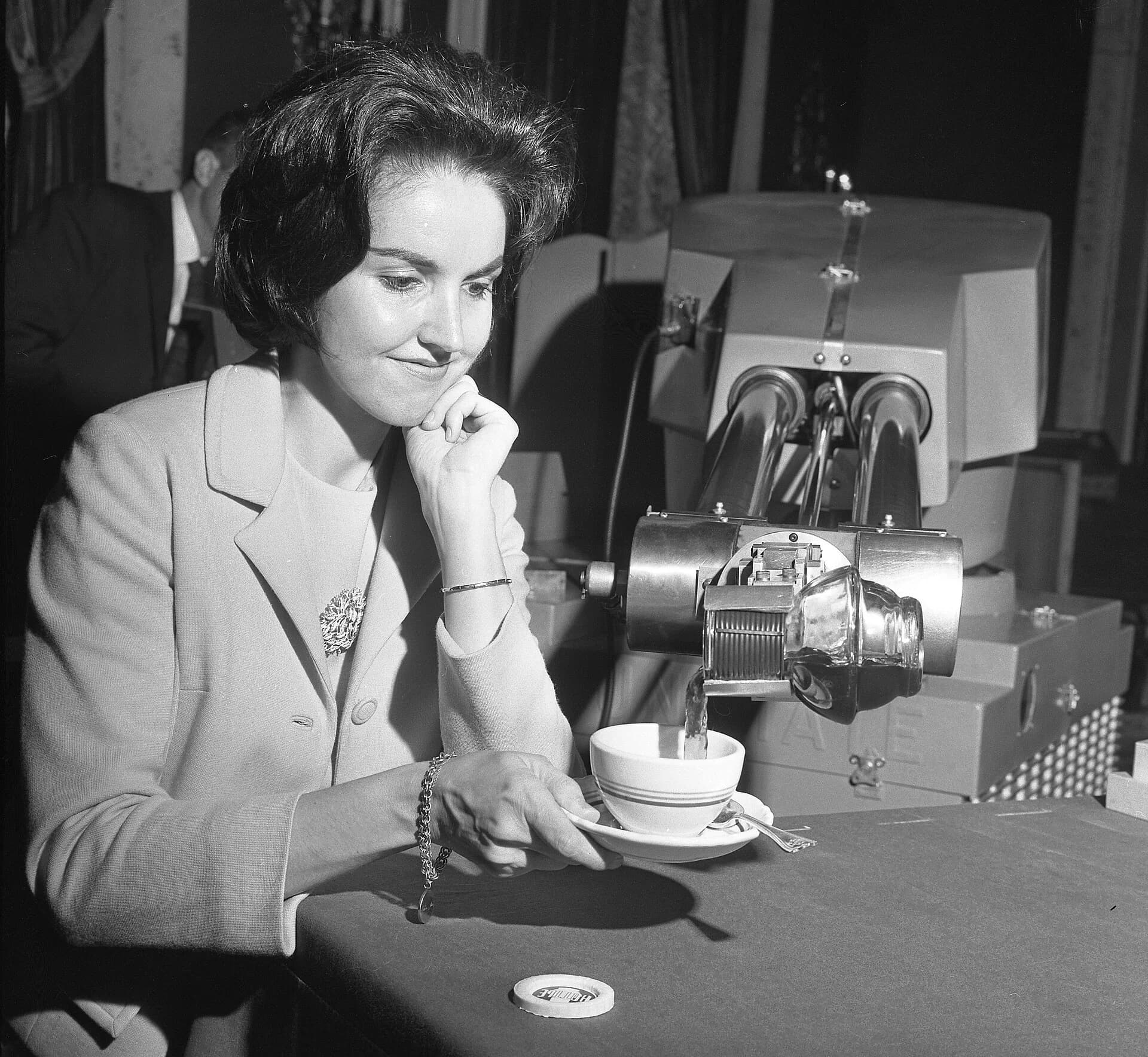
For decades robots were kept apart from the public. Even early experiments hinted at a different future: in 1967 a Unimate arm was demonstrated pouring coffee for a guest at a Los Angeles hotel. The first mobile robot able to reason about its own actions was Shakey, built at the Stanford Research Institute between 1966 and 1972. Shakey used a camera and touch sensors to perceive a set of rooms and planned how to push boxes between them, and software developed for it still underlies route-planning in robots and navigation apps.
From the late 1990s, robots and autonomous technologies entered homes and pockets. Sony's AIBO robot dog (1999) and the Roomba (2002) brought robots into living rooms, Siri and Alexa put assistants on phones and kitchen counters, and from 2020 robotaxis began carrying paying passengers with no driver. Human–robot interaction has become a research field of its own, because how people trust, fear or mistreat robots affects whether the robots work at all.
 YouTube
As robots and AI systems become more capable, three linked debates have moved from philosophy into public policy.
Machine consciousness is the question of whether a machine could have subjective experience: whether there is "something it is like" to be that machine, as there is to be a person. Most scientists think current robots and AI systems are not conscious. They process information and can imitate emotions, but there is no evidence that they feel anything. Philosophers such as John Searle argue that running a program can never by itself produce understanding; others argue that a sufficiently complex system that behaves exactly like a conscious being should be treated as one. In 2022 a Google engineer publicly claimed that the company's LaMDA chatbot was sentient; Google and most researchers rejected the claim, but the episode showed how readily people attribute minds to machines that talk fluently.
Cognitive robotics is a field of research that aims to give robots higher-level abilities such as perception, attention, learning, memory, planning and reasoning, often by copying how humans and animals develop them. A well-known example is iCub, a child-sized humanoid robot developed at the Italian Institute of Technology and used by laboratories around the world to study how a body that moves and touches things can learn concepts, much as an infant does.
Robot rights is the debate about whether robots should have moral or legal rights, and if so which. In 2017 Saudi Arabia announced that it had granted citizenship to Sophia, a humanoid robot made by Hanson Robotics, which many critics saw as a publicity act, pointing out that many human migrant workers in the country could never gain citizenship. In the same year the European Parliament asked the European Commission to consider a special legal status of "electronic persons" for the most advanced autonomous robots, mainly to settle liability for damage. More than 150 experts in robotics, law and ethics signed an open letter in 2018 opposing the idea, arguing that it would let manufacturers escape responsibility.
Arguments about robot rights fall into three groups. Some say rights should depend on consciousness, so no current robot qualifies. Others, such as the researcher Kate Darling, argue that protecting social robots from abuse may be justified for the sake of humans, much as laws against animal cruelty protect human moral character. A third view treats legal personhood as a practical tool, as it is for companies, that implies nothing about feelings.
Robots and autonomous technologies bring clear opportunities: dangerous, dirty and dull work can be handed to machines, goods can become cheaper, and people with disabilities or in remote areas can gain new help. They also raise dilemmas, in which people and communities make competing claims and no option is free of costs.
Anthropomorphism is the human habit of giving human traits, emotions and intentions to non-human things. People name their robot vacuums, apologise to voice assistants and feel sorry for robots that fall over. Research by Julie Carpenter in 2013 found that some US soldiers named their bomb-disposal robots and felt sadness or anger when the robots were destroyed. In 2015 HitchBOT, a Canadian robot that had hitchhiked across Canada and parts of Europe relying on strangers, was found vandalised in Philadelphia, and many people reacted as if a living being had been hurt.
Designers use anthropomorphism deliberately. Faces, names, voices and expressive movements make robots easier to use and more trusted, which can help a social robot comfort a patient. The same effect creates risks. People may trust a friendly robot more than its abilities justify, share private information with it, or form emotional attachments that a company can exploit, for example by making a robot appear sad to encourage a purchase. Through the concept of values and ethics, a key question is whether designing machines to appear to care is a form of deception.
The uncanny valley is a hypothesis put forward by the Japanese roboticist Masahiro Mori in 1970. Mori suggested that as a robot looks more human, people feel more comfortable with it, but only up to a point. When a robot looks almost, but not quite, human, comfort drops sharply into unease or disgust. Only when the robot becomes indistinguishable from a human does comfort rise again.
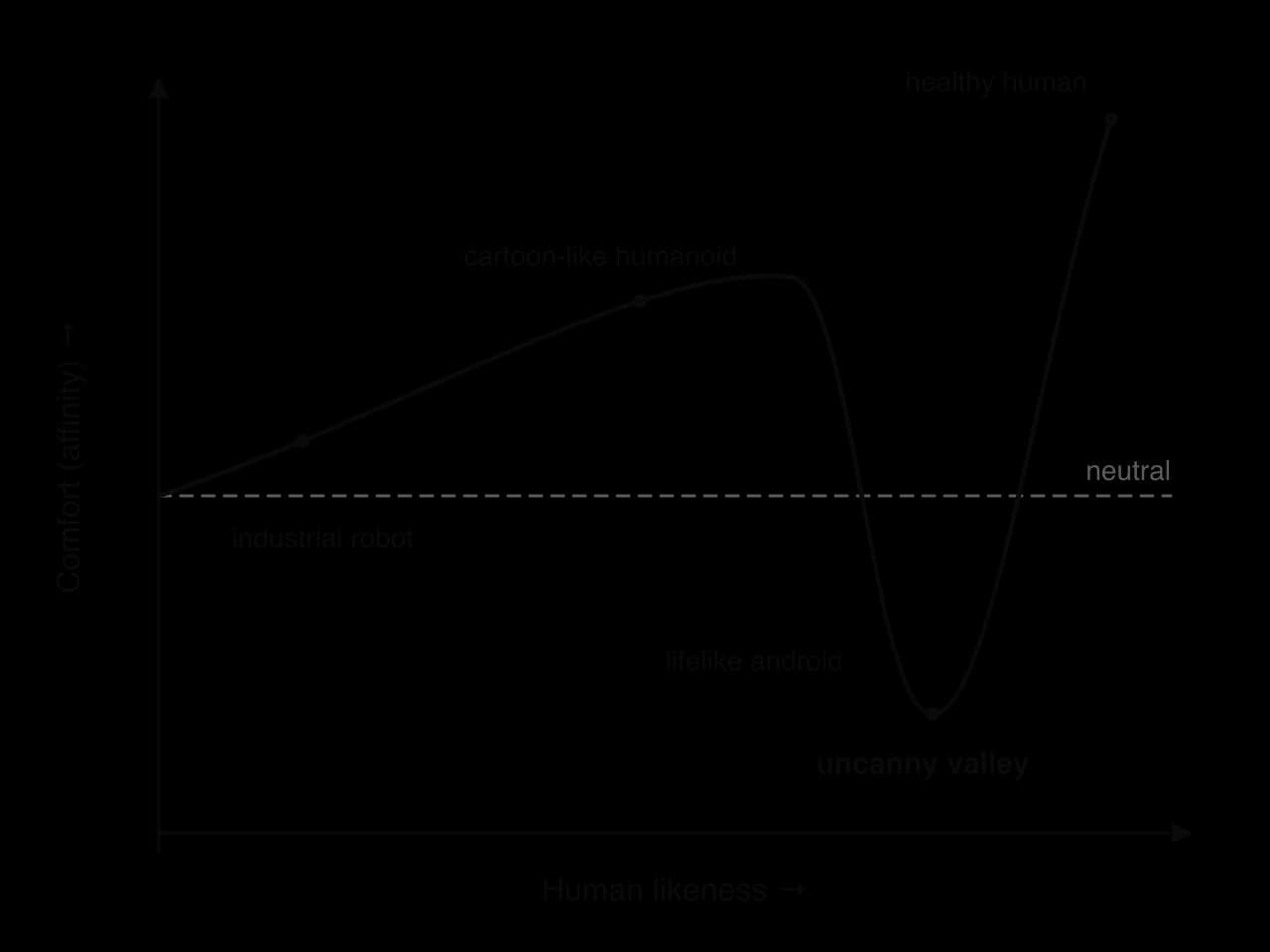
Explanations for the effect vary. One is that near-human faces with odd movements or lifeless eyes trigger the same responses as signs of illness or death. Another is that people cannot decide whether to treat the figure as a person or an object. Studies have produced mixed results, and the effect seems to depend on culture, age and familiarity. Designers respond in two ways: some, like the makers of PARO and many care robots, deliberately avoid human faces; others, like the makers of Sophia, try to cross the valley with ever more realistic faces.
Robots perform best in structured environments where everything is predictable. The real world is unstructured: people behave unexpectedly, weather changes, objects are out of place and rules are broken. Each unusual situation, called an edge case, must be handled safely, and there are effectively infinite edge cases on a city street.
The first recorded death of a pedestrian struck by a self-driving test car shows the difficulty. In March 2018 an Uber test vehicle in Tempe, Arizona, hit and killed a woman pushing a bicycle across a road away from a crossing. The US National Transportation Safety Board found that the software detected her several seconds before impact but repeatedly changed its classification of her, and had not been designed to expect pedestrians outside crossings; the human safety driver was looking at a phone. The failure lay in the interaction between the sensing, the software, the safety driver and the road design, an example of an unintended consequence in a complex system.
People also change their behaviour around robots. Some pedestrians step out in front of driverless cars because they expect them to stop, some people vandalise robots, and some over-trust automation, a pattern called automation bias. Environmental conditions matter too: snow can cover lane markings, dust can blind sensors, and wind can ground a drone.
Laws were written for a world in which a human operated every machine. When a robot causes harm, it is often unclear who is responsible: the manufacturer, the software developer, the owner or the remote operator. This problem of liability links robots to the political context.
Governance is uneven across the world and even within countries. In the United States, states set most rules for testing driverless cars, so a robotaxi can be legal in one state and not in the next. The European Union's Machinery Regulation (2023) updates safety rules for machines, including those that learn and change their behaviour, and the EU's AI Act (2024) classes AI systems used as safety components of products such as robots as high-risk. Many countries have no specific rules at all.
Other governance debates concern how robots may be used. In November 2022 San Francisco's Board of Supervisors voted to let police use remote-controlled robots to deliver lethal force in extreme situations, then reversed the decision a week later after protests. International negotiations on lethal autonomous weapon systems have continued at the United Nations for more than a decade without a binding treaty.
Automation by robots can displace humans: it replaces people in tasks or jobs, or changes the roles they play. Displacement happens in factories and warehouses, but also in driving, delivery, retail, farming, care and even companionship. It is one of the most debated impacts of robots, and the evidence points in more than one direction.
On one side, the economists Daron Acemoglu and Pascual Restrepo (2020) found that in US local labour markets between 1990 and 2007, each additional robot per thousand workers reduced the share of the population in employment by about 0.2 percentage points and wages by about 0.4%, with workers without degrees hit hardest. On the other side, robots create jobs in design, maintenance and programming, and can make firms competitive enough to hire more people in other roles. The OECD estimated in 2019 that about 14% of jobs in its member countries were at high risk of automation, and a further 32% were likely to change significantly.
Context | Who may be displaced | Example | Possible new roles or benefits |
|---|---|---|---|
Manufacturing (economic) | Assembly and welding workers | Robot welding lines in car plants | Robot technicians, safer workplaces |
Logistics (economic) | Warehouse pickers and packers | Amazon's robotic fulfilment centres | Robot supervisors; less walking and lifting |
Transport (economic, social) | Taxi, ride-hailing and truck drivers | Robotaxis in San Francisco and Wuhan | Remote assistants, fleet maintenance |
Health and care (health) | Some tasks of nurses and carers | Social robots in Japanese care homes | More time for human contact, if staffing is kept |
Home life (social, cultural) | Human companionship and domestic help | Robot vacuums, voice assistants | Independence for older and disabled people |
San Francisco became the world's main testing ground for driverless taxis in the early 2020s. Two companies led: Waymo, which began as Google's self-driving car project in 2009, and Cruise, a start-up bought by General Motors in 2016. Both tested cars in the city for years with safety drivers before starting to carry members of the public with no one in the driver's seat.
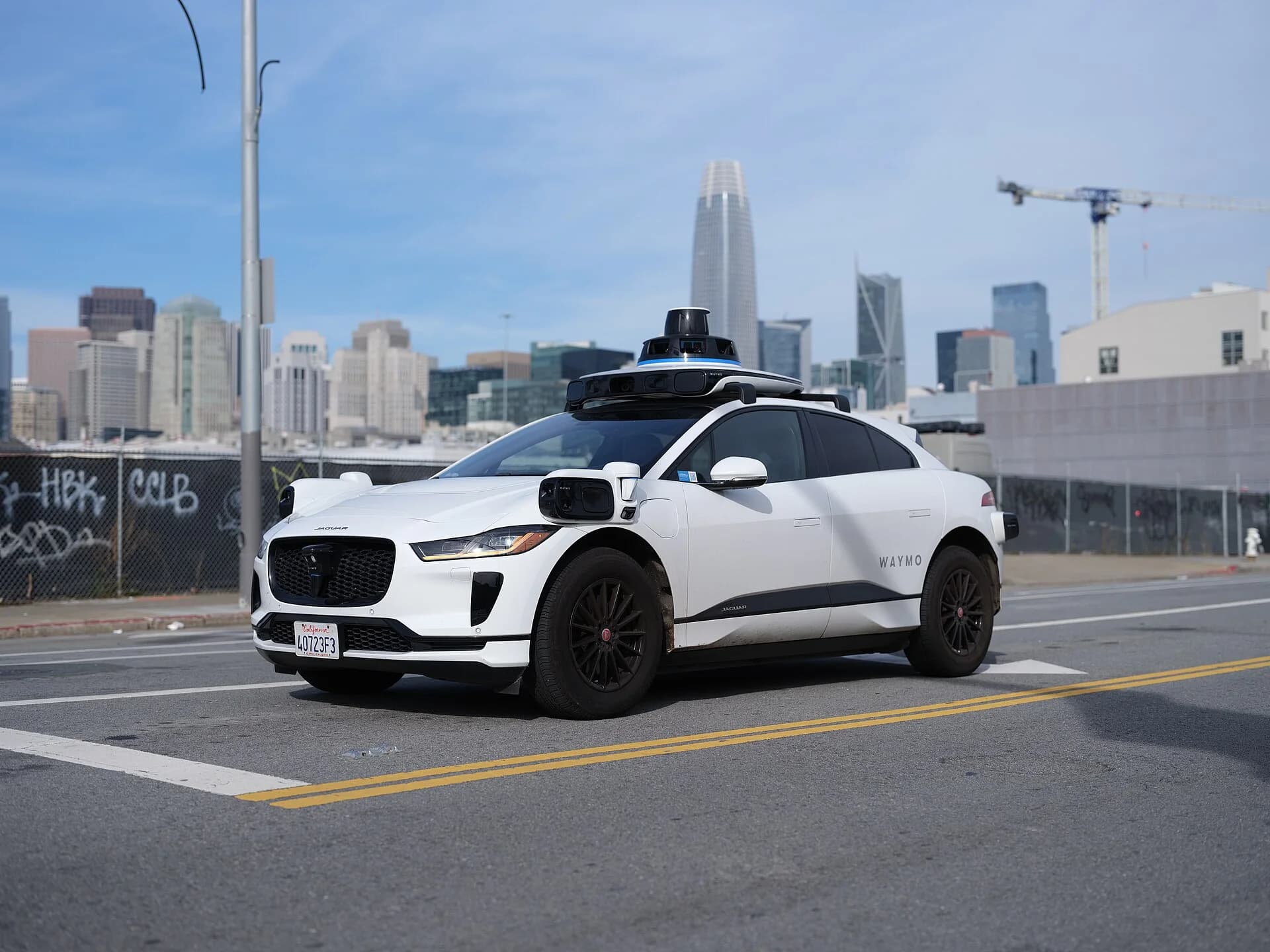
In California two state bodies control robotaxis. The Department of Motor Vehicles (DMV) issues permits to test and deploy driverless cars, and the California Public Utilities Commission (CPUC) issues permits to carry passengers for money. City governments have no power to license or limit them. On 10 August 2023 the CPUC voted 3–1 to let both Waymo and Cruise charge fares for driverless rides across San Francisco, at any time of day, with no limit on fleet size.
Date | Event |
|---|---|
July 2023 | The activist group Safe Street Rebel places traffic cones on robotaxi bonnets, which makes them stop until reset |
10 August 2023 | The CPUC approves 24-hour paid driverless service for Waymo and Cruise across San Francisco |
17 August 2023 | A Cruise robotaxi collides with a fire engine on an emergency call; the DMV asks Cruise to halve its fleet |
2 October 2023 | A Cruise car runs over a pedestrian thrown into its path by a hit-and-run driver, then drags her about 6 metres while pulling over |
24 October 2023 | The DMV suspends Cruise's driverless permits, saying its cars are unsafe and that the company misrepresented information; Cruise later halts driverless operations across the US |
February 2024 | A crowd vandalises and sets fire to a Waymo car in Chinatown during Lunar New Year celebrations |
June 2024 | Waymo opens its San Francisco service to anyone, removing its waiting list |
November 2024 | Cruise admits filing a false report to federal regulators about the October 2023 crash and agrees to pay a $500,000 fine |
December 2024 | General Motors stops funding Cruise's robotaxi business after investing more than $10 billion since 2016 |
A Waymo or Cruise robotaxi is a Level 4 autonomous vehicle: it drives itself with no human inside, but only within a mapped service area and under conditions its makers have tested. Riders book a trip in an app much like Uber's. The car follows the sense–think–act cycle many times a second.
Sense. Roof-mounted and corner lidar units build a 3D point cloud of the surroundings; cameras read traffic lights, signs and the gestures of police officers; radar tracks the speed of other vehicles, even in fog.
Think. Software fuses the sensor data, places the car on a detailed pre-made map, uses machine learning to classify objects (car, cyclist, pedestrian, cone) and predict their next moves, and plans a path that obeys traffic law and keeps a safe distance.
Act. Electric motors, steering and brakes carry out the plan. If the car cannot decide safely, it stops, puts on its hazard lights and asks for help from remote staff, who can give it guidance but do not usually steer it.
The service depends not only on the car but also on maps, data centres, mobile networks, remote assistance teams, regulators and the behaviour of every other road user.
The robotaxis created clear opportunities. Riders gained a taxi service available at any hour, and some passengers told reporters that they preferred travelling without a stranger at the wheel. Blind and partially sighted people gained a way to travel without depending on a driver, although the cars were not designed for wheelchair users. By June 2024, when Waymo removed its waiting list, almost 300,000 people had signed up to it. By mid-2024 Alphabet reported more than 50,000 paid Waymo rides a week across its cities.
Waymo also argued that its cars were safer than human drivers. A study published in December 2024 by the insurer Swiss Re, using Waymo's data, compared liability claims over 25.3 million driverless miles with the claims that human drivers would be expected to produce over the same distance.
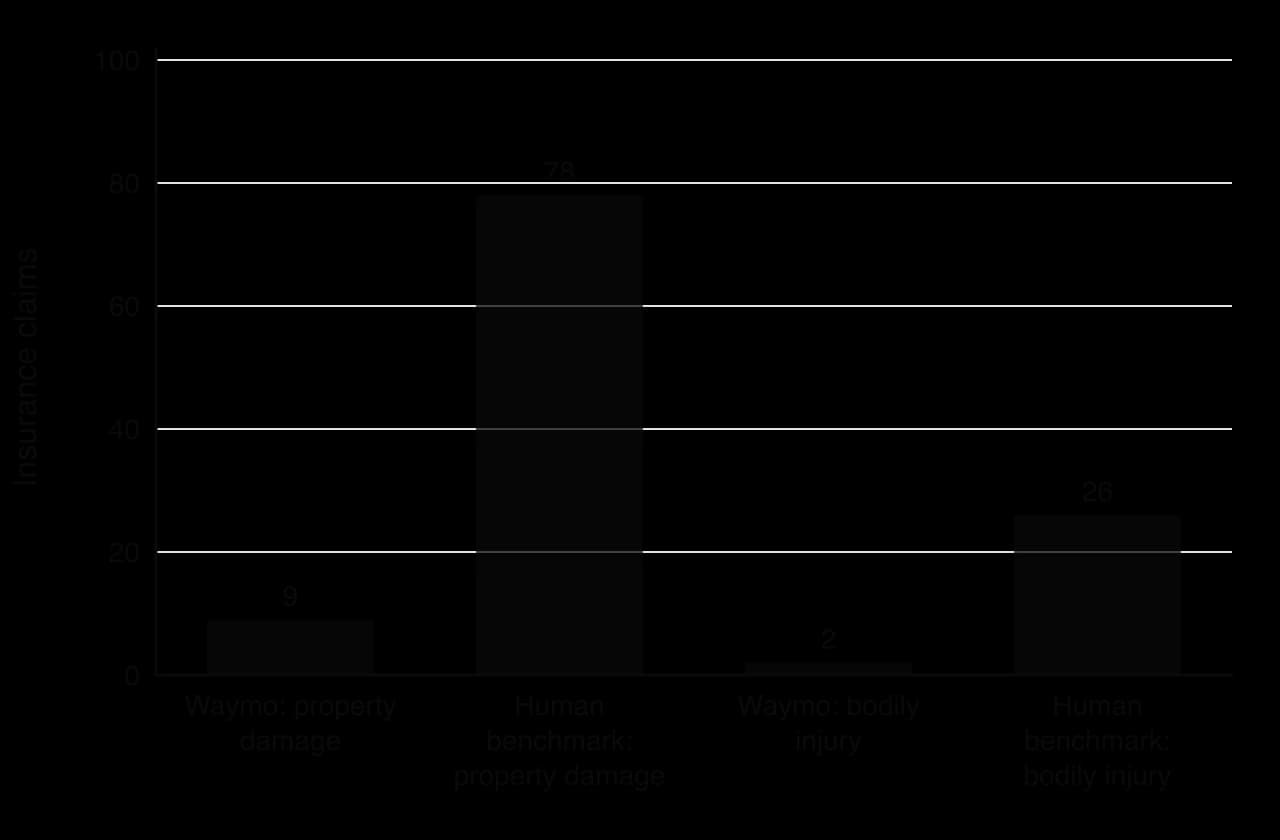
The figures are striking, but their origin and purpose matter. The study was produced with the company that benefits from its results, covers only the areas and conditions Waymo chose to operate in, and does not capture disruption that leads to no insurance claim. Independent studies in harder conditions would make the evidence stronger.
The robotaxis also had negative impacts. In 2023 alone the San Francisco Fire Department logged dozens of incidents in which driverless cars interfered with emergency work, for example by stopping in front of fire stations or driving into areas taped off for emergencies. Bus drivers and transit officials reported cars blocking lanes. Police could not issue a traffic ticket to a car with no driver, so California created a separate process, in force from July 2026, under which police can issue a "notice of autonomous vehicle noncompliance" to the operating company when they see a driverless car break a traffic law.
The Cruise crash of October 2023 was the turning point. A human driver hit a pedestrian and threw her into the path of a Cruise car, which braked but could not avoid her. The car then tried to pull over, as it was programmed to do after a collision, and dragged her about 6 metres because its sensors did not detect that she was trapped underneath. The DMV found that Cruise had at first shown regulators a video that did not include the dragging. Within weeks Cruise had lost its permits, paused its fleet nationwide, recalled the software in about 950 vehicles and lost its chief executive.
Not everyone accepted the technology. Safe Street Rebel's "week of cone" protest in July 2023 showed how easily the cars could be disabled. The Teamsters union, which represents many drivers, backed a state bill to require human operators in heavy autonomous trucks, which the governor vetoed in September 2023. Some residents objected to cars with dozens of cameras recording the streets, and the burning of a Waymo car in February 2024 showed how hostile some reactions became.
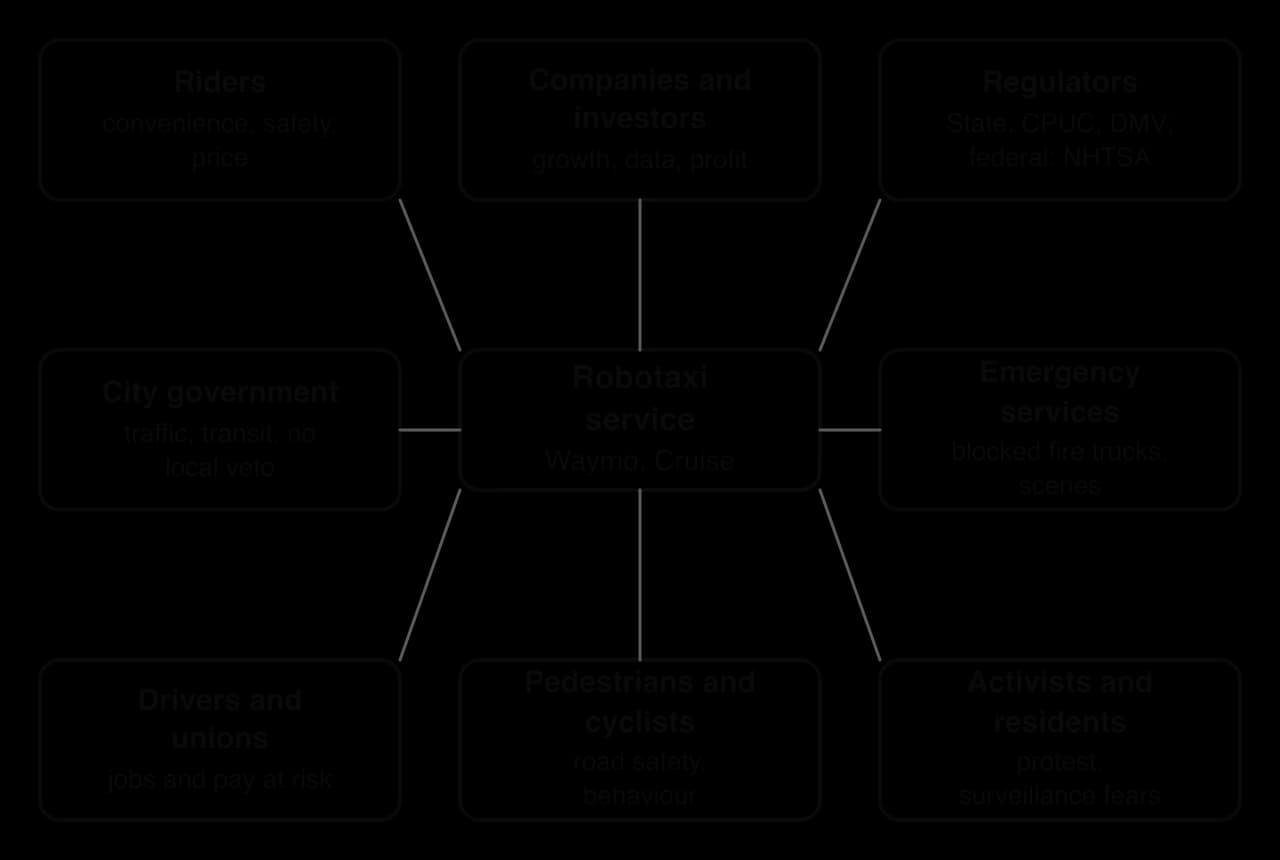
Power. California law placed the power to approve robotaxis with state agencies, not with the city where they operate. San Francisco's officials, fire chief and transit agency objected to unlimited expansion, but the CPUC approved it. Large, well-funded companies were able to shape the rules, while residents who never chose to share streets with robotaxis had little say. The suspension of Cruise showed that state regulators could also use power quickly once trust was broken, and that a company's control of information, such as crash videos, is itself a source of power.
Values and ethics. Supporters argued from consequences: if robotaxis cause far fewer injuries than human drivers, society has an ethical reason to allow them, even if they make occasional strange errors. Critics argued from duties and rights: the public was being used in a live experiment without its consent, and companies have a duty to be transparent when things go wrong. Cruise's misleading report to regulators suggests that commercial pressure can conflict with the duty of honesty that public trust requires.
Change. Robotaxis represent a possible discontinuity in urban transport, replacing the human driver who has been central to taxis for over a century. The contrasting fates of Cruise and Waymo show that change is not inevitable progress: the same technology, in the same city and the same year, led to expansion for one company and closure for the other, depending on safety records, honesty and public trust.
Systems. The October 2023 crash came from an interaction between a hit-and-run driver, the robotaxi's programmed pull-over behaviour and its limited sensor coverage under the car. A rule designed to make the car safer after a collision produced an unintended consequence that no part of the system was designed to handle.
The San Francisco robotaxis show both sides of the dilemmas of autonomous technologies. The available evidence suggests that a well-designed Level 4 system can produce fewer injury crashes than human drivers in the places it operates, and the service gave some riders new safety and independence. At the same time, the cars created new kinds of harm, such as blocking emergency vehicles, that existing laws did not anticipate, and they threatened the livelihoods of drivers without any plan for them.
A reasonable judgement is that robotaxis benefit people and communities only under conditions: independent safety data, a role for local government and emergency services in setting rules, clear liability, and attention to displaced workers. Waymo's continued expansion after 2024 and Cruise's closure suggest that public trust, built through safety records and honesty, matters as much as the technology itself.
HL students may meet robots and automation in Section B, where counter-claims are central.
I can define a robot and an autonomous technology and explain how they differ.
I can describe industrial and productivity robots, service robots and social robots, with a real-world example of each.
I can explain why the Internet of Things, autonomous vehicles, drones and virtual assistants count as autonomous technologies.
I can draw and explain the sense–think–act cycle, including the role of sensors and actuators.
I can distinguish spatial, environmental and operational awareness and name sensors for each.
I can explain how machine vision and machine learning help robots reason with sensor data.
I can explain teleoperation and how remote control and autonomy combine.
I can describe the six levels of driving automation and place a real vehicle on the scale.
I can outline the evolution of robots from automata, science fiction and philosophy to industry and everyday life.
I can explain machine consciousness, cognitive robotics and the debate over robot rights.
I can explain anthropomorphism and the uncanny valley with examples.
I can analyse why complex human and environmental interactions make robots hard to deploy safely.
I can discuss gaps in laws and governance for robots and autonomous technologies.
I can evaluate the displacement of humans by robots in several contexts and roles.
I can use the San Francisco robotaxi case to support claims about power, change, systems and values and ethics.