3 Content
How the seven content areas fit together, from data and algorithms running on computers and networks to the media, AI and robots built from them, and what each subtopic of Topic 3 covers.
- IB Digital Society
- SL and HL
What 3 covers
From the subject guide: what you need to know and be able to do.
The technologies themselves: how they work and what they make possible.
7 subtopics in Content
Each one has its own page once something is published for it.
- 3.1Datanotes
- 3.2Algorithmsnotes
- 3.3Computersnotes
- 3.4Networks and the internetnotes
- 3.5Medianotes
- 3.6Artificial intelligencenotes
- 3.7Robots and autonomous technologiesnotes
An overview of 3 Content
What content means in the course
Content is the knowledge of how digital systems work. It informs an inquiry: no one can judge the effects of a recommendation feed, a facial recognition camera or a delivery robot without knowing what it does, what it needs and where it can fail. Content is studied in enough depth to explain and evaluate these effects, not in the depth of a computer science course.
Topic 3 divides digital technology into seven areas. They are taught as separate subtopics, but in practice almost every real system involves several of them at once. A ride-hailing app, for example, collects location data, matches riders to drivers with algorithms, runs on phones and servers, communicates over mobile networks, and increasingly uses machine learning to predict demand.
How the seven areas connect
The seven areas form layers, as the relationship diagram shows. At the base are the physical machines and connections. In the middle are the data and the instructions that work on it. At the top are the forms of technology that people meet most directly.
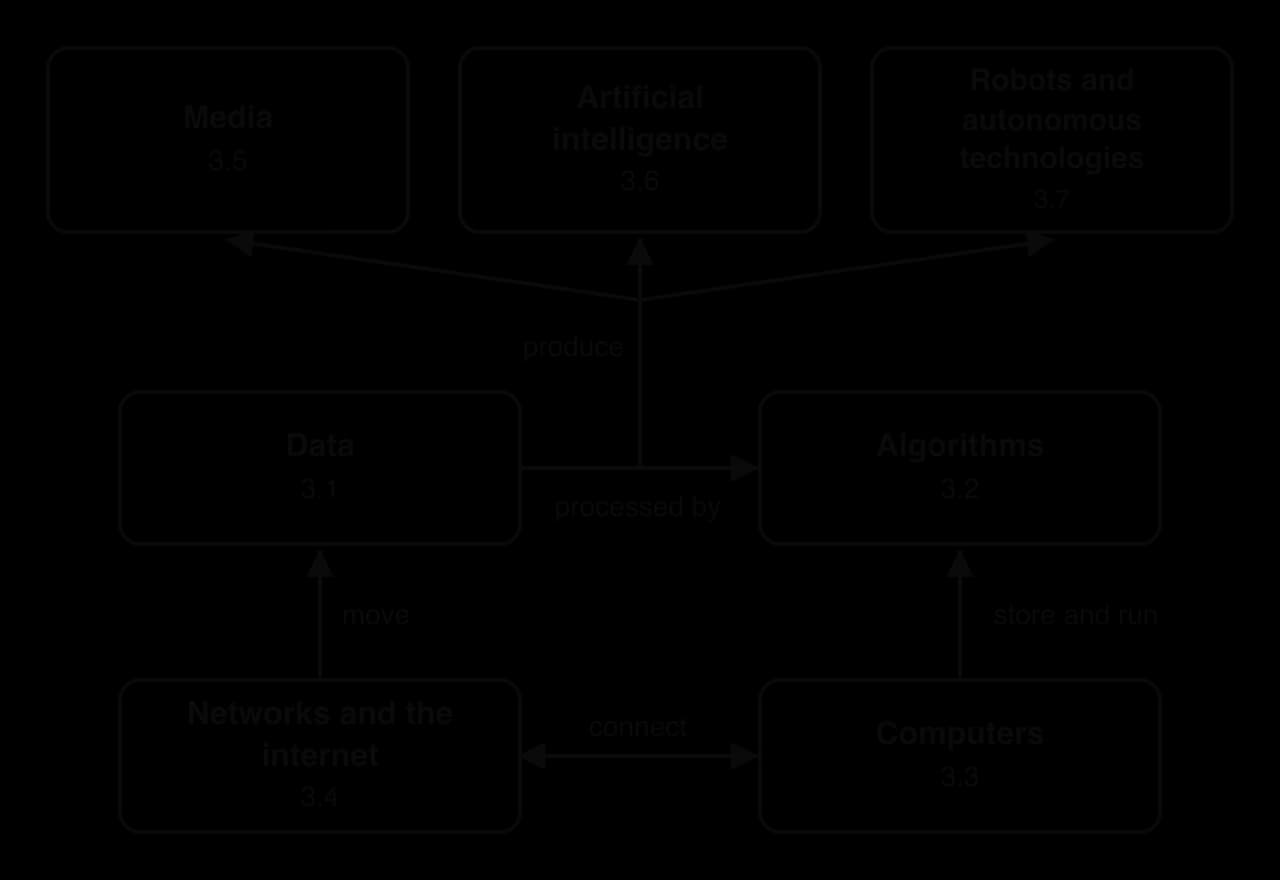
The base. Computers store data and carry out instructions. Networks, especially the internet, connect computers so that data can move between them.
The middle. Data is the raw material: recorded facts about people, places and events. Algorithms are the step-by-step instructions that sort, search, filter and classify that data to produce useful results.
The top. Digital media are the content that people create and share. Artificial intelligence uses data and algorithms to perform tasks that once needed human thinking. Robots and autonomous technologies add sensors and moving parts, so that digital decisions take effect in the physical world.
The layers depend on each other in both directions. Artificial intelligence could not have advanced so quickly in the 2010s without large datasets gathered online and powerful graphics processors, and its demand for computing has in turn driven the construction of new data centres.
The seven subtopics
Subtopic | What it covers |
|---|---|
3.1 Data | How data differs from information and knowledge; types of data; how it is collected, stored, represented and secured; big data and analytics; dilemmas of bias, ownership and privacy |
3.2 Algorithms | What makes a set of steps an algorithm; its parts and ways of writing it; uses from sorting to machine learning; dilemmas of bias, transparency and accountability |
3.3 Computers | Types of computer from mainframes to wearables; hardware, interfaces and software; coding; the evolution of computing and Moore's law |
3.4 Networks and the internet | Types, parts and features of networks; the web as distinct from the internet; how both evolved; dilemmas from surveillance to ransomware |
3.5 Media | Types and features of digital media, including immersive and AI-generated media; dilemmas of addiction, authenticity, copyright, preservation and censorship |
3.6 Artificial intelligence | Types of AI and machine learning; neural networks; the history of AI; dilemmas of bias, accountability, regulation and job losses |
3.7 Robots and autonomous technologies | Types of robots and autonomous systems; how they sense, reason, move and act; their evolution; dilemmas such as the uncanny valley and the displacement of workers |
Every subtopic ends with dilemmas. The technical detail matters because it explains why those dilemmas arise: an algorithm trained on biased data repeats the bias, and a network built without strong security invites attack.
Content in an inquiry
Content links the course's concepts and contexts to the actual technology. Through the concept of power, an inquiry asks who owns the data a smart speaker collects; the content of 3.1 Data explains what is collected and where it goes. In the health context, an inquiry into an AI tool that reads X-rays needs the content of 3.6 Artificial intelligence to explain how the tool learned and why it may perform worse for some groups of patients.
Carry on with 3 in Augment
With a free account, Augment remembers where you stopped and what you have practiced.