Distinguish types of AI and machine learning, explain how neural networks learn and generalise, trace AI's evolution from cybernetics to large language models, and evaluate its dilemmas of bias, accountability, governance and work.
Each is in the Digital Society glossary, with every other term in the subject.
The laws, regulations, standards, policies and institutions that guide and limit how AI systems are developed, deployed and used, at company, national and international levels.
An output from a generative AI system that is presented as fact but is false, invented or not supported by its sources, such as a made-up citation or legal case.
A period in which interest, funding and research in AI fall sharply after the technology fails to meet inflated expectations, as happened in about 1974 to 1980 and 1987 to the early 1990s.
A proposed form of AI that would match or exceed human ability across almost any intellectual task, transferring knowledge between areas and reasoning about new situations. It does not exist today.
The ability of a digital system to perform tasks that normally need human intelligence, such as recognising patterns, understanding language, making decisions or creating content, often by learning from data rather than following only fixed rules.
A machine learning model made of layers of connected nodes, in which each connection has a weight that is adjusted during training so that the network learns to map inputs to the correct outputs.
A computer program that holds a conversation with users in text or speech. Early chatbots such as ELIZA followed scripted rules; modern ones such as ChatGPT are built on large language models.
Define artificial intelligence and distinguish between narrow (weak, domain-specific) AI and general (strong, full) AI.
Outline the Turing test and discuss its strengths and limitations as a test of machine intelligence.
Distinguish between supervised, unsupervised and reinforcement learning, and explain what makes deep learning different.
Describe uses of machine learning, including pattern recognition, facial and speech recognition, image analysis and natural language processing.
Explain how artificial neural networks learn complex, non-linear relationships and generalise from the examples they are trained on.
Outline the evolution of AI, including its roots in science fiction and philosophy, cybernetics, the AI winters, and the ideas of the singularity and the multiplicity.
Analyse the dilemmas that AI raises: fairness and bias, accountability, transparency, uneven laws and governance, and automation and the displacement of humans.
Evaluate the impacts and implications of generative AI and large language models for people and communities, using ChatGPT as a real-world example.
Artificial intelligence (AI) describes digital systems that perform tasks which once needed human thinking, such as recognising faces, translating languages, diagnosing illness or writing text. AI already sits inside everyday tools, from the spam filter in an email inbox to the voice assistant on a phone, and since the release of ChatGPT in 2022 it has become one of the most debated technologies in digital society.
AI builds on other content in the course: data (3.1), algorithms (3.2), computers (3.3) and networks (3.4). It produces new forms of media (3.5) and gives robots and autonomous vehicles the ability to sense and decide (3.7). Through the concepts of power, values and ethics, and change, AI raises questions in every context: who gets hired (economic), how illness is diagnosed (health), what counts as original work (cultural and human knowledge), and how states watch their citizens (political).
With a free account, Augment remembers where you stopped and what you have practiced.
A field of AI that enables computers to identify and interpret the content of images and video, such as objects, people, text and movement.
The study of control and communication in machines and living things, based on feedback loops in which a system senses the effects of its actions and adjusts its behaviour. It was named by Norbert Wiener in 1948.
A form of machine learning that uses artificial neural networks with many hidden layers to learn complex patterns directly from large amounts of raw data such as images, audio or text.
AI systems, or methods applied to them, that make the reasons for an output understandable to humans, so that decisions can be checked, challenged and trusted.
The use of AI to detect a human face in an image and identify or verify the person by comparing measurements of their facial features with stored records.
The ability of a trained machine learning model to make accurate predictions on new, unseen data, not only on the examples it was trained on.
AI that produces new content, such as text, images, music, video or code, by learning the patterns in very large amounts of existing content and generating new examples in response to a prompt.
A layer of nodes between the input and output layers of a neural network, whose values are neither the input nor the final answer; hidden layers learn features such as edges and shapes.
Data in which each example is tagged with the correct answer, such as an email marked spam or not spam, used to train supervised learning systems.
A deep learning model with billions of weights, trained on vast amounts of text to predict the next token in a sequence, which allows it to generate fluent text and perform many language tasks.
A type of AI in which an algorithm finds patterns in data and uses them to make predictions or decisions, improving its performance as it is given more examples, without being explicitly programmed for each case.
The view, proposed by Ken Goldberg, that the future of AI lies in diverse groups of humans and machines working together on problems, rather than in a single superintelligent machine replacing human intelligence.
AI designed and trained for a specific task or domain, such as recognising faces or recommending videos, which cannot transfer its ability to unrelated tasks. It is also called weak AI or domain-specific AI.
A field of AI that enables computers to analyse, understand and generate human language, as in translation, chatbots and sentiment analysis.
A single processing unit in a neural network that adds up the weighted signals it receives, applies a simple function to them and passes the result on to the next layer.
A problem in which a machine learning model learns the details and noise of its training data so closely that it performs poorly on new data.
The automated identification of regularities in data, such as shapes in images, sequences in sound or trends in numbers, so that new data can be classified or predicted.
Machine learning in which an agent learns to make decisions by taking actions in an environment and receiving rewards or penalties, gradually finding the strategy that earns the most reward.
The use of AI to convert spoken words into written text, so that a system can respond to voice commands or transcribe speech.
A proposed form of AI that would have genuine understanding, and possibly consciousness, rather than only simulating intelligent behaviour. It is often used together with general AI and full AI for a system with human-level ability across all tasks.
Machine learning in which the algorithm is trained on labelled data, where each example has a known correct output, so that it learns to predict the output for new examples.
A hypothetical future point at which AI surpasses human intelligence and improves itself so rapidly that technological change becomes uncontrollable and unpredictable.
The set of examples a machine learning algorithm learns from. The quality and representativeness of the training data largely decide how accurate and fair the resulting model is.
A test, proposed by Alan Turing in 1950, of whether a machine can imitate human conversation so well that a human judge, communicating by text alone, cannot reliably tell the machine from a real person.
Machine learning in which the algorithm is given unlabelled data and finds patterns, groups or unusual cases in it without being told the correct answers.
AI that simulates intelligent behaviour without having a mind or genuine understanding. The term is often used as a synonym for narrow AI and says nothing about how well the system performs its task.
A number attached to a connection between two nodes that controls how much influence one node's output has on the next; training a network means adjusting its weights.
AI is hard to define, because "intelligence" itself is contested. A useful working definition treats AI as a set of agents, devices or systems that adapt in order to perform tasks, or appear to perform them, that once required human cognitive and creative processes such as perceiving, reasoning, learning, deciding and creating.
Three parts of this definition matter. AI systems adapt: their behaviour changes as they process more data or receive feedback. The phrase "or appear to" is deliberate, because a chatbot can produce fluent sentences without understanding them as a person does. And the list of tasks counted as "AI" keeps moving: once a task such as route planning becomes routine, people often stop calling it AI.
Early AI systems were mostly rule-based (also called symbolic AI). Programmers wrote explicit rules, such as "if the patient has a fever and a rash, consider measles". The expert systems of the 1980s worked this way. They performed well in narrow, predictable areas but broke down when the world did not match their rules.
Most modern AI instead uses machine learning: the system is shown many examples and works out its own rules from the patterns in them. Gmail's spam filter, which learns from messages that users mark as spam, is an example. The difference matters for AI's dilemmas. A rule written by a person can be read and challenged, while a pattern learned from millions of examples may be impossible to inspect directly.
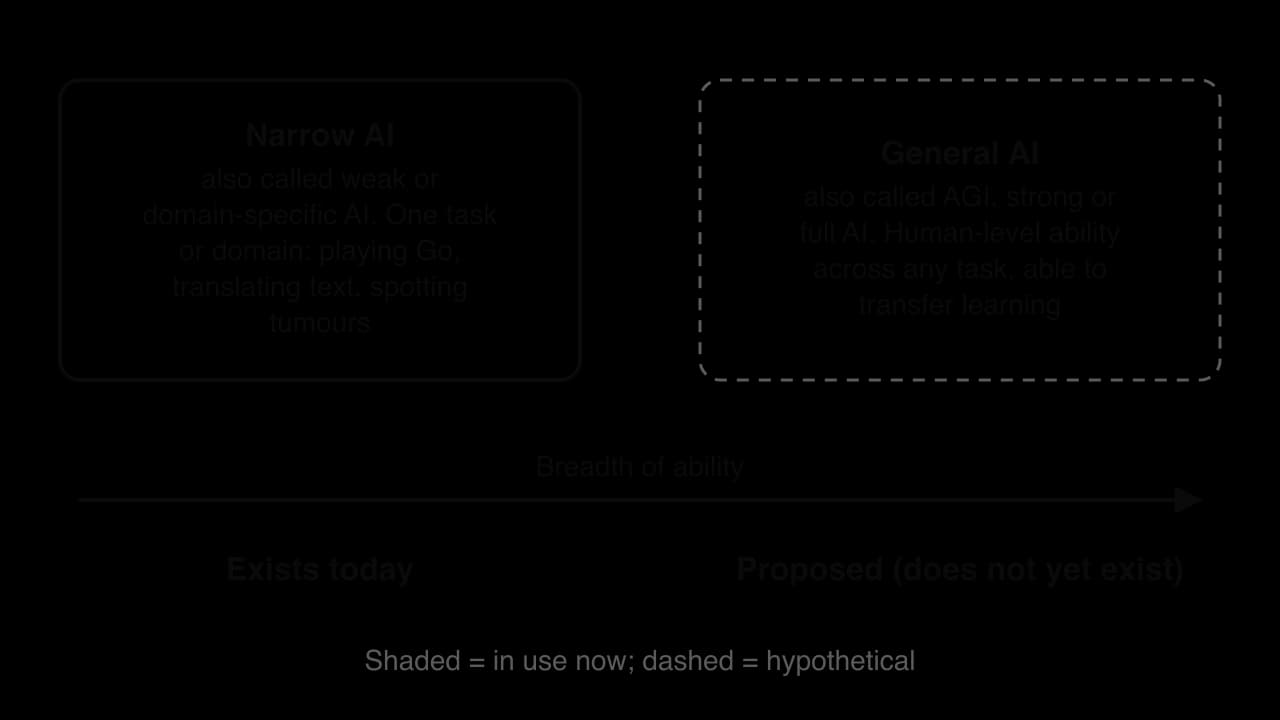
AI is grouped into types in several overlapping ways, and experts disagree about where the lines fall. The most common division is by breadth: how many different tasks a system can handle.
Narrow AI performs one task, or a small family of related tasks, within a single domain. Every AI system in use today is narrow in this sense. DeepMind's AlphaGo plays Go better than any human but cannot play chess, drive a car or write a poem without being rebuilt and retrained.
The terms weak AI and domain-specific AI are often used as synonyms for narrow AI. "Domain-specific" stresses that the system works within one field, such as medical imaging. "Weak" comes from philosophy: the philosopher John Searle used "weak AI" in 1980 for the view that computers can simulate thinking without actually having a mind. Weak does not mean poor performance. A weak AI system can be far more accurate than any human at its one task.
Artificial general intelligence (AGI) would match or exceed human ability across almost any intellectual task. It could transfer knowledge from one area to another and reason about situations it has never met. AGI does not exist today, although several companies, including OpenAI and Google DeepMind, state that building it is their goal.
Strong AI and full AI are frequently used as near-synonyms for AGI, but the terms stress different things. "General" is about breadth of ability. "Strong", in Searle's original sense, is about whether the machine truly has a mind. "Full" suggests a complete replica of human intelligence. A system could in theory be general without being strong, if it handled every task brilliantly but understood nothing, which is why the categories are contested.
The comparison diagram sets today's systems beside proposed ones.
Type | Other names | What it can do | Status | Real-world example |
|---|---|---|---|---|
Narrow AI | Weak AI, domain-specific AI | One task or domain, often better than humans | In use everywhere | Google Translate; AlphaGo; Spotify recommendations |
General AI | AGI, strong AI, full AI | Any intellectual task a human can do, with transfer of learning | Proposed; does not exist | None (a goal of OpenAI and Google DeepMind) |
Large language models such as GPT-4 complicate the division. They write essays, translate, write code and pass professional tests, so some researchers see "sparks" of general intelligence in them. Others point out that the same models still make basic reasoning errors, cannot learn from experience after training and have no goals of their own, so they remain narrow systems with a very wide domain (language). The disagreement is partly about definitions: judged by outputs, the systems look increasingly general; judged by understanding, many philosophers class them as weak AI.
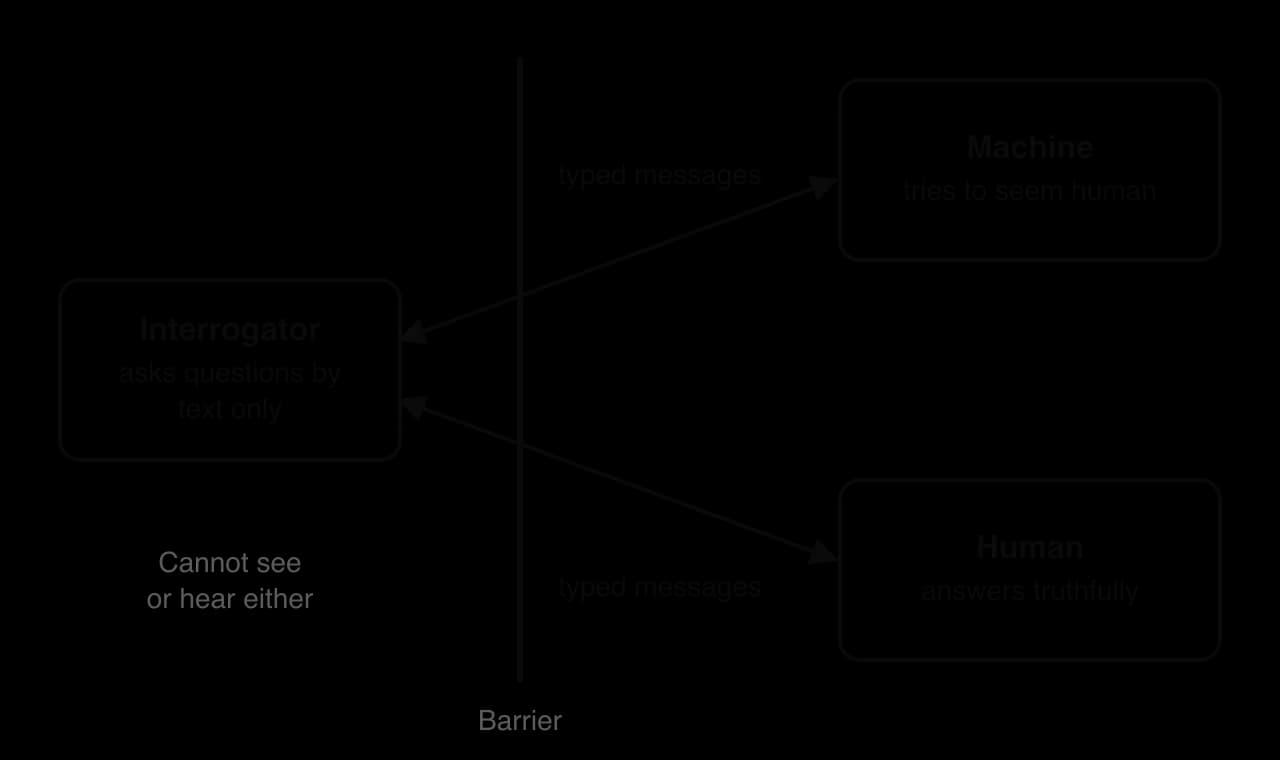
In 1950 the British mathematician Alan Turing published a paper asking whether machines can think. Because "thinking" is hard to define, he replaced the question with a practical test, which he called the imitation game and which is now known as the Turing test.
In the standard set-up, a human interrogator exchanges typed messages with two hidden partners, one human and one machine, as the diagram of the test shows. If the interrogator cannot reliably identify the machine, the machine is said to pass. Text-only communication is essential, because it removes clues such as voice and appearance and focuses the test on behaviour.
For decades no system passed convincingly. In 1966 Joseph Weizenbaum at MIT built ELIZA, a program that imitated a psychotherapist by turning users' statements into questions ("I feel sad" became "Why do you feel sad?"). ELIZA understood nothing, yet some users confided in it as if it were a person. Weizenbaum was disturbed by this reaction, which is now called the ELIZA effect: the tendency of people to read understanding into a machine's replies.
The test gained new attention with large language models. In a 2025 study at the University of California San Diego, interrogators held five-minute text conversations with a human and an AI at the same time. GPT-4.5, told to adopt a human-like persona, was judged to be the human in 73% of conversations, more often than the real humans. ELIZA, tested in the same study, was judged human only 23% of the time.
Strengths | Limitations |
|---|---|
Gives a clear, practical procedure instead of an argument about definitions | Measures imitation of human behaviour, not understanding or reasoning |
Focuses on observable behaviour, which can be tested | Can be passed by deception, such as typing errors or pretending to be a teenager |
Has guided AI research and public debate for over 70 years | Ignores non-conversational intelligence, such as vision or planning, and depends on the judge's skill |
The strongest philosophical objection is John Searle's Chinese Room argument (1980). Searle imagined a person who does not speak Chinese sitting in a room with a rulebook for matching Chinese symbols to other Chinese symbols. People outside pass in questions and receive sensible answers, so the room appears to understand Chinese, but the person inside understands nothing. Searle argued that a computer passing the Turing test would be in the same position, manipulating symbols without meaning. Passing the test is therefore usually treated as evidence of convincing weak AI, not proof of strong AI.
Machine learning is the branch of AI in which systems improve at a task by learning patterns from data instead of following rules written in advance. It is behind almost every major AI development since the 2000s.
Machine learning has two stages. In training, the algorithm is given training data, the set of examples it learns from, and adjusts its internal settings until its outputs match the patterns in the data. The result is a model: a stored set of learned patterns. In use (often called inference), the model is applied to new data it has never seen, such as a fresh email or a new photograph, and makes a prediction.
The quality of the model depends heavily on the training data. If the data is incomplete, out of date or unrepresentative, the model learns those flaws. This is often summarised as "garbage in, garbage out", and it is the main route by which bias enters AI systems.
In supervised learning, the training data is labelled data: every example comes with the correct answer attached. A spam filter is trained on thousands of emails, each labelled "spam" or "not spam". The algorithm learns which features (certain words, unknown senders, many links) predict each label, then applies that knowledge to new emails.
Supervised learning is used for classification (sorting items into categories, such as fraudulent or genuine transactions) and prediction of values (such as the price of a house or tomorrow's electricity demand). Its main limitation is the cost of labelling. Someone has to supply the correct answers, which often means thousands of hours of human work by data labellers, many of them low-paid workers in countries such as Kenya, India and the Philippines.
In unsupervised learning, the data has no labels. The algorithm looks for structure on its own, usually by grouping similar items together (clustering) or by finding items that do not fit (anomaly detection). A retailer can feed in the purchase histories of millions of customers and let the algorithm discover groups, such as "parents of young children" or "budget students", that no one defined in advance.
Banks use anomaly detection to spot card fraud, since a sudden purchase abroad at an unusual hour stands out from a customer's normal pattern. The strength of unsupervised learning is that it can find patterns humans did not expect. Its weakness is that the groups it finds may be meaningless, or may reflect sensitive characteristics such as ethnicity or health, and a human must still interpret them.
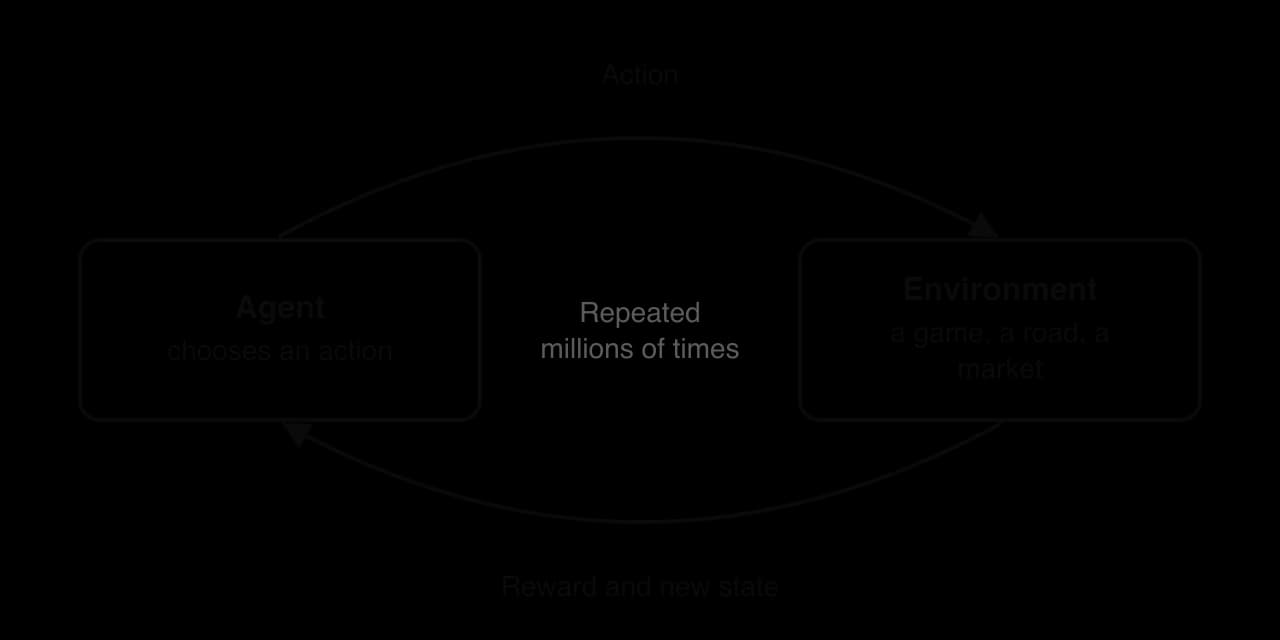
In reinforcement learning, an agent learns by trial and error in an environment. It takes an action, receives a reward (or penalty), observes the new situation and adjusts its strategy to collect more reward over time. The cycle repeats millions of times, as the loop diagram shows.
DeepMind's AlphaGo is the best-known real-world example. In March 2016 it beat Lee Sedol, one of the world's strongest Go players, by four games to one in Seoul. AlphaGo first learned from records of human games (supervised learning), then improved by playing millions of games against itself (reinforcement learning). Its "move 37" in the second game looked like a mistake to commentators but proved creative and strong. Its successor, AlphaGo Zero (2017), learned only from self-play and beat the original version 100 games to 0.
Reinforcement learning also trains robots to walk and fine-tunes chatbots using human ratings of their answers. Its main limitation is that real-world trial and error can be dangerous: a self-driving car cannot learn by crashing, so most training happens in simulation.
 YouTube
Deep learning is machine learning that uses artificial neural networks with many layers (the "deep" refers to the number of layers). It can be supervised, unsupervised or reinforcement learning; what defines it is the structure of the model, not the way it is trained. Deep learning is especially powerful for unstructured data such as images, sound and text, because the layers learn useful features by themselves. Earlier methods needed humans to decide in advance which features to measure.
The breakthrough came in 2012 in the ImageNet Large Scale Visual Recognition Challenge, an annual contest to label photographs from 1,000 categories. A deep neural network called AlexNet, built by Alex Krizhevsky, Ilya Sutskever and Geoffrey Hinton at the University of Toronto, cut the error rate from about 26% (the next best entry) to about 16%. Within three years every leading entry used deep learning, and the error rate dropped under the roughly 5% often quoted for a trained human.
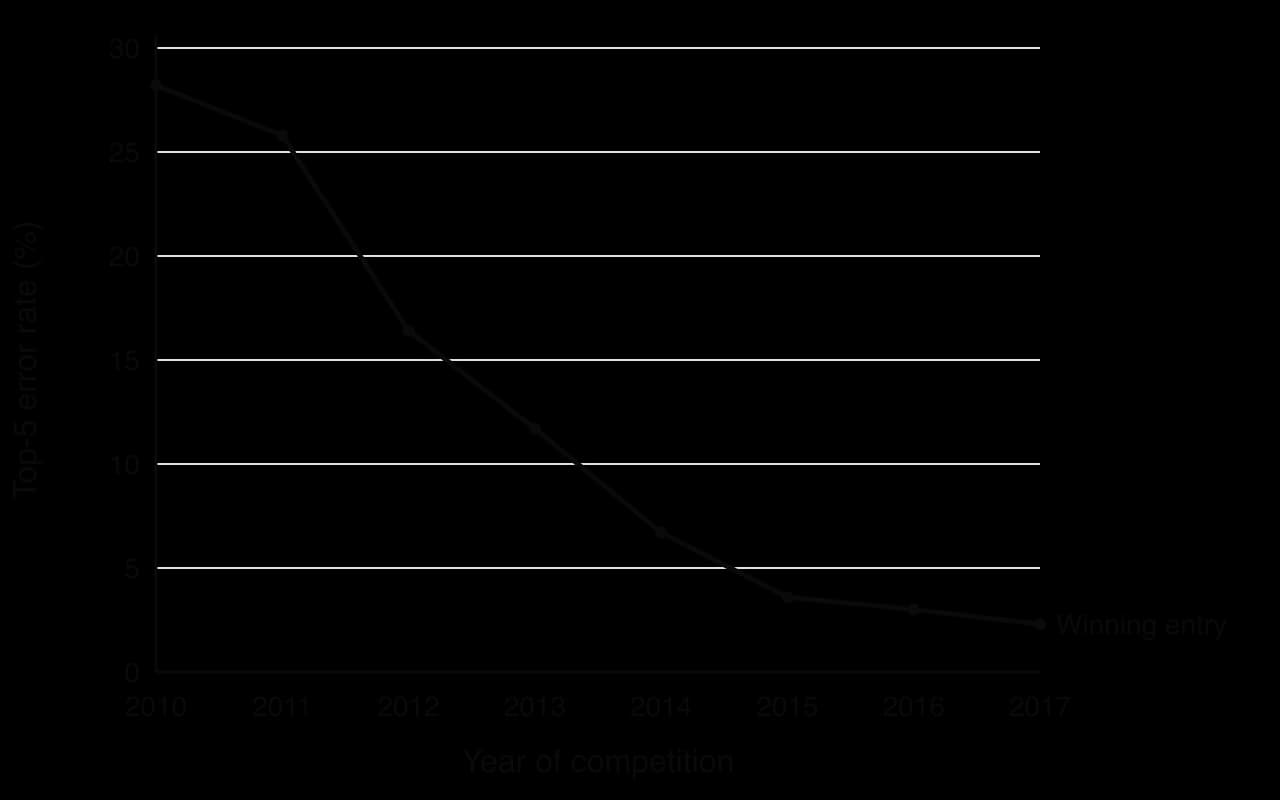
Three conditions made the breakthrough possible: large labelled data sets such as ImageNet (over 14 million images, labelled largely by crowd workers), graphics processing units (GPUs) able to run huge numbers of calculations in parallel, and improved training methods for networks with many layers. The same combination later produced large language models.
Type | Training data | How it learns | Typical uses | Real-world example |
|---|---|---|---|---|
Supervised | Labelled | Compares its predictions with known answers and corrects errors | Classification, prediction | Gmail spam filter; credit scoring |
Unsupervised | Unlabelled | Finds groups and unusual cases by itself | Customer segmentation, fraud detection | Bank card fraud alerts |
Reinforcement | Rewards from an environment | Trial and error to maximise reward | Games, robotics, control systems | AlphaGo (2016) |
Deep learning | Any of these, in large amounts | Many-layered neural networks learn their own features | Images, speech, language | AlexNet (2012); ChatGPT |
Machine learning is used wherever there is a pattern worth finding in large amounts of data. Its uses overlap: speech recognition, for example, is a kind of pattern recognition that feeds into natural language processing.
Pattern recognition is the most general use of machine learning: identifying regularities in data and using them to classify new inputs. Every other use in this list is a specialised form of it. Examples include detecting fraudulent card payments, predicting machine failures from vibration sensors in factories, and recognising handwritten postcodes on letters, one of the first commercial uses of neural networks in the 1990s.
Facial recognition identifies or verifies a person from an image of their face. The system detects a face, measures features such as the distance between the eyes and the shape of the jaw, turns them into a numerical "faceprint", and compares this with stored faceprints. Verification (one-to-one) checks that a face matches one stored identity, as when a phone unlocks for its owner or an airport e-gate matches a traveller to a passport photo. Identification (one-to-many) searches a whole database for a match, as when police compare CCTV images with a database of photographs.
Facial recognition shows how one technology plays out differently across contexts. In travel, it speeds up border checks. In politics, it can support mass surveillance: in 2020 the US company Clearview AI was found to have built a database of billions of photographs scraped from social media without consent, and data protection authorities in France, Italy, Greece and the Netherlands later fined it. Through the concept of power, the key question is who holds the database and who is being searched.
Speech recognition converts spoken language into text. It powers voice assistants such as Siri and Alexa, automatic captions on YouTube and video calls, and dictation for people who cannot type easily. Deep learning made speech recognition accurate enough for everyday use in the 2010s. Accuracy still varies: a 2020 Stanford University study of five major commercial systems found that the average error rate for Black American speakers was almost twice that for white American speakers, most likely because the systems were trained on too little audio from Black speakers.
Computer vision is the field of AI that enables machines to interpret images and video. Image analysis applies it to extract information from pictures: identifying objects, measuring changes or spotting abnormalities. Farmers in East Africa use the PlantVillage Nuru app, which runs offline on a smartphone, to identify diseases in cassava leaves from a photo. Conservation projects use camera-trap images analysed by AI to count animals across national parks, a task that once took researchers months.
Natural language processing (NLP) enables computers to work with human languages, in writing and in speech. It includes machine translation (Google Translate added 110 languages in 2024, many of them spoken mainly in Africa and Asia), sentiment analysis (judging whether reviews or posts are positive or negative), summarising documents and answering questions. Large language models are the most advanced form of NLP so far.
NLP raises an issue of equity. Most training text is in English and a few other widely used languages, so systems work far better in those languages. Speakers of languages with little online text, such as many indigenous and African languages, get poorer translations and assistants, which can widen the digital divide. Masakhane, a grassroots network of African researchers, builds data sets and models for African languages to close this gap.
Use | What it does | Real-world example | Context (4.x) |
|---|---|---|---|
Pattern recognition | Finds regularities to classify new data | Card fraud detection | Economic |
Facial recognition | Identifies or verifies people from their faces | Airport e-gates; Clearview AI | Political, social |
Speech recognition | Converts speech to text | Automatic captions; voice assistants | Social, health (accessibility) |
Image analysis | Extracts information from images | PlantVillage Nuru for cassava disease | Environmental, economic |
Natural language processing | Understands and generates language | Google Translate; ChatGPT | Cultural, human knowledge |
An artificial neural network (ANN) is a model loosely inspired by the brain, in which many simple processing units are connected in layers. Neural networks are the engine of deep learning and of most recent advances in AI.
A neural network has three kinds of layer, labelled in the network diagram.
The input layer receives the data. For an image, each node might receive the brightness of one pixel.
One or more hidden layers process the data. They are "hidden" because their values are neither the input nor the final answer. Early hidden layers tend to detect simple features such as edges; later ones combine them into shapes and then into whole objects.
The output layer gives the result, such as a probability for "cat" and for "dog".
Each connection between nodes has a weight, a number that sets how strongly one node's signal affects the next. Each node adds up its weighted inputs, applies a simple function that decides how strongly it "fires", and passes the result on.
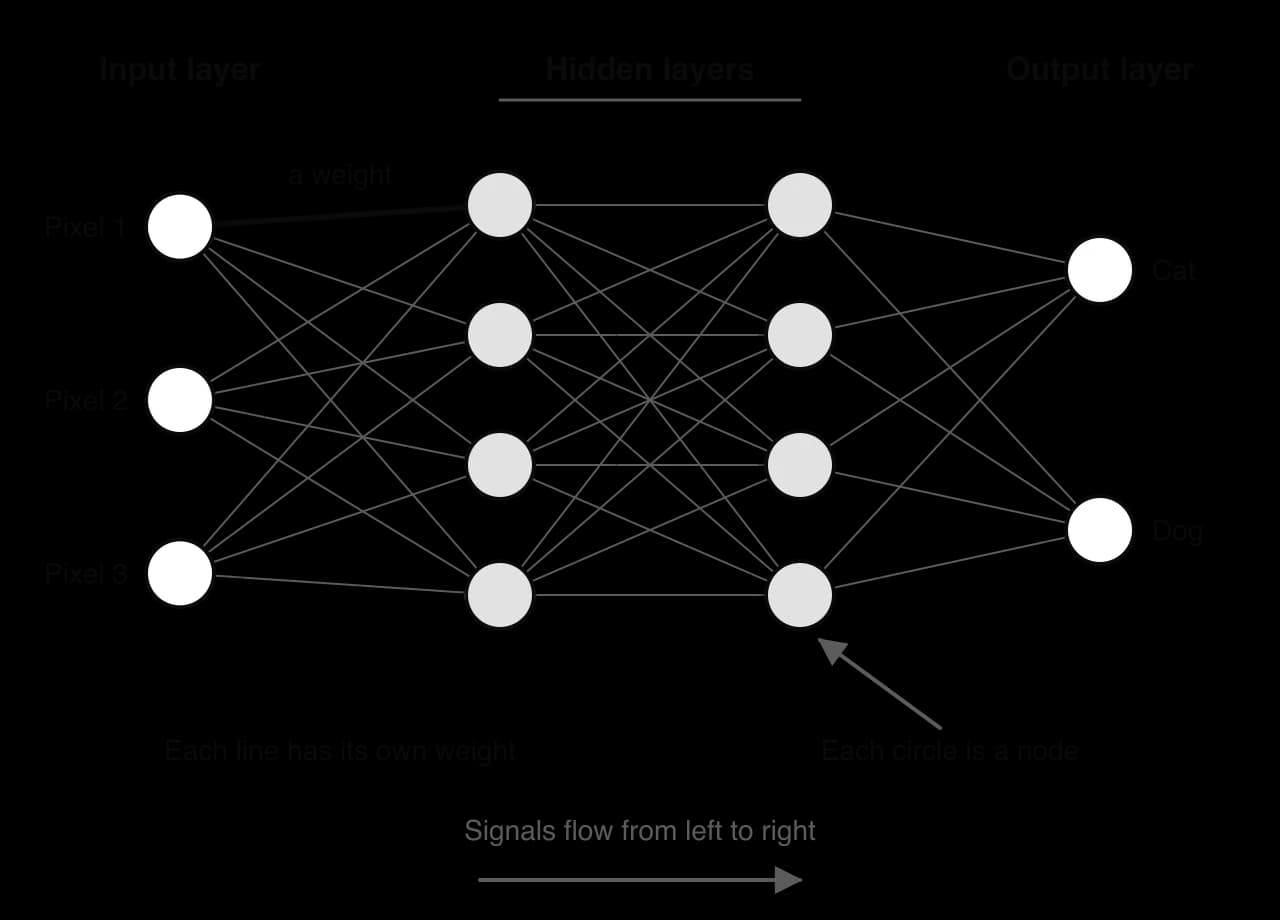
At the start, the weights are random, so the network's guesses are random too. During training, the network is shown an example (a photograph labelled "cat"), makes a prediction, and measures how wrong it was. A method called backpropagation then works backwards through the layers, nudging each weight slightly in the direction that would have made the answer less wrong. Repeated over millions of examples, these small adjustments add up to a network that classifies accurately. As a result, the network's rule for "cat" is never written by a programmer and is spread across thousands or millions of weights.
 YouTube
A linear relationship is one where a change in the input always produces a proportional change in the output, so it can be drawn as a straight line: each extra hour of work adds the same amount of pay. Many real relationships are non-linear. The risk of a disease may stay low across most ages and then rise steeply; the meaning of a word changes completely depending on the words around it; whether a photo shows a cat depends on combinations of thousands of pixels, not on any single one.
Neural networks can model these relationships because each node applies a non-linear function and the layers combine them. Stacking many simple bends produces curves and boundaries of almost any shape. This is the main reason neural networks outperform older methods on images, speech and language, where the relationship between input and output is highly complex.
Relationship | Example | Can a simple linear model capture it? |
|---|---|---|
Linear | Hours worked and pay at a fixed hourly rate | Yes |
Non-linear | Age and risk of a disease that rises steeply after 60 | Poorly |
Complex, non-linear, many inputs | Pixels in a photo and whether it shows a cat | No; needs a deep neural network |
The purpose of training is generalization: the ability to perform well on new data that the network has never seen. A face-unlock system must recognise its owner in new lighting or with a new haircut, not only in its training photos.
The opposite failure is overfitting. An overfitted network has memorised its training examples, including their noise and accidents, instead of learning the general pattern. It scores very well on the training data and badly on anything new. In skin-cancer photos, for example, malignant lesions are more often photographed beside a ruler, so a model can learn "ruler means cancer" instead of the features of the lesion. To detect overfitting, developers hold back some data as a test set that the network never sees during training and check performance on it.
Generalisation also explains a central risk: if the training data under-represents some groups, the network generalises poorly for them. Neural networks are also hard to inspect, because their "reasoning" is spread across millions of weights, which is why they are often called black boxes.
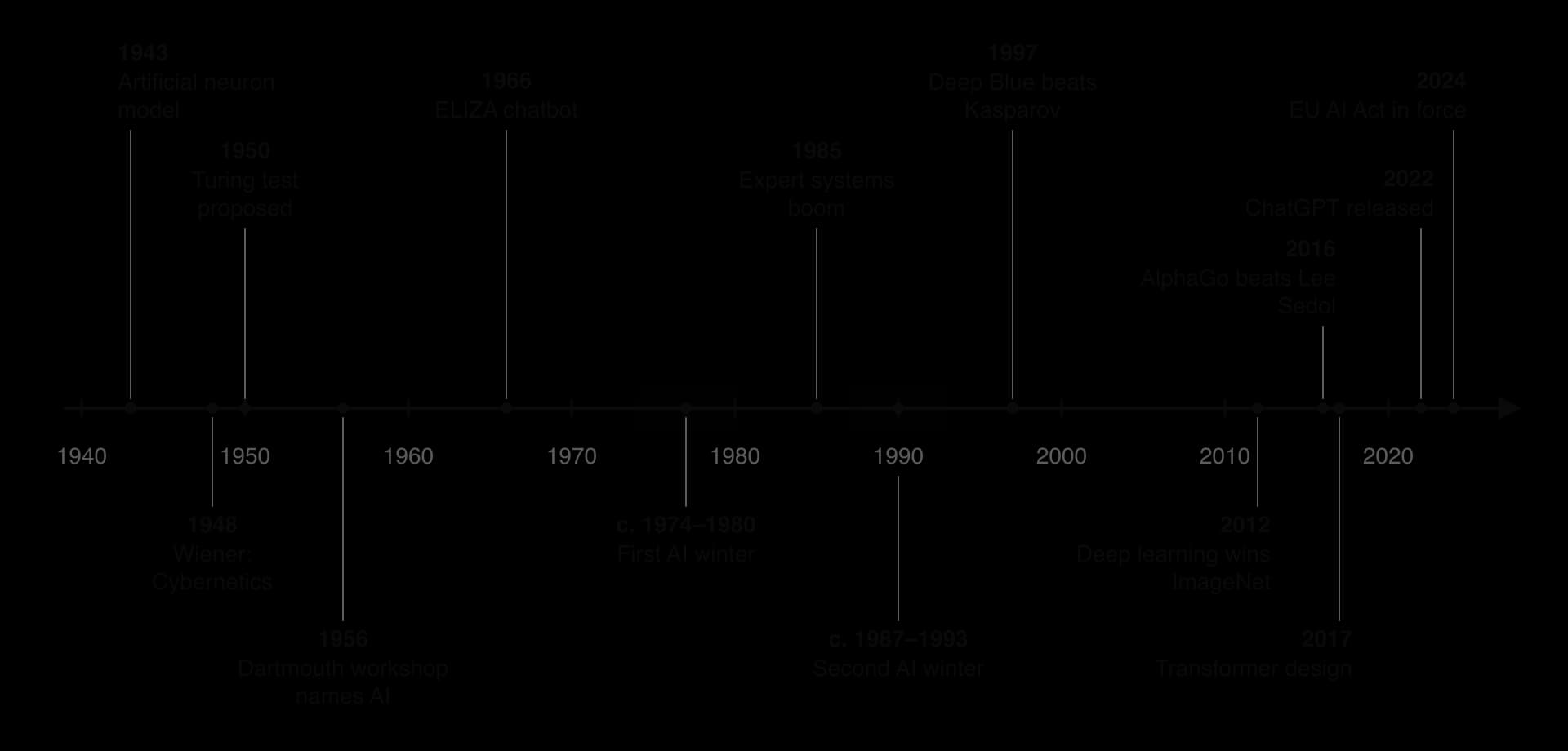
AI has developed through cycles of excitement, disappointment and renewal, in which bold predictions were made and broken many times.
The idea of artificial minds is much older than computers. Greek myths describe Talos, a bronze giant built to guard Crete. Mary Shelley's Frankenstein (1818) asked what responsibilities a creator has towards an artificial being. Karel Čapek's play R.U.R. (1920) introduced the word "robot".
HAL 9000, the calm computer that turns against its crew in 2001: A Space Odyssey (1968), and Skynet in The Terminator (1984) made AI a symbol of loss of control. Her (2013) imagined emotional relationships with a voice assistant. Through the concept of expression, science fiction acts as a way for societies to rehearse their hopes and fears about new technology.
René Descartes argued in 1637 that a machine could never use language flexibly enough to answer everything said to it, an early version of the question Turing later tested. Ada Lovelace wrote in 1843 that Charles Babbage's Analytical Engine could not "originate anything", only do what it was told; Turing called this "Lady Lovelace's objection" and argued against it. In the twentieth century, Searle's Chinese Room and the philosopher Hubert Dreyfus's book What Computers Can't Do (1972) challenged the idea that symbol manipulation could ever produce understanding.
Cybernetics was a field founded in the 1940s that studied control and communication in both animals and machines. The American mathematician Norbert Wiener named it in his 1948 book Cybernetics. Its central idea is feedback: a system senses the result of its own actions and adjusts. A thermostat that switches heating on and off to keep a room at a set temperature is a simple cybernetic system.
Cybernetics shaped AI in three ways. It treated the brain as an information-processing system, which made artificial minds seem possible. Warren McCulloch and Walter Pitts published a mathematical model of a neuron in 1943, the starting point of neural networks. And it produced early learning machines: in the late 1940s the British neuroscientist William Grey Walter built small robotic "tortoises" that used light sensors and feedback to wander around a room and return to their charging hutch. Feedback remains at the heart of AI today, from reinforcement learning to the way recommendation systems learn from what users click (linking to the concept of systems).
The term "artificial intelligence" was coined by John McCarthy for a summer workshop at Dartmouth College in the USA in 1956. The organisers predicted that significant progress could be made in a single summer. Early results seemed to justify the optimism: programs proved mathematical theorems, played draughts and solved algebra problems. In 1958 Frank Rosenblatt built the perceptron, an early neural network that learned to recognise simple shapes.
Progress then stalled. Programs that worked on toy problems failed on real ones, because the real world contains too many possibilities to write rules for and computers were far too slow. In 1969 Marvin Minsky and Seymour Papert showed mathematical limits of single-layer perceptrons, which discouraged neural network research for years. In 1973 the Lighthill Report, commissioned by the UK government, concluded that AI had failed to meet its promises, and funding was cut in the UK; the US defence research agency DARPA also cut back. The period from about 1974 to 1980 became known as the first AI winter.
In the 1980s AI revived through expert systems: rule-based programs that captured the knowledge of human specialists. XCON, used by Digital Equipment Corporation to configure computer orders, was reported to save the company millions of dollars a year. Japan launched its Fifth Generation Computer project in 1982, and companies bought specialised "Lisp machines" to run AI software.
The boom ended around 1987. Cheaper desktop computers made the specialised machines unnecessary and their market collapsed. Expert systems proved expensive to update, because every new rule had to be written and checked by hand, and they failed on cases outside their rules. Japan's project missed its goals. Funding fell again, and the second AI winter lasted until about the early 1990s.
AI recovered gradually through the 1990s and 2000s, often under other names such as "machine learning" or "data mining". IBM's Deep Blue beat the world chess champion Garry Kasparov in 1997, mainly through massive search power rather than learning. The growth of the internet then produced the data, and the games industry produced the GPUs, that neural networks needed. After AlexNet's success in 2012, deep learning spread rapidly. In 2017 Google researchers published the transformer, a neural network design that processes whole sequences of words at once; it became the basis of large language models and of ChatGPT in 2022.
The technological singularity is the idea that AI will one day become able to improve itself, triggering runaway growth in intelligence that leaves human understanding behind. The mathematician I. J. Good described an "intelligence explosion" in 1965: an "ultraintelligent machine" could design even better machines, and so on. The science fiction writer and mathematician Vernor Vinge popularised the term "singularity" in a 1993 essay, and the inventor Ray Kurzweil predicted in The Singularity Is Near (2005) that it would arrive around 2045.
Supporters point to the rapid growth in computing power and AI ability, and some AI researchers now warn that advanced AI could pose risks on the scale of pandemics or nuclear war. Critics reply that intelligence is not a single quantity that can simply increase, that progress in AI has repeatedly slowed, and that focusing on a distant superintelligence distracts from present-day harms such as bias and job loss.
The multiplicity is a different vision of the future. The idea was proposed by Ken Goldberg, a robotics professor at the University of California, Berkeley, in 2017. Instead of one superintelligence replacing humans, it describes diverse groups of humans and machines working together, each contributing what it does best. Some systems already work this way. Navigation apps such as Waze combine algorithms with reports from millions of drivers, and spam filters combine machine learning with users' decisions about what counts as spam.
The singularity | The multiplicity | |
|---|---|---|
Key thinkers | I. J. Good (1965), Vernor Vinge (1993), Ray Kurzweil (2005) | Ken Goldberg (2017) |
Picture of the future | One superintelligent AI surpasses and possibly replaces humans | Many humans and many machines collaborate |
Relationship between humans and AI | Competition or replacement | Partnership and complementary strengths |
Main concern | Loss of human control | Designing good collaboration and sharing the benefits |
Through the concept of change, the two views differ in the kind of change they expect. The singularity predicts a sudden transformation that breaks with the past. The multiplicity describes gradual evolution, in which AI extends human ability as earlier tools did. The evidence so far fits the multiplicity better: AI has mostly been introduced into existing human workflows, from doctors reviewing AI-flagged scans to programmers using code assistants. However, the multiplicity also depends on choices about design and policy, since collaboration can easily become replacement if employers decide it is cheaper.
The most visible current development in AI is generative AI: systems that create new content, including text, images, audio, video and computer code, in response to a prompt. Image generators such as Midjourney learn from millions of captioned images to produce pictures from a written description; deepfakes come from the same technology.
A large language model (LLM) is a generative AI system trained on enormous amounts of text to predict the next word, or more precisely the next token (a word or part of a word), in a sequence. By repeating this prediction, it can write paragraphs, answer questions, translate and summarise. LLMs are the technology behind chatbots such as ChatGPT (OpenAI), Gemini (Google), Claude (Anthropic), DeepSeek (China) and Llama (Meta), whose model weights are freely downloadable.
Because an LLM generates the most likely continuation of a text rather than looking up facts, it can produce confident statements that are false. This is called AI hallucination. A hallucination is not a bug that can simply be fixed, since it follows from the way the model works, although developers can reduce it, for example by connecting the model to search results.
AI brings significant opportunities, from faster diagnosis to help for people with disabilities, but it also raises dilemmas: situations in which values conflict and no option is free of costs. Five dilemmas run through AI's design (the choices made by developers) and its use (the choices made by the organisations and people that deploy it).
An AI system is biased when it systematically produces worse outcomes for some groups of people than for others. Bias can enter at every stage.
Training data may under-represent some groups or reflect past discrimination.
Design choices, such as which outcome the system predicts and which features it uses, may build in unfair assumptions.
Use in a different context from the one the system was designed for can create bias even when the design was fair.
Amazon's experimental recruiting tool is a clear case of bias from training data. Reuters reported in 2018 that the system, trained on ten years of CVs submitted to the company, mostly from men, had learned to downgrade CVs that included the word "women's", as in "women's chess club captain". Amazon abandoned the project. The tool discriminated without any instruction to do so, because it learned and repeated the pattern of past hiring decisions.
Facial recognition shows bias that arises across design and use. The 2018 Gender Shades study by Joy Buolamwini and Timnit Gebru at MIT tested commercial gender-classification systems from IBM, Microsoft and Face++. The error rate was at most 0.8% for lighter-skinned men but up to 34.7% for darker-skinned women. In use, these differences have serious consequences: in January 2020 Robert Williams, a Black man in Detroit, was arrested in front of his family after a facial recognition search wrongly matched him to CCTV footage of a theft. Through the concept of identity, the dilemma is that groups already disadvantaged are most likely to be misidentified.
Fixing bias is harder than it sounds, because "fair" has several meanings that can conflict. A system can be designed to have equal accuracy for all groups, or equal rates of positive decisions, or to ignore group membership entirely, and it is often mathematically impossible to satisfy all of these at once. Choosing between them is therefore a question of values and ethics as well as of engineering.
Accountability means that someone can be held responsible when a system causes harm, and that people affected have a way to challenge it. AI creates a responsibility gap: when a decision is produced by a learned model, the developer may blame the data, the company may blame the developer, and the user may blame the system.
Courts have begun to close the gap. In February 2024 a Canadian tribunal ruled in Moffatt v. Air Canada that the airline was liable when its website chatbot gave a customer wrong information about bereavement fares. Air Canada had argued that the chatbot was responsible for its own statements; the tribunal rejected this and held that a company is responsible for all the information on its website, whether it comes from a static page or a chatbot. The principle is that deploying an AI system does not transfer responsibility to the machine.
Stakeholder | Possible responsibility | Claim they might make to avoid blame |
|---|---|---|
Developer | Designing, testing and documenting the system | "We warned that the model can make mistakes." |
Deploying organisation | Checking it suits the context; monitoring outcomes | "We relied on a reputable supplier." |
Individual user | Checking outputs before relying on them | "The system said it was correct." |
Regulator | Setting and enforcing rules | "Existing law did not cover this use." |
Transparency means that people can find out when AI is being used, what data it relies on and how it reaches its outputs. Deep neural networks make this difficult, because their decisions emerge from millions of weights that do not correspond to human-readable reasons. Explainable AI (XAI) is a field of research that develops methods to show which inputs most influenced a decision, such as highlighting the region of an X-ray that led to a diagnosis.
The Dutch childcare benefits scandal shows the cost of opacity. From 2013 the Dutch tax authority used a risk-classification model to flag childcare benefit claims for fraud checks. Tens of thousands of families were wrongly accused and ordered to repay large sums, pushing many into debt. Investigations found that having non-Dutch nationality had been used as a risk factor, and families could not find out why they had been flagged. The Dutch government resigned over the scandal in January 2021. Through the concept of power, the case shows how opacity shifts power towards the institution using AI and away from the people it judges.
Transparency has costs too: companies argue that revealing how models work exposes trade secrets and teaches fraudsters which signals to avoid. A common compromise is transparency towards regulators and auditors rather than full public disclosure.
AI governance is the set of laws, rules, standards and institutions that shape how AI is developed and used. It is uneven because countries take very different approaches, and underdeveloped because laws move much more slowly than the technology.
Jurisdiction | Approach | Key features |
|---|---|---|
European Union | Comprehensive, risk-based law | The AI Act entered into force in August 2024. It bans "unacceptable risk" uses such as social scoring by governments; places strict duties on "high-risk" uses such as hiring and credit scoring; requires transparency for chatbots and deepfakes; and sets rules for general-purpose models. Fines reach €35 million or 7% of global turnover. In 2026 EU lawmakers agreed to delay most high-risk duties until December 2027 or later. |
China | Targeted rules for specific technologies | Rules on recommendation algorithms (2022), deepfakes (2023) and generative AI services (2023), which require content to reflect "core socialist values" and to be labelled. |
United States | Mainly voluntary and sector-based at federal level | A 2023 presidential executive order on AI safety was revoked in January 2025; some states, such as Colorado and California, have passed their own laws. |
African Union | Continental strategy | The Continental AI Strategy, endorsed in 2024, sets shared goals, but many member states have no AI-specific law. |
International | Non-binding principles and one treaty | UNESCO's Recommendation on the Ethics of AI (2021); the Council of Europe Framework Convention on AI (2024), the first binding international treaty on AI. |
Sources: European Commission; Cyberspace Administration of China; African Union; UNESCO; Council of Europe (2021–2026).
This unevenness means that citizens of different countries receive very different protections from the same global products, and small countries have little influence over systems built abroad. Supporters of light regulation, especially in the USA and the UK, argue that strict rules slow innovation and hand the lead to rival countries. Supporters of strong regulation reply that clear rules build public trust, and point to the EU's data protection law (GDPR) as a model that other countries later copied.
Automation is the use of machines and software to perform work previously done by people. Earlier waves mainly affected routine manual jobs in factories. AI can also automate cognitive tasks such as writing, translating and answering customer questions, so it reaches white-collar and creative jobs once thought safe.
In January 2024 the International Monetary Fund (IMF) estimated how many jobs are "exposed" to AI, meaning that AI can perform a significant share of their tasks. Exposure is highest in advanced economies, where more jobs involve cognitive tasks, as the bar chart shows.
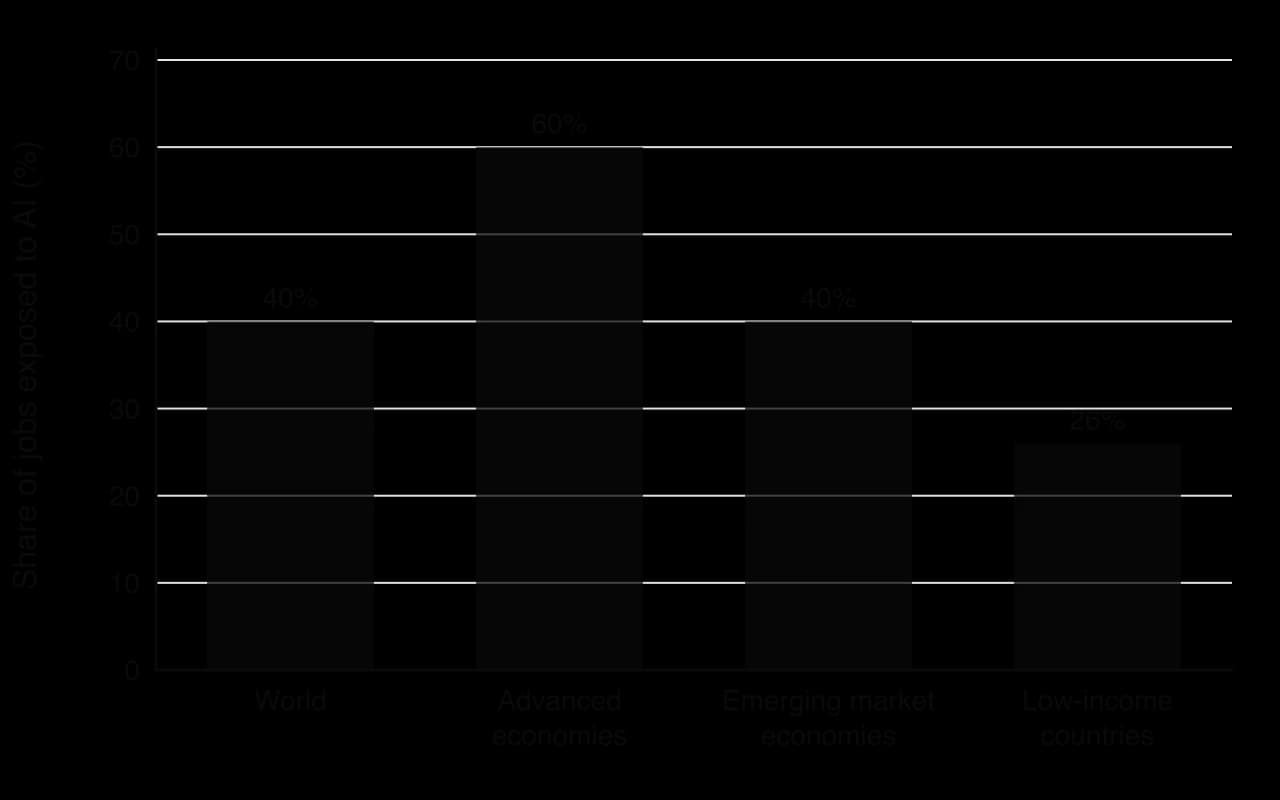
Exposure does not mean the job disappears. The IMF estimated that about half of exposed jobs in advanced economies could benefit from AI, which would make workers more productive (augmentation), while the other half could see lower demand for labour (displacement). Which happens depends on the task, the worker's skills and the employer's choices.
Real-world examples show both outcomes in multiple contexts and roles.
Creative work. In 2023 the Writers Guild of America went on strike for 148 days. Among its demands was protection against studios using AI to write scripts; the final agreement said that AI-generated material cannot be treated as source material and writers cannot be required to use AI.
Customer service. In 2024 the Swedish payments company Klarna reported that its AI assistant was doing the work of 700 full-time customer service agents. In 2025 it began hiring human agents again, saying that customers should always be able to reach a person.
Medicine. In radiology, AI tools flag possible problems on scans, but radiologists still review the results, so far an example of augmentation rather than replacement.
Through the concept of power, displacement raises the question of who gains from automation. If the gains go mainly to shareholders and technology companies, inequality grows; if workers share them through training, shorter hours or higher pay, AI could improve working life. The outcome depends on policy and bargaining power as well as on the technology.
ChatGPT is a chatbot developed by OpenAI, a San Francisco company closely partnered with Microsoft. It was released to the public as a free "research preview" on 30 November 2022. It reached an estimated 100 million monthly users within about two months, at the time the fastest growth of any consumer application. OpenAI reported 800 million weekly users in October 2025 and 900 million in February 2026. Its success started a race in which Google, Meta, Anthropic, Mistral (France) and DeepSeek (China) released competing models.
ChatGPT is built on a large language model of the GPT (generative pre-trained transformer) family. It is made and used in several stages, shown in the pipeline diagram.
Pre-training. The model is trained on a huge body of text taken from websites, books, articles and computer code. Its only task is to predict the next token in a passage. To do this well across billions of examples, the network has to capture grammar, facts, styles of writing and patterns of reasoning. GPT-3 (2020) had 175 billion weights; OpenAI has not published the size of later models.
Fine-tuning. The pre-trained model would continue any text, including harmful text. OpenAI therefore fine-tuned it on example conversations and used reinforcement learning from human feedback (RLHF): human raters ranked different answers, and the model was trained to produce the kinds of answers they preferred.
Use. When a user types a prompt, it is split into tokens. The model calculates the probability of every possible next token, chooses one, adds it to the text and repeats, building the reply one token at a time.
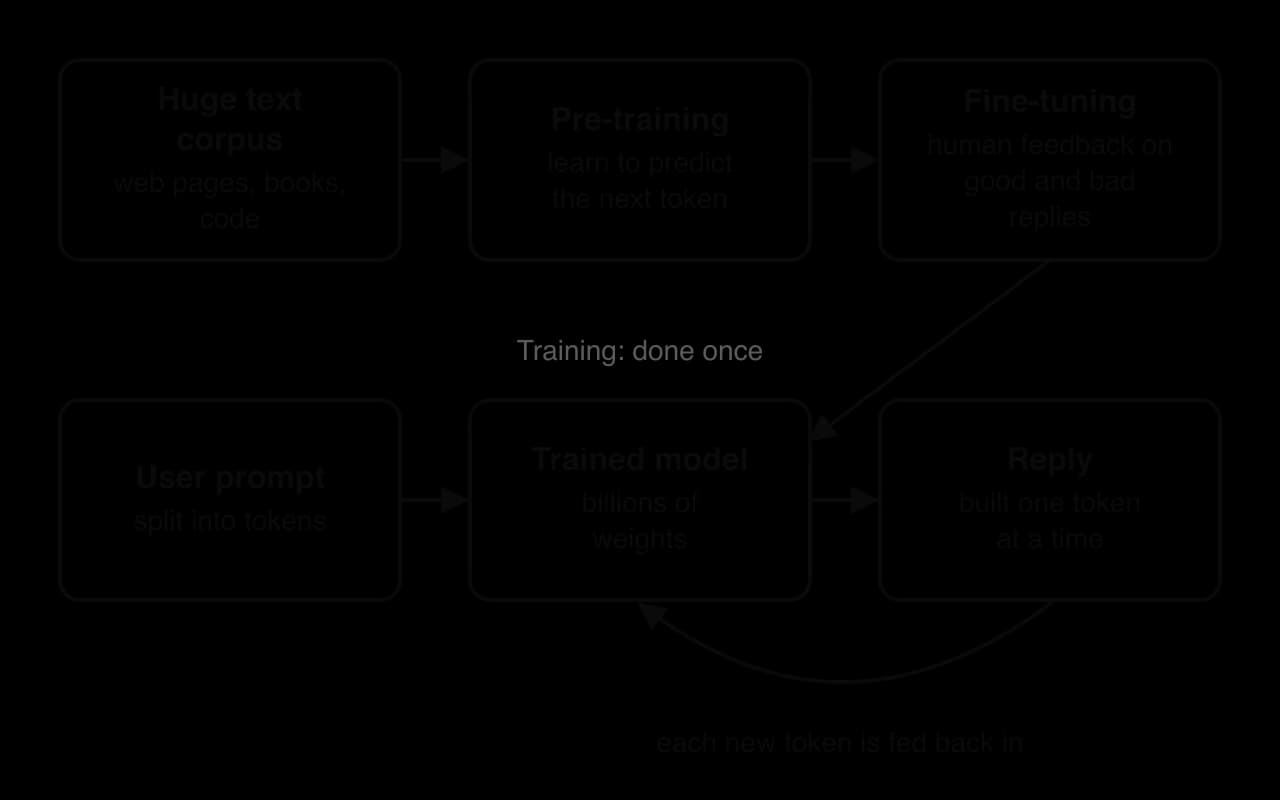
This design explains both strengths and weaknesses: patterns learned from an enormous range of text let the model generalise to tasks it was never trained for, but producing the most probable text rather than checking facts makes it hallucinate.
Students and teachers. ChatGPT can act as a tutor at any hour, which benefits students without access to private tutoring, but it also makes it easy to submit AI-written work. New York City's public schools blocked it on school devices in January 2023 over concerns about cheating and learning, then lifted the ban in May 2023, with the schools' chancellor admitting that the decision had been driven partly by "knee-jerk fear". Many schools and universities, and the IB itself, now allow AI use if it is acknowledged, shifting the focus to how students use it.
Workers. Programmers, marketers and office workers use LLMs to draft and check work faster. A 2023 study of over 5,000 customer support agents at a US software company, by researchers at Stanford and MIT, found that an AI assistant raised the number of problems resolved per hour by about 14% on average and by about a third for the least experienced workers. At the same time, freelance writers and translators have reported falling demand for their work.
Hidden workers. Making ChatGPT safer depended on human labour. A 2023 TIME investigation reported that workers in Kenya, employed by the outsourcing firm Sama for OpenAI, were paid between about $1.32 and $2 per hour to label thousands of passages of extremely violent and abusive text so that a filter could learn to block it. Several workers described lasting psychological harm. The case shows how the benefits of AI in one part of the world can depend on low-paid, hidden work in another.
Professionals relying on outputs. In 2023 two lawyers in New York submitted a court filing in Mata v. Avianca that cited six legal cases invented by ChatGPT. The judge fined them $5,000. Several courts now require lawyers to declare their use of AI.
Authors, artists and news organisations. LLMs are trained on text written by people who were not asked for permission or paid. In December 2023 The New York Times sued OpenAI and Microsoft for using millions of its articles in training. AI companies argue that training is lawful, like a person learning by reading. These cases will help decide who benefits economically from generative AI.
Privacy. In March 2023 Italy's data protection authority temporarily blocked ChatGPT, the first Western country to do so, over the lack of a legal basis for using personal data in training and the absence of age checks. Access was restored about a month later after OpenAI made changes, and in December 2024 the authority fined OpenAI €15 million.
Power. A few companies with the money for vast computing resources and data control the most capable models, and the public has little say over how they behave. ChatGPT concentrates influence over how millions of people find information, write and learn. Open-weight models such as Llama and DeepSeek partly counter this by letting others build on them, but they also make it harder to prevent misuse.
Values and ethics. The choices made in fine-tuning, such as which topics the chatbot refuses and which viewpoints it presents as balanced, embed values. Human raters in one country shape the answers given to users everywhere. The labelling work in Kenya and the use of authors' work without payment raise questions of fairness about who bears the costs of AI.
Change. Earlier AI was mostly hidden inside other products; ChatGPT made it a tool anyone could talk to. Whether this is an evolution of search engines and autocomplete or a transformation of how knowledge is produced is still debated.
ChatGPT and other LLMs bring real benefits, including faster work, accessible explanations and help with writing in a second language. These benefits are greatest for users who already have internet access, digital skills and fluency in well-supported languages, so without deliberate effort LLMs may widen existing divides. The main risks (hallucination, bias, hidden labour, unpaid use of creative work, and concentration of power) arise from how the system is built and governed, not from a single flaw. On balance, LLMs are a significant development whose impacts depend more on the rules and practices around them than on the technology itself: transparency about training data, accountability for outputs, fair treatment of data workers and creators, and teaching people to check AI outputs critically would shift the balance towards the opportunities.
Source-based questions test the comparison of claims and perspectives across two sources.
I can define artificial intelligence and explain why it is described as performing tasks "or appearing to".
I can distinguish narrow, weak and domain-specific AI from general, strong and full AI, with examples, and explain why the categories are contested.
I can outline the Turing test, describe ELIZA, and evaluate the test using the Chinese Room argument.
I can distinguish supervised, unsupervised and reinforcement learning, with a real-world example of each.
I can explain what makes deep learning "deep" and why the 2012 ImageNet result mattered.
I can describe uses of machine learning: pattern recognition, facial and speech recognition, image analysis and natural language processing.
I can label the layers, nodes and weights of a neural network and explain how it learns through training.
I can explain how neural networks model non-linear relationships and why generalisation and overfitting matter.
I can outline AI in science fiction and philosophy, cybernetics and the two AI winters.
I can distinguish the singularity from the multiplicity and evaluate each.
I can explain how a large language model such as ChatGPT is trained and why it hallucinates.
I can analyse fairness and bias, accountability and transparency in AI using named real-world examples.
I can compare approaches to AI governance in different parts of the world and explain why they are uneven.
I can evaluate the impacts of AI automation on workers, distinguishing augmentation from displacement.