Analyse how digital systems shape the arts, popular culture, home life, leisure, travel, heritage, celebrations and subcultures, and evaluate their impacts on people and communities, with Spotify as an extended case study.
Each is in the Digital Society glossary, with every other term in the subject.
The worldwide spread and mixing of ideas, values, media and practices, so that cultures in different places become more connected and influence each other.
The objects, places, traditions, languages and knowledge that a community inherits from past generations, values and wishes to pass on. It can be tangible, such as buildings and artefacts, or intangible, such as songs, rituals, skills and languages.
The process by which local cultures become more alike, and lose distinctive features, as a small number of dominant cultural products and practices spread across the world.
The shared beliefs, values, practices, customs, languages, arts and objects that a group of people creates and passes on, and through which its members understand themselves and each other.
Cultural and scientific resources that are created in digital form or converted into it, such as 3D scans of monuments, digitized archives and born-digital works, and that are worth preserving for future generations.
A community of fans of a particular artist, work, sport or franchise who share their enthusiasm and often create and organise activities together, such as fan art, fan fiction, events and campaigns.
A person who uses a large or highly engaged online following to affect the opinions, behaviour or purchases of that audience, often in return for payment from brands.
Define culture, popular culture, subculture and cultural heritage, and outline how digital systems change the ways people express themselves, live, travel and associate.
Describe how online galleries, virtual exhibitions and streaming platforms change the ways people experience art and entertainment.
Explain the roles of memes, online forums, internet celebrities and influencers in popular culture.
Analyse the impacts and implications of smart home technologies, digital sport and gaming, hobby communities and sharing platforms for people and communities.
Explain how digital systems are used to mark rites of passage and to express and preserve cultural heritage, customs and celebrations.
Distinguish between youth cultures, fandoms and other online communities, and analyse their opportunities and risks.
Evaluate the impacts of music streaming on artists and listeners, with reference to Spotify.
Discuss whether digital systems lead to cultural globalization, cultural homogenization or greater cultural diversity.
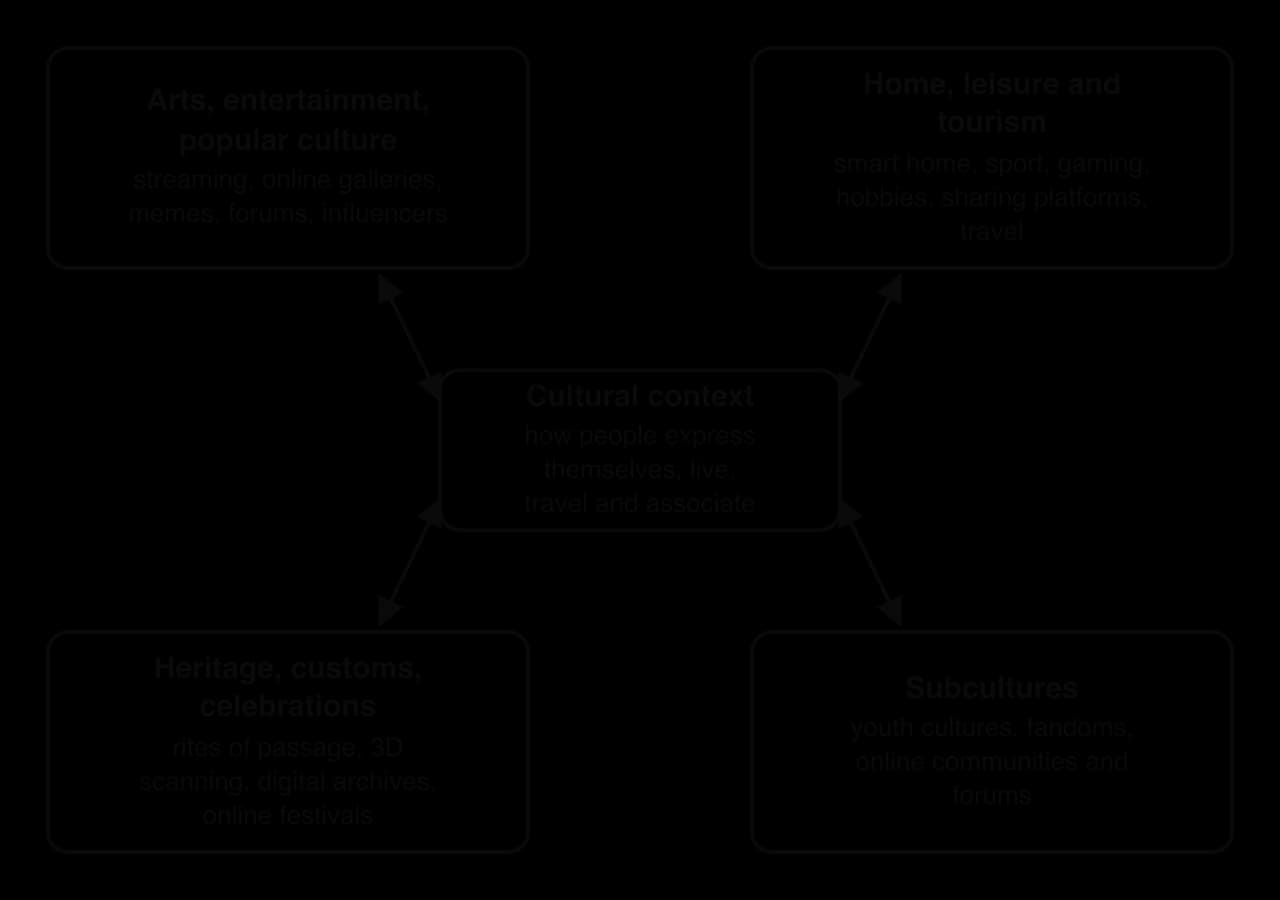
The cultural context covers how people and communities express themselves and how they live, travel and associate together. Digital systems now sit inside almost every part of it: music arrives through streaming apps, holidays are planned on review sites, weddings are watched over video calls and young people form identities in online communities.
This context draws on every content area. Recommendation algorithms (3.2) decide which songs and videos people meet, networks (3.4) carry live events to distant audiences, media (3.5) gives new forms to art, and data (3.1) records what people watch, play and buy. The concepts of expression (2.2),
With a free account, Augment remembers where you stopped and what you have practiced.
A person who becomes famous mainly through online platforms, such as video sites, social media or livestreaming services, rather than through traditional media such as television or film.
A group of people who interact regularly through a digital platform around a shared interest, identity or purpose, and who develop shared norms, language and a sense of belonging.
A situation in which the number of visitors to a place is so high that it damages the quality of life of residents, the environment or the experience of visitors themselves.
The forms of entertainment, media, fashion, music and everyday practice that are widely enjoyed and shared by large numbers of people at a particular time.
A ceremony or event that marks a person's move from one stage of life or social status to another, such as a birth, coming of age, graduation, marriage or death.
An economic system in which individuals rent or lend their own assets or services, such as rooms, cars or skills, to others, usually through an online platform that matches them and takes a fee.
A home in which appliances, heating, lighting, security and entertainment devices are connected to the internet and can be monitored and controlled remotely or automatically, often through a phone app or voice assistant.
An online service that delivers music, video, games or live events to users over the internet on demand, usually through a subscription or advertising model, without the user keeping a permanent copy.
A group within a larger culture that shares distinctive values, styles, language or practices that set it apart from the mainstream, while still belonging to the wider society.
An exhibition of artworks, objects or documents presented through a digital system, such as a website, 360-degree tour or virtual reality space, which visitors can explore remotely.
The shared tastes, styles, language, values and activities of young people, which often differ from those of older generations and change quickly.
Culture is learned, not inherited biologically. It includes visible elements, such as food, music and festivals, and less visible ones, such as ideas about family and respect. Every person belongs to several cultures at once, such as a national, religious, generational and hobby culture.
Social scientists often separate "high culture" (opera, classical painting, literature studied in schools) from popular culture. The line between them has always been debated, and digital systems blur it further, since a Rembrandt painting and a viral dance video can sit next to each other in the same feed.
The cultural context is usually studied in four areas. Each has its own digital systems, people and communities, as the map of the context shows.
A single real-world example often belongs to several areas. A livestreamed funeral is a rite of passage (heritage and customs) carried by a live-streaming service (media), and a viral photograph of a mountain view affects both popular culture and tourism.
Digital networks let cultural products cross borders almost instantly: a song released in Seoul can be streamed in Lagos within seconds.
Two opposite claims are made about this process. The first is that it leads to sameness, because a few large companies and the English language dominate what is seen and heard.
Evidence supports both claims. Spanish-language music by Bad Bunny made him Spotify's most-streamed artist worldwide in 2020, 2021 and 2022, and the Korean series Squid Game became Netflix's most-watched series when it was released in 2021. Cultural influence on these platforms no longer flows only from the United States. On the other hand, the platforms that carry these products are owned by a handful of companies, mostly based in the United States and China, and their algorithms reward content that already performs well, which can favour a narrow range of styles.
A third view stresses hybridity: local cultures absorb global forms and change them. Nigerian Afrobeats, South African amapiano and Korean pop all mix global and local sounds, and each has spread worldwide through digital platforms. Through the concept of change, cultural globalization is better described as a transformation with uneven winners than as a simple loss of diversity.
Digital systems have changed how art and entertainment are made (techniques), what shapes they take (forms) and how they are grouped (genres).
Techniques. Music production has moved from expensive studios to digital audio workstations on a laptop. Tools such as pitch correction, sampling software and free video editors let people with little money produce work that sounds or looks professional. Generative AI is the newest technique: in 2022 an image made with Midjourney won a digital art category at the Colorado State Fair in the United States, which led to an argument about whether the entrant was the artist.
Forms. New forms suit the screens on which people consume culture. Short vertical videos on TikTok, Instagram Reels and YouTube Shorts are made for phones. South Korean webtoons, digital comics read by scrolling down, grew from portals such as Naver Webtoon and are now adapted into television series. Interactive films, video games with complex stories and immersive art spaces such as teamLab's digital museums in Tokyo are other examples.
Genres. Some genres exist mainly because of online platforms. Lo-fi hip hop grew through 24-hour YouTube livestreams such as Lofi Girl, run from France. Phonk, a style of dark, bass-heavy music, spread through car-drifting videos on TikTok and was remixed by producers in Russia and Brazil. Genres now form and split faster, because communities can name and share a new sound within weeks.
Area of change | Before widespread digital systems | With digital systems | Example |
|---|---|---|---|
Technique | Studio recording, film cameras, printing | Laptop software, smartphone cameras, generative AI | Bedroom producers releasing music made on free software |
Form | Albums, feature films, printed comics | Short vertical video, webtoons, livestreams, games | Naver Webtoon series adapted for television |
Genre | Defined by record labels, radio and shops | Named and spread by online communities | Phonk spreading through TikTok drifting videos |
Distribution | Shops, cinemas, broadcasters | Streaming platforms and social media | Independent artists uploading through online distributors |
Through the concept of expression, these changes widen who can create. A teenager in Nairobi can release a song worldwide without a record contract. Through the concept of power, however, reaching an audience still depends on platforms and their algorithms, so for many creators the main barrier is now reaching an audience rather than producing the work.
Museums and galleries have digitized their collections and put them online, so people can view art without travelling.
Google Arts & Culture is the largest example. It began in 2011 as the Google Art Project with 17 partner museums, and by 2012 it held more than 34,000 works from 151 organisations in 40 countries. Its features include ultra-high-resolution images that show brushstrokes in more detail than the eye can see in a gallery, indoor "Street View" walks through museums, and the Art Selfie feature, which matches a user's face to a portrait in a collection. The Louvre in Paris put more than 480,000 works from its collection online in 2021, and the Rijksmuseum in Amsterdam lets anyone download high-resolution images of works in the public domain.
The impacts are mixed. Access widens for people who cannot travel to Paris or Amsterdam, for people with disabilities, and for schools. When museums closed during the COVID-19 pandemic in 2020, virtual exhibitions were often the only way to visit. However, the digital divide limits who benefits, and some art historians argue that a screen cannot give the experience of scale, texture and place that an original work offers.
Streaming platforms are the main way many people now experience entertainment. They use streaming media (3.5), which sends data in a continuous flow that is played as it arrives. Examples include Spotify, Apple Music, Tencent Music and JioSaavn for music; Netflix, iQIYI, Disney+ and Showmax for video; and Twitch, YouTube and Bilibili for live and user-made content.
Streaming changes how people experience culture in several ways:
Abundance. A subscription gives access to tens of millions of songs or thousands of films, so choice is no longer limited by what a shop stocks.
Personalization. Recommendation algorithms build a different home screen for each user, based on what they and similar users have watched or played.
Global reach. Platforms release content in many countries at once, often with subtitles and dubbing, which helped Squid Game and Spanish-language series such as Money Heist find audiences far from home.
Access, not ownership. Users rent access. When licensing deals end, content can disappear, and geoblocking means a film available in one country may be blocked in another.
Viewing has also become more individual: family members often watch different programmes on different devices, while live events such as sports finals or Twitch streams restore some of the shared moment.
A meme is a unit of culture, usually an image, video or phrase, that spreads online and is copied and changed by users as it spreads. Memes are a clear case of participatory culture, since their meaning comes from many people remixing them rather than from one author.
Memes travel across languages and regions. Psy's "Gangnam Style" (South Korea) became the first YouTube video to reach one billion views in December 2012, helped by thousands of parody videos. In 2020, a video of Ghanaian pallbearers dancing with a coffin became the "coffin dance" meme worldwide, bringing attention to a funeral custom from Ghana. The 2014 Ice Bucket Challenge, in which people filmed themselves pouring iced water over their heads and nominated friends, raised more than US$100 million for the ALS Association in the United States within weeks.
Memes give communities a shared language and can express political criticism where open protest is risky. They also spread stereotypes and false claims, and humour can make hateful messages seem harmless.
Online forums are websites where users post messages in topic threads that others reply to over time. Examples include Reddit (United States, 2005), Baidu Tieba (China, 2003), Kaskus (Indonesia, 1999) and Mumsnet (United Kingdom, 2000), which focuses on parenting. Forums let people with shared interests gather regardless of where they live. They are often where memes, slang and new genres start before they reach mainstream social media.
Internet celebrities are known for who they are and what they post; influencers are defined by the effect they have on their audience.
The two terms overlap but are not identical. Khaby Lame, born in Senegal and living in Italy, became the most-followed person on TikTok in 2022 through silent comedy videos; he is an internet celebrity whose fame later brought brand partnerships. An influencer may have a small following but a strong effect on a niche, such as a skincare reviewer with 20,000 loyal followers.
The influencer economy links four groups, as the cycle diagram shows. Creators supply content, audiences supply attention and data, platforms supply reach through their algorithms and sell advertising, and brands pay creators to reach their followers.

Influencers are found in every region. In China, livestream shopping hosts such as Li Jiaqi, known as the "Lipstick King", sell products live to millions of viewers on platforms like Taobao Live, combining entertainment and e-commerce. Virtual influencers, such as the computer-generated Lil Miquela, created in the United States in 2016, show that an influencer does not even have to be human.
Followers often feel they know an influencer personally, although the influencer does not know them. This is a parasocial relationship (4.7), and it gives influencers trust that brands are willing to pay for. Through the concept of values and ethics, this raises the question of whether followers can tell when content is advertising. France passed a law in June 2023 that requires influencers to label sponsored and retouched content and bans them from promoting cosmetic surgery, and India's advertising standards council issued disclosure guidelines for influencers in 2021.
The home has become a site of networked technology. Devices that once worked alone, such as lights, heating, locks and vacuum cleaners, now connect to the internet and to each other.
Smart homes are part of the internet of things (3.4). Common elements include voice assistants such as Amazon Alexa and Google Assistant, smart speakers, thermostats that learn a household's schedule, video doorbells, robot vacuum cleaners and smart TVs. Ecosystems such as Xiaomi's Mi Home in China connect hundreds of cheap devices through one app. Home services have also moved online: food delivery apps such as Meituan (China) and Swiggy (India), cleaning and repair booking apps and grocery delivery.
These systems change how people live at home. Older people and people with disabilities can switch on lights, call for help or hear reminders by voice, which supports independent living. Families can save energy by heating only occupied rooms. On the other hand, a smart home collects detailed data about routines, voices and movement.
Device | Opportunity | Risk | Real-world example |
|---|---|---|---|
Voice assistant | Hands-free control and help for people with limited mobility or sight | Recordings of conversations stored by companies | Amazon Alexa, Google Assistant |
Robot vacuum with camera | Saves time on housework | Images of private spaces can leave the home | Roomba test images shared online by data labellers (2022) |
Video doorbell | Security and parcel tracking | Neighbourhood surveillance and police access to footage | Ring and its Neighbors app |
Smart locks and thermostats | Convenience, energy saving | Can be misused to control a partner after a relationship breaks down | Reports of smart devices used in domestic abuse (New York Times, 2018) |
In 2022, MIT Technology Review reported that images taken by development versions of iRobot's Roomba, including a woman sitting on a toilet, had been posted online by contract workers in Venezuela who were labelling the images to train the device's AI. The testers had agreed to data collection, but not to strangers abroad seeing their homes. Ring's Neighbors app let police request users' doorbell footage until it removed that feature in January 2024 after criticism from privacy groups.
Through the concept of space, the smart home blurs the boundary between private space and public networks, since parts of the most private space in many cultures become visible to companies, contractors and sometimes the state.
Digital systems have changed how sport is played, judged, watched and followed. Video assistant referees (VAR) were first used at a men's FIFA World Cup in 2018, and in 2025 Wimbledon replaced human line judges with electronic line calling for the first time. These systems make decisions more accurate but change the culture of the game: fans in stadiums wait while decisions are reviewed, and some players and spectators argue that human judgement was part of sport's drama.
Fans follow sport through streaming, fantasy leagues and highlight clips, so an English football club can have more followers in Indonesia or Nigeria than in its home city. Apps such as Strava turn amateur running and cycling into a social activity.
Video games are one of the largest forms of entertainment and a culture in their own right, with their own language, celebrities and events. Esports, organised competitive gaming, fills arenas and draws large online audiences. The League of Legends World Championship in 2024 reached a peak of almost 7 million viewers, not counting Chinese platforms, according to Esports Charts. Esports were medal events for the first time at the Asian Games in Hangzhou, China, in 2023, a sign of official recognition as sport.
Games are also social spaces. During the COVID-19 lockdowns in April 2020, more than 12 million players attended a virtual Travis Scott concert inside Fortnite at the same time. Players meet friends, celebrate birthdays and join clubs inside games, so for many players a game works as a social space as well as a product.
Gaming cultures also face harassment in chat, especially of women and minority players, and concern about gambling-like microtransactions such as loot boxes, which several countries regulate.
Online platforms connect people with niche hobbies who would rarely meet locally. Knitters share patterns on Ravelry, cyclists ride together in the virtual world of Zwift, and millions learn crafts and instruments from YouTube tutorials, so skills once passed on in families or local clubs are now learned from strangers on other continents.
Digital systems are involved at every stage of travel: inspiration (Instagram, TikTok), research (Tripadvisor, Google Maps), booking (Booking.com, Airbnb, budget airline apps), the trip itself (translation apps, ride-hailing, mobile payment) and sharing afterwards (photos, reviews).
Airbnb, founded in 2008, is the best-known sharing platform in tourism. It lets residents rent spare rooms or whole homes to visitors, which can bring income to households and send tourists to neighbourhoods that hotels do not reach. Through the concept of change, it has transformed both how people travel and how cities are used. The platform economy side of this is examined in 4.2; the cultural side concerns what happens to neighbourhoods and local life.
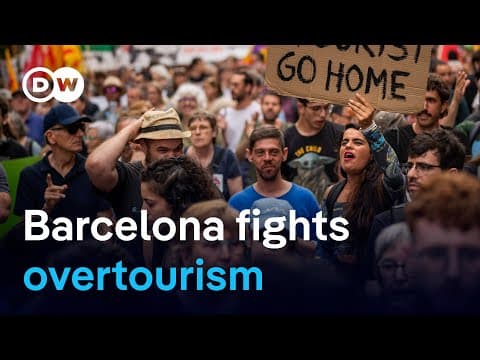
Barcelona is a leading example. In central districts such as the Gothic Quarter, many flats were converted into short-term tourist rentals, and residents link this to rising rents and the replacement of neighbourhood shops with tourist services. In 2024 thousands of residents protested against mass tourism, some spraying tourists with water pistols, and the city announced that it would end all of its roughly 10,000 licences for tourist apartments by November 2028. Amsterdam limits whole-home rentals to 30 nights a year.
 YouTube
Social media adds another cause of overtourism, sometimes called "Instagram tourism". A photograph shared widely can send crowds to a place that has no space for them. In May 2024 the town of Fujikawaguchiko in Japan put up a black mesh screen to block a famous view of Mount Fuji behind a convenience store, because crowds of photographers blocked pavements and roads. Hallstatt, an Austrian village with about 780 residents, received up to 10,000 visitors a day before 2020, many on bus tours, and introduced limits on tour buses.
Stakeholder | Claim about sharing platforms and digital tourism |
|---|---|
Hosts renting out homes | Platforms give them extra income and let them share their culture with visitors |
Long-term residents | Short-term rentals push up rents, empty neighbourhoods of residents and change local shops into tourist services |
Tourists | Platforms make travel cheaper and more authentic, with stays in real neighbourhoods |
City governments | Platforms make it harder to enforce housing and tax rules, so regulation is needed |
Rites of passage are found in every culture, from bar and bat mitzvahs and Latin American quinceañeras to Japan's Coming of Age Day. They usually depend on gathering people in one place, which is why digital systems became important when that was impossible.
During the COVID-19 pandemic, many rites moved online. In April 2020, New York State allowed marriage licences and ceremonies by video call. Utah County in the United States began offering fully online marriages, which couples from Israel, where civil marriage is not available, have used to marry without travelling. University of California, Berkeley students rebuilt their campus in Minecraft and held a virtual graduation in May 2020. Funerals were livestreamed so that relatives abroad could watch.
Death and remembrance now have a digital side as well. Facebook lets families turn a dead person's profile into a memorialised account and lets users name a "legacy contact" to manage it. In China, families have used online "cloud tomb-sweeping" services during the Qingming Festival to honour ancestors when they could not visit graves.
New digital rites have also appeared. Receiving a first smartphone or opening a first social media account is treated by many families as a step towards independence. Wedding hashtags and graduation posts turn private ceremonies into public performances that become part of a person's digital footprint.
Rite of passage | Digital form | Opportunity | Risk or loss |
|---|---|---|---|
Wedding | Video-call ceremony, livestream for distant guests | Relatives abroad can attend; couples can marry across legal barriers | Loss of shared physical rituals, food and touch |
Graduation | Ceremony in a game world, online awards | Celebration continues in a crisis | Students without good devices or connections take part less |
Funeral | Livestream, online memorial page | Diaspora families can mourn together | Grief made public; questions about who controls a dead person's data |
Coming of age | First phone or social media account | Marks growing independence | Children's images shared before they can consent |
Through the concept of identity, digital rites change who witnesses a transition and how it is remembered. A wedding watched by relatives on three continents strengthens a diaspora family's identity, but a ceremony shared publicly online is also judged by strangers.
When heritage is recorded or created with digital systems, a second category appears.
UNESCO recognised both ideas in 2003, adopting a convention on safeguarding intangible cultural heritage and a charter on preserving digital heritage. Digital systems support heritage in three main ways: recording it, giving access to it and restoring it.
Laser scanning and photogrammetry (building 3D models from many photographs) record buildings and objects with great precision. In 2010 the art historian Andrew Tallon laser-scanned Notre-Dame Cathedral in Paris, producing a 3D model made of more than a billion measured points. After fire destroyed the cathedral's roof and spire in April 2019, his scans were among the records that helped engineers and architects rebuild it, and the cathedral reopened in December 2024. The scans are a form of digital preservation. During the restoration, researchers also combined scans, photographs and records into a detailed digital model of the cathedral, a form of digital twin that supports both the rebuilding and future research.
Heritage threatened by conflict has also been recorded. CyArk, a non-profit founded in 2003, scans endangered sites worldwide. The Zamani Project at the University of Cape Town has created 3D models of African heritage sites, including the rock-hewn churches of Lalibela in Ethiopia. After the so-called Islamic State destroyed parts of the ancient city of Palmyra in Syria, the Institute for Digital Archaeology used photographs to make a replica of its Arch of Triumph, displayed in London's Trafalgar Square in 2016.
Intangible heritage survives only when people practise it, so digital systems help mainly by connecting practitioners and learners. Indigenous and minority language communities use apps, social media and recordings to teach their languages. In New Zealand, Te Hiku Media, a Māori-led broadcaster, collected recordings from speakers of te reo Māori to build its own speech-recognition tools, and it keeps control of the data under its own licence rather than selling it to large technology companies. This is an example of a community asserting digital sovereignty over its cultural data.
Digitization raises questions of power and ownership. Many museums in Europe and North America hold objects taken from other countries during colonial rule. In 2016, two German artists released a 3D scan of the bust of Nefertiti, held by the Neues Museum in Berlin, claiming they had scanned it secretly to protest that Egypt's heritage was kept in Germany; experts doubted their account, and the museum's official scan was only released in 2019 after a request under freedom-of-information law. Communities may also object to sacred objects or rituals being shown online at all, since some knowledge is meant only for initiated members.
Festivals and customs have digital versions that sit alongside traditional ones. During Lunar New Year, giving red envelopes of money (hongbao) is a long-standing custom. WeChat added digital red envelopes in 2014, and a promotion during the 2015 Spring Festival television gala, where viewers shook their phones to win red envelopes, made them a mass custom almost overnight. Today hundreds of millions of people send them each year, often in group chats where family members race to grab them.
In Mexico and other parts of Latin America, the Day of the Dead (Día de Muertos) is marked by altars (ofrendas) with photographs and food for dead relatives. In 2020, when the pandemic closed cemeteries in many places, families shared photographs of home altars on social media and some cities held events online. Diaspora communities everywhere use video calls to join Eid, Diwali, Christmas or New Year gatherings at home.
One view is that digital forms keep customs alive across distance and attract young people. Another is that they turn customs into commercial products, or reduce shared rituals to something people watch rather than do.
Many of the most visible subcultures are formed by young people.
Youth cultures were once tied to places: a music scene in a city, a style in a school. Online platforms let them form across borders and change within months. Cottagecore, an aesthetic of rural life, baking and handmade clothes, spread through TikTok and Instagram during the 2020 lockdowns. In China, "lying flat" (tang ping), a rejection of long working hours and constant competition, spread among young people after a post on the forum Baidu Tieba in April 2021, and was then censored by Chinese platforms. In South Africa, amapiano music grew from township parties to a global genre through dance videos on social media.
Youth cultures often use slang, memes and codes that parents and teachers struggle to read. This helps young people build a separate identity, a normal part of growing up, but it also creates a generation gap in which adults may misjudge harmless trends or miss harmful ones.
One of the most organised kinds of online community forms around shared admiration for a star or a story.
Online communities range from small Discord servers to forums with millions of members, often with norms enforced by volunteer moderators. Reddit's r/AskHistorians, for example, removes answers that do not cite sources, which makes it a trusted place for history questions.
K-pop fandoms show how organised online communities can be. Fans of the South Korean group BTS, known as ARMY, coordinate streaming to push songs up global charts, translate content into dozens of languages and run charity campaigns. In June 2020, after BTS donated US$1 million to Black Lives Matter causes, fans raised a matching sum within about a day through the #MatchAMillion campaign. In the same month K-pop fans flooded racist hashtags with videos of their idols, so that hateful posts became hard to find. Through the concept of power, these fandoms show that coordinated communities can influence charts, platforms and public debate.
Online communities can also cause harm. Some forums promote eating disorders, self-harm or hatred of women, such as "incel" communities. Their members often find them through recommendation algorithms and may be drawn into an echo chamber in which extreme views seem normal. Platforms respond with content moderation, but heavy moderation can push communities to less regulated sites, where they are harder to see and support.
Type of online community | Example | Opportunity | Risk |
|---|---|---|---|
Fandom | BTS ARMY, football club fan forums | Belonging, creativity, organised charity | Harassment of critics or rival fans, pressure to spend money |
Knowledge community | r/AskHistorians, Stack Overflow | Expert help available to anyone | Unpaid volunteer work; exclusion of beginners |
Identity and support community | LGBTQ+ forums, disability support groups | Support for people isolated where they live | Exposure to hostile users; data revealing sensitive identities |
Harmful community | Pro-eating-disorder forums, incel forums | Few, beyond visibility for researchers and support workers | Reinforces harmful beliefs and behaviours |
Through the concept of identity, online communities let people explore parts of themselves that their local communities may not accept, such as a young LGBTQ+ person in a conservative town. Through the concept of space, they create belonging that does not depend on place, but this can weaken ties to local communities.
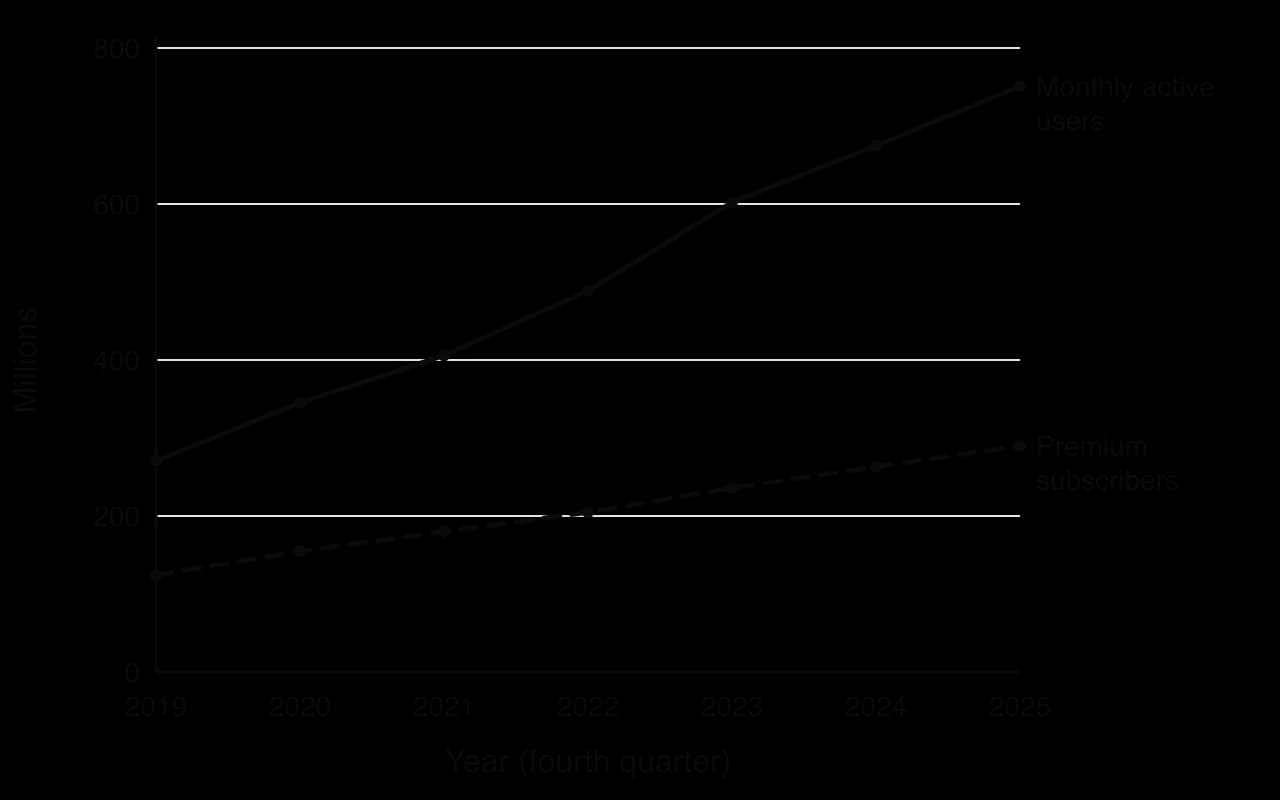
Spotify was founded in Stockholm, Sweden, in 2006 and launched in 2008 as a legal alternative to the music piracy that had cut the recorded music industry's income after Napster appeared. By the end of 2025 Spotify had 751 million monthly active users and 290 million paying subscribers, which made it the world's largest music streaming service.
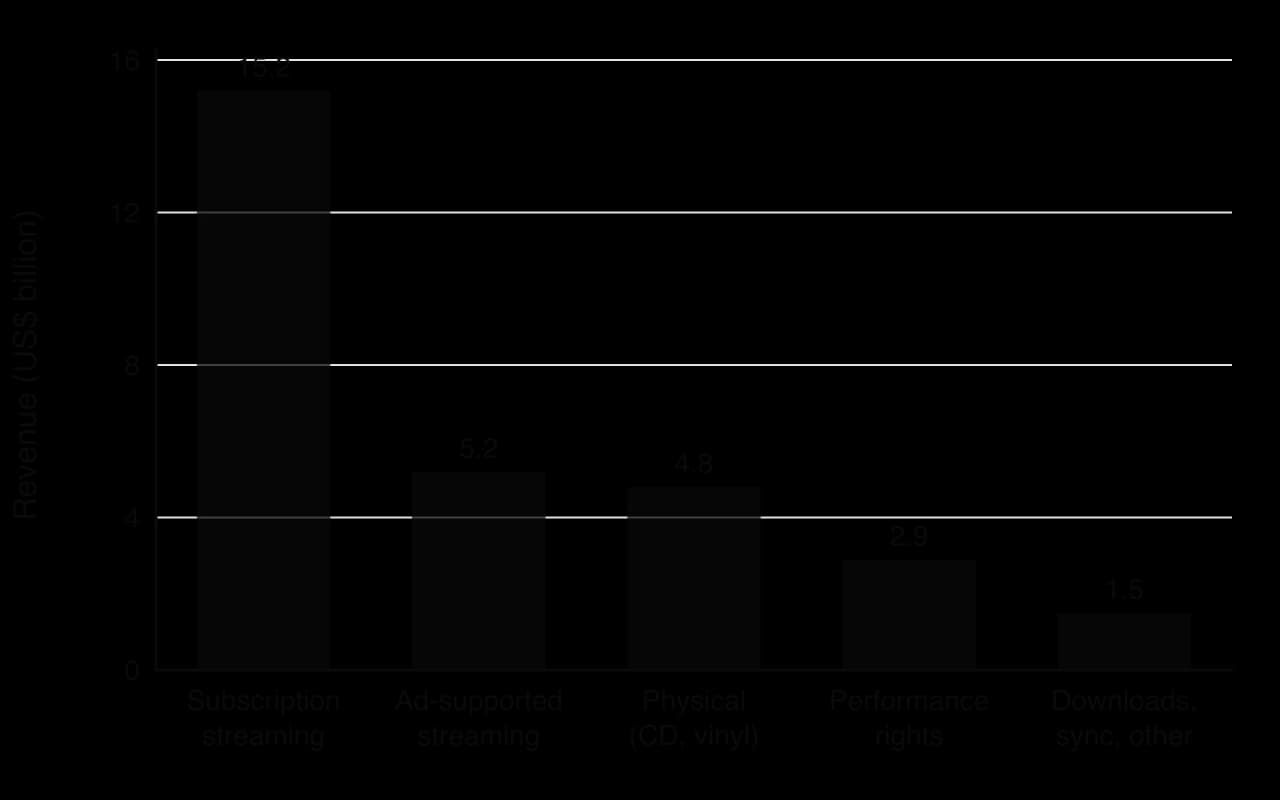
Streaming has become the core of the music industry. In 2024, according to the IFPI, global recorded music revenue was US$29.6 billion, of which 69% came from streaming. Paid subscription streaming alone made up about half of all revenue, and there were 752 million paid music subscription accounts across all services.
Spotify is a "freemium" service. Free users listen with advertisements and some limits on control; Premium users pay a monthly fee, which Spotify sets differently in each country, so it is much cheaper in India or Brazil than in Switzerland.
The service has four main parts:
The catalogue. More than 100 million tracks, licensed from record labels and from distributors that upload music for independent artists.
Data collection. Every play, skip, search, save and playlist addition is recorded, along with time of day and device.
Recommendation. Algorithms combine three kinds of analysis: collaborative filtering (people who play the songs you play also like this song), analysis of the audio itself (tempo, energy, mood), and analysis of how songs are described online. They produce personalised playlists such as Discover Weekly, launched in 2015, and the autoplay that continues after an album ends.
Editorial and algorithmic playlists. Spotify's own editors run playlists such as RapCaviar and Hot Hits, and many are now personalised for each listener.
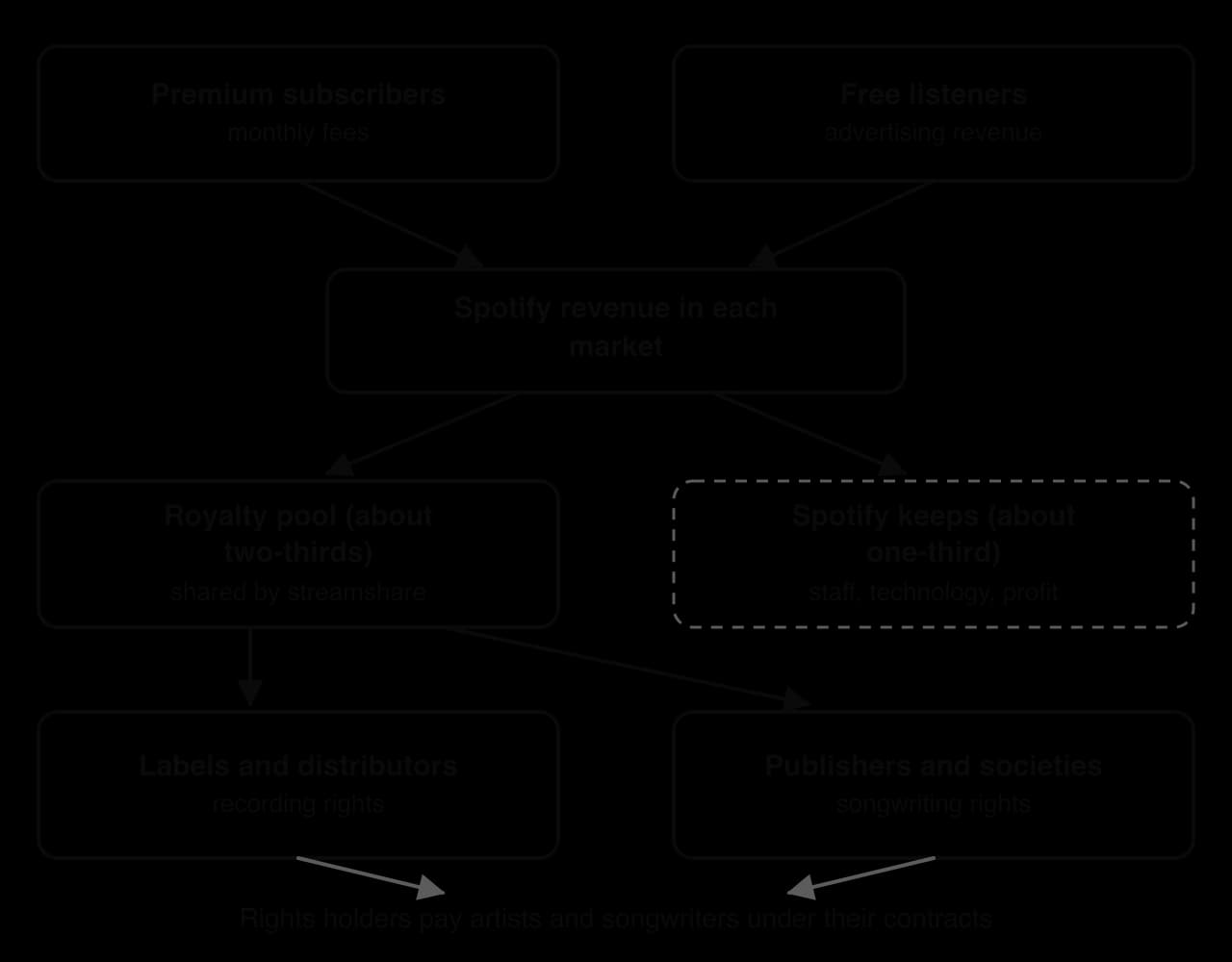
Spotify does not pay artists a fixed amount per stream. It pays rights holders according to "streamshare", their share of all streams in a market, as the flow diagram shows. A stream counts only after 30 seconds of play, and since 2024 a track needs at least 1,000 streams in the previous 12 months to earn royalties at all.
For listeners the impacts are large and mostly positive. A person with a phone and a data connection can reach almost all recorded music for the price of one album a month, or for free with advertisements. Personalised playlists help many people discover artists they would never have found on radio. Spotify Wrapped, an annual summary of each user's listening released every December since 2016, has become a cultural event in its own right, shared widely on social media as a statement of identity.
There are also costs. Listening becomes more passive when autoplay chooses the next song, and critics argue that algorithmic recommendation can narrow taste, since users are steered towards music similar to what they already play, a form of filter bubble. Albums lose their place as complete works when listeners hear single tracks in mood playlists. Listeners who do not own their music also lose access when licences change, as when Neil Young removed his music from Spotify in 2022 in protest against a podcast it hosted; it returned in 2024.
Spotify paid about US10 billion to the music industry in 2024. In its 2025 "Loud & Clear" report it stated that nearly 1,500 artists generated more than US1 million from Spotify alone in 2024, and that about 80% of them had no song in its global daily top 50 that year. Independent artists can upload music through distributors without a label, and artists from smaller markets can find global audiences. Rema's "Calm Down" (in its remix with Selena Gomez), for example, became the first song by an African lead artist to pass one billion streams on Spotify, in 2023.
Many artists, however, earn very little. Because royalties follow streamshare, the most-streamed artists and the largest labels take the biggest share of the pool, and income is spread very unequally. At typical rates of a fraction of a US cent per stream, 100,000 streams a month generate only a few hundred dollars in royalties, before the label or distributor takes its share. The 1,000-stream threshold introduced in 2024 means that tracks under it earn nothing, and that money is redistributed to more popular tracks. Spotify's "Discovery Mode", announced in 2020, lets artists and labels accept a lower royalty rate in return for algorithmic promotion, which critics compare to the old practice of paying radio stations to play songs.
Streaming has also changed how music is made. Since a stream is counted after 30 seconds, many songs now start with the chorus or a hook, and songs have tended to become shorter. The journalist Liz Pelly reported in 2024 that Spotify filled some mood playlists, such as ambient or study music, with tracks from production companies under invented artist names at lower cost, a programme called "Perfect Fit Content". In 2025 a band called The Velvet Sundown gained more than a million monthly listeners on Spotify before its profile was updated to describe it as a synthetic music project, made with AI under human direction. These cases raise questions about whether mood playlists value music as art or as background.
 YouTube
Power. Spotify acts as a gatekeeper between artists and listeners. Its editors and algorithms decide which songs reach millions of ears, and its royalty rules, such as the 1,000-stream threshold, are set by the company rather than negotiated with most artists. The three major labels (Universal, Sony and Warner) hold large catalogues and therefore strong bargaining power, while independent artists have little. Listeners hold some power through their choices, but those choices are shaped by what the interface shows them.
Change. Streaming is a transformation of the music industry rather than a gradual evolution. The basic product changed from owned copies to rented access, income shifted from sales to streamshare, and the role of radio and record shops as tastemakers moved to playlists and algorithms. Some continuity remains: the major labels are still the most powerful companies, and live concerts remain the main income for many artists.
Expression. Streaming widens who can express themselves through music, since anyone can upload a track through a distributor. At the same time, the commercial pressure to catch attention in 30 seconds and to fit mood playlists shapes how artists compose, which some see as a limit on artistic expression.
Values and ethics. The fairness of the payment model is the central ethical question. Some musicians argue for a "user-centric" model, in which each subscriber's fee is shared only among the artists that subscriber played; others reply that it would change little for most artists.
Spotify has brought clear benefits. It turned piracy into paid listening, restored growth to the recorded music industry and gave hundreds of millions of people affordable access to music from every region. For listeners, especially in lower-income countries where pricing is adjusted, the gains in access and discovery are large.
For artists, the impact depends on who they are. Established artists and major labels have gained most, while many independent and mid-level musicians find that streams bring exposure but little income, so they rely on concerts, merchandise and fan platforms such as Bandcamp. The company's design choices, from the streamshare model to Discovery Mode, mean that its gatekeeping power affects not only who is heard but also how music is written.
A balanced judgement is that Spotify has improved how listeners experience music in breadth and convenience, but at the cost of depth, ownership and a fair distribution of income to creators. Whether the balance improves depends less on the technology than on governance: how royalties are shared, how transparent the algorithms are and whether regulators or artists gain more say.
Inquiry in the cultural context often starts from a real-world example that is new to the reader. A clear sequence of questions makes any unfamiliar example manageable, as the steps diagram shows.
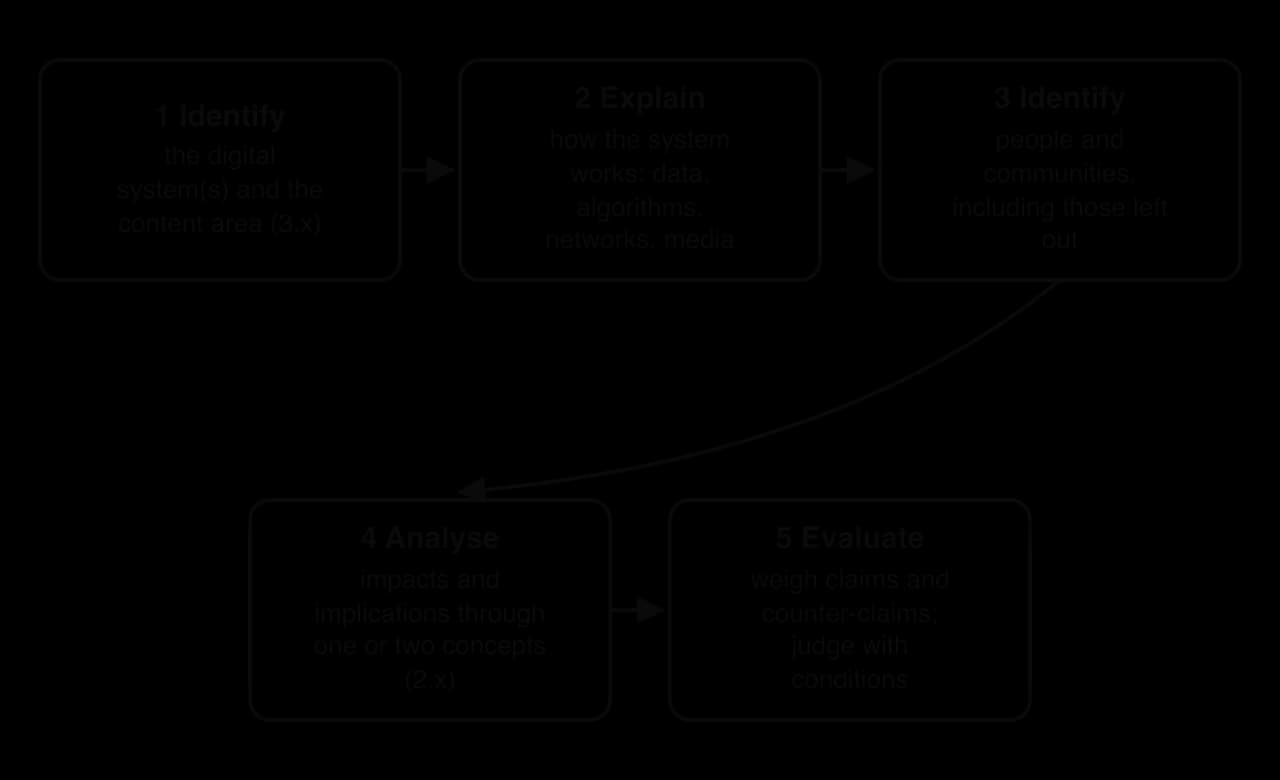
Steps 1 and 2 use the content areas (3.x): which data, algorithms, networks, media or AI the example relies on. Step 3 identifies people and communities, including stakeholders with power and those left out. Step 4 applies one or two concepts (2.x) to explain the impacts and implications. Step 5 weighs claims and counter-claims to reach a judgement with conditions.
Paper 2 gives short sources that must be compared with each other.
I can define culture, popular culture, subculture, youth culture and cultural heritage in my own words.
I can distinguish between cultural globalization and cultural homogenization, with real-world examples of each.
I can describe how digital techniques, forms and genres have changed the arts, with examples such as webtoons and phonk.
I can explain the opportunities and limits of online galleries and virtual exhibitions such as Google Arts & Culture.
I can describe how streaming platforms change the experience of music and film.
I can explain the roles of memes, online forums, internet celebrities and influencers, and the difference between the last two.
I can analyse the opportunities and risks of smart home technologies for different people in a household.
I can explain how digital systems have changed sport, gaming, esports and hobbies.
I can evaluate the role of sharing platforms and social media in overtourism, with Barcelona as an example.
I can explain how rites of passage, customs and celebrations take digital forms, and what is gained and lost.
I can explain how digital systems record, restore and sustain tangible and intangible heritage, and the questions of ownership this raises.
I can analyse the opportunities and risks of youth cultures, fandoms and other online communities.
I can evaluate the impacts of Spotify on listeners and on different groups of artists, using at least two concepts.
I can apply the five steps to analyse an unseen real-world example in the cultural context.