Identify the types and characteristics of digital media, including immersive and synthetic media, and evaluate their dilemmas, from addiction and deepfakes to copyright, preservation and censorship.
Each is in the Digital Society glossary, with every other term in the subject.
Technology that adds digital objects or information on top of a live view of the real world, usually through a smartphone camera or smart glasses.
A website of regularly updated written entries, called posts, usually shown with the newest first and often written by one person or a small group.
The suppression, removal or blocking of media content by a government, platform or other authority that judges it unacceptable.
The gathering, reporting and sharing of news by members of the public rather than professional journalists, usually with smartphones and social media.
Software that blocks access to online content matching set rules, such as keywords, website categories or image analysis, used by schools, employers, parents and governments.
A licensing method that lets anyone use, modify and share a work, on the condition that any modified version is shared under the same free licence.
The exclusive legal right of the creator of an original work to control how it is copied, shared, adapted and performed, for a period set by law.
A non-profit organisation, and the set of free licences it publishes, that let creators state in advance how others may reuse their work, for example with credit, without changes or only non-commercially.
Rules about what may be shown or said in media, especially to audiences that may include children, covering sexual content, violence and strong language.
Synthetic video, audio or images, generated with machine learning, that realistically show a real person saying or doing something they did not say or do.
A pattern of compulsive use of digital media or devices that the user struggles to control and that continues despite harm to their health, relationships or daily life.
Content such as text, images, audio, video, animation and games that is encoded as digital data, so it can be created, stored, edited, copied and distributed with computers and networks.
Technology that restricts how digital content can be copied, shared, played or transferred, used by publishers to enforce copyright and licence terms.
False information that is created or shared deliberately to deceive people, for political, financial or personal gain.
Organised competitive video gaming in which professional or amateur players and teams compete in leagues and tournaments, often in front of live and online audiences.
An umbrella term for all technologies that combine or replace the real world with digital content, including augmented, mixed and virtual reality.
The process of checking whether claims in media are accurate, by tracing them to original sources and comparing them with reliable evidence, often carried out by specialist organisations.
A legal exception in US copyright law that allows limited use of copyrighted work without permission for purposes such as criticism, commentary, news reporting, teaching and parody.
A word or phrase preceded by the # symbol that labels a post, so that posts on the same topic are grouped together and can be searched for or followed.
Digital media that create a sense of being inside or interacting with a digital environment, through technologies such as augmented, virtual and mixed reality.
The extent to which users can act on a medium and change what it shows or does, for example by clicking, choosing, commenting, creating or playing, rather than only receiving it.
Content presented in a fixed order and, for broadcasts, at a fixed time chosen by its creator, so every audience member follows the same sequence.
Broadcasting video and audio over the internet as events happen, so viewers can watch in real time and often interact through live chat.
Whether a piece of media is what it claims to be: genuine, unaltered and from the source it names, rather than edited, fabricated or taken out of context.
The concentration of media ownership in fewer, larger companies or groups, through mergers, takeovers and the closure of smaller outlets.
The merging of previously separate media forms, technologies and industries, made possible because all content can be handled as digital data on shared devices, networks and platforms.
The division of audiences across many more media sources, platforms and formats, so that fewer people share the same news and entertainment sources.
The process by which storage media, file formats, software or hardware become outdated and unsupported, so the content they hold can no longer be read or played.
An image, video, phrase or idea that is copied, adapted and shared rapidly between internet users, often changing slightly each time it spreads.
A proposed network of shared, persistent 3D virtual spaces, often reached through virtual or augmented reality, in which people interact through avatars for work, leisure and commerce.
False or misleading information that is shared by people who believe it is true, without the intention to deceive.
Technology that blends real and virtual environments so that digital objects are anchored in physical space and respond to it, and users can interact with both.
An intense, widespread public fear that something, often a new medium or technology, threatens social values or children's safety, out of proportion to the evidence of harm.
Content that users can access in an order or at a time of their own choosing, or whose path they shape through their choices, such as websites, games and on-demand services.
Material judged so harmful, for example terrorist attack footage or child abuse material, that law or platform rules restrict or ban it outright; New Zealand uses the term as a legal classification.
Speech or content that many people find upsetting, insulting or disrespectful; in many democracies it is legal, because freedom of expression protects speech that offends.
Software whose source code is published under a licence that lets anyone read, use, modify and share it; the term is also used for other openly shared work.
A series of audio episodes published online that listeners can stream or download and subscribe to, so they listen when they choose rather than to a broadcast schedule.
The practice of creating new works by combining, editing or adapting existing ones, such as mash-ups, memes, samples and fan videos.
Audio and video delivered over a network and played while the data arrives, rather than downloaded in full first; users pay for or receive access, not a copy.
Images, video, audio or text that are wholly or partly produced by artificial intelligence rather than recorded or written directly from the real world.
Text, images, video, audio or other material created by the users of a platform, rather than by the platform itself or by professional media producers.
Technology that replaces the user's view of the real world with a fully computer-generated environment, usually seen through a headset that tracks head movement.
A video blog: a series of videos, usually on a platform such as YouTube, in which a creator speaks to the camera about their life, opinions or interests.
A podcast published as a series of video episodes, which viewers can stream or download and subscribe to, rather than audio alone.
A website that many users can edit together through a web browser, keeping a history of every change; Wikipedia is the best-known example.
Define digital media and explain how they come from the convergence of computing, communication and content.
Identify and describe the main types of digital media, from text and video to e-sports, user-generated content and synthetic media.
Outline the characteristics of digital media: rapid sharing, efficient storage, interactivity, linear and non-linear content, and convergence.
Distinguish between augmented, virtual, mixed and extended reality, with real-world examples of each.
Explain the psychological concerns linked to digital media and their impact on journalism.
Distinguish between misinformation and disinformation, and analyse how deepfakes challenge media authenticity.
Compare copyright, copyleft, Creative Commons and open source as ways of controlling and sharing creative work.
Discuss the dilemmas of media obsolescence, digital preservation, censorship and content regulation.
Evaluate the impacts and implications of a deepfake for different people and communities, using the Zelensky deepfake of 2022.
Digital media are the forms of content, such as text, images, sound, video and games, that are created, stored and shared as digital data. Most of what people read, watch, play and share each day reaches them as digital media, so their design and control shape how people learn about the world, express themselves and spend their time.
Digital media draw on every other content topic. They depend on data and its compression, on algorithms that rank and recommend, on computers and on networks, and increasingly on artificial intelligence, which can now generate convincing images and video. The topic connects most strongly to the concepts of expression, identity, power, and values and ethics, and to the cultural, political, social and health contexts.
With a free account, Augment remembers where you stopped and what you have practiced.
A medium is a channel that carries a message from a creator to an audience. Before digital technology, each medium had its own physical form: newspapers were printed on paper, music was pressed onto vinyl or tape, and television travelled as an analogue broadcast signal. Digital media turn all of these into the same thing, a stream of binary data that any suitable digital system can store, process and transmit.
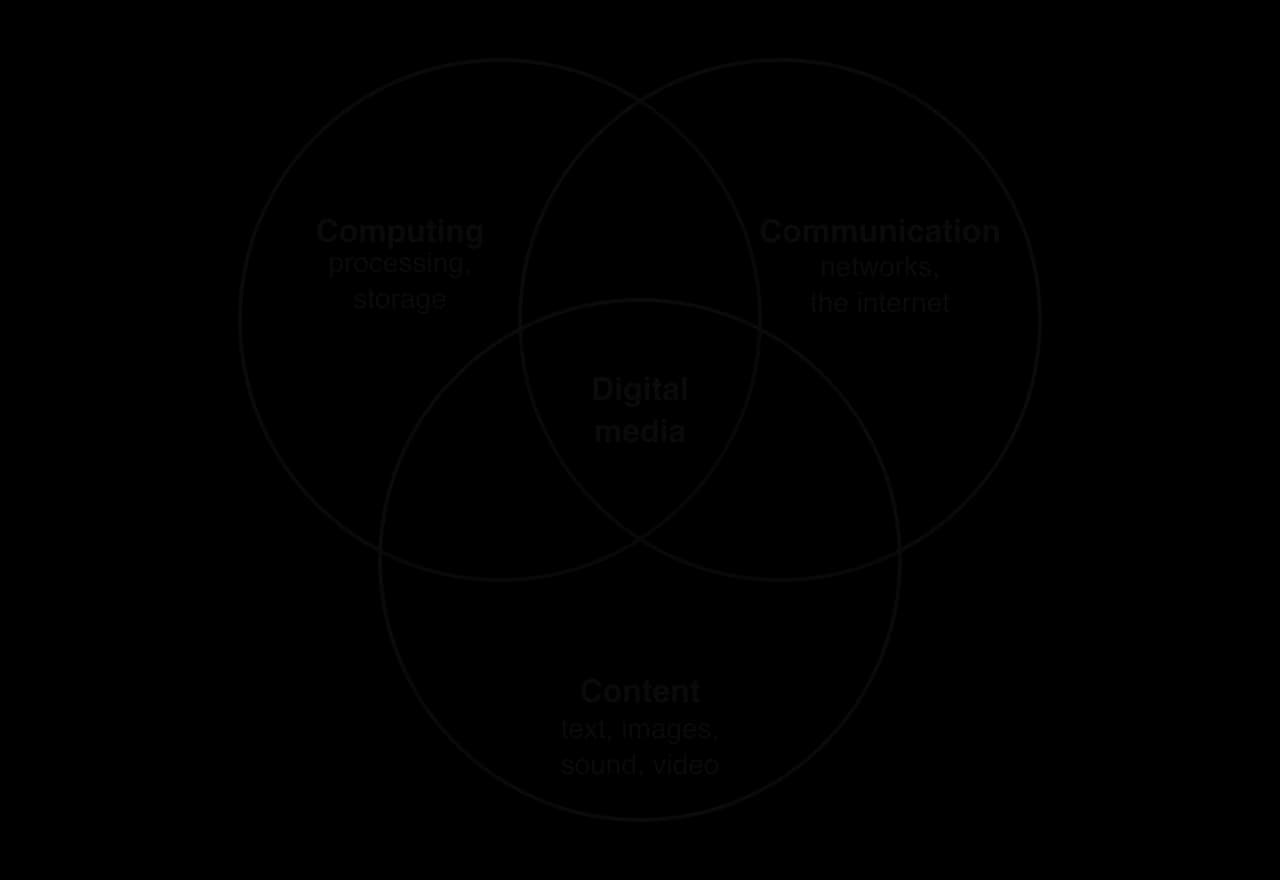
Digital media are best understood as the meeting point of three developments. Computing gives devices that can process and store data cheaply. Communication gives networks, especially the internet, that move data between devices almost instantly. Content gives the words, pictures, sounds and stories that people want to share. Where all three overlap, digital media appear, as the three-circle model shows.
This idea is called media convergence: once all content is digital, the old boundaries between media industries, devices and forms break down. A smartphone is a camera, a television, a newspaper, a radio and a games console at once. A news organisation such as the BBC now publishes text, live video, podcasts and short clips for social platforms from the same newsroom.
A second feature of digital media is that the same piece of content travels through many channels. A single football highlight may appear on a club's website, its YouTube channel, a broadcaster's app, fans' TikTok edits and a sports news site, each with its own audience and rules. Creators therefore plan for several platforms at once, and audiences meet the same story in different shapes.
Digital media come in many forms, and new ones appear as technology changes. They can be grouped into basic forms, gaming, participatory forms in which audiences also create, and synthetic media made by AI.
Every digital media product is built from a small set of basic forms. Each form is stored in standard file formats, and most formats use data compression to make files small enough to store and send.
Form | What it is | Common formats | Real-world example |
|---|---|---|---|
Text | Written words stored as character codes | TXT, HTML, PDF, EPUB | An e-book on Kindle; a news article |
Images | Still pictures, either a grid of pixels (raster) or shapes described mathematically (vector) | JPEG, PNG, SVG | A photo shared on Instagram; a logo |
Audio | Sound sampled thousands of times a second | MP3, AAC, WAV | A song on Spotify; a voice note |
Animation | A sequence of images or moving shapes shown quickly to give the illusion of motion | GIF, animated SVG, 3D models | An animated explainer; a Pixar film |
Video | Moving images with synchronised sound | MP4, WebM | A YouTube video; a video call |
Web pages | Documents written in HTML that combine the other forms and link to other pages | HTML, CSS, JavaScript | A news site's home page |
A web page is a container for the other forms. It can hold text, images, audio, video and interactive code at once, and it links to other pages through the world wide web. This ability to combine forms in one product is sometimes called multimedia.
Video games are digital media in which the player's actions change what happens on screen. They combine graphics, sound, animation, story and rules, and many now include online multiplayer play, live events and in-game purchases. Platforms such as Roblox and Fortnite are also social spaces where players meet, chat and attend virtual concerts.
E-sports (electronic sports) are organised, competitive video gaming, usually between professional players or teams, watched by live and online audiences. Popular e-sports titles include League of Legends, Counter-Strike, Dota 2 and Valorant. Tournaments fill large arenas and are streamed to millions of viewers online.
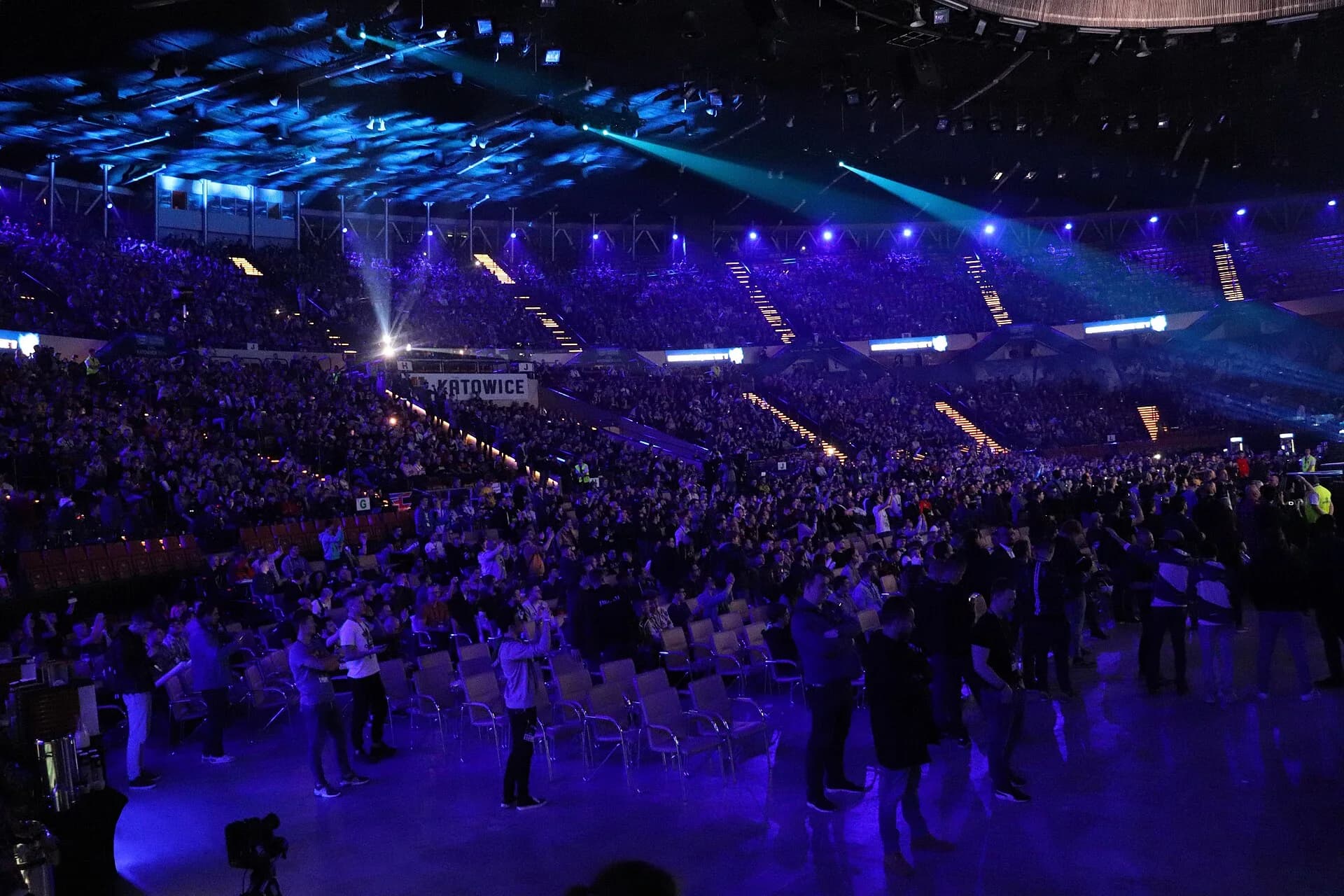
E-sports show how digital media cross several contexts. In the economic context, the first Fortnite World Cup in 2019 paid its solo champion, the 16-year-old Kyle Giersdorf, 3 million US dollars. In the cultural context, e-sports were a medal event at the 2022 Asian Games in Hangzhou (held in 2023), a sign that some institutions now treat them as sport. In the health context, they raise questions about long hours of practice, repetitive strain injury and the pressure on young professional players.
A group of digital media forms lets anyone with a device publish to a large audience. These forms grew with Web 2.0, the shift in the 2000s towards websites built around content that users create and share.
Form | What it is | Real-world example |
|---|---|---|
Blog | A website of regularly updated entries (posts), usually in reverse date order, often by one person | Personal blogs on Substack or WordPress |
Vlog | A video blog: a series of videos in which a creator talks to the camera about their life or interests | Daily vlogs on YouTube |
Podcast | A series of audio episodes that listeners can download or stream and subscribe to | The Daily (The New York Times); Global News Podcast (BBC) |
Vodcast | A video podcast: a podcast series published as video episodes | Video versions of podcasts on YouTube and Spotify |
Live streaming | Video broadcast over the internet in real time, often with live chat from viewers | Gamers on Twitch; concerts on YouTube Live |
The word "podcast" was coined in 2004, joining "iPod" and "broadcast". A podcast differs from a radio programme because listeners choose when to listen and subscribe through an app, so it is not tied to a broadcast schedule. Vodcasting extends the idea to video. Live streaming is the opposite in one respect: its value lies in being live, because viewers can talk to the streamer and to each other while it happens.
Through the concept of expression, these forms lowered the cost of publishing almost to zero. A teenager with a phone can reach as many people as a television channel. Through the concept of power, however, reach still depends on the recommendation algorithms of a few platforms, which decide which videos and posts are shown to whom.
Three smaller forms shape how content is organised and how it spreads.
A hashtag is a word or phrase preceded by the # symbol that groups posts on the same topic, so users can search for or follow a conversation. It was first proposed on Twitter in 2007 by the designer Chris Messina. Hashtags let scattered users find each other quickly, which is why campaigns, events and brands rely on them.
A meme is an image, video, phrase or idea that spreads from person to person online, usually changing as people copy and adapt it. The biologist Richard Dawkins coined the word in 1976 for any unit of culture passed on by imitation. Internet memes are often humorous, but they can also carry political messages, because a simple, shareable image travels further than a long argument.
A wiki is a website that many users can edit together through their browsers, with a history of every change. Wikipedia is the best-known example: written by volunteers, it holds millions of articles in more than 300 languages. Its model depends on open editing, shared rules about neutral writing and sourcing, and a community that reverts vandalism.
Streaming media are audio and video delivered over a network and played while they arrive, rather than downloaded in full first. The user pays, or watches adverts, for access, not for a copy. Netflix, Spotify, YouTube and Disney+ all work this way.
Streaming depends on enough network bandwidth and on compression, so services adjust the quality of a video to the speed of the connection. It changed how people consume media: many viewers now expect any film or song to be available instantly, and they rarely own the file. This shift from owning to accessing raises questions about ownership.
User-generated content (UGC) is any content created by ordinary users rather than by professional media organisations, and published on platforms. Reviews, comments, videos, photos, fan art, Wikipedia edits and posts are all UGC. YouTube said in 2019 that more than 500 hours of video were uploaded to it every minute, almost all of it by users rather than studios.
UGC is the basis of the platform business model. Platforms do not pay for most of the content they host, but they earn from the advertising shown next to it. This creates participatory culture, in which audiences are also creators, and it gives a voice to people who never had access to traditional media. It also creates problems of quality, accuracy and harmful material, because no editor checks content before it is published. Content moderation, explored in the concept of expression, is the platforms' attempt to manage this.
Synthetic media are images, video, audio or text that are wholly or partly produced by AI rather than recorded from the real world. They include AI-generated images from tools such as Midjourney and DALL-E, AI-written text from chatbots, cloned voices, and video from text-to-video models such as OpenAI's Sora, announced in 2024.
A deepfake is a form of synthetic media in which a real person's face, body or voice is digitally imitated or swapped, so they appear to say or do something they never did. The name joins "deep learning" and "fake". A deepfake model is trained on many images or recordings of a person, learns the patterns of their face or voice, and then generates new frames or sounds that match a target video or script.
Synthetic media have legitimate uses. Film studios use them to de-age actors and dub films into other languages with matching lip movements. In the 2019 "Malaria Must Die" campaign, the footballer David Beckham appeared to speak in nine languages through AI-generated voices, with his consent. People who lose their voice to illness can use voice cloning to keep speaking in their own voice. The same tools can also produce fraud, harassment and political deception.
Digital media share several characteristics that analogue media lacked or had only weakly. These characteristics explain both the opportunities and the dilemmas of digital media.
Digital content can be copied perfectly and sent across the world in seconds at almost no cost. A copy of a digital photo is identical to the original, unlike a photocopy of a photocopy. Sharing buttons, messaging apps and recommendation feeds turn this technical ability into rapid, large-scale spread, often called going viral.
Rapid sharing helps emergency alerts, campaigns and breaking news reach people quickly. It also spreads false content. A 2018 study in Science by Soroush Vosoughi, Deb Roy and Sinan Aral examined about 126,000 stories shared on Twitter between 2006 and 2017. False stories were 70% more likely to be retweeted than true ones, and true stories took about six times as long as false ones to reach 1,500 people. The researchers found that people, not automated bots, drove the difference, probably because false stories seemed more novel.
Digital media take up little physical space, and storage has become very cheap. A smartphone can hold thousands of songs and photos, and cloud computing lets people store media on remote servers and reach it from any device. Compression makes this possible.
Lossless compression reduces file size without losing any data, so the original can be rebuilt exactly (PNG images, FLAC audio).
Lossy compression removes data that people are unlikely to notice, such as sounds masked by louder ones, giving much smaller files (JPEG images, MP3 audio, most streamed video).
Efficient storage means that almost everything can be kept, from family photos to entire national archives. It also means that embarrassing or harmful content can last for years and be found again, which links to the right to be forgotten in the topic of networks and the internet.
Interactivity is the ability of a medium to respond to its user's actions. A printed newspaper can only be read; a news website lets readers search, click links, comment, share and choose which stories to open. Games are highly interactive, since the player's choices drive what happens.
Interactivity runs along a scale. At the low end, a user can only pause or skip. In the middle, a user can choose what to view and respond to it. At the high end, the user co-creates the content, as players do in Minecraft or editors do on Wikipedia. Every interaction also produces data that platforms collect and analyse to recommend content and target adverts.
Linear content is presented in a fixed order that the creator chooses, from start to finish. A traditional television broadcast, a radio programme and a film in a cinema are linear: the audience sees the same sequence at the same time. Non-linear content lets users choose their own path or order, or watch at any time. A website with hyperlinks, a video game with several endings and an on-demand streaming catalogue are non-linear.
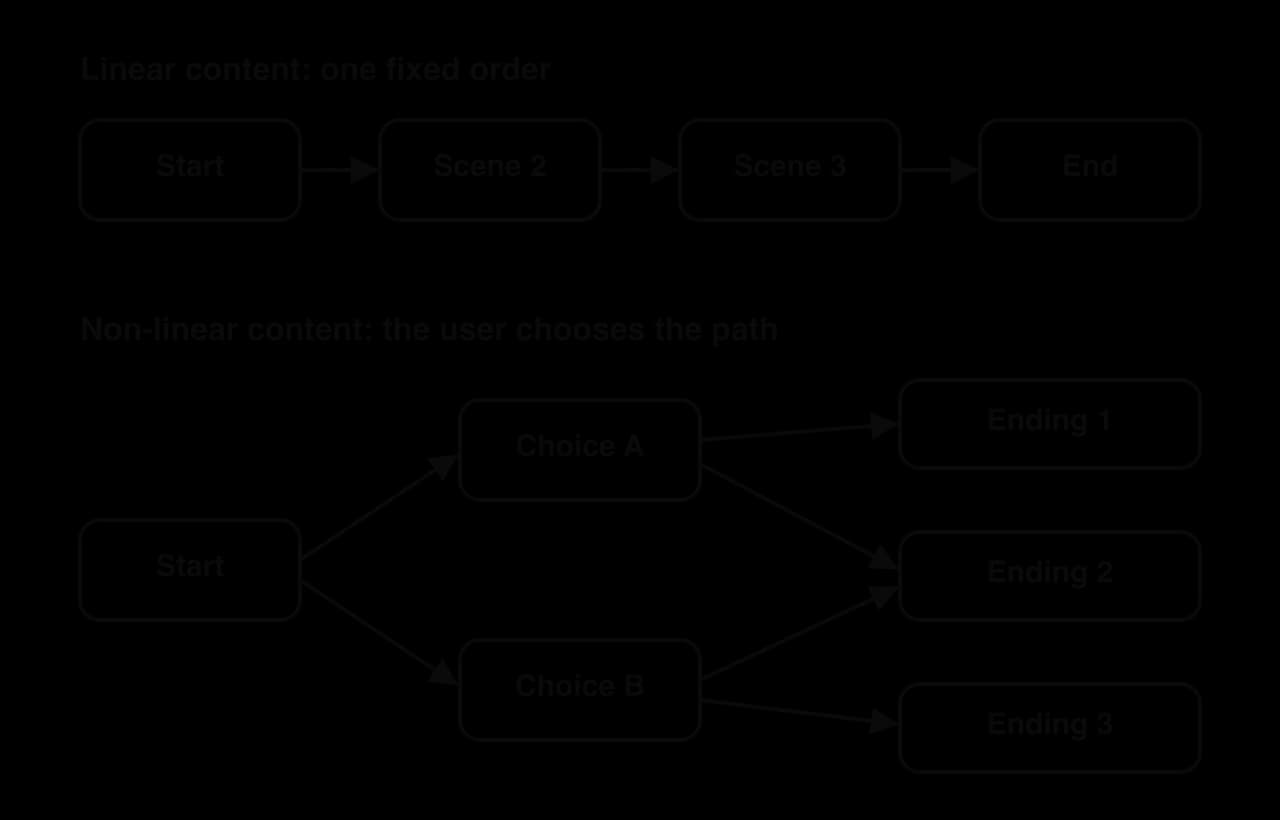
The terms are used in two related ways. In broadcasting, "linear TV" means scheduled channels, while "non-linear" means on-demand services such as BBC iPlayer or Netflix, which viewers watch when they choose. In storytelling, non-linear content lets the audience shape the story. Netflix's interactive film Black Mirror: Bandersnatch (2018) asked viewers to make choices for the main character, leading to several possible endings.
Convergence works at two levels. Convergence of media forms means that text, images, audio and video now mix in one product, such as a news article with embedded video and a podcast player. Convergence of layers means that the parts of the media system that were once separate now share the same infrastructure. Before digital media, each industry had its own chain from production to device. Now the same devices, networks and platforms carry every kind of content.
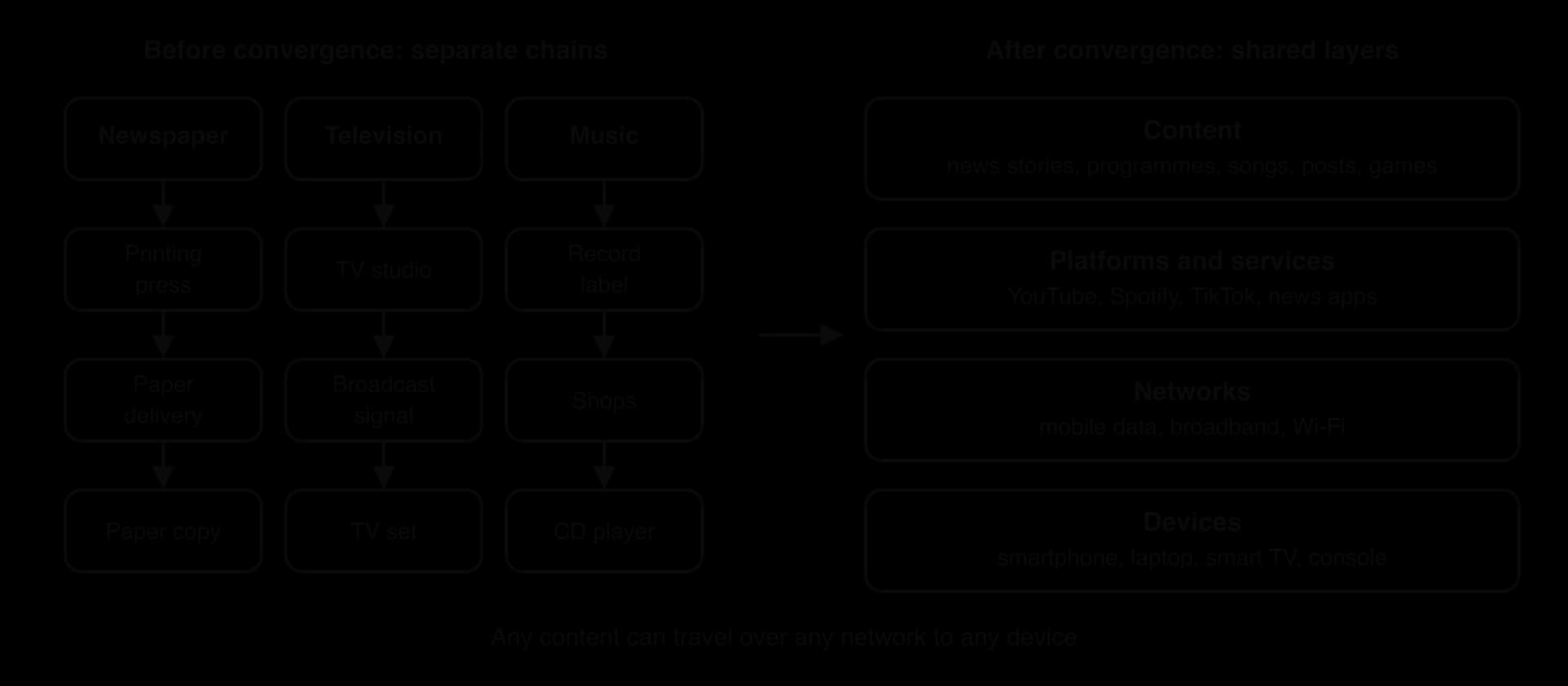
The media scholar Henry Jenkins, in Convergence Culture (2006), argued that convergence is cultural as well as technical: audiences follow stories across platforms and take part in creating them. A film franchise, for example, now spreads its story across games, social media accounts, fan fiction and streaming series.
Immersive media surround users with digital content or blend it with the physical world, so the user feels present inside the experience rather than looking at a screen. They depend on headsets or phone cameras, sensors that track movement, and powerful graphics processing.
The four terms describe how much of what the user experiences is real and how much is digital.
Augmented reality (AR) adds digital objects or information on top of the user's view of the real world, usually through a phone camera or smart glasses. Pokémon Go (2016) placed virtual creatures in real streets, and the IKEA Place app (2017) lets shoppers see furniture in their own room before buying.
Virtual reality (VR) replaces the real world with a fully computer-generated environment, seen through a headset that blocks out the surroundings and tracks head movement. Meta's Quest headsets are widely used for VR games and training.
Mixed reality (MR) blends real and virtual so that digital objects are anchored in the physical space and respond to it. A user wearing Microsoft's HoloLens can place a 3D engine model on a real table and walk around it. Apple markets its Vision Pro headset (2024) as "spatial computing", a form of mixed reality.
Extended reality (XR) is the umbrella term for all of these technologies together.
Researchers Paul Milgram and Fumio Kishino described these technologies in 1994 as points on a reality–virtuality continuum, which runs from the fully real environment to the fully virtual one. Between the two ends lies mixed reality, which includes augmented reality (mostly real, with digital additions) and augmented virtuality (mostly virtual, with real objects or people brought in, such as a live video of a user's hands shown inside a virtual scene).
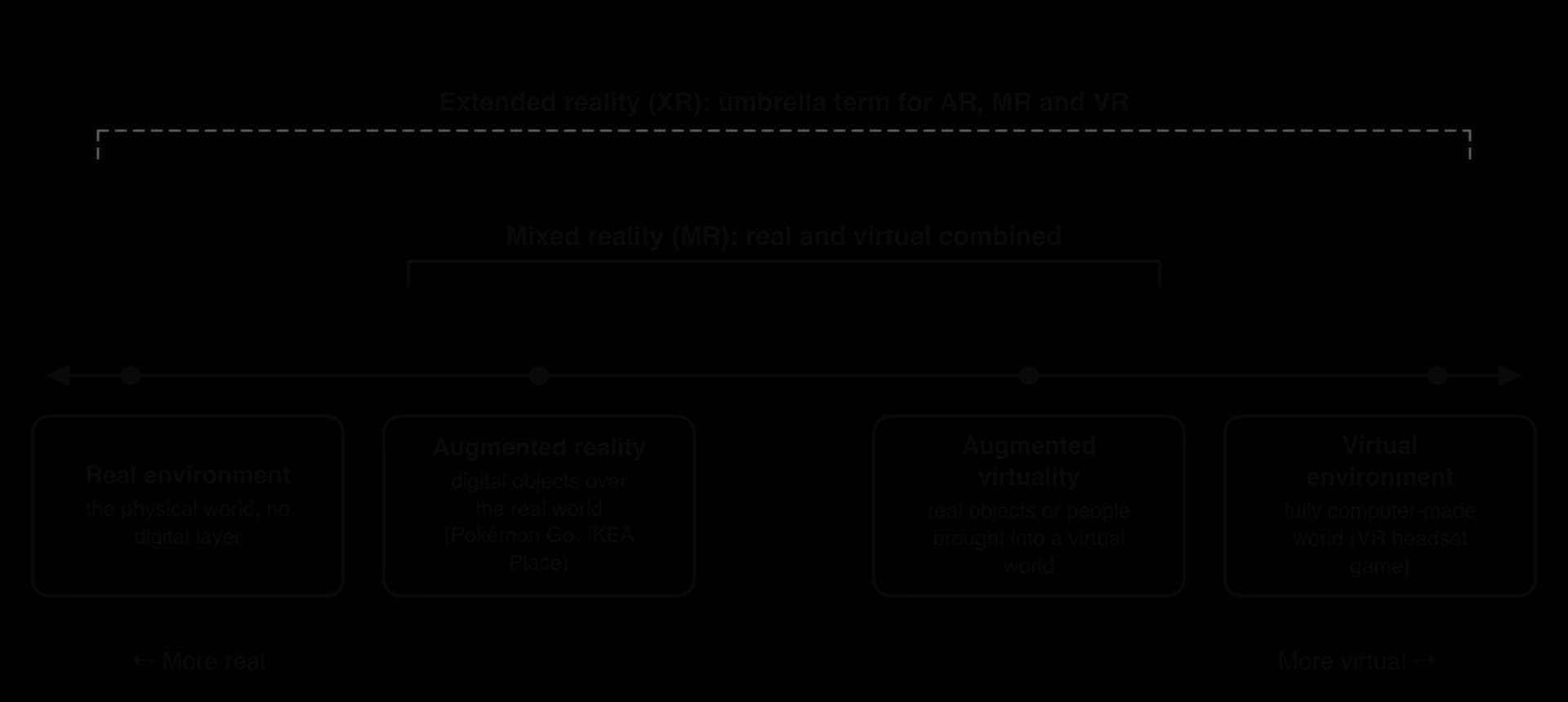
Technology | What the user sees | Typical hardware | Real-world example |
|---|---|---|---|
AR | The real world with digital additions | Smartphone, smart glasses | Snapchat face filters; Pokémon Go; Google Maps Live View directions |
VR | A fully virtual world | Headset with motion tracking | Beat Saber on Meta Quest; VR flight and surgical training |
MR | Real and virtual objects interacting | Advanced headset with depth sensors | HoloLens in engineering and medical training; Apple Vision Pro |
XR | Any mix of real and virtual | Any XR device | Used as a general term by industry and researchers |
Immersive media appear in many contexts. In health, VR is used to train surgeons and to treat phobias through gradual, controlled exposure. In education and culture, museums offer AR guides and VR tours of sites that are fragile or far away. In the economic context, AR lets online shoppers try on glasses or see furniture at home, and factories use MR headsets to guide workers through complex repairs.
The idea of the metaverse brings these strands together: a network of persistent, shared virtual worlds where people work, play and socialise through avatars. Facebook renamed itself Meta in October 2021 to signal its bet on this idea. Games such as Roblox and Fortnite already work as early, partial metaverses, but most people do not yet own a headset, and the vision remains contested.
Immersive media also raise dilemmas. Headsets collect very detailed data, including eye movements, hand movements and the layout of users' homes, which could show health conditions or emotions. Some users experience motion sickness and eye strain. High hardware costs widen the digital divide, and harassment in shared virtual spaces can feel more personal because it is experienced in the first person. Through the concept of space, immersive media blur the line between physical and virtual space, raising questions about who sets the rules in each.
The characteristics that make digital media powerful also create dilemmas: situations in which different people and communities make competing claims, and in which every choice has costs. Six groups of dilemmas stand out.
Many digital media are designed to hold attention, because platforms earn more when users stay longer. Features such as infinite scroll, autoplay, notifications, streaks and unpredictable rewards (a "like" may or may not arrive) draw on the same psychology as gambling machines. This design is part of the attention economy, in which user attention is the scarce resource that platforms compete for and sell to advertisers.
Digital addiction describes compulsive use of digital media that a person finds hard to control and that harms their sleep, work, relationships or health. Whether heavy use is truly an addiction is debated. The World Health Organization added gaming disorder to its International Classification of Diseases (ICD-11), which came into effect in 2022, defining it by impaired control over gaming and continued gaming despite harm. It has not added a similar diagnosis for social media.
Other psychological concerns include anxiety, low self-esteem and poor body image from constant comparison with edited images, fear of missing out, cyberbullying and disrupted sleep. In 2021 The Wall Street Journal published leaked internal Facebook research which found that Instagram made body-image issues worse for about one in three teenage girls who already had them. In 2023 the US Surgeon General issued an advisory warning that there was not enough evidence to conclude that social media were safe for young people's mental health.
The evidence is mixed, and researchers disagree about its strength. Large studies tend to find small average links between screen use and lower well-being, while some young people, including those from minority groups, report that online communities give them support they cannot find offline. Governments have nonetheless acted:
In 2021 China limited children under 18 to one hour of online gaming on Fridays, weekends and public holidays.
Australia banned children under 16 from holding accounts on major social media platforms from 10 December 2025; by mid-January 2026 platforms reported deactivating, removing or restricting about 4.7 million accounts.
Digital media changed how news is produced, paid for and consumed. Two opposite trends happened at the same time.
Media fragmentation is the splitting of audiences across a huge number of sources, platforms and formats. In the past, a few newspapers and television channels reached most people in a country. Today audiences divide between news sites, podcasts, YouTube channels, newsletters, TikTok creators and messaging groups. This gives people more choice and more diverse voices, but it weakens the shared set of facts that a society debates from, and it can feed echo chambers in which people mostly hear views like their own.
Media consolidation is the concentration of media ownership in fewer, larger companies. As advertising moved online, much of it went to Google and Meta, whose platforms sell targeted adverts more cheaply than newspapers can. Many newspapers closed or were bought by larger chains, which cut local staff. In Hungary in 2018, owners donated more than 400 pro-government media outlets to a single foundation, an example of consolidation with clear political effects.
The effects on jobs are clear in the United States, where the Bureau of Labor Statistics tracks newsroom employment.
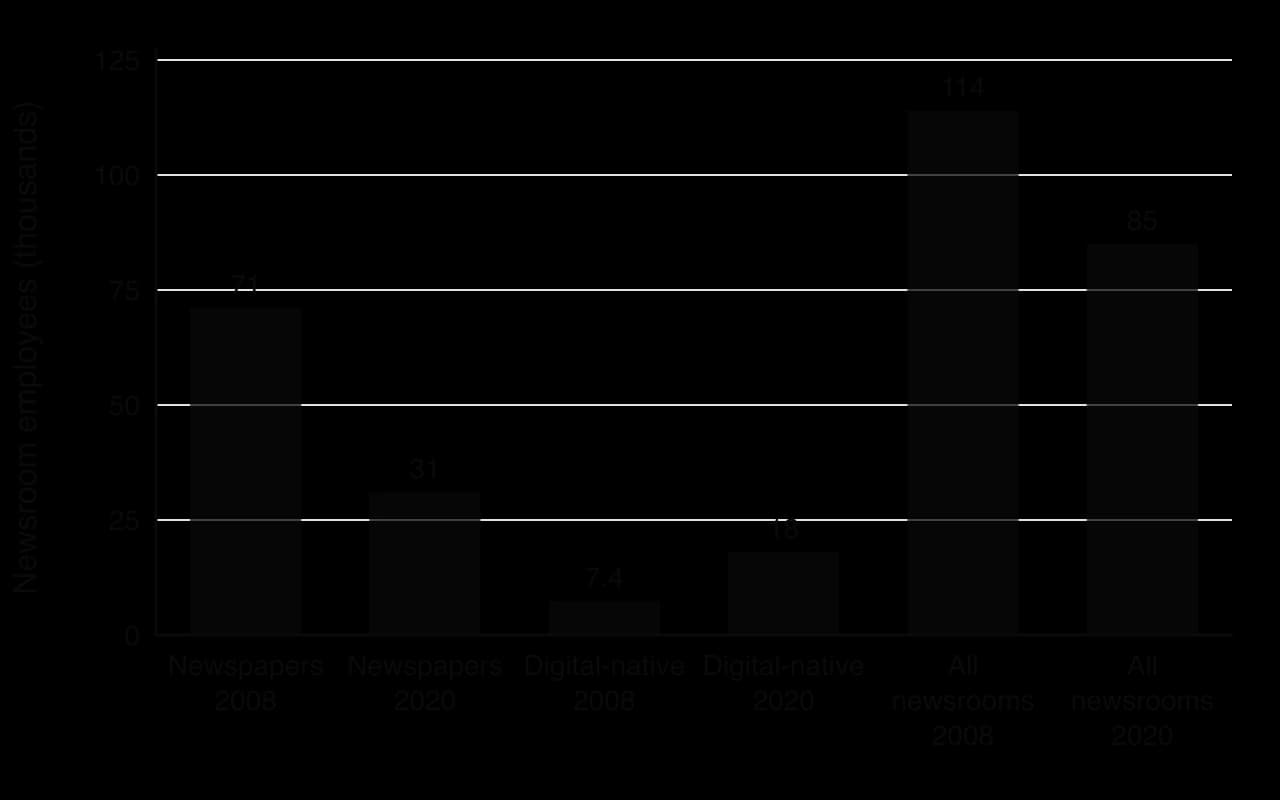
The loss of local reporting matters for democracy, because local journalists cover councils, courts and schools that national outlets ignore. Platforms also act as gatekeepers between news outlets and readers. When Australia passed its News Media Bargaining Code in 2021, requiring large platforms to pay news publishers, Facebook briefly blocked all news in Australia. When Canada passed a similar Online News Act, Meta ended news sharing on Facebook and Instagram in Canada from August 2023.
Digital media also created citizen journalism, in which ordinary people gather and publish news, often with a phone. In 2020 the teenager Darnella Frazier filmed the murder of George Floyd by a police officer in Minneapolis; her video changed how the event was reported and received a special citation from the Pulitzer Prize board in 2021. Citizen journalism adds voices and evidence, but it lacks the editing, fact-checking and legal checks of professional newsrooms.
Media authenticity is whether a piece of media is what it claims to be: genuine, unaltered and from the source it names. Digital media make authenticity hard to judge, because images, audio and video can be edited without visible traces and shared without their original context.
Two terms describe false content, and the difference lies in intention.
Deepfakes add a new layer to the problem. In 2023, two days before Slovakia's parliamentary election, a fake audio recording spread in which a party leader appeared to discuss rigging the vote. In January 2024, voters in the US state of New Hampshire received robocalls with a cloned voice of President Biden telling them not to vote in the primary election. In the same year a finance worker at the engineering company Arup in Hong Kong transferred about 25 million US dollars after a video call in which every other participant, including the company's chief financial officer, was a deepfake.
Deepfakes also cause a second, quieter harm. Once people know that convincing fakes exist, anyone caught on a genuine recording can claim that it is fake. Researchers call this the liar's dividend: the existence of deepfakes makes real evidence easier to deny.
Sourcing means tracing a piece of media back to where it came from, and judging whether that origin can be trusted. Professional fact-checking organisations, such as Full Fact in the UK, Africa Check and AFP Fact Check, investigate claims and publish their findings. Individuals can use the same methods:
Find the origin. A reverse image search (Google Lens, TinEye) can show where and when a picture first appeared.
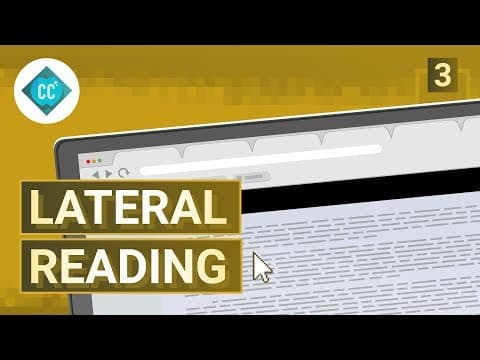
Read laterally. Leave the page and see what other, independent sources say about the claim and the publisher.
Check the context. Real photos are often shared with false captions, such as an old disaster image labelled as a new one.
Corroborate. Look for the same event reported by several reliable outlets with their own evidence.
 YouTube
Technical responses are also developing. The Coalition for Content Provenance and Authenticity (C2PA), founded in 2021 by companies including Adobe, Microsoft and the BBC, sets a standard for "content credentials": signed metadata that records how and by whom an image or video was made and edited. The EU's AI Act requires that deepfakes be labelled as artificially generated. Detection tools exist, but they often fall behind the generators.
Because digital media can be copied perfectly and for free, questions of who owns them, and who may use them, are central.
Copyright is the legal right of a creator to control the copying, distribution, adaptation and performance of their original work for a set period. It arises automatically when the work is made, with no need to register it. Under the Berne Convention, most countries protect works for at least the creator's life plus 50 years, and many, including the EU countries and the USA, for life plus 70 years. After that, the work enters the public domain and anyone may use it.
Digital copying tested copyright early. Napster, launched in 1999, let millions of users share MP3 music files directly with each other through a peer-to-peer network. The record industry sued, and after a US court ruled against Napster in 2001, it shut down. The music industry later moved to licensed downloads and streaming.
Some uses of copyrighted work are allowed without permission. In the USA, fair use permits limited use for purposes such as criticism, commentary, news reporting, teaching and parody, judged by factors including the purpose of the use and its effect on the market for the original. The UK and many Commonwealth countries have a narrower rule called fair dealing.
Creators and companies also use digital rights management (DRM): technology that restricts how digital content can be copied, shared or played, for example by locking an e-book to one account. DRM shows that buying digital media often means buying a licence to use it, not owning a copy. In 2009 Amazon remotely deleted copies of George Orwell's 1984 from customers' Kindles after discovering that the seller did not hold the rights.
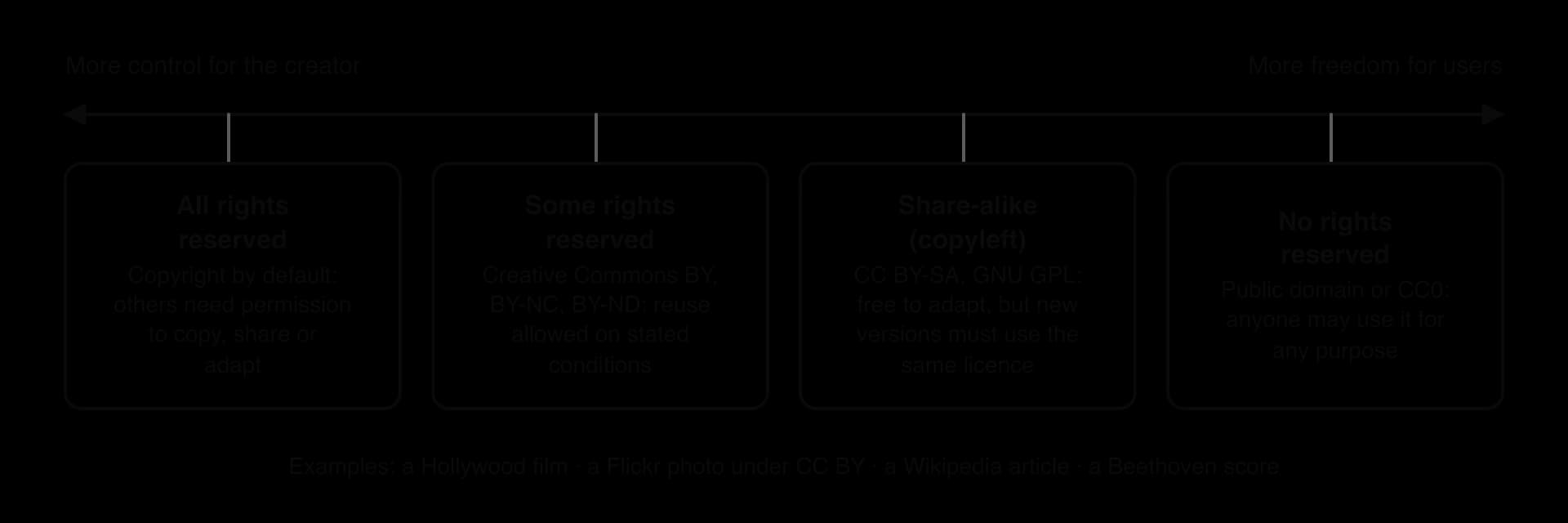
Many creators want their work to be shared and reused. Three approaches make this possible.
Creative Commons (CC), a non-profit founded in 2001, publishes free licences that creators attach to their work to say in advance what others may do with it. Licences combine conditions: BY (credit the creator), SA (share-alike: adapted versions must use the same licence), NC (non-commercial use only) and ND (no derivatives: no changes). CC0 gives up all rights.
Copyleft is a licensing approach that uses copyright law to keep work free: anyone may use, change and share the work, but any adapted version must be released under the same free terms. The GNU General Public License (GPL), first published by Richard Stallman's Free Software Foundation in 1989, is the best-known copyleft licence; CC BY-SA applies the same idea to creative work.
Open source software has its source code published under a licence that lets anyone read, use, change and share it. Linux, the Firefox browser, VLC media player and the 3D animation program Blender are open source. Wikipedia applies a similar model to text, releasing its articles under CC BY-SA.
Remix culture is the practice of creating new work by combining or changing existing work: mash-ups, fan videos, memes, sampling in music and TikTok videos that reuse a popular sound. The legal scholar Lawrence Lessig, one of the founders of Creative Commons, argued in Remix (2008) that strict copyright turns ordinary creative activity into infringement. Lil Nas X's song "Old Town Road" (2018) was built on a beat that sampled a Nine Inch Nails track and became a global hit after users remixed it in TikTok videos.
Remix culture raises a direct clash of claims. Remixers claim that culture has always built on earlier work and that remixing is a form of expression. Original creators claim the right to control and be paid for their work. AI image and text generators now extend this debate, because they are trained on huge amounts of copyrighted material; in December 2023 The New York Times sued OpenAI and Microsoft, claiming that its articles were used to train AI models without permission.
Media obsolescence happens when the hardware, software or file formats needed to read digital media are no longer available, so the content becomes inaccessible even if the data survives. Physical decay adds to the risk: CDs, hard drives and flash memory all degrade over time.
The BBC Domesday Project is a classic case. In 1986, a thousand years after William the Conqueror's Domesday Book, the BBC created a multimedia survey of the United Kingdom, with contributions from about a million people, stored on special laserdiscs read by a particular computer. Within about 15 years the hardware was rare and failing. Researchers in the CAMiLEON project rescued the content in 2002 through emulation, while the original Domesday Book, written on parchment, can still be read.
More recently, Adobe ended support for Flash Player on 31 December 2020, and browsers stopped running Flash. Thousands of web games and animations from the 2000s stopped working. The Internet Archive responded by running Flash content through an emulator so it can still be played in a browser. Online services face a related risk: when Disney closed the children's virtual world Club Penguin in 2017, the world its players had built disappeared with its servers.
Digital preservation is the set of methods used to keep digital content accessible over the long term. They include:
Migration: copying content to newer formats and storage media before the old ones fail.
Emulation: running software that imitates old hardware so old files and programs still work.
Open formats: storing content in well-documented formats such as PDF/A, which archives can read without one company's software.
Web archiving: capturing copies of websites, as the Internet Archive's Wayback Machine does.
The scale of the problem is large. A 2024 Pew Research Center study found that 38% of web pages that existed in 2013 were no longer accessible a decade later. Through the concept of change, digital media are easy to copy yet fragile over time. A society that records most of its life digitally and does not invest in preservation may therefore leave a less complete record of its history than earlier societies that wrote on paper.
Every society sets some limits on what media may show. Digital media make these limits harder to apply, because content crosses borders instantly and is created by billions of users.
Censorship is the suppression or restriction of content by an authority, such as a government, a platform or an organisation, because it is judged harmful, offensive, politically threatening or otherwise unacceptable. Governments may block websites or whole platforms: Turkey blocked Wikipedia from 2017 until its Constitutional Court ruled the ban unlawful in 2019, and Nigeria suspended Twitter from June 2021 to January 2022 after the platform deleted a post by the president. In more extreme cases, governments order internet shutdowns.
A content filter is software that blocks access to content that matches set rules, such as keywords, website categories or image analysis. Schools, libraries, workplaces and parents use filters to block adult or violent material. In the USA, the Children's Internet Protection Act (2000) requires schools and libraries that receive certain federal funding to filter internet access. Filters often over-block, for example hiding health information about sexuality, and under-block, missing harmful content that uses new words or images.
Decency standards are rules about what may be shown or said in media, especially to audiences that may include children, covering sexual content, violence and strong language. Broadcasters have long been bound by them. In the UK, Ofcom's Broadcasting Code includes a 9 p.m. "watershed" before which unsuitable material should not be shown. In the USA, the Federal Communications Commission fined the CBS network 550,000 US dollars after the 2004 Super Bowl half-time show, although a court later overturned the fine. Online platforms set their own decency rules through their community guidelines, which vary between platforms and countries.
Offensive speech is speech that many people find upsetting, insulting or disrespectful. In many democracies it is legal, because freedom of expression protects speech that offends. Hate speech, which attacks people because of characteristics such as religion, ethnicity or sexuality, is restricted by law in many countries, though where the line falls differs widely.
Objectionable content is material judged so harmful that it is restricted or banned outright. New Zealand uses the term in law. After the Christchurch mosque attacks of 15 March 2019, which the attacker live-streamed on Facebook, the country's Chief Censor classified the video as objectionable within a week, making it a crime to possess or share it. Facebook reported removing about 1.5 million copies of the video in the first 24 hours, which shows how quickly live streaming and rapid sharing can spread such material.
A moral panic is a widespread, intense public fear that a group, behaviour or technology threatens society's values or safety, out of proportion to the real risk. The sociologist Stanley Cohen developed the idea in Folk Devils and Moral Panics (1972). New media are frequent targets: novels in the 18th century, comic books in the 1950s, video games in the 1990s and 2000s, and social media today.
The "Momo challenge" of early 2019 is a digital example. Warnings spread across social media and news outlets that a frightening figure called Momo was appearing in children's videos and urging them to harm themselves. Schools and police issued alerts, but child-safety charities such as the NSPCC and the Samaritans found no evidence that anyone had been harmed, and warned that the publicity itself was spreading the fear.
Recognising moral panics matters because they can lead to poorly targeted laws and distract from real harms. The concept is also open to misuse: calling a concern a "moral panic" can be a way to dismiss genuine evidence. Evaluation therefore needs to weigh the evidence of harm in each case rather than assume that every fear about new media is either justified or exaggerated.
Russia launched its full-scale invasion of Ukraine on 24 February 2022. From the first days, the war was fought in the information space as well as on the battlefield. President Volodymyr Zelensky, a former actor and television producer, used short smartphone videos posted on Telegram, Instagram and other platforms to show that he had stayed in Kyiv and to rally Ukrainians and foreign governments.
On 2 March 2022, Ukraine's Center for Strategic Communications and Information Security warned on Facebook that Russia might release a deepfake video of Zelensky announcing a surrender. It told people not to believe any such video, saying that Ukraine would not surrender.
On 16 March, hackers broke into the website of the Ukrainian television channel Ukraine 24 and posted a video in which Zelensky appeared to stand at a lectern and tell Ukrainian soldiers to lay down their weapons. A false text caption with the same message ran across the channel's live broadcast. The video then spread on social media, including Facebook, YouTube, Telegram and the Russian platform VKontakte.
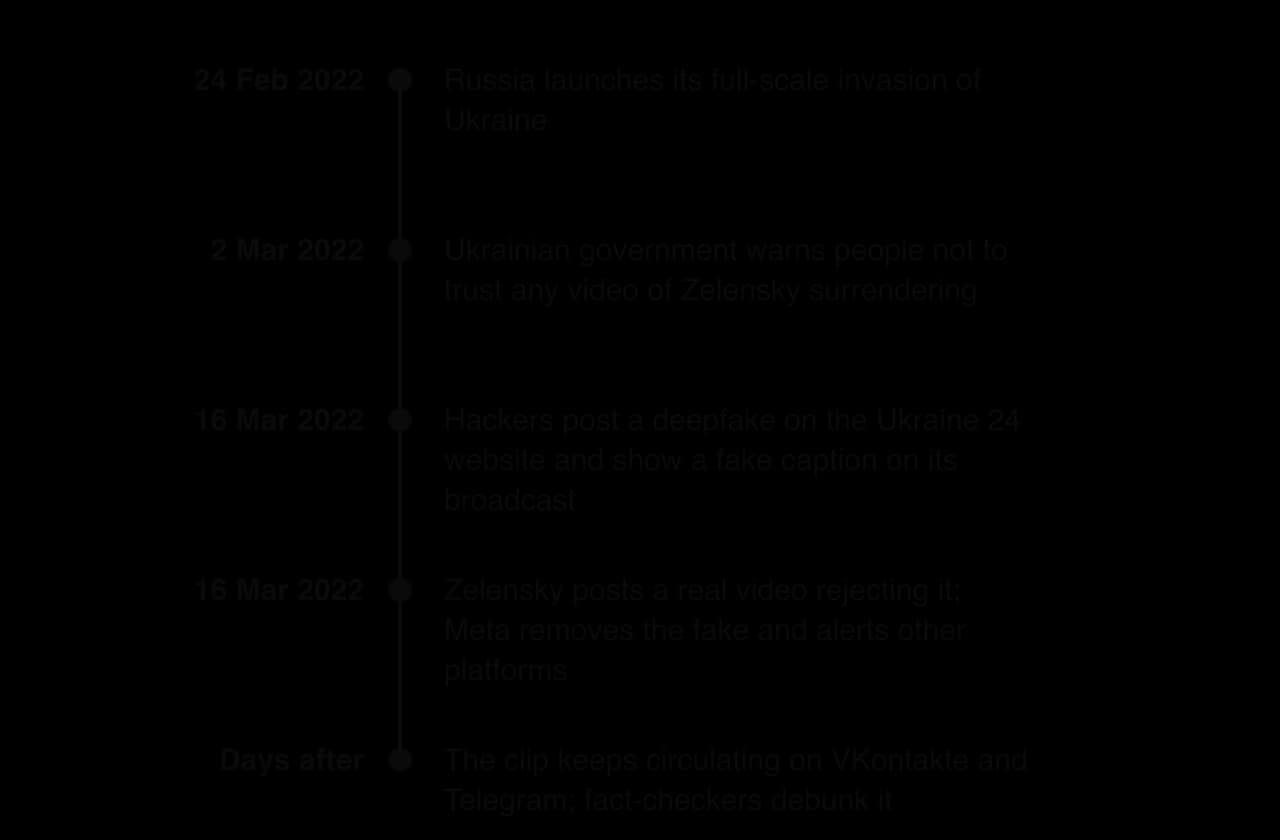
The fake joined several digital systems. A deepfake model generated Zelensky's face and lip movements to match a scripted message, and a synthetic or imitated voice delivered it. Hacking gave the fake the appearance of authority, because it appeared on a real news outlet's website and broadcast. Social platforms then provided rapid sharing to large audiences.
The deepfake was crude. Observers noticed that Zelensky's head looked too large for his body, the image was low resolution, and his voice was deeper than usual and sounded wrong to native speakers. Within hours Zelensky posted his own video on Telegram rejecting the message and saying that the only people who should lay down their arms were Russian soldiers. Meta's head of security policy announced that the company had identified and removed the video for breaking its policy on manipulated media and had alerted other platforms. Copies nevertheless continued to circulate on Russian social media, including VKontakte, and on Telegram channels.
People and communities | Impacts | Implications |
|---|---|---|
Ukrainian soldiers and civilians | Briefly exposed to a false order to surrender; most rejected it quickly because of the earlier warning | Future fakes may be more convincing; doubt about any official video can slow responses in a crisis |
President Zelensky and the Ukrainian government | Had to spend time and attention denying a statement he never made | Leaders must keep verified channels and respond quickly to protect their authority |
Ukraine 24 and other news outlets | Its website and broadcast were hijacked, damaging trust in the outlet | News organisations become targets, and need stronger cyber security and verification |
Platforms (Meta, YouTube, Telegram, VKontakte) | Meta and others removed it quickly; others let copies remain | Platforms' different rules mean disinformation survives where moderation is weakest |
Audiences in Russia and elsewhere | Some saw the clip without the debunking context | Audiences in closed information spaces are more exposed to state-aligned disinformation |
Fact-checkers and researchers | Analysed and debunked the video publicly | The case became a widely cited warning about deepfakes in war |
Through the concept of power, the case shows that control of media is a weapon in war. The attackers tried to use the authority of Zelensky's image and of a trusted news channel to change soldiers' behaviour. The Ukrainian government's power to communicate directly with citizens through its own channels, built up in the weeks before, limited the damage. Platforms held a different kind of power: a decision by Meta's security team affected what millions of users could see within hours.
Through the concept of values and ethics, the case raises questions about responsibility. The creators of the video acted to deceive, so it was clearly disinformation. People who shared it believing it was real spread misinformation, which raises the question of how far individual users are responsible for checking. Platforms faced a trade-off between quick removal and consistent, transparent rules, and the different choices made by Meta and VKontakte reflect different values and different relationships with governments.
Through the concept of change, the case marks a turning point. Deepfake technology had existed since about 2017, but this was among the first widely reported attempts to use a deepfake of a head of state during an armed conflict. It showed both how cheaply such a fake can be made and how quickly a prepared society can respond.
The Zelensky deepfake is often presented as a success story for defence against disinformation, and in the short term it was: the fake did not cause soldiers to surrender, and it was debunked within hours. This success depended on particular conditions, however. The target was one of the most recorded people in the world, whose real voice and face millions knew well. The government had prepared its audience in advance, and the largest Western platforms acted quickly.
These conditions will not always hold. A deepfake of a lesser-known local official, released hours before a vote, in a language that moderators do not speak, on a platform that does not remove such content, would be far harder to stop, as the Slovak election audio of 2023 suggests. Deepfake quality has also improved sharply since 2022. The more lasting implication may be the liar's dividend: after a widely reported fake, people may doubt genuine videos from war zones, which helps anyone who wants to deny real evidence of events. The case therefore shows that defending media authenticity depends less on detecting each fake than on trusted sources, prepared audiences and platform policies that apply across languages and countries.
The second question uses a short source in the style of the source-based paper.
The last question is a part (c) on its own, the part of Paper 1 that calls for evaluation and synthesis.
I can define digital media and explain how they come from the convergence of computing, communication and content.
I can explain why digital media travel through many channels and platforms, with an example.
I can describe the basic forms of digital media: text, images, audio, animation, video and web pages.
I can describe gaming and e-sports, blogs, vlogs, podcasts, vodcasts, live streaming, hashtags, memes, wikis and streaming media.
I can explain what user-generated content is and why platforms depend on it.
I can distinguish synthetic media from deepfakes, and give a legitimate and a harmful use of each.
I can outline rapid sharing, efficient storage, interactivity, linear and non-linear content, and convergence of forms and layers.
I can distinguish AR, VR, MR and XR using the reality–virtuality continuum, with an example of each.
I can explain the psychological concerns linked to digital media and why the evidence is debated.
I can explain media fragmentation and media consolidation and their impact on journalism.
I can distinguish misinformation from disinformation and describe methods for checking authenticity and sources.
I can compare copyright, copyleft, Creative Commons and open source, and explain fair use, DRM and remix culture.
I can explain media obsolescence and describe methods of digital preservation.
I can distinguish censorship, content filters, decency standards, offensive speech, objectionable content and moral panics.
I can evaluate the impacts and implications of the Zelensky deepfake for different people and communities.