R3 What are the mechanisms of chemical change?
Reactivity 3: acid–base, redox, radical and electron-pair reactions classified by what is transferred or shared, with exactly what HL adds to each subtopic.
- IB Chemistry
- SL and HL
4 subtopics in What are the mechanisms of chemical change?
Each one has its own page once something is published for it.
- R3.1Proton transfer reactions188 questions · notes · 116 quick fire
- R3.2Electron transfer reactions201 questions · notes · 116 quick fire
- R3.3Electron sharing reactions61 questions · notes · 50 quick fire
- R3.4Electron-pair sharing reactions136 questions · notes · 105 quick fire
Key terms introduced here
Each is in the Chemistry glossary, with every other term in the subject.
- Acid–base indicator
A weak acid, HInd, whose un-ionized form and conjugate base have different colours; it changes colour over a pH range of roughly .
- Buffer solution
A solution that resists a change in pH when small amounts of acid or alkali are added; it contains a weak acid and its conjugate base, or a weak base and its conjugate acid.
An overview of R3 What are the mechanisms of chemical change?
Reactivity 3 sorts chemical reactions into four types by what passes between the reacting particles: a proton, one or more electrons, a single unpaired electron, or a pair of electrons. Together they account for most of the reactions met in inorganic and organic chemistry.
How the subtopics fit together
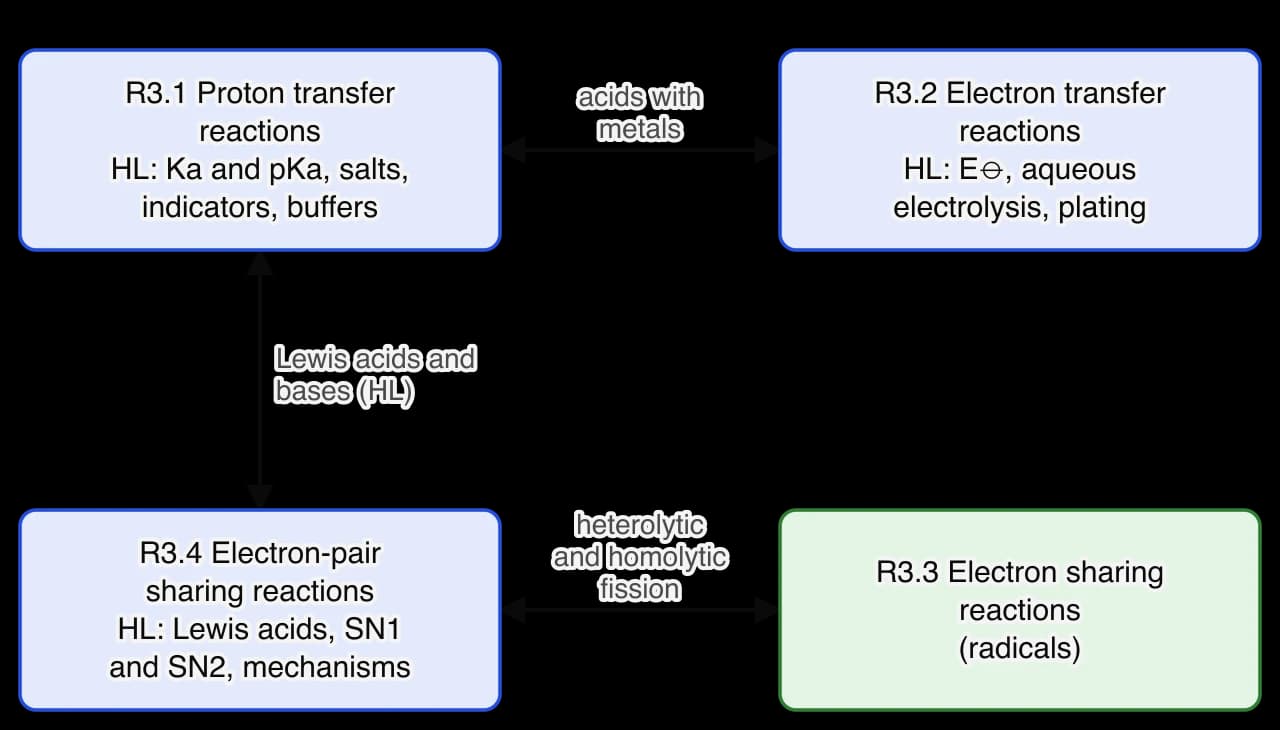
R3.1 Proton transfer reactions. Brønsted–Lowry acids donate protons and bases accept them, forming conjugate acid–base pairs; some species are amphiprotic. The pH scale and the ion product of water, , describe and . Strong and weak acids and bases differ in their extent of ionization. Neutralization reactions with metal oxides, hydroxides, carbonates and hydrogencarbonates, and the pH curve of a strong acid–strong base titration, complete the SL picture.
R3.2 Electron transfer reactions. Oxidation and reduction as electron transfer and changes in oxidation state, written as half-equations. The relative reactivity of metals and halogens, reactions of metals with acids, voltaic (primary) cells, secondary cells and electrolytic cells for molten salts. Organic redox includes the oxidation of alcohols, the reduction of carboxylic acids and ketones, and the hydrogenation of alkenes and alkynes.
R3.3 Electron sharing reactions. A radical has an unpaired electron and is highly reactive. Homolytic fission of a halogen in ultraviolet light starts a chain reaction, and radical substitution of an alkane follows through initiation, propagation and termination steps to give a mixture of products.
R3.4 Electron-pair sharing reactions. Nucleophiles donate an electron pair and electrophiles accept one. Halogenoalkanes undergo nucleophilic substitution, with curly arrows showing how the electron pairs move; heterolytic fission forms ions; and alkenes undergo electrophilic addition with water, halogens and hydrogen halides.
Big ideas across the topic
Classifying reactions by what moves. Asking what is transferred or shared turns a long list of reactions into four patterns. The same reaction can belong to two of them: magnesium reacting with hydrochloric acid is an acid reaction and a redox reaction, and the hydrogenation of an alkene is both a reduction and an addition.
Models of acids have changed. The Brønsted–Lowry theory defines acids by proton transfer. At HL, the Lewis theory widens the definition to electron-pair acceptors, so that a nucleophile is a Lewis base, an electrophile is a Lewis acid, and the coordination bond formed between them is the bond first met in S2.2.
Equilibrium and energy. Weak acids, and, at HL, , indicators and buffers are applications of the equilibrium law (R2.3). Neutralization is exothermic (R1.1), and cells convert the energy of a spontaneous redox reaction into electrical energy, as fuel cells do for fuels (R1.3). At HL, cell potentials and the Gibbs energy change are linked by (R1.4).
Structure explains reactivity. Oxidation states and the reactivity of metals and halogens follow periodic trends (S3.1). Organic reactions follow from functional groups (S3.2) and from bond properties (S2.2): the high electron density of the carbon–carbon double bond attracts electrophiles, and the strength of the carbon–halogen bond affects how fast a halogenoalkane is substituted. At HL, benzene's delocalized structure explains why it undergoes substitution rather than addition.
Mechanisms as models. A mechanism is a proposed sequence of steps consistent with the evidence. At HL, the rate equations of R2.2 distinguish the one-step SN2 mechanism from the two-step SN1 mechanism, and the stability of carbocations predicts the major product of an addition to an unsymmetrical alkene.
Standard level and higher level
No subtopic in Reactivity 3 is HL only, but HL nearly doubles it: Reactivity 3 takes 24 teaching hours at SL and 45 at HL, the largest HL addition of any topic. R3.3 is the same at both levels; the other three subtopics end with HL understandings.
Subtopic | Studied at SL and HL | Added at HL |
|---|---|---|
R3.1 Proton transfer reactions | Brønsted–Lowry acids and bases; conjugate pairs; amphiprotic species; pH and ; ; strong and weak acids and bases; neutralization equations; pH curves for strong acid–strong base titrations | pOH; , , and ; ; the pH of salt solutions; pH curves for all four combinations of strong and weak acids and bases; indicators and choosing one for a titration; buffer solutions and their pH |
R3.2 Electron transfer reactions | Oxidation states; half-equations; relative ease of oxidation of metals and reduction of halogens; metals with acids; anode and cathode; voltaic, secondary and electrolytic cells; electrolysis of molten salts; oxidation of alcohols; reduction of carboxylic acids and ketones; hydrogenation | The standard hydrogen electrode and standard electrode potentials, ; and spontaneity; ; electrolysis of water and aqueous solutions; electroplating |
R3.3 Electron sharing reactions | All of it | Nothing |
R3.4 Electron-pair sharing reactions | Nucleophiles and electrophiles; the general equation for nucleophilic substitution with curly arrows; heterolytic fission; equations for electrophilic addition to alkenes | Lewis acids and bases and the coordination bonds they form; the charges of complex ions; SN1 and SN2 mechanisms for tertiary and primary halogenoalkanes; the effect of the leaving group on rate; mechanisms of electrophilic addition; carbocation stability and the major product; electrophilic substitution of benzene |
The boundaries in R3.4 and R3.2 are easy to misplace. SL students use curly arrows only to show heterolytic fission and the general equation for nucleophilic substitution (from the nucleophile's lone pair to the carbon, and from the carbon–halogen bond to the halogen), and they write electrophilic addition as equations without a mechanism. The full mechanisms, SN1 and SN2 with their carbocation or transition state, electrophilic addition and the electrophilic substitution of benzene, are HL. In R3.2, electrolysis at SL is limited to molten salts, and reactivity is compared from experimental data rather than from values; aqueous electrolysis, where water competes at each electrode, needs electrode potentials and is HL. In R3.1, SL calculations stop at pH, , and , and only the pH curve of a strong acid with a strong base is interpreted.
Flashcards for R3
The official decks for this part of the syllabus.
- R3.1 Proton transfer reactions495 cards
- R3.2 Electron transfer reactions578 cards
- R3.3 Electron sharing reactions132 cards
- R3.4 Electron-pair sharing reactions353 cards
From the data booklet
The entries of the chemistry data booklet that R3 uses. Each opens in the explained booklet.
- Gibbs energy change and cell potential1. Some relevant equations
- pH from the oxonium ion concentration1. Some relevant equations
- pH from the hydrogen ion concentration1. Some relevant equations
- Ionic product of water1. Some relevant equations
- pOH1. Some relevant equations
- Ionic product constant for water at 298.15 K2. Physical constants
- Faraday constant2. Physical constants
- Acid–base indicators18. Acid–base indicators
- methyl orange18. Acid–base indicators
- bromophenol blue18. Acid–base indicators
And 34 more in the data booklet.
Carry on with R3 in Augment
With a free account, Augment remembers where you stopped and what you have practiced.