Notes on R3.4 Electron-pair sharing reactions
Most reactions of organic and inorganic compounds involve electron pairs: one species supplies a pair of electrons and another accepts it, and a new covalent bond forms between them. Classifying reactants as electron-pair donors (nucleophiles) or electron-pair acceptors (electrophiles) explains which molecules react with which, and where. It is how halogenoalkanes are turned into alcohols and amines, and how ethene from crude oil becomes ethanol, solvents and plastics.
Electron pairs and curly arrows
A covalent bond is a shared pair of electrons. Reactions make and break such bonds, so a reaction can be described by following where the electron pairs go. In R3.3, radicals react by moving single electrons. In most other reactions, electrons move in pairs: a pair that was a lone pair or a bond becomes a new bond, or a bonding pair moves onto one atom as the bond breaks.
Chemists show these movements with curly arrows: curved arrows with a full (double-barbed) arrowhead, each representing the movement of two electrons. A set of curly arrows drawn on the reactants is a description of the reaction mechanism, the sequence of bond-breaking and bond-making steps by which reactants become products.
A curly arrow starts where the electron pair is: at a lone pair (or a negative charge, which marks an atom with a lone pair) or at the middle of a bond.
It ends where the pair goes: at an atom, when a bond breaks and the pair becomes a lone pair, or between two atoms, where a new bond forms.
Atoms never move along a curly arrow. Only electrons do; the atoms simply end up bonded differently.
Charges must balance: an atom that gains a share in an extra pair becomes more negative, and an atom that loses a pair becomes more positive.
Heterolytic fission
A covalent bond can break in two ways. In homolytic fission (R3.3) the pair is shared out, one electron to each atom, giving two radicals. In heterolytic fission the whole pair goes to one atom.
Heterolytic fission is shown by one curly arrow from the middle of the bond to the atom that takes the pair. The two kinds of fission are compared for hydrogen bromide and bromine.
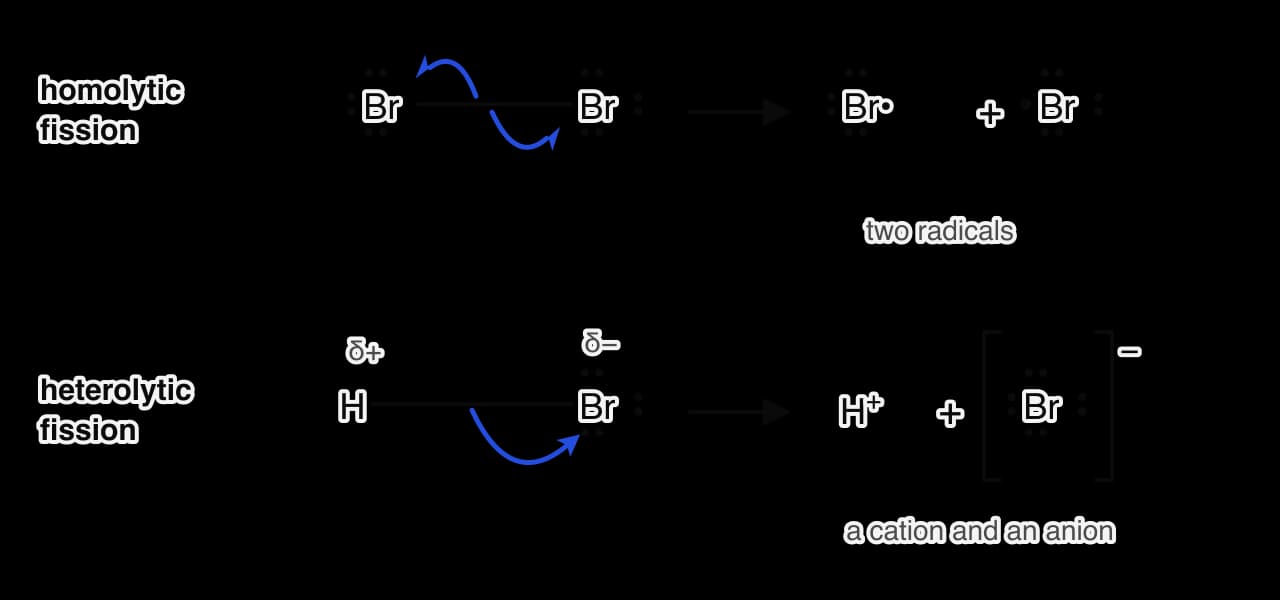
The pair normally goes to the more electronegative atom, which already carries a partial negative charge. Bromine (electronegativity 3.0) is more electronegative than hydrogen (2.2), so splits into and
In the gas phase, heterolytic fission needs far more energy than homolytic fission, because separating a positive ion from a negative ion requires a great deal of work. It happens readily only in polar solvents such as water, where the ions formed are stabilized by being hydrated. This is why hydrogen bromide gas is a covalent molecule, but its solution in water contains hydrated ions and is a strong acid (R3.1).
Carbocations and carbanions
When a bond to carbon breaks heterolytically, the carbon atom ends up either with a positive charge (if the other atom takes the pair) or with a negative charge and a lone pair (if carbon keeps it). Halogens are more electronegative than carbon, so the carbon–halogen bond breaks to give a positive carbon. The heterolysis of 2-bromo-2-methylpropane is an example.
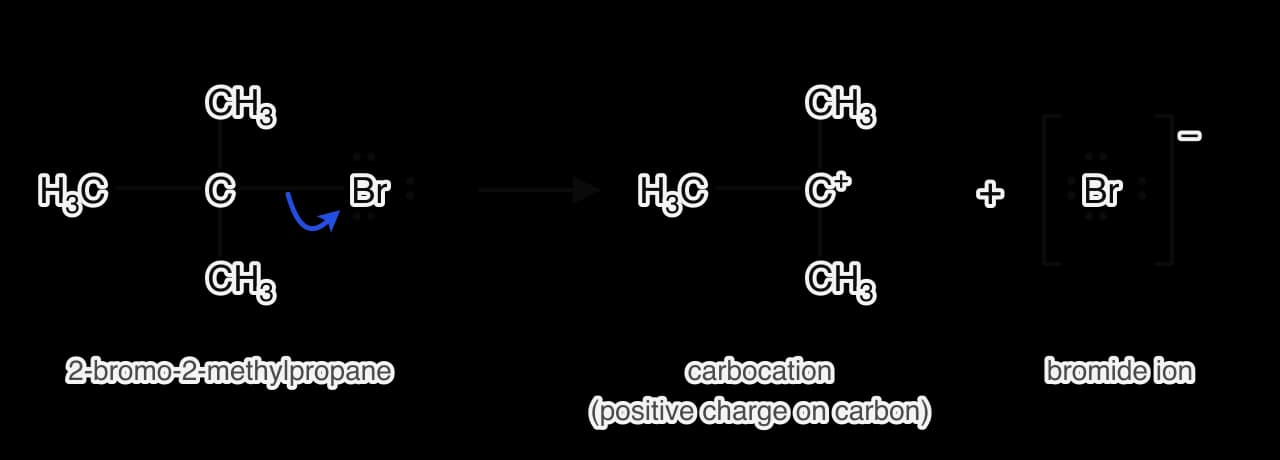
A carbocation has two electrons fewer than an octet on its positive carbon, so it reacts quickly with anything that can supply an electron pair. A carbanion is the opposite: it has an electron pair to give. These two ideas, electron-deficient and electron-rich, lead directly to electrophiles and nucleophiles.
Feature | Homolytic fission | Heterolytic fission |
|---|---|---|
what happens to the bonding pair | shared out: one electron to each fragment | both electrons go to one fragment |
products | two radicals | a cation and an anion |
arrows used | two fish-hook (single-barbed) arrows | one curly (double-barbed) arrow |
typical conditions | UV light or high temperature; non-polar conditions or the gas phase | polar solvents, which stabilize the ions |
examples |
Nucleophiles: electron-pair donors
A nucleophile ("nucleus-loving") seeks out positive or partially positive centres, where it can share its electrons. To do that it must have a pair of electrons available to donate.
A nucleophile can be a negative ion or a neutral molecule. What every nucleophile has in common is a lone pair that is not already involved in bonding. The Lewis formulas of five common nucleophiles show them.
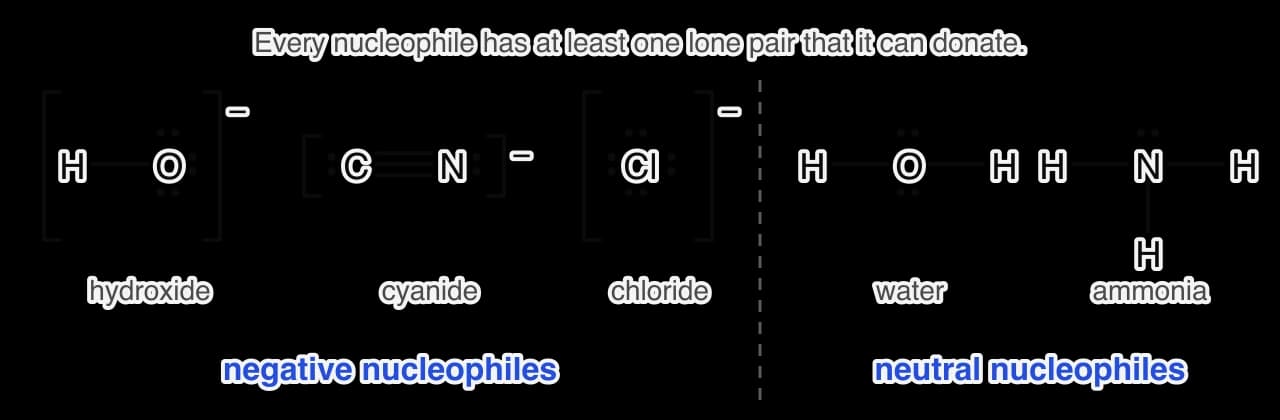
Nucleophile | Charge | Atom that donates the pair | Product with a halogenoalkane |
|---|---|---|---|
hydroxide ion, | negative | O | alcohol |
water, |
Negative nucleophiles generally react faster than their neutral relatives: hydroxide ions convert a halogenoalkane into an alcohol much faster than water does, because the negative charge makes the oxygen's lone pairs more available and the ion is attracted to the carbon.
Electrophiles: electron-pair acceptors
An electrophile ("electron-loving") is attracted to regions of high electron density. It is electron-deficient: it has a positive charge, a partial positive charge or an incomplete outer shell, so it can accept a pair of electrons to form a new bond.
An electrophile can be a positive ion or a neutral molecule. Neutral electrophiles contain a atom, either because a bond is permanently polar or because a dipole is induced as the molecule approaches an electron-rich region.
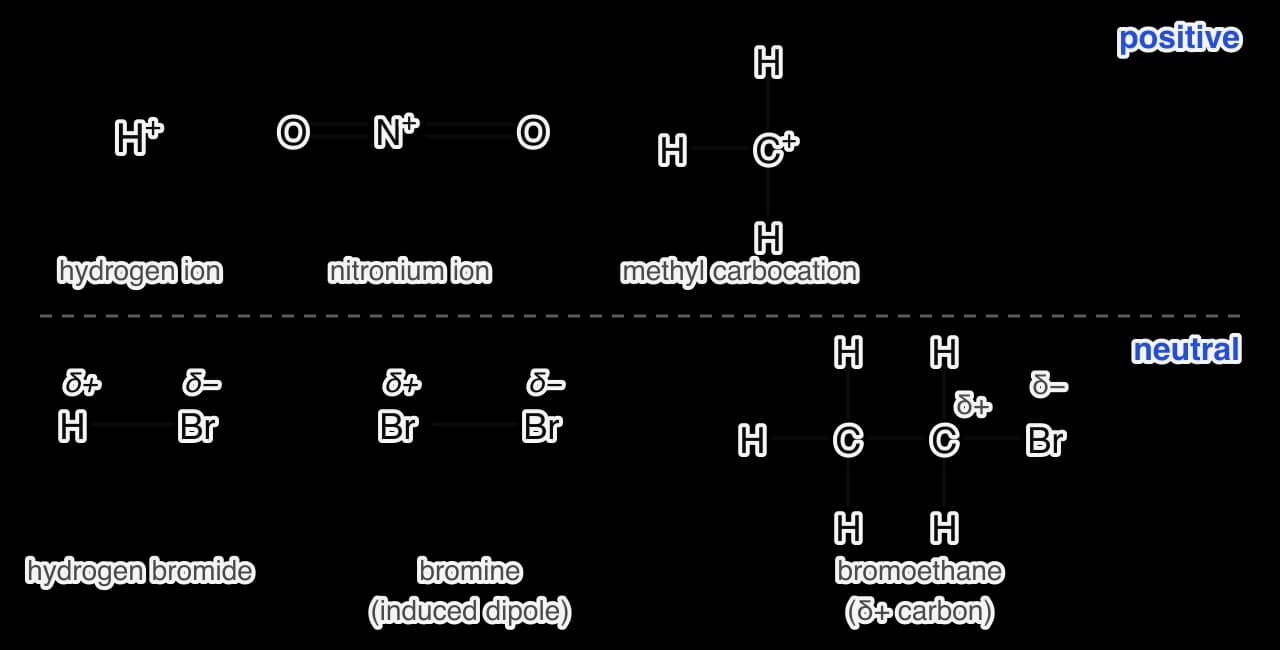
Positive ions: the hydrogen ion , the nitronium ion
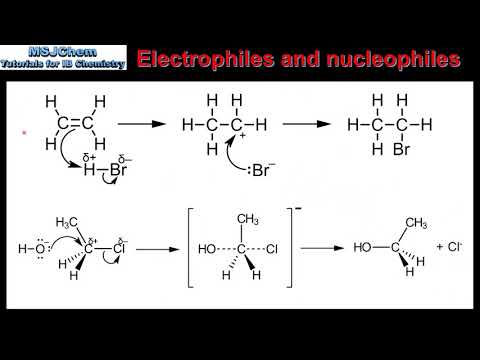 YouTube
Recognizing nucleophiles and electrophiles in a reaction
To decide the role of each reactant, find the new bond in the product and ask which reactant supplied its electron pair. The species that supplied the pair is the nucleophile; the one that received it is the electrophile. The same species can play different roles in different reactions: water is the nucleophile when it attacks a carbocation, but its hydrogen atoms are electrophilic when a strong base removes a proton from it.
HL students extend these ideas to Lewis acids and bases: every nucleophile is an electron-pair donor (a Lewis base) and every electrophile an electron-pair acceptor (a Lewis acid).
Nucleophilic substitution of halogenoalkanes
Halogenoalkanes are alkanes in which one or more hydrogen atoms have been replaced by halogen atoms, such as bromoethane,
The polar carbon–halogen bond
Chlorine (3.2), bromine (3.0) and iodine (2.7) are all more electronegative than carbon (2.6). The halogen atom attracts the bonding pair more strongly, so the carbon atom bonded to it carries a partial positive charge, . This
The halogenoalkane that is attacked is called the substrate. The general equation, with curly arrows, shows the two electron-pair movements: the nucleophile's lone pair forms the new bond, and the pair in the bond leaves with the halogen.
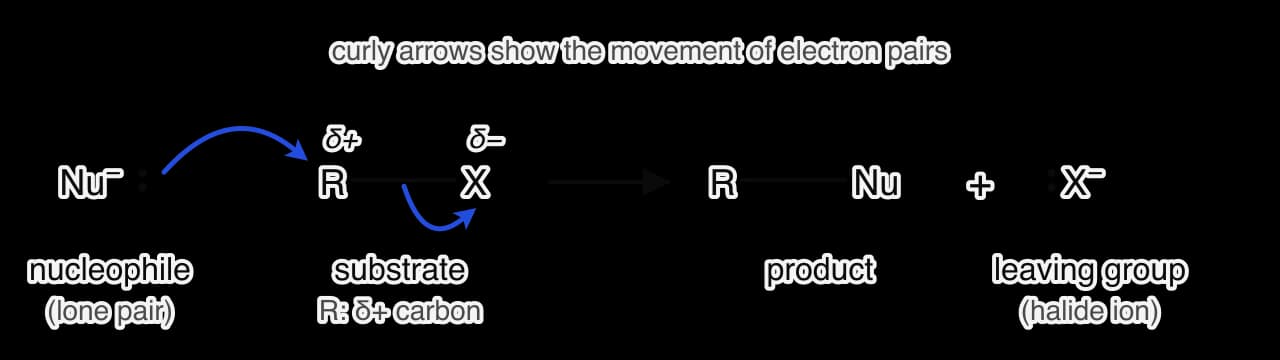
In this reaction the nucleophilic substitution replaces the halogen by the nucleophile. The halogen leaves as the leaving group: an ion or molecule that takes the bonding pair with it when it leaves the substrate. Halide ions are good leaving groups because they are stable on their own in solution.
Making alcohols: hydrolysis with hydroxide ions
When a halogenoalkane is warmed with aqueous sodium hydroxide, it is converted into an alcohol. Bromoethane gives ethanol:
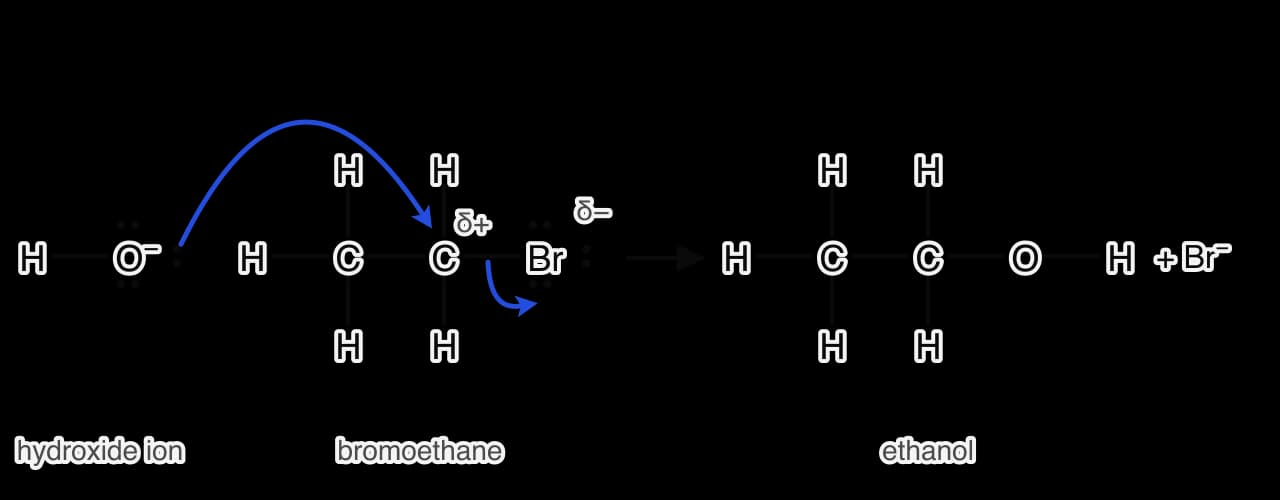
The reaction is a hydrolysis, because the bond is broken and an group from water (here as hydroxide ions) is introduced. It is usually carried out by heating under reflux, with a condenser fitted vertically so that the volatile halogenoalkane and alcohol condense and run back into the flask instead of escaping. Water alone hydrolyses halogenoalkanes too, but much more slowly, and the second product is the hydrogen halide:
The bromide ions released can be detected: adding aqueous silver nitrate after acidifying with nitric acid gives a cream precipitate of silver bromide. HL students use the rate at which these precipitates form to compare chloro-, bromo- and iodoalkanes.
Other nucleophiles
Changing the nucleophile changes the product, which makes halogenoalkanes useful intermediates for making other compounds.
Ammonia (excess, in ethanol, heated in a sealed tube) gives an amine:
How the substitution takes place depends on how many alkyl groups are bonded to the carbon atom that carries the halogen. HL students study the two mechanisms that result, and .
Electrophilic addition to alkenes
Alkenes are hydrocarbons containing a carbon–carbon double bond, ; the simplest is ethene,
Why the double bond attracts electrophiles
A double bond consists of two shared pairs, four electrons, concentrated between and around the two carbon atoms. This makes the bond a region of high electron density, and electrophiles are attracted to it. The second bond of the double bond is also weaker than the first: the bond enthalpy, , is less than twice that of
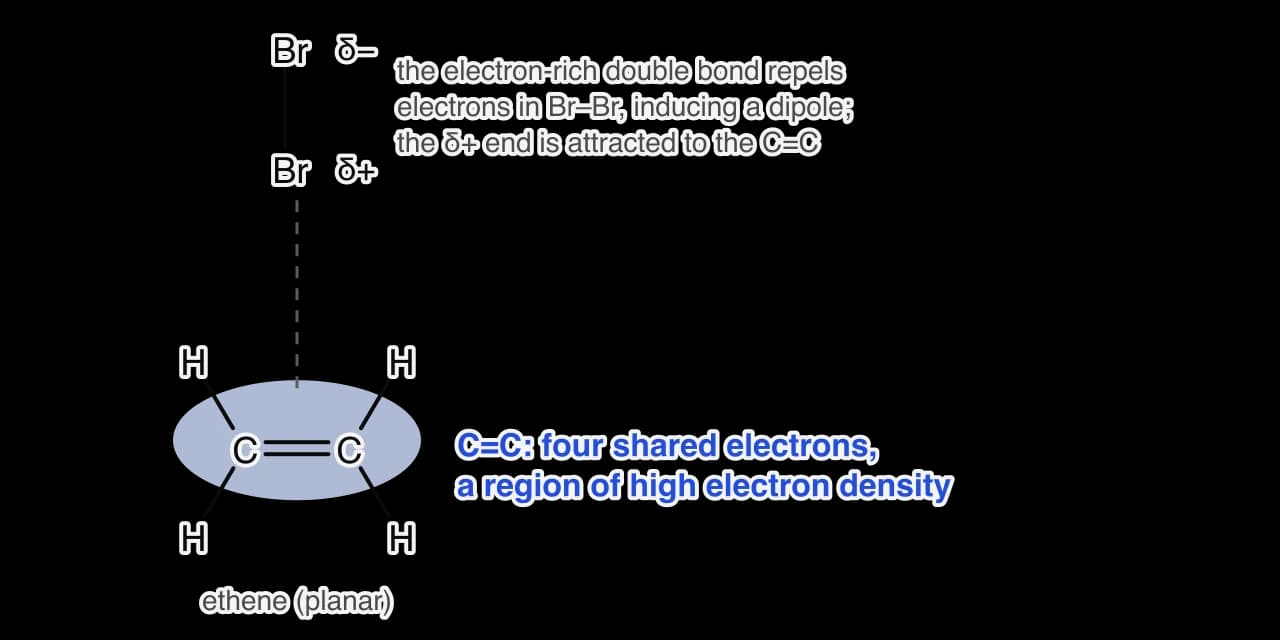
In every addition reaction of ethene the double bond becomes a single bond and one new atom or group is added to each of the two carbon atoms. The displayed formulas of the products show where the new atoms go. The reactions are called electrophilic addition because the reagent attacks as an electrophile.
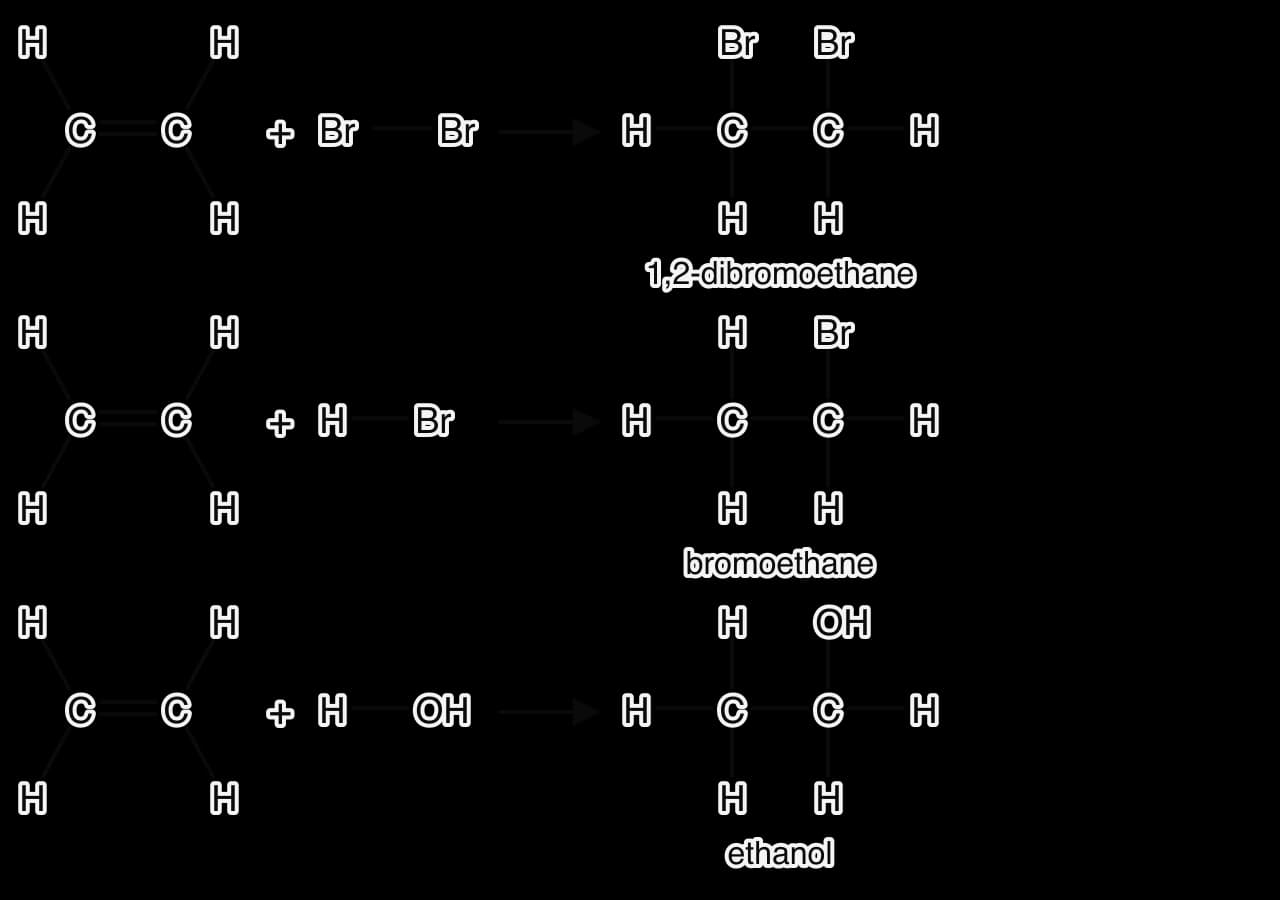
With halogens
Alkenes react rapidly with chlorine and bromine at room temperature, even in the dark, to give dihalogenoalkanes, with one halogen atom on each carbon of the former double bond:
The reaction with bromine is the standard test for a carbon–carbon double bond. Orange bromine water (a solution of bromine in water) is shaken with the compound. An alkene decolourizes it immediately, because the coloured is used up by addition. An alkane gives no reaction in the dark: the orange colour remains, although it moves into the alkane layer, in which bromine is more soluble than in water. Alkanes decolourize bromine only slowly in UV light, by free-radical substitution (R3.3).
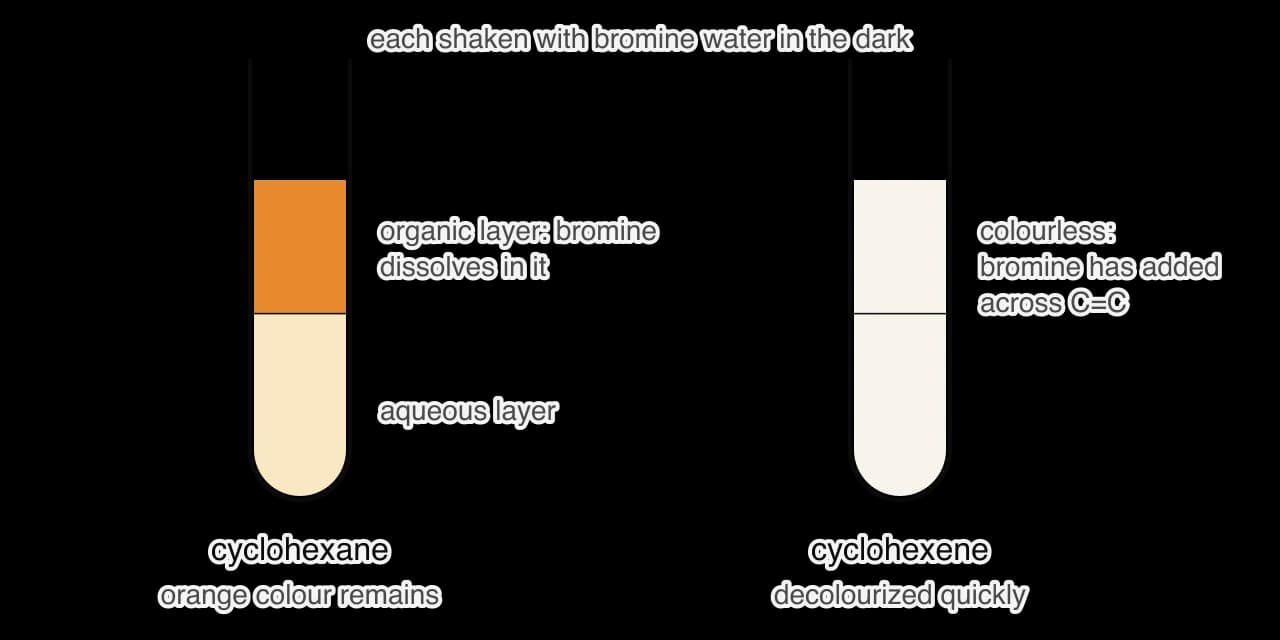
What forms in bromine water?
With pure bromine, or bromine dissolved in an organic solvent, ethene gives 1,2-dibromoethane. In bromine water, water molecules are present in huge excess and compete with bromide ions in the second stage of the reaction, so the main product is 2-bromoethanol,
With hydrogen halides
Hydrogen chloride, hydrogen bromide and hydrogen iodide add to alkenes at room temperature to give halogenoalkanes:
The reactivity increases from to to . The bond must break in the reaction, and it becomes weaker down the group:
Ethene and but-2-ene are symmetrical, so it does not matter which carbon atom the hydrogen and which the halogen join: only one product can form. With an unsymmetrical alkene such as propene, the two orientations give different products.
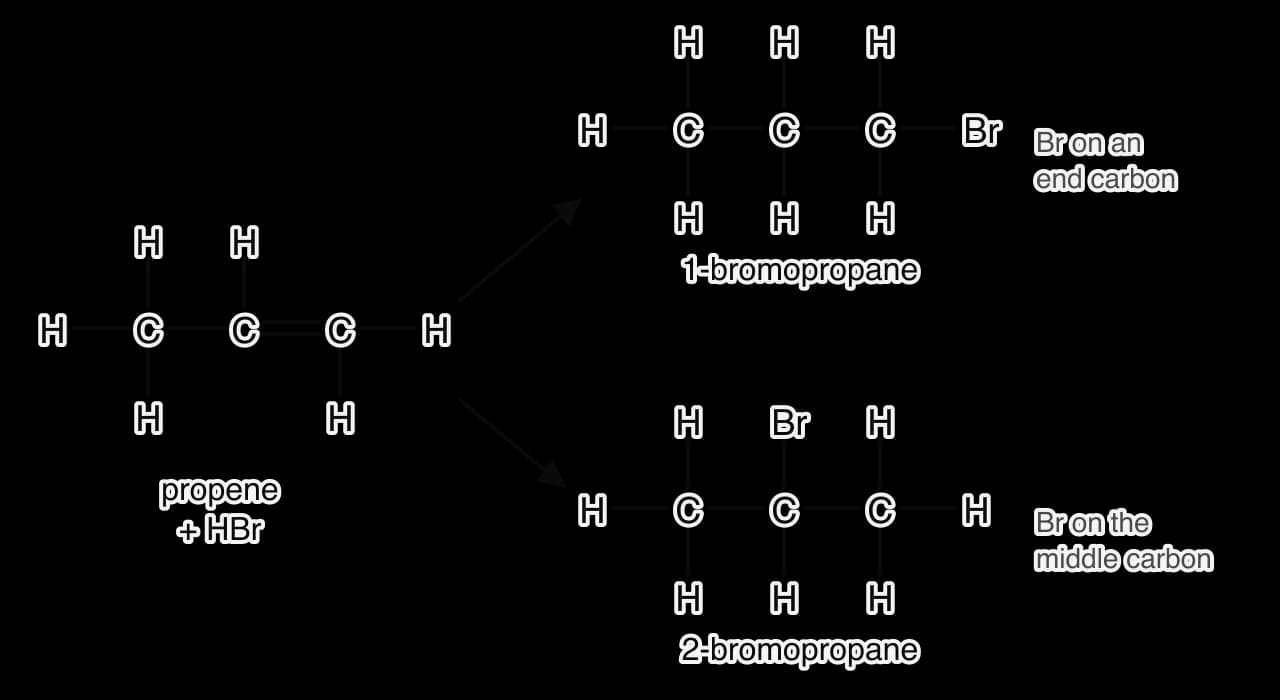
Both 1-bromopropane and 2-bromopropane can form, but 2-bromopropane is the major product. HL students explain why from the mechanism; at SL it is enough to recognize that two isomeric products are possible.
With water: hydration
Adding water across a double bond is called hydration, and it turns an alkene into an alcohol. Ethene and steam react in the presence of an acid catalyst:
Industrially, ethene and steam are passed over a catalyst of phosphoric acid on a silica support at about and 60–70 atmospheres. The reaction is reversible and only about 5 % of the ethene is converted on each pass over the catalyst, but the ethanol is condensed out and the unreacted ethene is recycled, so the overall conversion reaches about 95 %. Much industrial ethanol is made this way; ethanol for drinks and almost all fuel ethanol come from the fermentation of sugars instead.
The same reaction converts other alkenes into other alcohols. Propene gives a mixture of propan-1-ol and propan-2-ol, with propan-2-ol the major product for the same reason as with hydrogen bromide.
With hydrogen
Hydrogen adds to alkenes in the presence of a nickel catalyst at about , giving alkanes:
Reagent | Conditions | Product from ethene | Type of product |
|---|---|---|---|
or |
Working backwards: which alkene gives this product?
An addition product contains the two carbon atoms of the former double bond, each now carrying one of the added atoms or groups. To find the alkene that gives a product, remove the two added parts (for example and from an alcohol) from two adjacent carbon atoms and put a double bond between them. If more than one pair of adjacent carbons is possible, more than one alkene may work.
Alkenes as starting materials for industry
Ethene and propene are made in enormous quantities by cracking hydrocarbons from crude oil, and ethene is produced in larger amounts than any other organic compound. Their double bond is reactive, so they can be converted into a wide range of other compounds by addition: ethanol by hydration, halogenoalkanes and dihalogenoalkanes (1,2-dichloroethane is the first step towards PVC), and, by adding alkene molecules to one another, addition polymers such as poly(ethene) and poly(propene) (S2.4). Alkanes, by contrast, are mostly burned as fuels. This is why alkenes are sometimes called the "starting molecules" of the chemical industry.
Classifying organic reactions
An organic reaction is named by what happens to the organic molecule (substitution or addition) and by what kind of species attacks the organic molecule (a radical, a nucleophile or an electrophile). Saturated compounds such as alkanes, halogenoalkanes and alcohols undergo substitution; unsaturated compounds such as alkenes undergo addition. Benzene, although unsaturated, undergoes substitution (HL).
Reaction type | Attacking species | Typical substrate | Example |
|---|---|---|---|
free-radical substitution | radical, e.g. | alkane (in UV light) |
Lewis acids and bases (HL)
The Brønsted–Lowry theory describes acid–base reactions as proton transfers. Many reactions look like acid–base reactions but involve no proton at all: boron trifluoride reacts vigorously with ammonia, and carbon dioxide dissolves in sodium hydroxide solution and neutralizes it. A definition based on electron pairs, proposed by Gilbert N. Lewis in 1923, covers these reactions as well.
To act as a Lewis base, a species needs a lone pair of electrons that it can share. Ammonia, water, the hydroxide ion, the chloride ion and the cyanide ion are all Lewis bases. To act as a Lewis acid, a species needs a way of accepting a pair: an empty orbital of suitable energy, or a positively polarized atom whose bonding electrons can move away to make room for a new bond. Boron trifluoride, aluminium chloride, the hydrogen ion, transition element ions and the δ+ carbon atom of carbon dioxide are Lewis acids.
Lewis acids without a proton
Boron trifluoride, , is the standard example of a Lewis acid that is not a Brønsted–Lowry acid. Boron has three valence electrons, so in
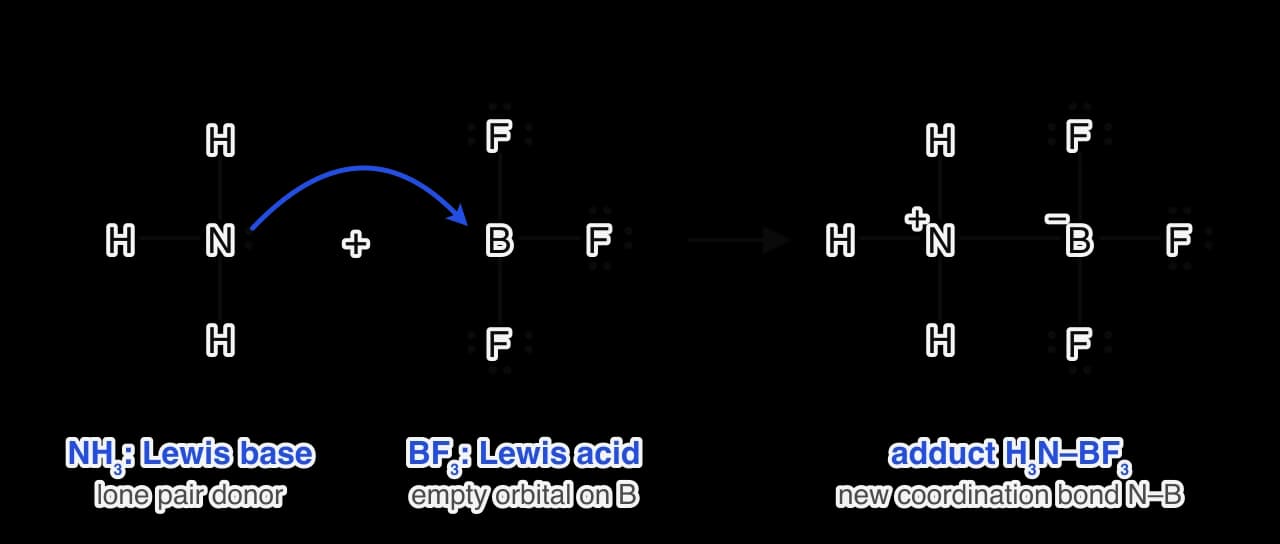
The product, , is called an
Carbon dioxide has a complete octet on every atom, yet it reacts with hydroxide ions as a Lewis acid. The carbon atom is δ+ because both oxygen atoms are more electronegative than carbon. The hydroxide ion donates a lone pair to this carbon, and at the same moment one of the electron pairs of a C=O double bond moves onto oxygen. The product is the hydrogencarbonate ion.
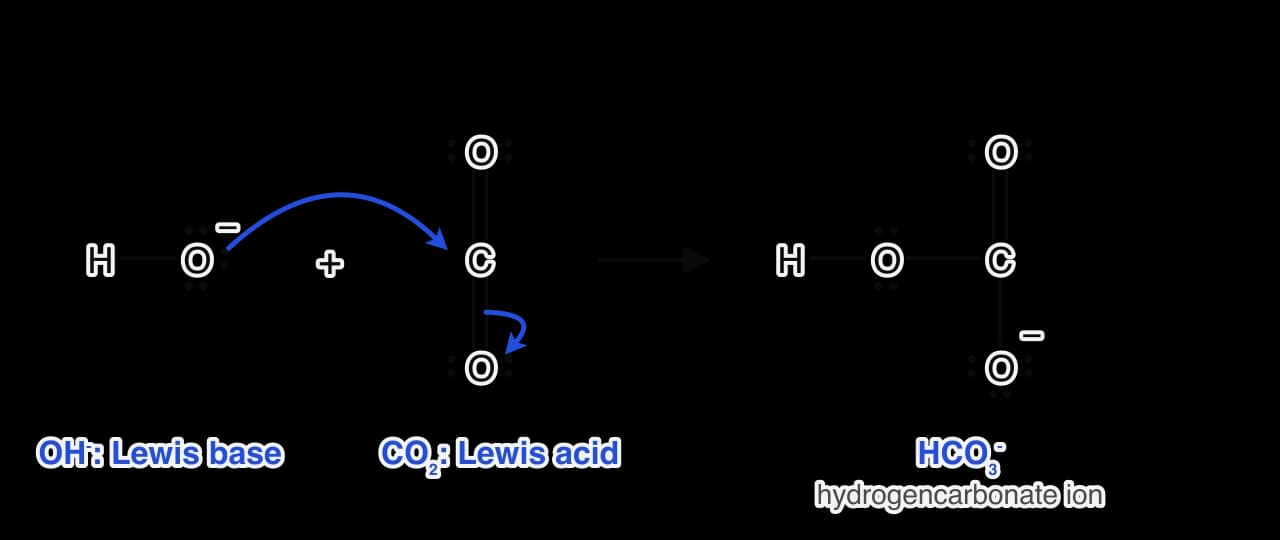
This reaction is why carbon dioxide is absorbed by alkaline solutions such as limewater and sodium hydroxide solution. Compare it with the reaction of hydroxide ions with hydrogencarbonate ions,
Brønsted–Lowry and Lewis definitions compared
A Brønsted–Lowry base accepts a proton. A bare proton has no electrons, so the only way a base can bond to it is by donating a lone pair. Every Brønsted–Lowry base is therefore also a Lewis base, and the hydrogen ion that it accepts is a Lewis acid. When ammonia accepts a proton to form the ammonium ion,
The reverse is not true. A Lewis acid need not contain hydrogen, so many Lewis acids (,
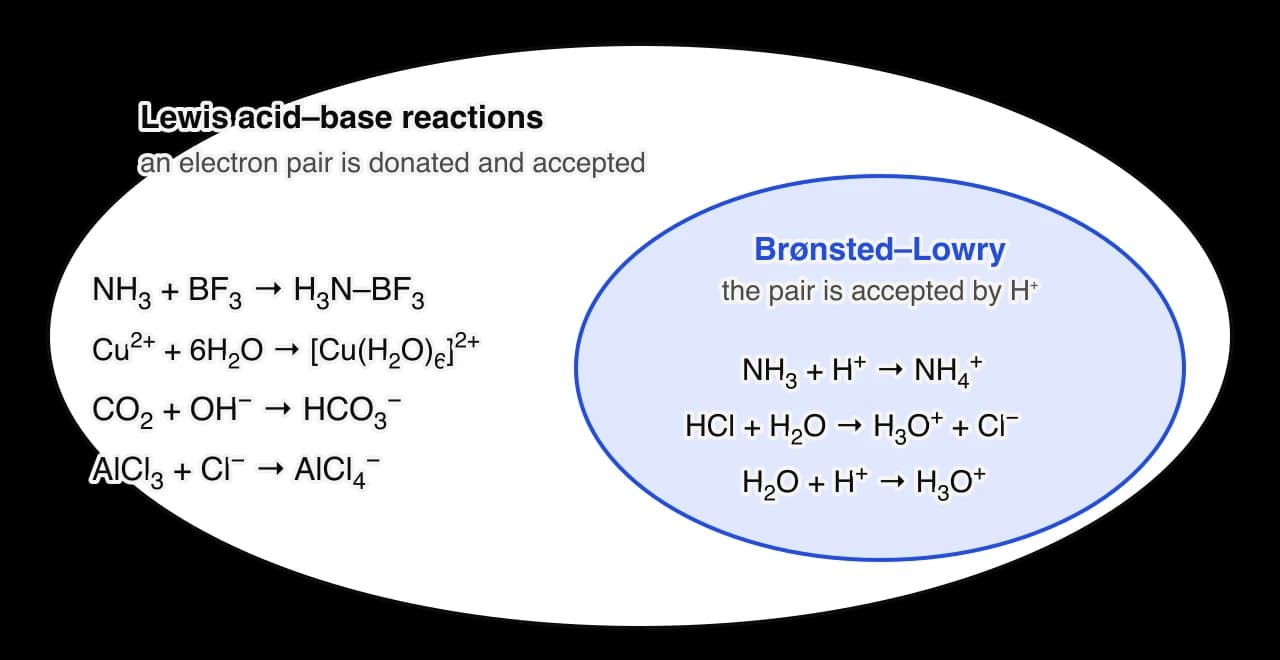
Brønsted–Lowry theory | Lewis theory | |
|---|---|---|
acid | proton () donor | electron-pair acceptor |
base | proton acceptor | electron-pair donor |
what is transferred or shared | a proton moves from acid to base | an electron pair is shared, forming a coordination bond |
essential feature of the acid | a hydrogen atom that can leave as |
Water shows how one species can act in both ways. In
Coordination bonds in Lewis acid–base reactions (HL)
When a Lewis base donates an electron pair to a Lewis acid, both electrons in the new bond come from the same atom. A covalent bond formed in this way is a coordination bond (also called a dative covalent bond). Every Lewis acid–base reaction therefore forms at least one coordination bond: the N–B bond in
In a Lewis formula a coordination bond can be drawn as an arrow pointing from the donor atom to the acceptor atom (
Are coordination bonds different from other covalent bonds?
A coordination bond differs from an ordinary covalent bond only in where its electrons came from. Once it has formed, it is a shared pair of electrons held between two nuclei like any other covalent bond. The ammonium ion is the clearest evidence. It is formed by a coordination bond from nitrogen to a proton, yet all four N–H bonds have the same length, the same bond enthalpy and the same bond angles (109.5°, a regular tetrahedron). Spectroscopy cannot tell which hydrogen arrived last.
The difference shows in the energy needed to break the bond. A coordination bond between two neutral molecules, such as the N–B bond in
Nucleophiles are Lewis bases; electrophiles are Lewis acids
The nucleophiles and electrophiles of organic chemistry fit the Lewis definitions exactly. A nucleophile donates an electron pair to form a new bond, so it is a Lewis base; an electrophile accepts an electron pair, so it is a Lewis acid. When the hydroxide ion attacks the δ+ carbon of a halogenoalkane, the hydroxide ion is a Lewis base and the carbon atom of the halogenoalkane accepts the pair. When the π electrons of an alkene attack from hydrogen bromide, the alkene is acting as the electron-pair donor and as the Lewis acid.
Reaction | Lewis base (electron-pair donor) | Lewis acid (electron-pair acceptor) | Usual name |
|---|---|---|---|
The Lewis theory therefore links three areas that are often learned separately: acid–base chemistry, the chemistry of transition element complexes, and organic reaction mechanisms. In each, a species rich in electrons shares a pair with a species that is short of them.
Complex ions as Lewis acid–base adducts (HL)
Transition element ions such as , and
When copper(II) sulfate dissolves in water, each copper(II) ion accepts a lone pair from six water molecules and becomes the pale blue hexaaquacopper(II) ion. Water bonds through its oxygen atom, the atom that carries the lone pairs, and the six ligands sit at the corners of an octahedron.
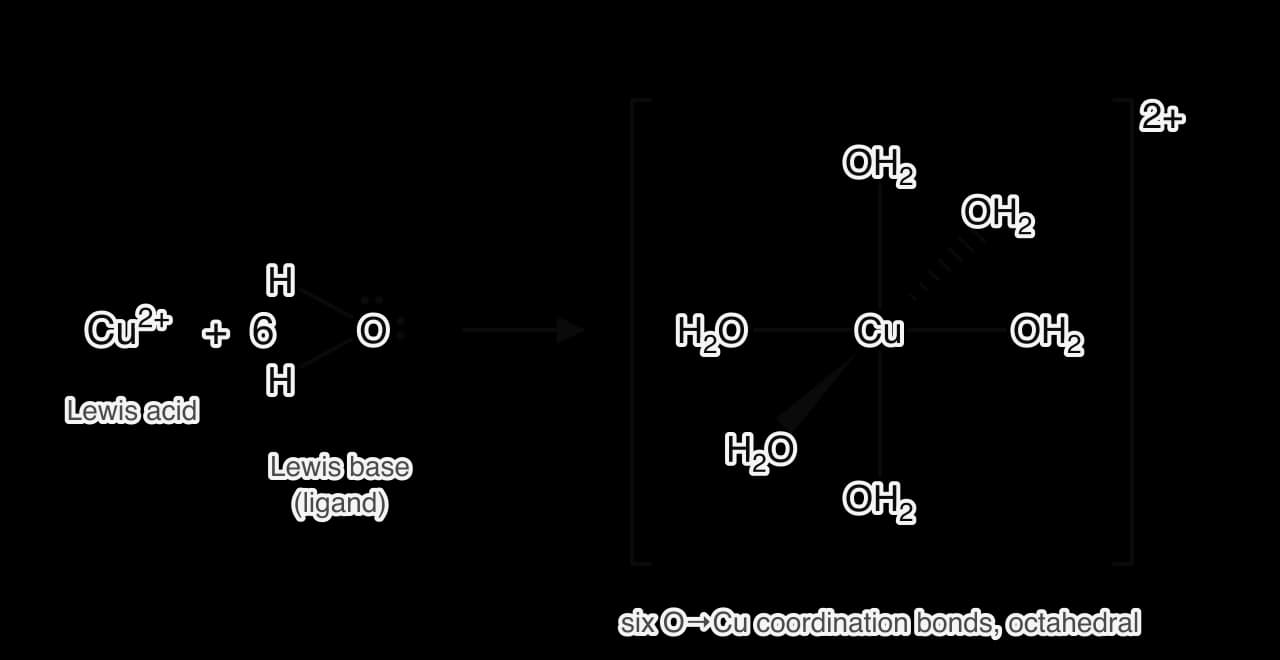
The number of coordination bonds to the central ion is its coordination number: six in
Deducing the charge on a complex ion
A ligand donates a pair of electrons but keeps its own charge, and the metal ion keeps its charge too. The charge on the complex is therefore the sum of the charges of its parts:
Common ligands fall into two groups: neutral molecules, which add nothing to the charge, and anions, which each add their negative charge.
Ligand | Name in a complex | Charge | Donor atom |
|---|---|---|---|
aqua | 0 | O | |
The same relationship works in reverse: if the formula and charge of a complex are given, the charge on the metal ion, and so its oxidation state, can be found by subtracting the ligand charges.
Ligand exchange
In ligand exchange, one set of ligands replaces another when a stronger or more concentrated Lewis base is added. Adding concentrated hydrochloric acid to a blue solution of copper(II) sulfate turns it green and then yellow, as chloride ions replace the water ligands:
The charge of the complex changes from 2+ to 2−, although copper stays in the +2 oxidation state throughout. The coordination number also changes, from six to four, because chloride ions are larger than water molecules and fewer fit round the copper ion. With aqueous ammonia, four ammine ligands replace four of the water ligands and the solution turns deep blue,
Nucleophilic substitution mechanisms: and (HL)
The general equation for nucleophilic substitution shows a nucleophile replacing the halogen atom of a halogenoalkane, with the halide ion as the leaving group. It does not say whether the new bond forms at the same moment as the old bond breaks, or afterwards. Kinetic and stereochemical evidence shows that both happen, depending on the structure of the halogenoalkane. The two pathways are called and : S for substitution, N for nucleophilic, and the number for the molecularity of the rate-determining step.
Primary, secondary and tertiary halogenoalkanes
Halogenoalkanes are classified by the number of alkyl groups bonded to the carbon atom that carries the halogen:
a primary halogenoalkane has one alkyl group on that carbon (or none, in a halogenomethane): 1-bromobutane,
All three isomers of
The mechanism: one concerted step
Primary halogenoalkanes, such as bromoethane, react by the mechanism. The carbon–bromine bond is polar, with the carbon atom δ+ and the bromine atom δ−. The hydroxide ion uses one of its lone pairs to attack the δ+ carbon from the side directly opposite the bromine atom. This backside attack is the only direction from which the nucleophile can approach the carbon without being repelled by the electron-rich bromine atom, and it lets the new bond form as the C–Br bond weakens.
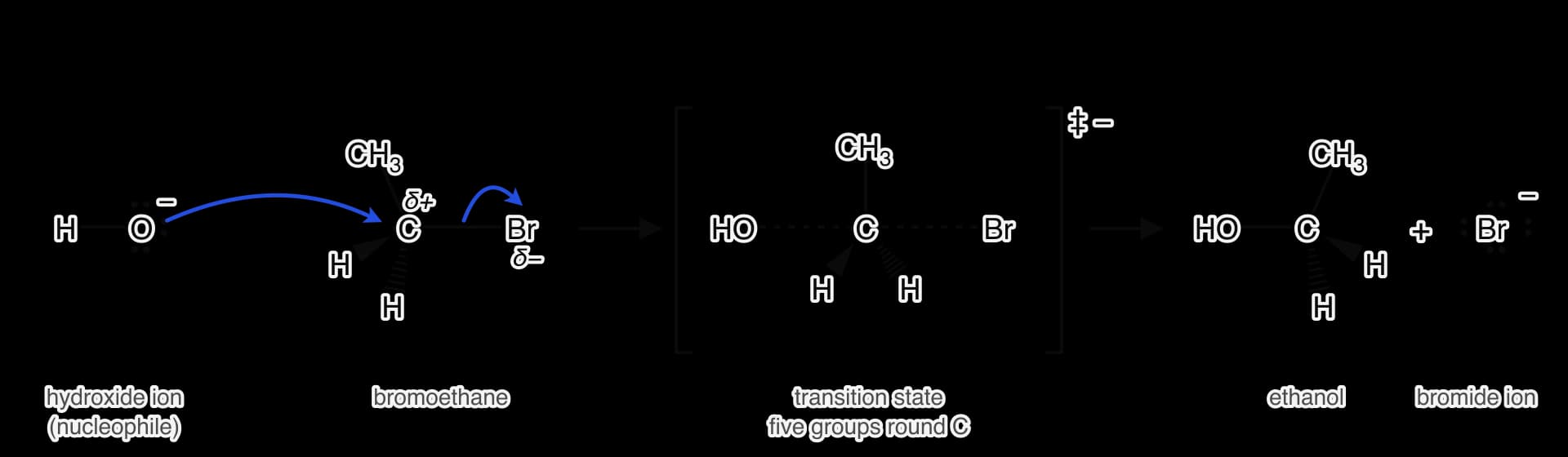
The reaction is concerted: bond making and bond breaking happen together in a single step, with no intermediate. At the top of the energy barrier is the transition state, in which the O···C and C···Br bonds are both partial (drawn dashed). In it the carbon atom has five groups round it: the hydroxide and bromine on a straight line through the carbon, and the other three groups in one plane at right angles to that line. The transition state carries the full negative charge of the incoming hydroxide ion, spread over oxygen and bromine, so it is drawn in square brackets with an overall negative charge. It cannot be isolated: it exists only for the instant of the bond change.
As the reaction is completed, the three groups on carbon swing through the plane to the other side, like an umbrella turning inside out in the wind. The products are ethanol and a bromide ion:
The rate equation for
Because the single step involves one molecule of halogenoalkane and one hydroxide ion, the rate is proportional to the concentration of each:
The reaction is first order with respect to each reactant and second order overall, and the rate constant has units of . Doubling the concentration of hydroxide ions doubles the rate. The energy profile has a single hump with the transition state at the top and no intermediate.
Why primary halogenoalkanes react by
A primary halogenoalkane has at most one alkyl group on the carbon under attack; the rest are small hydrogen atoms. There is plenty of room for the nucleophile to reach the back of the carbon atom, so backside attack is easy. The alternative two-step route would need a primary carbocation, which has only one alkyl group to stabilize its positive charge and is very unstable, so it is not followed.
The mechanism: two steps through a carbocation
Tertiary halogenoalkanes, such as 2-bromo-2-methylpropane, react by the mechanism. In the first step the C–Br bond breaks heterolytically on its own, without help from the nucleophile. Both bonding electrons go to bromine, which leaves as a bromide ion, and the carbon atom is left with only three bonds and a positive charge, as a tertiary carbocation.
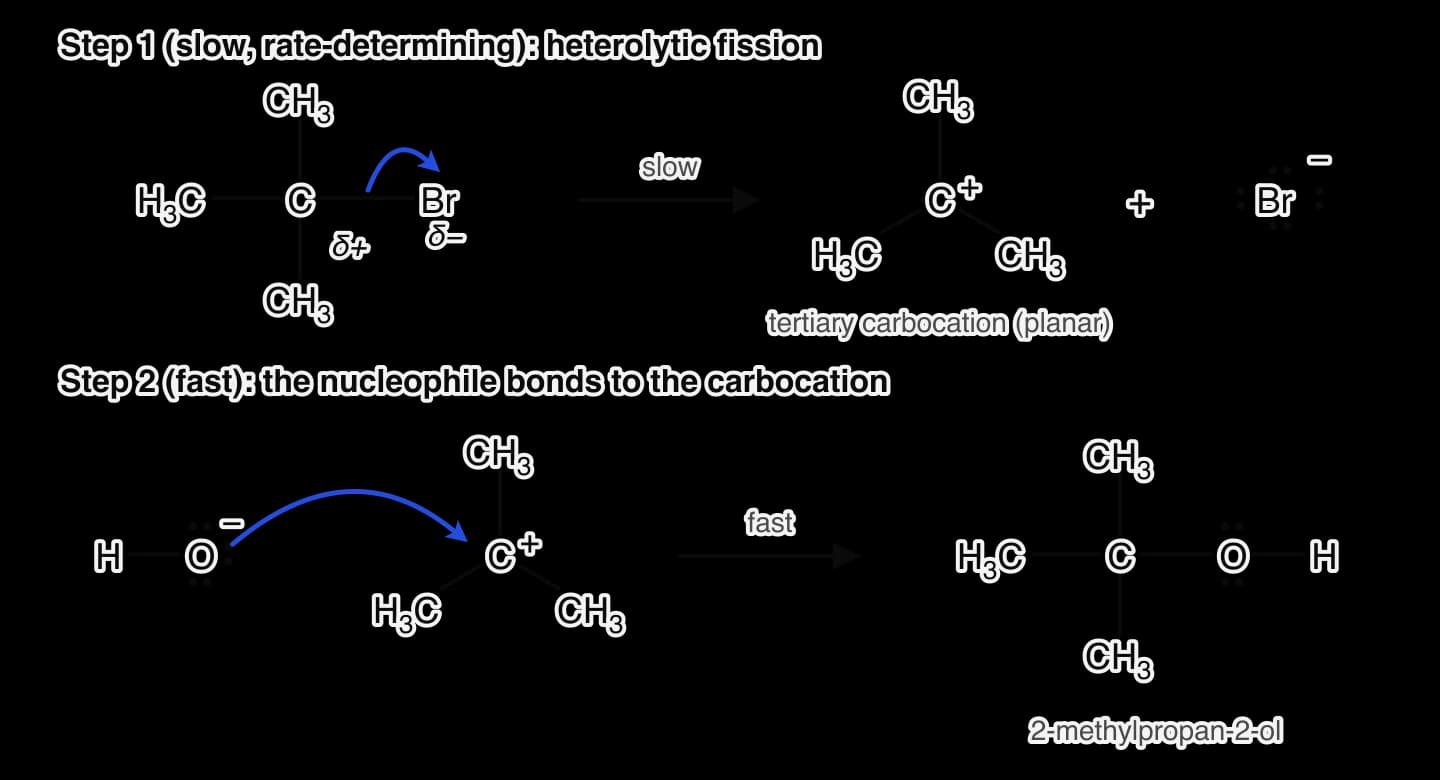
The carbocation is a reaction intermediate: a real species with a definite structure, sitting in an energy minimum between two transition states. Its positive carbon has three bonding pairs and no lone pair, so it is trigonal planar with bond angles of 120° (sp² hybridized). In the second step a lone pair on the hydroxide ion (or on a water molecule, in water) forms a bond to the positive carbon. The overall reaction is the same as for :
The rate equation for
The first step is much slower than the second, so it controls the rate of the whole reaction. Only the halogenoalkane takes part in it, so the rate depends only on the halogenoalkane concentration:
The reaction is first order overall and zero order with respect to the hydroxide ion; has units of . Adding more hydroxide ions does not speed up the reaction, because the hydroxide ions only react with carbocations once they have formed, and that happens as fast as the slow step can supply them.
Why tertiary halogenoalkanes react by
Two features of a tertiary halogenoalkane favour the two-step route:
The tertiary carbocation is relatively stable. Each of its three alkyl groups releases electron density towards the positive carbon (a positive inductive effect), which spreads out the positive charge. A more stable carbocation forms more easily, so the activation energy of step 1 is lower.
Backside attack is blocked. Three bulky methyl groups surround the carbon atom and shield its back from an approaching nucleophile. This crowding, called steric hindrance, makes the one-step route very slow.
The energy profiles of the two mechanisms show the difference directly.
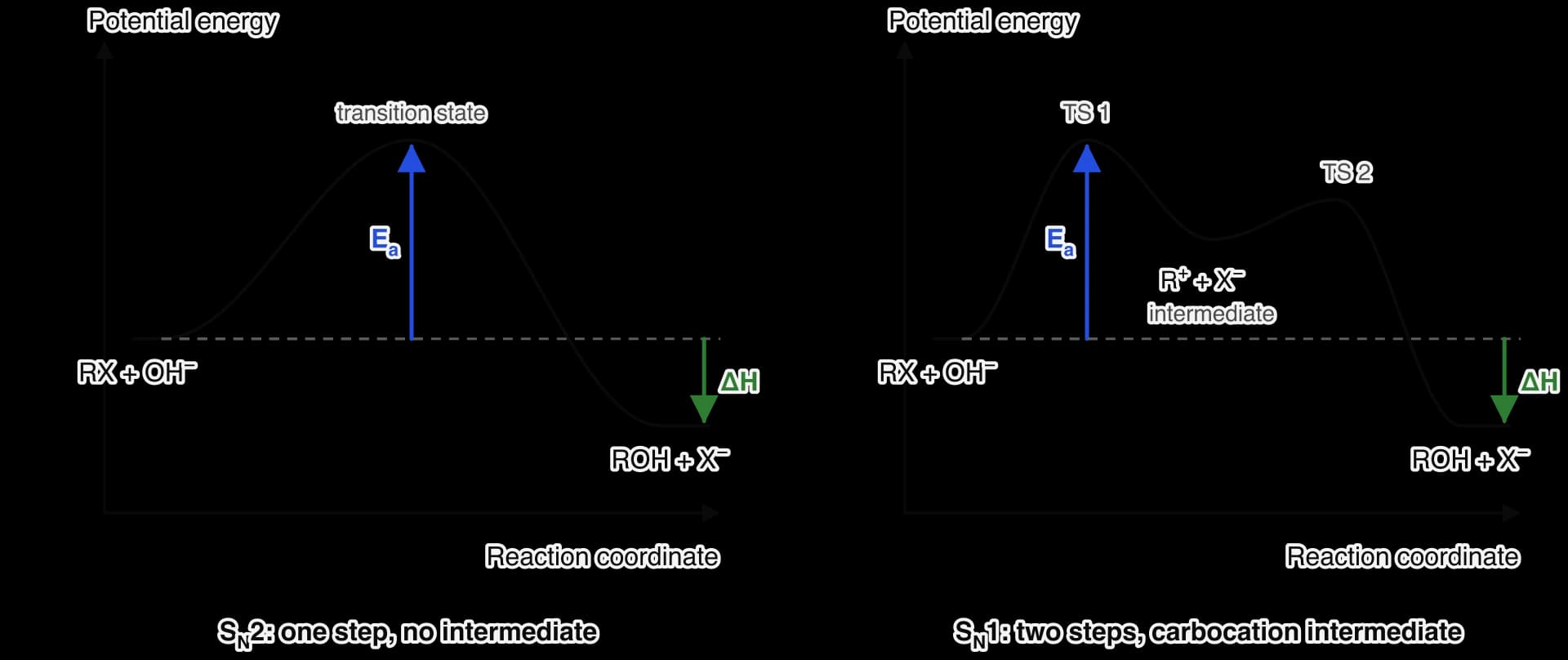
For , the first hump is the higher one: forming the carbocation needs the larger activation energy and is the rate-determining step. The carbocation and bromide ion sit in the trough between the humps; the second transition state, where the O–C bond is half formed, is reached easily from there. Both profiles are drawn for exothermic reactions, which is usual for these substitutions, and is the same whichever route is followed.
Stereochemistry: inversion and racemization
The two mechanisms give different results when the carbon atom under attack is a chiral carbon, bonded to four different groups. They are then distinguished by the arrangement of groups in the product, not only by the rate.
In the nucleophile always arrives from the side opposite the leaving group, and the other three groups are pushed through to the other side. The product has the opposite three-dimensional arrangement, an inversion of configuration (also called Walden inversion). A single enantiomer of 2-bromobutane therefore gives a single enantiomer of butan-2-ol, with its groups arranged as the mirror image of what simple replacement of Br by OH would give. A reaction in which one stereoisomer of the reactant gives one particular stereoisomer of the product is described as stereospecific.
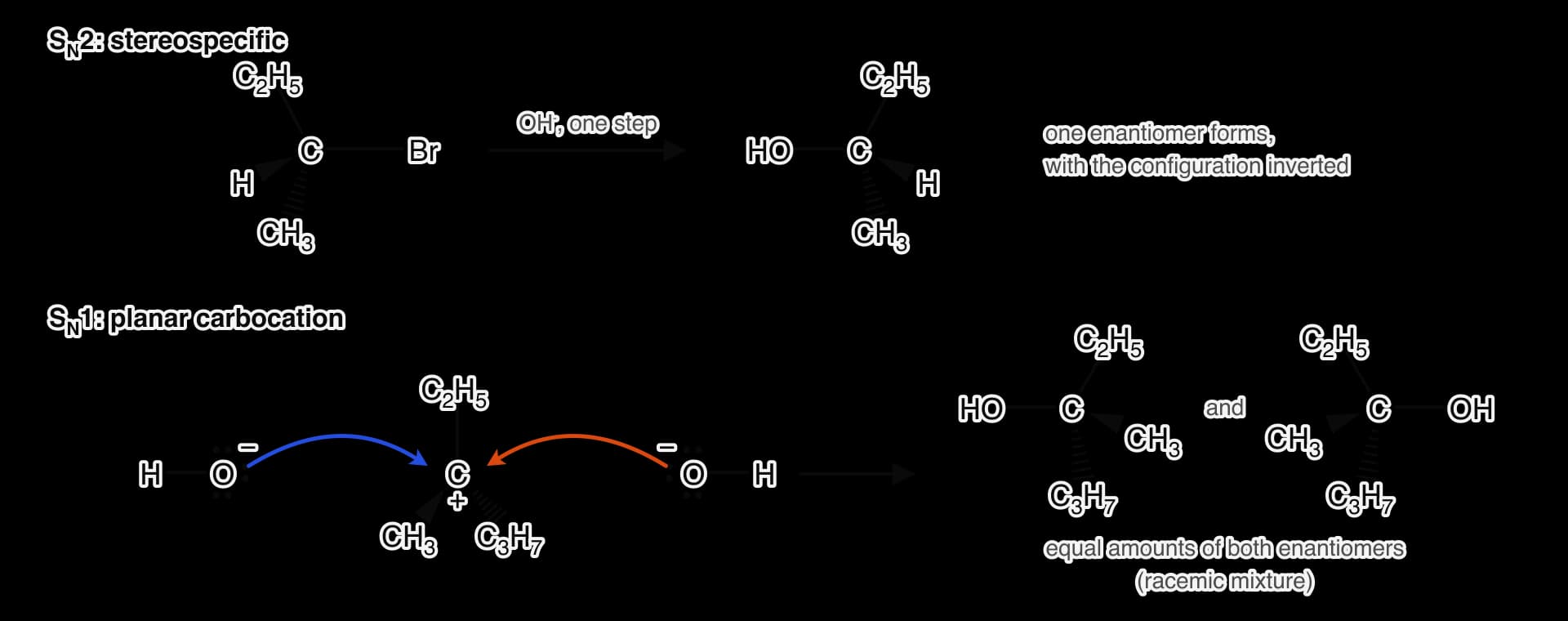
In the carbocation intermediate is planar. The nucleophile can attack either face of the plane with equal probability, so the two enantiomers of the product form in equal amounts. A single enantiomer of a chiral tertiary halogenoalkane therefore gives a racemic mixture, which does not rotate plane-polarized light. In practice the leaving halide ion often partly shields one face for a moment, so real reactions usually give slightly more of the inverted product, but the main outcome is loss of optical activity.
Evidence for inversion from a radioactive tracer
In 1935 Edward Hughes and co-workers at University College London tested the idea that every substitution inverts the carbon atom. They dissolved one enantiomer of 2-iodooctane in propanone with sodium iodide containing radioactive iodine. Each substitution replaces an iodine atom by an identical iodine atom, so the only things that can change are the radioactivity of the organic compound and the arrangement of its groups.
They followed both. Radioactive iodine entered the organic compound at exactly the rate needed to account for the loss of optical activity if every single substitution inverts the molecule it happens to. Isotope tracers make an otherwise invisible reaction measurable, and this experiment, together with the second-order rate equation, became key evidence for the one-step backside attack.
Secondary halogenoalkanes
A secondary halogenoalkane, such as 2-bromobutane, sits between the two extremes. Its carbocation is more stable than a primary one but less stable than a tertiary one, and its carbon atom is more crowded than a primary one but less crowded than a tertiary one. Secondary halogenoalkanes therefore react by both mechanisms at the same time, and the proportion going each way depends on the conditions, such as the nucleophile and the solvent.
Feature | ||
|---|---|---|
typical substrate | primary halogenoalkanes (and halogenomethanes) | tertiary halogenoalkanes |
secondary halogenoalkanes | react partly by this route | react partly by this route |
number of steps | one (concerted) |
Using kinetic data to identify the mechanism
The rate equation gives the most direct test of mechanism. If changing the concentration of the nucleophile changes the rate, the nucleophile takes part in the rate-determining step and the mechanism is . If it does not, the slow step involves the halogenoalkane alone and the mechanism is .
How useful are mechanisms such as SN1 and SN2?
A reaction mechanism is a model. Nobody watches the electrons move; the mechanism is a sequence of steps that is consistent with all the evidence: the rate equation, the stereochemistry of the products, the detection of intermediates and the results of isotope-labelling experiments. Evidence of this kind can rule a mechanism out, but it can never prove that a mechanism is correct.
The / model is powerful because a few simple ideas (carbocation stability, steric hindrance, the molecularity of the slow step) predict rates, rate equations and stereochemistry for a very large number of reactions. Its limits show in the middle ground. Secondary halogenoalkanes do not fit neatly into either box, and the solvent can shift a reaction from one route to the other. Chemists keep the model because it is simple and usually right, and refine it where the evidence demands.
 YouTube
The leaving group and the rate of substitution (HL)
For halogenoalkanes with the same alkyl group, the rate of substitution increases in the order chloroalkane < bromoalkane < iodoalkane. 1-Iodobutane reacts with a given nucleophile much faster than 1-chlorobutane does. In both mechanisms the carbon–halogen bond breaks in the rate-determining step, so the rate depends strongly on how easily that bond breaks.
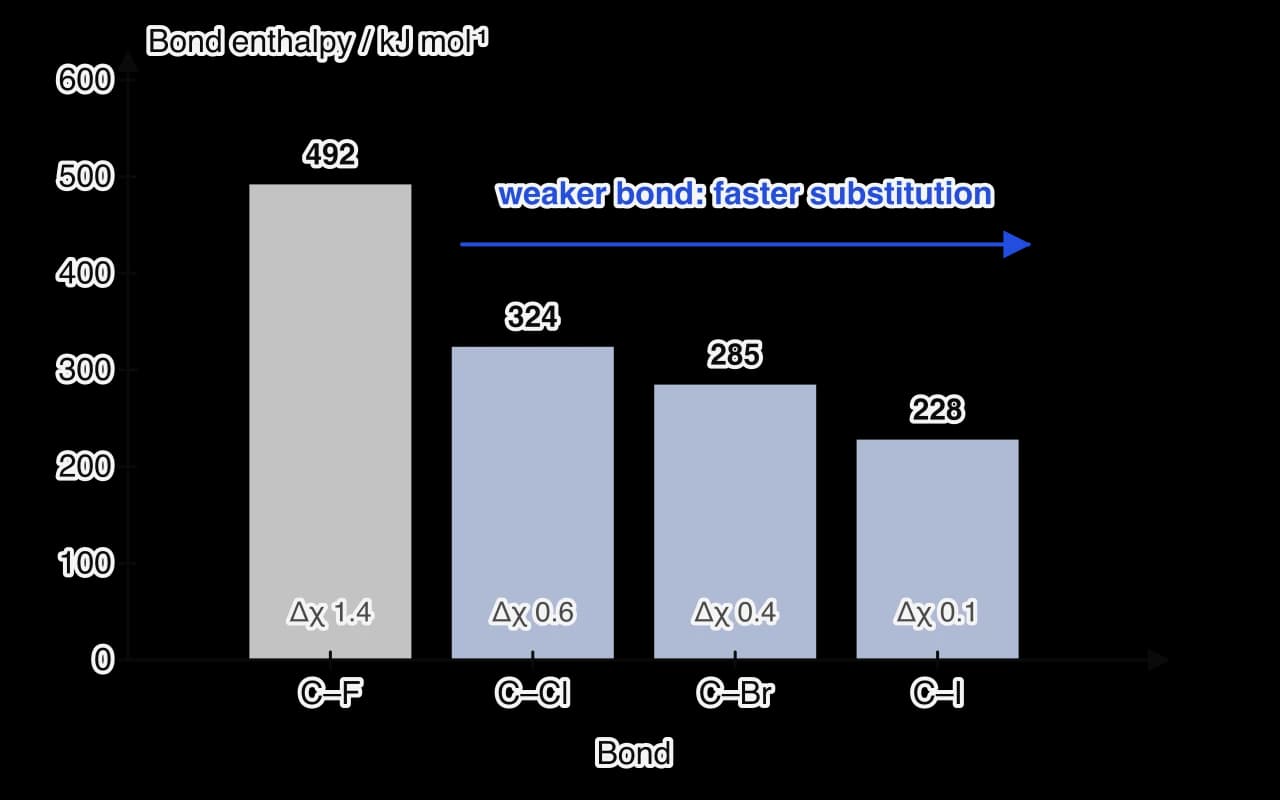
The bond enthalpies from the data booklet decrease from C–Cl () to C–Br () to C–I (
Bond polarity predicts the opposite order. Electronegativity falls from chlorine (3.2) to iodine (2.7), so the C–Cl carbon is the most δ+ and might be expected to attract nucleophiles most strongly. The experimental order shows that bond strength outweighs polarity: the C–I bond is the least polar but the easiest to break, so iodoalkanes react fastest. Fluoroalkanes, with the strongest C–X bond of all (), barely react with nucleophiles, which is one reason fluorinated compounds such as CFCs persist for so long in the environment.
Why iodide is a good leaving group
A good leaving group is one that leaves easily and is stable once it has left. Two properties make the iodide ion the best of the three halide ions:
the C–I bond is the weakest, so the least energy is needed to break it;
the iodide ion is the largest halide ion, so its negative charge is spread over the greatest volume. It is the most polarizable and the most stable of the three anions, and it is the weakest base: hydriodic acid is the strongest of the hydrogen halides, so has the least tendency to bond back to carbon (or to a proton).
The leaving group affects both mechanisms in the same direction. In the rate-determining step is the heterolysis of the C–X bond itself, and in the C–X bond is half broken in the transition state. A tertiary iodoalkane, which combines the easiest C–X bond to break with the most stable carbocation, reacts fastest of all; a primary chloroalkane reacts slowest of these.
Comparing rates in the laboratory
The relative rates of hydrolysis are compared by adding a few drops of each halogenoalkane to separate test tubes of aqueous silver nitrate dissolved in ethanol, warmed to the same temperature in a water bath (about 50 °C). Ethanol is used because halogenoalkanes do not mix with water. Water acts as the nucleophile, and the halide ion it releases is precipitated at once by the silver ions:
The time taken for a precipitate to appear measures the rate of the slow substitution step. With 1-iodobutane a yellow precipitate of silver iodide appears almost at once; 1-bromobutane gives a cream precipitate of silver bromide more slowly; 1-chlorobutane gives a white precipitate of silver chloride only after a long time. The colours also identify the halogen in an unknown halogenoalkane.
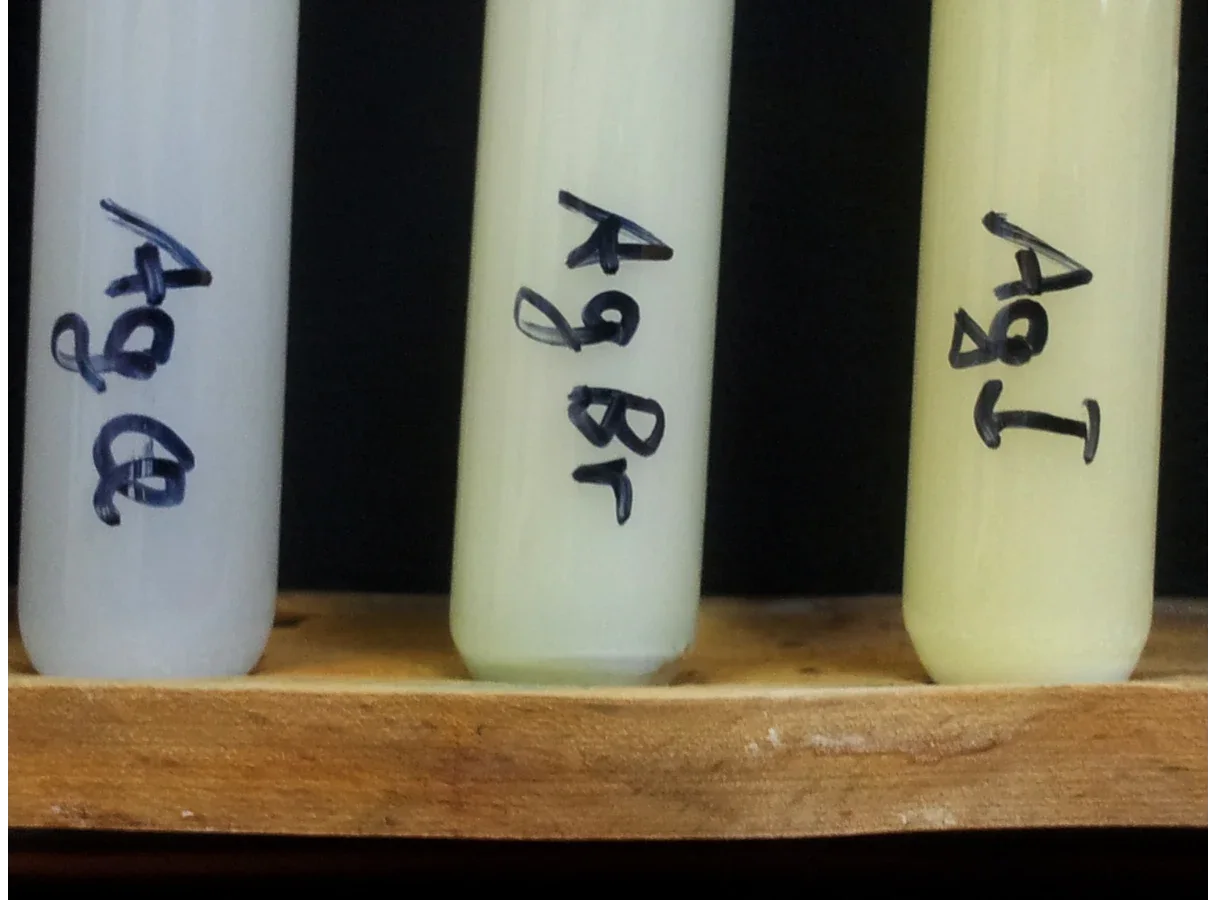
For a fair comparison the halogenoalkanes should have the same alkyl group, the same number of drops (ideally the same amount in moles), the same volume and concentration of silver nitrate solution, and the same temperature. The end point, the first sign of cloudiness, is a judgement; viewing each tube against a black card with a cross on it, or using a colorimeter, makes it more reproducible.
Electrophilic addition mechanisms (HL)
The carbon–carbon double bond consists of a σ bond and a π bond. The π electrons lie in a region above and below the plane of the molecule, further from the carbon nuclei than the σ electrons, and they are held less tightly; this is the weaker second bond shown by the C=C and C–C bond enthalpies. This exposed pair of electrons is attracted to electrophiles. Every electrophilic addition to an alkene follows the same pattern of two key steps:
the π electrons form a bond to the electrophile, and a carbocation intermediate forms on the other carbon atom of the double bond;
a nucleophile (an anion or a molecule with a lone pair) donates a pair of electrons to the positive carbon.
The double bond is replaced by two new single bonds, one to each part of the adding molecule.
Addition of hydrogen halides
Hydrogen bromide is a polar molecule, . When it approaches ethene, the π electrons of the double bond are attracted to the δ+ hydrogen atom. A pair of π electrons forms a new C–H bond, and at the same time the H–Br bond breaks heterolytically, with both electrons going to bromine. One carbon atom gains a hydrogen; the other is left with only three bonds and a positive charge. In the second step the bromide ion donates a lone pair to this carbocation.
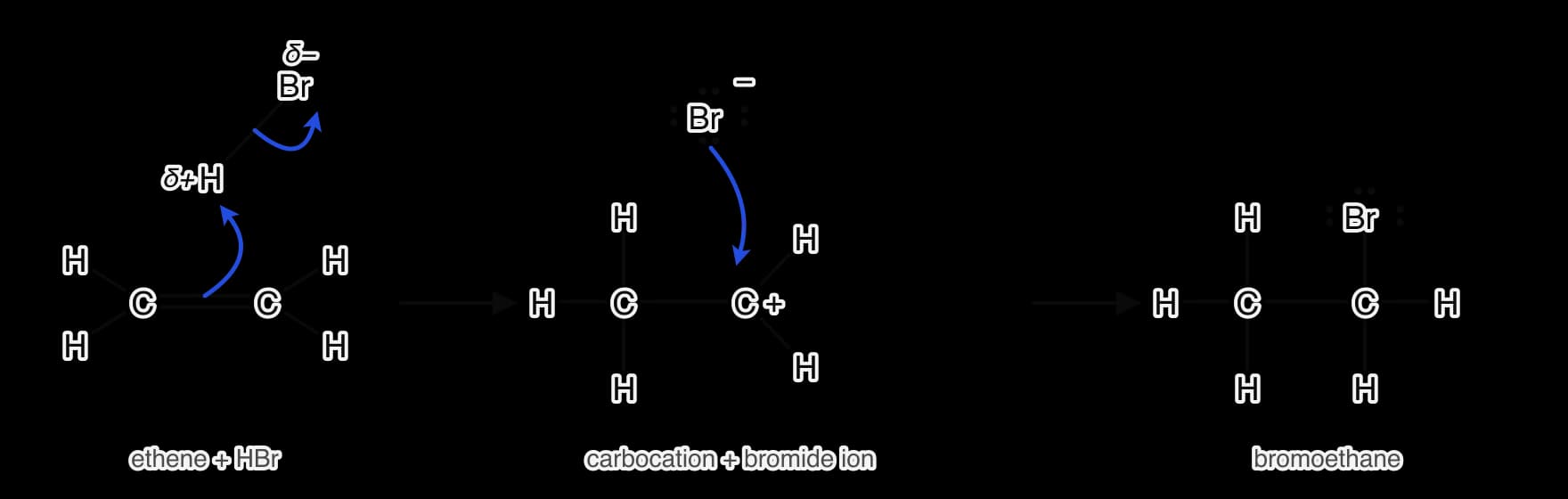
Hydrogen chloride and hydrogen iodide react by the same mechanism; hydrogen iodide, with the weakest H–X bond, reacts fastest.
Addition of halogens
The bromine molecule has no permanent dipole; the dipole induced in it by the π electrons makes the nearer bromine atom δ+, and that atom is attacked. The mechanism then follows the same two steps as for hydrogen bromide, with the far bromine atom leaving as a bromide ion.

Chlorine reacts in the same way to give 1,2-dichloroethane. The mechanism explains why the bromine water test works in the dark: the π electrons themselves polarize the bromine, so no light is needed, while an alkane, with no π electrons, can react only by radical substitution in ultraviolet light.
Evidence for a two-step mechanism, and the bromonium ion
If the addition happened in one step, with both bromine atoms arriving together, only 1,2-dibromoethane could form. When ethene reacts with bromine dissolved in aqueous sodium chloride, the products include 1-bromo-2-chloroethane,
Addition of water (acid-catalysed hydration)
Water is too weak an electrophile to react with an alkene on its own. With an acid catalyst, such as phosphoric acid in the industrial hydration of ethene with steam, the reaction takes place in three steps:
the π electrons form a bond to a hydrogen ion from the acid, giving a carbocation;
a lone pair on the oxygen atom of a water molecule forms a bond to the positive carbon, giving a protonated alcohol (an oxonium ion) with a positive charge on oxygen;
the protonated alcohol loses a hydrogen ion: the bonding pair of an O–H bond moves onto oxygen, leaving the alcohol.
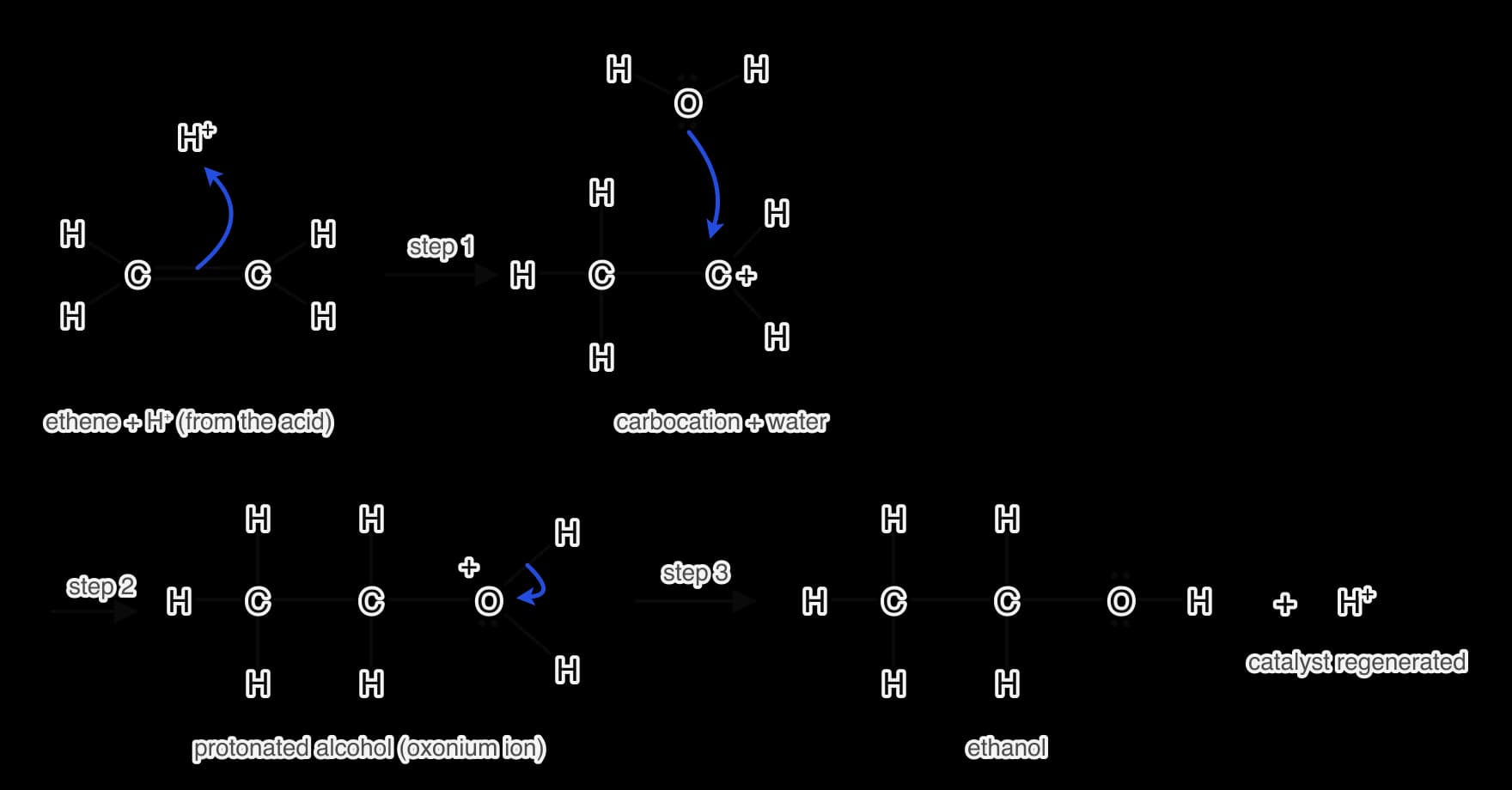
The hydrogen ion used in step 1 is released again in step 3, so the acid is a catalyst and does not appear in the overall equation. In step 1 the alkene acts as a Lewis base towards ; in step 2 water acts as a nucleophile (a Lewis base) towards the carbocation; and in step 3 the protonated alcohol acts as a Brønsted–Lowry acid.
Unsymmetrical alkenes and carbocation stability (HL)
In ethene and but-2-ene both carbon atoms of the double bond carry the same groups, so either way round the adding molecule gives the same product. An unsymmetrical alkene, such as propene, has different groups on the two carbon atoms of the double bond. Each of the two possible products of propene with hydrogen bromide, 2-bromopropane and 1-bromopropane, comes from a different carbocation, depending on which carbon atom the hydrogen bonds to.

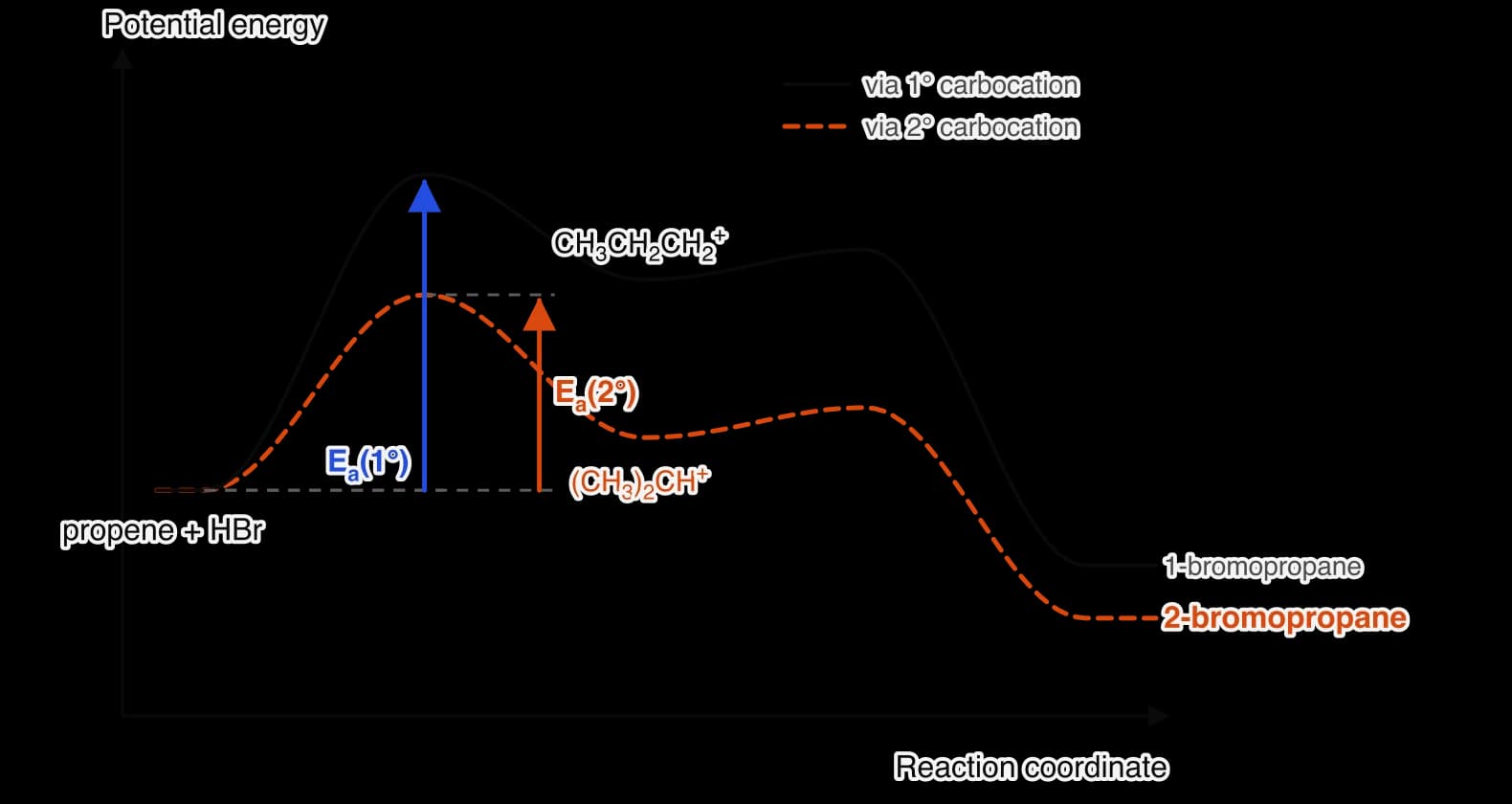
Both products form, but not in equal amounts: 2-bromopropane is the major product and 1-bromopropane the minor product. The explanation lies in the carbocation formed in the first, rate-determining step.
The stability of carbocations
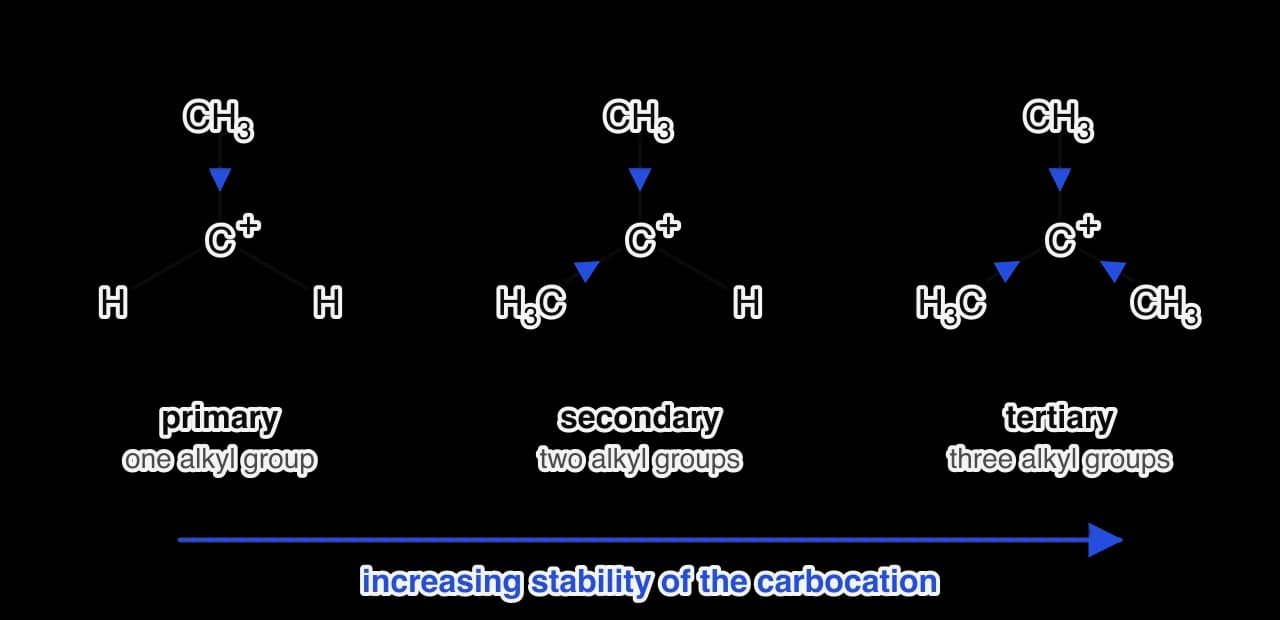
Carbocations are classified in the same way as halogenoalkanes, by the number of alkyl groups bonded to the positive carbon atom. A primary carbocation has one alkyl group, a secondary carbocation two and a tertiary carbocation three. Their stability follows the order:
Alkyl groups release electron density through their σ bonds towards a neighbouring atom that is short of electrons. This positive inductive effect partly offsets the positive charge on the carbon and spreads it over the surrounding groups. A charge that is spread out is more stable than one concentrated on a single atom, so each extra alkyl group makes the carbocation more stable.
The more stable a carbocation, the lower the energy of the transition state leading to it, and the lower the activation energy of the step that forms it. The secondary carbocation from propene forms much faster than the primary one, so nearly all the product is formed through it. The bromide ion then bonds to the middle carbon atom, giving 2-bromopropane.
The same reasoning applies to the acid-catalysed hydration of unsymmetrical alkenes. With steam and an acid catalyst, but-1-ene gives mainly butan-2-ol through a secondary carbocation, and 2-methylpropene gives mainly 2-methylpropan-2-ol through a tertiary carbocation:
Markovnikov's rule
The pattern was first described from experimental results by the Russian chemist Vladimir Markovnikov in 1870, long before carbocations were known. Markovnikov's rule states that when a hydrogen halide (or water) adds to an unsymmetrical alkene, the hydrogen atom adds to the carbon atom of the double bond that already has more hydrogen atoms bonded to it. The halogen (or OH) therefore ends up on the more substituted carbon.
The rule is a useful way to predict the major product, but it describes the result; it does not explain it. The explanation is the relative stability of the possible carbocation intermediates: the hydrogen adds where it creates the more stable carbocation.
Electrophilic substitution of benzene (HL)
Benzene has six π electrons delocalized round its ring, so like an alkene it has a region of high electron density above and below the plane of its carbon atoms, and it reacts with electrophiles. Two differences from an alkene follow from the delocalization:
Benzene needs a stronger electrophile. Its π electrons are spread over six atoms and stabilized by delocalization, by about compared with three separate double bonds (the delocalization energy). They are less available than the concentrated π electrons of a C=C bond, so benzene does not react with bromine water or hydrogen bromide. It reacts with positive electrophiles, written in general as .
Benzene undergoes substitution, not addition. Addition across one of the bonds would leave only four π electrons, destroying the delocalized ring and losing its extra stability. Substitution replaces a hydrogen atom with the electrophile and keeps the complete delocalized ring in the product, so it is the energetically favoured outcome.
The mechanism with a charged electrophile
The mechanism has two steps. In the first, a pair of the delocalized electrons forms a bond to the electrophile. The carbon atom that bonds to now has four single bonds (to E, to H and to two ring carbons) and is sp³ hybridized, so it is no longer part of the delocalized system. The remaining four π electrons are delocalized over the other five carbon atoms, which share the positive charge: the intermediate is a carbocation. It is drawn as a horseshoe of delocalization over five carbons, open towards the sp³ carbon, with a + sign inside.
In the second step the C–H bond on the sp³ carbon breaks, its bonding pair moves back into the ring and restores the full delocalized system, and is released. The overall reaction is:
Nitration of benzene
The best-known example is nitration, in which the electrophile is the nitronium ion, (O=N⁺=O). Benzene is warmed with a mixture of concentrated nitric acid and concentrated sulfuric acid, the nitrating mixture, at a temperature kept below about 50 °C to limit further nitration. The product is nitrobenzene, a pale yellow oil:
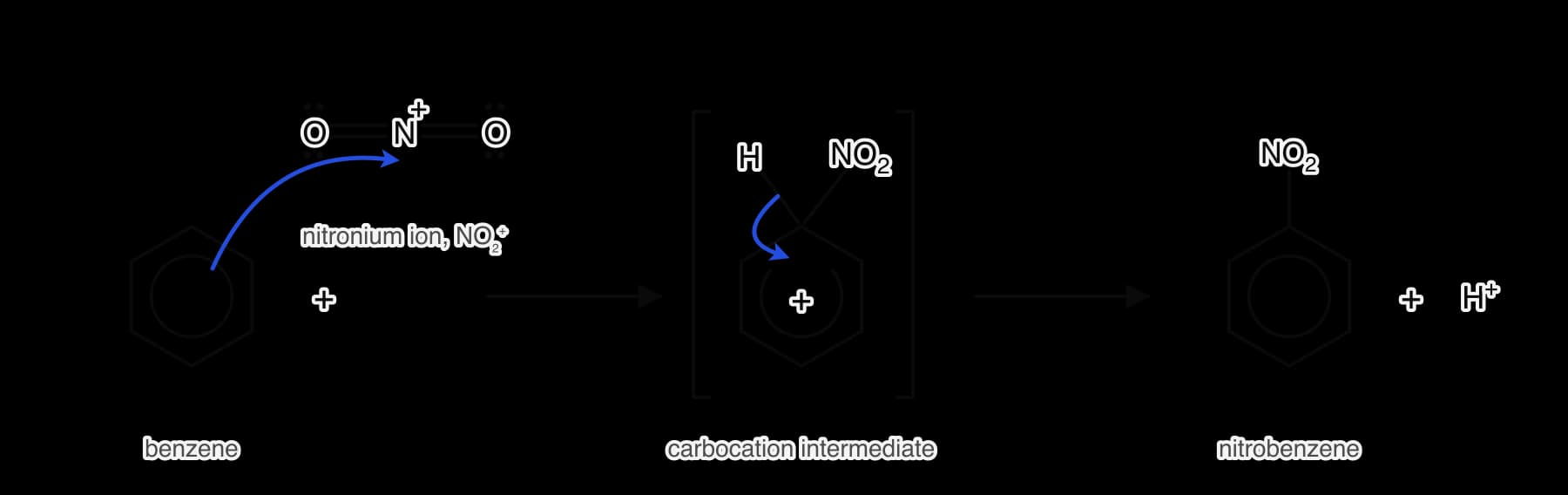
The nitronium ion forms when sulfuric acid, the stronger acid, protonates nitric acid, which then loses a water molecule. In this mixture nitric acid behaves as a Brønsted–Lowry base:
The hydrogen ion released in the second step of the mechanism reacts with a hydrogensulfate ion to re-form sulfuric acid,
Halogenation with a halogen carrier
Bromine on its own is too weak an electrophile to react with benzene. With a catalyst of iron(III) bromide or aluminium chloride, called a halogen carrier, bromobenzene and hydrogen bromide form at room temperature:
The catalyst is a Lewis acid. Iron in accepts a lone pair from one bromine atom of
Addition and substitution compared
Alkenes and benzene both react with electrophiles, both through a carbocation intermediate, and in both the first step is rate-determining. They differ in what happens to the carbocation, which decides the type of reaction.
Alkene + HBr | Benzene + | |
|---|---|---|
attacking species | electrophile ( |
The comparison shows how the same kind of first step, an electron-rich π system donating a pair to an electrophile, leads to two different types of reaction. The alkene carbocation bonds to a nucleophile, giving a saturated product. The benzene carbocation instead loses a proton, which restores the delocalized ring and its delocalization energy, so substitution is favoured.
Applying the ideas in exam questions
Paper 1A: recognizing an electrophile
Paper 1A: heterolytic fission
Paper 1B: counting double bonds by bromine titration
Limonene, (
Titration | Initial reading / cm³ | Final reading / cm³ | Titre / cm³ |
|---|---|---|---|
1 (rough) | 0.00 | 41.20 | 41.20 |
2 | 0.50 | 40.60 | 40.10 |
3 | 1.10 | 41.25 | 40.15 |
Paper 2: halogenoalkanes and nucleophiles
Paper 2: reactions of but-2-ene
Paper 1A: a Lewis acid that is not a Brønsted–Lowry acid (HL)
Paper 1A: the charge of a complex ion (HL)
Paper 1A: features of an SN1 reaction (HL)
Paper 1B: comparing the rates of hydrolysis of halogenoalkanes (HL)
Paper 2: two isomers of bromobutane (HL)
Paper 2: reactions of but-1-ene and benzene with electrophiles (HL)
Self-check
- To do:
I can explain what a curly arrow represents and where it must start and end.
- To do:
I can describe heterolytic fission, draw it with a curly arrow and predict which fragment takes the electron pair.
- To do:
I can distinguish homolytic from heterolytic fission by the products and the arrows used.
- To do:
I can define a carbocation and a carbanion.
- To do:
I can define a nucleophile, recognize neutral and negative nucleophiles and explain why a lone pair is essential.
- To do:
I can define an electrophile and recognize positive and neutral electrophiles, including polarized molecules such as Br₂.
- To do:
I can identify the nucleophile and the electrophile in a given reaction.
- To do:
I can explain why the carbon bonded to a halogen is attacked by nucleophiles.
- To do:
I can write equations for nucleophilic substitution of halogenoalkanes by hydroxide ions, water, ammonia and cyanide ions, and draw curly arrows for the general reaction.
- To do:
I can identify the substrate, nucleophile and leaving group in a nucleophilic substitution.
- To do:
I can explain why alkenes undergo electrophilic addition.
- To do:
I can write equations for the reactions of alkenes with halogens, hydrogen halides, water and hydrogen, with conditions.