R3.3 Electron sharing reactions · IB Chemistry | Augment Education
R3.3 Electron sharing reactions
Explain how radicals form by homolytic fission and react in chain reactions, including the free-radical substitution of alkanes by halogens and the destruction of ozone by CFCs.
IB Chemistry
Part of R3 What are the mechanisms of chemical change?
SL and HL
Key terms introduced here
Each is in the Chemistry glossary, with every other term in the subject.
A reaction in which a reactive intermediate, such as a radical, is regenerated in each cycle of steps, so one initiation event leads to many product molecules.
A compound of carbon, chlorine and fluorine, such as CClX2FX2
Notes on R3.3 Electron sharing reactions
33 min readLast reviewed
Questions on R3.3
61 exam-style questions on this subtopic, written in the style of the IB papers. The first has its markscheme open. Counted on
Question 1 · CHEM-00297HL only · 9 marks
Ozone, O3, in the stratosphere absorbs ultraviolet radiation. Both oxygen, O2, and ozone are dissociated by ultraviolet light.
(a)
Draw two resonance structures for ozone.
[2]2 marks
Markscheme (a)
one structure correct: central O with one lone pair, double bonded to one O (two lone pairs) and single bonded to the other O (three lone pairs) ✓ second structure with the double bond on the other side and a double-headed resonance arrow between them ✓
Accept formal charges shown or omitted. Do not award M2 for an equilibrium arrow.
(b)
State the bond order of the oxygen–oxygen bonds in ozone.
[1]1 mark
Markscheme (b)
1.5 ✓
(c)
Calculate the formal charge on each oxygen atom in one of your resonance structures.
[2]2 marks
Markscheme (c)
Try a quick-fire question
One of 50 short multiple-choice questions on R3.3. Pick an answer to see why it's right or wrong.
A CFC molecule contains only C–Cl and C–F bonds. Using the chart, which of these bonds can the UV light shown break?
Flashcards for R3.3
The official deck for this part of the syllabus.
R3.3 Electron sharing reactions · front
Define a radical.
R3.3 Electron sharing reactions · front
Why must a species with an odd number of valence electrons be a radical?
R3.3 Electron sharing reactions132 cards
Carry on with R3.3 in Augment
With a free account, Augment remembers where you stopped and what you have practiced.
A curved arrow with a full arrowhead, used in mechanisms to show the movement of a pair of electrons, from a lone pair or bond to the atom or bond where the pair ends up.
A substitution reaction that proceeds by a radical chain mechanism (initiation, propagation, termination), such as the reaction of an alkane with chlorine or bromine in UV light.
A compound of carbon, hydrogen and fluorine, such as CHX2FCFX3, used in place of CFCs; it contains no chlorine so does not destroy ozone, but many are strong greenhouse gases.
The first step of a radical chain reaction, in which radicals are formed from a molecule with none, usually by homolytic fission in UV light or heat: ClX22Cl∙.
The region of the stratosphere, mostly 15–35 km up, where ozone absorbs most of the Sun's harmful ultraviolet radiation; its thinning by chlorine atoms from CFCs is called ozone depletion.
A step in a chain reaction in which a radical reacts with a molecule to form a new molecule and a new radical, so the number of radicals does not change.
A step in a chain reaction in which two radicals combine to form a molecule, removing radicals and ending a chain.
.
Homolytic fission breaks a covalent bond so that each fragment keeps one of the two bonding electrons, forming two radicals.
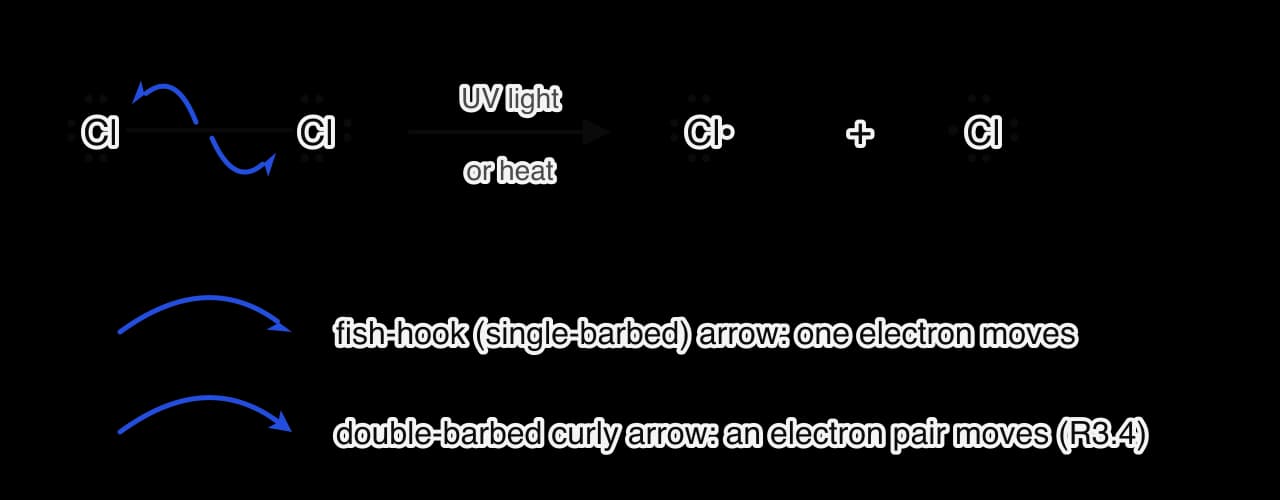
A single-barbed (fish-hook) arrow shows the movement of one electron; two are needed for each bond that breaks homolytically.
Halogen molecules undergo homolytic fission in ultraviolet light or on heating, because the halogen–halogen bond is relatively weak. This is the initiation step of a chain reaction.
Alkanes are unreactive because their C–C and C–H bonds are strong and essentially non-polar. They are kinetically stable but thermodynamically unstable.
Alkanes react with chlorine or bromine in UV light by free-radical substitution, in three stages: initiation, propagation and termination.
Each propagation step uses up one radical and forms another, so the reaction is a chain reaction; termination steps remove radicals by joining two of them.
Free-radical substitution gives a mixture of products, because substitution can continue, can occur at different carbon atoms and because termination steps join radicals together.
Chlorine atoms released from CFCs by UV light catalyse the destruction of ozone in the stratosphere.
Most molecules have all their electrons in pairs. A species with an unpaired electron, a radical, reacts quickly with almost anything it meets, because forming a bond pairs the electron and releases energy. Radical reactions turn methane into the chloromethane solvents of industry, drive the chemistry of the upper atmosphere, and, through chlorine atoms from chlorofluorocarbons, opened the ozone hole over Antarctica.
Radicals: species with an unpaired electron
In nearly all stable molecules every electron is paired: either shared in a covalent bond or held as a lone pair. A species with an odd number of valence electrons cannot pair them all, so at least one electron is left on its own. Such species are called radicals (older books call them "free radicals").
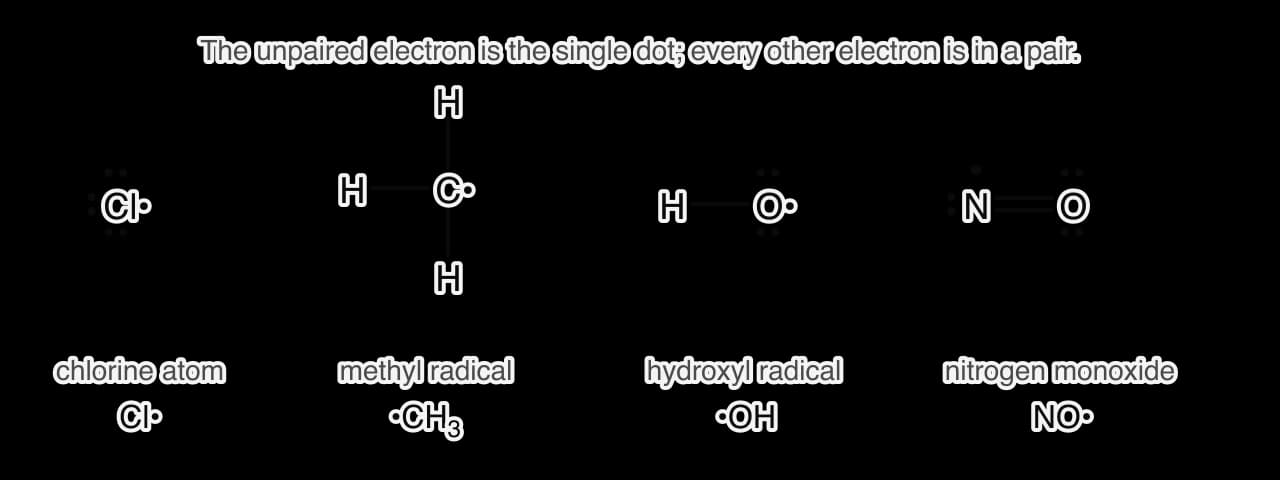
A radical is represented by a dot, ∙, placed on the atom that carries the unpaired electron. A chlorine atom is written Cl∙ and the methyl radical ∙CHX3, with the dot next to the carbon atom because carbon carries the unpaired electron. The dot stands for one electron only, so in a Lewis formula the other valence electrons are still drawn as bonding pairs and lone pairs. The Lewis formulas of four common radicals show this.
Each radical has one unpaired electron, shown as a single dot on the atom that carries it. In a condensed formula the dot is written next to that atom: Cl•, •CH₃, •OH.
Counting valence electrons confirms each structure. A chlorine atom has seven: three lone pairs and one unpaired electron. In ∙CHX3, carbon has four valence electrons and uses three of them in C−H bonds, leaving one unpaired. Nitrogen monoxide, NO, has 5+6=11 valence electrons; an odd total always leaves one unpaired.
Atoms, molecules and ions can all be radicals
The definition says "molecular entity" rather than "molecule" because radicals come in every form. Each kind in the table has an unpaired electron, whatever its size or charge.
Kind of radical
Examples
Where it is met
atom
Cl∙, Br∙, H∙
halogen atoms formed in UV light; chlorine atoms in the stratosphere
neutral molecule or fragment
∙CHX3, ∙CX2HX5, ∙OH, NO, NOX2
intermediates in halogenation; nitrogen oxides from car engines; the hydroxyl radical in the lower atmosphere
cation
[CHX3CHX2OH]X+∙
anion
OX2X−∙ (superoxide)
formed in living cells when an oxygen molecule gains one electron
The ions in the last two rows are radicals because removing one electron from, or adding one electron to, a molecule whose electrons were all paired must leave one unpaired. Nitrogen monoxide and nitrogen dioxide are unusual in being radicals that are stable enough to bottle. Most radicals, such as ∙CHX3, exist for only a tiny fraction of a second before they react.
Why radicals are so reactive
An unpaired electron becomes paired when the radical forms a covalent bond, either by taking an atom from a molecule or by combining with another radical. Bond formation releases energy, so these reactions are usually exothermic. They also need very little activation energy: a radical does not have to break a bond completely before the new bond starts to form, and when two radicals meet there is no bond to break at all. Radical reactions are therefore very fast, and radicals rarely survive long enough to build up to a high concentration.
Homolytic fission: how radicals are formed
A covalent bond is a pair of electrons shared between two atoms. When the bond breaks, the pair can be divided in two ways. If both electrons go to one atom, ions are formed; this is heterolytic fission, the subject of R3.4. If the pair is split evenly, each atom keeps one electron and two radicals are formed.
Homolytic fission is shown with single-barbed curved arrows, called fish-hook arrows. Each fish-hook has half an arrowhead and shows the movement of one electron, from where it starts (the bond) to where it ends up (an atom). Breaking one bond homolytically therefore needs two fish-hooks, one towards each atom. The full, double-barbed curly arrow shows the movement of a pair of electrons and is used for the reactions in R3.4.
In homolytic fission each atom takes one electron of the bonding pair. Each fish-hook arrow (blue) shows one electron moving from the bond to an atom, so two are needed for one bond.
The fission of chlorine can be written as a Lewis formula with arrows, as in the diagram, or simply as an equation. The condition, ultraviolet light, goes over the arrow; hν (a photon) is sometimes written instead.
ClX2UV light2Cl∙BrX2UV light2Br∙
Heat can also break these bonds: chlorine and methane react in the dark at about 400–500∘C, a thermal route used industrially to make chloromethanes. In the laboratory, light is the usual way to start the reaction.
Why halogen molecules break apart in light
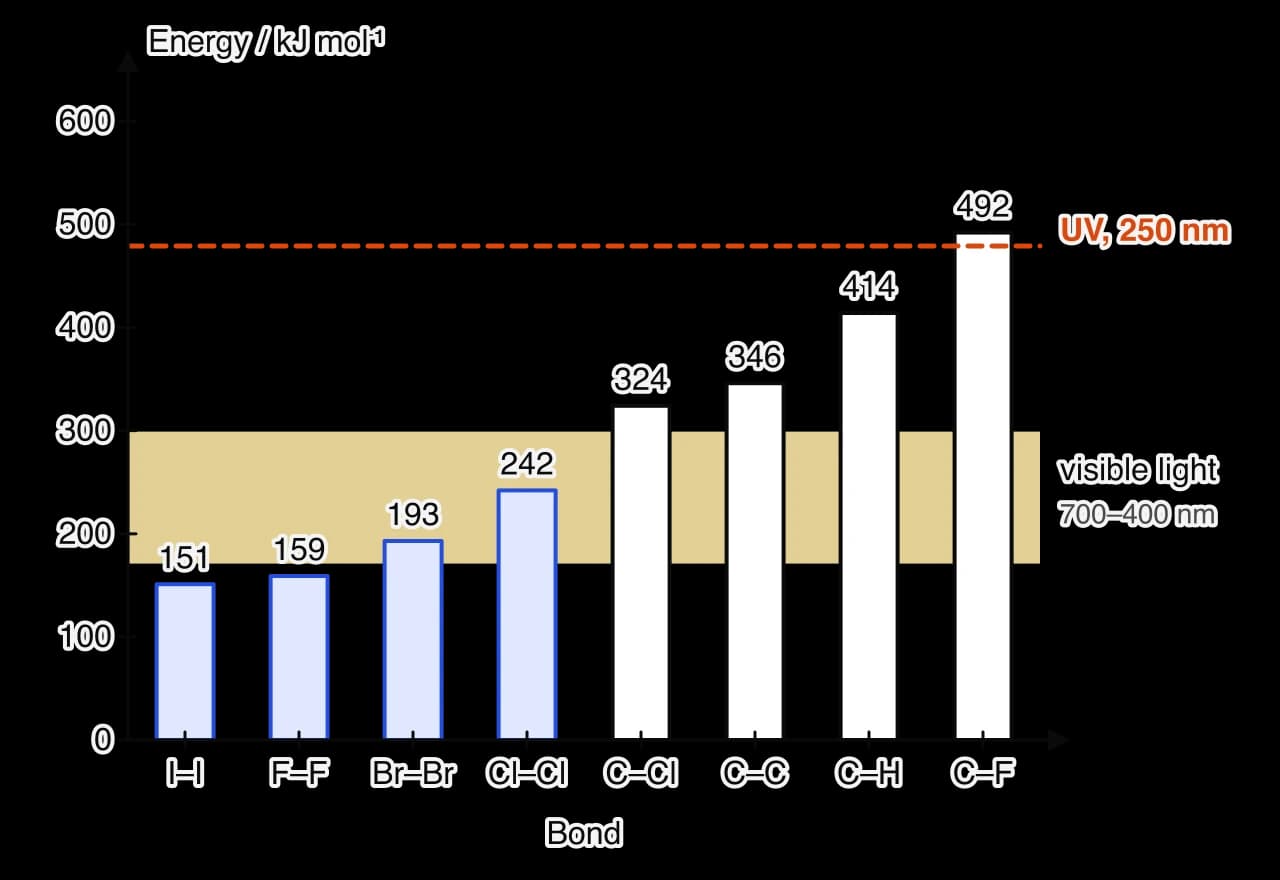
Light is absorbed as photons, and one photon can break one bond if it carries at least the bond's energy. Light of shorter wavelength carries more energy per photon. One mole of photons of red light (700nm) carries about 171kJ, one mole of violet photons (400nm) about 299kJ, and one mole of 250nm ultraviolet photons about 479kJ. The chart compares these energies with bond enthalpies from the data booklet.
The halogen–halogen bonds (blue) are the weakest single bonds in the chart, weak enough for visible or near-UV light to break them. The C–H bond needs short-wavelength UV, and C–F is stronger still. Bond enthalpies: IB Chemistry data booklet (2025), section 12. Photon energies are per mole of photons of the wavelength shown.
The halogen–halogen bonds are among the weakest covalent bonds: Cl−Cl is 242kJ mol−1 and Br−Br193kJ mol−1. Violet and near-ultraviolet light carries enough energy to break them, so a mixture of methane and chlorine reacts in sunlight but not in the dark. A bond can only be broken by light that the molecule absorbs. Chlorine is yellow-green because it absorbs violet and near-ultraviolet light, which splits its molecules. Alkanes are colourless and absorb no visible or near-ultraviolet light, and their C−H bonds (414kJ mol−1) would in any case need ultraviolet radiation of wavelength below about 290 nm, which hardly reaches the ground. The halogen molecule is therefore the species that splits to start the reaction.
The same comparison explains a key fact about chlorofluorocarbons (CFCs) in the upper atmosphere. The C−Cl bond (324kJ mol−1) is much weaker than the C−F bond (492kJ mol−1), so the UV radiation there breaks C−Cl bonds and releases chlorine atoms, while the C−F bonds survive and fluorine atoms are not released.
YouTube
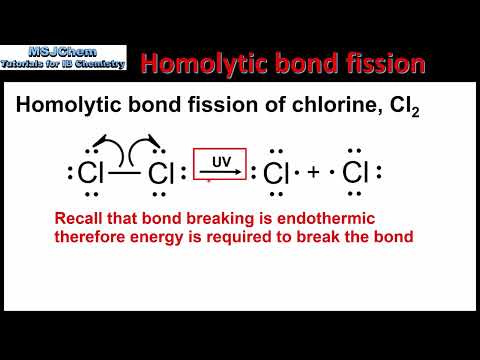
Mike Sugiyama Jones (MSJ Chem): homolytic bond fission, R3.3.1 and R3.3.2.
The reverse of homolytic fission
Running homolytic fission backwards joins two radicals: each supplies one electron and the two electrons form a new shared pair. This releases energy equal to the bond enthalpy of the bond formed, for example 242kJ mol−1 when two chlorine atoms combine:
Cl∙+Cl∙ClX2ΔH=−242kJ mol−1
Radical combination needs almost no activation energy, because no bond has to be broken. Radical combination is what ends radical chains in termination steps, and it is why the concentration of radicals in a reacting mixture always stays very low.
Why alkanes are unreactive
Alkanes are saturated hydrocarbons: they contain only carbon and hydrogen joined by single bonds. They burn readily once lit, but apart from combustion they react with very few substances. Acids, alkalis, oxidizing agents such as acidified potassium manganate(VII) and most other common reagents have no effect on them at room temperature. Two features of their bonding explain this.
Strong bonds.C−H (414kJ mol−1) and C−C (346kJ mol−1) bonds are strong, so any reaction that must begin by breaking one has a high activation energy.
Essentially non-polar bonds. Carbon (electronegativity 2.6) and hydrogen (2.2) differ by only 0.4, so the C−H bond is almost non-polar, and C−C bonds are completely non-polar. An alkane has no significant partial charges (δ+ or δ−) to attract ions or polar molecules, so reagents that react by donating or accepting electron pairs (R3.4) have nowhere to attack.
Being unreactive is not the same as being stable in energy terms. The combustion of methane is strongly exothermic, ΔHc⊖=−891kJ mol−1 (data booklet), so carbon dioxide and water are far lower in energy than methane and oxygen: methane is thermodynamically unstable with respect to its combustion products. Yet natural gas and air can be mixed in a cooker without reacting until a spark or flame supplies the activation energy. Methane is kinetically stable: the reaction is energetically favourable, but its high activation energy makes it extremely slow at room temperature (R1.1, R2.2).
Radicals provide one of the few routes by which alkanes react at moderate temperatures. A halogen atom is reactive enough to remove a hydrogen atom from an alkane with only a small activation energy, so once the halogen molecule has been split, the kinetic stability of the alkane is overcome.
Free-radical substitution of methane
A mixture of methane and chlorine is stable in the dark at room temperature. In ultraviolet light, or bright sunlight, it reacts to form chloromethane and hydrogen chloride:
CHX4(g)+ClX2(g)UV lightCHX3Cl(g)+HCl(g)
One hydrogen atom of methane has been replaced by a chlorine atom, so this is a substitution reaction. Because the reaction takes place through radicals it is called free-radical substitution, and because the halogen is introduced into the molecule it is also a halogenation.
The equation for the reaction does not show what happens to individual particles. The reaction takes place in a series of simple steps, called its mechanism, which falls into three stages: initiation, propagation and termination.
Initiation
The initiation step creates radicals from a molecule that has none. Ultraviolet light breaks the weakest bond present, Cl−Cl, by homolytic fission:
ClX2UV light2Cl∙
Only a tiny fraction of the chlorine molecules is split at any moment, but each chlorine atom formed can start a long sequence of reactions.
Propagation
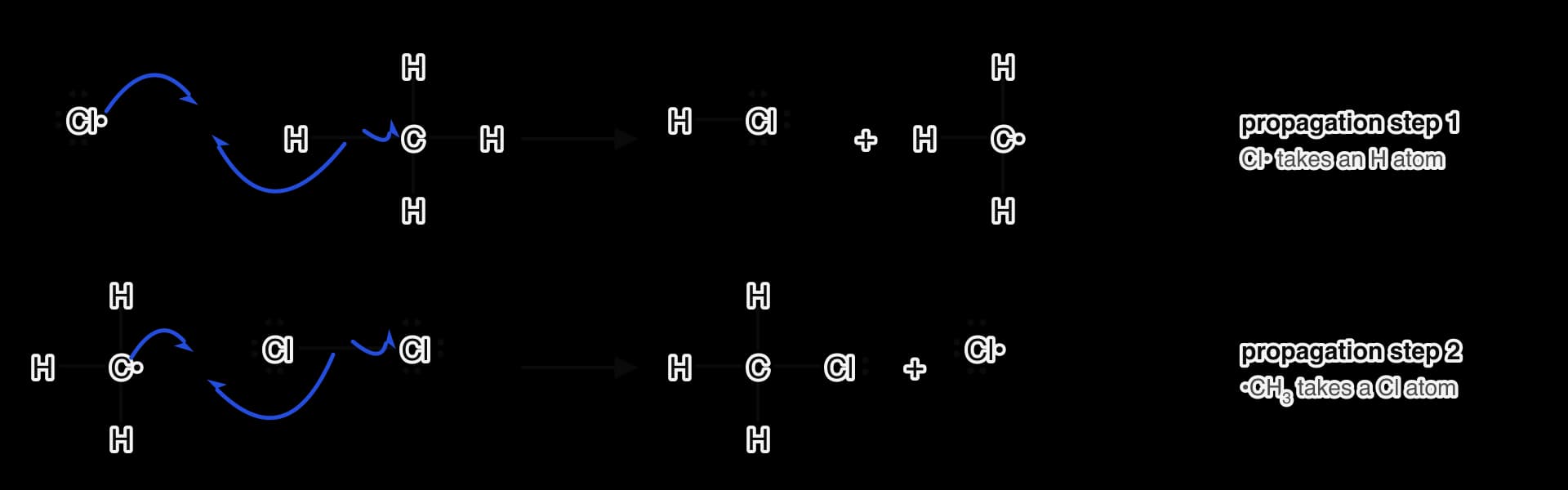
In a propagation step, a radical reacts with a molecule to form a new molecule and a new radical. The number of radicals does not change. Chlorination of methane has two propagation steps. First, a chlorine atom removes a hydrogen atom from methane, forming hydrogen chloride and a methyl radical. Then the methyl radical removes a chlorine atom from a chlorine molecule, forming chloromethane and a new chlorine atom:
CHX4+Cl∙∙CHX3+HCl∙CHX3+ClX2CHX3Cl+Cl∙
The fish-hook arrows for these two steps show where each electron goes. In both steps one bond breaks homolytically and one new bond forms from one electron supplied by each partner.
In each propagation step a radical reacts with a molecule to give a new molecule and a new radical. The new bond forms from one electron supplied by each partner (two fish-hooks meeting), and the bond that breaks sends one electron to each side. Arrows in blue.
Adding the two propagation steps and cancelling the radicals, which appear on both sides, gives the overall equation CHX4+ClX2CHX3Cl+HCl. The chlorine atom used in the first step is given back in the second, so it can start the cycle again.
Termination
A termination step removes radicals: two radicals combine to form a molecule, pairing their unpaired electrons in a new bond. Any two radicals present can combine:
Termination is rare compared with propagation, because radicals are present at very low concentration and so seldom meet each other. They are far more likely to collide with methane or chlorine molecules, which are present in vast excess.
Stage
What happens
Change in number of radicals
Example
initiation
a molecule splits by homolytic fission in UV light
radicals created (0 → 2)
ClX22Cl∙
propagation
radical + molecule → molecule + new radical
no change (1 → 1)
CHX4+Cl∙∙CHX3+HCl
termination
two radicals combine to form a molecule
radicals removed (2 → 0)
∙CHX3+Cl∙CHX3Cl
A chain reaction
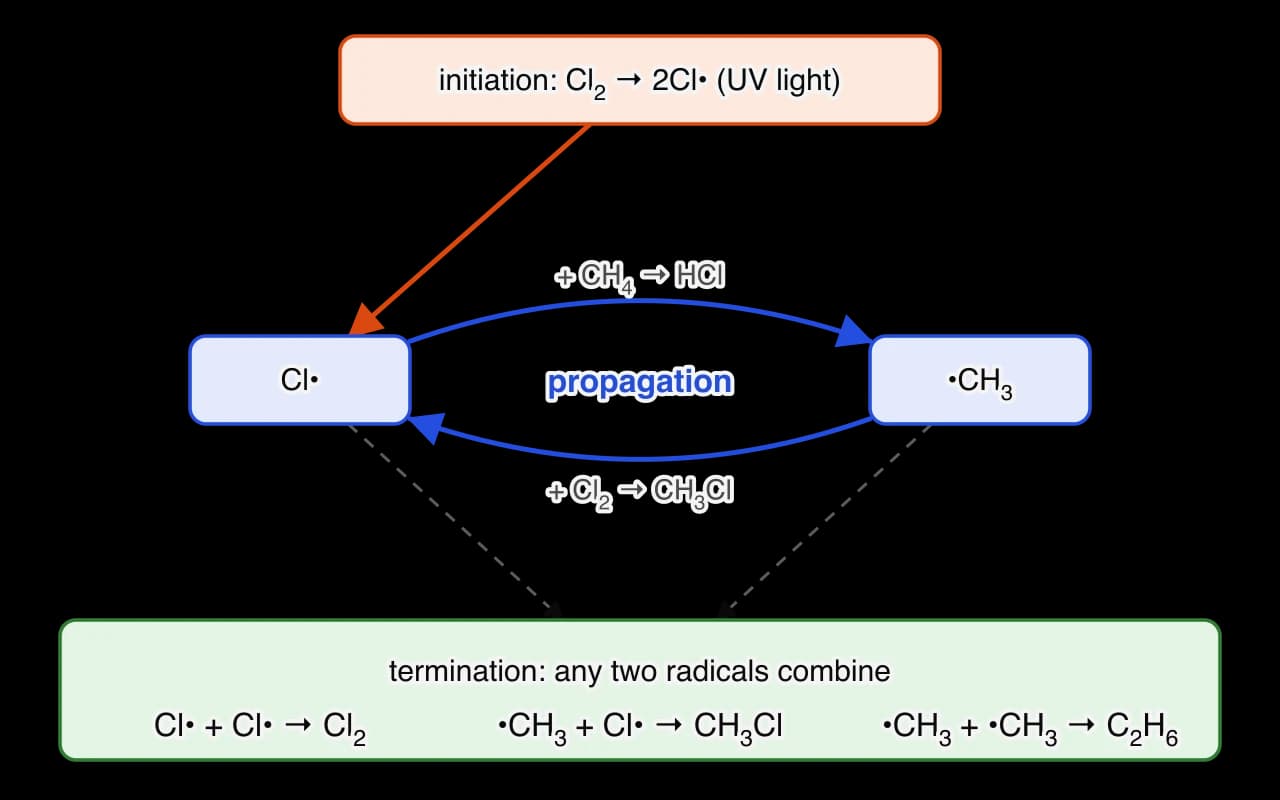
Because every propagation step regenerates a radical, the two propagation steps repeat over and over: each chlorine atom formed by initiation can convert a great many methane molecules before a termination step removes it. A reaction of this kind is a chain reaction. The cycle diagram shows how the three stages fit together.
One initiation step (orange) starts a chain: the two propagation steps (blue) regenerate the chlorine atom, so the cycle repeats many times. The chain stops only when two radicals meet in a termination step (green).
The chain explains why a little light can produce a large amount of product, and why the reaction can be violent. A mixture of hydrogen and chlorine is stable in the dark but explodes when exposed to bright sunlight or a camera flash: chlorine atoms start a very fast chain (Cl∙+HX2HCl+H∙, then H∙+ClX2HCl+Cl∙), and the heat released speeds it up further.
YouTube
Mike Sugiyama Jones (MSJ Chem): free-radical substitution reactions of the alkanes, R3.3.3.
Evidence of this kind supports the mechanism but does not prove it. Further support comes from the products themselves. Small amounts of ethane are always found in the product mixture, and the only reasonable source is the termination step ∙CHX3+∙CHX3CX2HX6. Adding a substance that reacts rapidly with radicals stops the reaction, as expected if radicals carry the chain.
Why a mixture of products forms
Free-radical substitution is hard to control. The reaction of methane with chlorine gives chloromethane, but never chloromethane alone. Three features of the mechanism lead to a mixture.
Further substitution
Chloromethane still has three C−H bonds, and a chlorine atom can remove a hydrogen atom from it just as it can from methane. The radical formed, ∙CHX2Cl, then reacts with chlorine to give dichloromethane. The same steps can continue until all four hydrogen atoms have been replaced:
Each further substitution has the same general form, CHX4−nClXn+ClX2CHX3−nClXn+1+HCl, so the product is a mixture of all four chloromethanes and hydrogen chloride. The four compounds have quite different boiling points and are separated by fractional distillation.
Product
Name
Boiling point / °C
Main uses
CHX3Cl
chloromethane
−24
making silicones
CHX2ClX2
dichloromethane
40
solvent, paint stripper
CHClX3
trichloromethane (chloroform)
61
making the refrigerant and PTFE starting material chlorodifluoromethane; formerly an anaesthetic
CClX4
tetrachloromethane
77
formerly a solvent and fire extinguisher; now restricted because it destroys ozone
Boiling points at 101 kPa, rounded to the nearest degree.
The proportions can be shifted by changing the ratio of reactants. A large excess of methane makes it much more likely that a chlorine atom collides with a methane molecule than with a chloromethane molecule, so chloromethane is the main product. An excess of chlorine favours the more substituted products, and enough chlorine converts methane completely into tetrachloromethane: CHX4+4ClX2CClX4+4HCl.
Substitution at different positions
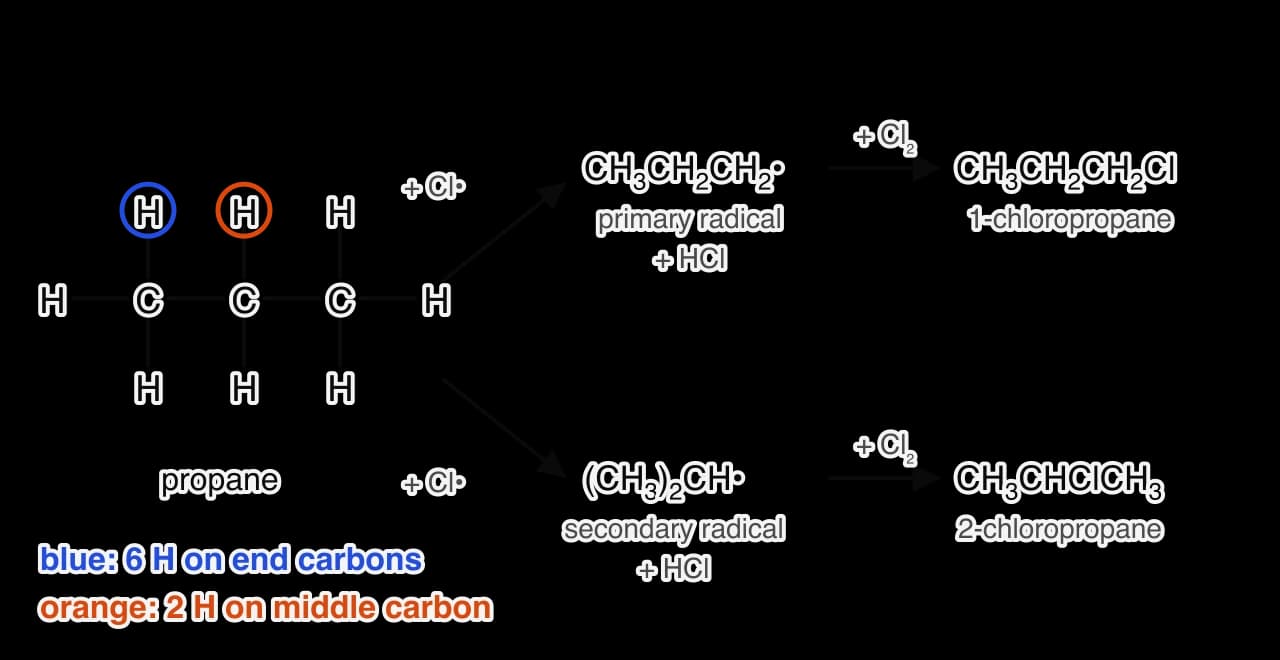
In larger alkanes, the hydrogen atoms are not all equivalent. Propane has six hydrogen atoms on its end carbon atoms and two on its middle carbon atom. A chlorine atom can remove either kind, giving two different radicals, and these lead to two structural isomers.
A chlorine atom can take any of the eight hydrogen atoms of propane. The six on the end carbons (blue) lead to 1-chloropropane and the two on the middle carbon (orange) to 2-chloropropane, so both isomers form.
Chlorination of propane therefore gives a mixture of 1-chloropropane and 2-chloropropane, before any further substitution is considered. With butane, pentane and larger alkanes the number of possible monosubstituted and disubstituted isomers increases rapidly, which makes free-radical substitution a poor way to make a single pure halogenoalkane from a large alkane.
Are all hydrogen atoms removed equally easily?
If every hydrogen atom were equally likely to be removed, propane would give 6 parts 1-chloropropane to 2 parts 2-chloropropane, a ratio of 75 : 25. In practice, gas-phase chlorination at 25∘C gives about 45 % 1-chloropropane and 55 % 2-chloropropane. A hydrogen atom on the middle carbon is removed about three to four times more easily than one on an end carbon, because the C−H bond there is slightly weaker and the secondary radical formed is a little more stable. Bromine atoms are even more selective: bromination of propane gives about 97 % 2-bromopropane.
Predicting these proportions goes beyond the course, but the pattern shows that the product mixture depends on the reactivity of each kind of C−H bond as well as on the number of hydrogen atoms.
Products of termination
Termination steps join whatever radicals meet. In the chlorination of methane, ∙CHX3+∙CHX3 gives ethane, which can itself be chlorinated to chloroethane. In the chlorination of ethane, two ethyl radicals give butane: 2∙CX2HX5CX4HX10. These products contain more carbon atoms than the starting alkane and add further compounds to the mixture.
Halogenation of other alkanes
Every alkane reacts with chlorine and bromine in UV light by the same mechanism. Ethane, for example, reacts with chlorine as follows.
The ethyl radical can be written ∙CX2HX5 or CHX3CHX2∙; in either form the unpaired electron is on a carbon atom.
Chlorine and bromine compared
Bromine reacts with alkanes much more slowly than chlorine, even though the Br−Br bond (193kJ mol−1) is easier to break than Cl−Cl. The difference lies in the first propagation step. A chlorine atom removing a hydrogen atom from methane is slightly exothermic (414−431=−17kJ mol−1), but a bromine atom doing the same is endothermic, because H−Br (366kJ mol−1) is weaker than C−H:
CHX4+Br∙∙CHX3+HBrΔH≈414−366=+48kJ mol−1
This step has a higher activation energy, so the chain runs more slowly. Fluorine reacts explosively with alkanes even in the dark, while iodine hardly reacts at all.
Observing the reaction: bromine and hexane
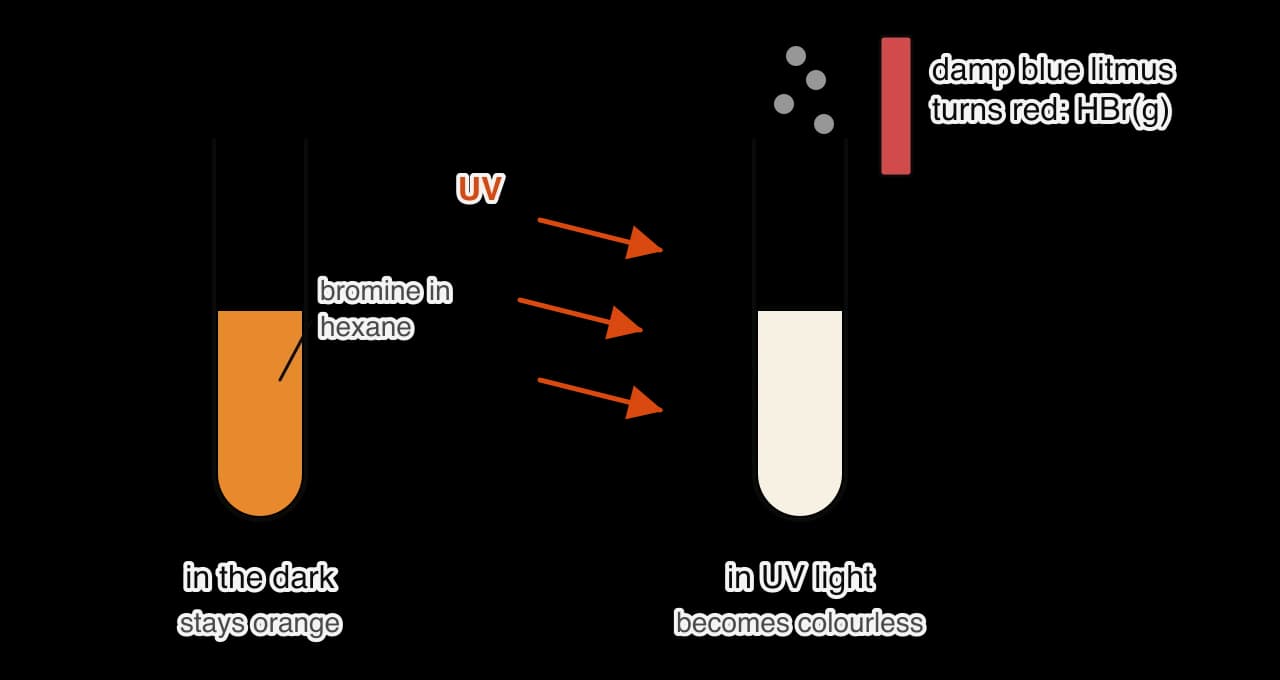
The reaction of bromine with a liquid alkane can be followed by its colour. A few drops of a dilute solution of bromine are added to hexane in two test tubes. One is wrapped in foil or kept in a dark cupboard; the other is placed in bright sunlight or under a UV lamp. The tube kept in the dark stays orange. The tube in the light slowly becomes colourless as the bromine is used up, and misty fumes of hydrogen bromide appear at its mouth; they turn damp blue litmus paper red because hydrogen bromide dissolves in the water on the paper to form an acid.
Hexane decolourizes bromine only in UV light (or bright sunlight), slowly, and gives off hydrogen bromide, which turns damp blue litmus red. The colours shown are those of the solutions.
The two tubes act as a controlled comparison: the only difference between them is the light, so light is shown to be needed. Alkenes behave differently: they decolourize bromine quickly even in the dark, by addition across the double bond (R3.4), and this difference is used to distinguish alkenes from alkanes. Bromine is toxic and corrosive, and its vapour irritates the lungs, so the experiment is done in a fume cupboard with gloves and eye protection, and halogenated waste is collected separately.
Alkyl side chains on a benzene ring
The same mechanism substitutes hydrogen atoms in an alkyl group attached to a benzene ring. Methylbenzene, CX6HX5CHX3, reacts with bromine in UV light at the methyl group, not at the ring:
CX6HX5CHX3+BrX2UV lightCX6HX5CHX2Br+HBr
The radical chain removes a hydrogen atom from the CHX3 group, which behaves as a small alkane attached to the ring. Substitution on the ring itself needs different conditions and a different, electrophilic mechanism (R3.4, HL).
Radicals in the stratosphere: CFCs and the ozone layer
Radical chain reactions are not confined to the laboratory. The clearest example of their effect on the whole planet is the destruction of stratospheric ozone by chlorine atoms from chlorofluorocarbons.
The ozone layer
The stratosphere is the layer of the atmosphere from about 10 to 50 km above the ground. It contains a small concentration of ozone, OX3, most of it between about 15 and 35 km: the ozone layer. Ozone and oxygen absorb almost all the high-energy ultraviolet radiation from the Sun before it reaches the ground, and ozone is the main absorber of the UV-B radiation that causes sunburn, skin cancer and cataracts. In the process, ozone is constantly broken down and re-formed:
OX2UV2OO+OX2OX3OX3UVOX2+O
Left alone, these reactions keep the amount of ozone roughly constant. The bonds in ozone are weaker than the O=O double bond in oxygen (498kJ mol−1), lying between that and the O−O single bond (144kJ mol−1), so lower-energy UV radiation can split ozone than oxygen (the HL treatment of resonance explains why the two bonds in ozone are identical and intermediate). This is also why chlorine atoms can break down ozone but not oxygen molecules in the stratosphere.
How CFCs destroy ozone
CFCs such as dichlorodifluoromethane, CClX2FX2, were widely used from the 1930s as refrigerants, aerosol propellants and blowing agents for foams, because they are non-toxic, non-flammable and very unreactive. That lack of reactivity means nothing removes them in the lower atmosphere. Over several years they drift up into the stratosphere, where UV radiation of short wavelength breaks the weakest bond, C−Cl, by homolytic fission:
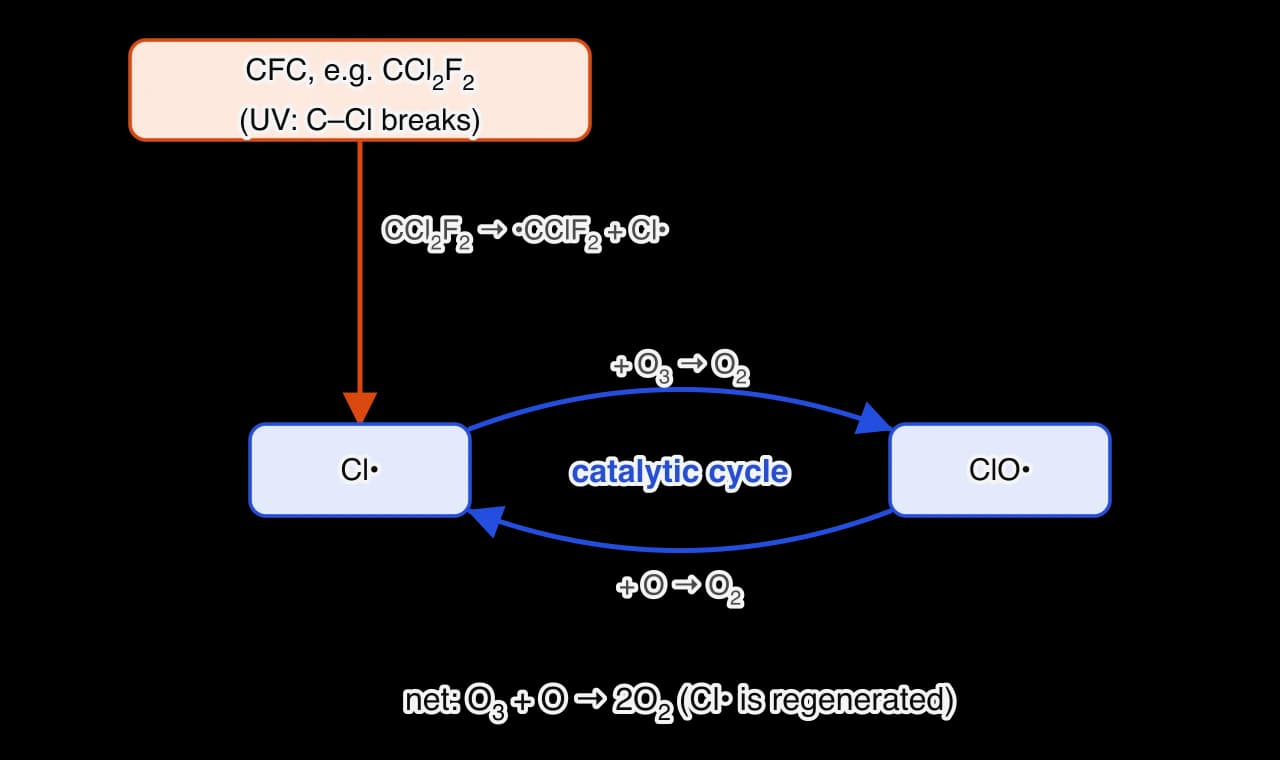
CClX2FX2UV∙CClFX2+Cl∙
The chlorine atom then destroys ozone in two steps, each of which consumes one radical and produces another:
Chlorine atoms released from CFCs by UV light destroy ozone in a cycle of two propagation-type steps (blue). The chlorine atom is regenerated each time round, so it acts as a catalyst and one atom can destroy many thousands of ozone molecules.
The chlorine atom is regenerated, so it acts as a catalyst. One chlorine atom can destroy up to about 100 000 ozone molecules before it is locked up in a less reactive compound, for example when ClO∙ combines with nitrogen dioxide (another radical) in a termination step to form chlorine nitrate, ClONOX2. Nitrogen monoxide from high-flying aircraft destroys ozone by a similar cycle: NO+OX3NOX2+OX2, then NOX2+ONO+OX2.
Fluorine atoms are not released, because the C−F bond (492kJ mol−1) is too strong to be broken by the UV radiation that splits C−Cl (324kJ mol−1). Any fluorine atoms that did form would also be removed quickly as stable hydrogen fluoride.
Prediction, discovery and the Montreal Protocol
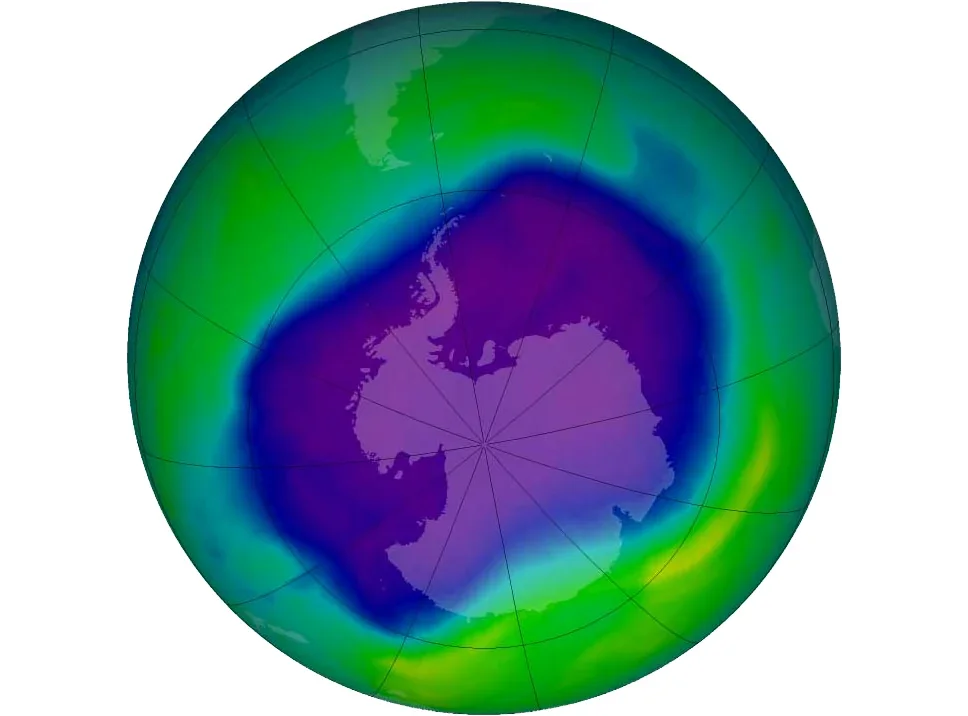
In 1974 Mario Molina and F. Sherwood Rowland predicted that chlorine from CFCs would reach the stratosphere and destroy ozone by this catalytic cycle. In 1985 scientists of the British Antarctic Survey reported that springtime ozone over Antarctica had fallen sharply since the late 1970s, the first evidence of what became known as the ozone hole. Satellite measurements showed the scale of the loss.
The Antarctic ozone hole on 24 September 2006, one of the largest recorded. Purple and blue show the lowest ozone; green and yellow show normal amounts. NASA satellite data. Image: Wikimedia Commons (public domain).
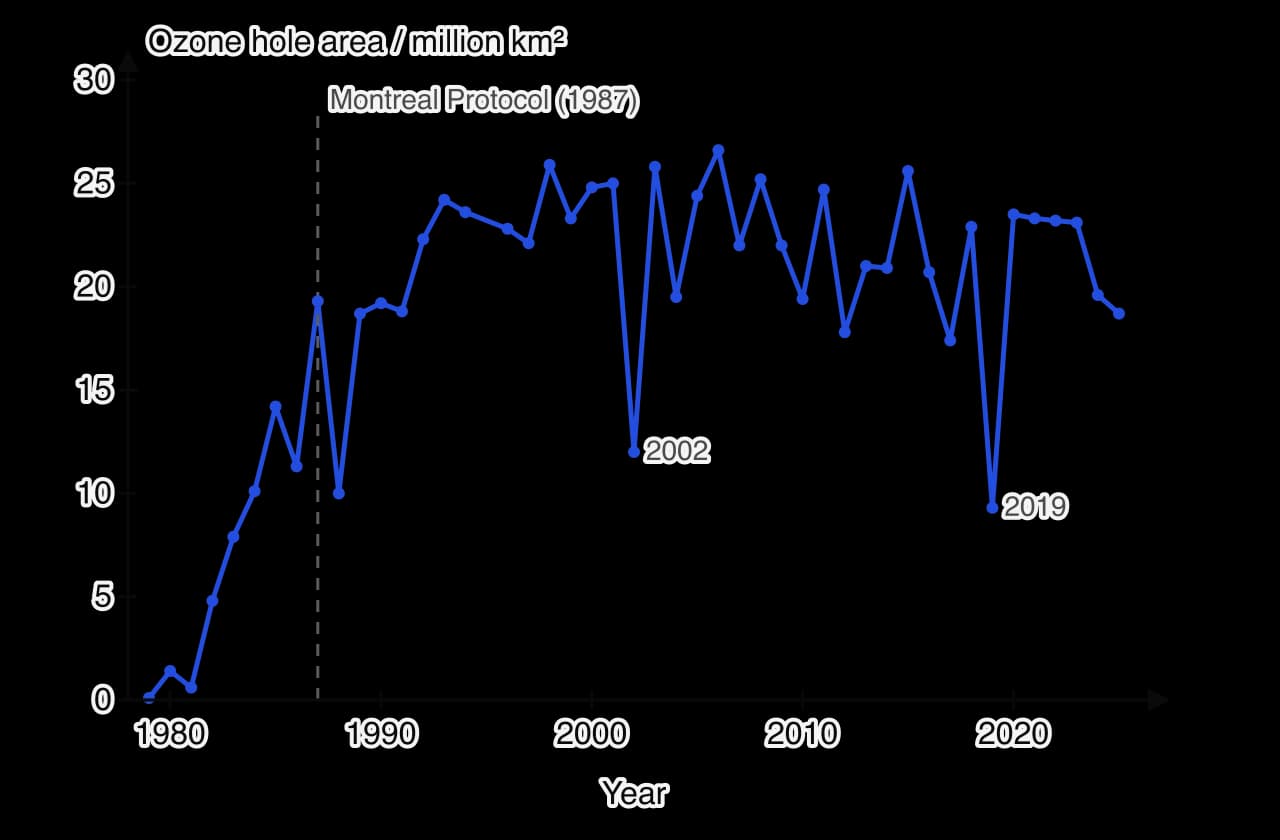
The hole forms over Antarctica in spring because extremely cold clouds there convert chlorine compounds into forms that release chlorine atoms as soon as sunlight returns. In response, governments agreed the Montreal Protocol in 1987, which phased out the production of CFCs and other ozone-depleting substances; every member of the United Nations has since ratified it. Molina and Rowland shared the 1995 Nobel Prize in Chemistry with Paul Crutzen for their work on stratospheric ozone.
The ozone hole grew through the 1980s as chlorine from CFCs built up. Because CFCs last for decades in the atmosphere, its size levelled off in the 1990s and has only recently begun to shrink, years after the Montreal Protocol. The holes of 2002 and 2019 were small because of sudden warmings of the Antarctic stratosphere. Mean area, 7 September to 13 October. Data: NASA Ozone Watch, 2025 (no value for 1995).
Because CFC molecules survive in the atmosphere for 50 to 100 years, the ozone hole stopped growing only slowly and has just begun to shrink. The 2022 scientific assessment by the World Meteorological Organization and the UN Environment Programme projected that ozone will return to its 1980 level around 2040 over most of the world, around 2045 over the Arctic and around 2066 over Antarctica.
Hydrofluorocarbons (HFCs), such as CHX2FCFX3, replaced CFCs in most refrigerators and air conditioners. They contain no chlorine and so do not destroy ozone, but many are powerful greenhouse gases, and the Kigali Amendment to the Montreal Protocol (2016) now limits their use as well. CFCs are an example of a chemical whose harmful effects appeared only after decades of global use, and the Montreal Protocol an example of international action taken on scientific evidence.
Applying the ideas in exam questions
Paper 1A: identifying a propagation step
Paper 1A: counting isomers
Paper 1B: bromination of hexane under a lamp
A student investigated the effect of light intensity on the reaction between bromine and hexane. 5.0cm3 of hexane and 1.0cm3 of a dilute solution of bromine in hexane were mixed in a test tube placed at different distances from a UV lamp, and the time taken for the orange colour to disappear was measured with a stopwatch. A tube kept in the dark was still orange after 30 minutes. The results are in the table.
Distance from lamp / cm
Time, trial 1 / s
Time, trial 2 / s
Time, trial 3 / s
10
85
91
88
20
160
171
149
30
262
240
308
40
410
372
396
Paper 2: chlorination of ethane
Paper 2: CFCs and ozone
Self-check
To do:
I can define a radical and explain why radicals are highly reactive.
To do:
I can represent radicals with a dot on the correct atom, such as Cl∙ and ∙CHX3, and decide from an electron count whether a species is a radical.
To do:
I can give examples of radicals that are atoms, molecules, cations and anions.
To do:
I can describe homolytic fission and draw it with two fish-hook arrows.
To do:
I can explain, using bond enthalpies, why halogen molecules split in UV light and why CFCs release chlorine but not fluorine atoms.
To do:
I can explain why alkanes are unreactive in terms of bond strength and bond polarity, and why they are kinetically stable but thermodynamically unstable.
To do:
I can write equations for the initiation, propagation and termination steps in the reactions of methane and ethane with chlorine or bromine, with the condition.
To do:
I can explain why free-radical substitution is a chain reaction.
To do:
I can explain why free-radical substitution gives a mixture of products, and deduce the isomers that can form.
To do:
I can describe how bromine and an alkane react in light and in the dark, and the observations.
To do:
I can explain how chlorine atoms from CFCs catalyse the destruction of ozone, with equations.
Explain why ozone is dissociated by ultraviolet light of a longer wavelength than that needed to dissociate oxygen.
[2]2 marks
Markscheme (d)
the O–O bonds in ozone are weaker than the O=O bond in O2 because the bond order is 1.5 rather than 2 / the electrons are delocalized ✓ less energy is needed to break the bond, and lower-energy photons have longer wavelength (lower frequency) ✓
(e)
State the molecular geometry of ozone and the hybridization of the central oxygen atom.
[2]2 marks
Markscheme (e)
bent / V-shaped ✓ sp2 ✓
Question 2 · CHEM-008006 marks
Methane reacts with halogens in the presence of ultraviolet light.
CH4(g)+Cl2(g)→CH3Cl(g)+HCl(g)
CH4(g)+Br2(g)→CH3Br(g)+HBr(g)
(a)
Calculate the enthalpy change, in kJ mol−1, for the reaction of methane with chlorine. Use section 12 of the data booklet.
[2]2 marks
(b)
Calculate the enthalpy change, in kJ mol−1, for the reaction of methane with bromine.
[1]1 mark
(c)
Using section 12 of the data booklet, identify the bond that is most easily broken in the reaction mixture of methane and bromine.
[1]1 mark
(d)
State the type of bond fission that occurs when ultraviolet light is absorbed by a chlorine molecule, and the species formed.
Propane was reacted with chlorine in ultraviolet light. The monochlorinated products, 1-chloropropane and 2-chloropropane, were separated from the other products, and the mixture of the two was analysed by 1H NMR spectroscopy.
Signal
Chemical shift / ppm
Relative area
CH2Cl of 1-chloropropane
3.5
1.10
CHCl of 2-chloropropane
4.1
0.62
Boiling points: 1-chloropropane 47 °C; 2-chloropropane 36 °C.
(a)
Classify 1-chloropropane and 2-chloropropane as primary, secondary or tertiary.
[1]1 mark
(b)
State the type of reaction that forms the products.
[1]1 mark
(c)
Determine the percentage of each isomer in the mixture, by amount (in mol).
[2]2 marks
(d)(i)
Propane has six primary and two secondary hydrogen atoms. Predict the percentage of 1-chloropropane if every hydrogen atom were equally likely to be substituted.
[1]1 mark
(d)(ii)
Deduce how many times more reactive each secondary hydrogen atom is than each primary hydrogen atom in this experiment.
molecular ions in a mass spectrometer, formed when a molecule loses one electron
is a radical; carbon uses three electrons in bonds and carries the fourth, unpaired.
(b)7+1=8, all paired: three C−H bonds and a lone pair on carbon. Not a radical (it is an anion).
(c)7+6=13, odd. ClO∙ is a radical; it appears in the destruction of ozone.
(d)7+1=8, four lone pairs. Not a radical.
: one
C−H
bond broken, one
H−Cl
bond formed.
ΔH=414−431=−17kJ mol−1
Propagation step 2, ∙CHX3+ClX2CHX3Cl+Cl∙: one Cl−Cl bond broken, one C−Cl bond formed.
ΔH=242−324=−82kJ mol−1
The two steps add up to −99kJ mol−1, which is ΔH for the overall reaction CHX4+ClX2CHX3Cl+HCl, as expected, since the radicals cancel.
(b) One C−H bond broken, one C−Cl bond formed:
ΔH=414−324=+90kJ mol−1
Comment. Both real propagation steps are exothermic, so the chain runs easily once started. The alternative step is endothermic by about 90kJ mol−1 and would have a high activation energy, so it does not compete. This is evidence that the chlorine atom removes a hydrogen atom to form HCl, as in the accepted mechanism.
. Place the first chlorine atom on C1, then place the second on each carbon in turn; then repeat with the first chlorine atom on C2. Skip any arrangement that is the same molecule numbered from the other end.
Positions of Cl
Condensed formula
Name
1 and 1
CHClX2CHX2CHX2CHX3
1,1-dichlorobutane
1 and 2
CHX2ClCHClCHX2CHX3
1 and 3
CHX2ClCHX2CHClCHX3
1 and 4
CHX2ClCHX2CHX2CHX2Cl
2 and 2
CHX3CClX2CHX2CHX3
2 and 3
CHX3CHClCHClCHX3
Six structural isomers. Arrangements such as 3,4 or 2,4 are the same as 1,2 and 1,3 counted from the other end, and 3,3 is the same as 2,2.
and
∙CX2HX5+BrX2CX2HX5Br+Br∙
;
∙CX2HX5+Br∙CX2HX5Br
;
∙CX2HX5+∙CX2HX5CX4HX10
(bromoethane and hydrogen bromide).
✓
∙CX2HX5+ClX2CX2HX5Cl+Cl∙ ✓
any one of: ∙CX2HX5+Cl∙CX2HX5Cl / 2∙CX2HX5CX4HX10 / 2Cl∙ClX2 ✓
Do not award M1 for a step that forms H∙.
✓
ClO∙+OCl∙+OX2 ✓
Accept ClO∙+OX3Cl∙+2OX2 for M2. Do not penalize missing radical dots.
(c)
the chlorine atom is regenerated «in the second step», so each one can react with many ozone molecules/it acts as a catalyst/chain reaction ✓
(d)
HFCs contain no chlorine/no C–Cl bond, so no chlorine atoms are released; C–F and C–H bonds are too strong to be broken ✓
and CHCl signals, rather than the
CH3
signals, were used for the analysis.
[1]1 mark
(f)
Suggest how the two isomers could be separated, and explain why this is possible.
[2]2 marks
(g)
Explain why the molecular ion peaks in the mass spectra cannot distinguish the two isomers.