R3.1 Proton transfer reactions · IB Chemistry | Augment Education
R3.1 Proton transfer reactions
Brønsted–Lowry acids and bases, conjugate pairs, pH and Kw, strong and weak acids, neutralization and pH curves; at HL also pOH, Ka and Kb, salt hydrolysis, indicators and buffers.
IB Chemistry
Part of R3 What are the mechanisms of chemical change?
SL and HL
Key terms introduced here
Each is in the Chemistry glossary, with every other term in the subject.
A base that dissolves in water to form hydroxide ions, OHX−(aq), such as sodium hydroxide or aqueous ammonia. Every alkali is a base, but insoluble bases such as CuO
Notes on R3.1 Proton transfer reactions
98 min readLast reviewed
Questions on R3.1
188 exam-style questions on this subtopic, written in the style of the IB papers. The first has its markscheme open. Counted on
Question 1 · CHEM-002829 marks
Ammonia, NH3, is manufactured by the Haber process. It is a gas at room temperature and is very soluble in water.
(a)
Draw the Lewis (electron dot) formula of ammonia.
[1]1 mark
Markscheme (a)
N with three N–H bonding pairs and one lone pair on N ✓
Accept dots, crosses or lines for the bonding pairs. Do not award the mark if the lone pair on N is missing.
(b)
State the molecular geometry of ammonia and predict its H–N–H bond angle.
[2]2 marks
Markscheme (b)
trigonal pyramidal ✓ 107° ✓
Accept any value from 106° to 108°. Do not accept "tetrahedral" for M1 (that is the electron domain geometry).
(c)
Explain why the H–N–H bond angle in ammonia is smaller than the H–C–H bond angle in methane, CH4.
[2]2 marks
Markscheme (c)
Try a quick-fire question
One of 116 short multiple-choice questions on R3.1. Pick an answer to see why it's right or wrong.
At 298 K a solution has [H+]=4.0×10⁻⁵mol dm−3
Flashcards for R3.1
The official deck for this part of the syllabus.
R3.1 Proton transfer reactions · front
Define a Brønsted–Lowry acid.
R3.1 Proton transfer reactions · front
Define a Brønsted–Lowry base.
R3.1 Proton transfer reactions495 cards
From the data booklet
The entries of the chemistry data booklet that R3.1 uses. Each opens in the explained booklet.
The reaction in which water molecules transfer protons to each other, HX2O(l)+HX2O(l)HX3OX+(aq)+OHX−(aq); it occurs to a very small extent and is endothermic.
The amount of acid or alkali a buffer can absorb before its pH changes significantly; it is larger for more concentrated buffers and falls when a buffer is diluted.
The flat part of a pH curve, before equivalence for a weak acid titrated with a strong base, where both the weak acid and its conjugate base are present and the pH changes only slowly.
The shift of electron density along σ bonds towards a more electronegative atom or away from an electron-releasing group such as an alkyl group. Electron-withdrawing chlorine atoms make chloroethanoic acids stronger than ethanoic acid.
The reaction of an acid with a base to form a salt and, usually, water; for strong acids and bases in water the ionic equation is HX+(aq)+OHX−(aq)HX2O(l).
The ion HX3OX+, formed when a water molecule accepts a proton; it is how a hydrogen ion exists in aqueous solution, so HX3OX+(aq) and HX+(aq) are used interchangeably.
Reaction of a weak acid with less than the equivalent amount of strong base (or of a weak base with too little strong acid), leaving a mixture of the weak species and its conjugate: a buffer.
The percentage of the molecules of a weak acid or base that are ionized at equilibrium, for an acid ([HX+]/c)×100. It increases as the solution is diluted.
An instrument whose glass-membrane probe measures pH precisely, usually to two decimal places; it is calibrated with buffer solutions of known pH before use.
The reaction of an ion from a salt with water, in which a proton is transferred and HX3OX+ or OHX− forms, so that the solution is acidic or basic; for example NHX4X++HX2ONHX3+HX3OX+.
A base that is only partially protonated in aqueous solution, so its solution contains an equilibrium; examples are ammonia and amines.
, so a change of one pH unit is a tenfold change in
[HX+]
.
The ion product constant of water, Kw=[HX+][OHX−], fixes an inverse relationship between [HX+] and [OHX−]; a solution is neutral when they are equal.
Strong acids and bases ionize completely in water and weak ones only partially; strength is a different property from concentration.
An acid–base equilibrium lies on the side of the weaker acid and the weaker base.
Acids are neutralized by metal oxides, metal hydroxides, carbonates, hydrogencarbonates, ammonia and amines, forming a salt.
The pH curve of a strong acid–strong base titration has a characteristic shape, with a steep section around the equivalence point at pH 7.
The pOH scale describes [OHX−], and [HX+], [OHX−], pH and pOH can be interconverted (HL).
The strengths of weak acids and bases are measured by Ka, Kb, pKa and pKb, and Ka×Kb=Kw for a conjugate pair (HL).
The pH of a salt solution depends on the relative strengths of its parent acid and base, and pH curves for all four combinations of strong and weak acids and bases have characteristic shapes (HL).
Indicators are weak acids whose two conjugate forms have different colours; an indicator changes colour at a pH close to its pKa and is chosen to match the equivalence point (HL).
A buffer resists changes in pH; its pH depends on the pKa or pKb and on the ratio of the two members of the conjugate pair (HL).
Acids and bases are some of the most familiar substances in chemistry: hydrochloric acid in the stomach, ethanoic acid in vinegar, sodium hydrogencarbonate in baking powder and ammonia in household cleaners. Their reactions all involve the same simple event, the transfer of a hydrogen ion (a proton) from one species to another. This idea explains why solutions are acidic or alkaline, how acidity is measured on the pH scale, and how acids and bases neutralize each other.
The Brønsted–Lowry theory of acids and bases
Acids were first recognized by their properties: they taste sour, turn blue litmus red, react with reactive metals to give hydrogen and react with carbonates to give carbon dioxide. Bases were the substances that cancel out these properties. Explaining why substances behave like this needed a model at the level of particles, and that model has changed as chemists found reactions the older definitions could not explain.
The first particle-level definition, proposed by Svante Arrhenius in the 1880s, described an acid as a substance that produces hydrogen ions, HX+, in water and a base as one that produces hydroxide ions, OHX−. It works well for many aqueous reactions, but it cannot describe ammonia as a base (ammonia contains no hydroxide), and it says nothing about reactions that happen without water, such as hydrogen chloride gas reacting with ammonia gas to form a white smoke of ammonium chloride:
HCl(g)+NHX3(g)NHX4Cl(s)
In 1923 Johannes Brønsted and Thomas Lowry independently proposed a more general definition based on what actually moves in these reactions: a hydrogen ion.
A hydrogen atom that has lost its only electron is just a proton, which is why HX+ and "proton" mean the same thing here. In the reaction of hydrogen chloride with ammonia, HCl donates a proton and NHX3 accepts it, forming NHX4X+ and ClX− ions. The Brønsted–Lowry definition covers this reaction in the gas phase as well as the familiar reactions in water. It was extended again later: the Lewis definition, in terms of electron pairs, includes reactions in which no proton moves at all (R3.4).
The proton in water: the oxonium ion
A bare proton is far too small and too highly charged to exist on its own in solution. When an acid dissolves in water, the proton is accepted by a lone pair on the oxygen atom of a water molecule, forming the oxonium ion, HX3OX+ (also called the hydronium ion). In this reaction water acts as a base. The Lewis formulas of the reaction between hydrogen chloride and water show the proton moving from chlorine to oxygen.
Hydrogen chloride donates a proton to water. The blue curly arrows show the electron pairs that move: a lone pair on oxygen forms the new O–H bond, and the H–Cl bonding pair stays with chlorine, which leaves as Cl⁻.
Both forms are used to represent the aqueous proton, and both are correct:
The first equation shows the role of water as a base explicitly. The second is shorter and is used when the role of water does not matter, for example in pH calculations, where [HX+] and [HX3OX+] mean the same concentration.
What makes a species an acid or a base
To act as a Brønsted–Lowry acid, a species needs a hydrogen atom that it can lose as HX+. This is usually a hydrogen bonded to a more electronegative atom, such as the H in H−Cl or in the O−H group of a carboxylic acid; the hydrogen atoms bonded to carbon in methane or in the CHX3 group of ethanoic acid are not released. To act as a Brønsted–Lowry base, a species needs a lone pair of electrons that can form a bond to the incoming proton. The nitrogen atom in ammonia and amines, the oxygen atom in water, and anions such as OHX−, OX2− and COX3X2− all have lone pairs available.
This explains why some reactions are acid–base reactions even though no substance in them is called an acid. Magnesium nitride reacts with water to give magnesium hydroxide and ammonia. Each nitride ion, NX3−, accepts three protons from water molecules, so the nitride ion is the base and water is the acid:
MgX3NX2(s)+6HX2O(l)3Mg(OH)X2(s)+2NHX3(g)
In the same way, the oxide ion of a soluble metal oxide accepts a proton from water: OX2−+HX2O(l)2OHX−(aq). The oxide ion cannot exist in water, so this reaction goes to completion. This is why sodium oxide and calcium oxide dissolve in water to form alkaline solutions.
Identifying the acid and the base in an equation
To identify the Brønsted–Lowry acid and base in an equation, compare each reactant with the product it forms. The species that loses an HX+ (its formula has one H fewer and a charge one lower) is the acid; the species that gains an HX+ is the base. Many acid–base reactions are reversible, so the reverse reaction also has an acid and a base. In the reaction of ammonia with water, water donates a proton in the forward reaction and the ammonium ion donates one in the reverse reaction:
NHX3(aq)+HX2O(l)NHX4X+(aq)+OHX−(aq)
So HX2O and NHX4X+ are the two acids in this equilibrium, and NHX3 and OHX− are the two bases.
YouTube
MSJ Chem (Mike Sugiyama Jones): the Brønsted–Lowry theory of acids and bases.
Bases and alkalis
Many bases are insoluble in water. Copper(II) oxide, magnesium oxide and iron(III) hydroxide all neutralize acids, so they are bases, but they do not dissolve to give hydroxide ions. A base that does dissolve in water and releases OHX− ions is called an alkali.
Every alkali is a base, but only bases that dissolve in water to give hydroxide ions are alkalis. Copper(II) oxide neutralizes acids but is insoluble in water, so it is a base and not an alkali.
Aqueous ammonia is an alkali even though ammonia contains no hydroxide: it produces OHX− ions by accepting protons from water, as in the equilibrium for ammonia and water. Soluble carbonates such as sodium carbonate also give alkaline solutions for the same reason, because the carbonate ion accepts a proton from water.
Conjugate acid–base pairs
When an acid donates a proton, what is left can accept a proton again, so it is a base. When a base accepts a proton, the product can give it back, so it is an acid. Species linked in this way are called a conjugate pair.
Every Brønsted–Lowry acid–base equilibrium contains two conjugate pairs. In the equilibria for ethanoic acid and for ammonia in water, each pair is made up of one species on the left and one on the right.
Every Brønsted–Lowry equilibrium contains two conjugate pairs, one on each side of the arrow. The two members of a pair differ by one H⁺. Water is the base in the first equilibrium and the acid in the second.
Writing the formula of a conjugate acid or base
Two simple rules give the formula of any conjugate species:
Conjugate base: remove one H from the formula and lower the charge by one. HNOX3NOX3X−; HCOX3X−COX3X2−; NHX4X+NHX3; HX2OOHX−.
Conjugate acid: add one H to the formula and raise the charge by one. NHX3NHX4X+
Only one proton moves at a time. The conjugate base of HX2SOX4 is HSOX4X−, not SOX4X2−, and the conjugate base of HX3POX4 is HX2POX4X−. The polyatomic ions met in S2.1 are the conjugate bases of familiar acids, as the table of conjugate pairs shows.
Acid
Conjugate base
Notes
HCl, hydrochloric acid
ClX−, chloride
strong acid
HNOX3, nitric acid
NOX3X−, nitrate
strong acid
HX2SOX4, sulfuric acid
HSOX4X−, hydrogensulfate
SOX4X2−
HX2COX3, carbonic acid
HCOX3X−, hydrogencarbonate
COX3X2−
HX3POX4, phosphoric acid
CHX3COOH, ethanoic acid
CHX3COOX−
NHX4X+, ammonium
NHX3
HX3OX+, oxonium
HX2O
HX2O, water
OHX−
Read from right to left, the same table gives conjugate acids: the conjugate acid of the carbonate ion is HCOX3X−, and the conjugate acid of the hydroxide ion is water.
When the structure of a conjugate species is drawn, its charge belongs on the atom that lost or gained the proton. In the ethanoate ion the negative charge sits on the oxygen that held the acidic hydrogen; in the methylammonium ion the positive charge sits on nitrogen, which used its lone pair to bond to the proton.
Removing H⁺ leaves the bonding pair on the atom that held the hydrogen, so the negative charge of ethanoate sits on oxygen. Adding H⁺ to methylamine uses the lone pair on nitrogen, so the positive charge sits on nitrogen.
Amphiprotic species
Some species can act as an acid in one reaction and as a base in another. To do this they need both a hydrogen that can be released as HX+ and a lone pair that can accept one.
Water is the most important example. It acts as a base when hydrogen chloride dissolves in it, accepting a proton to become HX3OX+, and as an acid when ammonia dissolves in it, donating a proton to become OHX−. Which role it takes depends on the other reactant: water behaves as a base towards stronger acids and as an acid towards stronger bases.
Many anions that still contain an acidic hydrogen are amphiprotic too, because they also carry the negative charge and lone pairs that attract a proton. Each has a conjugate base and a conjugate acid.
Species
As an acid (donates H⁺)
As a base (accepts H⁺)
HX2O
HX2O+NHX3OHX−+NHX4X+
HX2O+HClHX3OX++ClX−
HCOX3X−
HCOX3X−+HX2OCOX3X2−+HX3OX+
HX2POX4X−
HPOX4X2−
HPOX4X2−+HX2OPOX4X3−+HX3OX+
HSX−
HSX−+HX2OSX2−+HX3OX+
The hydrogencarbonate ion shows this behaviour in everyday chemistry. It neutralizes acids, which is why sodium hydrogencarbonate is used in antacids and baking powder (HCOX3X−+HX+HX2O+COX2), and it also neutralizes alkalis (HCOX3X−+OHX−COX3X2−+HX2O). Amino acids are amphiprotic for a similar reason: the −COOH group can donate a proton and the −NHX2 group can accept one.
Amphiprotic and amphoteric
A wider term, amphoteric, describes any substance that can react as both an acid and a base. Every amphiprotic species is amphoteric, but not the other way round. Aluminium oxide reacts with acids and with alkalis, so it is amphoteric, but it contains no hydrogen and cannot donate a proton, so it is not amphiprotic. The oxides of the period 3 elements show the trend across a period, from basic sodium and magnesium oxides, through amphoteric aluminium oxide, to the acidic oxides of phosphorus and sulfur (S3.1). The acidic oxides of sulfur and nitrogen released by burning fuels dissolve in rainwater as acids, which is the origin of acid rain (S3.1).
The pH scale
The concentration of hydrogen ions in aqueous solutions covers an enormous range: from about 1mol dm−3 in a strong acid to about 10−14mol dm−3 in a strong alkali. Numbers that differ by fourteen powers of ten are awkward to compare, so chemists use a logarithmic scale. Taking the logarithm turns each power of ten into one step on the scale, and the minus sign makes the values positive for most solutions.
Both equations are in the data booklet, which writes the first as pH=−log10[HX3OX+]=−log10[HX+]. Because the scale is logarithmic, pH has three important features:
A change of one pH unit is a tenfold change in [HX+]. A solution of pH 3 has ten times the hydrogen ion concentration of one of pH 4, and a thousand times that of one of pH 6.
A lower pH means a higher [HX+]. The minus sign reverses the order, so the most acidic solutions have the lowest pH.
pH has no units. It is the logarithm of the numerical value of a concentration measured in mol dm−3.
A graph of pH against [HX+] is therefore not a straight line. pH falls steeply at very low concentrations and only slowly at high ones: going from 10−5 to 10−4mol dm−3 lowers the pH by one unit, and going from 0.01 to 0.1mol dm−3 also lowers it by just one unit, although the second change is a thousand times larger in absolute terms.
pH = −log[H⁺]
pH against [H⁺]: a decreasing curve that falls steeply near zero concentration and flattens out. Each tenfold increase in [H⁺] lowers the pH by one unit.
The everyday range of pH runs from about 0 to 14 at 298 K. Values outside this range are possible: a solution of a strong acid more concentrated than 1mol dm−3 has a negative pH, but such solutions are rarely described with pH.
Substance
Typical pH
gastric juice in the stomach
1.5–3.5
lemon juice
about 2
vinegar
about 3
black coffee
about 5
pure water at 298 K
7.0
human blood
7.35–7.45
surface seawater
about 8.1
baking soda (sodium hydrogencarbonate) solution
about 8.3
household ammonia
about 11.5
1mol dm−3 sodium hydroxide
about 14
Approximate values for typical samples; real samples vary.
Calculations with pH
For a solution of a strong monoprotic acid, which releases one proton per molecule, the acid is completely ionized, so [HX+] equals the concentration of the acid. The pH follows directly from the definition. Working in the other direction, [HX+]=10−pH gives the hydrogen ion concentration from a measured pH.
Diluting a strong acid lowers [HX+] in proportion to the dilution, so the pH rises by one unit for every tenfold dilution. Diluting 0.100mol dm−3 hydrochloric acid (pH 1.00) ten times gives pH 2.00, and diluting it a thousand times gives pH 4.00. Dilution alone can never take an acid past pH 7, however: as [HX+] from the acid approaches 10−7mol dm−3, the ions from water itself become important, and the pH approaches 7 from below.
Ocean acidification
Ocean acidification is the fall in the pH of seawater caused by the uptake of carbon dioxide from the atmosphere. About a quarter of the carbon dioxide released by burning fossil fuels dissolves in the oceans. Dissolved carbon dioxide reacts with water to form carbonic acid, a weak acid that releases hydrogen ions:
The average pH of surface seawater has fallen from about 8.2 before the industrial era to about 8.1 today. The change looks small, but on a logarithmic scale a fall of 0.1 units means [HX+] has been multiplied by 100.1=1.26, an increase of about 26 %. Measurements that put today's value slightly below 8.1 give the figure of about 30 % that is often quoted. Seawater is still basic, so "acidification" describes the direction of the change, not a change to an acidic solution.
The extra hydrogen ions react with carbonate ions in seawater, which act as a Brønsted–Lowry base: HX+(aq)+COX3X2−(aq)HCOX3X−(aq). Corals, oysters, mussels and many plankton build their shells and skeletons from calcium carbonate, so a lower carbonate ion concentration makes it harder for them to grow and can make existing shells start to dissolve.
Measuring pH: indicators and pH meters
The pH of a solution can be estimated with universal indicator, a mixture of several indicators that together change colour gradually across the whole pH range: red in strongly acidic solution, through orange and yellow to green near neutral, then blue and violet in strongly alkaline solution. A drop of the solution on indicator paper, or a few drops of indicator solution added to it, gives a colour that is matched against a chart.
Universal indicator paper takes a different colour at each pH. Matching the colour of a wetted square against the chart on the tube gives the pH to about the nearest whole unit. Image: AgrisR, CC BY-SA 4.0, via Wikimedia Commons.
Universal indicator is quick, cheap and needs no equipment, but its readings are only estimates, to about ±1 pH unit, and they depend on judging a colour by eye. Coloured or cloudy solutions are difficult to read. Natural dyes behave in the same way: the juice of red cabbage contains anthocyanin pigments that are red in acid, purple near neutral and green to yellow in alkali.
A pH meter measures pH precisely. Its probe contains a thin glass membrane that develops a voltage depending on [HX+] in the solution, and the meter converts the voltage into a pH reading, usually to two decimal places. The meter must first be calibrated with buffer solutions of known pH (for example pH 4.00, 7.00 and 10.00), because the probe's response drifts with time and temperature. Connected to a data logger, a pH probe can record readings continuously, which is how the pH curves of titrations are measured.
Universal indicator (analogue)
pH meter or probe (digital)
Precision
about ±1 pH unit
usually ±0.01 pH unit
Reading
colour matched by eye to a chart
number on a display
Coloured or cloudy solutions
difficult to read
unaffected
Preparation
none
calibration with buffers; rinsing between samples
Continuous recording
no
yes, with a data logger
Cost and robustness
cheap, disposable
more expensive; glass probe is fragile
A digital probe is the better choice when precise values, continuous readings over time or many readings are needed, as in following a titration. A quick test of whether a solution is strongly acidic, roughly neutral or strongly alkaline only needs indicator paper.
The ionization of water and Kw
Even the purest water conducts electricity very slightly, because it contains a small number of ions. Water is amphiprotic, so one water molecule can donate a proton to another:
This autoionization of water happens to a tiny extent. At 298 K pure water contains 1.0×10⁻⁷mol dm−3 of each ion, while the concentration of water molecules is about 55.5mol dm−3, so only about two molecules in every thousand million are ionized at any moment.
Because the concentration of water is effectively constant, the equilibrium is described by the product of the two ion concentrations alone. This product is the ion product constant of water.
Kw applies to every aqueous solution, not only to pure water. Adding an acid increases [HX+], and the equilibrium shifts to the left until [OHX−] has fallen enough for the product to equal Kw again. The two concentrations are therefore inversely proportional: if one increases tenfold, the other decreases tenfold. This gives a precise way to classify solutions at 298 K.
Solution
Relative concentrations
[HX+] at 298 K / mol dm−3
pH at 298 K
acidic
[HX+]>[OHX−]
greater than 1.0×10⁻⁷
below 7
neutral
[HX+]=[OHX−]
1.0×10⁻⁷
basic (alkaline)
[HX+]<[OHX−]
less than 1.0×10⁻⁷
Every aqueous solution, even a strongly alkaline one, contains some hydrogen ions, and every acidic solution contains some hydroxide ions. The graph of both concentrations across the pH scale shows how they change together.
Because the product [H⁺][OH⁻] is fixed at 298 K, one concentration falls by a factor of ten for every factor of ten the other rises. The lines cross at pH 7, where the solution is neutral.
The effect of temperature on Kw
The autoionization of water is the reverse of neutralization, which releases energy as O−H bonds form. Breaking an O−H bond to separate the ions therefore absorbs energy: the forward reaction is endothermic. By Le Châtelier's principle (R2.3), raising the temperature shifts the equilibrium to the right, so more water ionizes and Kw increases.
Temperature / °C
Kw / mol2dm−6
pH of pure water
0
1.14×10⁻¹⁵
7.47
25
1.01×10⁻¹⁴
7.00
50
5.48×10⁻¹⁴
6.63
100
5.13×10⁻¹³
6.14
Data: J. Clark, chemguide.co.uk, from standard tables of the ionization of water (accessed 2026).
Pure water at 50 °C has a pH of 6.63, but it is not acidic. In pure water each ionization produces one HX+ and one OHX−, so [HX+]=[OHX−] at every temperature, and that equality is what defines a neutral solution. A pH of 7 marks neutrality only at 298 K.
Strong and weak acids and bases
Hydrochloric acid and ethanoic acid of the same concentration behave very differently. The difference lies in how far each acid ionizes when it dissolves in water.
The particle pictures of two acids at the same concentration show the difference. In a strong acid every molecule has given up its proton to water; in a weak acid most molecules remain intact.
A strong acid is completely ionized in water, so its solution contains H⁺(aq) and A⁻(aq) but no HA molecules. A weak acid is only partially ionized: most of it stays as HA molecules in equilibrium with a few ions. Water molecules are left out of both pictures.
The equations show the difference with the arrow. A strong acid is written with a single forward arrow, because the reverse reaction does not occur to a measurable extent. A weak acid is written with an equilibrium arrow:
In 0.100mol dm−3 ethanoic acid only about 1.3 % of the molecules are ionized at 298 K, so [HX+] is about 1.3×10⁻³mol dm−3 and the pH is about 2.9, compared with pH 1.0 for hydrochloric acid of the same concentration.
Strong
Weak
Acids
HCl, HBr, HI, HNOX3, HX2SOX4
carboxylic acids such as CHX3COOH and HCOOH; carbonic acid, HX2COX3
Bases
group 1 hydroxides: LiOH, NaOH, KOH, RbOH, CsOH
Sulfuric acid is strong only in its first ionization, HX2SOX4HX++HSOX4X−. The hydrogensulfate ion is a weak acid, so its second proton is released only partially.
Strength and concentration
"Strong" and "weak" describe the extent of ionization, a property of the acid or base itself. "Concentrated" and "dilute" describe how much acid or base is dissolved in a given volume, which the person making the solution chooses. The two properties are independent, so all four combinations are possible.
Strong acid
Weak acid
Concentrated
10mol dm−3 hydrochloric acid
10mol dm−3 ethanoic acid
Dilute
0.001mol dm−3 hydrochloric acid (pH 3.0)
0.001mol dm−3 ethanoic acid (pH about 3.9)
A dilute solution of a strong acid can have a higher pH than a concentrated solution of a weak acid. Concentrated ethanoic acid (10mol dm−3, pH about 1.9) is more acidic than 0.001mol dm−3 hydrochloric acid (pH 3.0), yet ethanoic acid is still the weak acid.
Distinguishing strong and weak acids by experiment
Solutions of a strong and a weak acid with the same concentration contain different concentrations of ions, so they can be told apart by any property that depends on [HX+] or on the total concentration of ions.
Test
0.10 mol dm⁻³ HCl (strong)
0.10 mol dm⁻³ CH₃COOH (weak)
Reason
pH (meter or universal indicator)
about 1 (red)
about 3 (orange)
higher [HX+] in the strong acid
Electrical conductivity
high
low
more mobile ions in the strong acid
Reaction with magnesium ribbon or calcium carbonate
vigorous effervescence; the solid disappears quickly
slower effervescence
rate depends on [HX+]
Temperature rise when neutralized by NaOH
slightly larger
slightly smaller
some energy is used to complete the ionization of the weak acid
One thing that is the same for both: equal volumes of the two acids need exactly the same volume of sodium hydroxide for neutralization, and produce the same final volume of gas with excess magnesium. As the base removes HX+ ions, the weak acid's equilibrium shifts to the right and releases more, until all of the acid has reacted. The amount of acid, not its strength, decides how much base it neutralizes.
The same tests distinguish strong and weak bases. A 0.10mol dm−3 sodium hydroxide solution has pH 13 and a high conductivity; 0.10mol dm−3 aqueous ammonia has pH about 11 and a much lower conductivity.
Conjugate strength and the position of acid–base equilibria
The strength of an acid and the strength of its conjugate base are linked. A strong acid gives up its proton readily, so its conjugate base has very little tendency to take a proton back: the chloride ion, conjugate base of hydrochloric acid, is so weak a base that it does not react with water at all. A weak acid holds on to its proton, so its conjugate base accepts protons readily: the ethanoate ion is a noticeably stronger base than the chloride ion.
The ladder of acids and conjugate bases arranges common pairs in order. The oxonium ion, HX3OX+, is the strongest acid that can exist in water: any stronger acid gives its proton to water completely, which is why the acids above it in the ladder are all strong.
The stronger an acid, the weaker its conjugate base. The strong acids above H₃O⁺ are completely ionized in water and their conjugate bases have almost no tendency to accept a proton; the weakest acid, water, has the strongest conjugate base, OH⁻.
In any acid–base equilibrium, two acids compete for the proton. The stronger acid gives its proton away more readily than the weaker acid does, so at equilibrium most of the proton-donating species is the weaker acid. An acid–base equilibrium therefore lies on the side of the weaker acid and weaker base. For ethanoic acid in water, the two acids are CHX3COOH and HX3OX+; HX3OX+ is the stronger, so the equilibrium lies to the left, which is what "partially ionized" means.
For strong acids the equilibrium lies so far to the right that the reaction is effectively complete, and the equilibrium constant is very large; for weak acids it is much smaller than 1 (R2.3). These equilibrium constants, Ka for acids and Kb for bases, compare the strengths of weak acids and bases quantitatively.
Why the hydrogen halides get stronger down group 17
Hydrochloric, hydrobromic and hydroiodic acids are all strong, but hydrofluoric acid is weak, even though fluorine is the most electronegative halogen. The extent of ionization depends largely on how easily the H−X bond breaks. Bond enthalpies fall steeply down the group, from 567kJ mol−1 for H−F to 431 for H−Cl, 366 for H−Br and 298kJ mol−1 for H−I (data booklet), as the halogen atom becomes larger and the bonding electrons are further from its nucleus. The weaker the bond, the more readily the proton is released, so acid strength increases from HF to HI.
Neutralization reactions
When an acid reacts with a base, the hydrogen ions of the acid are removed and the characteristic properties of both are lost. The ionic product of such a reaction is a salt.
In aqueous solution, the reaction between any strong acid and any strong base is the same reaction. The metal ions and the anions of the acid are spectator ions: they are present before and after and take no part. Removing them gives the ionic equation for neutralization:
HX+(aq)+OHX−(aq)HX2O(l)
This is why the enthalpy change of neutralization is almost the same, about −57kJ per mole of water formed, for every strong acid with every strong base. Neutralization is exothermic because a new O−H bond forms between the hydroxide ion and the proton, releasing energy, while no bonds need to be broken. Calorimetry of neutralization reactions is described in R1.1.
Neutralization can also be followed by measuring the electrical conductivity of the mixture, because the reaction changes the ions present. When dilute sulfuric acid is added to barium hydroxide solution, the conductivity falls steadily and reaches a minimum close to zero at the equivalence point: the HX+ and OHX− ions combine to form water, and the BaX2+ and SOX4X2− ions are removed as a white precipitate of barium sulfate. Adding more acid then raises the conductivity again.
Types of neutralization reaction
Acids react in characteristic ways with each type of base. Each reaction is a proton transfer to the base: to the oxide ion, the hydroxide ion, the carbonate or hydrogencarbonate ion, or the lone pair on the nitrogen of ammonia or an amine.
Base
General equation
Example
metal oxide
acid + metal oxide → salt + water
CuO(s)+2HCl(aq)CuClX2(aq)+HX2O(l)
metal hydroxide
acid + metal hydroxide → salt + water
NaOH(aq)+HNOX3(aq)NaNOX3(aq)+HX2O(l)
carbonate
acid + carbonate → salt + water + carbon dioxide
CaCOX3(s)+2HCl(aq)CaClX2(aq)+HX2O(l)+COX2(g)
hydrogencarbonate
acid + hydrogencarbonate → salt + water + carbon dioxide
NaHCOX3(aq)+HCl(aq)NaCl(aq)+HX2O(l)+COX2(g)
ammonia
acid + ammonia → ammonium salt
NHX3(aq)+HCl(aq)NHX4Cl(aq)
amine
acid + amine → alkylammonium salt
CHX3NHX2(aq)+HCl(aq)CHX3NHX3Cl(aq)
The observations follow from the products. Black copper(II) oxide dissolves in warm dilute acid to give a blue solution of a copper(II) salt. Carbonates and hydrogencarbonates fizz as carbon dioxide is released; the gas turns limewater milky. The reaction of ammonia or an amine produces no water, because the base only accepts a proton: NHX3(aq)+HX+(aq)NHX4X+(aq).
Each type of reaction has its own ionic equation. For an insoluble metal oxide or carbonate the solid appears in full, because it is not dissolved as separate ions:
Organic acids are neutralized in the same ways. Ethanoic acid reacts with sodium hydroxide to give sodium ethanoate, and with sodium carbonate to give sodium ethanoate, water and carbon dioxide. Because ethanoic acid is weak, its ionic equation shows the un-ionized molecule:
Vinegar and citric acid remove limescale from kettles in this way: they neutralize the calcium carbonate deposit, forming a soluble calcium salt, water and carbon dioxide.
Antacids: neutralization in the body
The stomach secretes hydrochloric acid, giving gastric juice a pH of about 1.5–3.5. When too much acid irritates the stomach or the oesophagus (indigestion or heartburn), antacid tablets neutralize the excess. Common active ingredients are calcium carbonate, magnesium hydroxide, aluminium hydroxide and sodium hydrogencarbonate. Each is a base that reacts with hydrochloric acid:
Insoluble bases such as magnesium hydroxide and calcium carbonate are useful because they cannot make the stomach contents strongly alkaline: once the excess acid has been used up, the remaining solid simply stays undissolved. The carbon dioxide released by carbonates and hydrogencarbonates explains why some antacids cause belching.
Parent acids and bases of salts
Every salt can be traced back to the acid and base that would form it. The anion comes from the acid (as its conjugate base) and the cation from the base (the metal ion of a metal oxide or hydroxide, or the conjugate acid of ammonia or an amine).
Salt
Parent acid
Parent base
sodium chloride, NaCl
hydrochloric acid, HCl
sodium hydroxide, NaOH
potassium nitrate, KNOX3
nitric acid, HNOX3
potassium hydroxide, KOH
copper(II) sulfate, CuSOX4
sulfuric acid, HX2SOX4
ammonium chloride, NHX4Cl
hydrochloric acid, HCl
ammonia, NHX3
ammonium sulfate, (NHX4)X2SOX4
sodium ethanoate, CHX3COONa
ethanoic acid, CHX3COOH
potassium methanoate, HCOOK
methanoic acid, HCOOH
potassium hydroxide, KOH
sodium carbonate, NaX2COX3
methylammonium chloride, CHX3NHX3Cl
Ammonium sulfate, made by neutralizing sulfuric acid with ammonia, is manufactured on a large scale as a nitrogen fertilizer. The parent acid and base of a salt also decide whether its solution is acidic, neutral or basic, because an ion from a weak parent reacts with water (salt hydrolysis).
Making a salt and separating it
The method used to prepare a pure, dry sample of a soluble salt depends on whether the base is soluble.
Insoluble base (metal oxide, hydroxide or carbonate). Add the solid to the acid in excess, so that all the acid reacts. Filter off the unreacted solid, then heat the filtrate to concentrate it and leave it to cool and crystallize. Copper(II) sulfate is made this way from copper(II) oxide and sulfuric acid.
Soluble base (an alkali such as sodium hydroxide). Excess alkali cannot be filtered off, so the exact volumes are found by titration with an indicator. The titration is then repeated with the same volumes and no indicator, and the salt is crystallized from the resulting solution.
Adding the insoluble base in excess makes sure all the acid is used up, and filtering then removes the unreacted solid. The salt is recovered from the filtrate by crystallization.
Crystallization is used rather than evaporating to dryness because many salts, such as copper(II) sulfate, form hydrated crystals (CuSOX4⋅5HX2O) that would lose their water of crystallization, or decompose, if heated strongly. The crystals are washed with a small amount of cold water to remove the solution left on their surface while dissolving as little of the salt as possible.
Metals with acids: a redox reaction, not neutralization
Reactive metals such as magnesium and zinc react with dilute acids to give a salt and hydrogen:
Mg(s)+2HCl(aq)MgClX2(aq)+HX2(g)
This reaction forms a salt, but it is not an acid–base reaction. No proton is transferred to a base; instead, magnesium atoms lose electrons (oxidation state 0 to +2) and hydrogen ions gain them (oxidation state +1 to 0). It is a redox reaction, an electron transfer (R3.2). Metals below hydrogen in the activity series, such as copper, do not react with dilute hydrochloric acid at all, although copper(II) oxide, hydroxide and carbonate all do.
pH curves for strong acid–strong base titrations
In an acid–base titration, a solution of known concentration (the titrant) is added from a burette to a measured volume of the other solution until the reaction is exactly complete. An indicator shows when this point is reached by changing colour. Following the pH throughout the titration with a pH probe gives much more information: a plot of pH against the volume added is called a pH curve (or titration curve).
The pH probe records the pH after each addition from the burette while the stirrer keeps the solution mixed. Plotting pH against the volume added gives the pH curve.
To record a pH curve, the probe is calibrated, a pipette delivers a known volume (for example 25.00cm3) of acid into a beaker, and the alkali is added from the burette in small portions, with the pH recorded after each addition once the reading is steady. Additions of about 1cm3 are enough at first, but near the equivalence point the pH changes so quickly that additions of 0.10cm3 or less are needed to show the shape of the curve.
The shape of the curve
The pH curve for 25.00cm3 of 0.100mol dm−3 hydrochloric acid titrated with 0.100mol dm−3 sodium hydroxide has a characteristic S shape with four features.
At the equivalence point (25.00 cm³, pH 7) the acid and alkali have reacted in exactly the stoichiometric ratio. Less than one drop of alkali either side of it changes the pH by several units, which is why the curve is almost vertical there. Curve calculated for 25 °C.
Starting pH (the intercept on the pH axis). Before any alkali is added the pH is that of the acid alone. For 0.100mol dm−3HCl, [HX+]=0.100 and the pH is 1.00.
A slow rise. As alkali is added, it neutralizes some of the acid, but most of the acid remains. Removing even 90 % of the HX+ ions raises the pH by only about one unit, because the pH scale is logarithmic.
A steep, almost vertical section around the equivalence point. Near the end of the reaction, the last few per cent of the acid are used up by a tiny volume of alkali. Between 24.90 and 25.10cm3 of alkali (four drops), the pH jumps from 3.7 to 10.3.
Levelling off. After the equivalence point, the excess hydroxide ions control the pH, which rises slowly towards (but never reaches) the pH of the alkali itself, 13.00.
For a strong acid and a strong base, the solution at the equivalence point contains only the salt (here NaCl) and water. Neither ion reacts with water, so the pH at the equivalence point is 7 at 298 K. On the curve, the equivalence point is the middle of the vertical section; its volume is the equivalence volume, 25.00cm3 in this titration because the acid and alkali have equal concentrations and react 1 : 1.
How the points on the curve are calculated
Before the equivalence point, the excess acid decides the pH; after it, the excess hydroxide does, and [HX+] comes from Kw. In each case the amount in excess is divided by the total volume of the mixture. The initial amount of HCl is 0.02500dm3×0.100mol dm−3=2.500×10⁻³mol.
Volume of NaOH added / cm3
Amount in excess / mol
Total volume / cm3
[HX+]
After the equivalence point, for example at 26.00cm3: [OHX−]=1.00×10⁻⁴/0.05100=1.96×10−3mol dm−3
The curves for the same titration at three different concentrations show how the starting and finishing pH depend on concentration, while the equivalence point does not.
Concentrations of acid and alkali in mol dm⁻³ are labelled on each curve. Each tenfold dilution raises the starting pH by one unit and lowers the final pH by about one unit, so the vertical section gets shorter. The equivalence volume and the pH at equivalence (7) do not change. Curves calculated for 25 °C.
For more dilute solutions the vertical section is shorter (about pH 5–9 at 0.0100mol dm−3 compared with about pH 3–11 at 0.100mol dm−3), but it is still centred on pH 7 at the same equivalence volume. When the alkali is in the flask and the acid is added from the burette, the curve is reversed.
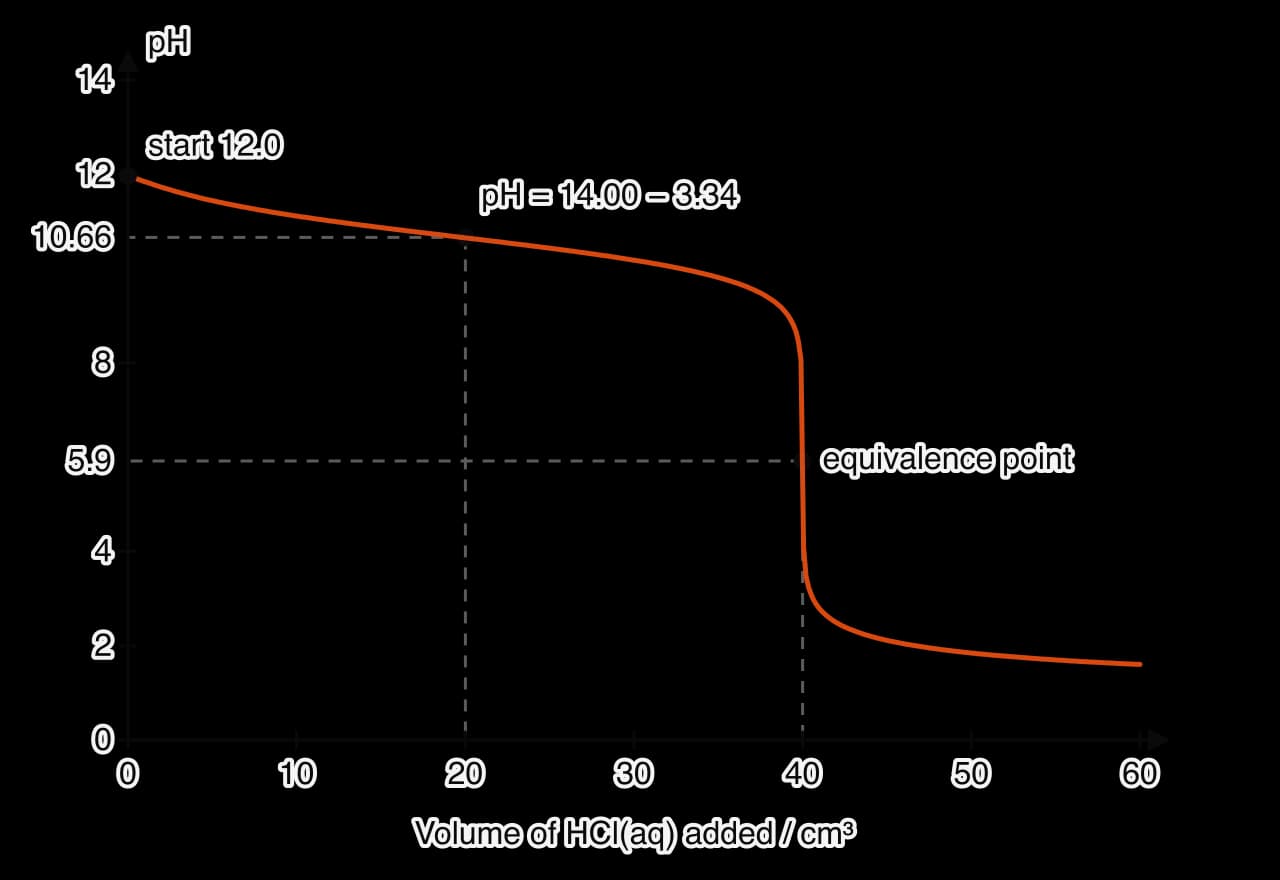
When acid is added to alkali the curve is the mirror image: it starts high, falls steeply through pH 7 at the equivalence point and levels off at the low pH of the excess acid.
Because the pH changes by several units for a fraction of a drop at the equivalence point, an indicator that changes colour anywhere within the steep section shows the equivalence point accurately. For a strong acid–strong base titration, phenolphthalein, bromothymol blue and methyl orange are all suitable.
Using a pH curve to find a concentration
The equivalence volume read from a pH curve gives the amount of titrant that exactly reacted with the solution in the flask. With the balanced equation, this gives the amount and then the concentration of the unknown solution, in the same way as a titration with an indicator (S1.4 and R2.1).
The pOH scale (HL)
The pH scale expresses the hydrogen ion concentration of a solution as a small, manageable number. Basic solutions are often described more naturally by their hydroxide ion concentration, and the pOH scale does this in exactly the same way.
Both equations are in the data booklet. As with pH, a lower pOH means a higher concentration, and each unit of pOH is a tenfold change: a solution of pOH 2 contains ten times as many hydroxide ions per dm3 as a solution of pOH 3. Like pH, pOH has no units.
Linking pH and pOH
The ion product constant of water connects the two scales. Taking the negative logarithm of each side of the Kw expression gives a sum:
At 298 K, Kw=1.00×10⁻¹⁴ (data booklet), so pKw=14.00 and
pH+pOH=14.00(at 298K)
This relationship is not printed in the data booklet; it follows from Kw by taking logarithms. In a neutral solution at 298 K, pH=pOH=7.00. An acidic solution has pH<7 and pOH>7; a basic solution the reverse. Any one of [HX+], [OHX−], pH and pOH is enough to find the other three, as the map of the four quantities shows.
Any one of the four quantities gives the other three. The horizontal links are logarithms; the vertical links come from Kw and hold at 298 K. Blue boxes describe hydrogen ions, orange boxes hydroxide ions.
The value 14.00 belongs to 298 K only. Because Kw increases with temperature, pKw is smaller in warmer solutions: at 323 K (50 °C) it is 13.26, so there pH+pOH=13.26 and a neutral solution has pH=pOH=6.63.
Calculations with pOH
For a strong base the hydroxide ion concentration follows directly from the formula, because the base is fully dissociated. Each formula unit of a group 1 hydroxide gives one OHX− ion; a hydroxide such as Ba(OH)X2 gives two.
The same relationships work in reverse. A measured pH gives [HX+] directly, and pOH or [OHX−] through Kw.
Acid and base dissociation constants (HL)
A weak acid, HA, is only partly ionized in water. Its molecules and ions reach a dynamic equilibrium in which most of the acid is present as HA:
HA(aq)+HX2O(l)HX3OX+(aq)+AX−(aq)
The equilibrium constant for this reaction follows the equilibrium law. Water is the solvent: its concentration, about 55.5mol dm−3, hardly changes as the acid ionizes, so it is absorbed into the constant and left out of the expression. The result is the acid dissociation constant.
A weak base, B, accepts a proton from water and produces hydroxide ions. The corresponding constant is the base dissociation constant:
For ammonia, NHX3(aq)+HX2O(l)NHX4X+(aq)+OHX−(aq) and Kb=1.78×10⁻⁵ at 298 K. For ethanoic acid, Ka=1.74×10⁻⁵. Both constants are small, which is what makes these substances weak: at equilibrium the reactants are present in far higher concentrations than the products. Like other equilibrium constants, Ka and Kb do not depend on concentration but do change with temperature, so values are quoted at a stated temperature, usually 298 K. They are written here without units.
pKa and pKb
Values of Ka range over many powers of ten, from about 10−1 for the stronger weak acids to 10−16 for alcohols. As with [HX+], a logarithmic scale makes them easier to compare:
Because of the minus sign, the order is reversed. The stronger the acid, the larger its Ka and the smaller its pKa; the same holds for bases with Kb and pKb. A difference of one unit in pKa means a tenfold difference in Ka. Ethanoic acid (pKa=4.76) and methanoic acid (pKa=3.75) differ by about one unit, so methanoic acid is roughly ten times stronger.
Weak acid
Formula
Ka at 298 K
pKa
chloroethanoic acid
CHX2ClCOOH
1.35×10⁻³
2.87
methanoic acid
HCOOH
1.78×10⁻⁴
3.75
benzoic acid
CX6HX5COOH
ethanoic acid
CHX3COOH
1.74×10⁻⁵
propanoic acid
CHX3CHX2COOH
hydrocyanic acid
HCN
6.17×10⁻¹⁰
9.21
phenol
CX6HX5OH
The weak acids are listed from strongest to weakest. Weak bases are compared in the same way; the amines are slightly stronger bases than ammonia, while phenylamine, whose nitrogen lone pair is drawn into the benzene ring, is much weaker.
Weak base
Formula
Kb at 298 K
pKb
methylamine
CHX3NHX2
4.57×10⁻⁴
3.34
ethylamine
CHX3CHX2NHX2
ammonia
NHX3
1.78×10⁻⁵
phenylamine
CX6HX5NHX2
Data for both tables: reference values at 298 K from the IB Chemistry data booklet (2016 edition); hydrocyanic acid from the CRC Handbook of Chemistry and Physics. The current data booklet has no table of pKa values, so the values needed are always given.
For solutions of equal concentration, the acid with the smallest pKa is the most ionized and gives the lowest pH; the base with the smallest pKb gives the highest pH. A list of acids can therefore be put in order of pH from their pKa values alone.
What makes one weak acid stronger than another
The strength of an acid depends on both sides of its equilibrium: how easily the H–A bond releases a proton and how stable the conjugate base AX− is once it forms. Anything that stabilizes the conjugate base, for example by spreading out its negative charge, shifts the equilibrium to the right and increases Ka.
The chloroethanoic acids show this clearly. Chlorine is more electronegative than hydrogen, so each chlorine atom on the carbon next to the carboxyl group draws electron density towards itself through the σ bonds. This inductive effect weakens the O–H bond and spreads the negative charge of the carboxylate ion over more of the molecule, so the anion is more stable. Each extra chlorine atom lowers the pKa, as the displayed formulas of the four acids show.
Replacing hydrogen atoms on the carbon next to the carboxyl group with chlorine atoms makes the acid stronger. Data: values at 298 K as tabulated in the IB Chemistry data booklet (2016 edition).
The same idea links acid strength to the stability of common polyatomic anions. Nitrate, chloride and hydrogensulfate ions are the conjugate bases of strong acids: they are so stable that they show almost no tendency to accept a proton, and their conjugate acids have very large Ka values. Carbonate and ethanoate ions are the conjugate bases of weak acids (HCOX3X−, pKa=10.33; CHX3COOH, pKa=4.76); they accept protons readily, which is why their solutions are basic.
Calculating the pH of a weak acid
For a strong acid, [HX+] equals the acid concentration. For a weak acid only a small fraction ionizes, so [HX+] has to be found from Ka. Suppose the initial concentration of HA is c and xmol dm−3 of it ionizes:
HA
HX+
AX−
initial
c
0
0
change
−x
+x
+x
equilibrium
c−x
x
x
Two approximations make the calculation simple:
[HX+]=[AX−]=x: the hydrogen ions from the ionization of water are negligible compared with those from the acid.
[HA]eqm=c−x≈c: the acid is so little ionized that its equilibrium concentration is almost the same as its initial concentration.
With these, the Ka expression rearranges directly to give [HX+]:
Ka[HX+]=[HA][HX+][AX−]≈c[HX+]2=Ka×c
The second approximation is good when less than about 5 % of the acid ionizes, which is true for most weak acids at concentrations above about 0.01mol dm−3. Solving the full quadratic equation is not needed for these problems.
The same equation run backwards gives Ka from a measured pH, which is how pKa values are found experimentally.
Diluting a weak acid lowers [HX+] but raises the percentage ionization, the percentage of the acid molecules that are ionized. With more water present, the equilibrium shifts towards the side with more dissolved particles (the ions). For ethanoic acid, the percentage ionized rises from 1.3 % at 0.100mol dm−3 to about 12 % at 0.00100mol dm−3.
Calculating the pH of a weak base
A weak base is treated in the same way, with Kb in place of Ka and [OHX−] in place of [HX+]. Assuming [BHX+]=[OHX−] and [B]≈c:
[OHX−]=Kb×c
The hydroxide ion concentration then gives pOH, and pOH gives pH.
Conjugate pairs: the relationship Ka × Kb = Kw (HL)
Every weak acid HA has a conjugate base AX−, and that base reacts with water in its own equilibrium. Writing both reactions and their constants side by side:
Taking negative logarithms gives the same relationship on the p scale:
pKa+pKb=pKw=14.00(at 298K)
Neither form is in the data booklet, but either can be derived in two lines from the expressions for Ka and Kb. Because the product is fixed, a conjugate pair behaves like a seesaw: the larger Ka for the acid, the smaller Kb for its conjugate base. This puts a number on the qualitative rule that a strong acid has a weak conjugate base. The ammonium ion, for example, is the conjugate acid of ammonia, so its pKa is 14.00−4.75=9.25.
Acid
pKa
Conjugate base
pKb
HCOOH
3.75
HCOOX−
10.25
CHX3COOH
4.76
CHX3COOX−
HX2COX3
HCN
9.21
CNX−
4.79
NHX4X+
9.25
NHX3
HCOX3X−
10.33
COX3X2−
CHX3NHX3X+
Reference values at 298 K from the IB Chemistry data booklet (2016 edition), with carbonic acid and the hydrogencarbonate ion from the CRC Handbook of Chemistry and Physics; each pair adds up to 14.00. Hydrogencarbonate appears twice, once as a base and once as an acid, because it is amphiprotic.
The pH of salt solutions (HL)
A salt is formed when an acid neutralizes a base, but its solution is neutral only when neither of its ions reacts with water. The anion of a salt is the conjugate base of its parent acid, and a cation such as NHX4X+ is the conjugate acid of its parent base. An ion derived from a weak parent is a noticeable base or acid in its own right, so it accepts a proton from water or donates one to it. The reaction is called salt hydrolysis.
The pH of a salt solution therefore depends on the relative strengths of the parent acid and the parent base. There are four cases.
Salt of a strong acid and a strong base
Sodium chloride, potassium nitrate and potassium bromide are typical. The anions (ClX−, NOX3X−, BrX−) are the conjugate bases of strong acids and have negligible tendency to accept protons. The cations (NaX+, KX+) do not donate protons. Neither ion reacts with water, so the solution is neutral, with pH 7 at 298 K.
Salt of a strong acid and a weak base
Ammonium chloride is formed from hydrochloric acid and ammonia. The chloride ion does not react, but the ammonium ion is a weak acid (pKa=9.25) and donates a proton to water:
NHX4X+(aq)+HX2O(l)NHX3(aq)+HX3OX+(aq)
The solution is acidic. Salts of amines with strong acids, such as methylammonium chloride, CHX3NHX3X+ClX−, behave in the same way.
Salt of a weak acid and a strong base
Sodium ethanoate is formed from ethanoic acid and sodium hydroxide. The sodium ion does not react, but the ethanoate ion is a weak base and accepts a proton from water:
CHX3COOX−(aq)+HX2O(l)CHX3COOH(aq)+OHX−(aq)
Any carboxylate ion does the same (RCOOX−+HX2ORCOOH+OHX−), so sodium and potassium carboxylates such as HCOOK give basic solutions. The carbonate ion, the conjugate base of the very weak acid HCOX3X−, is a much stronger base, and sodium carbonate solution is distinctly alkaline:
COX3X2−(aq)+HX2O(l)HCOX3X−(aq)+OHX−(aq)
The hydrogencarbonate ion is amphiprotic, so two equilibria compete in sodium hydrogencarbonate solution. It can act as a base or as an acid:
Because Kb>Ka, more hydroxide ions are produced than oxonium ions, and the solution is weakly basic, with a pH of about 8.3. This mild alkalinity is why sodium hydrogencarbonate (baking soda) is safe to handle and to eat in small amounts, while sodium carbonate is an irritant.
Salt of a weak acid and a weak base
In ammonium ethanoate both ions hydrolyse: the ammonium ion produces HX3OX+ and the ethanoate ion produces OHX−. The pH depends on which reaction goes further, found by comparing Ka of the cation with Kb of the anion:
CHX3COONHX4: Ka(NHX4X+)=5.6×10⁻¹⁰ and Kb(CHX3COOX−)=5.8×10⁻¹⁰ are almost equal, so the solution is very close to neutral.
HCOONHX4: Ka(NHX4X+)=5.6×10⁻¹⁰
The pH line of salt solutions shows all four cases side by side for solutions of the same concentration.
Calculated pH of 0.100 mol dm⁻³ salt solutions at 298 K. Orange: salts whose cation is a stronger acid than the anion is a base; blue: salts whose anion is the stronger base; black: neutral solutions.
Parent acid
Parent base
Examples
Ion that reacts with water
pH at 298 K
strong
strong
NaCl, KNOX3, KBr
neither
7
strong
weak
NHX4Cl, NHX4NOX3
weak
strong
CHX3COONa, HCOOK, NaX2COX3
weak
weak
CHX3COONHX4
The pH of a salt solution can be calculated in the same way as that of any weak acid or base, once Ka or Kb of the reacting ion is known. The pH at the equivalence point of a titration is found in exactly this way.
pH curves for weak acids and weak bases (HL)
Every pH curve is recorded in the same way as the strong acid–strong base curve, with a calibrated pH probe and data logger. Replacing either the acid or the base by a weak one changes the shape of the curve in predictable ways, and each change has a chemical cause.
A weak acid titrated with a strong base
The pH curve for ethanoic acid titrated with sodium hydroxide has five features, labelled on the calculated curve.
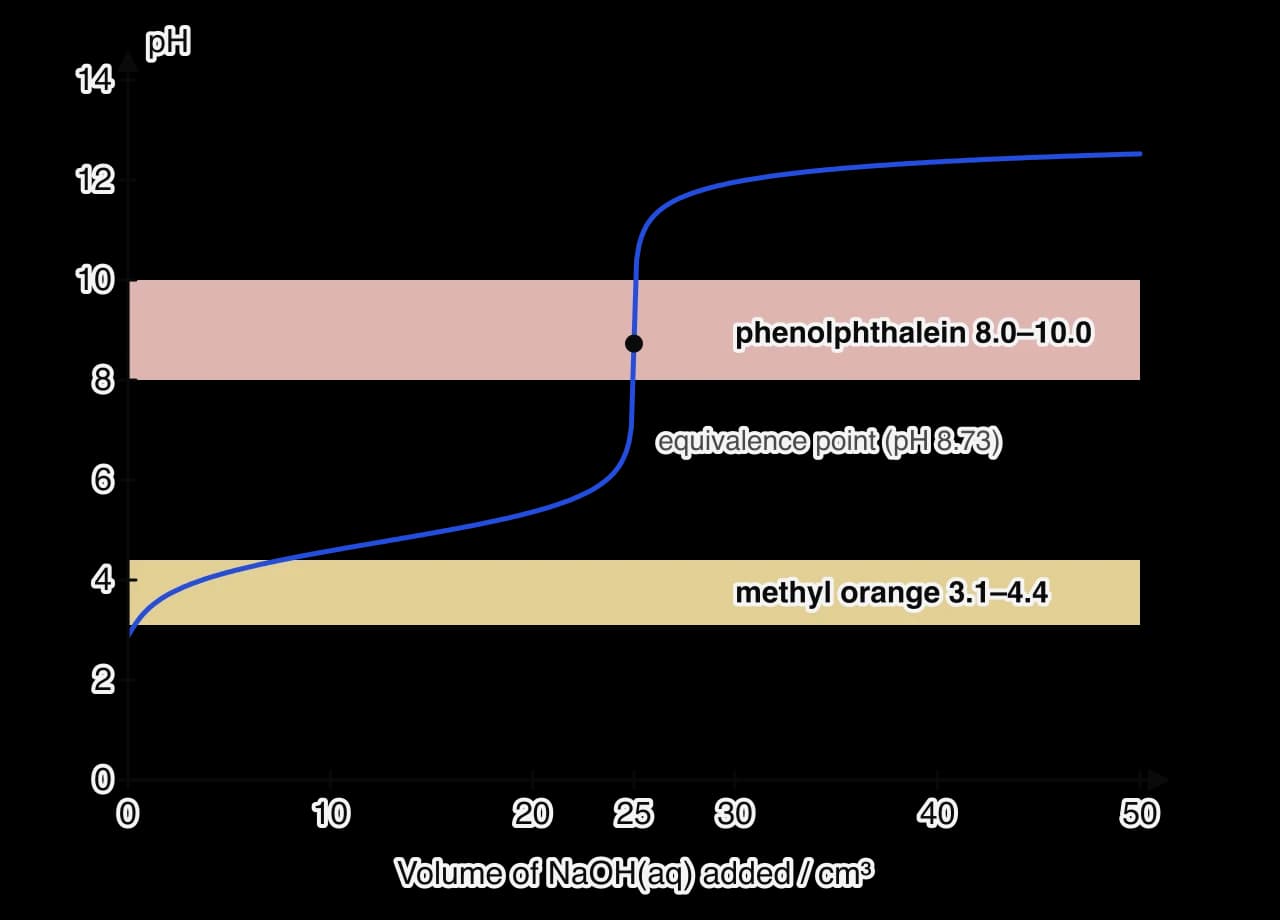
Weak acid titrated with a strong base, calculated for 25.0 cm³ of 0.100 mol dm⁻³ CH₃COOH and 0.100 mol dm⁻³ NaOH. The shaded band is the buffer region. At half the equivalence volume the pH equals the pKa of the acid; the equivalence point lies above pH 7.
The starting pH
Before any alkali is added, the flask holds only the weak acid. Because ethanoic acid is only about 1 % ionized, the curve starts at pH 2.88, almost two units higher than for hydrochloric acid of the same concentration.
The first rise and the buffer region
The sodium hydroxide converts ethanoic acid into ethanoate ions: CHX3COOH(aq)+OHX−(aq)CHX3COOX−(aq)+HX2O(l). The first few additions raise the pH quite quickly, because the solution initially contains almost no ethanoate ions. Soon both ethanoic acid and ethanoate ions are present in substantial amounts. That mixture is a buffer, so the pH then rises only slowly over a wide range of added volume. This flat part of the curve is the buffer region.
The half-equivalence point
When exactly half the volume needed for equivalence has been added, half of the acid has been converted into its conjugate base, so [CHX3COOH]=[CHX3COOX−]. These terms cancel in the Ka expression:
Ka=[CHX3COOH][HX+][CHX3COOX−]=[HX+]⇒pH=pKa
At the half-equivalence point the pH of the solution equals the pKa of the weak acid: 4.76 for ethanoic acid. Reading the pH at half the equivalence volume is therefore a straightforward experimental way to measure pKa.
The equivalence point
At equivalence, all of the acid has been converted into sodium ethanoate. Ethanoate ions are a weak base, so the solution is basic and the equivalence point lies above pH 7 (8.73 here). The vertical section is shorter than for a strong acid, from about pH 7 to 11, because the curve starts its steep rise from the higher pH of the buffer region.
After the equivalence point
Beyond equivalence, the excess hydroxide ions control the pH, and the curve becomes the same as that of a strong acid with the same alkali, levelling off below pH 13.
A weak base titrated with a strong acid
When hydrochloric acid is added to aqueous ammonia, the curve runs the other way: it starts high and falls. The features mirror those of the weak acid curve.
Weak base titrated with a strong acid, calculated for 25.0 cm³ of 0.100 mol dm⁻³ NH₃ and 0.100 mol dm⁻³ HCl. At half the equivalence volume the pH equals the pKa of the ammonium ion, so the pOH equals the pKb of ammonia. The equivalence point lies below pH 7.
Starting pH. Ammonia is a weak base, so the curve starts at about pH 11, two units below a strong alkali of the same concentration.
Buffer region. The acid converts ammonia into ammonium ions, NHX3(aq)+HX+(aq)NHX4X+(aq), and the mixture of NHX3 and NHX4X+ buffers the pH, which falls only slowly.
Half-equivalence point. Here [NHX3]=[NHX4X+]
Equivalence point. The flask holds ammonium chloride. The ammonium ion is a weak acid, so the equivalence point lies below pH 7 (5.28 here) and the vertical section runs from about pH 7 down to 3.
After equivalence. The excess strong acid controls the pH, which levels off near 1.5.
If the weak base is instead run from the burette into the strong acid, the curve rises. Before equivalence, the flask holds excess strong acid and no buffer forms; the buffer region appears after the equivalence point, once unreacted ammonia accumulates beside the ammonium ions. The pH equals 9.25 when twice the equivalence volume has been added, because the amounts of NHX3 and NHX4X+ are then equal.
Comparing the four combinations
Set side by side, with the acid in the flask and the base added each time, the four curves for monoprotic acids and bases of the same concentration differ in exactly two places. A weak acid raises the beginning of the curve and creates a buffer region before equivalence; a weak base lowers the end of the curve. Both effects shorten the vertical section.
The four combinations of strong and weak monoprotic acids and bases, calculated for 25.0 cm³ of 0.100 mol dm⁻³ acid and 0.100 mol dm⁻³ base. A weak acid raises the start of the curve; a weak base lowers its end. The vertical section is longest for strong–strong and almost absent for weak–weak.
Combination
Starting pH (0.100 mol dm⁻³)
pH at equivalence
Vertical section
Buffer region
strong acid + strong base (HCl+NaOH)
1.0
7
long, about pH 3–11
none
weak acid + strong base (CHX3COOH+NaOH)
2.9
above 7 (8.7)
about pH 7–11
before equivalence; pH=pKa at half-equivalence
strong acid + weak base (HCl+NHX3)
1.0
below 7 (5.3)
about pH 3–7
after equivalence when base is added
weak acid + weak base (CHX3COOH+NHX3
The weak acid–weak base curve has no sharp jump. On both sides of equivalence the solution contains a weak conjugate pair, and a fraction of a cubic centimetre of titrant changes the pH by only a small amount. Its equivalence point cannot be located precisely from the curve, and no indicator gives a sharp colour change.
YouTube
Mike Sugiyama Jones (MSJ Chem): pH curves for the combinations of strong and weak acids and bases (HL).
Interpreting a pH curve
The equivalence volume is the volume at the middle of the vertical section, where the curve is steepest. From it, the amount of titrant gives the concentration of the solution in the flask. For a weak acid, half of that volume locates the half-equivalence point, where the pH gives pKa. Temperature matters because Kw and pKa both change with it, so the probe is calibrated, and the titration carried out, at the same temperature.
When pH at half-equivalence is not exactly pKa
The result pH=pKa at half-equivalence assumes that the amounts of HA and AX− in the flask are set by the titration alone. For a moderately strong weak acid (such as chloroethanoic acid, pKa=2.87) or a very dilute one, the acid's own ionization adds noticeably to [AX−], and the measured pH at half-equivalence is slightly higher than the pKa. For acids with pKa above about 3.5 at concentrations of about 0.1mol dm−3, the difference is less than 0.02 pH units.
Acid–base indicators (HL)
An acid–base indicator is a weak acid whose un-ionized molecules and conjugate base have different colours. Writing the indicator as HInd:
colour AHInd(aq)HX+(aq)+colour BIndX−(aq)
Le Châtelier's principle explains the colour change. Adding acid raises [HX+] and shifts the equilibrium to the left, so the colour of HInd dominates. Adding alkali removes hydrogen ions (HX++OHX−HX2O) and shifts the equilibrium to the right, so the colour of IndX− dominates. In methyl orange HInd is red and IndX− is yellow; in phenolphthalein HInd is colourless and IndX− is pink.
Why the colour changes near the pKa
The indicator equilibrium has its own acid dissociation constant, which rearranges to give the ratio of the two coloured forms:
For a given indicator, the ratio of colours depends only on [HX+], that is, on the pH. Halfway through the colour change the two forms are present in equal amounts, [HInd]=[IndX−], so [HX+]=Ka(HInd) and pH=pKa(HInd). The pH at which an indicator changes colour is therefore approximately its pKa.
The eye sees the colour of one form alone once that form outnumbers the other by roughly ten to one. A ratio [IndX−]/[HInd] of 10 corresponds to pH=pKa+1 and a ratio of 0.1 to pH=pKa−1, so the colour changes over a range of roughly pKa±1. The ranges measured for real indicators are not exactly symmetrical, because the eye is more sensitive to some colours than others.
Each bar shows the colour of an indicator at every pH. The colour changes gradually between the two thin lines (the pH range); the thick line marks the pKa, which lies inside the range. Data: IB Chemistry data booklet (2025), section 18.
The same data appear in section 18 of the data booklet:
Indicator
pKa
pH range
Colour in acid
Colour in alkali
methyl orange
3.7
3.1–4.4
red
yellow
bromophenol blue
4.2
3.0–4.6
yellow
blue
bromocresol green
4.7
4.0–5.6
yellow
blue
methyl red
5.1
4.4–6.2
red
yellow
bromothymol blue
7.0
6.0–7.6
yellow
blue
phenol red
7.9
6.4–8.0
yellow
red
phenolphthalein
9.6
8.0–10.0
colourless
pink
Data: IB Chemistry data booklet (2025), section 18.
Universal indicator is a mixture of several indicators whose pKa values are spread across the pH scale. As the pH rises, first one component and then the next changes colour, so the mixture passes through a series of colours from red in strong acid through yellow and green to purple in strong alkali. This makes it useful for estimating pH to about one unit, but useless for a titration: its colour drifts gradually instead of changing sharply at one point.
Redox titrations also need a way to show the end point, but the colour change there responds to oxidation and reduction, not to pH. Potassium manganate(VII) is self-indicating: purple MnOX4X− is reduced to almost colourless MnX2+, and the first permanent pink colour marks the end point. Starch forms a blue-black complex with iodine and shows when iodine appears or disappears. Both kinds of indicator rely on a conjugate pair with two colours: an acid and its conjugate base in one case, an oxidized and a reduced form in the other.
Choosing an indicator for a titration
An indicator works in a titration only if its colour change happens in the vertical section of the pH curve. There, a fraction of a drop of titrant moves the pH right across the indicator's range, so the end point is sharp and lies at the equivalence volume. The suitable indicator for a titration therefore has a pH range that lies within the steep part of the curve, around the pH at the equivalence point.
Choosing an indicator for ethanoic acid titrated with sodium hydroxide. The curve passes through the phenolphthalein band (pink) in its vertical section, at the equivalence point. It crosses the methyl orange band (yellow) slowly and far too early.
For ethanoic acid titrated with sodium hydroxide, the steep section runs from about pH 7 to 11 and the equivalence point is at 8.73. Phenolphthalein (8.0–10.0) changes colour within it. Methyl orange (3.1–4.4) would change colour during the first few cubic centimetres, in the buffer region, where the pH changes slowly. It would turn gradually from red to orange to yellow long before the equivalence point and give a titre that is far too small.
Titration
pH at equivalence
Steep section
Suitable indicators (data booklet)
strong acid + strong base
7
about 3–11
almost any: methyl red, bromothymol blue, phenolphthalein; methyl orange is also used
weak acid + strong base
above 7
about 7–11
phenolphthalein
strong acid + weak base
below 7
about 3–7
methyl orange, bromocresol green, methyl red
weak acid + weak base
about 7
none
no indicator is suitable; use a pH probe
The equivalence pH, and so the choice of indicator, can be predicted from the identity of the salt formed: a salt of a weak acid gives a basic equivalence point, a salt of a weak base an acidic one.
Buffer solutions (HL)
Adding one cubic centimetre of 1.00mol dm−3 hydrochloric acid to 100cm3 of pure water lowers the pH from 7 to about 2. Adding the same acid to 100cm3 of a mixture of ethanoic acid and sodium ethanoate lowers the pH by less than 0.1. The mixture is a buffer solution.
The composition of a buffer
A buffer contains a weak acid and its conjugate base, or a weak base and its conjugate acid, both in substantial amounts. There are two types:
An acidic buffer contains a weak acid and a salt of its conjugate base, for example ethanoic acid with sodium ethanoate, CHX3COOH/CHX3COOX−. Its pH is below 7 (about 4.8 when the two are in equal amounts).
A basic buffer contains a weak base and a salt of its conjugate acid, for example ammonia with ammonium chloride, NHX3/NHX4X+
The salt supplies the conjugate base (or acid) in a high concentration. A weak acid on its own is not a buffer: it contains plenty of HA but almost no AX−, so it has nothing to remove added hydrogen ions.
Making a buffer by partial neutralization
A buffer can also be made by partial neutralization of a weak acid with a strong base, provided the weak acid is in excess. The strong base converts part of the acid into its conjugate base and leaves the rest unreacted:
100cm3 of 0.200mol dm−3CHX3COOH (0.0200 mol) mixed with 50.0cm3 of 0.200mol dm−3NaOH (0.0100 mol) leaves 0.0100 mol CHX3COOH and forms 0.0100 mol CHX3COOX−: a buffer.
Equal amounts of the two (0.0200 mol of each) give only sodium ethanoate solution: no buffer, because no weak acid remains.
Excess sodium hydroxide leaves a mixture of ethanoate and hydroxide ions: no buffer, and strongly alkaline.
In the same way, excess weak base with a strong acid makes a basic buffer. Mixing 0.30 mol of ammonia with 0.10 mol of sulfuric acid gives a buffer: each HX2SOX4 provides two protons, so 0.20 mol of NHX4X+ forms and 0.10 mol of NHX3 remains. This is the chemistry of the buffer region of a pH curve, where part of the weak acid or base has been neutralized.
How a buffer resists changes in pH
In an acidic buffer the weak acid equilibrium is present with large "reservoirs" of both partners:
CHX3COOH(aq)CHX3COOX−(aq)+HX+(aq)
Added acid. The conjugate base removes the extra hydrogen ions, CHX3COOX−(aq)+HX+(aq)CHX3COOH(aq). In equilibrium terms, the position shifts to the left.
Added alkali. The weak acid removes the extra hydroxide ions, CHX3COOH(aq)+OHX−(aq)CHX3COOX−(aq)+HX2O(l)
A basic buffer works in the same way: ammonia removes added acid (NHX3+HX+NHX4X+) and ammonium ions remove added alkali (NHX4X++OHX−NHX3+HX2O).
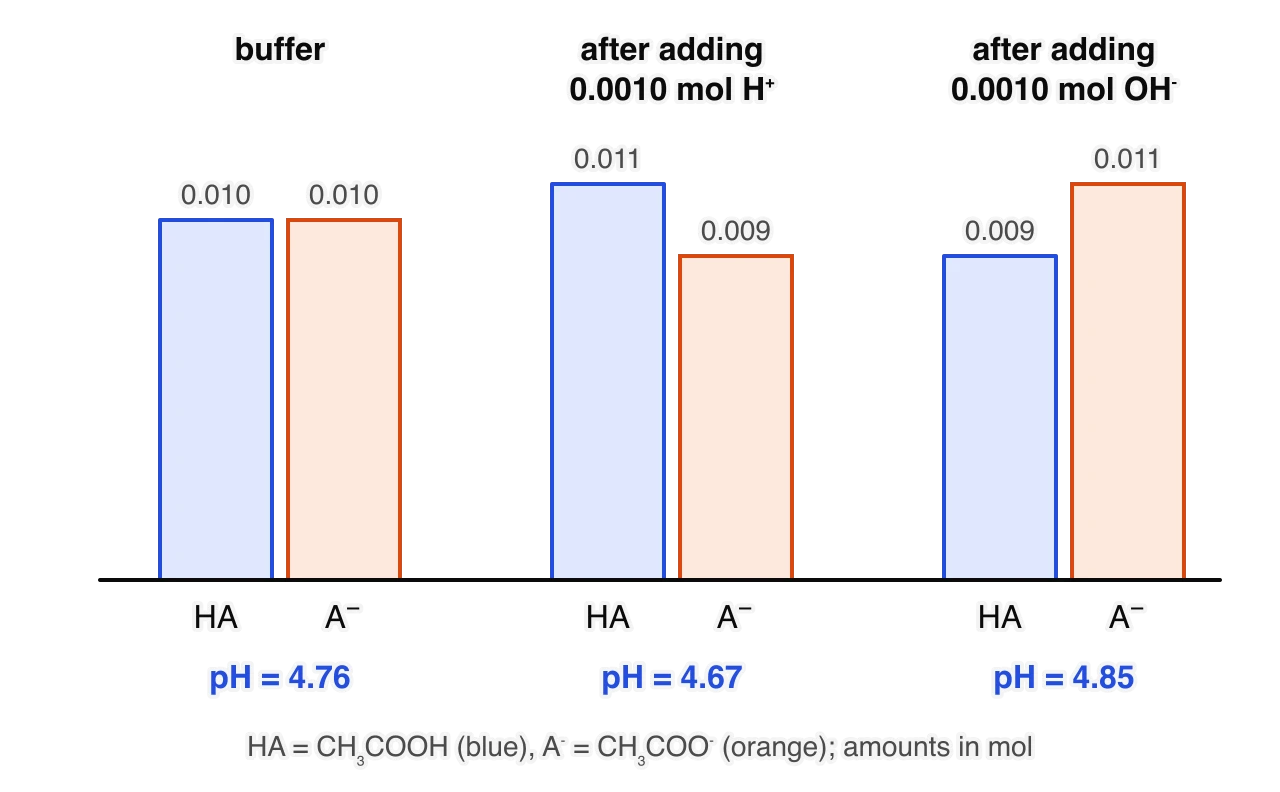
The pH stays almost constant because it depends on the ratio of the two partners. Adding a small amount of acid or alkali turns a little of one partner into the other. While both amounts are large compared with the amount added, their ratio changes only slightly, as the bar charts for a typical buffer show.
Why a buffer resists change. Added acid converts some ethanoate ions into ethanoic acid, and added alkali converts some ethanoic acid into ethanoate ions. Both amounts stay large, so their ratio, and with it the pH, changes only a little.
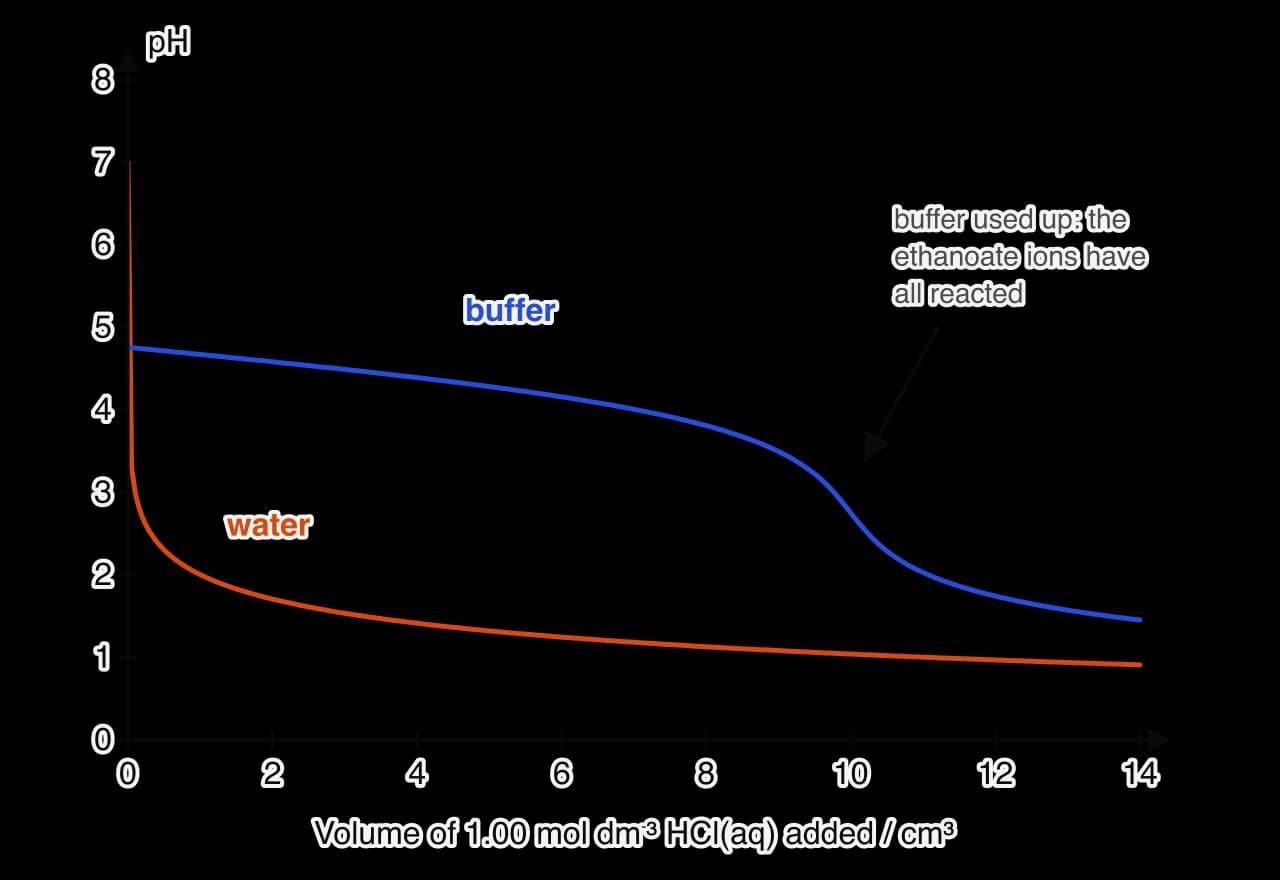
A buffer has a limited capacity. Once almost all of one partner has been used up, the solution can no longer remove the added ions and the pH changes sharply. The more concentrated the buffer, the more acid or alkali it can absorb. The calculated curves for water and for a buffer receiving the same hydrochloric acid show both effects: the buffer holds its pH until about 9 cm³ of acid has been added, then fails as its 0.010 mol of ethanoate ions runs out.
Adding 1.00 mol dm⁻³ HCl to 100 cm³ of pure water and to 100 cm³ of a buffer that is 0.100 mol dm⁻³ in both CH₃COOH and CH₃COONa (calculated). The buffer fails once its 0.010 mol of ethanoate ions are used up.
Why strong acids and bases cannot form buffers
A buffer needs a weak acid and its conjugate base in equilibrium, both present in large amounts. A strong acid such as hydrochloric acid is fully ionized, so the "pair" HCl/ClX− fails on both counts. The chloride ion is too weak a base to remove added HX+: the equilibrium ClX−+HX+HCl lies entirely on the left. And there are no HCl molecules in solution to react with added OHX−. In equilibrium terms, the position of the equilibrium of a strong acid lies so far to the right that it cannot shift to absorb added hydrogen ions. Only the equilibrium of a weak acid or base, with substantial amounts of both partners, can shift in both directions.
Buffers in blood
Human blood is kept between pH 7.35 and 7.45. Below about 7.35 (acidosis) or above about 7.45 (alkalosis) enzymes and oxygen transport begin to be disrupted, and a deviation of a few tenths of a unit can be life-threatening. Metabolism produces acids continuously, including carbon dioxide from respiration and lactic acid from exercising muscle, so the pH is held constant by buffers.
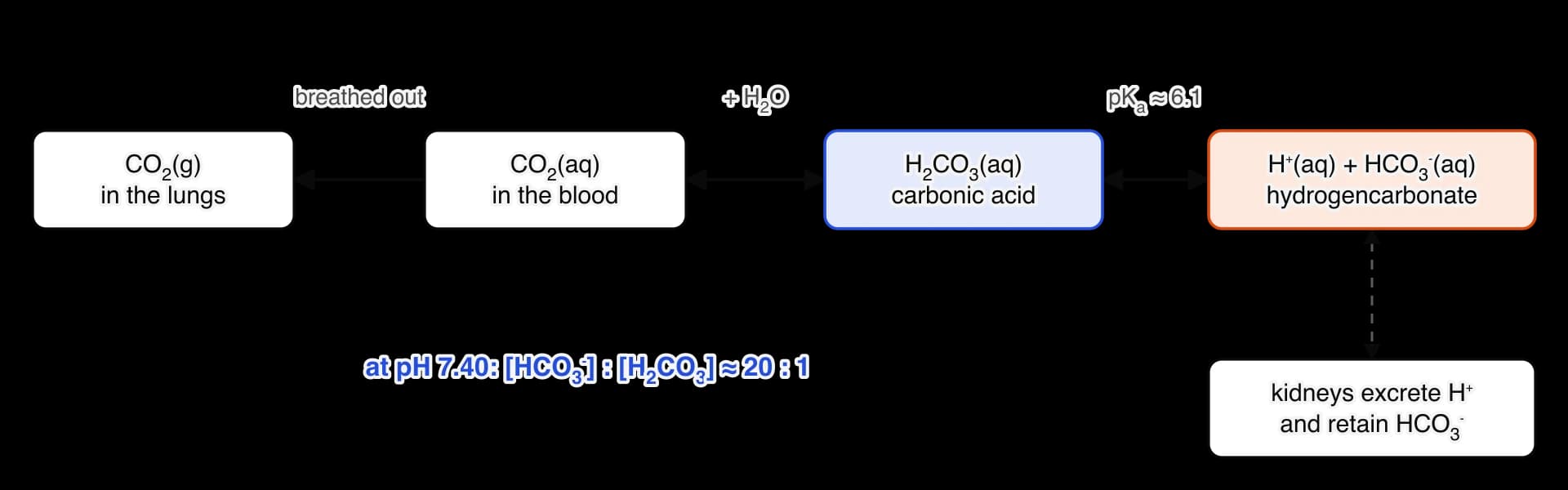
The most important is the carbonic acid–hydrogencarbonate buffer. Dissolved carbon dioxide reacts with water to form carbonic acid, a weak acid whose conjugate base is the hydrogencarbonate ion:
Hydrogencarbonate ions remove added hydrogen ions, and carbonic acid removes added hydroxide ions. At body temperature the effective pKa of the system, which counts dissolved COX2 together with carbonic acid, is about 6.1. At pH 7.40 the ratio [HCOX3X−]:[HX2COX3] is therefore about 20 : 1, as the buffer pH equation gives: 7.40=6.1+log1020.
The carbonic acid–hydrogencarbonate buffer in blood. Hydrogencarbonate ions remove added H⁺, and the carbonic acid formed leaves as carbon dioxide through the lungs. The pKa shown is the effective value at 37 °C, counting dissolved CO₂ as carbonic acid.
A ratio of 20 : 1 lies outside the range in which a closed buffer works well, yet the system is very effective because it is open at both ends. Carbonic acid formed by buffering acid is converted to carbon dioxide and breathed out, and the breathing rate rises when the blood becomes more acidic. Over hours to days, the kidneys excrete hydrogen ions and adjust the concentration of hydrogencarbonate. Hyperventilation removes carbon dioxide too fast, raising blood pH, which is one cause of alkalosis. Inside cells, the phosphate buffer (HX2POX4X−/HPOX4X2−, pKa=7.20 at 298 K) and proteins play a larger part.
Calculating the pH of a buffer (HL)
The equilibrium expression of the weak acid applies in a buffer just as it does in the acid alone. Rearranging it for [HX+] and taking negative logarithms gives two equivalent forms:
[HX+]pH=Ka×[AX−][HA]=pKa+log10[HA][AX−]
The logarithmic form is known as the Henderson–Hasselbalch equation. It is not in the data booklet; it follows directly from the Ka expression. Two approximations are built into it:
[HA] equals the concentration of weak acid used. The added conjugate base pushes the ionization equilibrium of HA even further to the left, so very little of the acid ionizes.
[AX−] equals the concentration of the salt used, because very little AX− reacts with water in the presence of so much HA.
Both species are in the same volume of solution, so the ratio of their concentrations equals the ratio of their amounts in moles: [HA][AX−]=n(HA)n(AX−). After mixing two solutions, amounts are the safest quantities to work with.
For a basic buffer of weak base B and its conjugate acid BHX+, the same steps applied to Kb give the pOH, and then the pH:
pOH=pKb+log10[B][BHX+]pH=14.00−pOH
Equivalently, pH=pKa(BHX+)+log10[BHX+][B], using pKa(BHX+)=14.00−pKb.
Consequences of the buffer equation
The pH depends on the ratio, not on the amounts. Two buffers with the same ratio of AX− to HA have the same pH, whatever their concentrations.
Equal amounts give pH=pKa. When [AX−]=[HA], log101=0. This is the half-equivalence point of a pH curve, where the curve is flattest and the buffer resists change best.
A useful buffer has a pH within about one unit of pKa. Beyond that the ratio exceeds 10 : 1 and one partner is too scarce to absorb much acid or alkali. To make a buffer of a chosen pH, a weak acid with pKa close to that pH is selected: ethanoic acid and ethanoate for pH 4–5.5, dihydrogenphosphate and hydrogenphosphate ions (pKa=7.20
When a buffer is made by partial neutralization, the amounts of each species after the reaction are found first.
The equation can also be run backwards to design a buffer.
The equation also predicts how far the pH moves when acid or alkali is added. The added species reacts completely with one partner, and the new amounts go into the equation.
For a basic buffer, the amounts of the weak base and its conjugate acid are used with pKb.
Diluting a buffer
Diluting a buffer with water divides the concentrations of the weak acid and its conjugate base by the same factor. Their ratio is unchanged, so the pH stays essentially the same:
The buffer capacity does fall. A given volume of the diluted buffer contains fewer moles of each partner, so a smaller amount of added acid or alkali is enough to use one of them up. A tenfold dilution of a strong acid, in contrast, raises its pH by a whole unit. Extreme dilution eventually defeats the approximations: when the concentrations approach [HX+] itself, the ionization of the acid and of water can no longer be ignored, and the pH drifts towards 7.
Applying the ideas in exam questions
Paper 1A: acids in an equilibrium
Paper 1A: a strong and a weak acid
Paper 1A: the pH of an alkali
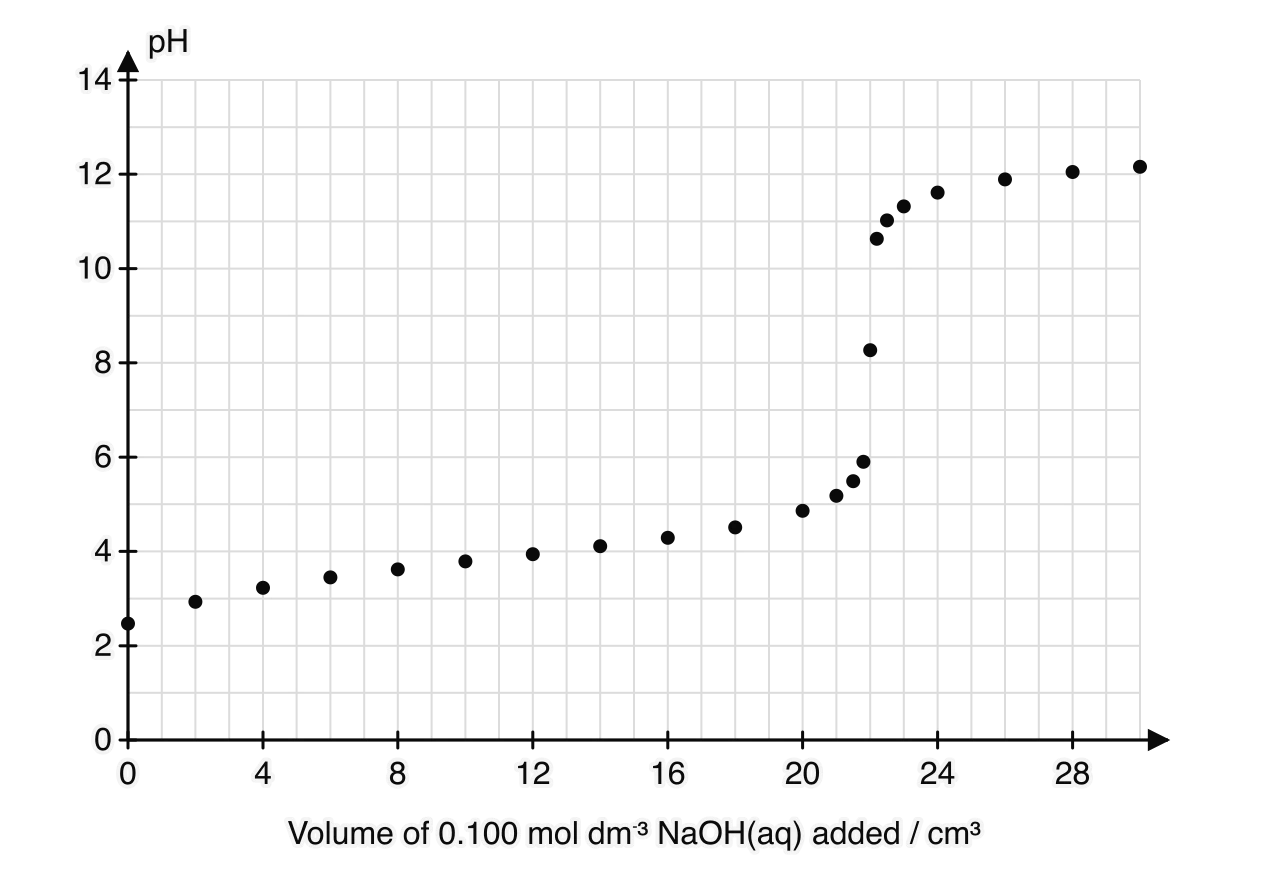
Paper 1B: a pH curve from a data logger
A student titrated 25.00cm3 of hydrochloric acid of unknown concentration with 0.100mol dm−3 sodium hydroxide, using a pH probe calibrated with buffers of pH 4.00 and 7.00. The burette has an uncertainty of ±0.05cm3 per reading. Selected results are shown in the table.
Volume of NaOH added / cm3 (±0.10)
pH (±0.01)
0.00
1.03
10.00
1.42
20.00
2.12
22.00
2.53
23.00
3.08
23.20
3.38
23.40
7.05
23.60
10.61
23.80
10.91
25.00
11.51
30.00
12.08
Paper 2: indigestion remedies
Paper 1A: pKb from a pH curve (HL)
Paper 1A: salt solutions in order of pH (HL)
Paper 1A: which mixture is a buffer? (HL)
Paper 1B: the pKa of lactic acid (HL)
Lactic acid, CHX3CH(OH)COOH, is the weak monoprotic acid that forms in sour milk and in exercising muscle. A student pipetted 25.00cm3 of a lactic acid solution into a beaker and titrated it with 0.100mol dm−3 sodium hydroxide, recording the pH with a calibrated pH probe after each addition. The burette readings have an uncertainty of ±0.05cm3.
pH probe readings for the titration of 25.00 cm³ of lactic acid solution with 0.100 mol dm⁻³ sodium hydroxide at 298 K (simulated data).
Paper 2: methylamine as a weak base (HL)
Self-check
To do:
I can define a Brønsted–Lowry acid and base, and identify both in either direction of an equation.
To do:
I can explain why HX+(aq) and HX3OX+(aq) both represent the aqueous proton.
To do:
I can distinguish between a base and an alkali, with examples.
To do:
I can deduce the formula of the conjugate acid or base of any species, and draw it with the charge on the correct atom.
To do:
I can identify the two conjugate pairs in an acid–base equilibrium.
To do:
I can write equations to show an amphiprotic species acting as an acid and as a base, and distinguish amphiprotic from amphoteric.
To do:
I can calculate pH from [HX+] and [HX+] from pH, and explain the effect of a tenfold dilution.
To do:
I can compare universal indicator and a pH meter for measuring pH.
To do:
I can use Kw to calculate [HX+] or [OHX−]
To do:
I can explain why Kw increases with temperature and why hot pure water is still neutral.
To do:
I can distinguish strong from weak acids and bases, and strength from concentration.
To do:
I can describe experiments that distinguish a strong and a weak acid of the same concentration.
To do:
I can predict the position of an acid–base equilibrium from the relative strengths of the acids and bases involved.
To do:
I can write full and ionic equations for acids reacting with metal oxides, hydroxides, carbonates, hydrogencarbonates, ammonia and amines.
To do:
I can identify the parent acid and base of a salt, and describe how a soluble salt is prepared and separated.
To do:
I can explain why the reaction of a metal with an acid is a redox reaction, not neutralization.
To do:
I can sketch and interpret the pH curve of a strong acid–strong base titration, including its starting pH and equivalence point.
To do:
I can explain why titrant is added in small portions near the equivalence point when recording a pH curve.
To do:
I can use the equivalence volume from a pH curve to calculate an unknown concentration.
To do:
I can define pOH and interconvert [H⁺], [OH⁻], pH and pOH at 298 K, using pH + pOH = 14.00 (HL).
To do:
I can derive pH + pOH = pKw from Kw and explain why pH + pOH = 14.00 only at 298 K (HL).
To do:
I can write Ka and Kb expressions for weak acids and bases, and convert between Ka and pKa, and Kb and pKb (HL).
To do:
I can rank acids, bases and their solutions by strength or pH from Ka, Kb, pKa or pKb values (HL).
To do:
I can explain how electron-withdrawing atoms such as chlorine increase the strength of a carboxylic acid (HL).
To do:
I can calculate the pH of a weak acid or weak base solution, and Ka from a measured pH, stating the approximations used (HL).
To do:
I can derive Ka × Kb = Kw for a conjugate pair and use pKa + pKb = 14.00 (HL).
To do:
I can write hydrolysis equations for NH₄⁺, RCOO⁻, CO₃²⁻ and HCO₃⁻, and predict whether a salt solution is acidic, neutral or basic (HL).
To do:
I can calculate the pH of a salt solution from Ka or Kb of the ion that reacts with water (HL).
To do:
I can sketch and interpret pH curves for all four combinations of strong and weak monoprotic acids and bases, including the starting pH, buffer region, half-equivalence point and equivalence point (HL).
To do:
I can find pKa, or pKb using pOH, from the pH at half-equivalence (HL).
To do:
I can explain, with an equilibrium and Le Châtelier's principle, why an indicator changes colour at a pH close to its pKa (HL).
To do:
I can distinguish between the end point and the equivalence point, and choose a suitable indicator from the data booklet (HL).
To do:
I can describe the composition of acidic and basic buffers, including those made by partial neutralization (HL).
To do:
I can explain with equations how a buffer resists a change in pH, and why strong acids and bases cannot form buffers (HL).
To do:
I can calculate the pH of a buffer, and the ratio of components needed for a chosen pH, from Ka or Kb (HL).
To do:
I can explain why diluting a buffer leaves its pH almost unchanged but lowers its buffer capacity (HL).
NH3 has one lone (non-bonding) pair and three bonding pairs, whereas CH4 has four bonding pairs ✓ lone pair–bonding pair repulsion is greater than bonding pair–bonding pair repulsion, so the N–H bonds are pushed closer together ✓
Do not accept "the lone pair pushes the bonds" without a comparison of repulsions for M2.
(d)(i)
Ammonia reacts with hydrogen chloride to form ammonium chloride, NH4Cl. Outline how the coordination bond in the ammonium ion, NH4+, forms.
[1]1 mark
Markscheme (d)(i)
the lone pair on the N atom is donated to/shared with an H+ ion, so both electrons of the new bond come from N ✓
Accept "dative covalent bond".
(d)(ii)
State the H–N–H bond angle in the ammonium ion.
[1]1 mark
Markscheme (d)(ii)
109.5° ✓
Accept 109°.
(e)
Explain why ammonia is very soluble in water.
[2]2 marks
Markscheme (e)
ammonia forms hydrogen bonds with water molecules ✓ between a δ+ H atom (bonded to N or O) on one molecule and a lone pair on the N/O atom of a neighbouring molecule ✓
Accept a correctly labelled diagram for M2. Ignore reference to ammonia reacting with water to form ions.
Question 2 · CHEM-003631 mark
Dilute nitric acid is neutralized by dilute potassium hydroxide solution in a polystyrene cup. The thermometer reading rises from 21.0 °C to 27.5 °C.
Which statement is correct?
A
ΔH is positive because the temperature increases.
B
Heat is transferred from the surroundings to the reacting system.
C
ΔH is negative and the enthalpy of the products is lower than that of the reactants.
D
ΔH is negative and the reacting system gains energy.
Writing HX+(aq) in place of HX3OX+(aq) is equally acceptable: HX2POX4X−(aq)+HX+(aq)HX3POX4(aq). Check that each equation balances in both atoms and charge.
.
Dilution factor. The volume increases from 10.0 to 500.0cm3, a factor of 50, so [HX+] falls by a factor of 50:
ammonia, NHX3; amines such as CHX3NHX2; the carbonate and hydrogencarbonate ions
on the right.
Compare them. From the ladder of acid strengths, ethanoic acid is a stronger acid than the ammonium ion. Equivalently, ammonia is a stronger base than the ethanoate ion.
Conclusion. The equilibrium lies on the side of the weaker acid (NHX4X+) and weaker base (CHX3COOX−), so it lies to the right. Ethanoic acid and ammonia react almost completely to form ammonium ethanoate.
copper(II) oxide, CuO, or hydroxide, Cu(OH)X2
sulfuric acid, HX2SOX4
ammonia, NHX3
sodium hydroxide, NaOH
carbonic acid, HX2COX3
sodium hydroxide, NaOH
hydrochloric acid, HCl
methylamine, CHX3NHX2
/
mol dm−3
pH
0.00
HX+: 2.500×10⁻³
25.00
1.00×10⁻¹
1.00
10.00
HX+: 1.500×10⁻³
35.00
4.29×10⁻²
1.37
20.00
HX+: 5.00×10⁻⁴
45.00
1.11×10⁻²
1.95
24.00
HX+: 1.00×10⁻⁴
49.00
2.04×10⁻³
2.69
24.90
HX+: 1.0×10⁻⁵
49.90
2.0×10⁻⁴
3.70
25.00
none
50.00
1.0×10⁻⁷
7.00
25.10
OHX−: 1.0×10⁻⁵
50.10
5.0×10⁻¹¹
10.30
26.00
OHX−: 1.00×10⁻⁴
51.00
5.10×10⁻¹²
11.29
30.00
OHX−: 5.00×10⁻⁴
55.00
1.10×10⁻¹²
11.96
50.00
OHX−: 2.500×10⁻³
75.00
3.00×10⁻¹³
12.52
, so
[HX+]=1.00×10⁻¹⁴/1.96×10−3=5.10×10−12mol dm−3
and the pH is 11.29.
The equation HCl+NaOHNaCl+HX2O has a 1 : 1 ratio, so n(HCl)=2.76×10⁻³mol:
[HCl]=0.02000dm32.76×10−3mol=0.138mol dm−3
(b)HCl is a strong acid, so [HX+]=0.138mol dm−3 and pH=−log10(0.138)=0.86.
(c) pH 7 (at 298 K): the solution contains only sodium chloride, which forms a neutral solution.
, so each mole of base gives two moles of hydroxide ions:
[OHX−]=2×0.0150=0.0300mol dm−3
pOH.pOH=−log10(0.0300)=1.52
pH.pH=14.00−1.52=12.48
Check: the solution is strongly basic, and pH>7>pOH as expected. Forgetting the factor of 2 gives pOH 1.82 and pH 12.18.
and
[OHX−]=10−9.70=2.0×10⁻¹⁰mol dm−3
.
Check: (5.0×10⁻⁵)(2.0×10⁻¹⁰)=1.0×10⁻¹⁴. Two decimal places in the pH correspond to two significant figures in each concentration.
6.31×10⁻⁵
4.20
4.76
1.35×10⁻⁵
4.87
1.02×10⁻¹⁰
9.99
4.47×10⁻⁴
3.35
4.75
7.41×10⁻¹⁰
9.13
and
[CHX3COOH]≈0.100mol dm−3
:
is justified. A
0.100mol dm−3
solution of hydrochloric acid has pH 1.00, nearly two units lower.
, and
[CX6HX5COOX−]=[HX+]
.
Ka, taking [CX6HX5COOH]≈0.0250mol dm−3:
Ka=0.0250(1.26×10⁻³)2=6.3×10⁻⁵
pKa.pKa=−log10(6.3×10⁻⁵)=4.20
About 5 % of the acid is ionized here (1.26×10⁻³ out of 0.0250), close to the limit of the approximation; using c−x instead of c would give 6.7×10⁻⁵.
and
[NHX3]≈0.250mol dm−3
:
.
9.24
6.35
HCOX3X−
7.65
4.75
3.67
10.66
CHX3NHX2
3.34
Route 1: on the p scale.pKb=14.00−4.87=9.13, so Kb=10−9.13=7.4×10⁻¹⁰.
Route 2: with the constants.Ka=10−4.87=1.35×10⁻⁵ and Kb=KaKw=1.35×10−51.00×10−14=7.4×10⁻¹⁰.
The propanoate ion is a very weak base, as expected for the conjugate base of an acid that is itself fairly weak.
is ten times larger than
Kb(HCOOX−)=5.6×10⁻¹¹
, so the solution is slightly acidic.
,
CHX3NHX3Cl
the cation (a weak acid)
below 7
,
NaHCOX3
the anion (a weak base)
above 7
,
HCOONHX4
both
depends on Ka(cation) and Kb(anion)
.
and
[CHX3COOX−]≈0.100mol dm−3
:
, which needs
25.0cm3
of
0.100mol dm−3
NaOH
.
(a) At 12.5cm3, [CHX3COOH]=[CHX3COOX−], so pH=pKa=4.76.
(b) At 25.0cm3 the flask holds 2.50×10⁻³mol of CHX3COOX− in 50.0cm3:
[CHX3COOX−]=0.05002.50×10−3=0.0500mol dm−3
With Kb=10−9.24=5.75×10⁻¹⁰, [OHX−]=(5.75×10⁻¹⁰)(0.0500)=5.36×10⁻⁶mol dm−3, so pOH=5.27 and pH=8.73.
(c) At 35.0cm3, the excess OHX− is (0.0350−0.0250)×0.100=1.00×10⁻³mol in 60.0cm3:
The hydroxide ions from the hydrolysis of ethanoate are negligible beside the excess alkali.
, so
pOH=pKb
of ammonia (4.75), and
pH=14.00−pKb=pKa
of the ammonium ion (9.25).
)
2.9
depends on Ka and Kb (7.0 here)
none: a gradual change
on both sides of equivalence
. Its pH is above 7 (about 9.3 when the two are in equal amounts).
. The position shifts to the right as hydrogen ions are replaced.
) for pH 6.5–8, ammonium and ammonia (
pKa=9.25
) for pH 8.5–10.
The buffer contains more acid than conjugate base, so its pH is below the pKa, as expected.
.
Reaction.HCOOH+OHX−HCOOX−+HX2O uses all of the hydroxide ions: 0.00300mol of HCOOX− forms and 0.00700mol of HCOOH remains. The weak acid is in excess, so the mixture is a buffer.
pH, using the ratio of amounts (both are in the same 80.0cm3):
Volumes. The two stock solutions have the same concentration, so the volumes are in the same ratio: 100cm3 of NaX2HPOX4(aq) and 50cm3 of NaHX2POX4(aq).
, so
pH=4.76+log101=4.76
.
Reaction.n(HX+)=0.00100mol reacts with ethanoate: CHX3COOX−+HX+CHX3COOH. Afterwards, n(CHX3COOX−)=0.00900mol and n(CHX3COOH)=0.0110mol.
pH=4.76+log100.01100.00900=4.76−0.09=4.67
The pH falls by 0.09. The same acid added to 100cm3 of pure water would give [HX+]=0.00100/0.101=9.9×10−3mol dm−3, pH 2.00: a fall of five units.
pH=14.00−4.57=9.43. Using pKa(NHX4X+)=9.25 gives the same result directly: pH=9.25+log10(0.150/0.100)=9.43.
and
HCOX3X−
B. HX2POX4X− and HPOX4X2−
C. COX3X2− and HPOX4X2−
D. COX3X2− and HCOX3X−
donates a proton in the forward reaction, and
HCOX3X−
donates a proton in the reverse reaction. B and D each pair an acid with its own conjugate base. C lists the two bases.
«mol» ✓
[HCl]=2.34×10⁻³/0.02500=0.0936 «mol dm−3» ✓
Award [2] for correct final answer. Accept ECF from (b).
(d)
23.400.10×100=0.43 «%» ✓
Accept 0.4 %.
(e)
−log10(0.0936)=1.03, the same as the measured value ✓
Accept ECF from (c).
(f)
the pH changes rapidly near the equivalence point, so small additions are needed to locate the steep section/equivalence volume precisely ✓
(g)
the probe response drifts, so calibration with buffers of known pH removes a systematic error/makes the readings accurate ✓
Do not accept "to make the readings precise" alone.
✓
Accept ionic equation Mg(OH)X2+2HX+MgX2++2HX2O. State symbols not required.
electrons are transferred: Mg is oxidized «0 to +2» AND H⁺ is reduced «+1 to 0»/it is a redox reaction ✓
B. NHX4NOX3<KNOX3<CHX3COOK<NaX2COX3
C. NHX4NOX3<KNOX3<NaX2COX3<CHX3COOK
D. NaX2COX3<CHX3COOK<KNOX3<NHX4NOX3
is acidic (
NHX4X+
is a weak acid);
KNOX3
is neutral (strong acid, strong base). Both
CHX3COOK
and
NaX2COX3
are basic, and carbonate is the stronger base because its conjugate acid,
HCOX3X−
, is far weaker than ethanoic acid (larger
pKa
), so
NaX2COX3
has the highest pH. A treats the ammonium salt as neutral, C reverses the two basic salts, and D lists decreasing pH.
and leaves 0.10 mol of
NHX3
, so both the weak base and its conjugate acid are present. A gives only ammonium chloride (complete neutralization). C and D contain excess strong acid and no remaining weak base, so nothing can remove added acid.
«mol»;
[acid]=0.025002.20×10−3=0.0880
«
mol dm−3
» ✓
Accept ECF from (a).
(c)
at half the equivalence volume «11.0cm3», [lactic acid] = [lactate] so pH = pKa ✓
pKa=3.86 ✓ (accept 3.8–3.9)
Award [1 max] for reading the pH at the equivalence volume or at the start.
(d)
the pH changes by a large amount for a small volume near the equivalence point, so small additions locate the vertical section / the equivalence volume precisely ✓
(e)
phenolphthalein ✓ (accept phenol red)
its range «8.0–10.0» lies within the steep part of the curve «about pH 6–10.5» / contains the equivalence pH «about 8.3» ✓
Do not award M2 for "pKa close to 7". Do not accept methyl orange or methyl red.
(f)
22.00.10×100=0.45% ✓
Two burette readings: the absolute uncertainty is ±0.10cm3. Award [0] for 0.23 %.
(g)
Any one of: pH probe not calibrated / calibrated at a different temperature; titration not at 298 K «Ka depends on temperature»; NaOH concentration lower than stated «absorbed CO₂» ✓
Do not accept "human error" or "faulty equipment".
✓
Equilibrium sign required. Do not penalize missing state symbols.
(b)
Kb=10−3.34=4.57×10⁻⁴ OR Kb=0.200[OHX−]2 ✓
[OHX−]=4.57×10−4×0.200=9.56×10⁻³
pOH = 2.02 AND pH = «14.00 − 2.02 =» 11.98 ✓
Award [3] for correct final answer. Award [2 max] for 2.02 (pOH given as pH).
(c)
starts near pH 12 and falls, with a gentle slope «buffer region» before a vertical drop ✓
vertical section at 40.0cm3, centred below pH 7 ✓
half-equivalence at 20.0cm3 labelled with pH «14.00 − 3.34 =» 10.66 ✓
Accept a final pH approaching about 1.5.
Model sketch
A sketch that earns full marks: a starting pH near 12, half-equivalence at 20 cm³ where pH = 14.00 − pKb, a vertical section at 40 cm³ centred below pH 7, and a final pH approaching that of the excess acid.
(d)
methyl red ✓ (accept bromocresol green; the equivalence point is about pH 5.9)
Do not accept phenolphthalein.
(e)
the mixture contains both CHX3NHX2 and CHX3NHX3X+ in equal «large» amounts ✓
CHX3NHX3X+(aq)+OHX−(aq)CHX3NHX2(aq)+HX2O(l)
(f)
pH «essentially» unchanged ✓
the ratio [CHX3NHX3X+]/[CHX3NHX2] is unchanged «both concentrations decrease by the same factor» ✓
Accept "buffer capacity decreases" as an additional point, but it does not score on its own.
, and classify a solution as acidic, neutral or basic.
✓
for
HX2COX3
. Accept equations with
HX+
or
OHX−
as the other reactant.
«
mol dm−3
» ✓
, so the added
OHX−
is removed «and the ratio of base to conjugate acid changes only slightly» ✓
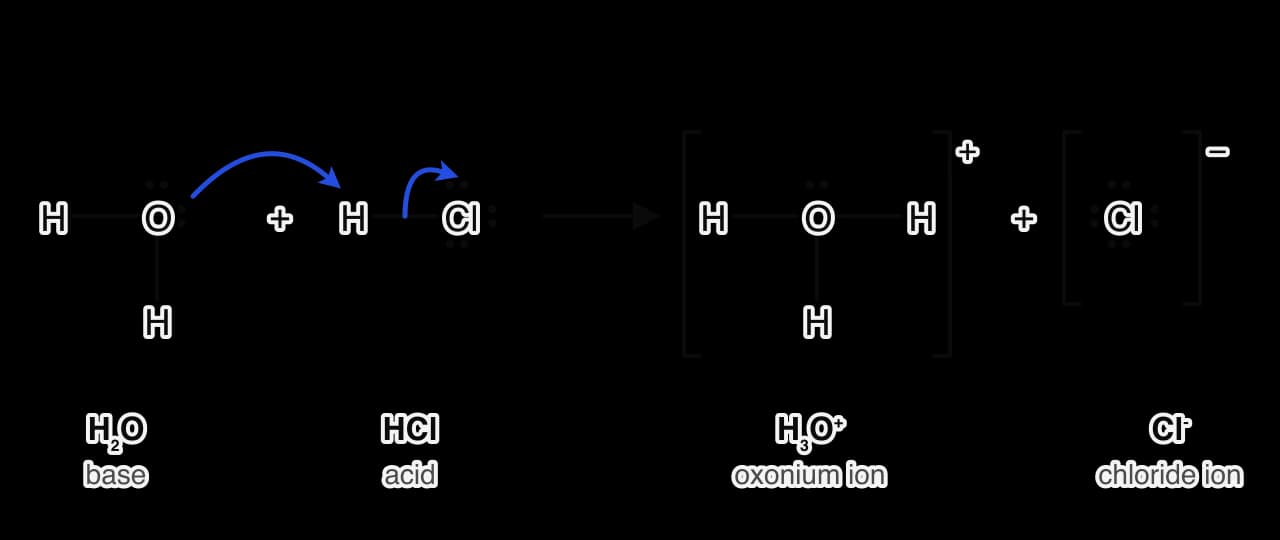
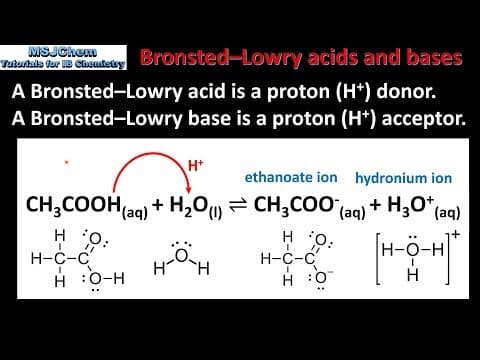 YouTube
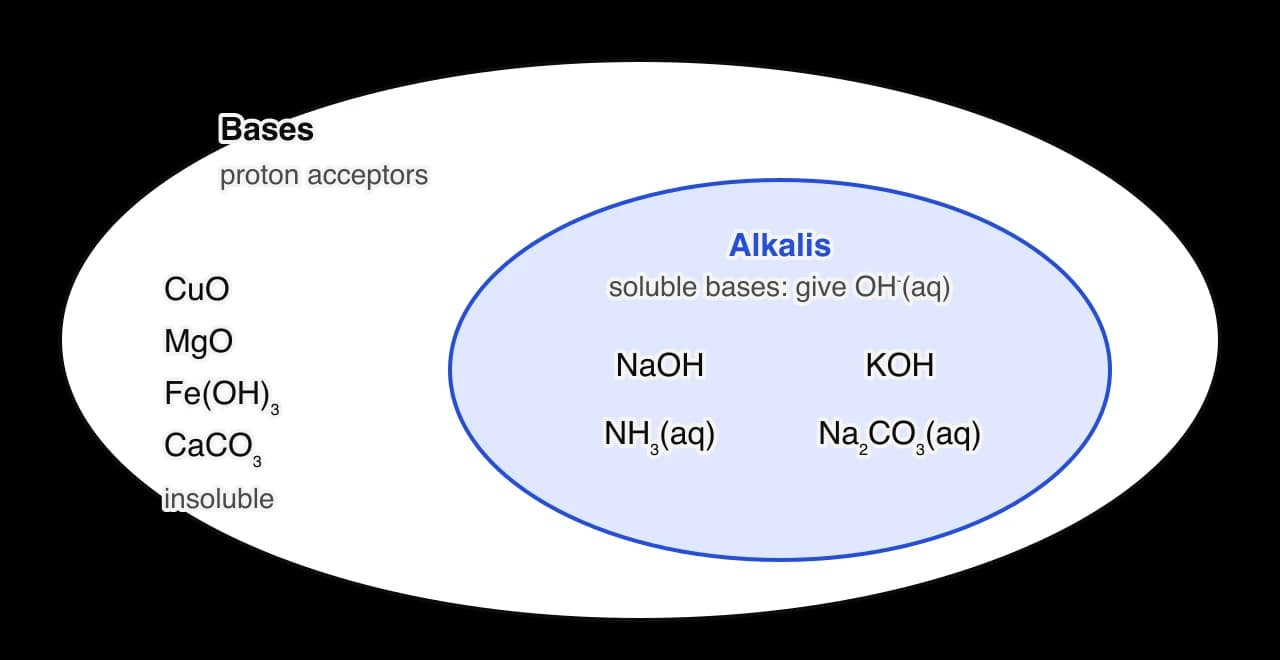
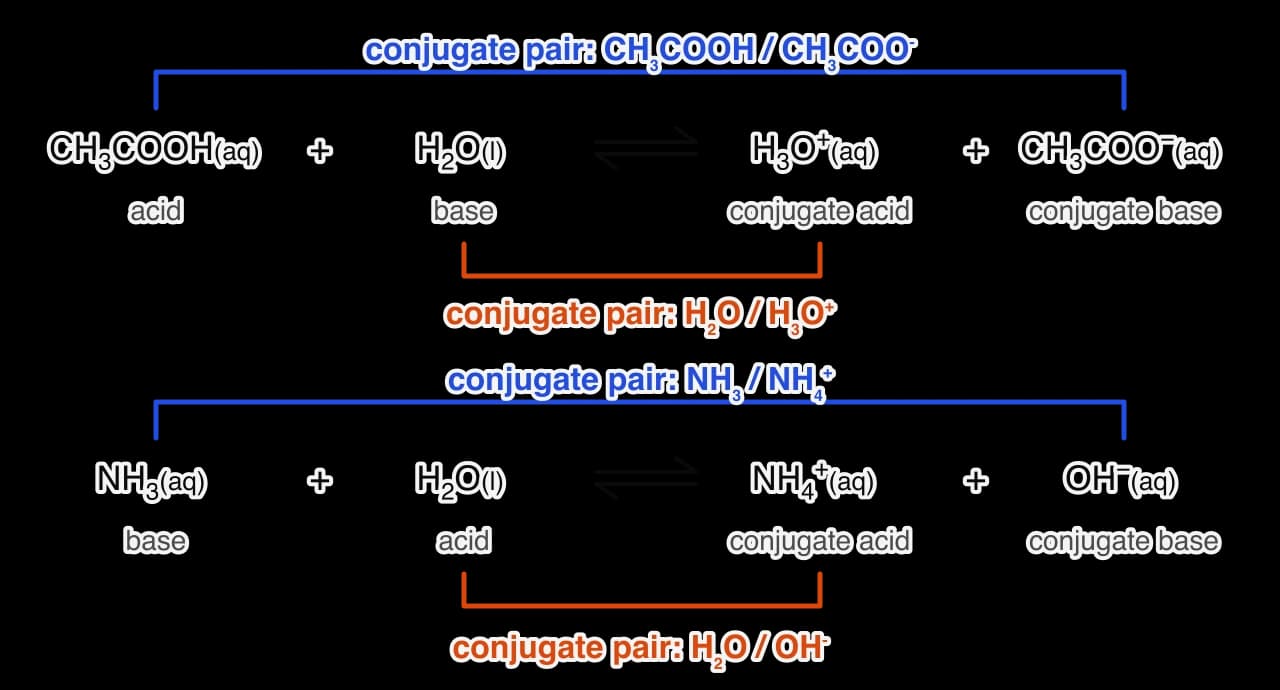
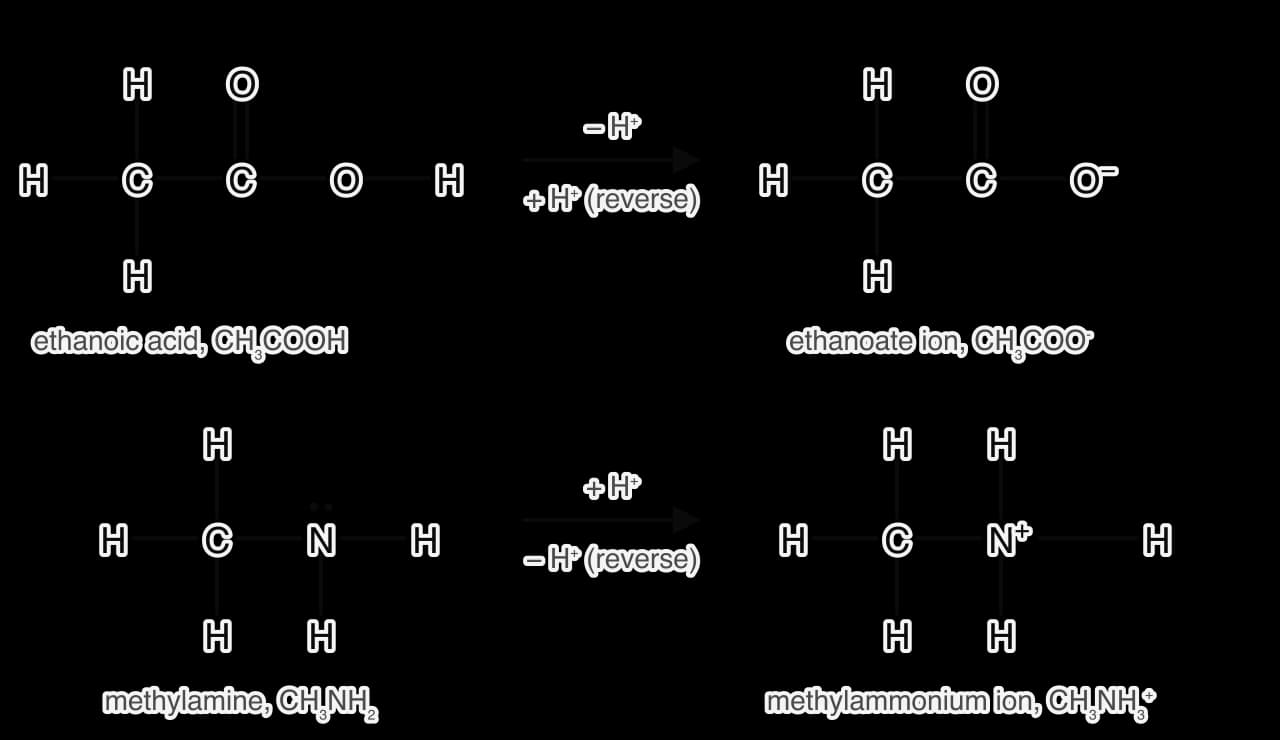
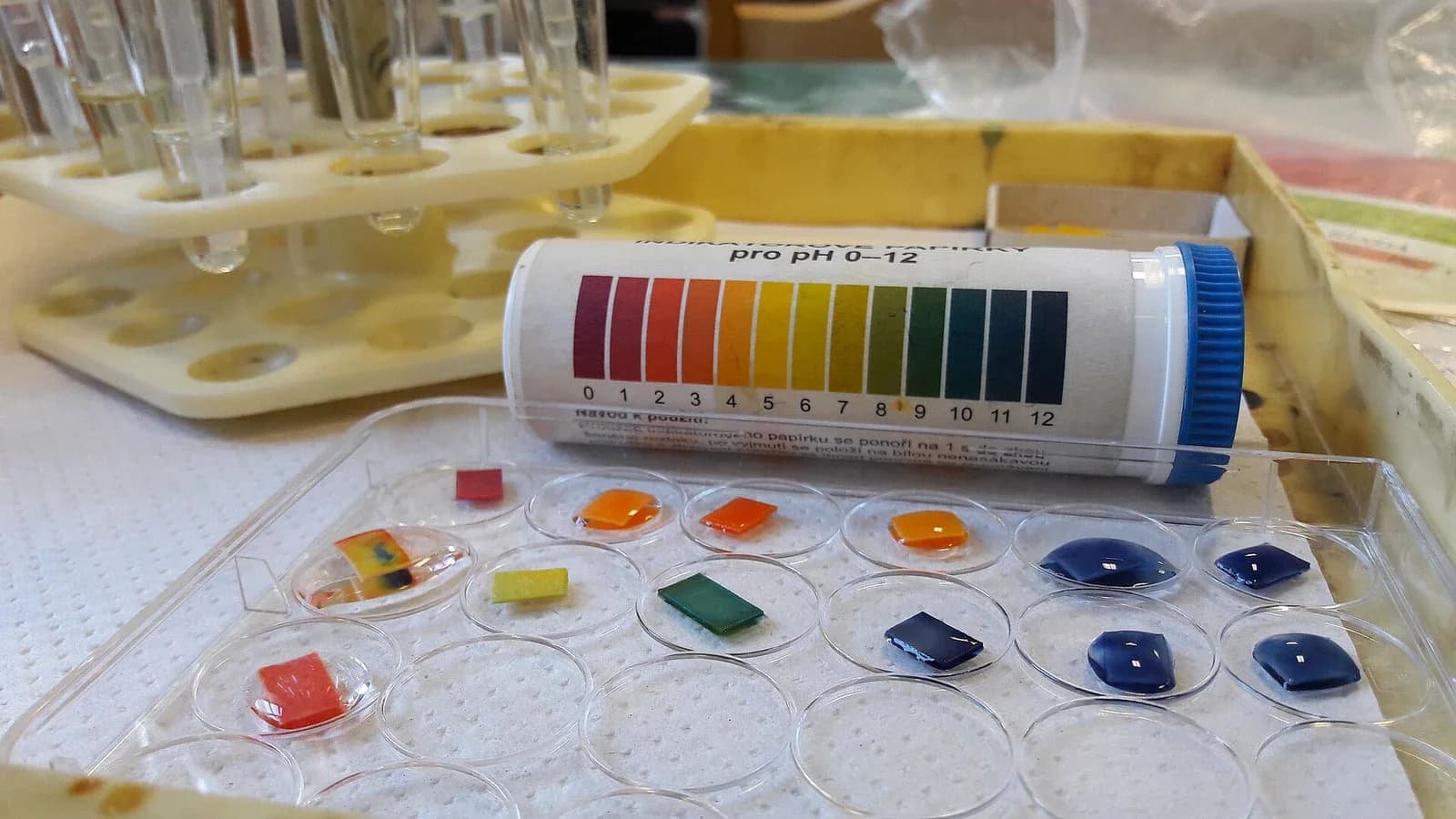
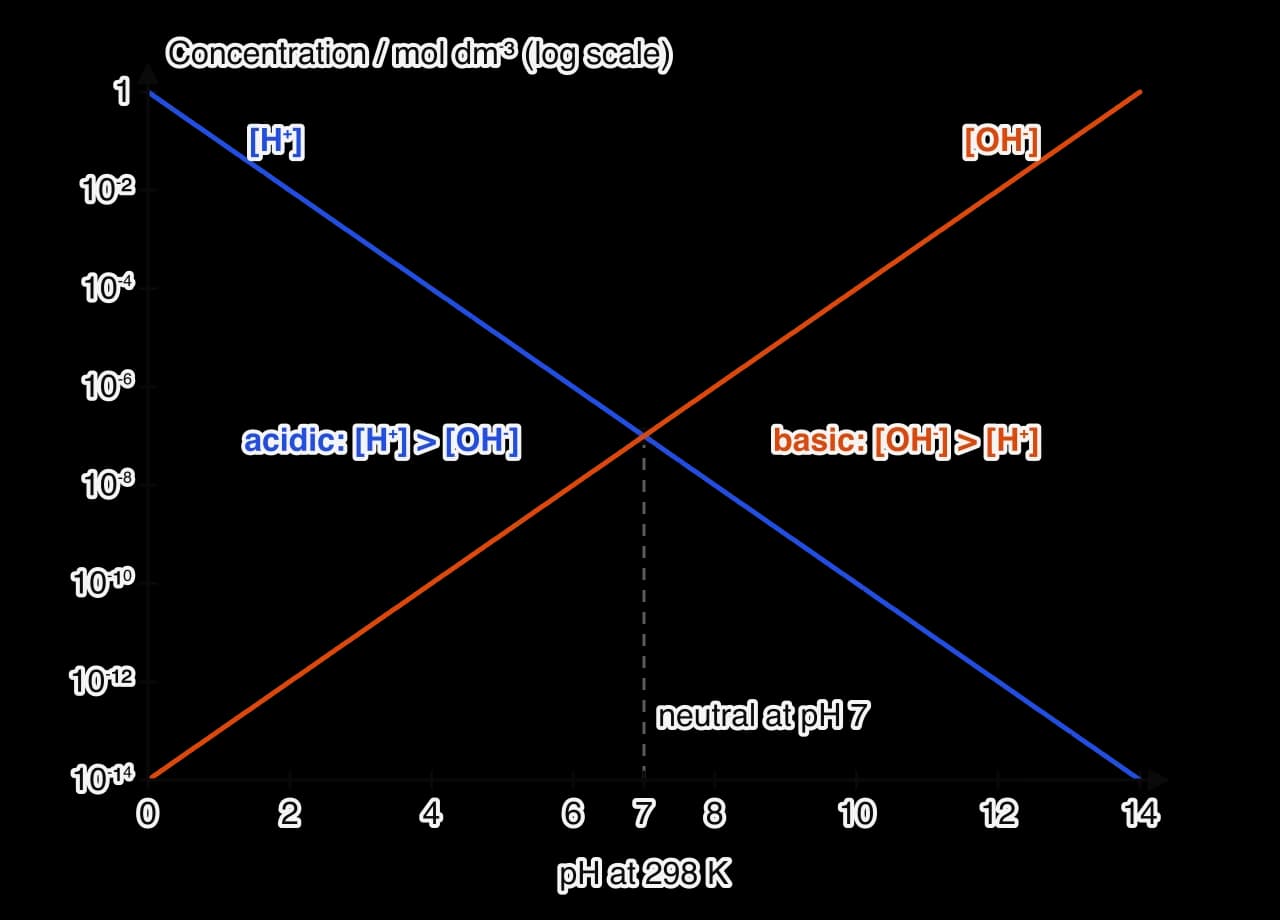
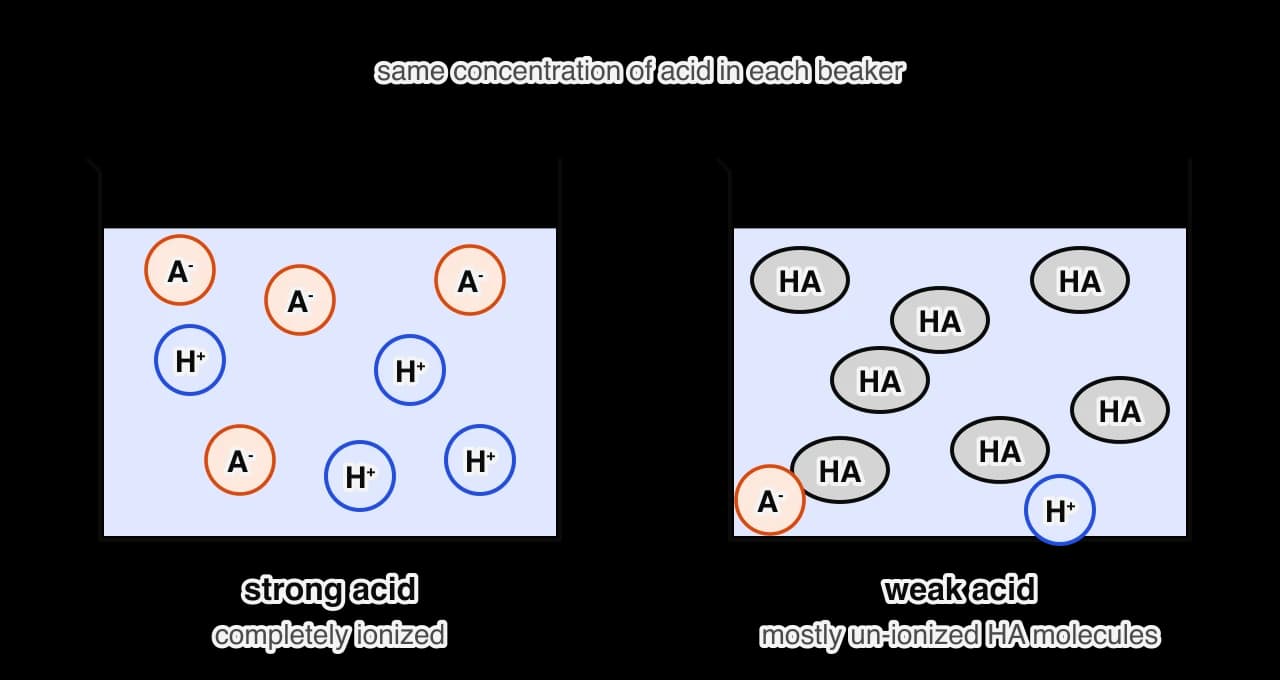
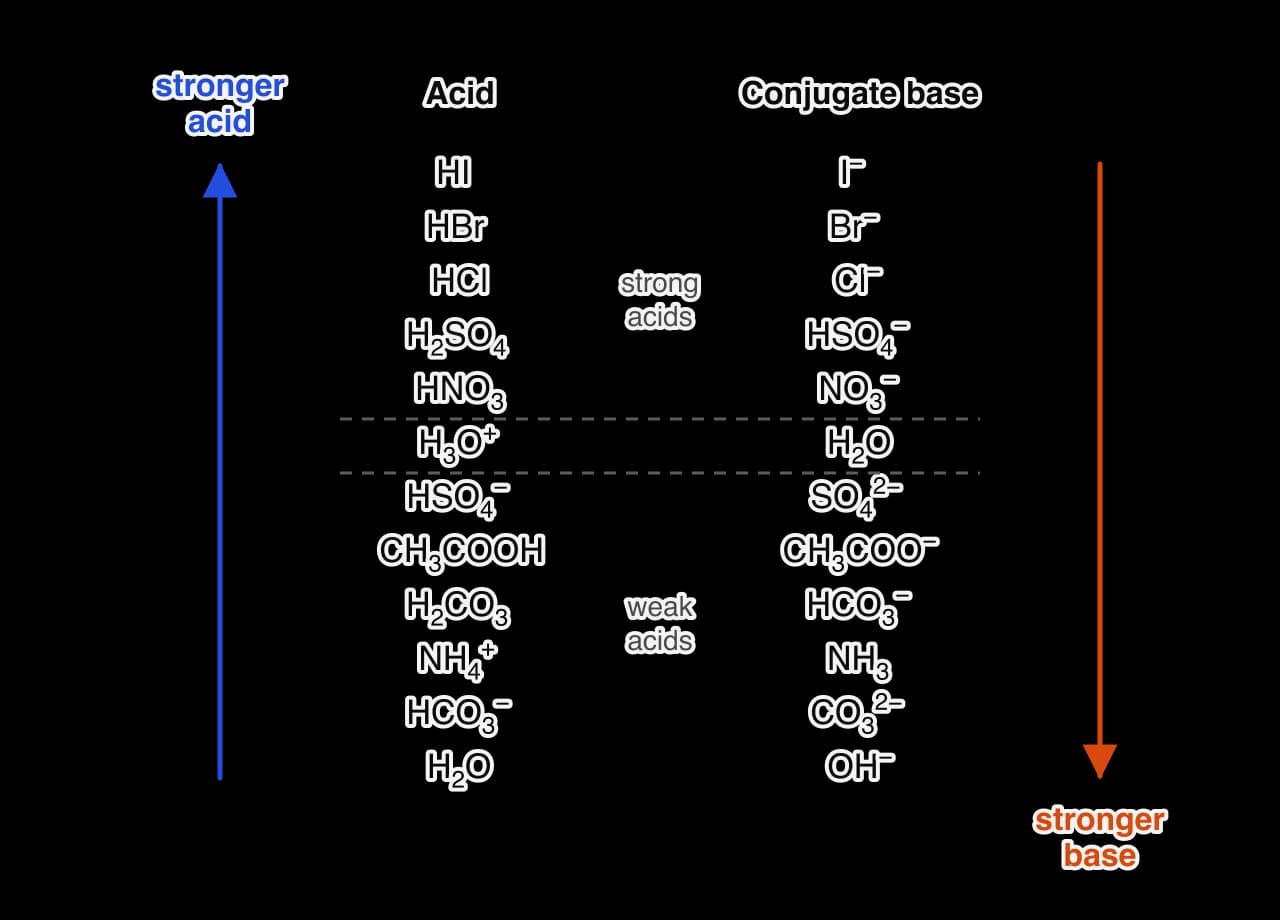
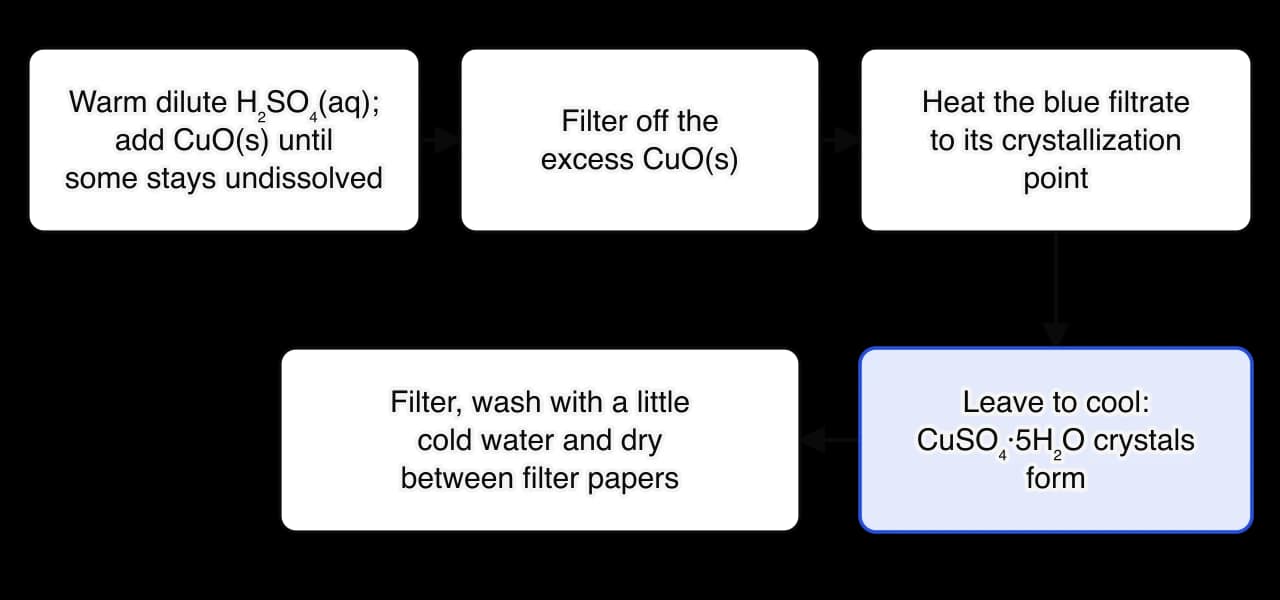
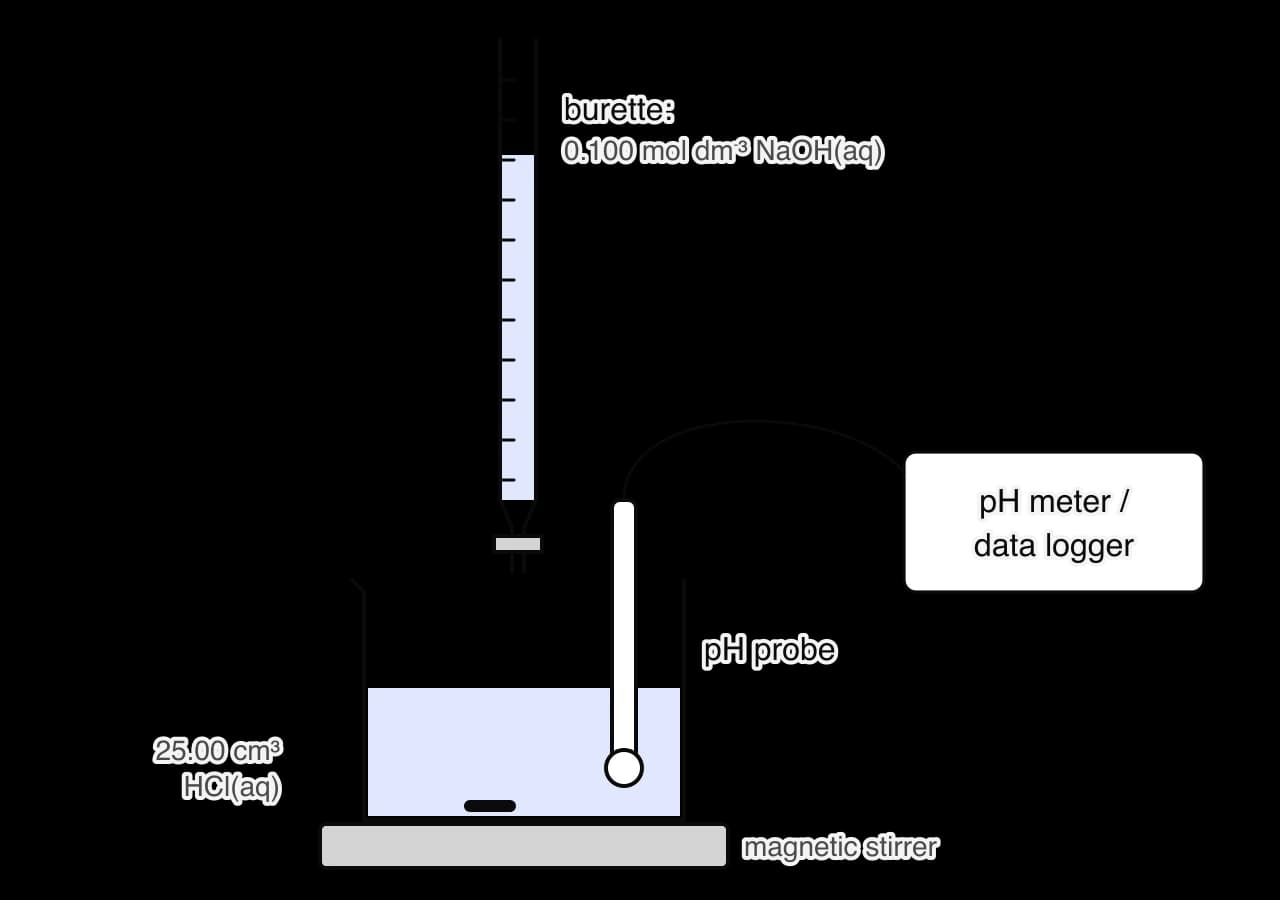
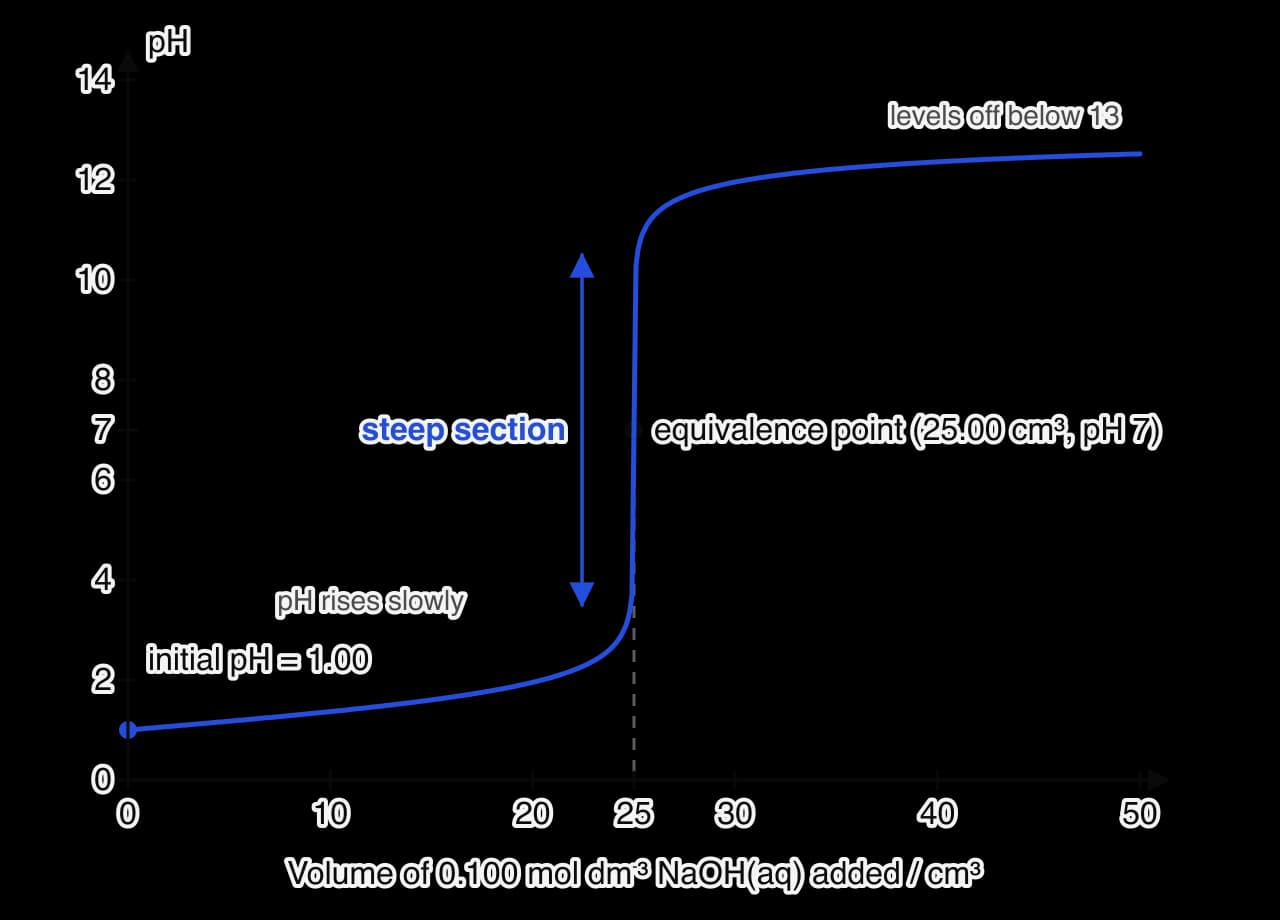
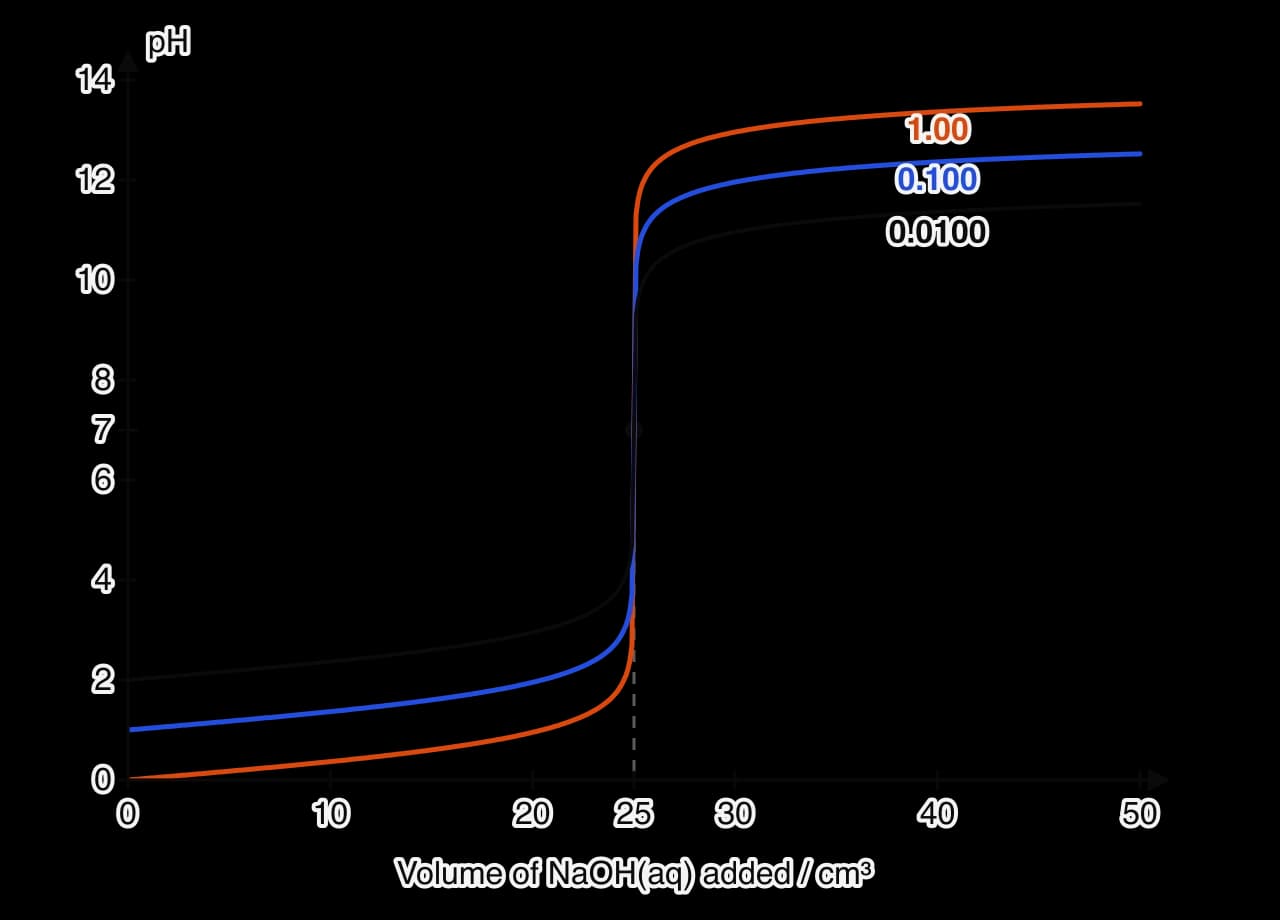
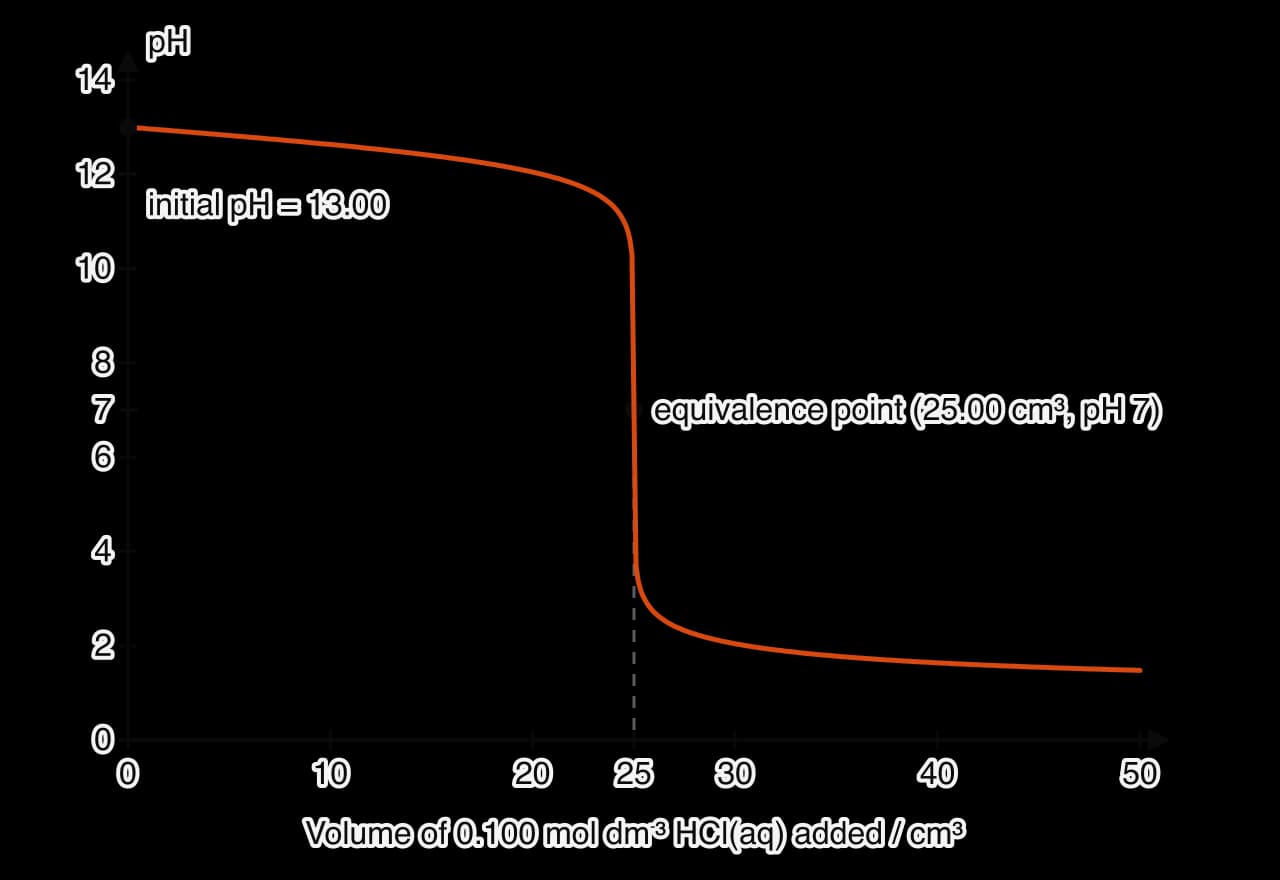
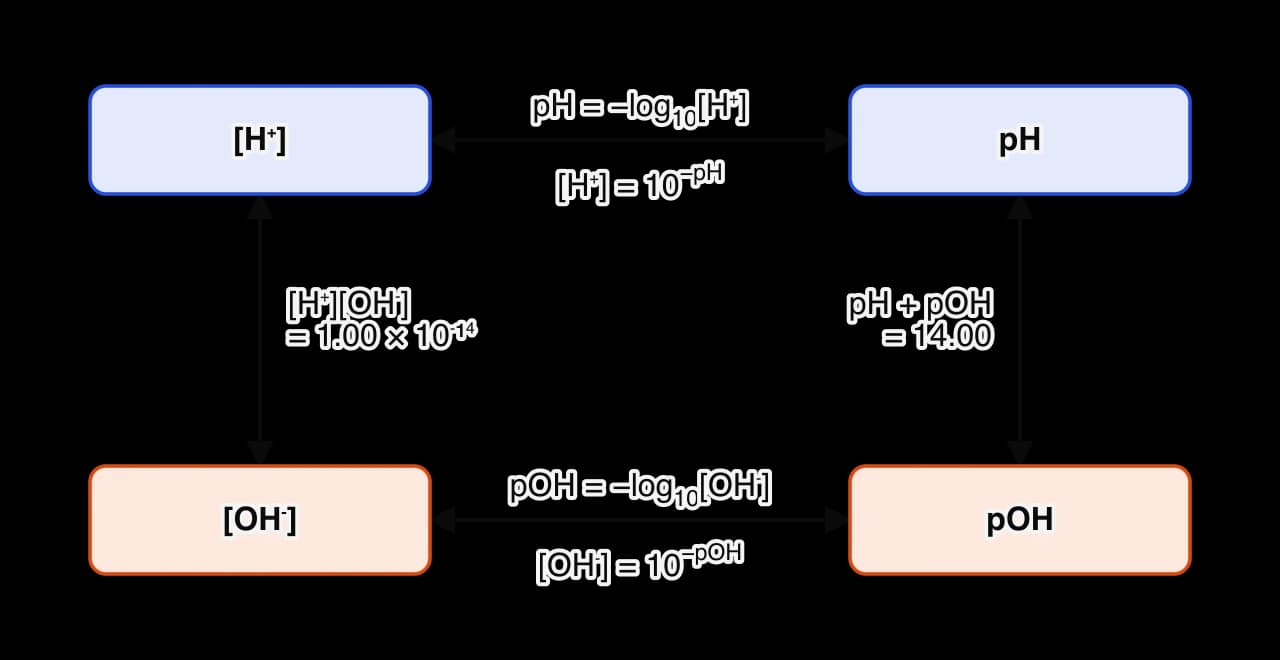
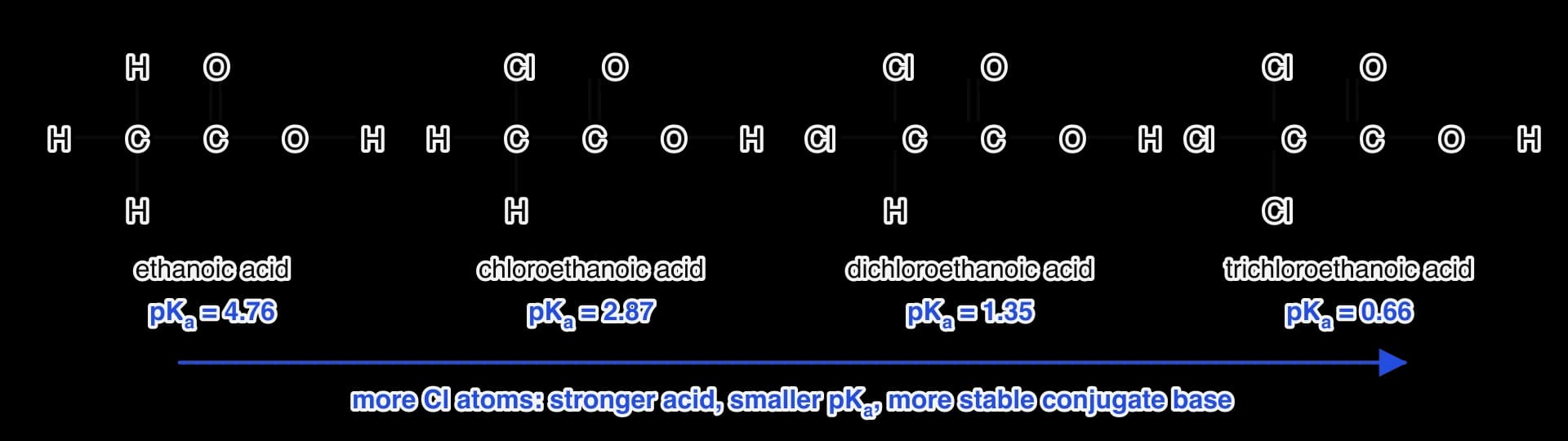
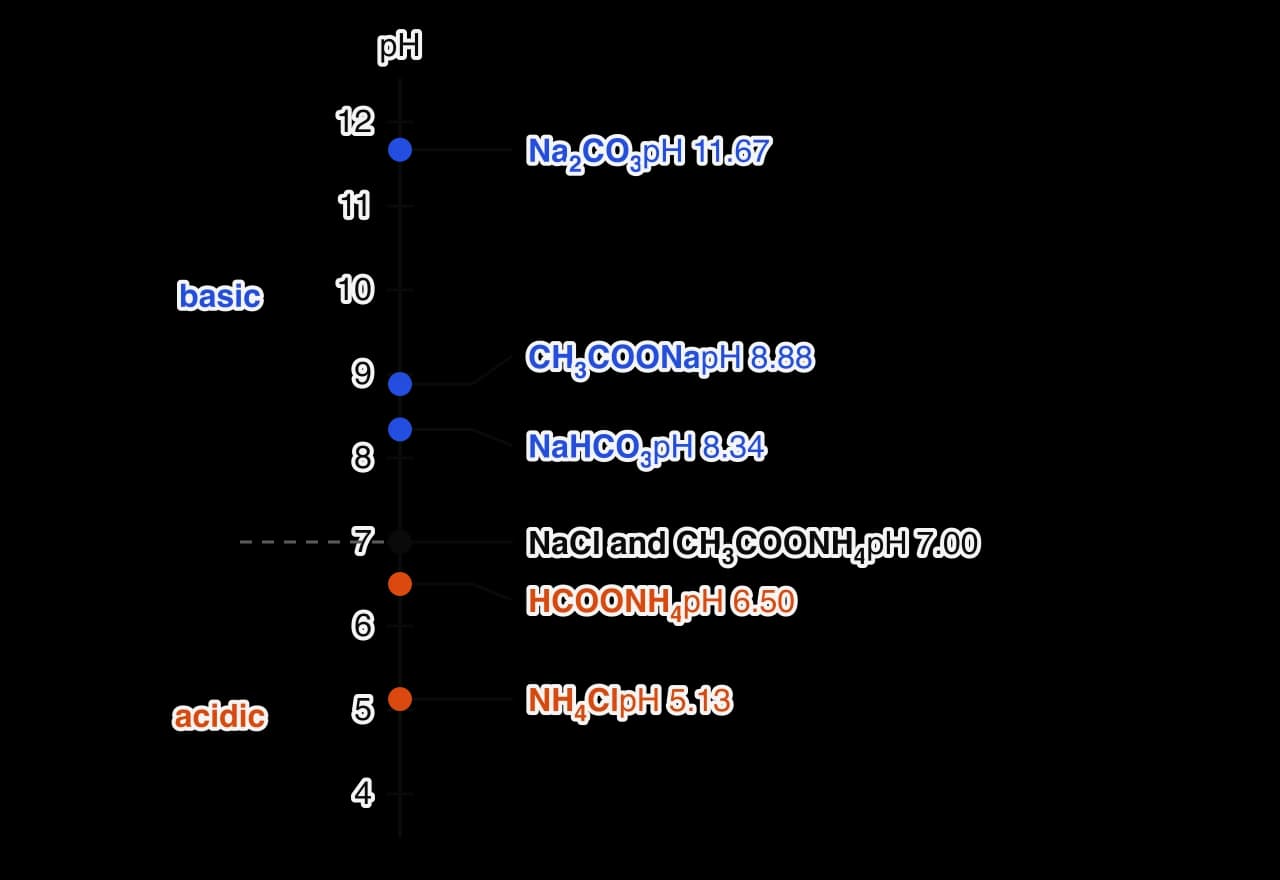
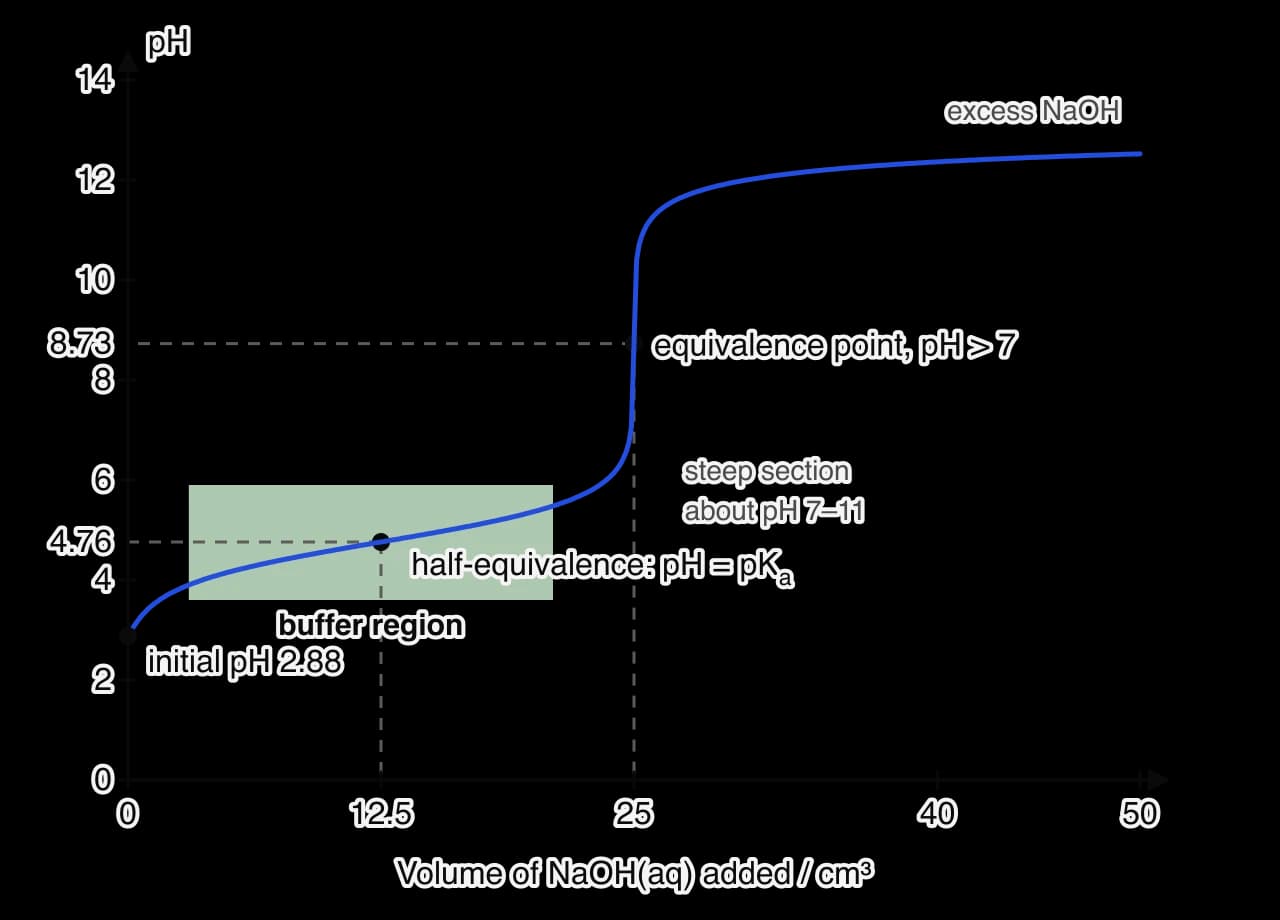
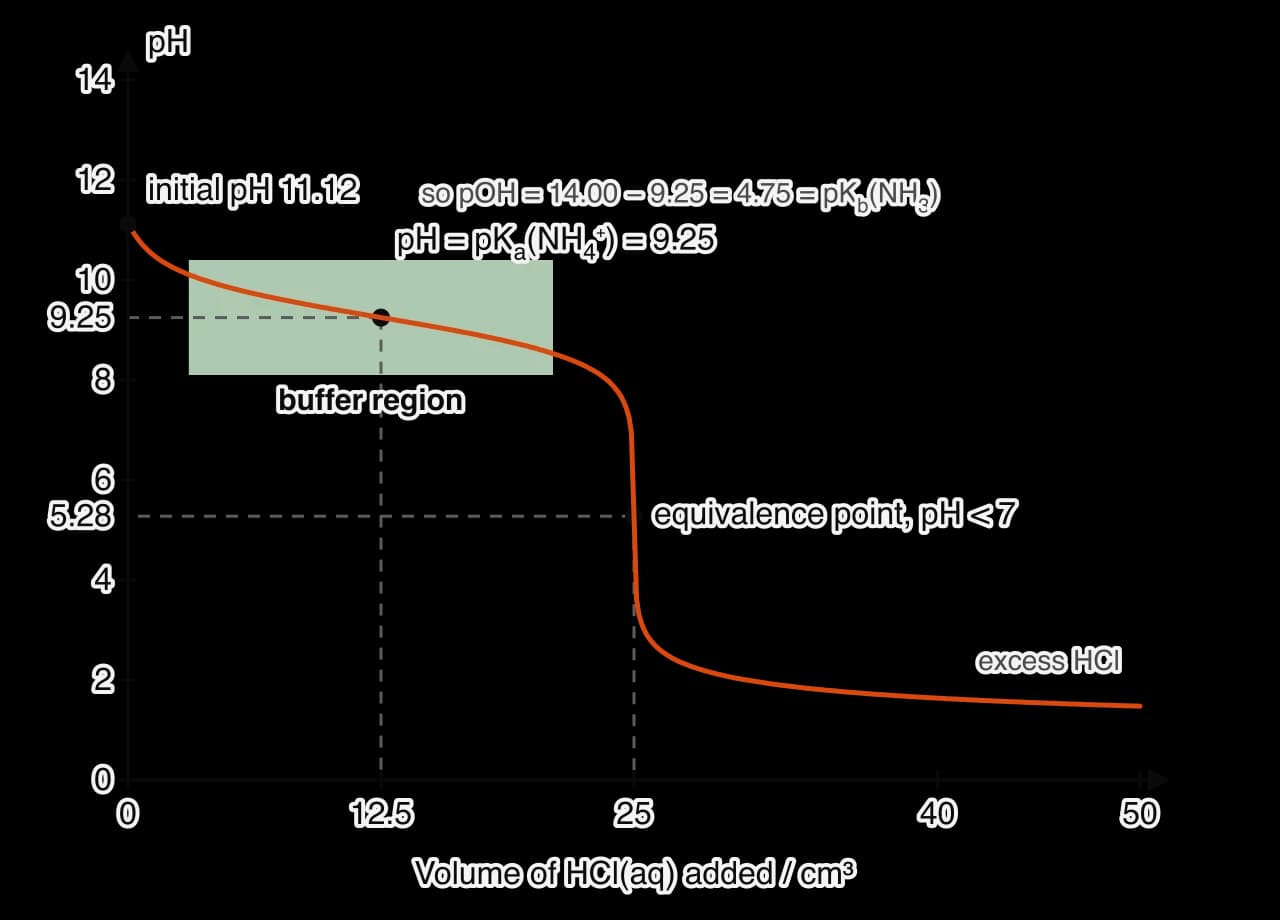
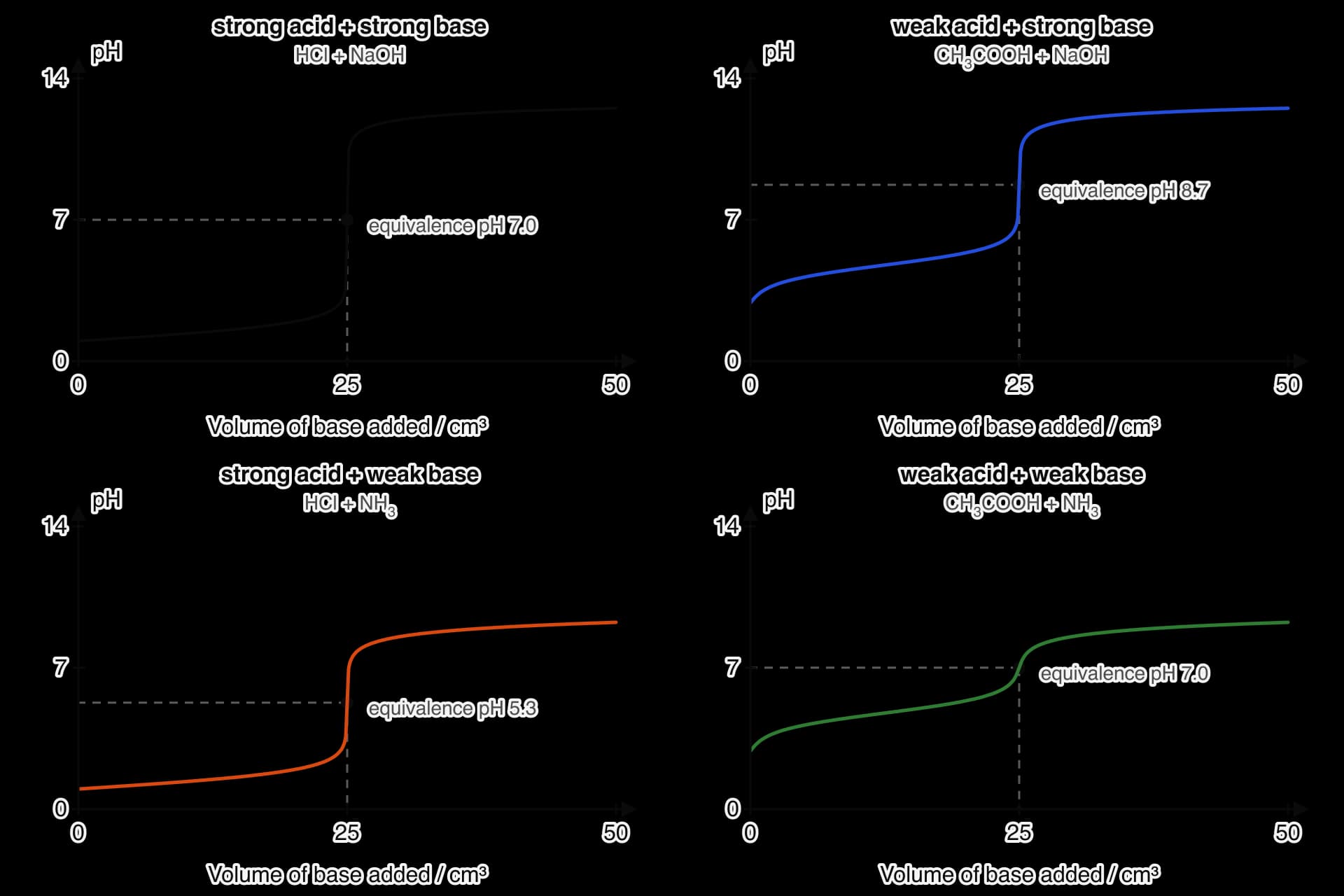
 YouTube