Notes on R3.2 Electron transfer reactions
Many of the most important reactions in chemistry and in everyday life involve the transfer of electrons from one species to another. Respiration, photosynthesis, the rusting of iron, the extraction of metals from their ores and every battery depend on these redox reactions. A lithium-ion battery in a phone, for example, stores energy in a reaction that releases electrons at one electrode and takes them up at the other, and recharging the battery drives the same reaction backwards.
Oxidation and reduction
The words oxidation and reduction first described reactions with oxygen: a metal "oxidized" when it combined with oxygen, and an ore was "reduced" when oxygen was removed from it to leave the metal. Chemists later found that the same pattern, one substance losing electrons while another gains them, runs through a much wider range of reactions, many of which involve no oxygen at all. Today four descriptions of oxidation and reduction are used, and each is useful in different situations.
Oxidation | Reduction | Example | |
|---|---|---|---|
Electrons | loss of electrons | gain of electrons |
The electron description is the most general, because it explains the other three. When magnesium burns in oxygen, each magnesium atom loses two electrons and each oxygen atom gains two, forming the ions in magnesium oxide:
Magnesium has gained oxygen and has also lost electrons, so it is oxidized by both descriptions. The same electron transfer happens when magnesium reacts with chlorine to form magnesium chloride, , although no oxygen is involved. Every reaction in which an ionic compound forms from its elements is a redox reaction for this reason. The oxygen and hydrogen descriptions remain convenient in organic chemistry, where electrons are shared rather than transferred and it is easier to count the oxygen and hydrogen atoms bonded to carbon.
Electrons cannot be destroyed or left over, so the electrons lost by one species must be gained by another. Oxidation and reduction therefore always happen together, and the total number of electrons lost equals the total number gained.
Oxidation states as a bookkeeping tool
For reactions between covalent species, or for complicated ions such as , it is not obvious which atoms have lost or gained electrons. Oxidation states make the electron transfer easy to follow. Each atom is given the charge it would carry if all its bonds were ionic, with the bonding electrons assigned to the more electronegative atom. The rules for assigning oxidation states are developed with the periodic table; the summary that follows is all that redox chemistry uses.
Rule | Example |
|---|---|
An uncombined element is 0. | , , |
Oxidation states are written with the sign first, +3 or −2, to distinguish them from ionic charges, which are written number first (). In names, the oxidation state of an element that has more than one is shown by a Roman numeral in brackets (Stock notation): iron(II) sulfate,
Variable oxidation states
Transition elements and most non-metals can take several oxidation states, so the same element can be oxidized or reduced in many different steps. Transition elements lose their 4s electrons and then a variable number of 3d electrons, and their compounds often have a different colour in each oxidation state. Non-metals such as nitrogen, sulfur and chlorine range from a negative value, when they are bonded to less electronegative atoms, to a high positive value when bonded to oxygen.
Element | Oxidation state: example species |
|---|---|
Manganese | +2: (very pale pink); +4: |
The vanadium sequence can be seen in a single test tube: a yellow solution of vanadium(V) shaken with zinc and acid turns blue, then green and finally violet as zinc reduces vanadium one step at a time.
Oxidation states are a model. They treat every bond as if it were ionic, and real molecules contain no such charges: the carbon in methane does not carry a charge of −4. The model can also give fractional averages, as in thiosulfate, that hide what happens to each atom. Its great advantage is that it lets electron transfer be counted in any reaction, ionic or covalent, using only the formulas of the species. Formal charge, an HL idea, makes the opposite assumption, that every bond is shared equally, and the two models together show the limits of each.
Identifying what is oxidized and reduced
To analyse a redox reaction, write the oxidation state of each element on both sides of the equation and look for those that change. An element whose oxidation state rises has been oxidized; one whose oxidation state falls has been reduced. The species that contains the reduced element took electrons from the other, so it is the oxidizing agent. The species that contains the oxidized element gave electrons away, so it is the reducing agent.
The reaction of manganese(IV) oxide with concentrated hydrochloric acid, used to make small amounts of chlorine in the laboratory, shows the method. The diagram of oxidation-state changes marks each element that changes.
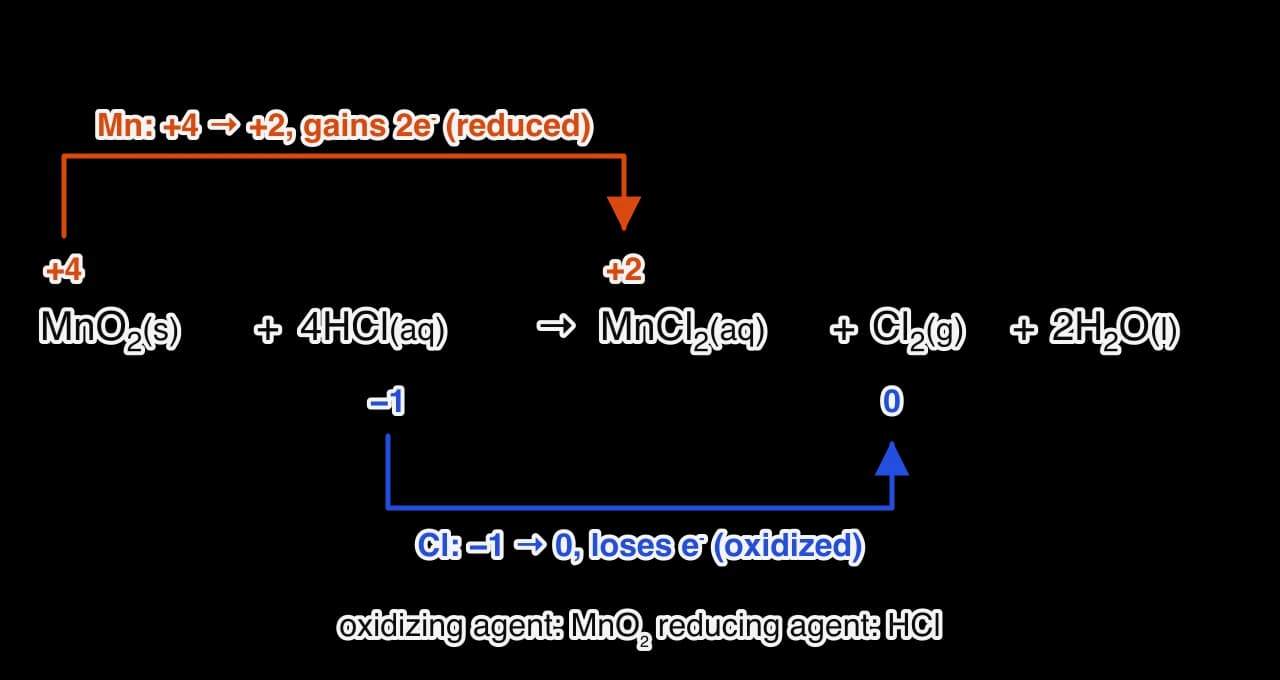
Manganese falls from +4 to +2, so is reduced and is the oxidizing agent. Chlorine rises from −1 to 0 in the chlorine molecule, so is oxidized and is the reducing agent. Hydrogen (+1) and oxygen (−2) do not change. Only two of the four chloride ions are oxidized: each
Not every reaction is a redox reaction. When magnesium nitride reacts with water,
In a few reactions one element is both oxidized and reduced. Chlorine reacts with cold, dilute sodium hydroxide to form the bleach sodium chlorate(I):
One chlorine atom of each molecule falls from 0 to −1 in and the other rises from 0 to +1 in . This is called disproportionation. Hydrogen peroxide decomposes in the same way,
Corrosion: rusting as a redox reaction
Corrosion is the gradual oxidation of a metal at its surface by substances in its environment. The rusting of iron, which needs both oxygen and water, is the most costly example. Iron atoms at one part of the surface are oxidized, and the electrons they release travel through the metal to another part of the surface, where oxygen dissolved in the water is reduced:
The iron(II) ions and hydroxide ions form iron(II) hydroxide, which is oxidized further by air to hydrated iron(III) oxide,
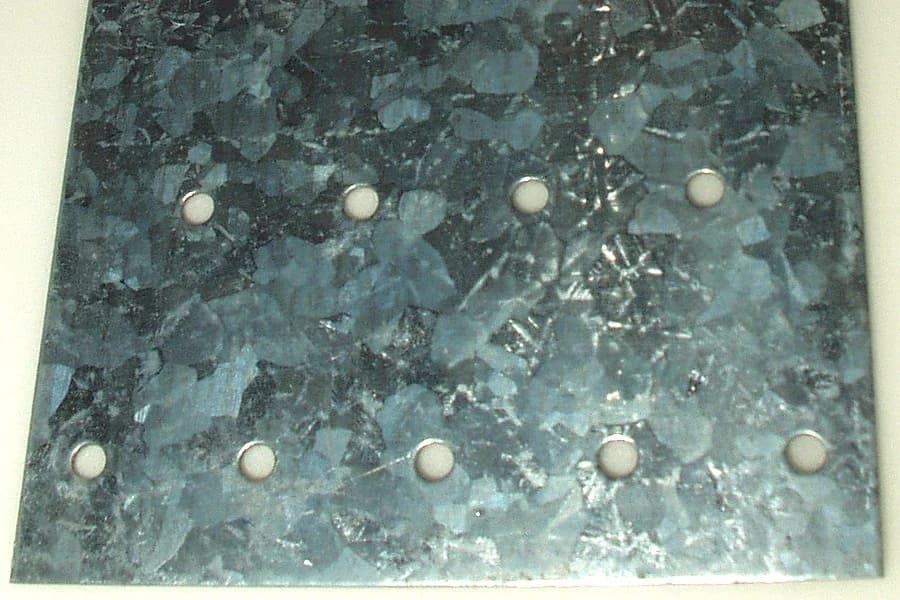
Iron can be protected by a barrier (paint, oil, plastic) or by attaching a more easily oxidized metal. In galvanizing, steel is coated with zinc. Zinc is oxidized in preference to iron, giving up its electrons to the iron, so the iron is not oxidized even where the coating is scratched. Blocks of zinc or magnesium bolted to ship hulls and buried pipelines work the same way: the more reactive metal corrodes instead of the iron, and the blocks are replaced when they have been used up. This method is called sacrificial protection.
Half-equations
A redox reaction can be split into two half-equations, one showing the oxidation and the other the reduction. Each half-equation includes the electrons lost or gained, written as . When zinc reacts with copper(II) ions,
A half-equation must balance in two ways: the same number of each type of atom on both sides, and the same total charge on both sides. The electrons supply the charge balance. In the half-equation for chlorine,
Species | Half-equation | Type |
|---|---|---|
Metal atom to ion |
Balancing half-equations in acidic solution
Oxyanions such as manganate(VII), , and dichromate(VI),
Balance the atoms of the element that changes oxidation state.
Balance oxygen by adding to the side that needs oxygen.
Balance hydrogen by adding
The same method gives the other half-equations that are met most often. In each, the number of electrons equals the change in oxidation state multiplied by the number of atoms that change.
Change | Half-equation in acidic solution |
|---|---|
(Mn +7) to |
Combining half-equations
To build the full redox equation, multiply one or both half-equations so that the electrons lost in the oxidation equal the electrons gained in the reduction. Then add the two half-equations, cancel the electrons and any species that appear on both sides, and check the atoms and charges once more. Electrons never appear in a full redox equation.
A second example combines two half-equations that each have two electrons. Hydrogen peroxide oxidizes iodide ions in acidic solution, and the brown iodine formed makes the reaction easy to follow:
When the electron numbers have no simple multiple, both half-equations are multiplied. For manganate(VII) (5 electrons) oxidizing ethanedioate ions (2 electrons), the lowest common multiple is 10, so the reduction is multiplied by 2 and the oxidation by 5:
Redox titrations
Balanced redox equations give the mole ratios used in a redox titration, in which a solution of an oxidizing or reducing agent of known concentration is used to find the amount of another species. Two kinds are common in school laboratories.
Manganate(VII) titrations. Acidified potassium manganate(VII) is added from the burette to a reducing agent such as ,
The calculation follows the usual steps: amount of the titrant from , the mole ratio from the balanced equation, then the amount, concentration or mass of the substance being analysed. The ratio is often not 1 : 1; in the iron(II)–manganate(VII) titration one mole of
The reactivity of metals and halogens
Metals react by losing electrons to form positive ions, so a metal acts as a reducing agent and is itself oxidized. The more easily a metal is oxidized, the more reactive it is. Non-metals such as the halogens react by gaining electrons, so they act as oxidizing agents and are themselves reduced. The ease of each process can be predicted from position in the periodic table.
Trends down a group
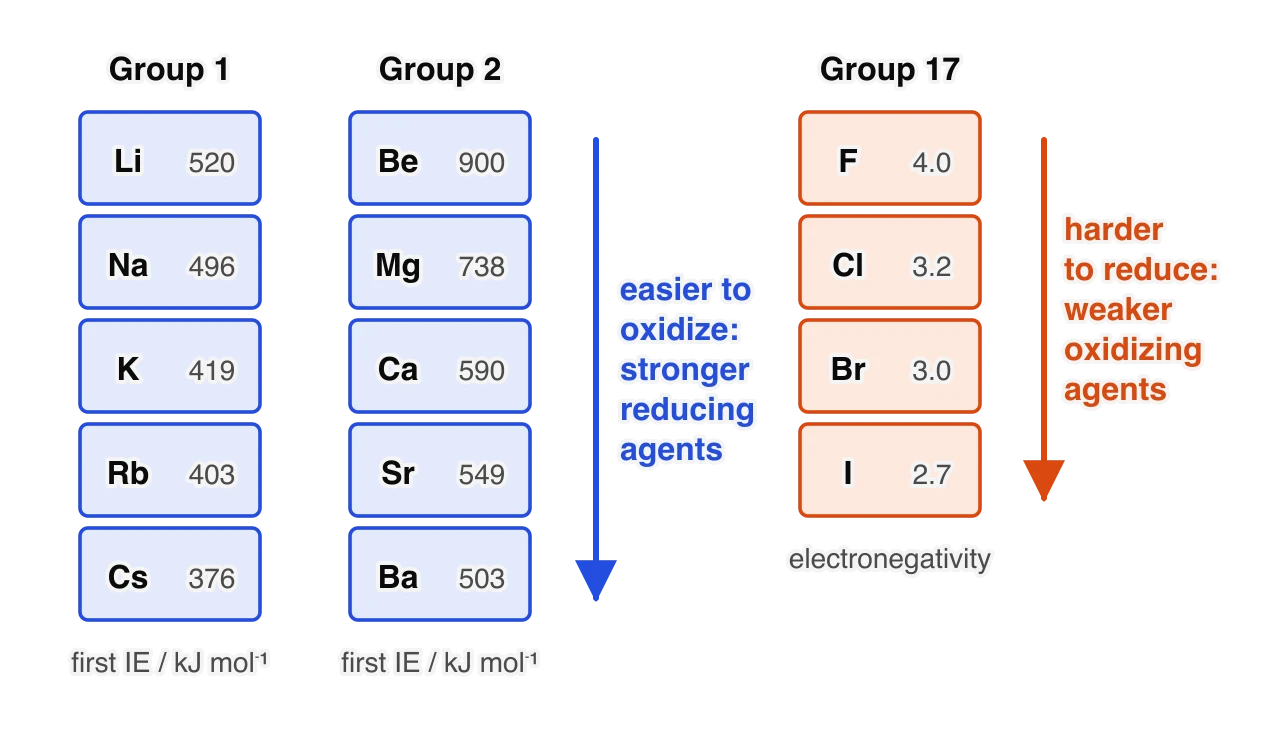
Down group 1 and group 2 the atoms have more occupied main energy levels. The outer electrons are further from the nucleus and more shielded by the inner electrons, so they are held less strongly, even though the nuclear charge increases. Less energy is needed to remove them, as the falling first ionization energies show, so the metals are oxidized more easily and become stronger reducing agents down each group. Potassium reacts with water more vigorously than sodium, and barium more vigorously than magnesium.
Down group 17 the opposite happens. A halogen atom reacts by gaining an electron into its outer level. As the atoms get larger the incoming electron is further from the nucleus and more shielded, so it is attracted less strongly. The halogens are therefore reduced less easily and are weaker oxidizing agents down the group:
A more reactive halogen oxidizes the halide ions of a less reactive halogen. Chlorine water added to potassium bromide solution turns it orange-brown as bromine is released:
Chlorine (0 → −1) is reduced and is the oxidizing agent, while the bromide ions (−1 → 0) are oxidized. Bromine oxidizes iodide ions, giving brown iodine, but neither bromine nor iodine can oxidize chloride ions. In water, chlorine is pale green or almost colourless, bromine yellow to orange-brown and iodine brown. Shaking with a non-polar solvent such as cyclohexane distinguishes bromine (orange in the organic layer) from iodine (purple), as the description of the halogens in the periodic table shows in more detail.
Displacement reactions of metals
A metal that is oxidized more easily can reduce the ions of a less reactive metal. When a strip of zinc is placed in blue copper(II) sulfate solution, zinc atoms give electrons to copper(II) ions. Copper is deposited and zinc ions go into solution:
The sulfate ions are spectator ions and are left out of the ionic equation. This is a displacement reaction: the more reactive metal displaces the less reactive metal from a solution of its ions. A strip of copper in zinc sulfate solution shows no change, because copper cannot reduce zinc ions.

Testing each metal with solutions of the others gives a grid of results from which the metals can be placed in order. The results for four common metals (✓ = a reaction is seen, ✗ = no reaction) are typical:
Metal added |
|---|
The metal that displaces the most others, magnesium, is the most easily oxidized and the strongest reducing agent; copper, which displaces none of them, is the least. The order Mg > Zn > Fe > Cu is part of the reactivity series (also called the activity series), which lists metals in order of their ease of oxidation:
The position of a metal in the series reflects the total energy change for
Reactions of metals with acids
Metals above hydrogen in the reactivity series react with dilute hydrochloric acid and dilute sulfuric acid to form a salt and hydrogen gas. The metal is oxidized to its positive ion and the hydrogen ions of the acid are reduced to hydrogen molecules:
Leaving out the spectator ions gives the same ionic equation for every metal of a given charge. For magnesium with either acid:
Magnesium (0 → +2) is oxidized and is the reducing agent; hydrogen (+1 → 0) is reduced, so the hydrogen ion is the oxidizing agent. The observations are effervescence (bubbles of gas), the metal getting smaller and dissolving, and a rise in temperature. The gas burns with a squeaky pop when a lighted splint is held at the mouth of the tube. Iron forms iron(II) salts, not iron(III) salts, because the hydrogen ion is too weak an oxidizing agent to take iron beyond +2.
The rate of bubbling follows the reactivity series. Magnesium fizzes rapidly, zinc steadily and iron slowly, while copper, silver and gold, which lie below hydrogen, do not react with dilute acids at all. Group 1 metals react dangerously violently and are never added to acids. Nitric acid behaves differently from other acids because the nitrate ion is itself a strong oxidizing agent; it reacts even with copper, releasing oxides of nitrogen rather than hydrogen.
Electrochemical cells: anode and cathode
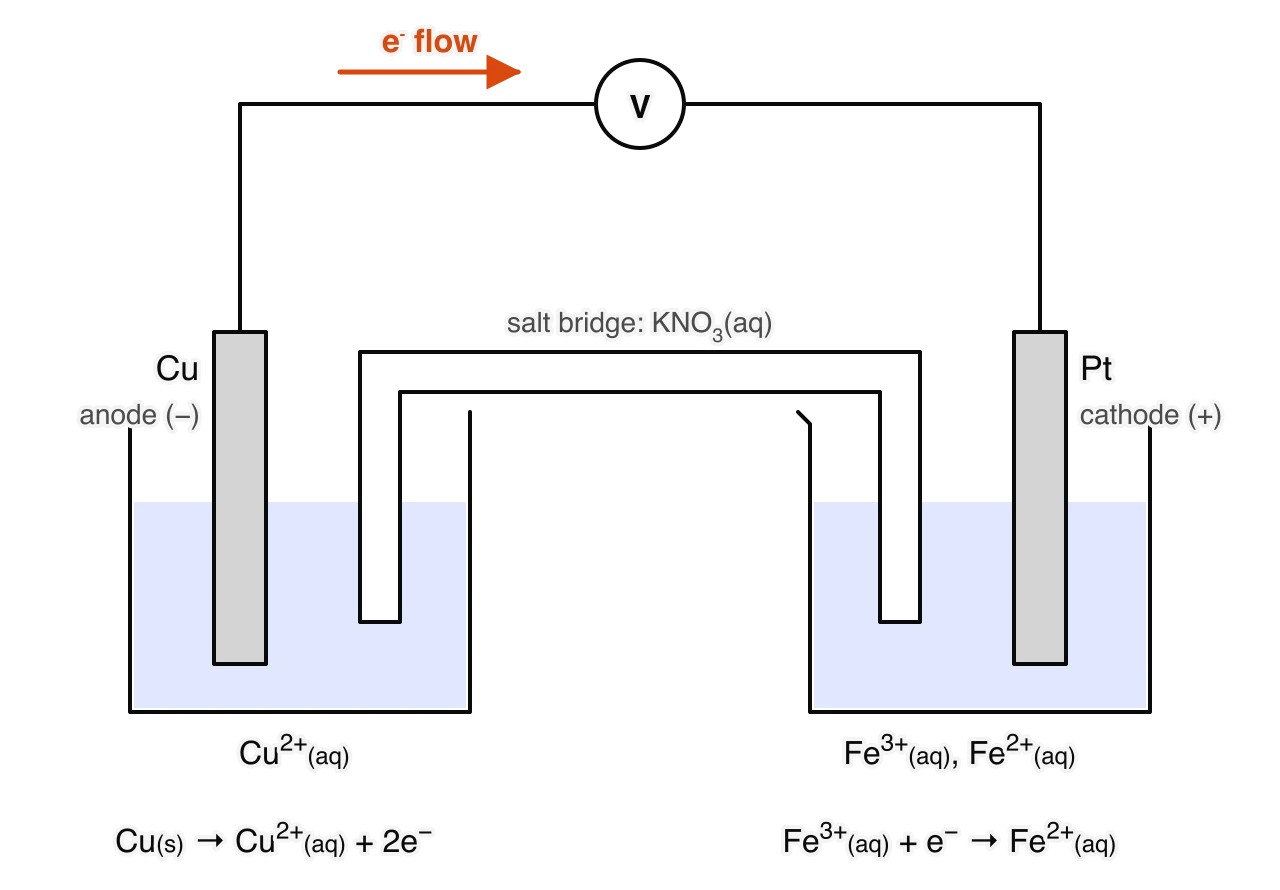
An electrochemical cell is any arrangement in which a redox reaction takes place at two separate electrodes connected by an external circuit, so that the electrons transferred travel through a wire. There are two kinds. In a voltaic cell a spontaneous redox reaction produces an electric current. In an electrolytic cell an external electrical supply forces a non-spontaneous redox reaction to happen. In both, the names of the electrodes depend only on the reaction at each one.
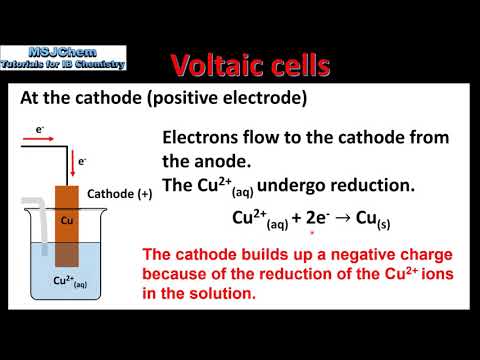
The sign of each electrode does depend on the type of cell. In a voltaic cell, oxidation at the anode releases electrons into the electrode, which builds up a negative charge; the cathode loses electrons to the species being reduced and is positive. In an electrolytic cell, the external supply pulls electrons away from the anode, so the anode is the electrode connected to the positive terminal, and pushes them into the cathode, which is connected to the negative terminal.
Voltaic cell | Electrolytic cell | |
|---|---|---|
Energy change | chemical energy → electrical energy | electrical energy → chemical energy |
Redox reaction | spontaneous | non-spontaneous, driven by the supply |
Anode | oxidation; negative (−) | oxidation; positive (+) |
Cathode | reduction; positive (+) | reduction; negative (−) |
Electron flow in the wire | anode → cathode | anode → cathode (pumped by the supply) |
Structure | two half-cells joined by a salt bridge | two electrodes in one electrolyte |
Voltaic cells
When zinc is placed directly in copper(II) sulfate solution, electrons pass from zinc atoms to copper(II) ions at the surface of the metal and the energy released appears as heat. If the oxidation and the reduction are made to happen in separate containers, the electrons must travel through a wire to get from the zinc to the copper(II) ions, and the energy can do electrical work, lighting a bulb or running a motor. This is the principle of the voltaic cell (also called a galvanic cell).
The Daniell cell
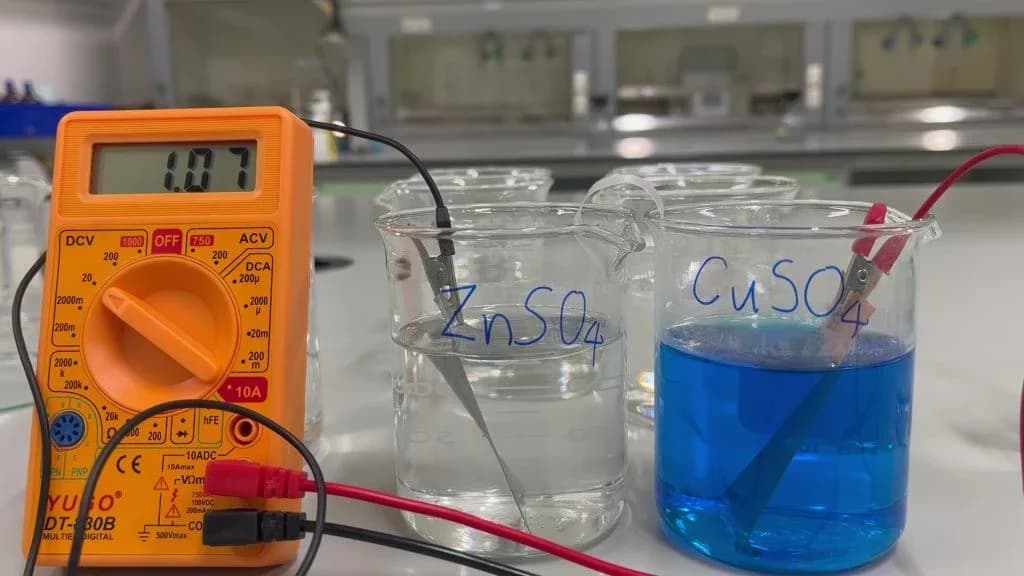
The Daniell cell, invented by John Frederic Daniell in 1836, is the standard example. One half-cell is a strip of zinc in zinc sulfate solution and the other a strip of copper in copper(II) sulfate solution. The metals are connected by a wire through a voltmeter or a bulb, and the solutions by a salt bridge, a tube or strip of filter paper soaked in a solution of an unreactive salt such as potassium nitrate.

Zinc is more easily oxidized than copper, so zinc atoms lose electrons and enter the solution as zinc ions: the zinc electrode is the anode and is negative. The electrons flow through the external circuit to the copper electrode, where copper(II) ions from the solution gain them and are deposited as copper: the copper electrode is the cathode and is positive. Over time the zinc electrode loses mass, the copper electrode gains mass and the blue colour of the copper(II) sulfate solution slowly fades. The cell reaction is the same as the displacement reaction:
The role of the salt bridge
Without a salt bridge the cell stops working almost at once. As zinc ions enter the solution in the anode half-cell, that solution would gain positive charge; as copper(II) ions leave the solution in the cathode half-cell, that solution would be left with an excess of negative sulfate ions. The charge separation would quickly oppose any further electron flow. The salt bridge allows ions to move between the half-cells and keeps each solution electrically neutral:
anions () move out of the salt bridge towards the anode half-cell, balancing the zinc ions being formed;
cations (
The salt bridge therefore completes the circuit. Charge is carried by electrons in the wire and electrodes, and by moving ions in the solutions and the salt bridge; electrons never travel through the solutions. The salt used must not react with either solution: potassium chloride, for example, is unsuitable with a silver half-cell because silver chloride would precipitate.
 YouTube
Predicting the electrodes of a voltaic cell
Any two different metals in solutions of their own ions can make a voltaic cell. The more reactive metal is oxidized more easily, so it is always the anode (negative), and the ions of the less reactive metal are reduced at the cathode (positive). The greater the difference in reactivity between the two metals, the larger the voltage of the cell: a magnesium–copper cell gives a larger voltage than a zinc–copper cell, which gives a larger one than an iron–copper cell. Calculating these voltages from standard electrode potentials is an HL extension.
Simple cells
A voltaic cell does not need two separate solutions. A lemon with a strip of zinc and a strip of copper pushed into it produces a small voltage, less than one volt, enough to run a digital clock. The lemon juice is the electrolyte: it contains mobile ions that carry charge between the metals. The zinc, as the more reactive metal, is the anode, and electrons flow from it through the wire to the copper, where hydrogen ions from the acidic juice are reduced. The same principle explains why two different metals in contact with salt water, such as a steel bolt in an aluminium boat fitting, can corrode rapidly.
Cells compared with combustion
Electrical energy can come either from burning a fuel in a power station or directly from a redox reaction in a cell. Both are exothermic redox reactions, and in both a fuel or metal is oxidized and an oxidizing agent such as oxygen is reduced. In combustion the reactants are mixed and electrons pass directly between them, so the energy is released as heat, which must then be converted into electricity through turbines and generators, with large losses at each step. A cell keeps the oxidation and reduction apart and makes the electrons pass through an external circuit, so much more of the chemical energy becomes electrical energy. Fuel cells, which run on hydrogen or methanol, use this idea on a large scale.
Primary, secondary and fuel cells
The batteries used in torches, phones and cars are voltaic cells (a battery is strictly several cells joined together). They differ in whether their reaction can be reversed.
Primary cells
The common alkaline primary cell has a zinc powder anode and a manganese(IV) oxide cathode in a paste of potassium hydroxide, and gives about 1.5 V. Simplified half-equations are:
When the zinc or the manganese(IV) oxide is used up, the cell is "flat". Trying to recharge it does not regenerate the original electrode materials in their working form, and can make the cell leak or burst.
Secondary cells
In a secondary cell, the products of the discharge reaction stay on the electrodes, usually as solids, in a form that can be converted back to the reactants. During discharge the cell acts as a voltaic cell. During charging an external power supply pushes electrons the other way, so every electrode reaction is reversed and the cell acts as an electrolytic cell. The electrode that was the anode during discharge becomes the cathode during charging, and vice versa, because the names follow the reaction.
The lead–acid cell, used in car batteries, has a lead anode and a lead(IV) oxide cathode in sulfuric acid. During discharge both electrodes become coated with lead(II) sulfate:
Lead is oxidized from 0 to +2 and lead(IV) oxide is reduced from +4 to +2. Each cell gives about 2 V, and a 12 V car battery contains six cells in series. While the engine runs, the alternator recharges the battery and both half-equations run in reverse:
To deduce the charging reactions from the discharge reactions, reverse each half-equation: the electrons move to the other side, and oxidation becomes reduction. The same rule works in the opposite direction.
Reversible electrode reactions share some features with the reversible reactions of an equilibrium system: the same products can be turned back into the same reactants, and the direction depends on the conditions, here whether energy is supplied or taken out. A secondary cell is not at equilibrium while it works, however. On discharge the reaction runs one way because it is spontaneous; on charging an external supply drives it the other way. The solid products must stay attached to the electrodes in a structure that can be converted back, and side reactions slowly damage the electrodes, which is why every rechargeable cell eventually loses capacity.
Case study: the lithium-ion cell
The lithium-ion cell powers almost every phone, laptop and electric car. Its development earned John B. Goodenough, M. Stanley Whittingham and Akira Yoshino the Nobel Prize in Chemistry in 2019, and the first commercial cells went on sale in 1991. Lithium is used because it is the least dense metal and is very easily oxidized, so a cell can store a large amount of energy for its mass and gives a high voltage, about 3.6–3.7 V, compared with 1.2–2 V for older rechargeable cells.
Neither electrode contains lithium metal. The negative electrode is graphite, between whose layers lithium atoms can be held, and the positive electrode is a metal oxide such as lithium cobalt oxide, . The electrolyte is a lithium salt dissolved in an organic solvent, because lithium reacts with water. During discharge, lithium atoms in the graphite are oxidized; the lithium ions travel through the electrolyte and enter the metal oxide, while the electrons travel through the external circuit:
Cobalt is reduced from +4 to +3 as the lithium ions arrive. Charging drives the lithium ions back into the graphite.

Lithium-ion cells have disadvantages too. The organic electrolyte is flammable, so a damaged or overheated cell can catch fire, and cells lose capacity over hundreds of charging cycles. Mining lithium and cobalt has environmental and human costs, and recycling the cells is still difficult, which has encouraged cathodes containing less cobalt, such as lithium iron phosphate.
Fuel cells and the choice of cell
A fuel cell is a voltaic cell to which the reactants, a fuel such as hydrogen or methanol and oxygen from the air, are supplied continuously, so it never runs flat and is never recharged. The hydrogen–oxygen and methanol fuel cells, and their half-equations, are described with the energy from fuels. The choice between the three types of cell depends on the use.
Cell | Advantages | Disadvantages |
|---|---|---|
Primary (e.g. alkaline) | cheap; ready to use; light and portable; long shelf life; low self-discharge, good for devices used rarely (smoke alarms, remote controls) | single use, so expensive per unit of energy; large amounts of waste; uses up metal resources; some contain toxic metals |
Secondary (e.g. lead–acid, lithium-ion) | recharged hundreds or thousands of times, so cheaper over its life and less waste; high power for vehicles and electronics | higher initial cost; recharging needs electricity, which may come from fossil fuels; capacity falls with use; some contain toxic or scarce metals (lead, cadmium, cobalt); lithium-ion cells are a fire risk |
Fuel cell | runs as long as fuel is supplied; high efficiency; a hydrogen cell produces only water at the point of use; quiet, no moving parts | expensive platinum catalysts; hydrogen is hard to store and transport and is mostly made from fossil fuels; a methanol cell releases carbon dioxide |
Electrolytic cells
Electrolysis uses electrical energy to bring about a redox reaction that would not happen on its own, such as decomposing a stable compound into its elements. It is carried out in an electrolytic cell.
The electrolyte is an ionic compound that is molten or dissolved in water, so that its ions are free to move. The electrodes are usually inert electrodes, made of graphite or platinum, which conduct electricity but do not take part in the reaction. The electrode connected to the positive terminal of the supply is the anode, and the one connected to the negative terminal is the cathode.
How the current is conducted
An electric current is a flow of charge, and in an electrolytic cell it is carried by two kinds of particle:
in the external circuit and the electrodes, by electrons, which the supply pumps from the anode, round the circuit, to the cathode;
in the electrolyte, by ions: cations are attracted to the negative cathode, and anions to the positive anode.
At the surfaces of the electrodes the two kinds of conduction are linked by redox reactions. At the cathode, cations gain electrons from the electrode and are reduced. At the anode, anions give up electrons to the electrode and are oxidized. The electrons released at the anode are the ones the supply pumps round to the cathode.
A solid ionic compound cannot be electrolysed, because its ions are held in fixed positions in the lattice and cannot move to the electrodes. Melting the solid or dissolving it in water frees the ions, which is why ionic compounds are electrolytes only when molten or in aqueous solution.
Electrolysis of molten salts
In a molten binary salt the only ions present are the metal cation and the non-metal anion. The metal is always produced at the cathode and the non-metal at the anode. Lead(II) bromide is often used to demonstrate this because it melts at a fairly low temperature (about 370 °C); the experiment is carried out in a fume cupboard because bromine is toxic.
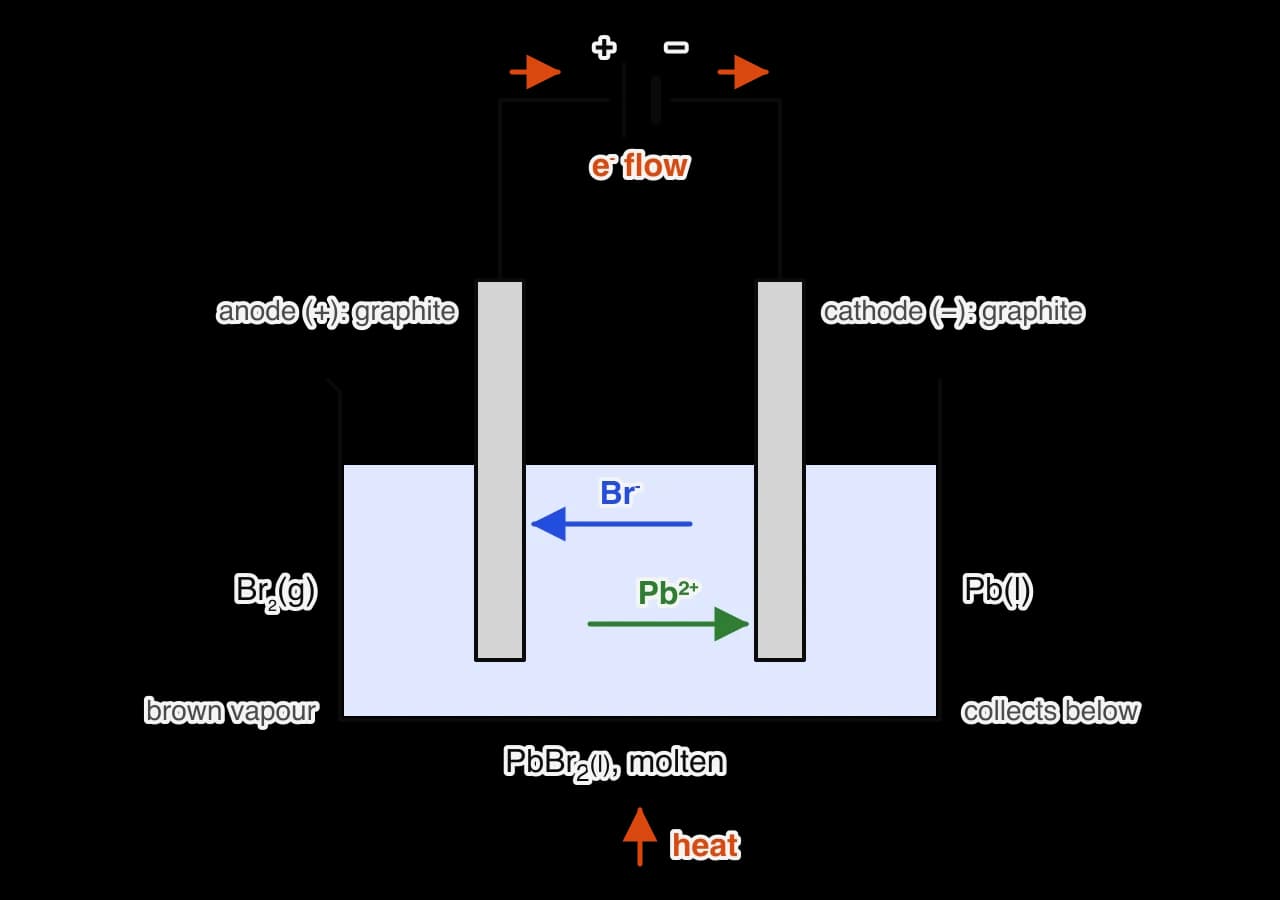
Brown bromine vapour is given off at the anode, and silvery beads of molten lead collect beneath the cathode. The state symbols depend on the temperature of the melt. Lead melts at 327.5 °C (data booklet), so at about 400 °C it is formed as a liquid. Bromine boils at 58.78 °C, so it is formed as a gas. Molten ions in the electrolyte carry the state symbol (l), not (aq).
Electrolysis of molten compounds is the only practical way to obtain the most reactive metals, because no cheaper reducing agent can take electrons from their ions. In the Downs cell, sodium is made by electrolysing molten sodium chloride mixed with calcium chloride, which lowers the melting point from 801 °C to about 600 °C and saves energy. Aluminium is extracted by the Hall–Héroult process, in which aluminium oxide is dissolved in molten cryolite at about 950 °C and electrolysed with carbon electrodes. Aluminium ions are reduced to molten aluminium at the cathode, and oxide ions are oxidized at the anode; the oxygen formed reacts with the hot carbon anodes, which burn away to carbon dioxide and must be replaced regularly. The large amount of electricity used means aluminium smelters are often built near cheap hydroelectric power, and recycling aluminium uses only about 5 % of the energy needed to extract it.
In aqueous solutions water molecules can also be oxidized or reduced at the electrodes, in competition with the ions of the dissolved salt; predicting the products is an HL extension.
Oxidation of alcohols
The functional groups of organic compounds can also be oxidized and reduced. Because the electrons in organic molecules are shared, the oxygen and hydrogen descriptions are the easiest to use: oxidation adds oxygen to, or removes hydrogen from, the carbon atom that carries the functional group. The oxidation state of that carbon increases as it forms more bonds to oxygen and fewer to hydrogen, as the series of one-carbon compounds from methane to carbon dioxide shows.
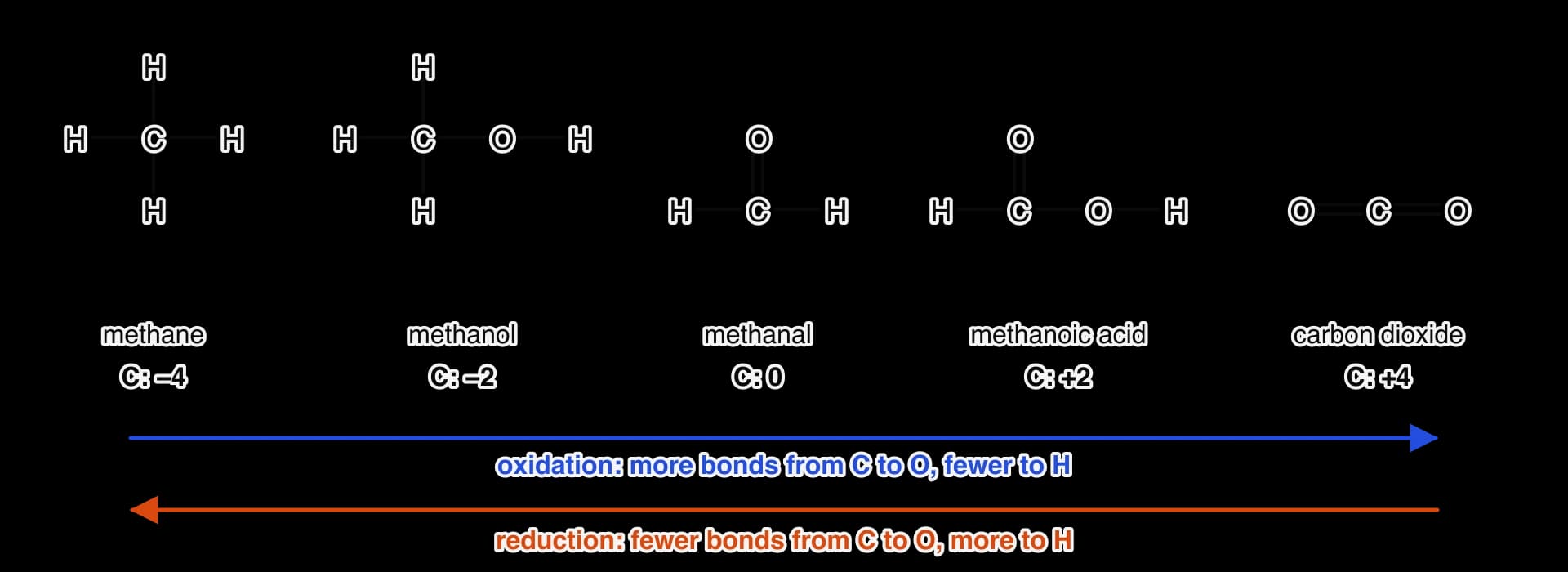
In equations the oxidizing agent is written as [O], meaning oxygen supplied by the oxidizing agent, and the reducing agent as [H]. These equations must still balance in atoms. A commonly used oxidizing agent is potassium dichromate(VI) acidified with dilute sulfuric acid. As it oxidizes the alcohol, orange dichromate(VI) ions, with chromium at +6, are reduced to green chromium(III) ions. The colour change is a useful sign that oxidation has occurred; the colours come from the different numbers of d electrons in the two oxidation states of chromium, an HL idea. Acidified potassium manganate(VII), which turns from purple to colourless, can be used in the same way.
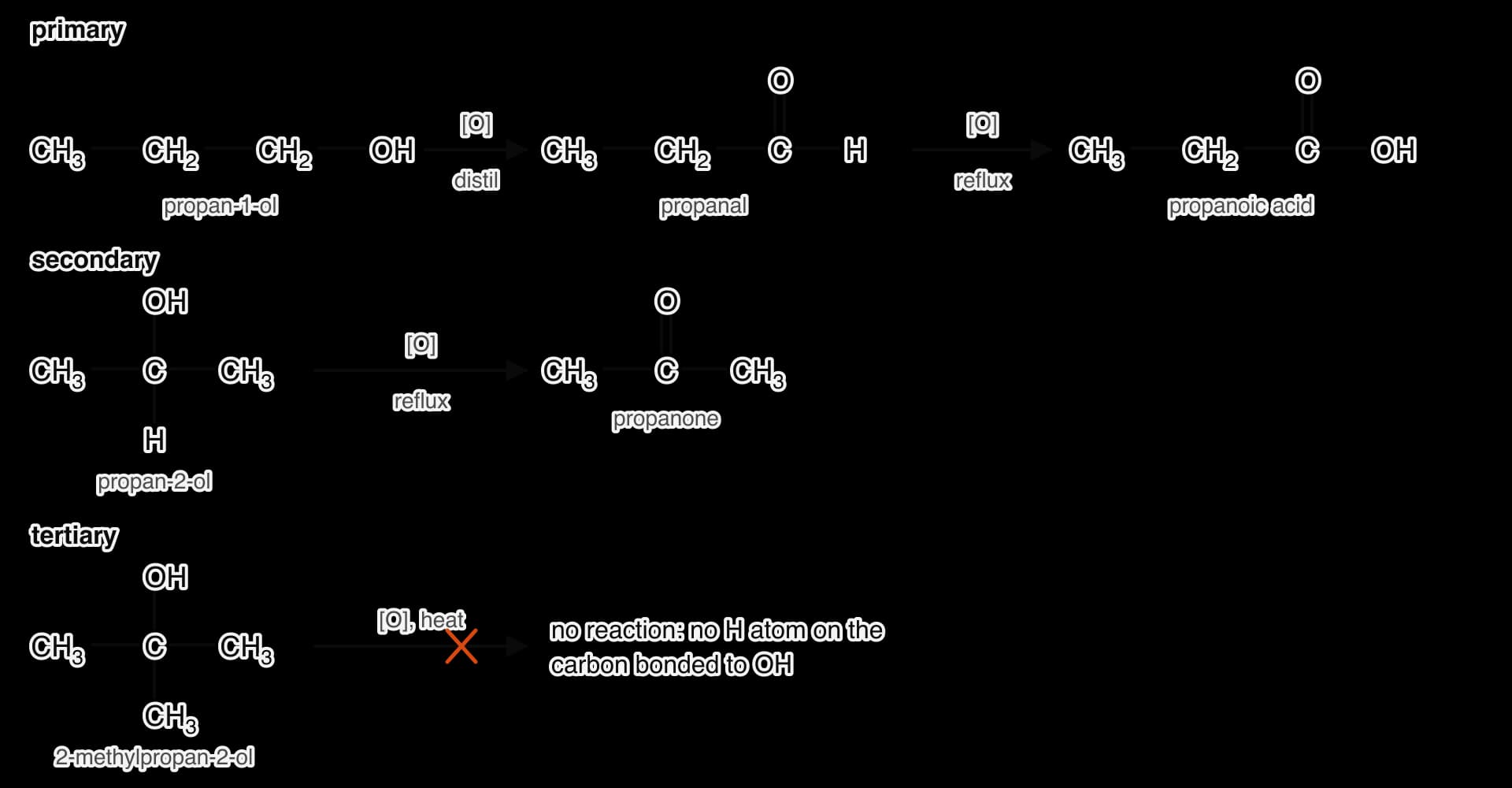
What an alcohol is oxidized to depends on how many hydrogen atoms are attached to the carbon atom bonded to the –OH group. This sorts alcohols into three classes:
a primary alcohol has the –OH group on a carbon bonded to at most one other carbon atom, so that carbon carries two hydrogen atoms (ethanol,
Primary alcohols: aldehydes, then carboxylic acids
A primary alcohol is oxidized in two steps. First it loses two hydrogen atoms, one from the –OH group and one from the carbon atom, to form an aldehyde. The aldehyde can then gain an oxygen atom to form a carboxylic acid:
The oxidation state of the functional-group carbon rises from −1 in ethanol to +1 in ethanal and +3 in ethanoic acid. Which product is obtained depends on how the reaction is carried out.
To obtain the aldehyde, the alcohol is heated with a limited amount of acidified oxidizing agent and the aldehyde is distilled off as it forms. The aldehyde has the lowest boiling point in the mixture: ethanal boils at 20 °C, ethanol at 78 °C and ethanoic acid at 118 °C. Molecules of an aldehyde cannot form hydrogen bonds with each other, as they have no O–H group, so the forces between them are much weaker than in the alcohol or the acid. The aldehyde vapour leaves the hot mixture straight away and is collected before it can be oxidized further.
To obtain the carboxylic acid, the alcohol is heated with excess acidified oxidizing agent under reflux. A condenser fitted vertically above the flask turns all the vapours back to liquid, which drips back into the flask. The mixture can then be heated for a long time without any reactant or intermediate escaping, so any aldehyde formed stays in the mixture and is oxidized completely to the acid.
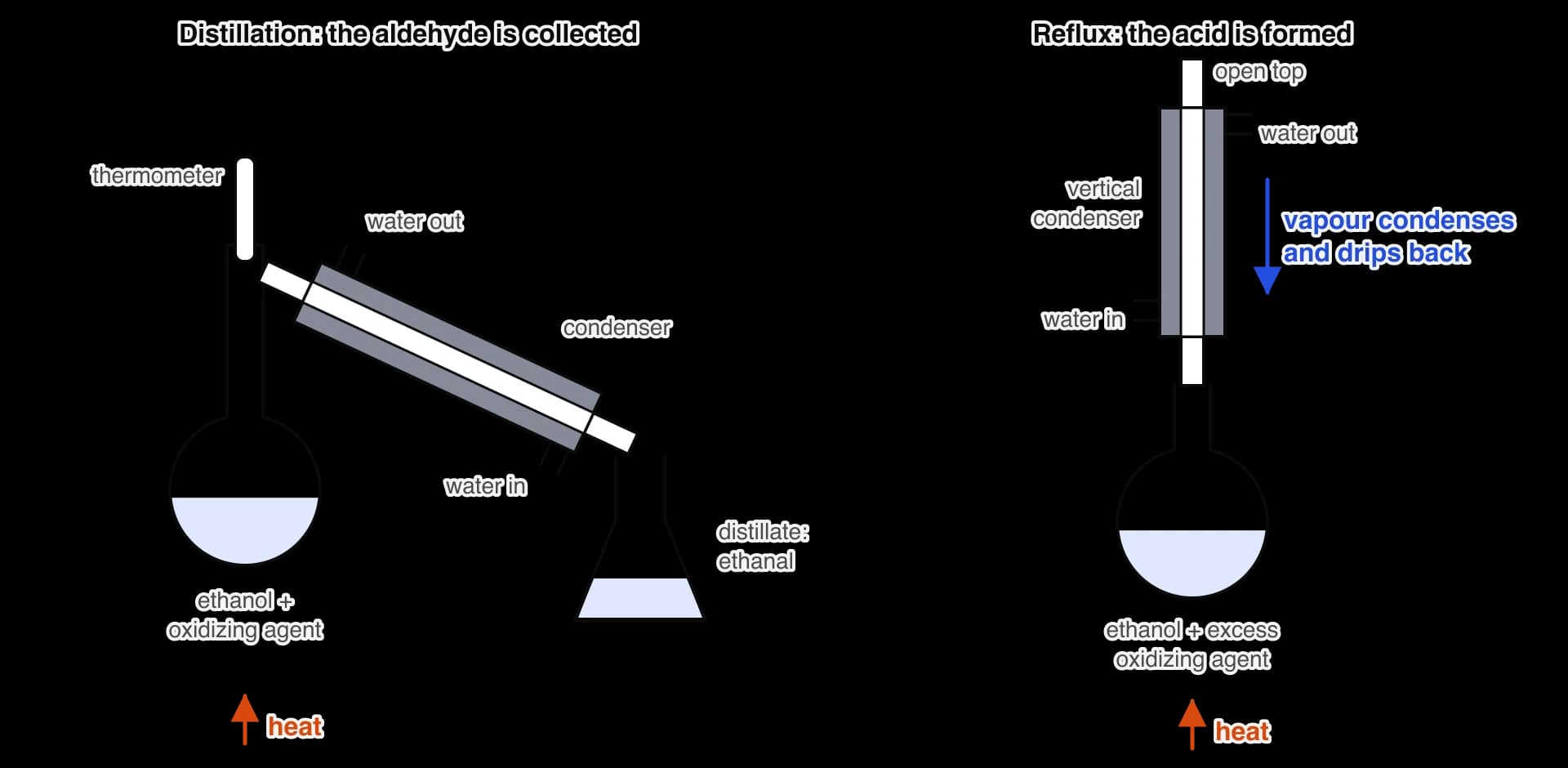
In both set-ups the cooling water enters the condenser at the lower end and leaves at the upper end, so the outer jacket stays full of cold water. The reflux condenser is left open at the top so that pressure cannot build up, and anti-bumping granules are added to the flask so that the liquid boils smoothly. After refluxing, the carboxylic acid can be separated from the mixture by changing to a distillation set-up.
Secondary and tertiary alcohols
A secondary alcohol is oxidized to a ketone. The carbon bonded to the –OH group has only one hydrogen atom, so after losing it (with the hydrogen of the –OH group) it forms a C=O group bonded to two other carbon atoms. Further oxidation would require breaking a C–C bond, which does not happen under these conditions, so the reaction stops at the ketone even under reflux with excess oxidizing agent:
A tertiary alcohol has no hydrogen atom on the carbon bonded to the –OH group, so it cannot lose the two hydrogen atoms needed to form a C=O group. Tertiary alcohols are not oxidized under the same conditions, and acidified dichromate(VI) stays orange when warmed with one. This colour test distinguishes tertiary alcohols from primary and secondary alcohols, which turn the solution green.
Class of alcohol | Product of oxidation | Conditions | Acidified dichromate(VI) |
|---|---|---|---|
primary | aldehyde, then carboxylic acid | distil (aldehyde) or reflux with excess oxidant (acid) | orange to green |
secondary | ketone | heat (under reflux) | orange to green |
tertiary | no reaction | — | stays orange |
Oxidizing an alcohol in this way changes only its functional group. Combustion is also the oxidation of an alcohol, but it is complete oxidation: every carbon–carbon and carbon–hydrogen bond is broken and the products are carbon dioxide and water, with the release of a large amount of energy. In ethanol the carbon atoms are at −3 and −1; complete combustion takes both to +4, while oxidation to ethanoic acid takes only the functional-group carbon from −1 to +3.
Reduction of carbonyl compounds and carboxylic acids
The reverse reactions, the reductions of carboxylic acids, aldehydes and ketones, need a strong reducing agent. In equations it is written as [H], a hydrogen atom supplied by the reducing agent; two are needed for each step:
A carboxylic acid is reduced first to an aldehyde and then to a primary alcohol; a ketone is reduced to a secondary alcohol. In each step the oxidation state of the functional-group carbon falls by 2, from +3 in ethanoic acid to +1 in ethanal and −1 in ethanol.
The role of the hydride ion
The reducing agents used, such as lithium aluminium hydride and sodium borohydride, are sources of the hydride ion, : a hydrogen atom with an extra electron, which gives it a lone pair and a negative charge. In a carbonyl group, , oxygen is more electronegative than carbon, so the carbon carries a partial positive charge. The hydride ion uses its lone pair to form a new bond to this electron-deficient carbon, and the oxygen then gains a hydrogen ion, usually from water added at the end. The result is the addition of two hydrogen atoms across the C=O bond.
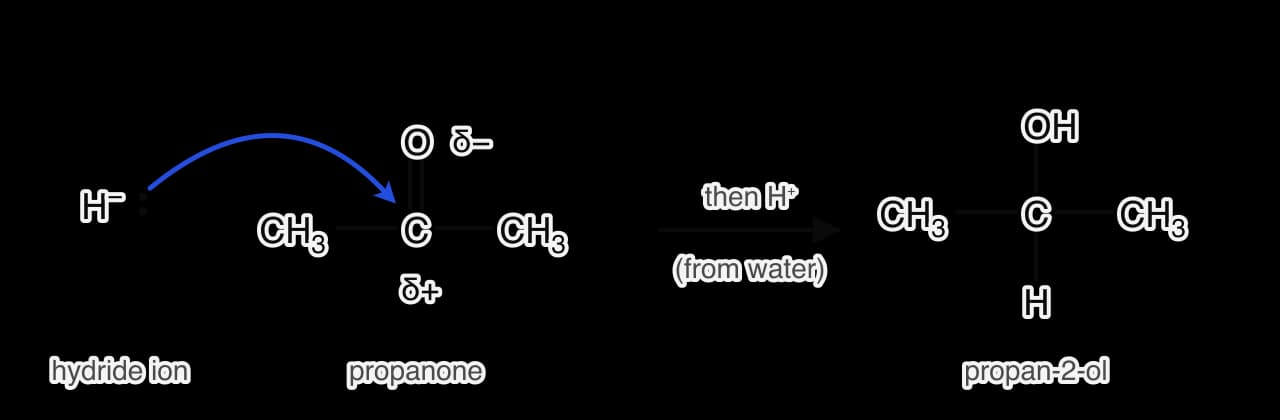
Sodium borohydride is mild and reduces only aldehydes and ketones; lithium aluminium hydride is strong enough to reduce carboxylic acids. With a carboxylic acid the intermediate aldehyde is reduced faster than the acid itself, so in practice the reaction continues to the primary alcohol and the aldehyde is not isolated.
Hydrogenation of alkenes and alkynes
Alkenes and alkynes are unsaturated: they contain carbon–carbon double or triple bonds. Heated with hydrogen in the presence of a finely divided metal catalyst (nickel at about 150 °C, or platinum or palladium at room temperature), they add hydrogen across the multiple bond. This is hydrogenation:
An alkyne adds hydrogen in two steps. With one mole of hydrogen per mole of alkyne it can stop at the alkene; with excess hydrogen it is reduced all the way to the alkane:
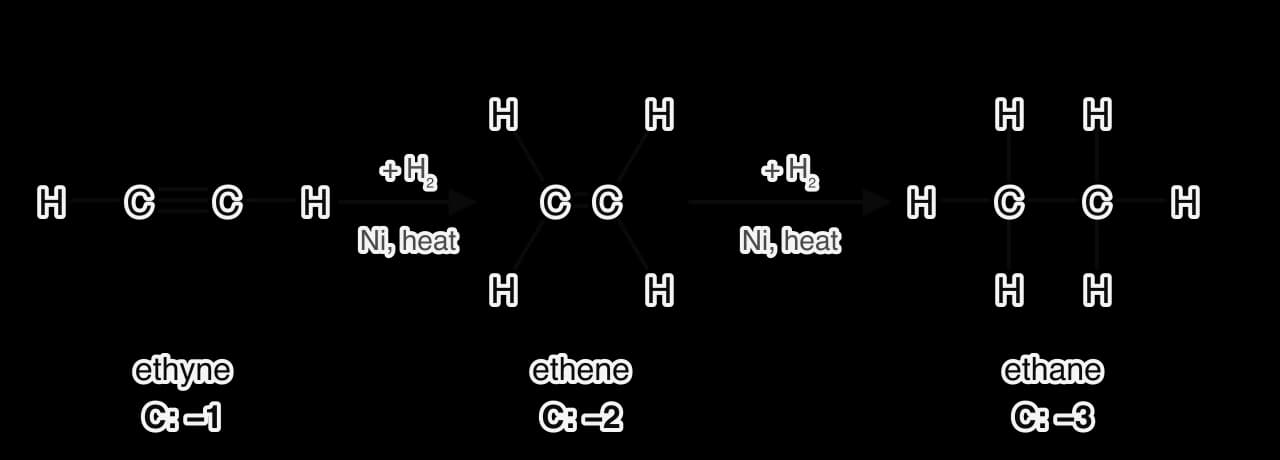
Hydrogenation is a reduction because the molecule gains hydrogen and the oxidation state of each carbon falls. It is also an addition reaction, because two molecules combine to form one. Each mole of added removes one degree of unsaturation. Bromine and hydrogen bromide also add across C=C bonds, but these reactions are classed as electrophilic additions, because the reagent is attracted to the electron-rich double bond. Adding bromine actually raises the oxidation state of the carbon atoms, as each gains a bond to the more electronegative bromine, which shows that a single reaction can be described by more than one classification.
Hydrogenation is used to harden vegetable oils. The oils contain unsaturated fatty acid chains with several C=C bonds and are liquid at room temperature. Partial hydrogenation over a nickel catalyst converts some of the C=C bonds to C–C bonds, making the chains straighter and able to pack more closely, so the melting point rises and the product is a soft solid such as margarine. Partial hydrogenation can also convert some cis double bonds into trans ones, and trans fats are linked to heart disease, so many countries now restrict their use.
Together, oxidation and reduction connect the functional groups into a network of reactions, which can be used to plan the conversion of one compound into another. Ethene, for example, can be converted into ethanoic acid by adding water to make ethanol, then oxidizing the ethanol under reflux.

The standard hydrogen electrode and standard electrode potentials (HL)
A voltaic cell produces a voltage because its two half-cells differ in their tendency to gain electrons. Each half-cell contains a redox couple: the oxidized and reduced forms of one element, such as or
The potential of a single half-cell cannot be measured on its own. A voltmeter needs two connections, and dipping a second wire into the solution creates a second half-cell. Only the difference between two half-cells can be measured. Chemists therefore choose one half-cell as a reference, give it a potential of zero, and measure every other half-cell against it, in the same way that the heights of mountains are measured from an agreed zero, sea level.
The standard hydrogen electrode
The reference is the standard hydrogen electrode (SHE). By convention its potential is exactly zero at all temperatures:
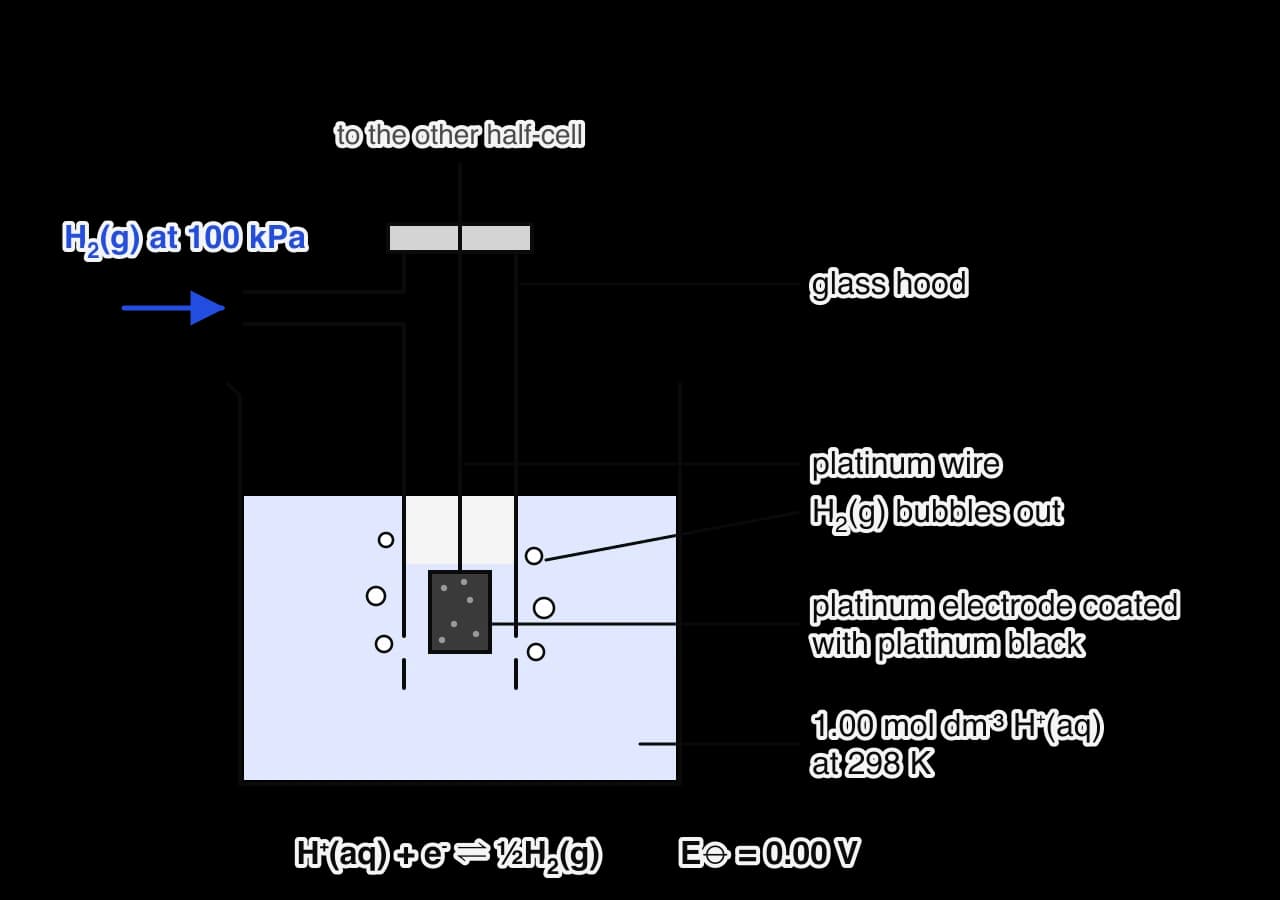
The standard hydrogen electrode consists of:
hydrogen gas at a pressure of 100 kPa, bubbled into the solution through a glass hood;
a solution in which , such as
Hydrogen is a gas and cannot carry electrons to the external circuit itself, so the half-cell needs a solid electrode. Platinum is chosen because it conducts electricity and is inert: it is not oxidized or reduced, so the only reaction at its surface is the one between hydrogen molecules and hydrogen ions. The coating of platinum black gives a very large surface area, on which this equilibrium is reached quickly because hydrogen molecules adsorb onto platinum and dissociate into atoms.
Measuring a standard electrode potential
To measure for the couple, a zinc rod in
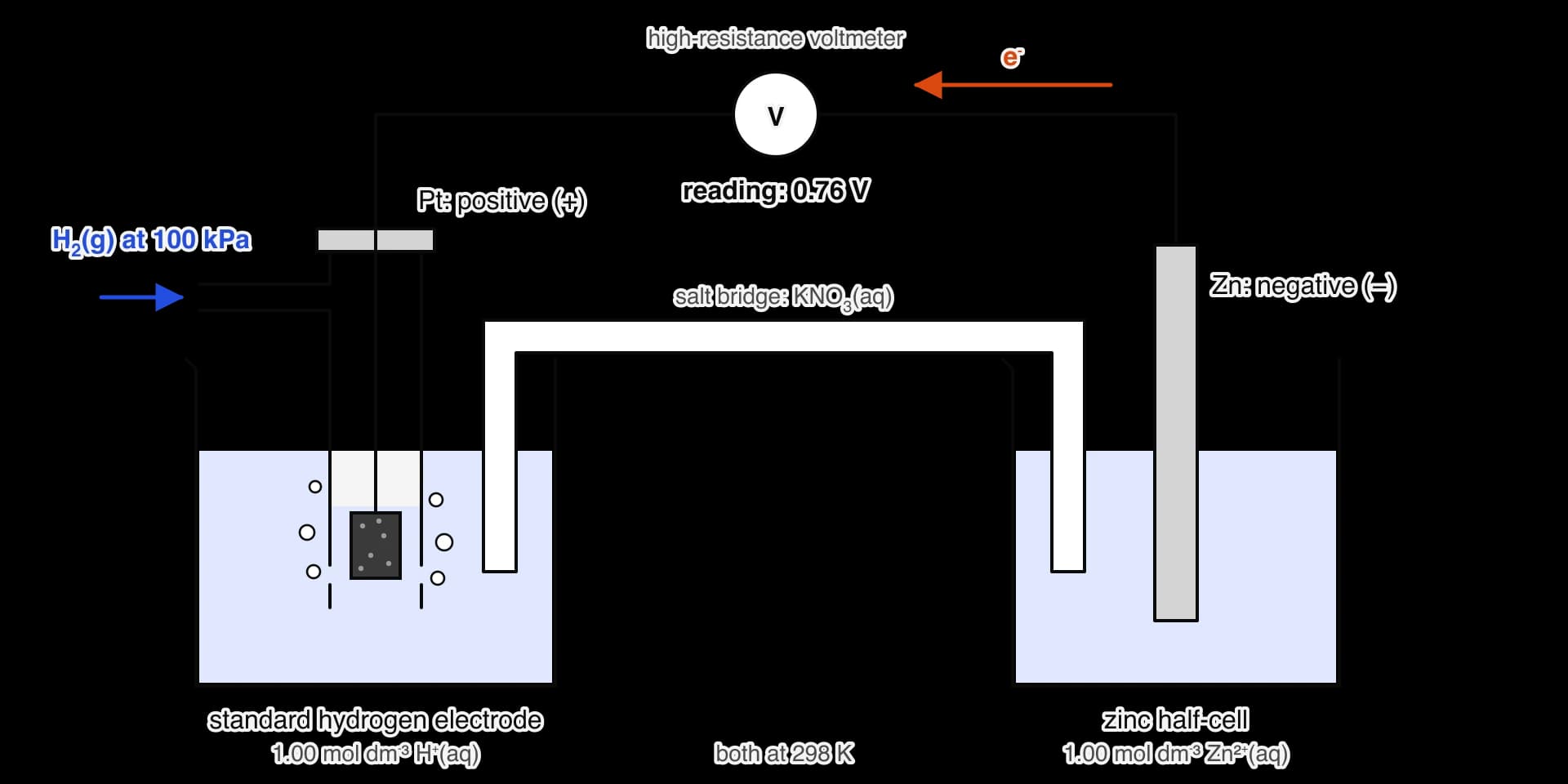
The voltmeter has a very high resistance so that almost no current flows. Without a current, no reaction takes place in either half-cell, the concentrations stay at their standard values, and the reading is the maximum potential difference the cell can produce. If a current flowed, part of the voltage would be lost driving it through the internal resistance of the cell, and the reading would be too low.
The meter reads 0.76 V, and the zinc is the negative electrode. Zinc atoms have a greater tendency to release electrons than hydrogen molecules have, so electrons build up on the zinc. The sign of is the sign of the electrode relative to the standard hydrogen electrode, so
Half-cells without a metal electrode
Many redox couples contain no metal in either form: ,
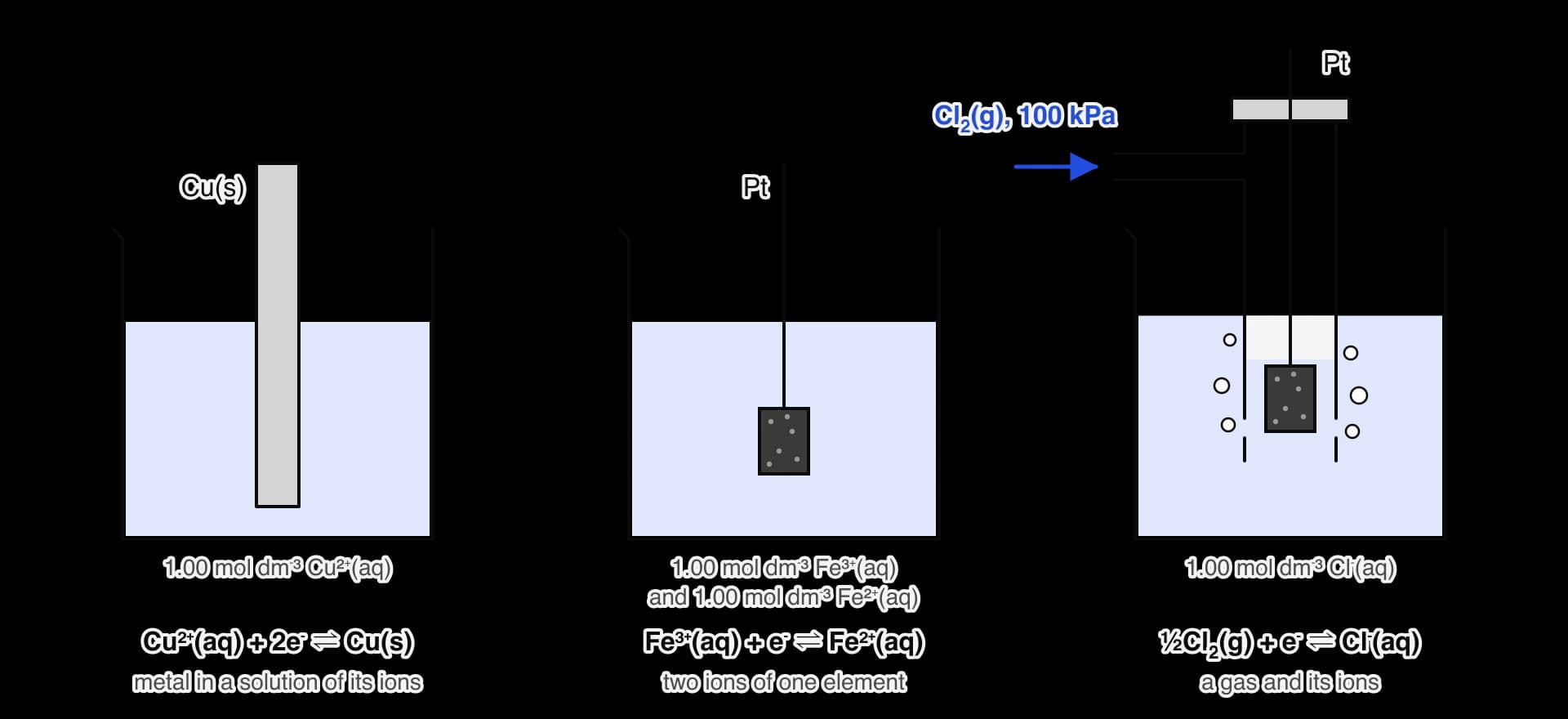
When a half-equation includes hydrogen ions, as for
Conventions for electrode potentials
Written as reductions. Every standard electrode potential refers to the half-equation with the electrons on the left,
Changing the reference electrode
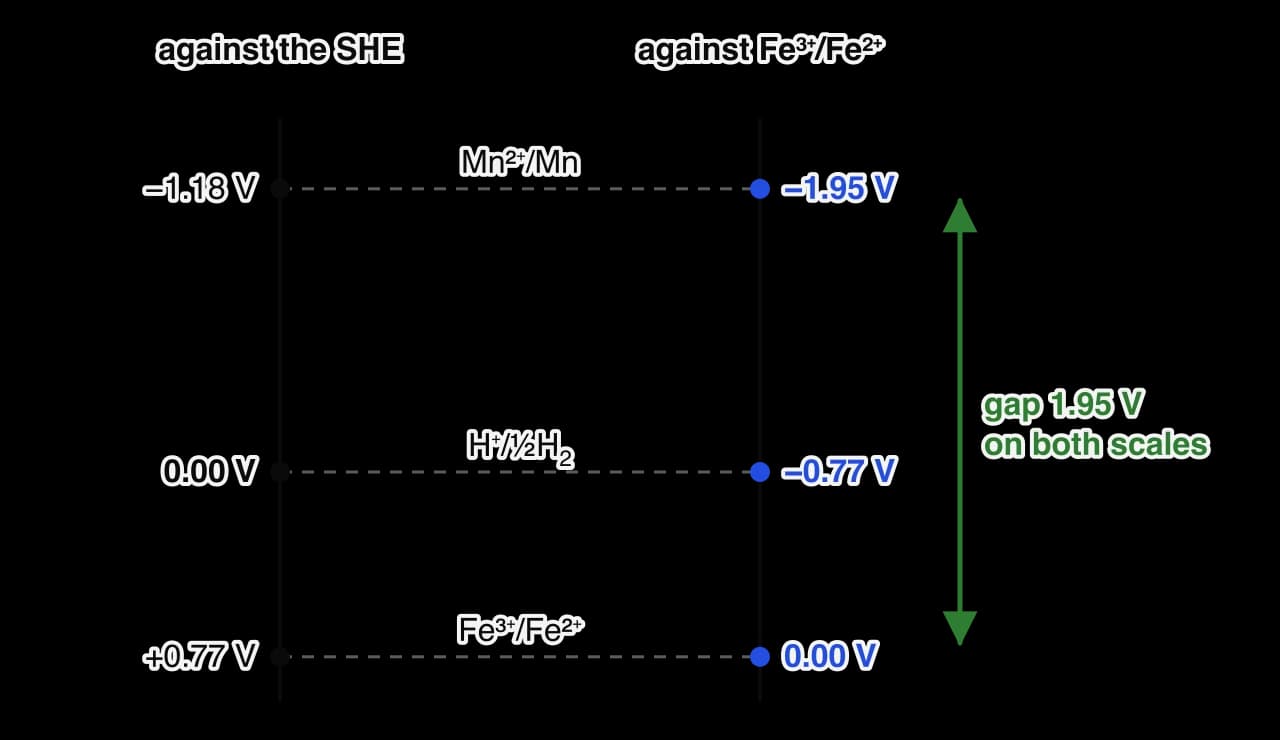
The value zero for the standard hydrogen electrode is a convention, chosen for convenience. If a different half-cell were chosen as the zero, every potential would shift by the same amount. Measured against the couple (
Reference electrodes used in practice
The standard hydrogen electrode is awkward to use: hydrogen is flammable, its pressure must be controlled, and platinum black is easily "poisoned" by impurities such as sulfur compounds that adsorb onto its surface. Laboratories therefore use secondary reference electrodes whose potential against the SHE is accurately known. The silver/silver chloride electrode, a silver wire coated with silver chloride in potassium chloride solution, has a potential of about +0.2 V, depending on the concentration of the chloride. A potential measured against it is converted to the hydrogen scale by adding that value. Most pH probes contain a reference electrode of this kind.
Comparing oxidizing and reducing agents with electrode potentials (HL)
Listing half-equations in order of their standard electrode potentials gives the electrochemical series. The data booklet lists the couples from the most negative, at , to the most positive,
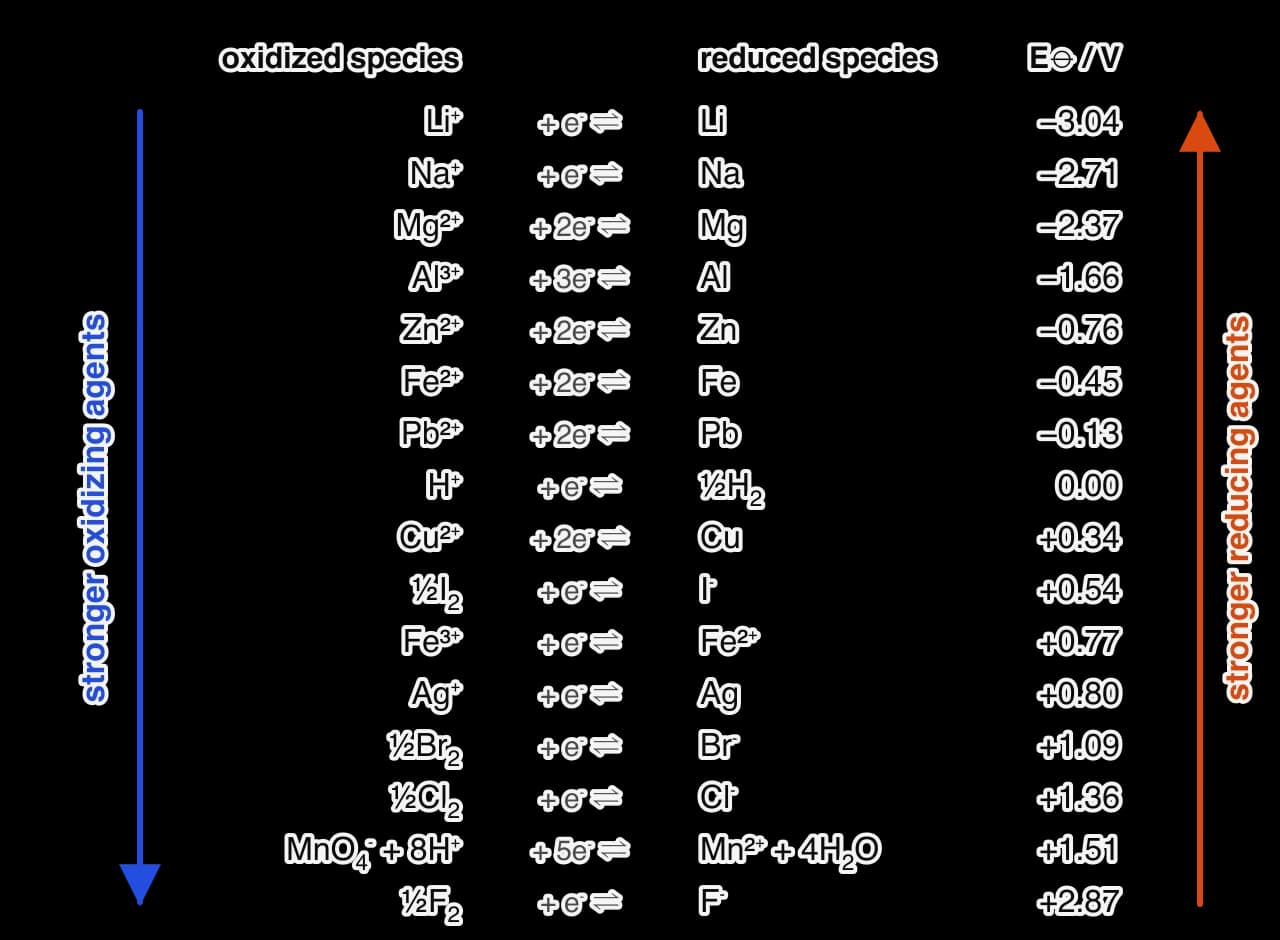
Oxidizing agents on the left, reducing agents on the right
The more positive the value of , the further the equilibrium of the half-equation lies to the right. The oxidized form, on the left of the half-equation, gains electrons readily and is a strong oxidizing agent; its reduced form, on the right, holds on to its electrons and is a weak reducing agent. Fluorine, at the bottom of the list, is the strongest oxidizing agent, and fluoride ions have almost no tendency to give up electrons.
The more negative the value of , the further the equilibrium lies to the left. The reduced form gives up electrons readily and is a strong reducing agent, while its oxidized form is very hard to reduce. Lithium, at the top, is the strongest reducing agent listed, and lithium ions are the hardest species to reduce.
More positive | More negative | |
|---|---|---|
Oxidized form (left side) | more easily reduced: stronger oxidizing agent | harder to reduce: weaker oxidizing agent |
Reduced form (right side) | harder to oxidize: weaker reducing agent | more easily oxidized: stronger reducing agent |
Examples |
Periodic trends in the electrochemical series
The electrochemical series puts numbers on the group trends in ease of oxidation and reduction. The alkali and alkaline earth metals have the most negative potentials, because they lose their outer electrons easily, and calcium () is a stronger reducing agent than magnesium (), the next element up group 2. The halogens become weaker oxidizing agents down group 17: falls from
Why lithium has a more negative potential than potassium
Lithium () has a more negative standard electrode potential than potassium (), yet potassium reacts with water far more vigorously. Electrode potentials describe the position of an equilibrium in aqueous solution, not the rate of a reaction. The potential measures the whole change from to
Elements with more than one oxidation state
An element with several oxidation states appears in more than one couple. Iron has at and
Standard cell potentials and spontaneous reactions (HL)
When two standard half-cells are connected, the one with the more positive electrode potential gains electrons: reduction takes place there, so it is the cathode, the positive electrode. The half-cell with the more negative potential loses electrons: it is the anode, the negative electrode. The voltage of the cell is the difference between the two potentials.
Both values are used exactly as tabulated, as reduction potentials; the subtraction itself takes care of reversing the anode half-equation. The same rule can be written
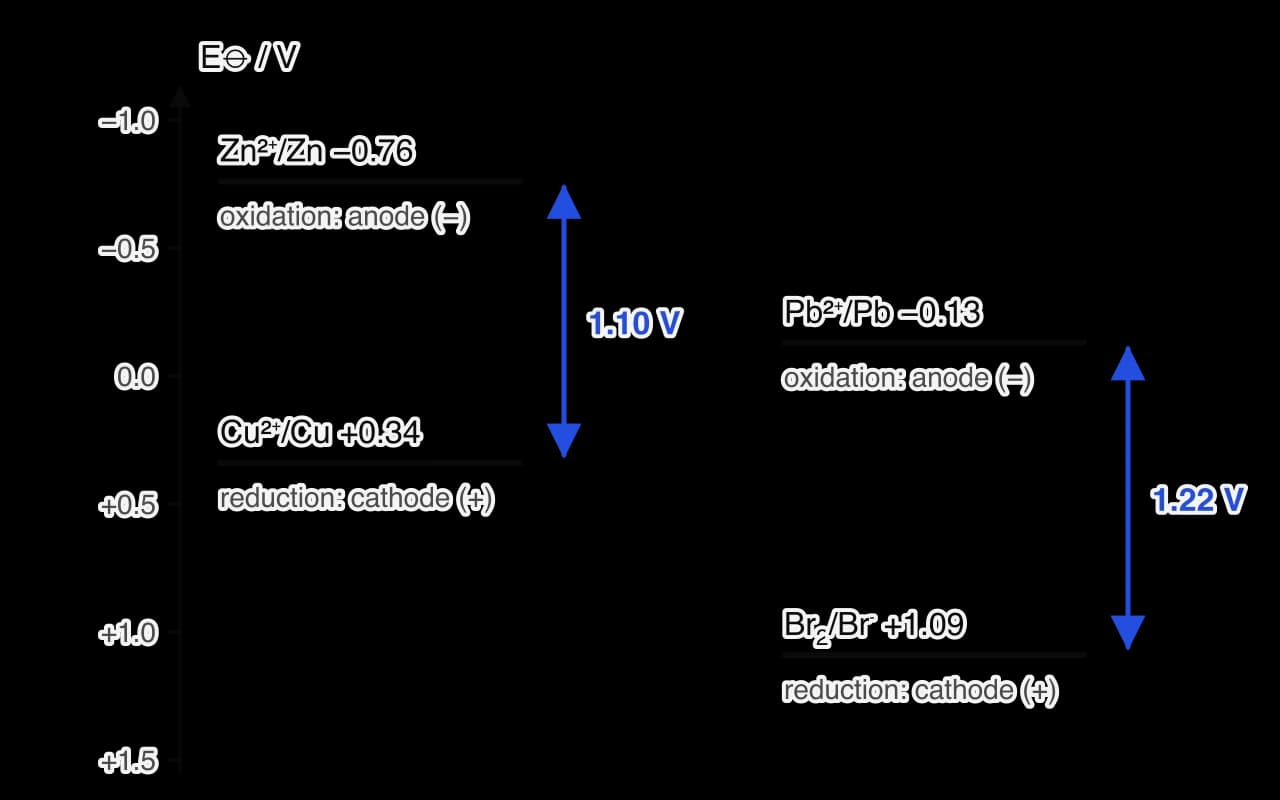
For the zinc–copper cell (the Daniell cell) under standard conditions, , which is the reading on a high-resistance voltmeter. The larger the gap between two couples in the electrochemical series, the larger the voltage: a magnesium–copper cell gives
Predicting whether a reaction is spontaneous
A cell is only one way of carrying out a redox reaction. The same calculation applies to any redox equation, whether or not the reactants are in a cell: the species reduced plays the part of the cathode and the species oxidized plays the part of the anode. A positive means the reaction as written is spontaneous under standard conditions; a negative
Split the equation into its reduction and oxidation half-equations, and identify the species reduced and the species oxidized.
Look up the standard electrode potential of each couple as a reduction potential.
Calculate
The same reasoning explains a practical detail of redox titrations. Potassium manganate(VII) is acidified with dilute sulfuric acid, never hydrochloric acid, because manganate(VII) oxidizes chloride ions: . Some of the titrant would be used up making chlorine, and the titre would be too large. Sulfate ions cannot be oxidized further, because sulfur is already in its highest oxidation state, +6.
Combining cell potentials
Because a cell potential is a difference between two electrode potentials, the potentials of two cells can be added when the cathode half-cell of one is the anode half-cell of the other, rather like enthalpy changes in a Hess cycle. The zinc–copper cell has and the copper–silver cell . Adding the two overall reactions cancels the copper:
The result equals , calculated directly. This works only for complete cell reactions. Two half-equations cannot be added in this way to give the potential of a third half-equation, because the electrons do not cancel; that calculation needs Gibbs energies.
Disproportionation of copper(I)
Electrode potentials also show when an ion with an intermediate oxidation state reacts with itself. Copper(I) ions could be reduced to copper () and oxidized to copper(II) () at the same time:
The positive value means this disproportionation is spontaneous. When white copper(I) sulfate is added to water, a brown precipitate of copper forms and the solution turns blue with copper(II) ions, so simple copper(I) compounds survive in water only when they are insoluble, as in copper(I) oxide and copper(I) iodide.
Limitations of predictions from electrode potentials
A positive shows that a reaction is thermodynamically favourable, but it does not guarantee that the reaction will be seen.
Non-standard conditions. The values apply at , 100 kPa and 298 K. Changing a concentration shifts the equilibrium in a half-cell, by Le Châtelier's principle, and changes its potential. Increasing pushes
Cell potential and Gibbs energy (HL)
A reaction is spontaneous when its Gibbs energy change is negative,
The electrical work done when a charge moves through a potential difference is . A reaction that transfers moles of electrons moves a charge , where
The value is the Avogadro constant multiplied by the charge of one electron:
This equation and the value of are in the data booklet. Its quantities and units are:
Symbol | Quantity | Unit |
|---|---|---|
standard Gibbs energy change for the reaction as written | (divide by 1000 for |
Because and are always positive, and
The relationship is plotted for reactions that transfer one, two and four moles of electrons. For the same cell potential, a reaction that transfers more electrons has a larger Gibbs energy change, because more charge moves through the same potential difference.
The equation also works backwards, giving a cell potential from thermodynamic data. This is a second, independent route to spontaneity: Gibbs energies of formation and standard electrode potentials always give the same answer.
Why electrode potentials cannot simply be added
The potential of the couple can be found from the two one-electron couples of copper, but only through Gibbs energies, which do depend on the amount and can be added like enthalpy changes:
Electrolysis of aqueous solutions (HL)
Unlike a molten binary salt, an aqueous solution also contains water molecules, in large excess, and small concentrations of and ions from the ionization of water. Water can be reduced at the cathode and oxidized at the anode, so at each electrode two or more reactions compete. Which one happens depends on the standard electrode potentials of the competing couples, on the concentrations of the ions and on the material of the electrodes.
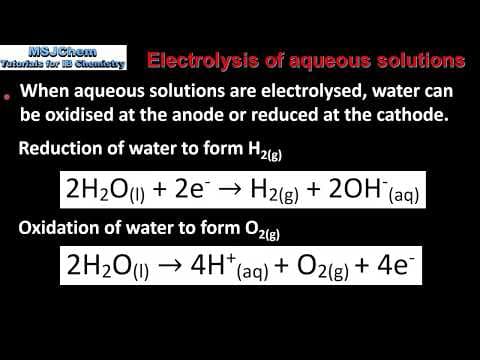
The reactions of water at the electrodes
At the cathode, water can be reduced to hydrogen gas and hydroxide ions; in acidic solution, hydrogen ions are reduced instead. Either way, hydrogen gas is produced:
At the anode, water can be oxidized to oxygen gas and hydrogen ions, the reverse of the booklet half-equation
So whenever water reacts, the solution around the cathode becomes alkaline and the solution around the anode becomes acidic. A few drops of universal indicator show this clearly.
Predicting the products
The ions that react at an electrode are said to be discharged: they gain or lose electrons and become neutral atoms or molecules. At each electrode, the species that reacts most readily is discharged in preference to the others.
At the cathode the species most easily reduced is discharged: the oxidized form with the most positive . Metal ions whose is more positive than , such as
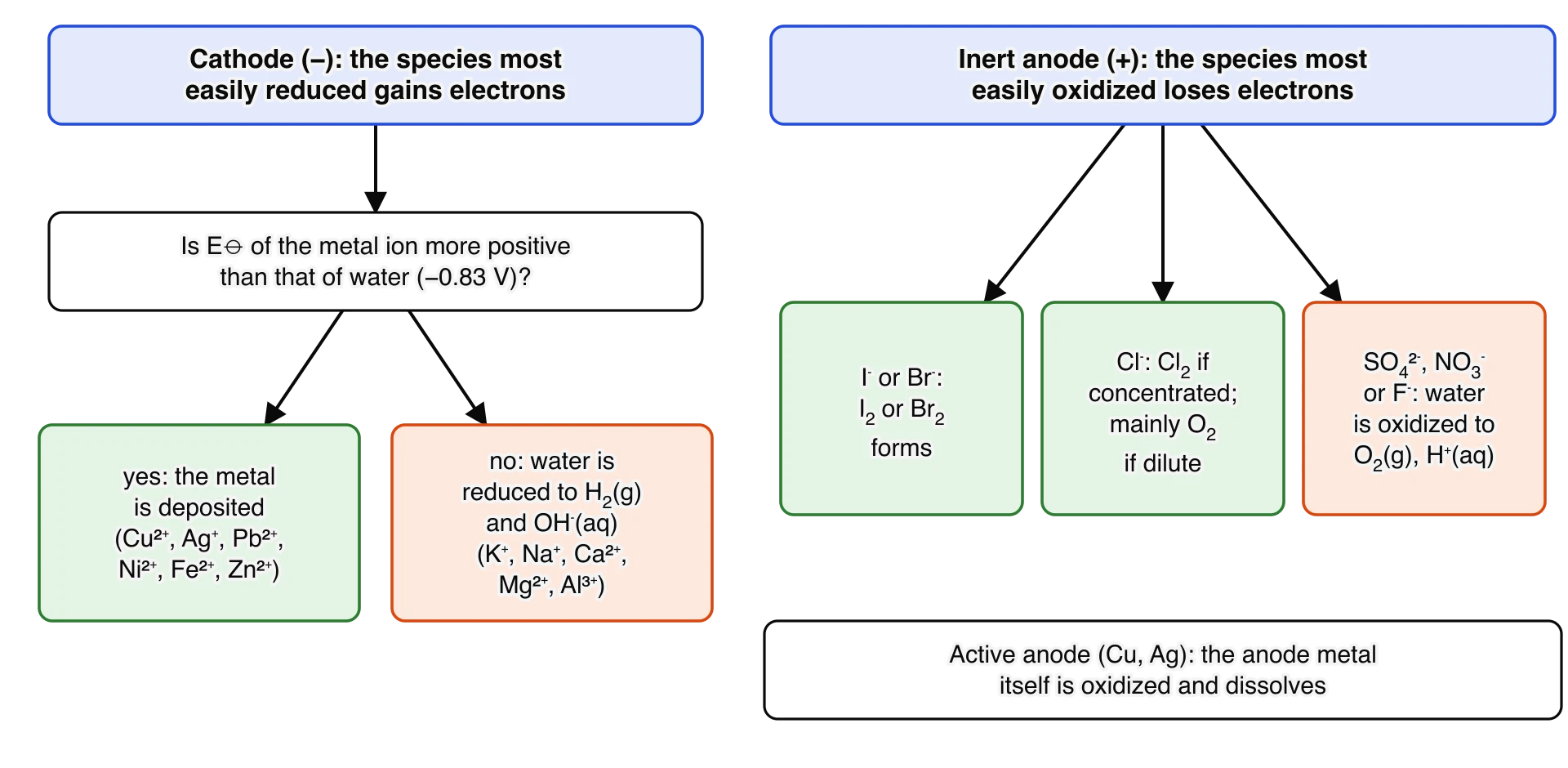
Electrolyte | Electrodes | Cathode (−) | Anode (+) | Change in the solution |
|---|---|---|---|---|
, concentrated | graphite or platinum |
 YouTube
Electrolysis of water
Pure water conducts electricity very poorly, because
The and ions formed at the two electrodes combine again to form water. The gases are collected in a Hofmann voltameter. Four moles of electrons produce two moles of hydrogen at the cathode but only one mole of oxygen at the anode, and equal amounts of gas occupy equal volumes at the same temperature and pressure, so the volumes are in the ratio 2 : 1.
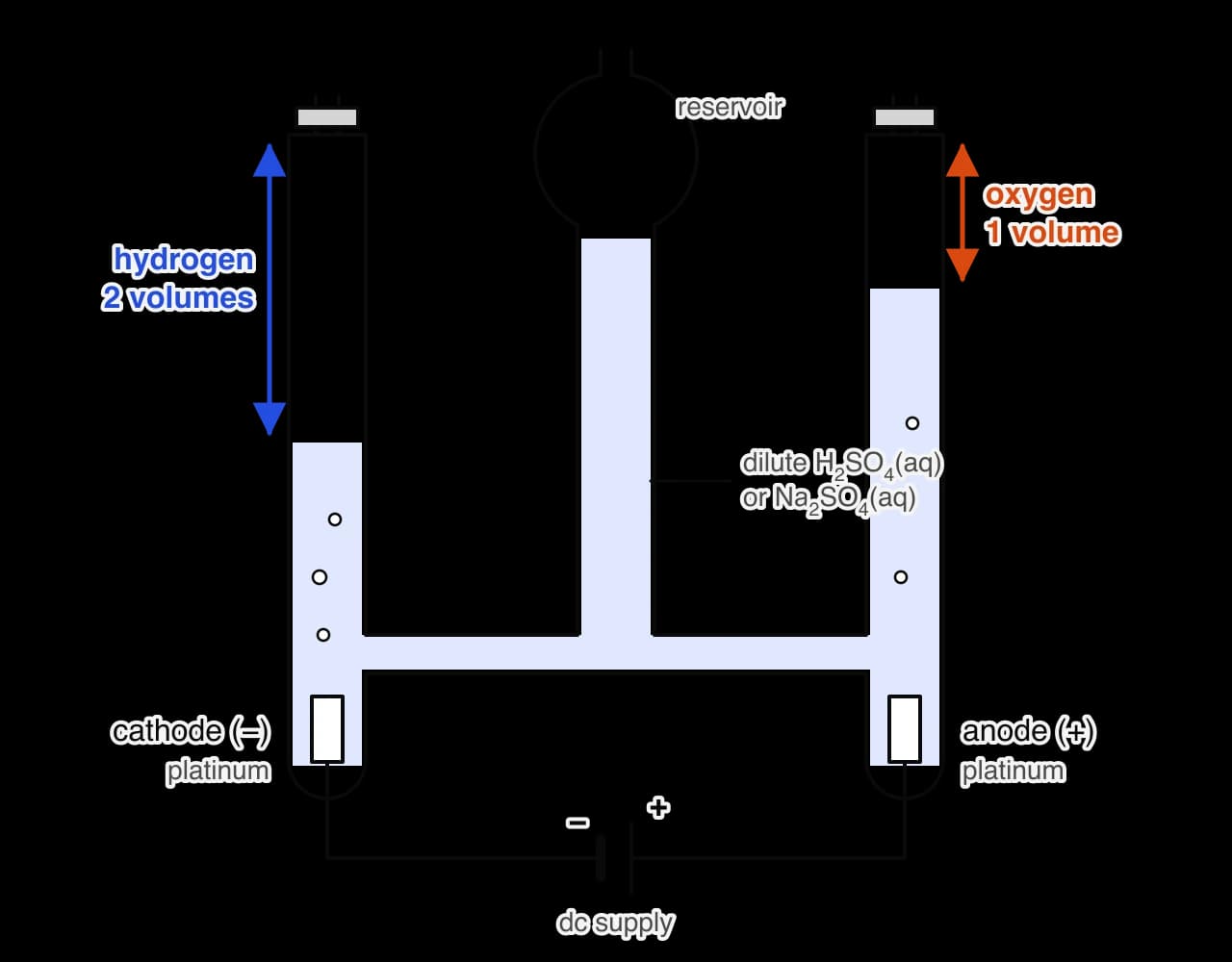
Hydrogen is identified because it burns with a squeaky pop when a lighted splint is held at the open tap, and oxygen because it relights a glowing splint. The measured volume of oxygen is usually slightly less than half that of hydrogen, because oxygen is more soluble in water than hydrogen and a little ozone forms at the anode.
The minimum voltage for electrolysis
Electrolysis drives a non-spontaneous reaction. For the decomposition of water,
This is the reverse of the fuel cell reaction, and the value agrees, within rounding, with the obtained from Gibbs energies of formation. The supply must provide at least 1.23 V, the size of the negative cell potential, before water can be decomposed. In practice about 2 V is needed, because extra voltage is used to drive the current through the resistance of the electrolyte and to make the gases form at a useful rate.
Overpotential
The extra voltage needed beyond the value predicted from standard electrode potentials, to make an electrode reaction go at a useful rate, is called the overpotential. It arises because some electrode reactions are slow, in the same way that a reaction with a high activation energy is slow. Forming oxygen gas involves breaking O–H bonds and joining oxygen atoms in several steps, and its overpotential on most electrodes is large, often several tenths of a volt. Forming chlorine involves fewer steps, and its overpotential on a suitable electrode is small. This is one reason why concentrated chloride solutions give chlorine rather than oxygen, even though
The difference between spontaneous and non-spontaneous cell reactions can now be put in numbers.
Voltaic cell | Electrolytic cell | |
|---|---|---|
of the reaction | positive | negative |
of the reaction | negative | positive |
Voltage |
Electrolysis of sodium chloride solution: the effect of concentration
At the cathode, sodium ions () are far harder to reduce than water (), so hydrogen forms at every concentration. The hydroxide ions produced stay in solution with the sodium ions, so the solution becomes sodium hydroxide; phenolphthalein turns pink around the cathode.
At the anode, chloride ions and water compete. By standard electrode potentials alone, water () should be oxidized in preference to chloride (), but the two values differ by only 0.13 V, and the outcome depends on the concentration of chloride ions.
Concentrated solution (such as saturated brine, about ): chloride ions are oxidized and chlorine gas is given off, which bleaches damp blue litmus paper (it turns red, then white).
Dilute solution: oxygen is the main product at the anode, mixed with a little chlorine. As the electrolysis continues and the chloride concentration falls, the proportion of oxygen rises.
A high chloride concentration favours oxidation of the chloride ions by Le Châtelier's principle: in the equilibrium
Case study: the chlor-alkali industry
The electrolysis of concentrated sodium chloride solution, brine, is one of the largest electrochemical industries. The chlor-alkali process makes chlorine, sodium hydroxide and hydrogen together. Modern plants use the membrane cell, in which a cation-exchange membrane divides the cell into two compartments.

Saturated brine flows into the anode compartment, where chloride ions are oxidized to chlorine on a titanium anode coated with metal oxides. Water flows into the cathode compartment, where it is reduced to hydrogen and hydroxide ions on a nickel cathode. The membrane lets sodium ions pass from the anode side to the cathode side to balance the charge, but it blocks chloride and hydroxide ions, so a solution of about 30–35 % sodium hydroxide leaves the cathode compartment almost free of chloride.
Keeping the products apart is essential. Chlorine reacts with sodium hydroxide,
Each product has major uses. Chlorine is used to make poly(chloroethene) (PVC), to disinfect drinking water and to make many solvents and medicines. Sodium hydroxide is used to extract aluminium oxide from bauxite, and in making paper, soaps and textiles. The hydrogen is burned as a fuel or used to make hydrochloric acid.
Electrolysis of copper(II) sulfate solution: the effect of the electrode
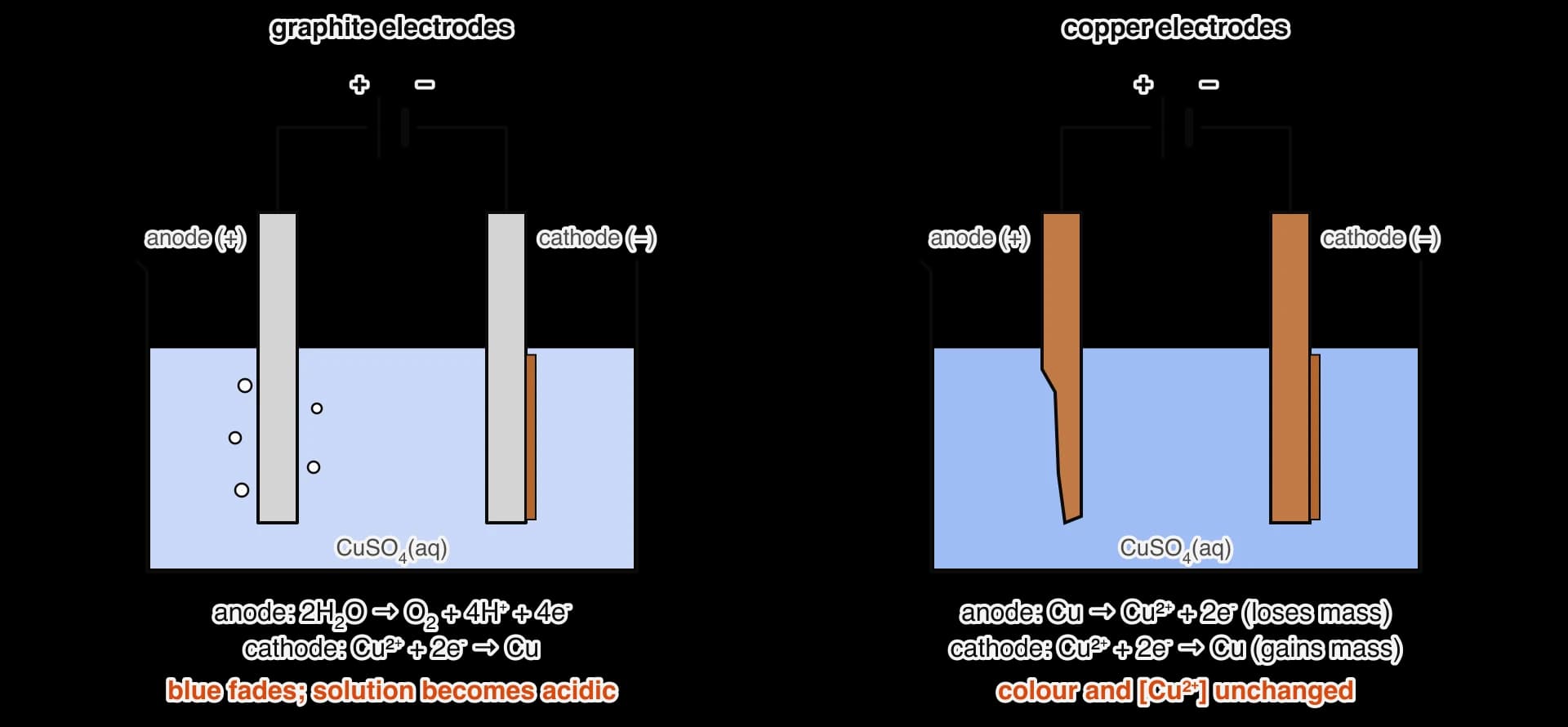
With inert electrodes of graphite or platinum, copper(II) ions () are much more easily reduced than water (), so a pink-brown layer of copper forms on the cathode. Sulfate ions are not oxidized, so water is oxidized at the anode and bubbles of oxygen form. The blue colour of the solution fades as copper(II) ions are removed, and the hydrogen ions formed at the anode make the solution acidic: copper(II) sulfate is gradually replaced by sulfuric acid.
Concentration matters here too. Once almost all the copper(II) ions have been removed, water begins to be reduced at the cathode and bubbles of hydrogen appear there.
With copper electrodes, the anode reaction changes. Copper atoms (, ) are oxidized much more easily than water (), so the copper anode itself is oxidized and dissolves. A copper anode is an
The same number of electrons passes through each electrode, so for every copper atom that leaves the anode, one copper(II) ion is deposited on the cathode. The anode loses exactly the mass the cathode gains, and the concentration and colour of the solution do not change. The two arrangements are compared side by side.
Electroplating and electrolytic refining (HL)
In electroplating, the object to be plated is made the cathode, so that metal ions from the electrolyte are reduced on its surface. The anode is usually a bar of the plating metal, which is oxidized and dissolves. Silver-plating a spoon shows the arrangement.
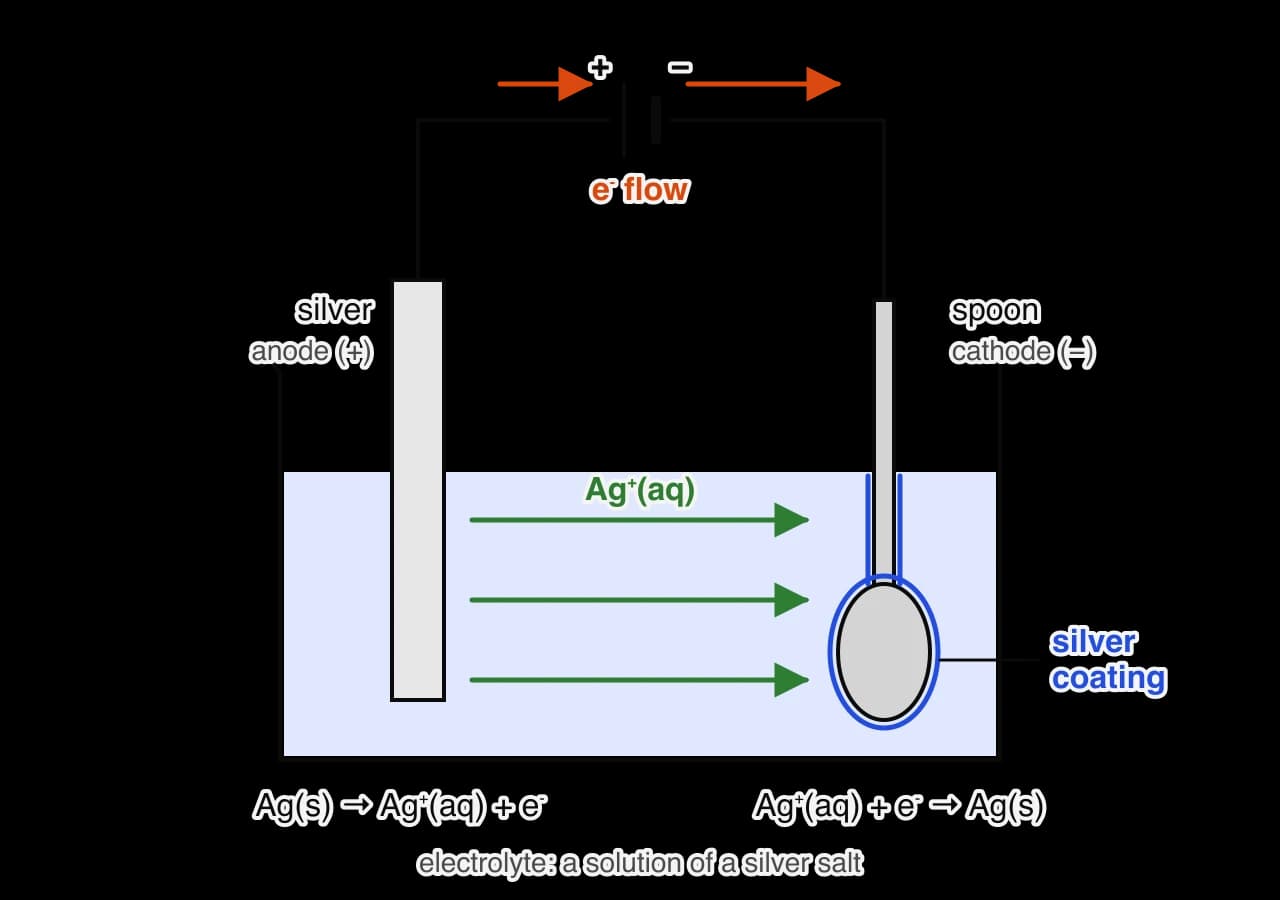
Silver ions are produced at the anode at the same rate as they are removed at the cathode, so the concentration of the electrolyte stays constant and the bath can be used for a long time. A direct-current supply is essential: with alternating current, each electrode would switch between anode and cathode and the metal would be stripped off again.
Electroplating in practice
A student can copper-plate a steel key in the laboratory. The key is cleaned with emery paper, washed with a detergent or propanone to remove grease, rinsed, dried and weighed. It is then connected to the negative terminal of a low-voltage dc supply and a strip of copper to the positive terminal, and both are dipped into acidified copper(II) sulfate solution. A small current, around 0.1–0.2 A, is passed for about 20 minutes, after which the key is rinsed, dried and reweighed; its increase in mass is the mass of copper deposited.
An even, shiny, firmly attached layer needs a clean surface, a small current for the area being plated, steady stirring and a constant temperature. A large current deposits the metal too fast, giving a rough, powdery coating that rubs off easily.
Protection from corrosion: steel is plated with nickel and chromium for bicycles and taps, and with tin to make the tinplate used for food cans.
Appearance: cutlery and jewellery are plated with silver or gold, which look attractive and resist tarnishing, over a cheaper base metal.
Wear resistance: a layer of hard chromium protects engine parts and hydraulic rods.
Electronics: gold is plated onto connectors and circuit-board contacts because it conducts well and does not corrode.
Chromium plating is an exception to the usual arrangement. Chromium anodes would dissolve as chromium(III) ions, which spoil the plating bath, so the electrolyte is a solution of chromium(VI) oxide in water (chromic acid), and the anodes are made of lead alloy, which does not dissolve. The chromium deposited comes from the electrolyte, which must be topped up regularly. Chromium(VI) compounds are toxic and cause cancer, so processes based on less hazardous chromium(III) salts are replacing them.
Electrolytic refining of copper
Copper for electrical wiring must be at least 99.99 % pure, because even small amounts of impurities increase its electrical resistance. Copper from the smelter is about 99 % pure. It is purified by electrolytic refining, using the same reactions as the electrolysis of copper(II) sulfate with copper electrodes.
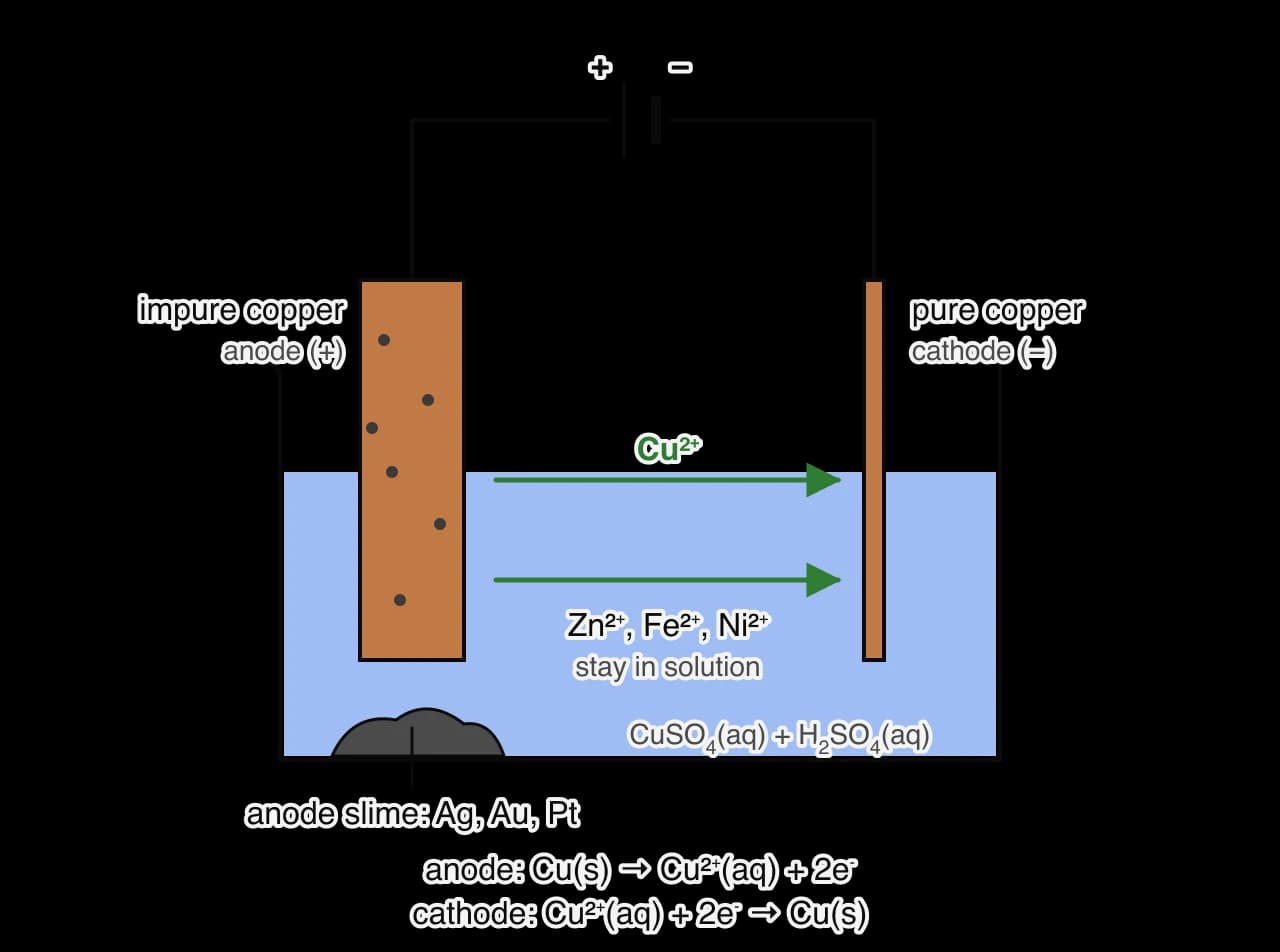
Large slabs of impure copper are the anodes and thin sheets of pure copper are the cathodes, in a solution of copper(II) sulfate acidified with sulfuric acid. At the anode, copper and any metals more easily oxidized than copper, such as zinc, iron and nickel, are oxidized and pass into solution. At the cathode, only copper is deposited, because copper(II) ions () are reduced much more readily than (),
Applying the ideas in exam questions
Paper 1A: a voltaic cell
Paper 1B: ordering metals by displacement
A student investigated the reactivity of three metals, X, Y and Z, by adding of each powdered metal to of solutions of the sulfates of the other metals in a polystyrene cup and recording the highest temperature rise. Each metal forms a 2+ ion. The thermometer reads to
Metal added | : / °C ± 0.2 |
|---|
Paper 2: hydrogen peroxide and manganate(VII)
Paper 2: a car battery and the electrolysis of a molten salt
Paper 2: redox reactions of butan-1-ol
Paper 1A: the strongest reducing agent (HL)
Paper 1A: electrolysis of sodium iodide solution (HL)
Paper 1B: measuring electrode potentials against a copper half-cell (HL)
A student connects four metal half-cells, each a clean strip of metal in a solution of its ions, in turn to a copper half-cell (copper in
Metal half-cell | Potential difference / V ± 0.01 | Polarity of the metal electrode | Expected value from the data booklet / V |
|---|---|---|---|
1.08 | negative | 1.10 | |
Paper 2: iron(III) ions and copper electrolysis (HL)
Self-check
- To do:
I can describe oxidation and reduction in terms of electrons, oxidation states, oxygen and hydrogen.
- To do:
I can deduce oxidation states of atoms in compounds and ions, including averages and the exceptions for peroxides and metal hydrides, and use them in names such as iron(III) oxide.
- To do:
I can give examples of the variable oxidation states of transition elements and non-metals.
- To do:
I can identify the species oxidized and reduced, and the oxidizing and reducing agents, in a redox reaction, and recognize reactions that are not redox.
- To do:
I can explain rusting as an electrochemical redox process and how galvanizing protects iron.
- To do:
I can write and balance half-equations, including those in acidic solution using water, hydrogen ions and electrons.
- To do:
I can combine half-equations into a balanced redox equation and use it in a redox titration calculation.
- To do:
I can predict the relative ease of oxidation of metals in groups 1 and 2 and of reduction of the halogens, and explain the trends.
- To do:
I can interpret displacement data to place metals in order of reactivity and describe what is observed.
- To do:
I can write equations for reactive metals with dilute hydrochloric and sulfuric acids.
- To do:
I can identify the anode and cathode, and their signs, in voltaic and electrolytic cells.