4 Marketing
Explain how organisations find out what customers want, plan how to reach them, and design a marketing mix of product, price, promotion, place and service at home and abroad.
- IB Business Management
- SL and HL
What 4 covers
From the subject guide: what you need to know and be able to do.
How businesses research their markets, plan and forecast, and use the marketing mix at home and abroad.
6 subtopics in Marketing
Each one has its own page once something is published for it.
- 4.1Introduction to marketing64 questions · notes
- 4.2Marketing planning71 questions · notes
- 4.3Sales forecastingHL only36 questions · notes
- 4.4Market research66 questions · notes
- 4.5The seven Ps of the marketing mix180 questions · notes
- 4.6International marketingHL only56 questions · notes
An overview of 4 Marketing
Marketing studies how organisations identify what customers need and want, decide which customers to serve, and design products, prices, promotion and distribution that meet those needs better than competitors do. Every organisation has to attract and keep customers, users or donors, so marketing decisions affect its sales revenue, its reputation and its long-term survival.
Questions that frame the unit
The unit is built around questions that marketing managers face in any market.
Why do some well-designed products fail while simpler ones succeed?
Should a business aim at the whole market or at a small, specialised group of customers?
How can a business charge more than its competitors and still keep its customers?
Is social media a cheaper way to promote a product, or a riskier one?
Should a business sell the same product in the same way in every country, or adapt it to each market?
What the unit covers
The unit has six subtopics. Four are studied at SL and HL; two are HL only.
Subtopic | Main question it answers | Level |
|---|---|---|
4.1 Introduction to marketing | Should a business start from what customers want or from what it can make, and how large is its share of a growing or shrinking market? | SL and HL |
4.2 Marketing planning | Which customers should a business target, how should it position itself, and how can it stand out from competitors? | SL and HL |
4.3 Sales forecasting | How can a business forecast its future sales, and how far can it rely on the forecast? | HL only |
4.4 Market research | How does a business find out about its customers and competitors, and how reliable are the results? | SL and HL |
4.5 The seven Ps of the marketing mix | Which combination of product, price, promotion, place, people, processes and physical evidence suits a given product and market? | SL and HL |
4.6 International marketing | What opportunities and threats does a business face when it sells abroad, and how should it enter a foreign market? | HL only |
How the subtopics connect
The unit starts with the meaning of marketing and the choice between market orientation, which starts from customers’ needs, and product orientation, which starts from what the business can make. It also measures a business’s position in its market through market share and market growth. These figures show whether a business is gaining or losing ground, and they set the context for every later decision.
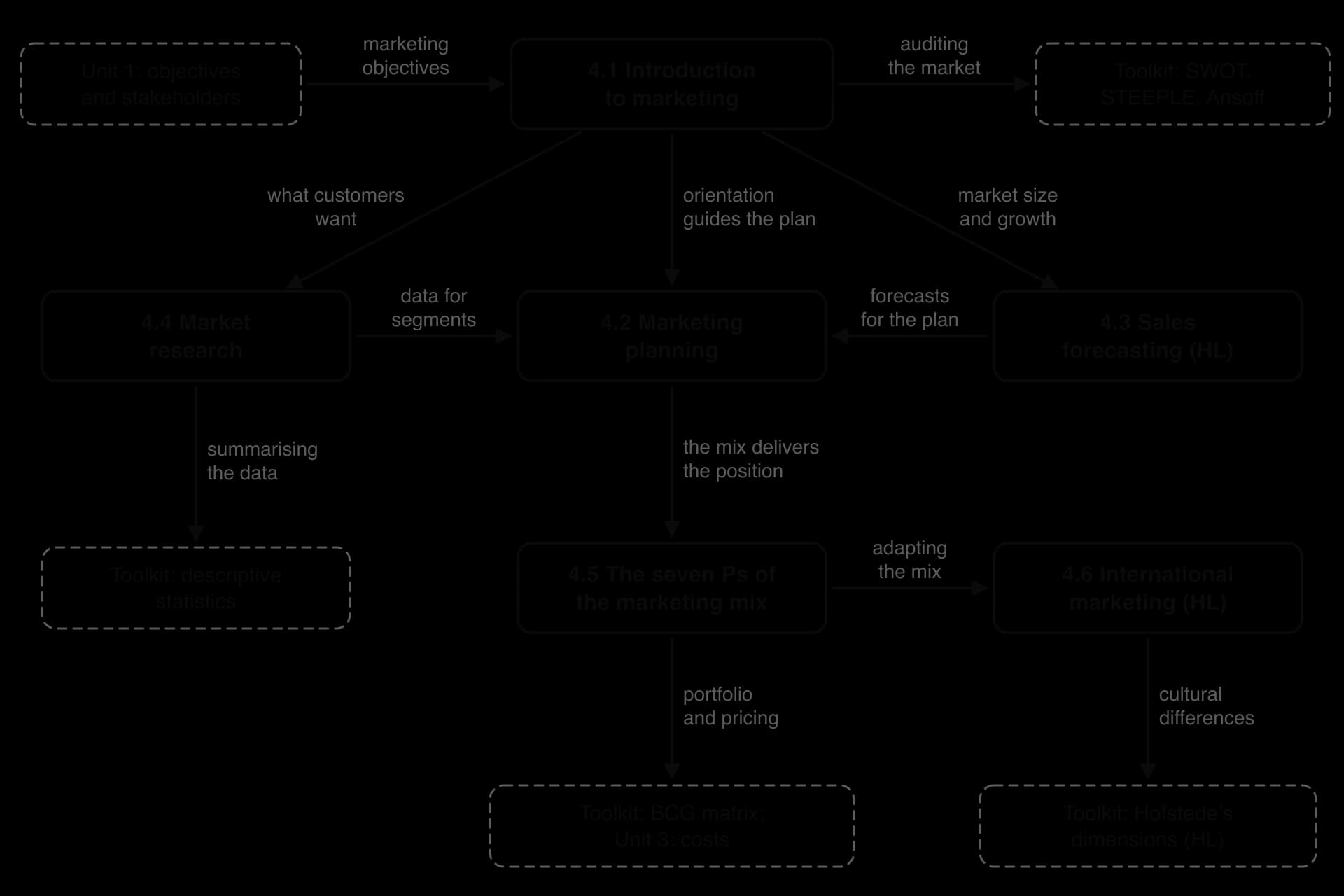
The concept map shows how planning sits at the centre of the unit. A marketing plan sets marketing objectives that follow from the business’s overall objectives, divides the market through market segmentation, chooses a target market and decides how the product will be positioned, often with a position map. The plan depends on information. Market research supplies data on customers and competitors, collected through primary research and secondary research and from a sample chosen to represent the population. At HL, sales forecasting adds estimates of future sales built from past trends.
The marketing mix puts the plan into practice. Its seven Ps cover the product and its product life cycle, branding, pricing methods, promotion, distribution channels, and the people, processes and physical evidence that matter most when the product is a service. A mix works when its parts fit together and suit the target market: a premium price needs a product, promotion and place that support a premium brand. At HL, international marketing asks how far the mix can stay the same in foreign markets and how far it must be adapted.
Marketing links to the rest of the course at many points. Marketing objectives come from the business’s objectives and must take account of its stakeholders; prices depend on costs; promotion is paid for from a budget; and the product must be produced in the right quantity and quality. Among the toolkit tools, a SWOT analysis and a STEEPLE analysis audit the business and its market, the Ansoff matrix classifies growth strategies, the Boston Consulting Group matrix analyses a product portfolio, and descriptive statistics summarise research data.
Change, creativity, ethics and sustainability in the unit
Key concept | How it shows up in the unit |
|---|---|
Change | Social, cultural and technological change alters both what marketing says and the media it uses. Social media marketing, e-commerce and influencer marketing have changed how businesses reach customers, and changing tastes shorten many product life cycles. |
Creativity | Creative ways of informing customers and other stakeholders can lead to positive outcomes, from a distinctive unique selling point to guerrilla marketing and campaigns shared by customers themselves. |
Ethics | Ethical marketing improves a brand’s image. Ethical questions arise in research (consent and data privacy), in pricing (predatory pricing is illegal in many countries), in promotion aimed at children, and in exaggerated environmental claims (greenwashing). |
Sustainability | Sustainable marketing practices, such as repairable products, honest environmental claims and less packaging, can be effective in attracting customers who care about the environment, as long as the claims are backed by the product itself. |
How SL and HL differ
HL students study everything SL students study, plus two HL-only subtopics and HL-only parts of two SL subtopics. The HL-only subtopics are:
4.3 Sales forecasting: qualitative forecasting methods and time series analysis, including the trend, moving averages and seasonal variation, with an evaluation of the benefits and limitations of forecasting.
4.6 International marketing: the reasons for entering foreign markets, the methods of entry, the opportunities and threats of operating abroad, and the choice between standardisation, adaptation and glocalisation of the marketing mix.
The SL subtopics with HL-only parts are:
SL subtopic | What HL adds |
|---|---|
4.1 Introduction to marketing | An evaluation of the importance of market share and of being the market leader. |
4.5 The seven Ps of the marketing mix | Three more pricing methods (dynamic pricing, competitive pricing and contribution pricing) and price elasticity of demand, including its calculation and its effect on sales revenue. |
Several HL toolkit tools are used often with the unit. Porter’s generic strategies show differentiation as a competitive strategy, which the marketing planning subtopic introduces at HL; Hofstede’s cultural dimensions compare the cultures of foreign markets; simple linear regression extends sales forecasting; and contribution, Gantt charts and critical path analysis support pricing decisions and the planning of campaigns and launches.
Assessment
Unit 4 is examined in Paper 1 and Paper 2. Its SL content can appear in either paper at both levels; the HL-only content (sales forecasting, international marketing, the importance of market leadership, the three extra pricing methods and price elasticity of demand) appears only in Paper 2 at HL and in Paper 3, never in Paper 1. Paper 1 questions on the unit are mostly qualitative, for example explaining a product’s position in its life cycle or analysing the case organisation’s promotion.
Paper 2 brings the unit’s calculations and constructions: market share and market growth, a position map plotted from data, a product life cycle or BCG matrix drawn and annotated, and at HL moving averages and price elasticity of demand. Extended responses often ask students to evaluate a marketing strategy, such as social media marketing, a pricing method, an extension strategy or a method of entering a foreign market, or to recommend an appropriate marketing mix for a given product.
Studying the unit
Flashcards for 4
The official decks for this part of the syllabus.
- 4.1 Introduction to marketing136 cards
- 4.2 Marketing planning155 cards
- 4.3 Sales forecasting136 cards
- 4.4 Market research156 cards
- 4.5 The seven Ps of the marketing mix315 cards
- 4.6 International marketing162 cards
Carry on with 4 in Augment
With a free account, Augment remembers where you stopped and what you have practiced.