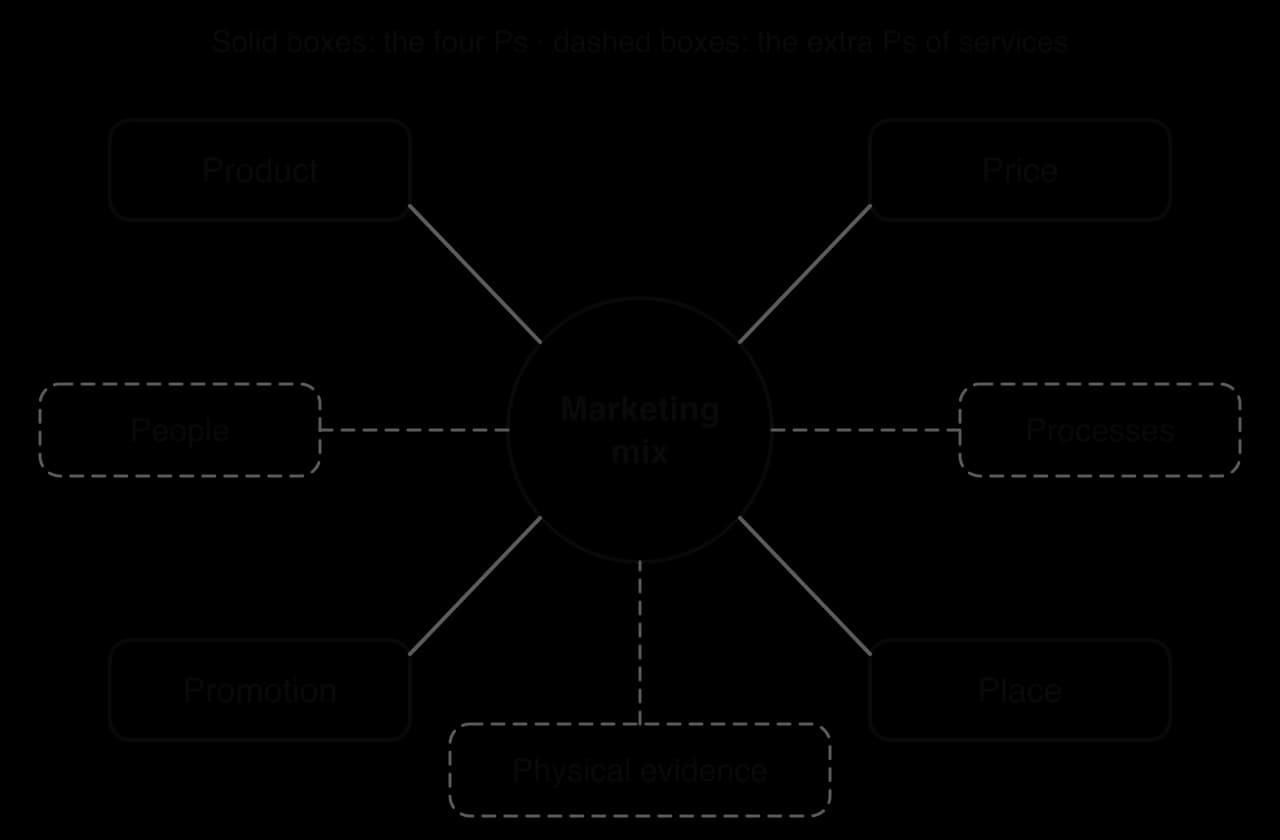
Use the seven Ps to analyse and recommend a marketing mix: the product life cycle, extension strategies, branding, pricing methods (HL: PED), promotion, distribution channels, people, processes and physical evidence.
Each is in the Business glossary, with every other term in the subject.
Paid advertising through mass media such as television, radio, newspapers, magazines, cinema and outdoor posters, aimed at a broad audience.
An intermediary that negotiates sales or finds buyers on behalf of a producer, usually for a commission, without taking ownership of the products.
Promotion that does not use paid mass media, such as sales promotions, direct marketing, public relations, sponsorship and personal selling, usually aimed at specific customers.
A name, term, sign, symbol, design or combination of these that identifies the products of a business and distinguishes them from those of competitors.
The extent to which customers recognise or can recall a brand and know what it offers.
The process of strengthening a brand’s image and reach over time, for example by improving its products, investing in promotion and extending the brand to new products or markets.
The set of ideas, feelings and associations that customers hold about a brand, such as its quality, reliability, style or values.
The extent to which customers repeatedly buy one brand in preference to competing brands, even when rivals offer lower prices or new alternatives.
Explain the marketing mix, the four Ps for goods and the seven Ps for services.
Explain the relationship between the product life cycle, the product portfolio and the marketing mix, and between the product life cycle, investment, profit and cash flow.
Evaluate extension strategies.
Explain the aspects of branding (awareness, development, loyalty and value) and the importance of branding.
Calculate a cost-plus price and evaluate the appropriateness of each pricing method, including (HL) dynamic, competitive and contribution pricing.
Calculate price elasticity of demand and explain its effect on sales revenue (HL).
Explain above the line, below the line and through the line promotion, and evaluate social media marketing as a promotional strategy.
Evaluate the importance of distribution channels, people, processes and physical evidence in marketing.
Recommend an appropriate marketing mix for a particular product or business.
The marketing mix is the set of decisions a business makes about how to sell a product to its target market: what to offer, what to charge, how to tell customers about it and where to make it available. Every product, from a bottle of water to a university degree, reaches its customers through a mix of these decisions, and a weak decision in one part can undo strong decisions in the others.
The marketing mix is where marketing objectives turn into action, so it involves all four key concepts. Social and technological change has moved much promotion and distribution online; creativity shows in new products, campaigns and service processes;
180 exam-style questions on this subtopic, written in the style of the IB papers. The first has its markscheme open. Counted on
Kalinda Surf Wax
[1] Kalinda Surf Wax (KSW) is a partnership based in Byron Bay, Australia, owned by Jarrah Collins and Linh Dao. Since 2012 KSW has made surfboard wax from beeswax and coconut oil, sold in recyclable cardboard tins through 60 independent surf shops along the east coast of Australia. KSW’s brand is well known among local surfers, and its wax has won two industry awards for grip in warm water.
[2] For the past three years KSW’s sales volume has hardly changed, at about 180 000 tins a year. Two larger competitors have launched cheaper waxes, and surf-shop owners report that most surfers in the region already buy KSW or a rival brand. Profit is still healthy, but Jarrah worries that the product is close to the end of its maturity stage.
[3] Jarrah wants to extend the product life cycle by selling KSW wax in Indonesia and Portugal, two growing surf markets. This would mean finding distributors abroad, translating the packaging and paying for export shipping. Linh prefers to modify the product: she has developed a “cold-water” formula and a wax for stand-up paddle boards, which could be sold through the existing surf shops. Her version would need AUD 45 000 of new equipment and some retraining of KSW’s six production workers.
[4] The partners have AUD 70 000 of retained profit available and do not want to borrow. Both agree that KSW must not lose its reputation for high quality and natural ingredients.
Define the term product life cycle.
2 marks
Award [1] for a partial definition that shows some understanding, e.g. “the stages a product goes through” with no further detail.
The official deck for this part of the syllabus.
Define the marketing mix.
State the four Ps of the marketing mix and what each one covers.
With a free account, Augment remembers where you stopped and what you have practiced.
The financial worth of a brand, based on the extra revenue and profit it is forecast to earn because customers recognise and prefer it.
The process of creating, developing and managing a distinctive name, design and image for a product so that customers can identify it and develop positive associations with it.
Setting a price based on the prices charged by competitors for similar products, at the same level or slightly above or below them.
Setting a price that covers the variable cost per unit and makes a contribution towards fixed costs and profit, without each price having to cover full average cost.
A pricing method that sets the price by adding a percentage mark-up to the average cost of producing each unit: price = unit cost × (1 + mark-up %).
The final stage of the product life cycle, in which sales and profits fall steadily, usually because tastes have changed or better products have replaced it.
Promotion that communicates directly with individual customers, for example by email, text message, post or app notification, usually using customer data.
The route by which a product passes from the producer to the final consumer, including any intermediaries involved.
A pricing method in which the price of a product changes frequently, often automatically, according to current demand, supply and other market conditions.
The buying and selling of goods and services over the internet, through websites, apps and online marketplaces.
A method used to lengthen the life of a product by preventing or delaying the decline in its sales, such as new markets, new uses, repackaging or product improvements.
A branding approach in which one brand name is used for all or most of a business’s products.
The stage of the product life cycle in which sales rise rapidly, unit costs fall, the product becomes profitable and competitors begin to enter the market.
Unconventional, often low-cost promotion that uses surprise and creativity in public or online spaces to attract attention and get people talking about a brand.
A form of promotion in which a business pays or rewards individuals with a large or loyal social media following to feature or recommend its products.
A business that operates between the producer and the final consumer in a distribution channel, such as a wholesaler, retailer or agent.
The first stage of the product life cycle, when a product is launched: sales are low, unit costs and promotion spending are high and the product usually makes a loss.
A product sold at a price below its cost to attract customers, who are then expected to buy other products on which the business makes a profit.
A branding approach in which the producer sells products under its own brand name through many different retailers.
The amount added to the unit cost of a product to set its price, usually expressed as a percentage of the unit cost.
The combination of elements, product, price, promotion and place (and for services people, processes and physical evidence), that a business uses to market a product to its target market.
The stage of the product life cycle in which sales are at or near their peak but grow slowly, competition is strongest and profit and cash flow are usually highest.
A distribution approach that integrates a business’s physical stores, websites, apps and other channels so that customers have one seamless experience across them.
A distribution channel with one intermediary, usually a retailer, between the producer and the consumer.
A branding approach in which a retailer sells products under its own brand name, made for it by other manufacturers.
Setting a low price when a product is launched in order to attract customers quickly and gain market share, with the intention of raising the price later.
In the marketing mix, the employees who deliver a service and interact with customers, whose skills, attitudes and behaviour shape the customer’s experience.
Promotion in which sales staff communicate directly with individual customers, face to face or remotely, to persuade them to buy.
The tangible elements of a service that customers can see or touch, such as premises, décor, uniforms, equipment, packaging and websites, which help them judge its quality.
The element of the marketing mix concerned with how and where a product is made available to customers, including distribution channels and outlets.
Setting a price deliberately low, often below cost, to force competitors out of the market or deter new entrants so that prices can be raised later; illegal for dominant firms in many countries.
Setting a price higher than competitors’ to reflect and reinforce a product’s image of high quality, exclusivity or status.
The amount of money that customers pay to obtain a good or service, set by the business as one element of its marketing mix.
Charging different prices to different groups of customers for the same product, where the groups can be kept apart and differ in their willingness to pay.
Demand for which the percentage change in quantity demanded is greater than the percentage change in price, so that PED, ignoring its sign, is greater than 1.
A measure of the responsiveness of the quantity demanded of a product to a change in its price: the percentage change in quantity demanded divided by the percentage change in price.
Demand for which the percentage change in quantity demanded is smaller than the percentage change in price, so that PED, ignoring its sign, is less than 1.
The method a business uses to set the price of a product, chosen to suit its costs, competitors, customers and marketing objectives.
In the marketing mix, the procedures, systems and activities through which a service is delivered to customers, from first contact to after-sales service.
A good or service, or a combination of both, that a business offers to the market to satisfy customers’ needs and wants.
A branding approach in which each product has its own separate brand name, often with little reference to the business that owns it.
The stages a product passes through from launch to withdrawal (introduction, growth, maturity, saturation and decline), shown as the pattern of its sales over time.
A group of closely related products sold by a business, such as different sizes, flavours or models of the same basic product.
The full range of products that a business sells, usually analysed to check that it holds products at different stages of the product life cycle.
The communication between a business and its customers that aims to inform them about, persuade them to buy, or remind them of a product or brand.
The combination of promotional methods, such as advertising, sales promotion, public relations, sponsorship, direct marketing and personal selling, that a business uses.
Setting prices that appeal to customers’ perceptions rather than to calculation, such as $9.99 instead of $10.
The management of a business’s reputation and relationships with the public and the media, for example through press releases, events and interviews.
A business that buys products from producers or wholesalers and sells them in small quantities to the final consumer, in shops or online.
A short-term incentive to encourage customers to buy, such as a discount, coupon, free sample, competition or “buy one, get one free” offer.
The stage of the product life cycle in which the market is full, so sales stop growing and firms can grow only by taking customers from competitors.
The extended marketing mix used for services: product, price, promotion and place plus people, processes and physical evidence.
The use of social media platforms to promote a business and its products, through its own content, paid targeted advertising, influencers and conversations with customers.
A form of promotion in which a business pays to be associated with an event, team, programme or person in order to raise awareness and improve its image.
An integrated promotional strategy that combines above the line and below the line methods so that they reinforce one another.
A distribution channel with two intermediaries, usually a wholesaler and a retailer, between the producer and the consumer.
Material about a brand or product, such as reviews, photos, videos and posts, that is created and shared by customers rather than by the business.
Promotion that encourages people to share a message or piece of content with others so that it spreads rapidly and widely, usually through social media.
An intermediary that buys large quantities of products from producers, stores them and sells them in smaller quantities to retailers.
A distribution channel in which the producer sells directly to the consumer, with no intermediaries.
A business that has chosen its target market and its positioning still has to decide how to reach those customers. The marketing mix organises these decisions into a small number of headings, traditionally called the Ps. Each P is a separate set of decisions, but customers experience them together, so the Ps must support one another.
The original four Ps were designed for physical goods: product (what is sold), price (what the customer pays), promotion (how the business communicates with customers) and place (how the product reaches customers). Marketing services needs three more Ps, because a service is produced and consumed at the same time, often with the customer present. These are people (the staff who deliver the service), processes (the way the service is delivered) and physical evidence (the tangible things customers see and use). Together the seven elements are known as the seven Ps, or the extended marketing mix.
Services differ from goods in four ways that make them harder to market. These differences explain why the extra Ps exist: each one gives customers something they can judge before or while they buy.
Feature of services | Meaning | Effect on marketing |
|---|---|---|
Intangibility | A service cannot be seen, touched or tried before it is bought. | Customers judge quality from clues such as the building, uniforms and reviews (physical evidence). |
Inseparability | A service is produced and consumed at the same time, usually with the provider present. | The skills and attitude of staff become part of the product (people). |
Perishability | A service cannot be stored: an empty hotel room or airline seat tonight is lost for ever. | Prices and capacity must be managed carefully, for example with off-peak prices. |
Variability (heterogeneity) | The quality of a service depends on who delivers it and when. | Businesses design standard procedures and train staff so that quality is consistent (processes). |
Most businesses sell a combination of goods and services, so the line between the four Ps and the seven Ps is not sharp. A restaurant sells food (a good) through a service; a car manufacturer sells a good but adds services such as finance, servicing and warranties. For this reason many marketers use all seven Ps for any business that has direct contact with its customers.
 YouTube
A product is anything a business offers to satisfy customers’ needs and wants: a good, a service or, most often, a mix of the two. The product is usually the most important P, because no price, promotion or distribution can sell for long a product that customers do not value.
Customers buy the benefits a product gives them, not only its physical features. A buyer of a flat-pack bookcase pays for storage, an attractive room and a low price, as well as for wood and screws. Marketers therefore think of a product in layers: the core benefit (storage), the actual product (the design, materials, brand name and packaging) and the augmented product (the extras, such as delivery, assembly services, a guarantee or after-sales help). Competition often takes place in the augmented layer, because the core benefit of rival products is usually the same.
Few businesses sell a single product. A product line is a group of related products sold under one name or for one purpose, such as a range of shampoos for different hair types. The product portfolio is the whole collection of products a business sells, across all its lines.
Managing the portfolio means deciding which products to develop, which to support with marketing spending, which to keep as they are and which to withdraw. A portfolio with products at different stages of their lives spreads risk: when one product declines, others are growing to replace its sales. The Boston Consulting Group matrix is a tool for this analysis: it places each product according to its market growth rate and relative market share, classifying products as stars, cash cows, question marks or dogs.
Most products follow a pattern of sales over time: slow sales at launch, a period of fast growth, a long period in which sales level off, and finally a decline as customers move to newer products. This pattern is the product life cycle (PLC). The time each stage lasts varies greatly: a fashion item or a viral toy may pass through the whole cycle in a year, while some food brands have stayed in maturity for more than a century.
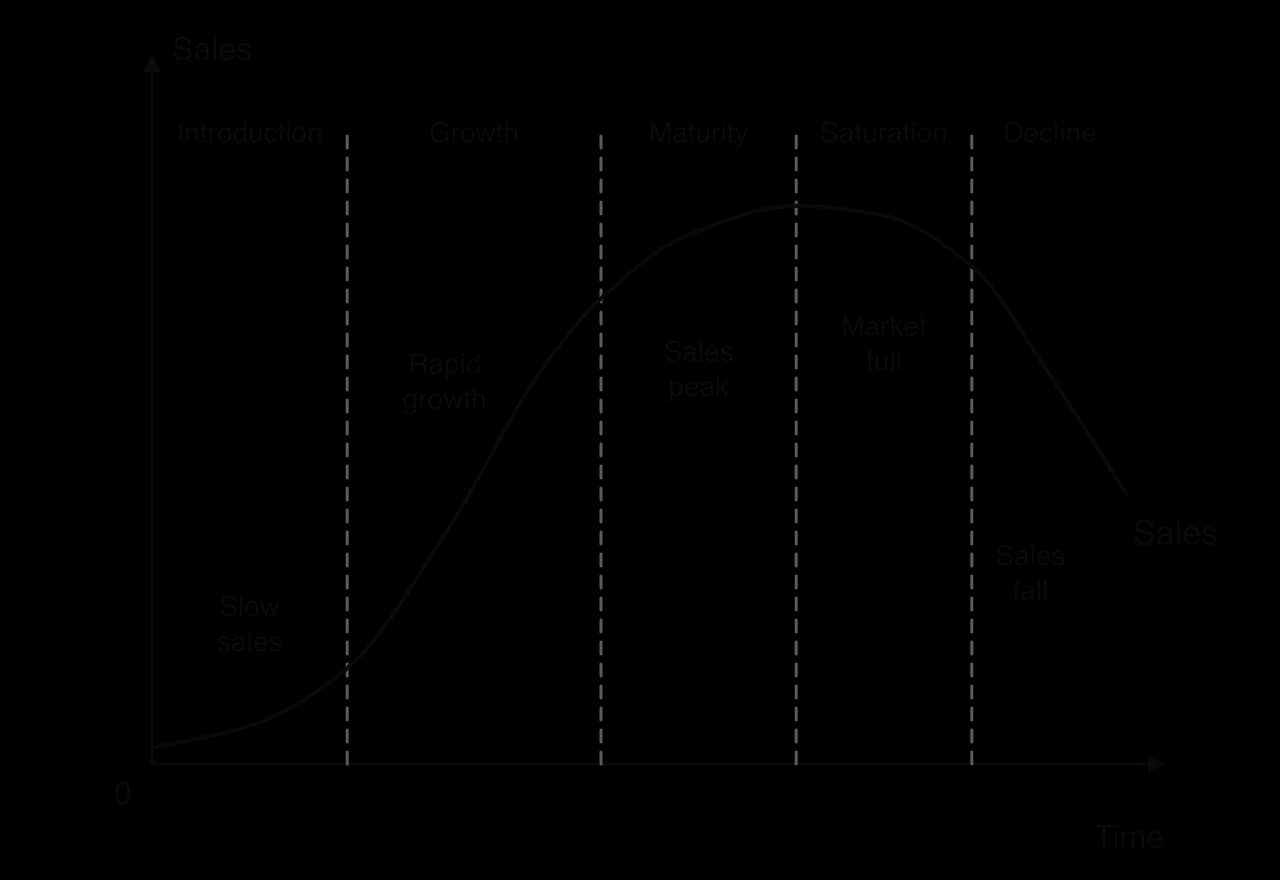
Before the product is launched it passes through research and development (R&D), when it is designed, tested and prepared for launch. There are no sales in this stage, only costs, so many diagrams leave it out of the sales curve but show it when cash flow is drawn.
In the introduction stage the product is launched. Sales are low because few customers know about it, retailers may be unwilling to stock it, and the price may be high or deliberately low to attract first buyers. Costs per unit are high because output is small, and the business spends heavily on promotion. Most products make a loss in this stage, and many fail here.
In the growth stage sales rise quickly as awareness spreads, word of mouth works and more retailers stock the product. Output rises, so unit costs fall and the product usually becomes profitable. Competitors see the success and start to launch similar products, so the business begins to add new versions and to build brand loyalty.
In the maturity stage sales are at or near their peak but grow only slowly, because most customers who want the product already buy it. Competition is strongest here, and businesses defend their market share with promotion, small improvements and price offers. A mature product usually earns the highest profit and the strongest cash flow, because the costs of development and launch have already been paid.
In the saturation stage the market is full: almost every potential customer owns the product or buys it regularly, so sales stop growing and may begin to fall. Firms can grow only by taking customers from competitors, so price competition increases and profit margins narrow. Some textbooks treat saturation as the late part of maturity.
In the decline stage sales fall steadily, usually because tastes have changed or a better product has replaced it, as streaming replaced DVDs. The business can cut promotion and let the product earn what it can, use an extension strategy to revive it, or withdraw it and use the resources elsewhere.
The right marketing mix changes as a product moves through its life cycle, because customers, competitors and the business’s objectives change. A launch aims to create awareness and trial; growth aims to build loyalty and widen distribution; maturity aims to defend share and maximise profit; decline aims to cut costs or revive sales. The table sets out the typical mix at each stage.
Stage | Product | Price | Promotion | Place |
|---|---|---|---|---|
Introduction | One basic version; faults corrected quickly | High (premium) to recover development costs, or low (penetration) to win early share | Heavy spending to build awareness and trial; free samples, launch events | Limited: a few selected outlets or online only |
Growth | Improved versions, more sizes and models | Kept steady, or lowered as rivals enter | Builds brand image and loyalty; persuasive advertising | Widened to more retailers and markets |
Maturity and saturation | Product improvements, new variants, special editions | Competitive; price offers to defend share | Reminder advertising and sales promotions; heavy spending to defend share | As wide as possible; strong retailer relationships |
Decline | Range reduced to the best-selling versions | Reduced to clear stock, or raised for a few loyal buyers | Cut to a minimum | Unprofitable outlets dropped |
The table shows typical patterns, not rules. A luxury watchmaker may keep a high price in every stage, and some products skip stages: a product that fails in introduction never reaches growth. The value of the PLC is that it prompts managers to ask what stage a product has reached and whether the current mix still suits that stage.
A business that relies on one product is exposed when that product enters decline. A balanced portfolio holds products at different stages, so that the cash earned by mature products pays for the development and launch of new ones. The timing matters: the next product should be launched while the current one is still in growth or maturity, before its sales start to fall.
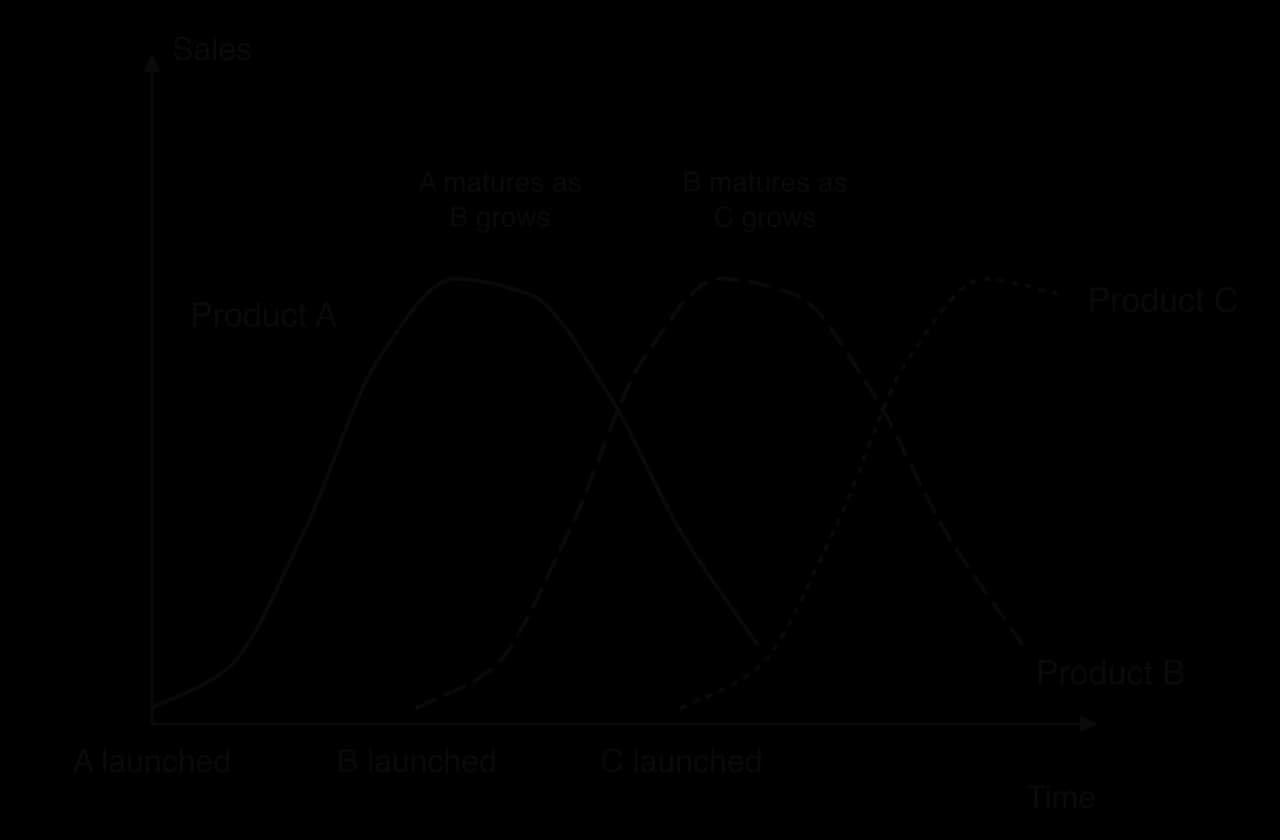
In the terms of the BCG matrix, mature products with a high share of a slow-growing market are cash cows, and new products in fast-growing markets start as question marks and, if they succeed, become stars. The PLC and the BCG matrix therefore support each other: the PLC shows where each product is in its life, and the BCG matrix shows how much cash it generates or needs. Smartphone makers, for example, launch new models every year, so that the previous model moves into maturity just as the new one enters growth.
When a product reaches maturity or saturation, a business can try to lengthen its life rather than replace it. An extension strategy is any method used to keep sales from falling or to raise them again. Extending an existing product is often cheaper and less risky than developing a new one, because the brand is already known, the production equipment is already paid for and retailers already stock it.
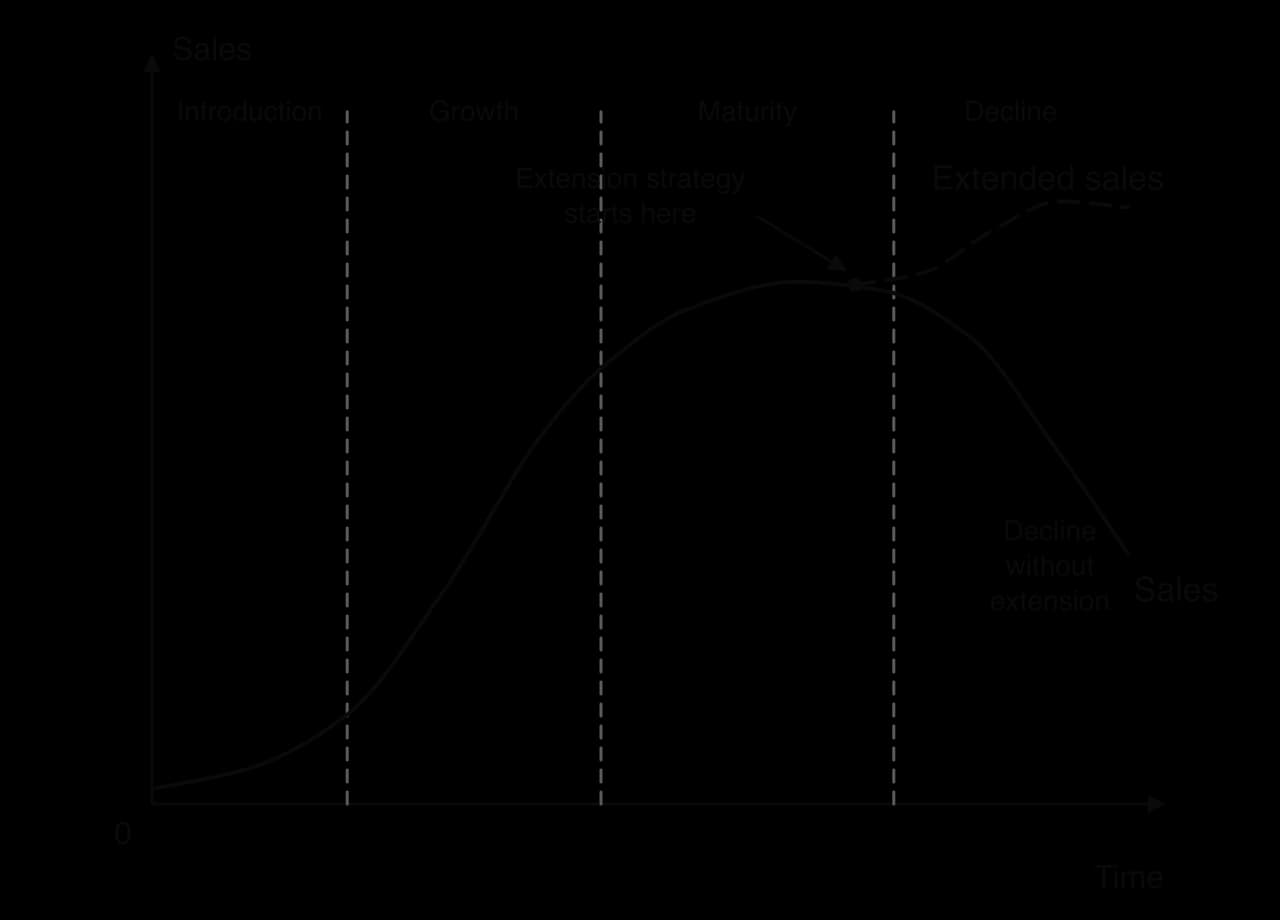
Businesses use several kinds of extension strategy, often together:
New markets: selling the product to a new segment or a new country, such as a children’s product promoted to adults or a domestic brand exported.
New uses: promoting a different use for the same product, such as a baking soda promoted for cleaning and deodorising.
Product improvements: new features, flavours, sizes or a better formula (“new and improved”).
Repackaging and redesign: a new look, more convenient pack sizes or more sustainable packaging.
New promotion: a fresh advertising campaign or a new brand image, often aimed at a different group of customers.
Price changes: price reductions or multi-buy offers to attract price-sensitive customers.
Special and limited editions: seasonal or limited versions that create urgency and media attention.
Lucozade in the United Kingdom is a well-known extension through new markets and promotion. Sold for decades as a glucose drink for people recovering from illness, it was relaunched in 1983 as an energy drink for active people, with the slogan “Lucozade replaces lost energy” and adverts featuring the Olympic decathlete Daley Thompson. UK sales roughly tripled to almost £75 million between 1984 and 1989, and the later Lucozade Sport range took the brand into sports drinks.
Sources: Wikipedia, “Lucozade” (history and sales), accessed 2026.
Advantages | Disadvantages |
|---|---|
Cheaper and less risky than developing a new product; the brand, equipment and distribution already exist. | Only delays decline if the cause is a better product or a lasting change in taste (no repackaging could save film cameras). |
Keeps a cash cow earning cash to fund new products. | Spending on an old product may take money from new products that would earn more in the long run. |
Can bring in new customers and media attention (limited editions, new markets). | Frequent variants can confuse customers and add costs, and price cuts can damage the brand image. |
Uses existing brand loyalty and retailer relationships. | Rivals can copy an improvement quickly, so the extra sales may be short-lived. |
An extension strategy is most likely to work when the product’s decline has a temporary or marketing cause, such as a tired image or a crowded home market, and when the brand still has strong awareness and loyalty. It is least likely to work when a new technology has replaced the product. The decision therefore depends on why sales are falling, on the cost of the extension compared with the cost of a replacement, and on whether the business has new products ready to take over. A sound judgment usually sees extension as a way to buy time while the next product is developed, not as a permanent solution.
Sales, profit and cash flow follow different paths over the life of a product. Investment comes first, profit later, and cash flow later still, because cash is spent on development, equipment, stock and launch promotion before the product earns any revenue. Drawing the three together shows why new products need finance and why mature products matter so much to a business.
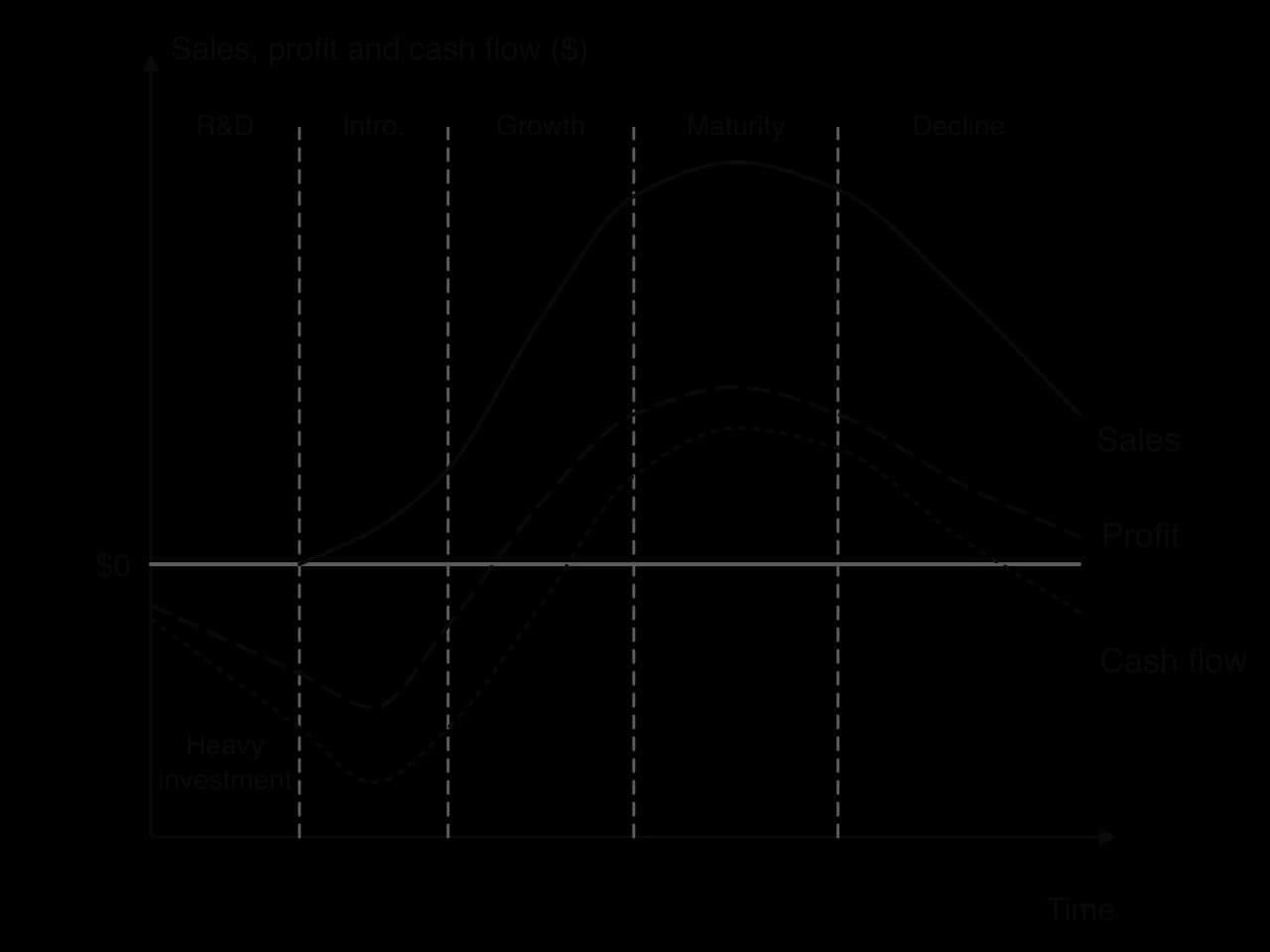
Research and development: heavy investment in design, testing and equipment, but no sales. Profit and cash flow are negative.
Introduction: spending on launch promotion and on building stock continues while sales are still low. The product usually makes a loss and cash flow reaches its lowest point.
Growth: sales rise and unit costs fall, so the product becomes profitable. Cash flow turns positive later than profit because the business is still investing in extra capacity and stock, and customers who buy on credit pay later.
Maturity: sales are high, development costs have been recovered and little new investment is needed, so profit and cash flow are at their highest. This cash funds new products.
Decline: sales and prices fall, so profit and cash flow fall too. Cash flow can stay positive for a while if marketing spending is cut, which is why some firms keep a declining product on sale.
The link has clear implications for decision-making. A business launching several products at once may run short of cash even if each product will eventually be profitable, which is a cause of overtrading. A business whose products are all mature has strong cash flow today but weak prospects, because nothing is ready to replace them. Managers use the PLC alongside a cash flow forecast to time launches so that mature products fund new ones.
 YouTube
A brand is a name, sign, symbol, design or combination of these that identifies a product and distinguishes it from competitors. Branding is the process of creating and managing that identity so that customers recognise the product, know what to expect from it and develop positive feelings towards it.
A brand is more than a logo. It is the set of ideas customers hold about the product: quality, reliability, style, value for money or social values. This brand image is formed by everything the customer experiences, from advertising and packaging to the behaviour of staff and the opinions of friends. Because the image exists in customers’ minds, a business can influence it but cannot fully control it.
Brand awareness is the extent to which customers recognise or recall a brand. Awareness ranges from recognition (a customer knows the brand when shown it) to recall (a customer names it without help) and to top of mind (the first brand a customer thinks of in a product category). Awareness matters because customers rarely buy a brand they have never heard of, and a well-known brand is more likely to be stocked by retailers.
Awareness is usually measured by market research surveys, such as the percentage of a sample who can name the brand unprompted. A new brand builds awareness with heavy promotion and distribution in its introduction stage; a well-known brand maintains it with reminder advertising.
Brand development is the work of strengthening a brand and extending its reach over time. It includes improving the products sold under the brand, investing in its image and using the brand on new products, a brand extension, as when a sports clothing brand starts to sell watches or a confectionery brand launches ice creams. A strong brand reduces the risk of a new launch, because customers transfer their trust from the existing products to the new one.
Brand development carries risks. A brand extension that does not fit the brand’s image, or that is of poor quality, can damage the reputation of the original products. Developing a brand also takes years of consistent spending, so it is easier for large businesses than for start-ups.
Brand loyalty is the tendency of customers to keep buying the same brand rather than switching to competitors. Loyal customers buy repeatedly, are less sensitive to price rises and recommend the brand to others, so they bring steady revenue at a low marketing cost. Winning a new customer usually costs more than keeping an existing one, which is why businesses use loyalty schemes, subscriptions and good after-sales service.
Brand value is the financial worth of a brand: the extra amount buyers would pay for a business because of its brand, or the extra revenue and profit the brand earns compared with an unbranded product. A strong brand allows a higher price, steadier sales and easier entry into new markets, and these benefits can be estimated and given a money value. Brand consultancies such as Interbrand and Kantar BrandZ publish annual rankings of the most valuable brands.
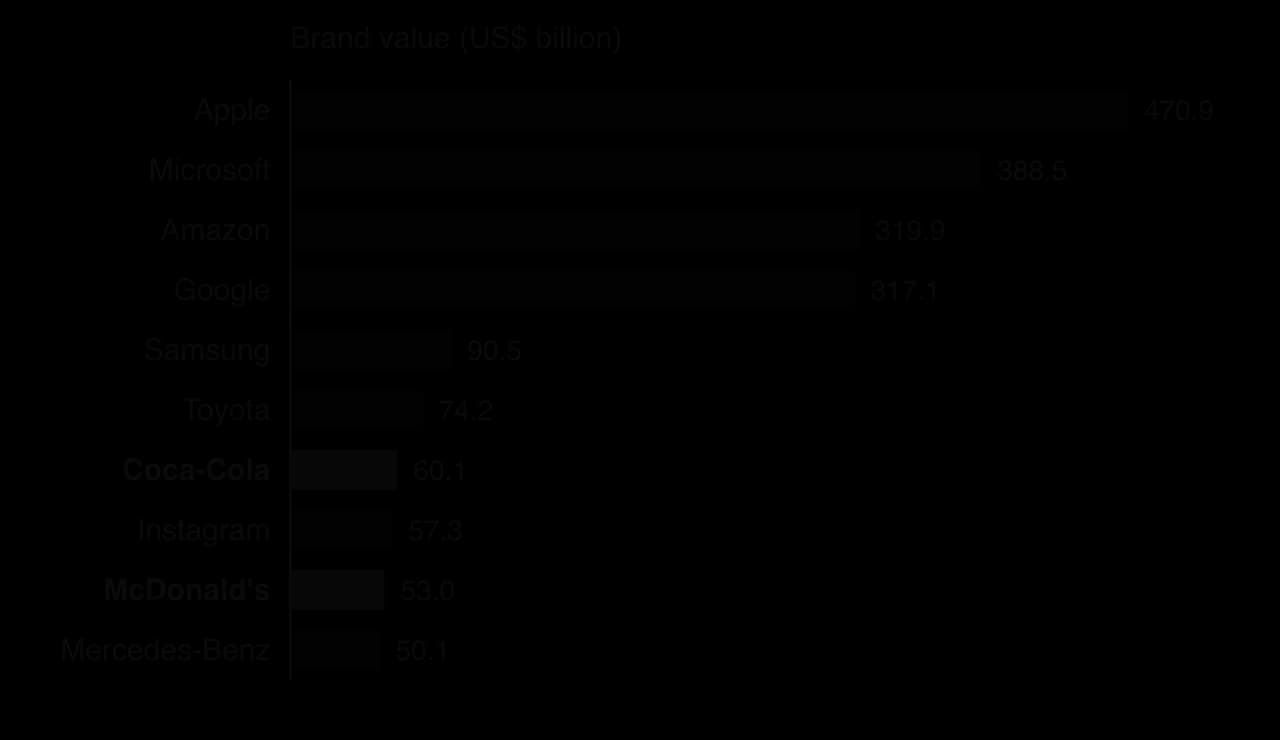
The ranking shows that brand value comes from different sources. The technology brands earn their value from products that customers use every day and from ecosystems that make switching costly. Coca-Cola and McDonald’s earn theirs from very high awareness, consistent products and loyalty built over decades, without the newest technology. Brand values also change: Interbrand reported a 15% fall in Mercedes-Benz’s brand value in 2025 and a 27% rise for Instagram, showing that brand value depends on current performance as well as history.
Sources: Interbrand, Best Global Brands 2025.
Businesses organise their brands in different ways. Some use one brand name for everything they sell; others give each product its own name. Retailers sell their own brands beside the manufacturers’ brands. Each approach has costs and benefits.
Type of brand | Meaning | Example | Main advantage | Main disadvantage |
|---|---|---|---|---|
Family branding (umbrella branding) | One brand name is used for all or most of a business’s products. | Samsung uses its name on phones, televisions and washing machines. | Each new product benefits from the existing awareness and trust; promotion supports the whole range. | A problem with one product can damage the reputation of all of them. |
Product branding (individual branding) | Each product has its own brand name, often with little mention of the owner. | Procter & Gamble sells Pampers, Gillette and Ariel as separate brands. | Each brand can target a different segment; a failure does not harm the others. | Each brand must be built and promoted separately, which is costly. |
Own-label branding (private label) | A retailer sells products under its own brand name, made for it by manufacturers. | Costco’s Kirkland Signature, launched in 1995, accounts for nearly a third of Costco’s sales. | Higher margins for the retailer and lower prices for customers; builds loyalty to the store. | Customers may see own-label products as lower quality, and the retailer bears the risk of poor products. |
Manufacturer branding | The producer’s own brand is sold through many retailers. | Heinz baked beans or Nestlé’s KitKat in any supermarket. | The manufacturer controls its image and can charge a premium for a trusted brand. | Retailers’ own labels compete on price on the same shelf. |
Sources: Costco Wholesale Corporation (via Wikipedia, “Costco”), Kirkland Signature sales, 2024.
Branding matters to a business because it makes its products recognisable and different, and difference allows a business to compete on something other than price. A strong brand supports product differentiation, so customers are willing to pay more; it builds loyalty, so revenue is steadier and easier to forecast; it helps a business launch new products and enter new markets; and it gives the business more power when negotiating with retailers, who want to stock the brands customers ask for.
Customers gain from branding too. A brand saves time and reduces risk, because it signals what quality to expect, and it can express identity: some customers choose a brand because it reflects their values or status. For services, which customers cannot inspect in advance, the brand is often the main clue to quality.
There are limits to what a brand can do. Building a strong brand takes years and heavy spending, which is a barrier for small firms, and a brand can be damaged quickly by a product failure, an ethical scandal or a badly judged campaign. Strong brands can also attract criticism for persuading customers to pay more for products that differ little from cheaper alternatives. The importance of branding therefore depends on the market: it is greatest where products are similar and customers buy on image (soft drinks, fashion, cosmetics) and smallest where customers compare technical specifications or price, as many business-to-business buyers do.
Price is the amount a customer pays to obtain a product. It is the only P that brings in revenue; every other P costs money. Price also sends a message about quality and positioning: a very low price can suggest poor quality, and a high price can signal luxury or expertise.
A pricing strategy is the method a business uses to set its price. The right method depends on several factors: the business’s costs, which set the lowest price it can accept in the long run; the prices of competitors; how sensitive customers are to price; the business’s objectives (market share, profit, survival); the stage of the product life cycle; the brand image; and the law, which forbids some pricing practices.
Pricing methods fall into three broad groups. Cost-based methods start from what the product costs to make. Competition-based methods start from what rivals charge. Market-based methods start from what customers are willing to pay and from the business’s objectives, such as entering a market or building a premium image. Most businesses use more than one approach, setting a price from costs and then checking it against competitors and customers.
Cost-plus pricing sets the price by adding a percentage, the mark-up, to the cost of producing each unit. The unit cost is the average cost: the total cost (fixed and variable) divided by the number of units. The mark-up is chosen to give the business the profit it wants on each unit.
The mark-up is the profit per unit expressed as a percentage of the unit cost. Retailers often use standard mark-ups for whole product categories, so that every item in a department earns a similar return on its cost.
Cost-plus pricing is simple, quick to apply across many products, and makes sure each unit sold covers its cost, provided sales reach the planned level. It suits retailers with thousands of product lines, contractors who price individual jobs, and businesses with little competition. It is also easy to justify to customers when costs rise.
Its weakness is that it ignores the market. The price takes no account of what competitors charge or what customers are willing to pay, so it may be too high to sell or lower than customers would happily pay. The unit cost itself depends on the level of output: if sales fall, fixed costs are spread over fewer units, unit cost rises and the price should rise too, which can reduce sales further. Cost-plus pricing is therefore most appropriate where costs are known, competition is limited and customers are not very sensitive to price, and least appropriate in fiercely competitive markets.
Penetration pricing sets a low price when a product is launched in order to win customers and market share quickly. Once the product is established and customers are loyal, the business raises the price. The approach suits mass markets where customers are sensitive to price and where high sales bring economies of scale that lower unit costs.
Reliance Jio, the Indian mobile network, launched commercially on 5 September 2016 with free voice calls and data under a “Welcome Offer” that was extended to 31 March 2017. It passed 100 million subscribers on 22 February 2017, less than six months after launch, before introducing paid plans. Rival networks had to cut their own prices sharply in response.
Sources: Wikipedia, “Jio” (launch, Welcome Offer and subscriber milestones), accessed 2026.
Penetration pricing works when the business can afford early losses, when customers will stay after the price rises (because switching is inconvenient or the product is good), and when competitors cannot easily match the low price. It fails when customers leave as soon as the price rises, when rivals start a price war, or when the low price damages the brand’s image. It also creates an ethical question if the low price is used with the aim of driving rivals out of the market, which turns it into predatory pricing.
A loss leader is a product sold at a price below its cost to attract customers who then buy other, profitable products. Supermarkets use loss leaders on items customers buy often and compare, such as bread, milk or bananas, so that shoppers judge the whole store as good value. Printer manufacturers sell printers cheaply and make their profit on ink cartridges; games console makers have at times sold consoles below cost and earned their profit on games and subscriptions.
Costco has charged US$1.50 for its hot dog and drink since 1985, and its low-priced rotisserie chickens, sold since 1994, are known for drawing customers into its warehouses. Products like these work in the same way as loss leaders, even when they do not sell below cost: the profit comes from the rest of the shopping basket and, for Costco, from membership fees, which made up 65.5% of its net operating income in the 2024 financial year.
Sources: Costco Wholesale Corporation, annual report data via Wikipedia, “Costco”, accessed 2026.
The method is appropriate for a business that sells many products to the same customer, so that losses on one item are recovered elsewhere. It is risky when customers buy only the loss leader (“cherry-picking”), when suppliers object to their brands being sold below cost, and in countries where selling below cost is restricted by law. It suits large retailers far better than single-product businesses.
Predatory pricing sets prices deliberately low, often below cost, with the aim of forcing competitors out of the market. Once rivals have left, the predator raises its prices to recover its losses. It differs from penetration pricing in its purpose: penetration pricing aims to win customers, predatory pricing aims to remove competitors.
Predatory pricing is illegal in many countries when it is used by a dominant firm, because it reduces competition and harms consumers in the long run. In the European Union, prices below average variable cost charged by a dominant firm are presumed to be abusive.
The European Commission fined the chemicals group AKZO €10 million in 1985 for loss-making price cuts aimed at a smaller rival, a case in which the Court of Justice set out the cost test in 1991, and fined Wanadoo, a subsidiary of France Télécom, €10.35 million in 2003 for pricing broadband below cost. In the United States, courts also ask whether the predator could recover its losses later by charging higher prices, a test set by the Supreme Court in 1993.
Sources: European Commission decisions ECS/AKZO (1985) and Wanadoo Interactive (2003); Brooke Group v. Brown & Williamson (US Supreme Court, 1993), via Wikipedia, “Predatory pricing”, accessed 2026.
Predatory pricing raises clear ethical questions, because its purpose is to harm competitors and, eventually, customers. It is also hard to prove: a business accused of predatory pricing can usually argue that it is simply competing hard or using penetration pricing. A low price becomes predatory only when a dominant firm uses it with the intention of removing competitors.
Premium pricing sets a price well above competitors’ to create an image of high quality, exclusivity or status. Customers of luxury watches, designer fashion and high-end cars often see a high price as part of the product’s appeal: a lower price would weaken the brand. Premium pricing needs a genuinely superior product or a very strong brand, together with promotion, distribution and service that match the price.
Premium pricing brings high profit margins and protects the brand from being seen as ordinary. Its risks are that it limits the size of the market, that it attracts competitors who offer similar quality at lower prices, and that customers may switch in a recession. It is appropriate for products with a strong unique selling point and for customers who are not very sensitive to price.
Premium pricing is sometimes confused with price skimming, which sets a high price at launch, when early buyers are keen to have the newest product, and then lowers it step by step as rivals enter. Premium pricing keeps the price high throughout the product’s life.
Two further pricing approaches are common. Price discrimination charges different prices to different groups of customers for the same product, when the groups can be kept apart and differ in how much they are willing to pay. Examples include student and senior discounts, peak and off-peak train fares, and lower prices for the same software in lower-income countries. It raises revenue by charging each group closer to what it will pay, but customers who pay more may see it as unfair.
Psychological pricing sets prices that appeal to customers’ perceptions rather than to calculation. The most familiar form is charm pricing, such as $9.99 instead of $10, which customers tend to read as “nine dollars and something”. Other forms include round prices for luxury goods, which signal quality, and showing a crossed-out “was” price to make the current price look like a bargain, a practice that consumer law controls in many countries.
Method | Most appropriate when… | Less appropriate when… |
|---|---|---|
Cost-plus | costs are known, competition is limited, the business sells many lines | competition is fierce or customers are very sensitive to price |
Penetration | launching into a price-sensitive mass market; economies of scale are large; the business can fund early losses | customers will leave when the price rises; rivals can match the price; the brand is premium |
Loss leader | customers buy several products in one visit; the business is a multi-product retailer | customers buy only the cheap item; suppliers or the law object |
Predatory | never ethically appropriate; illegal for dominant firms in many countries | always: it harms competition and risks large fines |
Premium | the product is clearly superior or the brand is very strong; customers are not price-sensitive | the market is a price-sensitive mass market or the economy is in recession |
No pricing method is best in every case. The appropriate method depends on the business’s objectives (a start-up seeking market share and an established luxury brand need different prices), on the stage of the product life cycle, on the strength of the brand and on the competition. A good pricing decision also fits the rest of the mix: a premium price needs premium quality, promotion, distribution and service, while a penetration price needs efficient, low-cost operations behind it.
Dynamic pricing changes the price of a product frequently, often in real time, in response to changes in demand and supply. Software uses data on current demand, the time of booking, competitors’ prices and the remaining capacity to set the price at each moment. Airlines, hotels, ride-hailing apps, event tickets and many online retailers use it.
The logic comes from the perishability of many services: an empty seat on a flight that has taken off earns nothing, so the airline lowers prices when demand is weak and raises them when the flight is nearly full. Ride-hailing companies such as Uber raise fares when many passengers want rides at once, which both rations the available cars and encourages more drivers to work at busy times.
Dynamic pricing can provoke strong reactions from customers. When tickets for Oasis’s 2025 reunion tour went on sale in the UK in 2024, many fans believed that prices had risen during the sale because of dynamic pricing. The Competition and Markets Authority (CMA) investigated Ticketmaster and in September 2025 reported that it had found no evidence of dynamic pricing; the standing tickets had been sold at two price tiers, released in turn, without fans in the online queue being told.
Ticketmaster agreed to give at least 24 hours’ notice of tiered pricing, to show the range of prices to fans when they join the queue and to update them when cheaper tickets sell out. Customers’ anger arose from a pricing method they believed was in use, so a business using any variable pricing needs to explain clearly how its prices are set.
Sources: Competition and Markets Authority, “CMA secures changes from Ticketmaster following Oasis tickets investigation”, 25 September 2025.
Dynamic pricing raises revenue by charging more when customers are willing to pay more, fills capacity that would otherwise be wasted, and responds automatically to competitors. Customers who book early or travel at quiet times can pay much less than under a fixed price.
Its disadvantages are that customers can see it as unfair or exploitative, particularly in emergencies or when the same item costs different people different amounts; that it needs investment in data and software; and that it can damage loyalty when customers feel they paid too much. Its use is appropriate where capacity is fixed and perishable and demand varies widely, and where the business is transparent about how prices are set.
Competitive pricing sets the price at, just below or just above the prices charged by competitors. It is common in markets where products are similar and customers compare prices easily, such as petrol stations, supermarkets and online electronics. In many such markets one large firm, the market leader, acts as price leader and smaller firms follow its price changes.
UK supermarkets show competitive pricing in action. Tesco began matching the prices of selected products at the discounter Aldi in March 2020, and Sainsbury’s followed with its own Aldi Price Match in February 2021, covering about 250 staple products at launch, to stop price-sensitive shoppers switching to Aldi. Petrol stations on the same road often change prices within hours of each other.
Sources: The Grocer, “Sainsbury’s apes Tesco with launch of Aldi Price Match campaign”, February 2021.
Competitive pricing reduces the risk of losing customers on price and avoids damaging price wars, and it is simple to apply once competitors’ prices are monitored. However, it ignores the business’s own costs: a firm with higher costs than its rivals may make a loss at the market price. It also reduces the business’s control over its price and makes it harder to build a distinctive position, so firms that rely on it often try to compete through service, location or brand instead. It is most appropriate for products with little differentiation and least appropriate for products with a strong competitive advantage that customers will pay more for.
Contribution pricing sets the price above the variable cost of each unit, so that each sale makes a contribution towards paying the fixed costs and then to profit. It is useful when a business has spare capacity: as long as a sale covers its variable cost, it adds to profit, because the fixed costs must be paid anyway. It is often used for special orders, off-peak sales and products sold in several markets at different prices.
Contribution pricing is appropriate for businesses with high fixed costs, low variable costs and spare capacity, such as hotels, airlines, theatres and factories in quiet periods. Its risks are that low prices can become expected, that customers paying full price may feel cheated, and that a business that sets too many prices only just above variable cost may fail to cover its fixed costs in total. Contribution costing and break-even analysis are the tools that show how much total contribution the business needs.
When a business raises its price, it usually sells fewer units. Whether its revenue rises or falls depends on how many fewer units it sells. Price elasticity of demand (PED) measures this responsiveness by comparing the percentage change in quantity demanded with the percentage change in price that caused it.
Because price and quantity demanded move in opposite directions, PED is normally a negative number. Businesses usually focus on its size, ignoring the sign. When the value (ignoring the sign) is greater than 1, demand is price elastic: the quantity demanded changes by a larger percentage than the price. When the value is less than 1, demand is price inelastic: the quantity demanded changes by a smaller percentage than the price. A value of exactly 1 is unitary elasticity, where revenue does not change.
Price elastic demand is typical of products with many close substitutes, such as one brand of petrol among several on the same road. Price inelastic demand is typical of necessities and of products with few substitutes, such as tap water, many medicines or the only bus route to a town.
The link between PED and revenue follows from the arithmetic. Revenue is price multiplied by quantity. When the price rises, the business gains extra revenue on every unit it still sells but loses the revenue from the units it no longer sells. With inelastic demand few units are lost, so the gain is larger than the loss; with elastic demand many units are lost, so the loss is larger.

Price rise | Price cut | |
|---|---|---|
Price elastic demand (PED > 1, ignoring the sign) | Revenue falls | Revenue rises |
Price inelastic demand (PED < 1, ignoring the sign) | Revenue rises | Revenue falls |
Unitary elasticity (PED = 1) | Revenue unchanged | Revenue unchanged |
Number and closeness of substitutes: the more close substitutes, the more elastic the demand. Demand for one brand of bottled water is far more elastic than demand for water in general.
Share of income: products that take a large share of a customer’s income (cars, holidays) tend to have more elastic demand than cheap items (salt, matches).
Necessity or luxury: necessities and habit-forming products tend to have inelastic demand.
Brand loyalty: strong branding makes demand less elastic, which is one reason businesses invest in brands.
Time: demand becomes more elastic over time, as customers find substitutes or change their habits.
PED helps a business choose and evaluate its pricing strategy. A firm facing inelastic demand can raise prices to increase revenue, as many premium brands and utilities do; a firm facing elastic demand may raise revenue by cutting prices, which is the logic behind penetration pricing and sales promotions. PED also helps forecast sales after a price change, plan production and stock, and judge how much of a cost increase (such as a new tax) can be passed on to customers.
PED has important limitations. Estimates are based on past data or market research, and elasticity changes over time and differs between customer groups. The calculation assumes that only the price changes, while in reality competitors’ prices, incomes, fashion and promotion change at the same time. A PED estimated for a small price change may not hold for a large one. Finally, a rise in revenue is not the same as a rise in profit: cutting the price of a product with elastic demand raises revenue but also raises output and therefore total costs.
Promotion is the way a business communicates with customers and other stakeholders about its products and brand. Its objectives are often summarised as to inform (create awareness of a new product or feature), to persuade (convince customers to buy or to switch from a rival) and to remind (keep a mature brand in customers’ minds). The objective depends on the stage of the product life cycle and on the target market.
Businesses combine several methods of promotion in a promotional mix, because each method reaches different people at a different cost. A promotional mix for a new smartphone game might combine online video adverts, social media posts by players, a launch event for journalists and a free trial period. The usual way to classify promotion is by whether it uses paid mass media (above the line), other methods (below the line) or a combination (through the line).
Above the line promotion (ATL) is paid advertising in the mass media: television, radio, newspapers and magazines, cinema and outdoor media such as billboards and posters on buses. The business pays a media owner to carry its message to a large, broad audience that it does not control precisely. Large consumer brands use ATL to build awareness and brand image nationally.
ATL reaches very large numbers of people quickly and can build strong brand images through sound, pictures and stories; a television campaign during a major sporting event can reach millions of viewers at once. Its disadvantages are its high total cost, which puts it beyond most small businesses, its waste (much of the audience is not in the target market), the difficulty of measuring its effect on sales, and the growing number of people who avoid adverts by streaming without advertising or skipping them.
Below the line promotion (BTL) is any promotion that does not use paid mass media. It is usually more targeted and more direct than ATL, and its results are often easier to measure. The main methods are sales promotion, direct marketing, public relations, sponsorship, personal selling and trade fairs.
Sales promotion: short-term incentives to buy, such as discounts, “buy one, get one free” offers, coupons, free samples, competitions and loyalty points. Sales promotions raise sales quickly and encourage trial, but the effect often ends when the offer ends, and frequent offers can cheapen a brand.
Direct marketing: communicating directly with individual customers by email, text message, post or app notifications, usually using customer data. It can be personalised and measured precisely, but customers may see it as unwanted, and data protection laws restrict how personal data can be used.
Public relations (PR): managing the business’s reputation through press releases, media interviews, events and responses to criticism. PR coverage is more credible than advertising because it comes from journalists, but the business cannot control what is written.
Sponsorship: paying to be associated with an event, team, programme or person, such as a bank sponsoring a football competition. Sponsorship builds awareness and links the brand with the values of what it sponsors, but its effect on sales is hard to measure and a scandal involving the sponsored party can harm the sponsor.
Personal selling: sales staff communicating face to face (or by phone or video) with customers to persuade them to buy. It suits expensive, complex or business-to-business products, because the seller can answer questions and adapt the message, but it is costly per customer reached.
Trade fairs and exhibitions: events where businesses show their products to buyers, retailers and the media in one place. They are important in business-to-business markets for meeting new buyers and watching competitors.
Through the line promotion (TTL) combines above the line and below the line methods in one integrated campaign, so that each method reinforces the others. A television advert might build awareness, direct customers to a website or app for a discount code, and be followed by targeted social media adverts to people who visited the site. Digital media have made TTL the normal approach for most large campaigns, because online adverts can reach both broad audiences and precisely targeted individuals.
TTL gives a consistent message across all the places customers meet the brand and allows the business to follow customers from awareness to purchase. It needs careful planning and coordination, a larger budget than a single method, and skills in data analysis, so it suits medium and large businesses more than small ones.
Above the line | Below the line | Through the line | |
|---|---|---|---|
Media | Paid mass media: TV, radio, print, cinema, outdoor | Sales promotion, direct marketing, PR, sponsorship, personal selling, trade fairs | A planned combination of both, often linked through digital media |
Audience | Broad, mass audience | Targeted groups or individuals | Broad awareness plus targeted follow-up |
Cost | High total cost, low cost per person reached | Lower total cost, higher cost per person for some methods | High; needs coordination |
Measuring results | Difficult | Easier (coupons redeemed, emails opened, sales calls made) | Easier for the digital parts |
Best for | Building awareness and brand image for mass-market products | Encouraging purchase, trial and loyalty; niche and B2B markets | Major launches and campaigns needing both reach and response |
Some promotion relies on surprise and on customers spreading the message themselves. Guerrilla marketing uses unconventional, low-cost methods in public places to surprise people and create talk, such as street art, flash mobs or unusual objects placed in a city. It suits businesses with small budgets and young, urban target markets, but it can annoy the public, break local rules on public spaces and be misunderstood.
Viral marketing creates content that people share with each other so rapidly that it spreads like a virus. The ALS Ice Bucket Challenge of July and August 2014, in which people filmed themselves pouring iced water over their heads and nominated friends to do the same, was shared in about 1.2 million videos on Facebook between 1 June and 13 August 2014; by 29 August the ALS Association reported more than US$100 million of donations received since 29 July.
Sources: The New York Times and the ALS Association, reported via Wikipedia, “Ice Bucket Challenge”, accessed 2026.
Viral campaigns reach huge audiences at a very low cost per person, but they are hard to plan: most content intended to go viral does not, and once content is shared the business loses control over how it is changed and interpreted.
Social media marketing uses platforms such as Instagram, TikTok, YouTube, Facebook, LinkedIn and WeChat to promote a business and its products. It includes the business’s own posts and accounts, paid adverts targeted at particular users, partnerships with influencers and the encouragement of content created by customers. Because many people, especially young people, spend hours each day on these platforms, social media have become a central part of the promotional mix for most consumer businesses.
Three features make social media different from traditional media. First, targeting: platforms hold data on users’ ages, locations, interests and behaviour, so adverts can be shown only to the target market. Second, two-way communication: customers can reply, comment, share and complain in public, so the business holds a conversation rather than broadcasting a message. Third, measurement: views, clicks, shares, follower growth, the engagement rate and the conversion rate (the percentage of viewers who buy) are recorded automatically, so the business can test and change campaigns quickly.
Influencer marketing pays or rewards individuals with large or loyal followings to feature a product in their content. Followers often trust an influencer more than an advert, so a recommendation can be persuasive. Businesses increasingly use micro-influencers with smaller but highly engaged audiences in a particular niche, who cost less and often achieve higher engagement than celebrities.
User-generated content (UGC) is content about a brand created by customers rather than by the business, such as reviews, unboxing videos, photos and posts using a campaign hashtag. It is cheap, appears authentic and helps other customers judge the product, but the business cannot control it, and negative content spreads as easily as positive.
Duolingo, the language-learning app, shows both the strength and the risk of social media marketing. Its accounts, built around its owl mascot Duo, became widely described as a model of successful marketing; in February 2025 a campaign announcing Duo’s “death” asked users to earn 50 billion points in the app to bring him back. In May 2025, after the company said it would replace some contractors with artificial intelligence, angry comments flooded its posts and Duolingo removed all its videos from TikTok and Instagram for a time, although its chief executive later said the effect on its financial results was not material.
Sources: Wikipedia, “Duolingo” (marketing, February 2025 campaign, May 2025 backlash and the August 2025 earnings call), accessed 2026.
Strengths | Weaknesses and risks |
|---|---|
Low cost per person reached; small businesses can compete with large ones. | Very crowded: content must stand out among millions of posts, which needs creative skill and constant effort. |
Precise targeting of the target market using platform data. | Platforms change their algorithms and rules, so reach can fall suddenly; the business does not own the audience. |
Two-way communication builds relationships and gives instant customer feedback. | Negative comments and backlash spread quickly and publicly (Duolingo, May 2025). |
Results can be measured and campaigns adjusted quickly. | Engagement does not always become sales; metrics such as likes can mislead. |
Influencers and UGC add credibility and reach young audiences. | Influencer scandals harm the brand; undisclosed paid posts break advertising rules. |
Social media marketing also raises ethical issues. Paid influencer posts that are not labelled as advertising mislead followers, so advertising regulators in many countries, including the UK’s Advertising Standards Authority, require them to be obviously identifiable as advertising, usually with a prominent “Ad” label at the start of the post. Targeting based on personal data raises privacy concerns, and promotion to children and teenagers of products such as unhealthy food or gambling is restricted in many countries.
The effectiveness of social media marketing depends on the target market (it suits young, digitally active customers better than older or B2B buyers), on the product (visual, shareable products such as fashion, food and travel gain most), on the business’s ability to produce authentic content consistently, and on how it is integrated with the rest of the promotional mix. For most consumer businesses today it is an essential part of a through the line strategy rather than a complete strategy on its own, because it builds engagement well but reaches people outside the platforms poorly.
Place covers the decisions that get the product to the customer at the right time, in the right quantity and in a convenient location. It includes the choice of distribution channels, the number and type of outlets, and the logistics of storing and transporting products. A good product at the right price still fails if customers cannot find it where and when they want to buy.
A distribution channel is the route a product takes from the producer to the final consumer. Each business between the two is an intermediary. Intermediaries take on tasks that the producer would otherwise have to do itself: holding stock, breaking bulk into smaller quantities, transport, displaying products, giving advice and handling customers’ payments. In return they take part of the final price as their margin.
Distribution channels are described by the number of intermediaries between producer and consumer. The main types are shown in the diagram.
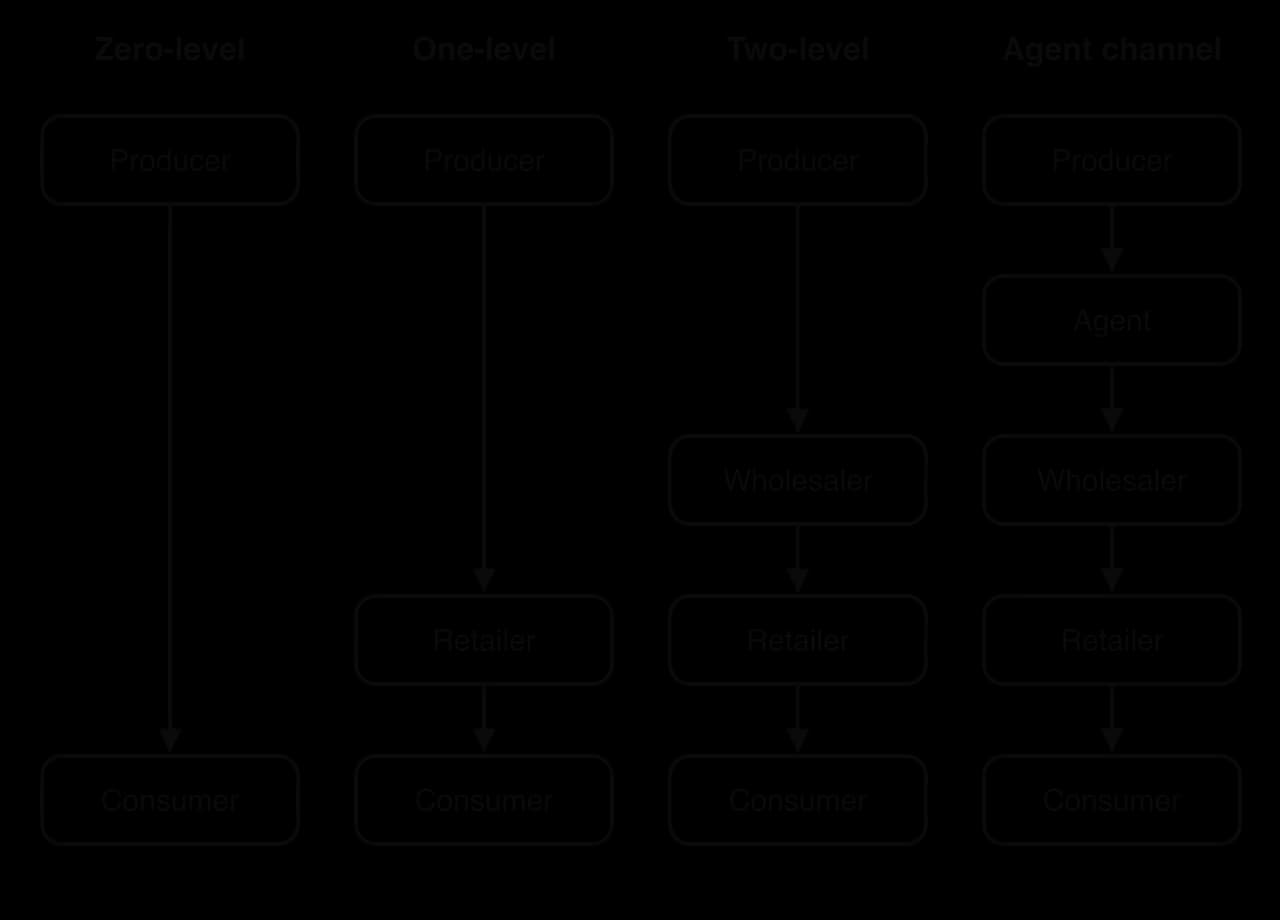
A zero-level channel has no intermediaries: the producer sells directly to the consumer through its own shops, website, app, sales staff or a farm shop. Direct selling gives the producer full control over the price, the customer experience and customer data, and it keeps the whole margin. However, the producer must pay for its own outlets, delivery and customer service, and it reaches only the customers it can attract itself.
In a one-level channel the producer sells to a retailer, which sells to consumers. This channel is typical of large manufacturers selling through supermarket chains and of car makers selling through dealers. The retailer provides the outlets, displays and staff; the producer gains wide reach but gives up part of the margin and some control over how its product is presented and priced.
A two-level channel adds a wholesaler between the producer and the retailer. The wholesaler buys in bulk, stores the products and sells them in smaller quantities to many small retailers, such as corner shops and independent pharmacies, which could not buy direct from the producer. This channel suits fast-moving consumer goods sold through thousands of small outlets and markets with many small retailers, as in much of India, Africa and South-East Asia.
Some channels use an agent, an intermediary that arranges sales on behalf of the producer, usually for a commission, without owning the products itself. Agents are common in international trade, where a local agent knows the market, the language and the buyers, and in services such as travel, insurance and property. An agent channel may also include a wholesaler and a retailer, so it can be the longest channel of all.
E-commerce is the buying and selling of products online, through websites, apps and online marketplaces. It allows producers to sell direct to consumers anywhere they can deliver, opens the market to small businesses at low cost, and gives businesses data on what customers view and buy. Its challenges are the cost of delivery and returns, fierce price comparison, and the loss of the physical experience that helps customers judge some products.
Most large retailers now combine channels. Omnichannel retailing joins physical stores, websites, apps and social media into one experience, so that a customer can browse online, check stock in a nearby store, buy on an app and collect or return in a shop. Customer data are shared across the channels, so the business recognises the customer wherever they shop. Omnichannel distribution meets customers’ expectations of convenience but is expensive, because stock, IT systems and staff must be coordinated across every channel.
Nike shows that the right channel mix can change. For several years it gave priority to direct-to-consumer sales through its own stores, website and apps over sales through wholesale partners. In December 2024 the new chief executive, Elliott Hill, said that “some partners and channels feel we’ve turned our back on them” and set out to rebuild relationships with retailers such as Foot Locker, JD Sports and Dick’s Sporting Goods; in the quarter he reported, Nike Direct revenue fell 13% while wholesale revenue fell 3%.
Sources: Retail Dive, “Nike sales fall as it rebuilds wholesale partnerships”, 20 December 2024.
Channel | Advantages | Disadvantages |
|---|---|---|
Zero-level (direct) | Full control of price, image and customer data; producer keeps the whole margin; direct feedback | Producer pays for outlets, delivery and service; limited reach; slow to grow |
One-level (retailer) | Wide reach through established outlets; retailer provides display, staff and location | Retailer takes a margin and may control shelf position and price; producer has less contact with customers |
Two-level (wholesaler and retailer) | Reaches thousands of small retailers; wholesaler holds stock and breaks bulk; lower distribution cost per outlet | Two margins raise the final price or cut the producer’s share; least control; slower feedback |
Agent | Local knowledge and contacts, useful for entering foreign markets; paid only for sales made (commission) | Agents may also sell rivals’ products; producer depends on the agent’s effort and honesty |
The importance of each channel depends on the product, the market and the business. Perishable or fragile products need short channels; expensive, complex or customised products suit direct selling with advice; cheap everyday products bought often need the widest possible distribution through retailers and wholesalers. Small businesses may have to use intermediaries because they cannot afford their own outlets, while strong brands can sell direct because customers seek them out. Most businesses now use several channels at once, and the key question is how to combine them so that each reaches a different group of customers without the channels competing destructively with one another.
In the marketing mix, people are the employees who deal with customers: shop assistants, waiters, call-centre staff, nurses, teachers, drivers and engineers. For a service, the employee is part of the product: the customer’s experience of a restaurant depends on the waiter as much as on the food. People also include the customers themselves, whose behaviour affects other customers in shared services such as cinemas and flights.
Employee–customer relationships matter for several reasons. Satisfied customers return and recommend the business, so friendly, knowledgeable staff raise sales and loyalty. Staff who handle a complaint well can turn an unhappy customer into a loyal one. In professional services (doctors, lawyers, financial advisers) customers often stay with a particular person rather than with the business. Because rivals can copy a menu or a price but find it hard to copy a skilled, motivated team, good people are a lasting source of differentiation.
The Ritz-Carlton hotel group expresses this idea in its motto, “We are Ladies and Gentlemen serving Ladies and Gentlemen”, which treats staff with the same respect expected for guests. Under the leadership that introduced the motto, its hotels won the United States’ Malcolm Baldrige National Quality Award twice, a rare achievement in the service sector.
Sources: Wikipedia, “The Ritz-Carlton Hotel Company” (motto and Baldrige awards), accessed 2026.
Good employee–customer relationships depend on human resource management: careful recruitment of people with the right attitude, training in product knowledge and customer service, motivation and fair pay, and the authority to solve customers’ problems without waiting for a manager. Low pay, a high rate of staff leaving and poor training show directly in the quality of service, which is why service businesses treat HR and marketing as closely linked.
What customers expect from staff varies between cultures. In some countries customers expect friendly, informal conversation and staff who use first names; in others they expect formal, polite and more distant service. Tipping is normal in restaurants in the United States, where it forms a large part of waiters’ pay, but uncommon in Japan, where good service is treated as part of the standard price. Attitudes to smiling, small talk, eye contact, the speed of service and how directly a complaint can be made also differ.
Businesses that operate in several countries, or serve tourists and migrant communities, must decide how far to standardise their service and how far to adapt it to local expectations. A global hotel chain may keep the same core standards everywhere while training staff in local customs and languages. Getting this wrong can offend customers or make staff appear rude or insincere. Cultural differences inside the business matter too, because staff from one culture may find the service style expected by another uncomfortable.
People matter most in high-contact services where the customer spends a long time with staff and judges quality by the interaction, such as healthcare, education, hospitality and personal services, and in premium businesses where service justifies the price. They matter less in low-contact services and in businesses that have replaced staff with self-service technology, such as online retailers and budget airlines, where efficiency and low prices are the selling point.
Investment in people has costs: training, higher pay and more staff raise costs, and the benefits are long term and hard to measure. A judgment on the importance of people should therefore consider the business’s positioning (premium or low-cost), how much contact customers have with staff, the culture of the market, and whether technology can deliver the service more reliably.
Processes are the procedures, systems and steps by which a service is delivered to the customer: how bookings are taken, how long customers wait, how orders are processed and delivered, how payments and complaints are handled. Customers judge a service by the process as well as the outcome: a restaurant can serve an excellent meal and still lose customers if the wait is too long or the bill is wrong.
Well-designed delivery processes make a service fast, reliable and consistent. Because services are variable, standard processes help every customer receive the same quality whichever employee serves them, which is the basis of franchised services such as fast-food chains. Efficient processes also lower costs, allowing lower prices or higher margins, and a distinctive process can itself be a selling point, as with drive-through restaurants, one-click online ordering and contactless payment.
Poor processes have the opposite effect: long queues, lost bookings, confusing websites and slow refunds drive customers to competitors and generate complaints that spread online. Processes also affect employees, because a clumsy system frustrates staff and makes good service harder to give.
Delivery processes change constantly, mostly because of technology and changing customer expectations. The main kinds of change, and what each gives customers, are set out in the table.
Change in the process | Examples | Effect on customers |
|---|---|---|
Self-service | Self-order kiosks in fast-food restaurants, self-checkouts in supermarkets, online check-in for flights | Shorter queues and more control, but less help from staff |
Online and app ordering | Booking, ordering and paying from a phone, often with delivery or click-and-collect | Convenience at any time and place; customers who are not confident online may be left out |
Tracking and information | Real-time updates on the progress of an order or delivery | Less uncertainty while waiting and fewer calls to ask where an order is |
Automation and artificial intelligence | Chatbots that answer common questions, automated warehouses, routing software for deliveries | Faster, cheaper answers and deliveries, but frustration when a problem needs a person |
More sustainable processes | Paperless tickets, consolidated deliveries, returnable packaging | Appeal to customers who value sustainability; sometimes slower or less convenient |
Domino’s Pizza introduced its online Pizza Tracker in 2008, showing customers each stage of their order on a progress bar, from preparation to baking and delivery. The pizza itself stayed the same and only the process changed, making waiting less uncertain and giving the company a point of difference in a crowded market.
Sources: Wikipedia, “Domino’s” (Pizza Tracker), accessed 2026.
Changes to processes can cut costs, speed up service and match what customers now expect, especially younger customers who prefer apps to queues. However, they need investment, they can fail (a crashing website at a busy time does great damage), and they can remove the human contact that some customers value. Self-checkouts, for example, reduce staff costs but some customers dislike them, and they can lead to more theft and errors.
The right process depends on the target market and positioning. A budget airline uses automated, self-service processes to keep prices low; a luxury hotel uses personal, unhurried processes because they justify a high price. Processes are therefore most important where speed, reliability or convenience are what customers buy, and changes to them succeed when they are tested with customers, introduced with training for staff, and balanced against the loss of personal service.
Because a service is intangible, customers look for tangible clues to judge its quality before and during purchase. Physical evidence is everything customers can see, touch, hear or smell that represents the service: the building and its décor, cleanliness, uniforms, equipment, signage, brochures, menus, receipts, tickets, packaging and, increasingly, the business’s website and app.
Physical evidence reduces the risk customers feel when they buy something they cannot inspect in advance. A clean, modern dental clinic reassures patients that the treatment will also be of high quality; a shabby waiting room has the opposite effect. Physical evidence also communicates positioning: polished marble and soft lighting signal a premium price, while bright, functional interiors signal value for money. It reinforces the brand, because consistent colours, uniforms and design make a chain recognisable in any city.
Singapore Airlines has used the sarong kebaya uniform, worn by its predecessor’s cabin crew from 1968 and updated by the French couturier Pierre Balmain in 1972, as a central part of its “Singapore Girl” brand for over fifty years. The uniform is physical evidence that customers associate with the airline’s positioning on service, and it has changed very little, apart from a green version added in 1992.
Sources: Wikipedia, “Singapore Girl”, accessed 2026.
Physical evidence is most important for high-involvement services that customers buy rarely and cannot easily judge, such as private healthcare, education, hotels and financial advice, and for premium services where the surroundings are part of what customers pay for. For online services, the website, app and the speed and design of the interface are the physical evidence, and online reviews and ratings act as evidence too.
Investing in physical evidence is expensive: refitting premises, uniforms and design systems costs a great deal and needs regular renewal. Evidence that promises more than the service delivers can also backfire, because customers who expect luxury are more disappointed by poor service. Physical evidence is therefore most effective when it is consistent with the rest of the mix, especially with price and people, and least important for low-cost services where customers accept basic surroundings in return for low prices.
The seven Ps must work together. A mix is appropriate when its elements are coherent (each P supports the same positioning), when it suits the target market, and when it is realistic for the business’s budget and resources. An inconsistent mix, such as a premium price with poor-quality service or a luxury brand sold in discount stores, confuses customers and wastes money.
Several factors decide what mix is appropriate for a particular product or business:
The target market and positioning: what customers need, how much they will pay, where they shop and which media they use.
The product itself: goods or services, convenience or luxury, simple or complex.
The stage of the product life cycle: the mix for a launch differs from the mix for a mature product.
Competition: what rivals offer and charge, and how the business differentiates itself.
The marketing budget and the business’s resources: a start-up cannot afford a national television campaign or its own store network.
The business’s objectives: market share, profit, survival or an ethical or social purpose.
The external environment: the economy, technology, culture, law and sustainability expectations (a STEEPLE analysis can identify these).
A budget airline | A luxury hotel | |
|---|---|---|
Product | Basic seat; extras (bags, seat choice, food) sold separately | Spacious rooms, fine dining, spa, personal service |
Price | Low headline fares, dynamic pricing, charges for extras | Premium pricing |
Promotion | Price-led online advertising and email offers | Selective print and digital adverts, PR, travel influencers, loyalty programme |
Place | Direct online sales through its own website and app | Direct booking plus luxury travel agents and selected online platforms |
People | Small, efficient crew; little personal service | Many highly trained staff; personal attention |
Processes | Self-service: online check-in, automated bag drop | Personal check-in, concierge, unhurried service |
Physical evidence | Functional aircraft interiors, strong brand colours | Elegant lobby and rooms, uniforms, quality materials |
The comparison shows coherence in practice. Every element of the budget airline’s mix supports low cost and low prices; every element of the luxury hotel’s mix supports high quality and a high price. Each mix is appropriate for its own target market and positioning, and neither would work for the other business.
The marketing mix also connects to the four key concepts, which shape what an appropriate mix looks like today:
Key concept | How it affects the marketing mix |
|---|---|
Change | New technology changes place (e-commerce, omnichannel), promotion (social media) and processes (apps, self-service); products move through the PLC and must be extended or replaced. |
Creativity | New products, extension strategies, viral and guerrilla campaigns and new service processes all depend on creative ideas. |
Ethics | Predatory pricing, misleading advertising, undisclosed influencer posts and the use of customer data raise moral questions for every P. |
Sustainability | Product design for repair and reuse, less packaging, buy-back schemes and lower-emission delivery change the product and place elements; claims must avoid greenwashing. |
An appropriate mix is not fixed. As the product moves through its life cycle, as competitors respond and as customers’ habits change, the mix must be reviewed. A business that kept the same mix for years risks becoming out of date even if every element was right when it was chosen.
IKEA, founded in Sweden by Ingvar Kamprad in 1943 and now a global franchise system run by Inter IKEA Group, sells home furnishings and food in more than 500 stores in 60 countries. Its marketing mix is a clear example of coherence: almost every element supports its positioning of well-designed furniture at prices most people can afford, an approach Kamprad called “democratic design”. IKEA also shows how a retailer that sells goods uses the service Ps and how a mix changes over time.
IKEA (all franchisees) | FY23 | FY24 | FY25 |
|---|---|---|---|
Total IKEA retail sales (€ billion) | 47.6 | 45.1 | 44.6 |
Store visits (million) | – | 899 | 915 |
Share of FY25 retail sales: products sold in stores / online / services to customers | 69% / 28% / 3% | ||
Change in sales volumes | +2.6% |
Sources: Inter IKEA Group, “IKEA year in review” FY25 (financial year 1 September 2024 to 31 August 2025); FY23 and FY24 sales as reported there; FY24 store visits from Inter IKEA Group, “IKEA year in review” FY24 (899 million, consistent with the 1.9% rise to 915 million reported for FY25).
IKEA’s range of about 12,000 products is designed with price as a starting point. Most furniture is sold flat-packed, which cuts the cost of storage and transport because many more units fit in a lorry or a warehouse, and customers assemble it themselves. These savings support low prices.
In FY24 IKEA lowered prices on many products; in FY25 total retail sales fell by about 1%, but sales volumes rose by 2.6% and store visits grew to 915 million. Ingka Group, IKEA’s largest franchisee, said it had “sold more to more customers, mainly driven by lowering prices in past year”. The figures suggest that demand for IKEA’s products responds to price: lower prices raised the number of items sold, but not by enough to keep revenue from falling slightly.
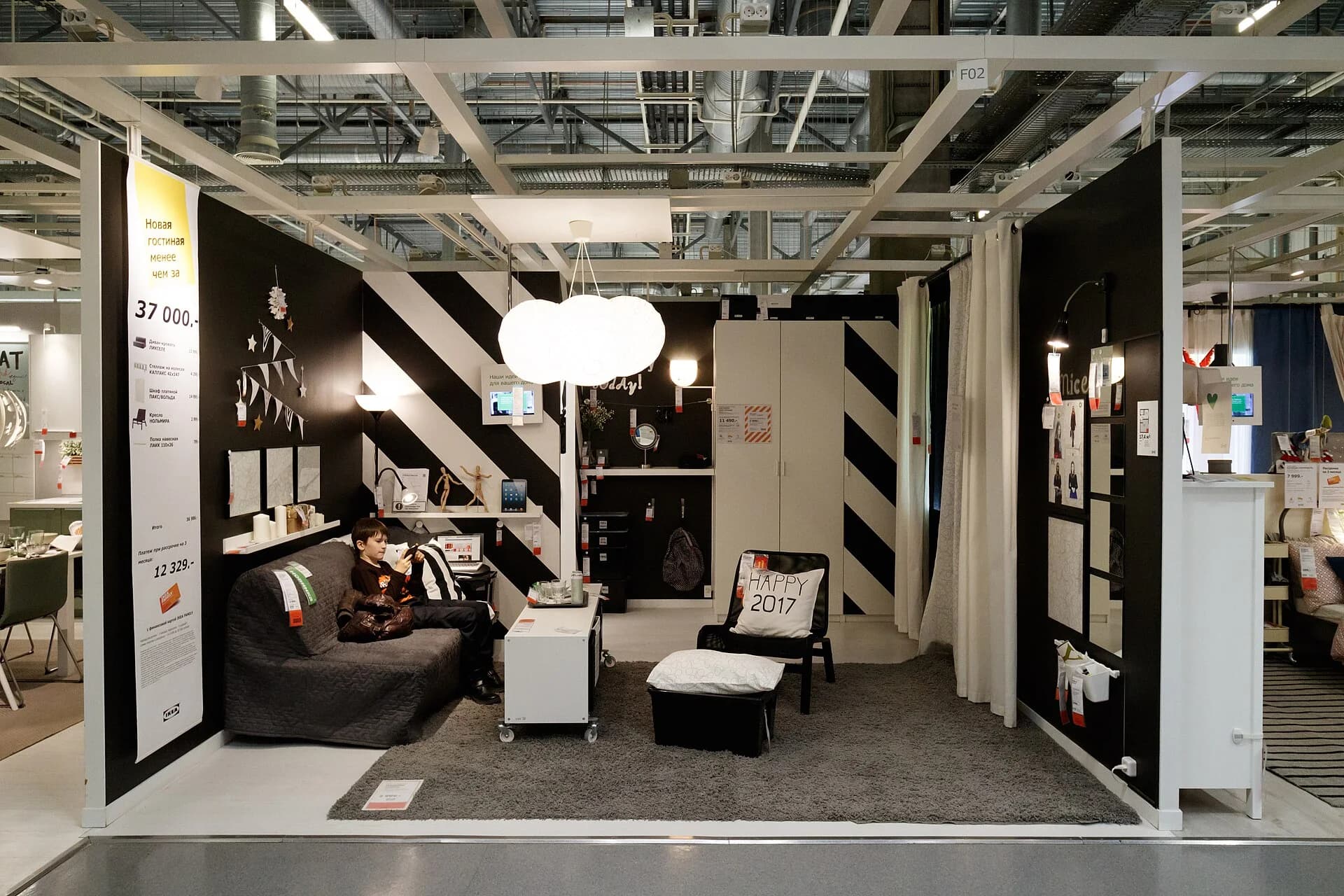
The traditional IKEA store is a large out-of-town building laid out as a one-way route: showrooms of furnished rooms first, then the Market Hall of smaller items, then a self-serve warehouse where customers collect their flat packs, and finally the checkouts. The room sets are physical evidence that lets customers picture the products at home, while the self-service process (measure, choose, collect, carry and assemble) transfers work from staff to customers and keeps costs down. Restaurants, operating since 1960, keep customers in the store longer and add to sales.
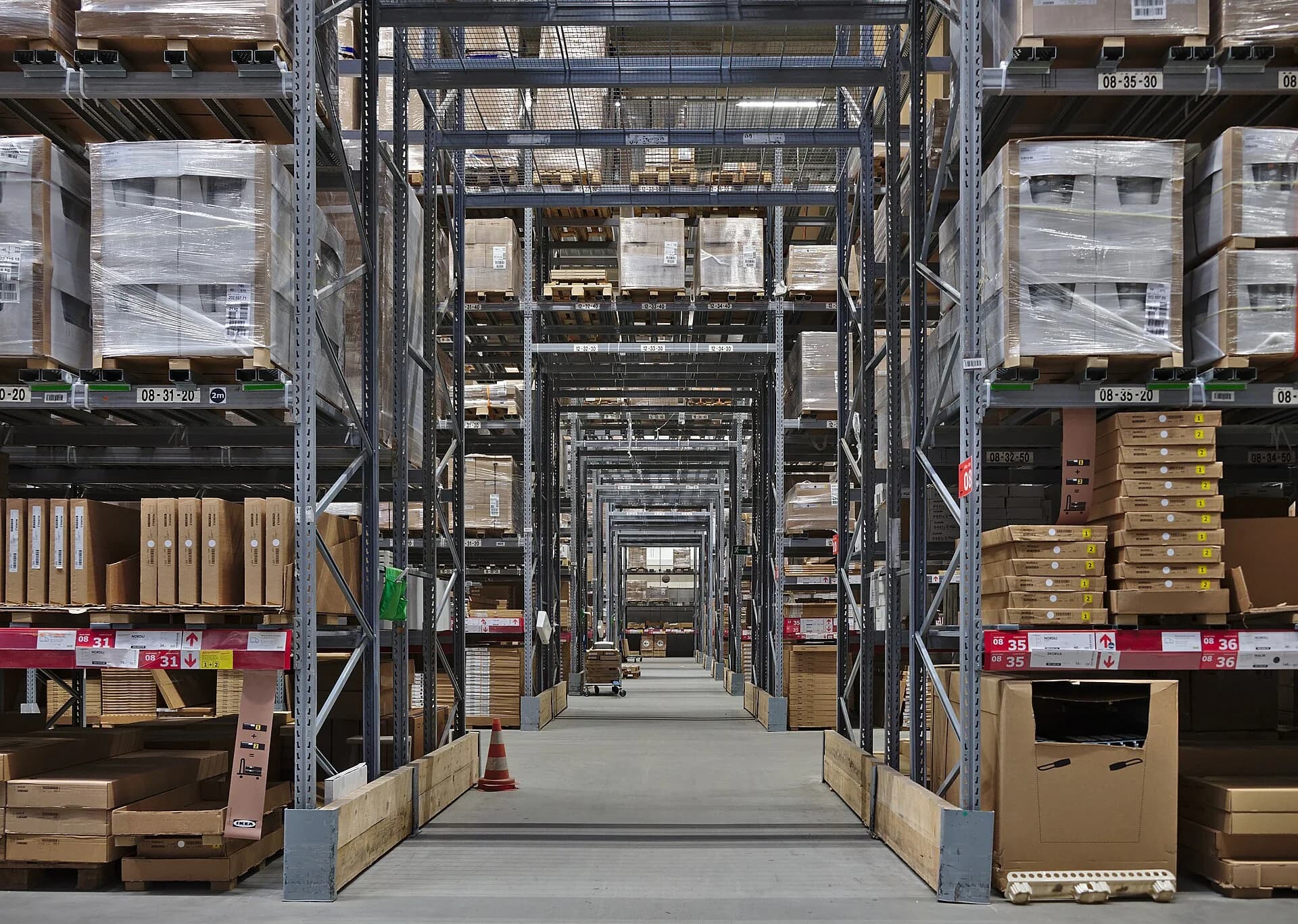
IKEA’s mix has shifted towards convenience. Online sales were 28% of IKEA retail sales in FY25, and IKEA has opened smaller city-centre stores and plan-and-order points that customers can reach without a car, including a store on Oxford Street in London in May 2025. It bought the assembly and errands platform TaskRabbit in 2017, adding paid services to a model built on self-service. In promotion, it ended its printed catalogue, published from 1951 and distributed in 200 million copies at its 2016 peak, after announcing in December 2020 that it had become less important as IKEA found new ways of reaching customers.
IKEA describes its staff as co-workers and, as customers move online, relies on them for planning advice and services such as kitchen design. Its Buy Back schemes, which take back used IKEA furniture for resale, link the product and place elements to sustainability and to circular business models, and in 2025 Ingka announced a test in Portugal and Spain in which people selling eligible used IKEA products can receive an offer directly from IKEA.
IKEA’s mix succeeds because its elements reinforce one another: flat-pack products, self-service processes, out-of-town stores and showrooms all serve low prices for a mass market. The changes show the tension between that coherence and customers’ demands for convenience: deliveries, assembly services and city-centre stores add cost to a low-cost model. The data have limits. The sales figures cover all franchisees and are affected by exchange rates and store openings; a single year of falling revenue and rising volume does not prove how sensitive demand is to price, and profit, which IKEA reports separately, is not shown.
Explain how IKEA’s self-service process supports its pricing strategy.
Analyse how the growth of online sales and city-centre stores changes the importance of the place, people and physical evidence elements of IKEA’s mix.
To what extent do the FY25 figures show that IKEA’s lower prices were the right decision?
Sources: Inter IKEA Group, “IKEA year in review” FY25 (2025); Ingka Group, “IKEA serves more customers and increases volumes in a challenging year”, 16 October 2025, and Ingka Group newsroom (Buyback test), 2025; Wikipedia, “IKEA” (history, store layout, TaskRabbit, Oxford Street) and “IKEA Catalogue”, accessed 2026.
The seven Ps can be examined on Papers 1, 2 and 3. Short questions ask for definitions (brand, extension strategy, penetration pricing, below the line promotion), explanations of two advantages or disadvantages of a pricing method, promotional method or channel, and diagrams of the product life cycle. Calculations are usually mark-up prices and, at HL, PED with its effect on revenue. Extended responses ask candidates to evaluate a pricing strategy, discuss social media marketing, or recommend a marketing mix, and Section B questions may name a key concept, such as ethics or sustainability, to apply to the mix.
Calculations need the formula, the working and a clear answer with units. For mark-up questions, check whether the question gives the unit cost directly or expects it to be worked out from fixed and variable costs.
The marketing mix is the set of decisions on product, price, promotion and place; services add people, processes and physical evidence because they are intangible, inseparable, perishable and variable.
Products pass through the product life cycle (introduction, growth, maturity, saturation, decline); the right mix changes at each stage, and a balanced portfolio holds products at different stages.
Extension strategies lengthen a product’s life cheaply but only delay decline when a better product has replaced it.
Investment comes before profit, and profit before positive cash flow; mature products generate the cash that funds new ones.
Branding builds awareness, development, loyalty and value, which allow higher prices and steadier sales.
Pricing methods (cost-plus, penetration, loss leader, predatory, premium; HL: dynamic, competitive, contribution) suit different objectives, costs and markets; PED predicts the effect of a price change on revenue (HL).
Promotion uses above the line, below the line and through the line methods; social media marketing is cheap and targeted but risks loss of control and backlash.
Distribution channels, people, processes and physical evidence matter most when they are coherent with the rest of the mix and with the target market.
I can explain the marketing mix and why services need seven Ps.
I can draw and explain the product life cycle and the marketing mix at each stage.
I can explain how the product life cycle relates to the product portfolio, investment, profit and cash flow.
I can evaluate extension strategies for a given product.
I can explain brand awareness, development, loyalty and value, and the importance of branding.
I can calculate a cost-plus price and evaluate each pricing method for a business.
I can evaluate dynamic, competitive and contribution pricing and calculate PED and its effect on revenue (HL).
I can distinguish above, below and through the line promotion and evaluate social media marketing.
I can evaluate distribution channels and the importance of people, processes and physical evidence.
I can recommend an appropriate marketing mix for a particular product or business.
Award [0] for a tautological answer that only repeats the term.
Candidates are not expected to word their definition exactly as above.
Explain two pieces of evidence that KSW’s surf wax is in the maturity stage of its product life cycle (paragraph 2).
4 marks
Evidence may include:
Sales have levelled off: sales volume has been roughly constant at about 180 000 tins a year for three years, so growth has stopped.
Market saturation: surf-shop owners report that most surfers already buy KSW or a rival, so there are few new customers left to win.
Increased competition: two larger rivals have entered with cheaper waxes, typical of a mature market where firms compete on price.
Healthy profit: profit remains high because development costs have been recovered, which is typical of maturity (the product is a likely cash cow).
Accept any other relevant evidence from the case.
Mark as 2 + 2. For each piece of evidence, award [1] for identifying it from the case and [1] for explaining why it indicates maturity.
Award a maximum of [2] for a description of the maturity stage that makes no use of KSW’s case.
Discuss whether KSW should extend the life of its product by entering new markets abroad (Jarrah’s option) or by modifying the product (Linh’s option).
10 marks
Jarrah’s option: new markets in Indonesia and Portugal
For: Indonesia and Portugal are growing surf markets, so KSW could move into a market where the product is at an earlier stage of its life cycle and sales can grow again; the existing product, process and brand are used, so no new production equipment is needed; geographical diversification spreads risk away from the saturated east-coast market.
Against: KSW has no experience abroad and must find reliable distributors; translating packaging and export shipping raise costs and may absorb much of the AUD 70 000; it is a small partnership, so managing at a distance is difficult; established local and global brands may compete strongly; the award-winning warm-water grip suits Indonesia but may suit Portugal’s colder water less well.
Linh’s option: product modification (cold-water and paddle-board waxes)
For: it uses KSW’s existing distribution through 60 surf shops and its strong local brand (brand extension), so launch costs are lower; the AUD 45 000 is within the AUD 70 000 available, so no borrowing is needed; it adds new reasons for existing customers to buy (winter surfing, paddle boarding) and widens the product portfolio.
Against: it still targets the same saturated regional market, and new variants may cannibalize sales of the original wax; the equipment and retraining of six workers carry risk and could disrupt production; demand for cold-water wax in a warm-water region may be limited; quality must be maintained to protect the brand.
Other points: Ansoff (market development vs product development, both riskier than penetration); the two strategies are not mutually exclusive in the longer term; both must protect the reputation for natural ingredients.
Possible conclusion: for example, Linh’s option may be preferred because it is cheaper, lower-risk and within KSW’s funds; or Jarrah’s option may be preferred because only new markets offer real growth. Any well-supported judgement can earn full marks.
Limitations that strong answers may note: there is no market research on demand in Indonesia or Portugal or for the new formulas; the costs of exporting are not given; no data on competitors’ prices or KSW’s margins.
Marks should be allocated according to the markbands below.
Additional guidance:
If only one option is discussed, even with balance, award a maximum of [5]; one option, one-sided, a maximum of [3].
A response that makes no use of the data or case details the question refers to cannot be awarded more than [4].
A response with no conclusion or judgement will typically not be awarded more than [6].
Markbands (10-mark extended response, Papers 1 and 2)
Marks | Level descriptor |
|---|---|
0 | The response does not reach the standard described below. |
1–2 | Little understanding of what the question demands. Business management tools and theories are barely used, or are irrelevant or inaccurate. Little or no reference to the stimulus material. No arguments are made. |
3–4 | Some understanding of what the question demands. Some use of tools and theories, but mostly inaccurate or not relevant. Use of the stimulus is superficial, often no more than the name of the organisation or person. Arguments are mostly unsubstantiated. |
5–6 | Understands what the question demands but addresses it only partially. Some relevant, accurate use of tools and theories. Some relevant use of the stimulus beyond names, but it does not effectively support the argument. Arguments are substantiated but mostly one-sided. |
7–8 | Mostly addresses what the question demands. Mostly relevant, accurate use of tools and theories. The stimulus generally supports the argument, with some lapses in clarity or relevance. Arguments are substantiated and show some balance. |
9–10 | Clear focus on what the question demands. Relevant, accurate use of tools and theories. Relevant stimulus material is integrated effectively to support the argument. Arguments are substantiated and balanced, and the limitations of the case or stimulus material are explained. |
A response with no judgement or conclusion is unlikely to reach the top band of a discuss, evaluate, examine or recommend question.
Saigon Optics is a Vietnamese electronics company. In 2020 it began developing the TrekCam, a waterproof action camera, which it launched in 2021. Table 1 shows data for the TrekCam since development began.
Table 1: Sales, profit and net cash flow of the TrekCam, 2020–2025
Year | Sales (units) | Profit/(loss) ($m) | Net cash flow ($m) |
|---|---|---|---|
2020 | 0 | (1.8) | (1.8) |
2021 | 12 000 | (0.9) | (1.2) |
2022 | 45 000 | 0.6 | 0.2 |
2023 | 90 000 | 2.1 | 1.6 |
2024 | 110 000 | 3.0 | 3.2 |
2025 | 112 000 | 2.8 | 3.1 |
$ = US dollars
Using Table 1, calculate the percentage change in TrekCam sales between 2024 and 2025 (show all your working).
2 marks
Using Table 1, calculate the cumulative net cash flow of the TrekCam from 2020 to the end of 2025 (show all your working).
2 marks
Using Table 1, explain the relationship between the product life cycle, investment, profit and cash flow for the TrekCam.
4 marks
Mirella Sauces, a family business in Bologna, Italy, has sold the same tomato-and-basil pasta sauce since 1998. Sales have been falling for two years, so the owners plan to launch a reduced-salt version in smaller glass jars as an extension strategy.
Define the term extension strategy.
2 marks