Notes on 4.6 International marketing
Learning objectives
Define international marketing and explain why businesses sell in foreign markets.
Describe the main methods of entry: exporting, e-commerce, licensing, franchising, joint ventures, strategic alliances, acquisitions and subsidiaries.
Evaluate the methods of entry for a given business and market.
Analyse the opportunities of entering and operating in international markets.
Analyse the threats of international markets, including cultural, legal, political and economic differences and trade barriers.
Calculate the effect of a change in the exchange rate or a tariff on prices and profit.
Distinguish between standardisation, adaptation and glocalisation of the marketing mix.
Evaluate the opportunities and threats of entering and operating internationally, and recommend a strategy.
Introduction
Most large businesses, and many small ones, now sell outside the country where they started. International marketing is the planning and carrying out of marketing activities across national borders, and it raises decisions that a business selling only at home never faces: which countries to enter, how to enter them, and how far to change the product, price, promotion and place for each one.
KFC opened its first restaurant in China in Beijing in 1987 and by the end of 2025 there were 12,997 KFC restaurants in more than 2,500 Chinese cities, serving rice dishes and congee alongside fried chicken. Walmart, by contrast, entered Germany in 1997 and left in 2006 at a cost of about US$1 billion.
International marketing involves all four key concepts. Entering a new country is a response to change in markets and technology; adapting a product for a new culture calls for creativity; operating under weaker laws or in politically sensitive markets raises questions of ethics; and long supply chains and the choice of local partners affect the sustainability of the business and the communities it works in.
What international marketing is
Marketing is the process of identifying, anticipating and satisfying customers’ needs profitably. International marketing applies the same process to customers in more than one country. The core tasks stay the same: research the market, choose target segments, position the product and design a marketing mix. What changes is that each task has to be done for markets whose customers, laws, incomes, languages and competitors may differ from those at home.
International marketing ranges from a small business selling a few products to overseas customers through its website to a multinational company (MNC) running factories, shops and advertising campaigns in dozens of countries. The growth of international marketing is part of globalisation: cheaper transport, the internet, lower trade barriers and the spread of global media have made it easier and less risky to reach foreign customers.
Why businesses market internationally
A business looks abroad when the expected gains outweigh the extra costs and risks. The main reasons are:
A saturated home market. When most potential customers at home already buy the product, sales growth slows. Foreign markets with fewer competitors or lower ownership rates offer new customers.
Faster growth and higher profits. Markets with rising incomes and young populations, such as India, Indonesia or Nigeria, may grow faster than the home market.
Economies of scale. Selling more units spreads fixed costs, such as research and development, brand building and factories, over a larger output, which lowers average costs. These economies of scale can then make the business more competitive at home as well.
Spreading risk. A business that sells in several countries depends less on the economy, tastes or laws of any one of them. A recession in one market may be offset by growth in another.
Extending the product life cycle. A product in the maturity or decline stage of its product life cycle at home may be in the introduction or growth stage elsewhere. Entering a new market is one of the most common extension strategies.
Access to resources and lower costs. Operating abroad can give access to raw materials, skilled labour, lower wages or local suppliers.
Avoiding trade barriers. Producing inside a foreign market, rather than exporting to it, avoids import taxes and rules that discriminate against imported goods.
Brand image and learning. A presence in leading foreign markets can raise a brand’s status, and ideas developed abroad can be used at home.
These reasons are closely linked to the growth strategies of the Ansoff matrix. Selling existing products in a new country is market development, a medium-risk strategy: the product is known to work, but the market is not.
Methods of entry into international markets
Once a business has chosen a foreign market, it has to decide how to enter it. The methods of entry differ in how much the business must invest, how much control it keeps over its products and brand, how much of the profit it earns and how much risk it carries.

The staircase shows the general pattern. Exporting and online selling need little investment, so the business can withdraw cheaply if sales disappoint, but it has little control over how its products are sold. A wholly owned subsidiary gives full control and keeps all the profit, but the business must commit large sums and bears every loss. Many businesses move up the staircase over time, starting with exporting and setting up their own operations once they understand the market.
Exporting
Exporting means producing goods in the home country and selling them to customers in another. It is the oldest and simplest method of entry.
Direct exporting: the business sells straight to foreign customers or retailers, for example through its own sales team, trade fairs or website. It keeps more of the profit and learns more about the market, but it must handle shipping, payment, paperwork and after-sales service itself.
Indirect exporting: the business sells through an intermediary in the home country or the foreign market, such as an export house, a distributor or an agent, who handles the foreign sales. It is easier and cheaper but gives less control and a smaller margin.
Exporting suits businesses testing a market, businesses whose products are hard to make abroad (such as Scotch whisky, which must by law be produced in Scotland), and small firms without the funds for foreign operations. Its main drawbacks are transport costs, exposure to import taxes and exchange rate changes, and the distance from customers, which makes it harder to understand and respond to their needs.
E-commerce
E-commerce allows a business to reach foreign customers through its own website, social media or online marketplaces such as Amazon, Alibaba’s Tmall or Mercado Libre, without any physical presence abroad. It is the cheapest method of entry and it allows even very small businesses to sell internationally.
Cross-border e-commerce brings its own problems. Delivery times are long and delivery costs high; returns are expensive; customers expect websites, prices and customer service in their own language and currency; and the business must follow each country’s rules on consumer rights, data protection and product safety. Many sellers therefore start online and later use local warehouses or local partners once demand is proven.
Licensing
In licensing, a business (the licensor) gives a foreign business (the licensee) the right to use its intellectual property, such as a brand name, a patent, a design or a production process, in return for a fee or a royalty, usually a percentage of sales.
Licensing lets a business earn income from a foreign market with almost no investment, because the licensee provides the capital, the staff and the local knowledge. Yum China, a separate listed company, holds the exclusive licence to run the KFC and Pizza Hut brands in mainland China and pays Yum! Brands a licence fee equal to 3% of the net system sales of the licensed brands. The licensor’s income is safe from the costs of running restaurants, but it is a small share of the value the brand creates.
The main risks of licensing are loss of control and loss of know-how. A licensee that cuts corners on quality damages the licensor’s brand, and a licensee that learns the technology may become a competitor once the agreement ends.
Franchising
A franchise is a form of licensing in which the franchisor sells the right to use a complete business format, including the brand, the products, the store design, the operating methods and training, to a franchisee, who pays an initial fee and ongoing royalties. Internationally, the franchisor often grants a master franchise to one business, which then opens outlets or sells sub-franchises across a whole country or region.
Franchising allows very rapid international growth with other people’s capital and local knowledge, while the standard format keeps the customer experience consistent. About 95% of McDonald’s restaurants were franchised at the end of 2022, which is how a single company operates in more than 100 countries. The disadvantages are the franchisor’s smaller share of profit and its dependence on the franchisees’ standards.
Joint ventures and strategic alliances
A joint venture is a new business jointly owned by two or more businesses, which share its capital, risks, control and profits. In international marketing, a foreign business often forms a joint venture with a local firm that brings knowledge of customers, suppliers, regulators and property. Some governments require it: foreign businesses in certain sectors in China and India were for many years allowed to enter only with a local partner.
A strategic alliance is a looser agreement in which businesses cooperate, for example by sharing distribution networks, research or marketing, while staying independent and without creating a new company. Airline alliances such as Star Alliance, in which airlines sell seats on each other’s flights and share lounges, are a well-known example.
Both methods share the cost and risk of entry and give access to local knowledge. Their weaknesses are the need to share profits and decisions, the risk of disputes over objectives, and culture clash between partners from different countries. Many international joint ventures end with one partner buying out the other once it no longer needs local help.
Acquisitions
A business can enter a foreign market quickly by buying an existing local company: an acquisition. The buyer gains the target’s customers, brands, shops, staff and supplier relationships at once, and avoids the slow process of building a market share from nothing.
Acquisitions are expensive and risky. The buyer may pay too much, the acquired company’s culture and systems may not fit, and the local business may lose customers once it becomes foreign-owned. Walmart entered Germany in 1997 by buying the 21-store Wertkauf chain and then 74 Interspar stores, but it struggled against strong local discount retailers such as Aldi. In 2006 it left the country, selling its 85 stores to the German retailer Metro, in a deal that cost it about US$1 billion.
Setting up a subsidiary
The highest level of commitment is a wholly owned subsidiary: a company in the foreign market owned and controlled by the parent company. It may be created by an acquisition or by building new operations from scratch, which is called greenfield investment. Both are forms of foreign direct investment (FDI).
Building new operations takes longer than buying a local business, but it lets the parent choose the location, size and design of its operations from the start and avoids taking on another company’s culture and problems.
A subsidiary gives full control over quality, the brand and the marketing mix, and the parent keeps all the profit. It also shows commitment to the host country, which may help with governments and customers. The costs are high, setting up takes time, and the business carries the full risk of losses, of political change and of being seen as a foreign company in a sensitive market.
Comparing the methods of entry
Method | Investment and risk | Control | Share of profit | Speed and local knowledge |
|---|---|---|---|---|
Exporting | Low; easy to withdraw | Low over how goods are sold | High per unit but exposed to tariffs and transport costs | Quick to start; little local knowledge |
E-commerce | Very low | High over the website, low over delivery | High per unit; delivery and returns are costly | Very quick; little local presence |
Licensing | Very low for the licensor | Low | Small (royalty only) | Quick; licensee brings local knowledge |
Franchising | Low for the franchisor | Medium (set by the franchise agreement) | Fees and royalties only | Fast growth; franchisees bring local knowledge |
Joint venture / strategic alliance | Shared | Shared; risk of disputes | Shared | Fairly quick; partner brings local knowledge |
Acquisition | High; risk of overpaying | High | All of it | Immediate presence; inherits local staff and customers |
Greenfield subsidiary | Highest | Full | All of it | Slow; must build local knowledge |
The table shows a trade-off that runs through every entry decision. Methods that cost little and carry little risk also give little control and a small share of the profit. Methods that give full control and all the profit require large investment and expose the business to large losses.
Evaluation: choosing a method of entry
No method of entry is best in every case. The right choice depends on:
The business’s objectives and resources. A small business with little capital is limited to exporting, e-commerce or licensing; a large MNC seeking market leadership may prefer a subsidiary.
The importance of control. A luxury brand whose image depends on every detail of the customer experience may refuse to license or franchise, because one poor licensee damages the brand worldwide.
The risk of the market. In a politically or economically unstable country, a low-commitment method limits possible losses.
Local knowledge. Where the culture, language and business customs are very different, a local partner reduces the risk of mistakes.
The law. Some countries limit foreign ownership in some sectors, which forces a joint venture or licensing.
Speed. An acquisition gives an immediate presence; a greenfield subsidiary may take years.
The product. Services that must be delivered locally, such as restaurants or hotels, cannot be exported, so they use franchising, joint ventures or subsidiaries.
In practice many businesses use different methods in different countries, and change the method as their knowledge of a market grows. Starbucks, for example, entered parts of China through licensing and joint ventures in 1999, bought out its partners to take full ownership in 2017, and then sold a majority stake in its Chinese business to a local investor in 2026.
 YouTube
Opportunities of entering and operating internationally
The opportunities of international markets follow from the reasons for going abroad. A business that enters a new market successfully can gain:
More customers and higher sales revenue, especially in large or fast-growing markets.
Lower average costs through economies of scale in production, purchasing and marketing.
Lower risk overall, because sales are spread across economies at different stages of their business cycles.
A longer product life cycle, as products mature at home but grow abroad.
Access to cheaper or better resources, including skilled workers, raw materials and suppliers.
A stronger brand, as a presence in many countries signals quality and success to customers and investors.
New ideas. Products and processes developed for one market can be used in others, and competing with demanding local rivals pushes a business to innovate.
Ways round trade barriers, by producing or assembling inside the market.
Not every business gains all of these. The size of the opportunity depends on the size and growth of the market, the strength of local competitors, how well the product fits local needs and how well the business can manage operations at a distance. A SWOT analysis that places these opportunities beside the business’s own strengths and weaknesses is a useful first step in deciding whether to enter.
Threats and issues of operating internationally
Every market is different, and differences between markets that a business does not understand can become threats. A STEEPLE analysis is a useful way to list them: social and cultural, technological, economic, environmental, political, legal and ethical factors. The most important threats are cultural, linguistic, legal, political, economic, trade-related, logistical and reputational.
Cultural differences
Culture shapes what people buy, how they make decisions, what they find attractive or offensive in advertising and how they expect to be treated by staff. Food, religion, family structure, attitudes to time, gift-giving and the meaning of colours and numbers all vary between countries. A product, a brand name or an advertisement that works at home may fail or cause offence abroad.
Culture also affects the way a business manages its foreign staff: how much employees expect to be consulted, how they respond to individual targets and bonuses, and how directly managers can give criticism. Hofstede’s cultural dimensions are a widely used way of comparing national cultures on six scales, such as power distance and individualism, so that managers can predict where differences are likely to matter.
Businesses that succeed abroad usually invest in understanding local culture through market research, local managers and local partners. The ability to understand and work effectively with people from other cultures is called cultural intelligence.
Language and communication
Language differences affect brand names, slogans, packaging, instructions, contracts and the everyday work of managing staff. Translations can change the meaning or tone of a message, and a brand name may be hard to pronounce or have an unfortunate meaning in another language. Careful translation, testing with local consumers and hiring local staff reduce these risks but add cost and time.
Legal and regulatory differences
Each country has its own laws on product safety, ingredients and labelling, advertising (including what may be advertised to children), consumer rights, employment, competition, data protection and foreign ownership. A product may need to be redesigned or retested to meet local standards, and some products are banned altogether. Breaking local law, even by mistake, can bring fines, product withdrawals and lasting damage to the brand.
Businesses also face differences in how laws are applied. Where the legal system is slow, unpredictable or affected by corruption, contracts are harder to enforce and intellectual property, such as brand names and patents, is harder to protect.
Political instability and political risk
Wars, revolutions, changes of government and sanctions can disrupt or destroy a business’s foreign operations. Governments may also raise taxes on foreign firms, restrict profit repatriation, the transfer of earnings back to the home country, or take foreign assets into state ownership.
After Russia’s invasion of Ukraine, McDonald’s closed its restaurants in Russia in March 2022 and then sold its Russian business, which led to the closure of 855 restaurants and pre-tax charges of US$1,281 million in its 2022 accounts. The decision combined political risk, the effect of sanctions and the reputational cost of staying.
Economic factors: income, demand and exchange rates
Average incomes, the distribution of income, inflation, interest rates and the stage of the business cycle differ between countries and change over time. A premium product that sells well in a high-income market may be affordable only to a small group elsewhere, so the business may need a smaller pack size, a cheaper version or a different target segment.
The most direct economic threat to a business that trades internationally is a change in the exchange rate. Exporters set prices in one currency but pay their costs in another, so a change in the exchange rate changes either the price foreign customers pay or the profit the exporter earns.
When a currency appreciates (rises in value), the country’s exports become more expensive in foreign currencies and its imports become cheaper. When it depreciates (falls), exports become cheaper abroad and imports more expensive. Changes in exchange rates also change the home-currency value of profits earned abroad. McDonald’s revenue in 2022 was flat at $23.2 billion when measured in US dollars, but rose by 6% in constant currencies: the strong dollar reduced the dollar value of sales made in other currencies.
Trade barriers
Governments restrict imports to protect domestic producers and jobs, to raise tax revenue, to respond to unfair competition or for political and security reasons. These trade barriers raise the cost of exporting or limit the quantity that can be sold.
Tariffs: taxes on imported goods, usually a percentage of their value. They raise the price of imports or reduce the exporter’s margin.
Quotas: limits on the quantity or value of a product that can be imported in a period.
Embargoes: bans on trade with a particular country or in a particular product, often for political reasons.
Administrative and technical barriers: complicated customs procedures, local content rules and product standards that are hard for foreign producers to meet.
Trade barriers can change quickly. The large increases in US tariffs announced in 2025 forced many exporters to the United States to raise prices, accept lower margins or move production. Businesses respond to barriers by producing inside the market, using a local partner, sourcing from a country that faces lower tariffs, or targeting other markets.
Logistics and distribution
Moving goods over long distances adds transport, insurance and storage costs and makes supply chains longer and more fragile. Distribution channels abroad may also be different: in some countries most shopping happens in small independent shops or on mobile apps rather than in supermarkets. A business must find reliable distributors and adapt its channels, which is often a reason for using a local partner.
Reputational and ethical risk
Operating in many countries exposes a business to criticism over the working conditions in its suppliers’ factories, environmental damage, tax avoidance or support for governments with poor human rights records. Social media spreads such stories worldwide within hours. A business can also cause offence through careless advertising or by appearing to ignore local customs. These risks make corporate social responsibility and careful monitoring of partners part of international marketing.
A summary of the threats
STEEPLE factor | Example of a threat in a foreign market | Possible response |
|---|---|---|
Social and cultural | Different tastes, religion, values and shopping habits | Market research; local managers; adapt the mix |
Technological | Lower internet use, different payment apps or technical standards | Adapt channels and payment methods |
Economic | Lower incomes, inflation, exchange rate changes | Smaller packs or cheaper versions; pricing in local currency; hedging |
Environmental | Stricter packaging and emissions rules; climate risks to supply | Redesign packaging; diversify suppliers |
Political | Instability, sanctions, hostility to foreign firms | Low-commitment entry; local partner; insurance |
Legal | Product, labelling, advertising and ownership laws | Legal advice; redesign; joint venture where ownership is limited |
Ethical | Pressure to cut standards, bribery, poor supplier conditions | Codes of conduct; audits of suppliers |
Global or local: standardisation, adaptation and glocalisation
Once a business is in a foreign market it must decide how far to change its marketing mix. At one extreme it sells the same product, at a similar price, with the same advertising, everywhere. At the other, it designs a different mix for each country. Most businesses choose a position between the two.
The opposite approach treats each country as a separate market with its own needs.
Standardisation gives large economies of scale in production, packaging and advertising, a consistent brand image for travellers and online customers, and simpler management. It works best where needs are similar across countries: business-to-business products such as machine parts and software, luxury goods bought for their global prestige, and technology products such as smartphones.
Adaptation makes the product more attractive to local customers and allows the business to meet local laws and compete with local rivals that understand the market well. It costs more, because each version must be designed, tested and produced in smaller quantities, and it can weaken the global brand if the versions drift too far apart.
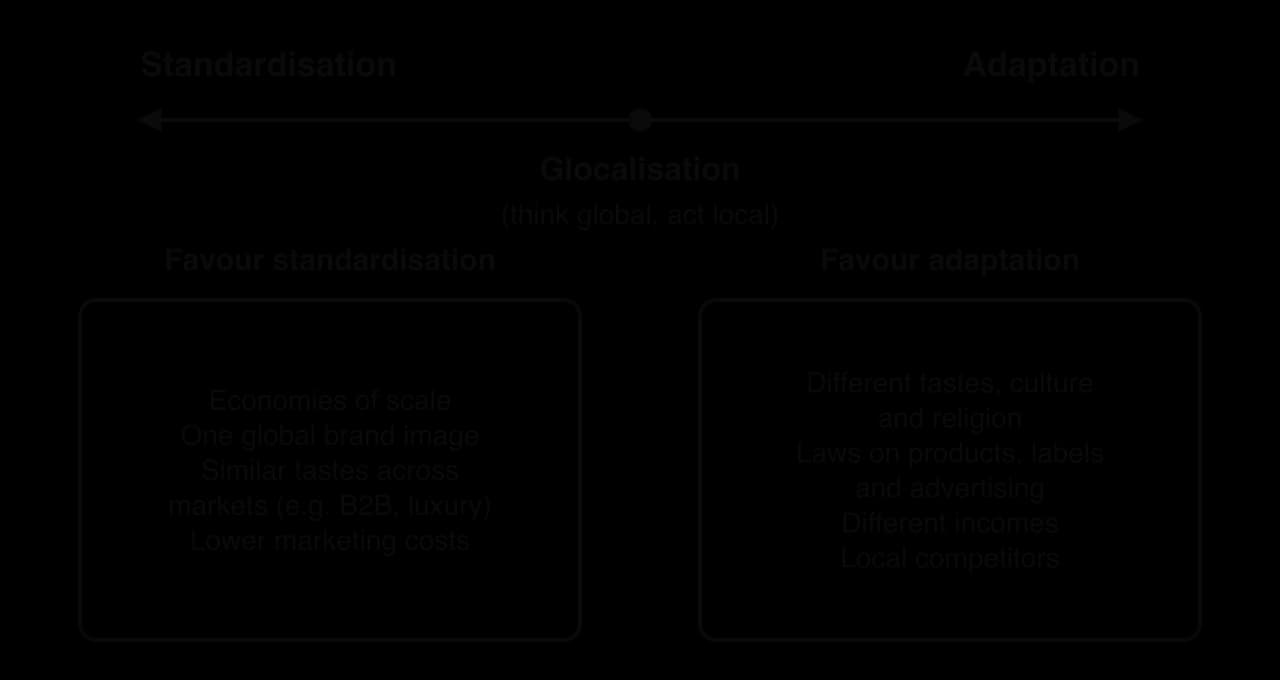
Most successful international businesses use glocalisation, a blend of the two often summed up as "think global, act local". They keep the core of the product, the brand and the main processes the same everywhere, and adapt the parts customers notice most: flavours, menus, pack sizes, prices, advertising and the in-store experience.
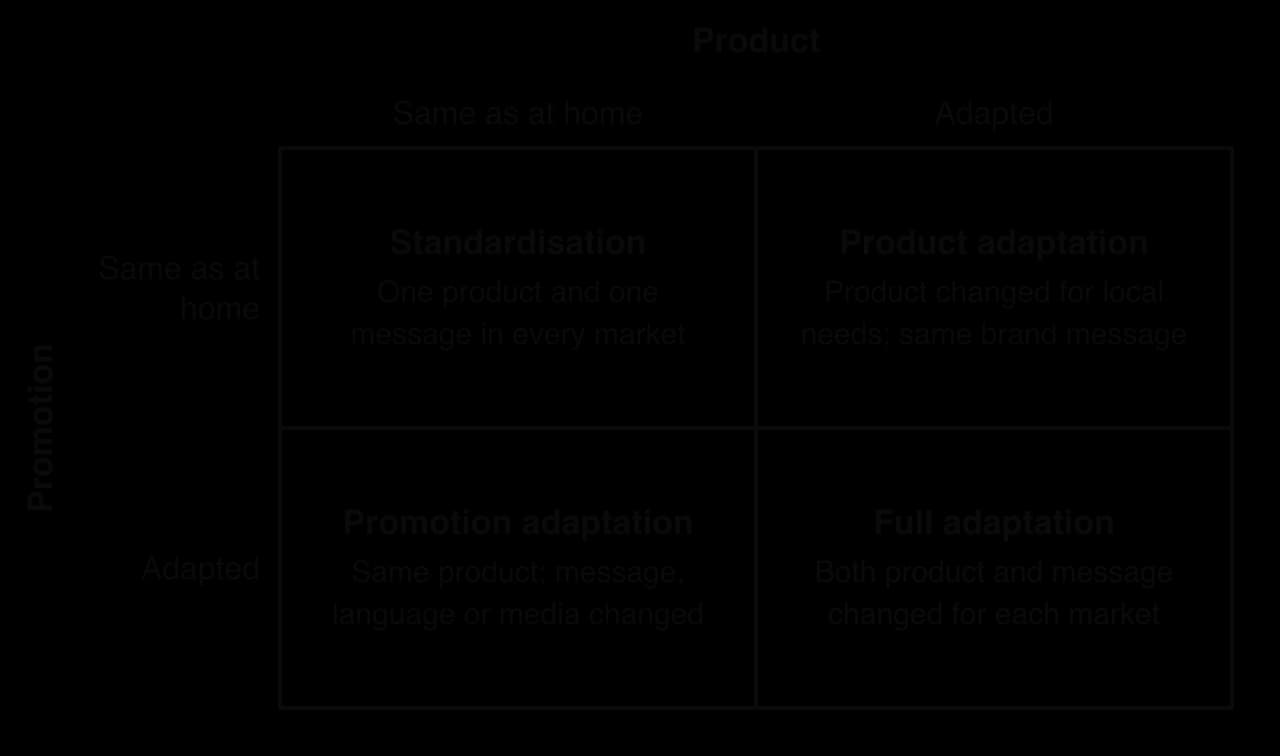
The degree of adaptation can be analysed for the product and the promotion separately. The matrix shows the four combinations.
Adapting each element of the marketing mix
Element | Reasons to adapt | Examples of adaptation |
|---|---|---|
Product | Tastes, religion, climate, laws, technical standards | Different flavours, ingredients, sizes, plugs or voltages; local products added to a range |
Price | Incomes, competitors’ prices, taxes, tariffs, exchange rates | Lower prices in lower-income markets; smaller packs at lower prices; prices set in local currency |
Promotion | Language, values, humour, media habits, advertising laws | Translated slogans, local celebrities, different social media platforms, different images |
Place | Retail structure, internet use, infrastructure | Local distributors, convenience stores, delivery apps, local online marketplaces |
People, processes, physical evidence | Service expectations, working customs, store sizes | Different greetings, uniforms, opening hours, payment methods and store layouts |
Price and promotion are often adapted more than the core product. They depend on local incomes, competition and media, while businesses prefer to keep the core product the same because product development is expensive. Services such as restaurants and hotels adapt the people, processes and physical evidence elements as well, because these are experienced directly by customers.
Evaluation: standardise or adapt?
The case for standardisation is strongest when customers’ needs are similar across countries, when the brand’s global image is part of its appeal, when economies of scale are large and when competitors are also global brands. The case for adaptation is strongest when tastes, culture, laws or incomes differ greatly from home and when strong local competitors offer products designed for local customers.
The choice also changes over time. A business may enter a market with a largely standardised mix, learn from sales and market research, and adapt more once it knows what local customers value. Too little adaptation risks rejection by local customers; too much raises costs and weakens the brand. The best position on the scale depends on the product, the distance between the home and host cultures, the strength of local competition and the business’s objectives for the market.
Evaluation: is international expansion worthwhile?
Whether entering or operating in an international market is worthwhile depends on the balance between the opportunities and the threats for that business in that market at that time. The main factors are:
The attractiveness of the market: its size, growth, incomes and the strength of local competitors.
The distance between home and host country, in culture, language, law, income and geography. The greater the distance, the more the business must adapt and the greater the risk of misjudging the market.
The business’s resources and experience: finance, managers with international experience and the cultural intelligence of the organisation.
The method of entry: a low-commitment entry limits the losses if the venture fails but also limits the gains.
The degree of adaptation: success usually requires a mix that is adapted enough to appeal locally without losing the economies of scale and brand strength of a standard product.
The time scale: international ventures often make losses for several years before they become profitable, and conditions such as exchange rates and trade policy can change during that time.
A justified judgment weighs these factors for the specific case and considers the short run and the long run. Rapid entry may win market share before competitors arrive, but entering too quickly, without understanding local customers, has been the cause of many expensive failures.
Key concept | How it applies to international marketing |
|---|---|
Change | Rising incomes abroad, new technology, trade policy and exchange rates create new opportunities and threats, so the choice of markets and methods of entry must be reviewed regularly. |
Creativity | Adapting products, brand names and promotions for new cultures, and finding new formats such as pick-up stores or delivery apps, are creative tasks. |
Ethics | Businesses must decide whether to apply home-country standards on wages, safety and the environment in countries with weaker laws, and whether to operate in countries with poor human rights records. |
Sustainability | Long supply chains raise transport emissions, while local production and local suppliers can support economic sustainability in host countries. |
Case study: Starbucks in China
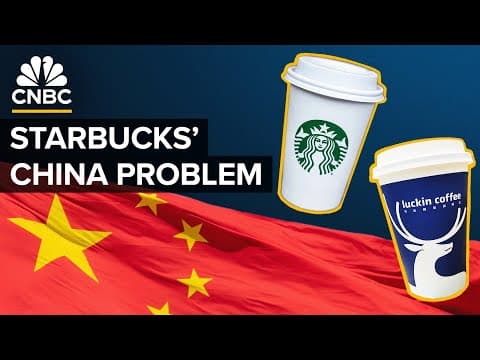
Starbucks entered mainland China in January 1999 with a store in the China World Trade Center in Beijing. China had little coffee culture at the time, and Starbucks entered gradually through licensing agreements and joint ventures with local partners in different regions. Partners such as Uni-President, a Taiwanese food group that ran the East China joint venture, brought local knowledge of property, suppliers and staff, and reduced Starbucks’ financial risk while it learned about the market.
As the business grew, Starbucks increased its commitment. On 31 December 2017 it bought the remaining 50% of the East China joint venture, which brought almost 1,500 licensed stores under company ownership and made its China business 100% company-owned. At that point China was Starbucks’ fastest-growing market and its second largest overall. The move from joint ventures to full ownership follows the staircase of entry methods. Once Starbucks understood the market well enough to manage without a partner’s local knowledge, it took full control and all the profit.
Starbucks’ marketing in China was a form of glocalisation. The brand, the core coffee menu and the "third place" idea of a comfortable space between home and work stayed the same, while the stores, digital services and products were adapted for local customers, with services such as Starbucks Delivers and WeChat social gifting. Store numbers grew from 2,382 at the end of fiscal 2016 to 8,009 at the end of fiscal 2025.
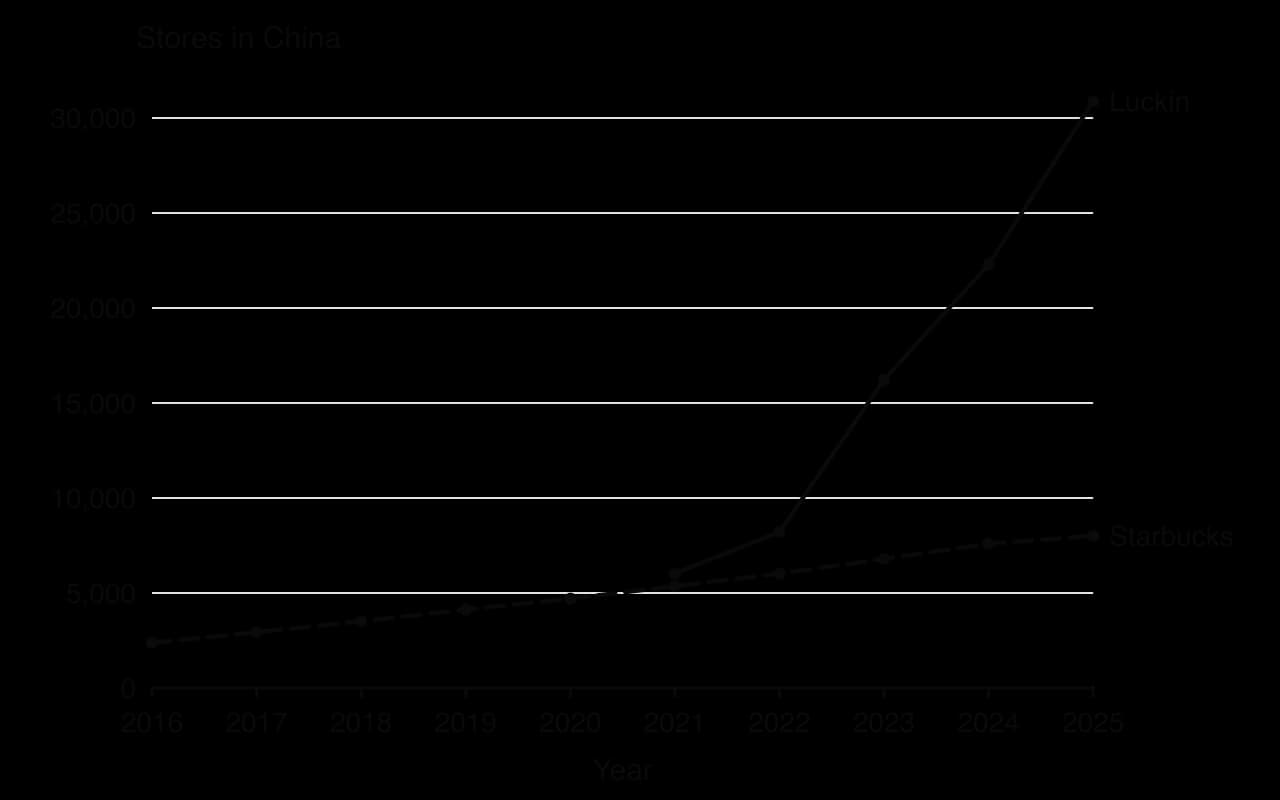
The threat came from a local competitor with a different model. Luckin Coffee, founded in Beijing in 2017, built a network of small pick-up stores (99.1% of its self-operated stores in 2025) designed for ordering through its app, with low prices and delivery. Despite an accounting scandal in 2020, it grew to 30,888 stores in China by the end of 2025, and its total revenue of RMB 49.3 billion (about US$7.0 billion) in 2025 was more than twice Starbucks’ revenue in China. Luckin’s low-cost model resembles cost leadership, while Starbucks positioned itself as a premium experience.
Fiscal year | 2018 | 2019 | 2020 | 2021 | 2022 | 2023 | 2024 | 2025 |
|---|---|---|---|---|---|---|---|---|
Starbucks revenue in China (US$ million) | 2,355.8 | 2,872.0 | 2,582.8 | 3,674.8 | 3,008.3 | 3,081.5 | 3,008.2 | 3,160.8 |
Starbucks stores in China (year end) | 3,521 | 4,123 | 4,704 | 5,358 | 6,019 | 6,804 | 7,594 | 8,009 |
The table shows the effect on Starbucks. Between fiscal 2021 and fiscal 2025 the number of stores rose by about 49%, but revenue in China fell by about 14%, so revenue per store dropped sharply. Starbucks reported a decline in customer traffic and a difficult economic and competitive environment in China, and same-store sales in China fell in both fiscal 2024 and fiscal 2025.
Starbucks responded by changing its method of entry again. In November 2025 it agreed to sell 60% of its China retail business to Boyu Capital, a Chinese investment firm, at an enterprise value of about US$4 billion. The deal closed on 30 March 2026 for total consideration of US$3.1 billion, and 7,991 company-operated stores became licensed stores run by the new joint venture. Starbucks kept 40% and continues to own and license the brand, and the partners announced a long-term aim of up to 20,000 stores in China.
The case shows the opportunities of international marketing (a huge market, rapid growth and a strong brand) and its threats (local competitors with lower costs and better local knowledge, and an economic slowdown). It also shows that the method of entry is not fixed: Starbucks moved from licensing and joint ventures to full ownership and then back to a joint venture with a local majority owner. The evidence has limits. Store numbers are measured at different dates by the two companies, Luckin’s figures include partnership stores run by others, and the long-term success of the Boyu partnership is not yet known.
 YouTube
Analyse why Starbucks used licensing and joint ventures when it first entered China.
Explain how Luckin Coffee’s model threatened Starbucks’ position in China.
To what extent was selling a majority stake to Boyu Capital the right response for Starbucks?
Sources: Starbucks Corporation, Form 10-K for fiscal years 2016–2025 and Form 10-Q for the quarter ended 29 March 2026; Starbucks China, "About us" (starbucks.com.cn), 2026; Luckin Coffee Inc., Form 20-F for 2021–2025; Associated Press, 3 November 2025.
Exam practice
International marketing is an HL-only subtopic, so it appears in Paper 2 for HL students and in Paper 3, where a social enterprise may be considering selling or working abroad. It does not appear in Paper 1. Questions usually set a short case of a business planning to enter a foreign market and ask you to explain, calculate or evaluate.
The threats of international markets are the area where answers most often stay general.
Short-answer questions test definitions and the application of a concept to a case, as in the examples that follow.
The next question uses a short invented case.
Calculation questions often combine a currency conversion with a short comment on what the result means for the business.
The final question is a 10-mark extended response.
Summary
International marketing is marketing across national borders: choosing markets, choosing a method of entry and deciding how far to adapt the marketing mix.
Businesses go international to grow, escape saturated home markets, gain economies of scale, spread risk, extend the product life cycle and avoid trade barriers.
Methods of entry range from exporting and e-commerce through licensing, franchising, joint ventures and strategic alliances to acquisitions and wholly owned subsidiaries; commitment, control, profit and risk rise together.
Threats include cultural and language differences, different laws, political instability, low incomes, exchange rate changes, trade barriers, logistics and reputational risk.
A currency appreciation makes a country’s exports dearer abroad and its imports cheaper; a tariff raises the price of imports or cuts the exporter’s margin.
Standardisation keeps one marketing mix everywhere; adaptation changes it for each market; glocalisation keeps the global brand and core product but adapts what local customers notice.
Whether international expansion is worthwhile depends on the market, the cultural and economic distance from home, the business’s resources, the method of entry and the time scale.
Self-check
- To do:
I can define international marketing and explain why businesses sell abroad.
- To do:
I can describe each method of entry, from exporting to a wholly owned subsidiary.
- To do:
I can evaluate the methods of entry for a given business and recommend one.
- To do:
I can analyse the opportunities of entering and operating in international markets.
- To do:
I can analyse the threats of international markets using STEEPLE factors.
- To do:
I can calculate the effect of an exchange rate change or a tariff on prices and profit.
- To do:
I can distinguish between standardisation, adaptation and glocalisation, with examples.
- To do:
I can evaluate whether international expansion is worthwhile for a business.