 YouTube
Test each component of fitness, apply every training principle, periodise a season, set intensities with heart rate, RPE and %1RM, and recognise and prevent overreaching and overtraining.
Each is in the SEHS glossary, with every other term in the subject.
An immediate, short-term change in the body during or just after a single bout of exercise, which returns to resting values during recovery.
A skill-related component of fitness: the ability to change the direction of the whole body quickly and accurately while maintaining control.
A skill-related component of fitness: the ability to keep the centre of mass over the base of support, either when stationary (static) or when moving (dynamic).
Measuring an individual's fitness and related values before a training programme begins, so that intensities can be set and later progress compared with the starting point.
The relative proportions of fat mass and fat-free mass (muscle, bone, organs and water) in the body, usually expressed as body fat percentage.
The ability of the cardiovascular and respiratory systems to supply oxygen to working muscles during sustained whole-body exercise; its best single measure is VO₂ max.
A long-term structural or functional change in the body that results from repeated training over weeks or months and is lost through detraining.
Outline the health-related and skill-related components of fitness and state a valid test for each.
Explain how validity, reliability, baseline testing, heart rate, RPE, session-RPE and wearable technology are used to measure fitness, training load and progress.
Describe each training principle (specificity, progressive overload, recovery, variety, reversibility and periodisation) and apply it to a named sport or exercise programme.
Describe macrocycles, mesocycles and microcycles, and explain how tapering and peaking affect performance.
Calculate training intensities using percentages of maximum heart rate, the Karvonen method and percentages of one-repetition maximum.
Compare aerobic and anaerobic training methods and distinguish between acute responses and chronic adaptations.
Explain why individuals respond differently to the same training, including responders and non-responders.
Discuss how current fitness, age, sex, reproductive status, the menstrual cycle and the phase of the macrocycle affect programme design.
Distinguish between functional overreaching, non-functional overreaching and overtraining syndrome, and evaluate methods of monitoring and prevention.
Training is the planned, repeated use of exercise to bring about lasting improvements in fitness and performance. A well-designed programme applies a small set of training principles, measures where the individual starts and how they progress, and balances hard work with recovery. A poorly designed one wastes time, causes injury or illness, or leaves the athlete slower than before.
The same principles serve both lenses of the course. For health, they explain how an inactive adult can safely raise their cardiorespiratory fitness and muscle strength, which lowers the risk of chronic disease. For performance, they explain how an Olympic rower and a 100 m sprinter can both train for years and still keep improving, although their sessions look completely different.
With a free account, Augment remembers where you stopped and what you have practiced.
Exercise performed at a steady, submaximal intensity without rest intervals, usually for at least 20 minutes, to develop cardiorespiratory endurance.
A skill-related component of fitness: the ability to move two or more body parts together smoothly, efficiently and accurately.
A form of continuous training in which speed and intensity are varied, often over varied terrain, so that both aerobic and anaerobic energy systems are stressed.
The ability to meet the physical demands of a task or environment, such as daily life, an occupation or a sport, without undue fatigue.
A planning aid for applying overload by adjusting the frequency, intensity, time (duration) and type of exercise.
The range of motion available at a joint or a group of joints, determined by joint structure and the extensibility of muscles, tendons and ligaments.
A planned, short-term increase in training load that causes a temporary fall in performance lasting days to about two weeks, followed by improved performance after recovery.
The components of fitness associated with good health and a reduced risk of disease: cardiorespiratory endurance, muscular strength, muscular endurance, flexibility and body composition.
The difference between an individual's maximum heart rate and resting heart rate, representing the range of heart rate available for exercise.
Repeated bouts of high-intensity exercise, typically above 80% of maximum heart rate, lasting seconds to several minutes, separated by rest or low-intensity exercise.
A training principle stating that a programme should be designed for the needs, goals, abilities, health and responses of the individual rather than copied from someone else.
Training that alternates periods of work with periods of rest or low-intensity recovery, with work and rest durations chosen to target a particular energy system.
A method of calculating target heart rate by adding a chosen percentage of heart rate reserve to resting heart rate: target HR = HRrest + intensity × (HRmax − HRrest).
The longest cycle of a periodised programme, usually a season or a year, built around the main competitions and divided into preparatory, competition and transition phases.
A medium-length training cycle, typically 3–6 weeks, with a specific training goal; several mesocycles make up each phase of a macrocycle.
The shortest training cycle, usually about one week, that sets out the content, order and intensity of individual sessions and the recovery between them.
The ability of a muscle or muscle group to perform repeated contractions, or sustain a contraction, against a submaximal resistance for an extended period without fatigue.
The maximum force that a muscle or muscle group can generate in a single maximal contraction.
An accumulation of training and non-training stress that lowers performance for weeks to months, with psychological and physiological symptoms, and gives no performance gain after recovery.
The greatest mass that can be lifted once with correct technique through the full range of an exercise; a measure of strength used to prescribe resistance training loads.
A long-term decline in performance lasting months or longer, caused by an imbalance between stress and recovery, with severe physiological, psychological and immune symptoms; diagnosed by excluding other causes.
Reaching the highest level of performance at the planned time of the most important competition, through the organisation of training and a taper.
The planned division of a training programme into cycles with different aims, volumes and intensities, so that the athlete peaks at the most important competitions while fatigue is managed.
Explosive exercises such as jumps, hops, bounds and throws in which a rapid eccentric stretch of a muscle is followed immediately by a powerful concentric contraction, to develop power.
A distribution of training intensity in which about 75–80% of training is at low intensity, very little at threshold intensity, and the rest at high intensity.
A skill-related component of fitness: the ability to exert a large force in a short time, combining muscular strength with speed of contraction.
A training principle stating that training must demand more of the body than it is used to, and that this demand must rise gradually as the body adapts so that improvement continues.
A subjective rating of how hard exercise feels, usually on the Borg 6–20 scale or the CR-10 scale, used to monitor and prescribe exercise intensity.
The time between the presentation of a stimulus and the initiation of the response to it.
A training principle stating that adequate rest between sessions and within a programme is needed for the body to repair, refuel and adapt; without it fatigue accumulates and performance declines.
Exercise in which muscles contract against an external resistance, such as free weights, machines, elastic bands or body weight, to improve strength, endurance, hypertrophy or power.
Individuals who show large improvements (responders) or little or no improvement (non-responders) in a given measure after following the same standardised training programme, partly because of genetics.
A training principle stating that training adaptations are gradually lost when training stops or falls below the level needed to maintain them.
The components of fitness that contribute to the successful performance of motor skills: agility, balance, coordination, power, reaction time and speed.
A training principle stating that adaptations are specific to the type of training performed: the energy systems, muscle groups, movement patterns, speeds and contraction types used.
A skill-related component of fitness: the ability to move the whole body, or a part of it, from one point to another in the shortest possible time.
A form of interval training using a few short (about 10–30 s) all-out efforts above the intensity that elicits VO₂ max, separated by long recoveries.
A rapid eccentric contraction of a muscle followed immediately by a concentric contraction, which produces more force than a concentric contraction alone because of stored elastic energy and the stretch reflex.
The rise in performance capacity above its previous baseline that follows recovery from a training stimulus, which guides the timing of sessions and tapers.
A planned reduction in training load, mainly volume, for about 1–3 weeks before an important competition, to remove accumulated fatigue while maintaining fitness.
Training at or just below the intensity of the lactate inflection point, continuously or as long intervals with short recoveries, to raise the pace that can be sustained.
The overall stress a training session or period places on an individual, combining intensity and volume; often quantified as session RPE multiplied by duration in minutes.
The general rules that guide the design of a training programme so that it produces the desired adaptations safely, including specificity, progressive overload, recovery, variety, reversibility and periodisation.
A range of exercise intensity, defined by heart rate, speed, power, RPE or blood lactate, within which training produces a particular set of adaptations.
A training principle stating that methods, exercises and environments should be varied, within the limits of specificity, to maintain motivation, prevent boredom and reduce overuse injury risk.
Question a programme answers | Health lens (an inactive 45-year-old) | Performance lens (an elite 800 m runner) |
|---|---|---|
What is the goal? | Lower blood pressure, healthy body composition, the ability to do daily tasks without fatigue | Run 800 m as fast as possible at one or two major championships |
Which components of fitness matter most? | Cardiorespiratory endurance, muscular strength, flexibility, body composition | Speed, cardiorespiratory endurance, anaerobic capacity, power |
How is intensity set? | Moderate intensity: RPE about 12–14 on the Borg scale; the talk test | Heart rate zones, blood lactate, race-pace times |
What limits progress? | Adherence, injury from doing too much too soon | Fatigue, overreaching, the narrow margin between optimal and excessive load |
In everyday speech "fit" usually means "able to run without getting out of breath". In sport and exercise science, fitness has a broader meaning: it describes how well the body meets the demands of a particular task or environment. A sumo wrestler and a marathon runner can both be extremely fit, but for very different tasks.
Fitness is divided into components, each a measurable physical quality. Dividing it this way lets a coach test each quality separately, identify strengths and weaknesses, and choose training methods that target the weakest components that matter most for the individual's goal.
Health-related fitness covers the components linked to good health and a lower risk of disease. They can be improved by almost anyone through regular activity, and low levels of them are associated with conditions such as cardiovascular disease, type 2 diabetes and osteoporosis.
Component | Meaning | Example in daily life or sport |
|---|---|---|
Cardiorespiratory endurance | The ability of the heart, lungs and blood vessels to deliver oxygen to working muscles during prolonged whole-body exercise | Walking uphill without stopping; a 10,000 m race; a 90-minute football match |
Muscular strength | The maximum force a muscle or muscle group can produce in a single contraction | Lifting a heavy suitcase; a rugby scrum; a 1RM squat |
Muscular endurance | The ability of a muscle or muscle group to perform repeated contractions, or hold a contraction, against a submaximal load without fatigue | Carrying shopping bags; repeated strokes in rowing; holding a plank |
Flexibility | The range of movement available at a joint or series of joints | Bending to tie shoelaces; a gymnast's split leap; a hurdler's trail leg |
Body composition | The relative proportions of fat mass and fat-free mass (muscle, bone, organs, water) in the body | A healthy body fat percentage; low body fat in distance runners; high muscle mass in throwers |
Muscular strength and muscular endurance are often confused because both involve the same muscles. Strength is about the size of a single maximal force; endurance is about how many times a submaximal force can be repeated, or how long it can be held. A powerlifter has very high strength; a 2,000 m rower needs high muscular endurance in the legs, back and arms, plus good strength. Muscular endurance depends less on the maximum force of the muscle and more on its oxidative capacity and its resistance to fatigue. Cardiorespiratory endurance is best measured as VO₂ max, the maximal rate of oxygen consumption.
Flexibility depends on the shape of the joint, the length and extensibility of muscles and tendons, and the elasticity of ligaments and the joint capsule. It is specific to each joint: a swimmer may have very flexible shoulders but tight hamstrings. Body composition is a component of fitness, not a measure of body mass, which is why two people of the same mass and height can have very different health risks.
Body composition is usually estimated rather than measured directly, from skinfold thicknesses, bioelectrical impedance or, in laboratories, by scanning methods such as dual-energy X-ray absorptiometry (DXA).
Skill-related fitness covers the components that allow a person to perform motor skills well. They depend heavily on the nervous system and are partly inherited, so they are harder to change through training than the health-related components, although practice of the specific skill improves them.
Component | Meaning | Example in sport |
|---|---|---|
Agility | The ability to change the direction of the whole body quickly and accurately while keeping control | A netball centre dodging an opponent; a rugby winger side-stepping |
Balance | The ability to keep the centre of mass over the base of support, either still (static balance) or while moving (dynamic balance) | A handstand (static); a surfer on a wave (dynamic) |
Coordination | The ability to move two or more body parts together smoothly and efficiently | Hand–eye coordination in a tennis serve; the arm and leg action in front crawl |
Power | The ability to produce force quickly; the product of strength and speed | A vertical jump in volleyball; the drive phase of a shot put |
Reaction time | The time between the onset of a stimulus and the start of the response to it | A sprinter reacting to the gun; a goalkeeper reacting to a deflection |
Speed | The ability to move the whole body, or a body part, from one point to another in the shortest possible time | A 100 m sprint; the arm speed of a fast bowler |
Several skill-related components overlap. Agility combines speed, balance, coordination and reaction time, which is why a good agility test is hard to design: a slow time could come from poor acceleration, poor footwork or slow decisions. Reaction time is also only one part of the decision process studied in motor learning: it measures how quickly a response begins, not whether the right response was chosen.
Every sport needs a different profile of components. A gymnast needs exceptional flexibility, balance, power and strength relative to body mass. A marathon runner needs very high cardiorespiratory endurance and low body fat but little flexibility beyond a normal range. A goalkeeper in football depends on reaction time, agility and power more than on endurance. A needs analysis of the sport is therefore the first step in programme design.
A programme can only be designed and evaluated if the coach knows where the individual starts and whether they are improving. Measurement also motivates many exercisers, shows when training is too hard or too easy, and gives early warning of overreaching.
A fitness test is a standardised procedure that gives a score for one component of fitness. Field tests are carried out in a sports hall or on a track with simple equipment, so many people can be tested cheaply. Laboratory tests use specialist equipment (gas analysers, force plates, timing gates) and are more accurate, but they are expensive and further from the real sport.
Component | Test | Outline of the protocol | Score |
|---|---|---|---|
Cardiorespiratory endurance | Multistage fitness test (20 m shuttle run) | Run between two lines 20 m apart in time with beeps that get faster each level, until the pace can no longer be kept | Level and shuttle reached; converted to an estimated VO₂ max |
Cardiorespiratory endurance | Cooper 12-minute run | Run as far as possible in 12 minutes on a measured track | Distance (m) |
Muscular strength | Handgrip dynamometer | Squeeze the dynamometer as hard as possible with the dominant hand; best of three trials | Force (kg) |
Muscular strength | One-repetition maximum (1RM) | After a warm-up, lift progressively heavier loads until only one correct repetition is possible | Mass lifted (kg) |
Muscular endurance | Push-up test; 1-minute sit-up test | As many correct repetitions as possible to fatigue, or in 60 s, at a set cadence | Repetitions |
Flexibility | Sit-and-reach test | Sit with legs straight and feet against a box; reach forward slowly and hold the furthest point for 2 s | Distance past (or short of) the toes (cm) |
Body composition | Skinfold callipers; bioelectrical impedance | Measure skinfold thickness at standard sites, or pass a weak current through the body | Estimated body fat (%) |
Agility | Illinois agility run | Sprint a set course of 10 m straights and a weave through four cones, starting lying face down | Time (s) |
Balance | Standing stork test | Stand on the ball of one foot with the other foot against the standing knee and hands on hips | Time balanced (s) |
Coordination | Alternate-hand wall toss | Throw a ball against a wall 2 m away with one hand and catch it with the other, alternating, for 30 s | Number of catches |
Power | Vertical jump (Sargent jump); standing broad jump | Jump as high, or as far, as possible from a standing start | Height or distance (cm) |
Reaction time | Ruler drop test | A partner drops a metre ruler between the thumb and finger without warning; catch it as soon as possible | Distance the ruler falls (cm), converted to time |
Speed | 30 m sprint | Sprint 30 m from a standing or flying start, timed by stopwatch or timing gates | Time (s) |
VO₂ max is measured directly by analysing expired air during an incremental test to exhaustion on a treadmill or cycle ergometer. The multistage fitness test and the Cooper run only estimate it from performance, so they are field substitutes for the laboratory test.
A test result is only useful if it measures what it claims to measure and gives the same result when nothing has changed. These two qualities are validity and reliability, and every test choice involves a trade-off between them and practicality.
Validity is the extent to which a test measures what it is intended to measure. The sit-and-reach test is valid for hamstring and lower-back flexibility, but not for shoulder flexibility. A field test is often less valid than a laboratory test for elite athletes: the multistage fitness test depends on turning skill and motivation as well as on aerobic capacity.
Reliability is the extent to which a test gives consistent results when it is repeated under the same conditions. It is improved by standardising the protocol: the same warm-up, surface, footwear, time of day, equipment and tester, the same verbal encouragement, and enough rest before the test.
Reliability is often checked by repeating a test several times and calculating the coefficient of variation: the standard deviation as a percentage of the mean. A low coefficient of variation (below about 5% for most fitness tests) means that the trials agree closely, so a later change larger than this is likely to be real rather than random variation.
Baseline testing is the first round of measurement, carried out before a programme begins. It shows the individual's strengths and weaknesses, sets the starting point for intensities (for example a 1RM or a maximum heart rate), and gives the reference values against which progress is judged. Testing is then repeated at planned points, often at the end of each mesocycle, under the same standardised conditions.
Progress is usually reported as a percentage change, which allows individuals of different sizes and starting levels to be compared.
During a session, intensity can be monitored internally (how hard the body is working) or externally (what the athlete does, such as speed, distance or mass lifted). Two simple measures of internal intensity are used in almost every programme.
Heart rate rises roughly in a straight line with oxygen consumption during steady submaximal exercise, so it is a practical guide to aerobic intensity. It is measured by palpation at the radial or carotid artery, or continuously with a chest strap or an optical sensor in a watch. Heart rate is less useful for short intervals, because it takes 1–2 minutes to catch up with a sudden change in intensity, and it is raised by heat, dehydration, caffeine, anxiety and illness.
The rating of perceived exertion (RPE) is the individual's own judgement of how hard the exercise feels. Gunnar Borg's original scale runs from 6 ("no exertion at all") to 20 ("maximal exertion"); its numbers were chosen so that RPE × 10 roughly matches heart rate in a young adult (RPE 13 ≈ 130 beats min⁻¹). The later CR-10 scale runs from 0 (rest) to 10 (maximal) and is easier for most athletes to use.
Borg 6–20 | CR-10 | Description | Typical use |
|---|---|---|---|
6–8 | 0–1 | No exertion to extremely light | Rest, very light recovery |
9–11 | 2–3 | Very light to light | Warm-up, recovery runs |
12–14 | 4–5 | Somewhat hard | Moderate-intensity exercise for health; long slow distance |
15–16 | 6–7 | Hard | Tempo and threshold training |
17–19 | 8–9 | Very hard to extremely hard | High-intensity intervals |
20 | 10 | Maximal exertion | All-out sprints, the end of a maximal test |
RPE is cheap, needs no equipment and reflects the whole body, including fatigue, heat and motivation, which heart rate alone can miss. Its weakness is that it is a self-report measure: beginners may not judge effort accurately, and athletes may under-report to impress a coach or over-report to avoid a hard session. Its validity improves with practice and when athletes are taught to anchor the scale with known efforts.
Training load combines how hard and how long the athlete trains. Internal load is the physiological and psychological stress the body experiences (heart rate, RPE, blood lactate); external load is the work done (distance, speed, sets and repetitions, number of jumps). The two do not always match: the same 10 km run at the same pace is a larger internal load on a hot day or for a tired athlete.
The session-RPE method gives a single number for internal load that works for any type of training, from a swim to a basketball practice. About 30 minutes after the session, the athlete rates the whole session on the CR-10 scale. The rating is multiplied by the session duration in minutes, giving a load in arbitrary units (AU).
A study of cycling and basketball training found that session-RPE scores were consistently related to an objective heart rate method, which supports its use as a valid and simple tool across different types of exercise. Weekly loads are found by adding up the sessions, and comparing weeks shows whether load is rising steadily, rising too fast or falling.
Sources: Foster et al., Journal of Strength and Conditioning Research, 2001.
The table records one week of a netball player's training, with the duration and session RPE of each session (hypothetical data).
Day | Session | Duration (min) | Session RPE (CR-10) |
|---|---|---|---|
Mon | Gym: resistance training | 60 | 4 |
Tue | Court session with intervals | 75 | 7 |
Wed | Rest | 0 | — |
Thu | Conditioning: repeated sprints | 45 | 8 |
Fri | Light skills session | 30 | 3 |
Sat | Match | 60 | 9 |
Sun | Rest | 0 | — |
Many professional teams also calculate an acute:chronic workload ratio: the most recent week's load divided by the average weekly load of the previous four weeks. The idea is that a ratio well above 1 (a sudden spike in load) increases injury risk, while athletes who build a high chronic load gradually are more robust. Its use is now strongly debated: critics point out that the studies only show associations, that a ratio of two related numbers creates statistical artefacts, and that no study has shown that adjusting the ratio actually prevents injuries.
Sources: Gabbett, British Journal of Sports Medicine, 2016; Impellizzeri et al., International Journal of Sports Physiology and Performance, 2020.
Wearable devices have made continuous monitoring possible outside the laboratory. Chest-strap and optical heart rate monitors record heart rate throughout a session; GPS units in a vest between the shoulder blades record distance, speed and the number of high-speed runs in field sports; inertial sensors (accelerometers and gyroscopes) count jumps, impacts and changes of direction; and smart watches estimate sleep and heart rate at rest.
Strengths: large amounts of objective data with little effort; real-time feedback to the athlete; external and internal load measured together; trends over a whole season.
Limitations: accuracy varies between devices and is lower for optical sensors at high intensities and for GPS over short, fast movements or indoors; consumer devices use estimates (for example of VO₂ max or sleep stages) whose validity is often unpublished; data are only useful if someone interprets them; there are privacy concerns about who owns an athlete's data.
The training principles are general rules, drawn from physiology and from coaching experience, that explain how the body adapts to exercise and how training should therefore be organised. They apply to every type of training and every individual, from a cardiac rehabilitation patient to an Olympic champion. Six principles are central: specificity, progressive overload, recovery, variety, reversibility and periodisation. Underlying all of them is individualisation: the principles are applied to a particular person with a particular goal.
The body adapts specifically to the type of demand placed on it. Long, steady cycling increases the number of mitochondria and capillaries in the leg muscles used in cycling, but does little for sprint speed or upper-body strength. This is often summarised as the SAID principle: specific adaptations to imposed demands.
Training can be made specific in several ways:
Energy system. A 400 m runner needs the phosphagen system and, above all, the glycolytic system, so a large part of their training is intervals of 20–60 s at high intensity. A marathon runner relies on the oxidative system, so most of their training is long, continuous running.
Muscle groups. A rower trains the legs, back and arms used in the stroke; a cyclist's strength work focuses on the hip and knee extensors.
Movement patterns, speeds and contraction types. A volleyball player's power training uses vertical jumps, because strength gained slowly in a leg press transfers only partly to a fast, explosive jump. Eccentric strength is trained for sports with a lot of landing and deceleration.
Environment. Athletes competing in heat or at altitude benefit from training in similar conditions.
Specificity applies to health programmes too. An older adult who wants to climb stairs and carry shopping benefits most from functional strength exercises such as sit-to-stand and step-ups, plus balance training, rather than from long cycling sessions alone.
The body only adapts if it is stressed beyond what it is used to: this is overload. Once it has adapted, the same session no longer overloads it, so the demand must keep rising, gradually, for improvement to continue. That is progressive overload. If load rises too slowly, adaptation stalls; if it rises too quickly, the risk of injury, illness and overreaching increases.
Overload is achieved by changing one or more variables, often remembered with the FITT principle:
FITT variable | Meaning | Example of progression (beginner runner) |
|---|---|---|
Frequency | How often training takes place (sessions per week) | From 2 runs per week to 3 |
Intensity | How hard the exercise is (heart rate, % of maximum, RPE, speed, load) | From RPE 11 to RPE 13; from 60% to 70% of heart rate reserve |
Time | How long each session or effort lasts (duration) | From 20 to 30 minutes per run |
Type | The kind of exercise or training method | Adding one fartlek session per week |
In practice coaches usually change one variable at a time, and increase volume (frequency and duration) before intensity in beginners, because higher intensity carries more risk. A common rule of thumb in running is to raise weekly distance by no more than about 10% per week. It is a cautious heuristic, not a law: highly trained athletes, people returning from a break and people with very low starting volumes may progress differently.
YouTubeAdaptation does not happen during a training session. The session causes fatigue and small amounts of damage, depletes glycogen stores and disturbs homeostasis; the body rebuilds itself, slightly stronger, during the hours and days of recovery that follow. Recovery is therefore part of training, not a break from it.
The timing of recovery and the next session is described by the model of supercompensation. After a session, performance capacity falls below its starting level because of fatigue. During recovery it returns to the baseline and then, for a period, rises above it. If the next session falls in this window, each session starts from a higher level and fitness climbs step by step.
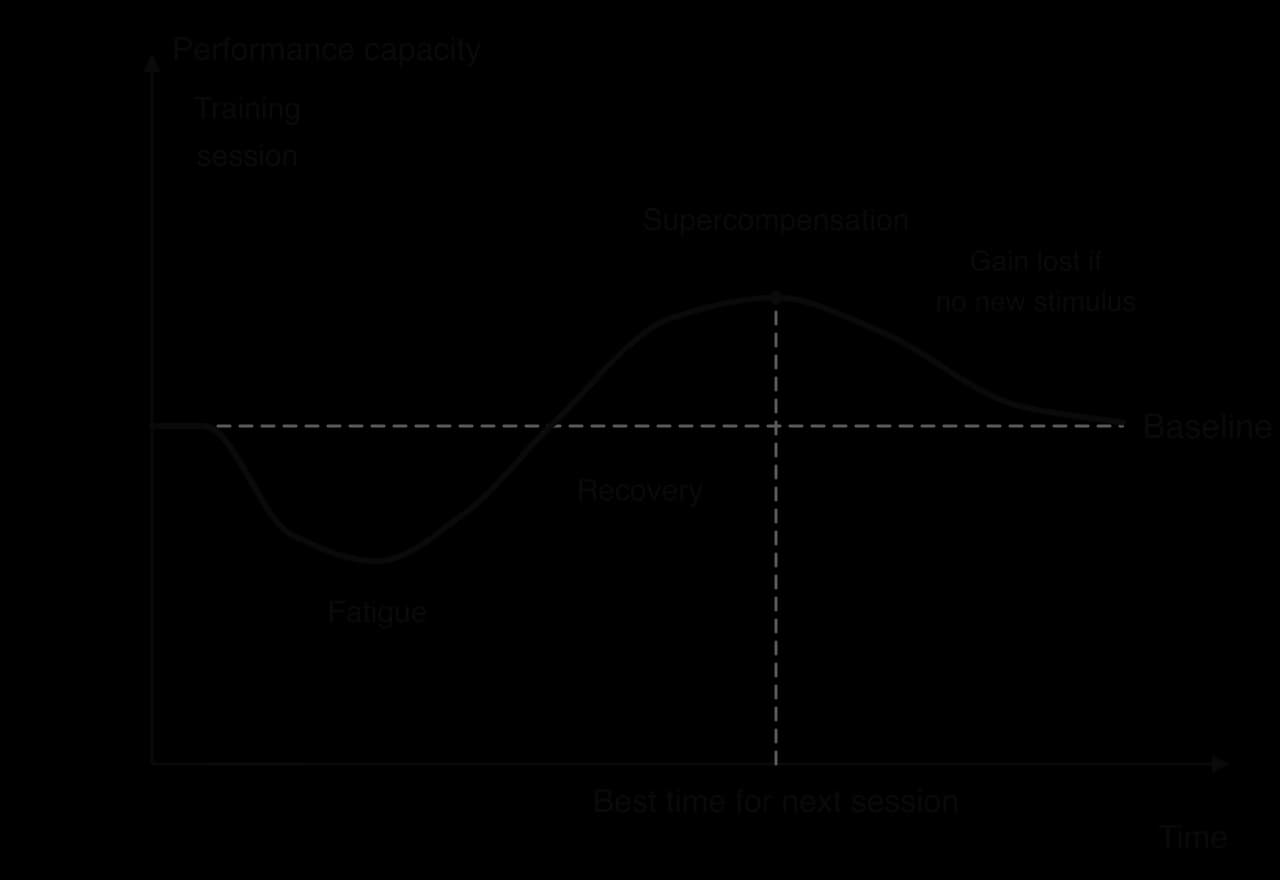
Two errors follow from the model. If the next session comes too early, before recovery is complete, the athlete starts each session more fatigued, and capacity drifts downward: this is how overreaching develops. If the next session comes too late, the supercompensation has already faded and no progress is made. The ideal gap depends on the type and intensity of the session: an easy run may need only a few hours, a heavy eccentric strength session or a marathon several days.
Recovery is built in at every level: rest between repetitions and sets, easy days between hard ones, lighter weeks at the end of each mesocycle and a transition phase at the end of the season. Sleep, nutrition and hydration determine how quickly it happens and how soon fatigue clears.
Doing exactly the same sessions week after week leads to boredom, lower motivation and repetitive strain on the same tissues. Variety means changing the exercises, methods, environments and session structures while keeping the training specific to the goal. A runner might replace one road run with a hill session, a fartlek on trails or cross-training on a bike, which gives a similar aerobic stimulus with less impact on the legs.
Variety links directly to motivation: sessions that the individual enjoys and finds interesting support intrinsic motivation and adherence, which matters especially in health programmes, where many people stop exercising within the first few months. It also links to injury: changing the type of loading reduces repeated stress on the same bones and tendons, which lowers the risk of an overuse injury.
Adaptations are lost when training stops or is greatly reduced: the body removes structures it no longer needs. This is the principle of reversibility, and the loss itself is called detraining. Aerobic adaptations reverse fastest. Within two to four weeks of stopping, highly trained athletes show a rapid fall in VO₂ max and blood plasma volume, so stroke volume and maximal cardiac output fall. Strength declines more slowly, and in long breaks usually stays above untrained values for a long time.
Reviews of detraining have also shown how to limit it. Adaptations can be kept with a much smaller volume of training, provided that intensity is maintained and frequency is reduced only moderately. Injured athletes can maintain cardiorespiratory fitness through cross-training, such as aqua jogging for a runner with a stress fracture.
Sources: Mujika and Padilla, Sports Medicine, 2000 (parts I and II).
Two people following the same programme will not respond in the same way. They differ in starting fitness, genetics, age, sex, training history, injury history, recovery capacity, life stress and goals. Individualisation means applying the other principles to the person: the same principle of progressive overload might mean adding 2.5 kg to a lift for one athlete and 5 kg for another.
Individualisation is the reason that baseline testing, monitoring and the factors discussed later (age, sex, reproductive status, the menstrual cycle and genetics) matter. In team sports it is difficult to apply, because the team trains together; coaches often adjust the volume or intensity of each player within a shared session.
Periodisation is the sixth principle, and it organises the others in time. A periodised programme divides the training year into cycles, each with its own goals, so that general fitness is built first, then converted into sport-specific fitness, and the athlete reaches peak performance at the right moment. It also plans recovery, so that progressive overload does not become chronic fatigue.
The idea was formalised by Soviet and Eastern European sport scientists in the 1950s and 1960s, notably Lev Matveyev, and developed further by Tudor Bompa. It is now used in almost every sport, and in a simpler form in health and rehabilitation programmes, which also progress through planned phases.
A macrocycle is the longest cycle, usually a whole season or year, and in Olympic sports sometimes four years. A single macrocycle with one peak suits sports with one main event per year, such as a marathon runner aiming at one autumn race; a double macrocycle (two peaks) suits a swimmer with a national championship and a summer international meet.
Preparatory phase. Divided into a general preparation period, with high volume and moderate intensity to build an aerobic base, general strength and work capacity, and a specific preparation period, in which training becomes more sport-specific and intensity rises while volume begins to fall.
Competition phase. Often begins with a pre-competition period of lead-up events. Volume is lower, intensity and specificity are highest, and fitness is maintained while the athlete competes. Before the most important event the athlete tapers.
Transition phase. A period of active rest (2–6 weeks) after the season. Volume and intensity are low, other activities are used, and the athlete recovers physically and psychologically. Too long a break causes detraining; too short a break risks starting the next season tired.
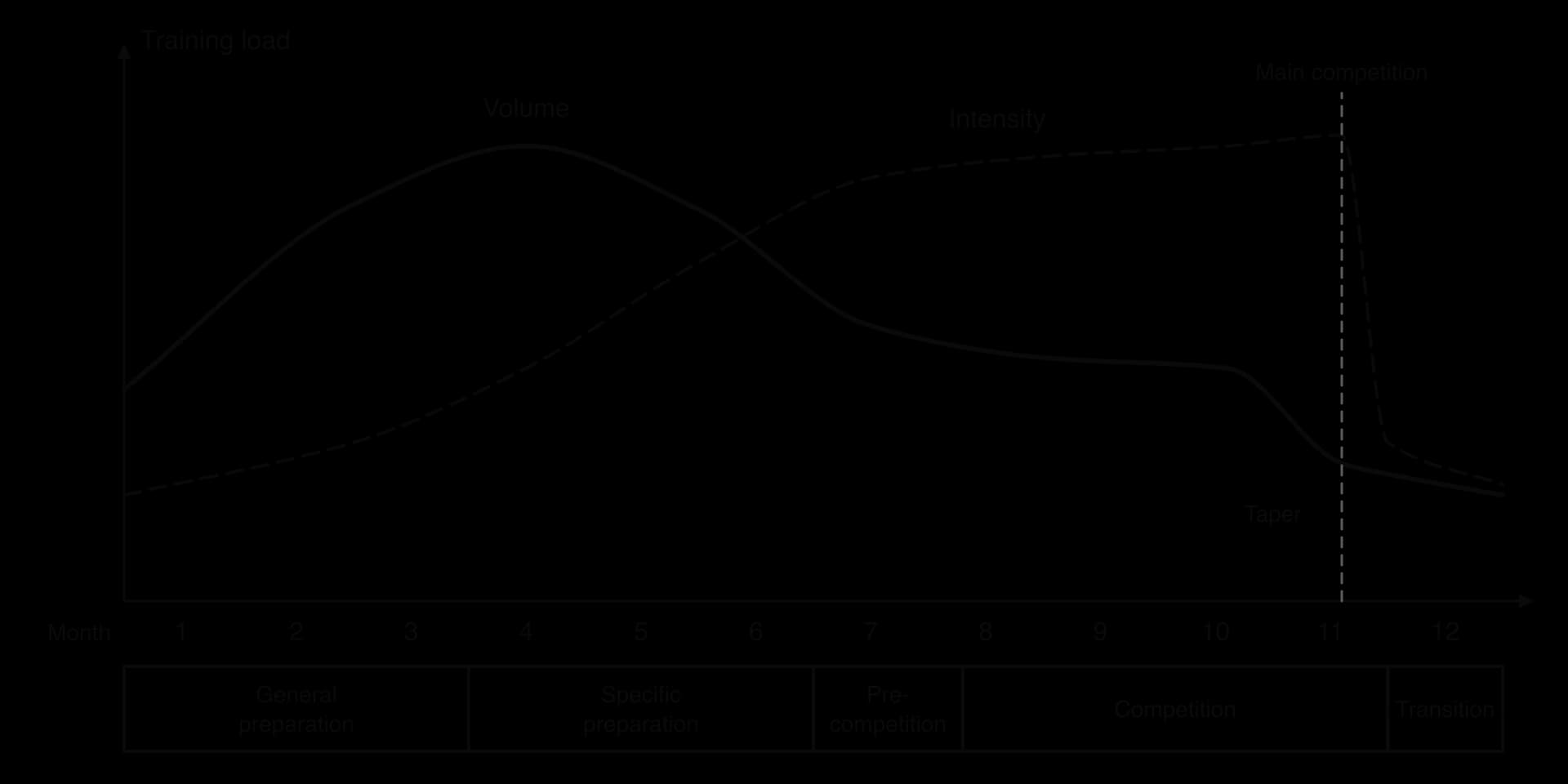
The figure shows the classic pattern for an individual sport with one main competition. Volume rises through general preparation, when the body can tolerate long sessions at moderate intensity, and then falls as intensity rises, because high volume and high intensity together cannot be sustained without overreaching. During the competition phase the athlete maintains fitness with short, intense, specific sessions. In the transition phase both volume and intensity fall to allow full recovery.
Each phase of the macrocycle is made up of mesocycles, blocks of training that usually last 3–6 weeks and focus on one or two goals, such as aerobic base, maximal strength or race-specific speed. A common pattern is three weeks of gradually increasing load followed by a lighter "recovery" or "unloading" week, which allows supercompensation and is often when progress tests are carried out.
A microcycle is the shortest repeated cycle, usually one week. It sets out the individual sessions and arranges hard and easy days so that recovery happens between the most demanding sessions. In team sports the competition-phase microcycle is built backwards from match day, with the lightest session the day before the match.
Day | Session (specific preparation, club 1,500 m runner) | Intensity |
|---|---|---|
Mon | Easy run 40 min + core strength | Low (RPE 2–3) |
Tue | Intervals: 6 × 800 m at 3 km race pace, 2 min jog recovery | High |
Wed | Easy run 35 min or cross-training | Low |
Thu | Tempo run 25 min at threshold + resistance training | Moderate–high |
Fri | Rest | — |
Sat | Hill sprints 10 × 10 s, full recovery + easy run | High (short) |
Sun | Long run 70 min | Low–moderate |
The hard days (Tuesday, Thursday, Saturday) are separated by easy days, so that the athlete arrives at each key session recovered. The microcycle trains several energy systems in one week but emphasises the specific needs of a 1,500 m runner, an event with a large aerobic contribution and an important anaerobic one (hypothetical example).
Hard training builds fitness but also accumulates fatigue, which hides some of that fitness. Tapering reduces training load for a short period before an important competition, so that fatigue disappears faster than fitness, and performance rises. A meta-analysis of 27 studies on competitive athletes concluded that the most effective taper lasts about two weeks, during which training volume is reduced progressively by about 41–60%, while intensity and frequency are kept the same. Keeping intensity is essential: without it, the specific adaptations begin to reverse.
Sources: Bosquet et al., Medicine and Science in Sports and Exercise, 2007.
The aim of the taper is peaking: reaching the athlete's highest level of performance at the planned time of the most important competition. Peaking is the result of good periodisation. A single athlete can only peak a few times a year, which is why sprinters and swimmers often race slower times early in the season. Team sports with a weekly match for 9–10 months cannot peak in the same way. They aim instead to maintain a high level all season with short "mini-tapers" before important matches and rotation of players.
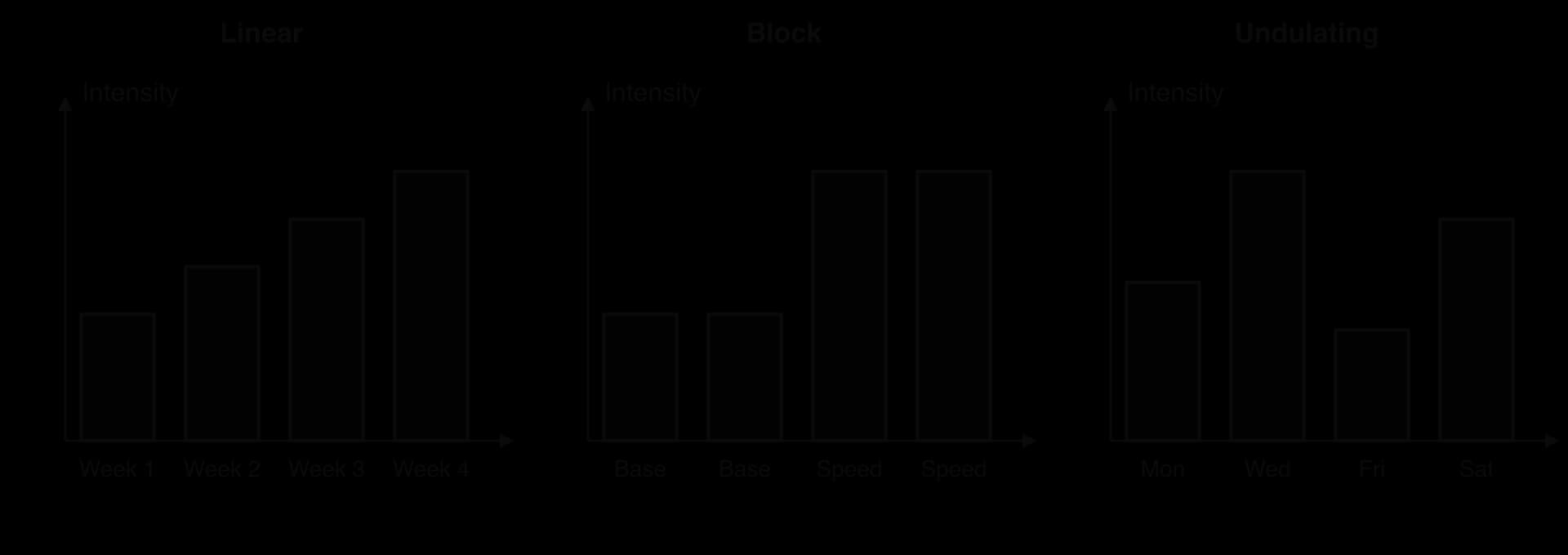
Coaches organise the cycles in different ways. The three main models differ in how quickly the emphasis changes.
Model | How it works | Suits | Limitations |
|---|---|---|---|
Linear (traditional) | Volume falls and intensity rises gradually across the mesocycles, from general to specific | Beginners; individual sports with one main peak; long preparation periods | Qualities trained early (such as aerobic base) may decline by the end; only one or two peaks a year |
Block | Each mesocycle concentrates on a small number of qualities (for example aerobic base, then threshold, then race speed), each block building on the previous one | Elite athletes who need a large, focused stimulus; sports with several competitions a year | Qualities not trained in a block may detrain; needs careful sequencing |
Undulating (non-linear) | Volume and intensity change from session to session or week to week (heavy, light, moderate days) | Team sports in long seasons; recreational resistance training; maintaining several qualities at once | Harder to plan and monitor; less suited to a single precise peak |
In resistance training, a meta-analysis of 35 studies in which total volume was matched found that periodised programmes increased 1RM strength slightly more than non-periodised ones, but did not increase muscle size more. Undulating programmes produced slightly greater 1RM gains than linear ones in trained participants, but not in untrained beginners, for whom almost any progressive programme works. Most elite programmes combine features of all three models.
Sources: Moesgaard et al., Sports Medicine, 2022.
The cycles affect performance in three ways. Across the macrocycle, the sequence of phases builds fitness in a logical order: aerobic base and general strength support the higher-intensity specific work that follows. Within each mesocycle, the pattern of loading and unloading weeks allows supercompensation and limits the build-up of fatigue. Within each microcycle, the arrangement of hard and easy days decides whether the athlete is recovered enough to train at the intended intensity in each key session.
Poorly organised cycles show up as stagnation (too little overload), repeated small injuries or illnesses (too little recovery), or a peak at the wrong time, such as a swimmer setting personal bests at a minor meet and then swimming slower at the championship.
 YouTube
Strengths: periodisation gives training a logical structure and clear goals for each period; it plans recovery and tapers, reducing the risk of overreaching; it allows testing at planned points; it is supported by a long history of successful use and by research on tapering and supercompensation.
Limitations: most of the evidence comes from coaching experience and short studies (often 6–12 weeks in recreationally trained young men), not long-term trials in elite athletes, so it is hard to show that one model is best; plans assume that the body responds predictably, but illness, injury, school deadlines and travel disrupt them; team sports with long seasons cannot follow the classic model; rigid plans may ignore day-to-day readiness.
What it depends on: the sport's competition calendar, the athlete's training age and level, and the quality of monitoring that allows the plan to be adjusted.
Periodisation is best seen as a flexible framework rather than a fixed recipe. Its basic ideas (vary load, plan recovery, become more specific as competition approaches, taper before key events) are well supported, while the details of which model to use are less certain and should be adjusted to the athlete's responses.
Intensity is the most powerful FITT variable, and it decides which energy system and which muscle fibres a session trains. It is prescribed relative to the individual's own maximum, so that the same session is equally demanding for a beginner and a trained athlete.
The simplest method sets a target heart rate as a percentage of maximum heart rate (HRmax). HRmax is best measured in a maximal test, but this is unsafe or impractical for many people, so it is usually estimated from age. The traditional estimate is 220 − age. A large analysis of 351 studies found that 208 − 0.7 × age fits measured values better, especially in older adults, for whom 220 − age gives values that are too low.
Sources: Tanaka, Monahan and Seals, Journal of the American College of Cardiology, 2001.
Both equations describe averages. Individuals of the same age can differ from the estimate by 10 beats min⁻¹ or more, so a heart rate zone based on an estimate is only approximate. HRmax does not increase with training, so it is not a measure of fitness.
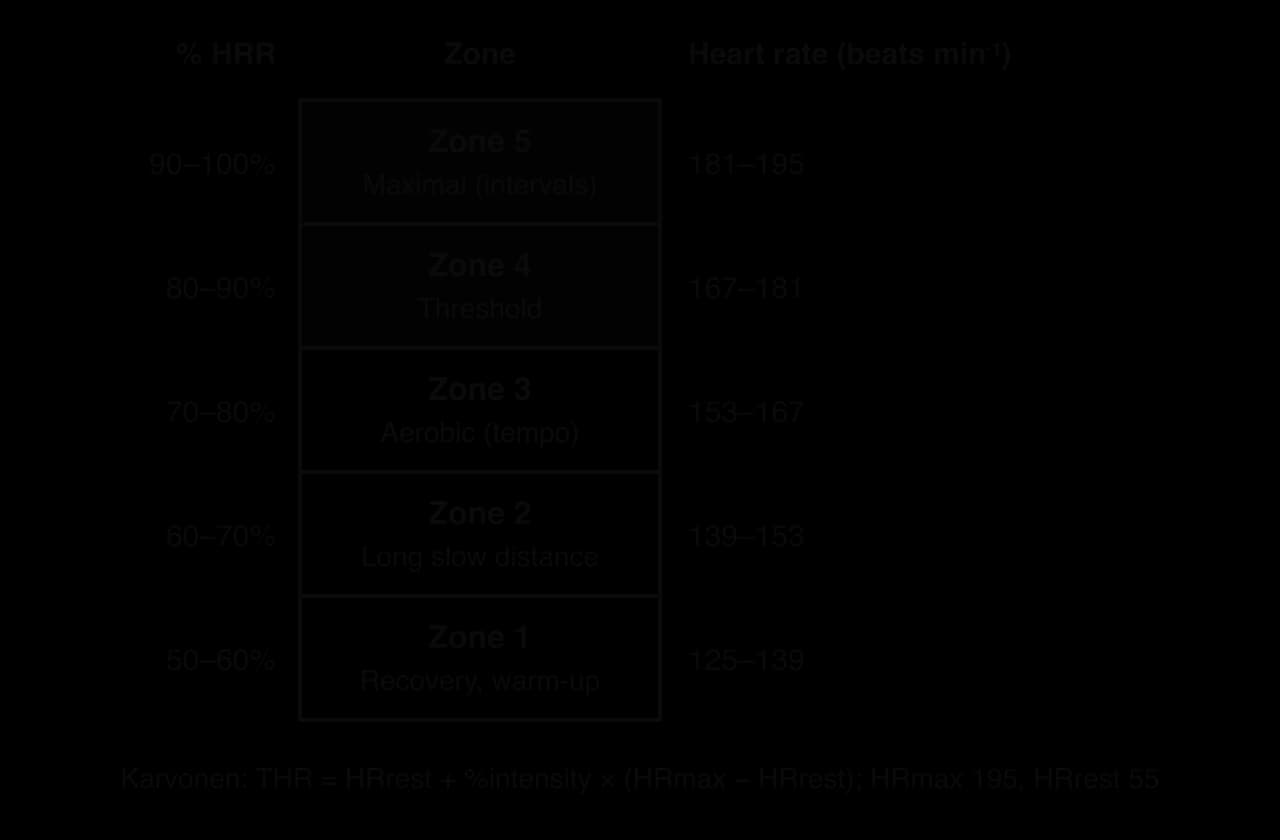
A fitter person has a lower resting heart rate, so a given percentage of HRmax is a different relative effort for people with different resting values. The Karvonen method corrects this by working with the heart rate reserve (HRR): the difference between maximum and resting heart rate, which is the range of heart rate available for exercise.
For an athlete with HRmax 200 and resting heart rate 50 beats min⁻¹, the heart rate reserve is 150 beats min⁻¹. The Karvonen method takes a percentage of this reserve and adds it to the resting value.
A percentage of HRR matches the same percentage of VO₂ reserve quite closely, so the Karvonen method gives a better estimate of metabolic intensity than a percentage of HRmax, especially at lower intensities. Resting heart rate should be measured on waking, lying down, on several mornings.
A training zone is a band of heart rate (or speed, power, RPE or blood lactate) chosen to produce a particular adaptation. Most systems use three to five zones. The zones are linked to physiological markers: the lower zones lie below the lactate inflection point, where lactate production and removal are balanced and fat makes a large contribution to energy supply; the higher zones lie above it, where lactate accumulates and glycogen use and fatigue rise quickly.
In resistance training, intensity is set as a percentage of the one-repetition maximum (1RM). The relationship between load and the number of repetitions possible is fairly consistent, so the goal of the session decides the load. Because a true 1RM test carries some injury risk for beginners, it is often estimated from the number of repetitions completed with a lighter load.
Goal | Load (% 1RM) | Repetitions per set | Sets | Rest between sets |
|---|---|---|---|---|
Maximal strength | ≥ 85% | ≤ 6 | 2–6 | 2–5 min |
Hypertrophy (muscle size) | 67–85% | 6–12 | 3–6 | 30–90 s |
Muscular endurance | ≤ 67% | ≥ 12 | 2–3 | ≤ 30 s |
Power | 30–60% (fast), or 75–90% for single explosive lifts | 1–5 | 3–5 | 2–5 min |
A training method is a way of organising exercise to develop particular components of fitness. Aerobic methods develop cardiorespiratory endurance and the oxidative system; anaerobic methods develop speed, power, strength and the phosphagen and glycolytic systems. Most programmes combine several.
Continuous training means exercising for a long period without rest at a steady, submaximal intensity, typically 60–80% of HRmax for 20 minutes to several hours. Running, cycling, swimming and rowing are typical. It develops the heart, capillaries, mitochondria and the use of fat as a fuel, and is the basis of training for endurance athletes and of most health programmes.
Two forms are widely used:
Long slow distance (LSD): long sessions (often 60 minutes to several hours) at low intensity, about 60–70% of HRmax or RPE 11–13, at which conversation is possible. It builds aerobic base, fat oxidation and the resilience of muscles, tendons and bones.
Tempo or threshold training: shorter sessions (about 20–40 minutes in total) at a "comfortably hard" intensity close to the lactate inflection point, about 80–90% of HRmax. It raises the intensity at which lactate begins to accumulate, so a faster pace can be sustained. It can also be done as long intervals with short rests ("cruise intervals").
Fartlek training (Swedish for "speed play") is continuous running in which the pace changes freely: short bursts of fast running, uphill efforts and recovery jogging, often on varied terrain. Because the athlete never stops, the oxidative system is trained throughout, while the bursts also stress the anaerobic systems. It suits games players, whose sports involve frequent changes of pace, and adds variety for endurance athletes. Its weakness is that intensity is hard to control and record.
Interval training alternates periods of work with periods of rest or light activity. Breaking the work into repetitions lets the athlete spend much more time at high intensity than would be possible in one continuous effort, and the length of each work and rest period can be set to target a particular energy system. The work:rest ratio is the key variable.
Energy system targeted | Work duration | Intensity | Work:rest ratio | Example |
|---|---|---|---|---|
Phosphagen | 5–10 s | Maximal | 1:10 to 1:20 (allows PC to resynthesise) | 8 × 30 m sprints, 2 min walk back |
Glycolytic | 20–90 s | Near maximal | 1:2 to 1:4 | 6 × 300 m with 3 min rest |
Oxidative | 2–5 min | Hard, 85–95% HRmax | 1:1 or shorter rest | 5 × 4 min with 3 min jog |
The recovery interval decides which system is trained. Long rests allow phosphocreatine to resynthesise, so every sprint is near maximal and the phosphagen system is trained. Short rests mean the next effort starts before recovery is complete, so the glycolytic system contributes more and tolerance of lactate and hydrogen ions improves.
High-intensity interval training (HIIT) uses short to medium bouts at a high intensity (usually above 80–90% of HRmax) separated by recovery. A well-known protocol from a 1996 study used 7–8 bouts of 20 s cycling at about 170% of VO₂ max with 10 s rest, five days a week for six weeks. VO₂ max rose by 7 mL kg⁻¹ min⁻¹ and anaerobic capacity by 28%, whereas a group doing 60 minutes of moderate continuous cycling improved VO₂ max but not anaerobic capacity. The study shows the principle of specificity: only the high-intensity training improved the anaerobic system.
Sources: Tabata et al., Medicine and Science in Sports and Exercise, 1996.
Sprint interval training is the most extreme form: a few all-out efforts, such as four to six 30 s cycle sprints with 4 minutes of recovery. HIIT and sprint interval training give aerobic and metabolic improvements similar to those of much longer continuous training in a fraction of the time, which makes them attractive for busy adults and for health. They are, however, very uncomfortable, need high motivation and are not suitable for everyone with cardiovascular disease without medical clearance and supervision.
Resistance training means making muscles contract against an external load: free weights, machines, elastic bands or body mass. Depending on the load, repetitions and rest (the %1RM table), it develops maximal strength, hypertrophy, muscular endurance or power. It is important for health as well as performance: it maintains muscle mass and bone mineral density, improves insulin sensitivity and reduces the risk of falls in older adults by slowing sarcopenia.
Strength gains in the first few weeks come mainly from neural adaptations: more motor units are recruited, they fire at higher rates and more in synchrony, and antagonist muscles relax more effectively. After about 6–8 weeks, hypertrophy of the muscle fibres, especially type IIx fibres and type IIa fibres, makes a growing contribution.
Plyometrics are explosive jumping, bounding and throwing exercises, such as depth jumps (stepping off a box and jumping up immediately on landing), hops, bounds and medicine ball throws. They train power by using the stretch-shortening cycle: a muscle that is stretched under load (an eccentric contraction) immediately before it shortens (a concentric contraction) produces more force, because elastic energy is stored in the tendon and the stretch reflex adds to the contraction.
The benefit depends on a short transition between the stretch and the shortening: if the athlete pauses on landing, the stored elastic energy is lost as heat. Plyometrics involve large forces on landing, so they need a base of strength, good landing technique, a forgiving surface and a low volume counted in foot contacts. They suit sports with jumping, sprinting and throwing, such as basketball, volleyball and athletics.
Flexibility training increases the range of movement at joints through static stretching (holding a stretch, typically for 15–30 s), dynamic stretching (controlled movements through the range, such as leg swings) and PNF stretching (stretching combined with an isometric contraction of the stretched muscle). Dynamic stretching suits a warm-up; static and PNF stretching are better done after training or in separate sessions, because long static stretches immediately before explosive activity can slightly reduce power.
Method | Main energy system(s) | Main components developed | Health lens | Performance lens |
|---|---|---|---|---|
Continuous (LSD) | Oxidative | Cardiorespiratory endurance, body composition | Safe, easy to start, good for weight management and cardiovascular health | Aerobic base for every endurance sport; low intensity limits speed |
Threshold (tempo) | Oxidative, some glycolytic | Speed at the lactate inflection point | Moderate–hard; useful once a base exists | Raises sustainable race pace (5 km to marathon) |
Fartlek | Oxidative and glycolytic | Cardiorespiratory endurance, speed | Enjoyable variety | Matches the changing pace of games |
Interval / HIIT | Glycolytic, phosphagen, oxidative | VO₂ max, anaerobic capacity, speed | Time-efficient; needs screening and motivation | Raises VO₂ max and race speed; high fatigue cost |
Resistance | Phosphagen and glycolytic | Strength, hypertrophy, muscular endurance, power | Maintains muscle and bone; prevents falls | Force production, injury resilience |
Plyometrics | Phosphagen | Power, speed | Limited use (impact load) | Jumping, sprinting, throwing |
No method is best in every situation. For an inactive adult, continuous training at moderate intensity is safe and easy to maintain, and resistance training twice a week adds benefits for muscle and bone. For an endurance athlete, most training volume is continuous and low intensity, with a smaller amount of threshold and high-intensity interval work, a balance explored in the case study. A sprinter's programme is dominated by maximal-intensity intervals, resistance training and plyometrics, with only a small aerobic component to support recovery between repetitions.
Exercise causes two kinds of change. An acute response is the immediate, temporary change that happens during a single session and disappears afterwards: heart rate rises during a run and falls back to resting values after it. A chronic adaptation is the lasting structural or functional change that develops over weeks and months of repeated training: resting heart rate falls because the heart has become larger and stronger.
Acute responses are the body's way of meeting the immediate demand of the session. When the same demand is repeated many times, the body changes its structure so that the demand causes less disturbance in future.
System | Acute responses (during one session) | Chronic adaptations to endurance training | Chronic adaptations to resistance or anaerobic training |
|---|---|---|---|
Cardiovascular | Heart rate, stroke volume and cardiac output rise; systolic blood pressure rises; blood is redistributed to working muscles | Larger left ventricle and stroke volume; lower resting and submaximal heart rate; higher maximal cardiac output; more capillaries; greater blood and plasma volume | Thicker ventricular walls (small change); little change in VO₂ max |
Respiratory | Breathing rate, tidal volume and minute ventilation rise | Stronger respiratory muscles; higher maximal minute ventilation; lower ventilation at a given submaximal workload | Little change |
Muscular | Muscle temperature rises; fibres are recruited; fatigue develops | More mitochondria, myoglobin and oxidative enzymes, especially in type I fibres; more capillaries per fibre | Hypertrophy of type II fibres; greater motor unit recruitment and firing rate; stronger tendons and bones |
Metabolic | Rate of ATP turnover, oxygen consumption and lactate production rise; glycogen is used | Higher VO₂ max; lactate inflection point at a higher % of VO₂ max; more fat used at a given intensity, sparing glycogen; larger glycogen stores | Larger PC and glycogen stores; more glycolytic enzymes; better buffering of hydrogen ions |
The table shows specificity again: endurance training mainly changes oxygen delivery and use, while resistance and sprint training mainly change force production and anaerobic capacity. The adaptations of each type of training explain its benefits for health. Endurance adaptations lower resting heart rate and blood pressure and improve blood lipid profiles; resistance adaptations preserve muscle and bone into old age.
Even when everyone follows exactly the same programme, the size of their improvement varies widely. Part of this variation comes from differences in starting fitness: an untrained person improves much more, in percentage terms, than a trained athlete, who is already close to their genetic ceiling. Part comes from age, sex, sleep, nutrition and stress. A large part comes from genetics.
The clearest evidence comes from the HERITAGE Family Study, in which 481 previously sedentary adults from 98 families completed the same 20-week supervised cycling programme. The average increase in VO₂ max was about 400 mL min⁻¹, but some people gained little or nothing while others gained more than 1 L min⁻¹. Members of the same family responded much more similarly than members of different families, and the researchers estimated that up to 47% of the variation in trainability was inherited.
Sources: Bouchard et al., Journal of Applied Physiology, 1999.
People who improve a lot are called high responders; people who improve little or not at all on a given measure are called low responders or non-responders. A person can be a low responder for one outcome (VO₂ max) and a high responder for another (blood pressure or insulin sensitivity), so being a "non-responder" does not mean training is useless for that person.
Sources: Montero and Lundby, Journal of Physiology, 2017.
Genetics also shapes the starting point. Muscle fibre type proportions, heart size, haemoglobin mass and body proportions are partly inherited, which is why elite athletes are often unusual before they begin training. Practical consequences follow: programmes should be individualised, progress should be monitored rather than assumed, and an individual who is not improving may need a different type, intensity or volume of training rather than simply more of the same.
Before writing a programme, a coach or exercise professional considers who it is for. Four groups of factors change what is safe and effective: current fitness, age and sex, reproductive status and the menstrual cycle, and the phase of the macrocycle.
Baseline testing shows the starting point. A beginner improves quickly from a small dose of training, so the starting load is low and progression is gradual; most early gains in strength are neural. An elite athlete needs a much larger and more specific stimulus to improve even slightly, and is closer to the boundary between optimal training and overreaching. Health screening, such as the PAR-Q+ questionnaire, identifies people who need medical advice before starting vigorous exercise.
Children (before puberty). Children respond well to training of skills, speed and coordination. Well-supervised resistance training with good technique and progressive loads is safe and improves strength, mainly through neural adaptations, and reduces injury risk; an international consensus statement in 2014 endorsed it. Children have a smaller sweating capacity and a larger surface area relative to mass, so they need care in hot conditions. Training should be varied, enjoyable and based on play and many sports, not early specialisation.
Adolescents. The growth spurt brings rapid changes in limb length and body mass, temporary losses of coordination and a period when the growth plates (the cartilage near the ends of long bones where growth happens) are vulnerable to overuse. Training load should be monitored closely during this period. Rising testosterone in boys after puberty increases the response of muscle to resistance training.
Older adults. Maximum heart rate, VO₂ max, muscle mass (sarcopenia) and bone mineral density decline with age, and recovery takes longer. Older adults remain highly trainable: resistance training, balance training and weight-bearing activity reduce falls, fractures and loss of independence. Intensity is progressed cautiously and more recovery is allowed between hard sessions.
After puberty, males on average have greater muscle mass, larger hearts and lungs, more haemoglobin per litre of blood and a lower body fat percentage, largely because of testosterone. As a result, absolute strength, power and VO₂ max are higher on average. However, the relative response to training (the percentage improvement) is broadly similar in males and females, so the training principles apply to both. Differences between individuals of the same sex are often larger than the average difference between sexes.
Some differences do affect programme design. Females on average use slightly more fat during endurance exercise. Female athletes have a higher risk of iron deficiency and of low energy availability, which can lead to relative energy deficiency in sport (REDs), menstrual disturbances and bone stress injuries, so energy intake and menstrual function are monitored. Wider hips and differences in landing mechanics are among the reasons female athletes have a higher rate of anterior cruciate ligament injuries, which is why neuromuscular training (landing, strength and balance) is built into their programmes.
Pregnancy. For most people with an uncomplicated pregnancy, regular moderate exercise is safe and beneficial: it supports cardiovascular fitness, healthy weight gain and mood, and lowers the risk of gestational diabetes. Training is adjusted rather than stopped: contact sports and activities with a high risk of falls are avoided, overheating and exercise lying flat on the back after the first trimester are avoided, intensity is guided by RPE and the talk test (because heart rate responses change in pregnancy), and pelvic floor training is included. Elite athletes continue to train under medical supervision, and the return to training after birth is gradual.
Menopause. The fall in oestrogen at menopause accelerates the loss of bone mineral density and muscle mass and changes fat distribution. Resistance training and impact or weight-bearing exercise therefore become especially important, and symptoms such as hot flushes and disturbed sleep may affect training and recovery.
The menstrual cycle is often described, for simplicity, as a 28-day cycle in which the reproductive hormones oestrogen and progesterone rise and fall in a regular pattern. Real cycles vary from about 21 to 35 days and differ between people and from month to month. The cycle is usually divided into phases:
Phase (28-day model) | Hormones | Possible effects on training | Possible adjustments |
|---|---|---|---|
Early follicular phase (menstruation, days 1–5) | Oestrogen and progesterone both low | Some individuals report cramps, fatigue and lower motivation; iron loss through menstrual bleeding | Adjust session content or intensity on bad days; monitor iron intake; pain relief and heat for cramps |
Late follicular phase (days 6–13) | Oestrogen rises to a peak; progesterone low | Many individuals feel well; some evidence of greater strength gains from training in this phase | A possible window for the hardest strength and high-intensity sessions |
Ovulation (about day 14) | Oestrogen peaks, luteinising hormone surges | Higher ligament laxity has been suggested, with a possible link to ACL injury risk | Emphasise warm-up, landing technique and neuromuscular training |
Luteal phase (days 15–28) | Progesterone and oestrogen both raised, then fall before menstruation | Core temperature rises by about 0.3–0.5 °C; breathing and heart rate slightly higher; more reliance on fat; some report higher RPE | Extra attention to hydration and cooling in heat; adequate carbohydrate; recovery and sleep |
Training can therefore be adjusted for the cycle, but the evidence that it should be adjusted for everyone is weak. A small study of 20 women who trained one leg mainly in the follicular phase and the other mainly in the luteal phase found greater gains in strength and muscle diameter in the follicular-phase leg. Larger reviews, however, find that average effects of cycle phase on performance are small and inconsistent, that many studies are of low quality and that individuals vary widely. Hormonal contraceptives also change the hormone pattern, so the 28-day model does not apply to users.
Sources: Sung et al., SpringerPlus, 2014.
The current recommendation is therefore individual tracking. An athlete records cycle dates and symptoms (with an app or a diary) alongside training load, RPE, mood and performance over several cycles. If a consistent pattern appears for that athlete, the coach can adjust training load, nutrition (iron, carbohydrate) and hydration around it. Missing or irregular periods in an athlete are a warning sign of low energy availability and need medical attention, not a training adjustment.
The same athlete needs different training at different times of the year. In the general preparation phase, volume is high and intensity moderate; in the specific preparation phase, intensity and specificity rise; in the competition phase the emphasis is on quality, maintenance and recovery between competitions; in the transition phase the aim is rest and regeneration. A session that is ideal in March may cause overreaching if it is added in the week before a championship.
Progressive overload means deliberately making the body tired. Some accumulated fatigue is a normal and useful part of training, but when the balance between load and recovery is wrong for too long, performance falls instead of rising. The outcomes lie on a continuum, from normal training fatigue to a serious, long-lasting condition, and they are told apart mainly by how long it takes performance to recover.
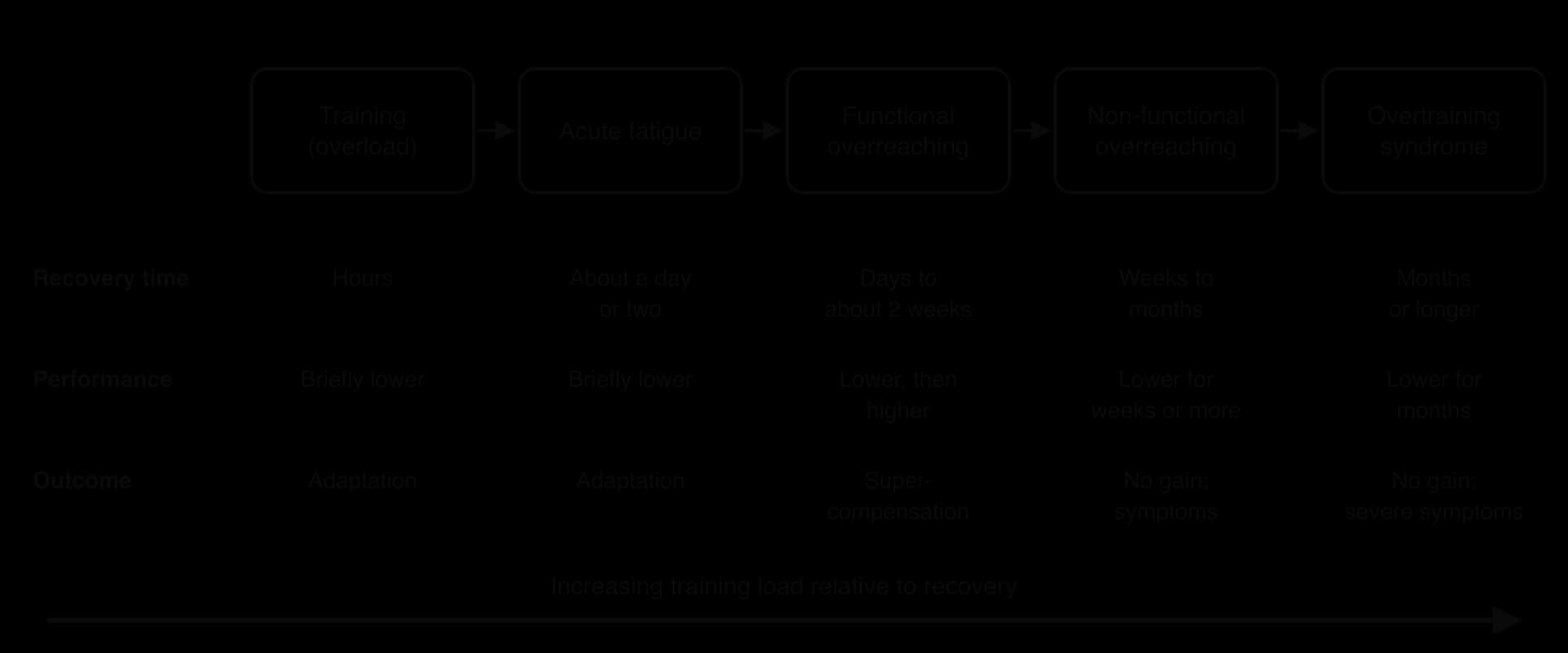
Functional overreaching is a short period of deliberately heavy training, such as a hard training camp or a high-load mesocycle, that causes a temporary drop in performance. After a few days to about two weeks of reduced training, performance rebounds above its previous level: a large-scale version of supercompensation. Many periodised programmes plan a functional overreaching block before a taper.
If the heavy training continues without enough recovery, or if other stressors (illness, poor sleep, low energy intake, school deadlines, travel) are added, the athlete may develop non-functional overreaching. Performance stays lower for weeks to months, and there are psychological and hormonal symptoms such as low mood and disturbed sleep. The athlete eventually recovers fully with rest, but the time lost means there is no performance gain from the period of heavy training.
Overtraining syndrome (OTS) is the most severe end of the continuum: a long-term decline in performance, lasting months or longer, with severe symptoms in several body systems. It is described as a "prolonged maladaptation" of the athlete and of the nervous, hormonal and immune systems. It is relatively rare, much rarer than non-functional overreaching, but can end careers.
A 2013 joint consensus statement of the European College of Sport Science and the American College of Sports Medicine noted that NFOR and OTS share the same signs and symptoms, and that the distinction is often made only afterwards, from how long recovery takes. OTS is therefore diagnosed by exclusion: other explanations for poor performance and fatigue, such as infection, anaemia, iron deficiency, thyroid disease, depression and low energy intake, must first be ruled out. No single blood test or questionnaire can confirm it.
Sources: Meeusen et al., Medicine and Science in Sports and Exercise, 2013.
Type of symptom | Examples |
|---|---|
Performance | Decline in performance despite continued or increased training; heavy legs; inability to complete normal sessions; higher RPE for the same workload |
Physiological | Persistent fatigue; altered resting and exercise heart rate and reduced heart rate variability; disturbed sleep; loss of appetite and body mass; muscle soreness that does not clear; hormonal changes (for example in cortisol and testosterone) |
Psychological | Low mood, irritability, anxiety, depression; loss of motivation and enjoyment; difficulty concentrating |
Immune | Frequent upper respiratory tract infections, slow healing of minor injuries |
Non-functional overreaching and overtraining syndrome are consequences of poorly designed or poorly managed programmes. Common causes are a sudden large increase in load (breaking the principle of progressive overload), too little recovery between hard sessions (breaking the recovery principle), too little variety (monotonous training), the same programme for every athlete (no individualisation), and competing too often without a transition phase.
Training is not the only stress. Lack of sleep, low energy and carbohydrate intake, illness, travel, school deadlines, relationship problems and pressure from coaches or parents all add to the total load the body must recover from. This is why stress, motivation and burnout are linked to overtraining: an athlete who is under psychological pressure, or who trains out of fear of failure rather than enjoyment, may ignore warning signs and keep training.
Because no single marker confirms overreaching, coaches use several measures together and watch for trends in each individual, compared with that individual's own baseline:
Monitoring tool | What it shows | Strengths | Limitations |
|---|---|---|---|
Session-RPE and training load | Internal load per session and week; sudden spikes | Simple, cheap, valid across many sports | Self-report; needs honesty and daily recording |
Resting heart rate and heart rate variability | Balance of the autonomic nervous system; a falling HRV or rising resting heart rate over several days can indicate poor recovery | Objective; measured at home with a chest strap or app | Affected by hydration, alcohol, illness, sleep and how it is measured; trends matter more than single values |
Mood questionnaires (for example the Profile of Mood States, POMS) and daily wellness ratings | Mood disturbance, fatigue, motivation, soreness, sleep quality | Mood often changes before performance falls; quick to complete | Self-report; athletes may hide symptoms to keep their place in the team |
Sleep monitoring (diary or wearable) | Sleep duration and quality | Sleep problems are an early sign; easy to record | Consumer devices estimate sleep stages with limited validity |
Performance tests (for example a countermovement jump or a standard submaximal run) | Whether the athlete is getting fitter or slower | Objective and specific | A single poor result may be chance; maximal tests add to fatigue |
Blood markers (for example creatine kinase, cortisol, testosterone) | Muscle damage, hormonal stress | Objective | Expensive, invasive, highly variable; none is a reliable marker of OTS on its own |
Prevention follows from the training principles: increase load gradually; plan recovery days, unloading weeks and a transition phase; individualise training, especially for athletes with heavy school, work or travel commitments; eat enough to avoid low energy availability; protect sleep; reduce training during illness; and make sure athletes feel able to report fatigue and low mood honestly. Education of coaches and athletes, and a motivational climate that values long-term development, are part of prevention as well as of performance.
Since the early 2000s, a group of Norwegian middle- and long-distance runners and triathletes has used a distinctive way of organising and controlling training intensity. It is often called the "Norwegian model" or "double threshold", and in research it is described as lactate-guided threshold interval training within a high-volume, low-intensity approach. It is a good example of how the training principles, intensity zones, periodisation and monitoring combine in one programme.
The model was developed by the runner Marius Bakken, whose best 5,000 m time was 13:06.39, and refined by the Ingebrigtsen brothers and their coaches. Henrik and Filip Ingebrigtsen became European 1,500 m champions in 2012 and 2016, and Jakob Ingebrigtsen won the Olympic 1,500 m title in Tokyo in 2021 in 3:28.32, an Olympic record. The triathletes Kristian Blummenfelt, Olympic champion in Tokyo in 2021, and Gustav Iden, Ironman 70.3 world champion in 2019 and 2021, also used lactate-guided threshold sessions.
A typical week contains three to four threshold interval sessions and one session at about VO₂ max intensity, with the rest of the running at low intensity, up to about 150–180 km per week. On two days a week the athlete does a threshold session in the morning and another in the evening: the "double threshold". The pace of each threshold session is set by the athlete's blood lactate concentration rather than by a target time, typically 2–4.5 mmol L⁻¹ and measured with a portable lactate analyser every one to three repetitions. If lactate rises above the target, the athlete slows down.
Day | Morning | Evening |
|---|---|---|
Mon | 15 km easy (zone 1) | 12 km easy; short sprints and technique |
Tue | 5 × 6 min at 2.5 mmol L⁻¹, 1 min recovery (zone 2), with easy warm-up and cool-down | 10 × 1,000 m at 3.5 mmol L⁻¹, 1 min recovery (zone 2), with easy warm-up and cool-down |
Wed | 16 km easy; strength training | 10 km easy; short sprints and technique |
Thu | 5 × 2 km at 2.5 mmol L⁻¹, 1 min recovery (zone 2) | 25 × 400 m at 3.5 mmol L⁻¹, 30 s recovery (zone 2) |
Fri | 15 km easy | Rest |
Sat | 20 × 200 m uphill at about 8 mmol L⁻¹, jog-back recovery (high intensity) | 10 km easy |
Sun | 21 km easy | Rest |
Sources: Casado, Foster, Bakken and Tjelta, International Journal of Environmental Research and Public Health, 2023 (sample week adapted from Bakken).
The model applies several principles at once. Progressive overload comes from a very large weekly volume and a large amount of time at threshold intensity. Recovery is built into the design: because threshold intervals stay below the intensity at which lactate and hydrogen ions accumulate rapidly, each session causes less central and peripheral fatigue than racing-pace intervals, so the athlete can recover by the next day and do more high-quality sessions per week. The hard–easy pattern of the microcycle (double threshold days followed by easy days) applies the same idea.
Individualisation comes from lactate control: the same target lactate gives a pace that suits the athlete's fitness on that day, which allows for fatigue, heat or altitude. It is a direct measure of internal load, where a target time would be an external one.
Splitting threshold work into intervals with short recoveries lets athletes run faster than they could in a continuous tempo run at the same lactate level, which recruits more motor units, including some type II fibres, at near race-specific speeds (specificity). The large volume of easy running builds the aerobic adaptations described earlier: more mitochondria and capillaries and greater stroke volume. Over the year, training is reported to move from a more pyramidal distribution of intensity in the preparatory period towards a more polarised one in the competition phase (periodisation).
The model is interesting because it differs from the best-known description of elite endurance training. Observational studies of elite cross-country skiers, rowers and runners led researchers such as Stephen Seiler to describe a polarised distribution of intensity: about 75–80% of sessions at low intensity, a small amount at threshold, and the rest at high intensity. Polarised training deliberately avoids the middle zone, which the Norwegian model uses heavily.

In a randomised study, 48 well-trained runners, cyclists, triathletes and skiers followed one of four 9-week programmes: high volume, threshold, HIIT or polarised. The polarised group improved peak VO₂ by 11.7% and time to exhaustion by 17.4%, while the threshold and high-volume groups showed no further improvement in most measures. On this evidence, more threshold training looks less effective than a polarised approach.
Sources: Seiler and Kjerland, Scandinavian Journal of Medicine and Science in Sports, 2006; Stöggl and Sperlich, Frontiers in Physiology, 2014.
The two findings are not necessarily in conflict. The randomised study lasted only 9 weeks and its threshold programme did not reproduce the Norwegian structure, in which threshold work is broken into short, lactate-controlled intervals within a very high volume of easy running, so that most running is still at low intensity. Both approaches agree on a large base of low-intensity training; they disagree about how the harder 20% should be spread.
The case shows that intensity control and recovery are as important as how hard an athlete trains, and that monitoring internal load (here with blood lactate, elsewhere with heart rate or RPE) allows the training principles to be applied to the individual each day. It also links to the motivation and psychology of training: the method demands patience and discipline to run slower than possible in threshold sessions.
Its scientific limits are important. A 2023 review of the model stated that it is based only on observational studies and reports and that no controlled studies have tested it; many of its features were developed by trial and error.
The athletes who use it are a small, highly selected group with exceptional genetics and years of training, so their success does not show that the method caused it (correlation rather than causation), and unsuccessful athletes who tried the same method are rarely reported. Lactate measurement adds equipment cost and its own measurement error, and it is unclear whether the approach suits recreational runners, who train far less, or marathon runners.
Sources: Casado, Foster, Bakken and Tjelta, International Journal of Environmental Research and Public Health, 2023.
Analysis questions
Use the sample week to estimate the distance run at threshold intensity (zone 2) on Tuesday and Thursday, and suggest why this might be a smaller fraction of total weekly distance than the double-threshold name suggests.
Explain, using the supercompensation model, why lactate-controlled threshold intervals may allow more hard sessions per week than intervals at race pace.
Evaluate the quality of the evidence that the Norwegian model is more effective than polarised training, referring to study design, sample and outcome measures.
Questions on qualities of training appear in every part of the assessment. Paper 1A tests definitions of principles and cycles, the difference between responses and adaptations, and simple intensity calculations. Paper 1B often uses training studies with fitness test results. Paper 2 asks for definitions, calculations (Karvonen, session-RPE, percentage change), sketches (supercompensation, a periodised year) and extended responses on programme design and overtraining.
Intensity calculations in multiple-choice questions usually include the answers produced by common slips, so each option should be checked against the method.
Questions on overreaching often describe a situation and ask which term fits it, so the time scale in the stem is the key clue.
In a laboratory study, two training programmes were compared on a mechanically braked cycle ergometer. In the first experiment, one group of participants trained at 70% of VO₂ max for 60 min per day, 5 days per week, for 6 weeks. In the second experiment, a different group of seven participants performed 7–8 bouts of 20 s cycling at about 170% of VO₂ max with 10 s rest between bouts, 5 days per week, for 6 weeks. VO₂ max and anaerobic capacity (the maximal accumulated oxygen deficit) were measured before and after training.
Programme | VO₂ max before (mL kg⁻¹ min⁻¹, mean ± SD) | VO₂ max after (mL kg⁻¹ min⁻¹, mean ± SD) | Change in VO₂ max (mL kg⁻¹ min⁻¹) | Change in anaerobic capacity |
|---|---|---|---|---|
Moderate continuous (70% VO₂ max, 60 min) | 53 ± 5 | 58 ± 3 | +5 | No significant change (p > 0.10) |
High-intensity intermittent (20 s on, 10 s off) | not given | not given | +7 | +28% (significant) |
Sources: Tabata et al., Medicine and Science in Sports and Exercise, 1996.
Sketch questions are marked on correctly labelled axes and the key features of the shape, not on artistic quality.
Explanation questions on periodisation reward a cause-and-effect chain from the change in training to the change in performance.
Fitness is the ability to meet the demands of a task; it has five health-related components and six skill-related components, each measured by a specific test.
Tests must be valid (measure the right thing) and reliable (consistent); standardised protocols, baseline testing and percentage change are used to track progress.
Intensity and load are monitored with heart rate, RPE, session-RPE (RPE × minutes) and wearable technology; the acute:chronic workload ratio is widely used but its value is debated.
The training principles are specificity, progressive overload (FITT), recovery, variety, reversibility and periodisation, all applied to the individual.
Periodisation divides training into macrocycles (preparatory, competition, transition), mesocycles and microcycles; a taper of about two weeks cuts volume but keeps intensity so the athlete peaks.
Intensity is set with %HRmax, the Karvonen method (HRrest + % × HRR) and %1RM; training methods (continuous, threshold, fartlek, interval, HIIT, resistance, plyometrics, flexibility) target different energy systems and components.
Acute responses happen during one session; chronic adaptations develop over weeks and months and are specific to the type of training.
Individuals respond differently, partly because of genetics (responders and non-responders), so programmes consider current fitness, age, sex, reproductive status, the menstrual cycle (tracked individually) and the phase of the macrocycle.
Too much load with too little recovery leads from functional overreaching to non-functional overreaching and overtraining syndrome, which are prevented by good design and monitored with several measures together.
I can outline the health-related and skill-related components of fitness and state a test for each.
I can explain validity and reliability and calculate a coefficient of variation and a percentage change.
I can calculate session-RPE training load and explain how heart rate, RPE and wearables are used to monitor training.
I can describe each training principle and apply it to a named sport or exercise programme.
I can describe macrocycles, mesocycles and microcycles and explain how a taper produces a peak.
I can calculate training intensities using %HRmax, the Karvonen method and %1RM.
I can compare aerobic and anaerobic training methods and distinguish acute responses from chronic adaptations.
I can explain responders and non-responders and discuss how age, sex, reproductive status, the menstrual cycle and the macrocycle phase affect programme design.
I can distinguish functional overreaching, non-functional overreaching and overtraining syndrome and evaluate ways of monitoring and preventing them.