A.3 Response
Explain how the body responds to a single bout of exercise and to training, how programmes are designed for health or performance and, at HL, where fatigue comes from and how recovery works.
- IB Sports, Exercise and Health Science
- SL and HL
What A.3 covers
From the subject guide: what you need to know and be able to do.
How the body responds to exercise and training, and how it recovers.
3 subtopics in Response
Each one has its own page once something is published for it.
- A.3.1Qualities of trainingnotes
- A.3.2Benefits to health of being activenotes
- A.3.3Fatigue and recoveryHL onlynotes
An overview of A.3 Response
Response is the study of how the body reacts to exercise, immediately and over weeks and months of training, and how that reaction can be planned, measured and used. It explains how training improves performance, how regular physical activity lowers the risk of chronic disease and, at HL, why the body fatigues and how it recovers.
Questions that frame response
The central question is how the body responds to exercise and to training, and how those responses can be steered towards better health or better performance. A single session causes short-lived changes, while the same session repeated with enough recovery causes lasting ones, and both depend on who is exercising and how the exercise is planned.
Why does an elite marathon runner reduce training in the final weeks before a race?
How much activity does an adult need each week to lower the risk of heart disease and type 2 diabetes?
Why can training harder for longer make an athlete slower?
Why do two people on the same programme improve by very different amounts?
Do ice baths speed up recovery, or can they hold back gains in strength?
What the topic covers
Subtopic | Main question it answers | Level |
|---|---|---|
A.3.1 Qualities of training | How should a training programme be designed, monitored and adjusted for a particular individual? | SL and HL |
A.3.2 Benefits to health of being active | How much physical activity is healthy, and how does it reduce the risk of disease? | SL and HL, with an HL-only part |
A.3.3 Fatigue and recovery | Where does fatigue come from, and which recovery strategies work? | HL only |
How training, health and recovery connect
Every session of exercise is a training load that causes acute responses: heart rate, ventilation and blood flow to the muscles rise within seconds, and fuel stores begin to fall. Qualities of training explains how these sessions are planned with the training principles, such as specificity, progressive overload and reversibility, and arranged over a season through periodisation. Specificity links directly to the energy systems: a programme trains the system and the muscles that dominate the event.
A training load also causes fatigue, and the body adapts only when the load is followed by enough recovery. Repeated cycles of load and recovery produce chronic adaptations, such as a larger stroke volume, more mitochondria or stronger muscles, which is the basis of supercompensation. Too much load with too little recovery leads instead to non-functional overreaching and, in the worst cases, overtraining syndrome.
The same adaptations explain the health benefits of an active lifestyle. Regular physical activity improves the control of blood glucose, lowers resting blood pressure and maintains bone and muscle, which reduces the risk of hypertension, type 2 diabetes, osteoporosis and cardiovascular disease. The concept map shows how the three subtopics fit together, with fatigue and recovery at the centre of the path from a single session to lasting change.
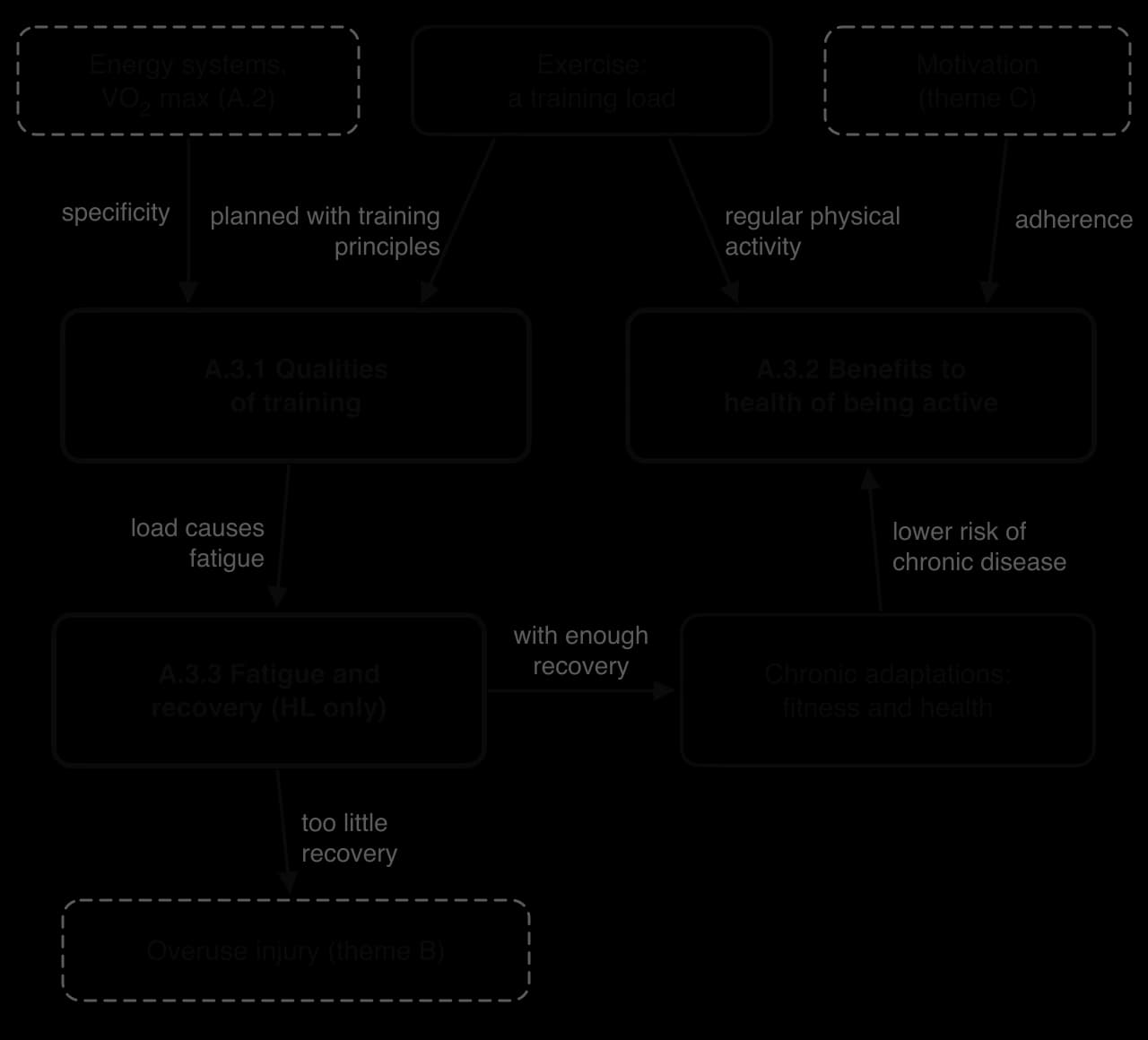
Response draws on several other topics. Fatigue can be central fatigue, where the brain and spinal cord reduce the drive to the muscles, or peripheral fatigue in the muscle itself, so it links to motor unit recruitment in biomechanics. A programme only works if it is followed, which depends on motivation, and training loads that rise too quickly increase the risk of overuse injury. Mood questionnaires used to monitor overtraining measure the same stress responses studied in sports psychology.
Health and performance lenses
Through the health lens, response is about dose. Most of the benefit for an inactive adult comes from moving from little or no activity to the amounts in the World Health Organization’s guidelines, and the main barriers are sedentary behaviour, time and adherence rather than physiology. The training principles still apply: an older adult who adds balance and strength work improves function and lowers the risk of falls, and progression must be gradual to avoid injury.
Through the performance lens, the same principles are pushed much further. Elite athletes train close to the limit of what they can recover from, so periodisation, tapering and careful monitoring of training load decide whether they peak at the right time. At HL, recovery strategies such as sleep, nutrition and cold-water immersion are evaluated for how well they help an athlete absorb a heavy load or play several matches in a few days.
How SL and HL differ
In SEHS, the higher level (HL) material is mostly added inside the subtopics rather than as separate subtopics. HL students study everything SL students study, plus additional material. Most pages are therefore read by both SL and HL students and contain sections whose headings end “(HL only)”, which SL students can skip.
Response is one of only two topics with a whole subtopic at HL only. For response, the HL material is:
Qualities of training: none. SL and HL students study the whole subtopic.
Benefits to health of being active: prescribing exercise for health and performance (screening before exercise, setting and progressing intensity safely, monitoring) and exercise for target groups: children and adolescents, older adults, and pregnant individuals, including its effects on mental health.
Fatigue and recovery: the whole subtopic is HL only. It covers where fatigue originates (fuel depletion, ionic and metabolic changes, dehydration and hyperthermia) and the evaluation of recovery: its signs, nutritional strategies, recovery techniques, and sleep, including the effects of travel across time zones.
Fatigue and recovery builds on the energy systems, including the lactate inflection point and EPOC, which HL students study within hydration and nutrition.
Assessment
Questions on response appear in all three parts of the written papers. Paper 1A (multiple choice) tests the training principles, the components of fitness and the activity guidelines; at SL it contains only SL material, while the HL paper also covers exercise prescription and fatigue and recovery. Paper 1B (data-based questions) often uses data from training studies, fitness tests or surveys of physical activity. Paper 2 contains short-answer and extended-response questions, and HL-only material appears only in the HL paper.
Response tends to produce these kinds of question:
calculating a target heart rate with the Karvonen method, a session training load from RPE and duration, an energy balance or a percentage change in a fitness score;
sketching and annotating a periodised year, the supercompensation curve, the overreaching–overtraining continuum or the J-shaped curve of immune function;
designing or evaluating a programme for a named individual, such as a pregnant exerciser or an older adult (HL);
evaluating a recovery technique, a nutritional recovery strategy or the evidence on sleep (HL), often as an extended response.
Carry on with A.3 in Augment
With a free account, Augment remembers where you stopped and what you have practiced.