Explain how the phosphagen, glycolytic and oxidative systems resynthesise ATP, apply the energy continuum, measure and interpret VO₂ max and, at HL, explain the lactate inflection point and EPOC.
Each is in the SEHS glossary, with every other term in the subject.
The molecule left when ATP loses its terminal phosphate group and releases energy; it is rebuilt into ATP with inorganic phosphate using energy from the breakdown of fuels.
A molecule made of adenosine and three phosphate groups that is the immediate source of energy for muscle contraction; energy is released when the bond to its terminal phosphate is broken.
Describes a process that requires oxygen, such as the resynthesis of ATP by the oxidative system in the mitochondria.
Describes a process that takes place without oxygen, such as the resynthesis of ATP by the phosphagen and glycolytic systems in the sarcoplasm.
The process in the mitochondria that breaks fatty acids down into two-carbon units of acetyl coenzyme A, which then enter the Krebs cycle.
A maximal field test in which an individual runs as far as possible in 12 minutes; the distance covered is used to estimate VO₂ max.
The process in which lactate from muscle is carried in the blood to the liver, converted back to glucose and returned to the blood for use as a fuel.
Outline the structure of ATP and its role as the immediate source of energy for muscle contraction.
Describe the fuel, site, oxygen requirement, ATP yield, rate, capacity, by-products and recovery of the phosphagen, glycolytic and oxidative systems.
Explain the benefits and limitations of each energy system for named physical activities.
Apply the energy continuum to activities of different intensity and duration, including intermittent team and racket sports.
Explain why an oxygen deficit occurs at the start of exercise and how it is covered.
Distinguish between absolute and relative VO₂ max and calculate one from the other.
Evaluate direct and indirect methods of measuring VO₂ max.
Explain how age, sex differences, body composition, lifestyle and fitness affect VO₂ max.
Explain how VO₂ max and running economy together determine endurance performance.
Explain the lactate inflection point and the fast and slow components of EPOC, and apply them to training (HL).
Every muscle contraction, nerve impulse and heartbeat is powered by one molecule, adenosine triphosphate (ATP). Muscles hold only a few seconds’ supply of it, so the body keeps rebuilding ATP through three energy systems that differ in the fuel they use, how fast they work and how long they can keep going. The balance between these systems explains why a 100 m sprinter and a marathon runner look, train and eat so differently.
The same physiology matters for health. Low-intensity activity of long duration relies on the oxidative system, which uses fat as a major fuel, and an individual’s maximal oxygen consumption is one of the strongest single predictors of long-term health. For performance, knowing which system dominates an event tells a coach how to train for it and how much recovery to give between efforts.
With a free account, Augment remembers where you stopped and what you have practiced.
A series of proteins on the inner membrane of the mitochondria that uses hydrogen from the Krebs cycle to resynthesise most of the ATP in aerobic metabolism, with oxygen accepting the hydrogen to form water.
The relative contributions of the phosphagen, glycolytic and oxidative systems to ATP resynthesis, which change with the intensity and duration of an activity; all three systems contribute at all times.
A series of chemical reactions in the body that releases energy from a fuel and uses it to resynthesise ATP from ADP and inorganic phosphate: the phosphagen, glycolytic or oxidative system.
The volume of oxygen consumed after exercise above the resting level, used to return the body to its pre-exercise state; it has a fast and a slow component.
The first 2–3 minutes of recovery, when oxygen consumption falls rapidly as phosphocreatine and ATP are resynthesised and the oxygen stores of myoglobin and blood are restored.
The energy system that resynthesises ATP anaerobically by breaking down glucose or glycogen to pyruvate in the sarcoplasm, producing lactate and hydrogen ions when pyruvate forms faster than it is oxidised.
A test in which exercise intensity rises in stages until exhaustion, used to measure VO₂ max, the blood lactate response or maximum heart rate.
A cycle of reactions in the mitochondria that breaks down acetyl coenzyme A from carbohydrate, fat or protein, releasing carbon dioxide and hydrogen for the electron transport chain.
A compound formed from pyruvate when glycolysis is rapid; it is a fuel that is oxidised in muscle and the heart or converted to glucose in the liver, not the cause of muscle soreness.
The removal of lactate from the blood, mainly by oxidation in muscle fibres and the heart and by conversion to glucose in the liver through the Cori cycle.
The highest exercise intensity at which lactate is removed from the blood at the same rate as it is produced; above it, blood lactate concentration rises rapidly.
The highest constant exercise intensity at which blood lactate concentration stays stable over time, because lactate production and clearance are balanced.
Structures inside cells, including muscle fibres, in which the Krebs cycle and electron transport chain use oxygen to resynthesise large amounts of ATP.
A maximal field test in which participants run 20 m shuttles at a pace set by beeps that gets faster every minute; the level reached is used to estimate VO₂ max.
The energy system that resynthesises ATP aerobically in the mitochondria by completely breaking down carbohydrate, fat and some protein, producing carbon dioxide and water; slow but with a very large capacity.
The difference between the oxygen needed to meet the energy demand of exercise aerobically and the oxygen actually consumed, mainly at the start of exercise; the shortfall is met by anaerobic systems.
The energy system that resynthesises ATP anaerobically from phosphocreatine in the sarcoplasm; it has the highest rate of ATP resynthesis but lasts only about 10 seconds at maximal intensity.
A high-energy phosphate compound stored in muscle that is broken down by creatine kinase to resynthesise ATP rapidly without oxygen, for about 10 seconds of maximal effort.
A three-carbon molecule produced when glucose is broken down by glycolysis; it is oxidised in the mitochondria when oxygen is available or converted to lactate.
The oxygen cost of running at a given submaximal speed, in mL kg⁻¹ min⁻¹ or mL kg⁻¹ km⁻¹; a more economical runner uses less oxygen at the same speed.
The cytoplasm of a muscle fibre: the fluid around the myofibrils in which phosphocreatine breakdown and glycolysis take place.
The later, longer part of recovery, lasting minutes to hours, when oxygen is used to remove lactate and meet the raised cost of heart rate, ventilation, body temperature and hormones.
A period of submaximal exercise during which oxygen consumption meets the oxygen demand of the activity, so heart rate and oxygen consumption stay roughly constant.
The maximum rate at which the body can take in, transport and use oxygen during exercise with large muscle groups, in L min⁻¹ (absolute) or mL kg⁻¹ min⁻¹ (relative).
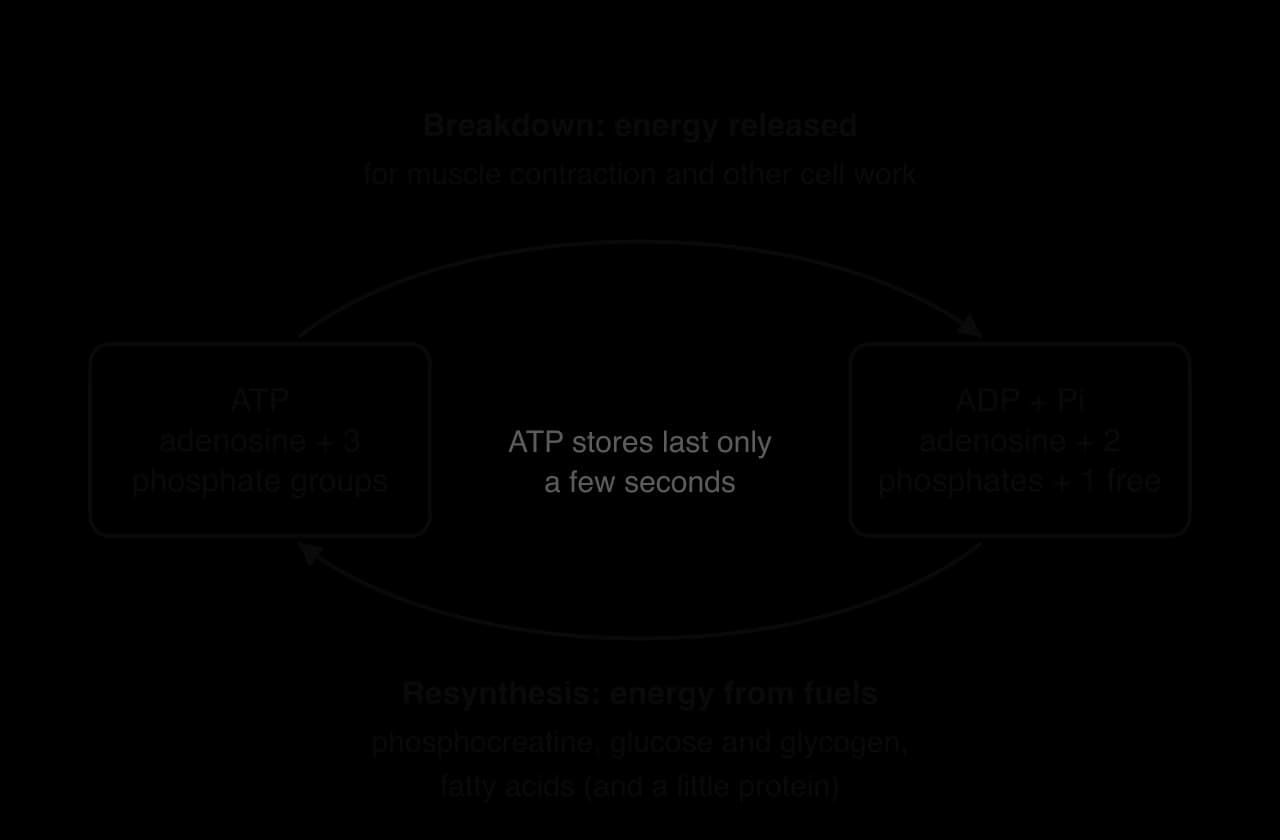
Adenosine triphosphate (ATP) is made of a base called adenosine joined to a chain of three phosphate groups. The bonds that hold the last phosphate group store a large amount of chemical energy. When an enzyme (ATPase) breaks the bond to the terminal phosphate, energy is released and ATP becomes adenosine diphosphate (ADP) and a free inorganic phosphate (Pi).
In a muscle fibre the released energy moves the myosin heads, so each cross-bridge pulls the thin filaments towards the centre of the sarcomere (the sliding filament theory); ATP is also needed to detach the myosin heads and to pump calcium ions back into storage. ATP also powers nerve impulses, protein synthesis and active transport, so it is used at rest as well as in exercise.
A muscle stores only a small amount of ATP, enough for roughly 2–3 seconds of maximal effort. Even so, the concentration of ATP in a working muscle hardly falls during exercise, because ADP and Pi are rebuilt into ATP almost as fast as ATP is broken down. The energy for this resynthesis comes from the breakdown of other fuels: phosphocreatine stored in the muscle, carbohydrate (glucose and glycogen), lipids (mainly fatty acids) and, to a small extent, protein.
A sprinter at full speed may turn over the entire ATP store of the working muscles every few seconds, so the rate at which ATP can be resynthesised, not the size of the store, limits how hard a muscle can work.
The body has three systems for resynthesising ATP. Sports scientists call them the phosphagen system, the glycolytic system and the oxidative system. Older textbooks and many coaches call them the ATP–PC system, the lactic acid or anaerobic glycolytic system, and the aerobic system; the names describe the same processes.
The two systems that work without oxygen are described as anaerobic, and the system that needs oxygen is aerobic. The anaerobic systems work in the sarcoplasm, the fluid that fills the muscle fibre around the myofibrils. The oxidative system works inside the mitochondria, small structures in the sarcoplasm that use oxygen to break fuels down completely.
The words describe how ATP is resynthesised, not the activity as a whole. A 400 m race is often called an “anaerobic event”, but in trained runners roughly 40% of its energy comes from the oxidative system.

The glycolytic and oxidative systems share a first stage: glucose is always broken down to pyruvate in the sarcoplasm. Depending on how fast pyruvate is produced and how much oxygen is available, it then either enters the mitochondria and is oxidised or is converted to lactate.
Muscle fibres that are adapted for endurance contain many more mitochondria than fibres adapted for power, and endurance training increases their number and size further.
Phosphocreatine (PC) is a high-energy compound stored in the sarcoplasm, at a concentration about three to four times that of ATP. The enzyme creatine kinase splits PC into creatine and phosphate. The energy released is used to join a phosphate to ADP, so one molecule of PC resynthesises one molecule of ATP.
Creatine kinase is activated as soon as ADP starts to accumulate, so the reaction responds within a fraction of a second of a muscle starting to work hard. It is a single reaction in the same place as the myosin heads that use the ATP, and needs no oxygen. That is why the phosphagen system gives the highest rate of ATP resynthesis of the three systems.
Phosphocreatine is sometimes called creatine phosphate. Together with the small store of ATP itself, it makes up the muscle’s “phosphagens”, which gives the system its name.
The phosphagen system’s weakness is its small store. During an all-out effort, PC falls to low levels within about 10 seconds, and power output drops as the other, slower systems take a larger share. Activities that last a few seconds and need maximal power rely on it most: a 100 m sprint, a shot put, a high jump take-off, a weightlifting attempt, a tennis serve or a goalkeeper’s dive. Usain Bolt’s 100 m world record of 9.58 s, set in Berlin in 2009, lasted about as long as the phosphagen system can sustain maximal effort, although the glycolytic system also made a large contribution.
Phosphocreatine is resynthesised after exercise using ATP from the oxidative system, so recovery needs oxygen. About 50% of PC is restored within 30 seconds and almost all of it within about 3 minutes. The only by-product is creatine, which is reused to rebuild PC, so the phosphagen system leaves nothing behind that causes fatigue.
Time after a maximal effort | Phosphocreatine restored (approximate) | What it means for training |
|---|---|---|
30 s | About 50% | The next sprint starts with half-full stores and is slower |
1 min | About 75% | Useful for repeated-sprint training, where some fatigue is intended |
3 min | Almost 100% | Each repetition can be maximal: used for pure speed and power work |
The recovery times explain why sprint and power athletes take long rests between maximal repetitions, and why a team-sport athlete’s sprints become slower when they come close together. Because PC is rebuilt aerobically, good aerobic fitness speeds PC recovery between efforts.
Benefits | Limitations |
|---|---|
Highest rate of ATP resynthesis: supports maximal power and speed | Very small store of PC: maximal effort lasts only about 10 s |
Works immediately, without oxygen | Only one ATP per molecule of PC |
No fatiguing by-products; creatine is reused | Full recovery takes about 3 minutes, and needs oxygen |
Stores can be raised slightly by training and by creatine supplementation | Cannot sustain repeated maximal efforts with short rests |
The glycolytic system resynthesises ATP from carbohydrate without oxygen. Its fuel is glucose taken up from the blood or glucose units split off the muscle’s own glycogen store. In the sarcoplasm, a chain of about ten enzyme-controlled reactions (glycolysis) breaks each six-carbon glucose molecule into two three-carbon molecules of pyruvate.
Two ATP are used at the start to activate a glucose molecule taken from the blood; four ATP are produced later in the chain. The net yield is 2 ATP per molecule of glucose.
Glucose released from glycogen enters the chain already carrying a phosphate group, so one fewer ATP is used to activate it. The net yield is 3 ATP per glucose unit from glycogen.
The enzyme phosphofructokinase (PFK) controls the rate of the whole chain. It is stimulated when ADP and Pi build up, so glycolysis speeds up within seconds of the start of hard exercise.
During intense exercise, pyruvate is produced faster than the mitochondria can take it in and oxidise it. The excess is converted to lactate by the enzyme lactate dehydrogenase. This step regenerates a carrier molecule (NAD⁺) that glycolysis needs, so glycolysis can keep running at a high rate. Hydrogen ions (H⁺) are also released by the reactions of glycolysis and ATP breakdown, and these accumulate in the muscle.
Lactate is often called “lactic acid”, but inside the body almost all of it exists as the lactate ion. Lactate itself does not make muscles burn or ache. The rise in hydrogen ions lowers the pH of the muscle and blood (acidosis), which slows PFK and interferes with the contraction process, and together with other changes such as the build-up of inorganic phosphate this contributes to fatigue during hard efforts. Lactate is in fact a useful fuel: it leaves the working fibres and is oxidised by other muscle fibres and by the heart, or converted back to glucose in the liver.
The glycolytic system resynthesises ATP more slowly than the phosphagen system, because it involves many reactions, but about twice as fast as the oxidative system. Its contribution rises within the first seconds of maximal exercise, peaks after roughly 30 seconds and remains large for up to about 2 minutes. Events that depend heavily on it include the 400 m and 800 m in athletics, the 100 m and 200 m in swimming, a 1 km track cycling time trial and long attacking or defensive phases in team sports.
The capacity of the system is limited mainly by the accumulation of hydrogen ions, not by a shortage of fuel. After exercise, lactate is cleared from the blood over roughly 30–60 minutes, faster with light activity such as jogging, while used muscle glycogen takes 24–48 hours to replace with a carbohydrate-rich diet.
Benefits | Limitations |
|---|---|
Faster ATP resynthesis than the oxidative system; works without oxygen | Hydrogen ions accumulate, lowering pH and contributing to fatigue within about 1–2 minutes of maximal work |
Large fuel store (muscle glycogen) compared with phosphocreatine | Low yield: only 2 ATP per glucose (3 per glucose unit from glycogen) |
Supplies energy for sustained high-intensity efforts and sudden increases in pace | Uses glycogen quickly; heavy reliance in long events can empty the store early |
Lactate formed is a fuel for other tissues | Recovery of pH and clearance of lactate take time; glycogen takes about 24 h to restore with a high-carbohydrate diet, and up to 48 h otherwise |
The oxidative system resynthesises ATP by breaking fuels down completely, using oxygen, inside the mitochondria. It can use carbohydrate, fat and a small amount of protein. Because the fuel is broken down all the way to carbon dioxide and water, far more ATP is resynthesised from each molecule than in glycolysis.
Glucose is first broken down to pyruvate by glycolysis in the sarcoplasm. When oxygen supply keeps pace with demand, pyruvate enters a mitochondrion and is converted to acetyl coenzyme A and carbon dioxide. Acetyl coenzyme A then enters two linked stages.
The Krebs cycle: a cycle of reactions that removes carbon as carbon dioxide and releases hydrogen atoms (carried by carrier molecules). A small amount of ATP is formed directly.
The electron transport chain: a series of proteins on the inner membrane of the mitochondrion that uses the hydrogen from the Krebs cycle to resynthesise most of the ATP. Oxygen is the final acceptor of the hydrogen, forming water. Without oxygen the chain stops.
The complete oxidation of one molecule of glucose resynthesises about 30–32 ATP. Older textbooks give 36–38 ATP, a figure based on earlier, theoretical estimates of how efficiently the electron transport chain works; more recent measurements give the lower value. Either way the yield is about fifteen times that of anaerobic glycolysis, which is why oxidising carbohydrate is so economical with the body’s fuel stores.
The carbon dioxide produced in the Krebs cycle diffuses into the blood and is breathed out, which is why carbon dioxide output rises with oxygen consumption during exercise.
Fat is stored as triglycerides in adipose tissue and inside muscle fibres. Each triglyceride is split into glycerol and three fatty acids. In the mitochondria, a fatty acid is cut into two-carbon units of acetyl coenzyme A by beta-oxidation, and these units enter the Krebs cycle and electron transport chain. A typical fatty acid such as palmitate yields more than 100 ATP, several times more than a glucose molecule.
Fat has two disadvantages during hard exercise. Mobilising fatty acids and moving them into the mitochondria takes time, so the rate of ATP resynthesis is low, and fat needs more oxygen per ATP: carbohydrate releases about 21 kJ per litre of oxygen, fat about 19.6 kJ. When oxygen delivery limits performance, carbohydrate is the more efficient fuel.
As exercise intensity rises, the share of energy from carbohydrate therefore rises and the share from fat falls. At rest and during walking, fat supplies more than half of the energy. During a hard 10 km race almost all of it comes from carbohydrate. This is why muscle glycogen, which lasts roughly 90 minutes to 2 hours of hard endurance exercise, limits performance in long events such as the marathon, and why carbohydrate loading is used before them.
Amino acids from protein can be converted into Krebs cycle compounds and oxidised, but protein normally provides less than 5% of the energy used in exercise, rising towards 10% in very long events when glycogen is low. It is used mainly for growth and repair.
The oxidative system has the lowest rate of ATP resynthesis but by far the largest capacity. Even a lean athlete stores enough fat to fuel several days of continuous walking. At maximal intensity it dominates any effort longer than about 2 minutes, and it supplies almost all the ATP at rest and in prolonged activity such as a marathon, a long-distance swim, a stage of a cycling race or a day’s hike.
Its rate depends on how fast oxygen is delivered (cardiac output, haemoglobin, capillaries) and used (myoglobin, mitochondria and enzymes). Type I fibres are rich in mitochondria, myoglobin and capillaries, which suits them to long aerobic work. The by-products, carbon dioxide and water, are easily removed, so the system can continue for hours provided fuel and fluid are replaced.
Benefits | Limitations |
|---|---|
Very high ATP yield: about 30–32 ATP per glucose, more than 100 per fatty acid | Slowest rate of ATP resynthesis: cannot meet the demand of high-intensity exercise on its own |
Almost unlimited capacity, because fat stores are large | Needs a continuous supply of oxygen; takes 1–3 minutes to reach full rate at the start of exercise |
By-products (CO₂ and H₂O) are easily removed and do not cause fatigue | Fat oxidation needs more oxygen per ATP than carbohydrate oxidation |
Resynthesises phosphocreatine and removes lactate during recovery | Performance in long events falls when muscle glycogen runs low |
The three systems are easiest to learn side by side. The main trade-off runs through every row of the table: the faster a system resynthesises ATP, the smaller its capacity and the sooner it limits performance.
Feature | Phosphagen system | Glycolytic system | Oxidative system |
|---|---|---|---|
Also called | ATP–PC system, alactic system | Lactic acid system, anaerobic glycolysis | Aerobic system |
Fuel | Phosphocreatine (PC) | Glucose and muscle glycogen | Carbohydrate, fat, a little protein |
Site in the muscle fibre | Sarcoplasm | Sarcoplasm | Mitochondria |
Oxygen needed | No (anaerobic) | No (anaerobic) | Yes (aerobic) |
ATP yield | 1 ATP per PC | 2 ATP per glucose (3 per glucose unit from glycogen) | About 30–32 ATP per glucose; over 100 per fatty acid |
Rate of ATP resynthesis | Very fast (highest) | Fast | Slow (lowest) |
Duration of dominance at maximal intensity | About 0–10 s | Peak contribution about 30 s to 2 min | Over about 2 min, up to hours |
By-products | Creatine (reused) | Lactate and hydrogen ions | Carbon dioxide and water |
Recovery | PC about 50% in 30 s, almost full in 3 min | Lactate cleared in about 30–60 min; glycogen about 24 h with a high-carbohydrate diet | Glycogen about 24 h with a high-carbohydrate diet (up to 48 h otherwise); fat stores barely change |
Main limitation | Tiny store of PC | Hydrogen ions accumulate | Slow; needs oxygen delivery |
Activities where it is the main supplier | 100 m sprint, jumps, throws, lifts, a tennis serve | 400 m, 800 m, 100 m swim, a long rally or attack | Marathon, triathlon, cycling road race, rest and recovery |
No activity uses only one energy system. All three resynthesise ATP from the first second of exercise, and what changes is the relative contribution of each. The energy continuum describes how those contributions shift as the intensity and duration of an activity change.
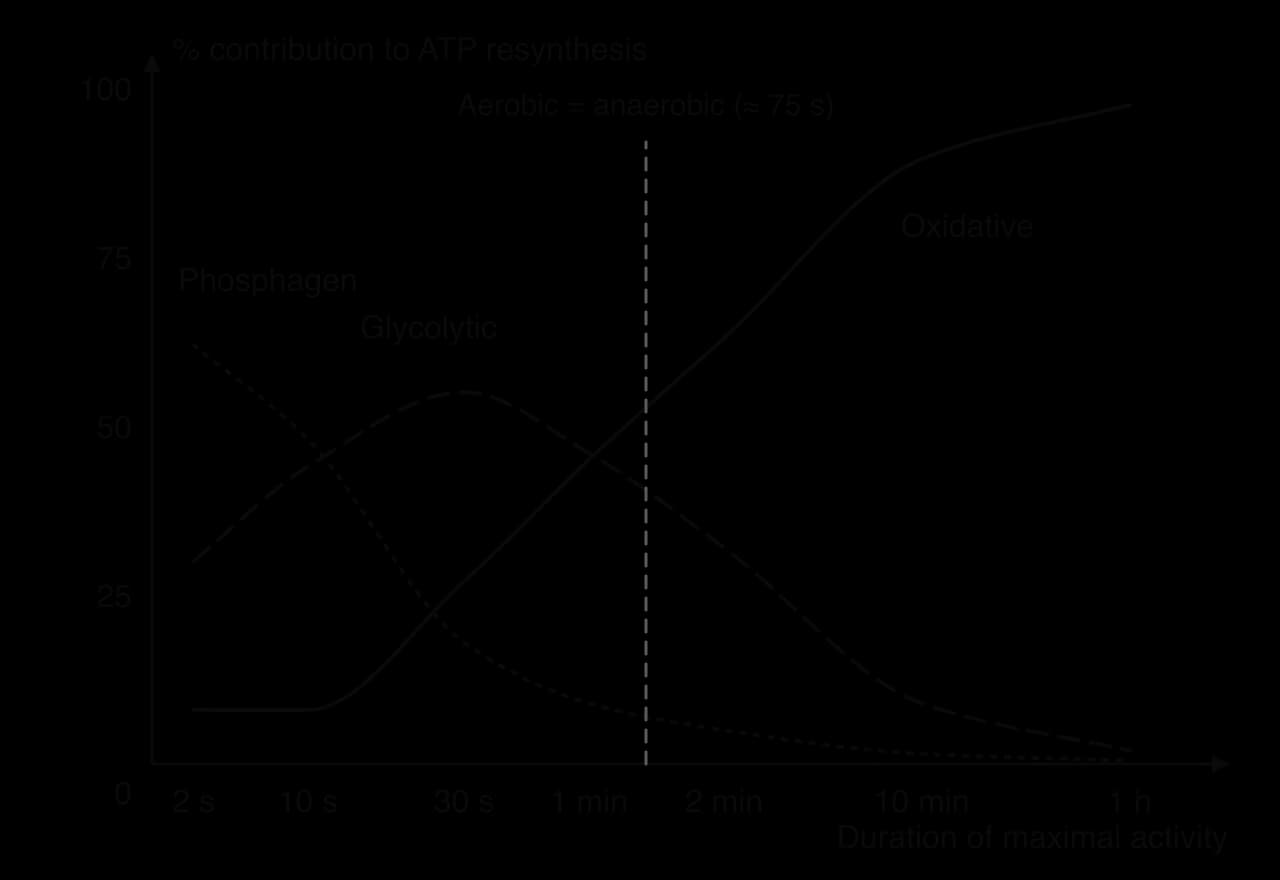
The sketch shows a single maximal effort. The phosphagen share is largest over the first few seconds and then falls as PC runs low; the glycolytic share peaks at about 30–60 seconds; the oxidative share rises from the start and overtakes the two anaerobic systems combined at about 75 seconds, an estimate from a 2001 review of studies of maximal exercise. In efforts of 10 minutes or more, over 90% of the ATP is resynthesised aerobically.
Intensity and duration are linked: maximal intensity can be held only briefly, and long activities must be performed at lower intensity. The continuum is therefore usually drawn for maximal efforts of different lengths. Below maximal intensity, during walking, jogging or a steady swim, the oxidative system can meet the demand almost on its own.
At rest and during long periods of submaximal exercise, the oxidative system is the dominant supplier of ATP. When intensity is high, or rises suddenly, anaerobic ATP resynthesis covers the gap between the ATP demand and what the oxidative system can supply. A marathon runner, for example, relies on the oxidative system for over two hours, then draws more on glycolysis in a sprint finish.
Team sports such as football, hockey, rugby and basketball, and racket sports such as tennis and badminton, are intermittent. Short bursts of sprinting, jumping and tackling are separated by periods of walking, jogging or standing. The demand moves up and down the continuum many times a minute.
Sprints, jumps and changes of direction draw mainly on the phosphagen system, with a growing glycolytic contribution when efforts are long or close together.
During the low-intensity periods the oxidative system supplies ATP and also resynthesises phosphocreatine and removes lactate, preparing the player for the next burst.
Over a whole match most ATP is resynthesised aerobically, but the decisive actions are anaerobic.
A tennis point typically lasts a few seconds, with up to 25 seconds between points, so each point relies mainly on the phosphagen system and PC is partly restored between points; a long rally draws much more on glycolysis. Players therefore need both anaerobic and aerobic fitness, and train with repeated sprints as well as longer aerobic work.
 YouTube
When exercise starts, the demand for ATP rises within a second, but the oxidative system takes 1–3 minutes to reach the rate needed. Breathing, heart rate and blood flow to the muscles all have to increase, and the enzymes of the mitochondria have to be activated. During this delay, oxygen consumption lags behind the oxygen demand of the activity, creating an oxygen deficit.

The graph shows that the deficit is the area between the dashed demand line and the curve of actual oxygen consumption. During that time the phosphagen and glycolytic systems resynthesise the ATP that the oxidative system cannot yet supply, using up some phosphocreatine and producing some lactate. Once oxygen consumption matches the demand, the body has reached a steady state.
An oxygen deficit also appears whenever intensity rises suddenly, for example when a cyclist attacks on a climb. A trained endurance athlete reaches steady state sooner, because the heart, blood vessels and mitochondria respond faster, so the deficit is smaller. Above a certain intensity no steady state is possible: demand exceeds the maximum oxygen consumption, and anaerobic systems keep contributing until the athlete slows down or stops.
The oxidative system can only resynthesise ATP as fast as oxygen reaches the mitochondria and is used there, and the upper limit of this process for the whole body is the VO₂ max.
VO₂ max depends on every link in the oxygen transport chain. The lungs load oxygen into the blood, haemoglobin carries it, the heart pumps it (maximal cardiac output, set by maximum heart rate and stroke volume), capillaries deliver it to the fibres, and the mitochondria use it. In healthy people the main limit is usually the delivery of oxygen by the heart, which is why maximal stroke volume is so much larger in endurance athletes than in untrained people.
Oxygen consumption is the product of cardiac output and the oxygen extracted from each litre of blood (the arteriovenous oxygen difference, a-vO₂ difference), so training can raise VO₂ max by delivering more blood or by extracting more oxygen.
VO₂ max can be expressed in two ways, and choosing the right one matters when comparing people.
Absolute VO₂ max, in litres per minute (L min⁻¹), is the total volume of oxygen used by the whole body each minute. It suits activities in which body mass is supported, such as rowing, cycling on flat roads and swimming, and is larger in bigger people.
Relative VO₂ max, in millilitres per kilogram of body mass per minute (mL kg⁻¹ min⁻¹), divides the absolute value by body mass. It suits activities in which the body has to be carried, such as running and cross-country skiing, and allows fair comparison between people of different size.
VO₂ max varies widely between people. The highest values, above 90 mL kg⁻¹ min⁻¹ in some individuals, belong to athletes in endurance sports that use a large muscle mass, such as cross-country skiing, distance running and road cycling.
Group | Typical relative VO₂ max (mL kg⁻¹ min⁻¹) |
|---|---|
Untrained healthy young men | About 35–40 |
Untrained healthy young women | About 27–31 |
Median for US men aged 20–29 (treadmill test) | 46.5 |
Median for US women aged 20–29 (treadmill test) | 36.6 |
Elite male distance runners | Up to about 85 |
Elite female distance runners | About 77 |
World-class male cross-country skiers and cyclists | Above 90 in some individuals |
Sources: Heyward, Advanced Fitness Assessment and Exercise Prescription, 1998; Noakes, Lore of Running, 2001; Kaminsky et al., Mayo Clinic Proceedings, 2022.
The most valid method is a laboratory graded exercise test with gas analysis. The individual runs on a treadmill or pedals a cycle ergometer while breathing through a mask, and the workload increases every 1–3 minutes until they cannot continue. A gas analyser measures the volume of air breathed and its oxygen and carbon dioxide concentrations, from which oxygen consumption is calculated breath by breath.
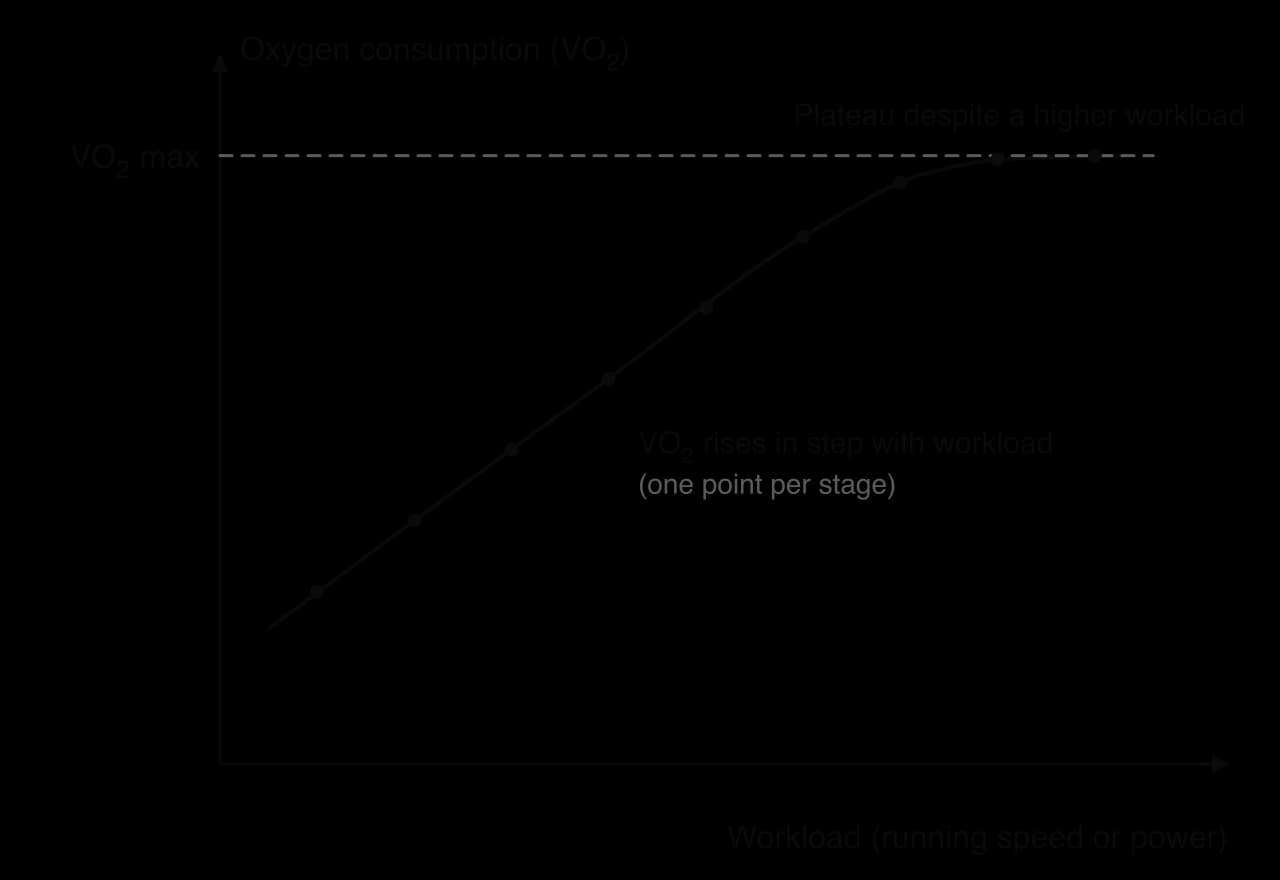
The classic criterion for a true maximum is this plateau. Many people, especially untrained people, children and older adults, stop before a clear plateau appears, so laboratories also use secondary criteria such as a respiratory exchange ratio (CO₂ produced ÷ O₂ consumed) above about 1.10, a heart rate close to the predicted maximum and a rating of perceived exertion near the top of the scale. When the criteria are not met, the highest value reached is called VO₂ peak.
A direct test is valid and reliable but needs expensive equipment, trained staff and a participant willing to work to exhaustion. The result also depends on the mode of exercise: untrained people typically score 10–20% lower on a cycle ergometer than on a treadmill, because cycling uses a smaller muscle mass, while trained cyclists may score the same or higher on the bike.
Field tests estimate VO₂ max from performance or heart rate, using equations developed by comparing the test with laboratory measurements. They are cheap and can test many people at once.
In the multistage fitness test (beep test), participants run between two lines 20 m apart in time with recorded beeps. The speed starts at 8.5 km h⁻¹ and rises by 0.5 km h⁻¹ each minute (level); a participant is out after failing to reach the line in time on two consecutive shuttles, and the last level and shuttle reached are converted to an estimated VO₂ max from a published table.
In the Cooper 12-minute run, the participant covers as much distance as possible in 12 minutes on a flat running track. Kenneth Cooper’s original equation estimates VO₂ max (mL kg⁻¹ min⁻¹) from the distance d in metres.
Step tests, such as the Queens College step test, ask the individual to step on and off a bench at a set rate for a few minutes, and estimate VO₂ max from heart rate in recovery: a fitter person’s heart rate is lower at the same workload. Being submaximal, they are safer for older or less fit people, but they assume that heart rate rises in a straight line with workload and that maximum heart rate can be predicted, both of which vary between individuals.
Method | Validity | Reliability | Practicality | Best suited to |
|---|---|---|---|---|
Laboratory gas analysis (treadmill or cycle ergometer) | Highest; measures oxygen consumption directly | High, if equipment is calibrated and protocol standardised | Expensive, one person at a time, needs maximal effort | Elite athletes, research, clinical testing |
Multistage fitness test | Moderate; an estimate from performance | Moderate; affected by motivation, surface, turning skill and group effects | Cheap, large groups, indoor | Team sports, schools, monitoring change |
Cooper 12-minute run | Moderate; depends on pacing and running economy | Moderate; weather and track conditions vary | Cheap, large groups, needs a track | Runners, schools, general fitness |
Step test (submaximal) | Lower; based on heart rate assumptions | Moderate; affected by stress, caffeine, temperature | Cheap, quick, little space, safe | Health screening, older or less fit individuals |
No method is best for every purpose. A laboratory test gives the most valid value but cannot test a squad of 25 players in an afternoon. A field test is valid enough to track an individual’s change over time, provided it is repeated under the same conditions, and choosing a test that matches the sport improves validity more than any other single decision.
VO₂ max reaches its peak in the late teens to mid-twenties and then declines. A review of the research put the decline at about 10% per decade after the age of about 25–30 in both men and women, whatever their activity level. The main causes are a fall in maximum heart rate, which lowers maximal cardiac output, and a loss of lean muscle mass. Regular training slows the decline but does not stop it, because training does not prevent the fall in maximum heart rate.
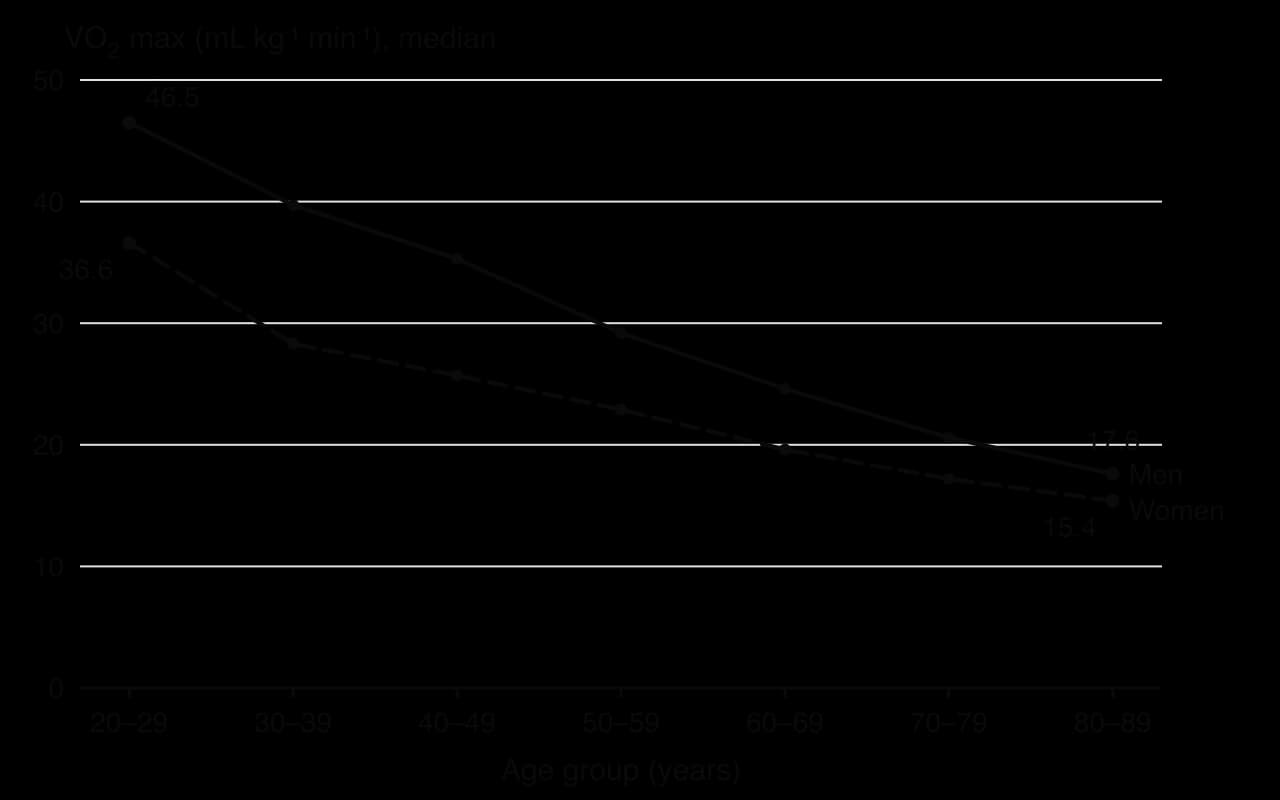
The chart shows the median of more than 16,000 treadmill tests on healthy US adults. Between the ages of 20–29 and 60–69, the median for men falls from 46.5 to 24.6 mL kg⁻¹ min⁻¹, a decrease of 47%.
The fall matters for health because everyday tasks such as climbing stairs need a fixed amount of oxygen, so they take a larger fraction of a falling VO₂ max and become harder. Training can keep older individuals well above the median. A 76-year-old woman who held the world records for her age group from 1,500 m to the marathon was measured in 2024 with a VO₂ max of 47.9 mL kg⁻¹ min⁻¹, higher than the median for women aged 20–29.
On average, men have a higher VO₂ max than women of the same age and training status; in the treadmill data the median for men aged 20–29 is 27% higher. Most of the reasons follow from the rise in testosterone at puberty: on average, women have a lower haemoglobin concentration (less oxygen per litre of blood), a smaller heart and blood volume (lower maximal stroke volume and cardiac output), a higher percentage of body fat (mass that does not use oxygen) and less muscle mass.
Expressed per kilogram of fat-free mass, the difference becomes much smaller, and the overlap between individuals is large: many women have a higher VO₂ max than many men.
Adipose tissue adds to body mass but uses little oxygen during exercise, so a higher body fat percentage lowers relative VO₂ max even when absolute VO₂ max is unchanged. Losing body fat raises relative VO₂ max without any change in the heart or muscles, one reason weight-bearing endurance athletes are usually lean. A larger muscle mass raises absolute VO₂ max.
Physical inactivity reduces stroke volume, blood volume, capillary density and mitochondrial content, so VO₂ max falls within weeks of stopping training. Smoking raises the concentration of carbon monoxide in the blood, which binds to haemoglobin far more strongly than oxygen and so reduces the blood’s oxygen-carrying capacity; smoking also narrows the airways. Diet and sleep act mainly through body composition and the ability to train.
Endurance training raises VO₂ max by increasing maximal stroke volume, blood volume and haemoglobin mass, and by increasing the number of capillaries and mitochondria in trained muscle, so more oxygen is both delivered and extracted. Improvements of about 15–20% are typical in previously untrained people over several months, but the response varies widely.
The HERITAGE Family Study trained 481 sedentary adults from 98 families on the same standardised 20-week programme. The size of the increase in VO₂ max varied widely, and members of the same family responded more like each other than like unrelated people; the heritability of the training response was estimated at 47%. Genetics therefore influences both the starting VO₂ max and how much it can improve, which is the basis of the idea of responders and non-responders.
Sources: Hawkins and Wiswell, Sports Medicine, 2003; Kaminsky et al., Mayo Clinic Proceedings, 2022; Van Hooren et al., Journal of Applied Physiology, 2025; Bouchard et al., Journal of Applied Physiology, 1999.
Health lens | Performance lens |
|---|---|
Cardiorespiratory fitness predicts long-term health. A meta-analysis of 33 studies found that each 1 MET higher maximal aerobic capacity (3.5 mL kg⁻¹ min⁻¹) was associated with a 13% lower risk of death from all causes. | A high VO₂ max is needed to compete in endurance sport, but among elite athletes with similar values it does not predict who wins. |
Because VO₂ max falls with age, older adults with a low value find everyday activities hard; training slows the decline and helps maintain independence. | Endurance performance also depends on running economy and the fraction of VO₂ max that can be sustained. |
Sources: Kodama et al., JAMA, 2009.
The health evidence shows a link, not proof of cause: fitter people also differ in diet, smoking and other habits, and adjusting for some of these cannot fully separate their effects.
VO₂ max sets the ceiling of aerobic ATP resynthesis, but two athletes with the same VO₂ max can race at very different speeds. Endurance performance depends on three factors working together: the VO₂ max, the fraction of it that can be sustained for the length of the event, and how economically the oxygen is turned into movement.
Running economy is one form of the efficiency of movement, which matters in swimming, cycling and skiing too. An economical runner needs a smaller fraction of their VO₂ max for any given pace, so they can run faster at the same effort or the same pace with less fatigue and less glycogen use.
Running economy is improved by low mass in the lower legs, stiff tendons that store and return elastic energy, efficient technique, a high proportion of type I fibres, years of training and lighter, more responsive footwear. It is measured as the steady-state oxygen consumption at several fixed submaximal treadmill speeds.
The athletes tested for Nike’s Breaking2 marathon project show how the factors combine. The 16 world-class male runners had a mean VO₂ peak of 71.0 mL kg⁻¹ min⁻¹, high but not exceptional for elite distance runners. In the seven runners who reached a steady state at 21.1 km h⁻¹, the pace for a 2-hour marathon, the oxygen cost of running averaged 191 mL kg⁻¹ km⁻¹. At that economy, a 59 kg runner needs about 4.0 L min⁻¹ of oxygen, roughly 94% of the group’s average VO₂ peak, held for two hours.
Sources: Jones et al., Journal of Applied Physiology, 2021.
VO₂ max is a strong predictor of endurance performance when a varied group is tested, for example a class of students or a running club, because the differences in VO₂ max between them are large. Among elite athletes, whose VO₂ max values are all high and similar, economy and the fraction of VO₂ max they can sustain decide the result. Comparisons of elite East African and European runners suggest that the East Africans’ success is linked more to excellent running economy than to an unusually high VO₂ max.
 YouTube
Lactate is produced in muscle at every intensity, even at rest, because some pyruvate is always converted to lactate. At the same time lactate is removed from the blood. The concentration of lactate in the blood at any moment therefore reflects the balance between two rates: the rate at which muscles release it and the rate of lactate clearance.
Oxidation in muscle and heart. Lactate diffuses or is transported out of glycolytic fibres and into neighbouring type I fibres and heart muscle. There it is converted back to pyruvate and oxidised in the mitochondria. This is the largest route of clearance during exercise, and it is faster during light activity than at rest.
The Cori cycle. Lactate carried in the blood to the liver is converted back to glucose. The glucose is released into the blood or stored as liver glycogen, and can return to the muscles as fuel.
During a graded exercise test, blood lactate stays close to its resting value of about 1 mmol L⁻¹ at low intensities, because clearance keeps pace with production. As intensity rises, faster recruitment of type II fibres and a faster rate of glycolysis raise lactate production. At a certain intensity production starts to exceed clearance, and from there blood lactate concentration rises steeply with each further increase in intensity.
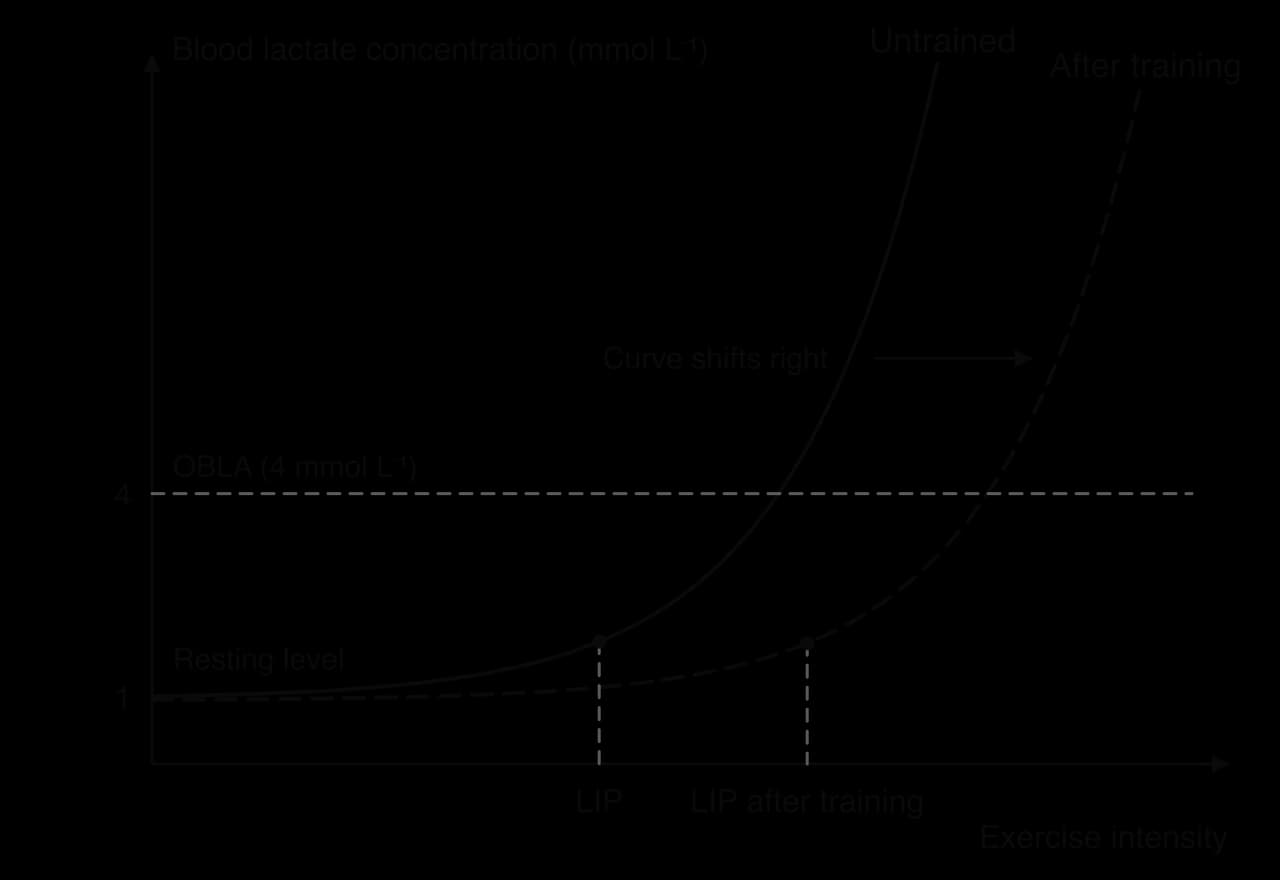
The graph shows the point at which the curve bends upward. The lactate inflection point is closely related to several other terms. The lactate threshold is often used for the first rise in blood lactate above its baseline. The onset of blood lactate accumulation (OBLA) is the intensity at which blood lactate reaches a fixed reference concentration of 4 mmol L⁻¹. The maximal lactate steady state (MLSS) is the highest intensity at which blood lactate stays constant during a long, continuous effort.
These markers fall at slightly different intensities in the same person, but all describe the same transition from stable to rapidly rising blood lactate.
The LIP is measured in an incremental test on a treadmill, ergometer or track, with stages of about 3–4 minutes so that blood lactate can settle. At the end of each stage a drop of blood from a fingertip or earlobe is analysed by a portable lactate analyser, and lactate is plotted against speed, power or heart rate.
A review of lactate threshold research found 25 different ways of identifying the threshold, from fixed concentrations such as 4 mmol L⁻¹ to the steepest change in the curve. They give different values for the same athlete, so results are comparable only when the same protocol and method are used each time, but most correlate strongly with endurance performance.
Sources: Faude et al., Sports Medicine, 2009.
The LIP is usually expressed as a percentage of VO₂ max: typically about 50–60% in untrained people and about 70–90% in trained endurance athletes. In the Breaking2 runners, the lactate threshold occurred at 83% and the lactate turn point (a second, steeper break) at 92% of VO₂ peak. A 76-year-old world-record holder tested in 2024 reached her lactate threshold at 83% of her VO₂ max, showing that a high LIP can be maintained into old age by training.
Sources: Jones et al., Journal of Applied Physiology, 2021; Van Hooren et al., Journal of Applied Physiology, 2025.
Endurance training shifts the blood lactate curve to the right, so the LIP occurs at a higher speed or power and at a higher percentage of VO₂ max. The shift has several causes:
More mitochondria and more oxidative enzymes in trained muscle, so more pyruvate is oxidised and less is converted to lactate.
More capillaries around each fibre, so oxygen is delivered and lactate is carried away faster.
More lactate transport proteins in the membranes of muscle fibres and the heart, so lactate is taken up and oxidised faster.
Greater use of fat at a given intensity, so glycolysis and lactate production are lower.
Training methods that shift the curve include large volumes of low-intensity continuous training, threshold (tempo) runs or rides held close to the LIP, and interval training just above it.
The LIP is used in two ways. First, it sets training zones: the speed, power or heart rate at the LIP divides easy aerobic training from harder threshold and interval training, and zones are set as percentages of it. Second, it predicts performance in events lasting about 30 minutes or more. The speed at the LIP is roughly the pace that can be held for about an hour, and the higher an athlete’s LIP as a percentage of VO₂ max, the larger the fraction of VO₂ max they can sustain in a race.
Reading the LIP from test data is a common task. The table gives the results of an incremental treadmill test in which blood lactate was measured at the end of each 4-minute stage (hypothetical data).
Speed (km h⁻¹) | 10 | 11 | 12 | 13 | 14 | 15 | 16 |
|---|---|---|---|---|---|---|---|
Blood lactate (mmol L⁻¹) | 1.0 | 1.1 | 1.2 | 1.5 | 2.4 | 4.0 | 6.6 |
After exercise stops, oxygen consumption does not fall straight back to its resting value. It stays raised for minutes to hours while the body restores the conditions it had before exercise, returning to homeostasis. This extra oxygen is called excess post-exercise oxygen consumption (EPOC). An older term, “oxygen debt”, suggested that the body simply repays the oxygen it “borrowed” during the oxygen deficit; it is no longer used because EPOC is larger than the deficit and has causes that are not linked to it.
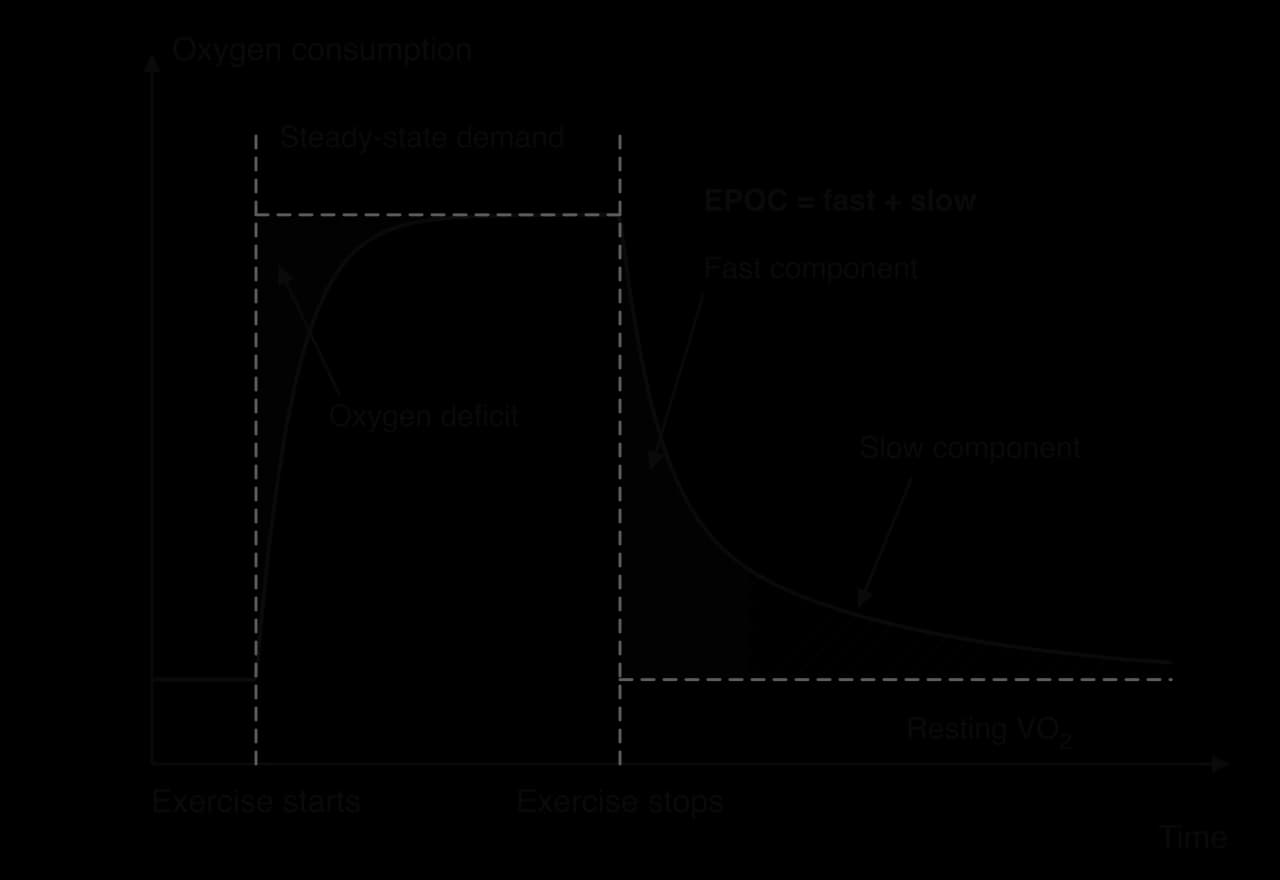
The fast component of EPOC lasts about 2–3 minutes after exercise. The oxygen is used for processes that can be completed quickly.
Resynthesis of phosphocreatine. ATP from the oxidative system is used to rebuild PC; about half is restored in 30 seconds and nearly all within about 3 minutes.
Resynthesis of ATP in the muscle to resting levels.
Resaturation of myoglobin with oxygen in the muscle fibres.
Reloading of oxygen in the blood, as haemoglobin in venous blood returns to its resting saturation.
The slow component of EPOC can last from several minutes to several hours, depending on how hard and long the exercise was. Oxygen consumption falls slowly because several processes take longer to return to resting values.
Elevated heart rate and breathing. The heart and respiratory muscles keep working harder than at rest, and their own ATP needs oxygen.
Raised body temperature. A higher temperature speeds up chemical reactions in all cells, so metabolic rate stays higher until core temperature returns to normal.
Raised hormone concentrations. Epinephrine and norepinephrine remain high for a time and keep metabolic rate up.
Lactate removal. Lactate is oxidised in muscle and the heart or converted to glucose in the liver (the Cori cycle), which needs oxygen.
Glycogen resynthesis begins, and after exhausting exercise a shift towards fat use and increased cycling of triglycerides and fatty acids add to the prolonged component.
EPOC depends on the oxygen deficit and on how far the exercise has disturbed homeostasis. Research shows that EPOC rises steeply and in a curved way with intensity, but more nearly in proportion to duration, so intensity matters more than duration.
Factor | Effect on EPOC | Reason |
|---|---|---|
Higher intensity | Much larger | Bigger oxygen deficit, more PC used, more lactate and H⁺, higher temperature and hormone levels |
Longer duration | Larger (roughly in proportion) | More glycogen used and a longer rise in temperature |
Training status | Faster return to resting levels | Trained people reach steady state sooner (smaller deficit) and clear lactate and resynthesise PC faster |
Sources: Børsheim and Bahr, Sports Medicine, 2003.
The fast component sets the recovery needed between repeated maximal efforts. Given the PC recovery times of the fast component, a sprinter who wants every repetition to be maximal rests for about 3 minutes, while a team-sport athlete practising repeated sprints may rest for only 20–30 seconds so that the session also trains the glycolytic system and the ability to recover. The work-to-rest ratio in interval training is chosen with these times in mind.
Active recovery, such as light jogging, keeps blood flow high and speeds lactate clearance, so it is used after hard sessions and between heats. Endurance training shrinks both the deficit and EPOC. For health, EPOC adds to the energy cost of exercise, but the extra is modest compared with the exercise itself, so claims that hard sessions burn large amounts of energy for hours afterwards overstate it.
The oxygen deficit and EPOC can be estimated from minute-by-minute measurements of oxygen consumption. The table gives data for an athlete running at a speed that requires 3.0 L min⁻¹ of oxygen, with a resting oxygen consumption of 0.3 L min⁻¹ (hypothetical data).
Minute | 1 | 2 | 3 | 4 |
|---|---|---|---|---|
VO₂ during exercise (L min⁻¹) | 1.4 | 2.3 | 2.8 | 3.0 |
VO₂ during recovery (L min⁻¹) | 1.8 | 1.1 | 0.7 | 0.6 |
Coaches use the energy continuum to decide how much aerobic and anaerobic training each event needs, but the percentages in coaching books were long based on laboratory estimates, not real races. A group at the University of Western Australia measured the aerobic and anaerobic contributions in trained athletes running individual time trials on an athletics track, in three studies published in 2004 and 2005 covering the 100 m to the 3,000 m.
Each athlete completed a laboratory graded exercise test to measure VO₂ max and running economy, then ran all-out time trials over their event carrying a portable gas analyser. The anaerobic contribution was estimated in two ways: from the accumulated oxygen deficit (AOD: the oxygen the race would have needed at the measured economy minus the oxygen actually consumed), and from blood lactate and estimated phosphocreatine breakdown (La/PCr).
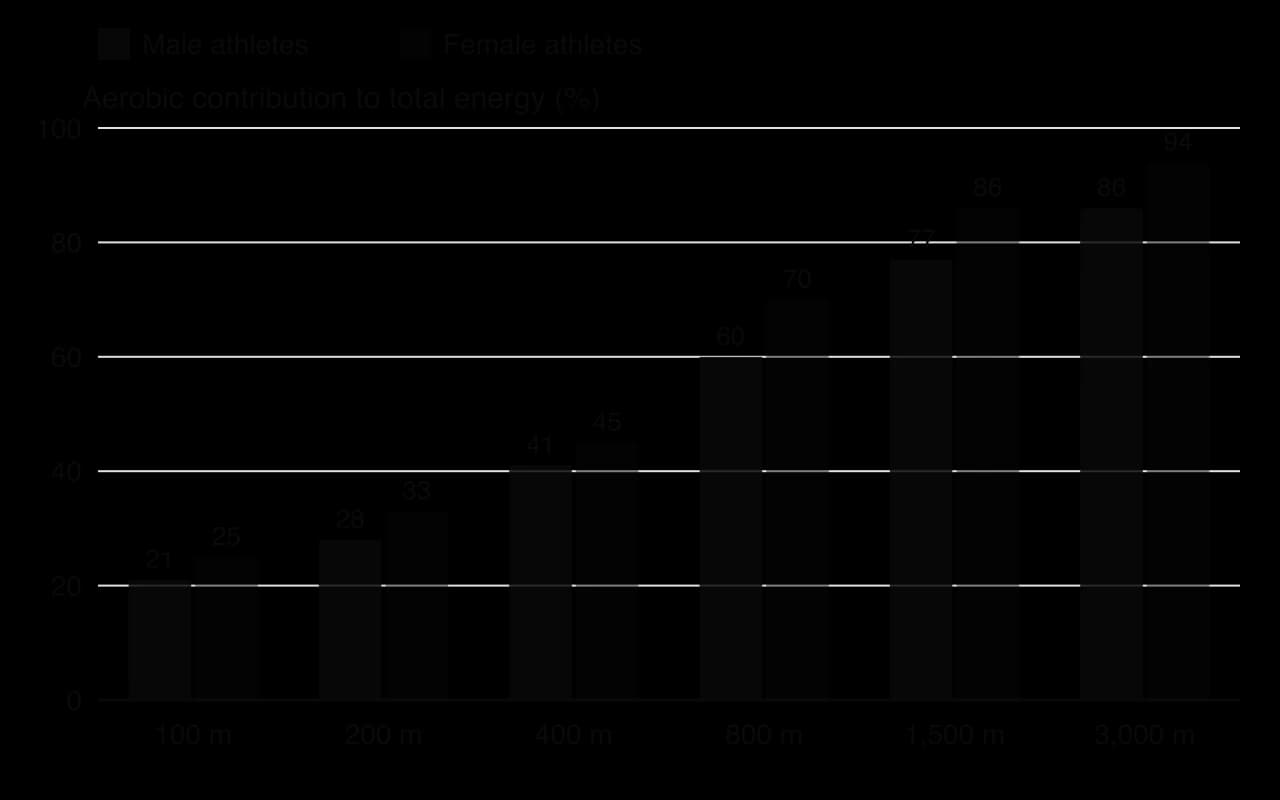
The chart shows that even the 100 m is not purely anaerobic: by the AOD method, about a fifth of the energy came from the oxidative system. The aerobic share rose with every increase in distance, from 21% (male) in the 100 m to 41% in the 400 m, 60% in the 800 m, 77% in the 1,500 m and 86% in the 3,000 m. The point at which aerobic and anaerobic contributions are equal falls between the 400 m and the 800 m, consistent with the crossover at about 75 seconds of maximal exercise proposed by the 2001 review of earlier studies.
The pattern matches the energy continuum: the shorter events rely more on the fast but small-capacity anaerobic systems, while in longer races the athlete runs at a lower percentage of maximal speed and the slower, high-capacity oxidative system supplies most of the ATP. Female athletes had a higher aerobic share in every event. One possible explanation is that they ran each event for longer, which shifts the balance towards the oxidative system.
For training, the results support the modern view that middle-distance runners need a large aerobic base as well as anaerobic capacity for the finish, and that even sprinters benefit from aerobic fitness, which speeds PC resynthesis between repetitions.
The two methods did not agree. For the male 100 m, the AOD method gave an aerobic share of 21% but the La/PCr method only 9%, and the authors noted that at such high intensities and short durations the AOD method gave larger aerobic estimates than expected. Every percentage on the chart is therefore an estimate that depends on assumptions in the method, not a direct measurement of ATP.
The samples were small (for example, 11 male and 5 female athletes in the 400 m, and only 2 female athletes in each of the 800 m and 3,000 m), the athletes were trained but not world-class, and they ran solo time trials carrying equipment, not races against opponents. The female values in particular rest on very few people.
Sources: Duffield, Dawson and Goodman, Journal of Science and Medicine in Sport, 2004; Journal of Sports Sciences, 2005 (400 m and 800 m; 1,500 m and 3,000 m); Gastin, Sports Medicine, 2001.
Using the chart, estimate the aerobic contribution to a female 1,000 m race and explain how the estimate was reached.
Explain why the AOD and La/PCr methods can give different answers for the same race, and suggest which result a coach of 100 m sprinters should rely on.
Suggest how a coach of a male 800 m runner could use these data to plan the balance of aerobic and anaerobic training over a season.
Paper 1A asks you to match activities to systems and recall features from the comparison table; Paper 1B gives data on oxygen consumption, lactate or VO₂ max; Paper 2 asks you to describe, compare and explain the systems, sketch the continuum or oxygen deficit, and evaluate tests of VO₂ max.
Calculations are short but carry marks for method as well as the answer.
Calculation questions in Paper 1A usually take one or two steps, so the wrong options are built from common slips.
Questions on the continuum often describe an effort by its duration.
Paper 1B-style question. Researchers compared elite male distance runners from Eritrea (n = 7) with elite male distance runners from Spain (n = 9). Each runner completed a treadmill test to measure VO₂ max and the oxygen cost of running at 21 km h⁻¹. Body mass index (BMI) and lower-leg (shank) length were also measured. The results are shown as mean ± standard deviation.
Variable | Eritrean runners (n = 7) | Spanish runners (n = 9) |
|---|---|---|
Age (years) | 22 ± 3 | 24 ± 2 |
VO₂ max (mL kg⁻¹ min⁻¹) | 73.8 ± 5.6 | 77.8 ± 5.7 |
VO₂ at 21 km h⁻¹ (mL kg⁻¹ min⁻¹) | 65.9 ± 6.8 | 74.8 ± 5.0 |
Body mass index (kg m⁻²) | 18.9 ± 1.5 | 20.5 ± 1.7 |
Shank length (cm) | 44.1 ± 3.0 | 40.6 ± 2.7 |
Sources: Lucia et al., Applied Physiology, Nutrition, and Metabolism, 2006.
Structured HL questions combine definitions with mechanisms.
ATP is the immediate source of energy for muscle contraction; muscles store only a few seconds’ supply, so ATP is continuously resynthesised from ADP and Pi.
The phosphagen system uses phosphocreatine in the sarcoplasm to resynthesise ATP at the highest rate, without oxygen, for about 10 s; PC recovers about 50% in 30 s and almost fully in 3 min.
The glycolytic system breaks down glucose or glycogen to pyruvate without oxygen (net 2 ATP per glucose, 3 from glycogen), producing lactate and hydrogen ions; the hydrogen ions contribute to fatigue.
The oxidative system oxidises carbohydrate, fat (via beta-oxidation) and a little protein in the mitochondria, giving about 30–32 ATP per glucose with CO₂ and water as by-products; it is slow but has a huge capacity.
All three systems contribute at all times; the energy continuum describes how their relative contributions change with intensity and duration, with aerobic and anaerobic contributions equal at about 75 s of maximal exercise.
At rest and in prolonged submaximal exercise the oxidative system dominates; at the start of exercise and in sudden increases in intensity, anaerobic ATP resynthesis covers the oxygen deficit.
VO₂ max, the maximum rate of oxygen uptake and use, is expressed as absolute (L min⁻¹) or relative (mL kg⁻¹ min⁻¹) values and is measured by gas analysis or estimated by field tests.
VO₂ max declines by about 10% per decade in adults, is higher on average in men, is lowered by body fat, inactivity and smoking, and rises with training by an amount that is partly inherited.
Endurance performance depends on VO₂ max, the fraction of it that can be sustained and running economy (the oxygen cost of a given speed).
The lactate inflection point is the highest intensity at which lactate clearance matches production, and EPOC (fast and slow components) restores the body to homeostasis after exercise (HL).
I can outline the structure of ATP and its role in muscle contraction.
I can describe the fuel, site, oxygen requirement, yield, rate, capacity, by-products and recovery of each energy system.
I can explain the benefits and limitations of each energy system for a named activity.
I can sketch the energy continuum and apply it to continuous and intermittent activities.
I can sketch and explain the oxygen deficit at the start of exercise.
I can convert between absolute and relative VO₂ max and say when to use each.
I can evaluate laboratory and field tests of VO₂ max for validity, reliability and practicality.
I can explain how age, sex differences, body composition, lifestyle and fitness affect VO₂ max.
I can explain how VO₂ max and running economy together determine endurance performance.
I can explain the lactate inflection point, and describe the fast and slow components of EPOC and their use in planning recovery (HL).