Distinguish learning from performance, apply the information processing and ecological models to coaching, choose feedback, guidance and practice for each phase of learning, and explain the PRP and transfer.
Each is in the SEHS glossary, with every other term in the subject.
A stable, enduring and largely inherited trait, such as balance, coordination or reaction time, that underlies the performance of a range of skills.
An opportunity for action that the environment offers a particular performer, depending on both the environment and the performer's capabilities, for example a gap that affords a pass.
The second, practice phase of learning, in which subroutines are linked, errors become fewer and smaller, and the learner begins to use intrinsic feedback.
A stable, preferred pattern of coordination, such as walking or running, that a movement system settles into because it is efficient under the current constraints.
The final phase of learning, in which the skill is performed automatically, consistently and efficiently with little conscious attention, and the performer corrects their own errors.
The transfer of learning from one side of the body to the other, for example from the dominant to the non-dominant foot or hand.
Practising one skill, or one version of a skill, repeatedly before moving on to the next, which improves performance quickly during practice.
Distinguish between skill and ability, and between learning and performance.
Describe how learning is inferred from retention tests, transfer tests and performance curves.
Apply the open–closed, gross–fine, discrete–serial–continuous and self-paced–externally paced continua to classify skills.
Describe the stages of the information processing model and explain how reaction time, movement time and response time are related.
Explain open-loop and closed-loop control, schema theory and the role of subroutines in linear pedagogy.
Describe the cognitive, associative and autonomous phases of learning and apply them to choose feedback, guidance and practice for a learner.
Explain ecological and dynamical systems theory, including affordances, degrees of freedom, self-organisation, perception–action coupling and performance variability.
Apply the constraints-led approach by manipulating individual, task and environmental constraints in practice.
Evaluate the information processing and ecological models and the linear and non-linear pedagogies built on them.
Explain the psychological refractory period and its use in deception, and describe the six types of transfer of learning.
Motor learning is the process by which people acquire, refine and keep movement skills through practice and experience. It explains how a child learns to catch, how a club player develops a reliable tennis serve and how a patient relearns to walk after a stroke, and it gives coaches, teachers and therapists a scientific basis for designing practice.
Two families of theory compete to explain motor learning: the information processing model, which leads to a coach-led linear pedagogy, and the ecological model, which leads to a games-based, non-linear pedagogy. Most good practice today borrows from both.
With a free account, Augment remembers where you stopped and what you have practiced.
A skill performed in a stable, predictable environment that does not affect it, so the movement can be repeated the same way, for example a basketball free throw.
Control of a movement in which feedback received during the movement is compared with a reference of correctness, so that errors can be corrected while it continues.
The first phase of learning, in which the learner tries to understand the skill; performance is inconsistent with many large errors, and every movement needs conscious attention.
A method of coaching, based on the ecological model, in which the coach manipulates individual, task and environmental constraints to guide learners towards functional movement solutions.
The interference that occurs when several skills or variations are practised in a random order, which makes practice harder and lowers performance during practice but usually improves retention and transfer.
The use of a false movement or cue, such as a dummy or fake, to make an opponent respond to it, so their response to the real movement is delayed by the psychological refractory period.
The number of independent ways in which the parts of the body (joints, muscles, motor units) can move, which must be controlled and coordinated to produce a movement.
Practice with rest intervals or other activities between attempts or blocks, allowing recovery and mental rehearsal; suited to beginners and complex or demanding skills.
A theory treating the body as a complex system of many interacting parts whose coordinated movement patterns emerge through self-organisation under individual, task and environmental constraints.
A theory of motor learning combining ecological psychology and dynamical systems theory, explaining skilled movement as emerging from performer–environment interaction guided by directly perceived information.
A model of motor learning in which movement emerges from the interaction of performer, task and environment, and learning is the improving coupling of perception and action without stored programmes.
A theory of perception and action, developed from Gibson's work, proposing that performers perceive information in the environment directly and use it to guide action without stored representations.
Features of the surroundings that shape movement, either physical (surface, temperature, wind, light) or sociocultural (family, peers, culture, access to facilities).
A skill whose timing and rate are controlled by the environment, such as an opponent, the ball or a starting signal, for example receiving a volleyball serve.
Feedback from an outside source, such as a coach, team-mate, video or timing system, added to what the performer senses for themselves.
Information received by a performer about a movement or its outcome, during or after the movement, which can be used to detect and correct errors.
A skill that uses small muscle groups and small, precise movements, often needing high hand–eye coordination, for example an archery release or a snooker shot.
A stored, abstract movement pattern for a class of actions, with fixed sequence and relative timing, adapted to each situation by setting parameters such as force, speed and direction.
A skill that uses large muscle groups and large movements, where precision is less important, for example a shot put or a tackle.
Information given to a learner to help them understand and perform a skill, in visual, verbal, manual or mechanical form.
A principle stating that choice reaction time increases as the number of possible stimulus–response alternatives increases, rising by a roughly constant amount each time the number of choices doubles.
Characteristics of the performer that shape movement, either structural (height, limb length, body mass) or functional (fitness, skill, motivation, emotions, fatigue).
A model of motor control and learning describing how information is received, interpreted, used to select a response from memory and sent to the muscles, with feedback adjusting later responses.
Feedback that comes from within the performer through the senses, especially proprioceptors, during or after a movement, such as the feel of a well-struck ball.
Feedback about the quality or pattern of a movement (the technique) rather than its outcome, for example the position of the elbow at release.
Extrinsic feedback about the outcome of a movement, such as the score, time, distance or whether a shot was successful.
A relatively permanent change in behaviour, or in the capability to perform a skill, brought about by practice and experience.
A coach-centred approach to teaching motor skills, based on the information processing model, in which a correct technique is demonstrated, broken down and repeated in progressive drills with corrective feedback.
The memory store of well-learned information and motor programmes, with almost unlimited capacity and duration, from which past experiences are retrieved to select responses.
Practice with no rest intervals, or very short ones, between attempts or blocks, suited to simple skills and fit, motivated, experienced performers.
The cognitive rehearsal of a skill without physical movement, in which the performer imagines performing the skill in order to learn it or improve its performance.
The process by which movement skills are acquired, refined and retained through practice and experience, producing relatively permanent changes in the capability to perform them.
The time taken from the start of a movement to its completion, which together with reaction time makes up response time.
Transfer in which learning one skill hinders the learning or performance of another, usually because the situations are similar but need different responses.
A learner-centred approach to teaching motor skills, based on the ecological model, in which the coach manipulates constraints in game-like practice so learners discover functional movement solutions.
A skill performed in a changing, unpredictable environment, so the performer must continually adapt the movement, for example a pass in hockey.
Control of a movement by a motor programme sent to the muscles as a whole, without using feedback during the movement; typical of fast, well-learned, discrete skills.
Breaking a skill into its subroutines and practising them separately before combining them, including progressive part (chaining) and whole–part–whole practice.
The close, continuous link between perceiving information in the environment and moving, in which perception guides action and action creates new information to perceive.
The observable execution of a skill at a particular time, which is temporary and fluctuates with factors such as fatigue, arousal, motivation and conditions.
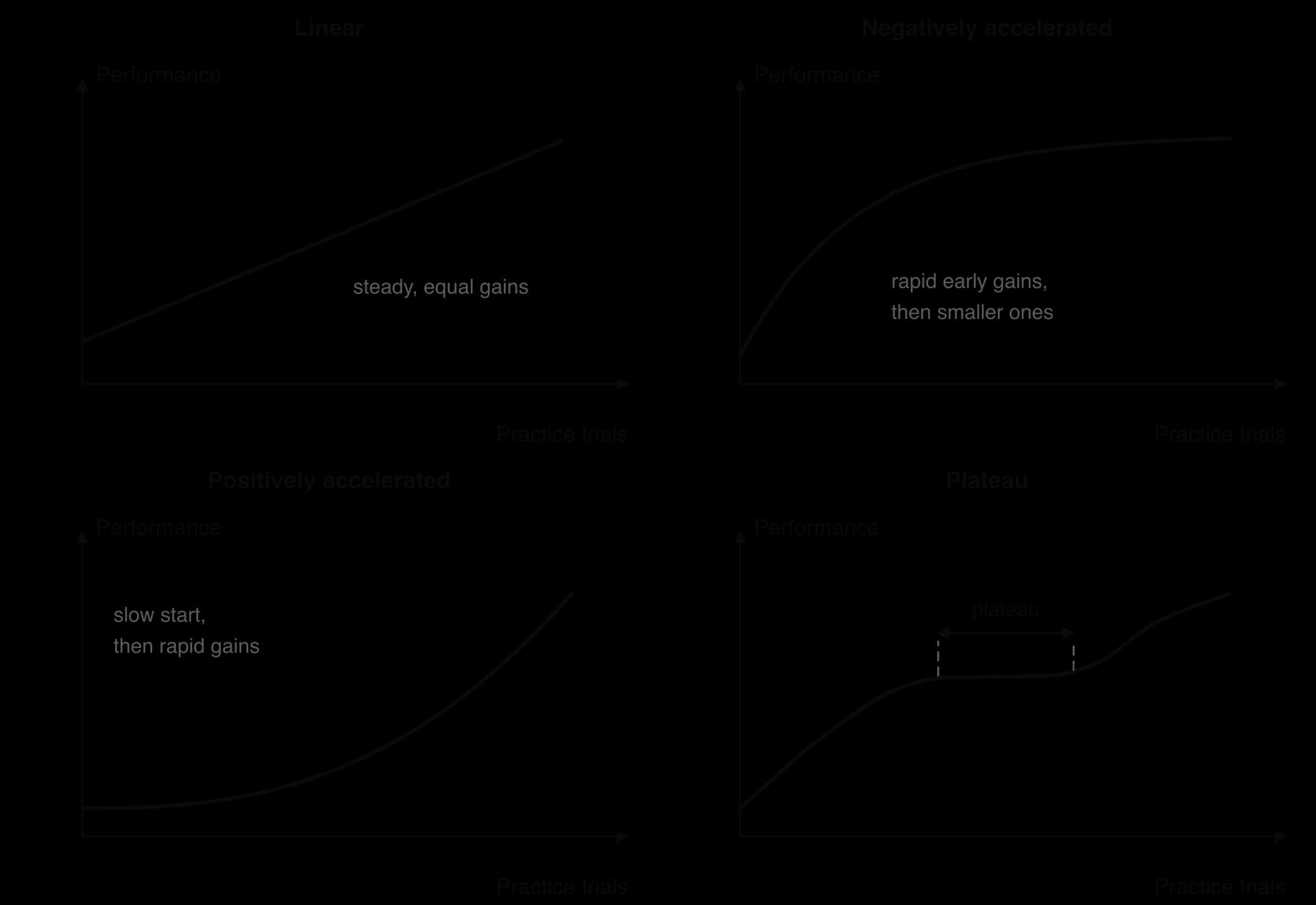
A graph of performance against practice trials or time, used to track progress and infer learning; common shapes are linear, negatively accelerated, positively accelerated and plateau.
The natural variation in a performer's movement from one attempt to the next, which in the ecological view is often functional, helping adaptation to changing conditions.
The three stages a learner passes through when acquiring a motor skill, cognitive, associative and autonomous, described by Fitts and Posner.
A period during learning when performance stops improving despite continued practice, shown as a flat section on a performance curve.
Transfer in which learning one skill helps the learning or performance of another, usually because the skills share movement patterns, information or principles.
The influence of a skill learned earlier on the learning or performance of a skill learned later, which may be positive or negative.
The delay in responding to a second stimulus that arrives while a first stimulus is still being processed, which significantly slows the response to the second stimulus.
Practising several skills or variations in a mixed, unpredictable order within a session, which lowers performance during practice but usually improves retention and transfer.
The part of a schema that relates initial conditions and past response specifications to their outcomes, used before a movement to select the parameters needed.
The part of a schema that relates initial conditions and past outcomes to the sensory consequences of movement, used during and after a movement to detect errors.
The total time from the onset of a stimulus to the completion of the movement in response to it, equal to reaction time plus movement time.
A test of a skill after a period without practice, used to show whether improvements made during practice have been retained and so reflect learning.
The influence of learning a new skill on the performance of a skill that was learned earlier, which may be positive or negative.
A theory of motor learning, proposed by Schmidt, in which performers store generalised motor programmes and rules (recall and recognition schemas) that adapt movements to new situations.
The process of filtering relevant information from the display and ignoring irrelevant information, so that only important cues are processed further.
The process by which a stable, coordinated movement pattern emerges spontaneously from the interaction of the body's parts with the task and environment, without central direction of each part.
A skill in which the performer decides when to start the movement and controls its rate, for example a javelin throw or a golf putt.
The working memory of the information processing system, holding about 7 ± 2 items for about 20–30 seconds while they are used, and passing rehearsed information to long-term memory.
The proposal that the brain can process only one stimulus and select only one response at a time, so a second stimulus must wait until the first is processed.
A learned, goal-directed action or movement performed efficiently and consistently, with maximum certainty and minimum outlay of time and energy.
One of the component parts of a motor programme (a subordinate motor pattern), performed in sequence with the others to produce the whole skill, for example the ball toss in a tennis serve.
Features of a task that shape movement, including its goal, rules, equipment, playing area and number of players.
The influence of previous experience of learning or performing a skill on the learning or performance of a new skill.
A test of a skill in a new situation or a variation of the practised task, used to show whether learning can be adapted beyond the conditions of practice.
Practice of a skill under a range of different conditions, such as distances, speeds and positions, intended to build a strong schema that adapts to new situations.
Practising a skill in its entirety without breaking it into parts, suited to simple or highly organised skills whose subroutines are hard to separate.
The absence of any influence of one skill on the learning of another, usually because the two skills have nothing in common.
Health lens | Performance lens |
|---|---|
Children who master fundamental movement skills (running, jumping, throwing, catching) are more likely to stay physically active. Practice design matters in school physical education. | Elite coaches design practice so that skills learned in training transfer to competition under pressure, at speed and against opponents. |
Physiotherapists use feedback, guidance and part practice to help patients relearn everyday movements after injury or a stroke. | Understanding reaction time and the psychological refractory period helps athletes deceive opponents and avoid being deceived. |
Balance and stepping practice that varies the conditions can help older adults keep their independence. | Constraints such as smaller pitches and modified balls speed up decision-making in youth sport. |
In everyday speech "skill" and "ability" are used loosely, but motor learning separates them clearly. An ability is something a person brings to a task; a skill is something a person learns.
A skilled performance has several recognisable features. It is consistent (the same result over many attempts), efficient (no wasted movement or energy), fluent and well timed, goal-directed and adaptable to changing conditions. A novice and an expert may both score a basketball free throw on a single attempt, but only the expert can repeat it with the same smooth technique under pressure.
Abilities are the building blocks of skills. Good dynamic balance supports gymnastics, surfing and skiing; good hand–eye coordination supports catching, racket sports and batting. A person with a strong profile of relevant abilities does not automatically perform a skill well, but they can usually learn it faster. Abilities are partly genetic and change little with practice, which is why talent identification programmes measure them in children.
Feature | Skill | Ability |
|---|---|---|
Origin | Learned through practice and experience | Largely inherited; develops through childhood |
Stability | Can be improved, refined and lost | Stable and enduring in adults |
Specificity | Specific to a task (a lay-up, a tumble turn) | General: supports many skills |
Example | A badminton smash | Coordination, power, reaction time |
Learning and performance are related but different. Performance is what can be observed on a particular attempt or day; learning is the more permanent change in capability that practice produces, which cannot be seen directly.
A sprinter who has learned an excellent start can still react poorly in one race; the learning is unchanged, but the performance on that day is not.
Performance fluctuates for many reasons that have nothing to do with learning. A swimmer may record a slow time because of fatigue, poor sleep, a cold pool or high anxiety, yet still possess the skill. Equally, a golfer may hit an excellent shot by chance on the first day of lessons without having learned anything permanent. Motor learning therefore refers to changes in skill that last, and these must be measured in ways that separate them from day-to-day performance.
Because learning cannot be observed directly, researchers and coaches infer it from patterns of performance. Three methods are used: retention tests, transfer tests and performance curves.
A retention test removes the temporary effects of practice, such as warm-up, fatigue or the support of constant feedback. If a learner who improved during a practice session performs just as well a week later, the improvement was learning. If the gain has disappeared, it was only a temporary change in performance.
A transfer test might ask a tennis player who practised serves to the deuce court to serve to the advantage court, or a footballer who practised passing in drills to pass in a small-sided game. Good transfer shows that the learner has developed a flexible capability, which is usually the real aim of practice.
A performance curve (often called a learning curve) is a graph of performance against practice trials or time. It shows how quickly a learner improves and is the most common way of tracking progress. Because each point is a performance, a single curve shows performance, and learning is inferred from its overall trend and from later retention tests.
Linear curve: performance improves by about the same amount with each block of practice. It is rare over long periods and usually appears only over a short section of practice.
Negatively accelerated curve: large improvements early, then smaller and smaller gains (diminishing returns). It is typical of simple skills or learners with relevant abilities and experience, because the most obvious errors are corrected first.
Positively accelerated curve: slow progress at first, then rapid improvement. It is typical of complex skills, where the learner must first understand the task and develop the basic movement pattern before gains appear, and of learners with low initial ability.
S-shaped (ogive) curve: a combination of the two, slow, then rapid, then levelling off. It describes the whole learning of many complex skills.
A plateau can occur for physiological, psychological or practice-related reasons: fatigue, loss of motivation or boredom, a ceiling set by the learner's current abilities or fitness, poor or repetitive practice, a need to consolidate one part of the skill before moving on, or coaching that offers no new challenge. Plateaus are often temporary. Coaches respond by varying practice, setting new short-term goals, giving more specific feedback, allowing rest, or improving the relevant component of fitness.
Skills are classified so that coaches can choose suitable methods of practice. Because few skills are purely one type, each classification is a continuum: a line between two extremes on which a skill is placed according to its main characteristics. Four continua are used in motor learning.
This continuum describes how much the environment affects the skill. An open skill is performed in a changing, unpredictable environment, so the performer must constantly perceive and adapt; a closed skill is performed in a stable, predictable environment, so the same movement pattern can be repeated.
Open skills such as a rugby tackle or a tennis return demand constant perception and decision making, because the situation changes during every attempt.
This continuum describes the size and precision of the muscle movements involved.
Gross skills usually depend heavily on components of fitness such as strength, power and speed.
This continuum describes how clearly the skill has a beginning and end. A discrete skill has a clear beginning and end (a golf drive, a penalty kick); a serial skill links several discrete elements in a set order (the triple jump, a gymnastics routine); a continuous skill has no obvious beginning or end, and one cycle flows into the next (running, cycling, swimming). The same continuum is used in movement analysis to divide skills into phases.
This continuum describes who controls the timing of the movement.
Self-paced skills are usually closed, because a stable environment allows the performer to choose the moment to begin.
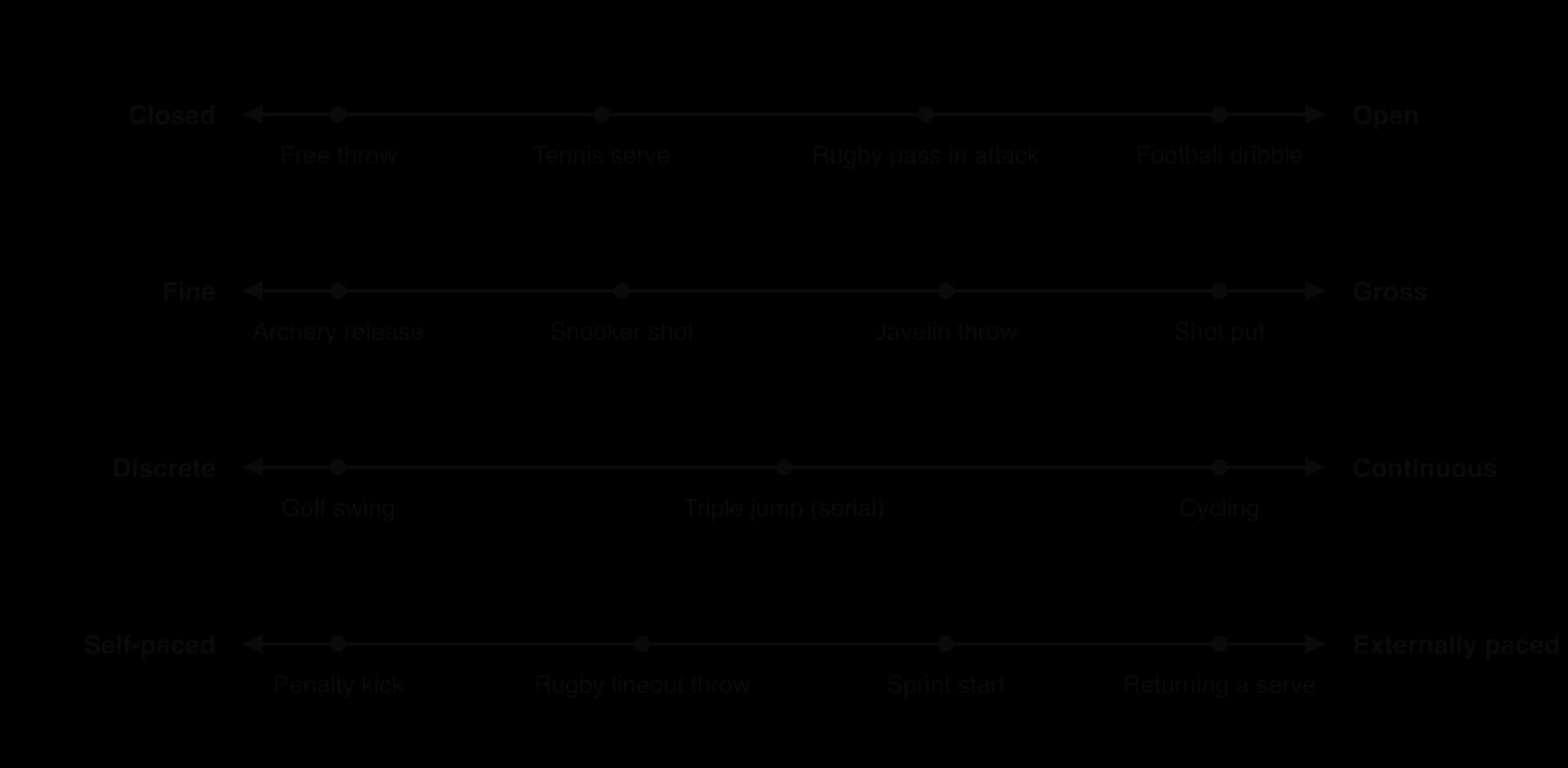
Classification guides coaching. Closed, self-paced skills suit repetition of a consistent technique, so that the movement pattern becomes grooved. Open, externally paced skills need practice in which the performer reads the situation and makes decisions, so practice should keep the opponents, team-mates and timing pressures of the game. Fine skills need precision and often benefit from distributed practice to limit fatigue, while gross skills may be trained alongside the fitness components they require.
Skill | Open–closed | Gross–fine | Discrete–serial–continuous | Self-paced–externally paced |
|---|---|---|---|---|
Basketball free throw | Closed | Fairly fine (wrist and fingers) | Discrete | Self-paced |
Rugby tackle | Open | Gross | Discrete | Externally paced |
400 m freestyle swim | Closed | Gross | Continuous | Self-paced (pace chosen by the swimmer) |
Football dribble past a defender | Open | Gross with fine control of the ball | Serial (a chain of touches) | Externally paced |
High jump | Closed | Gross | Serial (approach, take-off, clearance) | Self-paced |
Motor learning has two competing explanatory models, and each has led to its own approach to teaching skills, or pedagogy.
The information processing model sees the performer as a processor of information, like a computer: information from the senses is interpreted, a stored motor programme is selected, and commands are sent to the muscles. It is best represented by schema theory and underpins linear pedagogy.
The ecological model sees movement as emerging from the continuous interaction between the performer, the task and the environment, with no need for stored programmes. It is best represented by ecological dynamics, which combines ecological psychology with dynamical systems theory, and it underpins non-linear pedagogy.
The two models answer the same questions in different ways: where the control of movement lies (in the brain's programmes or in the whole performer–environment system), what practice should look like, and what the coach's role is. Each model has strengths, and good coaching uses both.
The information processing model describes the sequence of mental operations between a stimulus and a response. Several versions exist (Welford, Whiting), but all share the same stages: input, perception, decision making, output and feedback, supported by memory.

 YouTube
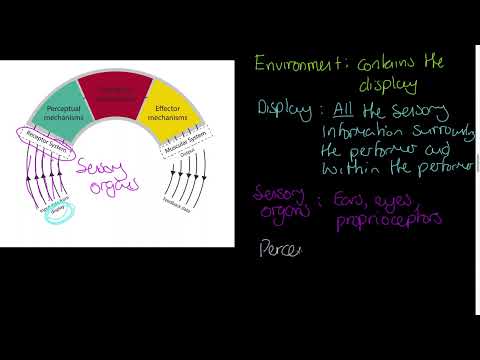
Input is all the information available to the performer. It comes from the display (the environment: the ball, opponents, team-mates, the crowd, the scoreboard) and from inside the body, through proprioceptors in muscles and joints that sense body position and movement. A batter receives visual input about the bowler's arm and the ball, auditory input from the bat on the ball, and kinaesthetic input from the body.
Input is held very briefly in the short-term sensory store, which has a very large capacity but keeps information for less than about one second. Most of it is lost. Selective attention filters it, so that only relevant information passes on to the short-term memory for processing.
Selective attention matters because processing capacity is limited. A netball goal shooter must attend to the ring and ignore the crowd and the defender's waving arms. Selective attention improves with experience, because an expert knows which cues matter most; it can be trained by highlighting key cues and by practising with realistic distractions. Selective attention is the basis of wider attentional focus, which explains how performers shift attention between broad and narrow, internal and external cues.
Perception is the process of interpreting the selected information. It is often described in three steps, abbreviated DCR:
Detection: noticing that a stimulus is present (a ball is coming).
Comparison: comparing it with similar situations stored in long-term memory (a short-pitched delivery, as faced before).
Recognition: identifying the stimulus and its meaning (it is a bouncer at the head; a hook or a duck is needed).
Two memory stores support perception and decision making.
Information in short-term memory is lost within seconds unless it is rehearsed or used.
Short-term memory is the "workbench" where current information is compared with what is retrieved from long-term memory. Its small capacity explains why beginners are easily overloaded: a coach who gives five coaching points at once exceeds what a novice can hold. Grouping information into meaningful units (chunking) increases what can be held; an expert sees a defensive formation as one pattern, while a novice sees eleven separate players. Information is passed to long-term memory by rehearsal (practice), which is why motor programmes become well established only after many repetitions.
Once the situation is recognised, the performer selects a response, usually a motor programme retrieved from long-term memory, and the effector mechanism sends nerve impulses to the muscles. The speed of this process is measured by reaction time, a component of fitness that also has a central role in information processing.
Reaction time is the time from the onset of a stimulus to the start of the response. Simple reaction time applies when there is one stimulus and one possible response, such as a sprinter reacting to the gun; it is typically about 0.15–0.25 s in trained adults. Choice reaction time applies when there are several possible stimuli, each with its own response, such as a goalkeeper reacting to a shot that could go to either side, and it is longer.
Hick's law explains why deception and variety work in sport. A tennis player who can serve with equal disguise to three areas forces the receiver to choose among more alternatives, which lengthens their reaction time. It also explains why experienced players anticipate: by using early cues to rule out some options, they reduce the number of choices and so react faster.
Movement time depends on the distance to be covered, the speed and power of the performer and the efficiency of the technique.
Response time is what decides many sporting outcomes. A badminton player who reacts quickly but moves slowly still arrives late, so movement time matters as much as reaction time. Reaction time itself depends on the number of choices, the intensity and clarity of the stimulus, age, arousal, fitness, practice and anticipation.
Sources: World Athletics Technical Rules, false start rule; Komi, Ishikawa and Salmi, New Studies in Athletics, 2009.
Output is the movement itself, produced when the effector mechanism sends impulses along motor nerves to the muscles. Feedback is the information about the movement and its result that returns to the performer as new input: the feel of the movement, the sight of the ball's flight, a coach's comment. Feedback closes the loop of the model and is the basis of learning, because each attempt can be compared with the intended result and corrected next time. Feedback is classified into several types, which suit learners at different phases of learning.
The information processing model is clear and practical. It breaks a complex process into stages that can be studied in the laboratory (reaction time experiments, memory tests), and it gives coaches simple rules: limit information for beginners, highlight key cues, give feedback, practise until programmes are stored. It explains why performers are slow when they have many choices and why experts anticipate.
Its limitations are also clear. It treats perception and action as separate steps that happen one after another, whereas in fast sports a performer adjusts continuously while moving. It needs a stored programme for every possible movement, which raises the problem of how memory could hold so many (schema theory tries to answer this). Much of its evidence comes from simple laboratory tasks, such as pressing buttons in response to lights, which may not represent complex skills performed in real environments.
Linear pedagogy is the traditional, coach-led way of teaching skills that follows from the information processing model. The coach demonstrates and explains an ideal technique, breaks it into parts, and has learners repeat it in controlled drills, with feedback that corrects deviations from the model. Progress is planned as a sequence of steps from simple to complex, which is why the approach is called linear.
Four ideas from the information processing tradition underpin linear pedagogy: open-loop and closed-loop control, schema theory, the building of skills from subroutines, and the phases of learning, each with its practical implications for coaching.
Motor control theories ask how the brain controls a movement once it has been selected. Two forms of control are distinguished by whether feedback is used while the movement is happening.
Open-loop control is fast, because no time is spent processing feedback, but an error cannot be corrected once the movement has started.
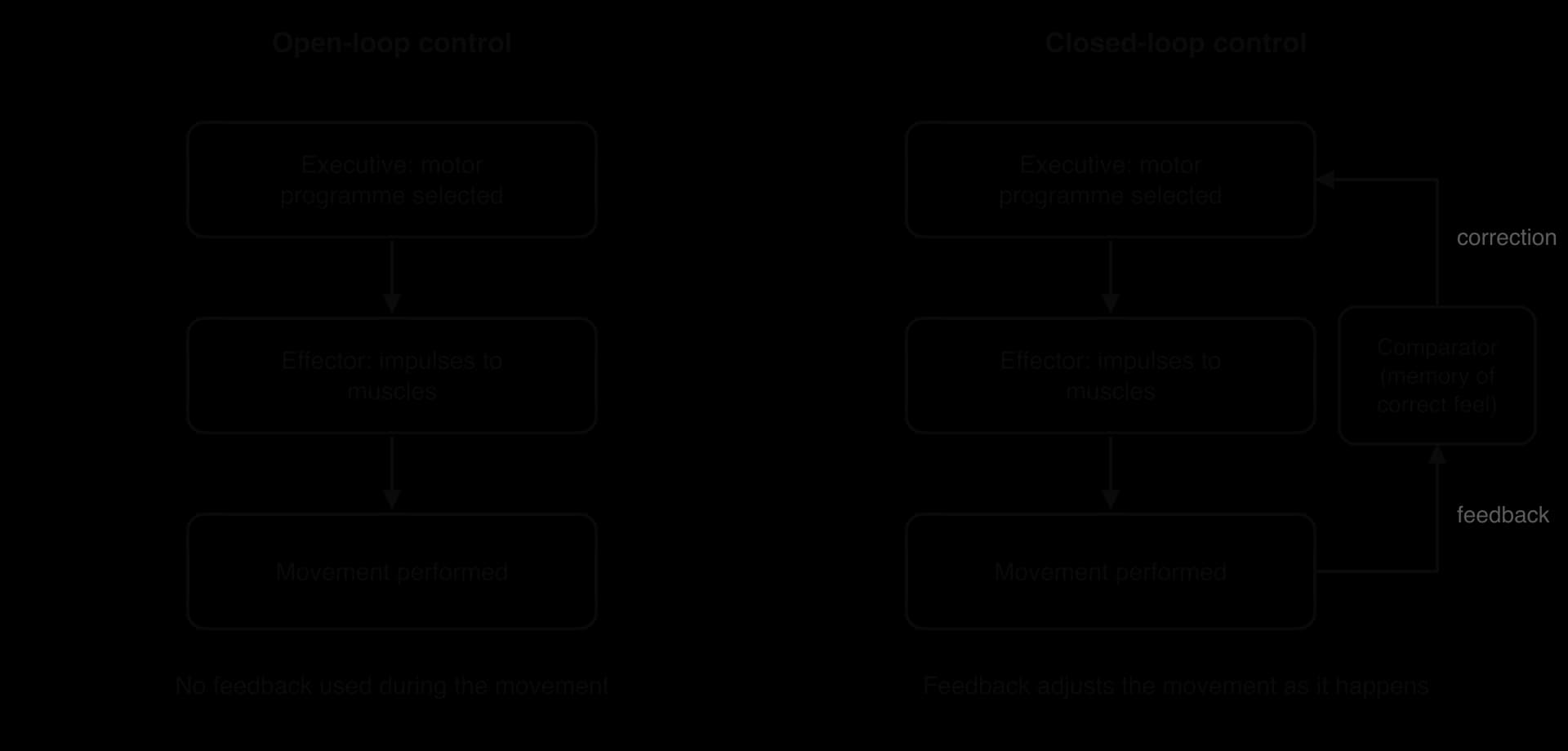
A golf drive, a boxing jab or a volleyball spike takes well under half a second. There is not enough time to detect an error through feedback and send a correction before the movement is finished, so these skills are controlled by open-loop control: the programme runs as a whole, and feedback can be used only after the movement to improve the next attempt. By contrast, a gymnast holding a handstand, a cyclist steering round a bend or a rock climber placing a foot can feel small errors and correct them, so they use closed-loop control.
Adams' closed-loop theory (1971) proposed that two memory states control movement. A memory trace selects and starts the movement, and a perceptual trace, built up from the feel of many correct attempts, acts as the reference against which feedback is compared. The theory explains why beginners, who have no strong perceptual trace, cannot tell when a movement feels right, and why accurate practice builds an internal sense of correctness. It cannot explain how very fast movements are controlled, or how performers produce movements they have never practised exactly.
Schema theory, proposed by Richard Schmidt in 1975, answers two problems with earlier theories: how long-term memory could store a separate programme for every movement ever made, and how performers produce movements they have never practised in exactly that form. Its answer is that people store general rules, not individual movements.
A generalised motor programme (also called a generalised motor pattern) holds the invariant features of a class of movement: the sequence of actions and their relative timing. Before each movement the performer adds parameters: the overall force, overall speed (duration), direction, and which limb or muscles to use. The same overarm throwing programme can therefore produce a short, soft throw to a nearby team-mate or a long, fast throw from the outfield, by changing force and direction while keeping the pattern the same.
Schmidt proposed that after every attempt the performer briefly stores four pieces of information: the initial conditions (body position, the environment, the weight of the ball), the response specifications (the parameters used: how hard, how fast, in what direction), the sensory consequences (how the movement felt, looked and sounded) and the response outcome (what happened: the ball fell short, went too far, was on target). Over many attempts the relationships between these are abstracted into two schemas.
The recall schema therefore deals with how a movement should be performed, before it begins.
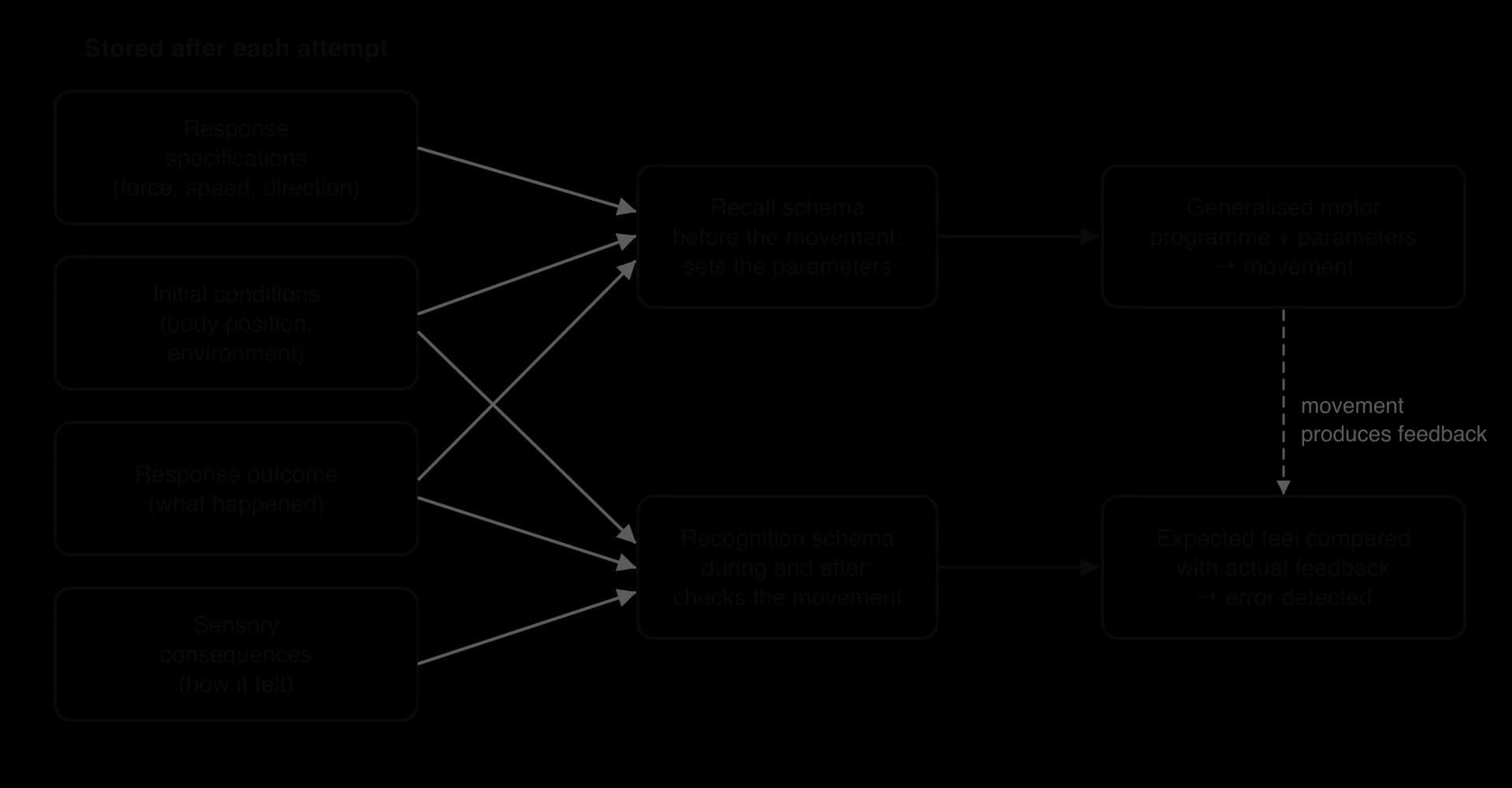
The recall schema is like a rule that says "from this position, to throw this far, use this much force". It is used to start the movement. The recognition schema is like a rule that says "a throw that reaches that far should feel like this". It is used to evaluate the movement. Together they allow a performer to produce and check a movement they have never made before, such as a pass over an unusual distance in a match.
If schemas are rules abstracted from many different attempts, they should become stronger when practice includes a range of initial conditions and parameters. Schema theory therefore predicts that variable practice (practising the same skill under varied conditions) produces better transfer to new situations than repeating one version of the skill.
An early test of this prediction used 64 children aged 8 and 12 years who threw at a target without vision but were told the result after each throw. One group practised only at the test distance, the other practised only at two other distances. At the end of a 12-week physical education programme, the varied-practice group was more accurate at the test distance, even though it had never practised that distance. The result supports schema theory, although the task was a simple throw and the sample small.
Sources: Kerr and Booth, Perceptual and Motor Skills, 1978.
Strengths: it solves the storage problem (one programme for a class of movements) and the novelty problem (new movements produced from rules); it explains why variable practice improves transfer; it combines open-loop (recall) and closed-loop (recognition) control; and its predictions have been tested experimentally.
Limitations: the evidence for variable practice is stronger in children than in adults, perhaps because adults already have broad schemas; the theory does not explain how a generalised motor programme is first formed; it still assumes stored representations in the brain, which ecological theorists reject; and much of the evidence comes from simple laboratory tasks.
Complex skills are organised in a hierarchy. At the top is the executive programme (the generalised motor programme for the whole skill). It is made up of smaller components, called subroutines or subordinate motor patterns, which run in sequence and are themselves made up of smaller movements.
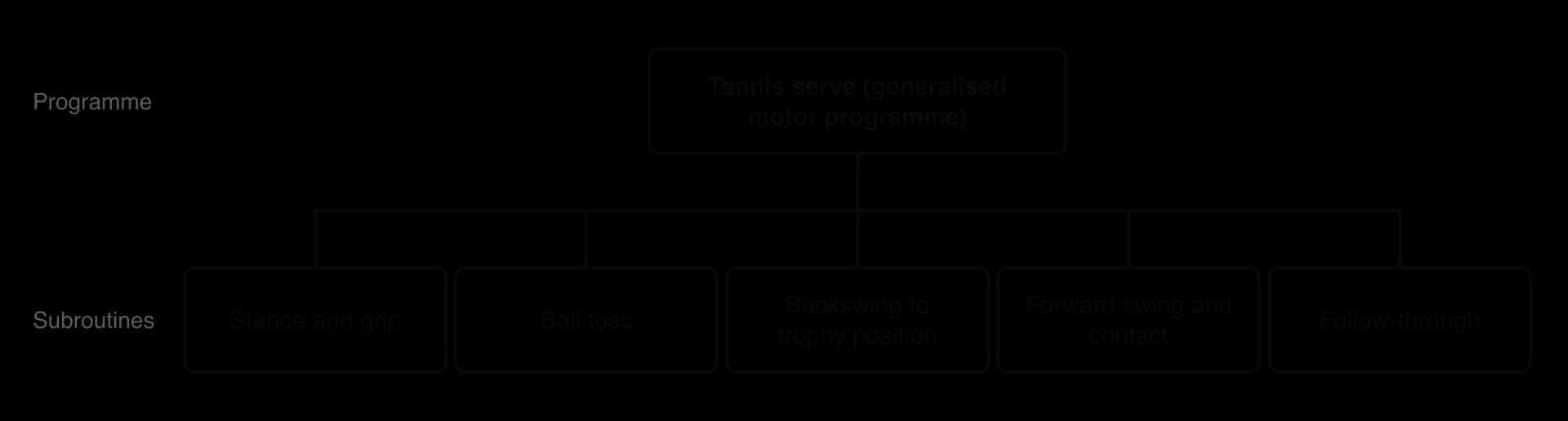
When a skill is learned, subroutines are at first performed one at a time, each needing attention. With practice they link together into a smooth executive programme that runs automatically, which is the change seen as a learner moves through the phases of learning. The hierarchy also tells a coach how to break a skill down for part practice and where to look for the cause of an error, and it links directly to the phases used in movement analysis.
Fitts and Posner (1967) described learning a motor skill as progressing through three phases of learning. The phases are not separate boxes: learners move gradually from one to the next, may show features of two at once, and can slip back under pressure or after a break.
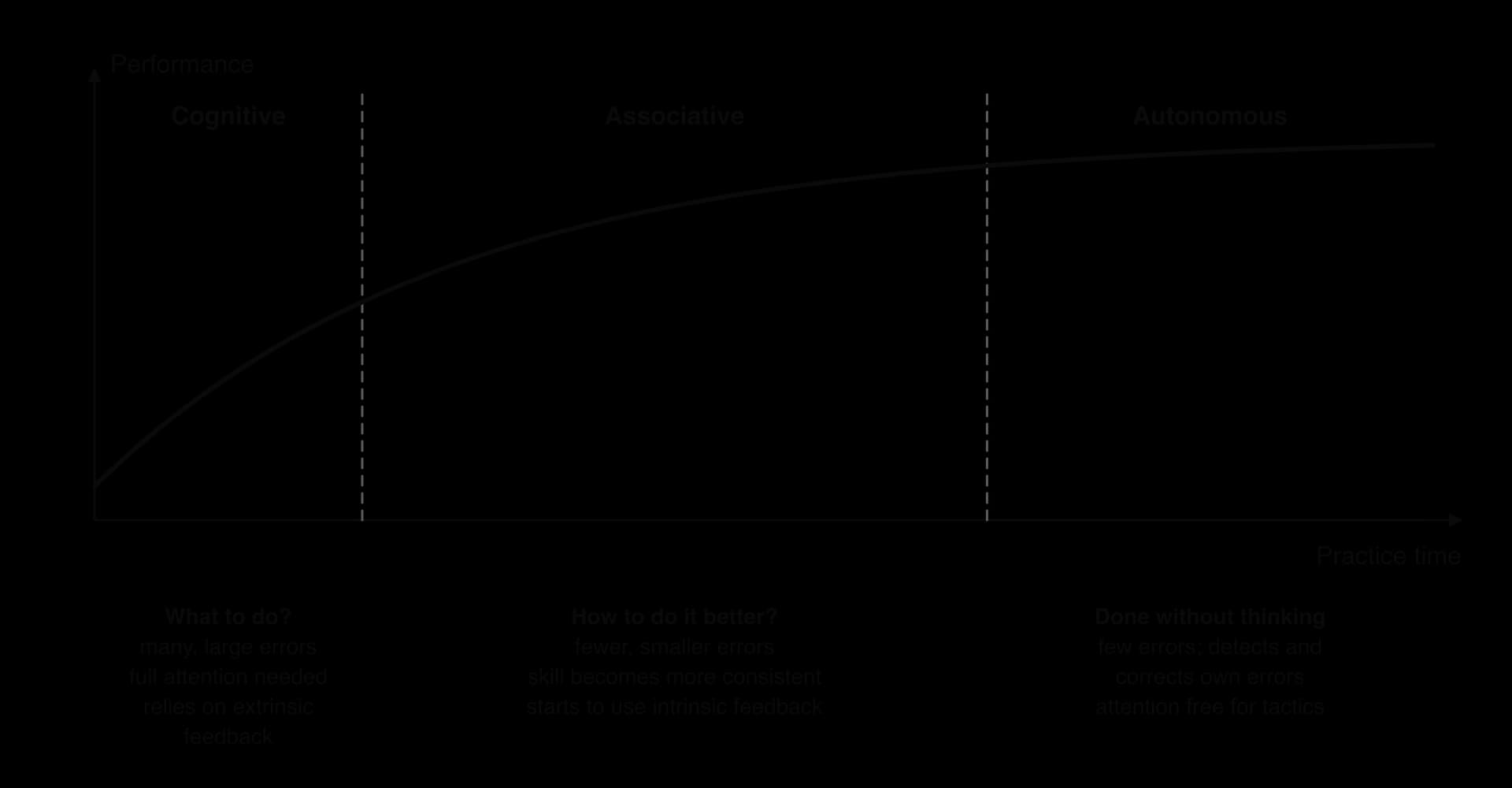
In the cognitive phase the learner is working out "what to do". They form a mental picture of the skill from demonstrations and instructions, and they think about each part as they perform it. Movements are jerky, slow and poorly timed, and success is often a matter of chance. The learner cannot yet detect their own errors, because they have no clear idea of how a correct movement feels, so they depend on extrinsic feedback from the coach. A beginner in a tennis lesson who watches the ball, thinks about the grip and swings late is in this phase.
In the associative phase the learner knows what to do and is refining "how to do it better". Subroutines are linked, timing improves, and performance becomes more consistent. The learner starts to feel the difference between good and poor attempts (intrinsic feedback) and can correct gross errors. This phase is the longest, and some performers never leave it. A club tennis player who can rally consistently but whose serve breaks down under pressure is in this phase.
In the autonomous phase the motor programme is stored in long-term memory and runs without conscious control. Because the skill needs little attention, the performer can attend to opponents, team-mates and tactics, and can perform under pressure and with distractions. Errors are few, and the performer detects and corrects them using intrinsic feedback. The skill must be practised to stay in this phase, and too much conscious attention to an autonomous skill can disrupt it, which is one explanation of performance breaking down under high arousal.
Characteristic | Cognitive | Associative | Autonomous |
|---|---|---|---|
Question the learner is answering | What do I do? | How do I do it better? | How do I use it in the game? |
Errors | Many, large | Fewer, smaller | Few; self-corrected |
Consistency | Low; success by chance | Improving | High |
Attention | Fully on the movement | Partly on the movement | Free for tactics and the environment |
Movement quality | Slow, jerky, poorly timed | Smoother; subroutines linked | Fluent, efficient, well timed |
Main feedback | Extrinsic, from the coach | Extrinsic and intrinsic | Mainly intrinsic |
The practical value of the phases of learning is that they tell a coach what type of feedback, guidance and practice will help most at each stage.
Feedback is classified by its source, by what it describes and by its tone. The two main distinctions are intrinsic versus extrinsic, and knowledge of results versus knowledge of performance.
Intrinsic feedback is always present, but beginners find it hard to interpret.
Intrinsic feedback becomes more useful as the learner develops a sense of how correct movements feel, so it suits associative and autonomous performers. Extrinsic feedback is essential for beginners, who cannot yet interpret their own sensations. Video and sensor technology now give very precise extrinsic feedback: a sprint coach can show a slow-motion clip of foot strike, and a rower can see the force curve of each stroke on a screen.
Knowledge of results is usually extrinsic, although a performer can often see the outcome for themselves.
Knowledge of results is simple and motivating, and it is often all that a beginner can use; a novice free-throw shooter learns from whether the ball went in. Knowledge of performance is needed to improve technique, because a good result can come from poor technique and vice versa. It is especially useful in the associative phase, when the learner can act on detailed information. KP often comes from a coach or video, but a skilled performer can produce their own KP from intrinsic feedback.
Feedback can also be positive (telling the learner what was done well, which reinforces correct actions and motivates) or negative (telling the learner what was wrong, which helps correct errors but can demotivate beginners if overused). It can be concurrent (during the movement) or terminal (after it). Beginners usually respond best to positive feedback with one simple correction; experienced performers can use precise negative feedback.
Type of guidance | What it is | Advantages | Disadvantages | Best suited to |
|---|---|---|---|---|
Visual | Demonstrations, video, pictures, cue cards, markers on the floor | Builds a mental picture quickly; easy for beginners | Must be accurate; poor demonstrations mislead; hard to show internal feel | Cognitive phase; all learners |
Verbal | Explanations, instructions, key words ("reach, pull, push") | Can be given during performance; draws attention to key points | Easily overloads short-term memory; hard to describe complex movements | Associative and autonomous phases; short cues for beginners |
Manual | The coach physically moves or supports the learner (guiding a golfer's arms) | Gives the feel of the movement; builds confidence; safe | Learner may become dependent; feel differs from the real movement | Cognitive phase; complex or risky skills |
Mechanical | Equipment that supports or restricts movement (a gymnastics harness, swimming floats) | Allows dangerous skills to be practised safely; reduces fear | Dependence; the skill feels different without the aid | Cognitive phase; dangerous skills |
Guidance should match the learner. A beginner gymnast learning a back somersault may need a spotter (manual) and a harness (mechanical), plus demonstrations (visual) and one or two key words (verbal). The aim is always to remove the support as soon as possible, so that the learner relies on their own intrinsic feedback.
Practice can be organised in many ways. The choice depends on the skill (its complexity and organisation), the learner (phase, age, motivation, fitness) and the time available.
Whole practice keeps the timing and flow of the skill intact and saves time, but it can overload a beginner if the skill is complex.
Whole practice suits skills that are highly organised (subroutines closely linked in time, so they are hard to separate) and simple, such as a golf swing, a cartwheel or a sprint start. Part practice suits skills that are complex (many subroutines or a high information load) and low in organisation (subroutines easily separated), such as a swimming stroke, a gymnastics routine or a tennis serve. Two variations combine the advantages:
Progressive part practice (chaining): one part is learned, then the next is added, and so on, until the whole skill is performed (approach, then approach plus take-off, then the full triple jump). It suits serial skills with a fixed order.
Whole–part–whole practice: the learner tries the whole skill, a weak part is isolated and practised, then the whole skill is practised again. It keeps the feel of the whole skill while fixing a specific error, which makes it popular with associative performers.
Massed practice is efficient in time but can cause fatigue and boredom.
Massed practice can groove simple, discrete skills for motivated, fit and experienced performers, as when a netball shooter takes 50 shots in a row, but the loss of quality as fatigue builds can make it dangerous for complex or physically demanding skills. Distributed practice allows physical recovery and time to think about feedback, so it suits beginners, complex or demanding skills and learners with low fitness or motivation. In general, distributed practice leads to better learning, although it takes longer.
Blocked practice gives beginners quick success and confidence.
The quick gains of blocked practice come from repeating the same programme with the same parameters. Random practice makes practice harder, because the learner must retrieve and adjust a different programme on each attempt. This difficulty, called contextual interference, lowers performance during practice but usually leads to better retention and transfer.
The evidence for this effect is strongest in the laboratory. A 2024 meta-analysis of 34 studies found a medium overall benefit of random practice for transfer, with a clear effect in laboratory tasks but a small effect that was not statistically significant in applied sports settings. The benefit was also clearer in adults and older adults than in children. Coaches should therefore treat random practice as useful, but not as a guarantee of better learning for every learner and skill.
Sources: Czyż, Wójcik and Solarská, Frontiers in Psychology, 2024.
Blocked practice is therefore useful in the cognitive phase, when the learner needs to establish a basic movement pattern and early success for motivation. Random and variable practice suit associative and autonomous performers, especially for open skills, because they prepare the performer to choose and adapt movements as in a real game.
Mental practice uses imagery to rehearse a skill without movement. For beginners it helps them understand the sequence of a skill and fixes the mental picture formed in the cognitive phase. For experienced performers it rehearses the feel and timing of the skill, prepares them for competition and can be used during injury or between physical practice blocks. It is most effective when combined with physical practice rather than replacing it.
Coaching decision | Cognitive phase | Associative phase | Autonomous phase |
|---|---|---|---|
Feedback | Extrinsic; mainly positive; KR plus one simple KP point; frequent but brief | Extrinsic and intrinsic; detailed KP from coach and video; some negative feedback; feedback faded over time | Mainly intrinsic; precise KP on fine details; performer analyses own video; little extrinsic feedback |
Guidance | Visual (demonstrations) first; manual and mechanical for risky skills; very short verbal cues | Verbal guidance on specific points; visual feedback by video | Verbal on tactics; video analysis; little technical guidance |
Practice structure | Whole practice for simple skills; part or progressive part for complex ones; blocked; distributed | Whole–part–whole to fix errors; increasing variable and random practice | Whole practice in game-like conditions; random and variable practice |
Practice environment | Closed, simplified conditions; few distractions | Gradually more open and game-like | Open, pressured, competition-like conditions |
Mental practice | To understand the sequence of the skill | To rehearse the feel and correct errors | To prepare for competition and maintain the skill |
Linear pedagogy is clear, safe and easy to organise. It suits beginners, closed skills and dangerous skills (gymnastics, trampolining, diving), because learners receive an accurate model, early success and close supervision. It suits large groups in schools, where drills can be organised safely. It is supported by laboratory evidence on feedback, guidance and practice scheduling, and its terms (phases of learning, KR and KP) give coaches a shared language.
Its weaknesses appear with open skills. Drills often separate perception from action, so learners practise movements without the information (opponents, team-mates, a real ball) that guides them in a game, and skills may not transfer. Insisting on one "correct" technique ignores differences between individuals in body size and strength. Constant instruction and feedback can make learners passive and dependent, and repetitive drills may reduce motivation. Linear pedagogy works best when it is used for the stages and skills it suits, and combined with game-based practice as learners progress.
The ecological model starts from a different question. Instead of asking what programme the brain sends to the muscles, it asks how a performer and an environment together produce a movement. Its answer is that skilled movement emerges from the interaction of the performer, the task and the environment, guided by information that the performer picks up directly from the environment. Learning is a process of becoming better attuned to that information and better at organising the body to act on it.
The ecological model draws on two theories: ecological systems theory, which explains perception, and dynamical systems theory, which explains how movement is coordinated. Together they form ecological dynamics and lead to non-linear pedagogy.
Ecological systems theory is based on the work of the psychologist James Gibson (1979). Gibson argued that perception is direct: the environment contains rich information that specifies what is happening and what can be done, so the performer does not need to build an internal model of the world or compare it with memories before acting. A cricketer facing a fast bowler does not calculate the ball's path; the expanding image of the ball and the bowler's movements specify when and where it will arrive, and the batter acts on that information.
A central idea of the theory is the affordance: what the environment offers a particular performer for action. A gap between two defenders affords a pass for a skilled passer but not for a beginner who cannot pass accurately at that range; a low wall affords a vault for a parkour athlete but only a step for someone else. Affordances depend on both the environment and the individual's abilities, size and skill.
Learning, in this view, is the process of becoming attuned to the most useful information and to the affordances available. Experts do not have better programmes; they are better at picking up the key information (a defender's weight shift, the angle of the bowler's wrist) and at acting on it.
Dynamical systems theory treats the human body as a complex system made of many parts (bones, joints, muscles, motor units) that can move in a huge number of combinations. It explains coordination as the result of these parts organising themselves under the influence of constraints, in the same way that birds form a flock without a leader.
The Russian physiologist Nikolai Bernstein identified the degrees of freedom problem: with so many joints and muscles, there are far too many degrees of freedom for the brain to control each one individually. Bernstein described learning as a process of solving this problem in stages.
Freezing the degrees of freedom: beginners hold joints rigid and move as a stiff unit, reducing the number of parts to control. A beginner throwing a ball keeps the trunk still and throws mainly from the elbow.
Freeing (releasing) the degrees of freedom: with practice, the learner gradually allows more joints to move and links them into coordinated units, so that the movement becomes fluid and powerful. The trunk rotation and shoulder join the throw, giving a better summation of joint forces.
Exploiting the degrees of freedom: the skilled performer uses the passive forces of the body and the environment (momentum, elasticity, gravity) efficiently, so the movement looks effortless.
Self-organisation means that the coordination pattern is not planned in detail by the brain but emerges from the constraints acting on the system. A familiar example is the change from walking to running: as treadmill speed increases, people switch suddenly from a walk to a run at a fairly consistent speed, without deciding to. Stable patterns such as walking and running are called attractors: patterns that the system settles into because they are efficient for the current constraints. Learning a new skill involves destabilising an existing attractor and settling into a new one, which is why change is often sudden rather than gradual.
In linear pedagogy, variation from the ideal technique is treated as error to be removed. In the ecological view, performance variability is often functional. Studies of elite performers show that their joint movements vary slightly from attempt to attempt even when the outcome is very consistent, because they adjust to small differences in conditions. A javelin thrower adapts the run-up to the wind; a basketball shooter adjusts the release to the fatigue in their legs. Practice that encourages exploration of different movement solutions helps learners find the variability that is useful.
In the ecological model perception and action cannot be separated: what a performer sees guides how they move, and how they move changes what they see. This perception–action coupling has a direct consequence for practice. If perception and action are separated in practice, for example by practising a batting stroke without a ball or against a predictable machine, the coupling that the performer needs in competition is not developed.
A study of 12 young cricketers (mean age 15.6 years) compared their batting against a bowler and against a bowling machine, with the ball delivered at the same speed (about 28 m s⁻¹). Against the bowler, the batters began their backswing, front-foot movement and downswing earlier, raised the bat higher and took a longer step. Against the machine there is no bowler's action to read, so the batters had to wait for the ball itself and organised a different movement. Practising mostly against machines may therefore develop a different skill from the one used in matches, and the authors advised against relying heavily on them.
Sources: Pinder, Renshaw and Davids, Human Movement Science, 2009.
This idea is called representative learning design: practice should sample the key information sources of the competition environment, so that the perception–action couplings learned in practice are the ones that work in competition.
The constraints-led approach (CLA) is the practical method of non-linear pedagogy. It uses Newell's model of constraints (1986), which proposes that every movement emerges from the interaction of three categories of constraint. A constraint is a boundary or feature that shapes the movement solutions available to a performer.
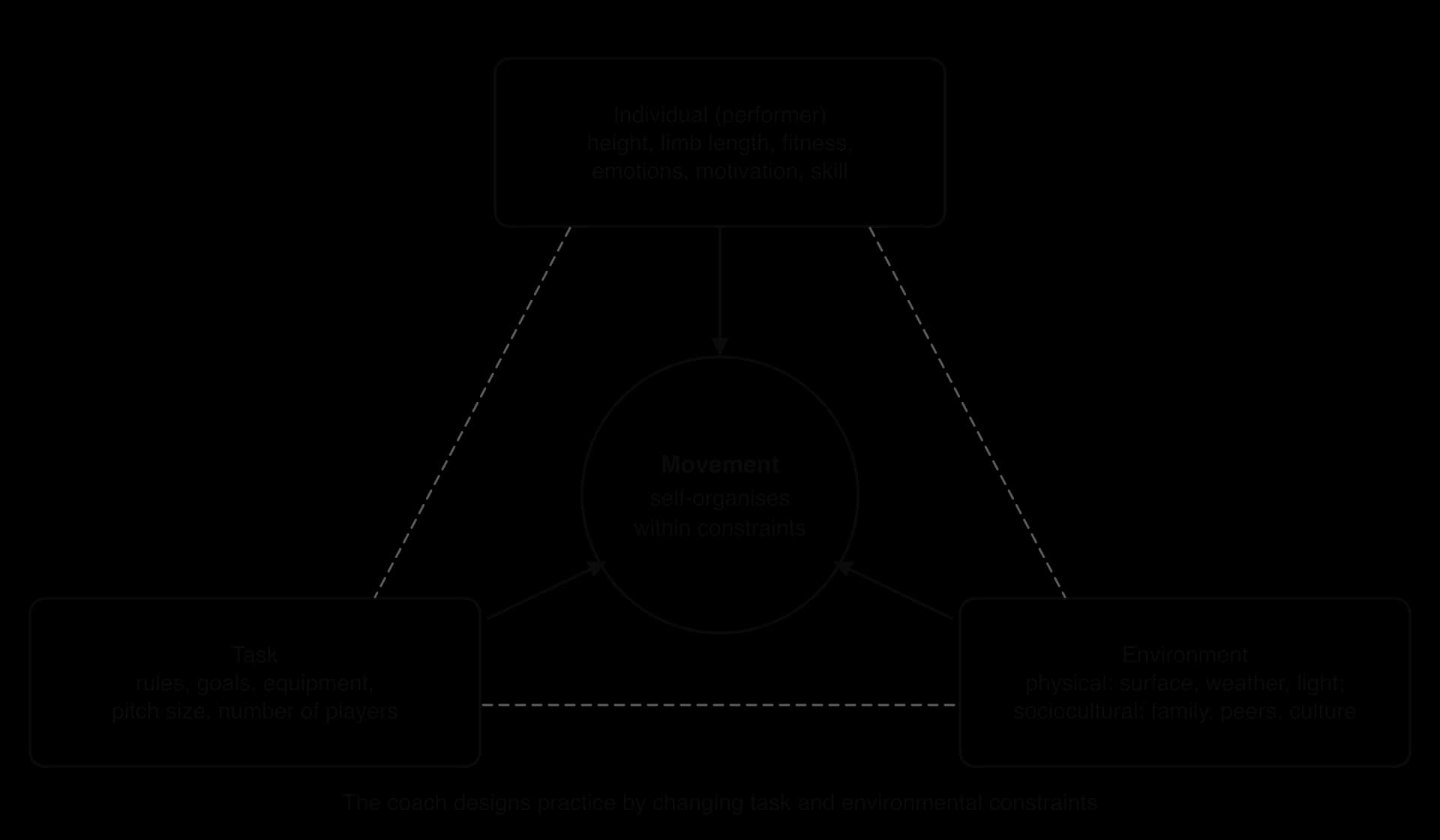
Individual constraints change slowly, through growth, training and experience.
Task constraints are the easiest for a coach to change within a single session.
Individual constraints explain why the same task produces different movements in different people. A tall basketball player may shoot over defenders, while a shorter player develops a quicker release; a fatigued runner changes stride length. Task constraints are the coach's main tool. Environmental constraints include physical conditions, such as wind on a golf course or a slippery pitch, and sociocultural ones, such as a culture in which children play street football with few rules, or a family that drives a child to training.
Coaches who use the CLA design practice by changing constraints, then let learners discover solutions. Examples include:
Small-sided games in football: fewer players and a smaller area give each player more touches and more decisions in a short time.
Futsal and modified balls: a smaller, heavier ball that bounces less keeps the ball on the ground and encourages close control and passing.
Scaled equipment for children: smaller courts, lower nets and low-compression balls in junior tennis; lower baskets and smaller balls in junior basketball. Scaling the task to the child's size lets them use adult-like techniques sooner, and links motor learning to anthropometry and ergonomics, because a shorter racket also changes the lever the child must control.
Rule changes: a "three-touch maximum" rule in a passing game encourages quick decisions; a target zone behind the opposition encourages forward passes.
Representative practice: batting against real bowlers or bowling machines that vary their deliveries, rather than identical deliveries.
 YouTube
Non-linear pedagogy keeps perception and action together, so skills are practised with the information present in competition and are more likely to transfer. Games-based practice is motivating, gives learners responsibility, and develops decision-making and creativity. It respects individual differences, because each learner can find a solution that suits their body. A study of 19 under-12 footballers found that a 14-session programme of modified games with a numerical advantage in attack improved decision-making and the execution of passes compared with a control group, but not decision-making or execution in dribbling.
Sources: Práxedes et al., Journal of Human Kinetics, 2018.
The same results suggest a limitation, because the approach may help tactical skills more than technical ones. Discovery can be slow, and beginners may settle on inefficient or unsafe solutions without guidance, which matters in gymnastics, diving or weightlifting. It needs skilled coaches who can design constraints and observe their effects, and it is harder to organise for large classes. Its research base is younger, with many small studies of youth football and cricket, and few long-term randomised trials.
Feature | Information processing model and linear pedagogy | Ecological model and non-linear pedagogy |
|---|---|---|
View of the learner | A processor of information that stores and retrieves motor programmes | A complex system that self-organises in interaction with the environment |
Where control lies | In the brain (central programmes and schemas) | In the whole performer–task–environment system |
Perception | Indirect: information is processed, compared with memory and interpreted (DCR) | Direct: information in the environment specifies affordances |
Role of variability | Error to be reduced towards an ideal technique | Functional; helps adaptation and exploration |
Role of the coach | Instructor: demonstrates, explains, corrects | Designer: manipulates constraints and guides discovery |
Typical practice | Drills, part practice, blocked repetition, then progression | Small-sided and modified games, representative practice |
Feedback and instruction | Frequent extrinsic feedback, KR and KP, detailed instruction | Less instruction; questioning; feedback focused on outcomes and the environment |
Strengths | Clear, safe, structured; suits beginners, closed and dangerous skills; strong laboratory evidence | Develops decision-making and adaptability; transfers to games; motivating; respects individual differences |
Limitations | Separates perception and action; may not transfer to open skills; can make learners dependent | Can be slow; beginners may find inefficient or unsafe solutions; needs skilled coaches; fewer long-term trials |
Representative theory | Schema theory | Ecological dynamics |
In practice the models are increasingly seen as complementary. Many coaches use a hybrid approach: a demonstration and a few key points to give a beginner a starting idea (linear), followed by modified games that let the skill adapt to real conditions (non-linear). The best choice depends on the skill (open or closed, safe or dangerous), the learner (phase, age, motivation, individual constraints) and the aim (technical precision or decision-making in a game).
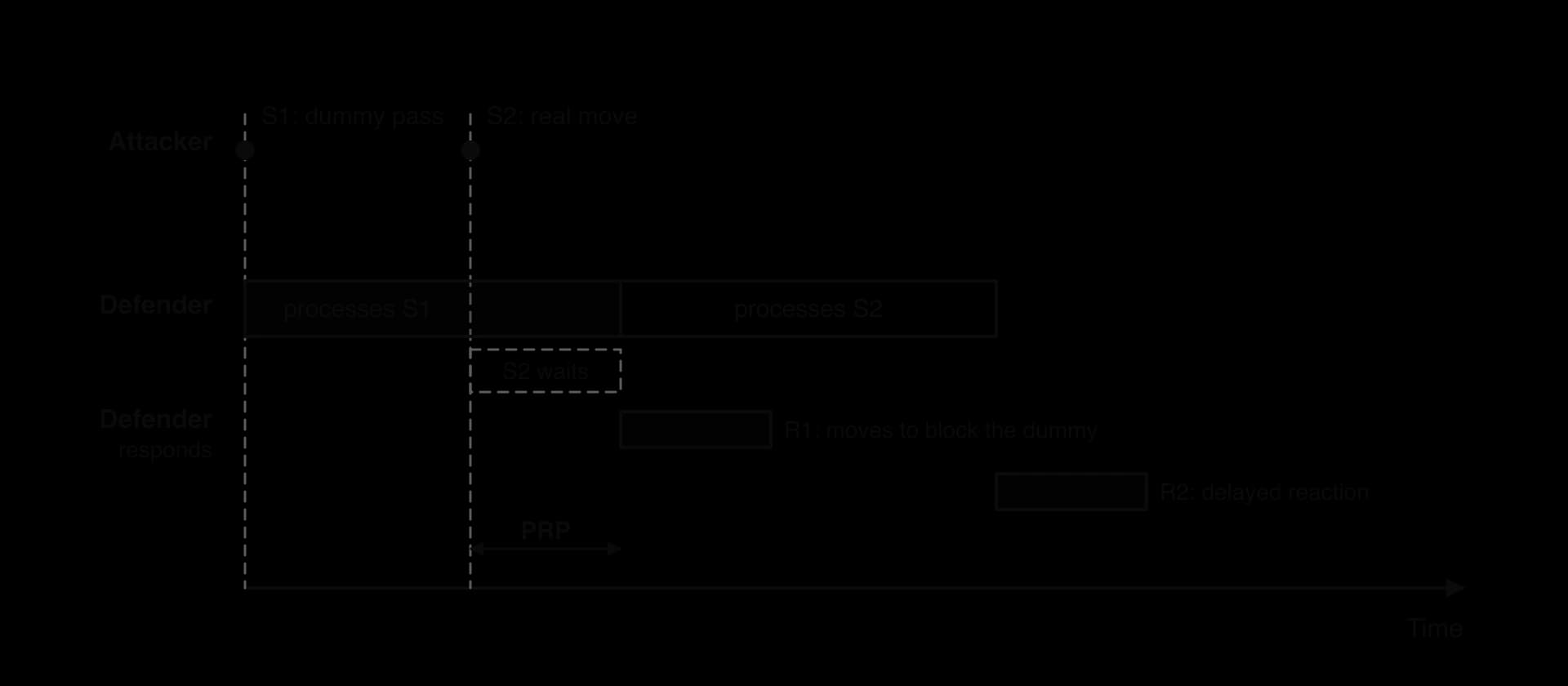
The information processing model assumes that the processing of information, especially decision making, has limited capacity. One consequence is that a performer cannot easily respond to two stimuli that arrive very close together. This delay is called the psychological refractory period (PRP).
The PRP is therefore an extra delay on top of normal reaction time, and it appears only when two stimuli arrive close together.
The single-channel hypothesis, proposed by Alan Welford in 1952, explains the PRP. When the first stimulus (S1) arrives, the performer begins to process it and to select a response. If a second stimulus (S2) arrives before this is finished, it must wait in a queue. The performer's reaction time to S2 is therefore its normal reaction time plus the time it spends waiting, and the performer may already have begun moving in response to S1.
Laboratory and simulator studies show that the PRP is greatest when the second stimulus follows the first by a short interval and shrinks as the interval grows. In one driving-simulator study, the time taken to brake when a lead car braked rose steadily as the gap between a first signal and the braking was shortened from 350 to 50 milliseconds.
Sources: Bock et al., Psychological Research, 2021.
Deception uses the PRP deliberately. The first, false move (S1) must be convincing enough for the opponent to process it, and the real move (S2) must follow soon enough to arrive while S1 is still being processed, but not so soon that the opponent sees both as one movement. If the second move comes too late, the opponent has finished processing the dummy and can react normally.
Rugby: a dummy pass. The defender processes the passing movement and begins to drift towards the receiver, then the ball carrier keeps the ball and runs into the gap.
Basketball: a head fake or pump fake. The defender processes the look or shot and jumps, then the attacker passes or drives past.
Badminton and squash: a disguised shot. The player prepares as if for a powerful clear or drive, then plays a soft drop shot.
Football: a step-over or feint before a penalty or a dribble, which sends the defender or goalkeeper the wrong way.
Research on the basketball head fake shows how strong the effect is. Observers asked to judge whether a player would pass left or right responded more slowly when the player looked in the opposite direction from the pass. The effect remained after practice and appeared to arise in perception, because the head direction interfered with encoding the direction of the pass. A later study found that telling observers to ignore the head did not remove the effect, so coaches are advised to tell defenders to focus on the relevant cue (the pass direction) instead.
Sources: Kunde, Skirde and Weigelt, Journal of Experimental Psychology: Applied, 2011; Güldenpenning, Weigelt and Kunde, Human Movement Science, 2019.
Anticipation: experienced performers read reliable early cues (the hips of a dribbler, the shoulders of a passer) and are less likely to respond to a false cue in the first place.
Attending to the relevant cue: focusing on the part of the opponent that cannot lie (the ball, the centre of mass) rather than the head or arms.
Not committing too early: a defender who stays balanced and delays the final commitment keeps the second response quick.
Experience and practice: practising against varied deceptive opponents builds knowledge of an opponent's patterns and reduces the time needed to process each stimulus.
Almost every new skill is learned on top of skills learned before, so earlier learning can help or hinder new learning. This influence is called transfer of learning.
Positive transfer is the aim of most coaching progressions.
Negative transfer is usually temporary and can be reduced by pointing out the differences between the skills.
Positive transfer occurs between an overarm throw in cricket and a javelin throw, which share the same basic pattern. Negative transfer occurs when a squash player takes up tennis: both use a racket to hit a ball, but the flexible wrist action of squash produces errors with the heavier tennis racket and firmer wrist needed in tennis. Zero transfer would be expected between swimming the backstroke and putting in golf. Transfer can also work in time: proactive transfer is the effect of a skill learned earlier on a new skill, and retroactive transfer is the effect of learning a new skill on a skill learned earlier.
Bilateral transfer is used when a footballer who has learned to pass with the right foot finds it easier to learn with the left, or when a basketball player develops a left-handed lay-up after mastering the right-handed one. It suggests that part of what is learned is a general pattern that is not tied to one set of muscles, which fits the idea of a generalised motor programme.
Type of transfer | What it means | Sporting example |
|---|---|---|
Skill to skill | Learning one skill affects the learning of another skill | Positive: overarm throw → tennis serve. Negative: squash wrist action → tennis groundstrokes |
Practice to performance | Skills learned in practice carry over into competition | Match-like practice with opponents, crowd noise and time pressure transfers better than isolated drills, which is the principle of specificity applied to skill |
Abilities to skills | General abilities support the learning of specific skills | Good balance and coordination help a child learn gymnastics or skiing |
Bilateral | Learning moves from one limb to the other | Learning a left-footed pass after mastering the right-footed pass |
Stage to stage | Each stage of a progression builds on the previous one | Front crawl drills (kick with a float, then single-arm pulls) → the full stroke; a forward roll → a dive roll → a handspring |
Principles to skills | Understanding a principle helps learning skills that use it | Understanding the summation of forces helps in learning the shot put and the tennis serve; understanding spin helps in learning a topspin drive |
Make practice as similar as possible to competition (the same information, pressure and decisions), so that practice-to-performance transfer is high.
Make sure the first skill is well learned before building on it, because transfer from a poorly learned skill is weak.
Point out the similarities between the old and new skills, and the principles they share, so that learners can use what they already know.
Teach skills in logical progressions, from simple to complex and from easier to harder versions.
Avoid teaching skills that are likely to produce negative transfer at the same time (squash and tennis in the same session), and point out the differences when they must be learned together.
Use variable practice, which builds flexible schemas that transfer to new situations.
Futsal is a five-a-side form of football played on a hard court with a smaller, heavier ball that bounces less than a standard football. Many youth football coaches use it as a training environment, on the argument that its constraints produce more touches, faster decisions and closer ball control. Two studies by Oppici and colleagues tested this idea by comparing young players who had spent their whole development in futsal with players who had developed in football (referred to in the studies as soccer).
The first study recruited 48 elite young male players aged about 13–14 years: 24 futsal players from a successful Spanish club and 24 soccer players from Australian state representative squads. Each group had about 7 years and over 1,200 hours of structured practice in its own sport.
The players took part in 5 against 5 games (plus goalkeepers) in which the aim and the rules were the same, but the ball, surface and playing area were set to match each sport. Two players in each game wore the scene camera of a mobile eye-tracking system, which recorded where their head and attention were oriented while they received, controlled and passed the ball.
Constraint | Futsal task | Soccer task |
|---|---|---|
Ball (task) | Futsal ball: smaller and heavier, low bounce | Standard soccer ball |
Surface (environment) | Wooden court | Synthetic grass |
Pitch size (task) | 24 m × 15 m | 24 m × 36 m |
Space per player (task) | 36 m² per player | 86 m² per player |
Players, goals and rules (task) | 5 v 5 plus goalkeepers, futsal-size goals, no offside | The same |
Observed: passes per minute | 30.9 ± 2.1 | 20.1 ± 1.3 |
Observed: space around the passer | 24.9 ± 4.9 m² per player | 46.5 ± 11.9 m² per player |
Observed: time to receive the ball | 0.83 ± 0.13 s | 1.08 ± 0.17 s |
The table shows how the task constraints changed the game. In the futsal task each player had less space and less time: there were about 31 passes per minute instead of 20, and the ball took about a quarter of a second less to arrive. These are the conditions in which a player must perceive the positions of team-mates and opponents before the ball arrives.
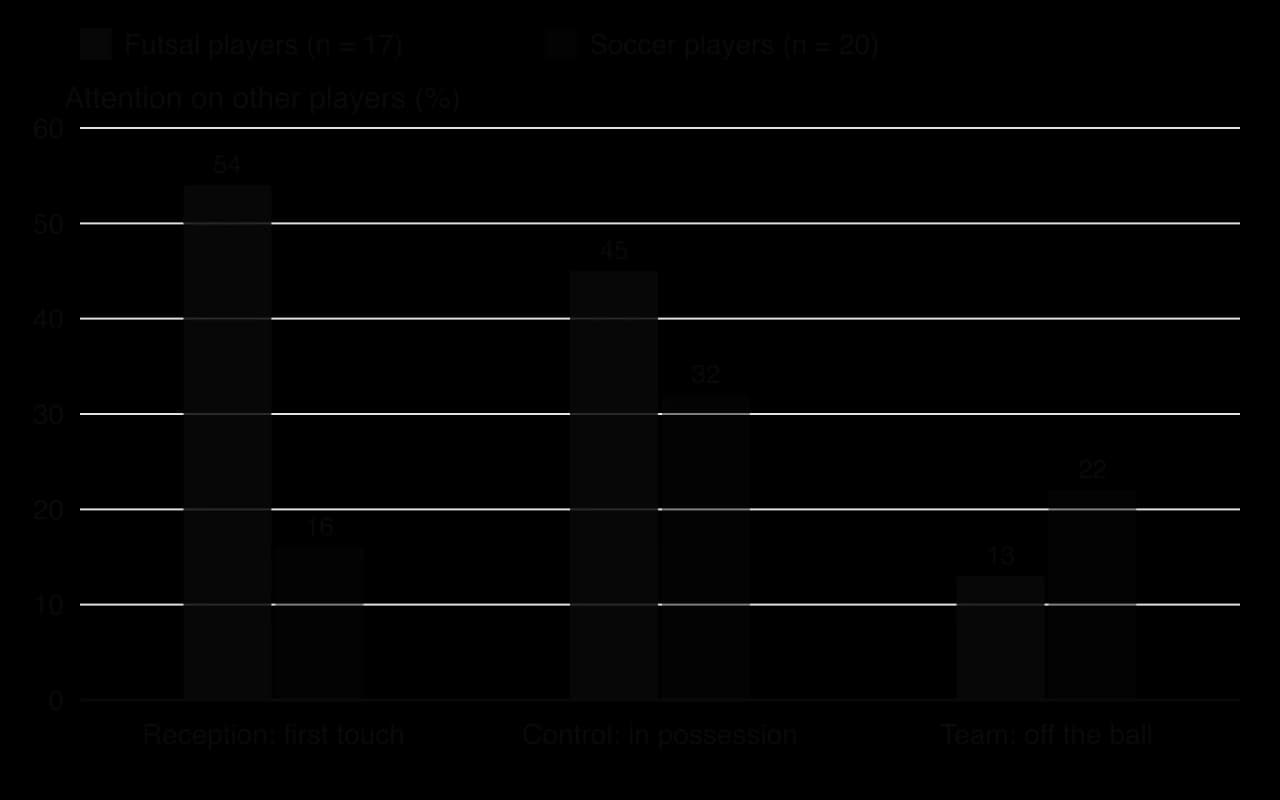
At the moment of the first touch, futsal players' attention was directed to other players in 54% of receptions, compared with 16% for soccer players. While in possession, futsal players spent 45% of the time attending to other players, compared with 32% for soccer players. Soccer players, in contrast, scanned the field more when their team had the ball but they were not in possession (22% vs 13% of the time). The differences were statistically significant, with effect sizes ranging from moderate to very large.
A follow-up study with players of the same age and experience tested transfer. Both groups played a futsal-like game and a soccer-like game. The futsal players' passing accuracy improved when they moved to the soccer-like game, and in that game they were more accurate than the soccer players, with a very large effect size. The soccer players' accuracy stayed about the same in both games. The authors concluded that skills learned under the tighter constraints of futsal transferred well to the more open conditions of football, while the reverse transfer was weaker.
The constraints-led approach explains these findings. The task constraints of futsal (a small area, a low-bouncing ball, frequent passes) changed the information available and the time to use it. Over many hours, the futsal players became attuned to different information: they learned to perceive affordances for passing while receiving the ball, coupling perception and action at the moment of the first touch. Soccer players, with more time, could look at the ball while receiving and scan the field earlier. Both patterns are functional adaptations to the constraints each group practised under.
The transfer result links to transfer of learning. Practice under futsal constraints gave positive skill-to-skill transfer to football, which supports the use of futsal and small-sided games in youth development. A linear approach, such as passing in pairs between cones, would practise the kicking action but not the scanning and decision-making that the futsal players showed, because the drill contains no team-mates or opponents to perceive.
The evidence has clear limits, and each limitation suggests how a stronger study could be designed.
Limitation | Why it matters | How a future study could avoid it |
|---|---|---|
Cross-sectional design: groups not randomly assigned | Players chose or were selected into their sport, so other differences between them could explain the results | Randomly assign similar players to futsal or football practice and test them before and after |
Groups from different countries and clubs (Spain and Australia) | Sociocultural constraints such as coaching culture may explain some differences | Recruit both groups from the same country and club system |
Each group tested in its own sport's task | The attention results mix the effect of the immediate task with the effect of years of practice | Test both groups in both tasks, as the follow-up transfer study did |
Small, all-male samples (37 players gave usable attention data) | Results may not generalise to other ages, levels or to female players | Use larger, mixed samples from several clubs |
The scene camera recorded where the head was pointed, not exact gaze | Attention may have been on cues the camera did not capture | Use full eye tracking with calibrated gaze position |
Sources: Oppici, Panchuk, Serpiello and Farrow, Frontiers in Psychology, 2017; Oppici, Panchuk, Serpiello and Farrow, European Journal of Sport Science, 2018.
Identify one task constraint and one environmental constraint that differed between the futsal and soccer tasks, and explain how each could change a player's movement or attention.
Using the idea of perception–action coupling, explain why passing drills between cones may transfer less well to matches than small-sided games.
The groups came from different countries. Suggest how this could affect the validity of the conclusion, and how a future study could avoid the problem.
Motor learning questions can appear in every paper. Paper 1A tests definitions and the application of models to short scenarios; Paper 1B often presents a practice study with data on performance during practice and retention; Paper 2 asks for descriptions of models, applications to named skills and extended evaluations of the two pedagogies.
Sketch questions on performance curves and on the phases of learning appear often.
Calculation questions on response time are short but easy to get wrong if movement time is ignored.
Questions on schema theory often test which form of practice it supports.
A researcher studied two groups of 12 beginner badminton players learning three types of serve (short, flick and high) over three sessions. The blocked group practised each serve in a separate block of 30 attempts; the random group practised the same 90 serves in a mixed order. Accuracy was scored out of 50 at the end of practice (acquisition) and in a retention test one week later (hypothetical data).
Group | Acquisition score (mean ± SD) | Retention score after one week (mean ± SD) |
|---|---|---|
Blocked practice (n = 12) | 38.2 ± 4.1 | 30.5 ± 5.0 |
Random practice (n = 12) | 33.6 ± 4.4 | 34.8 ± 4.6 |
Sketch questions test the shapes of performance curves and the features marked on them.
Schema theory questions often ask for one of the two schemas in detail.
Application questions about constraints reward specific changes to practice with a clear reason for each.
A skill is a learned, efficient and consistent action; an ability is a stable, largely inherited trait that supports many skills.
Learning is a relatively permanent change in capability, inferred from retention tests, transfer tests and performance curves; performance is temporary and fluctuates.
Skills are classified on continua: open–closed, gross–fine, discrete–serial–continuous and self-paced–externally paced.
The information processing model describes input, perception (selective attention, DCR), memory, decision making, output and feedback; response time = reaction time + movement time.
Linear pedagogy uses open- and closed-loop control, schema theory (generalised motor programmes, recall and recognition schemas, variable practice) and subroutines.
Fitts and Posner's cognitive, associative and autonomous phases guide the choice of feedback (KR, KP, intrinsic, extrinsic), guidance and practice.
The ecological model explains movement as self-organising within individual, task and environmental constraints, with direct perception of affordances and perception–action coupling.
Non-linear pedagogy and the constraints-led approach use modified, representative games; linear and non-linear approaches are best combined according to the learner and the skill.
The psychological refractory period delays the response to a second stimulus while the first is processed (single-channel hypothesis), which deception exploits.
Transfer of learning can be positive, negative or zero and occurs skill to skill, practice to performance, abilities to skills, bilaterally, stage to stage and principles to skills.
I can distinguish between skill and ability, and between learning and performance.
I can describe how retention tests, transfer tests and performance curves are used to infer learning, and sketch the main curve shapes.
I can classify any skill on the four continua and justify its position.
I can describe the stages of the information processing model and calculate response time.
I can explain open-loop and closed-loop control, schema theory and subroutines.
I can describe the three phases of learning and choose suitable feedback, guidance and practice for each.
I can explain affordances, degrees of freedom, self-organisation, perception–action coupling and performance variability.
I can apply the constraints-led approach by changing individual, task and environmental constraints.
I can evaluate linear and non-linear pedagogy and reach a justified judgment.
I can explain the psychological refractory period and deception, and give an example of each type of transfer of learning.