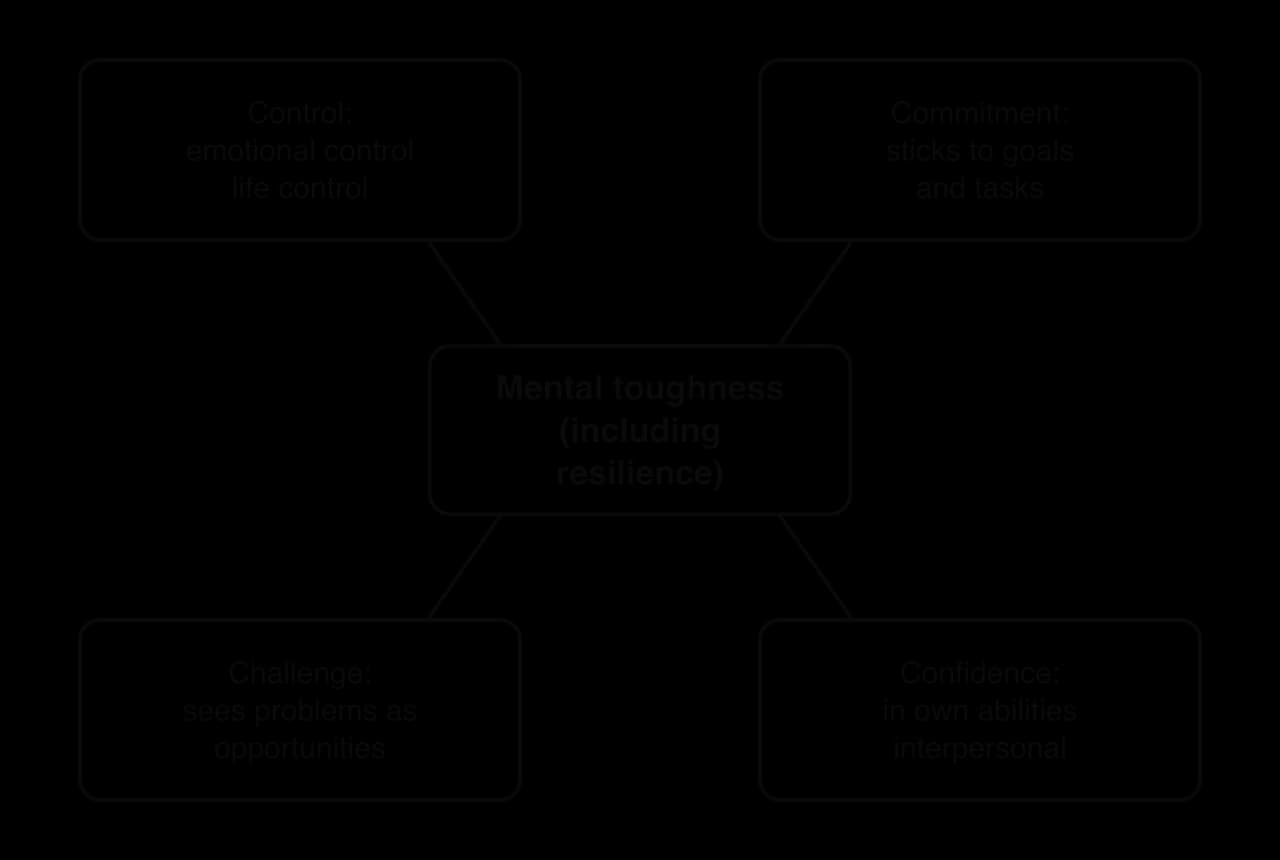
Describe mental toughness with the 4Cs model, distinguish it from resilience, evaluate how it is measured and developed and, at HL, explain the self-fulfilling prophecy, learned helplessness, health links and attribution theory.
Each is in the SEHS glossary, with every other term in the subject.
A model that describes mental toughness as four components: challenge, commitment, control (emotional and life control) and confidence (in one’s abilities and interpersonal confidence).
The reason an individual gives to explain the cause of an outcome, such as a success or a failure, for example ability, effort, task difficulty or luck.
An intervention that teaches individuals to attribute failure to unstable, controllable causes such as effort or strategy, rather than to stable, uncontrollable causes such as lack of ability.
A theory describing how individuals explain the causes of their successes and failures, and how these explanations affect their emotions, expectations, confidence and future behaviour.
A syndrome of physical and emotional exhaustion, reduced sense of accomplishment and devaluation of sport, caused by long-term stress when demands exceed an athlete’s resources.
The component of mental toughness describing the tendency to appraise difficult situations, change and setbacks as opportunities for growth rather than as threats.
Outline what mental toughness is and why it is described as an aspect of personality.
Describe the 4Cs model of mental toughness: challenge, commitment, confidence and control.
Distinguish between mental toughness and resilience.
Explain how mental toughness contributes to performance in high-pressure situations.
Discuss the evidence that mental toughness is partly genetic and can be developed through training.
Evaluate the measurement of mental toughness by self-report questionnaires, including the difference between correlation and causation.
Explain the self-fulfilling prophecy, self-efficacy and learned helplessness in sport (HL).
Discuss the association between mental toughness and depressive symptoms, burnout and sleep quality (HL).
Apply attribution theory, using locus of control and stability, to explain changes in confidence after success and failure (HL).
Mental toughness is the aspect of personality that partly explains why some individuals keep performing well, and keep trying, when conditions are difficult, pressure is high or things go wrong. It is one of the most widely used terms in sport, from coaches praising a player who scores a late winner to commentators describing a tennis player who saves match points.
The concept matters through both lenses. In performance contexts it is linked to persistence in hard training, consistency under pressure and recovery from errors. In health contexts it is linked to how people cope with stress, and research on adolescents and young athletes links higher mental toughness to fewer depressive and burnout symptoms and better sleep. A responsible use of the idea also recognises its limits: being “tough” should never mean ignoring injury or avoiding help.
With a free account, Augment remembers where you stopped and what you have practiced.
The component of mental toughness describing an individual’s tendency to set goals and persist with tasks until they are completed, despite obstacles and setbacks.
The component of mental toughness describing an individual’s belief in their own abilities to succeed and their assertiveness with others (interpersonal confidence).
The component of mental toughness describing perceived control over one’s emotions (emotional control) and the belief that one can influence events and outcomes through one’s own actions (life control).
A state in which an individual, after repeated failure or uncontrollable experiences, believes that their actions cannot change future outcomes and therefore stops trying.
The dimension of attribution describing whether the cause of an outcome is seen as internal (within the individual) or external (outside the individual); also called locus of causality.
The dimension of attribution describing whether the cause of an outcome is seen as stable (unlikely to change over time) or unstable (likely to change); it affects expectations of future success.
A relatively stable personality characteristic that can nevertheless be changed or developed over time through experience, training and the environment.
A response to failure in which an individual attributes the failure to changeable, controllable causes, keeps positive expectations and increases effort and persistence.
An aspect of personality that partly explains how individuals manage challenging and pressurised situations, including how they appraise challenges and remain committed, confident and in control under pressure.
A 48-item self-report questionnaire, based on the 4Cs model, that measures overall mental toughness and its components of challenge, commitment, control and confidence; the MTQ10 is a 10-item version.
The improvement in a person’s performance that results from the higher expectations that another person, such as a teacher or coach, holds for them.
The ability to adapt positively to and recover from adversity, setbacks or stress, returning to previous levels of functioning or performance; one part of mental toughness.
A person’s belief in their ability to perform a specific task or succeed in a specific situation, built mainly from past performance accomplishments.
An expectation about a person or outcome that changes behaviour in a way that makes the expectation come true; in sport, confidence leads to more effort and persistence and so to success.
The tendency to attribute success to internal causes and failure to external causes, which protects self-esteem but can prevent learning from failure.
Researchers have defined mental toughness in several ways, but the definitions share a core. In an influential interview study with elite performers, Graham Jones, Sheldon Hanton and Declan Connaughton described mental toughness as a natural or developed psychological edge that allows performers to cope better than their opponents with the demands of sport, and to be more consistent than opponents in staying determined, focused, confident and in control under pressure. Peter Clough and colleagues defined it as a personality trait that determines, in large part, how individuals deal with challenge, stressors and pressure, whatever the circumstances.
Sources: Jones, Hanton and Connaughton, Journal of Applied Sport Psychology, 2002; Clough, Earle and Sewell, in Solutions in Sport Psychology, 2002.
Two features of these definitions matter. First, mental toughness is treated as an aspect of personality, so it is relatively stable and shows itself across many situations, not just in one match. Second, it is described as partly explaining performance under pressure. Skill, fitness, tactics and the situation still matter, and a mentally tough athlete can still lose, make errors or feel anxious.
The most widely used model of mental toughness is the 4Cs model of Peter Clough, Keith Earle and David Sewell. It describes mental toughness as four related components: challenge, commitment, control and confidence. Control and confidence are each divided into two subcomponents.
Challenge is the extent to which an individual sees difficult situations, change and setbacks as opportunities to learn and improve rather than as threats. A swimmer high in challenge sees a strong new rival as a reason to train better; a swimmer low in challenge sees the same rival as a threat to avoid. This component is often called the appraisal of challenges, and it is closely linked to challenge appraisal in the study of stress.
Commitment is the tendency to stick to goals and tasks, to see them through despite difficulty, and to keep going when progress is slow. A committed marathon runner completes long winter training runs in bad weather because the long-term goal matters more than short-term discomfort.
Control is the extent to which individuals feel that they can influence what happens to them (perceived control). Clough’s model divides it into emotional control, the ability to manage one’s emotions and not show anxiety or frustration to opponents, and life control, the belief that one can shape events and outcomes in one’s life through one’s own actions.
Perceived control matters even in situations that look like chance. Football players and coaches often call penalty shoot-outs a “lottery”. A review of research on shoot-outs argued that this belief reduces players’ perceived control, increases anxiety and discourages preparation, and recommended that players prepare a routine and a clear plan for each kick to regain a sense of control.
Sources: Wood, Jordet and Wilson, Journal of Sports Sciences, 2015.
Confidence is a belief in one’s ability to succeed. Clough’s model divides it into confidence in abilities, the belief that one has the skills to perform well, and interpersonal confidence, being assertive and not being intimidated by others, such as an aggressive opponent or a hostile crowd.
Component | High score: typical behaviour | Low score: typical behaviour |
|---|---|---|
Challenge | Welcomes a strong opponent or a change of coach as a chance to improve | Sees new or difficult situations as threats; prefers routine |
Commitment | Completes demanding training plans; sticks to rehabilitation exercises | Gives up on goals when progress is slow or training is uncomfortable |
Control (emotional) | Stays composed after a bad call; hides frustration from opponents | Emotional reactions disrupt technique and decisions |
Control (life) | Believes preparation and effort shape results | Believes results depend on luck, officials or others |
Confidence (abilities) | Wants the ball at a decisive moment | Avoids responsibility for key moments |
Confidence (interpersonal) | Holds position against intimidating opponents or crowds | Is easily intimidated or withdrawn in conflict |
Resilience is the ability to recover from or adapt positively to adversity, such as a serious injury, deselection or a heavy defeat. It is often described as “bouncing back”. Resilience is usually treated as one part of mental toughness, together with the appraisal of challenges, commitment, confidence and perceived control.
The two ideas overlap but are not identical. Resilience focuses on recovery after something goes wrong. Mental toughness is broader: it also covers how individuals approach demanding situations before and during them, and their ability to keep performing well, or even improve, under pressure. A gymnast who returns to competition after a long injury shows resilience; the same gymnast executing a difficult routine with a medal at stake shows mental toughness.
Feature | Resilience | Mental toughness |
|---|---|---|
Main focus | Recovering from adversity (“bouncing back”) | Thriving in and managing demanding, pressurised situations |
Timing | Mainly after a setback | Before, during and after demanding situations |
Outcome | Return to previous functioning | Consistent or improved performance under pressure |
Example | A footballer returning to the team after a cruciate ligament injury | The same footballer taking the decisive penalty in a shoot-out |
Pressure situations share some features: an important outcome, an audience, evaluation by others and uncertainty. These features raise arousal and anxiety, narrow attention and can disrupt well-learned skills. Mental toughness is thought to help athletes in these moments through a chain of psychological processes.
Appraisal: a mentally tough athlete is more likely to appraise the situation as a challenge rather than a threat, which is linked to a more helpful interpretation of anxiety symptoms.
Control of emotions and attention: emotional control allows the athlete to stay focused on task-relevant cues instead of worrying about the outcome.
Confidence: belief in one’s ability supports decisive action, such as committing to a shot rather than hesitating.
Commitment and persistence: the athlete keeps trying after an error, a missed chance or falling behind, which keeps the possibility of success open.
Examples are easy to find in sport, such as closing out a tight match, recovering after conceding an early goal, or converting a decisive penalty. Care is needed with such examples, because a single successful moment does not prove that an athlete is mentally tough: the outcome also depends on skill, fatigue and the opponent. Research therefore looks for patterns across many athletes and situations, often by measuring persistence on demanding physical tasks.
Mental toughness also links to other areas of sport psychology. It overlaps with coping (mentally tough athletes tend to use more problem-focused strategies), with attentional control under pressure (resisting attentional narrowing) and with motivation. These links are one reason it is described as an aspect of personality rather than a separate skill.
Mental toughness is described as a malleable trait: like other personality traits it is relatively stable, but it can be developed, especially over long periods. Two kinds of evidence support this view, twin studies of its genetic basis and studies of how it develops through training and experience.
The first behavioural genetic study of mental toughness tested 219 pairs of adult identical and non-identical twins from North America with the MTQ48 questionnaire. Individual differences in mental toughness, like those in the Big Five personality traits, were largely explained by genetic factors and by environmental experiences unique to each twin (non-shared environment), rather than by the family environment the twins shared. A second twin analysis combined the Big Five traits with four mental toughness scales and found a single general factor of personality that was also explained by genetic and non-shared environmental factors, which suggests that mental toughness and the Big Five share genetic influences.
Sources: Horsburgh, Schermer, Veselka and Vernon, Personality and Individual Differences, 2009; Veselka et al., Twin Research and Human Genetics, 2009.
This supports the idea that mental toughness is part of personality: genes influence personality traits such as emotional stability, and these traits in turn contribute to mental toughness. It does not mean that mental toughness is fixed. The large role of non-shared environment shows that individual experiences, such as coaching, injuries and competition, also matter.
Coaches and sport psychologists aim to develop mental toughness in several ways. These approaches are based mainly on interviews with elite athletes and coaches and on intervention studies with small samples, so the evidence is promising but not conclusive.
Approach | How it works | Example |
|---|---|---|
Exposure to pressure in training | Gradually increases familiarity with pressure so that it is appraised as a challenge | Penalty practice with consequences, an audience or video recording; simulated match scenarios |
Psychological skills training | Gives athletes tools to control emotions, attention and confidence | Goal setting, self-talk, imagery and relaxation techniques practised regularly |
Challenging and supportive coaching | High expectations combined with support build commitment and confidence without threat | Demanding sessions followed by clear, specific feedback and encouragement |
Reflection and reappraisal | Helps athletes interpret setbacks as learning opportunities | Structured post-match reviews focusing on controllable factors |
Graded adversity | Builds resilience through manageable difficulties rather than overwhelming ones | Training in poor weather, playing a man down, competing against older age groups |
Mental toughness scores do change. In a randomised trial of inpatients with depression, self-reported mental toughness rose during six weeks of either aerobic exercise or stretching added to treatment, and the improvement was still present six months later. Because both groups improved, the study shows that the scores changed but cannot show what caused the change.
Sources: Imboden et al., Journal of Affective Disorders, 2020.
Mental toughness is difficult to observe directly. An athlete may look calm and still be very anxious, or may succeed for reasons unrelated to mental toughness. It is therefore usually measured by self-report questionnaire, in which athletes rate statements about themselves.
Questionnaire | Items | What it measures |
|---|---|---|
MTQ48 (Mental Toughness Questionnaire 48) | 48 | The 4Cs with the subscales of control and confidence; total score |
MTQ10 | 10 | A short version giving an overall score |
SMTQ (Sports Mental Toughness Questionnaire) | 14 | Confidence, constancy and control in sport |
MTI (Mental Toughness Index) | 8 | A single overall mental toughness score |
The MTQ48 is the most widely used. Participants rate each of the 48 statements on a five-point scale from “strongly disagree” to “strongly agree”, for example statements about whether they usually find something to motivate them or whether they tend to worry about things they cannot control. Some items are reverse-scored, and the items for each scale are combined to give scores for challenge, commitment, control and confidence and a total.
Social desirability bias: athletes, especially in selection settings, may want to appear tough and rate themselves highly.
Self-awareness: athletes may not judge their own behaviour under pressure accurately; a self-image of toughness may differ from behaviour in a match.
Context: questionnaires are usually completed in calm conditions, not under the pressure they describe.
Construct definition: researchers still disagree about exactly what mental toughness includes, so different questionnaires measure slightly different things.
To check whether a questionnaire is valid, researchers compare scores with behaviour, such as how long participants persist on a demanding physical task or how coaches rate their athletes. When scores predict such behaviour, the questionnaire is said to have criterion validity. The strength of such a relationship is usually reported as a correlation coefficient, r.
Most research on mental toughness is correlational: it measures mental toughness and an outcome at the same time and calculates the relationship. A correlation between mental toughness and performance could mean that mental toughness improves performance, that success increases mental toughness (winning makes athletes feel more confident and in control), or that a third variable, such as fitness or experience, raises both. Correlation alone cannot establish causation.
Stronger causal evidence would come from experiments. Athletes could be randomly allocated to a mental toughness training programme or to a control programme of equal length and attention (a placebo-style comparison). Performance under pressure would then be measured by assessors who do not know which group each athlete is in (single blinding), and ideally the athletes would not know which programme is the “real” intervention (double blinding). Such studies are difficult to run in sport, which is why much of the evidence remains correlational.
 YouTube
A self-fulfilling prophecy is an expectation that causes the behaviour that makes it come true. In sport, the theory suggests that an athlete’s perceived self-confidence leads to greater persistence and effort, which increases the probability of eventual success. The expectation may come from the athlete or from others, such as a coach, a parent or the media.
In a classic study in an American primary school, Robert Rosenthal and Lenore Jacobson told teachers that certain pupils were likely to show unusual intellectual growth. The pupils had in fact been chosen at random. By the end of the year, the selected pupils showed greater gains in IQ scores than other pupils, which suggested that the teachers’ raised expectations had changed how they treated these children. This effect of others’ high expectations is called the Pygmalion effect. Later reanalyses and replications found expectancy effects to be real but generally smaller and less consistent than the original study suggested.
Sources: Rosenthal and Jacobson, Pygmalion in the Classroom, 1968; Horn, Journal of Sport Psychology, 1984.
Research on coaches, including Thelma Horn’s studies of school sports teams, has examined how coaching expectations work in sport. Coaches form expectations from cues such as an athlete’s past performance, physique, reputation or even age group. They may then, often without realising it, treat high-expectancy athletes differently: giving them more playing time, more specific technical instruction and more encouragement after errors. Over time these differences can change the athletes’ confidence, effort and skill, so that the original expectation is confirmed.
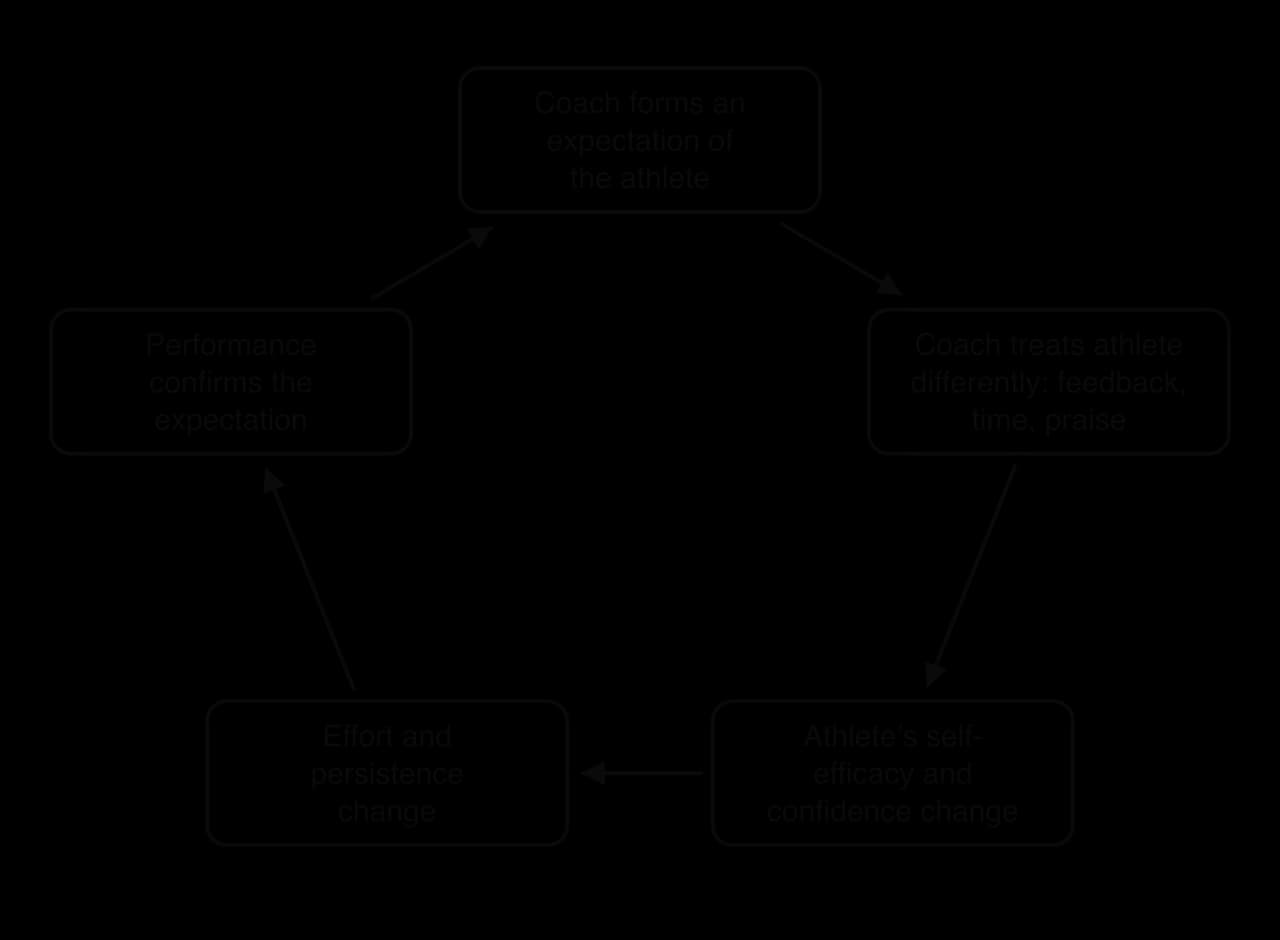
The same process can work negatively. A coach who decides that a young player “lacks ability” may give less feedback and fewer chances, and the player’s confidence and effort fall, confirming the coach’s view. This negative version is sometimes called the Golem effect. Coaches can reduce it by basing expectations on current, specific evidence, by reviewing their expectations regularly and by giving every athlete specific feedback and opportunities.
Albert Bandura’s concept of self-efficacy explains where confidence comes from. Self-efficacy is a person’s belief in their ability to succeed in a specific task or situation, such as “I can make this free throw” or “I can complete this 10 km run”. It is situation-specific: a basketball player may have high self-efficacy for free throws and low self-efficacy for three-point shots.
Bandura identified four sources of self-efficacy, which coaches can use deliberately:
Source | Description | Coaching example |
|---|---|---|
Performance accomplishments | Past success at the task; the strongest source | Progressions that let a gymnast succeed at simpler versions before the full skill |
Vicarious experiences | Seeing similar others succeed (modelling) | Watching a teammate of similar ability perform the skill |
Verbal persuasion | Encouragement and feedback from others | A coach telling a swimmer, with reasons, that they are ready for the race |
Emotional and physiological states | How arousal and emotions are interpreted | Teaching athletes to interpret a raised heart rate as readiness, not fear |
Self-efficacy links the self-fulfilling prophecy to persistence. An athlete with high self-efficacy expects to succeed, so they choose difficult tasks, work harder and persist longer after failure. This makes success more likely, and success in turn raises self-efficacy through performance accomplishments.
 YouTube
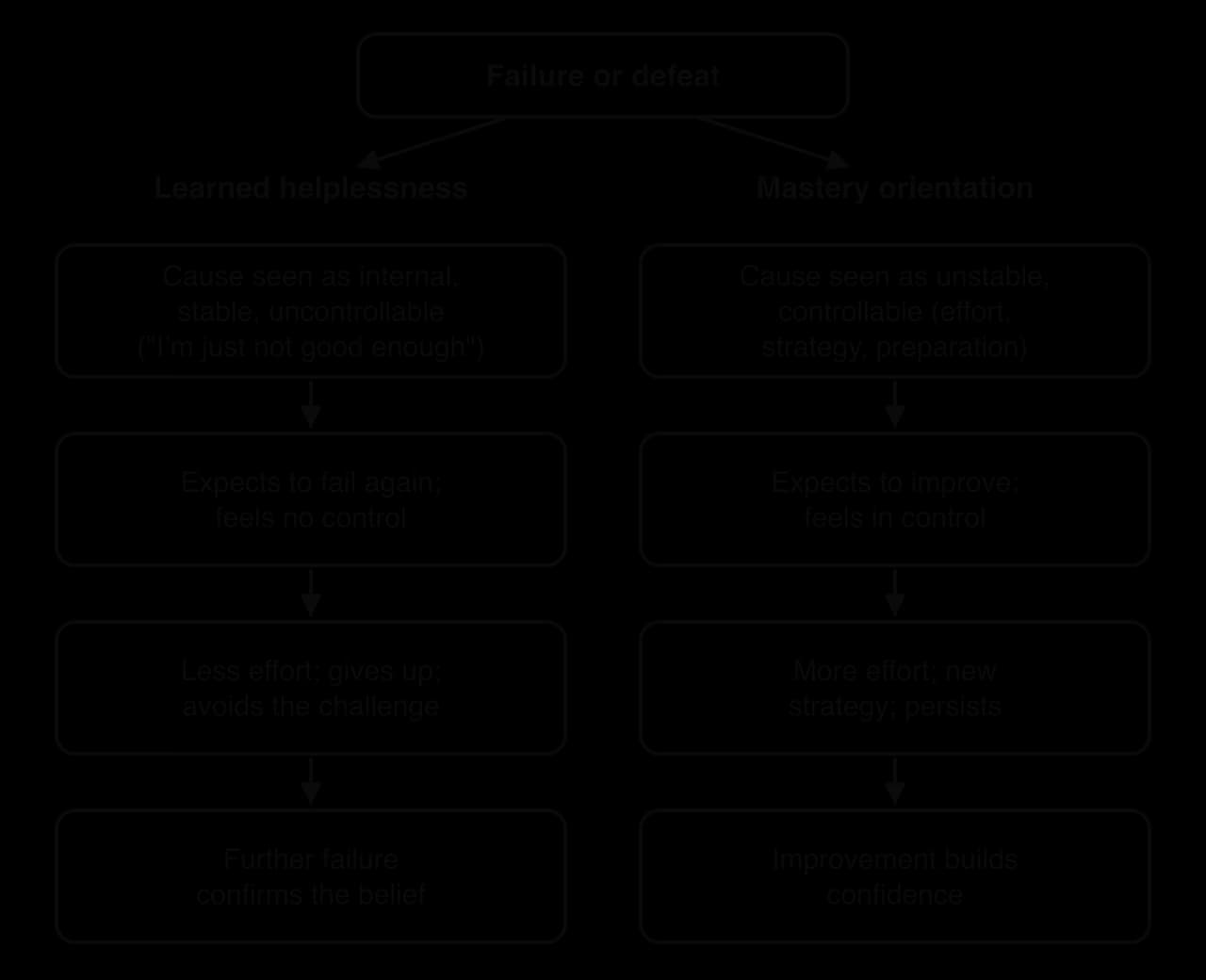
Learned helplessness is a state in which an individual believes that their actions have no influence on outcomes, so they stop trying. The concept comes from experiments by Martin Seligman and Steven Maier in which dogs that had been exposed to electric shocks they could not escape later failed to escape shocks when escape was easy. The key factor was not the unpleasant experience itself but the lack of control over it.
Sources: Seligman and Maier, Journal of Experimental Psychology, 1967.
In sport, learned helplessness develops when an athlete or team repeatedly fails and explains the failure by causes they cannot control, such as a lack of natural ability. It can be specific, limited to one skill or opponent (“I can never return his serve”), or general, spreading across a whole sport or activity (“I am useless at sport”). General helplessness is especially damaging for health, because it leads people to avoid physical activity altogether.
Research on penalty shoot-outs illustrates helplessness at team level. An analysis of every shoot-out in World Cups and European Championships between 1976 and 2006 (260 players, 309 kicks) found that players from countries with a history of losing shoot-outs performed worse, and took their kicks more quickly, than players from countries with a history of winning them, even after controlling for team ability. The effect appeared even in players who had not taken part in the earlier losses.
Sources: Jordet, Hartman and Vuijk, British Journal of Psychology, 2012.
The researchers interpreted the results mainly as choking under pressure linked to the team’s history, and the study is observational. The pattern is still consistent with learned helplessness: a shared belief that “we always lose on penalties” reduces perceived control and may change preparation and behaviour, such as rushing the kick to escape the situation. It also shows how expectations can be learned socially, not only from personal experience.
The opposite of learned helplessness is a mastery orientation. A mastery-oriented athlete explains failure by causes they can change, such as effort, preparation or strategy, so failure leads to more effort and new approaches rather than giving up.
Set achievable, specific goals so that athletes experience success and build self-efficacy.
Emphasise improvement and effort rather than only results, creating a mastery climate.
Help athletes attribute failure to controllable, unstable causes such as effort and tactics (attribution retraining).
Break skills into progressions so that early success is possible.
Use positive role models of similar ability (vicarious experience).
Rehearse high-pressure situations, such as shoot-outs, so that athletes have a plan and a sense of control.
Mental toughness was first studied for its links with performance, but much recent research concerns mental health. This matters because young athletes face the same mental health risks as other young people, plus sport-specific stressors such as selection, injury and high training loads.
Burnout in athletes is a syndrome of physical and emotional exhaustion, a reduced sense of accomplishment and a devaluation of the sport, which develops when demands exceed resources over a long period. It is one cause of dropout and can overlap with depressive symptoms.
A prospective study of 257 young elite athletes in Switzerland (average age about 17, 36% female) measured perceived stress, mental toughness (with the MTQ), burnout and depressive symptoms, and followed 197 of them for six months. About 12% reported burnout symptoms and about 9% depressive symptoms at levels of potential clinical relevance. Under high stress, athletes with higher mental toughness reported significantly fewer mental health problems than those with lower mental toughness. Under low stress, mental toughness made no difference.
Sources: Gerber et al., Journal of Science and Medicine in Sport, 2018.
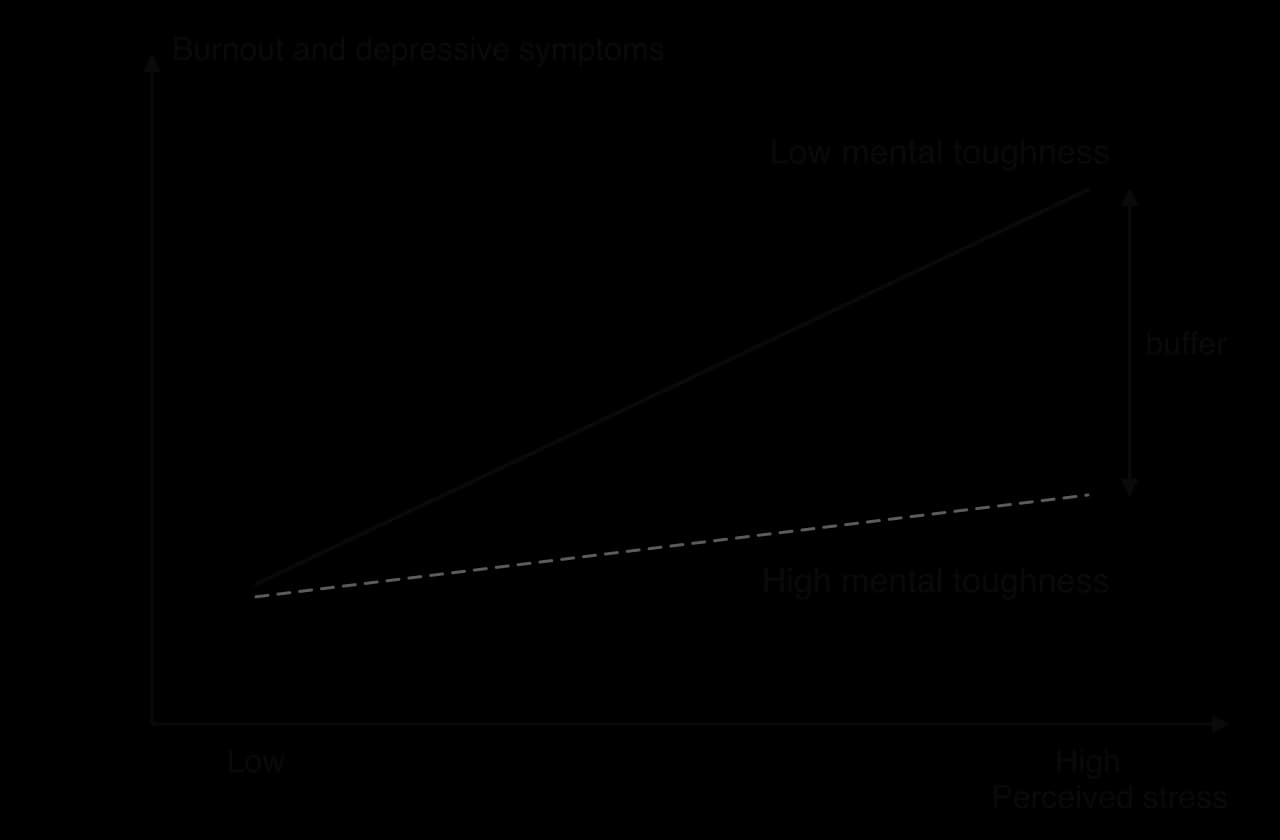
This pattern is called stress-buffering: mental toughness does not prevent stress, but reduces its harmful effects. Possible mechanisms include appraisal (stressors seen as challenges rather than threats), coping (more problem-focused coping and less avoidance), confidence and perceived control (which protect against hopelessness), and better sleep.
In a study of 92 adolescents (average age about 19), participants completed the Mental Toughness Questionnaire and their sleep was recorded with sleep electroencephalograms (EEG), an objective measure of brain activity during sleep. Compared with those low in mental toughness, those high in mental toughness had higher sleep efficiency, fewer awakenings after falling asleep, less light sleep and more deep sleep, and reported less daytime sleepiness.
Sources: Brand et al., Journal of Adolescent Health, 2014.
The use of EEG is a strength because it does not rely on self-report for sleep. The authors suggested that the relationship is probably bidirectional: mentally tough adolescents may worry less at night and so sleep better, while good sleep improves emotional regulation and confidence the next day. Sleep is also central to recovery from training, which links mental toughness to the physiology of sleep hygiene and recovery.
Most studies are correlational or prospective, not experimental, so they do not show that raising mental toughness would improve health.
Mental toughness, stress, burnout and depressive symptoms are usually all self-reported, so shared biases (such as a generally negative or positive response style) can inflate correlations.
Samples are often adolescents or young athletes from a few European countries.
Mental toughness overlaps with traits such as low neuroticism, which is itself strongly linked to depression; it is unclear how much mental toughness adds.
A narrow idea of toughness can harm health. In some sporting cultures, admitting pain, anxiety or low mood is seen as weakness. Athletes may then hide injuries, train while ill, avoid seeking social support and delay getting help for mental health problems. Several high-profile athletes have spoken publicly about withdrawing from competition or seeking help for their mental health, which has helped change these attitudes.
Properly understood, mental toughness includes recognising when a situation needs help and acting on it. Seeking support from a coach, a sport psychologist or a doctor is an active coping response: it is problem-focused when the athlete seeks information or practical help, and emotion-focused when the athlete seeks emotional support. Either way it is consistent with the control and commitment components of the 4Cs.
After every match or performance, athletes and coaches explain what happened: “we won because we worked harder”, “I lost because the wind was against me”. These explanations are called attributions. Attribution theory studies the types of explanation people give and how these affect their emotions, expectations, confidence and future effort.
The theory built on these explanations asks two questions: what kinds of reason people give, and what those reasons lead to.
Bernard Weiner classified attributions on two main dimensions. The locus of control (also called the locus of causality) describes whether the cause is internal (within the person, such as ability or effort) or external (outside the person, such as luck, the opponent or the referee). The locus of stability describes whether the cause is stable (unlikely to change, such as ability or task difficulty) or unstable (likely to change, such as effort or luck).
Stability is the second, independent dimension, so every attribution has both a locus and a stability.
Weiner later added a third dimension, controllability: whether the cause is under the individual’s control. Effort is internal, unstable and controllable; ability is internal and stable but generally seen as uncontrollable. Combining the first two dimensions gives a 2×2 grid with four classic attributions.
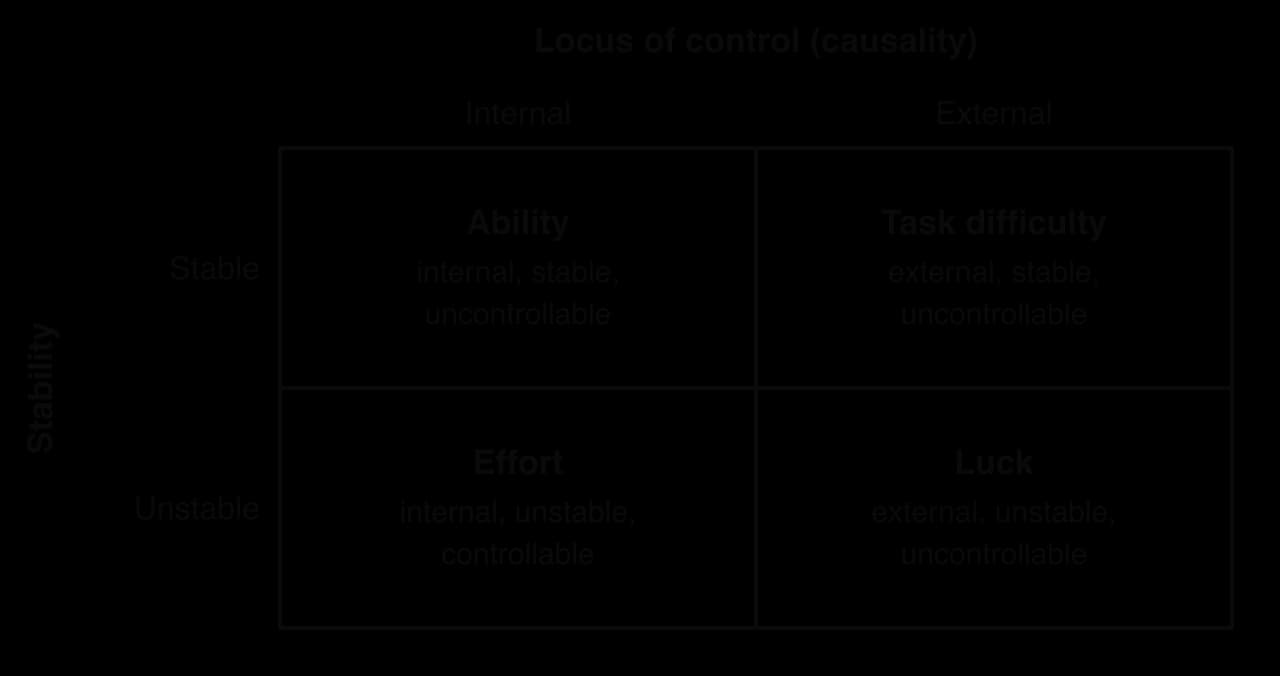
Attribution | Locus of control | Stability | Controllable? | Example after a defeat |
|---|---|---|---|---|
Ability | Internal | Stable | No | “I am just not good enough at this level.” |
Effort | Internal | Unstable | Yes | “I didn’t work hard enough in the second half.” |
Task difficulty | External | Stable | No | “They are the best team in the league.” |
Luck | External | Unstable | No | “The ball hit the post twice.” |
The two dimensions affect different things. Stability affects expectations of future success. If a result is attributed to a stable cause, the athlete expects the same result next time; if it is attributed to an unstable cause, the next result could be different. The locus of control affects emotions. Internal attributions produce stronger emotions: pride after success, shame or guilt after failure. External attributions produce weaker emotions.
Together these explain why some attributions build confidence and others destroy it. Attributing success to ability (internal, stable) gives pride and a high expectation of future success, so confidence rises. Attributing failure to lack of ability (internal, stable, uncontrollable) gives shame and an expectation of future failure, so confidence falls; repeated over time, this pattern leads to learned helplessness. Attributing failure to lack of effort or a poor tactic (unstable, controllable) keeps expectations positive, because the cause can be changed.
People tend to attribute their successes to internal causes (ability, effort) and their failures to external causes (luck, officials, conditions). This self-serving bias protects self-esteem and is common among athletes and coaches, for example a coach who credits a win to the team’s preparation but blames a loss on the referee.
In the short term, the bias protects confidence. In the long term it can prevent learning: an athlete who always blames external factors never identifies the controllable weaknesses that caused the defeat. Blaming luck also reduces perceived control, which links back to the view of penalty shoot-outs as a “lottery”.
Attribution retraining teaches individuals to replace dysfunctional attributions, especially attributing failure to stable, uncontrollable causes such as lack of ability, with functional ones, especially attributing failure to unstable, controllable causes such as effort and strategy. The aim is to keep expectations of success high, protect confidence and prevent learned helplessness.
In one study, 35 beginner tennis players were guided to attribute their performance on a tennis skill task to controllable, unstable factors, to uncontrollable, stable factors, or to no specific factors, while receiving fictitious failure feedback over four sessions. Players’ attributions could be changed, the new attributions were still present three weeks later and transferred to a different tennis task, and players who adopted more functional attributions had higher expectations of future success and more positive emotions.
Sources: Orbach, Singer and Price, The Sport Psychologist, 1999.
In practice, coaches use attribution retraining in post-match reviews. Instead of accepting “we were unlucky” or “I’m just not good enough”, the coach guides the athlete towards specific, controllable causes (“the second serve percentage dropped when the player rushed between points”) and towards a plan to change them. After success, the coach encourages attributions to both ability and effort, which builds confidence while keeping the athlete working.
If mental toughness partly explains how people manage challenging situations, mentally tough individuals should keep going for longer when a physical task becomes painful or exhausting. Researchers have tested this by comparing self-reported mental toughness with performance on tests that require persistence, which also checks the criterion validity of the questionnaires. Three studies show how the evidence has developed.
Study | Participants | Mental toughness measure and task | Main finding |
|---|---|---|---|
Crust and Clough (2005) | 41 male sports students, UK | MTQ48; time a weight could be held at arm’s length | Total mental toughness correlated with endurance time, r = 0.34 (significant) |
Gucciardi et al. (2016) | 330 male Australian footballers aged 15–18 | Self-report questionnaire; 20 m multistage shuttle run test | 95% probability that the correlation lay between 0.14 and 0.34, after controlling for age, height, body mass and playing experience |
Giles et al. (2018) | 38 male Australian footballers, mean age 21 | Self-report; shuttle run test when fresh and after a 60 min simulated game circuit | Mental toughness was associated with perseverance when fresh, but not when fatigued; fitness then mattered more |
Sources: Crust and Clough, Perceptual and Motor Skills, 2005; Gucciardi et al., Journal of Science and Medicine in Sport, 2016; Giles et al., Journal of Science and Medicine in Sport, 2018.
The first study supported the idea that the MTQ48 measures something related to physical persistence: students who described themselves as more mentally tough held a weight for longer. Squaring r = 0.34 gives R² ≈ 0.12, so mental toughness accounted for about 12% of the differences in endurance time. The sample was small, all male and all sports students, so the result could not be generalised far.
A second, much larger study used a sample of young footballers in a natural testing setting. The multistage shuttle run (often called the beep test) is a maximal test, so how long a player keeps going after it becomes very uncomfortable depends partly on willingness to persevere. By controlling for age, height, body mass and experience, the researchers ruled out some obvious confounding variables. They also used Bayesian statistics, which combined their new data with earlier findings. The association was positive but small to moderate.
The third study tested whether the relationship holds in a more game-like situation. After a 60-minute circuit designed to simulate the fatigue of a match, the link between mental toughness and shuttle run performance disappeared, and aerobic fitness (measured as peak oxygen consumption, closely related to VO₂ max) became the more important factor. The authors concluded that mental toughness is a salient correlate of perseverance in some situations but not all, and that underlying fitness can outweigh it when athletes are fatigued.
Together the studies illustrate several features of the nature of science. Evidence accumulated across studies with larger and more varied samples, and a later study tested the limits of an earlier claim. All three relied on self-reported mental toughness and were correlational, so they cannot show that mental toughness causes longer persistence: a third factor, such as pain tolerance or competitive experience, could explain both. Their samples were all male, which limits how far the findings apply to female athletes. They also show the interaction of psychology and physiology: a psychological trait matters most when physiological capacity is not the limiting factor.
Using the table, compare the sample sizes of the three studies and explain why sample size affects confidence in a correlation.
Suggest why the link between mental toughness and perseverance disappeared when players were fatigued.
Suggest how an experiment, with random allocation and blinding, could test whether mental toughness training causes longer persistence on a maximal test.
Sources: Crust and Clough, 2005; Gucciardi, Peeling, Ducker and Dawson, 2016; Giles et al., 2018.
Mental toughness appears in Paper 1A as definitions and components of the 4Cs, in Paper 1B as data from questionnaire or intervention studies (often testing correlation and causation), and in Paper 2 as descriptions of the components and extended discussions of whether mental toughness can be developed. At HL, Paper 2 can also ask about the self-fulfilling prophecy, learned helplessness, health and attribution theory.
Questions on measurement test whether you understand why mental toughness is hard to study.
At HL, multiple-choice questions often ask you to place an attribution in Weiner’s grid.
Paper 1B: Twenty-four university hockey players were randomly allocated to an eight-week mental toughness training programme (pressure training and psychological skills) or a control group that attended team-building talks of the same length. Mental toughness was measured with the MTQ48 (scale 1–5) before and after the eight weeks (hypothetical data).
Group | MTQ48 before (mean ± SD) | MTQ48 after (mean ± SD) |
|---|---|---|
Training (n = 12) | 3.2 ± 0.3 | 3.6 ± 0.3 |
Control (n = 12) | 3.3 ± 0.4 | 3.3 ± 0.4 |
An “explain” question about the genetic basis needs both evidence and its meaning.
Attribution questions often combine the 2×2 grid with a prediction about confidence or helplessness.
Health questions at HL reward named evidence and a comment on its limits.
Mental toughness is an aspect of personality that partly explains how individuals manage challenging and pressurised situations.
The 4Cs model describes mental toughness as challenge, commitment, control (emotional and life) and confidence (in abilities and interpersonal).
Resilience is the ability to recover from adversity; it is one part of the broader concept of mental toughness.
Mental toughness supports performance under pressure through challenge appraisal, emotional and attentional control, confidence and persistence.
It is a malleable trait: partly genetic, but shaped by individual experience and trainable through pressure exposure, psychological skills and supportive coaching.
It is measured by self-report questionnaires such as the MTQ48, which are open to social desirability bias; most evidence is correlational and cannot show causation.
Expectations can become self-fulfilling through their effect on self-efficacy, effort and persistence; repeated uncontrollable failure can produce learned helplessness (HL).
Higher mental toughness is associated with fewer depressive and burnout symptoms under high stress and better sleep, though a narrow “toughness” culture can discourage help-seeking (HL).
Attribution theory classifies explanations by locus of control and stability; attributing failure to unstable, controllable causes protects confidence (HL).
I can define mental toughness and explain why it is an aspect of personality.
I can describe each component of the 4Cs model with a sporting example.
I can distinguish mental toughness from resilience.
I can explain how mental toughness helps performance in a high-pressure situation.
I can discuss the genetic basis of mental toughness and how it can be developed.
I can evaluate self-report measures of mental toughness and explain why correlation does not show causation.
I can explain the self-fulfilling prophecy, the Pygmalion effect and self-efficacy (HL).
I can explain learned helplessness and how coaches can prevent it (HL).
I can outline the evidence linking mental toughness to burnout, depressive symptoms and sleep (HL).
I can classify attributions on Weiner’s grid and predict their effect on confidence (HL).