Describe Nideffer’s attentional styles, internal and external focus, distraction and attentional narrowing, and evaluate the strategies performers use to keep attention on the right cues under pressure.
Each is in the SEHS glossary, with every other term in the subject.
The process of focusing mental resources on selected information from the environment or from within the body, while ignoring other information.
The direction (internal or external) and width (broad or narrow) of a person's attention at a particular moment, meaning what they attend to and how much information they take in.
A reduction in the width of attention as arousal increases, so that fewer cues are processed and, at high arousal, relevant cues are missed.
Attention that takes in a wide range of cues at the same time, used to assess a changing situation or to plan.
A significant drop in the performance of a well-learned skill under pressure, caused by the perceived importance of the situation.
The ability to keep attention on the relevant cues of a task for as long as the task requires, resisting the movement of attention elsewhere.
A training method in which distractions likely in competition are deliberately introduced into practice so that the performer learns to maintain attention despite them.
Define attention, concentration and attentional focus, and outline why attention must be selective.
Describe Nideffer’s model of attentional style, with its two dimensions (width and direction) and four styles, using sporting examples.
Explain why performers must shift attention between styles during a performance.
Distinguish between an internal and an external focus of attention, and evaluate the evidence that an external focus benefits motor performance and learning.
Describe distraction, and distinguish between external (visual and auditory) and internal distractors.
Explain how controlled distraction is used to improve attentional control.
Explain attentional narrowing at high arousal using cue utilisation theory, and link it to choking.
Evaluate self-talk, process goals, pre-performance routines, quiet-eye training and mindfulness as ways to control attentional focus.
Attentional control is the ability to direct attention to the information that matters for a task, keep it there for as long as needed, and move it when the task changes. A penalty taker, a gymnast on the beam and a cyclist in a time trial all need it, because the same movement can succeed or fail depending on what the performer attends to in the second before it starts.
Attention matters through both lenses of the course. For performance, it explains why skilled athletes sometimes miss easy shots under pressure and how training can protect them. For health, the same principles shape how a physiotherapist words instructions for a patient relearning balance after a stroke, and how a beginner can be helped to keep exercising when sessions feel hard.
With a free account, Augment remembers where you stopped and what you have practiced.
Easterbrook's theory that attention narrows as arousal rises: at low arousal irrelevant cues are taken in, at optimal arousal only relevant cues are used, and at high arousal relevant cues are missed.
The movement of attention away from task-relevant cues to information irrelevant to the task, so that concentration is lost.
A visual or auditory stimulus in the environment, such as crowd noise, cameras or an opponent's comments, that draws attention away from task-relevant cues.
Attention directed outside the body, to cues in the environment or to the intended effect of a movement, such as the flight of the ball or the target.
A thought, feeling or sensation within the performer, negative or unrelated to the task, that draws attention away from relevant cues, such as worry about the outcome.
Attention directed inside the body, to thoughts, feelings, mental images or the movements of one's own body parts.
A mental training practice of paying attention, on purpose and without judgement, to present-moment experience, repeatedly noticing when the mind wanders and returning attention to a chosen focus.
Attention focused on one or two specific cues, used when a performer executes a skill or responds to a single target.
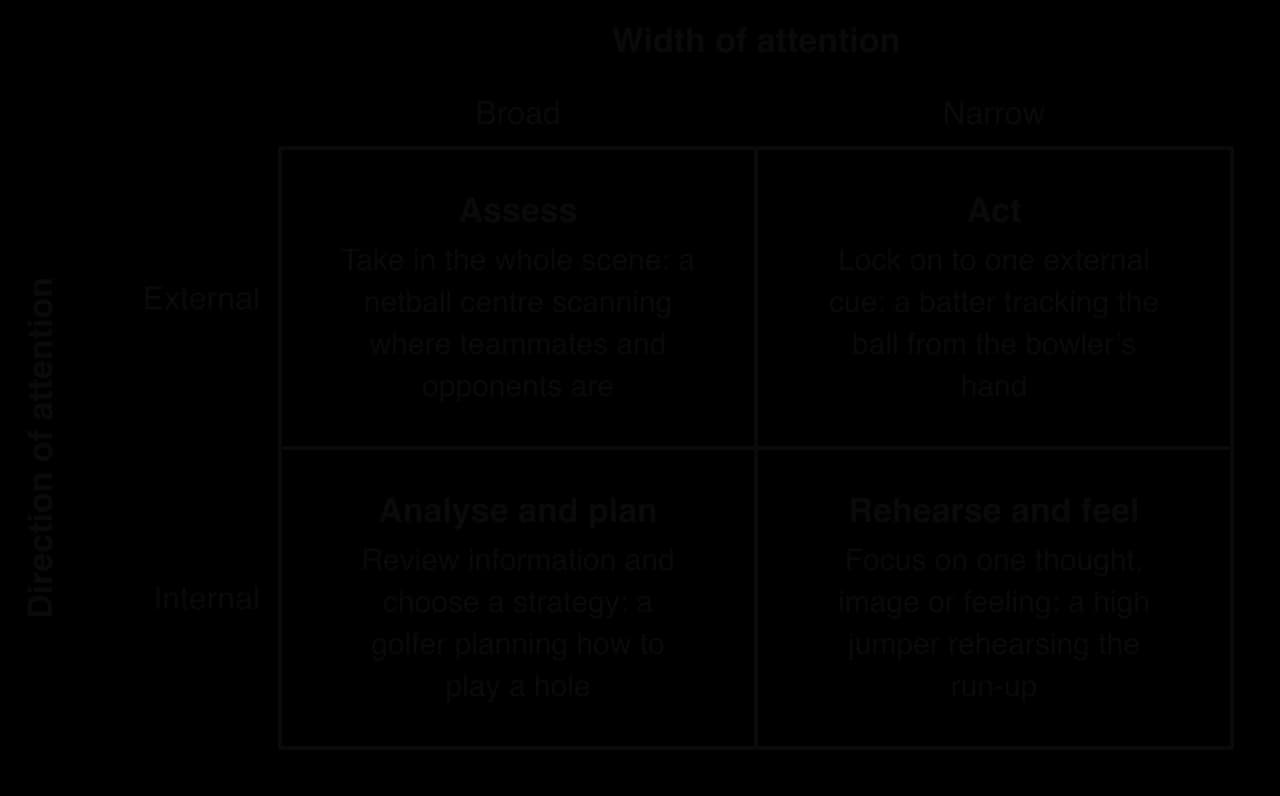
A model describing attention on two dimensions, width (broad or narrow) and direction (internal or external), giving four styles: broad-external (assess), broad-internal (analyse), narrow-internal (rehearse) and narrow-external (act).
A consistent, practised sequence of thoughts and actions carried out before a skill, which directs attention to task-relevant cues and helps control arousal.
The final fixation or tracking gaze on a specific location or object before a movement begins, lasting at least about 100 ms; longer quiet-eye periods are associated with expert and successful performance.
Scope: The syllabus covers attentional focus (internal or external, broad or narrow), distraction and its internal and external sources, controlled distraction, attentional narrowing at high arousal, and the use of self-talk and goal setting to control attention. The subtopic is the same at SL and HL.
A performer is surrounded by far more information than the brain can process at once: the flight of the ball, the positions of ten other players, the crowd, the coach’s shouts, the feeling of the legs and a stream of thoughts. In the information processing model, only a small part of this information is passed on from the sensory stores for processing. The process that picks it out is selective attention, which filters relevant information from irrelevant information.
Attention has a limited capacity. When a task is new, it uses most of that capacity, which is why a beginner in the cognitive phase cannot dribble a basketball and look up at the same time. As a skill becomes automatic in the autonomous phase, it needs much less attention, and the freed capacity can be used to read the game.
The two terms are closely related. Attention describes where mental resources are directed at a given moment; concentration describes how well that direction is maintained over time. A tennis player needs concentration for a three-hour match, but within each rally attention must move quickly between the opponent’s racket, the ball and the open court.
Robert Nideffer described attention along two independent dimensions. Combining them gives four attentional styles, and each style suits a different part of a sporting task. The model is usually drawn as a two-by-two grid, often called Nideffer’s attentional styles.
The width of attention is the amount of information attended to. Broad attention takes in many cues at once, such as the positions of all the players on a pitch. Narrow attention focuses on one or two cues only, such as the seams of a cricket ball or the centre of a target.
Neither width is better in general. A quarterback scanning the field needs broad attention for a second or two; the same quarterback needs narrow attention on the receiver as the ball is released.
The direction of attention is whether it is aimed outwards or inwards. An external focus is directed to the environment: the ball, an opponent, a target, the effect of a movement on an object. An internal focus is directed to the performer’s own thoughts, feelings, images and body movements.
An internal focus is not a sign of poor concentration. Planning a tactic, rehearsing a movement in the mind and controlling breathing are all internal, and all are useful at the right moment.
Each combination of width and direction is suited to a different job. The grid gives a short name for each style and a sporting example.
Style | Main purpose | Example |
|---|---|---|
Broad-external | Assess a changing situation quickly | A rugby fly-half reading the defensive line before choosing to pass, kick or run |
Broad-internal | Analyse information and plan | A marathon runner checking pace, fuelling and how the legs feel before deciding when to attack |
Narrow-internal | Mentally rehearse a skill or control emotions | A diver picturing the dive and taking a slow breath on the board |
Narrow-external | Execute the skill by focusing on one or two external cues | An archer aiming at the centre of the target; a goalkeeper tracking the ball |
The demands differ between sports and between positions. Open skills in invasion games, such as a point guard’s passing in basketball, demand frequent broad-external attention because the situation changes constantly. Closed skills such as a golf putt or a gymnastics vault make heavy use of narrow-internal attention in preparation and narrow-external attention in execution. A goalkeeper needs broad-external attention while play is far away and narrow-external attention when a shot is struck.
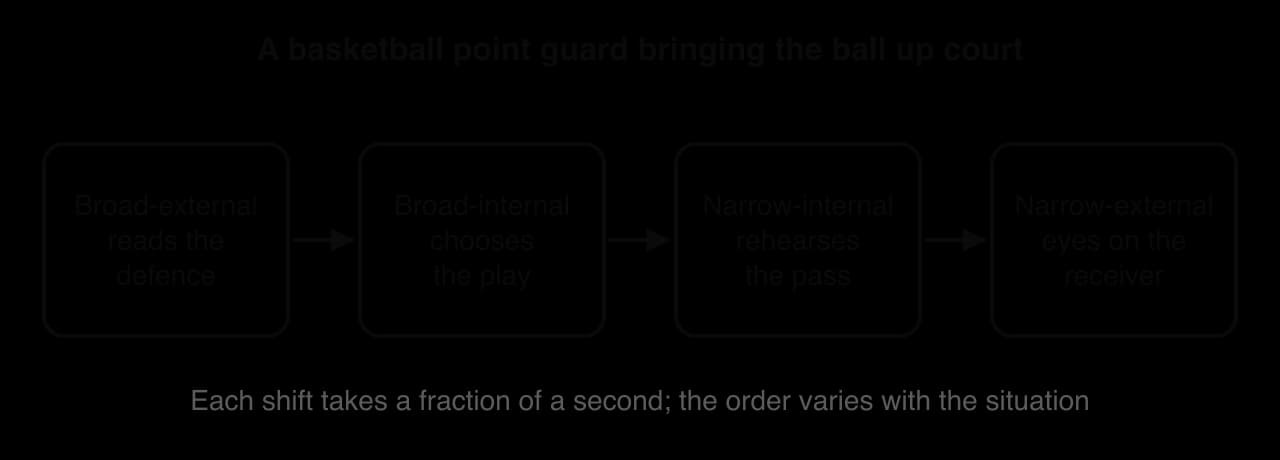
Skilled performance depends less on any single style than on moving between styles at the right time. A point guard bringing the ball up court shifts from reading the defence to choosing a play, to rehearsing the pass and finally to fixing the eyes on the receiver, all within a few seconds. A shift made too late or to the wrong style, such as continuing to plan when the ball should already be released, harms performance.
Nideffer also argued that individuals have a preferred style and that some people are better than others at shifting. He developed the Test of Attentional and Interpersonal Style (TAIS), a questionnaire on which people rate how often they experience statements about their attention. Coaches can use such profiles to match practice to a player’s weaknesses, for example by giving a player who becomes overloaded by information drills that train narrowing attention quickly.
Strengths | Limitations |
|---|---|
Simple and practical: coaches and athletes can use it to describe the attentional demands of any skill. | Width and direction are treated as separate dimensions, but in real performance they often blur; a single glance at a target can contain internal and external elements. |
Explains why the same performer may succeed in one phase of a game and struggle in another. | The TAIS relies on self-report, and studies of its structure have not always found the four styles as distinct factors. |
Highlights shifting, which can be trained through drills and routines. | Describes styles but says little about why attention fails under pressure; theories such as cue utilisation theory are needed for that. |
On balance, Nideffer’s model is most useful as a descriptive tool for analysing a skill and planning practice. Its weakness lies in measurement and explanation, so it works best alongside other theories and objective measures such as eye-tracking.
A second, narrower meaning of internal and external focus comes from motor learning research. Here the question is what a performer should think about while moving. An internal focus means attending to the movements of one’s own body parts (such as bending the knees or snapping the wrist). An external focus means attending to the intended effect of the movement on the environment ("push the ground away", "send the ball over the front of the rim").
Research led by Gabriele Wulf has compared the two over more than two decades. In an early study published in 1998, people learning slalom-type movements on a ski simulator were told to focus either on their feet (internal) or on the wheels of the platform directly under their feet (external). The external-focus group learned more effectively, as shown in a later retention test, even though the two instructions referred to almost the same location.
The usual explanation is the constrained action hypothesis. When a performer attends to their own body movements, they try to control the movement consciously, step by step. This interferes with the automatic control processes that coordinate the many muscles involved, so the movement becomes stiffer and less efficient. An external focus lets those automatic processes run, which is why it is linked to smoother movement and lower muscle activity for the same result.
The evidence was combined in a meta-analysis published in 2021, which pooled 73 studies (1,824 participants) of performance and 40 studies (1,274 participants) of learning. An external focus was better than an internal focus in all three comparisons.
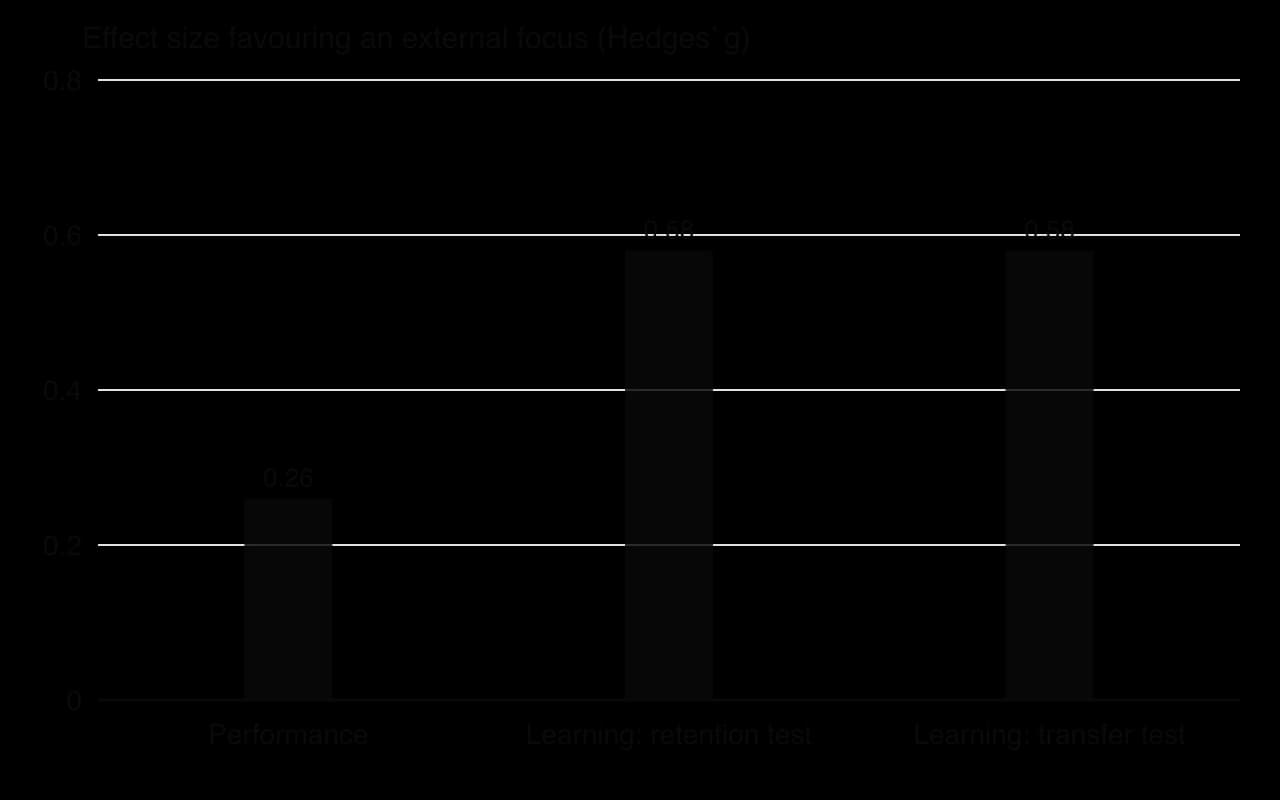
The authors found that age group, health status and skill level did not significantly change the size of the advantage, and that a more distant external focus (the target rather than the club) worked slightly better than a near one. Electromyography studies in the same analysis showed more efficient muscle activity with an external focus. These findings matter for health settings as well as sport, because the advantage held for older adults and for people with health conditions as well as for healthy young performers.
The external-focus advantage is consistent but not universal. Effect sizes for performance are small, and some studies find no difference, especially when the "internal" instruction is holistic (a whole-body feeling such as "be smooth") rather than about one body part. Beginners sometimes need an internal cue to understand the basic shape of a new movement, and in sports judged on the form of the body, such as gymnastics or diving, the movement itself is the goal. Many studies also last a single session with novices in a laboratory, which limits how far the results apply to elite performers over a season.
Concentration is said to be lost when attention moves away from the cues that are relevant to the task. This is distraction. A distraction does not have to be dramatic: a single thought about the score, a camera flash or a comment from an opponent can take attention away for the fraction of a second that matters.
An external distractor comes from the environment. Visual distractors include crowd movement, banners, cameras, an opponent’s gestures and the scoreboard. Auditory distractors include crowd noise, music, opponents’ comments ("sledging" in cricket) and the shouts of spectators or parents. A golfer who stops the backswing because a phone rings in the gallery has been distracted externally.
An internal distractor comes from within the performer. Internal distractors are thoughts that are either negative or unrelated to the goal: worrying about the outcome, replaying an earlier mistake, thinking about what the coach or selectors will say, or thinking about something outside sport. Sensations such as fatigue and pain, and emotions such as anger after a refereeing decision, can also pull attention inwards.
Type | Source | Examples |
|---|---|---|
External: visual | What the performer sees | Crowd movement behind the goal; flash photography; an opponent waving arms during a free throw; the scoreboard |
External: auditory | What the performer hears | Crowd noise; music; sledging; a whistle on an adjacent pitch |
Internal: negative | Thoughts and feelings about failure | “Don’t miss again”; worry about letting the team down; anger at an umpire’s call |
Internal: irrelevant | Thoughts unrelated to the goal | Thinking about a school test the next day or the journey home; attending to how tired the legs feel |
Anxiety makes both kinds of distraction more powerful, because it directs attention towards anything perceived as threatening. In a study of 14 experienced footballers taking penalties under low and high threat while wearing eye trackers, anxious players looked at the goalkeeper sooner and for longer, and their shots became more central, within the goalkeeper’s reach. The goalkeeper acted as a threatening external cue that captured attention from the target areas of the goal.
Sources: Wilson, Wood and Vine, Journal of Sport and Exercise Psychology, 2009.
Controlled distraction is a training method in which performers deliberately practise with the kinds of distraction they will meet in competition, so that they learn to keep their attention on the task when those distractions occur. Because the distractions are introduced in a planned, gradual way, performers become used to them and learn which cues to ignore.
Typical forms include playing recorded crowd noise during training, having teammates shout or wave during free throws, practising penalties after a sprint so that fatigue is present, staging simulated competitions with officials and spectators, and rehearsing what to do when an event is delayed. In each case, the training environment is made more like the competitive one, which is also an application of the specificity of practice.
Evidence that this works comes from research that trains under pressure as well as noise. In two experiments with expert performers, 17 basketball players practised free throws for five weeks either with or without induced anxiety, and 17 dart players practised either high on a climbing wall (anxious) or low (not anxious). In both experiments, only the group that had trained under anxiety kept its performance in a later high-anxiety test, despite higher heart rate and anxiety. Practising with the distracting effects of pressure helped the performers adapt to them.
Sources: Oudejans and Pijpers, Quarterly Journal of Experimental Psychology, 2009.
Controlled distraction is cheap, simple and can be built into normal training sessions. Its main limitation is fidelity: recorded crowd noise does not reproduce the meaning of a real crowd, and practice pressure is rarely as intense as an Olympic final. Too much distraction too early can also disrupt learning in beginners, who need most of their attention for the skill itself. The method suits performers in the associative and autonomous phases who already have a stable technique, and the distractions should be increased gradually.
Arousal has a strong effect on attention. Arousal is the level of physiological and psychological activation, from deep sleep to intense excitement. As arousal rises, the sympathetic nervous system increases heart rate and breathing, and attention also changes: its width shrinks. This shrinking is called attentional narrowing.
James Easterbrook proposed cue utilisation theory in 1959 to explain how arousal affects the number of cues a performer uses. The theory links each level of arousal to a width of attention and therefore to a quality of performance.
Low arousal: attention is too broad. The performer takes in relevant and irrelevant cues alike, is easily distracted and makes poor decisions because the important information is mixed with the unimportant. A player in a one-sided match may notice the crowd and the clock as much as the opponent.
Optimal (moderate) arousal: attention narrows just enough to shut out the irrelevant cues while keeping all the relevant ones. Performance is at its best.
High arousal: attention narrows too far. The performer still shuts out irrelevant cues but also begins to miss relevant ones, such as a teammate in space or a change in the opponent’s position. Decisions become hurried and performance falls. The performer may also start to panic, a state called hypervigilance, in which attention darts between cues without settling on any.
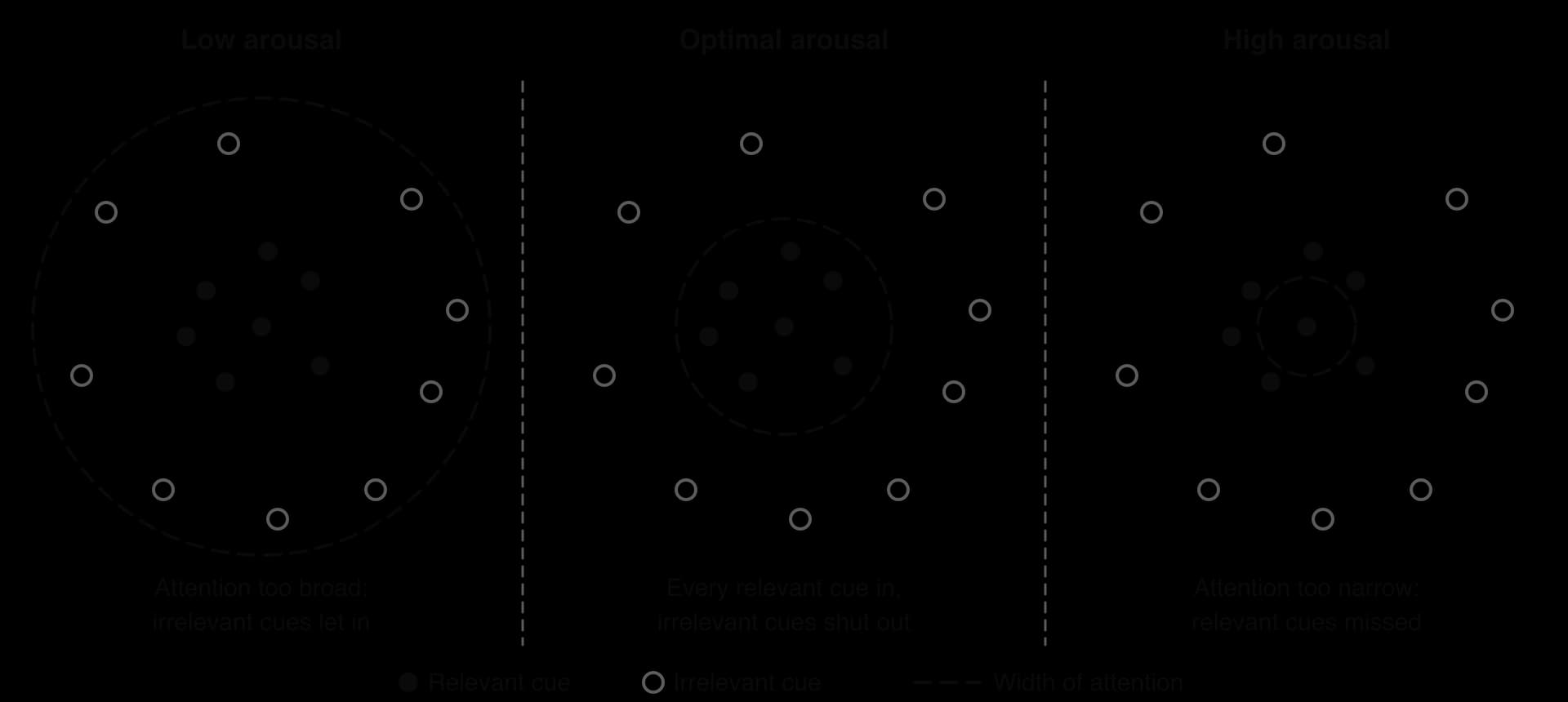
Cue utilisation theory explains the shape of the inverted U theory of arousal and performance. Performance rises from low to moderate arousal because irrelevant cues are being excluded, and falls at high arousal because relevant cues are lost. The inverted U describes the relationship between arousal and performance; cue utilisation theory supplies one reason for it, through attention.
The theory also predicts that the optimal width depends on the task. A rugby scrum-half must monitor many relevant cues at once, so narrowing harms performance early, at a relatively low level of arousal. A weightlifter needs only a few relevant cues, so narrowing does little harm and higher arousal can be tolerated. Experience matters too: experts know which cues are relevant, so they can afford to process fewer of them.
Choking is a sudden, marked fall in the performance of a well-learned skill under pressure, at a time when the performer is trying hard to do well. It differs from an ordinary mistake because the pressure itself causes it. Attention is central to the two main explanations.
Distraction explanations: anxious thoughts (worry about losing, about the crowd) act as internal distractors and use up attentional capacity, leaving too little for the task. Attentional narrowing at high arousal adds to this.
Self-focus (explicit monitoring) explanations: pressure makes the performer pay conscious attention to the step-by-step process of a skill that is normally automatic. Experimental work in the 1980s showed that increased attention to one’s own process of performance, and situational pressures such as competition, cash incentives and audiences, produced performance decrements on skilled tasks. This is the opposite of an external focus: the skilled performer reverts to the internal, step-by-step control of a beginner.
Both explanations agree that the problem lies in where attention goes under pressure, which is why strategies such as routines and quiet-eye training aim to give attention a clear, task-relevant target. The links with anxiety are developed further in catastrophe theory, which explains why performance can collapse rather than decline gradually. Mental toughness is also relevant: performers who appraise pressure as a challenge and feel in control may be better protected against attentional narrowing.
 YouTube
Sources: Baumeister, Journal of Personality and Social Psychology, 1984.
Performers use several psychological strategies to direct their attention to the right cues and bring it back after a distraction. Each works by giving attention a clear target that is relevant to the task.
Self-talk is what performers say to themselves, aloud or silently. It is studied in detail as a coping strategy, but it also controls attention. Instructional self-talk uses short cue words that direct attention to a key part of the task: "ball" for a batter, "smooth" for a rower at the catch, "high hands" for a goalkeeper. A cue word replaces a distracting thought with a task-relevant one, and it can switch the performer quickly to the right attentional style. Cue words work best when they are short, practised in training and, where possible, refer to an external effect.
Goal setting directs attention to what the goal names. An outcome goal, such as winning the match, points attention towards the result, which the performer cannot fully control and which can become an internal distractor under pressure. A process goal, such as "follow through towards the target" or "watch the ball onto the racket", points attention to the actions that produce good performance. Process goals are therefore the goal type most used for attentional control during performance, while outcome goals are kept for motivation away from competition.
A pre-performance routine is a fixed sequence of thoughts and actions that a performer carries out before executing a closed skill, such as a free throw, a tennis serve, a golf putt or a rugby place kick. It typically includes physical actions (bouncing the ball a set number of times, adjusting equipment), a breathing pattern to control arousal, a moment of imagery or a cue word, and a final fixation on the target.
Routines help attention in three ways. They fill the time before the skill with task-relevant actions, leaving little room for internal distractors. They move attention through the right sequence of styles, from broad to narrow and from internal to external. They make the situation feel familiar, because the same routine is used in practice and in a final. Their timing should also stay the same: a routine that speeds up or slows down under pressure is a sign that attention has been disrupted.
The evidence is generally supportive but mixed. Routines are widely used and are recommended to reduce choking, yet a 2020 study of 54 beach volleyball players randomly assigned to different routine interventions found no difference in serving accuracy compared with a control group after a short period of training. The authors suggested that their pressure manipulation may have been too weak, and the study shows that a routine learned briefly may not help; routines need extensive practice before they become automatic.
Sources: Wergin et al., PLOS ONE, 2020.
The quiet eye is a measurable visual feature of attention, discovered by Joan Vickers using eye-tracking. It is the final fixation of the eyes on a specific target before a movement begins, such as the back of a golf ball before the backswing or the front of the rim before a free throw. Experts have longer quiet-eye periods than less skilled performers, and their own successful attempts have longer quiet-eye periods than their unsuccessful ones.
In Vickers’ basketball study, elite players with a free-throw success rate of 78% fixated on the target for longer than near-experts with a rate of 56%. A 2016 meta-analysis of 27 studies confirmed a large difference between experts and novices in quiet-eye duration and a moderate difference between successful and unsuccessful attempts within the same performers. The quiet eye is thought to give the brain time to organise the movement parameters (force, direction) while blocking distractions.
Sources: Vickers, Journal of Experimental Psychology: Human Perception and Performance, 1996; Lebeau et al., Journal of Sport and Exercise Psychology, 2016.
Mindfulness is the practice of paying attention, on purpose and without judgement, to present-moment experience. In sport it is taught through short meditation exercises, such as attending to the breath and noticing when the mind has wandered, then gently bringing attention back. This is a form of attentional training: repeatedly noticing distraction and returning to a chosen focus. A 2017 meta-analysis of nine trials (290 athletes) found moderate to large improvements in psychological performance measures after mindfulness training and improved performance in shooting and darts, but the trials were few and of only fair quality.
Sources: Bühlmayer et al., Sports Medicine, 2017.
Strategy | How it controls attention | Strengths | Limitations |
|---|---|---|---|
Self-talk (cue words) | Replaces distracting thoughts with a task-relevant word | Quick, usable during play, easy to learn | Negative self-talk can become a distractor; a cue about body parts may cause an internal focus |
Process goals | Points attention to controllable actions | Reduces worry about outcome; links to coaching | Too many process goals overload attention |
Pre-performance routine | Fixed sequence moving attention from broad to narrow | Familiar under pressure; controls arousal too | Suits closed, self-paced skills only; needs long practice; can become rigid |
Quiet-eye training | Lengthens the final fixation on the target | Objective, measurable; supported by training studies | Needs eye-tracking equipment; mainly studied in aiming skills |
Controlled distraction | Practice with distractions so they lose their effect | Cheap; builds specificity of practice | Hard to reproduce real pressure |
Mindfulness | Trains noticing and returning from distraction | Also benefits well-being | Few, small trials; takes weeks of practice |
No single strategy suits every performer and every skill. Pre-performance routines and quiet-eye training suit closed, self-paced aiming skills where there is time before the movement. Cue words and process goals suit open skills where attention must be redirected during play. The most effective approach usually combines strategies, for example a routine that contains a cue word and ends with a long quiet eye, practised under controlled distraction until it is automatic.
Health lens | Performance lens |
|---|---|
Physiotherapists use external-focus instructions ("push the floor away") to help older adults and patients improve balance and movement, because an external focus helps whatever the age or health status. | Coaches write external-focus cues and process goals to improve technique and protect it under pressure. |
Attending to music or scenery during moderate exercise can make sessions feel easier, which may help beginners keep exercising. | Elite endurance athletes tend to attend inwards to pace and body signals during races, because those cues guide decisions. |
Mindfulness training reduces stress and supports mental well-being. | Mindfulness, routines and quiet-eye training reduce choking in precision sports. |
Putting is a closed, self-paced aiming skill in which a few millimetres of error decide whether the ball drops. Because the performer has time to think before the movement, it is also a skill that is vulnerable to choking. A study from the University of Exeter, published in 2011, tested whether a brief training intervention focused on the quiet eye could protect elite golfers’ putting under pressure and in real competition.
Twenty-two elite male golfers (mean handicap 2.78; all below 6) recorded their putting statistics over ten competitive rounds. Each then came to the laboratory, was fitted with a mobile eye tracker and putted 20 times from 10 ft (3.05 m) as a pre-test.
The golfers were randomly assigned to two groups. Both groups watched video of their own gaze beside that of an elite model, but only the quiet-eye (QE) trained group had the differences pointed out and was taught a set of gaze rules: a final fixation on the back of the ball lasting 2–3 seconds before the stroke, no glance at the clubhead during the swing, and the gaze kept on the green for 200–300 ms after contact.
The golfers then played ten more competitive rounds, before returning for a retention test and a pressure test. In the pressure test, a £50 prize for the best score, the threat that scores would be shared with their golf clubs and false feedback that their earlier putts ranked in the bottom 30% raised their anxiety. Self-reported cognitive anxiety rose from about 3 to about 7 on an 11-point scale in both groups.
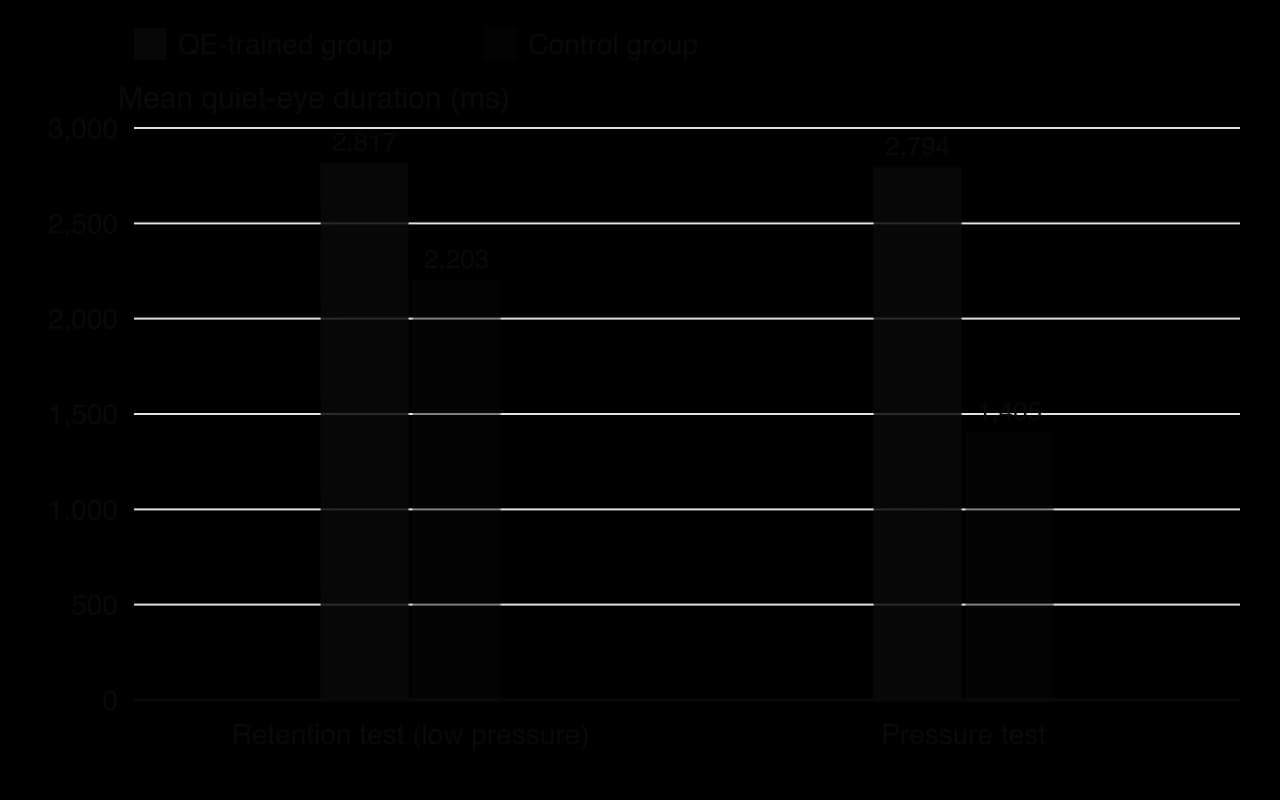
In the pressure test the QE-trained group held a mean quiet-eye period of 2,794 ms, almost the same as in the retention test, whereas the control group’s fell from 2,203 ms to 1,405 ms. Putting performance showed the same pattern, and across the test phase quiet-eye duration predicted 43% of the variance in the average distance the ball finished from the hole.
Measure | QE-trained group | Control group |
|---|---|---|
Putts holed, retention test (%) | 59 | 45 |
Putts holed, pressure test (%) | 60 | 36 |
Mean distance from the hole, pressure test (cm) | 4.45 | 10.28 |
Putts per round in competition, after training | 27.61 | 29.89 |
Change in putts per round from before training | 1.9 fewer | no significant change |
The results support cue utilisation theory and the explanations of choking. Anxiety disrupted the control group’s visual attention: their final fixation became shorter, so they had less time to organise the stroke and were more open to distraction. The trained golfers had an attentional anchor, a long fixation built into their pre-shot routine, which kept their attention external and on the task. The benefit also transferred from the laboratory to the course, where it reduced the number of putts per round, the measure that matters to a golfer.
The study is strong because it was a randomised controlled design, measured attention objectively with an eye tracker and tested real competitive performance. It also has limits. The sample was small (22 golfers, and gaze data were lost for some), all were young men, and competitive putting statistics were self-recorded by the golfers, who knew which group they were in. The pressure test was a laboratory manipulation, and in the retention test the difference in the percentage of putts holed was not statistically significant. The findings fit a wider body of quiet-eye research, but they are strongest for aiming skills and cannot simply be assumed for open skills.
Analysis questions
Calculate the percentage change in the control group’s quiet-eye duration from the retention test to the pressure test, and explain the change using attentional narrowing.
Suggest why the golfers’ own records of putts per round may be less reliable than the laboratory measures.
How could quiet-eye training be built into a pre-performance routine for a basketball free throw?
Sources: Vine, Moore and Wilson, Frontiers in Psychology, 2011.
Paper 1A questions on attentional control test the meaning of the four styles, the types of distractor and the predictions of cue utilisation theory.
Recall questions often ask for a category from an example, so practise classifying.
A third style of question tests the external-focus research.
Paper 1B style. Researchers investigated whether controlled distraction improves free-throw performance in noisy conditions. Twenty-four university basketball players were randomly allocated to two groups of 12. For six weeks, group A practised free throws with recorded crowd noise and teammates waving behind the basket; group B practised in a quiet gym. After training, all players took 20 free throws in a quiet test and 20 in a noise test. The results are hypothetical.
Group | Quiet test: mean % made (SD) | Noise test: mean % made (SD) |
|---|---|---|
A: controlled distraction | 72 (6) | 70 (7) |
B: quiet practice | 73 (7) | 61 (8) |
Questions that ask for Nideffer’s styles usually expect a named sport and situation for each style.
Attention is the focusing of limited mental resources on selected information; concentration is keeping it there for as long as needed.
Nideffer’s model describes attention by width (broad or narrow) and direction (internal or external), giving four styles: assess, analyse, rehearse and act.
Skilled performers shift between styles as the situation changes; the right style depends on the moment.
An external focus on the effect of a movement generally improves performance and learning more than an internal focus on body movements, though effects for performance are small.
Distraction is the loss of concentration when attention moves to irrelevant cues; external distractors are visual or auditory, and internal distractors are negative or irrelevant thoughts.
Controlled distraction trains performers to keep focus by practising with distractions and pressure.
Cue utilisation theory explains attentional narrowing: broad attention at low arousal, only relevant cues at optimal arousal, missed relevant cues at high arousal; it helps explain the inverted U and choking.
Self-talk cue words, process goals, pre-performance routines, quiet-eye training and mindfulness give attention a clear, task-relevant target.
I can define attention, concentration and attentional focus.
I can draw Nideffer’s grid and give a sporting example of each attentional style.
I can explain why performers need to shift attention during a performance.
I can distinguish internal from external focus and evaluate the evidence for an external focus.
I can describe external (visual, auditory) and internal distractors with examples.
I can explain how controlled distraction improves attentional control.
I can explain attentional narrowing using cue utilisation theory and link it to the inverted U and choking.
I can evaluate self-talk, process goals, pre-performance routines, quiet-eye training and mindfulness as ways to control attention.