C.2 Motor learning
Explain how motor skills are learned, practised and refined, compare the two main models of motor learning, and apply them, with attentional control, to coaching, teaching and rehabilitation.
- IB Sports, Exercise and Health Science
- SL and HL
What C.2 covers
From the subject guide: what you need to know and be able to do.
How skills are learned, practised and perfected.
2 subtopics in Motor learning
Each one has its own page once something is published for it.
- C.2.1Motor learning processesnotes
- C.2.2Attentional controlnotes
An overview of C.2 Motor learning
Motor learning studies how people acquire movement skills, from a child’s first catch to an elite athlete’s refinement of a serve, and how they keep attention on the right information while performing them. It matters for performance, because coaching methods decide how quickly and how securely skills are learned, and for health, because the same principles guide physical education, the relearning of movement after injury or stroke, and helping older adults stay active and avoid falls.
The questions behind the topic
The topic is built around one central question: how are skills acquired, practised and perfected? Two very different models answer it, and much of the topic compares them. Everyday situations in sport and health make the question concrete:
Why can a beginner hit a perfect shot one day and miss the same shot the next, and how can a coach tell whether any learning has taken place?
Should a learner practise one technique repeatedly, or face a different situation on every attempt?
Why does a well-timed dummy or head fake make a defender react too late to the real move?
Why does learning to play squash help, or sometimes hinder, a tennis player?
Why do performers make more errors when they concentrate on how their own body is moving?
Why does attention narrow under pressure, so that a midfielder fails to see an open teammate?
What the topic covers
Subtopic | Main question it answers | Level |
|---|---|---|
C.2.1 Motor learning processes | How do people learn movement skills, how do the information processing and ecological models explain it, and how should practice be designed? | SL and HL |
C.2.2 Attentional control | How does the focus of attention affect performance, and what strategies help performers attend to the right cues under pressure? | SL and HL |
Motor learning processes is the longest part of the theme. It distinguishes learning from performance, classifies skills, and sets out two models. The information processing model treats the learner as a processor of information and leads to linear pedagogy: schema theory, the phases of learning, and coach-led feedback, guidance and practice. The ecological model treats movement as emerging from the learner, the task and the environment, and leads to non-linear pedagogy and the constraints-led approach. The subtopic ends with the psychological refractory period and transfer of learning. Attentional control covers Nideffer’s attentional styles, internal and external focus, distraction, attentional narrowing and strategies such as pre-performance routines and the quiet eye.
How the subtopics connect
The concept map places both subtopics in one picture. Motor learning processes can be explained by either model, and each model leads to a different way of coaching: practice planned and directed by the coach, or practice shaped by changing the constraints of the task and environment. Practice builds learning, which is a relatively permanent change that can only be inferred from performance over time, usually through retention and transfer tests.
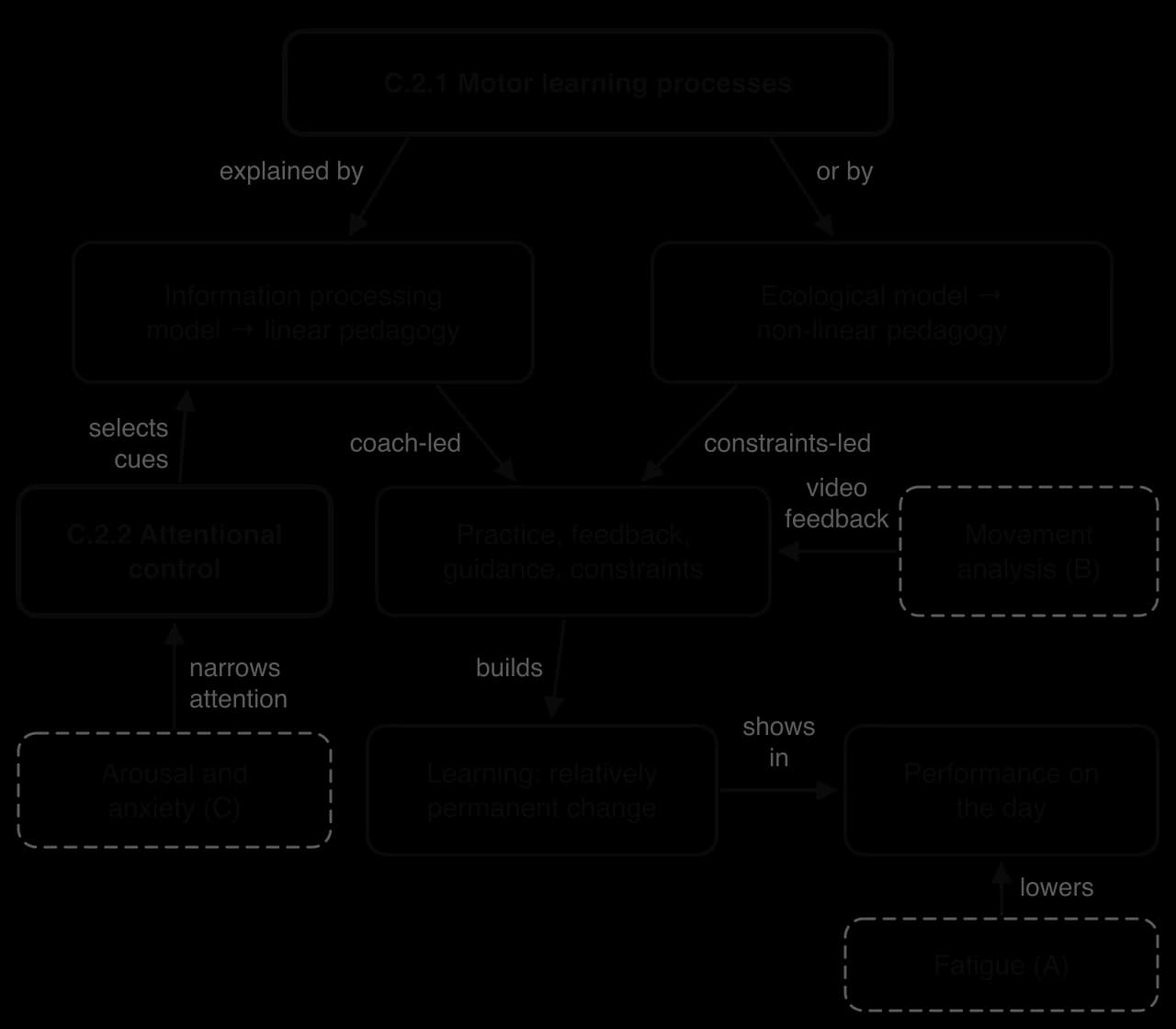
Attentional control connects to the first stage of the information processing model, where selective attention picks out the relevant cues from everything a performer can see and hear. In the ecological model the same idea appears as perception–action coupling: a skilled performer attends to the information that guides the movement. Errors in attention reduce performance even when the skill itself is well learned.
The map also shows links beyond the topic. Rising arousal narrows attention, which links attentional control to arousal and anxiety. Movement analysis with video, a central method in biomechanics, gives the knowledge of performance that learners need, and a skill’s phases provide a structure for feedback. Fatigue lowers performance without necessarily affecting learning, which is one reason the two must be kept apart.
Health and performance
The same principles of learning apply whether the goal is a medal or a safer, more active life:
Health lens | Performance lens |
|---|---|
Physical education builds the fundamental movement skills that make lifelong physical activity more likely. | Variable and random practice produce skills that transfer to the changing demands of competition. |
Rehabilitation relearns movement after injury or stroke, often using an external focus and modified tasks. | An external focus and pre-performance routines help performers stay accurate under pressure. |
Balance and gait training for older adults applies feedback and practice principles to reduce falls. | Understanding the psychological refractory period helps attackers use deception and defenders resist it. |
Motor learning links to both of the other themes. In biomechanics, the phases of movement and lever analysis describe what a learner is trying to produce, and equipment scaled to body size changes the task constraints, so children can use adult-like techniques sooner. In exercise physiology, the nervous system carries the signals that motor learning refines, and fatigue sets limits on how much high-quality practice is possible in one session.
How SL and HL differ
HL students study everything SL students study, plus additional higher level material. In this course that extra material is mostly added inside subtopics rather than as separate subtopics, so most pages contain sections with headings ending “(HL only)” that SL students can skip. Questions on HL material appear only in the HL papers.
Motor learning has no HL material: both levels study the whole topic, and neither Motor learning processes nor Attentional control contains an HL-only section. HL students meet this content in the same depth as SL students, and the questions on it can appear in both the SL and the HL papers.
Assessment
Motor learning is examined in all three parts of the external assessment, at both levels. Paper 1A asks multiple-choice questions, for example which phase of learning a description fits or which type of transfer a situation shows. Paper 1B gives data from a practice study, such as accuracy scores of groups practising in different ways, and asks students to compare acquisition with retention, interpret error bars and evaluate the design. Paper 2 asks short-answer and extended-response questions.
The topic tends to produce these kinds of question:
distinguishing between learning and performance, or between the two models;
drawing and annotating the information processing model or a performance curve;
describing the psychological refractory period with a sketch of the two stimuli and responses;
outlining types of transfer, feedback or practice with a sporting example;
applying Nideffer’s attentional styles to a named sport;
evaluating linear and non-linear pedagogy, or an attentional strategy, for a given learner.
Carry on with C.2 in Augment
With a free account, Augment remembers where you stopped and what you have practiced.