A.2 Hydration and nutrition
Connect water and electrolyte balance, fuelling and the energy systems to explain how hydration and nutrition shape health and performance, and see what HL adds.
- IB Sports, Exercise and Health Science
- SL and HL
What A.2 covers
From the subject guide: what you need to know and be able to do.
How water, food and the energy systems affect what the body can do.
3 subtopics in Hydration and nutrition
Each one has its own page once something is published for it.
- A.2.1Water and electrolyte balancenotes
- A.2.2Fuelling for health and performancenotes
- A.2.3Energy systemsnotes
An overview of A.2 Hydration and nutrition
Hydration and nutrition is the study of how the body gains, uses and loses water, electrolytes and food energy, and how it turns food into adenosine triphosphate (ATP), the molecule that powers every movement. The same knowledge helps a cyclist fuel a five-hour race, and helps any individual stay well hydrated, eat enough for growth and training, and protect bone and hormonal health.
Questions that frame hydration and nutrition
The central question is how the amount of water and food in the body, and its timing, affects what the body can do, from resting and growing to sprinting for ten seconds or running for three hours. Answering it means following water, electrolytes and nutrients from the moment they are eaten or drunk to the moment their energy is released in a muscle.
Why can a recreational marathon runner who drinks at every station become seriously ill?
Why does heart rate keep rising during a long run at a steady pace in hot weather?
Why do road cyclists eat and drink throughout a race, while a 100 m sprinter needs nothing during the event?
How can training hard without eating enough damage bones, hormones and mental health?
Why can an elite runner with a modest VO₂ max still beat rivals whose VO₂ max is higher?
What the topic covers
Subtopic | Main question it answers | Level |
|---|---|---|
A.2.1 Water and electrolyte balance | How does the body keep its water and electrolytes in balance, and what happens when exercise and the environment upset that balance? | SL and HL |
A.2.2 Fuelling for health and performance | Which nutrients supply energy, how much does an individual need, and how should eating be planned around exercise? | SL and HL, with an HL-only part |
A.2.3 Energy systems | How do the three energy systems resynthesise ATP, and what determines endurance performance? | SL and HL, with an HL-only part |
How water, fuel and energy connect
Water makes up about 50–60% of body mass, and the electrolytes dissolved in it, mainly sodium, potassium and chloride, control where that water sits and how nerves and muscles work. The hypothalamus detects changes in the concentration of the blood, and antidiuretic hormone (ADH) and thirst restore the balance, so water balance depends directly on the communication systems of the body. Exercise in the heat increases sweat loss, and dehydration reduces plasma volume, which leads to cardiovascular drift and less oxygen delivered to the working muscles.
Food supplies the fuel. The three macronutrients, carbohydrate, protein and fat, provide energy, and carbohydrate is stored as glycogen in muscle and liver. How much an individual needs depends on body composition, age, sex and activity level, and the timing of meals before and during exercise changes how much fuel is available when it is needed. When intake is too low for the training load, low energy availability develops, and over time it can lead to relative energy deficiency in sport (REDs).
The energy systems are where water and fuel meet. The phosphagen system uses phosphocreatine, the glycolytic system uses glucose and glycogen, and the oxidative system uses carbohydrate and fat with a steady supply of oxygen. All three contribute at every moment, and the energy continuum describes how their shares change with the intensity and duration of the activity. The concept map shows these links: the subtopics form a chain that ends with ATP powering each muscle fibre.
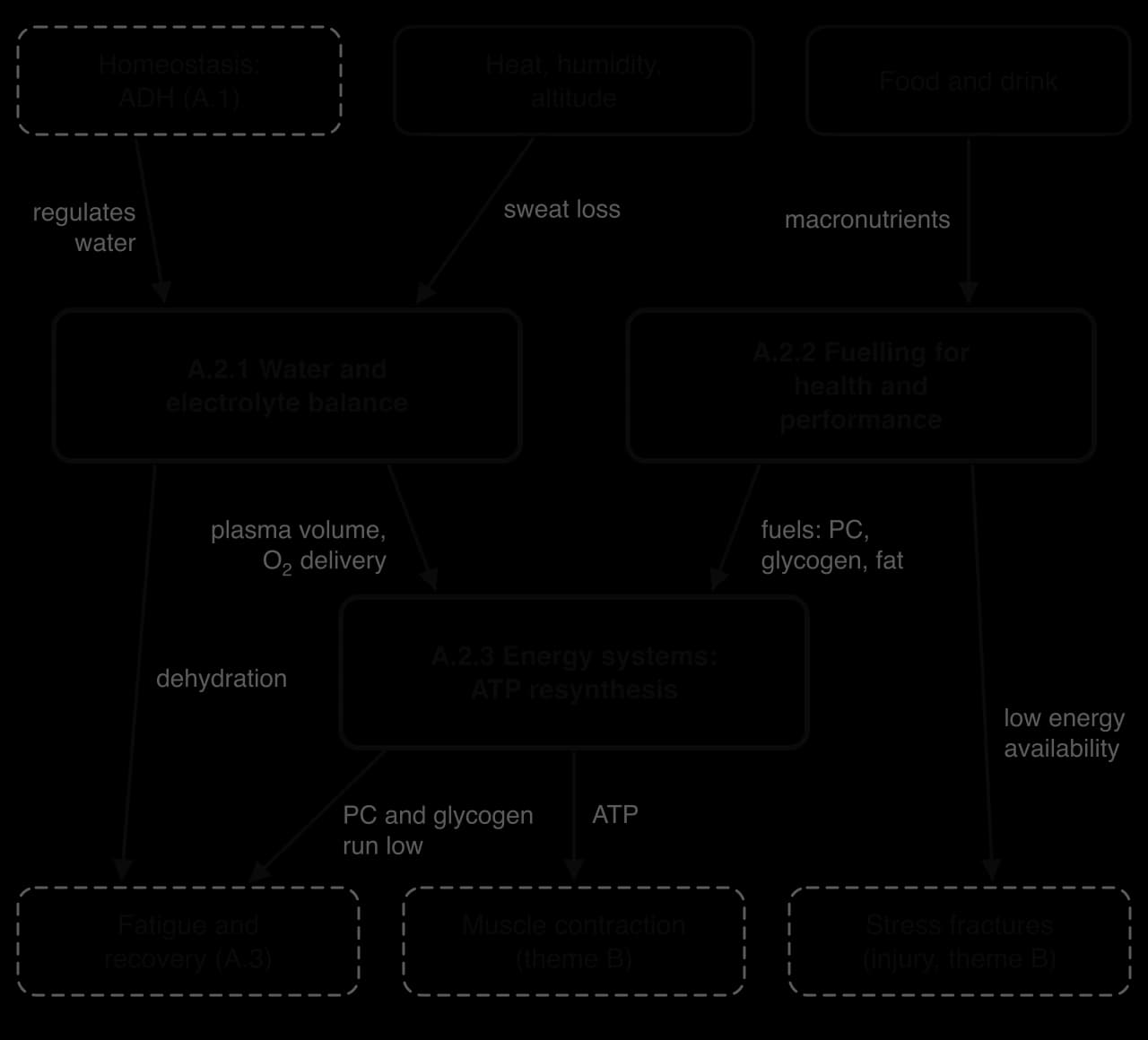
The chain also explains why things go wrong. Running short of phosphocreatine or glycogen, or losing too much water, contributes to fatigue, and a long-term energy deficit weakens bone and raises the risk of stress fractures. Reading the map from the bottom up is a useful way to explain any drop in performance: start from the outcome and trace it back to water, fuel or the energy system involved.
Health and performance lenses
Idea | Health lens | Performance lens |
|---|---|---|
Water and electrolytes | Preventing heat illness in workers and older adults, whose thirst response is weaker; avoiding hyponatraemia in slow marathon runners who overdrink. | Replacing sweat losses to limit the rise in heart rate and core temperature; individual drinking plans based on sweat rate. |
Fuelling | Enough energy and protein for growth in young people and for keeping muscle in older adults; REDs harms bone, menstrual and mental health. | Carbohydrate loading before long events; carbohydrate during races; protein for repair and adaptation. |
Energy systems | Long, low-intensity activity uses fat as a major fuel; VO₂ max is a strong predictor of long-term health. | Training the system that dominates an event; using running economy and VO₂ max to explain endurance performance. |
Hydration and nutrition also link to the other two themes. ATP from the energy systems powers the cross-bridges that shorten muscle, so every force studied in biomechanics depends on it, and the injury risk of an athlete with low energy availability rises because bone is not repaired fast enough. In psychology, dehydration impairs attention and decision-making, and REDs is closely linked to disordered eating and low mood, which makes the way coaches talk about body mass and food part of the athlete’s health.
How SL and HL differ
In SEHS, the higher level (HL) material is mostly added inside the subtopics rather than as separate subtopics. HL students study everything SL students study, plus additional material. Every page of hydration and nutrition is therefore read by both SL and HL students, and the HL material sits in sections whose headings end “(HL only)”, which SL students can skip.
Hydration and nutrition has no HL-only subtopic. The HL material is:
Water and electrolyte balance: none. SL and HL students study the whole subtopic.
Fuelling for health and performance: micronutrients (iron, calcium, sodium, potassium and vitamins) and their roles in energy transfer and tissue repair, including iron deficiency and anaemia; the gut microbiome, what influences it, and how it affects health and performance.
Energy systems: the lactate inflection point and its use in training; excess post-exercise oxygen consumption (EPOC), its fast and slow components and what determines its size.
Assessment
Questions on hydration and nutrition appear in all three parts of the written papers. Paper 1A (multiple choice) tests definitions and the features of each energy system; at SL it contains only SL material, while the HL paper also includes questions on micronutrients, the gut microbiome, the lactate inflection point and EPOC. Paper 1B (data-based questions) often uses results from studies of sweat rate, hydration markers, carbohydrate intake, VO₂ max or blood lactate. Paper 2 contains short-answer and extended-response questions, and HL-only material appears only in the HL paper.
Hydration and nutrition tends to produce these kinds of question:
calculating sweat rate from the change in body mass, energy availability per kilogram of fat-free mass, or relative VO₂ max, with units;
sketching and annotating the energy continuum, cardiovascular drift or, at HL, the blood lactate curve and the oxygen deficit and EPOC;
comparing the fuel, rate, capacity and by-products of the three energy systems in a table;
evaluating a hydration strategy, carbohydrate loading, or a method of measuring hydration status or VO₂ max.
Carry on with A.2 in Augment
With a free account, Augment remembers where you stopped and what you have practiced.