B.1 Generating movement in the body
Explain how bones, joints, connective tissues, muscles and levers work together to produce movement, and describe any movement precisely using planes, axes and movement terms.
- IB Sports, Exercise and Health Science
- SL and HL
What B.1 covers
From the subject guide: what you need to know and be able to do.
How bones, joints and muscles work together to produce movement.
4 subtopics in Generating movement in the body
Each one has its own page once something is published for it.
- B.1.1Anatomical position, planes and movementnotes
- B.1.2Structure and function of connective tissues and jointsnotes
- B.1.3Muscular functionnotes
- B.1.4Levers in movement and sportnotes
An overview of B.1 Generating movement in the body
Generating movement in the body studies the structures that produce movement: the skeleton, the connective tissues and joints that hold it together, the muscles that pull on bones, and the levers that bones and muscles form. The same knowledge explains how athletes produce force and speed, why some movements injure tissue, and how exercise keeps bones, joints and muscles healthy across the lifespan.
The questions behind the topic
The topic is built around one central question: how does the structure of the musculoskeletal system make some movements possible, limit others, and determine how much force and speed a movement can produce? Each subtopic answers part of that question for one set of structures. Everyday situations in sport and health make it concrete:
Why can the shoulder move in almost every direction while the knee mainly bends and straightens?
Why are the leg muscles of elite sprinters rich in fast-twitch fibres while those of marathon runners are mostly slow-twitch?
Why are most levers in the body third class, even though they need an effort larger than the load?
How can a coach describe a tennis serve precisely, joint by joint, so that another coach knows exactly what happened?
Why do bones become denser in people who do regular weight-bearing exercise?
How are bicycles, seats and protective equipment sized to fit bodies of different shapes and sizes? (HL)
What the topic covers
Subtopic | Main question it answers | Level |
|---|---|---|
B.1.1 Anatomical position, planes and movement | How are the skeleton, body positions and movements described precisely, and how are body measurements used to design equipment? | SL and HL, with an HL-only part |
B.1.2 Structure and function of connective tissues and joints | How do bone, ligaments, tendons, cartilage and the different types of joint allow movement while keeping the body stable? | SL and HL |
B.1.3 Muscular function | How do muscles, motor units and fibre types produce different kinds of contraction, and how does a muscle fibre shorten? | SL and HL, with an HL-only part |
B.1.4 Levers in movement and sport | How do bones and implements act as levers that trade force for speed and range of motion? | SL and HL |
Anatomical position, planes and movement gives the shared language for the whole theme: the axial skeleton and appendicular skeleton, positional terms such as proximal and distal, the sagittal plane, frontal plane and transverse plane with their axes, and movement terms such as flexion and abduction. Connective tissues and joints explains how ligaments, tendons and cartilage support the synovial joint. Muscular function covers how muscles are controlled and how they contract, and levers apply all of this to the mechanics of movement.
How the subtopics connect
The four subtopics describe the same event from different angles, shown in the concept map. A nerve impulse reaches a motor unit, and the muscle fibres contract using energy from ATP. The muscle pulls on its tendon, and the tendon pulls on a bone at a joint. The bone turns about the joint, which acts as the fulcrum of a lever, with the muscle supplying the effort.
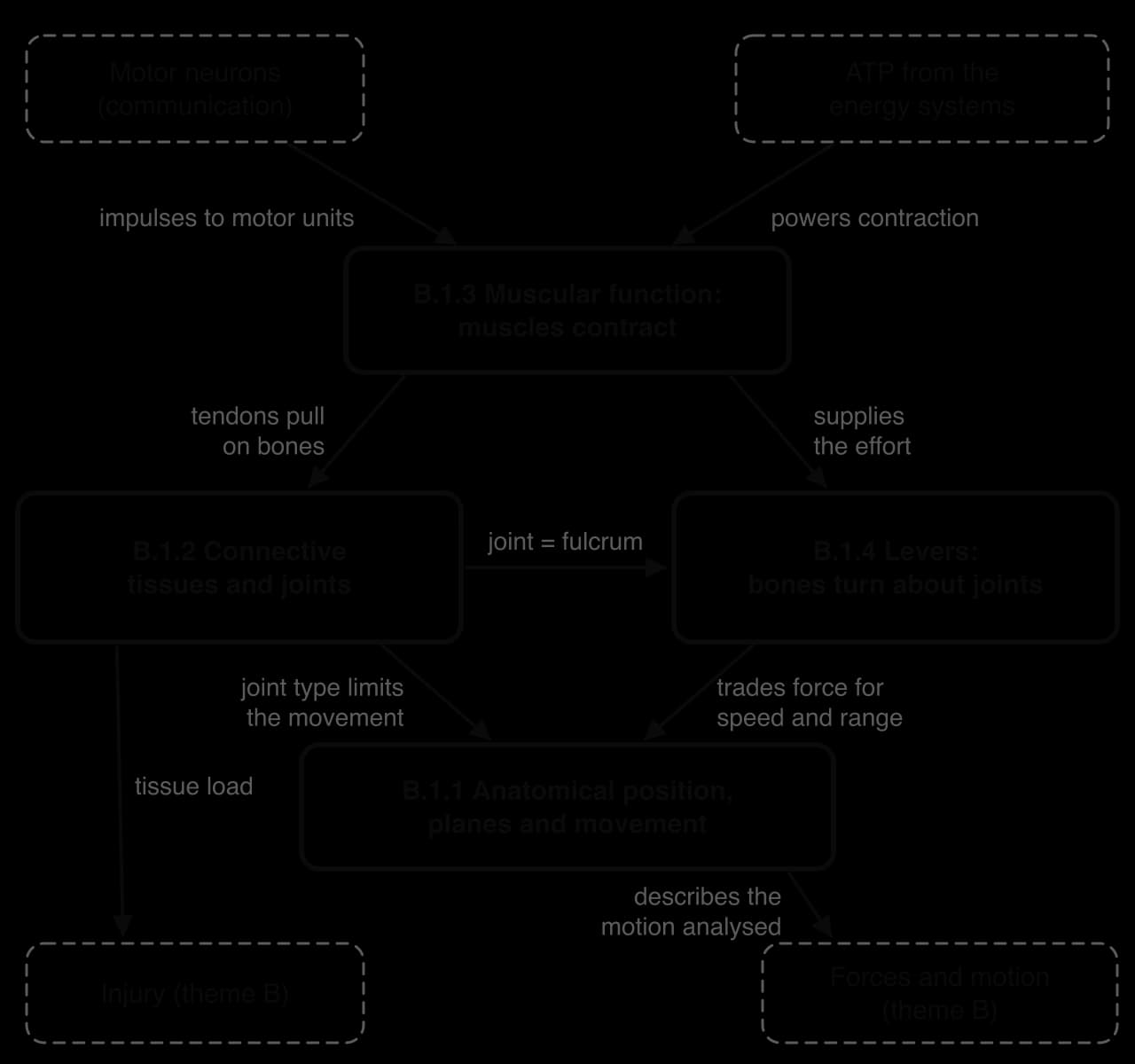
The type of joint limits which movements are possible, and the lever arrangement decides whether the movement favours force or speed. In the body, most muscles insert close to the joint, so most levers are third-class levers: they need a large effort but move the end of the limb quickly through a wide range. The resulting movement is then named precisely by its plane, its axis of rotation and the movement term, for example flexion of the elbow in the sagittal plane about the frontal axis.
The map also shows links beyond the topic. Motor units are activated by the motor neurons of the nervous system, and the ATP that powers contraction comes from the energy systems, which explains why type I fibres suit long, low-intensity work and type IIx fibres suit short, explosive efforts. The movements described with planes and axes are the movements that biomechanics analyses with forces and Newton’s laws, and the loads that tissues carry are the starting point for understanding injury.
Health and performance
Health lens | Performance lens |
|---|---|
Weight-bearing exercise increases bone mineral density and lowers the risk of osteoporosis in later life. | Fibre type distribution helps explain why some athletes suit sprinting and others endurance events. |
Resistance training reverses muscle atrophy and slows sarcopenia in older adults. | Hypertrophy and better motor unit recruitment increase strength and power. |
Joint stability and range of motion matter for daily tasks and rehabilitation after injury. | Longer levers and implements (rackets, bats, oars) increase the speed of the end of the lever. |
Ergonomic design of seats, tools and workstations reduces strain (HL). | Anthropometry is used to size bicycles, boats and protective equipment for each athlete (HL). |
Generating movement links to both of the other themes. In exercise physiology, the energy systems and training adaptations explain how muscles keep contracting and how they change with training. In sport psychology and motor learning, the many joints and muscles that a learner must coordinate are the degrees of freedom of dynamical systems theory, and a joint-by-joint analysis of a skill gives a coach precise feedback on technique. Equipment scaled to a child’s size also changes the levers involved, which links anthropometry to skill learning.
How SL and HL differ
HL students study everything SL students study, plus additional higher level material. In this course that extra material is mostly added inside subtopics rather than as separate subtopics. Most pages are therefore read by everyone, and contain sections with headings ending “(HL only)” that SL students can skip. Questions on the HL material appear only in the HL papers.
In Generating movement in the body, no subtopic is HL only. Connective tissues and joints and Levers in movement and sport contain no HL material: both levels study them in full. Two subtopics have HL-only parts:
Anatomical position, planes and movement: anthropometry (measuring body segments and proportions, percentiles and somatotype), anthropometric databases and their use in sizing equipment, and ergonomics, including the limits of designing from average data.
Muscular function: the sliding filament theory: the structure of the sarcomere, the roles of actin, myosin, troponin, tropomyosin and calcium ions, the cross-bridge cycle, and how the bands of the sarcomere change during contraction.
Assessment
Questions on Generating movement in the body appear in all three parts of the external assessment. Paper 1A asks multiple-choice questions, for example which plane a movement occurs in, which class of lever a joint forms or which fibre type has the most mitochondria. Paper 1B gives data from a study, such as fibre type percentages, range of motion or muscle activity, and asks students to interpret it and evaluate the method. Paper 2 asks short-answer and extended-response questions. HL-only material on anthropometry and the sliding filament theory appears only in the HL papers.
The topic tends to produce these kinds of question:
labelling the data booklet’s diagrams of the skeleton, the planes and axes, the major muscles, the muscle fibre and (HL) the sarcomere;
analysing a skill joint by joint: joint type, movement, plane, axis, agonist, antagonist and type of contraction;
drawing and labelling the three classes of lever with the effort arm and load arm, and calculating mechanical advantage;
distinguishing between types of contraction, fibre types, or joint stability and mobility;
explaining the steps of muscle contraction from the nerve impulse to the cross-bridge cycle (HL).
Carry on with B.1 in Augment
With a free account, Augment remembers where you stopped and what you have practiced.