Notes on B.1.4 Levers in movement and sport
Learning objectives
Label the fulcrum, effort, load, effort arm and load arm of a lever in the body or in sports equipment.
Distinguish between first-class, second-class and third-class levers by the relative positions of the fulcrum, effort and load.
Calculate the moment of a force and use the principle of moments to find an unknown force on a lever.
Calculate mechanical advantage and explain the difference between a mechanical advantage and a mechanical disadvantage.
Explain why most levers in the human body are third-class levers.
Apply lever principles to implements such as rackets, bats, clubs and poles, and to throwing.
Evaluate the use of simple lever models to analyse human movement.
Introduction
A lever is one of the simplest machines: a rigid bar that turns about a fixed point. Every bone moved by a muscle across a joint acts as a lever, and so does every bat, racket, club, paddle and pole used in sport. Lever principles explain why the body can move its limbs quickly through a wide range, why a longer implement can strike or throw an object faster, and why some movements need surprisingly large muscle forces.
The same principles matter for health. Large muscle forces acting through short lever arms place heavy loads on tendons and joints, which links levers to injury and rehabilitation. Shorter, lighter implements for children and adapted equipment for older adults or people with disabilities are designed around lever length, so that the user can control the movement safely.
What a lever is
Every lever has four parts. In the human body, each has a direct equivalent.
Part of a lever | What it is | In the body | Example: biceps curl |
|---|---|---|---|
Rigid bar | The part that turns | A bone (or several bones moving as one) | Radius and ulna (forearm) |
Fulcrum (F) | The fixed point about which the bar turns | A joint | Elbow joint |
Effort (E) | The force applied to turn the bar | The pull of a muscle, applied where its tendon attaches to the bone | Biceps brachii pulling on the radius |
Load (L) | The force the effort must overcome | The weight of the body part plus anything held or moved | Weight of the forearm, hand and dumbbell |
The fulcrum is sometimes called the pivot. In the body it is the joint at which the movement happens, so the elbow is the fulcrum of an arm curl and the knee is the fulcrum of a knee extension.
The effort acts at the point where the muscle’s tendon attaches to the moving bone (its insertion), in the direction in which the muscle pulls. Because muscles can only pull, the effort always acts along the line of the muscle towards its other attachment.
The load is also called the resistance. It is usually a weight acting downwards, but it can be any force that opposes the movement, such as the drag of water on a swimmer’s hand or the resistance of an elastic band.
Moments: the turning effect of a force
A force applied to a lever makes it turn. How strongly it turns the lever depends not only on the size of the force but also on how far from the fulcrum it acts. Pushing a door near its hinges is much harder than pushing it at the handle.
Here is the force in newtons and is the perpendicular distance from the fulcrum in metres. The moment is also called the turning effect, and in the study of angular motion it is called torque. A force acting through the fulcrum itself has no turning effect, because its distance from the fulcrum is zero.
When a lever is balanced, or turning at a steady rate, the moments in the two directions are equal. This is the principle of moments. For a lever with one effort and one load:
This equation is the basis of every lever calculation. If three of the four quantities are known, the fourth can be calculated. The weight of a load is found first from its mass using , with g = 9.81 m s⁻².
 YouTube
Effort arm, load arm and mechanical advantage
The effort arm is sometimes called the force arm. In the body it is the distance from the joint to the point where the muscle’s tendon attaches, measured at right angles to the muscle’s line of pull.
The load arm (resistance arm) is usually much longer, because loads such as a dumbbell, a ball or the weight of a limb act far from the joint. Comparing the two arms shows what a lever is good at.
Mechanical advantage has no units, because it is a ratio of two distances. It shows how much the lever multiplies force.
MA greater than 1 (effort arm longer than load arm): the lever is a force multiplier. A small effort can move a large load, but the load moves through a smaller distance and more slowly than the point where the effort is applied.
MA less than 1 (effort arm shorter than load arm): the lever has a mechanical disadvantage. A large effort is needed to move a small load, but the load moves through a larger distance and faster than the point where the effort is applied. The lever multiplies speed and range of movement.
MA equal to 1: effort and load are equal, and the lever only changes the direction of the force.
The trade-off follows from geometry. As the lever turns, every point on it turns through the same angle in the same time. A point twice as far from the fulcrum travels twice as far and therefore moves twice as fast. If the muscle attaches close to the joint and the load is far away, a short, slow contraction of the muscle produces a large, fast movement of the hand or foot.
MA greater than 1 | MA less than 1 | |
|---|---|---|
Effort arm vs load arm | Effort arm longer | Effort arm shorter |
Effort needed | Less than the load | More than the load |
Speed and range of the load | Smaller than at the effort | Greater than at the effort |
Good for | Moving heavy loads with little force | Fast, wide-ranging movements |
Examples | Calf raise; press-up; wheelbarrow | Elbow flexion; kicking; swinging a bat |
The three classes of lever
Levers are classified by which of the three components (fulcrum, effort, load) lies in the middle. The order of the other two does not matter. The class determines whether a lever can have a mechanical advantage.
First-class levers
A seesaw is the everyday example of a first-class lever. Because the fulcrum is in the middle, the MA depends on where it sits: closer to the load gives MA greater than 1, closer to the effort gives MA less than 1. First-class levers are relatively rare in the body.
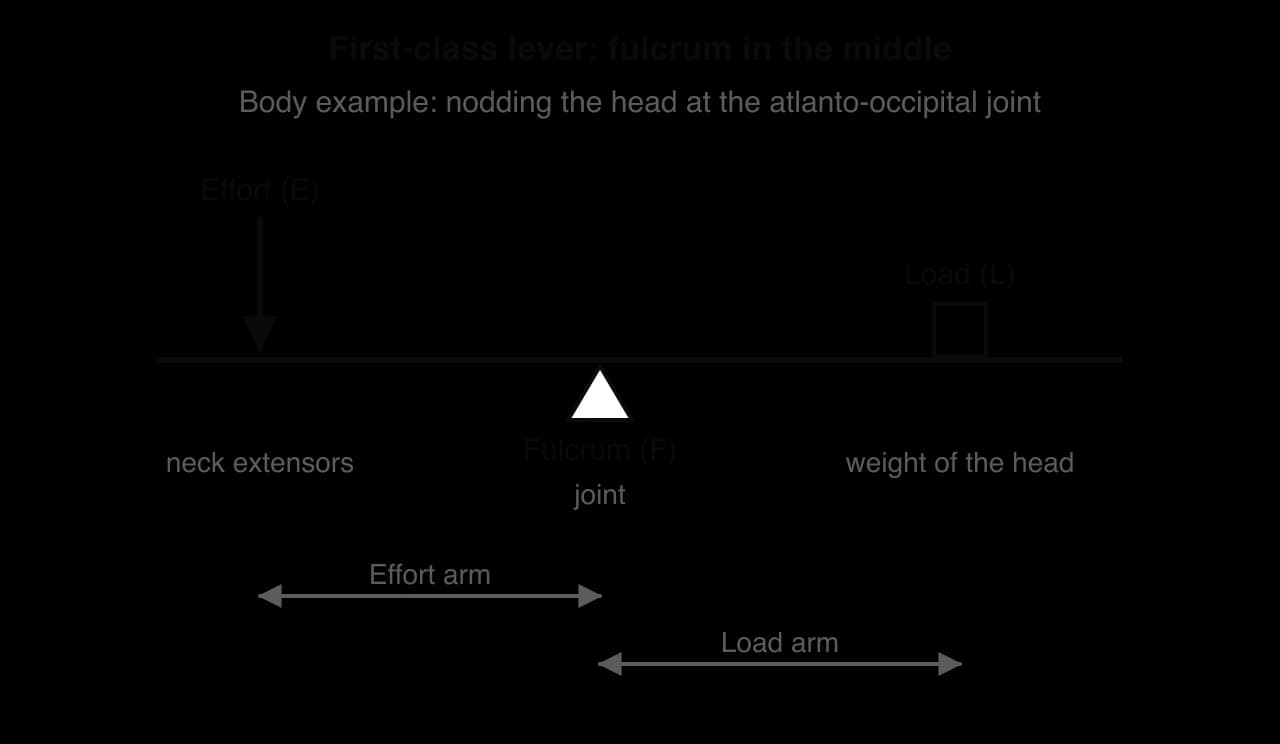
Nodding the head (extension of the neck): the atlanto-occipital joint, between the skull and the first vertebra, is the fulcrum. The weight of the face and front of the skull is the load, in front of the joint; the neck extensor muscles (such as the splenius and upper trapezius) pull down behind it as the effort.
Extending the elbow with the triceps: the triceps brachii inserts on the olecranon process, the bony point of the elbow that lies behind the joint. When the arm is raised overhead and the forearm extends, as in an overhead triceps extension, throwing a dart or a football throw-in, the triceps pulls on one side of the elbow and the load (forearm, hand and object) is on the other.
Second-class levers
A wheelbarrow is a second-class lever: the wheel is the fulcrum, the load sits in the middle and the effort is applied at the handles. Second-class levers multiply force but give a smaller range and speed of movement.
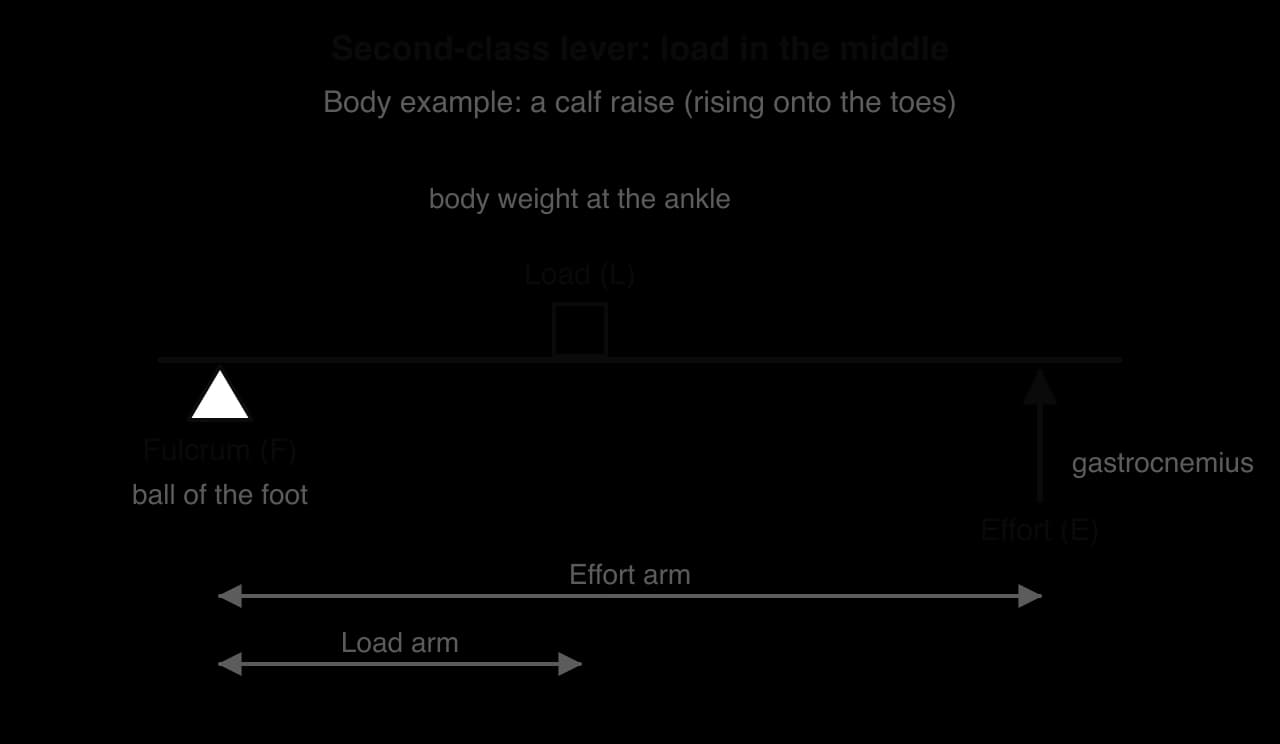
The usual example in the body is rising onto the toes in a calf raise. The ball of the foot (the metatarsophalangeal joints) acts as the fulcrum, the body weight acts down through the tibia at the ankle, and the gastrocnemius and soleus pull up on the heel through the Achilles tendon. A press-up is a second-class lever for the whole body: the feet are the fulcrum, the body weight acts at the centre of mass in the middle, and the arms push up at the shoulders.
Third-class levers
A third-class lever always has a mechanical disadvantage, but it gives the greatest speed and range of movement at the end of the lever. Most joints of the limbs work as third-class levers.
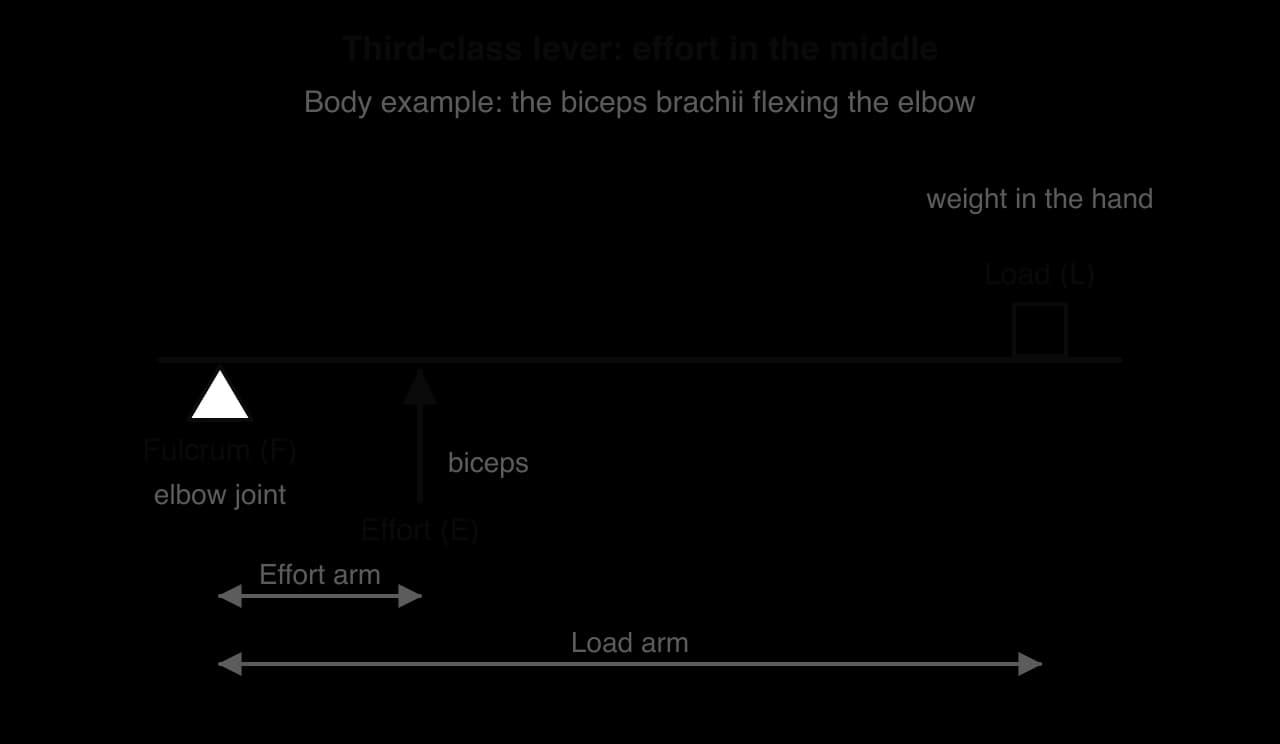
Elbow flexion: the biceps brachii inserts on the radius a few centimetres from the elbow, while the load (forearm, hand and anything held) acts much further away.
Knee extension: the quadriceps pull on the tibia through the patellar tendon just below the knee, while the load is the weight of the lower leg and foot, or a ball being kicked.
Hip flexion: the iliopsoas inserts on the femur close to the hip joint, so a short contraction swings the whole leg forward in sprinting or kicking.
Shoulder abduction: the deltoid inserts on the upper third of the humerus, so the hand moves much further and faster than the deltoid shortens.
 YouTube
First class | Second class | Third class | |
|---|---|---|---|
In the middle | Fulcrum | Load | Effort |
Order | E – F – L | F – L – E | F – E – L |
Mechanical advantage | Greater than, equal to or less than 1 | Always greater than 1 | Always less than 1 |
Main benefit | Balance or change of direction; depends on fulcrum position | Force (moving large loads) | Speed and range of movement |
Body example | Nodding the head; triceps extending the elbow | Calf raise (classification debated); press-up | Biceps flexing the elbow; quadriceps extending the knee |
Outside the body | Seesaw; scissors | Wheelbarrow; nutcracker | Hockey stick; fishing rod; tweezers |
Calculating with levers in the body
Lever calculations show how large muscle forces in the body really are. Three cases are worked here: the forearm holding a dumbbell, the calf raise and the speed gain of a third-class lever.
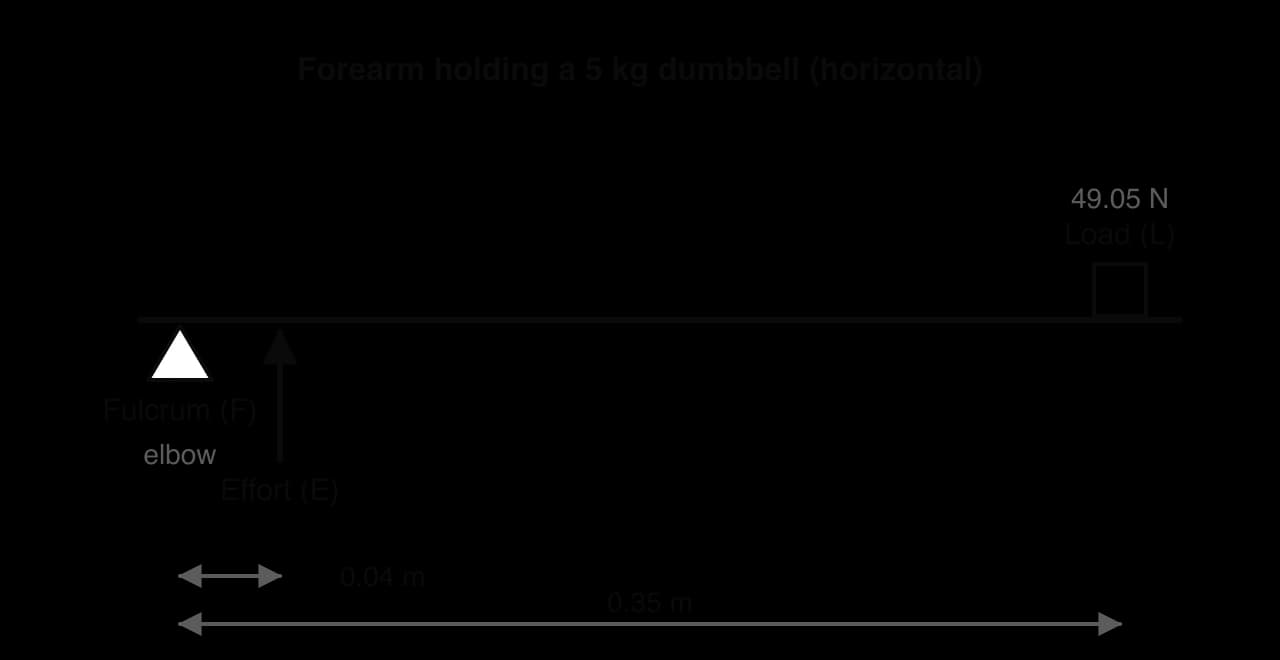
Second-class levers give the opposite result: the muscle force is smaller than the load.
The speed gain of a third-class lever follows from the same distances. In the forearm example, the hand is 0.35 m from the elbow and the biceps insertion 0.04 m. Every point on the forearm turns through the same angle, so the hand moves 0.35 ÷ 0.04 = 8.75 times as far, and therefore 8.75 times as fast, as the point where the biceps pulls. A contraction that shortens the biceps by a few centimetres moves the hand through a wide arc.
Why most levers in the body are third class
Most muscles of the limbs attach close to the joint they move, so most limb movements are third-class levers with a mechanical disadvantage. This arrangement has several advantages for movement.
Speed: a small, quick shortening of a muscle produces a large, fast movement at the end of the limb, which is essential for running, jumping, kicking, throwing and striking.
Range of movement: the end of the limb travels through a large arc, so the hand or foot can reach a wide area.
Compact shape: muscles lying along the bone, attached near the joint, keep the limbs slim and light. A limb with muscles attached far from the joint would be bulky and would have a large moment of inertia, so it would be slow to swing.
The cost is that muscles must produce forces many times larger than the loads they move, as the forearm calculation showed. These large forces pass through tendons and joints, which is why tendon injuries such as Achilles and patellar tendinopathy are common in jumping and running sports, and why loads held far from the body (for example lifting a heavy box with straight arms) strain the back. Keeping a load close to the body shortens the load arm and reduces the muscle force needed, which is the basis of safe lifting advice in health and in occupational settings.
The effort arm also changes as a joint moves, because the angle at which the muscle pulls on the bone changes. The biceps has its longest effort arm when the elbow is bent at about a right angle, so an arm curl feels hardest near the start and end of the movement, where the effort arm is shorter. Resistance machines with cams are designed to change the load through the range to match these changes.
Levers outside the body: implements
Sports implements such as bats, rackets, clubs, sticks and paddles extend the body’s levers. Holding a tennis racket adds up to about 0.7 m to the length of the arm. Because the whole arm and racket rotate together about the shoulder, the racket head is much further from the axis of rotation than the hand, so it moves faster.
The link between rotation and speed at the end of a lever is given by the equation for angular motion, where is the linear velocity of a point, is the angular velocity in radians per second and is the distance from the axis:
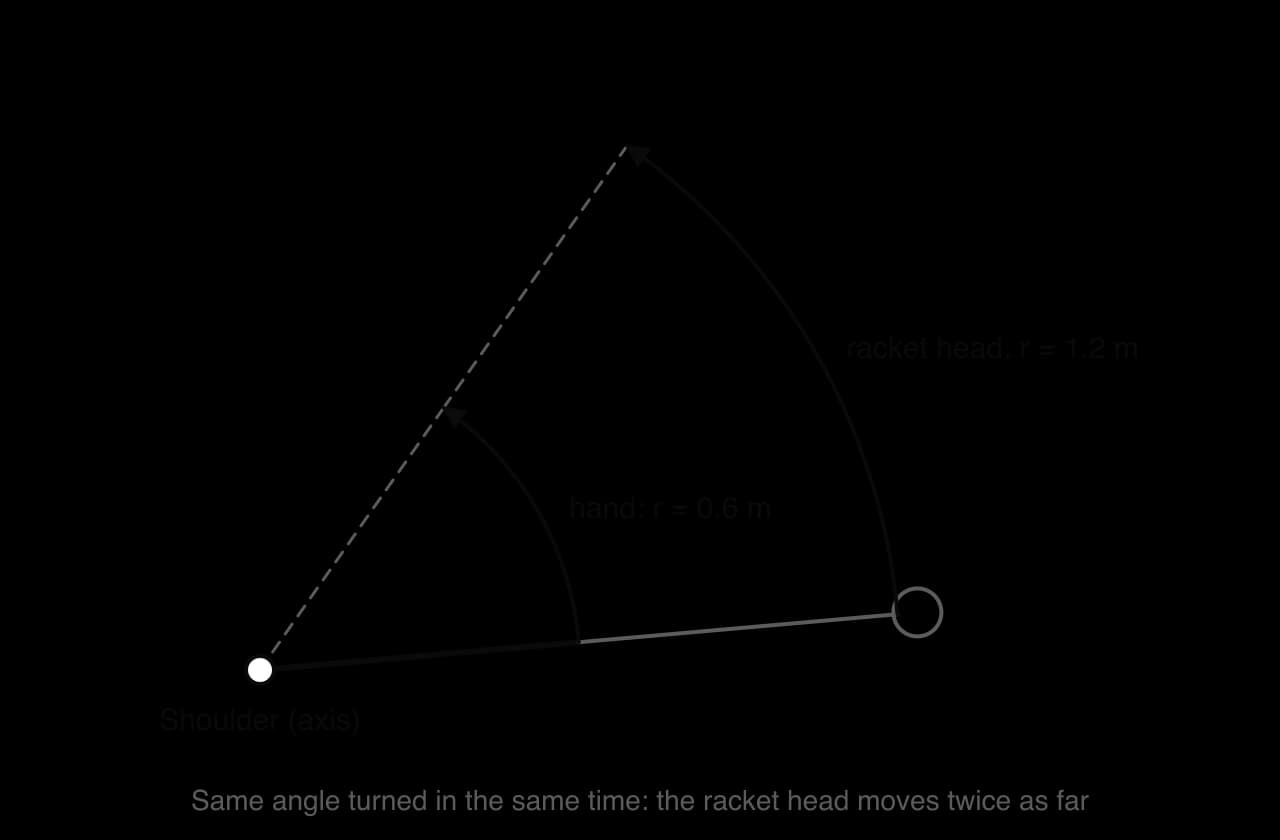
Longer levers are not always better. A longer, heavier implement has a larger moment of inertia, so it is harder to rotate quickly; if the angular velocity falls, some or all of the speed gain is lost. A longer lever also needs a larger muscle force to swing, is harder to control and takes longer to bring round.
This is why a golfer uses a long driver for distance from the tee but a short wedge for accuracy near the green, and why a baseball or cricket player chooses a bat of a length and mass he or she can swing quickly. Many implements are themselves third-class levers in use: a hockey player’s top hand acts as the fulcrum, the bottom hand applies the effort and the ball at the blade is the load.
Equipment for children and adapted sport
Children have shorter limbs and less muscle strength, so full-size implements give them long, heavy levers that they cannot swing fast or control. Junior equipment shortens the lever. Mini tennis uses shorter rackets, lower-compression balls and smaller courts; youth cricket bats and junior golf clubs are sized by height; youth javelins and shots are lighter. With shorter, lighter levers, children can use correct technique, which supports skill learning and reduces the risk of overuse injury. The same idea applies to adapted equipment for older adults and people with disabilities, and links to ergonomics, the design of equipment around the user’s body.
The pole vault and the rowing oar
In the pole vault, the pole acts as a long lever and as an elastic store of energy. A longer pole, gripped higher, can lift the vaulter higher, but only if the vaulter can run fast enough and is strong and skilled enough to bend and control it. Young vaulters therefore start with short, soft poles and progress to longer, stiffer ones as their technique develops. Changing the length of an external lever in this way changes the skill itself, so coaches use it as a progression in motor learning, and the choice of pole is an important task constraint.
The rowing oar shows how the classification depends on the frame of reference. If the oarlock on the boat is taken as the fulcrum, with the rower’s hands as the effort and the force of the water on the blade as the load, the oar is a first-class lever. If the blade is taken as nearly fixed in the water, the blade becomes the fulcrum, the rower pulls at the handle (effort) and the oarlock pushes the boat along (load) in the middle, making it a second-class lever. Both models are used; what matters is to state which point is treated as fixed.
Levers and projecting objects
Throwing, kicking and striking all aim to give an object a high speed of release, which, together with the angle and height of release, decides how far a projectile travels. A long lever at the moment of release increases the linear velocity of the hand or foot, and so the velocity of the ball or implement.
Javelin and cricket bowling: the throwing arm is kept straight and extended behind the body, then whipped through, so that the hand is as far as possible from the shoulder at release. In cricket, the laws limit how much the bowling elbow may straighten during delivery, so bowlers gain speed from the length of an almost straight arm and the rotation of the trunk.
Tennis serve and volleyball spike: the player reaches up to full extension at contact, which makes the lever (shoulder to racket head or hand) as long as possible and raises the contact point.
Kicking: the knee extends just before contact so that the foot is at the end of a long lever (hip to foot) at impact.
Discus and hammer: the implement is held at arm’s length as the athlete spins, so it travels on a large radius and leaves the hand at high speed.
In each case, the body first uses shorter levers to rotate quickly (for example bending the arm or leg to bring it forward), then lengthens the lever just before release or contact. A short lever is easier to accelerate, and a long lever converts the rotation into a high end-point speed. The order in which the body segments are used, from the large segments of the legs and trunk to the small, fast segments of the arm or foot, is the summation of joint forces.
Evaluation: using lever models to analyse movement
Lever models are useful because they are simple. With only three components and two distances, they explain why the biceps must produce several hundred newtons to hold a dumbbell, why limbs are built for speed rather than force, and why longer implements strike faster. They allow quick calculations that coaches and physiotherapists can use, for example to see how changing the position of a load in an exercise changes the muscle force needed.
The models also have clear limitations. A real joint is not a fixed point: the axis of rotation moves slightly as the joint bends. Muscles rarely pull at right angles to the bone, so their effective effort arm changes throughout the movement. Several muscles usually act on the same joint, sometimes with different lines of pull, and antagonists may co-contract. The models are two-dimensional, while most sporting movements happen in three. As the calf-raise and oar examples show, the class assigned to a lever can depend on which point is chosen as the fulcrum.
On balance, simple lever models are best used to explain principles and to compare situations (MA greater or less than 1, short or long lever), not to give exact muscle forces. Precise values need motion capture, force platforms and computer models of the musculoskeletal system, which are used in research and elite sport but are expensive and need expertise. For teaching, coaching and most practical decisions, the simple model gives the right answer to the question being asked.
Case study: the clap skate
In long-track speed skating, the boot of a conventional skate is fixed rigidly to a long blade that extends well beyond the toes. In the clap skate (klapskate), the boot is attached to the blade by a hinge under the ball of the foot, and the heel is free to lift away from the blade. The idea was patented in 1894 but was redeveloped from 1979 by the Dutch biomechanist Gerrit Jan van Ingen Schenau. The Dutch women’s team began racing on it in the 1996–97 season, and skaters from other countries soon followed, in time for the 1998 Winter Olympics in Nagano.
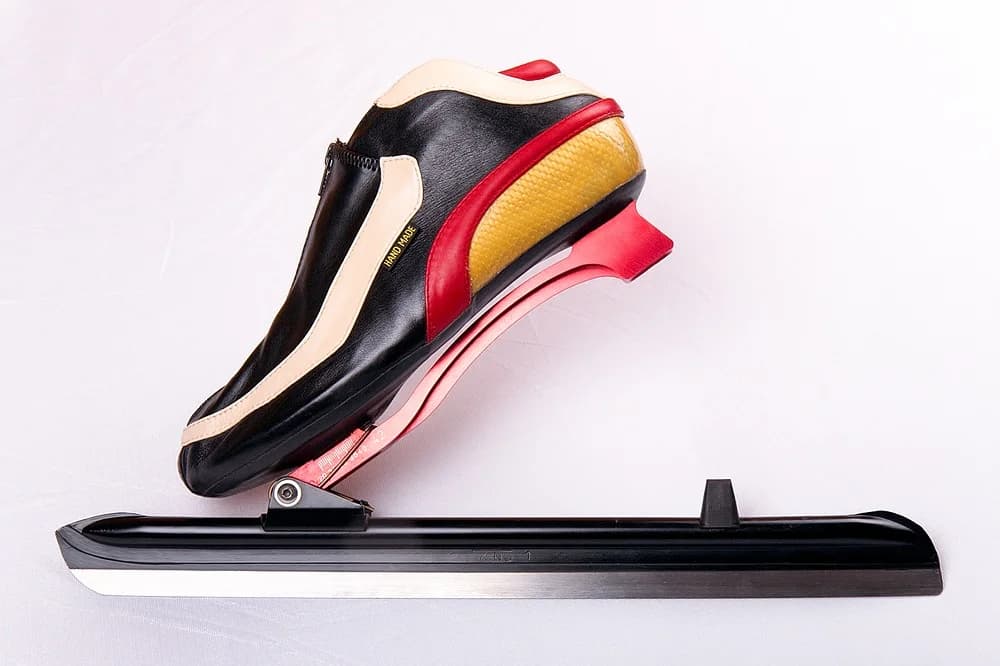
The clap skate changes the lever at the end of each push. Speed skaters push sideways with the leg, extending the hip and knee and finally plantarflexing the ankle. With a conventional skate, plantarflexion rotates the whole skate about the front tip of the blade, so the point of rotation (the fulcrum of the foot lever) lies far in front of the toes. The tip digs into the ice and the rear of the blade lifts.
Skaters therefore learned to stop the push before plantarflexing fully, and the powerful calf muscles contributed little. The hinge moves the fulcrum back to the ball of the foot. The foot can now rotate about the hinge while the whole blade glides on the ice, so the calf muscles can add work at the very end of the push.
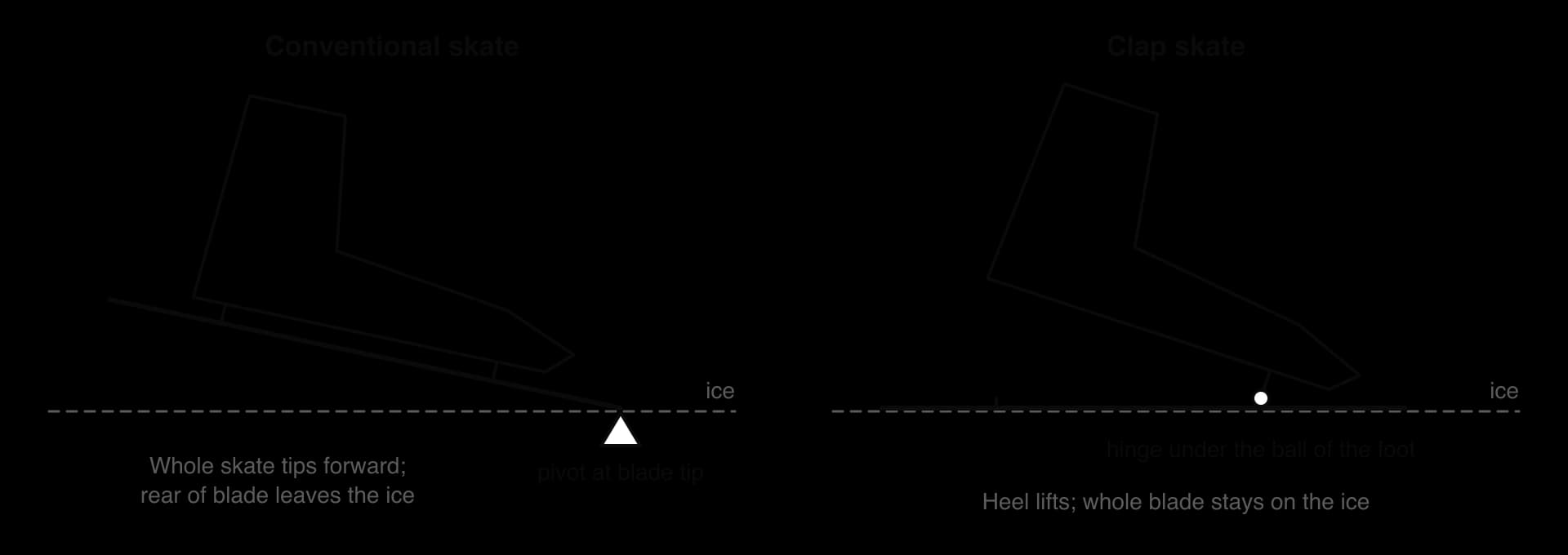
Laboratory studies tested this explanation. When ten elite speed skaters skated four maximal 400 m laps on each type of skate, their velocity was 5% higher with clap skates, because mean power output rose by 25 W. The extra power came from 11 J more work per stroke and a slightly higher stroke frequency (1.36 instead of 1.30 strokes per second), and the difference in work arose in the final 50 ms of the push-off.
The muscle activation patterns measured by electromyography were the same, so the skaters were not using their muscles differently; the hinge simply made the same plantarflexion effective. A separate study found that reduced ice friction explained only a minor part of the benefit.
The position of the hinge matters, as lever theory predicts. A computer simulation that varied the position of the hinge, expressed as the length of the foot lever, between 115 mm and 300 mm found the best push-off at about 185 mm, with performance about 25% lower at both extremes. A study of 16 skaters found that the best hinge position differed from skater to skater and could not be predicted from their ankle and knee strength, so the hinge position is best set for each skater.
Event | World record before clap skates | World record with clap skates | Change |
|---|---|---|---|
Men’s 5000 m | 6:34.96 (Hamar, 13 February 1994) | 6:22.20 (Nagano, 8 February 1998) | −12.76 s (−3.2%) |
Men’s 10,000 m | 13:30.55 (Hamar, 20 February 1994) | 13:15.33 (Nagano, 17 February 1998) | −15.22 s (−1.9%) |
Women’s 3000 m | 4:09.32 (Calgary, 25 March 1994) | 4:01.67 (Calgary, 27 March 1998) | −7.65 s (−3.1%) |
The records show the effect in competition. The men’s 5000 m world record had improved by only about 12 seconds in the seven years from 1987 to 1994. It then stood for almost four years, until clap skates took it below 6:31 in December 1997 and to 6:22.20 at Nagano. The men’s 10,000 m and women’s 3000 m records fell by similar margins within the first two seasons of clap skating.
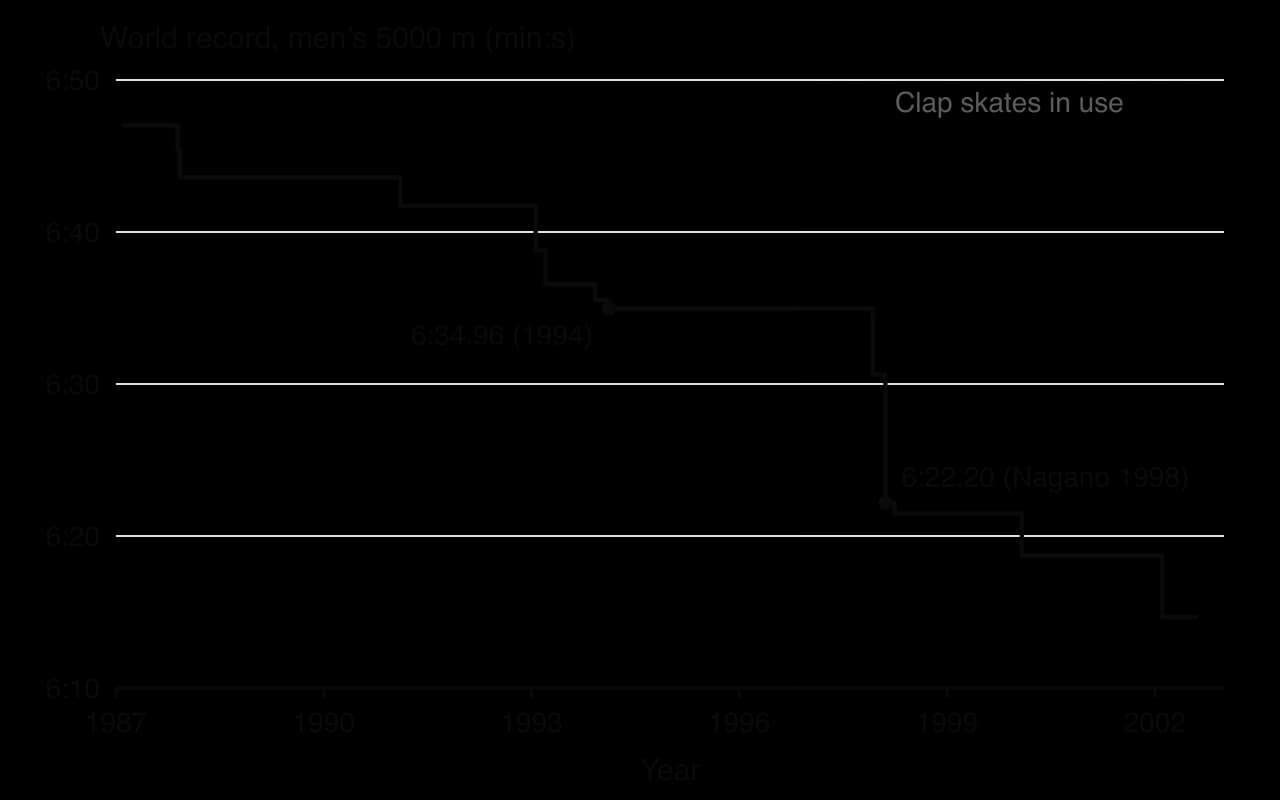
The case also shows the limits of drawing conclusions from records alone. Other factors also affect records, such as ice quality, skin suits, training methods and venue: several of the records were set at the high-altitude oval in Calgary, where the air is thinner. The laboratory studies are stronger evidence because the same skaters used both skates under controlled conditions, a within-participant design that removes differences between individuals.
Even so, laboratory tests over a few laps cannot show how much the benefit grows as skaters adapt their technique to the new skate over whole seasons. The clap skate is an example of a change to an external lever enhancing performance, and of scientific understanding (van Ingen Schenau’s analysis of the push-off) leading directly to a change in equipment.
Sources: Houdijk et al., Medicine & Science in Sports & Exercise, 2000, 2001 and 2003; Van Horne and Stefanyshyn, Journal of Applied Biomechanics, 2005; ISU world record progressions via Wikipedia, accessed 2026.
Identify the fulcrum, effort and load of the foot lever at the end of a push with a clap skate, and explain why moving the fulcrum improved the push-off.
Suggest why the world record data alone cannot prove that clap skates caused the improvement, and how the laboratory study overcame this.
Discuss whether equipment that changes a lever, such as the clap skate, should be allowed in sport, considering fairness, safety and access.
Exam practice
Lever questions test identification, sketching and calculation. Paper 1A often asks for the class of a lever or a quick MA calculation; Paper 2 asks you to sketch and label a lever from the body, calculate an MA or an effort, or explain the advantages of a lever system in a named sport.
Calculations follow the same pattern every time.
Paper 1A-style questions
MA questions in Paper 1A need only one division.
Questions also test the rules for each class.
Paper 1B-style data-based question
A study investigated the effect of racket length on serve performance in junior tennis players (hypothetical data). Ten players aged 13–14 years each hit 20 first serves with rackets of three lengths, in a random order, on the same day. Serve speed was measured with a radar gun and accuracy as the percentage of serves landing in the service box. All three rackets had the same head size and string tension.
Racket length (m) | Mean serve speed (m s⁻¹) | Mean accuracy (% in) |
|---|---|---|
0.58 | 31.2 ± 2.4 | 72 ± 8 |
0.63 | 33.0 ± 2.6 | 68 ± 9 |
0.68 | 33.6 ± 3.1 | 55 ± 11 |
Values are mean ± standard deviation, n = 10 (hypothetical data).
Paper 2-style structured questions
Calculations in Paper 2 usually combine weight, moments and MA.
Explanation questions on levers usually target the third-class arrangement of the limbs.
Extended-response question
Summary
A lever is a rigid bar that rotates about a fulcrum; in the body, bones are the bars, joints the fulcrums, muscles provide the effort and body weight or objects are the load.
The moment (turning effect) of a force is force × perpendicular distance from the fulcrum, in N m; for a balanced lever, effort × effort arm = load × load arm.
Mechanical advantage = effort arm ÷ load arm. MA > 1 multiplies force; MA < 1 is a mechanical disadvantage that gives speed and range of movement.
First-class levers have the fulcrum in the middle (MA can be any value); second-class the load in the middle (MA always > 1); third-class the effort in the middle (MA always < 1).
Most body levers are third class, so muscles must produce large forces, but the ends of the limbs move fast and far.
Implements extend the body’s levers: from v = ωr, a longer lever gives a faster end point at the same angular velocity, but it is harder to rotate and control.
Throwers and strikers lengthen their levers just before release or contact to maximise speed; children use shorter, lighter levers.
Lever models are simple and useful for explaining principles but ignore moving joint axes, changing angles of pull and three-dimensional movement.
Self-check
- To do:
I can identify the fulcrum, effort, load, effort arm and load arm in a body movement or a piece of equipment.
- To do:
I can distinguish between first-, second- and third-class levers and give a body example and a sport example of each.
- To do:
I can calculate a moment and use the principle of moments to find an unknown effort or load.
- To do:
I can calculate mechanical advantage and explain what a mechanical advantage and a mechanical disadvantage mean.
- To do:
I can explain why most levers in the body are third class, including the cost of this arrangement.
- To do:
I can apply v = ωr to explain why longer implements and extended limbs increase release or impact speed.
- To do:
I can sketch and label a lever in house style.
- To do:
I can evaluate the strengths and limitations of lever models for analysing movement.