Notes on B.1.1 Anatomical position, planes and movement
Learning objectives
Outline the functions of the skeleton and distinguish between the axial and appendicular skeleton.
Label the major bones on a diagram of the skeleton and classify bones as long, short, flat, irregular or sesamoid.
Describe the anatomical position and use positional terms to describe the location of one body part relative to another.
Describe the sagittal, frontal and transverse planes and the frontal, sagittal and longitudinal axes, and state which axis goes with each plane.
Define each anatomical movement term and give a joint, a sporting example, the plane and the axis for each.
Analyse a whole sporting skill joint by joint, stating the movement, plane and axis at each joint.
Outline what anthropometry measures, how measurements are standardised and how percentiles are used in design (HL).
Explain how anthropometric databases and ergonomic design are used to size equipment and improve efficiency and safety (HL).
Evaluate the use of average body data when designing for individual athletes (HL).
Introduction
Biomechanics describes human movement precisely, and that requires a shared language. Anatomists, coaches, physiotherapists and sport scientists describe every movement from the same starting posture, using fixed directions, planes and axes and an agreed set of movement terms, so that "the knee flexes in the sagittal plane about a frontal axis" means exactly the same thing to all of them.
The same language serves both lenses of the course. A physiotherapist measuring how far a patient can flex the knee after surgery uses it to track recovery, and a coach analysing a tennis serve uses it to give exact technical feedback. At higher level, measuring the body itself (anthropometry) and designing equipment around it (ergonomics) link this anatomy to the safety and efficiency of sport and everyday life.
The skeleton and its functions
The skeleton is the framework of bones, together with the cartilage and ligaments that join them, that supports and protects the body and allows it to move. An adult skeleton has 206 bones. Each bone is a living organ: it has a blood supply and nerves, it grows, it repairs itself after a fracture and it changes shape and density in response to the loads placed on it.
Five functions of the skeleton
Function | How the skeleton carries it out | Example |
|---|---|---|
Support | Provides a rigid frame that holds the body upright and gives shape; bones carry the body's weight down to the feet. | The vertebral column and the bones of the legs carry body weight when standing or landing from a jump. |
Protection | Hard bone surrounds delicate organs and absorbs or spreads the force of impacts. | The cranium protects the brain; the ribs and sternum protect the heart and lungs. |
Movement | Bones act as rigid levers; muscles pull on them through tendons, and the bones move at joints. | The quadriceps pull on the tibia through the patellar tendon to extend the knee in a kick. |
Mineral storage | Bone stores calcium and phosphate and releases them into the blood when needed. | Calcium released from bone helps keep blood calcium stable, which nerves and muscles need to work. |
Blood cell production | Red bone marrow, found in spongy bone, produces red blood cells, white blood cells and platelets. | Red marrow in the sternum, ribs, pelvis and the ends of the femur makes the red blood cells that carry oxygen to working muscles. |
The functions are linked. Weight-bearing exercise that loads the skeleton for support and movement also stimulates bone to lay down more mineral, which strengthens it. This is why physical activity in childhood and adolescence is promoted as a way of reducing the risk of osteoporosis later in life, and why long periods of bed rest or spaceflight, which remove the normal loads on the skeleton, lead to bone loss. The red marrow links the skeleton to the oxygen transport system, because it produces the red blood cells that carry oxygen.
Axial and appendicular skeleton
The skeleton is divided into two parts with different main functions. The axial skeleton lies along the central axis of the body: the skull, the vertebral column, the ribs and the sternum. Its primary functions are protection and support. The appendicular skeleton is made up of the bones of the limbs (the appendages) and the girdles that attach them to the axial skeleton. Its primary function is movement.
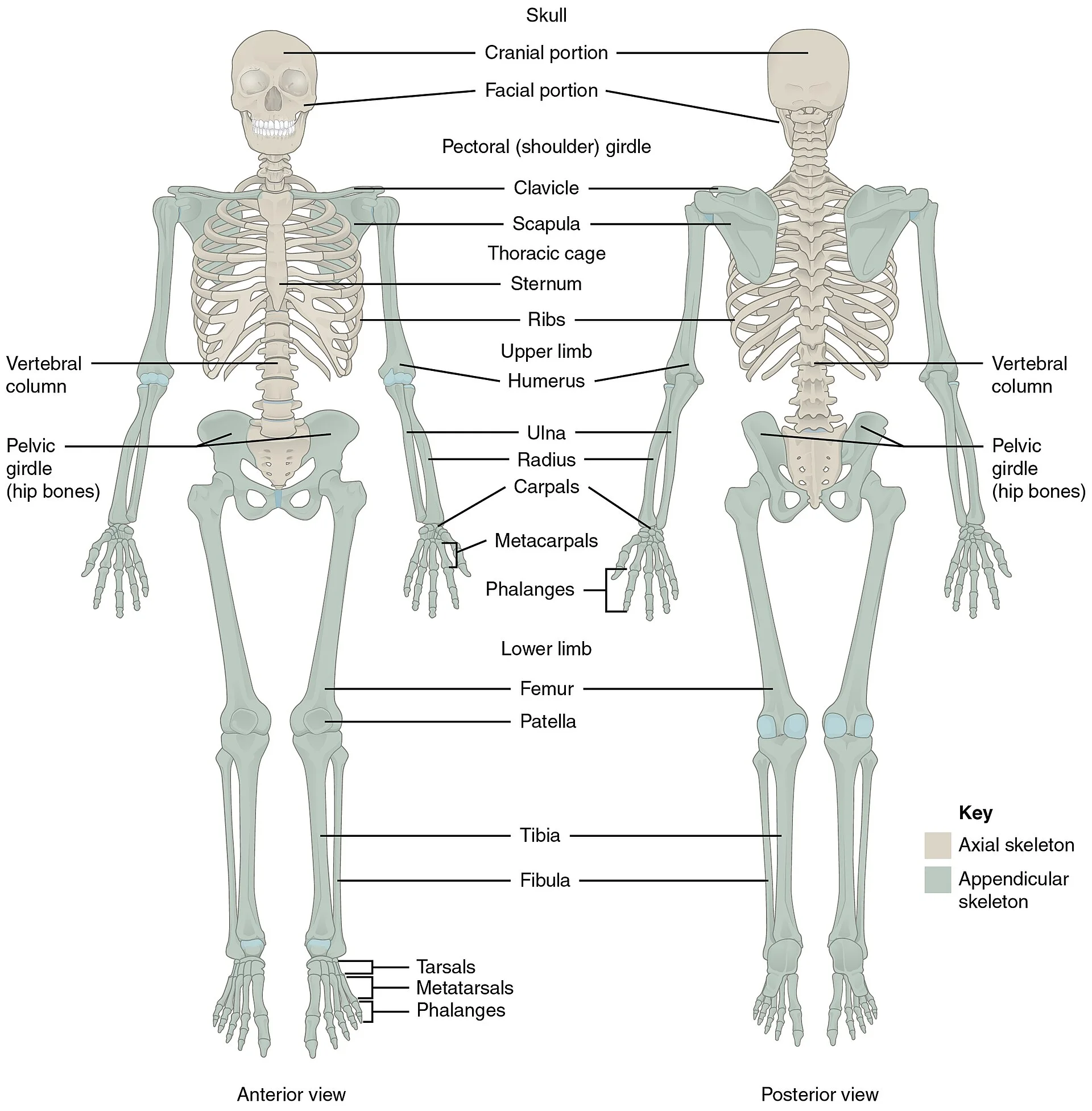
The girdles sit at the boundary. The shoulder girdle (clavicle and scapula) connects the arms to the trunk and is only loosely attached to the axial skeleton, through the small joint between the clavicle and the sternum. This gives the arm a very large range of movement. The pelvic girdle is fused firmly to the sacrum, which makes it far more stable and suited to transferring body weight from the trunk to the legs.
The major bones
The major bones are usually learned by region, from the head downwards. Bones of the upper limb have matching bones in the lower limb, which halves the memory work: the humerus matches the femur, the radius and ulna match the tibia and fibula, and the carpals, metacarpals and phalanges of the hand match the tarsals, metatarsals and phalanges of the foot.
Region | Bones | Notes |
|---|---|---|
Skull (axial) | Cranium; mandible | The mandible (lower jaw) is the only skull bone that moves freely. |
Thorax (axial) | Sternum; 12 pairs of ribs | Together with the thoracic vertebrae these form the rib cage. |
Vertebral column (axial) | Cervical, thoracic and lumbar vertebrae; sacrum; coccyx | See the next table for the number in each region. |
Shoulder girdle (appendicular) | Clavicle; scapula | The scapula is the "shoulder blade"; the clavicle is the "collarbone". |
Upper limb (appendicular) | Humerus; radius (thumb side) and ulna (little-finger side); carpals; metacarpals; phalanges | The radius rotates around the ulna in pronation and supination. |
Pelvic girdle (appendicular) | Pelvis (two hip bones) | Each hip bone has a deep socket (the acetabulum) for the head of the femur. |
Lower limb (appendicular) | Femur; patella; tibia (shin bone, medial) and fibula (lateral); tarsals; metatarsals; phalanges | The femur is the longest and strongest bone; the patella sits in the tendon of the quadriceps. |
The vertebral column (spine) has five regions. Its curves (forward in the neck and lower back, backward in the thorax) help it absorb shock when running and landing. The vertebrae become larger from top to bottom because each lower vertebra carries the weight of more of the body above it.
Region | Number of vertebrae | Main role |
|---|---|---|
Cervical | 7 | Support the head and allow a large range of head movement; the first two (atlas and axis) allow nodding and turning. |
Thoracic | 12 | Each joins a pair of ribs; protect the heart and lungs; limited movement. |
Lumbar | 5 | Largest vertebrae; carry the most body weight; allow flexion and extension of the lower back. |
Sacrum | 5 fused into one | Joins the spine to the pelvic girdle; transfers weight to the legs. |
Coccyx | 3–5 fused (usually 4) | The "tailbone"; attachment for some muscles and ligaments of the pelvic floor. |
Types of bone
Bones are also classified by their shape, and shape follows function. Long bones act as levers, flat bones protect and give large areas for muscle attachment, and short bones give stability with a little movement.
Type | Shape and function | Examples |
|---|---|---|
Long | Longer than they are wide, with a shaft and two ends; act as levers for movement and contain red and yellow marrow. | Femur, humerus, tibia, radius, phalanges |
Short | Roughly cube-shaped; give strength and stability with small gliding movements and absorb shock. | Carpals, tarsals |
Flat | Thin and often curved; protect organs and provide broad surfaces for muscle attachment. | Cranium, sternum, ribs, scapula |
Irregular | Complex shapes that fit a specific job, often protection plus support. | Vertebrae, mandible, bones of the pelvis |
Sesamoid | Small bones that develop inside a tendon; protect the tendon and increase the turning effect of the muscle by moving the tendon away from the joint. | Patella |
Anatomical position and positional terms
Describing where one part of the body is relative to another only works if everyone imagines the body in the same posture. That reference posture is the anatomical position. Every positional term and every movement term is defined from it, even when the athlete being described is upside down on a bar or mid-air in a dive.
The palms-forward detail matters. In the anatomical position the radius and ulna lie side by side, with the thumb on the lateral side. Many everyday postures (arms hanging with the palms facing the thighs) already involve some rotation of the forearm, which is why the reference posture is fixed precisely.
Pairs of positional terms
Positional terms come mostly in opposite pairs. They are always relative: a structure is only "superior" or "distal" compared with something else.
Term | Meaning | Example sentence |
|---|---|---|
Superior | Towards the head, or higher up the body | The sternum is superior to the pelvis. |
Inferior | Away from the head, or lower down the body | The lumbar vertebrae are inferior to the thoracic vertebrae. |
Anterior (ventral) | Towards the front of the body | The patella is anterior to the knee joint. |
Posterior (dorsal) | Towards the back of the body | The scapula is posterior to the ribs. |
Medial | Towards the midline of the body | The ulna is medial to the radius. |
Lateral | Away from the midline of the body | The fibula is lateral to the tibia. |
Intermediate | Between a more medial and a more lateral structure | The clavicle is intermediate between the sternum (medial) and the shoulder joint (lateral). |
Proximal | Closer to the trunk or to the point where a limb attaches to the trunk | The knee is proximal to the ankle. |
Distal | Further from the trunk or from the point where a limb attaches | The phalanges are distal to the carpals. |
Superficial | Closer to the surface of the body | The skin is superficial to the muscles. |
Deep |
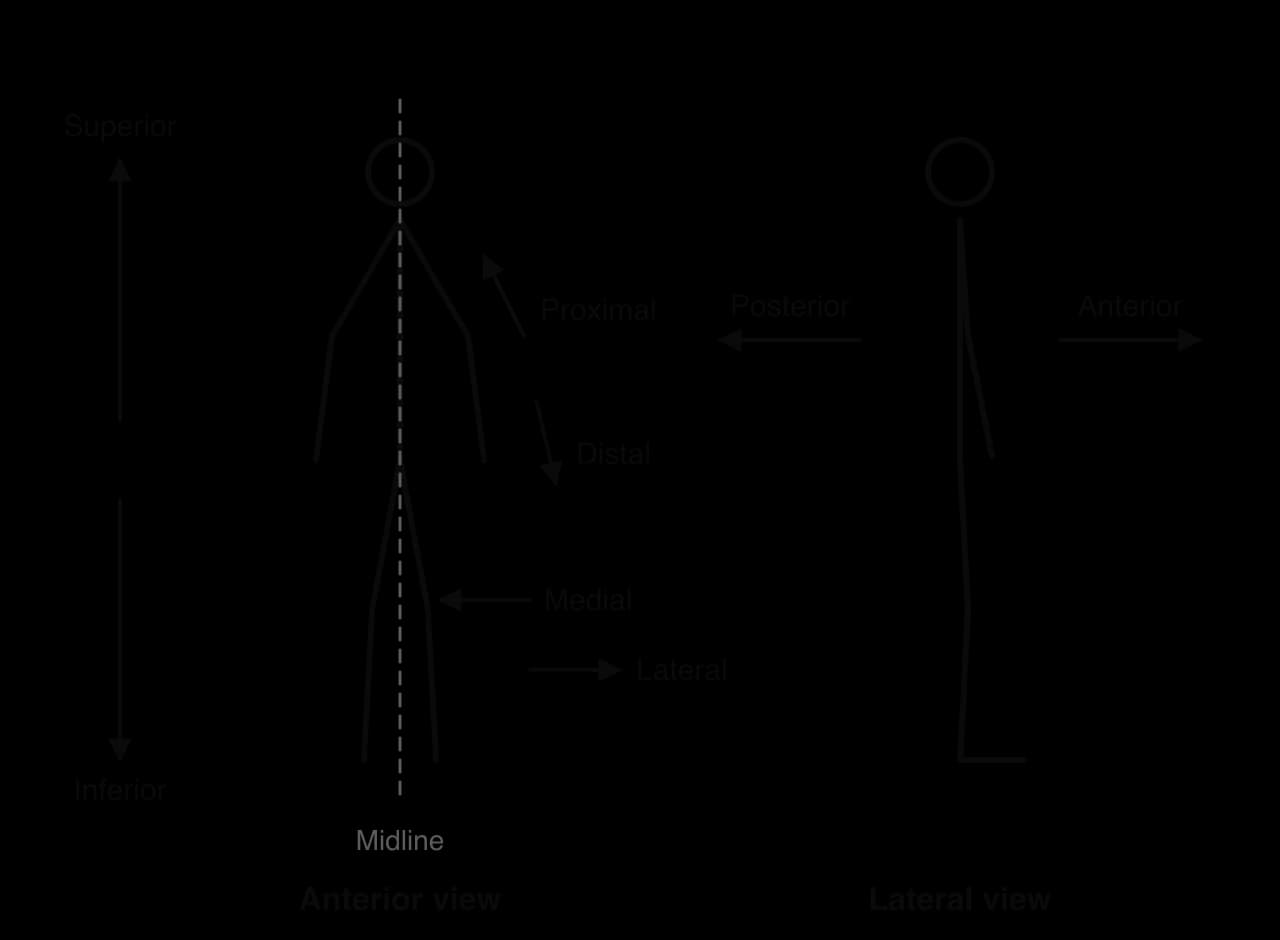
Proximal and distal are used mainly for the limbs, where "superior" can be misleading: when a gymnast raises the arms overhead, the hand is above the shoulder but is still distal to it. Superficial and deep describe depth, which is useful in injury: a graze is superficial, while a tear in a muscle close to the bone is a deep injury.
Planes of movement and axes of rotation
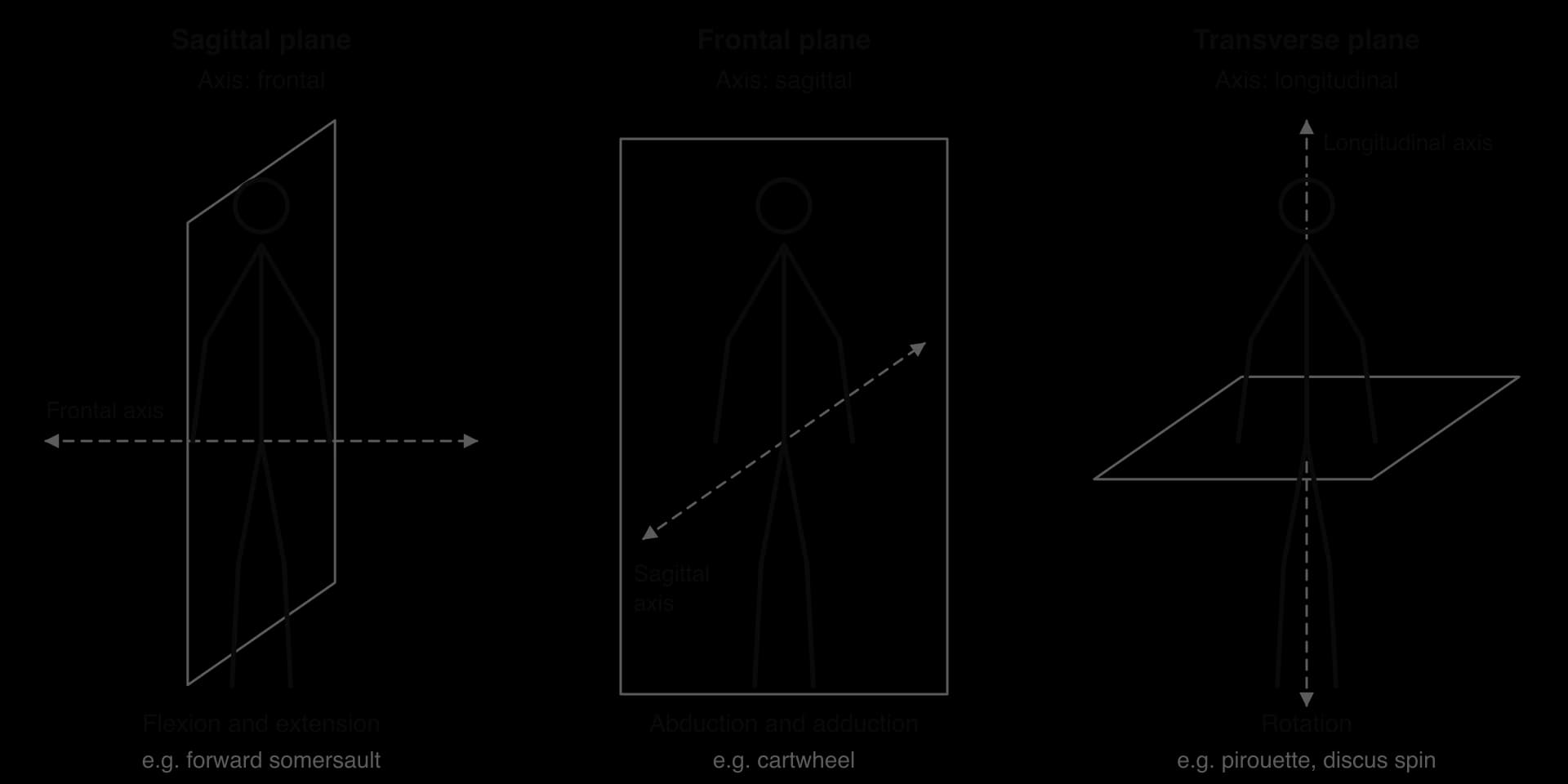
Human movement is three-dimensional, but it can be broken down into movements in three flat surfaces at right angles to one another. Each of these imaginary surfaces is a plane of movement. Movement of a limb at a joint is a rotation, and every rotation happens about a line called an axis of rotation. The axis always passes through the joint (or, for the whole body, through the centre of mass) and is at right angles to the plane in which the movement happens.
A plane describes where a movement happens; an axis describes what it turns about. A door swinging on its hinges is a useful picture: the door moves in a horizontal plane, and the hinge line is a vertical axis at right angles to it.
The sagittal plane and the frontal axis
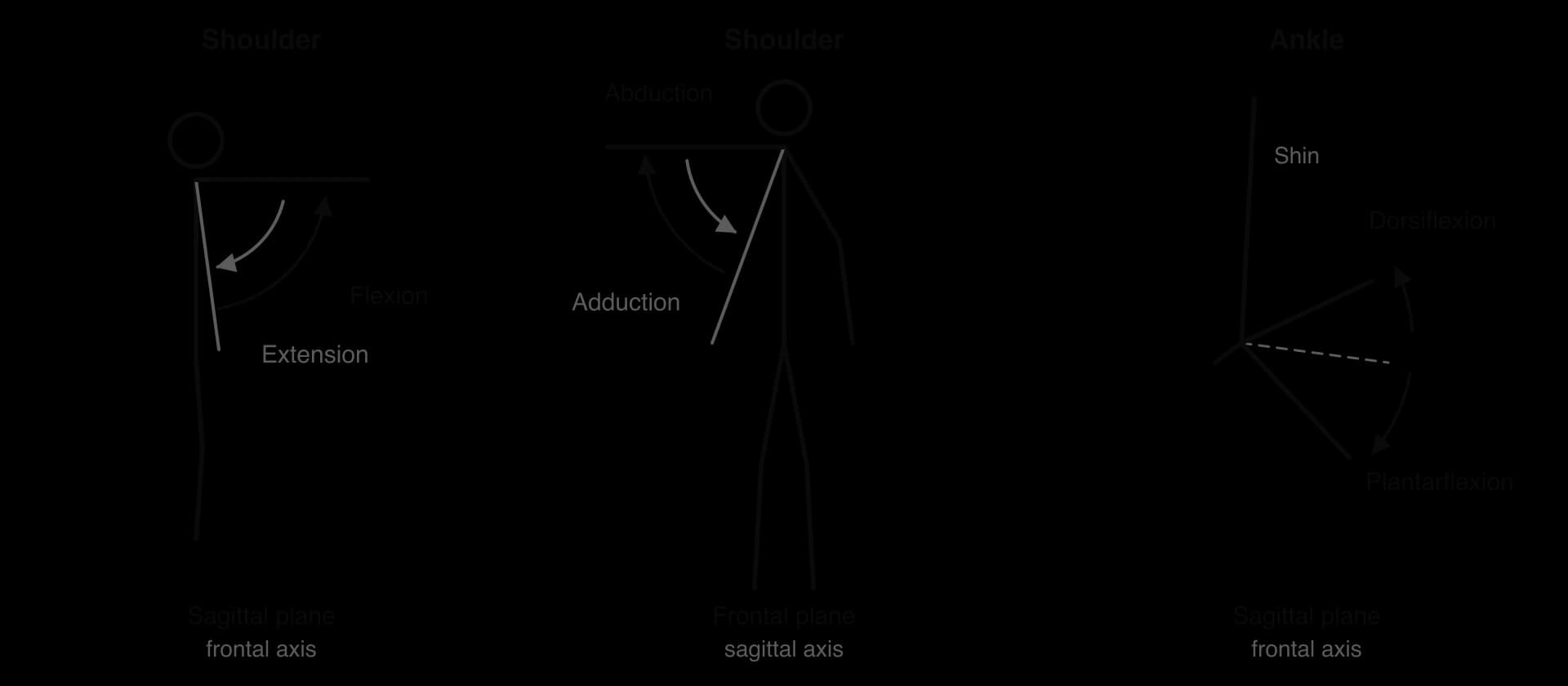
The sagittal plane is a vertical plane that runs from front to back and divides the body into left and right parts. Movements in it are forward and backward movements: flexion and extension of most joints, and dorsiflexion and plantarflexion of the ankle. They happen about the frontal axis, which runs horizontally from side to side (left to right) through the joint.
Most of the large movements in running, cycling, rowing, the squat and the forward roll are in the sagittal plane. A forward somersault in diving or gymnastics is a whole-body rotation in the sagittal plane about the frontal axis through the centre of mass.
The frontal plane and the sagittal axis
The frontal plane (also called the coronal plane) is a vertical plane that runs from side to side and divides the body into front and back parts. Movements in it are sideways movements: abduction and adduction, lateral flexion of the trunk, elevation and depression of the shoulder girdle, and inversion and eversion of the foot. They happen about the sagittal axis, which runs horizontally from front to back through the joint.
A cartwheel is a whole-body rotation in the frontal plane about a sagittal axis. A star jump moves the arms and legs in the frontal plane, and a side-step in rugby or a lateral lunge relies on hip abduction and adduction.
The transverse plane and the longitudinal axis
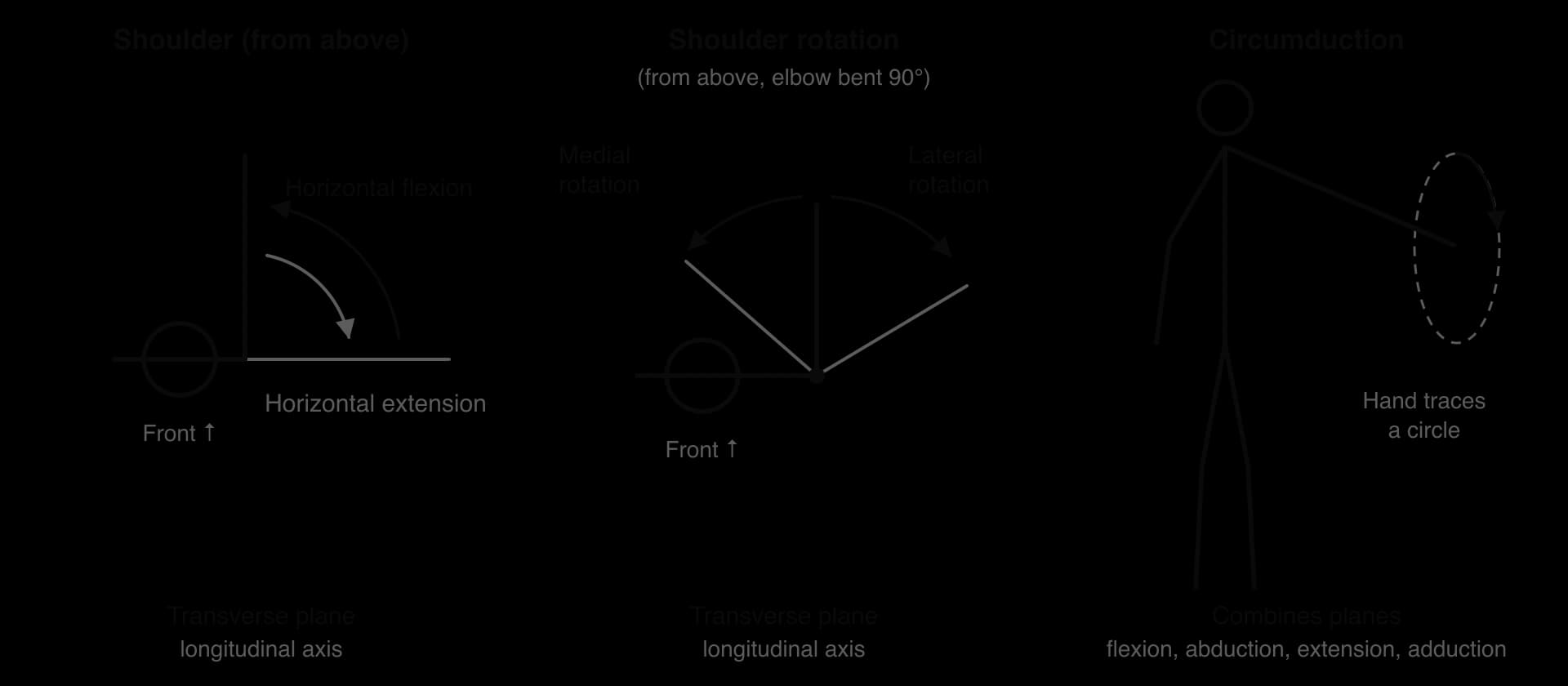
The transverse plane is a horizontal plane that divides the body into upper and lower parts. Movements in it are twisting movements: medial and lateral rotation, pronation and supination of the forearm, horizontal flexion and extension, and protraction and retraction of the shoulder girdle. They happen about the longitudinal axis, which runs vertically from head to toe (or along the length of a limb).
A pirouette in ballet, the spin of a discus thrower and the turn of a hammer thrower are whole-body rotations in the transverse plane about the longitudinal axis. Twisting somersaults, such as those performed by Simone Biles on floor and vault, combine a somersault about the frontal axis with twists about the longitudinal axis.
Plane | Divides the body into | Axis (runs) | Typical movements | Whole-body example |
|---|---|---|---|---|
Sagittal | Left and right | Frontal (side to side) | Flexion, extension, hyperextension, dorsiflexion, plantarflexion | Forward somersault; forward roll |
Frontal (coronal) | Front and back | Sagittal (front to back) | Abduction, adduction, lateral flexion, elevation, depression, inversion, eversion | Cartwheel; star jump |
Transverse | Upper and lower | Longitudinal (head to toe) | Medial and lateral rotation, pronation, supination, horizontal flexion and extension, protraction, retraction | Pirouette; discus spin |
 YouTube
Movement terms
Each anatomical movement term describes how one body segment moves relative to another at a joint, starting from the anatomical position. Most come in opposite pairs, and each pair happens in one plane about one axis. Which movements a joint can perform depends on its type, a topic covered with synovial joints: the elbow can only flex and extend, while the shoulder can perform almost every movement on the list.
Flexion, extension and hyperextension
Flexion decreases the angle between the two bones at a joint, and extension increases it, returning the joint towards the anatomical position. Bending the elbow in a biceps curl is flexion; straightening it again is extension. At the shoulder and hip, flexion moves the limb forwards (raising the arm forwards, lifting the knee towards the chest), and extension moves it backwards.
Hyperextension is extension beyond the anatomical position. Arching the lower back in a gymnastic back walkover or in the take-off of a Fosbury flop hyperextends the spine, and swinging the arm back behind the body before a bowling action hyperextends the shoulder. At some joints, such as the knee and elbow, hyperextension is limited by bone and ligaments, and forced hyperextension causes injury.
All three are sagittal-plane movements about the frontal axis. The trunk can also flex (bending forwards in a sit-up), extend and hyperextend; bending the trunk sideways is a separate movement called lateral flexion, which happens in the frontal plane about a sagittal axis.
Abduction and adduction
Abduction moves a body part away from the midline of the body, and adduction moves it back towards the midline. Raising the arms sideways in a star jump is abduction of the shoulders; bringing them back down to the sides is adduction. Both happen in the frontal plane about the sagittal axis. Spreading the fingers or toes apart is also abduction, judged from the midline of the hand or foot.
Dorsiflexion and plantarflexion
Flexion and extension at the ankle have their own names. Dorsiflexion brings the top of the foot (the dorsal surface) up towards the shin, decreasing the angle at the front of the ankle. Plantarflexion points the toes away from the shin, as when standing on tiptoe. Both happen in the sagittal plane about the frontal axis. A sprinter plantarflexes forcefully at the end of each push-off, while landing from a jump begins with the ankle dorsiflexing as the knees and hips bend to absorb the force.
Inversion and eversion
Inversion turns the sole of the foot inwards to face the midline, and eversion turns the sole outwards. These movements happen mainly at the joints between the tarsal bones, in the frontal plane about the sagittal axis. A footballer inverts the foot slightly to strike the ball with the outside of the boot. The most common ankle sprain happens when the foot is forced into inversion, usually while it is also plantarflexed, for example landing on another player's foot after a rebound in basketball, which overstretches the ligaments on the lateral side of the ankle.
Pronation and supination
Pronation and supination are rotations of the forearm. In supination the palm turns to face forwards or upwards (as in the anatomical position); in pronation the palm turns to face backwards or downwards. The radius rotates around the ulna at the radio-ulnar joints, so these are movements in the transverse plane about the longitudinal axis of the forearm. Topspin forehands in tennis and the follow-through of a basketball shot both involve pronation.
Rotation and circumduction
Rotation is the turning of a bone around its own long axis. Medial (internal) rotation turns the anterior surface of the limb towards the midline; lateral (external) rotation turns it away. At the shoulder, the cocking phase of a baseball pitch or a tennis serve involves extreme lateral rotation, and the forward swing involves rapid medial rotation. Rotation of the head at the neck (shaking the head) and of the trunk (a golf backswing) are also rotations. All are in the transverse plane about the longitudinal axis.
Circumduction is a circular movement in which the distal end of a limb traces a circle while the proximal end stays fixed at the joint, so the limb sweeps out a cone. It combines flexion, abduction, extension and adduction in sequence, so it happens in more than one plane and has no single axis. Bowling a cricket ball and swinging the arms in a butterfly stroke involve circumduction at the shoulder. Only joints that move in two or more planes, such as the shoulder, hip, wrist and the base of the fingers, can circumduct.
Horizontal flexion and horizontal extension
When the arm (or leg) is first raised to the horizontal, it can then swing forwards or backwards in the horizontal plane. Horizontal flexion (also called horizontal adduction) moves the raised arm forwards and across towards the midline, as in the pushing phase of a chest press or a forehand drive in tennis. Horizontal extension (horizontal abduction) moves it backwards, away from the midline, as in the backswing of a forehand or a discus wind-up. Both are in the transverse plane about the longitudinal axis through the shoulder.
Elevation, depression, protraction and retraction
These terms describe movements of the shoulder girdle (and of the mandible). Elevation moves a structure upwards, as in shrugging the shoulders; depression moves it downwards, as when the shoulder blades are pulled down during the press phase of a dip or in the pull-down phase of a lat pull-down. Both happen in the frontal plane about a sagittal axis.
Protraction moves a structure forwards (anteriorly), as when the shoulder blades slide forwards around the rib cage at the end of a punch in boxing or of a chest pass. Retraction moves it backwards, pulling the shoulder blades together, as at the end of the pulling phase in rowing. Both happen in the transverse plane about the longitudinal axis. Jutting the jaw forwards and pulling it back are also protraction and retraction.
Opposition and reposition
Opposition is the movement of the thumb across the palm so that its tip touches the tip of a finger. It combines flexion, abduction and medial rotation at the saddle joint at the base of the thumb, and it is what makes precise gripping possible: holding a pen, a dart or the seam of a cricket ball. Reposition returns the thumb to the anatomical position. Because opposition combines movements, it is not confined to one plane.
The full set of movement terms
The table brings together every movement term with a joint where it occurs, a sporting example, the plane and the axis. Multi-plane movements have no single axis.
Movement | Joint and sporting example | Plane | Axis |
|---|---|---|---|
Flexion | Knee in the recovery phase of running; hip when lifting the knee | Sagittal | Frontal |
Extension | Knee when kicking; elbow in a chest pass | Sagittal | Frontal |
Hyperextension | Spine in a back walkover; shoulder in a bowling wind-up | Sagittal | Frontal |
Abduction | Hip in a side-step; shoulder in a star jump | Frontal | Sagittal |
Adduction | Hip in the breaststroke kick; shoulder when lowering the arms | Frontal | Sagittal |
Dorsiflexion | Ankle on landing from a jump; front ankle in a deep lunge | Sagittal | Frontal |
Plantarflexion | Ankle in a sprint push-off; pointed toes in diving | Sagittal | Frontal |
Inversion | Foot striking with the outside of the boot in football | Frontal | Sagittal |
Eversion | Foot pushing off the inside edge in a skating stride | Frontal | Sagittal |
Pronation | Radio-ulnar joints in a topspin forehand |
 YouTube
Analysing a whole skill joint by joint
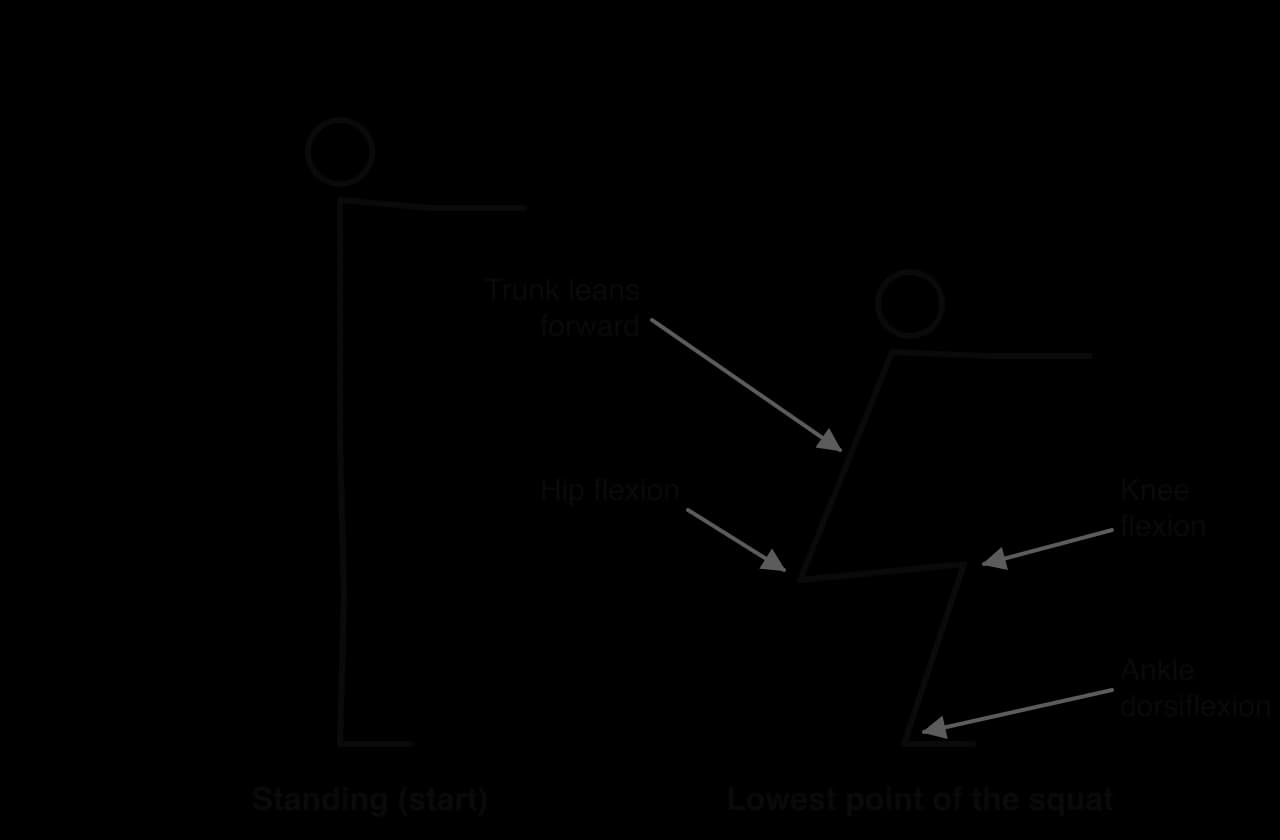
Real sporting skills combine movements at many joints, often in more than one plane, and the movement at each joint changes from one phase of the skill to the next. A movement analysis breaks a skill into its phases of movement and then, for each phase, names the joint, the movement, the plane and the axis. The same method underpins the analysis of muscle action, where the agonist responsible for each joint movement is added, and of levers.
Choose the phase to analyse (for example the downward phase of a squat) and describe the start and end positions.
List the main joints that move: usually the hip, knee and ankle for the legs, and the shoulder, elbow and wrist for the arms; add the trunk and the shoulder girdle when they move.
For each joint, compare the start and end positions and name the movement (has the angle decreased? has the limb moved away from the midline? has it turned?).
Add the plane in which the movement happens and the axis about which it rotates.
Joint | Downward phase | Upward phase | Plane | Axis |
|---|---|---|---|---|
Hip | Flexion | Extension | Sagittal | Frontal |
Knee | Flexion | Extension | Sagittal | Frontal |
Ankle | Dorsiflexion | Plantarflexion | Sagittal | Frontal |
Trunk (spine) | Slight flexion as the trunk leans forward (kept small to protect the lower back) | Extension back to upright | Sagittal | Frontal |
The squat is a useful first example because every movement happens in one plane. Skills such as a tennis serve or a golf swing combine movements in all three planes at once, which is why they take longer to learn and analyse. Precise terms also make coaching feedback more exact: "lift the knee higher" can be stated as "increase hip flexion in the recovery phase", which links this language to motor learning and the feedback a coach gives.
The health lens uses exactly the same language. After a knee ligament reconstruction, a physiotherapist records how many degrees of knee flexion and extension the patient can reach with a goniometer, a protractor-like instrument centred over the joint's axis. The return of full knee extension is one of the early goals of rehabilitation, because walking normally depends on it.
Health lens | Performance lens | |
|---|---|---|
Who uses the terms | Physiotherapists, doctors, exercise instructors working with older adults or patients | Coaches, biomechanists, performance analysts, athletes |
What is described | Range of motion lost after injury or surgery; movements to avoid after a hip replacement (for example combined hip flexion and medial rotation) | The joint actions of a technique, phase by phase, and how they differ from an expert model |
Why precision matters | A rehabilitation programme can be progressed safely and its results compared over time | Feedback is specific, and training exercises can be chosen to match the planes and movements of the sport (specificity) |
Anthropometry (HL only)
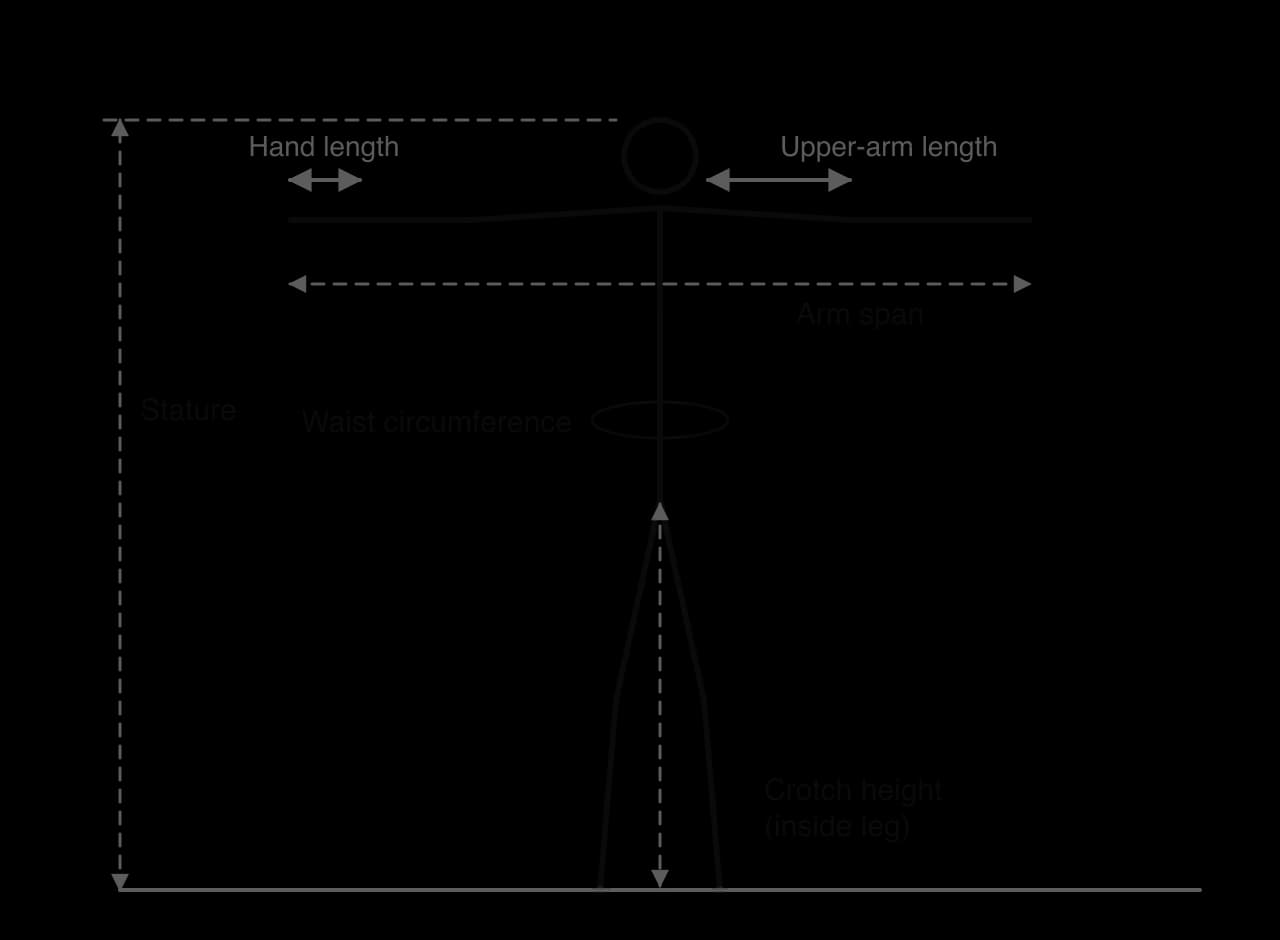
Bodies differ greatly in size and proportions, and those differences affect performance, injury risk and how well equipment fits. Anthropometry is the science of measuring them. It provides the numbers needed to describe an individual athlete, to compare groups (sprinters with distance runners, children with adults, women with men) and to design equipment and spaces that fit the people who use them.
What is measured
Type of measurement | Examples | Typical instrument | Use in sport and health |
|---|---|---|---|
Stature and body mass | Standing height; sitting height; body mass | Stadiometer; calibrated scales | Growth monitoring in young athletes; body mass index in health screening |
Lengths | Arm span; upper-arm, forearm, thigh and leg length; hand and foot length | Anthropometer or segmometer (long ruler with sliding branches) | Lever lengths in throwing and rowing; bicycle and rowing-boat set-up |
Breadths | Shoulder (biacromial) breadth; hip breadth; bone breadths at the elbow and knee | Large and small sliding callipers | Frame size; somatotype rating |
Girths | Waist, hip, chest, arm and calf circumference | Flexible steel tape | Waist circumference as a health risk marker; muscle growth with training |
Skinfolds | Triceps, subscapular, supraspinale, abdominal, front thigh, calf | Skinfold callipers | Tracking changes in body fat and body composition |
Standardising the measurements
An anthropometric measurement is only useful if it can be repeated and compared. Measurers therefore follow standard protocols that fix the posture of the person, the exact bony landmark at each end of a length, the instrument and the number of repeats. The International Society for the Advancement of Kinanthropometry (ISAK) publishes such a protocol and trains and accredits measurers in it, so that a skinfold taken in Australia can be compared with one taken in Brazil.
Even trained measurers make small errors. Stature falls during the day as the intervertebral discs compress, so it is measured at a set time, and skinfolds depend on exactly where and how firmly the fold is grasped. Protocols therefore require repeat measurements and calculate the technical error of measurement (the typical difference between repeated measurements of the same person), so that a real change can be told apart from measurement error.
Somatotype
A somatotype describes body shape as a combination of three components rather than as a single type. Endomorphy is relative fatness and roundness; mesomorphy is relative muscularity and the robustness of the skeleton; ectomorphy is relative linearity, or slenderness. In the Heath–Carter method each component is rated on a scale (from about 1 upwards), giving three numbers such as 2–5–2, which describes a mainly mesomorphic body with low fatness and moderate linearity.
Athletes in a sport tend to cluster in similar somatotypes, because body shape affects the demands of the event. Sprinters, gymnasts and rugby forwards tend towards mesomorphy, distance runners and high jumpers towards ectomorphy, and some heavyweight throwers have high endomorphy as well as mesomorphy. A group average does not predict whether an individual child will succeed in a sport.
Percentiles
Body dimensions in a large population are usually close to a normal distribution: most people are near the average and fewer are very small or very large. A percentile gives the value below which a stated percentage of the population falls. The 50th percentile is the median; the 5th percentile is the value that only 5% of people are below, and the 95th percentile the value that only 5% are above.
Designers rarely design for the average person, because an object sized for the 50th percentile fits only people close to the middle and does not fit half the population at all for a clearance (too low a doorway, too narrow a seat).
The usual rule is to design so that the 5th to 95th percentile of the intended users are accommodated. For a clearance, such as a cockpit width or a helmet's internal size, the large end matters, so the design uses the 95th percentile. For a reach, such as the distance to a gear lever or the height of a control, the small end matters, so it uses the 5th percentile. Where both ends matter, the design is made adjustable.
Anthropometric databases
An anthropometric database stores many body dimensions measured on a large, defined sample using standard methods. Manufacturers use such databases to choose the size range of a product, to decide how many sizes to make and how large each should be, and to check whether a design accommodates the intended users. Examples include national surveys of civilian adults and children and military surveys such as ANSUR II, collected from US Army personnel.
Applications in sport and health
Talent identification and selection. Some events favour particular proportions: long limbs give rowers a long stroke and swimmers long propulsive levers, while short gymnasts have a smaller moment of inertia, which makes rotation easier. Body measurements are one part of talent identification, alongside physiological, psychological and skill measures.
Body-size trends across sports. Over the 20th century, athletes in many sports became more specialised in body size: very tall in basketball and volleyball, heavier and more muscular in rugby, and smaller in women's gymnastics, as the best-suited bodies were selected for each event.
Monitoring growth and training. Repeated measurements track a young athlete's growth spurt, when injury risk rises and training load may need adjusting, and show changes in muscle and fat with training or diet.
Health screening. Waist circumference and body mass index are simple anthropometric indicators of the risk of cardiovascular disease and type 2 diabetes in the general population.
Equipment for children. Children's limbs are shorter and their muscles weaker than adult equipment assumes. Since 2012, the rules of tennis have required competitions for players aged 10 and under to use slower red, orange or green balls on smaller courts, with shorter, lighter rackets, so that young players can rally with an adult-like technique.
Protective equipment. Helmets, shin pads and body protectors only work when they fit closely, so the sizes of personal protective equipment are based on head, limb and torso dimensions.
Ergonomics (HL only)
Ergonomics applies knowledge of the human body, including anthropometric data, to the design of equipment, tasks and environments. Its principle is to fit the task to the person rather than forcing the person to fit the task. Good ergonomic design improves efficiency (less energy wasted, more force transferred), comfort and safety (less strain on joints and tissues), and can make a skill easier to learn.
Ergonomics in sport
Example | Body data used | How the design improves efficiency or safety |
|---|---|---|
Bicycle fit (saddle height, frame size, handlebar reach) | Leg length (inside leg), trunk and arm length, knee angle when pedalling | A saddle at the right height lets the leg extend fully enough to produce force without overstretching, reducing oxygen cost and knee strain. |
Racket grip size | Hand length and hand circumference | A grip that matches the hand lets the player hold the racket securely with less grip force, which is thought to reduce strain on the forearm muscles and tendons. |
Racing wheelchairs | Hip breadth, trunk length, arm length, the athlete's impairment | A chair built around the athlete holds the body firmly so that push force is transferred to the push rims, and places the shoulders at the best height for the stroke. |
Women's running shoes and football boots | Foot length and breadth, heel width | A shoe built on a last shaped for women's feet fits more closely than a scaled-down men's shoe, which improves comfort and control. |
Seats and cockpits (rowing boats, kayaks, motor sport) | Hip breadth sitting, buttock–knee length, sitting height | A seat that fits holds the body stable so that force is transferred efficiently and pressure on the spine and pelvis is spread. |
Bicycle fit shows both the value and the limits of rules based on body measurements. Saddle height has traditionally been set from leg length, for example as a fixed fraction of the inside-leg measurement (the Hamley and Thomas and LeMond methods).
A 2011 review of 62 studies found that these methods vary and are not well established, and recommended setting the saddle so that the knee is flexed by about 25–30° at the bottom of the pedal stroke. In most studies a 5% change in saddle height changed knee joint movement by about 35%, so a small error in fit has a large effect on the joint, and overuse knee pain affects about half of cyclists.
Sources: Bini, Hume and Croft, Sports Medicine, 2011; Bini and Priego-Quesada, Journal of Sports Sciences, 2022; LeMond method as described by Active.com.
Ergonomics and learning skills
Ergonomic design also affects how quickly a skill is learned, which links to motor learning. Equipment that matches a child's size allows the child to perform a movement pattern close to the adult technique: a slower, lower-bouncing tennis ball keeps the contact point at a comfortable height, and a shorter racket is easier to control. In the language of the constraints-led approach, equipment is a task constraint that the coach can change to shape the movement that emerges.
Evaluation: average data and individual athletes
Anthropometric databases and ergonomic rules are built on population data, and their strengths and limits follow from that.
Strengths | Limitations |
|---|---|
Large, standardised samples describe a population's range reliably, so a product line can be sized to fit most users. | Databases describe the people who were measured. ANSUR II, for example, is a sample of young-to-middle-aged US Army personnel, not of children, older adults, elite athletes or other populations. |
Percentile-based design (5th–95th) gives a clear, objective target and makes it possible to check accommodation before a product is made. | Designing for 90% still excludes 10% of users, often those at the extremes who most need a good fit (very tall athletes, small women, children). |
Body-measurement rules (such as saddle height from leg length) give a quick, cheap starting point. | Dimensions are only partly correlated, and function also depends on flexibility, strength, technique and comfort; an individual fit, such as setting the knee angle on the bike, is more accurate than a rule. |
Data show where existing designs fail groups of users, for example women using equipment scaled from men's data. | Populations change over time (secular trends in stature and body mass), so old data become less accurate. |
Population data are therefore suited to designing a range of products but not to fitting one person. Good practice combines both, using the database to decide the range of sizes and adjustments and then fitting each athlete individually. The gap between the average and the individual recurs throughout sport science, from training responses to equipment.
Designing for women and men with ANSUR II (HL only)
ANSUR II is an anthropometric survey of US Army personnel carried out in 2010–2012. Trained measurers recorded 93 body dimensions on each participant using standard landmarks and instruments, and the public data set holds 4,082 men and 1,986 women aged 17 to 58. It was designed to size clothing, protective equipment and workspaces.
The data show how differently men and women are distributed for many dimensions. The women's 95th percentile for stature (1,740 mm) is below the men's median (1,755 mm), and 63% of the women are shorter than the men's 5th percentile (1,648 mm). A product sized to fit men from the 5th to the 95th percentile would therefore leave most women at or below the bottom of its range.
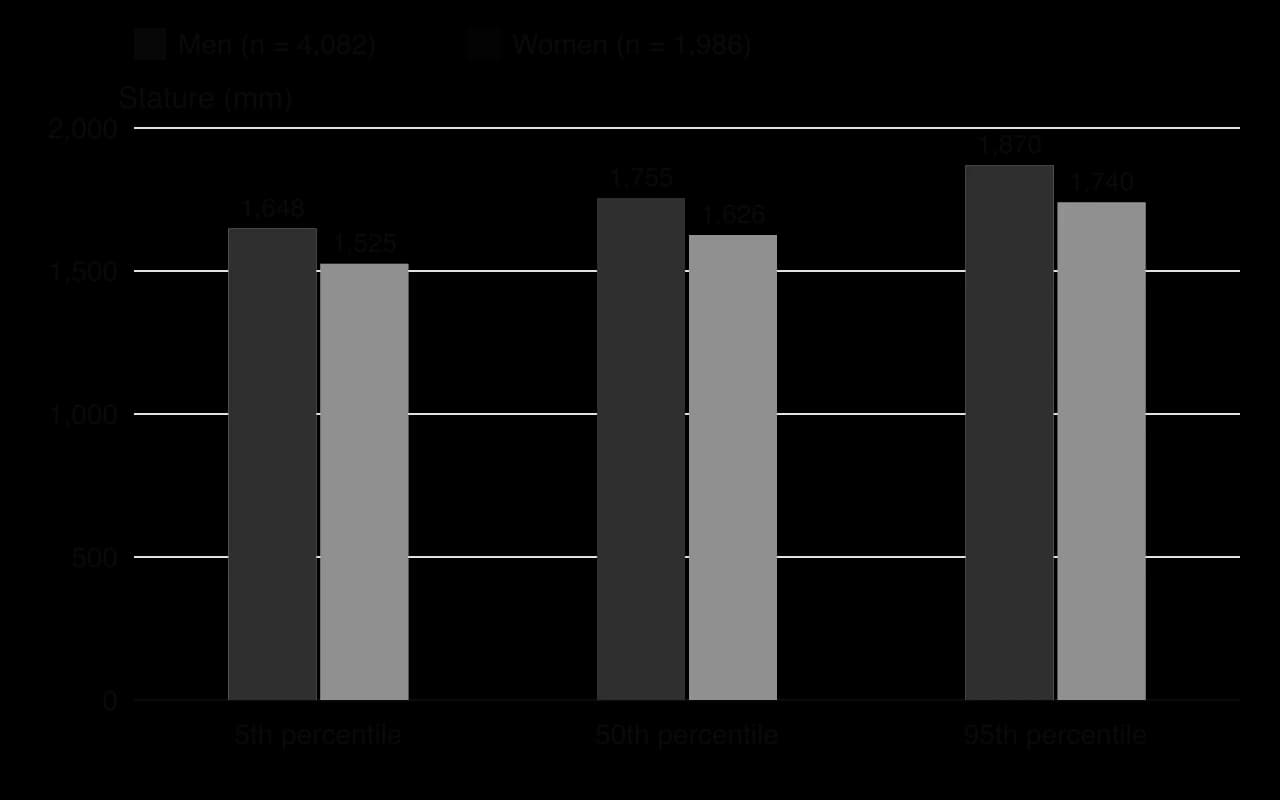
The differences are not the same for every dimension. Women are smaller for most lengths, but larger for hip breadth when seated (95th percentile 456 mm against 431 mm), so a seat or cockpit sized from men's data would be too narrow for many women. Of the women, 34% have hands shorter than the men's 5th percentile and 41% a shorter inside leg, which affects grip sizes, handlebar reach and frame sizes.
Dimension (mm unless stated) | Men 5th | Men 50th | Men 95th | Women 5th | Women 50th | Women 95th |
|---|---|---|---|---|---|---|
Stature | 1,648 | 1,755 | 1,870 | 1,525 | 1,626 | 1,740 |
Crotch height (inside leg) | 771 | 845 | 925 | 712 | 780 | 857 |
Hand length | 177 | 193 | 210 | 165 | 180 | 199 |
Foot length | 250 | 271 | 293 | 226 | 246 | 268 |
Foot breadth | 94 | 102 | 111 | 85 | 93 | 101 |
Hip breadth, sitting | 333 | 378 | 431 | 348 | 397 | 456 |
Body mass (kg) | 64.4 | 84.6 |
Women's feet are also not simply small men's feet. Among participants with a foot length of 245–255 mm, the women's feet averaged 93.3 mm wide and the men's 97.3 mm, about 4% narrower at the same length, so a men's shoe scaled down in length would still be too wide for a typical woman. Because accommodation is decided dimension by dimension, a design built from one group's data fits another group only where the distributions overlap; the solutions are separate designs (women-specific lasts, saddles and frames) or a wider adjustable range.
The data also have limits. Soldiers must meet fitness and body-composition standards, so the sample is not the general population, and it contains no children, no older adults and no athletes selected for a sport. A designer of junior football boots or of a seat for elite heavyweight rowers would need data from those groups, because a database is only valid for the population it samples.
Sources: ANSUR II public data (US Army Natick Soldier Research, Development and Engineering Center; Gordon et al., 2014); percentiles, proportions and foot breadth by length calculated from the 4,082 male and 1,986 female records.
Case study: the joint movements of a baseball pitch
The baseball pitch is one of the most studied skills in biomechanics, because it combines movements in all three planes and includes some of the fastest joint movements in sport. Researchers at the American Sports Medicine Institute in Birmingham, Alabama, have recorded several hundred pitchers in the laboratory, with reflective markers on the body and high-speed cameras that reconstruct the movement of each body segment in three dimensions. From these recordings they calculate the angle at each joint at every instant of the pitch and how fast it changes.
The researchers divide the pitch into phases: the windup, the stride, arm cocking, arm acceleration, arm deceleration and the follow-through. The table gives the main joint actions of the pitcher in four of them, using the movement terms with the plane and axis each movement has when it starts from the anatomical position.
Phase | Main joint actions (typical values) | Plane and axis (from the anatomical position) |
|---|---|---|
Stride to front-foot contact | The front leg steps forwards and the foot is planted; the throwing shoulder is abducted to about 90° and laterally (externally) rotated by about 60° | Abduction: frontal plane, sagittal axis. Lateral rotation: transverse plane, longitudinal axis |
Arm cocking | The pelvis rotates towards the target, followed by the upper trunk; the trunk arches back (hyperextends); the shoulder laterally rotates to its maximum, about 175–180°, with the elbow flexed to about 90° | Pelvis, trunk and shoulder rotation: transverse plane, longitudinal axis. Hyperextension and elbow flexion: sagittal plane, frontal axis |
Arm acceleration to ball release | The elbow extends, followed by rapid medial rotation of the shoulder; the front knee extends; the trunk flexes forwards; the shoulder stays abducted at about 90° | Elbow and knee extension, trunk flexion: sagittal plane, frontal axis. Medial rotation: transverse plane, longitudinal axis |
Deceleration and follow-through | Medial rotation continues until the shoulder is back to about 0° of lateral rotation; the arm crosses in front of the body; the trunk flexes further | Horizontal flexion: transverse plane, longitudinal axis. Trunk flexion: sagittal plane, frontal axis |
Shoulder rotation has the largest range of any movement in the pitch. In a study of 29 elite throwers, the arm reached about 175° of lateral rotation, far more than the shoulder joint allows on its own, because the scapula also moves on the rib cage and the trunk arches back. In about the last 30 milliseconds before release, the arm then rotated medially through about 80°, at peak angular velocities close to 7,000° s⁻¹.
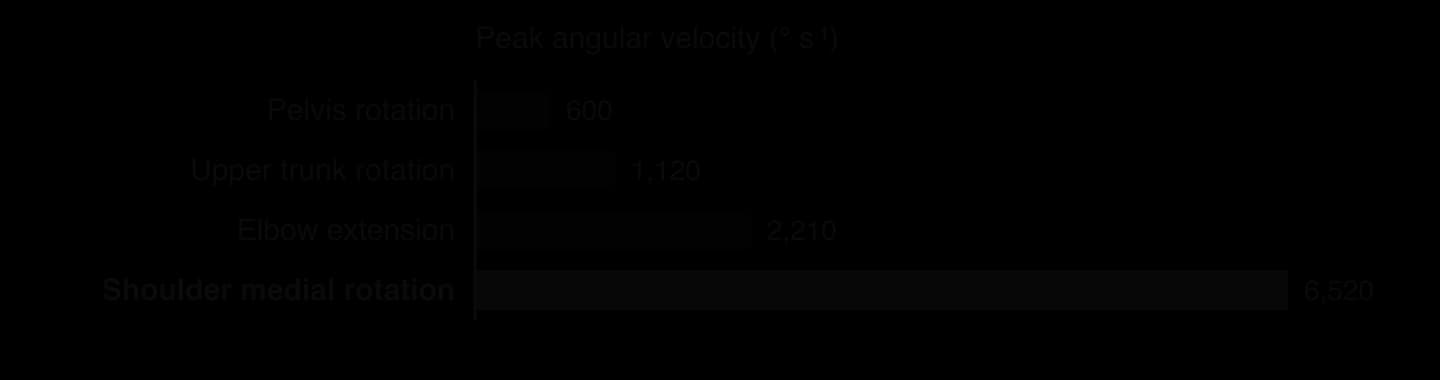
The chart shows this sequence for fastballs thrown by collegiate pitchers. Rotation of the pelvis and the upper trunk about the longitudinal axis comes first and is slowest, elbow extension is faster, and medial rotation of the shoulder is fastest of all. The type of pitch changes the movement at the forearm: the curveball was released with about 32° of supination, compared with about 17° for the fastball and 18° for the changeup.
Analysis
Exact movement terms are what make this analysis possible. Everyday words such as "twist" or "bend" cannot separate pelvis rotation from trunk hyperextension, or shoulder rotation from elbow extension, but the terms name the joint, the direction and, with a measurement, the amount.
Planes and axes are defined from the anatomical position, which limits the framework, because in the cocking phase the arm is already abducted to 90°. Lateral rotation is still a turn of the humerus about its own long axis, yet that axis now points sideways, so the forearm swings backwards and upwards in a vertical plane rather than in the body's transverse plane. Biomechanists therefore measure each joint angle relative to the segments on either side of the joint, not relative to the room.
For performance, a smaller maximum lateral rotation of the shoulder is associated with a lower ball speed. For health, the extreme positions and angular velocities load the shoulder and elbow and are linked with injury risk. A comparison of 23 youth, 33 high school, 115 college and 60 professional pitchers found that only one of 11 joint-position measures differed between the four levels, while all five angular velocities and all eight joint-load measures differed. The researchers concluded that children can be taught the adult movement pattern early, with strength built later as the body matures.
Sources: Dillman, Fleisig and Andrews, Journal of Orthopaedic and Sports Physical Therapy, 1993; Fleisig et al., Journal of Biomechanics, 1999; Fleisig et al., American Journal of Sports Medicine, 2006; Fortenbaugh, Fleisig and Andrews, Sports Health, 2009.
Using the table, identify one movement in each of the three planes during the pitch, with the joint and the axis of rotation.
Explain why the pitcher's shoulder can reach about 175° of lateral rotation although the shoulder joint alone allows much less.
To what extent can joint angles measured in a laboratory be used to coach a pitcher or to reduce injury risk during a season?
Exam practice
Questions on anatomical position, planes and movement test the precise use of terms. Multiple-choice questions often pair a plane with the wrong axis or use a positional term the wrong way round. Structured questions ask you to state functions, to identify movements from a photograph or description of a skill, or to analyse a skill joint by joint, and the data booklet's diagrams of the skeleton and of the planes and axes may be used as stimuli.
The multiple-choice questions test the definitions.
Positional terms are tested with statements about pairs of bones.
Movement terms are often tested by plane.
Data-based question
Paper 1B-style question (hypothetical data). A researcher investigated whether a six-week shoulder flexibility programme increases the range of lateral rotation at the shoulder in recreational swimmers. Twenty-four swimmers were randomly allocated to a training group (n = 12), who completed the programme three times a week, or a control group (n = 12), who continued their normal swimming. Range of lateral rotation was measured with a goniometer, with the elbow flexed to 90°, before and after the six weeks.
Group | Before: mean ± SD (°) | After: mean ± SD (°) |
|---|---|---|
Training (n = 12) | 92 ± 8 | 101 ± 7 |
Control (n = 12) | 91 ± 9 | 92 ± 8 |
Structured questions
Questions on movements often use a familiar exercise.
"Explain" questions need the reason as well as the fact: here, the rule that links a plane to its axis.
Extended response
HL questions (HL only)
Structured HL questions usually ask how anthropometric data are applied.
Extended HL questions ask for a balanced judgment about how body data are used.
Summary
The skeleton supports, protects, allows movement, stores minerals and produces blood cells; the axial skeleton (skull, vertebral column, ribs, sternum) mainly protects and supports, and the appendicular skeleton (limbs and girdles) mainly allows movement.
Bones are classified as long, short, flat, irregular or sesamoid, and their shape matches their function.
All positional and movement terms are defined from the anatomical position; positional terms (superior/inferior, anterior/posterior, medial/lateral, proximal/distal, superficial/deep) are always relative.
Movements take place in a plane and about an axis at right angles to it: sagittal plane with frontal axis, frontal plane with sagittal axis, transverse plane with longitudinal axis.
Each movement term names a specific movement at a specific joint, most in opposite pairs; circumduction and opposition combine planes.
A whole skill is analysed phase by phase as joint, movement, plane and axis.
Anthropometry measures body size and proportions with standardised protocols; somatotype describes shape with three components (HL).
Designers use anthropometric databases and percentiles, usually the 5th–95th, plus adjustability to size equipment (HL).
Ergonomic design fits equipment to the user to improve efficiency, comfort and safety, but population data cannot replace an individual fit (HL).
Self-check
- To do:
I can outline the five functions of the skeleton and sort bones into the axial and appendicular skeleton.
- To do:
I can name the major bones and the regions of the vertebral column, and classify bones by type.
- To do:
I can describe the anatomical position and use each positional term correctly in a sentence.
- To do:
I can state the three planes and the axis that goes with each, and give a sporting example of each.
- To do:
I can define every movement term and give its plane and axis.
- To do:
I can analyse a sporting skill joint by joint, phase by phase.
- To do:
I can outline what anthropometry measures, how it is standardised and what a percentile is (HL).
- To do:
I can explain how anthropometric databases and ergonomic design are used to size equipment (HL).
- To do:
I can evaluate the use of population data to design for individual athletes (HL).