Notes on B.2.1 Newton’s laws of motion
Learning objectives
Distinguish between scalar and vector quantities, distance and displacement, and speed and velocity, and calculate speed, velocity and acceleration with the correct units.
Interpret distance–time and velocity–time graphs, using gradients and the area under a velocity–time graph.
Describe the forces that act on a sportsperson, distinguish between mass and weight, and draw free-body diagrams.
Explain Newton’s three laws of motion and apply them to sporting movements, including calculations with .
Explain how the height of the centre of mass, the base of support, the line of gravity and mass affect stability.
Explain the principle of summation of joint forces and the principle of impulse direction.
Calculate momentum and impulse, and interpret force–time graphs using the impulse–momentum relationship.
Explain how an eccentric force produces rotation, calculate angular velocity, and explain the conservation of angular momentum using moment of inertia.
Calculate the coefficient of restitution and apply the conservation of momentum to collisions (HL).
Calculate friction, work, energy and power, and evaluate how technique and equipment change them (HL).
Introduction
Biomechanics applies the laws of mechanics to the human body. Newton’s three laws of motion explain how forces change the motion of an athlete, a ball or an implement, so they underpin almost every technique in sport, from a sprint start to a somersault.
The same physics serves both lenses of the course. For performance, it explains why a sprinter leans forward out of the blocks, why a thrower uses the whole body and why a diver tucks. For health, it explains why older adults widen their stance to avoid falls, why soft landings reduce the load on joints and why protective equipment lengthens the time of an impact. The forces described here are produced by muscles pulling on bones through levers, so biomechanics also links directly to muscular function and to motor learning, where coaches use these principles to correct technique.
Describing motion: scalars and vectors
Before the causes of motion can be explained, motion must be described precisely. Every physical quantity used in biomechanics is either a scalar or a vector, and the difference matters as soon as direction affects the outcome, as it does in almost every sport.
A scalar is fully described by a number and a unit: 70 kg, 400 m, 9.58 s. A vector also needs a direction. A force of 500 N acting forward on a sprinter has a different effect from 500 N acting upward, and a velocity of 8 m s⁻¹ towards the opponent’s goal is not the same as 8 m s⁻¹ towards one’s own goal.
Vectors are drawn as arrows. The length of the arrow shows the size and the arrowhead shows the direction. In one-dimensional problems, direction is shown by a sign: one direction is chosen as positive (usually the direction of motion) and the opposite direction is negative. A ball travelling at +20 m s⁻¹ towards a batter and −30 m s⁻¹ after it is hit has reversed direction.
Scalar (size only) | Vector (size and direction) |
|---|---|
Distance (m) | Displacement (m) |
Speed (m s⁻¹) | Velocity (m s⁻¹) |
Mass (kg) | Weight and other forces (N) |
Time (s) | Acceleration (m s⁻²) |
Energy, work (J) (HL) | Momentum (kg m s⁻¹) and impulse (N s) |
Distance and displacement
Distance is the total length of the path travelled. Displacement is the straight-line distance from the starting point to the finishing point, in a stated direction. A runner who completes one lap of a 400 m track covers a distance of 400 m but finishes where she started, so her displacement is zero.
The difference matters in events with turns or curves. A 100 m sprint is run in a straight line, so distance and displacement are equal in size. In a 200 m swimming race in a 50 m pool, the swimmer covers 200 m but ends at the starting wall with zero displacement. In a game of football, a midfielder may cover more than 10 km during a match while her displacement at the final whistle is only a few metres from where she began.
Speed and velocity
Speed describes how fast a body is moving, regardless of direction. Velocity describes how fast and in which direction, so it is the rate of change of displacement.
In this equation is speed in metres per second (m s⁻¹), is distance in metres (m) and is time in seconds (s). Velocity uses displacement instead of distance:
Here is the change in displacement (in m) and is the time taken (in s). The symbol Δ (delta) means “change in”. Because the symbol is used for both speed and displacement in these two equations, it is good practice to write the quantity in words beside each step of a calculation.
Average speed hides changes within a race. A sprinter’s speed is close to zero at the start, rises for several seconds and then levels off, so the average for the whole race is well below the top speed. Instantaneous speed is the speed at a single moment; in practice it is estimated from very short time intervals, from laser or radar devices, or from video analysis.
Acceleration and deceleration
Acceleration is the rate of change of velocity. A body accelerates when it speeds up, slows down or changes direction, because each of these changes its velocity. Slowing down is often called deceleration, which is acceleration with a negative sign.
In this equation is acceleration in metres per second squared (m s⁻²), is the final velocity, is the initial velocity (both in m s⁻¹) and is the time taken for the change (in s). The unit m s⁻² means “metres per second, every second”: an acceleration of 3 m s⁻² adds 3 m s⁻¹ to the velocity each second.
Linear, angular and general motion
Movement in sport is classified by the path that the body or object follows. In linear motion (translation), every part of the body moves the same distance in the same direction in the same time. A skier gliding in a fixed tuck position or a sprinter’s whole body moving down the track are approximations of linear motion. Linear motion can be rectilinear (in a straight line) or curvilinear (along a curved path, such as the flight of a shot put).
In angular motion (rotation), a body or segment moves along a circular path about an axis of rotation, so different parts travel different distances. A gymnast’s giant circle on the high bar, a diver’s somersault and the lower leg rotating about the knee in a kick are examples. The axis may be inside the body (the longitudinal axis in a pirouette) or outside it (the bar in a giant circle); planes and axes are described using the frontal axis, sagittal axis and longitudinal axis.
Most sports movements are general motion, a combination of linear and angular motion. When a cyclist rides, the bicycle and trunk move linearly while the legs rotate at the hip, knee and ankle. Running is the same: angular motion of the limbs produces linear motion of the whole body.
Motion graphs
Graphs show how a quantity changes during a movement and are often easier to interpret than a table of numbers. Two graphs are used to describe linear motion: distance–time (or displacement–time) graphs and velocity–time graphs. Coaches build them from timing gates, video analysis, laser devices and GPS units worn by players.
Distance–time graphs
On a distance–time graph, time is on the x-axis and distance travelled is on the y-axis. The gradient (slope) of the line at any point equals the speed at that moment, because the gradient is the change in distance divided by the change in time.
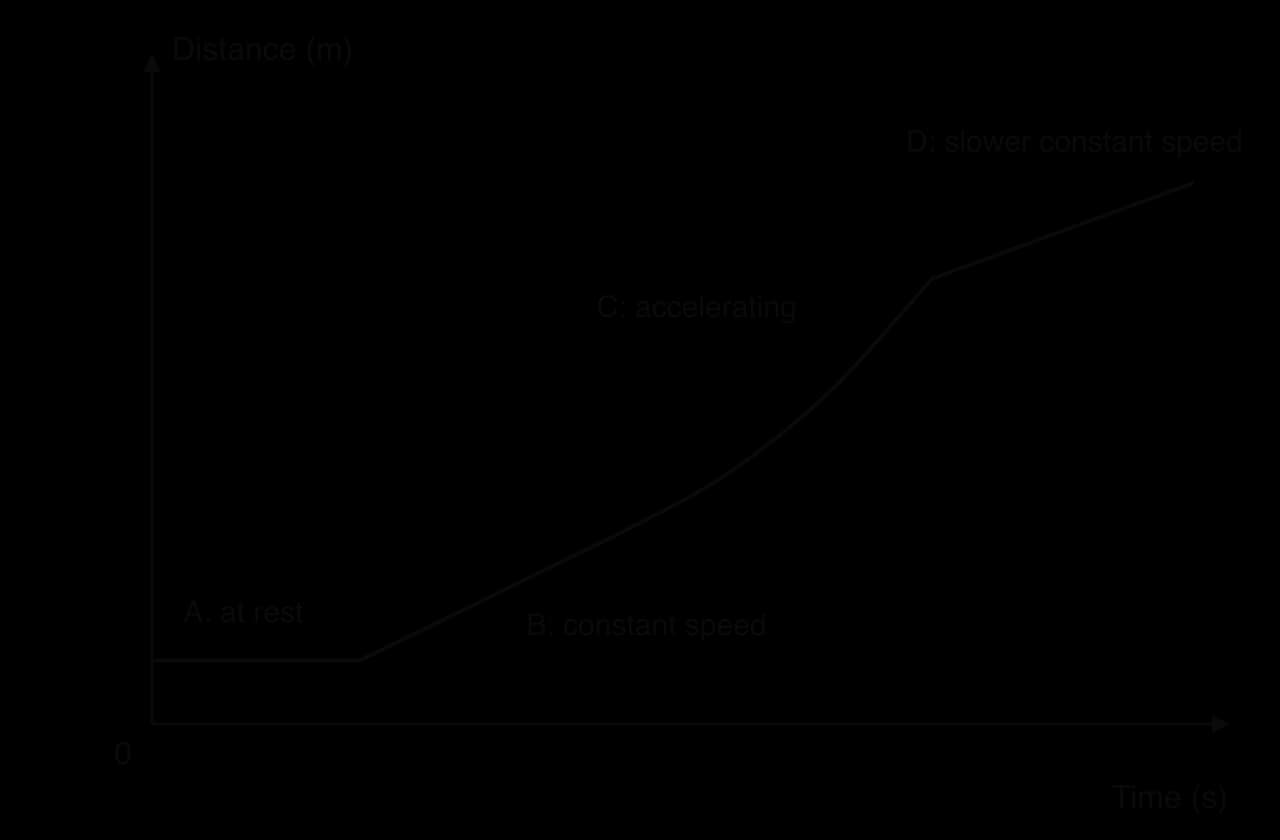
Horizontal line (A): distance does not change, so the body is at rest.
Straight sloping line (B and D): equal distances in equal times, so the speed is constant. A steeper line (B) shows a higher speed than a shallower line (D).
Curve that becomes steeper (C): the speed is increasing, so the body is accelerating. A curve that becomes shallower shows deceleration.
A sprinter’s distance–time graph for a 100 m race curves upward for the first 30–50 m while the athlete accelerates, then becomes almost straight as the athlete holds close to top speed. Real race data for this shape come from the official 10 m split times recorded in major championships.
Velocity–time graphs
On a velocity–time graph, time is on the x-axis and velocity is on the y-axis. It shows two further quantities. The gradient equals the acceleration, because acceleration is the change in velocity divided by the change in time. The area under the line equals the displacement, because displacement is velocity multiplied by time.
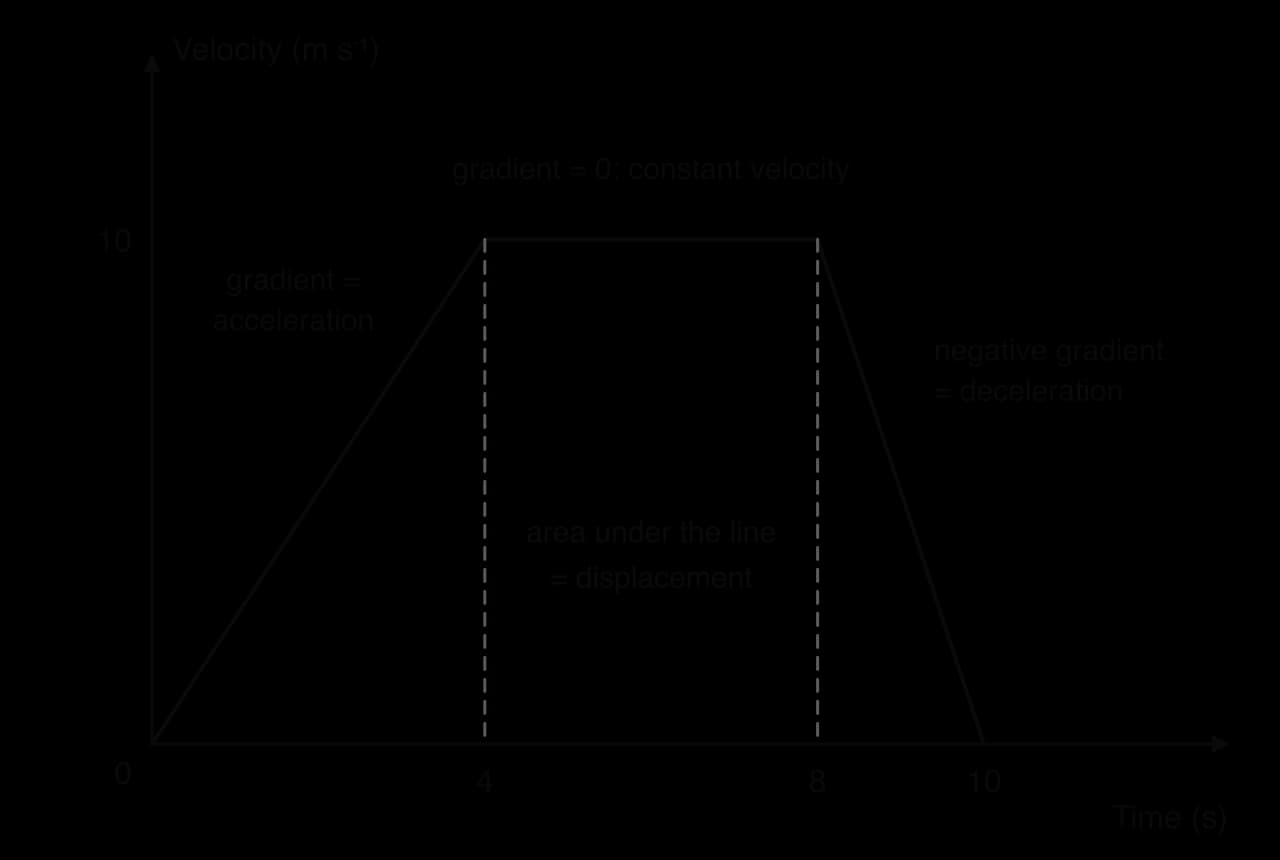
Velocity–time graphs also show direction. If the line falls below the x-axis, the velocity has become negative and the body is moving the opposite way, as when a basketball player sprints forward and then back-pedals in defence. The area below the axis is then a displacement in the negative direction.
Forces in sport
A force is a push or a pull that acts on a body. A force can start a body moving, stop it, speed it up, slow it down, change its direction or change its shape. Forces are vectors, so each one has a size, a direction and a point of application (the point where it acts on the body).
The unit of force is the newton (N). One newton is the force needed to give a mass of 1 kg an acceleration of 1 m s⁻², so 1 N = 1 kg m s⁻². To give a sense of scale, the weight of an apple is about 1 N, the weight of a 70 kg athlete is about 690 N and the peak vertical force under a sprinter’s foot can exceed two to three times body weight.
Forces in sport are either internal or external. Internal forces act inside the body: muscles pull on tendons, which pull on bones, and ligaments resist the movement of bones at joints. External forces act on the body from outside: gravity, the ground, the air or water, an opponent or an implement. Only external forces can change the motion of the body’s centre of mass, which is why an athlete must push against the ground, the water or the blocks to move.
Force | Direction | Sporting example |
|---|---|---|
Weight () | Vertically downward, from the centre of mass | Pulls a high jumper back to the ground; acts on every body at all times near the Earth |
Normal reaction () | At right angles to the surface in contact, away from it | The floor pushing up on a weightlifter holding a barbell |
Ground reaction force |
Drag is the force that resists motion through a fluid (air or water); in air it is often called air resistance. It is described in detail as part of fluid mechanics. Friction is described qualitatively at SL and quantitatively in the HL section on friction.
Mass and weight
Mass is the amount of matter in a body, measured in kilograms (kg). It is a scalar and does not change with location: a 70 kg athlete has a mass of 70 kg on Earth, on the Moon and in space. Weight is the gravitational force acting on that mass, measured in newtons. It is a vector, always acting vertically downward towards the centre of the Earth.
In this equation is weight in newtons, is mass in kilograms and is the acceleration due to gravity, 9.81 m s⁻² near the Earth’s surface. Because depends on location, weight changes when gravity changes but mass does not.
Resultant force: balanced and unbalanced forces
Several forces usually act on an athlete at once. The resultant force (net force) is the single force that has the same effect as all of them together. In one dimension it is found by adding forces in the same direction and subtracting forces in opposite directions.
When the forces are balanced, the resultant force is zero and the body either stays at rest or keeps moving at a constant velocity. A weightlifter holding a barbell overhead is in this state: the floor pushes up on her with a normal reaction equal to the combined weight of her body and the bar. When the forces are unbalanced, the resultant force is not zero and the body accelerates in the direction of the resultant.
Balanced: a cyclist riding at a steady 12 m s⁻¹ on a flat road. The forward force from the tyres on the road equals the backward drag and rolling resistance, so velocity stays constant.
Unbalanced: the same cyclist sprints for the line. The forward force exceeds drag, the resultant force is forward and she accelerates.
Unbalanced: a skydiver who has just left the aircraft. Weight is greater than drag, so she accelerates downward until drag rises to equal her weight (terminal velocity).
Free-body diagrams
A free-body diagram is a simplified drawing of a single body (an athlete, a ball, a sled) showing every external force acting on it as an arrow. It is the main tool for deciding which way a body will accelerate, because it shows at a glance whether the forces are balanced.
Free-body diagrams follow a few conventions:
Draw only the body being studied, not the objects it touches (the ground, the ball, the opponent).
Draw weight vertically downward from the centre of mass. Draw contact forces (normal reaction, friction) from the point of contact.
Label each arrow with the force’s name and symbol: weight , normal reaction , friction
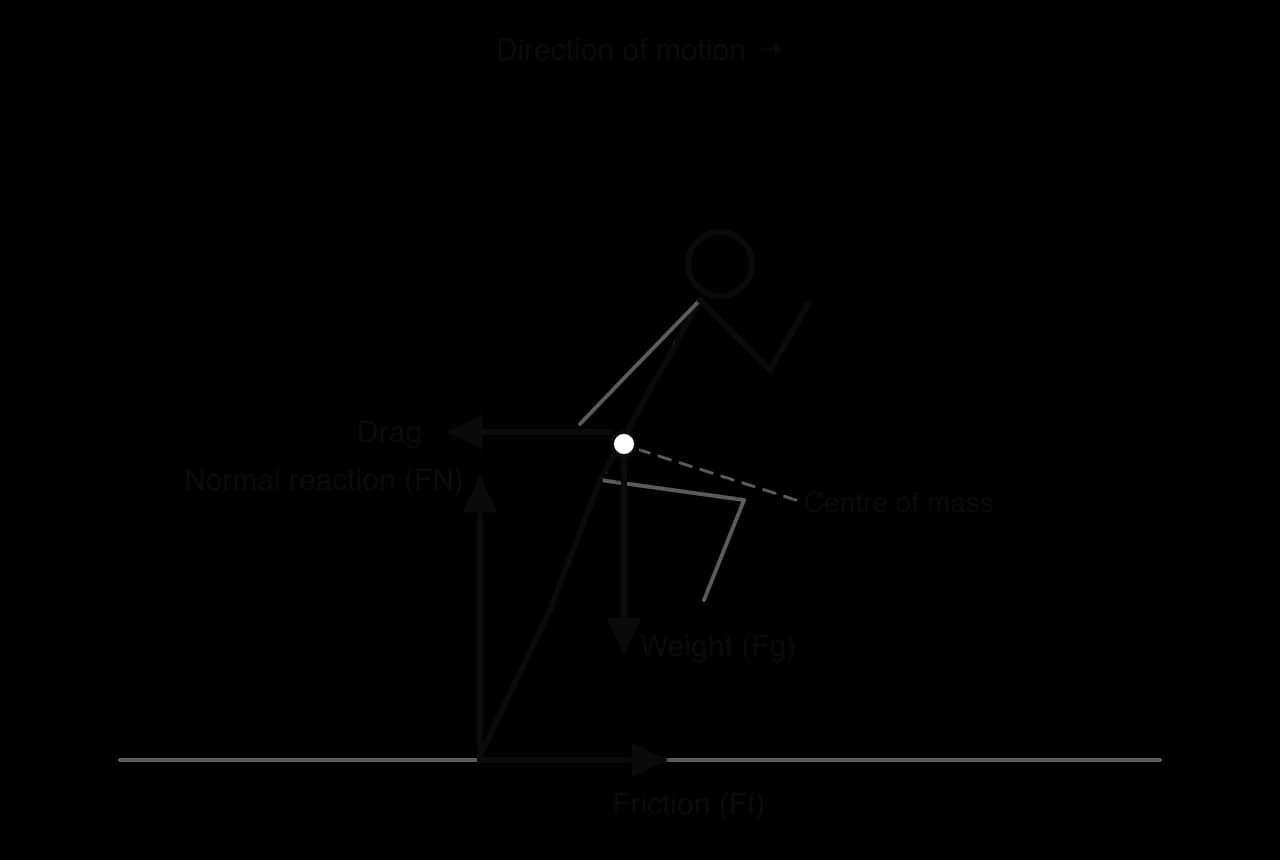
The sprinter’s diagram shows that a runner cannot accelerate forward without friction between the shoe and the track. The foot pushes backward on the track, and friction acts forward on the foot. In the vertical direction, the normal reaction and weight are of similar size while the sprinter’s height stays roughly constant.
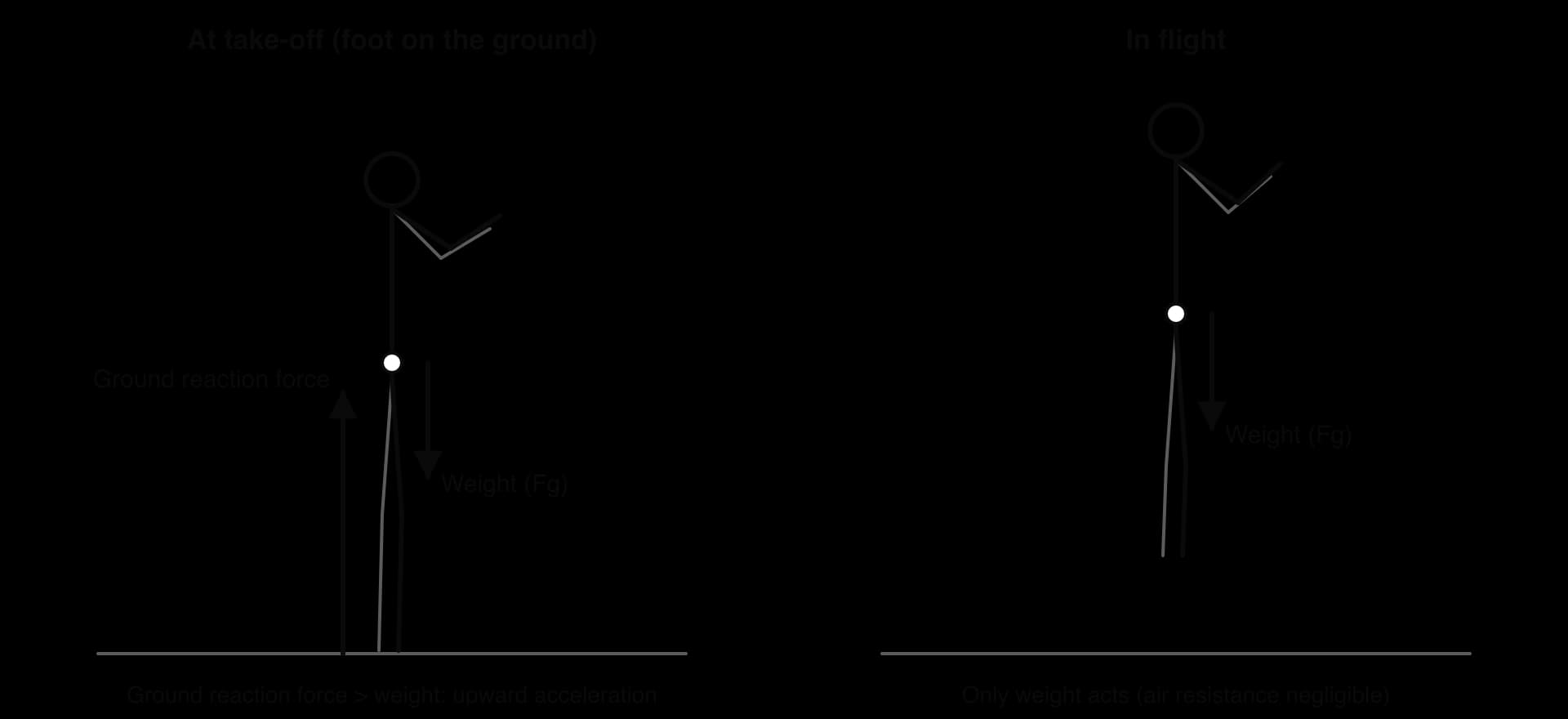
The jumper’s diagram shows the difference between contact and flight. On the ground, the ground reaction force can be made larger than weight by extending the hips, knees and ankles forcefully. In the air, there is no ground to push against, so nothing the jumper does can change the path of the centre of mass: only weight (and a very small air resistance) acts. This is why the path of a long jumper’s centre of mass is fixed at take-off.
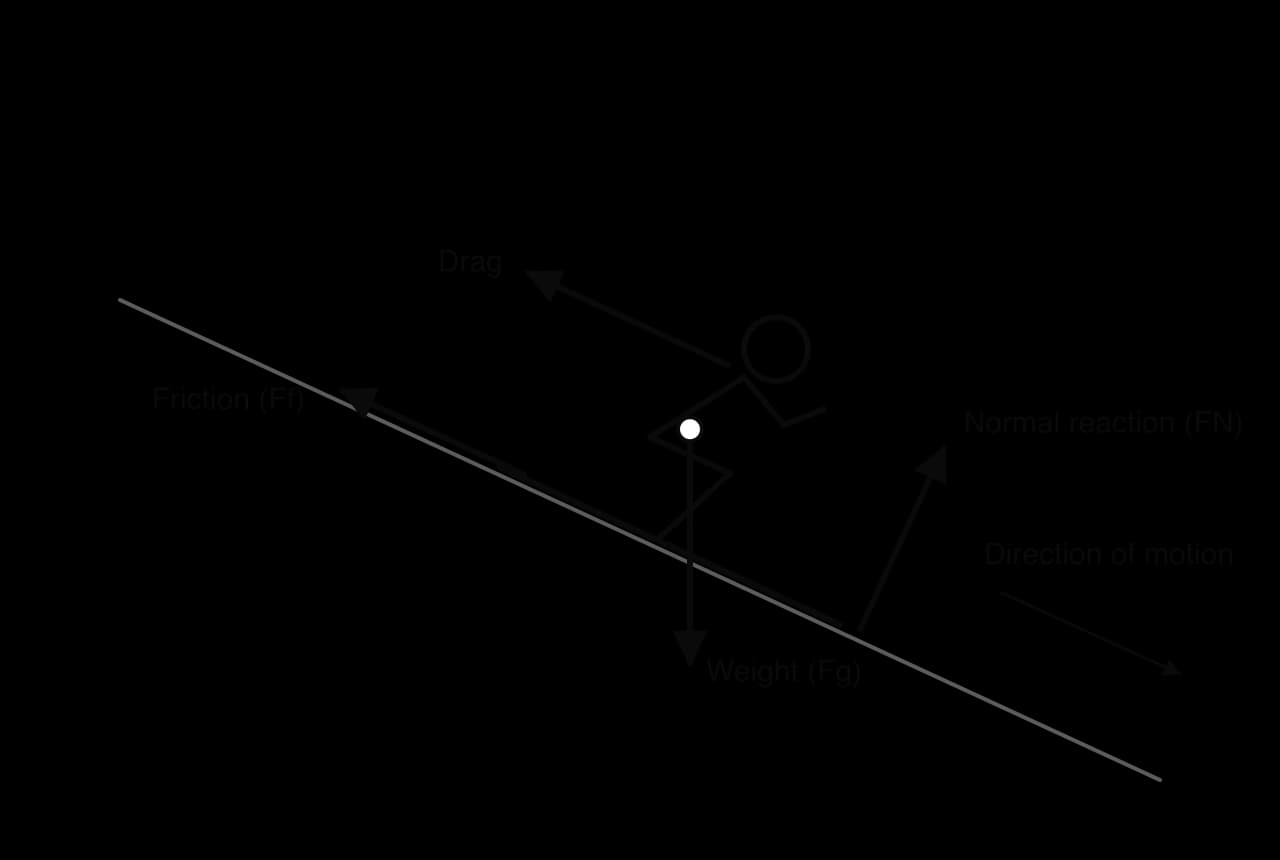
The skier’s diagram adds a slope. Weight still acts vertically downward, but the normal reaction acts at right angles to the snow. Part of the skier’s weight acts down the slope and causes acceleration; friction from the snow and drag oppose it. A skier who crouches into a tuck reduces drag and so increases the resultant force down the slope.
Newton’s laws of motion
Isaac Newton’s three laws of motion, published in 1687, describe how forces change motion. They apply to an athlete’s whole body, to a single limb and to every implement and ball in sport.
Newton’s first law: inertia
Newton’s first law states that a body remains at rest, or continues to move in a straight line at a constant velocity, unless an external resultant force acts on it. The law describes inertia, the resistance of a body to any change in its state of motion. The greater the mass of a body, the greater its inertia.
The first law explains several familiar observations in sport. A football on the penalty spot stays there until the kicker’s foot applies a force. An ice hockey puck glides a long way after a pass because the ice provides very little friction, so the puck’s velocity changes only slowly. A heavy rugby forward is harder to stop than a light winger running at the same velocity, because his greater mass gives him greater inertia.
Newton’s second law: force and acceleration
Newton’s second law states that the acceleration of a body is directly proportional to the resultant force acting on it and inversely proportional to its mass, and takes place in the direction of the resultant force.
In this equation is the resultant force in newtons, is mass in kilograms and is acceleration in m s⁻². The second form, , says that the resultant force equals the rate of change of
The law explains why the men’s shot (7.26 kg) leaves the hand more slowly than the women’s shot (4 kg) when the same force is applied for the same time, and why a lighter sprinter can accelerate quickly even if a heavier one produces more force. What matters for acceleration is force relative to mass, which is why sprinters, jumpers and gymnasts train for high strength relative to body mass.
The second form of the law, force as the rate of change of momentum, is the more useful one when a force acts for a very short time, as in kicking, hitting or catching.
Newton’s third law: action and reaction
Newton’s third law states that when one body exerts a force on a second body, the second body exerts a force on the first that is equal in size and opposite in direction. The two forces are often called action and reaction. They always act on different bodies, so they never cancel each other out.
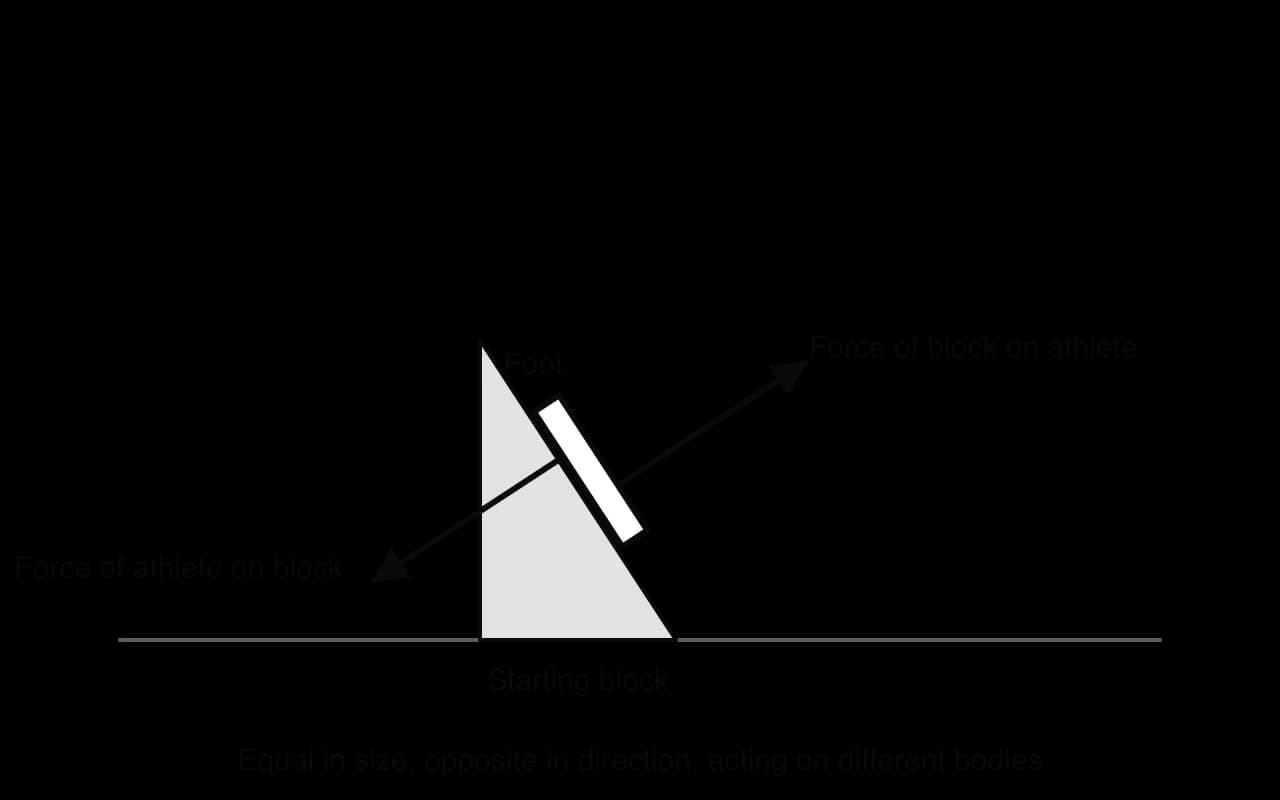
The third law explains how athletes move. To accelerate forward out of the blocks, a sprinter pushes backward and downward on the blocks; the blocks push forward and upward on the sprinter with an equal force, and this reaction is what accelerates her. A swimmer pushing off the wall after a turn pushes backward on the wall and the wall pushes her forward. During each stroke, the swimmer’s hand and forearm push water backward, and the water pushes the swimmer forward.
The ground reaction force is the most important third-law force in sport. When a jumper pushes down on the ground with 1,500 N, the ground pushes up on the jumper with 1,500 N. The Earth also accelerates, but because its mass is enormous its acceleration is far too small to detect, whereas the jumper’s small mass gives her a large acceleration.
 YouTube
Applying Newton’s laws in coaching
Coaches use the three laws to structure training and technique. The second law guides strength and power training (sprinters and jumpers combine heavy strength work with jumps and throws), and the third law guides technique, because the direction and timing of the push on the ground, the water or the blocks decide the direction of motion. The table pairs each law with a performance and a health application.
Law | Performance application | Health or safety application |
|---|---|---|
First (inertia) | A larger, heavier rugby forward is harder to stop in a tackle | Seat-belt-style restraints in motor sport stop the driver’s body continuing forward in a crash |
Second () | Increase force relative to body mass to improve acceleration in a sprint start | Lighter, smaller balls and implements for children let them reach useful speeds with smaller forces |
Third (action–reaction) | Push backward and down hard on the blocks to be driven forward and up | Every footstrike returns an equal force to the body, so cushioned surfaces and footwear, which lengthen the impact, lower the peak ground reaction force on joints |
Stability
Stability is the ability of a body to resist being moved from a balanced position, and to return to balance after it has been disturbed. A wrestler resisting a takedown and a gymnast holding a handstand both depend on it. Stability depends on where the body’s mass is concentrated, how large its area of support is and where its weight acts relative to that area.
Centre of mass
The centre of mass is the single point at which the whole mass of a body can be considered to be concentrated. It is also called the centre of gravity, since weight acts through it. In a standing adult it lies roughly in front of the sacrum, a little below the navel, at about 55% of standing height; it is slightly lower on average in women than in men because of differences in body proportions.
The centre of mass is not fixed. Raising the arms overhead moves it upward; bending forward moves it forward. In some positions it lies outside the body altogether. In a pike, a gymnast’s centre of mass is in the space between the trunk and the legs. In the Fosbury flop technique of high jumping, the arched body lets the jumper’s centre of mass pass close to, or even below, the bar while each body part clears it in turn, so less height has to be produced for a given bar height.
The line of gravity is an imaginary vertical line passing down through the centre of mass to the ground. The base of support is the area enclosed by the outermost points of contact between the body and the supporting surface, including the area between the feet (or the hands, or an implement such as a pole or a walking stick).
A body is balanced (in equilibrium) when its line of gravity falls inside its base of support. If the line of gravity moves outside the base, weight creates a turning effect that rotates the body over the edge of the base, and it topples unless it moves its base or its centre of mass.
Factors that affect stability
Four factors determine how stable a body is. Each can be changed deliberately by an athlete.
Factor | More stable when… | Why | Sporting example |
|---|---|---|---|
Height of the centre of mass above the base | The centre of mass is low | The line of gravity must move further (the body must tilt more) before it leaves the base | A rugby player lowers the hips before contact; a judoka bends the knees |
Size of the base of support | The base is wide, especially in the direction of the expected force | The line of gravity can move further before it passes outside the base | A sumo wrestler’s very wide stance; a goalkeeper’s ready position |
Position of the line of gravity relative to the base | The line of gravity falls near the centre of the base | It can move a large distance in any direction before leaving the base | A gymnast holding a handstand keeps the centre of mass directly over the hands |
Mass of the body | The mass is large | Greater inertia: a larger force is needed to move it | Heavier props in rugby union scrums; sumo wrestlers aim for high body mass |
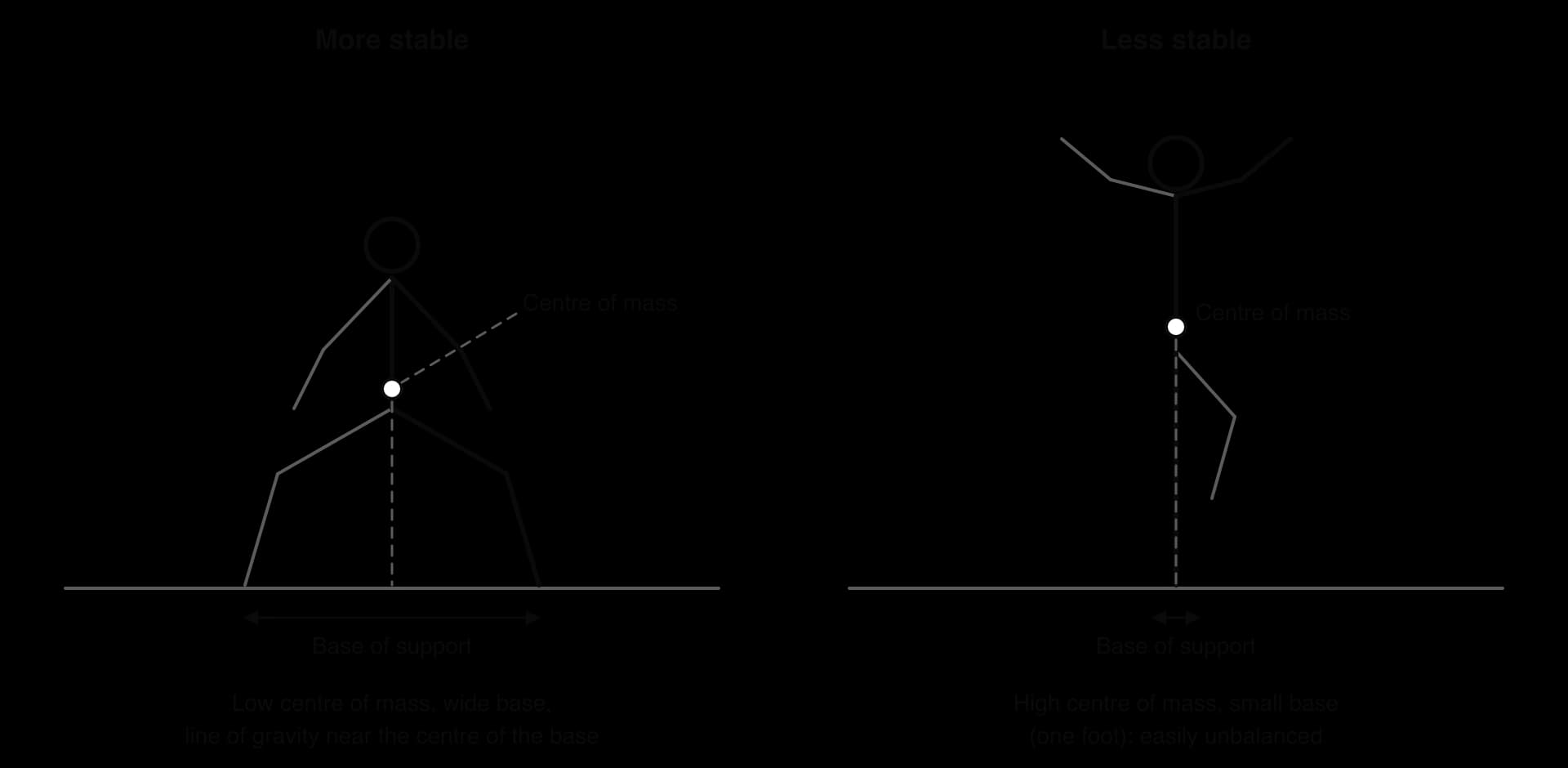
Stability is not always desirable. A body that is very stable is hard to move quickly, so athletes who need to start fast deliberately make themselves less stable. In the “set” position of a sprint start, the sprinter raises the hips and moves the shoulders forward over the hands so that the line of gravity lies close to the front edge of the base of support. When the hands leave the track at the gun, the line of gravity falls in front of the feet and the body is already falling forward in the direction of the race. A swimmer on the starting block uses the same principle.
Many sports require a rapid switch between stability and instability. A tennis player waiting to return a serve adopts a wide, slightly crouched stance so she can be pushed neither way, then shifts her centre of mass towards the ball to move quickly. A basketball defender widens the base in the direction of an expected drive. This trade-off between stability and mobility mirrors the one at joints, where stable joints such as the hip move less freely than mobile ones such as the shoulder.
Stability is also central to health. Falls are a major cause of injury in older adults, partly because ageing reduces muscle strength and the speed of balance responses. Walking sticks and frames enlarge the base of support, and balance training (for example tai chi or single-leg exercises) improves the ability to keep the line of gravity within the base.
Summation of joint forces
A thrower, kicker or striker wants the end of the chain (the hand, the foot, the racket head or the implement) to move as fast as possible at release or contact. No single joint can produce that speed. The principle of summation of joint forces states that the body achieves maximum speed at the end of the chain by using as many joints and muscles as is useful, activating them in sequence from the large, proximal segments to the small, distal segments, with each segment starting its movement as the previous one reaches its peak speed.
The sequence is often described as a kinetic chain. In an overarm throw such as the javelin, the legs push against the ground and rotate the hips; the hips rotate the trunk; the trunk rotates the shoulder; the shoulder moves the upper arm; the elbow extends the forearm; and finally the wrist and fingers flex. The large segments are strong but slow; the small segments are weaker but can move very fast. Each segment builds on the speed of the one before.
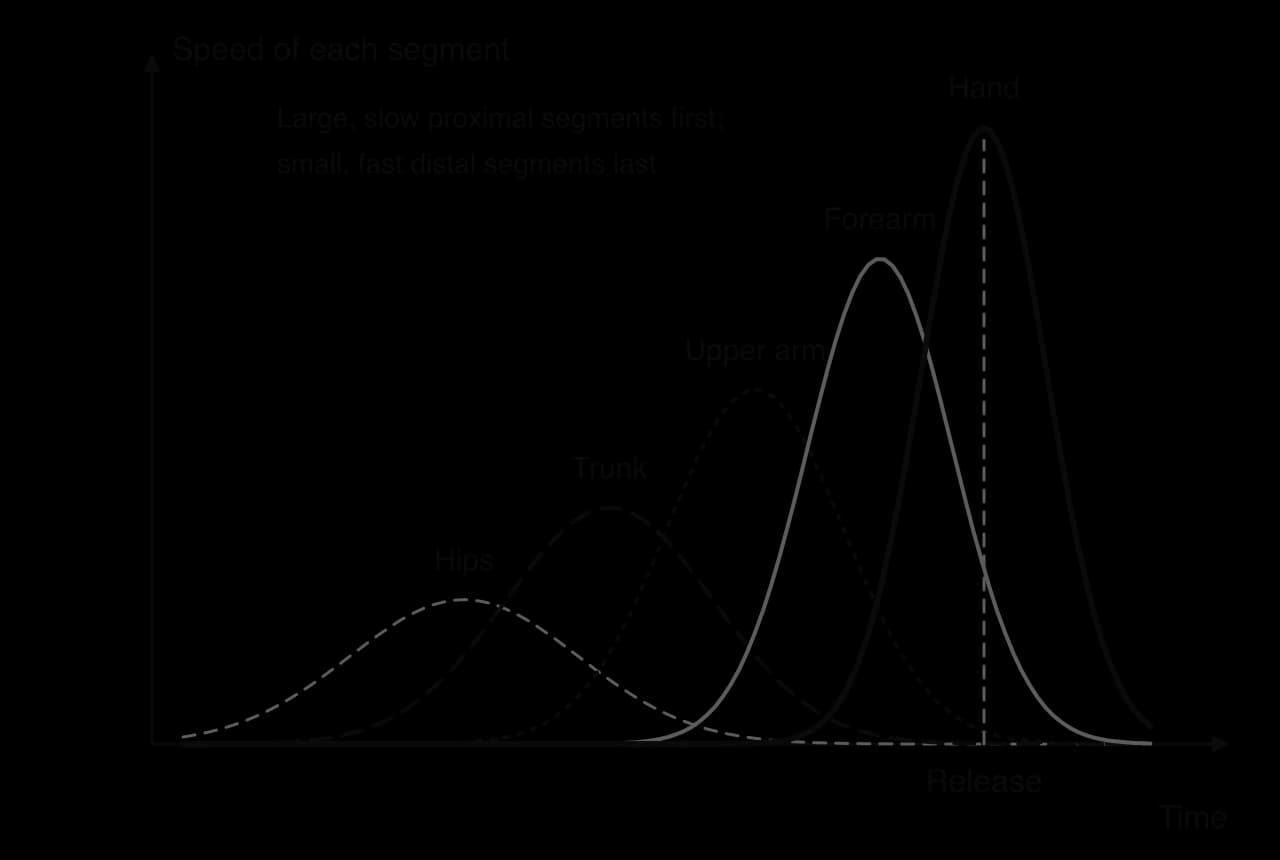
Two features make the sequence effective. First, the order runs from proximal to distal: if the arm moved before the trunk rotated, the trunk’s contribution would be lost. Second, the timing must be precise. Each segment should start to accelerate as the previous one reaches its peak speed; too early and the segments fight each other, too late and speed is lost. The proximal segment also slows down just before the distal one whips through, which transfers motion along the chain in the way that cracking a whip does.
Skill | Sequence from proximal to distal |
|---|---|
Tennis serve | Knee extension → hip and trunk rotation → shoulder rotation → elbow extension → forearm pronation and wrist flexion → racket head |
Football instep kick | Approach and plant foot → hip rotation and flexion → knee extension → ankle fixed (plantarflexed) at contact |
Javelin throw | Run-up and block with the front leg → hip rotation → trunk rotation and flexion → shoulder → elbow extension → wrist |
Golf drive | Weight transfer → hip rotation → trunk rotation → shoulders and arms → wrist uncocking → club head |
Whether a skill should use full summation depends on its goal. Skills that need maximum speed or distance (throwing, kicking for distance, serving) use many segments in a long sequence. Skills that need accuracy, such as a putt in golf, a dart throw or a basketball free throw, deliberately use fewer segments, because every extra segment adds another source of timing error. This is a direct link to motor learning: beginners often “lock” joints to reduce the number of segments they must control, and the full sequence is usually learned gradually.
Poor sequencing is also linked to injury. If the legs and trunk contribute too little, the arm must produce more of the final speed itself, increasing the load on the shoulder and elbow. Throwing coaches therefore treat a well-timed kinetic chain as both a performance and an injury-prevention goal.
Linear motion: momentum and impulse
Momentum
Momentum is the quantity of motion a body has. It depends on both the mass of the body and its velocity, so a heavy, slow body and a light, fast body can have the same momentum.
In this equation is momentum in kilogram metres per second (kg m s⁻¹), is mass in kg and is velocity in m s⁻¹. Because velocity is a vector, momentum is a vector in the same direction as the velocity.
Momentum also measures what an athlete has achieved by the end of a push: a sprinter leaving the blocks or a jumper leaving the ground has a momentum that depends on everything that happened during the contact.
Impulse
Impulse is the product of the average force applied and the time for which it acts. Its unit is the newton second (N s), which is equivalent to kg m s⁻¹, the unit of momentum.
In this equation is impulse in N s, is the average force in N and is the time of contact in s. A large impulse can come from a large force, a long time of application, or both.
The impulse–momentum relationship
Rearranging Newton’s second law, , gives . The left-hand side is impulse, so the impulse applied to a body equals its change in momentum. This is the impulse–momentum relationship: the greater the impulse applied, the greater the change in momentum.
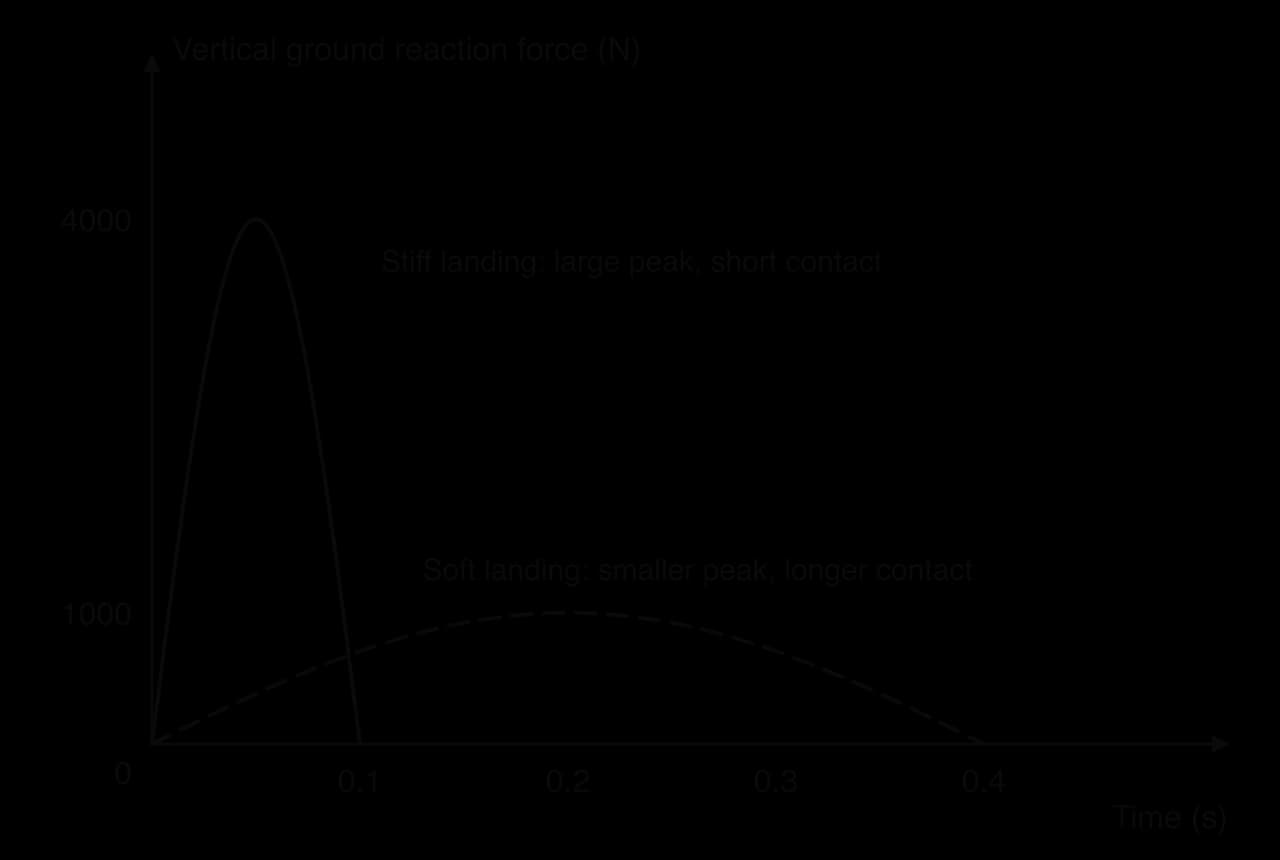
The relationship gives athletes two ways to change momentum. To increase momentum as much as possible (sprinting, jumping, throwing), they apply as large a force as they can for as long as they can. To reduce momentum safely (landing, catching, being tackled), they spread the same change in momentum over a longer time, which reduces the average force.
Increasing impulse to increase momentum: a long, powerful drive phase out of the blocks; a countermovement before a jump, which lengthens the time the legs push; a long throwing arc in the discus and shot put; a follow-through in striking, which keeps the implement in contact with the ball for longer.
Increasing time to reduce force: bending the knees and hips on landing; “giving” with the hands when catching a cricket ball; rolling after a fall in judo; padded protective equipment, crash mats and cushioned shoes, which deform during an impact.
Force–time graphs
A force plate measures the ground reaction force many hundreds of times a second and plots it against time. On a force–time graph, the area under the curve equals the impulse, because impulse is force multiplied by time. When an athlete pushes against the ground vertically, the useful area is the area above the line of body weight, called the net impulse, because only the part of the force greater than weight accelerates the body upward.
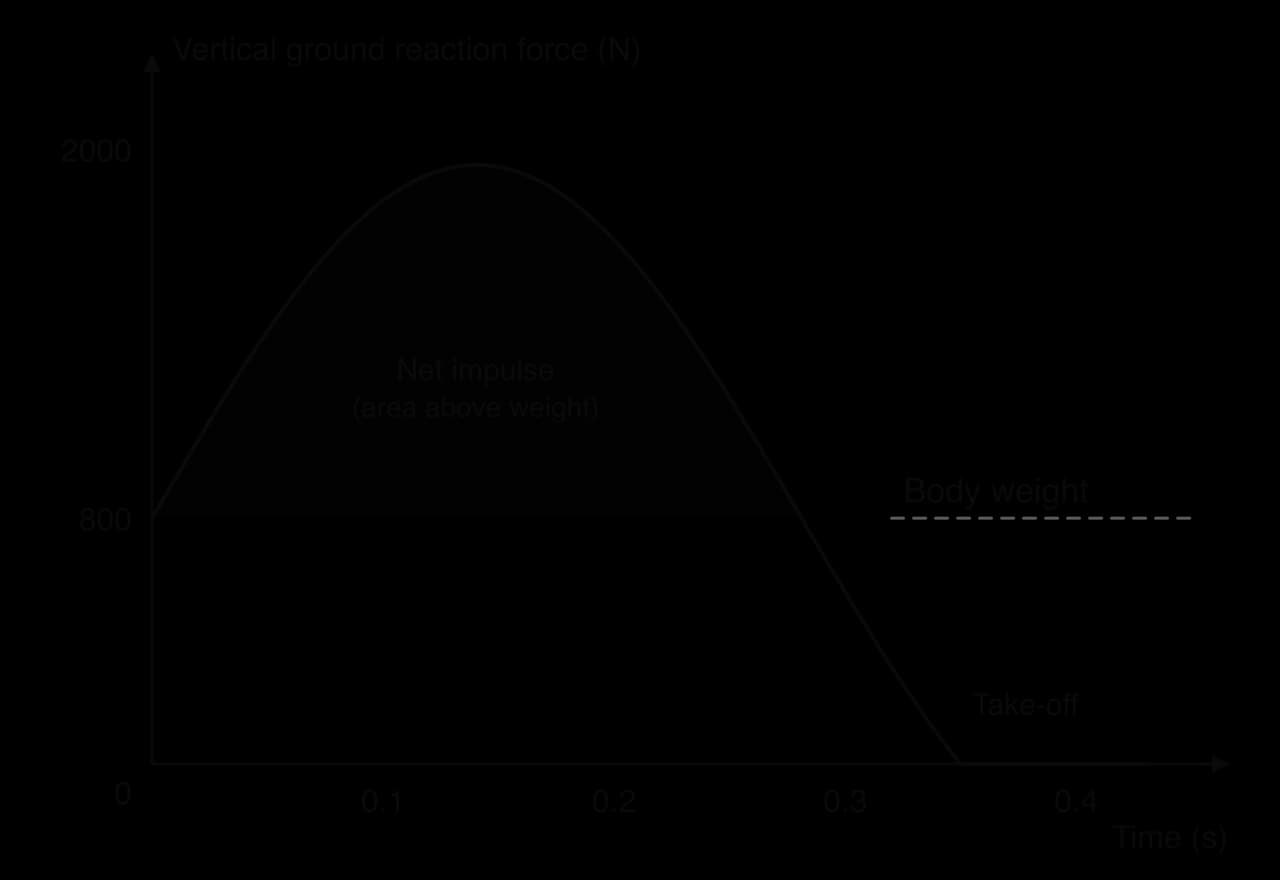
Force–time graphs of landings and running steps show the second use of impulse. When a runner’s heel strikes the ground, the curve often has a sharp early peak (the impact peak) followed by a broader active peak as the runner pushes off. Landing graphs show how technique changes the shape of the curve without changing its area.
The principle of impulse direction
The principle of impulse direction states that the direction of motion that results from an impulse is the same as the direction in which the impulse is applied. An athlete who wants to move a body or an implement in a particular direction must therefore apply force in that direction, and through the centre of mass if no rotation is wanted.
In a vertical jump for a basketball rebound, the jumper wants to go straight up, so the ground reaction force must act vertically through the centre of mass. If the line of the force passes in front of or behind the centre of mass, the jumper rotates as well as rising. In a basketball chest pass, the hands push through the middle of the ball directly towards the target; pushing off-centre sends the ball off line and adds spin. In the shot put, the athlete keeps the shot moving in a straight line through the release so that the final push is in the direction of the intended flight.
The principle connects linear and angular motion. When an athlete wants rotation, as in a forward somersault in gymnastics or diving, the impulse is applied deliberately off-centre, so that its line passes behind or in front of the centre of mass. This off-centre force is called an eccentric force.
Angular motion
Somersaults, twists, swings and every joint action involve rotation. The laws that describe linear motion have angular equivalents: an off-centre force starts rotation, moment of inertia plays the part of mass, angular velocity the part of velocity, and angular momentum the part of momentum.
Eccentric force and torque
A force whose line of action passes through a body’s centre of mass (a direct force) produces only linear motion. A force whose line of action does not pass through the centre of mass is an eccentric force. It produces both linear motion and rotation, because it creates a turning effect about the centre of mass.

The turning effect of a force is called torque (or moment of force). It equals the size of the force multiplied by the perpendicular distance between its line of action and the axis of rotation, and is measured in newton metres (N m). A larger force or a larger distance gives a larger torque and so a faster start to the rotation.
Athletes use eccentric forces to start rotations. A diver beginning a forward somersault leans forward on the board so that the reaction force from the board passes behind the centre of mass, rotating the body forward.
A gymnast starting a back somersault drives the arms up and back so that the ground reaction force passes in front of the centre of mass. In ball sports, striking a ball off-centre gives it spin: a tennis player brushes up the back of the ball to give topspin, and a footballer strikes the side of the ball to make a free kick curve. The effect of that spin on the ball’s flight belongs to fluid mechanics, through the Magnus effect.
Angular velocity
Angular velocity is the rate of rotation of a body about an axis: the angle turned through per unit of time. It is measured in radians per second (rad s⁻¹). One radian is the angle at the centre of a circle that cuts off an arc equal in length to the radius; one complete revolution is 2π radians (360°), so one radian is about 57.3°.
Angular velocity is linked to the linear velocity of any point on the rotating body by the equation:
In this equation is the linear velocity of a point on the rotating body (m s⁻¹), is the radius, the distance of that point from the axis of rotation (m), is the time for one complete revolution (s) and (omega) is the angular velocity (rad s⁻¹), equal to
The equation explains why levers in sport are often long. For the same angular velocity, a point further from the axis moves faster. A golfer’s club head travels much faster than the hands, a tennis racket extends the arm, and a fast bowler bowls with a straight arm. The cost is that a longer lever is harder to rotate, because its moment of inertia is larger, which is why children use shorter rackets and lighter bats that they can swing quickly.
Moment of inertia
Moment of inertia is the resistance of a body to a change in its angular motion, the angular equivalent of inertia. Like inertia, it increases with mass. It also depends on how that mass is distributed: the further the mass is from the axis of rotation, the larger the moment of inertia, and the effect of distance is large because it depends on the square of the distance.
An athlete cannot change her mass during a movement, but she can change her moment of inertia by moving her limbs towards or away from the axis. A diver in a straight (layout) position has her mass spread along her whole length, so her moment of inertia about the axis through her centre of mass is large. When she pulls into a tight tuck, the same mass is close to the axis and her moment of inertia falls to roughly a quarter or less of the layout value.
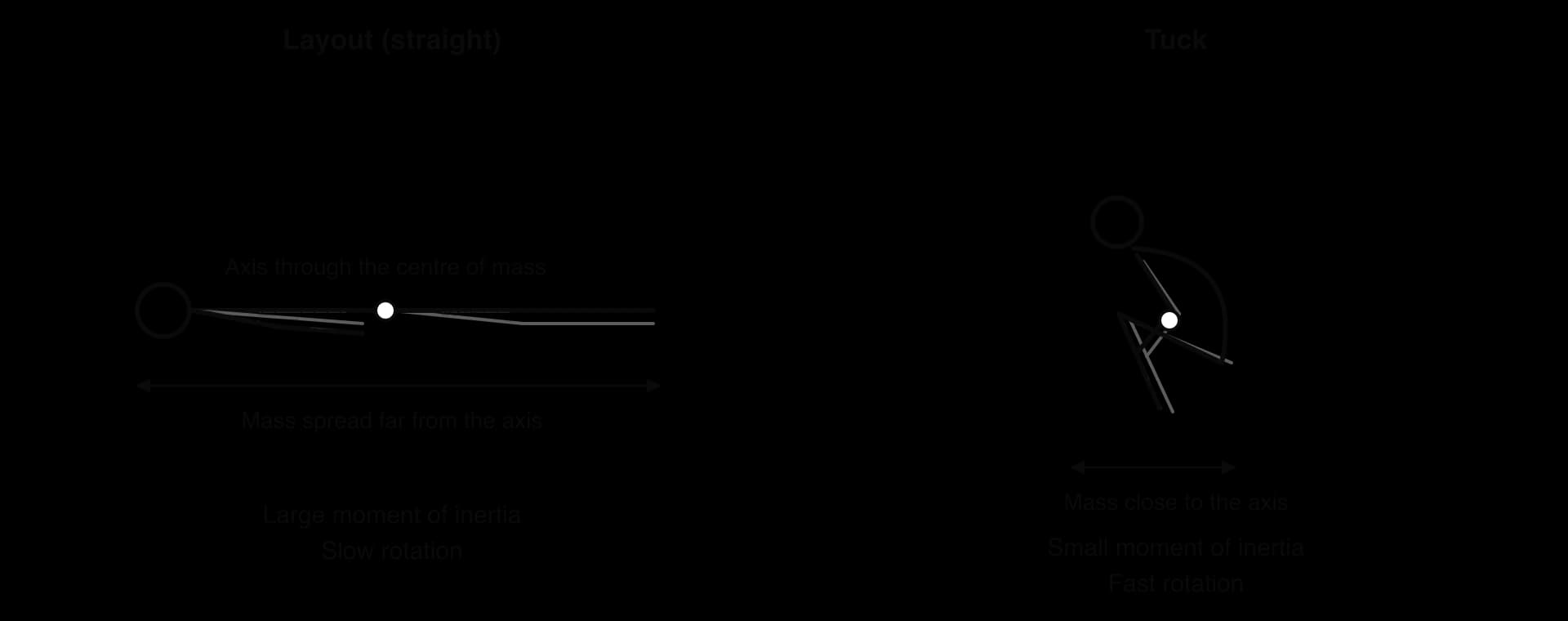
Runners use the same principle in every stride. During the recovery phase, a sprinter flexes the knee strongly so the heel comes up close to the buttock. This brings the mass of the lower leg close to the hip (the axis of rotation for the swinging leg), reducing the leg’s moment of inertia so it can be swung forward quickly. A distance runner, who moves the legs more slowly, flexes the knee less.
Angular momentum and its conservation
Angular momentum is the quantity of rotation a body has. It is the product of moment of inertia and angular velocity, the angular equivalent of , and is measured in kg m² s⁻¹.
Angular momentum is conserved when no external eccentric force (no external torque) acts on a body. This is the conservation of angular momentum. When a diver, gymnast or long jumper is in the air, the only significant external force is weight, which acts through the centre of mass and therefore produces no torque about it. The athlete’s angular momentum is fixed at take-off and stays constant until landing or entry into the water.
Because angular momentum is constant in flight, any change in moment of inertia must be matched by an opposite change in angular velocity. If the moment of inertia halves, the angular velocity doubles. Athletes use this to control the speed of their rotation in the air.
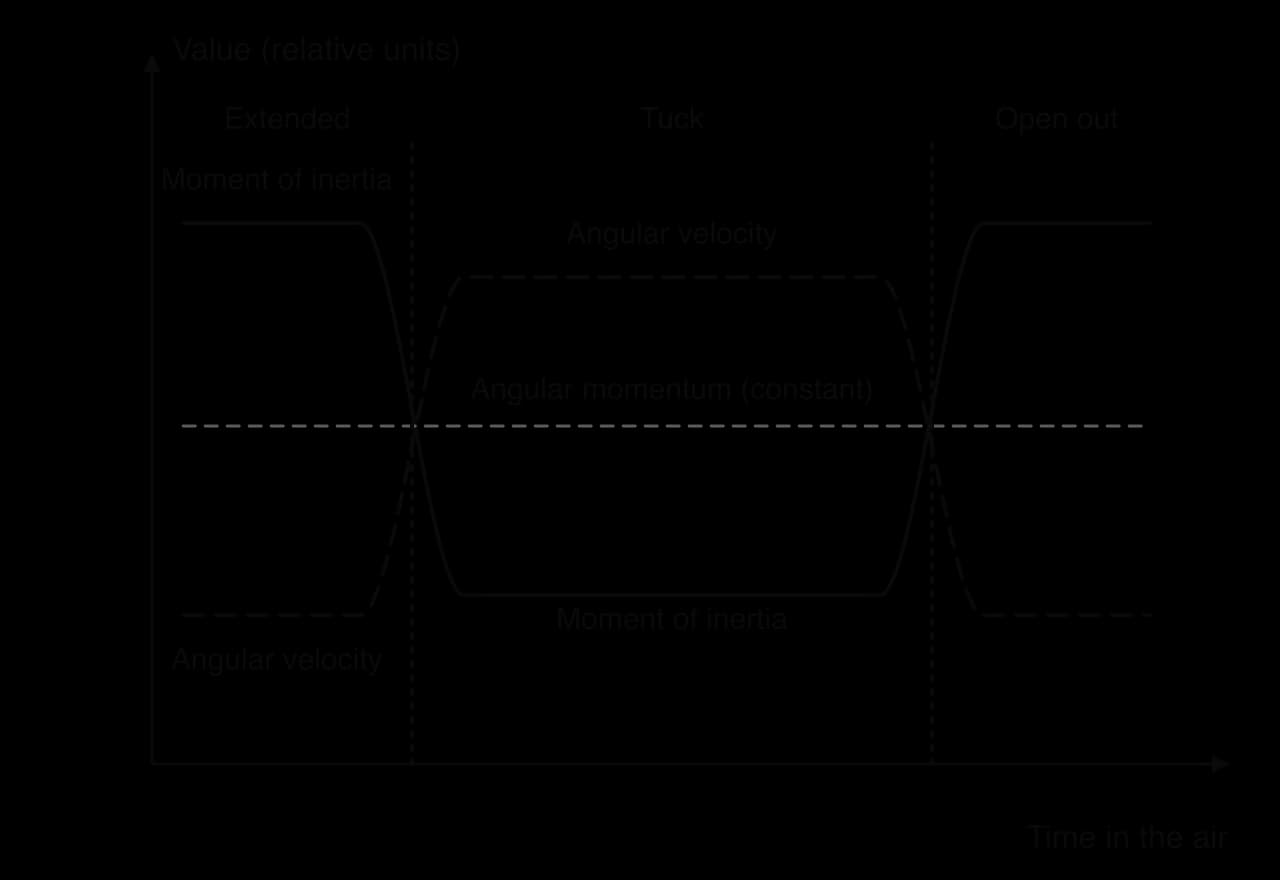
The same principle appears across sport:
Figure skating spins: a skater starts a spin with the arms and free leg extended, then pulls them in close to the longitudinal axis. Her moment of inertia falls and her angular velocity rises sharply. Extending the arms again slows the spin before she exits.
Diving and gymnastics: a tucked somersault rotates faster than a piked one, which rotates faster than a layout, so more somersaults can be completed in a tuck. Opening out before entry or landing slows the rotation so the athlete can enter the water vertically or land in control.
Long jump: the take-off gives the jumper unwanted forward rotation that would pitch her face-first into the sand. In the hitch-kick technique, she “runs in the air”, rotating the arms and legs forward in large circles. These limbs take up some of the angular momentum, so the trunk rotates less and stays upright for landing; total angular momentum stays the same.
Linear quantity | Angular equivalent |
|---|---|
Mass, (kg) | Moment of inertia (kg m²) |
Velocity, (m s⁻¹) | Angular velocity, (rad s⁻¹) |
Momentum, (kg m s⁻¹) | Angular momentum = moment of inertia × angular velocity (kg m² s⁻¹) |
Force through the centre of mass |
 YouTube
Collisions and the coefficient of restitution (HL only)
A collision occurs when two bodies come into contact and exert forces on each other for a short time: a bat and a ball, a foot and a football, two rugby players in a tackle, a ball and the floor. By Newton’s third law the two forces are equal and opposite, and they act for exactly the same time, so the two bodies receive equal and opposite impulses. Each body’s momentum changes by the same amount in opposite directions.
Conservation of momentum
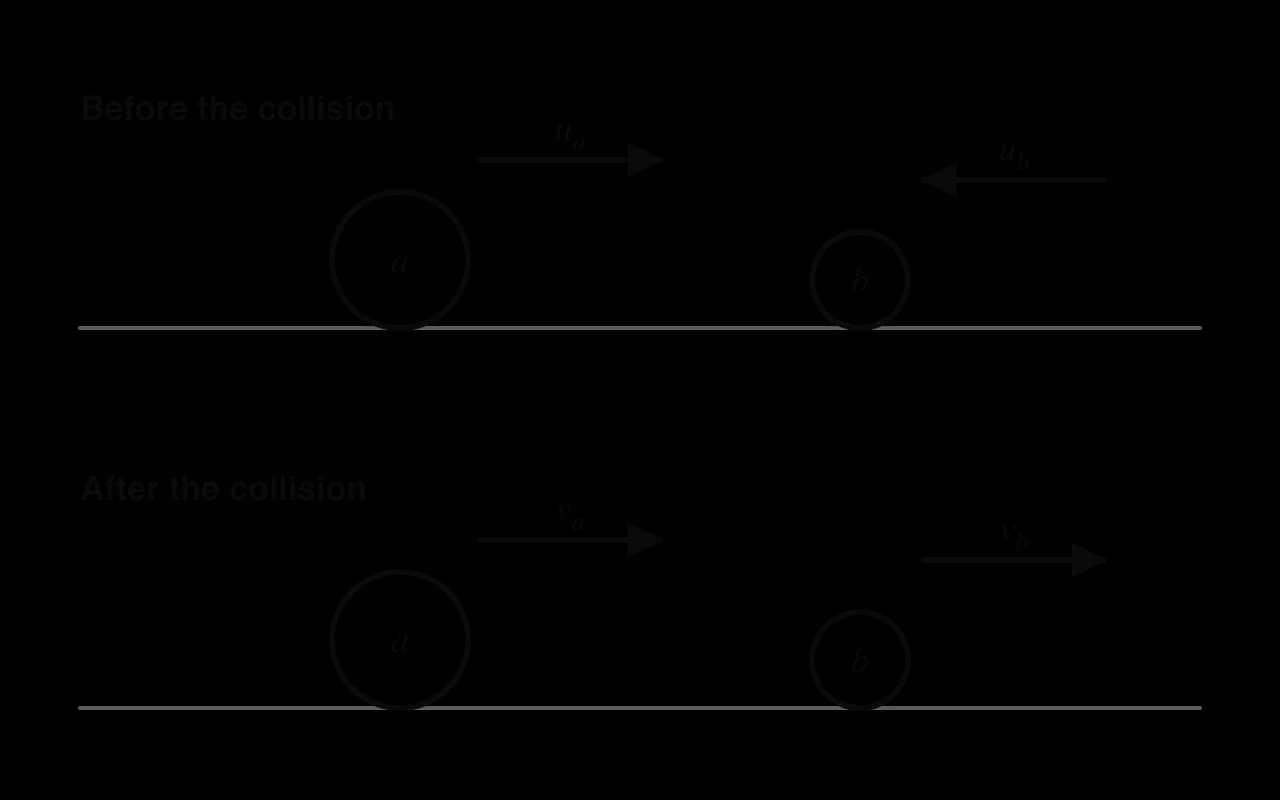
The momentum gained by one body therefore equals the momentum lost by the other, so the total momentum of the two bodies is the same after the collision as before, provided no external resultant force acts on them. This is the conservation of momentum.
Here and are the masses of bodies a and b, is a velocity before the collision and a velocity after it. Velocities are vectors, so one direction must be taken as positive and velocities in the opposite direction given a negative sign. Here, collisions are treated in one dimension only: both bodies move along the same straight line.
Impulse in collisions
In every collision, the change in momentum of each body equals the impulse it receives. This connects collisions with the safety principle seen in landings: for a given change in momentum, a longer contact time means a smaller average force. Padded headgear in rugby, helmets in American football, boxing gloves, cricket pads, crash mats and the foam in running shoes all deform during impact, lengthening the contact time and lowering the peak force on the body.
In striking skills, the aim is the opposite. A long follow-through in a tennis forehand or a golf drive keeps the implement accelerating through impact, so that the force on the ball is as large as possible during the short contact time. In kicking, a firm, fixed ankle makes the foot behave as a rigid striking surface rather than a cushion.
The coefficient of restitution
Collisions differ in how much the bodies bounce apart. A golf ball rebounds sharply from a driver, while a ball of wet clay hardly bounces at all. The coefficient of restitution () measures this “bounciness”: it is the ratio of the relative velocity of separation after a collision to the relative velocity of approach before it.
Here and are the velocities of bodies a and b before the collision, and
: a perfectly elastic collision. The bodies separate as fast as they approached, and no kinetic energy is lost. No real sports collision reaches this value.
: a perfectly inelastic collision. The bodies do not separate; they move off together, as in the rugby tackle.
Between 0 and 1: real collisions. The closer to 1, the livelier the bounce. Some of the kinetic energy is converted to heat, sound and permanent deformation.
Bouncing on a fixed surface: the drop test
When a ball (a) hits a fixed surface such as a floor or a wall (b), the surface does not move, so and the equation simplifies to the ratio of the rebound speed to the impact speed. With downward taken as negative, a ball that hits the floor at 6.0 m s⁻¹ and leaves it at 4.5 m s⁻¹ gives:
Speeds at impact are hard to measure without high-speed video, so sports bodies test balls with a drop test instead. The ball is dropped from a fixed height onto a rigid surface, usually concrete or steel, and the height of the bounce is measured. The speed of a falling ball at impact depends on the square root of the height it falls from, and the speed it leaves the surface with depends on the square root of the height it rebounds to, so:
This form follows from treating the fall and the rise as transfers between gravitational potential energy and kinetic energy, with air resistance ignored. It applies only to a ball dropped vertically onto a fixed surface.
Factors that affect the coefficient of restitution
Factor | Effect on | Example |
|---|---|---|
Materials of both bodies | A collision depends on both surfaces: the more elastic both are, the higher the value | A tennis ball bounces higher on a hard court than on grass |
Temperature | Warming a ball usually raises its : the gas inside is at higher pressure and the rubber is more elastic | Squash players warm the ball by hitting it before a match; a cold squash ball barely bounces |
Because the coefficient of restitution directly affects performance, sports regulate it. Basketball’s rules require a ball dropped from 1,800 mm to rebound to between 1,035 and 1,085 mm, which corresponds to a of about 0.76–0.78. Golf’s governing bodies limit the spring-like effect of a driver’s face by setting an upper limit of 0.830 on the coefficient of restitution between club and ball, since a livelier face would send the ball further with the same swing. Rules of this kind keep competition fair and stop equipment, rather than athletes, deciding results.
Sources: ITF ball-testing specifications (via Wikipedia, Tennis ball, 2026); FIBA Official Basketball Rules 2024, Basketball Equipment; USGA, Conforming golf club rules (via Wikipedia, Coefficient of restitution, 2026).
Friction (HL only)
Friction is the force that opposes the sliding, or the tendency to slide, of one surface over another. It acts parallel to the surfaces in contact, in the direction opposite to the relative motion (or intended motion). Friction is essential in most sports: without it a sprinter could not push forward, a footballer could not change direction and a climber could not grip the rock. In other sports, such as skiing, skating and bobsleigh, athletes try to reduce it.
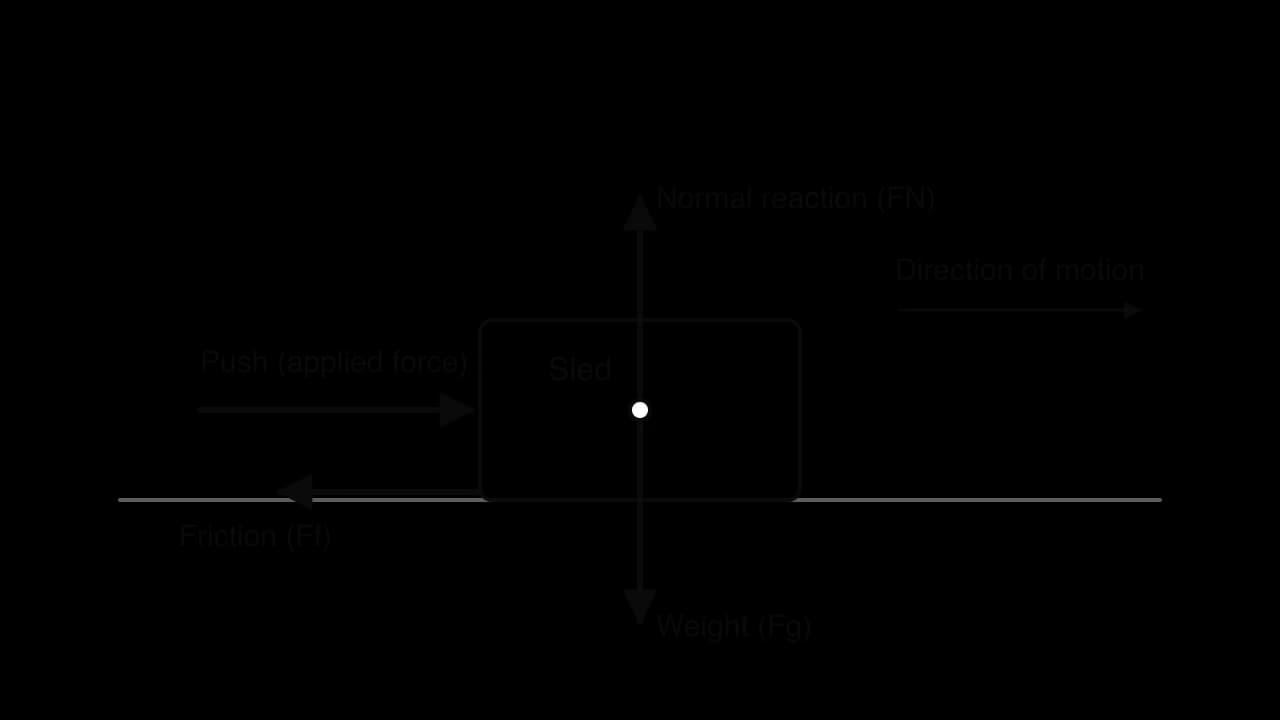
Friction depends on two things. The first is the normal reaction force pressing the surfaces together: the harder they are pressed, the greater the maximum friction. The second is the nature of the two surfaces in contact, described by the coefficient of friction (μ), which has no units. Friction does not, to a first approximation, depend on the area of contact.
Static and dynamic friction
Static friction acts between surfaces that are not sliding over each other. It matches the applied force exactly, up to a maximum value called limiting friction. While the applied force is less than this limit, friction balances it and nothing slides.
In this inequality is the friction force (N), is the coefficient of static friction and
Dynamic friction (also called kinetic or sliding friction) acts once the surfaces are sliding. It has a roughly constant value that is lower than limiting static friction, which is why it is harder to start a heavy object sliding than to keep it sliding.
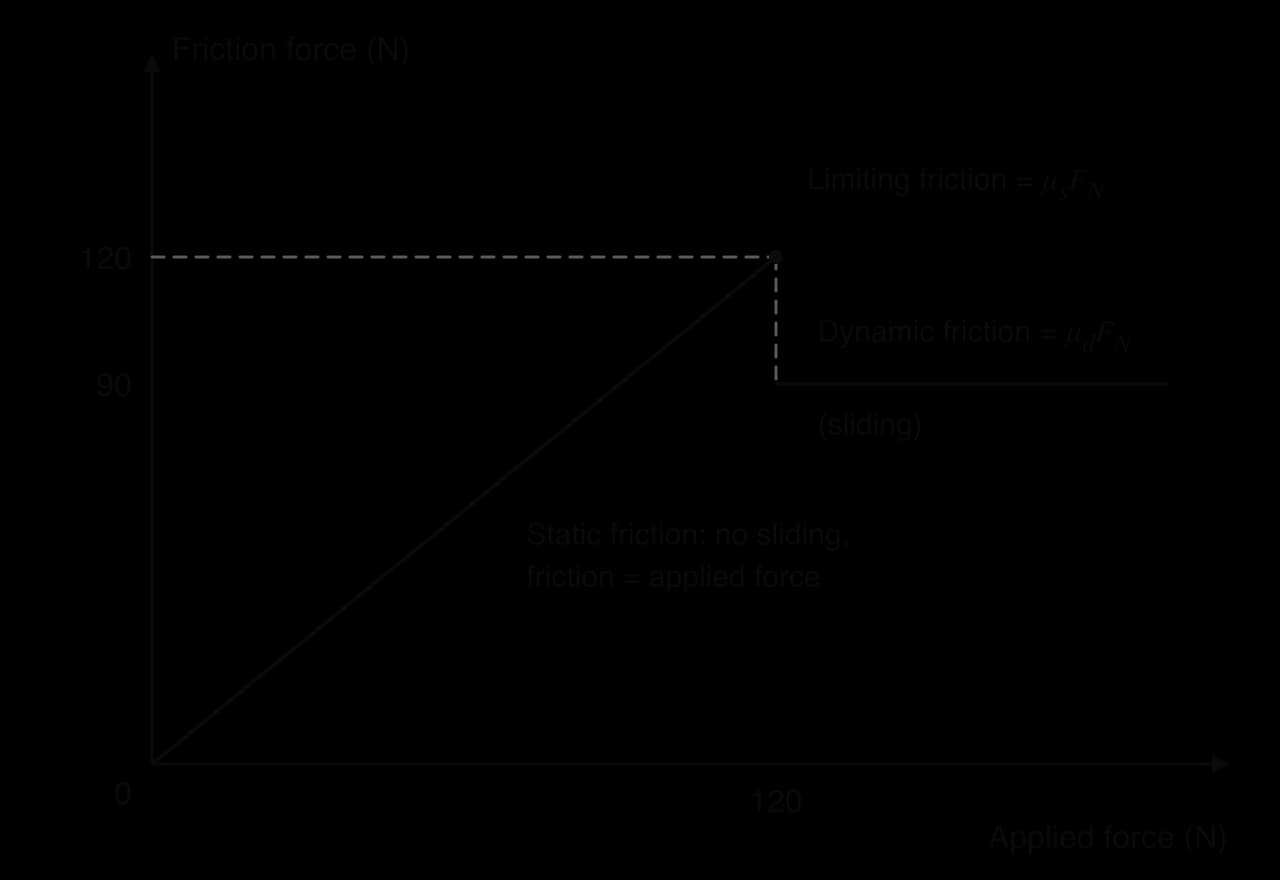
For any pair of surfaces, μs is greater than μd. The coefficients depend on the materials: rubber on a dry running track has high coefficients, steel on ice very low ones. Water, dust and temperature also change them, which is why a wet pitch or a dusty court changes how athletes move.
The same two equations decide how hard an athlete must push to start a load moving and how fast it then accelerates, as in sled training for rugby and sprinting.
Increasing friction to improve performance
Where athletes need grip, equipment and technique are designed to raise the coefficient of friction or the normal reaction force.
Spikes and studs: sprint spikes and football studs dig into the track or turf, so the shoe cannot slide backward during push-off. Different stud patterns suit firm, soft and artificial ground.
Rubber soles: court shoes for basketball, netball and squash use soft rubber with a high coefficient of friction on wooden or synthetic floors, allowing rapid changes of direction.
Chalk and grip aids: gymnasts, climbers and weightlifters use magnesium carbonate (chalk) to absorb sweat, which would otherwise act as a lubricant. Grip tape on racket handles and tacky gloves in American football and goalkeeping serve the same purpose.
Increasing the normal reaction: Formula 1 cars use wings that create downforce, pressing the tyres onto the track and increasing the maximum friction available for cornering.
Reducing friction to improve performance
Where athletes need to glide, they lower the coefficient of friction.
Skis and snowboards: wax suited to the snow temperature reduces friction between the base and the snow.
Curling: sweeping the ice in front of a moving stone briefly warms and smooths the surface, lowering dynamic friction so that the stone travels further; sweeping on one side or the other also changes how much it curls.
Bobsleigh, luge and skeleton: steel runners are polished to slide with very little friction on the ice. Warm runners would melt a thin film of water and slide faster, so heating runners is banned: officials compare each sled’s runner temperature with a reference runner before a race. At the 1994 Winter Olympics in Lillehammer, a United States two-man sled was disqualified because its runners were too warm.
Swimming and cycling: drag, rather than friction between solid surfaces, is the main resistive force, and it is reduced by body position and equipment.
Sources: Bradley, Journal of Sports Science and Medicine, 2009; Sports Illustrated, 7 March 1994; NBC Olympics, bobsled equipment guide.
Friction is also linked to injury. Shoe–surface combinations that grip too strongly can fix the foot to the ground while the body turns over it, increasing the twisting load on the knee and ankle, a mechanism associated with ligament injuries in field and court sports. Footwear and surface design therefore aim for enough grip for performance but not so much that the foot cannot release.
Work, energy and power (HL only)
Work
In mechanics, work is done when a force moves its point of application through a distance in the direction of the force. The amount of work equals the force multiplied by the distance moved in the direction of the force.
In this equation is work in joules (J), is the force in newtons and is the distance moved in the direction of the force, in metres. One joule is the work done when a force of 1 N moves its point of application 1 m, so 1 J = 1 N m.
Two consequences follow from the definition. If nothing moves, no mechanical work is done, however hard the athlete is trying: a weightlifter holding a barbell still overhead or a rugby front row in a static scrum does no work on the bar or the opposition, even though the muscles are contracting isometrically and using energy. And only the part of the motion in the direction of the force counts: carrying a bag horizontally at a steady height does no work against gravity on the bag.
Energy and its forms
Energy is the capacity to do work, so it has the same unit, the joule. Energy cannot be created or destroyed, only transformed from one form to another (the law of conservation of energy). When work is done on a body, energy is transferred to it; when a body does work, it transfers energy away.
Form of energy | What it depends on | Sporting example |
|---|---|---|
Kinetic energy | Mass and the square of velocity: | A sprinter at top speed; a ball in flight |
Gravitational potential energy | Mass, g and height above a reference level: |
Kinetic energy is the energy a body has because of its motion. Because it depends on the square of velocity, doubling an athlete’s speed quadruples her kinetic energy: an 80 kg sprinter has 4,000 J of kinetic energy at 10 m s⁻¹ but 16,000 J at 20 m s⁻¹ (a speed reached by downhill skiers rather than runners).
Gravitational potential energy is the energy a body has because of its height above a reference level. A 70 kg high jumper who raises her centre of mass by 1.2 m gains 70 × 9.81 × 1.2 = 824 J of gravitational potential energy.
Elastic potential energy (strain energy) is stored in a material that has been deformed and returns to its shape. Tendons are the body’s main elastic stores: the Achilles tendon is stretched as the foot lands in running and recoils as it pushes off, returning part of the energy and reducing the work the calf muscles must do. Vaulting poles, trampoline beds, diving boards, the strings of a racket and the foam and plates in modern running shoes all store and return elastic energy.
Energy transformations in sport
Every movement involves energy changing from one form to another. Tracing these changes explains the technique of several events.

Pole vault. During the run-up, chemical energy in the vaulter’s muscles is converted into kinetic energy. At take-off the pole is planted and bends, storing part of that kinetic energy as elastic potential energy. As the pole straightens, it returns this energy, lifting the vaulter; the vaulter also does extra work by pulling and pushing on the pole. At the top, most of the energy is gravitational potential energy and the vaulter is moving slowly over the bar. Some energy is lost as heat in the pole and the vaulter’s tissues and as sound at every stage.
Sources: World record: Athletics Weekly, “Mondo Duplantis soars to 6.31m world record in Sweden”, 2026.
Trampoline. As the athlete lands, kinetic energy is transformed into elastic potential energy in the bed and springs, and the athlete comes momentarily to rest at the lowest point. The bed then recoils, converting elastic energy back into kinetic energy and then into gravitational potential energy as the athlete rises. Because some energy is converted to heat and sound in each bounce, the trampolinist must add energy by extending the legs and hips forcefully against the bed to keep or gain height.
High jump. The horizontal kinetic energy of the curved run-up is partly converted into vertical motion at take-off, as the take-off leg acts as a stiff strut and the knee, hip and arm drive add work. In flight, kinetic energy is converted into gravitational potential energy until the centre of mass reaches its peak, then back into kinetic energy as the jumper falls onto the mat.
Power
Power is the rate at which work is done, or energy is transferred. Two athletes who do the same work are not equally powerful if one does it faster.
In this equation is power in watts (W), is the work done in joules, is the time taken in seconds, is the force in newtons and is the velocity in m s⁻¹. One watt is one joule per second. The form
The second form shows that power needs both force and velocity. Muscles cannot produce their greatest force at high speeds (the force–velocity relationship), so maximum power occurs at an intermediate combination of force and speed. A very heavy load can be moved only slowly, and a very light one is moved fast but with little force; in both cases power is low.
Power output as a measure of exercise intensity
Because power is the rate of doing work, measuring it gives a direct, objective measure of how hard an athlete is working, independent of how the athlete feels or how the heart is responding. This makes power output useful in both performance and health settings.
Cycling power meters: strain gauges in the cranks, pedals or rear hub measure the force applied and the speed of rotation many times a second and calculate power. Professional and recreational cyclists use them to pace efforts, set training zones and track fitness.
The Wingate anaerobic test: the athlete pedals all-out for 30 s on a cycle ergometer against a resistance set from body mass. Peak power (usually reached in the first few seconds) and mean power are recorded, often expressed per kilogram of body mass: a peak of 900 W for a 75 kg athlete is 12 W kg⁻¹.
Jump tests: a vertical jump performed on a force plate gives force and velocity throughout the take-off, so power can be calculated directly. Simpler field tests estimate power from jump height and body mass with prediction equations.
Rowing and running: rowing ergometers display power in watts, and some running devices estimate it, letting coaches set work intensity precisely.
In health and rehabilitation settings, power output on a cycle ergometer is used to set a precise and repeatable workload for exercise testing and training, for example in cardiac rehabilitation programmes. Power is also an important outcome in older adults, because the ability to produce force quickly (to rise from a chair or recover from a trip) declines with age faster than strength alone.
Optimising power output through technique and equipment
Power output can be increased by improving the athlete’s technique and by designing equipment so that more of the athlete’s effort becomes useful power.
Technique: a countermovement before a jump uses the stretch–shortening cycle, storing elastic energy in the tendons and allowing more force to be produced, so the jump is higher than one from a static squat. Summation of joint forces in throwing raises the final speed of the implement for the same muscular effort.
Gearing in cycling: gears let a cyclist keep the pedalling rate in the range where her muscles produce the most power, whatever the road speed or gradient.
Footwear: carbon-plated running shoes combine a stiff plate with a highly compliant and resilient foam that returns more of the energy stored at each footstrike. In a laboratory study of 18 high-calibre runners at 14, 16 and 18 km h⁻¹, a prototype of these shoes lowered the energetic cost of running by about 4% compared with established marathon racing shoes, in every runner tested.
Oars, rackets and poles: the length, stiffness and blade shape of an oar, the stiffness of a vaulting pole and the string tension of a racket are chosen so that the athlete’s force is transferred to the boat, ball or body as efficiently as possible.
Sources: Hoogkamer et al., Sports Medicine, 2018.
Case study: Usain Bolt’s 9.58 s 100 m, Berlin 2009
At the 2009 World Championships in Berlin, Usain Bolt won the men’s 100 m in 9.58 s, a world record that still stood in 2026; Tyson Gay finished second in 9.71 s. The race was run with a tailwind of 0.9 m s⁻¹. The championship organisers measured each athlete’s time at every 10 m mark, so the race can be analysed with the concepts of speed, velocity, acceleration, momentum and impulse.
Distance (m) | Time from the gun (s) | Time for the 10 m section (s) | Average velocity in the section (m s⁻¹) |
|---|---|---|---|
0 (reaction) | 0.146 | — | — |
10 | 1.89 | 1.744 | 5.73 |
20 | 2.88 | 0.99 | 10.10 |
30 | 3.78 | 0.90 | 11.11 |
40 | 4.64 | 0.86 | 11.63 |
50 | 5.47 | 0.83 | 12.05 |
60 | 6.29 | 0.82 | 12.20 |
70 | 7.10 | 0.81 | 12.35 |
80 | 7.92 | 0.82 | 12.20 |
90 | 8.75 | 0.83 | 12.05 |
100 | 9.58 | 0.83 | 12.05 |
The first section is timed from the end of the reaction time (0.146 s), when Bolt began to push on the blocks, so the 0–10 m section lasted 1.89 − 0.146 = 1.744 s. Each average velocity is 10 m divided by the section time.
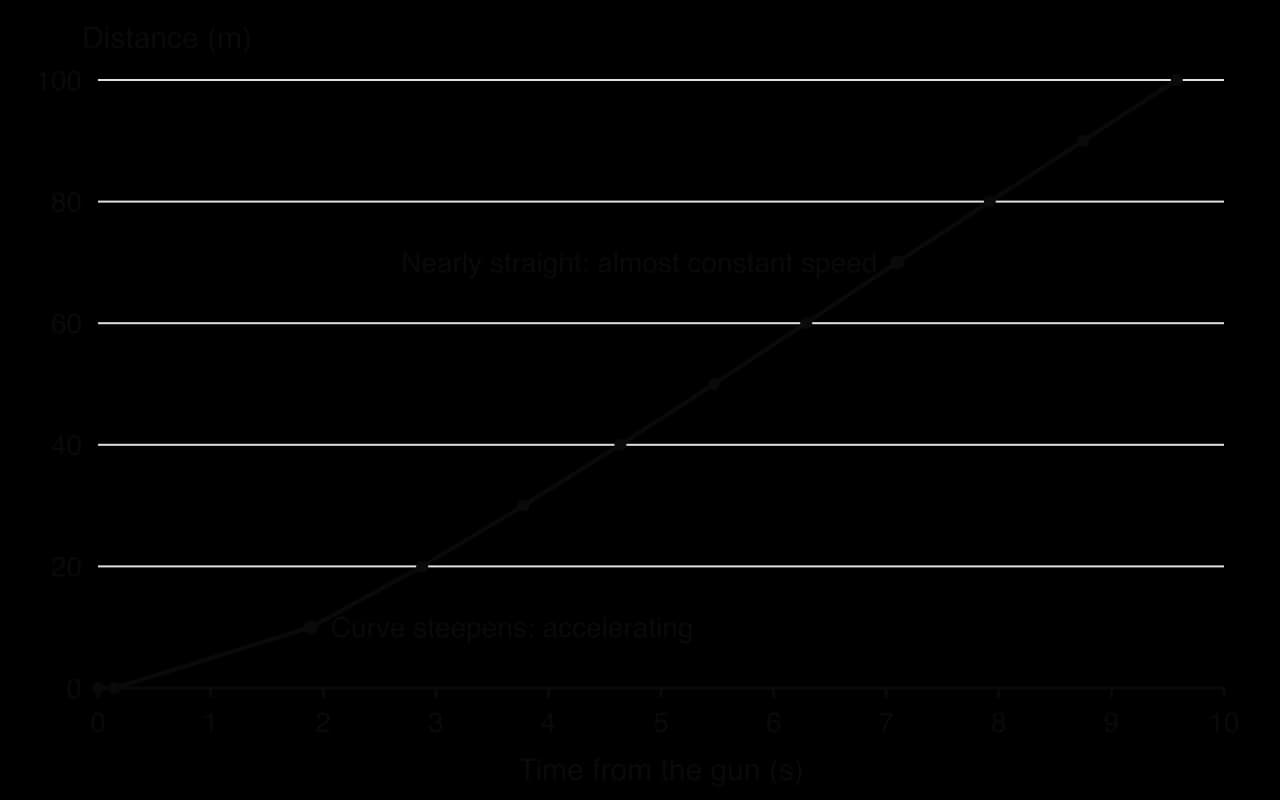
Acceleration and the impulse from the blocks
Bolt’s average velocity rose from 5.73 m s⁻¹ in the first 10 m to 10.10 m s⁻¹ in the second. Plotting each average at the middle of its section gives an estimate of his average acceleration between those points of (10.10 − 5.73) m s⁻¹ ÷ (2.385 − 1.018) s ≈ 3.2 m s⁻². After 30 m the increases become smaller and smaller, so the velocity–time graph flattens: the gradient (acceleration) falls towards zero as he approaches top speed.
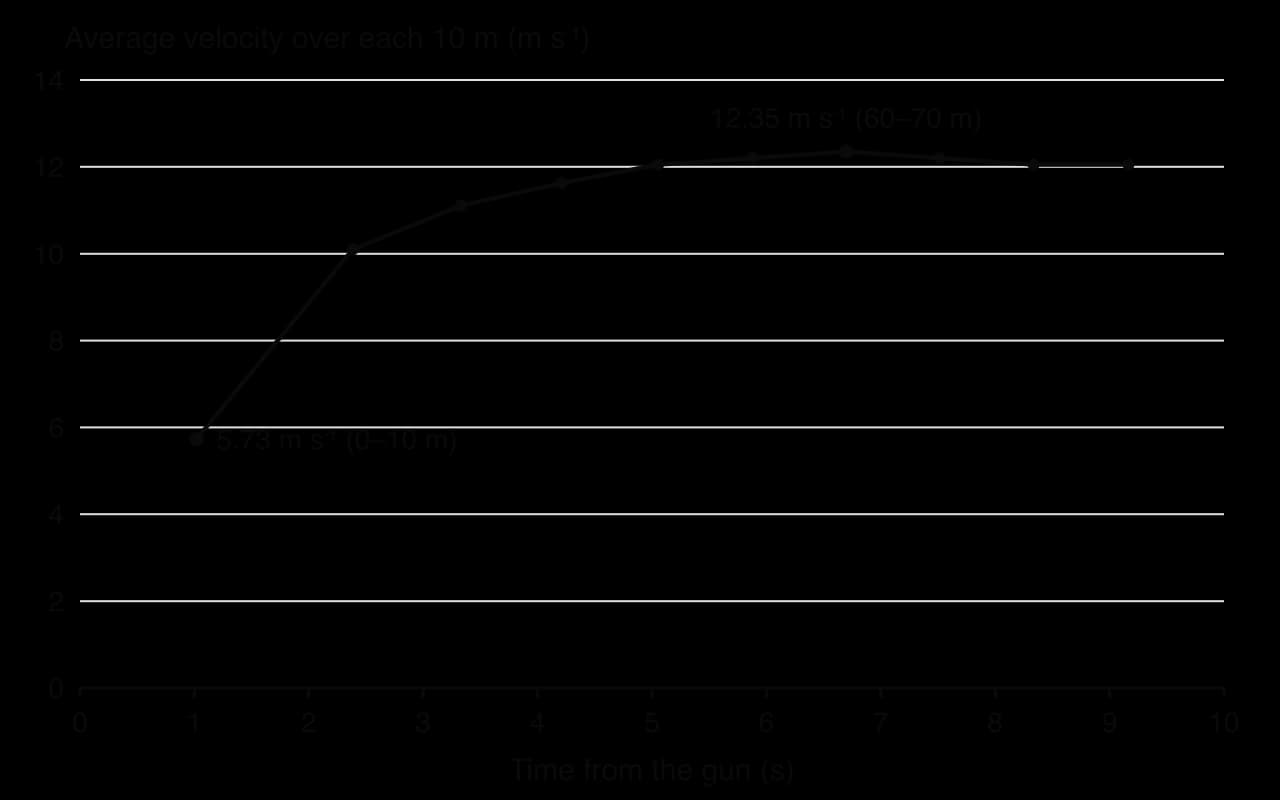
The impulse–momentum relationship links the shape of this curve to the forces Bolt produced. With a body mass of about 94 kg, his momentum at 12.05 m s⁻¹ (reached by the 40–50 m section, about 4.9 s after he started to move) was 94 kg × 12.05 m s⁻¹ ≈ 1,130 kg m s⁻¹. This momentum came from the net horizontal impulse of the ground on his feet, so the average net horizontal force over that time was about 1,130 N s ÷ 4.9 s ≈ 230 N.
Most of this impulse was produced in the first few steps, when each push could act against the ground for longer and he leaned forward so that the ground reaction force was directed forward as well as upward (the principle of impulse direction).
Top speed and the end of the race
Between 60 and 70 m Bolt covered 10 m in 0.81 s, an average of 12.35 m s⁻¹, and from 70 m he slowed only slightly, to 12.05 m s⁻¹ over the last 20 m (a fall of about 2.4%).
At top speed, Newton’s first law applies to his whole body: his velocity stays almost constant because the forward horizontal impulse from each step only just balances the backward impulse from braking at footstrike and from drag. The small deceleration at the end of the race shows that this balance was lost as his ability to produce force fell, linked to fatigue and to the depletion of the phosphagen system over about 10 s of maximal effort.
The analysis shows why 100 m races are won by the athlete who decelerates least as well as the one who accelerates best. For a 94 kg sprinter to hold more than 12 m s⁻¹, every ground contact must produce a large impulse relative to body mass, which is why elite sprinters train for high force relative to their mass (Newton’s second law).
Limitations of the data
The analysis has several limits that illustrate the nature of science. Split times give only average velocities over 10 m, so the true peak instantaneous velocity is hidden; analyses using laser devices and different timing systems give peak values for this race of roughly 12.3–12.4 m s⁻¹. The 0.9 m s⁻¹ tailwind reduced drag, so the results apply to those conditions. The momentum and force estimates depend on a body mass taken from published records rather than measured on the day. Finally, one race by one exceptional athlete cannot show how sprinters in general should run.
Analyse the table to identify the 10 m section in which Bolt’s acceleration was greatest, and explain the reasoning.
Calculate Bolt’s average speed for the whole race, from the gun and from the end of his reaction time, and explain why the two values differ.
How might a coach use Newton’s laws and split-time data like these to improve the start and the final 30 m of a junior sprinter’s race?
Sources: Official 10 m split times, IAAF World Championships in Athletics, Berlin, 2009, as tabulated by Helene and Yamashita, arXiv, 2009 (including wind and reaction time); body mass and race results from Wikipedia, Usain Bolt, 2026.
Exam practice
Newton’s laws appear in every part of the assessment. Multiple-choice questions test definitions, units and the direction of forces; data-based questions use force plate and timing data; structured questions ask for calculations, free-body diagrams, sketched graphs and explanations of technique; extended responses ask how the principles are applied to improve performance or reduce injury.
Explanations must link a principle to an outcome in a chain. “The sprinter leans forward” is a description; “the sprinter leans forward so that the ground reaction force is directed forward through the centre of mass, giving a forward impulse and a greater forward change in momentum” is an explanation.
Multiple-choice questions
Questions on Newton’s third law often test which body each force acts on.
Angular motion questions usually test whether angular momentum or angular velocity changes.
Data-based question
Paper 1B style. Twelve trained volleyball players each performed a squat jump (starting from a static half-squat) and a countermovement jump (starting upright and dipping down before jumping) on a force plate, in a random order, with three minutes of rest between jumps. Mean body mass was 80 kg. The results are hypothetical data.
Jump type | Jump height (cm), mean ± SD | Net vertical impulse (N s), mean ± SD |
|---|---|---|
Squat jump | 37.2 ± 4.1 | 216 ± 19 |
Countermovement jump | 41.8 ± 4.6 | 229 ± 21 |
Structured questions
Sketching questions reward correctly labelled axes and the key features of the shape.
Explanations of a sprint start often combine the third law with impulse and stability.
Questions on throwing and striking usually test the order and timing of the segments.
Extended-response question
HL questions (HL only)
HL structured questions combine definitions with one-step or two-step calculations.
An HL extended response may ask for a full chain of energy transformations.
Summary
Scalars have size only (distance, speed, mass); vectors have size and direction (displacement, velocity, acceleration, force, momentum).
Speed , velocity
Self-check
- To do:
I can distinguish scalars from vectors and calculate speed, velocity and acceleration with units.
- To do:
I can interpret distance–time and velocity–time graphs using gradients and areas.
- To do:
I can draw and label free-body diagrams and calculate weight from mass.
- To do:
I can explain Newton’s three laws with sporting examples and use .
- To do:
I can explain the four factors that affect stability and apply them to a sporting position.
- To do:
I can explain summation of joint forces and the principle of impulse direction.
- To do:
I can calculate momentum and impulse and interpret force–time graphs.
- To do:
I can explain how an eccentric force causes rotation and how athletes use the conservation of angular momentum.
- To do:
I can apply the conservation of momentum and calculate the coefficient of restitution (HL).