B.2 Forces, motion and movement
Apply Newton’s laws, projectile motion and movement analysis to explain and improve how bodies and objects move in sport and exercise, and see what HL adds on collisions, friction, energy and fluid forces.
- IB Sports, Exercise and Health Science
- SL and HL
What B.2 covers
From the subject guide: what you need to know and be able to do.
Applying the laws of motion to explain and improve movement in sport.
3 subtopics in Forces, motion and movement
Each one has its own page once something is published for it.
- B.2.1Newton’s laws of motionnotes
- B.2.2Fluid mechanicsnotes
- B.2.3Movement analysis and its applicationsnotes
An overview of B.2 Forces, motion and movement
Forces, motion and movement applies the laws of mechanics to the human body and to the balls, implements and equipment it moves. The same principles explain how a sprinter accelerates or a diver rotates, and how an older adult avoids a fall, how a soft landing protects the knees and how a wheelchair can be pushed with less strain on the shoulders.
Questions that frame forces, motion and movement
The central question is how the laws of motion explain the way bodies move in sport and exercise, and how they can be used to improve performance. Biomechanics answers it in three steps: describing the forces and the motion they cause, following an object once it is released into the air or water, and analysing a whole skill phase by phase.
Why does a sprinter lean forward out of the blocks and run upright later in the race?
Why does a diver spin faster in a tuck than in a straight position?
Why does a shot-putter release the shot at an angle below 45°?
How do the dimples on a golf ball help it travel further?
How can video of a patient walking help a physiotherapist after knee surgery?
What the topic covers
Subtopic | Main question it answers | Level |
|---|---|---|
B.2.1 Newton’s laws of motion | How do forces change the linear and angular motion of a body, and how do they affect stability? | SL and HL, with an HL-only part |
B.2.2 Fluid mechanics | What determines the flight path of a projectile, and how do air and water act on a moving body? | SL and HL, with an HL-only part |
B.2.3 Movement analysis and its applications | How can a movement be broken into phases and analysed to improve performance, safety and health? | SL and HL |
How forces, flight and technique connect
Newton’s laws are the foundation. A force is a push or pull, measured in newtons, and a resultant force changes an object’s motion according to Newton’s second law, . Newton’s third law explains why a runner moves forward: the foot pushes back on the ground and the ground reaction force pushes the runner forward. A free-body diagram shows every force acting on a body, and ideas such as momentum, impulse, stability and the summation of joint forces follow from the same laws. When a force acts off-centre it causes rotation, and the conservation of angular momentum explains why a diver spins faster after pulling into a tuck.
Fluid mechanics follows an object once it leaves the hand, foot or racket, or a body moving through air or water. In flight, a projectile is acted on by its weight and by air resistance, so its path depends on the speed of release, the angle of release, the height of release and the ratio of weight to air resistance. A shot follows an almost symmetrical path, while a shuttlecock drops steeply because air resistance is large compared with its weight. At HL, drag, lift, buoyancy and the Magnus effect explain how swimmers, cyclists, javelins and spinning balls are affected by the fluid around them.
Movement analysis brings these ideas together. It breaks a skill into phases of movement (preparation, force production, the critical instant and follow-through or recovery) and uses Newton’s laws and fluid mechanics to explain what happens in each phase and why the result is good or poor. The concept map shows this structure: forces from the muscles enter through Newton’s laws, and movement analysis turns the physics into practical changes.
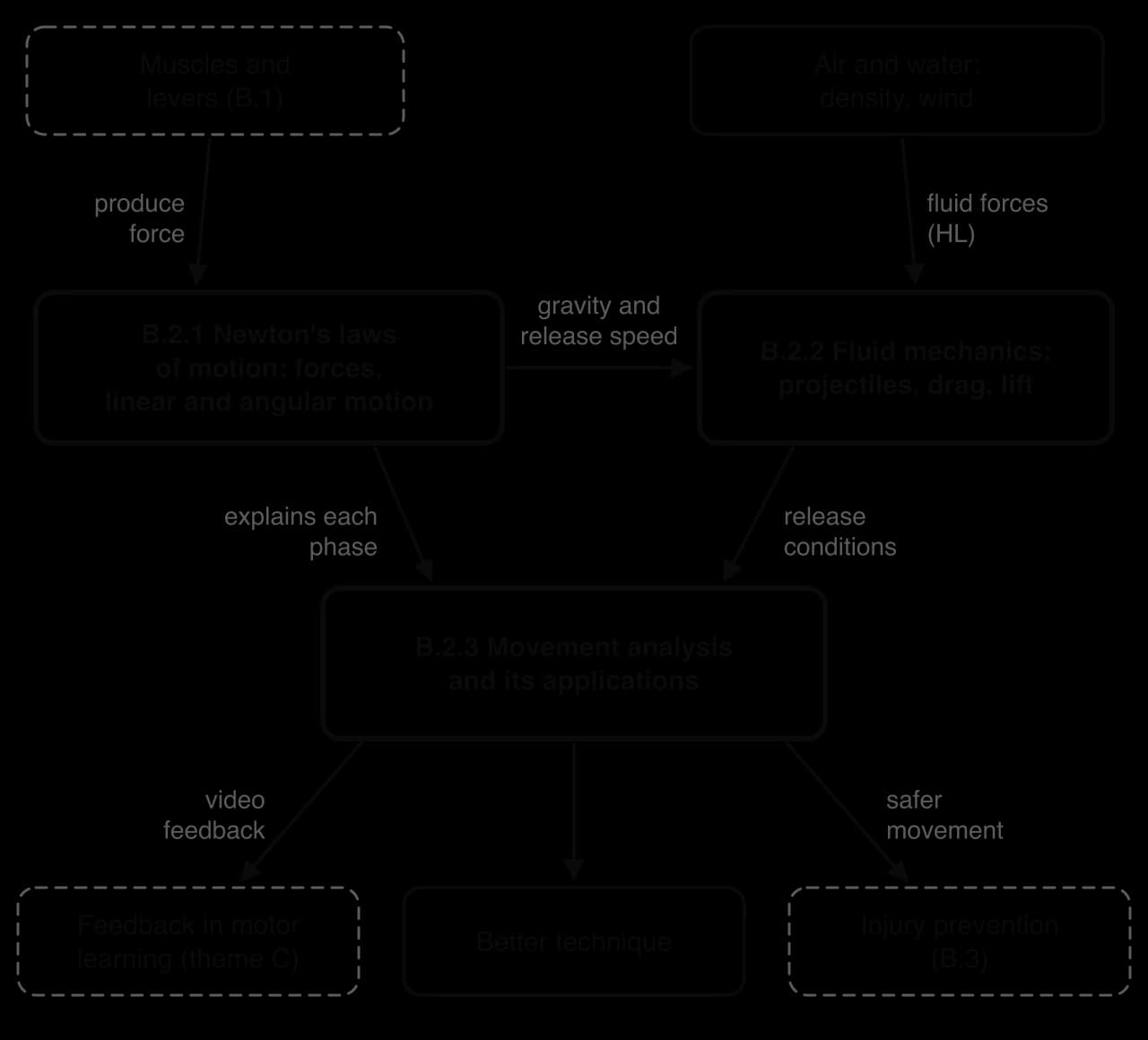
The forces studied here are produced by muscles pulling on bones that act as levers, so biomechanics depends on the structure and function of the musculoskeletal system. Movement analysis also links to motor learning: video and force data give a performer feedback about their technique, and coaches use the phases of a skill to plan practice. In injury, the same analysis identifies movements that overload tissues, and the principles of impulse explain why padding, soft surfaces and a bent-knee landing reduce peak forces.
Health and performance lenses
Idea | Health lens | Performance lens |
|---|---|---|
Newton’s laws and stability | Older adults widen their base of support and lower their centre of mass to avoid falls; landing with bent knees increases the time of impact and lowers the peak force on the joints. | A sprinter’s forward lean at the start directs the ground reaction force forwards; a thrower uses the whole body in sequence to give the implement maximum speed. |
Fluid mechanics | Drag in water provides resistance for low-impact exercise, and buoyancy reduces the load on painful joints (HL); lighter balls and foam javelins make throwing safer for children. | The angle and height of release are matched to each event; at HL, streamlining, suit design and spin are used to reduce drag or create lift. |
Movement analysis | Gait analysis guides rehabilitation after injury or surgery; analysis of wheelchair propulsion improves accessibility and reduces overuse. | Phase analysis and video analysis find the faults that limit a jump shot, a serve or a high jump. |
How SL and HL differ
In SEHS, the higher level (HL) material is mostly added inside the subtopics rather than as separate subtopics. HL students study everything SL students study, plus additional material. Every page of forces, motion and movement is therefore read by both SL and HL students, and the HL material sits in sections whose headings end “(HL only)”, which SL students can skip. Calculations use at most three terms at SL and four at HL, and none needs trigonometry.
Forces, motion and movement has no HL-only subtopic, but it contains a large share of the HL material in biomechanics:
Newton’s laws of motion: collisions and the coefficient of restitution; friction and the static and dynamic coefficients of friction, and how friction is increased or reduced in sport; work, energy and power, including transformations between kinetic, potential and elastic energy.
Fluid mechanics: how environmental conditions (temperature, humidity, air pressure, wind, water salinity and altitude) change fluid forces; buoyancy; drag in detail; lift, Bernoulli’s principle and the angle of attack; the Magnus effect; and the sporting, ethical and regulatory implications of equipment that changes these forces, including the polyurethane swimsuits of 2008–2009.
Movement analysis and its applications: none. SL and HL students study the whole subtopic.
Assessment
Questions on forces, motion and movement appear in all three parts of the written papers. Paper 1A (multiple choice) tests definitions, the laws of motion and the factors that affect a flight path; at SL it contains only SL material, while the HL paper also covers collisions, friction, work and power and fluid forces. Paper 1B (data-based questions) often uses sprint split times, force plate data or measurements from video. Paper 2 contains short-answer and extended-response questions, and HL-only material appears only in the HL paper.
Forces, motion and movement tends to produce these kinds of question:
calculations with the data booklet’s equations: speed, acceleration, force and weight, momentum, impulse and angular velocity, plus the coefficient of restitution, friction, work and power at HL;
drawing and labelling free-body diagrams, and interpreting velocity–time and force–time graphs;
sketching projectile paths and explaining how a change in release speed, angle or height changes them;
analysing a named skill phase by phase, and evaluating methods of movement analysis.
Carry on with B.2 in Augment
With a free account, Augment remembers where you stopped and what you have practiced.