
Explain how social learning spreads norms, aggression and prosocial behaviour through groups, evaluate research including a radio drama in Rwanda, and apply the theory to change group behaviour.
Each is in the Psychology glossary, with every other term in the subject.
Behaviour intended to harm another person who wishes to avoid that harm, whether physically, verbally or through damage to relationships.
A communication strategy that builds educational messages into popular entertainment, such as soap operas, so that characters model behaviours the audience may learn and adopt.
Voluntary behaviour intended to benefit another person or group, such as helping, sharing, cooperating or comforting.
A person whose behaviour others in a group pay particular attention to when judging what is normal, often because they are widely connected or visible in the group’s social network.
Explain how social learning theory accounts for the spread of norms and behaviour within groups.
Explain the role of social referents and media models in shaping what group members see as normal.
Discuss research on the social learning of aggression in groups, including media violence.
Discuss research on the social learning of prosocial behaviour.
Describe and evaluate Paluck (2009), a field experiment using a radio drama to change group behaviour in Rwanda.
Explain how social learning theory can be applied to change group behaviour, with examples of interventions.
Evaluate research on social learning in group behaviour with reference to causality, measurement, bias, responsibility and change.
Groups pass on behaviour. Students in one school treat fighting as normal while students in a similar school do not; a community recovering from violence either repeats old patterns of mistrust or slowly develops new ones. Social learning explains much of this: members of a group watch one another, and especially the most visible members, and learn from them what the group does and approves of.
Social learning in group behaviour links the sociocultural approach, which explains behaviour through social norms and group membership, with the cognitive processes of attention, memory and expectation. It is closely connected to conformity, because people copy what they believe most group members do, and to social identity theory, because models from the in-group are more influential than models from outside it. Its main applications, reducing aggression and conflict and encouraging prosocial behaviour, raise questions of
With a free account, Augment remembers where you stopped and what you have practiced.
Social learning theory, developed by Albert Bandura, proposes that people learn new behaviour by observing models, without needing to be reinforced themselves. Imitation depends on four mediational processes: attention to the model, retention of what was seen, the ability to reproduce it and the motivation to perform it. Motivation comes from the consequences the observer expects, including vicarious reinforcement when a model is rewarded and vicarious punishment when a model is punished. In the Bobo doll experiments, children copied an adult’s specific aggressive acts after watching them only once.
For group behaviour, two features of the theory are especially important. First, models differ in influence: people pay most attention to models who are similar, liked and high in status. Second, people learn not only actions but also what others in their group consider normal and acceptable. When enough members learn the same behaviour from the same models, it becomes a group norm, and each new member who adopts it becomes a model for the next.
A social norm is a shared expectation about how members of a group behave or should behave. Psychologists distinguish what people believe others actually do, a descriptive norm, from what they believe others approve of, an injunctive norm. Social learning shapes both: watching group members shows what is done, and watching how others react to them shows what is approved.
People rarely observe everyone in their group. They infer norms from a small number of visible members and from the media, and they generalise from these models to the group as a whole. This makes norms open to change: if the most visible members change their behaviour, the perceived norm can change even though most members have not changed yet.
Some group members attract much more attention than others. Paluck and her colleagues called them social referents: people whom many others notice and use as a guide to what is normal, either because they have many connections in the group or because they are highly visible. In social learning terms, social referents are high-status, widely observed models.
Social referents are not always the most popular people in the conventional sense. They are those whose behaviour is seen by the largest number of others, which can be measured by asking every member of a group whom they spend time with and mapping the resulting social network.
Television, radio, films, games and social media provide symbolic models that can be observed by whole communities at once. A media character who is liked and similar to the audience can model behaviour for millions of people simultaneously, and because many people watch the same model, they may also learn what they think others have learned. This shared exposure is what allows media to shift group norms rather than only individual behaviour.
Aggression is behaviour intended to harm another person who wishes to avoid that harm. Social learning theory proposes that people learn aggressive behaviour, and when it is acceptable, by observing aggressive models in their family, peer group and media, and by seeing aggression rewarded, for example with status, attention or getting one’s way.
Huesmann, Moise-Titus, Podolski and Eron (2003) studied children in the Chicago area who were aged 6 to 10 in 1977, measuring how much violent television they watched and how strongly they identified with aggressive television characters. About 15 years later, the researchers collected archival records for 450 of them and interviewed 329. Heavy childhood exposure to television violence predicted more aggressive behaviour in young adulthood for both men and women. Identifying with aggressive television characters and believing that television violence was realistic also predicted later aggression.
These relationships remained after the researchers controlled for socioeconomic status, intellectual ability and several parenting factors, which strengthens the case for a causal link. Identification with characters is exactly what social learning theory predicts: models who seem similar and admired attract more attention and are copied more. Because the design was correlational, however, an unmeasured third variable such as family conflict could still explain both violent viewing and later aggression.
 YouTube
Not all evidence shows that media models increase aggression in a group. When broadcast television arrived on the remote island of St Helena in 1995, Charlton et al. (2000) observed children’s playground behaviour and found little or no increase in antisocial behaviour over the following years. The researchers attributed this to the island’s close-knit community, in which children were closely supervised and aggressive behaviour was not rewarded. In social learning terms, the island provided strong local models and clear vicarious punishment that outweighed the influence of television models.
Social learning theory predicts that helpful behaviour can be learned by observation in the same way as aggression. Prosocial behaviour includes helping, sharing, cooperating and comforting others, and it is the basis of trust and cooperation within groups.
Bryan and Test (1967) carried out field experiments in the United States in which a woman stood beside a car with a flat tyre on a busy road. When drivers had just passed another scene in which a man was helping a woman change a tyre, more of them stopped to help than when no helping model had been staged. In a second study, more shoppers donated to a Salvation Army collection after seeing another person donate. Brief exposure to a helpful model was enough to increase helping among strangers in a real setting.
Gentile et al. (2009) tested whether prosocial content in video games could increase helping, using three different methods in three countries. Among secondary-school students in Singapore, those who played more prosocial games behaved more prosocially (a correlational study). In two longitudinal samples of children and adolescents in Japan, prosocial game play predicted later increases in prosocial behaviour. In an experiment with university students in the United States, those randomly assigned to play a prosocial game were more helpful to another student afterwards than those who played a neutral game.
Study | Country | Method | What it adds about social learning |
|---|---|---|---|
Bryan & Test (1967) | United States | Field experiments | A single live model increases helping by strangers in a real setting |
Gentile et al. (2009) | Singapore, Japan, United States | Correlational, longitudinal and experimental | Symbolic models in games relate to prosocial behaviour across cultures and methods |
Huesmann et al. (2003) | United States | Longitudinal | Identification with aggressive media models predicts adult aggression |
St Helena television studies | St Helena (South Atlantic) | Natural experiment | Strong community norms can limit the influence of media models |
Taken together, the methods support each other. Experiments show that models can cause short-term changes in helping, while longitudinal studies suggest that repeated exposure to models is linked to longer-term differences. Using several methods and samples to answer one question is a form of triangulation, and consistent results across methods give more confidence than any single study.
 YouTube
If group norms are learned from visible models, then changing the models should change the norms, and changing the norms should change behaviour. Two kinds of intervention apply this idea: those that use media characters and those that use influential members of the group itself.
Entertainment-education builds educational messages into popular entertainment such as soap operas. Characters are designed to model the target behaviour, to be rewarded or punished for their choices, and in some cases to change during the story so that the audience can identify with their struggle. The method was developed by the Mexican producer Miguel Sabido in the 1970s, drawing on Bandura’s theory, and has since been used for literacy, family planning, HIV prevention and reconciliation.
Entertainment-education is especially suited to group behaviour because audiences often listen or watch together and discuss what they see. The drama provides shared models, and the discussion lets listeners find out that others in their group have reacted in the same way, which can change the perceived norm quickly.
Paluck, Shepherd and Aronow (2016) tested whether social referents could reduce conflict in schools. They mapped the social networks of 56 middle schools in New Jersey, with 24,191 students in total, by asking every student whom they had spent time with. In randomly selected schools, a randomly chosen group of 20–32 students was invited to take part in an anti-conflict programme in which they designed and publicised their own campaign against peer conflict, using their own ideas for messages and activities.
Over one year, disciplinary reports of student conflict fell by about 25% in the intervention schools compared with control schools. The effect was larger when the seed group included more social referents, and network analyses showed that students who spent time with these referents changed their perception of whether conflict was normal. The study combines social learning with network science, and its results suggest that the choice of model matters as much as the message the model gives.
Paluck aimed to test whether a radio soap opera designed to reduce intergroup prejudice and conflict could change listeners’ personal beliefs, their perceptions of social norms and their behaviour, in a real setting ten years after the 1994 genocide in Rwanda. In that genocide more than 10% of the population was killed, and survivors, returned refugees and people accused of killing had to live side by side again in the same communities.
The study was a year-long field experiment in 2004–2005. The reconciliation programme was Musekeweya (“New Dawn”), produced by the non-governmental organisation La Benevolencija. Its plot follows two fictional Rwandan communities in conflict, one more prosperous than the other, without naming ethnic groups, and includes a forbidden love between a young man and a young woman from the two communities. Its messages were that ordinary people can be drawn into violence through everyday psychological processes, that people should speak out against those who incite violence, and that talking about trauma helps recovery.
Twelve communities were sampled to represent the main groups of present-day Rwanda: eight general-population communities, two communities of genocide survivors and two Twa communities (a historically marginalised minority). Communities were matched in pairs of the same type on characteristics such as gender ratio, quality of housing and education, and one community in each pair was randomly assigned to the reconciliation programme. The other listened to Urunana, an entertainment-education drama about reproductive health and HIV, as the control. In each community 40 adults were selected at random from official lists, balanced for sex and age, giving 480 participants with an average age of 38.5 years.
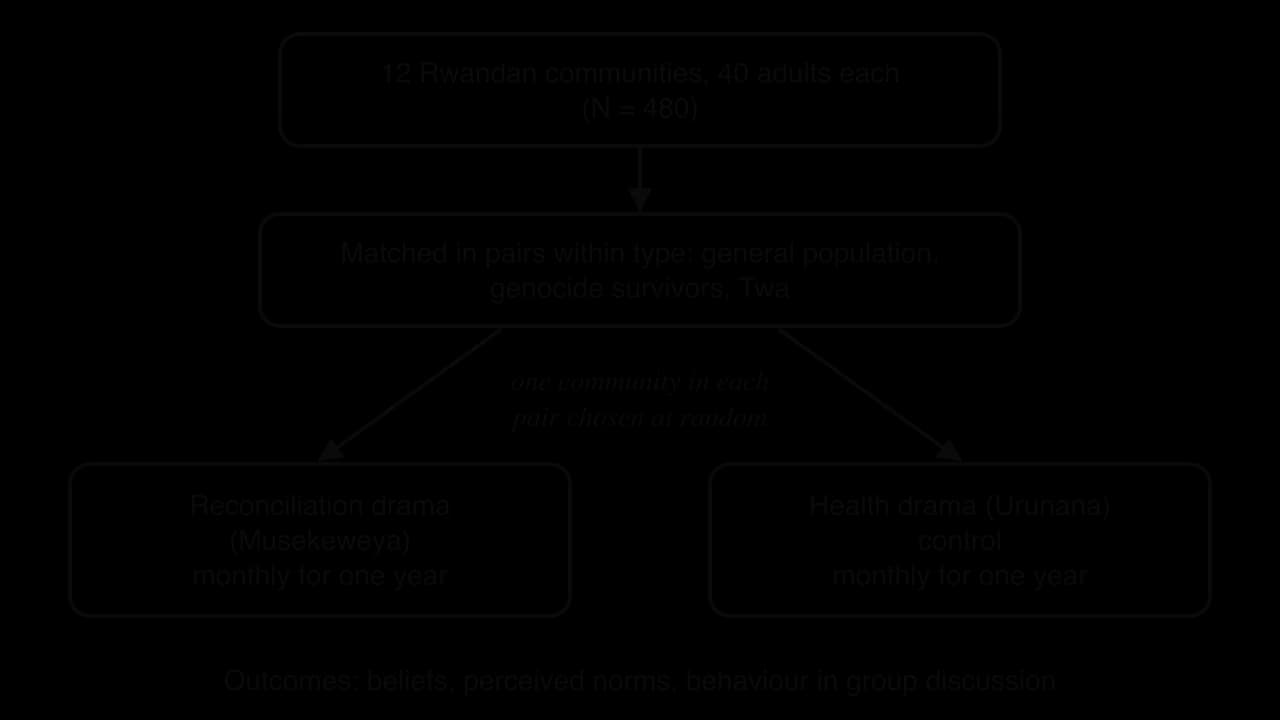
Each month for a year, Rwandan research assistants visited every community and played that month’s four 20-minute episodes on a portable stereo to the group, as Rwandans usually listen to radio together. The assistants knew which programme was being played but not the specific hypotheses. At the end of the year, three kinds of data were collected:
Individual interviews: participants rated their agreement with statements about personal beliefs (for example, that intermarriage between groups brings peace) and about social norms (for example, whether they would advise their children to marry only within their own group, and whether people should speak up when they disagree).
Focus groups: single-sex groups of about ten discussed questions on trust, intermarriage and trauma, and their comments were transcribed and coded.
Behavioural observation: at the end, each community was given a radio and cassettes of the programme, and the researchers discreetly recorded how the group decided to share and manage them.
The programme changed perceived norms and behaviour much more than personal beliefs. On beliefs about the causes of violence, intermarriage and trauma, reconciliation listeners did not differ meaningfully from controls, and on a few items they moved slightly against the programme’s messages.
On norms, however, the differences were clear. Reconciliation listeners were more likely to reject the idea of advising their children to marry within their own group: the effect implied that a person with a 50% chance of giving that advice would have about a 40% chance after listening. They were also more likely to say that people should speak up when they disagree, that it is not naïve to trust, and that people should talk about their traumatic experiences.
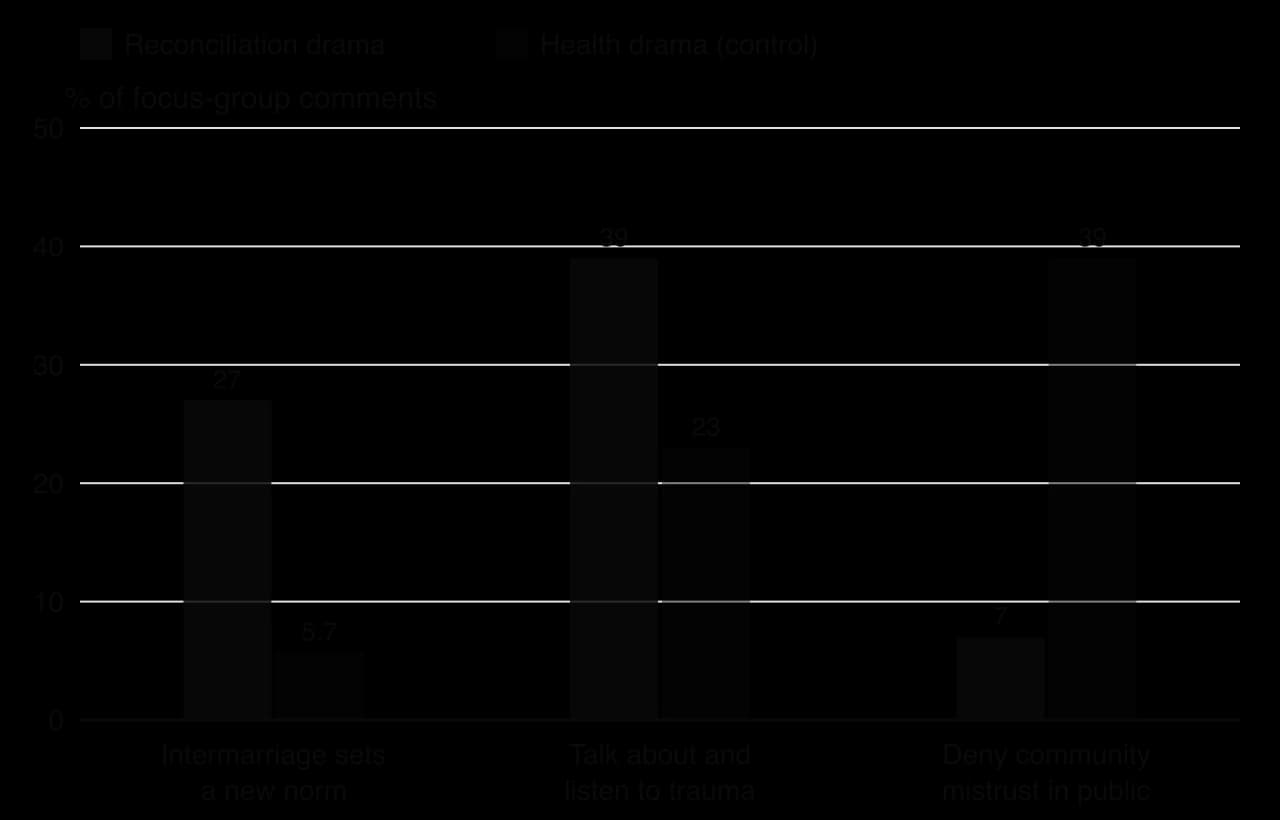
Behaviour in the groups followed the same pattern. When deciding how to manage the radio, health groups usually accepted the first proposal, to hand it to the local authority, and ended the discussion. Reconciliation groups more often challenged that proposal, put forward alternatives and commented on their own ability to cooperate. Reconciliation listeners also expressed more empathy for prisoners, genocide survivors, poor people and political leaders.
Paluck concluded that the radio drama changed what listeners believed was normal and acceptable in their community, and their behaviour, without changing their personal beliefs about prejudice and violence. Listeners learned from the characters, whom they found realistic and emotionally engaging, what people like them could do, and because they listened together they could see that others had learned the same. This supports a social learning account of group behaviour in which models change perceived norms, and norms guide behaviour even when private beliefs stay the same.
Random assignment of matched communities means that differences between the conditions can be attributed to the programme rather than to pre-existing differences between communities. The control group also listened to an engaging drama in the same way, so the effect cannot be explained by simply meeting researchers or listening together. This makes the study one of the few that supports a causal claim about media effects on intergroup behaviour in a real, non-Western setting. However, with only six pairs of communities, the number of independent units is small, and some control participants may also have heard the reconciliation programme on public radio, which would make the measured effect an underestimate.
The study combined self-report interviews, coded focus-group discussions and an observed group decision, a form of triangulation that strengthens its conclusions. The distinction between beliefs and perceived norms depends on how the questions were worded, and participants may have answered in ways they thought the researchers wanted (social desirability bias), especially on sensitive topics after a genocide. The behavioural measure was a single decision about a radio, which is a limited sample of real cooperation.
The study was followed by a published debate about its mechanism. Staub and Pearlman (2009), who had helped to develop the programme’s messages, offered an alternative interpretation that gave more weight to its educational content about the origins of violence and to listeners’ past experiences, and they raised doubts about how some outcomes were measured. In her reply, Paluck (2009) showed that the norm measures related to perceptions of public opinion and public behaviour, and argued that group discussion and emotional engagement, rather than individual education, were the most likely routes of change.
For social learning theory, the debate matters because it separates two things a model can teach. Listeners may learn new beliefs from a character, or they may learn what other people in their community now consider acceptable. The Rwandan results fit the second account better: listening together let people see the same models and observe one another’s reactions, so the change was shared by the group.
The research was carried out with Rwandan research assistants from different backgrounds, in Kinyarwanda, and with a stratified sample that included survivors and the Twa minority, which reduces the cultural bias of studies conducted only in Western settings. Its findings may not transfer to other conflicts or other media. The topic is also ethically sensitive: participants were asked about genocide and trauma, and the same mechanism the study demonstrates was used destructively in 1994, when the radio station RTLM broadcast propaganda encouraging violence. Using media to change group norms carries a responsibility to be transparent about who chooses the norms and why.
Sources: Paluck, E. L. (2009). Reducing intergroup prejudice and conflict using the media: A field experiment in Rwanda. _Journal of Personality and Social Psychology, 96(3), 574–587._
Research on social learning in groups has moved from laboratory experiments with children, which show short-term imitation, to field experiments such as Paluck (2009) and Paluck et al. (2016), which randomise real communities and schools. Field experiments combine causal control with real settings, but they are expensive and rare, so much of the evidence on media and aggression remains correlational. In groups, cause and effect can also run in both directions: aggressive young people may choose violent media and aggressive friends, which then reinforce their aggression, an example of bidirectional ambiguity.
Group behaviour is difficult to measure directly. Researchers rely on self-reports of norms and behaviour, disciplinary records or coded observations, and each has limitations: self-reports are open to social desirability, and school records depend on whether conflict is noticed and reported. Paluck et al. (2016) used official disciplinary reports, which are less affected by students’ wish to appear good, but a fall in reports could partly reflect changes in how teachers record conflict.
Classic social learning research used American children, but recent research on group behaviour includes Rwanda, Singapore and Japan, which strengthens the claim that modelling of group norms is a general human process. Cultural differences remain important: which models are respected, which behaviours are rewarded and how strongly people attend to group norms vary between cultures. Interventions designed in one culture, such as American school campaigns, may need adapting elsewhere.
The strongest argument for social learning theory in group behaviour is that it has been used to produce measurable change in real groups, often at low cost per person. At the same time, the power to change norms through media and influential members raises ethical questions about who decides which norms are desirable and whether audiences know that they are being influenced. Interventions are more defensible when they are developed with the communities affected and evaluated openly.
A further question is how long such change lasts. Paluck (2009) measured outcomes at the end of a year of listening, and Paluck et al. (2016) over one school year, so neither shows whether new norms survive once the models stop. Norms that are learned from models may need continued modelling, or support from institutions such as schools and local government, to become stable.
Concept | Key point | Evidence |
|---|---|---|
Causality | Field experiments show causal effects of models on norms and behaviour; media-violence evidence is mostly correlational | Paluck (2009); Paluck et al. (2016); Huesmann et al. (2003) |
Measurement | Norms and group behaviour are inferred from self-report, records and observation; triangulation helps | Paluck (2009) combined interviews, focus groups and observation |
Bias | Evidence now spans several cultures, but effects of models depend on local norms | Gentile et al. (2009); St Helena |
Responsibility | Changing group norms through media can be used for harm as well as good | RTLM radio in 1994 versus reconciliation drama |
Change | Social referents and entertainment-education can change group behaviour | About 25% fewer conflict reports in Paluck et al. (2016) |
In the human relationships context, social learning can appear in Paper 1 Section B as an unseen scenario about a group, asking how the theory explains or could change its behaviour, and in Section C as a concept-based essay on social learning in group behaviour.
Group members learn from visible models what the group does and approves of, so individual examples can become group norms.
Social referents are widely observed group members whose behaviour others use to judge what is normal.
Huesmann et al. (2003): childhood exposure to TV violence and identification with aggressive characters predicted adult aggression, in a correlational longitudinal design.
Prosocial behaviour is also learned from live models, as Bryan and Test (1967) showed, and from symbolic models in games across three countries, as Gentile et al. (2009) found.
Entertainment-education uses media characters as models to change group behaviour.
Paluck (2009): a reconciliation radio drama in Rwanda changed perceived norms and group behaviour but not personal beliefs.
Paluck et al. (2016): campaigns led by social referents reduced conflict reports in schools by about 25%.
Evaluation: field experiments support causal claims, but group behaviour is hard to measure, effects depend on local norms, and changing norms raises questions of responsibility.
I can explain how social learning spreads norms and behaviour through a group.
I can explain the role of social referents and media models in group behaviour.
I can discuss research on the social learning of aggression, including media violence.
I can discuss research on the social learning of prosocial behaviour.
I can describe and evaluate Paluck (2009).
I can explain how social learning theory can be used to change group behaviour, with examples.
I can evaluate research on social learning in groups with reference to causality, measurement, bias, responsibility and change.