 YouTube
Explain how cultural dimensions help to understand group behaviour, including social loafing, conformity, deference in teams, conflict and trust, and evaluate this research through the concepts.
Each is in the Psychology glossary, with every other term in the subject.
A theory of social loafing proposed by Karau and Williams (1993) stating that people work hard in groups only if they expect their effort to make a difference to an outcome they value.
The public image and social dignity a person claims in interaction with others, which can be lost, protected or given; people try to maintain both their own face and that of others.
A theory proposing that people in all cultures manage face during conflict, and that values such as individualism–collectivism shape conflict styles through concern for one’s own or others’ face.
The tendency for individuals to put in less effort when working collectively on a group task, where individual contributions are pooled, than when working alone.
Describe how individualism–collectivism and power distance relate to behaviour in groups.
Explain social loafing and the collective effort model, and how culture affects social loafing.
Describe the aim, method, results and conclusions of Earley’s study of social loafing in the United States and China.
Explain how cultural dimensions help to understand conformity, deference to leaders, conflict and trust in groups.
Discuss how biological, cognitive and sociocultural factors interact in cultural differences in group behaviour.
Evaluate research on cultural dimensions and group behaviour with reference to measurement, bias, causality and change.
Apply cultural dimensions to an unfamiliar group situation.
Group behaviour (how people act when they work, decide and live together in groups) differs across cultures in ways that cultural dimensions help to explain. Whether team members put in full effort, whether they challenge a leader, how they handle disagreement and whom they trust all depend partly on the values their culture shares.
This area of study applies cultural dimensions, a term from the sociocultural approach, to group behaviour, drawing on research on social loafing, conformity and intergroup relations. It links to the concepts of measurement, because group behaviour must be linked to values measured in individuals or countries, and of causality, because cultures differ in many ways at once.
With a free account, Augment remembers where you stopped and what you have practiced.
Scope: An area of study in the human relationships context: the role of one or more cultural dimensions in understanding group behaviour. Studied at SL and HL; questions set in this context can ask for the dimensions to be applied to a group scenario or evaluated through a concept.
A cultural dimension is a measurable aspect of the values a culture shares, on which whole cultures can be placed and compared. Hofstede’s six dimensions, derived from a survey of IBM employees in many countries, are power distance, individualism–collectivism, masculinity–femininity, uncertainty avoidance, long-term orientation and indulgence–restraint. Other models include Hall’s high-context and low-context communication and Gelfand’s tightness–looseness.
For group behaviour, two dimensions matter most. Individualism–collectivism describes whether people define themselves as independent individuals or as members of close in-groups, which affects how hard they work for a group and how much they value group harmony. Power distance describes how far people accept unequal power, which affects how group members relate to leaders. Dimension scores describe national averages, so applying them to an individual group member risks the ecological fallacy.
When people work together on a task in which their individual contributions are pooled, they often work less hard than when they work alone. The French agricultural engineer Max Ringelmann reported in 1913 that men pulling on a rope in a group pulled less hard, per person, than when each pulled alone. Later research separated two causes: poorer coordination in the group and lower effort by each person. Latané, Williams and Harkins (1979) showed that people clapped and shouted less loudly when they believed they were part of a group, even when they were in fact alone, which shows a loss of effort rather than only of coordination.
Social loafing matters in many groups: school project teams, workplaces, sports teams, juries and online communities. It is a problem for the group as well as a fairness issue, because those who work harder carry those who do not, which can cause resentment and lead the harder workers to reduce their own effort.
YouTubeKarau and Williams (1993) carried out a meta-analysis of 78 studies and found that social loafing was robust across many tasks and populations. Several factors reduced it: the chance that individual effort would be evaluated, expectations about co-workers’ performance, the meaningfulness of the task and culture. To explain these findings they proposed the collective effort model.
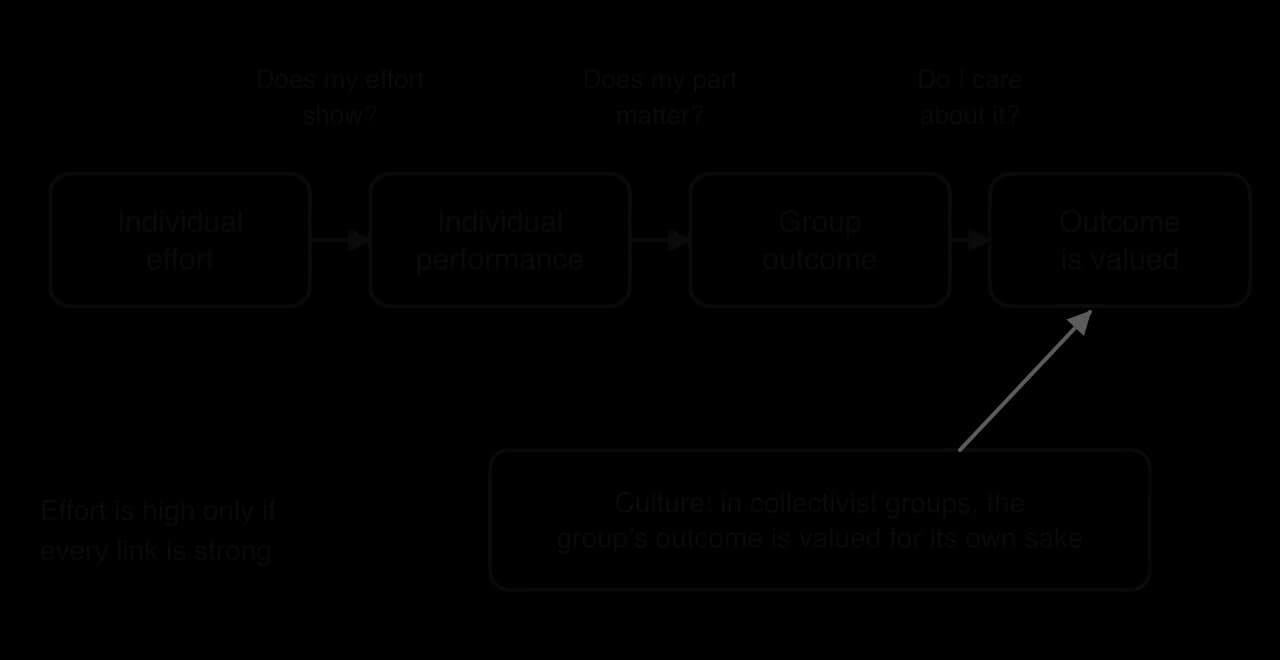
The model is a cognitive explanation of a group behaviour: effort depends on the individual’s expectations and on the value of the outcome. Working in a group weakens the first two links, because one person’s effort is harder to see and matters less to the result. Culture enters through the last link. When the group is an in-group and its success is valued for its own sake, as collectivist values encourage, the group outcome has high value even if the person’s own contribution is not recognised, so effort remains high.
Karau and Williams reported that social loafing was smaller among women and among participants from Eastern, more collectivist cultures. This is a cultural difference in a group behaviour that the collective effort model can explain through a cultural dimension.
P. Christopher Earley aimed to find out whether social loafing, which had been found mainly in American participants, also occurs in a collectivist culture, and whether individualist and collectivist values explain differences in loafing. He predicted that collectivism would reduce loafing because collectivists put group goals before their own.
Participants were management trainees in the United States and in the People’s Republic of China, chosen to be similar in their demographic characteristics, working in groups whose members had known each other for three to five weeks. Each participant spent an hour on an “in-basket” task: a set of realistic paperwork items of the kind found in a manager’s job, each designed to take two to five minutes. Completed items were handed to an assistant, so participants could not compare their work with others’.
The study manipulated two variables. Shared responsibility was high when participants were told their work contributed to a group goal, and low when they worked towards an individual goal. Accountability was high when participants’ own output could be identified and low when it could not. Each participant’s individualist or collectivist values were also measured with a questionnaire, so that the effect of values could be tested at the individual level as well as by nationality. Performance was operationalised as the number of items completed.
Participants with individualist values performed worse under high shared responsibility and low accountability than when they worked alone or could be identified: they showed social loafing. Participants with collectivist values did not loaf; they performed slightly better when responsibility was shared with the group, whether or not their own work could be identified. Because the analysis used each participant’s measured values, the effect could be linked to collectivist beliefs rather than to nationality alone: the individualist participants were mostly American and the collectivist participants mostly Chinese, but it was the values that predicted loafing.

Sources: Earley, P. C. (1989). Social loafing and collectivism: a comparison of the United States and the People’s Republic of China. _Administrative Science Quarterly, 34(4), 565–581._
Earley concluded that collectivism reduces social loafing: people who see themselves as members of a group, and value the group’s success, keep working hard even when their own contribution cannot be identified. Social loafing is therefore not a universal feature of group work but depends on cultural values, and the explanation lies in the values of the individuals rather than in their country.
By measuring each participant’s individualism–collectivism, Earley could show that values, not simply nationality, predicted loafing. This avoids the ecological fallacy that would arise from assuming every Chinese participant was collectivist and every American individualist. The in-basket task also gave an objective, behavioural measure of effort (items completed) rather than a self-report. However, values were measured with a questionnaire developed mainly in Western research, and translated questionnaires raise questions of measurement equivalence.
Shared responsibility and accountability were manipulated, so their effects can be interpreted causally. Culture and values, however, could not be randomly assigned, so the comparison between Americans and Chinese, and between individualists and collectivists, is a quasi-experiment. Other differences between the groups, such as the organisation they worked for or their expectations of the trainers, could also have affected effort.
The participants were management trainees working on office tasks in the 1980s. Trainees may be more motivated to perform well than other workers, and China and the United States have changed greatly since then. The groups had known each other for only a few weeks; in long-standing in-groups the effect of collectivism might be stronger, while groups of strangers might not be treated as in-groups at all. Later research by Earley in 1993, with managers from the United States, China and Israel, found that collectivists performed better when working with in-group members than with out-group members or alone, which supports the role of in-group membership.
Collectivist values and tight social norms are linked to greater conformity to group judgements. Berry (1967) compared the Temne of Sierra Leone, a farming people who stored food and whose economy depended on cooperation and strict social rules, with the Inuit of Baffin Island, who lived by hunting with greater independence. In a line-judgement task in which participants were told what most members of their group had answered, Temne participants conformed more to the suggested group answer than Inuit participants.
Berry explained the difference through ecology. A farming society that must store food and coordinate work rewards obedience to group norms, while a hunting society rewards self-reliance. This explanation anticipates later work on tightness–looseness, in which stronger norms develop where groups face threats that require coordination. At the level of nations, a meta-analysis of Asch-type studies by Bond and Smith (1996) found more conformity in countries with collectivist values.
Conformity in collectivist groups is not simply weakness or lack of independent thought. Agreeing with the group in public can be a way of maintaining harmony and showing respect, and in many collectivist cultures it is valued as social sensitivity. The same behaviour can therefore have different meanings, which is why researchers need emic knowledge to interpret cross-cultural differences in conformity.
Power distance shapes how group members relate to people with authority. In high power-distance cultures, members are more likely to defer to leaders, wait for instructions and avoid disagreeing in public; in low power-distance cultures, they expect to be consulted and to question decisions. These differences affect decision-making, communication and the acceptance of leadership styles in groups.
Brockner et al. (2001) studied how people react when they have no voice, that is, no opportunity to express their views before a decision affecting them is made. In three studies comparing low power-distance countries (the United States and Germany) with high power-distance ones (China, Mexico and Hong Kong), people in low power-distance cultures reacted more negatively to having little voice, with lower commitment to their organisation. A fourth study, within a single culture, found the same pattern for individuals’ own power-distance beliefs, which predicted their work attitudes and job performance.
The findings matter for teams and organisations. Participative decision-making, often recommended in Western management, may be expected and motivating in low power-distance groups but less important, or even uncomfortable, in high power-distance ones. A leader who invites open criticism in a group whose members expect a clear hierarchy may be seen as weak rather than fair.
 YouTube
Groups inevitably face disagreement, and cultural dimensions help to explain how it is handled. In more individualist, low-context cultures, conflict is more often addressed directly and openly; in more collectivist, high-context cultures, it is more often handled indirectly, through avoidance, compromise or a third party, so that relationships and face are protected.
Stella Ting-Toomey’s face-negotiation theory proposes that people in all cultures try to maintain face during conflict, but that culture shapes whose face matters most: individualists are more concerned with their own face, collectivists with the face of the other person and the relationship.
Oetzel and Ting-Toomey (2003) tested the theory by giving a questionnaire to 768 participants in China, Germany, Japan and the United States, who described a recent interpersonal conflict and how they had handled it. Individualism–collectivism affected conflict styles both directly and through self-construals and face concerns. An independent self-construal was linked to concern for one’s own face (self-face), which was linked to a dominating style. An interdependent self-construal was linked to concern for the other person’s face (other-face), which was linked to avoiding and integrating styles.
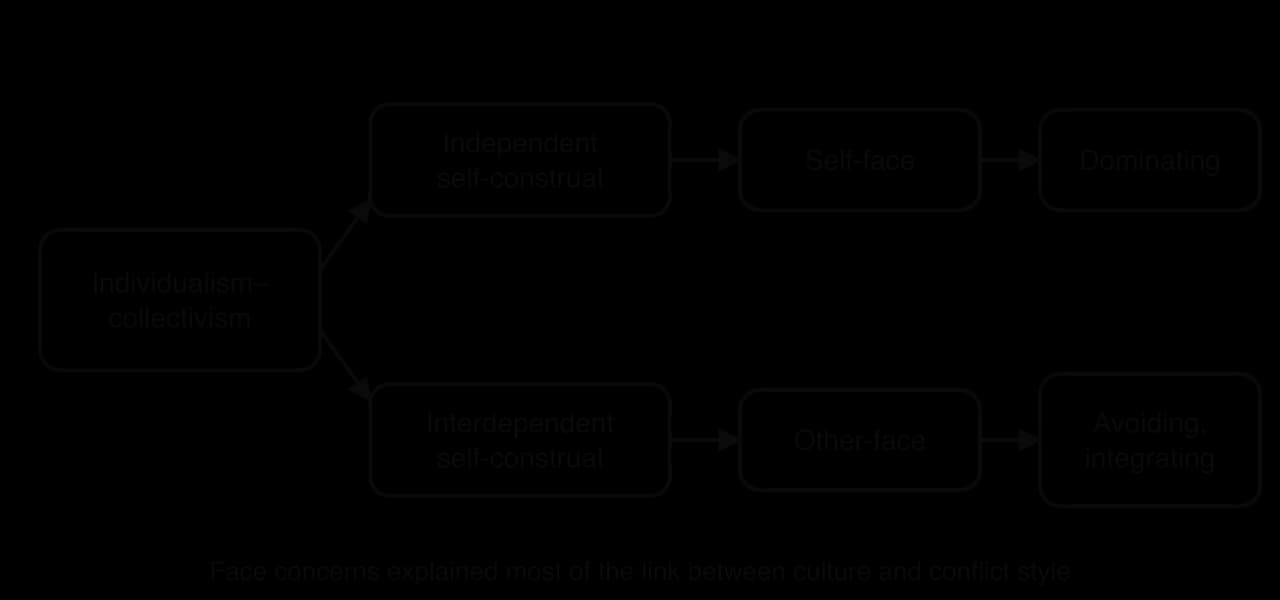
The study is useful because it identifies a mechanism. Rather than stopping at “collectivists avoid conflict”, it shows that the link runs through individual self-construals and face concerns, which can be measured in each person. The amount of variance explained was modest (about a fifth of the differences in each style), which shows that culture is one influence among many.
In multicultural groups these differences can create misunderstanding. A member from a high-context culture may express disagreement indirectly and assume it has been understood, while a member from a low-context culture may hear no objection and assume agreement. Each may then judge the other as dishonest or rude, although both are following the norms of their own culture.
Collectivism involves strong loyalty to in-groups, which can be accompanied by a sharper distinction between in-group and out-group members. Yamagishi and Yamagishi (1994) found that Americans reported higher general trust in other people, including strangers, than Japanese participants. They argued that in Japan cooperation was traditionally secured through long-term committed relationships within groups, which provide assurance that others will behave well, so trust in strangers was less needed and less developed.
This finding challenges the simple idea that collectivist cultures are more cooperative overall. Collectivists may be more cooperative with in-group members and less so with strangers, while individualists may extend a moderate level of trust to everyone. It also connects cultural dimensions to social identity theory, which explains why people favour in-groups: culture may affect how sharply the boundary between “us” and “them” is drawn.
The family is a group whose influence on decisions varies with culture. Levine et al. (1995) asked college students in 11 countries, including India, Pakistan, Thailand, Mexico, Brazil, Japan, Australia, England and the United States, about the importance of love in deciding to marry. Love was rated as most important in Western and Westernised countries and least important in less economically developed Eastern countries, and individualist countries gave love much more importance than collectivist ones. Few differences were found between men and women.
In collectivist cultures, marriage is more often seen as a joining of two families, so the views of the family group carry weight alongside the feelings of the couple, in line with social norms about family duty. In individualist cultures, it is more often seen as a personal choice. The study also found that countries where love mattered more tended to be richer and to have higher divorce rates, which shows how a cultural dimension is tied to economic conditions.
Explanations of group behaviour through cultural dimensions are sociocultural, but they work through cognitive processes and may interact with biological ones. Treating culture as the only cause would be reductionist, so research increasingly models the interaction of several levels.
Factor | Contribution to cultural differences in group behaviour | Example |
|---|---|---|
Sociocultural | Shared values and norms make some group behaviours expected and others unacceptable | Collectivist norms of loyalty reduce loafing in in-groups |
Cognitive | Values are represented as self-construals, expectations and appraisals that guide individual decisions | Collective effort model: expectations of whether effort matters; face concerns in conflict |
Ecological and economic | Farming systems, threats and wealth shape which values develop | Temne vs Inuit conformity; individualism rising with wealth |
Biological | Shared human capacities, such as the need to belong and stress responses to social threat, may underlie group behaviour everywhere; culture shapes what triggers them | What counts as disrespect or rejection in a group differs between cultures |
The cognitive level is especially important for explaining group behaviour, because culture influences behaviour only through how individuals think about themselves, their groups and their goals. This is why the strongest research, such as Earley’s and Oetzel and Ting-Toomey’s, measures values and self-construals in each participant rather than relying on national scores.
Much research on culture and group behaviour compares nationalities and explains differences using national scores. This is the weakest form of evidence, because it assumes that every participant holds their country’s average values. Studies that measure values in each participant, such as Earley (1989), Brockner et al. (2001) and Oetzel and Ting-Toomey (2003), provide stronger evidence that the dimension itself, and not some other national difference, explains the behaviour. Even these studies usually rely on self-report questionnaires of values, which raise questions of measurement equivalence across languages.
Culture cannot be randomly assigned, so most studies are quasi-experiments or correlational. Countries that differ in individualism also differ in wealth, education, political systems and organisational practices, any of which could explain differences in group behaviour. Some studies strengthen causal claims by manipulating features of the group situation (Earley manipulated shared responsibility and accountability) or by priming individualist or collectivist thinking in the laboratory, although priming effects have often been small and difficult to replicate.
Much of the evidence comes from students, management trainees or employees of multinational companies, who are more educated, urban and internationally exposed than most of their compatriots. Many studies compare the United States with one East Asian country, so findings about “collectivism” may really be findings about East Asia. Group behaviour in African, Latin American, Middle Eastern and Indigenous communities is much less studied, which is a form of sampling bias.
Comparisons using the etic approach can show that a group behaviour differs, but not what it means to the people involved. Conformity to a group judgement may be interpreted by Western researchers as a lack of independence, but within a collectivist culture it may express tact and respect. Avoiding open conflict may look like passivity but may be a skilled way of protecting relationships. Research using the emic approach is needed to interpret these differences without ethnocentrism.
Many key studies date from the 1960s to the 1990s, and individualism has risen in most countries since then, especially in fast-developing economies such as China. Globalised workplaces, international schools and online teams also bring people from different cultures together, and individuals may adapt their group behaviour to the setting. Findings about national differences in group behaviour may therefore be weaker today, and cultural dimensions are better treated as tendencies than as fixed national characteristics.
Concept | Strength | Limitation |
|---|---|---|
Measurement | Individual-level value measures (Earley; Oetzel and Ting-Toomey) avoid the ecological fallacy | Self-report value scales; translation and response styles |
Causality | Group conditions can be manipulated within each culture | Culture itself cannot be manipulated; national confounds |
Bias | Matched samples (similar trainees, similar tasks) reduce some differences | Educated, urban samples; US–East Asia focus |
Perspective | Dimensions provide a common framework for comparison | Outsider interpretation of what group behaviour means |
Change | Dimensions identify slow-changing values | Individualism has risen; workplaces are globalised |
This area of study can be examined in Paper 1 Section B, through a group scenario set in the human relationships context to which one or more cultural dimensions must be applied, and in Section C, through an essay on the role of cultural dimensions in group behaviour evaluated through a concept such as measurement, bias, causality or change.
Cultural dimensions, especially individualism–collectivism and power distance, help to explain cross-cultural differences in group behaviour.
Social loafing is reduced effort when individual contributions to a group task are pooled; the collective effort model explains it through expectations and the value of the outcome.
Karau and Williams’s (1993) meta-analysis of 78 studies found that loafing was robust but smaller in Eastern, more collectivist samples and among women.
Earley (1989) found that US and Chinese trainees with individualist values loafed under shared responsibility, while those with collectivist values did not; the effect followed individual values, not nationality.
Collectivist and tight cultures show more conformity, as Berry (1967) found with the Temne and Inuit; Brockner et al. (2001) found that people with high power-distance values react less negatively to having no voice in decisions.
Individualism–collectivism shapes conflict styles through self-construals and face concerns, as Oetzel and Ting-Toomey (2003) showed, and Yamagishi and Yamagishi (1994) linked it to lower trust in strangers in Japan than in the United States.
Sociocultural, cognitive, ecological and biological factors interact; culture influences group behaviour through how individuals think about themselves and their groups.
The evidence is limited by national-level measurement and the ecological fallacy, quasi-experimental designs, educated and US–East Asia-focused samples, outsider interpretation and cultural change.
I can describe how individualism–collectivism and power distance relate to group behaviour.
I can explain social loafing and the collective effort model.
I can describe the aim, method, results and conclusions of Earley (1989).
I can explain how cultural dimensions help to understand conformity, deference, conflict and trust in groups.
I can discuss how sociocultural, cognitive and other factors interact in group behaviour.
I can evaluate this research with reference to measurement, bias, causality and change.
I can apply a cultural dimension to an unfamiliar group scenario.