 YouTube
Explain how conformity shapes group behaviour through norms, pluralistic ignorance, groupthink, polarisation and minority influence, and evaluate the research through the concepts.
Each is in the Psychology glossary, with every other term in the subject.
The tendency for a group's attitudes or decisions after discussion to be more extreme, in the direction members already leaned, than the average of their individual views before discussion.
A mode of thinking in a cohesive group in which the wish for agreement overrides realistic appraisal of alternatives, leading to poor decisions.
A form of social influence in which a smaller group or individual changes the views of a majority, usually through a consistent argument that leads to private acceptance (conversion).
A situation in which most members of a group privately reject a norm but wrongly believe that most others accept it, so they go along with it.
Explain the role of conformity in understanding group behaviour, including how group norms form and are maintained.
Explain pluralistic ignorance and describe research showing that groups can conform to a norm few members privately hold.
Describe and evaluate groupthink as an explanation of poor group decisions.
Explain group polarisation and the normative, informational and identity-based explanations of it.
Explain how a consistent minority can change group behaviour, and evaluate research on minority influence.
Discuss how biological, cognitive and sociocultural factors interact in conformity within groups.
Apply conformity research to a group behaviour scenario and suggest how group behaviour could be changed.
Evaluate research on conformity in groups with reference to measurement, causality, bias and responsibility.
Groups such as friendship circles, sports teams, committees, juries and online communities develop shared ways of thinking and acting. Conformity explains how these shared norms spread and hold, why a group can make a decision that few of its members privately support, and how a small group of dissenters can eventually change what everyone does.
In the human relationships context, conformity is studied as an influence on group behaviour: drinking habits on a university campus, decisions by government advisers, the attitudes of discussion groups and the spread of new social conventions. Explanations draw on all three approaches: the sociocultural approach (norms and group identity), the cognitive approach (using others as information, categorising oneself as a group member) and the biological approach (the emotional cost of standing apart from the group).
With a free account, Augment remembers where you stopped and what you have practiced.
Conformity is a change in behaviour or belief to match a group, caused by real or imagined group pressure rather than a request or an order. It has two main sources. In normative social influence people go along with the group to be accepted, which usually produces public agreement without private change. In informational social influence people use the group as a guide to what is correct, which changes private belief as well (internalisation). Asch’s line-judgement studies showed that about a third of answers followed a unanimous but obviously wrong majority, and that a single dissenter greatly reduced conformity.
YouTubeLaboratory studies isolate conformity in groups of strangers making simple judgements. Real groups differ from these in several ways: members know each other, care about the group, make decisions with real consequences and influence each other over weeks or years. Research on group behaviour therefore asks how conformity shapes the behaviour of the group as a whole, as well as the behaviour of one individual facing a majority.
A social norm is a shared expectation about how members of a group behave or should behave. Psychologists distinguish two kinds. A descriptive norm describes what most members actually do (“most students here go to the library at lunch”). An injunctive norm describes what members approve or disapprove of (“students here think cheating is wrong”). Both shape behaviour, and both can be misperceived.
Norms form through the same processes that produce conformity. In new or uncertain situations, members watch each other and converge on a shared standard, as participants did in Sherif’s autokinetic studies. Once a norm exists, normative influence maintains it: members who break it risk disapproval, so they keep to it in public, and newcomers adopt it to fit in. Norms can therefore persist long after the reasons for them have gone.
Self-categorisation theory adds that people conform to the norms of groups they see themselves as members of. A first-year university student who categorises herself as “a student at this university” takes on what she thinks the typical student believes and does. This makes the accuracy of her picture of the typical student very important, because she conforms to the norm she *perceives*, which may not be the real one.
Pluralistic ignorance occurs when most members of a group privately reject a norm but each wrongly believes that most others accept it. Because everyone keeps their doubts to themselves to avoid standing out, the public behaviour of the group seems to confirm the norm, and each member’s mistaken belief is reinforced, so the group keeps conforming to a norm that few of its members actually hold.
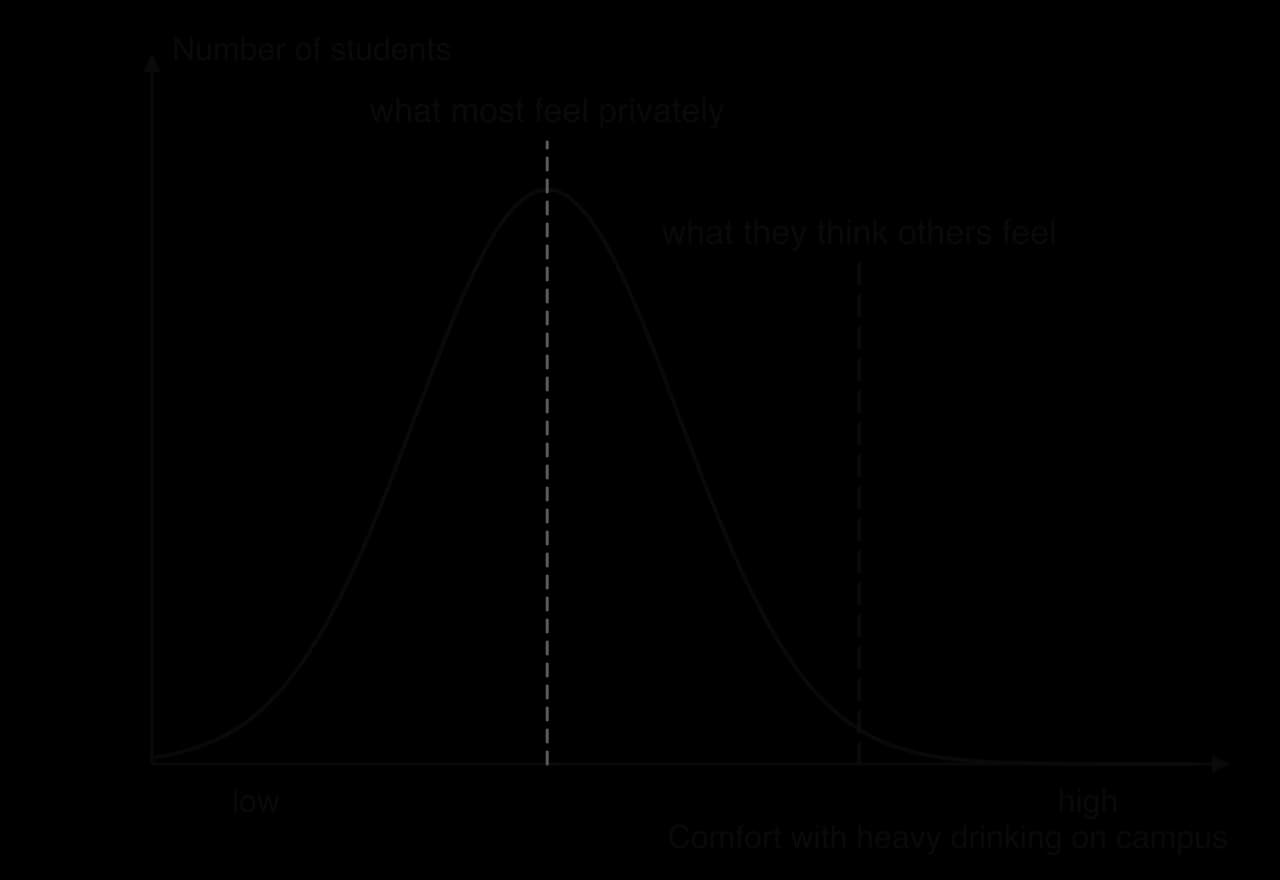
Pluralistic ignorance links conformity to cognition. Members infer others’ private attitudes from their public behaviour, but they explain their own conforming behaviour by the social pressure they feel. They assume that others who behave the same way genuinely mean it. This difference in how people explain their own and others’ behaviour keeps the misperception going.
Prentice and Miller aimed to find out whether university students misperceived their peers’ attitudes to alcohol use, and how students responded over time to believing that their own views were different from the norm.
The researchers carried out four studies with undergraduates at Princeton University, a selective private university in the United States with a strong drinking culture at the time. All four used questionnaires. Students rated how comfortable they were with alcohol practices on campus and how comfortable they thought the average student was, using the same rating scale. The difference between the two ratings was the measure of pluralistic ignorance.
Study 1 compared students’ own comfort with campus drinking and their estimate of the average student’s comfort.
Study 2 added an estimate of the comfort of the student’s own friends, to see whether the misperception applied to close groups as well as to “the average student”.
Study 3 followed students over a semester, measuring their own attitudes and the perceived norm at several points, to see whether attitudes moved towards the norm. This was a longitudinal design.
Study 4 measured how far students felt different from the norm and related this to measures of feeling alienated from the university.
Study | Main finding |
|---|---|
1 | Students believed they were less comfortable with campus drinking than the average student was: evidence of pluralistic ignorance. |
2 | The same gap appeared when students compared themselves with their friends, not only with an abstract “average student”. |
3 | Over the semester, male students’ own attitudes moved towards what they mistakenly believed the norm to be; female students’ attitudes did not change in this way. |
4 | The more students felt different from the (illusory) norm, the more alienated from campus life they reported feeling. |
Sources: Prentice, D. A. and Miller, D. T. (1993). Pluralistic ignorance and alcohol use on campus: some consequences of misperceiving the social norm. _Journal of Personality and Social Psychology, 64(2), 243–256._
Students in this group misperceived the norm: most were privately less comfortable with heavy drinking than they believed others were. This misperception had consequences. Some students, especially men, gradually changed their own attitudes to match a norm that did not really exist, which is conformity to an imagined majority, and those who felt different paid a social cost in feeling alienated. The group’s visible drinking culture was therefore maintained partly by members who did not privately endorse it.
The gender difference fits a normative explanation. Drinking was more closely tied to social acceptance for men on that campus, so men had stronger reasons to close the gap between themselves and the perceived norm, while women may have dealt with the gap in other ways, such as distancing themselves from campus drinking.
All four studies relied on self-reported data. Students may have presented themselves as less comfortable with drinking than they were, which would exaggerate the gap; this is a form of social desirability bias. Against this, the questionnaires were anonymous, the same pattern appeared across four studies, and the finding has been repeated on other campuses and for other behaviours. The ratings measured attitudes and perceived norms, not drinking itself, so the studies show how norms are perceived rather than how much students drank.
Study 3 followed the same students over time and found that men’s attitudes moved towards the perceived norm, which is stronger evidence for a causal direction than a single survey. It is still correlational: other experiences during the semester, such as joining clubs where drinking was common, could have changed both attitudes and perceived norms. The best evidence for causality comes from intervention research that changes perceived norms and measures the effect on behaviour.
The participants were students at a single selective American university in the early 1990s. Drinking norms differ greatly between countries, religious communities and age groups, so the size of the gap cannot be generalised. The gender difference also needs testing in other settings before it is treated as general. The process itself, misperceiving a group norm and conforming to the misperception, has been found in other groups, which suggests that the mechanism generalises better than the specific numbers.
Schroeder and Prentice (1998) tested whether correcting the misperception would change behaviour. First-year students took part either in a peer discussion that explained pluralistic ignorance and showed how students’ private attitudes differed from the perceived norm, or in a discussion focused on individual decision-making about alcohol. Four to six months later, students in the peer-oriented discussion reported drinking significantly less. Because students were assigned to the two kinds of discussion, the study gives experimental support for the claim that the perceived norm influences drinking.
This is the basis of the social norms approach to health promotion, which publicises accurate information about what most members of a group actually do and think. The approach works through conformity: if the perceived norm moves closer to the real one, members who conform to it will behave more moderately. Its results in later large-scale campaigns have been mixed, partly because messages that seem unbelievable are ignored, and partly because a message that most people drink “only” a certain amount can encourage those who drink less to drink more.
Janis (1972) used the term groupthink for a way of thinking in which members of a cohesive group are so concerned with maintaining agreement that they stop judging alternatives realistically. Normative influence is central to it: members hold back doubts so as not to disrupt a group they value, and the resulting silence makes it seem that everyone agrees.
Janis developed his model from historical case analyses of American foreign-policy decisions. It proposes that certain antecedent conditions make groupthink likely, that groupthink shows itself in a set of symptoms, and that these lead to defective decision-making.
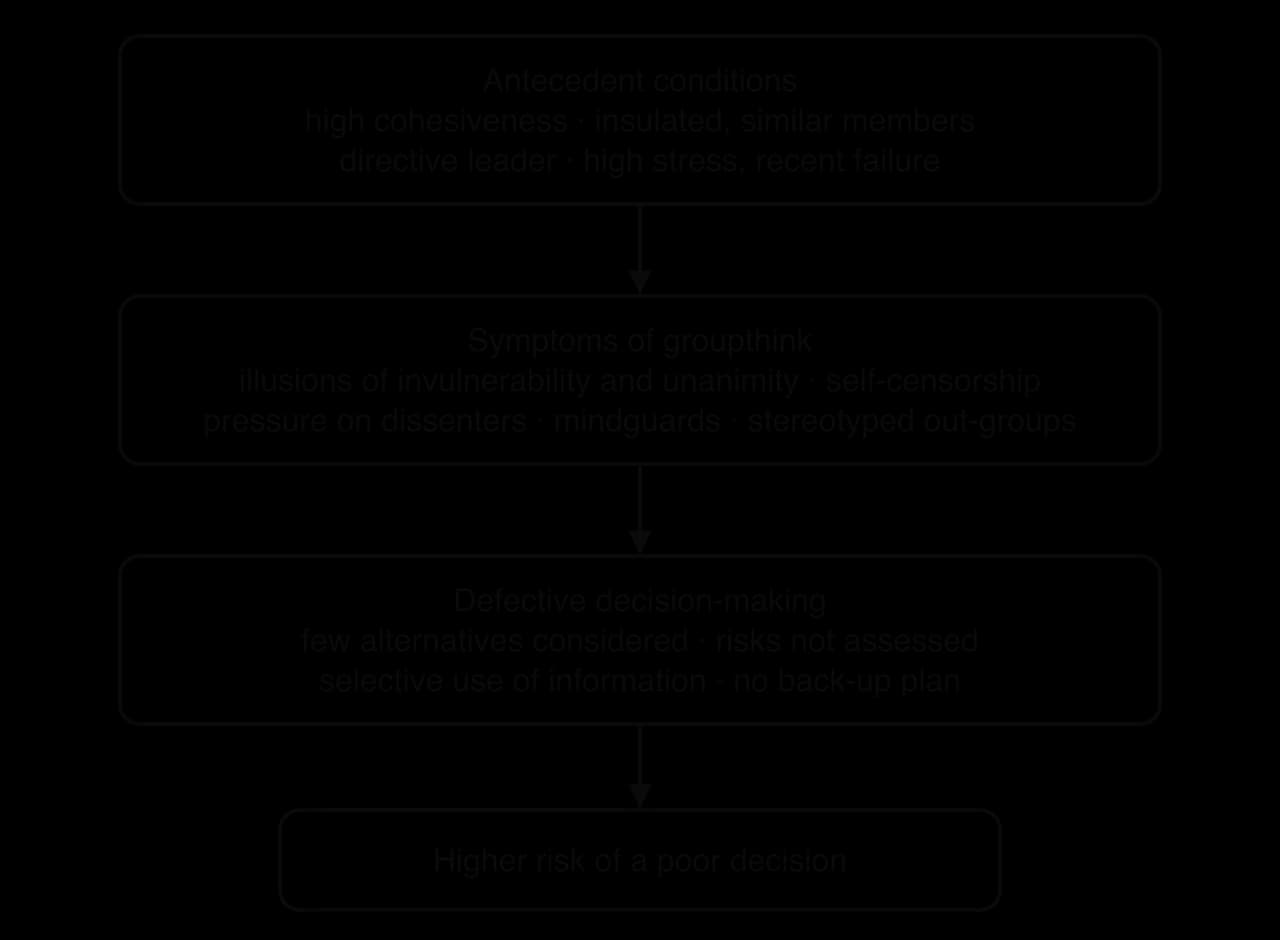
Type of symptom | Symptom | What it looks like |
|---|---|---|
Overestimating the group | Illusion of invulnerability | Members believe the group cannot fail, so they take excessive risks. |
Belief in the group’s morality | Members assume their aims are right and ignore ethical consequences. | |
Closed-mindedness | Rationalisation | Warnings are explained away rather than considered. |
Stereotyping out-groups | Opponents are seen as too weak, foolish or evil to matter. | |
Pressure towards uniformity | Self-censorship | Members keep their doubts to themselves. |
Illusion of unanimity | Silence is taken as agreement. | |
Direct pressure on dissenters | Anyone who questions the plan is told they are disloyal. | |
Mindguards | Some members protect the group from information that would challenge it. |
Janis’s main case was the decision by President Kennedy’s advisers in 1961 to support an invasion of Cuba by a small force of exiles at the Bay of Pigs, which failed within days. Janis argued that the advisers accepted the plan without challenging its assumptions, that some members kept their doubts to themselves, and that the group held a stereotyped view of Cuba’s leadership and army. He contrasted this with the same group’s handling of the Cuban Missile Crisis the following year, when Kennedy brought in outside experts, divided the group into subgroups and sometimes left meetings so that his own view would not dominate.
The contrast is important because it suggests that the same people can avoid groupthink when the group’s procedures change. Janis recommended remedies that follow from this: leaders should hold back their preferences, each member should be asked to act as a critical evaluator, one member should be given the role of devil’s advocate, independent subgroups should work on the same problem, and outside experts should be invited to challenge the plan.
Groupthink has been very influential outside psychology, in government inquiries and management training, but its empirical support is weaker than its fame. Park (1990) found only 16 empirical studies testing the model at that time, with partial support and no clear effect of cohesiveness, the condition Janis considered most important. Later work suggested that structural conditions, such as a group’s insulation and the similarity of its members, predict poor decisions better than cohesiveness does.
Measurement. Groupthink is a complex construct and is hard to operationalise. Historical case analyses depend on memoirs and records written after the event, often by people with reasons to explain the failure in a particular way, and a laboratory group meeting for an hour lacks the cohesiveness and stakes of a real government team.
Bias. Cases were chosen because they ended badly, which risks hindsight bias: once a decision has failed, signs of groupthink are easy to find. Kramer (1998) re-examined the Bay of Pigs and Vietnam decisions and argued that the presidents sought more outside advice than Janis suggested, and that political calculation played a larger role than group conformity.
Causality. Because the evidence is mostly correlational and retrospective, it is hard to show that groupthink caused the poor decisions rather than other factors, such as poor information from intelligence agencies.
Value. Even critics accept that the remedies, such as inviting dissent and using a devil’s advocate, are sensible, so the model has practical value as a checklist for group decisions even where its causal claims are uncertain.
 YouTube
After discussing an issue, groups often reach positions that are more extreme than the average of their members’ views before the discussion, in the direction the members already leaned, instead of settling on a moderate compromise. This is group polarisation.
The effect was first noticed by Stoner (1961) as a “risky shift”: groups who discussed dilemmas recommended riskier choices than individuals had. Later research showed that groups shift towards caution on issues where members initially lean towards caution, so the general pattern is polarisation rather than risk. Moscovici and Zavalloni (1969) found that French secondary-school students who held mildly positive attitudes towards their president and mildly negative attitudes towards Americans held both attitudes more strongly after discussing them in groups.
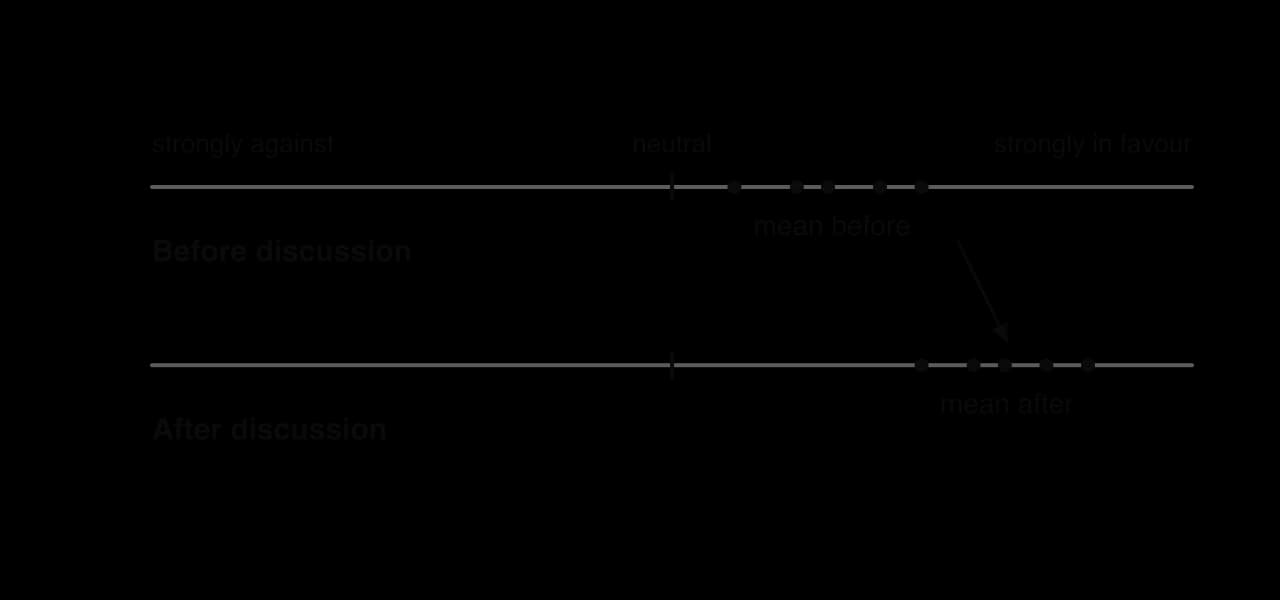
Explanation | Process | Link to conformity |
|---|---|---|
Social comparison | Members discover where others stand and move a little further in the valued direction, to be seen as a good group member. | Normative influence |
Persuasive arguments | Discussion produces many arguments for the side most members already favour, including new ones; hearing them makes members more convinced. | Informational influence |
Self-categorisation | Members conform to what they see as the group’s prototypical position, which is defined partly by contrast with out-groups and so is more extreme than the average member. | Conformity to an in-group norm |
The explanations are complementary: reviews of the research suggest that both normative and informational processes operate, with one or the other dominating depending on the task. Self-categorisation research shows that polarisation is stronger when group identity is salient, for example when a group discusses an issue in opposition to another group.
Group polarisation helps to explain behaviour in many relationships and groups: juries that become harsher or more lenient after deliberation, political groups whose views move further apart, and online communities in which people mostly interact with like-minded others. In an echo chamber, members repeatedly encounter arguments for one side and see their views reflected by others, which provides the conditions for both informational and normative polarisation.
Many norms that are now widely accepted began as the view of a small and unpopular minority, so conformity to the majority cannot fully explain how group norms develop. Minority influence is the process by which a smaller group or an individual changes the views of a majority. Moscovici argued that minorities work mainly through informational influence: a minority that keeps to its position makes others ask why, and the resulting thought can lead to a genuine private change of view, called conversion.
Moscovici, Lage and Naffrechoux (1969) showed the importance of consistency in groups of four participants and two confederates who named the colour of blue slides. A minority that called every slide “green” produced far more “green” answers from the majority than a minority that called only some of the slides green, as the chart shows.
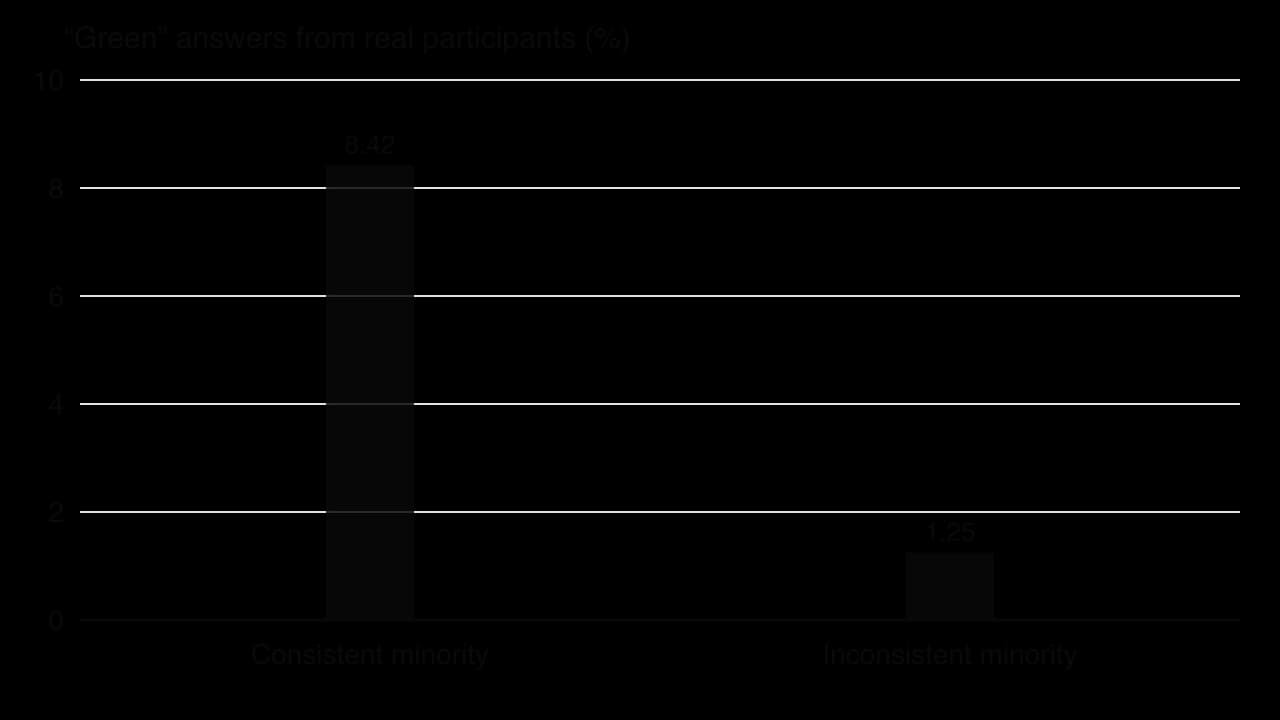
Consistency has two forms. Diachronic consistency means the minority keeps the same position over time; synchronic consistency means minority members agree with each other. Both suggest to the majority that the minority is confident and may have a point, which encourages the majority to examine the issue rather than dismiss it.
Minorities are more persuasive when they show commitment, for example by accepting personal costs for their view, because this signals conviction. The women who campaigned for the vote in the early twentieth century, some of whom were imprisoned and went on hunger strike, are a historical example. Commitment also has to be distinguished from rigidity.
In a mock-jury study described by Nemeth (1986), groups discussed how much compensation to award the victim of a ski-lift accident. A confederate who refused to move from a low figure had no influence, while one who started low and then compromised moved the majority towards his position. A minority is therefore most persuasive when it is firm on its main position but willing to compromise on details, because a rigid minority is easily dismissed as dogmatic.
Minority influence is usually slow and indirect. People may change their private views before they are willing to say so, because publicly agreeing with an unpopular minority carries a cost. As more people move to the minority view, it gains social support and normative influence begins to work in its favour, so change can speed up suddenly. Centola et al. (2018) found such a tipping point in an online experiment: groups switched to a new naming convention once a committed minority reached roughly a quarter of the group.
Conformity to peers appears early. Haun and Tomasello (2011) tested 24 groups of four children aged about four years. Three children in each group were shown pictures that led them to give an obviously wrong but unanimous answer in public, before the fourth child answered. The fourth child often conformed. In a follow-up with 18 more groups, children did not change their real judgement of the pictures, only their public answer, which shows that normative influence from peers operates by the preschool years.
The finding suggests that sensitivity to the peer group as a reference point is part of normal social development, and it helps to explain why peer groups become such strong sources of norms in childhood and adolescence. Peer influence on risky behaviour in adolescence builds on this early sensitivity.
The strength of conformity in groups varies with culture. A meta-analysis of Asch-type studies found higher conformity in more collectivist countries, where group harmony is highly valued. In such cultures, agreeing with the group in public may be seen as maintaining relationships rather than as a loss of independence, and decisions are often reached by consensus. The same values that support harmony could, in some conditions, make groupthink more likely, because questioning a leader or a group decision is more costly. Cultural norms about expressing disagreement therefore shape how conformity affects group decisions.
No single approach explains why groups conform. The research shows several levels working together, which is why a single-approach explanation of a group behaviour, such as campus drinking, is reductionist.
Approach | Contribution | Example |
|---|---|---|
Sociocultural | Group norms, social identity and cultural values set the standard members are held to and how costly deviation is. | Campus drinking norms; collectivist values and consensus |
Cognitive | People infer norms from others’ behaviour, use the group as information and categorise themselves as members. | Misperceiving the norm in pluralistic ignorance; persuasive arguments in polarisation |
Biological | Standing apart from the group is linked to emotional responses; social rejection is aversive. | Brain imaging studies linking independence from the group to activity in emotion-related areas |
In the example of campus drinking, the sociocultural norm sets the expectation, a cognitive error (misperceiving the norm) inflates it, and the emotional discomfort of feeling different, which has a biological basis, motivates conformity to it. Interventions work best when they address more than one level: correcting the perceived norm (cognitive) through peer discussion within the group (sociocultural).
Researchers use very different methods for different questions: laboratory experiments for minority influence and polarisation, questionnaires for perceived norms, and historical case analysis for groupthink. Each captures a different part of group conformity. Laboratory tasks give control but use trivial judgements in temporary groups; questionnaires reach real groups but rely on self-report; case analyses study real decisions but cannot test causes. Triangulation across methods gives the most credible picture, and the strongest conclusions are those, such as the role of perceived norms, that are supported by more than one method.
Experiments such as Moscovici et al. (1969) and Schroeder and Prentice (1998) support causal claims because conditions were manipulated. Research on real groups is mostly correlational. Groupthink in particular is supported mainly by case studies of failures, so it is uncertain whether the symptoms caused the failures or were found because researchers looked for them after the event.
Most research comes from American and European students and political elites. The behaviours studied (heavy drinking on campus, US foreign-policy decisions) are specific to particular settings, and the samples in some key studies were all of one sex. Cross-cultural research suggests that the costs of disagreeing, and therefore the pressures towards conformity in groups, vary considerably between cultures.
Research on group conformity is used to change behaviour, for example in social norms campaigns and in training for decision-making groups. This carries responsibility: norm messages must be accurate, or they risk misleading people; campaigns must avoid encouraging those below the norm to increase a harmful behaviour; and studies of real groups must protect participants who report behaviour that breaks rules, through anonymity and confidentiality.
Conformity explains why group norms are stable, and minority influence and the correction of misperceived norms explain how they change. This makes the topic useful for understanding change at the level of groups: norms can shift suddenly once enough members privately disagree and that disagreement becomes visible.
In this context, conformity can appear in Paper 1 Section B as a group behaviour scenario, and in Section C as a concept-based essay on “the role of conformity in understanding group behaviour”. Essays reward research on real groups as well as laboratory evidence, and sustained links to the named concept.
In groups, conformity explains how norms form and persist; people conform to the norm they perceive, which may differ from the real one.
Pluralistic ignorance occurs when most members privately reject a norm but believe others accept it; Prentice and Miller (1993) found this for campus drinking, with men’s attitudes moving towards the misperceived norm over a semester.
Correcting misperceived norms reduced students’ drinking in Schroeder and Prentice (1998), the basis of the social norms approach.
Groupthink, described by Janis in 1972, is a mode of thinking in cohesive groups in which the wish for agreement suppresses critical appraisal; it is influential but has limited empirical support.
Group polarisation makes groups more extreme after discussion, through social comparison (normative), persuasive arguments (informational) and self-categorisation.
A consistent, committed but flexible minority can change the majority through informational influence and conversion, as Moscovici and colleagues showed with a consistent minority.
Normative conformity to peers appears by age four; cultural values affect how costly it is to disagree with a group.
Group conformity is best understood through interacting sociocultural, cognitive and biological factors and evaluated through measurement, causality, bias and responsibility.
I can explain how conformity helps to explain the formation and maintenance of group norms.
I can explain pluralistic ignorance and describe Prentice and Miller (1993) and its application.
I can describe and evaluate Janis’s model of groupthink.
I can explain group polarisation and its three explanations.
I can explain how a minority influences a majority and evaluate the research.
I can discuss how biological, cognitive and sociocultural factors interact in group conformity.
I can apply conformity research to a group behaviour scenario and suggest a way to change the behaviour.
I can evaluate research on conformity in groups with reference to measurement, causality, bias and responsibility.