Notes on 11.3 Technology
Learning objectives
Describe how digital technologies, including smartphones, social media, video games and artificial intelligence, have changed behaviour and relationships.
Discuss the role of technology in health and well-being, human development, human relationships, and learning and cognition, using research from each context.
Explain why most research on technology is correlational, and explain bidirectional ambiguity, third variables and the value of experiments in this field.
Explain the other research challenges of studying technology: sampling bias, self-report of use, researcher and confirmation bias, publication bias and funding, and replication failures.
Describe and evaluate Allcott et al. (2020) as a randomised experiment on social media and well-being.
Analyse unseen sources about technology, explaining what limits their interpretation and what conclusion they support.
Evaluate claims about the effects of technology on behaviour with reference to causality, change, perspective and responsibility.
Introduction
Digital technology, meaning smartphones, computers, the internet, social media, video games and artificial intelligence, has changed how people communicate, learn, seek help and spend their time within a single generation. Psychology asks what these changes do to well-being, development, relationships and cognition, and how to answer that question with research that keeps pace with technologies that change every year.
The technology extension links to the concept of change, because technology is a deliberate change to the environment in which behaviour develops, and to perspective, because the same technology can be a support for one person and a harm for another. It also raises questions of responsibility, for example about whether technology companies, schools and parents should restrict use on the basis of evidence that is still uncertain, and above all of causality, because most research in the field cannot show what causes what.
Technology as a change in the environment
Technology has always shaped behaviour: writing changed memory, printing changed learning and the telephone changed relationships. What is new about digital technology is its speed, its reach and the way it is designed to hold attention. In many countries most adolescents now carry a smartphone with constant access to social media, video and messaging, and generative artificial intelligence has become widely available within a few years.
Two features make this technology important for psychology. It is interactive: social media responds to each user with likes, comments and recommended content, so the experience of two users of the same app can be completely different. It is also designed for engagement: notifications, endless feeds and variable rewards draw on the principles of operant conditioning to keep people returning, which is one reason why concern about excessive use has grown.
A large language model (LLM), such as the models behind ChatGPT, is a form of artificial intelligence trained on very large amounts of text to predict and generate language. LLMs can hold conversations, explain ideas and imitate many styles of writing, which raises new psychological questions: how people form relationships with chatbots, how students learn when an assistant can write for them, and whether a machine that produces human-like answers can be used to test theories of the human mind.
Why the effects of technology are hard to judge
Public debate about technology often takes one of two extreme positions: that smartphones and social media are causing a crisis in young people’s mental health, or that worries about new technology are a moral panic like earlier fears about television or comics. Research suggests that both positions are too simple. Effects depend on what the technology is used for, by whom and in what context, and they are often smaller than headlines suggest.
Twenge et al. (2018) analysed two nationally representative surveys of more than 500,000 US adolescents and reported that depressive symptoms and suicide-related outcomes rose between 2010 and 2015, alongside a rise in time spent on new media. Orben and Przybylski (2019), analysing similar large datasets in every defensible way, found that the association between technology use and adolescent well-being was negative but extremely small. These correlational findings form the baseline that experiments, such as Allcott et al. (2020), try to test.
 YouTube
Technology in health and well-being
Technology enters health and well-being in two opposite ways. It can deliver prevention and treatment to people who would otherwise receive none, and it may contribute to mental health problems through the way it is used. Research in this context asks how effective technology-based treatment is, and what technology use does to mental health.
Technology in treatment
Teletherapy is psychological therapy delivered at a distance, by video call, telephone, text or a structured online programme. The most studied form is internet-delivered cognitive behavioural therapy (iCBT), in which clients work through online modules, often with brief written support from a therapist. Hedman-Lagerlöf et al. (2023) carried out a meta-analysis of 31 randomised trials that directly compared therapist-supported iCBT with face-to-face CBT for adults with 16 different psychiatric and physical conditions, about half of them depression or anxiety disorders. The pooled difference between the two formats was close to zero (g = 0.02), so the two formats produced similar effects.
Technology can also create treatment situations that would be hard to arrange in real life. In virtual reality exposure therapy (VRET), a person with a phobia is gradually exposed to the feared situation in a computer-generated environment. Rothbaum et al. (1995) randomly allocated 20 university students with a fear of heights to virtual reality graded exposure or to a waiting list. After eight weeks, the 10 treated students who completed the study had improved significantly on measures of anxiety, avoidance and distress, while the 7 on the waiting list were unchanged.
Automated tools go a step further, removing the human therapist entirely. Fitzpatrick, Darcy and Vierhile (2017) randomly allocated 70 US university students with symptoms of depression or anxiety either to two weeks of self-help based on CBT principles, delivered by a text-based conversational agent called Woebot, or to an electronic information book about depression. Students using Woebot showed a significant reduction in depressive symptoms on a self-report questionnaire, while the information group did not. The trial was small, short and unblinded, compared the chatbot only with reading material, and one author had founded the company that developed it, so it shows feasibility rather than effectiveness.
Form of technology-based treatment | Evidence | Main limitation |
|---|---|---|
Therapist-supported internet CBT | 31 randomised trials: about as effective as face-to-face CBT in Hedman-Lagerlöf et al. (2023) | Mostly adults in high-income countries; needs motivation, literacy and internet access |
Virtual reality exposure | Fear of heights reduced compared with a waiting list in Rothbaum et al. (1995) | Small early samples; compared with no treatment rather than real-life exposure |
Chatbots and apps | Depressive symptoms reduced over two weeks compared with an information book in Fitzpatrick et al. (2017) | Small, short, unblinded trials, often run by developers; risk in crises |
Technology use and mental health
The question that worries parents and governments most is whether social media and smartphones harm young people’s mental health. Correlational surveys find small associations. Experiments that change how much people use social media provide stronger, though still limited, evidence.
Hunt et al. (2018) randomly allocated 143 undergraduates at the University of Pennsylvania either to limit their use of Facebook, Instagram and Snapchat to 10 minutes per platform per day or to use them as usual, for three weeks. The limited-use group showed significant reductions in loneliness and depression compared with the control group, while both groups showed less anxiety and fear of missing out, possibly because monitoring their own use helped.
A larger experiment with adults, Allcott et al. (2020), found that deactivating Facebook for four weeks slightly increased subjective well-being. Effects in both studies are real but modest, and they come from volunteers in the United States who were willing to change their use.
 YouTube
Technology in human development
Children and adolescents grow up with technology that earlier generations met as adults. Research in this context asks how technology affects the development of the self, how it affects relationships with parents (including attachment), and whether artificial intelligence can be used to test models of development.
Social media and the developing self
Adolescence is a period in which identity and self-esteem are shaped by feedback from peers, and social media turns that feedback into numbers that are visible to everyone. Research on adolescents increasingly shows that average effects hide very different individual responses. Beyens et al. (2020) used experience sampling, asking adolescents six times a day for a week how they felt and how much they had used social media in the past hour, giving 2,155 real-time assessments. After passive social media use (scrolling and viewing rather than posting), 46% of adolescents felt better, 44% felt no different and 10% felt worse.

A later diary study by Siebers et al. (2026) followed 479 adolescents for 100 days. The average day-to-day effect of social media use on stress was negligible, but 37% of adolescents showed a positive link between use and stress and 14% a negative one, and the average effect became stronger when measured over weeks and months than over single days. Person-specific effects mean that a question such as “Is social media bad for teenagers?” has no single answer, and that research and advice need to identify who is affected and how.
Technoference and attachment
Technoference matters for development because responsive caregiving is central to attachment. Zayia et al. (2021) surveyed 80 mothers and their primary-school-aged children. More frequent technoference was associated with less secure mother–child attachment as rated by the children (but not as rated by the mothers), and with lower social–emotional functioning as rated by the mothers. McDaniel, Ventura and Drouin (2025) surveyed 183 families with a young child and found that parents who felt their phone use cut into family time reported more parenting stress.
Both studies are correlational and depend on self-report. Parents under stress may use their phones more to escape, children who are less securely attached may notice and resent their parents’ phone use more, and a family with more conflict may produce both, so the direction of the effect cannot be established.
Artificial intelligence and models of development
Large language models have created a new way to test theories of development. Kosinski (2024) gave eleven language models 40 false-belief tasks of the kind used to measure theory of mind in children. Older models solved none, models from late 2022 and early 2023 solved 20%, and a 2023 version of ChatGPT-4 solved 75%, comparable to six-year-old children. Kosinski suggested that a theory-of-mind-like ability might emerge from learning language, which would support theories that link theory of mind to language experience.
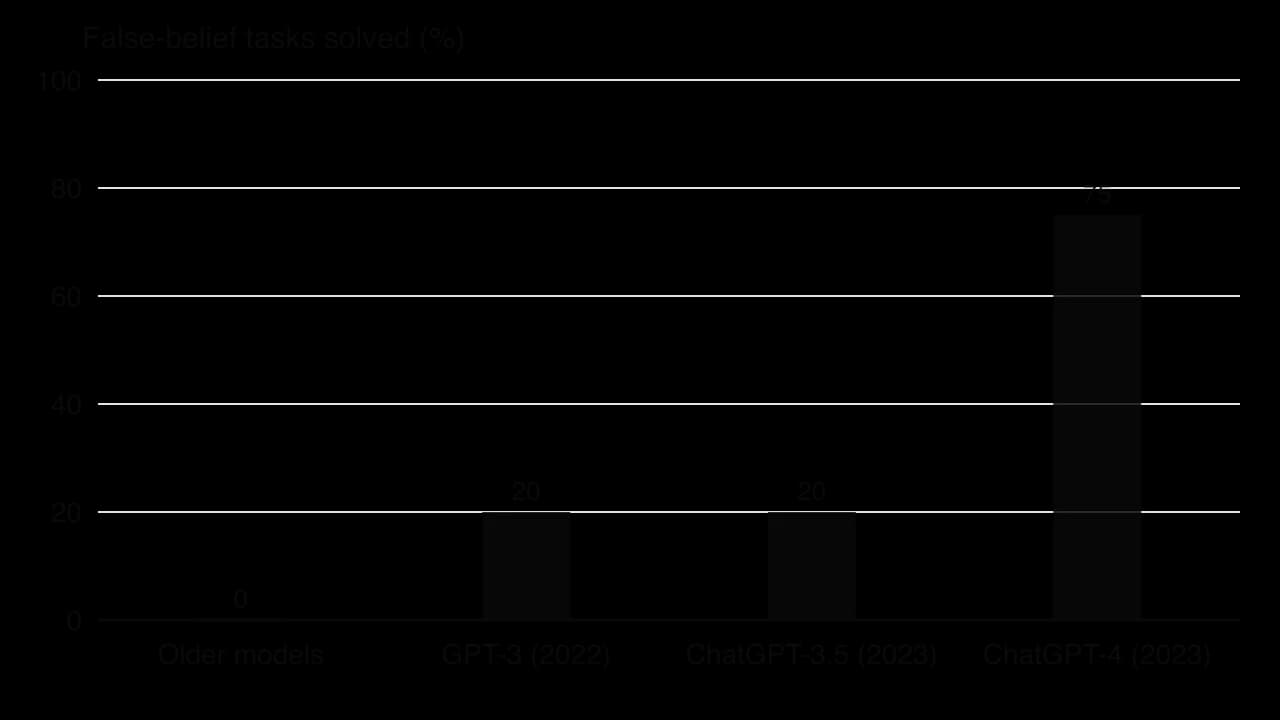
Ullman (2023) showed that small changes that should not matter to an agent who understands beliefs, such as making a container transparent, could make the models fail. Using AI to test a theory of development therefore depends on the same question as testing children, namely whether the task can be passed without the ability it is meant to measure. The models also change every few months, so a result for one version may not hold for the next.
Technology in human relationships
Technology now carries a large part of social life, from messaging friends to meeting partners and joining online communities. Research in this context asks how technology affects interpersonal relationships, how social media shapes group behaviour, and how technology can help people adapt to a new culture.
Social media and group behaviour
Social media platforms show each user content chosen by recommendation algorithms and by the people they follow, so users can end up mainly seeing views they already share. An echo chamber is an online environment in which people encounter mostly information and opinions that agree with their own, which can strengthen existing views and polarise groups. The idea links technology to confirmation bias and to social identity theory.
Brady et al. (2017) analysed 563,312 social media messages about three polarising moral and political issues. Each additional moral-emotional word in a message increased the rate at which it was shared by about 20%. This “moral contagion” spread mainly within liberal or conservative networks and much less between them, which fits the idea that social media can intensify within-group feeling while dividing groups from each other.
The study analysed real behaviour on a large scale rather than self-report, a strength. It could not show that sharing moral-emotional content changed anyone’s opinions, and the platform and its users have changed since the data were collected, a common problem in technology research.
Technology and acculturation
For migrants and international students, technology can support acculturation in two directions at once: it keeps them connected with their culture of origin while giving them access to information about the new culture. Zhao (2025) surveyed 438 Chinese international students in Malaysia and found that using social media for information, social contact and entertainment was linked to better psychological adaptation, partly through stronger orientation to both Malaysian and Chinese culture. The sample was a convenience sample and the design correlational, so better-adapted students may simply use social media in more varied ways.
Qualitative research gives the migrants’ own view. Khamis, Ben Romdhane and Lee (2026) interviewed African women from Ethiopia, Uganda and Nigeria working as domestic workers in the United Arab Emirates. Social media helped them keep contact with their families, learn the norms of their workplaces and host country, find emotional and spiritual support and maintain their religious identity, but the women also used it cautiously and described it as a source of stress. The study shows that technology can both ease and complicate acculturation, and its focus on an understudied group widens the perspective of research that is mostly based on students.
Technology in learning and cognition
Technology is now part of almost every classroom and of most studying. Research in this context asks how technology can support learning and what constant access to devices does to cognitive processes such as attention and memory.
Media multitasking and attention
Media multitasking is using several media at once, such as messaging while watching a video and doing homework. Ophir, Nass and Wagner (2009) developed a questionnaire measure of how much people media-multitask and compared heavy and light media multitaskers on standard tests of cognitive control. Heavy multitaskers were more distracted by irrelevant stimuli and by irrelevant items in memory, and they performed worse on a task-switching test, the opposite of what might be expected from people who switch tasks all the time.
The comparison of heavy and light multitaskers is a quasi-experiment: participants were grouped by their existing habits, not assigned to them. People who already find it hard to filter out distraction may be drawn to multitasking, rather than multitasking weakening their control, so the direction of the relationship is unclear.
The mere presence of a phone
Ward et al. (2017) reported that participants whose own smartphone was on the desk performed worse on a test of working memory than participants whose phone was in another room, even when they did not use it, an effect called the mere presence effect or “brain drain”. The finding was widely reported in schools, but later research has not found it consistently. Hartmann et al. (2020) found no overall effect of a smartphone on the desk on short-term memory or prospective memory, which suggests that the original effect is fragile or limited to particular tasks.
Technology as a tool for learning
Technology can also support learning. Online programmes allow practice with immediate feedback, adapt the difficulty to each student and reach students who have no teacher in a subject; the online growth mindset programme of Yeager and colleagues reached thousands of students in a nationally representative sample. Whether a device helps or harms depends on what it is used for: a laptop used for retrieval practice is a different technology, psychologically, from a laptop used for social media during a lecture. Claims about “screen time” that ignore what is on the screen therefore tell little about learning.
The challenges of researching technology
Technology research faces most of the problems of other fields at once, and some of its own. Knowing them makes it possible to judge any study, news report or unseen source about technology quickly and precisely.
Causality: isolating the effect of technology
Technology use cannot easily be isolated in natural conditions. People who use social media heavily differ from light users in age, personality, sleep, friendships and mood, and all of these could explain differences in well-being. Most studies are therefore correlational, and correlations in this field are open to bidirectional ambiguity and to third variables.
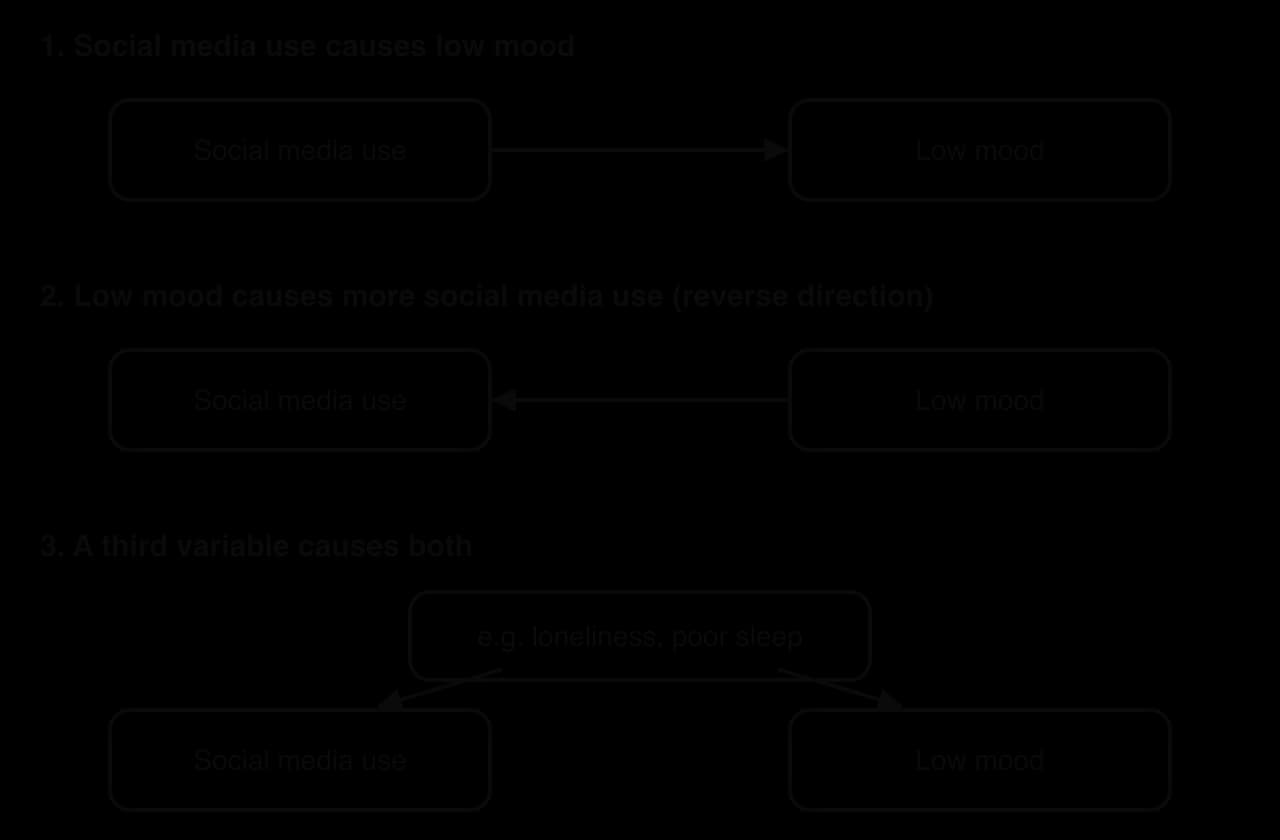
Researchers use three main designs to get closer to causes. Experiments change technology use at random, as in Hunt et al. (2018) and Allcott et al. (2020). Longitudinal and diary studies follow the same people over time to see whether changes in use come before changes in mood, as in Siebers et al. (2026). Natural experiments use events that change access to technology for some people and not others. Each design has limits: experiments are short and use volunteers, while longitudinal studies still cannot rule out every third variable.
Measurement: how much do people really use technology?
Most studies ask people to estimate their own use, which is surprisingly inaccurate. Parry et al. (2021) carried out a preregistered meta-analysis of 106 effect sizes from studies that measured both self-reported and logged use. Self-reports correlated only moderately with logged use, rarely reflected it accurately, and measures of “problematic” use were even more weakly related to logs. Any study that relies on self-reported screen time therefore measures use with considerable error, which can weaken or distort the relationships it finds.
Measuring outcomes is also hard. Well-being, loneliness and anxiety are usually self-reported, and participants in technology experiments know whether they have stopped using social media, so their reports could be influenced by demand characteristics or by expectations that quitting is good for them.
Sampling bias
Many technology studies recruit university students or online volunteers. People who volunteer for a study on quitting social media may already be dissatisfied with it, and paid participants who accept deactivation are those who value the platform least. These forms of sampling bias limit how far findings can be generalised to adolescents, older adults or people in other countries, where platforms and patterns of use differ.
Bias in researchers, publication and funding
Researcher and confirmation bias. Researchers, teachers and parents often hold strong views about technology. Action research in schools, in which teachers evaluate a device policy they introduced, is especially open to confirmation bias, because the people collecting the data hope for a particular result.
Assumptions of harm or benefit. Studies often start from the assumption that technology is harmful (or, for educational technology, helpful) and measure only outcomes that fit that assumption, such as anxiety but not friendship or creativity.
Publication bias. Striking findings of harm are more likely to be published and reported than null results, a form of publication bias that is especially likely in a new field attracting public attention.
Funding and access. Technology companies fund some research and control the data on how people actually use their platforms, while developers often evaluate their own apps, as in the Woebot trial. Independent researchers may have little access to the data needed to test claims.
Replication and the speed of change
Several widely reported findings have not replicated consistently, including the mere presence effect of a smartphone. Technology also changes faster than research: a study of Facebook in 2018 says little about short-video platforms or chatbots used today, so findings can be out of date before they are published. Research on technology therefore needs replication with current platforms and samples before strong conclusions are drawn.
Evaluating claims about technology through the concepts
Concept | Key question | Example |
|---|---|---|
Causality | Does the design allow a causal conclusion? | Survey correlations are tiny and directionless; Hunt et al. and Allcott et al. randomly changed use and found small improvements in well-being. |
Change | Does technology change behaviour, and do changes last? | Facebook deactivation reduced later use; effects of social media on stress grew when measured over months rather than days. |
Perspective | Whose experience does the research capture? | Person-specific effects; migrant workers’ accounts of social media as both support and stress. |
Responsibility | Who should act on uncertain evidence, and how? | Developers evaluating their own chatbots; schools banning phones on the basis of findings that have not replicated. |
A balanced conclusion is that technology affects behaviour in every context, but rarely in the simple way public debate assumes. Technology-based treatments can work as well as face-to-face ones, social media has small average effects on well-being that differ greatly between people, and claims about cognitive harm need replication. The strongest conclusions come from experiments and long-term studies with large, varied samples and objective measures of use.
Key study: Allcott et al. (2020), the welfare effects of social media
Aim
Hunt Allcott, Luca Braghieri, Sarah Eichmeyer and Matthew Gentzkow, economists at Stanford and New York University, aimed to measure the causal effects of using Facebook on how people spend their time, on their political knowledge and attitudes, and on their subjective well-being. Correlational studies had linked social media to unhappiness and political division, but could not show whether social media caused these outcomes.
Method
Design: a randomised controlled experiment with a preregistered analysis plan, run in the four weeks before the US midterm elections of November 2018.
Recruitment: adverts on Facebook were shown to about 1.9 million US users; participants had to be adults using Facebook for more than 15 minutes a day. 2,743 participants reached the stage at which they were asked how much they would need to be paid to deactivate their account for four weeks.
Allocation: the 61% who would accept less than 102 US dollars were randomly allocated to a treatment group, paid to deactivate their Facebook accounts for four weeks, or a control group, who kept using Facebook. The researchers checked regularly that deactivated accounts stayed deactivated. The main analysis sample contained 1,661 participants.
Measures: surveys before, during and after the deactivation period measured time use, news knowledge (a quiz on recent events), political polarisation, and subjective well-being (happiness, life satisfaction, depression, anxiety and loneliness, combined into an index), with brief text-message mood checks during the period. Facebook use after the experiment and how much participants valued Facebook were also measured.
Results
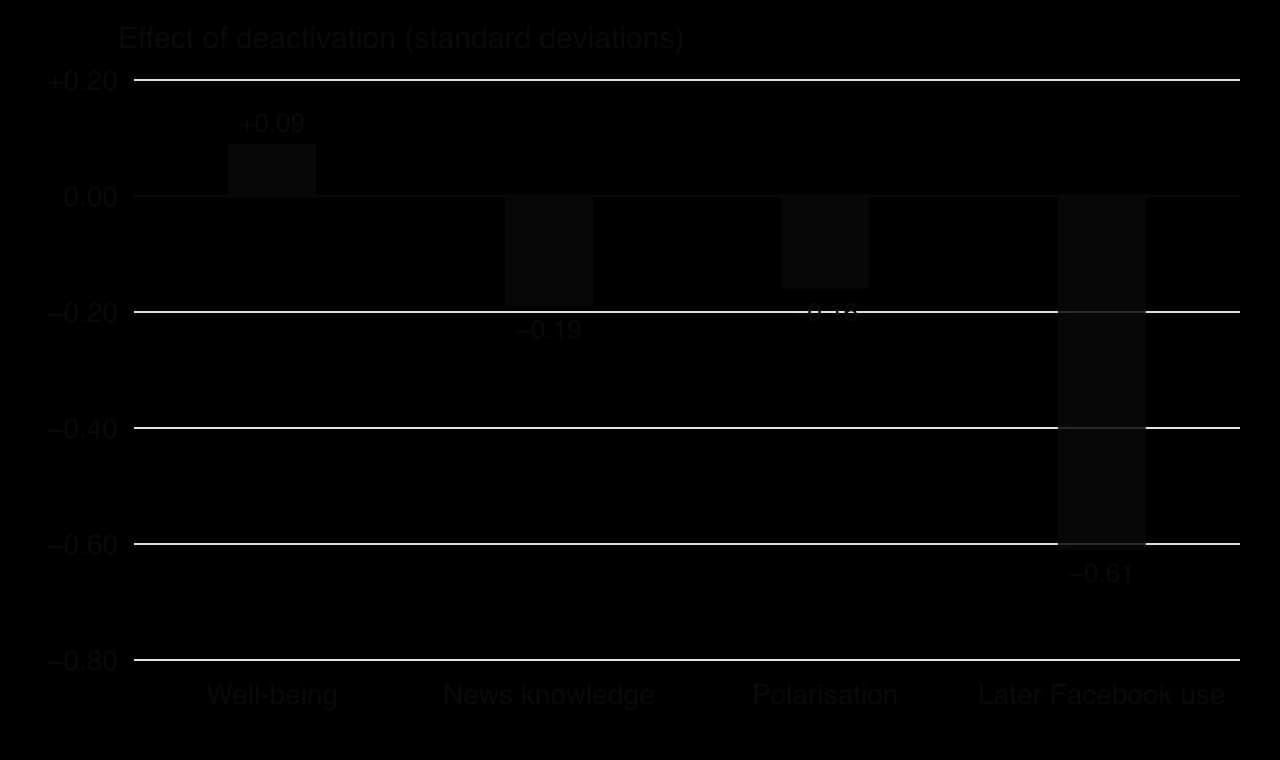
Deactivation freed about 60 minutes a day. The treatment group did not move this time to other online activities; they spent more time offline, for example watching television alone and socialising with friends and family. Their news knowledge index fell by 0.19 standard deviations and their political polarisation index by 0.16.
The subjective well-being index rose by 0.09 standard deviations, with improvements in self-reported happiness, life satisfaction, depression and anxiety; the daily text-message measures were positive but not significant. The authors estimated that this was about 25–40% of the effect of standard psychological interventions such as self-help or group therapy. After the experiment, the treatment group used Facebook much less (0.61 standard deviations below the control group), and about 80% said that deactivation had been good for them.
Conclusions
Using Facebook has real causal effects on behaviour: it displaces offline social activity, it increases news knowledge and political polarisation, and it slightly lowers well-being. The fall in later use suggests that Facebook use is partly habitual, so people may use it more than they would choose to on reflection. The effect on well-being was small, which fits the small correlations in survey data, but it was a causal effect rather than an association.
Evaluation
Causality
Random allocation and checks that deactivation actually happened make this one of the strongest tests of a causal effect of social media. The preregistered analysis plan limited the researchers’ freedom to choose favourable analyses. The study measured the effect of giving up Facebook entirely for four weeks, which is not the same as the effect of using it less, using it differently or using other platforms.
Measurement
Time use, news knowledge and well-being were self-reported, and participants knew whether they had deactivated, so expectations could have influenced their answers; the non-significant result for the daily text-message measure is a reminder of this. Deactivation itself was checked objectively, a strength compared with studies that rely on participants’ promises.
Bias and generalisability
The sample was not representative. Participants were younger, more educated and more left-leaning than the average Facebook user, and only people willing to deactivate for less than 102 dollars were randomised, so the heaviest and most attached users were left out, a form of sampling bias. The participants were adults in the United States, so the findings cannot be applied directly to adolescents or to other countries, and the period before an election may have made political content unusually prominent.
Change and responsibility
The large fall in later use shows that a temporary change in habit can change long-term behaviour, which is relevant to interventions such as phone-free periods. Participants gave informed consent and were paid for their time, and deactivation, unlike deletion, preserved their accounts. The authors noted that the benefits of social media (news, contact) have to be weighed against its costs, a reminder that policies based on harm alone would be one-sided.
Sources: Allcott, H., Braghieri, L., Eichmeyer, S. and Gentzkow, M. (2020). The welfare effects of social media. _American Economic Review, 110(3), 629–676._
Exam practice
Technology appears only in Paper 3, through a booklet of unseen sources built around one claim about the role of technology in one context. The questions ask you to explain an issue that limits the interpretation of a source, to analyse findings and link them to the claim, to discuss a qualitative source, and to weigh the claim using at least three sources and your own knowledge. All data in the practice booklet are hypothetical.
Claim for the practice booklet: using digital devices at school increases students’ anxiety.
Source 1: device use and anxiety
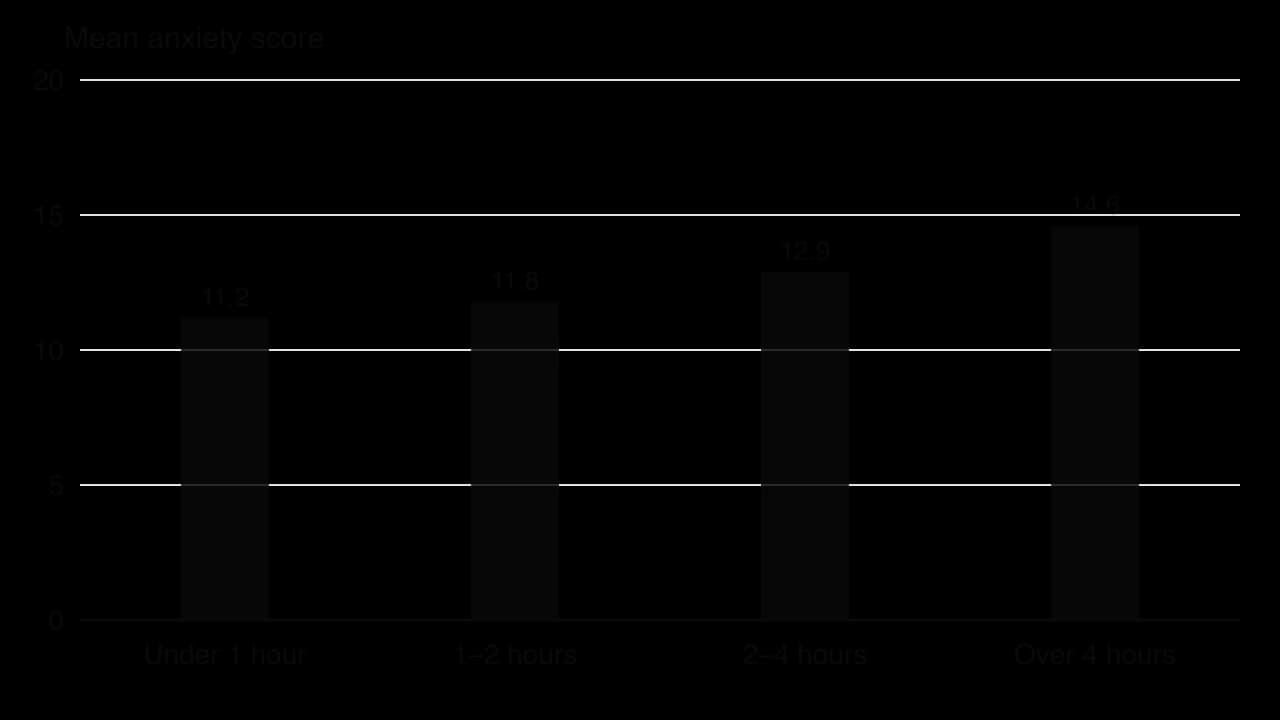
A school district surveyed its secondary students about how many hours a day they used school-issued laptops or tablets and asked them to complete an anxiety questionnaire (scores 0–21).
Source 2: a classroom experiment
Researchers randomly allocated 16 classes of 14-year-olds in one city to use tablets for all mathematics lessons for one term or to use paper and textbooks. Students completed the same anxiety questionnaire (0–21) before and after the term.
Condition (8 classes each) | Students | Anxiety before: mean (SD) | Anxiety after: mean (SD) |
|---|---|---|---|
Tablets in mathematics | 203 | 11.6 (4.1) | 12.1 (4.3) |
Paper and textbooks | 198 | 11.4 (4.0) | 11.7 (4.2) |
Difference in change between conditions | p = 0.48 (not significant) |
Hypothetical data for practice.
Source 3: a focus group with teachers
A head teacher who had recently banned phones at her school ran a focus group with six teachers she selected to discuss the effects of the ban. She reported a theme of “calmer, more present students”:
The corridors are quieter and they actually talk to each other at lunch. … I had two students tell me they feel less pressure without their phones. … Honestly, I was always against phones in school, so I am not surprised.
— Hypothetical focus group extract, written for practice
Synthesis
Summary
Digital technology, including social media and artificial intelligence, is a deliberate change to the environment in which behaviour develops, designed to be interactive and engaging.
In health, therapist-supported internet CBT is about as effective as face-to-face CBT, virtual reality exposure reduces phobias, and chatbots show early promise in small trials; limiting social media slightly improved well-being in experiments.
In development, the effects of social media differ from adolescent to adolescent; technoference is linked with less secure attachment as children see it; language models are used to test theories of theory of mind.
In relationships, moral-emotional content spreads within political groups on social media, supporting concern about echo chambers, while social media can both support and complicate acculturation.
In cognition, heavy media multitaskers show weaker control of attention (direction unclear), and the mere presence effect of smartphones has not replicated consistently.
Research problems include correlational designs and bidirectional ambiguity, inaccurate self-reported use, sampling bias, researcher and confirmation bias, publication bias and funding, replication failures and the speed of technological change.
Allcott et al. (2020) found that four weeks without Facebook raised well-being by 0.09 SD, cut news knowledge and polarisation and reduced later use, in a preregistered randomised experiment with an unrepresentative adult sample.
Self-check
- To do:
I can describe how digital technologies, including artificial intelligence, have changed behaviour and relationships.
- To do:
I can discuss the role of technology in each of the four contexts with a piece of research for each.
- To do:
I can explain why most technology research is correlational and how experiments and longitudinal studies address this.
- To do:
I can explain sampling bias, inaccurate self-report, researcher and publication bias, funding and replication problems in technology research.
- To do:
I can describe and evaluate Allcott et al. (2020).
- To do:
I can explain an issue that limits the interpretation of an unseen technology source and analyse its findings in relation to a claim.
- To do:
I can discuss how bias could be avoided in a qualitative source on technology.
- To do:
I can evaluate a claim about technology and behaviour using several sources and my own knowledge.