B The particulate nature of matter
Theme B: matter as particles, from thermal energy and radiation to the greenhouse effect, gas laws, thermodynamics and electric circuits, and how SL and HL differ.
- IB Physics
- SL and HL
5 subtopics in The particulate nature of matter
Each one has its own page once something is published for it.
- B.1Thermal energy transfers176 questions · notes · 65 quick fire
- B.2Greenhouse effect61 questions · notes · 55 quick fire
- B.3Gas laws98 questions · notes · 60 quick fire
- B.4ThermodynamicsHL only70 questions · notes · 55 quick fire
- B.5Current and circuits122 questions · notes · 85 quick fire
An overview of B The particulate nature of matter
Theme B explains the behaviour of matter in bulk from the behaviour of the particles that make it up. A small set of assumptions, that matter consists of atoms and molecules in constant random motion with forces between them, accounts for temperature, heating and changes of state, the pressure of a gas, the warming of the Earth by its atmosphere and the flow of charge in a wire.
How the subtopics fit together
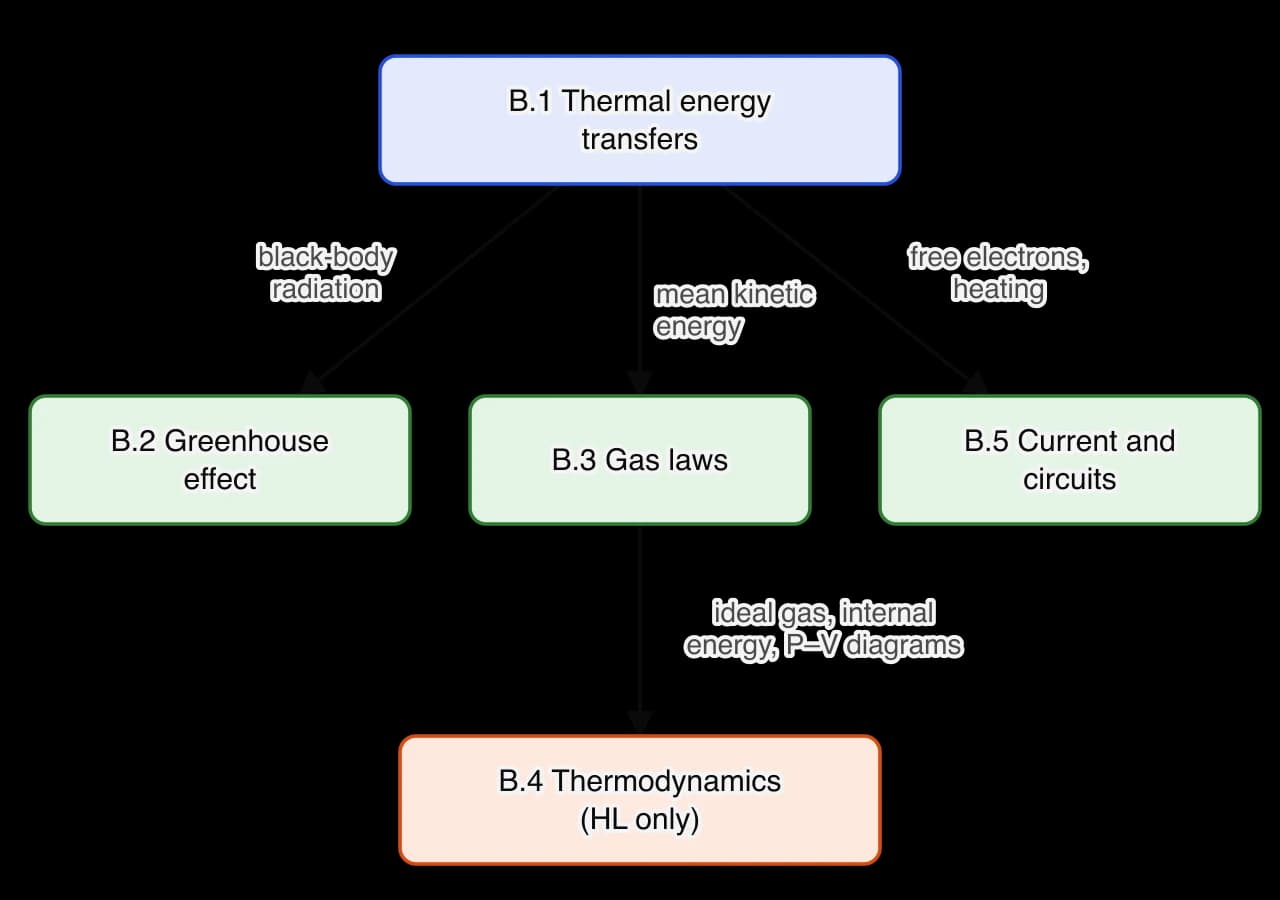
B.1 Thermal energy transfers. The particle model of solids, liquids and gases; density; temperature as a measure of the mean kinetic energy of particles; internal energy; specific heat capacity and specific latent heat; and the three ways thermal energy moves: conduction, convection and radiation. The radiation of a black body, described by the Stefan–Boltzmann law and Wien's law, gives the luminosity, temperature and size of stars.
B.2 Greenhouse effect. The radiation laws of B.1 applied to a planet. Conservation of energy, together with albedo, emissivity and the solar constant, gives the Earth's equilibrium temperature. Greenhouse gases absorb the infrared emitted by the surface, which explains why the surface is warmer than this, and how human emissions are enhancing the effect.
B.3 Gas laws. Pressure, the amount of substance and the empirical gas laws combine in the ideal gas equation . The kinetic model of an ideal gas explains pressure as the result of molecules colliding with the walls, and links the internal energy of a monatomic gas to its temperature.
B.4 Thermodynamics (HL). The first law of thermodynamics, , applied to gases that expand and are compressed; work as an area under a – graph; the four standard processes; entropy and the second law; and the efficiency of heat engines and its Carnot limit.
B.5 Current and circuits. Charge carriers moving through conductors: current, potential difference, resistance and resistivity, electrical power, cells with internal resistance, and circuits in series and parallel. The heating effect of a current is a transfer of energy from the moving charges to the vibrating lattice of the conductor.
Big ideas across the theme
The particle model. Every subtopic uses the same picture of matter. In B.1 it explains states, phase changes and conduction; in B.3 it becomes the kinetic model of an ideal gas, whose assumptions (negligible molecular volume, no forces except in collisions) show both why the model works so well at low pressure and where it fails; in B.5 the particles are the free electrons that carry charge. In theme E the particles themselves are taken apart, into nuclei and electrons.
Energy and its conservation. Internal energy, heating and work are all forms of the energy accounting first met in A.3. The principle of conservation of energy gives the method of mixtures in B.1, the Earth's energy balance in B.2 and the first law of thermodynamics in B.4, and it reappears in the energy released by fission and fusion (E.4, E.5).
Temperature and kinetic energy. The kelvin temperature is proportional to the mean random kinetic energy of the particles. This one link connects heating curves (B.1), gas pressure and the gas laws (B.3) and the internal energy of a gas (B.3, B.4).
Radiation. Every body radiates according to its temperature. The black body laws of B.1 are used for the Earth in B.2 and again for stars in E.5, where luminosity, apparent brightness and Wien's law place stars on the Hertzsprung–Russell diagram. The absorption of infrared by greenhouse gases rests on resonance (C.4) and on quantised molecular energy levels, an idea developed for atoms in E.1.
Models and their limits. The ideal gas, the single-layer atmosphere of B.2 and the simple circuit with ideal meters are all deliberately simplified models. Each is useful because it makes clear predictions, and each comes with known limitations that a full answer to a question often has to discuss.
Standard level and higher level
One subtopic in theme B is HL only: B.4 Thermodynamics, which appears only in the HL view of the notes. It covers the first law of thermodynamics with Clausius' sign convention, work done by a gas and the area under a – graph, the change in internal energy of a monatomic ideal gas, isovolumetric, isobaric, isothermal and adiabatic processes (including ), entropy in both its macroscopic form and its statistical form , the second law of thermodynamics in its Clausius, Kelvin and entropy forms, and cyclic heat engines with the Carnot efficiency .
The other four subtopics, B.1 Thermal energy transfers, B.2 Greenhouse effect, B.3 Gas laws and B.5 Current and circuits, have no HL sections: they are the same at SL and HL. The first law, work done by a gas and adiabatic changes are HL only, so at SL gas problems stop at the gas laws and the kinetic model. HL students spend 32 hours on the theme compared with 24 at SL; the 8 extra hours are B.4.
Flashcards for B
The official decks for this part of the syllabus.
- B.1 Thermal energy transfers256 cards
- B.2 Greenhouse effect167 cards
- B.3 Gas laws197 cards
- B.4 Thermodynamics203 cards
- B.5 Current and circuits254 cards
From the data booklet
The entries of the physics data booklet that B uses. Each opens in the explained booklet.
- Avogadro constantFundamental constants
- Gas constantFundamental constants
- Boltzmann constantFundamental constants
- Stefan–Boltzmann constantFundamental constants
- Elementary chargeFundamental constants
- Solar constantFundamental constants
- Temperature (K) temperature (°C) Unit conversions
- 1 kilowatt-hour (kWh) Unit conversions
- Electrical circuit symbolsElectrical circuit symbols
- CellElectrical circuit symbols
And 58 more in the data booklet.
Carry on with B in Augment
With a free account, Augment remembers where you stopped and what you have practiced.