Notes on B.4 Thermodynamics
Thermodynamics is the physics of energy transfer by heating and by doing work, and of the limits on converting one into the other. Every car engine, power station, refrigerator and heat pump is designed with its two laws. The first law is conservation of energy; the second explains why the energy released by burning fuel can never all be turned into useful work, and why many processes in nature run in only one direction.
Systems, surroundings and internal energy
Thermodynamics divides the world into the system, the part being studied (usually a gas in a cylinder), and its surroundings, everything else. The system and surroundings can exchange energy and sometimes matter.
A gas sealed in a cylinder with a movable piston is a closed system: its mass is fixed, but it can be heated or cooled and it can do work on the piston. An isolated system is an idealisation; a sealed, perfectly insulated, rigid container comes close, and on the largest scale the Universe as a whole is isolated.
Energy crosses the boundary of a closed system in two ways. Heating (thermal energy transfer, ) happens because of a temperature difference between the system and its surroundings. Work () is energy transferred by a force acting through a distance, such as a gas pushing a piston. Neither is something the gas "contains"; both are energy in transit.
Internal energy of a monatomic ideal gas
The energy stored in the gas is its internal energy , the total random kinetic and intermolecular potential energy of its particles. For a monatomic ideal gas there is no potential energy, and the internal energy is
Because , this can also be written
The internal energy of a fixed mass of ideal gas depends only on its temperature, so it is a property of the state of the gas. Any two processes that start at the same state and end at the same state produce the same , however different they are in between. Work done and thermal energy transferred, by contrast, depend on the route taken.
The first law of thermodynamics
Energy supplied to a gas by heating can go to two places: it can raise the internal energy of the gas, or it can leave again as work done by the gas on its surroundings. Conservation of energy for a closed system then gives the first law of thermodynamics:
The signs follow Clausius’ sign convention, which states each quantity from the point of view of the gas:
Quantity | Positive when | Negative when |
|---|---|---|
thermal energy is transferred to the gas | thermal energy leaves the gas | |
the internal energy, and so the temperature, increases | the internal energy and temperature decrease | |
the gas does work on its surroundings (it expands) | work is done on the gas (it is compressed) |
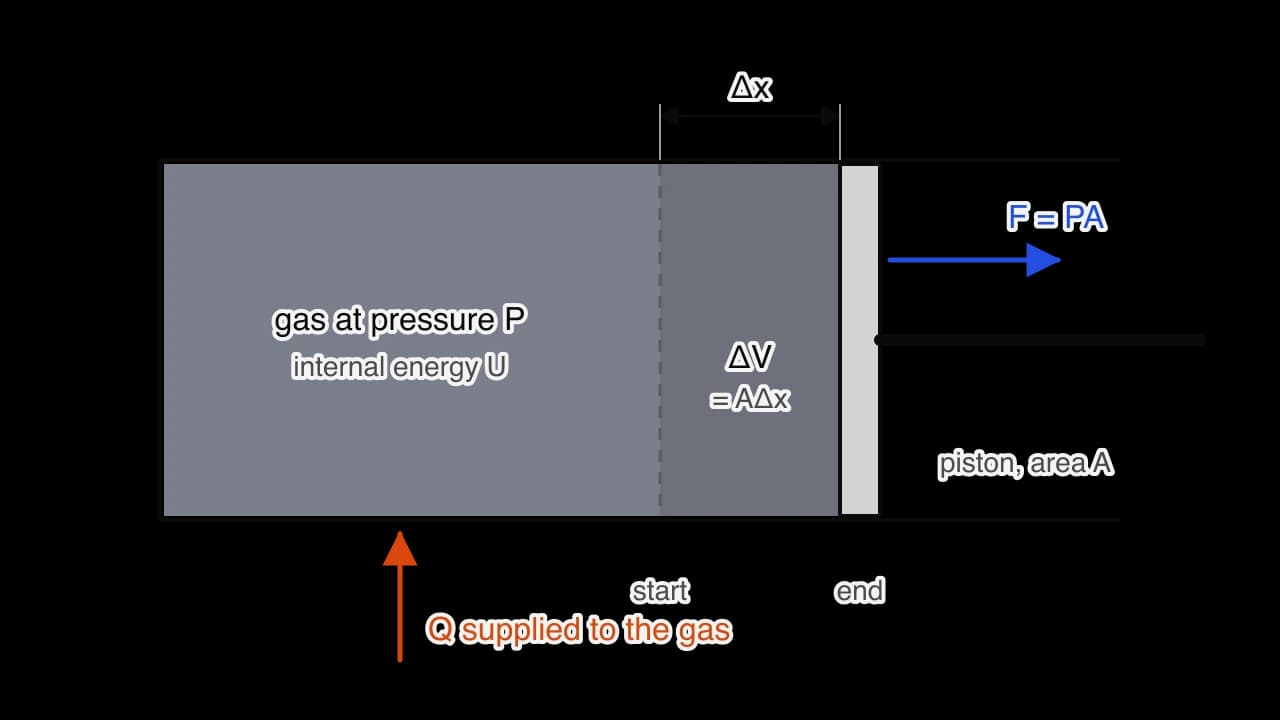
Work done by an expanding gas
Work at constant pressure
A gas at pressure pushes on a piston of area with a force . If the piston moves out a small distance while the pressure stays constant, the work done by the gas is
where is the increase in volume. When the gas expands, is positive and so is . When the gas is compressed, and are negative: work is done on the gas. When the volume does not change, no work is done, however much the pressure changes.
Work as the area under a P–V graph
On a P–V diagram, a change at constant pressure is a horizontal line, and is the area of the rectangle between the line and the volume axis. This holds generally: the work done by a gas is the area under its P–V graph, between the starting and final volumes. The area counts as positive for an expansion (moving to the right) and negative for a compression (moving to the left).
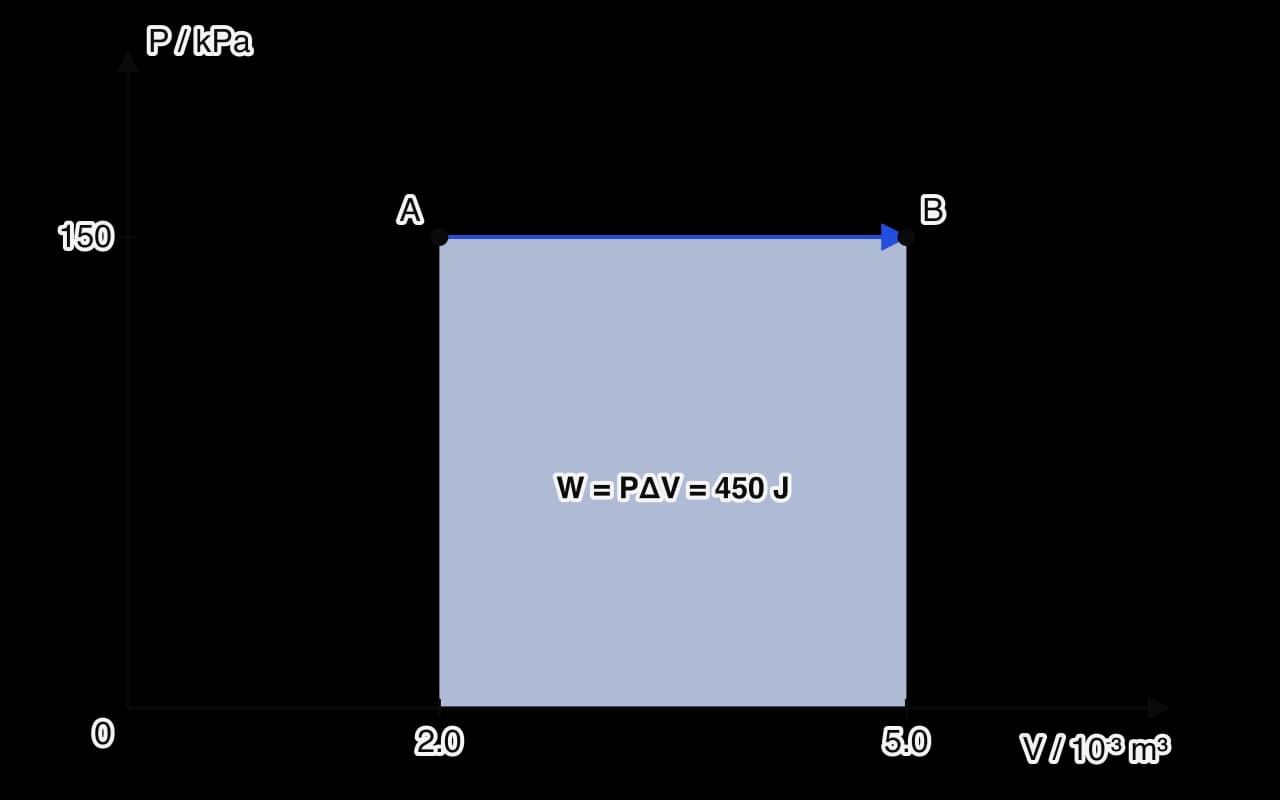
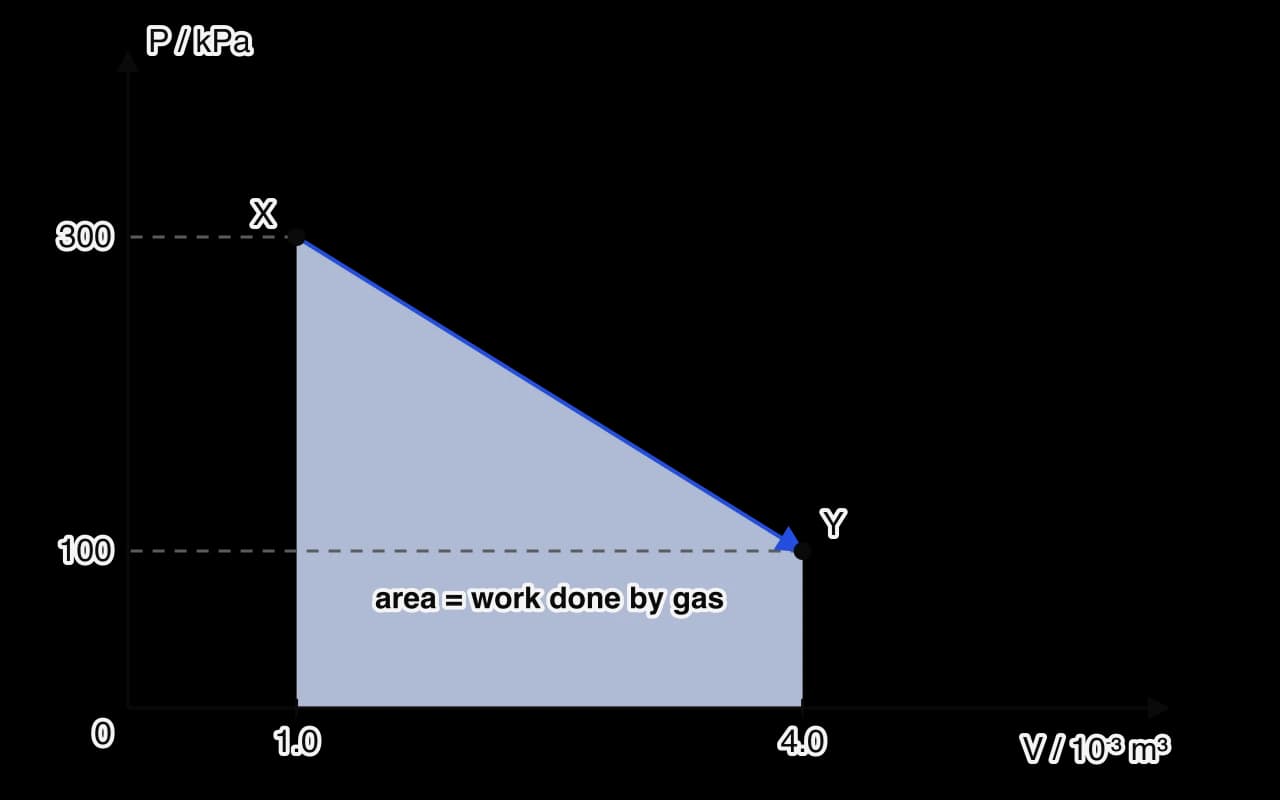
When the pressure changes during an expansion, the work is still the area under the line. If the line is straight, the area is a trapezium; if it is curved, the area is estimated by counting grid squares, each of which represents a known amount of work (for example ).
Work depends on the path
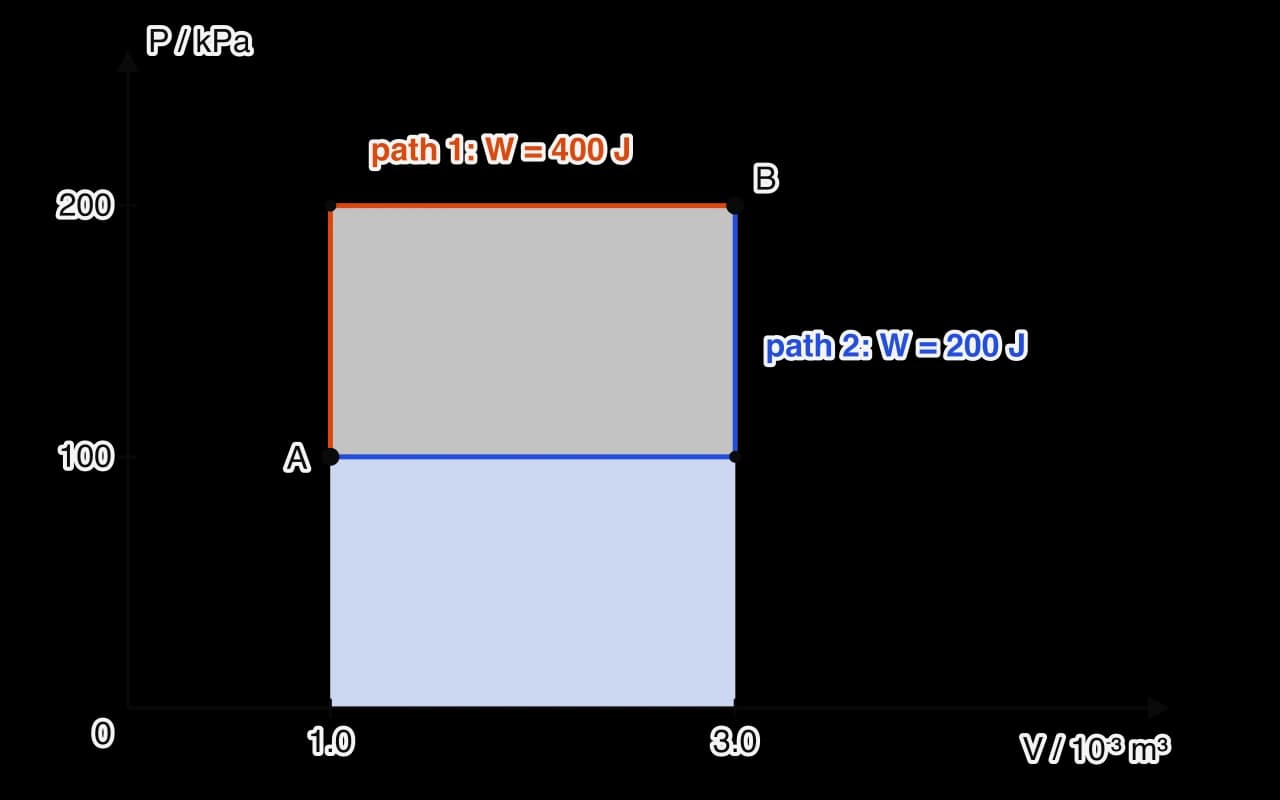
Two different routes between the same two states enclose different areas under them, so the gas does different amounts of work. Since is fixed by the end states, the first law shows that the thermal energy must differ too. A gas has a definite internal energy in each state, but no definite "amount of heat" or "amount of work".
The four thermodynamic processes
Thermodynamic processes of a gas are named after what stays fixed. In each, the first law simplifies because one of , or is zero, or because two of them are linked.

Isovolumetric (constant volume)
In an isovolumetric process the volume does not change, so the gas does no work: and . All the thermal energy supplied raises the internal energy, and the pressure rises in proportion to the absolute temperature. On a P–V diagram it is a vertical line. Heating a gas in a rigid sealed container is an isovolumetric process.
Isobaric (constant pressure)
In an isobaric process the pressure is constant, so and the process is a horizontal line on a P–V diagram. For a monatomic ideal gas,
Isothermal (constant temperature)
In an isothermal process the temperature is constant, so for an ideal gas and . The gas follows an isotherm, . During an isothermal expansion, all the thermal energy flowing in leaves as work; during an isothermal compression, all the work done on the gas leaves as thermal energy. For this to happen, the change must be slow and the gas in good thermal contact with its surroundings, so that the temperature can stay equal to theirs.
Adiabatic (no thermal energy transfer)
In an adiabatic process no thermal energy enters or leaves the gas: , so . If the gas expands it does work, and the energy can only come from its internal energy, so it cools. If the gas is compressed, the work done on it raises its internal energy, so it gets hotter. A process is adiabatic if the gas is perfectly insulated or, more often, if the change is so fast that there is no time for significant thermal energy transfer.
For a monatomic ideal gas, an adiabatic change follows
On a P–V diagram, an adiabatic curve is steeper than the isotherm through the same point. On expansion, the pressure falls for two reasons: the volume increases, and the temperature drops as well. Combining with gives a version for temperature and volume,
The work in an adiabatic change can be found without calculating any area, from the first law. Since ,
Adiabatic changes are common in everyday life. A bicycle pump becomes warm near the outlet when the tyre is pumped quickly. In a diesel engine, air is compressed so quickly that it becomes hot enough to ignite the fuel sprayed into it, with no spark plug. In the atmosphere, a parcel of air that rises expands as the pressure falls, cools adiabatically and, if it cools enough, its water vapour condenses into cloud.
Summary of the processes
Process | Fixed | On a P–V diagram | |||
|---|---|---|---|---|---|
Isovolumetric | V | 0 |
Cyclic processes and heat engines
Cycles on a P–V diagram
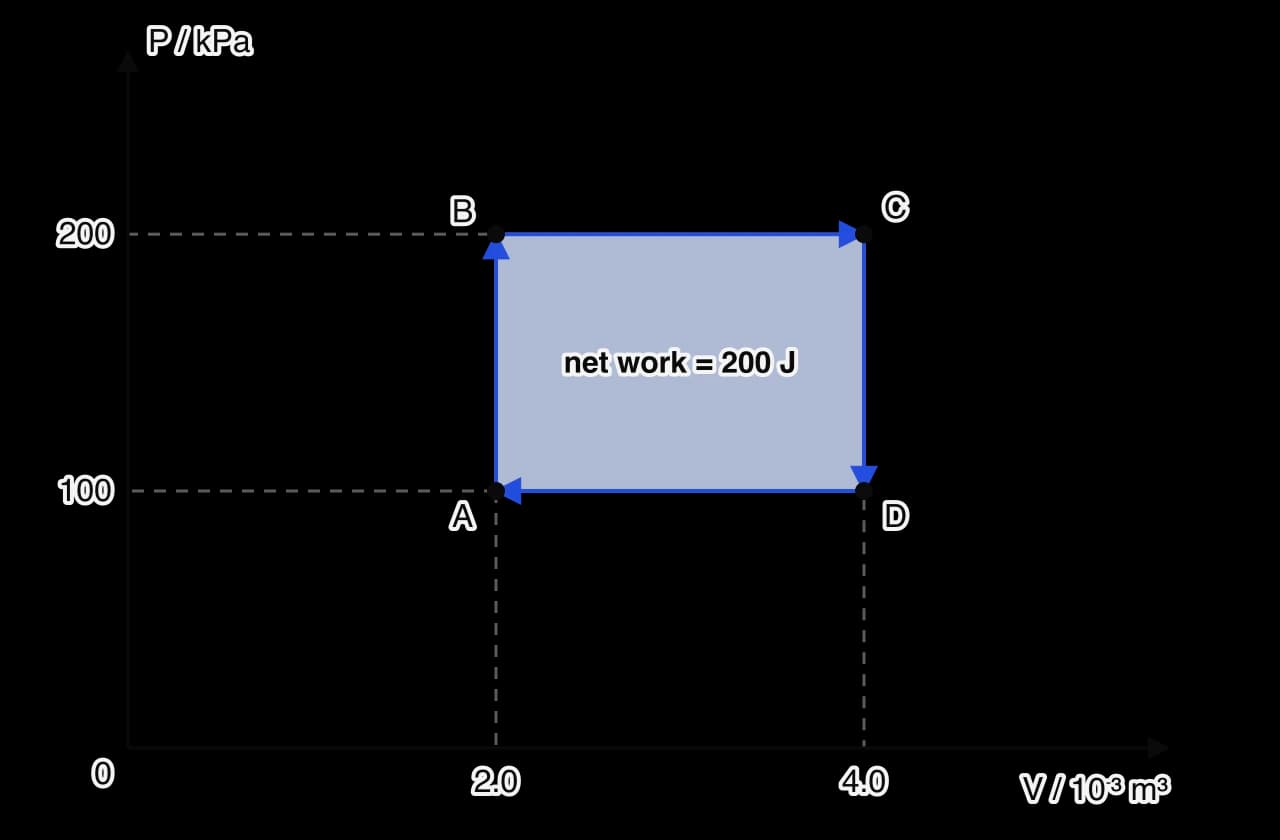
A cyclic process takes a gas through a series of changes that return it to its starting state. Because internal energy depends only on the state, over a complete cycle , and the first law gives
The net work done by the gas in one cycle is the area enclosed by the loop on the P–V diagram: the work done during the expansion (area under the upper line) minus the work done on the gas during compression (area under the lower line). If the cycle runs clockwise, the gas does net work on its surroundings, and the device is a heat engine. If it runs anticlockwise, net work is done on the gas, and the device is a refrigerator or heat pump.
Heat engines
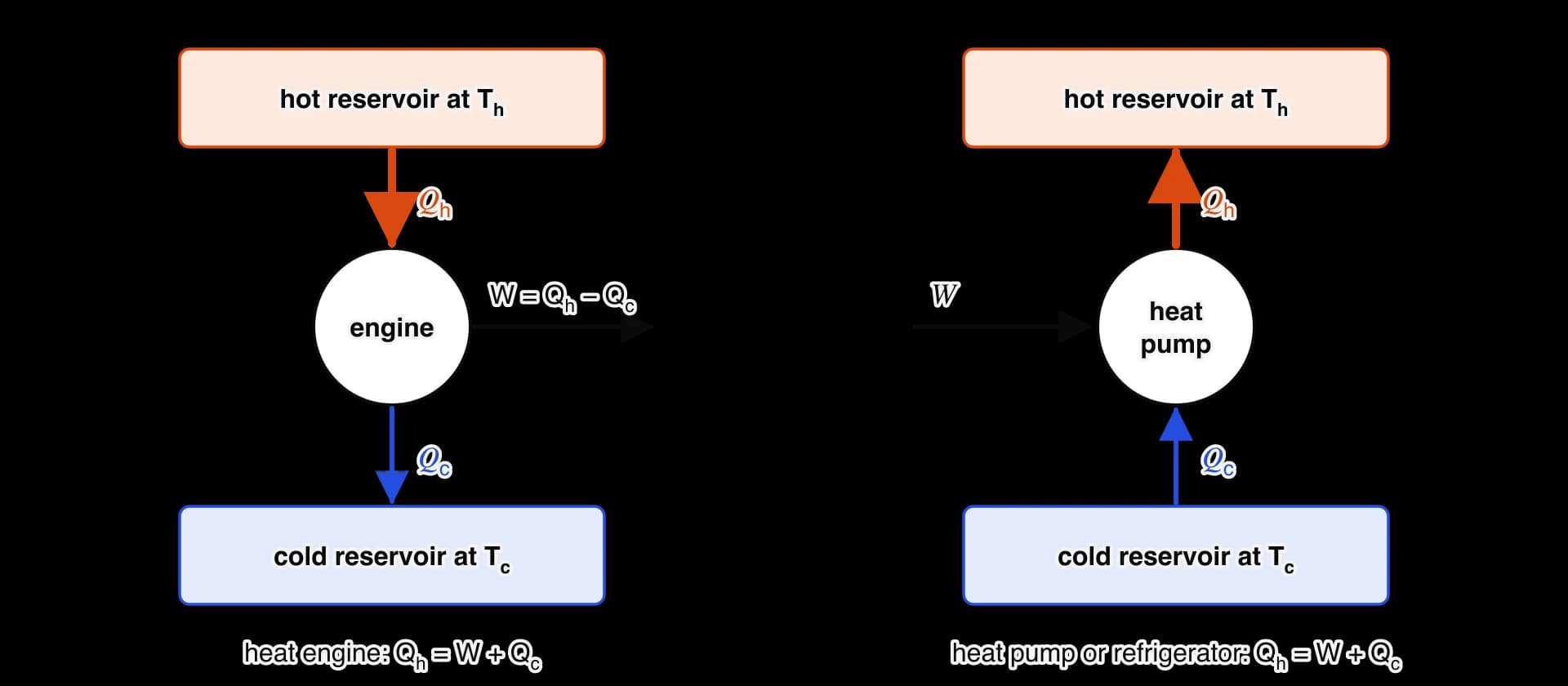
A heat engine is a device that takes in thermal energy and converts part of it into work, running through a cycle again and again. Every heat engine works between two thermal reservoirs: a hot one at temperature (burning fuel, a nuclear reactor) from which it takes thermal energy , and a cold one at
In engine and reservoir diagrams, , and are written as positive sizes, and the arrows show which way each transfer goes. Applied to the gas itself with Clausius’ sign convention, the energy rejected to the cold reservoir is a negative
Case study: the four-stroke petrol engine
A petrol car engine is an internal combustion engine working on the four-stroke cycle. Each cylinder repeats four strokes of the piston: intake (the piston moves out, drawing in a mixture of air and fuel), compression (the piston moves in, squeezing the mixture quickly), power (a spark ignites the mixture, the pressure and temperature jump, and the hot gas pushes the piston out), and exhaust (the piston moves in, pushing the burnt gas out).
The idealised model of this engine is the Otto cycle. The compression and power strokes are so fast that they are modelled as adiabatic changes. Combustion is so rapid that the piston barely moves, so it is modelled as heating at constant volume; opening the exhaust valve at the end of the power stroke is modelled as cooling at constant volume. The intake and exhaust strokes exchange gas but do no net work and are left out of the P–V loop.
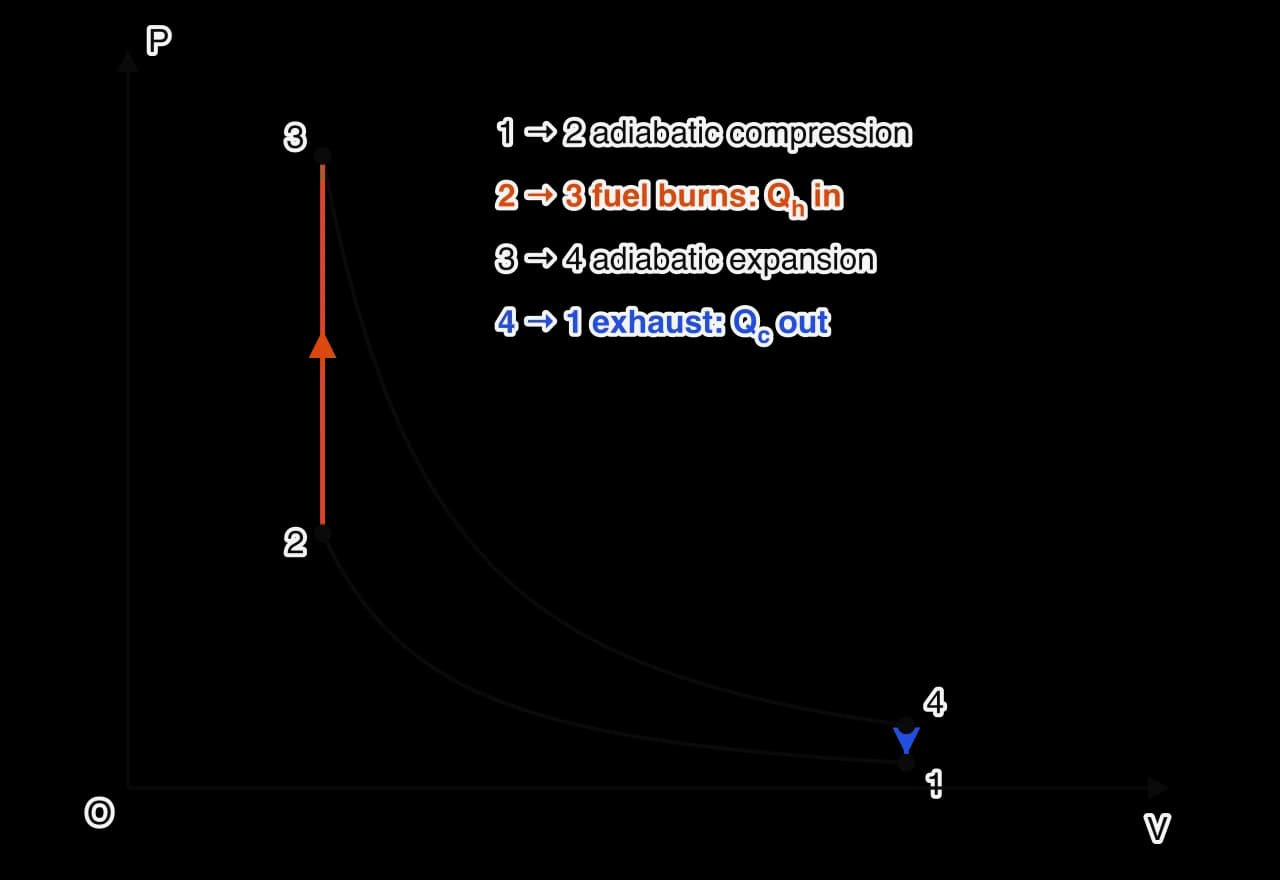
The model is only an approximation. Real gas in an engine is mostly diatomic air with fuel, not a monatomic ideal gas; combustion takes a finite time; and energy is lost to friction and by heating the cylinder walls, so the real P–V loop has rounded corners and a smaller area. A higher compression ratio makes the cycle more efficient, but too much compression ignites the mixture too early. The best modern petrol engines reach a peak thermal efficiency of about 40 %. Toyota’s 2.5-litre Dynamic Force engine, announced in December 2016 with a compression ratio of 13 : 1, was rated at 40 % (41 % in its hybrid version). In everyday driving, at part load, the average efficiency of a petrol engine is much lower than its peak.
The second law of thermodynamics
The first law says that energy is conserved, but it does not say which processes actually happen. A hot cup of coffee cools down in a room; the room never spontaneously heats the coffee, even though that would conserve energy just as well. A heat engine always rejects some thermal energy; no engine turns all of its input into work, even though that too would conserve energy. The second law of thermodynamics accounts for these one-way processes.
"Spontaneously" is the key word. A refrigerator does move energy from its cold interior to the warmer kitchen, but only because work is done on it by the compressor. Without that work, energy only ever flows from hot to cold.
The Kelvin statement means that every heat engine needs a cold reservoir to reject energy to: can never be zero, so the efficiency of a heat engine is always less than 1. The two statements are equivalent: if an engine could break the Kelvin statement, its work could drive a refrigerator that broke the Clausius statement, and the other way round.
Both statements follow from a deeper one, written in terms of a quantity called entropy: the entropy of an isolated system never decreases. It stays constant in a reversible process and increases in an irreversible one.
Reversible and irreversible processes
A reversible process is one that can be run backwards, step by step, returning both the system and its surroundings exactly to their original states. That only happens in an idealised limit: changes made infinitely slowly, with no friction, and with thermal energy only ever transferred across temperature differences that are vanishingly small.
Every real process is an irreversible process. Friction converts work into internal energy, a gas expanding into a vacuum does not gather itself back up, and thermal energy flowing across a finite temperature difference does not flow back. Reversible processes are a useful model, like the ideal gas: they set the limit that real processes can approach but never reach.
The Carnot cycle and the maximum efficiency
The most efficient heat engine possible between two given temperatures runs a reversible cycle, the Carnot cycle, first analysed by Sadi Carnot in 1824. It has four stages:
A → B: isothermal expansion at . The gas absorbs from the hot reservoir and does work.
B → C: adiabatic expansion. The gas does more work and cools from
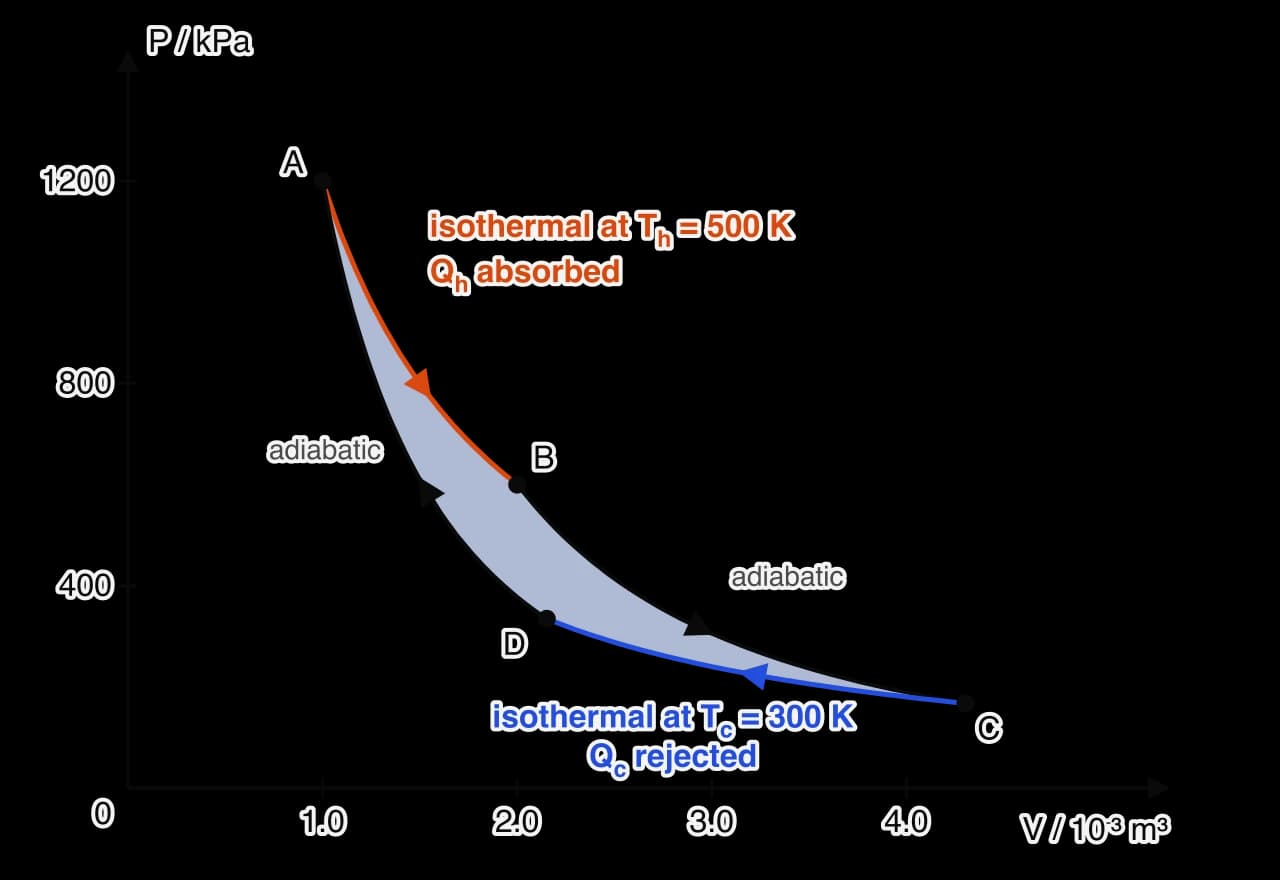
Thermal energy is only ever exchanged at the temperature of the reservoir involved, so there are no flows across finite temperature differences and the whole cycle is reversible. The efficiency of a Carnot engine, the Carnot efficiency, depends only on the temperatures of the two reservoirs:
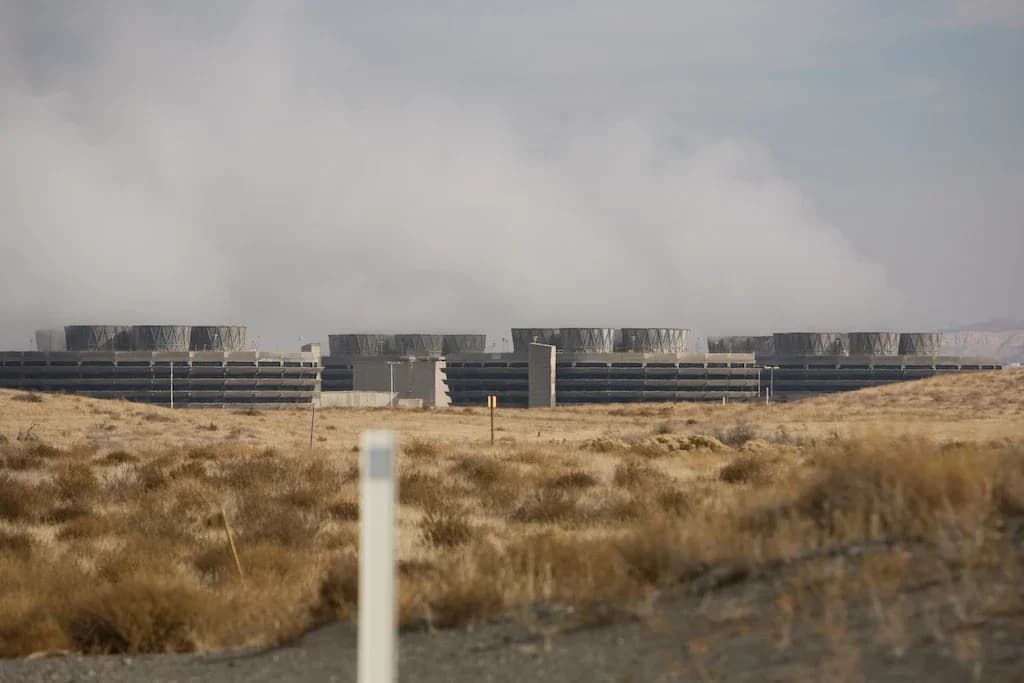
The Carnot efficiency can only be 1 if , which is impossible, so no engine can convert all its input energy into work. To raise the maximum efficiency, the hot reservoir must be as hot as possible and the cold one as cold as possible. This is why power stations use high-temperature steam and are built next to rivers or the sea, and why they need cooling towers to reject energy to the atmosphere.
 YouTube
Entropy: the macroscopic view
Entropy is a property of the state of a system, like internal energy, that measures its disorder: how spread out its energy and particles are. Its change is defined through thermal energy transfer. When a quantity of thermal energy is transferred to a system at a constant absolute temperature , the entropy of the system changes by
Entropy is measured in . Thermal energy flowing in () increases the entropy of the system; thermal energy flowing out decreases it. The same quantity of energy produces a bigger change in entropy at a lower temperature, because adding energy to a cold, ordered system disturbs it more than adding it to a hot, already disordered one.
The equation applies directly when the temperature stays constant: a change of state such as melting or boiling, or a reservoir so large that its temperature hardly changes.
Why thermal energy flows from hot to cold
Entropy explains the Clausius statement. When thermal energy flows from a hot body at to a cold body at , the hot body loses entropy
Entropy in the Carnot cycle
In a Carnot cycle the gas absorbs at (entropy gain
This is where the Carnot efficiency comes from. A real, irreversible engine creates entropy, so it must reject more thermal energy to the cold reservoir,
Local decreases in entropy
The entropy of a system that is not isolated can decrease. Water freezing in a freezer becomes more ordered, so its entropy falls. Living things build ordered structures from disordered raw materials. In every such case, the system transfers energy to its surroundings, and the entropy of the surroundings increases by at least as much as the system’s entropy decreases. The total entropy of the system and its surroundings, taken together as an isolated system, never falls.
A refrigerator is the standard example. Taking out of the cold interior lowers the interior’s entropy by . The work
A heat pump is the same device used to heat a building: it takes thermal energy from cold outside air or ground and, using electrical work, delivers more energy into the house than the electrical energy it consumes. It does not break the second law, because work is done and the total entropy still increases.
Entropy and the evolution of the Universe
The Universe is an isolated system, so its total entropy has been increasing since the beginning. Every irreversible process, from a star shining to a cup of coffee cooling, adds to it. This one-way increase gives time a direction: the past is the direction of lower entropy. Taken to its limit, the second law predicts a far-future state in which all temperatures have evened out, no energy flows from hot to cold, and no heat engine, star or living thing could run.
 YouTube
Entropy: the microscopic view
The second law can be understood by counting the ways in which particles can be arranged. A macrostate is a state described by bulk properties, such as the pressure, volume and temperature of a gas. A microstate is one particular arrangement of all the individual particles (their positions and energies) that produces that macrostate. Most macrostates can be produced by an enormous number of different microstates.
If every microstate is equally probable, a macrostate with more microstates is more probable. Boltzmann connected this number, , to entropy:
A perfectly ordered state, which can be arranged in only one way (), has zero entropy. The more ways a macrostate can be made, the higher its entropy.
A coin model of microstates
Tossing coins is a simple model. Each coin lands heads or tails with equal probability, so each sequence of results is one equally likely microstate. The macrostate is the total number of heads. With four coins there are microstates:
Macrostate | Microstates | |
|---|---|---|
4 heads | HHHH | 1 |
3 heads, 1 tail | HHHT, HHTH, HTHH, THHH | 4 |
2 heads, 2 tails | HHTT, HTHT, HTTH, THHT, THTH, TTHH | 6 |
1 head, 3 tails | HTTT, THTT, TTHT, TTTH | 4 |
4 tails | TTTT | 1 |
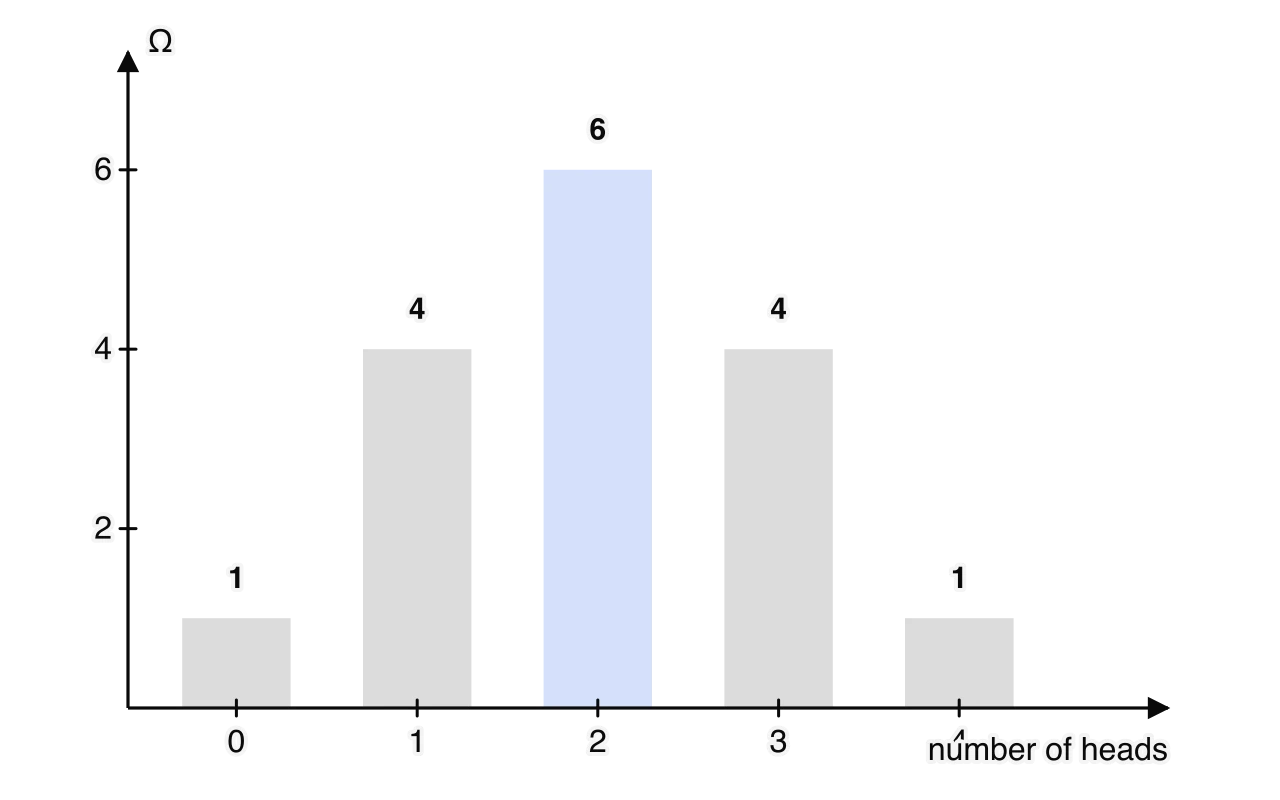
The evenly mixed macrostate is six times as likely as "all heads". With more coins the effect becomes overwhelming. For 100 coins, the number of microstates with exactly 50 heads is about , against just 1 for all heads. A gas contains around molecules, so the most disordered macrostates are so much more probable than ordered ones that the gas is, in practice, always found in them.
Why entropy increases
The microscopic view explains the second law as a matter of probability. A gas let into a larger volume through a removed partition spreads out because there are vastly more microstates with the molecules spread through the whole container than with them all in one half. The molecules move randomly, and they move into the more probable macrostates simply because there are so many more of them. Gathering back into one half is not impossible in principle, only so improbable that it never happens.
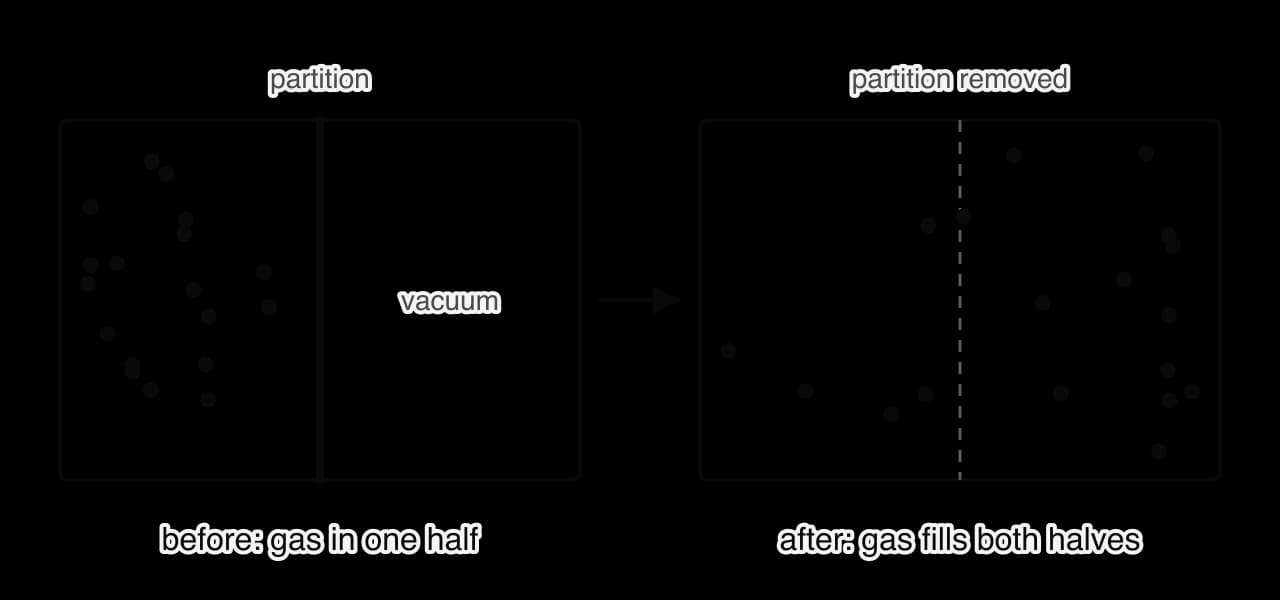
The two descriptions of entropy agree. Supplying thermal energy to a system lets its particles occupy more energy levels in more ways, raising ; the macroscopic and the microscopic are two ways of measuring the same quantity.
Applying the ideas in exam questions
Calculations on cycles reward a fixed routine: for each stage, find from the area, from , then
Paper 1A: an adiabatic compression
Paper 1A: statements about entropy
Paper 1B: testing an adiabatic compression
A group of students compresses helium rapidly in a sealed syringe fitted with a pressure sensor. They record the volume and the pressure at several points during one rapid compression.
/ cm³ ± 0.5 | / kPa ± 2 |
|---|---|
50.0 | 101 |
40.0 | 147 |
30.0 | 236 |
25.0 | 322 |
20.0 | 462 |
Paper 2: a three-stage cycle
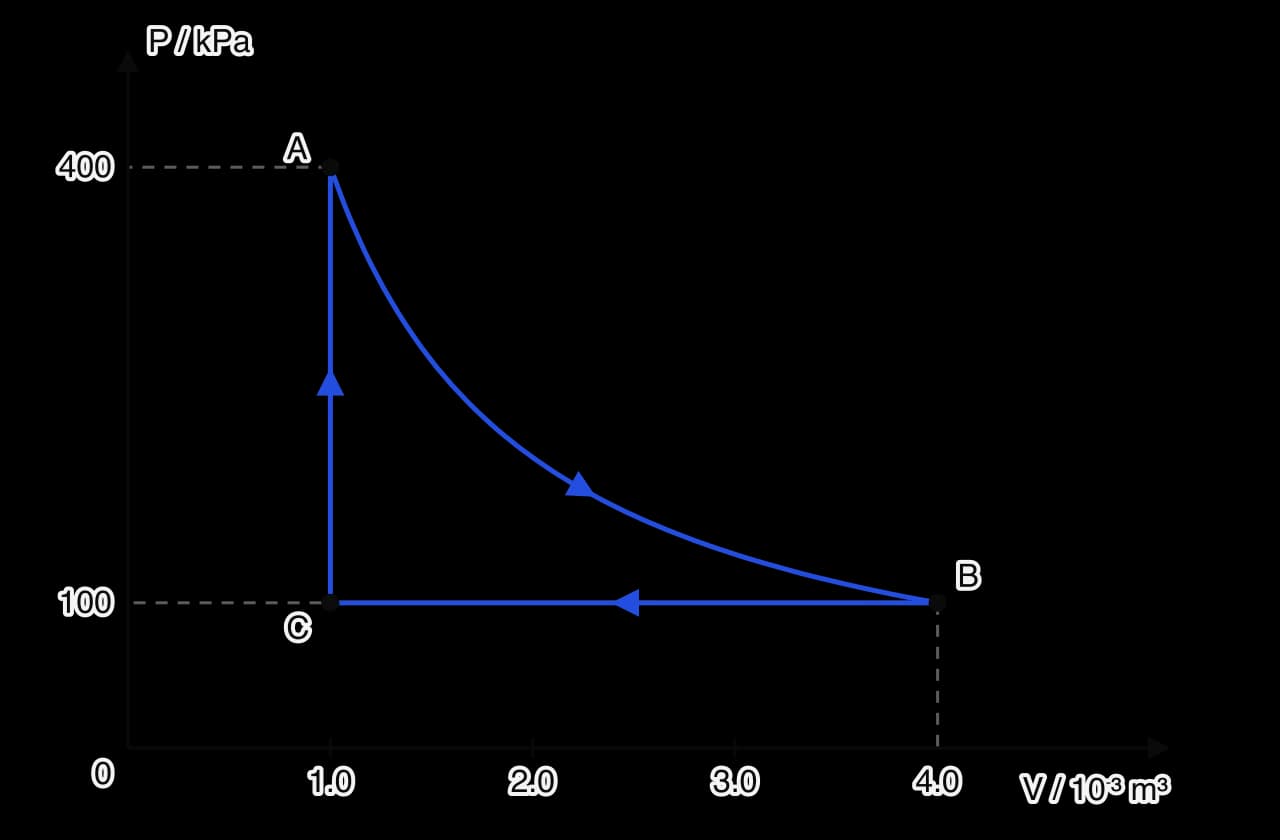
A fixed mass of monatomic ideal gas is taken round the cycle A → B → C → A shown. A → B is a curve along which is constant. The work done by the gas from A to B is 555 J.
Paper 2: melting ice and a refrigerator
Self-check
- To do:
I can distinguish between closed and isolated systems, and between heating and doing work.
- To do:
I can calculate the change in internal energy of a monatomic ideal gas from ΔU = (3/2)nRΔT or (3/2)Δ(PV).
- To do:
I can state the first law, Q = ΔU + W, and use Clausius’ sign convention for each quantity.
- To do:
I can calculate work done by or on a gas from W = PΔV and from the area under a P–V graph, including when the pressure changes.
- To do:
I can explain why work and heat depend on the path but ΔU does not.
- To do:
I can describe isovolumetric, isobaric, isothermal and adiabatic processes and apply the first law to each.
- To do:
I can use PV^(5/3) = constant to find the pressure, volume or temperature after an adiabatic change.
- To do:
I can analyse a cycle stage by stage, find the net work as the enclosed area, and calculate the efficiency.
- To do:
I can describe a heat engine with hot and cold reservoirs and use η = useful work / input energy.
- To do:
I can describe the Carnot cycle and use η_Carnot = 1 − T_c/T_h.
- To do:
I can state the second law in Clausius form, Kelvin form and in terms of entropy, and explain why no heat engine is 100 % efficient.
- To do:
I can distinguish reversible and irreversible processes.