D Fields
How fields describe forces at a distance: gravitational, electric and magnetic fields, the motion of masses and charges in them, and electromagnetic induction.
- IB Physics
- SL and HL
4 subtopics in Fields
Each one has its own page once something is published for it.
- D.1Gravitational fields101 questions · notes · 90 quick fire
- D.2Electric and magnetic fields110 questions · notes · 100 quick fire
- D.3Motion in electromagnetic fields83 questions · notes · 60 quick fire
- D.4InductionHL only68 questions · notes · 55 quick fire
Key terms introduced here
Each is in the Physics glossary, with every other term in the subject.
- Equipotential surface
A surface on which every point has the same potential; no work is done moving along it, and field lines cross it at right angles.
- Lenz’s law
The direction of an induced emf is such that the current it would produce opposes the change in flux that causes it; a consequence of the conservation of energy.
- Magnetic flux
For a flat area in a uniform field, , where is the angle between the field and the normal to the area; measured in webers.
An overview of D Fields
A field describes how a mass, a charge or a current changes the space around it, so that another mass, charge or current placed there feels a force without any contact. Theme D builds this one idea for gravity, for electric charge and for magnetism, then uses it to explain orbits, the motion of charged particles and the generation of electricity.
How the four subtopics fit together
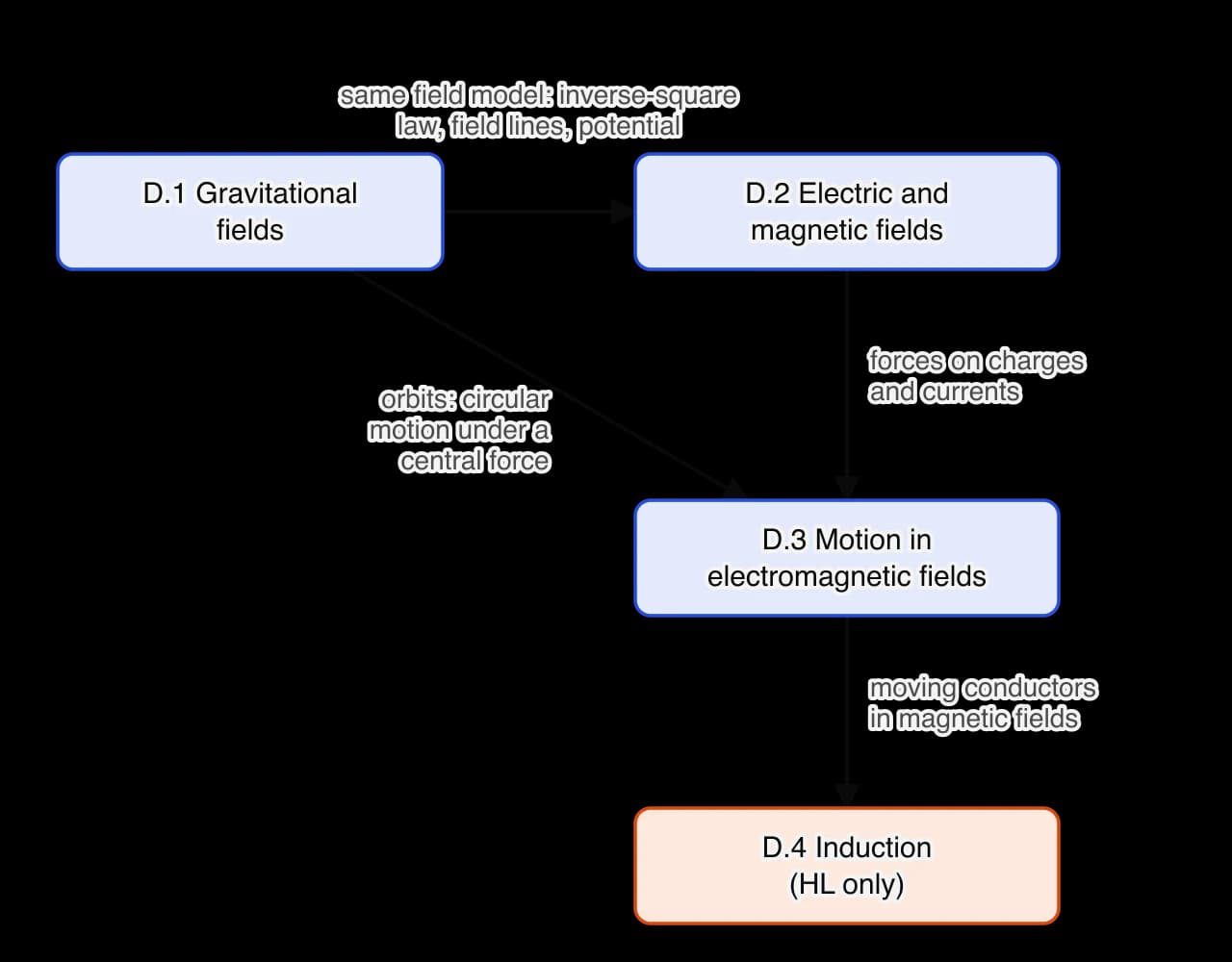
D.1 Gravitational fields starts with Kepler’s laws of planetary motion and Newton’s law of gravitation, . It defines gravitational field strength as force per unit mass, pictures fields with field lines, and explains why satellites and planets move in orbits, with Kepler’s third law derived from the field.
D.2 Electric and magnetic fields applies the same model to charge. Coulomb’s law, , has the same inverse-square form as Newton’s law, but charges can repel as well as attract. Electric field strength, field lines between plates and around charges, Millikan’s evidence that charge is quantised, and the magnetic field patterns of magnets, wires and solenoids all belong here.
D.3 Motion in electromagnetic fields asks what fields do to moving charges. A charge in a uniform electric field follows a parabola, like a projectile; a charge moving across a magnetic field follows a circle, like a satellite; and a current-carrying wire in a magnetic field feels a force, which is how electric motors work.
D.4 Induction (HL only) turns the last idea round. When the magnetic flux through a circuit changes, an emf is induced (Faraday’s law), in a direction that opposes the change (Lenz’s law). This is how the generators in power stations produce most of the world’s electricity.
Big ideas across the theme
One field model for several forces
Gravitational and electric fields are described with the same set of tools: a force law, a field strength (force per unit mass or per unit charge), field lines whose spacing shows strength, and, at HL, potential, potential energy and equipotential surfaces. Learning the model once for gravity makes the electric version faster to learn, and comparing the two shows what is different: gravity is always attractive and very weak, while electric forces can attract or repel and are enormously stronger.
Action at a distance and the field idea
Newton was uneasy that his law described a force acting across empty space. The field model answers this by giving each point in space a property, the field, that acts on whatever is placed there. In electromagnetism the field turned out to be physically real: a changing electric field produces a magnetic field and vice versa, and together they travel as light and other electromagnetic waves (C.2).
Energy in fields
Fields store energy. A satellite trades potential energy for kinetic energy as it moves in an elliptical orbit, an electron accelerated through a potential difference gains kinetic energy, and in D.4 mechanical work done against a magnetic force becomes electrical energy. Each is the conservation of energy from A.3, applied to a field.
Links to other themes
Circular motion and Newton’s laws (A.2) explain orbits in D.1 and the circular paths of charges in D.3.
Projectile motion (A.1) is the model for a charge moving through a uniform electric field.
Current, potential difference and emf (B.5) are used throughout D.2 to D.4.
Coulomb’s law explains alpha-particle scattering (E.1), and the balance between gravity and pressure keeps stars stable (E.5).
Standard level and higher level
Subtopic | SL and HL | HL only |
|---|---|---|
D.1 Gravitational fields | Kepler’s three laws; Newton’s law of gravitation; when extended bodies act as point masses; gravitational field strength ; field lines; circular orbits, orbital speed and period, Kepler’s third law derived | Gravitational potential energy and potential ; potential gradient ; work done ; equipotential surfaces and their relation to field lines; escape speed; the energy of an orbit and of changing orbit; the effect of atmospheric drag on a satellite |
D.2 Electric and magnetic fields | Charge and its conservation; Coulomb’s law; Millikan’s experiment; charging by friction, contact and induction; electric field strength and field lines; the uniform field between plates, ; magnetic field lines | Electric potential energy and potential ; potential gradient ; work done ; equipotential surfaces for charges, spheres and plates |
D.3 Motion in electromagnetic fields | The whole subtopic | — |
D.4 Induction | — | The whole subtopic: magnetic flux, Faraday’s and Lenz’s laws, emf induced in moving conductors and rotating coils |
At SL the theme concentrates on forces and field strengths: calculating forces between masses and charges, sketching field patterns, and predicting the motion of satellites and charged particles. At HL the same fields are also described by energy. Potential and equipotential surfaces map a field as contour lines map a landscape, and they make it possible to calculate how much energy a spacecraft needs to escape a planet or to change orbit, how much work moves a charge between two points, and, in D.4, how mechanical energy becomes electrical energy in a generator.
Flashcards for D
The official decks for this part of the syllabus.
- D.1 Gravitational fields211 cards
- D.2 Electric and magnetic fields265 cards
- D.3 Motion in electromagnetic fields143 cards
- D.4 Induction165 cards
From the data booklet
The entries of the physics data booklet that D uses. Each opens in the explained booklet.
- Acceleration of free fallFundamental constants
- Gravitational constantFundamental constants
- Coulomb constantFundamental constants
- Permittivity of free spaceFundamental constants
- Permeability of free spaceFundamental constants
- Elementary chargeFundamental constants
- Electron rest massFundamental constants
- 1 astronomical unit (AU) Unit conversions
- Newton’s law of gravitationD. Fields › Standard level and higher level › D.1 Gravitational fields
- Gravitational field strengthD. Fields › Standard level and higher level › D.1 Gravitational fields
And 19 more in the data booklet.
Carry on with D in Augment
With a free account, Augment remembers where you stopped and what you have practiced.