How charged particles and currents move in uniform electric and magnetic fields: parabolic and circular paths, velocity selection, charge-to-mass ratio, and forces on wires.
Each is in the Physics glossary, with every other term in the subject.
Light emitted high in the atmosphere near the polar regions by atoms excited by charged particles from the Sun, guided there by the Earth’s magnetic field.
The charge of a particle divided by its mass, , in ; it sets the radius and period of the particle’s path in a magnetic field.
Uniform electric and magnetic fields at right angles to each other, arranged so that their forces on a moving charge act in opposite directions.
A pivoted frame that measures a magnetic flux density by balancing the magnetic force on a current-carrying wire against the weight of a known mass.
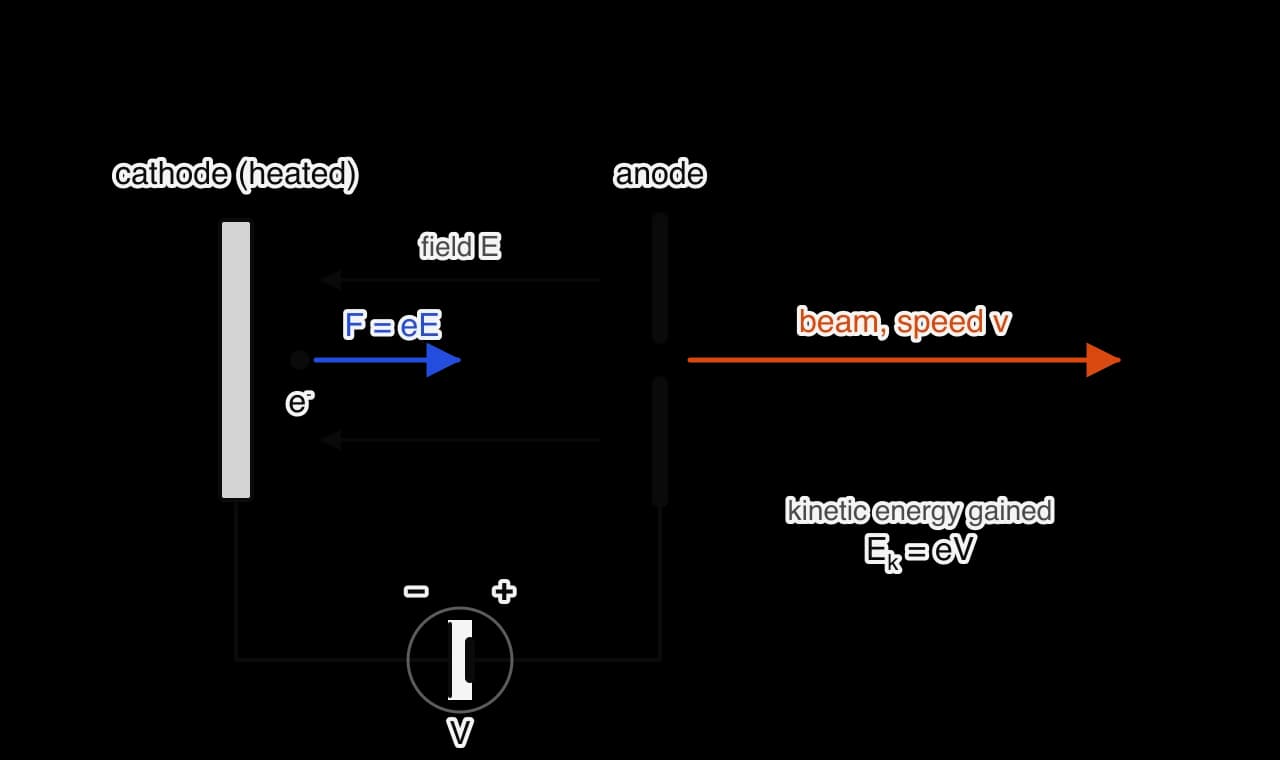
A device that produces a narrow beam of electrons: electrons released from a heated cathode are accelerated through a potential difference towards an anode and pass through a hole in it.
A glass bulb containing an electron gun and gas at low pressure, in which an electron beam bent into a circle by a magnetic field is made visible by the glowing gas.
A rule for the direction of the magnetic force: with the first finger along the field and the second finger along the conventional current, the thumb points along the force.
The force a magnetic field exerts on a moving charge, , perpendicular to both the velocity and the field.
An instrument that separates ions by their charge-to-mass ratio, using the different radii of their paths in a magnetic field, to measure the masses and abundances of isotopes.
The force on a current-carrying conductor in a magnetic field, , used in electric motors and loudspeakers.
The constant that sets the strength of the magnetic field produced by a current in a vacuum.
The continuous stream of charged particles, mainly protons and electrons, flowing outwards from the Sun.
The SI unit of magnetic flux density: the field that exerts a force of 1 N on a 1 m length of wire carrying 1 A at right angles to it; .
The release of electrons from the surface of a heated metal, when some electrons gain enough energy to escape.
An arrangement of crossed electric and magnetic fields that lets through undeflected only particles with speed .
83 exam-style questions on this subtopic, written in the style of the IB papers. The first has its markscheme open. Counted on
In a mass spectrometer, singly charged positive ions of neon-20 (mass 20 u) and neon-22 (mass 22 u) all move with a speed of m s. They enter a region of uniform magnetic field of strength 0.20 T through a slit S. The field is directed into the page. The ions travel in semicircles and strike a detector plate.
One of 60 short multiple-choice questions on D.3. Pick an answer to see why it's right or wrong.
A charged particle enters a uniform magnetic field moving at right angles to the field. What is the shape of its path while it is in the field?
The official deck for this part of the syllabus.
Why does a charged particle between two oppositely charged parallel plates have a constant acceleration?
Write the equation for the acceleration of a particle of charge and mass between parallel plates with pd and separation , with each symbol defined.
The entries of the physics data booklet that D.3 uses. Each opens in the explained booklet.
With a free account, Augment remembers where you stopped and what you have practiced.
A current-carrying conductor in a magnetic field feels a force .
Two parallel currents exert equal and opposite forces on each other: attractive when the currents are in the same direction, repulsive when they are opposite.
Electric and magnetic fields push on electric charges, and when the charges are free to move, the fields steer them. An electric field speeds charged particles up or bends their paths into parabolas; a magnetic field bends the path of a moving charge into a circle without changing its speed. Together these effects explain how electron beams are produced and steered, how the charge and mass of the electron were first compared, and why electric motors turn.
The same physics works on very different scales. Inside a laboratory tube, electrons accelerated through a few hundred volts circle in a magnetic field a few thousandths of a tesla strong. High above the polar regions, particles from the Sun are guided by the Earth’s magnetic field into the upper atmosphere, where they light up the aurora.
Between two parallel plates with a potential difference across them, the electric field is uniform: it has the same strength and direction everywhere except near the edges. Its strength is
where is the separation of the plates. A particle of charge in this field feels a force , which is the same at every point. By Newton’s second law, the particle has a constant acceleration
The force on a positive charge is along the field lines, from the positive plate towards the negative one. The force on a negative charge, such as an electron, is in the opposite direction. Because the acceleration is constant, the equations of uniformly accelerated motion apply, exactly as they do for a falling ball.
A charged particle in an electric field near the Earth is also pulled down by gravity. For electrons, protons and ions the gravitational force is so much smaller than the electric force that it can be ignored. Larger charged objects, such as the oil drops in Millikan’s experiment, are different: their weight is comparable with the electric force.
When a charge moves through a potential difference , the field does work on it. If the charge starts from rest and nothing else acts, all of this work becomes kinetic energy:
This is how an electron gun works. A metal cathode is heated so that electrons escape from its surface, a process called thermionic emission. An anode a short distance away is held at a potential above the cathode, so the electrons accelerate towards it, and those passing through a hole in the anode form a narrow beam. The kinetic energy of each electron in the beam is , which is why accelerating pds are often quoted in energy units: an electron accelerated through 1 V gains one electronvolt (1 eV), which is J.
A particle that enters the space between the plates moving parallel to them behaves like a projectile thrown horizontally. Its velocity parallel to the plates is unchanged, because no force acts in that direction. At right angles to the plates it accelerates uniformly from zero. The two motions are independent, and together they give a parabolic path.
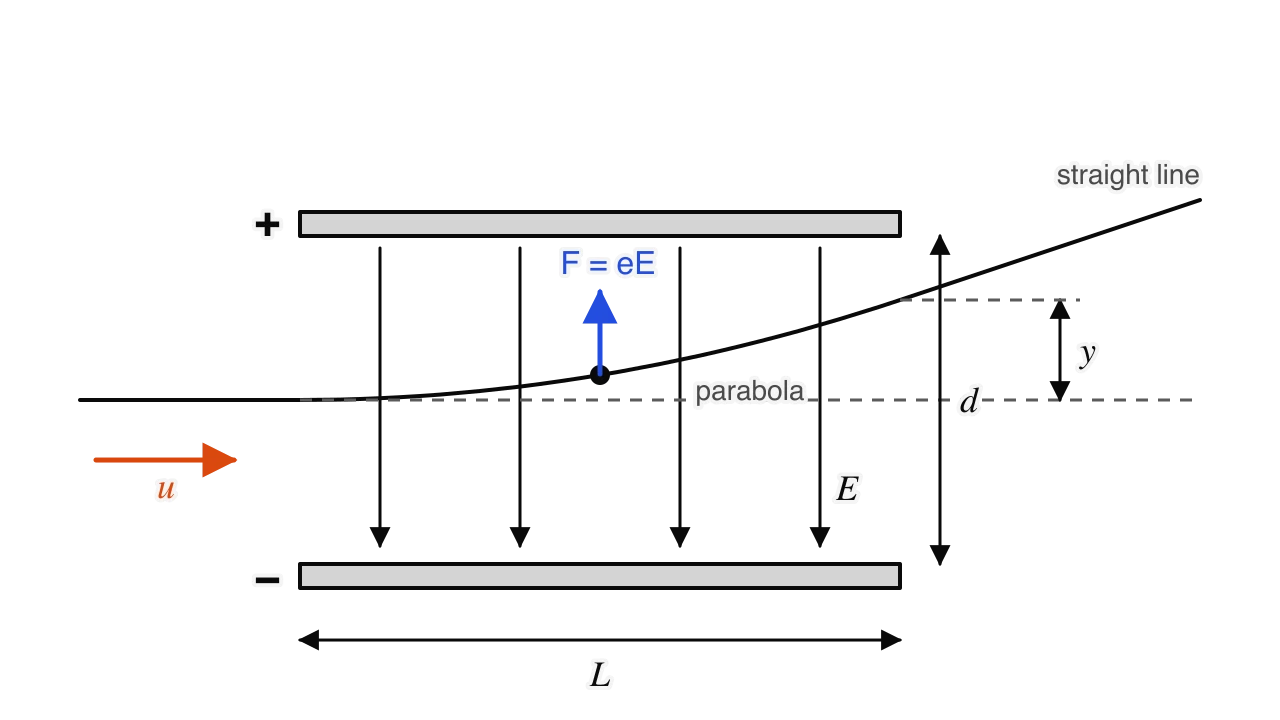
For plates of length , a particle entering with speed spends a time between them. In that time it gains a perpendicular velocity and a sideways displacement
After it leaves the plates there is no more force, so the particle continues in a straight line in the direction it had at the exit. The angle of that line to the original direction satisfies . A beam that is deflected this way can be aimed at different points on a screen by changing the pd across the plates, which is how the beam in a cathode-ray oscilloscope is steered.
A magnetic field exerts no force on a stationary charge. Once the charge moves, a force appears, and it has three features that make it unlike any force met in mechanics. Its size depends on the speed of the charge. Its direction is at right angles to the velocity. It is also at right angles to the field itself, so it never points along the field lines.
For a charge moving with speed at an angle to a magnetic field of strength , the size of the magnetic force is

The factor means that only the component of the velocity perpendicular to the field, , matters. The force is largest, , when the charge moves at right angles to the field (). A charge moving along the field lines ( or ) feels no magnetic force at all.
The equation is also the way the strength of a magnetic field is defined. Rearranging it for a charge moving at right angles to the field gives .
Magnetic flux density is the full name for what is often called the magnetic field strength. From the definition, one tesla is the field that exerts a force of 1 N on a charge of 1 C moving at at right angles to it, so . The tesla is a large unit: the Earth’s field at the surface is about T, and the field between the poles of a strong school magnet is about 0.1–0.5 T.
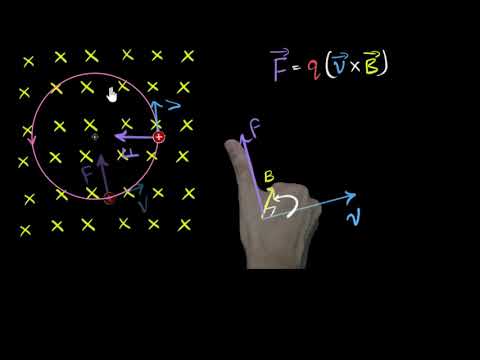
The force, the velocity and the field are mutually perpendicular when the velocity is at right angles to the field. The direction of the force on a positive charge is given by Fleming’s left-hand rule. The first finger points along the field, the second finger along the velocity of the positive charge (the direction of conventional current), and the thumb then gives the direction of the force.
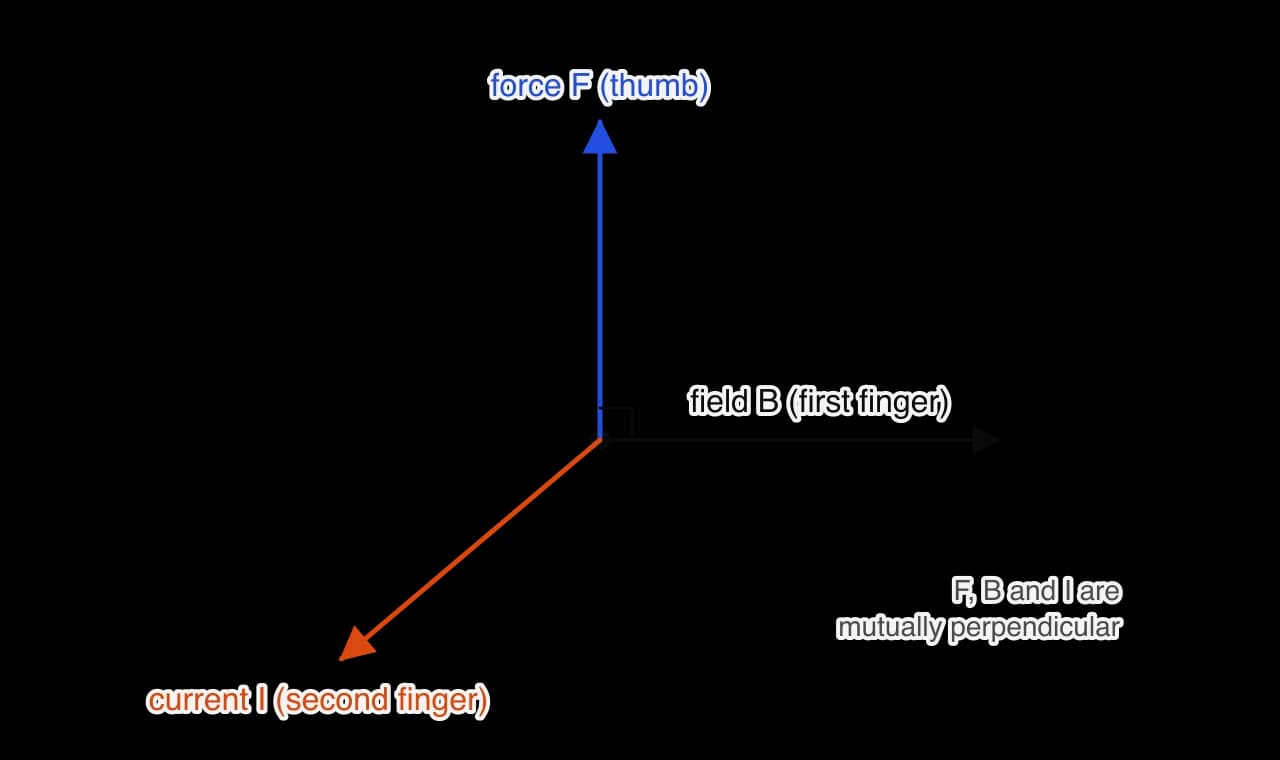
For a negative charge such as an electron, the force is in the opposite direction. The simplest way to handle this is to remember that a negative charge moving one way is equivalent to a conventional current in the opposite direction: point the second finger against the electron’s velocity. Some textbooks use a right-hand rule instead (fingers along , thumb along , palm pushing in the direction of on a positive charge). Either rule gives the same answer, and it is best to learn one and use it every time.
Diagrams of these situations show fields perpendicular to the page with two symbols. A cross (⊗) means the field points into the page, like the tail feathers of an arrow flying away. A dot (⊙) means the field points out of the page, like the tip of an arrow coming towards the reader.
 YouTube
The two kinds of force on a charged particle behave differently, and the differences explain the different shapes of the paths they produce.
Electric force | Magnetic force | |
|---|---|---|
Size | ||
On a stationary charge | Yes | No |
Direction | Along the field lines (opposite for negative charges) | Perpendicular to both the field and the velocity |
Work done on the particle | Can do work: changes the speed | Does no work: speed constant |
Path in a uniform field (entering at right angles) | Parabola | Circle |
The magnetic force on a moving charge is always perpendicular to its velocity. A force at right angles to the motion does no work: it changes the direction of the velocity but never its size. So in a magnetic field alone, the speed and the kinetic energy of a charged particle stay constant, however long it moves.
When the particle moves at right angles to a uniform field, the force has the constant size and always points sideways to the motion. A force of constant size that is always perpendicular to the velocity is exactly what produces uniform circular motion, so the particle moves in a circle. The magnetic force provides the centripetal force.
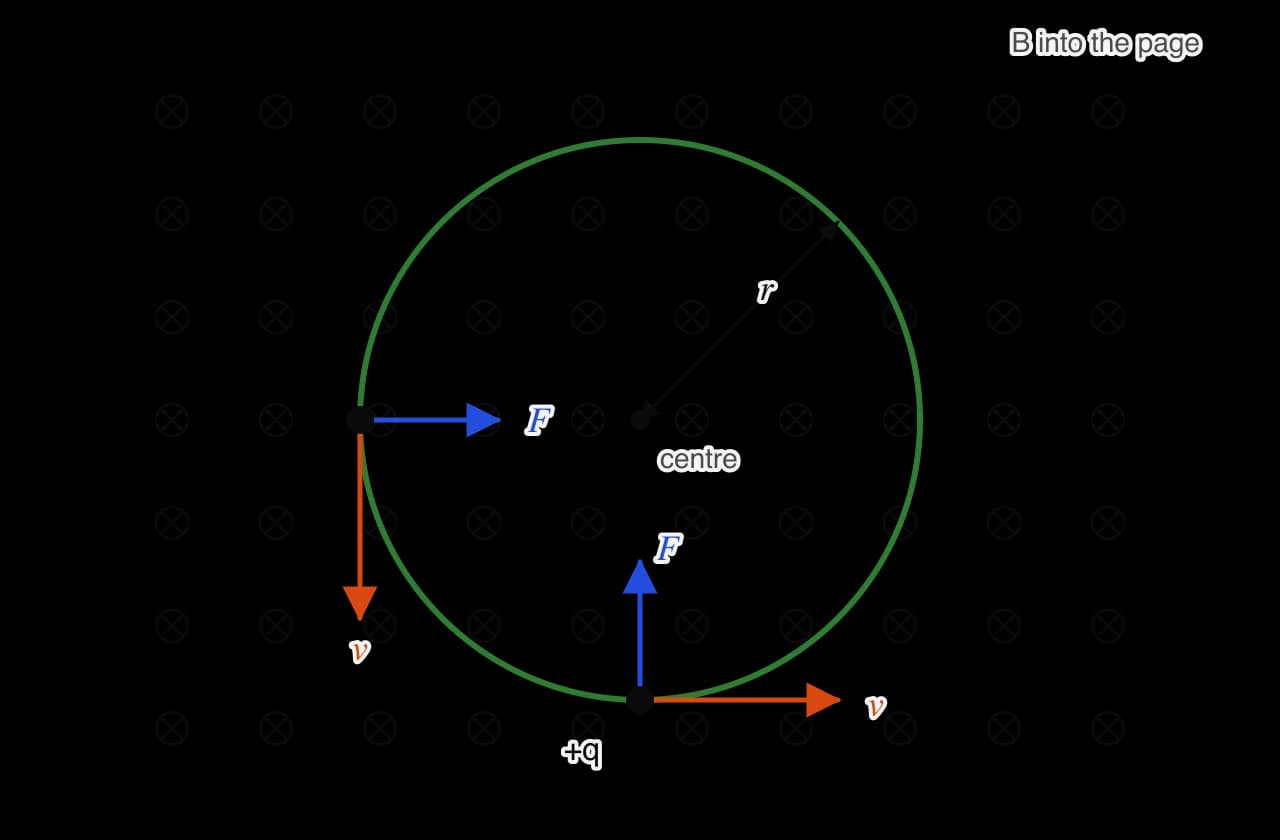
Setting the magnetic force equal to the centripetal force gives the radius of the circle:
The radius is proportional to the momentum of the particle and inversely proportional to its charge and to the field strength. A faster or heavier particle is harder to turn, so it moves in a larger circle. A stronger field or a larger charge gives a larger force and a tighter circle.
The time for one revolution is the circumference divided by the speed:
The speed cancels. A faster particle travels further on its larger circle, but at a higher speed, and the two effects exactly balance, so all particles with the same charge-to-mass ratio take the same time to go round in a given field. This is the principle the cyclotron uses to accelerate particles.
 YouTube
Particles that enter the same field at the same speed curve by different amounts. The direction of curvature gives the sign of the charge, and the radius gives the ratio . The radius is proportional to at a fixed speed, so a proton and an electron moving at the same speed curve in opposite directions, the electron in a circle 1836 times smaller. An α particle (two protons and two neutrons, charge ) has about four times the proton’s mass but twice its charge, so its path has twice the radius of the proton’s.
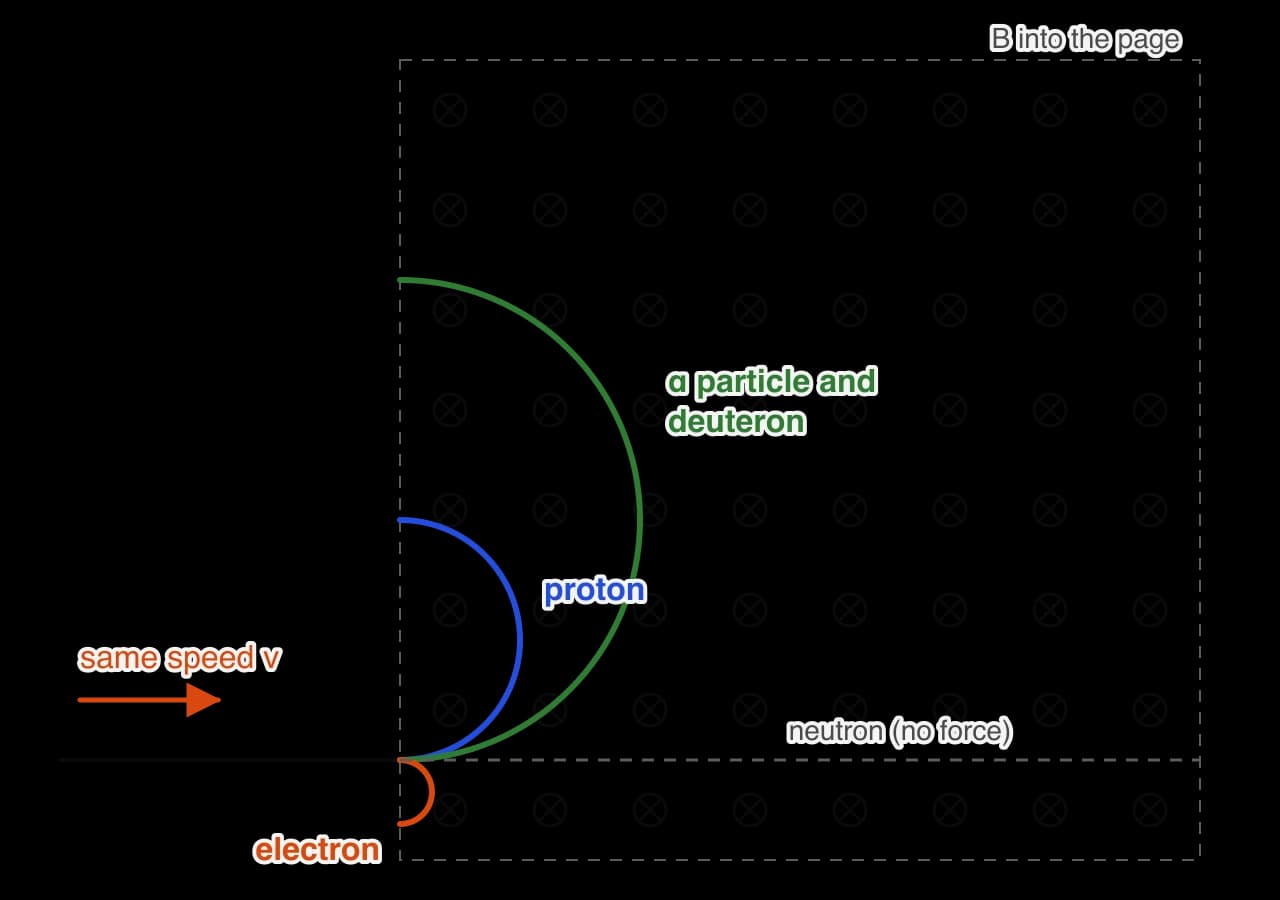
If the particles have instead been accelerated from rest through the same pd , each has kinetic energy . Then , and
Sorting charged particles by the radius of their paths is the basis of the mass spectrometer, which separates the ions of different isotopes of an element. Ions of the same speed and charge but different mass land at different points on a detector, so the instrument measures the relative abundance of each isotope. Chemists use it to identify unknown compounds, and geologists use it in radiometric dating.
In 1897 J. J. Thomson used electric and magnetic deflections of cathode rays to show that they were streams of particles with a charge-to-mass ratio more than a thousand times that of a hydrogen ion. This was the discovery of the electron, the first particle found to be smaller than an atom. The same idea is used today in school laboratories with a fine-beam tube.
A fine-beam tube is a glass bulb containing an electron gun and a small amount of gas at low pressure. A pair of coils outside it produces a uniform magnetic field at right angles to the beam. The electrons collide with gas atoms, which glow, so the circular path can be seen and its diameter measured.
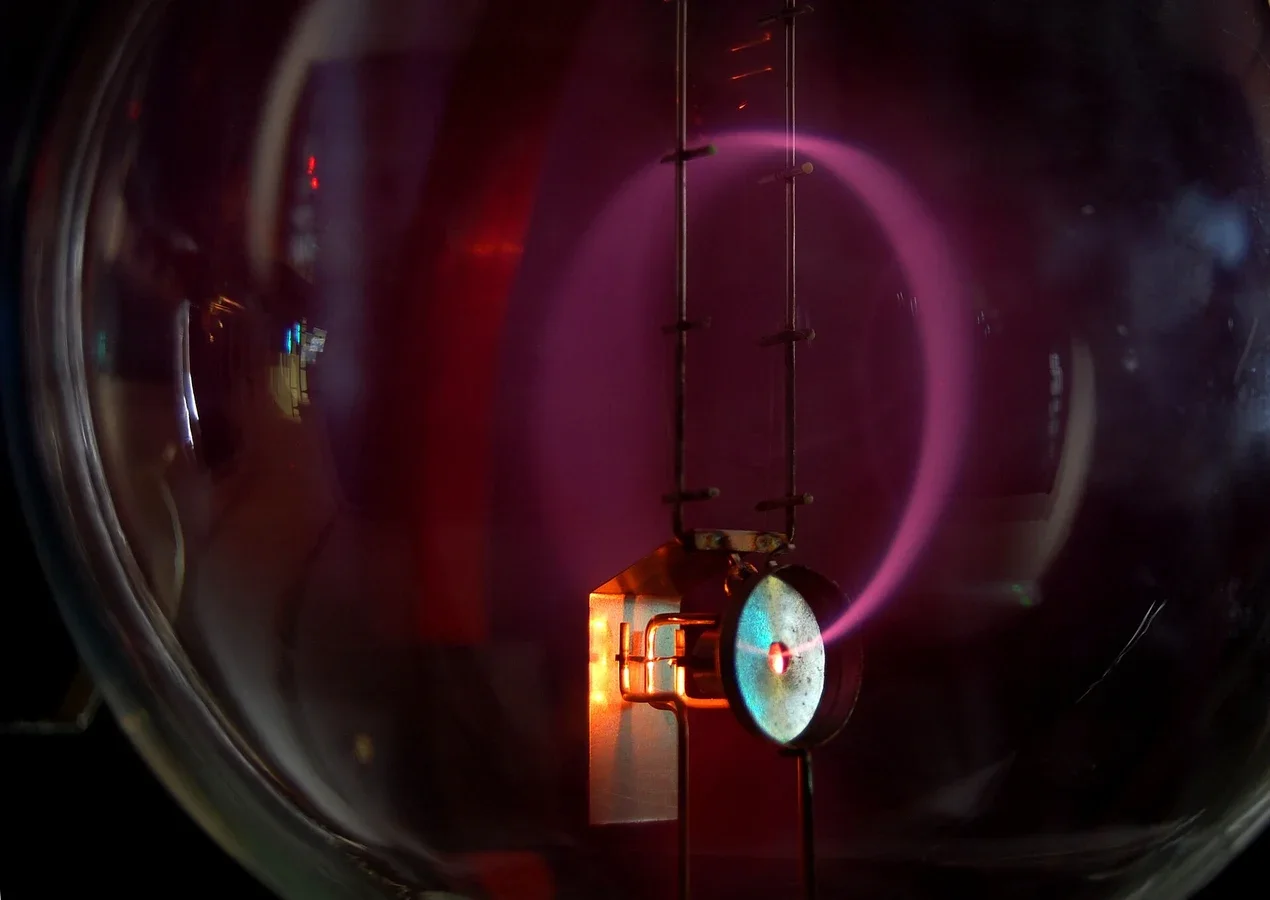
Two equations describe the experiment. The electron gun gives the electrons kinetic energy , and the field bends them into a circle of radius :
Eliminating the speed (it equals from the second equation) gives the charge-to-mass ratio in terms of quantities that can all be measured:
The Sun continuously releases a stream of charged particles, mainly protons and electrons, called the solar wind. It reaches the Earth at around . The Earth’s magnetic field deflects most of these particles around the planet, shielding the surface. A proton moving at this speed at right angles to a field of T would circle with a radius of m, tiny compared with the Earth, so the particles cannot travel straight across the field lines.
Charged particles can, however, move freely along the field lines, where the magnetic force is zero. Near the magnetic poles the field lines dip steeply into the atmosphere, and particles travelling along them reach altitudes of about 100–300 km. There they collide with oxygen and nitrogen atoms and excite them, and the atoms emit light as they return to their ground states. Green light comes from oxygen at about 100–250 km; red light from oxygen higher up; blue and violet light from nitrogen. These glowing curtains are the aurora borealis in the north and the aurora australis in the south. During strong solar storms more energetic particles arrive and the aurora can be seen much further from the poles.

The aurora links several parts of physics: the magnetic force on moving charges, energy levels in atoms and the emission spectra they produce, and the Sun as a source of particles as well as radiation. The same shielding protects astronauts on the International Space Station, which orbits inside the Earth’s magnetic field.
An electric field and a magnetic field can be arranged at right angles to each other so that their forces on a moving charge point in opposite directions. This arrangement of crossed fields is used in a velocity selector to select particles of one particular speed from a beam containing many.
The selector has parallel plates that produce an electric field , and a magnetic field at right angles to both the electric field and the beam. For a positive ion moving to the right with into the page and the top plate positive, the electric force points down and the magnetic force points up.
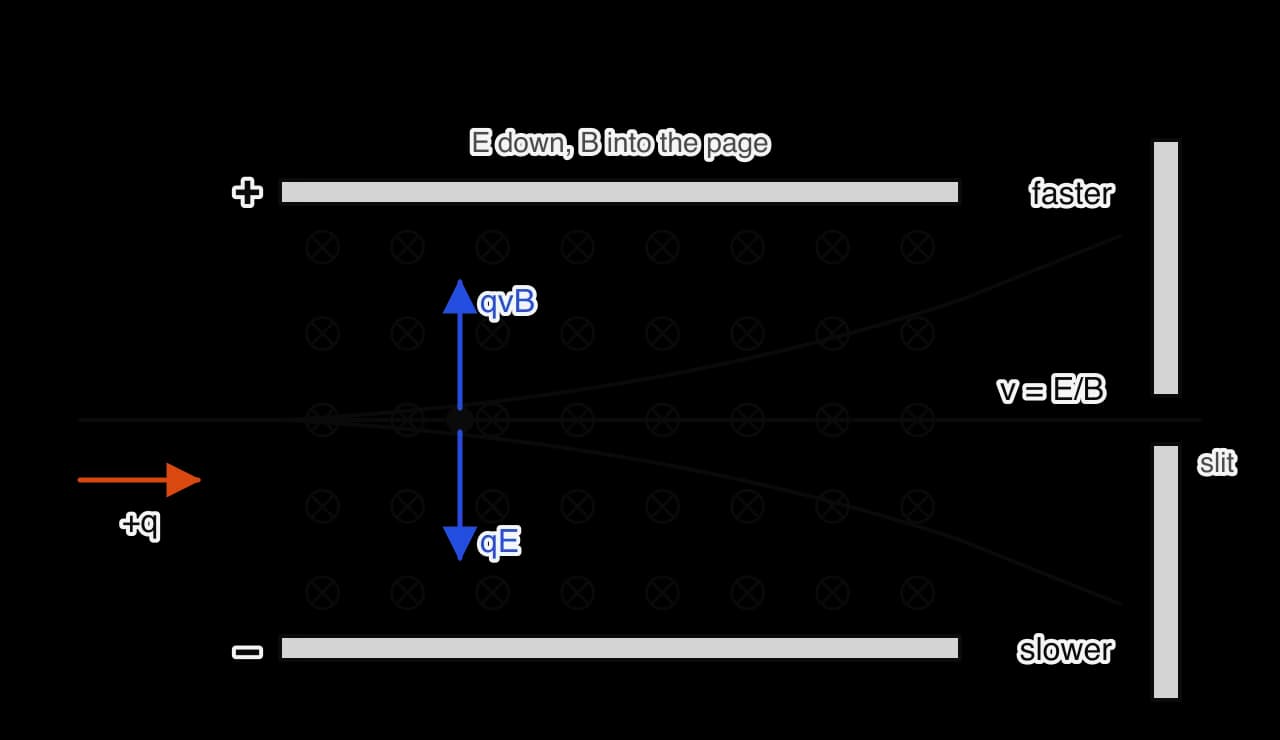
The ion passes through undeflected when the two forces balance:
The charge cancels, and the mass does not appear at all. Every particle travelling at exactly goes straight through, whatever its charge, sign or mass. For a faster particle the magnetic force is larger than the electric force, so it curves in the direction of the magnetic force; a slower particle curves the other way, because the electric force, which does not depend on speed, is then the larger. A slit at the far end lets through only the particles that are not deflected.
A velocity selector is often the first stage of a mass spectrometer. All the ions leaving it have the same known speed . In a second region with only a magnetic field , each ion moves in a circle of radius . Since and are known, measuring gives , and for ions of known charge, their mass.
A current in a wire is a flow of moving charges, so a wire carrying a current in a magnetic field feels a force: the sum of the magnetic forces on all its moving charges. This is the motor effect, and it is what turns electric motors and moves the cones of loudspeakers. For a straight wire of length carrying a current at an angle to a uniform field , the force is
The force is largest, , when the wire is at right angles to the field and zero when the wire lies along the field. Its direction is perpendicular to both the wire and the field and is given by Fleming’s left-hand rule, with the second finger along the conventional current.
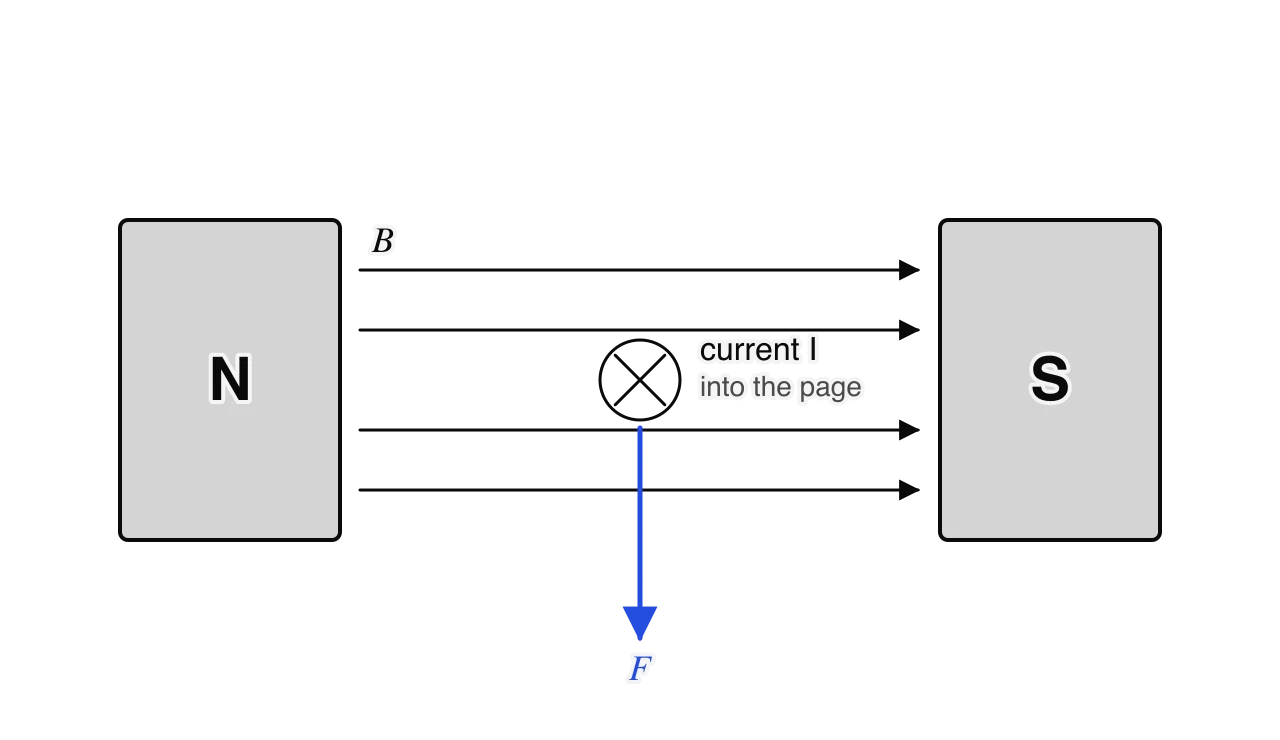
Suppose a total moving charge is spread along a length of wire and drifts along it at speed . The time for this charge to pass any point is , so the current is , or .
The magnetic force on all the moving charge is . Replacing by gives
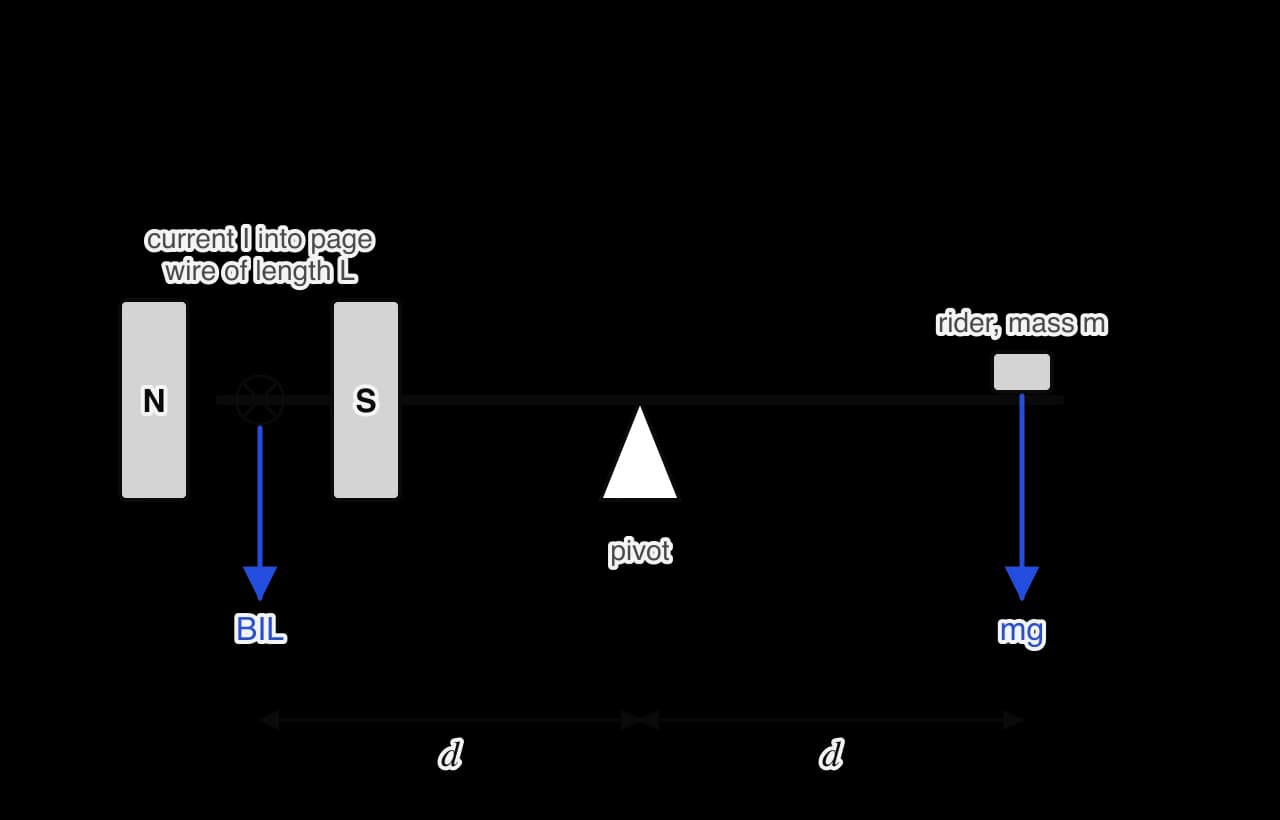
A current balance measures a magnetic field directly from the force on a wire. A light frame carrying a current is pivoted so that one horizontal section of wire, of length , lies at right angles to the field. When the current flows, the magnetic force tips the frame, and a small known mass (a rider) is placed on the other side to restore the balance.
The force on a coil of wire is the basis of the electric motor. In a rectangular coil in a magnetic field, the current flows in opposite directions along the two sides that are perpendicular to the field. The forces on those sides are equal and opposite and not along the same line, so they form a couple that turns the coil. A loudspeaker uses the same effect in a straight line: an alternating current in a coil sitting in the field of a permanent magnet produces a force that drives the coil, and the cone attached to it, back and forth at the frequency of the sound.
A current produces a magnetic field around it. For a long straight wire, the field lines are concentric circles centred on the wire, in planes at right angles to it. The field is strongest close to the wire and weakens with distance, so the circles are drawn further apart further out.
The direction of the field lines is given by the right-hand grip rule: grip the wire with the right hand so that the thumb points along the conventional current, and the curled fingers point in the direction of the field. Seen from the end that the current comes out of, the field goes anticlockwise.
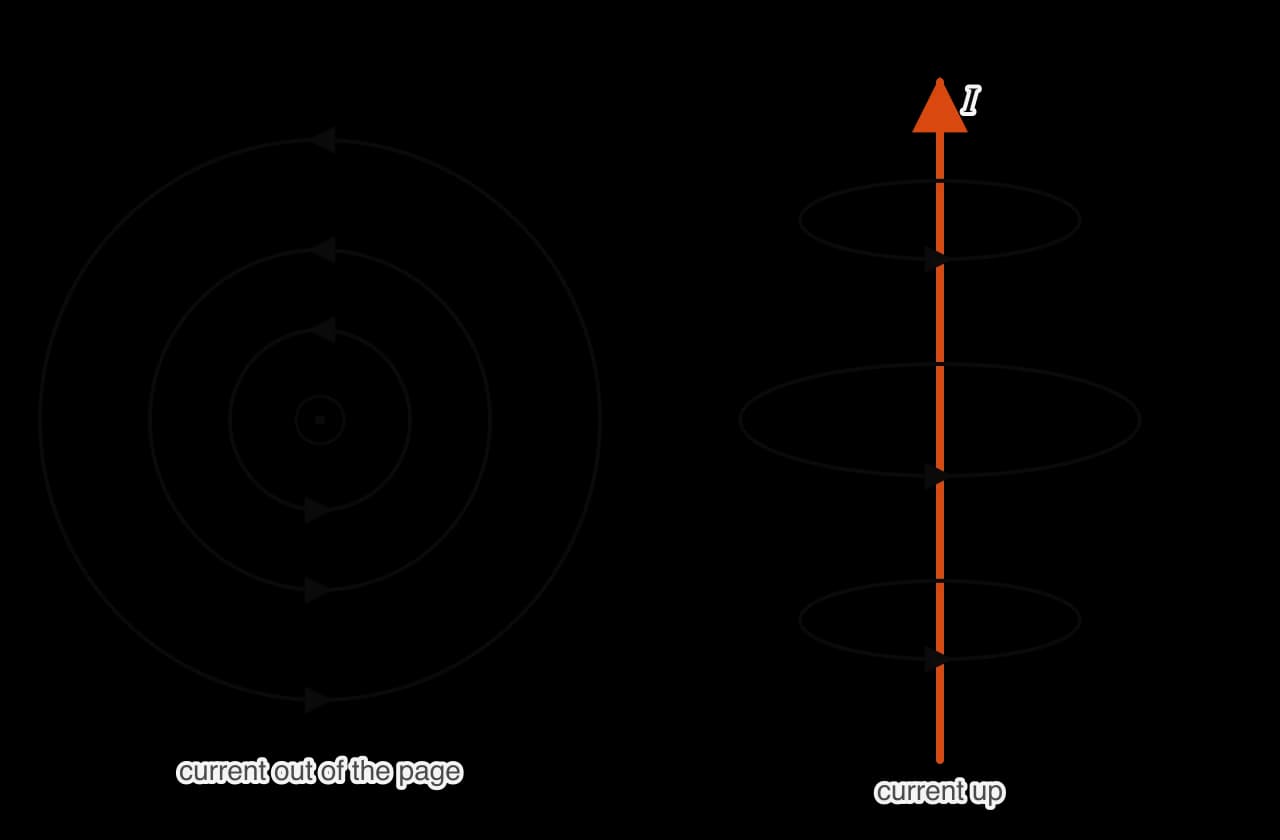
At a distance from a long straight wire carrying a current , the magnetic flux density is , where is the permeability of free space. The field is proportional to the current and inversely proportional to the distance.
For a current of 10 A, the field 5.0 cm from the wire is
Two long parallel wires carrying currents each lie in the magnetic field of the other, so each feels a force. The direction follows from the two rules in turn. In the parallel-wires diagram, the field of wire 1 at wire 2 points up the page (right-hand grip rule). With current 2 out of the page and the field up, Fleming’s left-hand rule gives a force on wire 2 towards wire 1. The same reasoning applied to wire 1 gives a force towards wire 2.
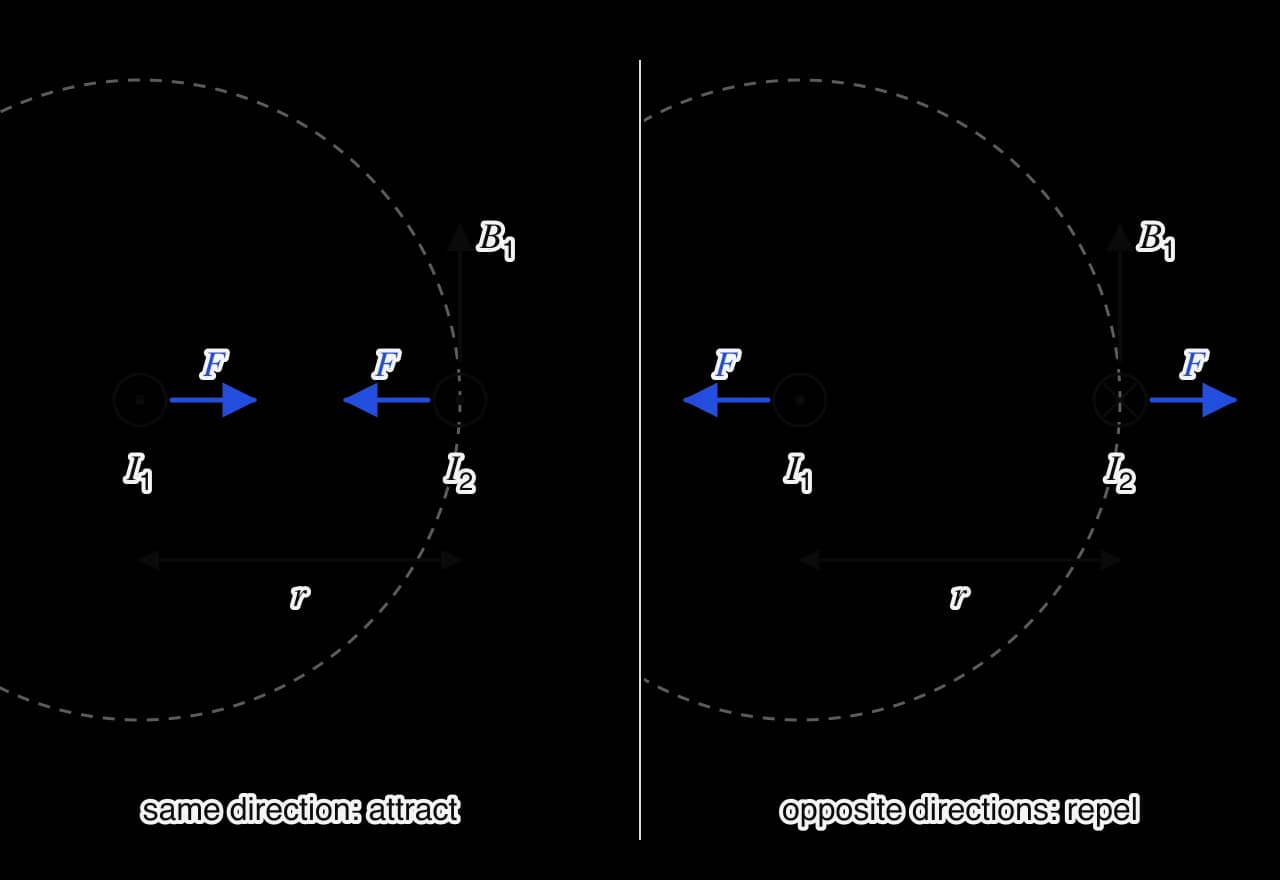
The size of the force on a length of either wire, when the wires are a distance apart in a vacuum (or air), is
The force per unit length is proportional to each current and inversely proportional to the separation. The equation comes from combining with the field of a wire: the field of wire 1 at wire 2 is , and the force on a length of wire 2 is this field times .
The force on wire 1 has exactly the same size as the force on wire 2, even if the currents are different. The expression is symmetrical in and , and the two forces are a Newton’s third law pair: equal in size, opposite in direction, and acting on different bodies.
When there are more than two wires, the force on any one of them is the vector sum of the forces from each of the others, calculated in pairs. For wires in a line, each force is along the line, so the resultant is found by adding forces with signs.
From 1948 until 2019 the force between parallel wires defined the SI unit of current. One ampere was the constant current that, flowing in two infinitely long, thin, parallel wires 1 m apart in a vacuum, produced a force of N on each metre of wire. Substituting into shows why had the exact value . Infinitely long wires cannot be built, so in practice the definition was realised with current balances using coils. In 2019 the ampere was redefined by fixing the value of the elementary charge , which links the unit directly to the charge of a single particle and allows more precise measurements.
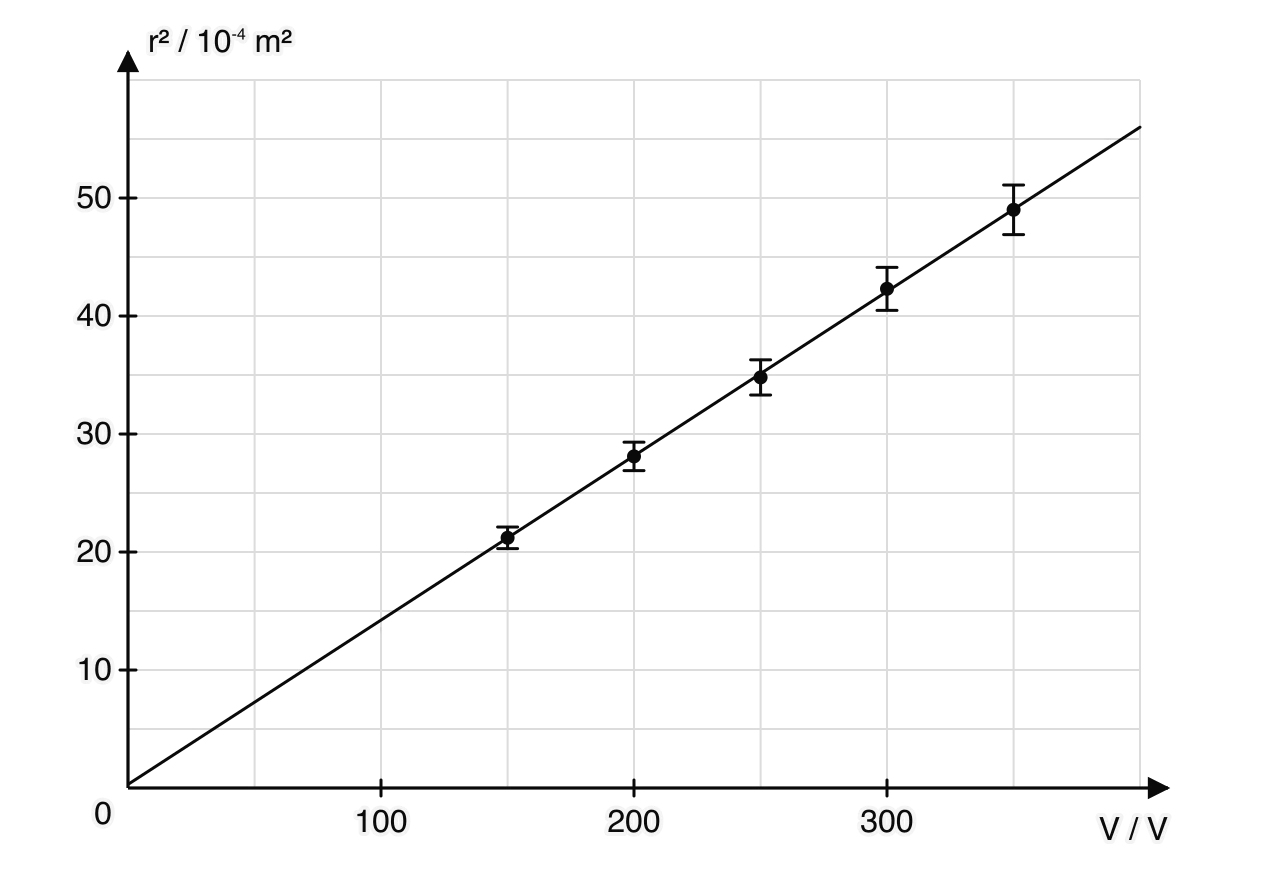
A group of students use a fine-beam tube to determine for the electron. The magnetic flux density is kept at mT while the accelerating pd is varied. For each pd they measure the diameter of the circular beam with a ruler; the uncertainty in each diameter is cm. The table and the graph show the variation of with .
/ V | / cm | / m² |
|---|---|---|
150 | 9.2 | 21.2 |
200 | 10.6 | 28.1 |
250 | 11.8 | 34.8 |
300 | 13.0 | 42.3 |
350 | 14.0 | 49.0 |
I can calculate the force and acceleration of a charged particle in a uniform electric field between parallel plates.
I can calculate the speed of a charged particle accelerated from rest through a potential difference.
I can describe and analyse the parabolic path of a charged particle entering a uniform electric field at right angles, including the time in the field and the deflection.
I can use to find the size of the magnetic force on a moving charge, and a hand rule to find its direction for positive and negative charges.
I can explain why the kinetic energy of a charged particle stays constant in a magnetic field.
I can derive and use and for circular motion in a magnetic field.
I can compare the paths of different particles and identify a particle from its charge-to-mass ratio.
I can describe how the charge-to-mass ratio of the electron is determined from the radius of its path.
I can explain how perpendicular electric and magnetic fields select particles with speed .
I can use to find the force on a current-carrying conductor and its direction.
I can sketch the magnetic field around a straight wire and give its direction with the right-hand grip rule.
I can calculate the force per unit length between parallel wires, state when it is attractive or repulsive, and explain why the forces on the two wires are equal.
I can find the resultant force on one of three parallel wires and analyse a current balance.
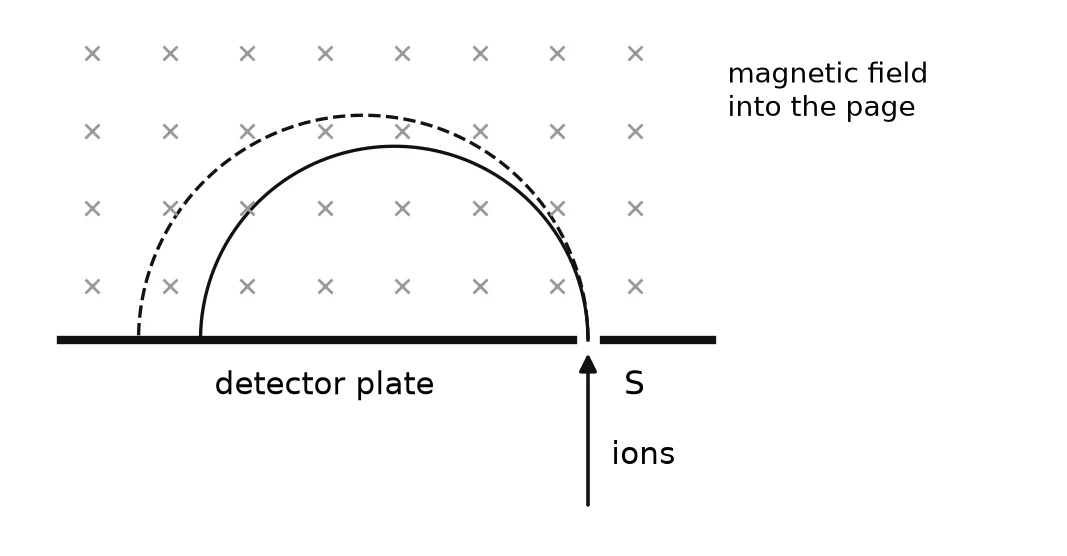
Explain why the ions move in a circular path.
2 marks
the magnetic force is perpendicular to the velocity ✓
it has a constant magnitude and changes only the direction of motion, so it acts as a centripetal force ✓
Outline why the kinetic energy of an ion does not change while it is in the field.
1 mark
the force is perpendicular to the displacement/velocity so no work is done on the ion ✓
Show that the radius of the path of a neon-20 ion is about 6 cm.
2 marks
so ✓
«m» ✓
Must see the substitution OR the answer to at least 3 s.f.
Determine the distance between the points where the neon-20 and the neon-22 ions strike the detector plate.
2 marks
Calculate the time that a neon-20 ion spends in the magnetic field. State, with a reason, whether a faster neon-20 ion would spend more time, less time or the same time in the field.
2 marks
Calculate the centripetal acceleration of a neon-20 ion in the field.
1 mark
«
A cloud chamber is placed in a uniform magnetic field of strength 0.20 T. At one instant an alpha particle in the chamber moves with a speed of in a direction at 30° to the magnetic field. What is the magnitude of the magnetic force on the alpha particle?
A beam of electrons in an evacuated tube travels to the right. It enters a region of uniform magnetic field directed into the page.
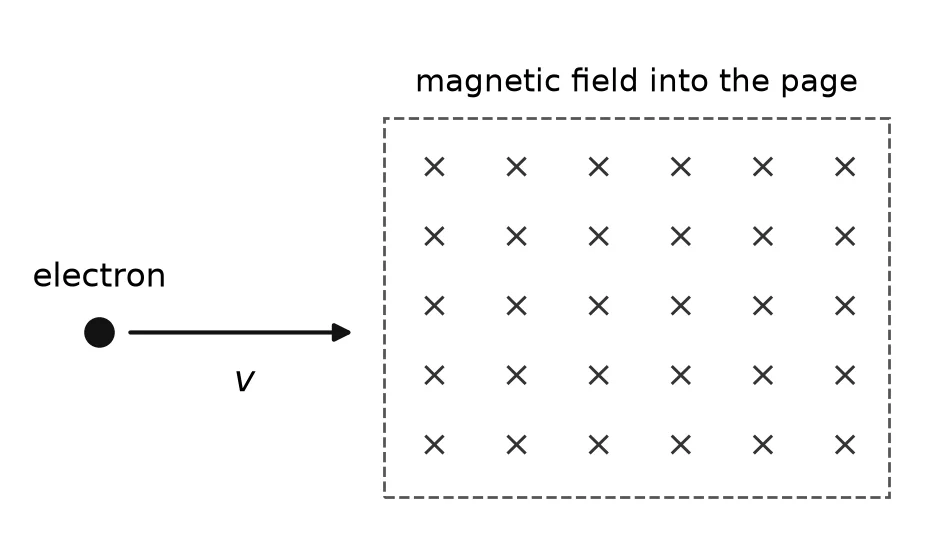
What is the direction of the magnetic force on an electron as it enters the field?
relative to the proton |
|---|
Radius |
|---|
Proton | 1 | 5.0 cm |
Deuteron | 2 | cm |
α particle | cm |
The deuteron and the α particle have the same , so they follow the same path and cannot be told apart by this measurement alone. At the same speed (rather than the same pd) their radii would both be 10 cm, since then .
A comes from confusing the radius with the period, which does not depend on speed. C treats the radius as proportional to the pd, and D squares the factor instead of taking its square root.
(b) a straight line passes through the origin «within the error bars», showing ✓
(c) gradient read from the line, e.g. «accept to » ✓
✓
✓ «allow ECF from the gradient»
(d) the value differs from the accepted value by about 1%, which is less than the about 4% uncertainty in , so the values agree within the uncertainty ✓