Notes on 2.7 Composite and inverse functions
Learning objectives
Find composite functions , both as values and as expressions.
Interpret a composite function in context, explaining why the order of the two processes matters.
Determine the domain and range of a composite function.
Find the inverse of a function algebraically and state its domain and range.
Show that two functions are inverses by composing them to give the identity function.
Determine a domain restriction that makes a many-to-one function one-to-one, and find the inverse on that domain.
Solve equations of the form using technology.
Interpret an inverse function in context, including situations where a process cannot be exactly undone.
Introduction
Many real processes happen in stages. A price has tax added and then a discount taken off; a sum of money is converted into another currency and then a fee is charged; a population grows over time and its size decides how much food it needs. Each stage is a function, and the whole process is a single new function made by feeding the output of one stage into the next. Running a process backwards, from the result to the starting value, is the job of an inverse function.
Subtopic 2.2, Functions, domain and range, introduced inverse functions as reflections in the line and found single values such as by solving . The work here adds the algebra: building composite functions, finding a formula for an inverse, and choosing a domain that allows an inverse to exist at all.
Composite functions
Function machines
A simple way to picture a function is as a machine: a number goes in, the machine applies a rule, and a number comes out. A function with rule takes the input 2 and gives the output 5. Thinking of functions as machines makes it natural to connect two of them, so that the output of the first becomes the input of the second.
The two chains of machines in the figure use the same two functions, and , in opposite orders. Starting from 2, one order gives 11 and the other gives 5.
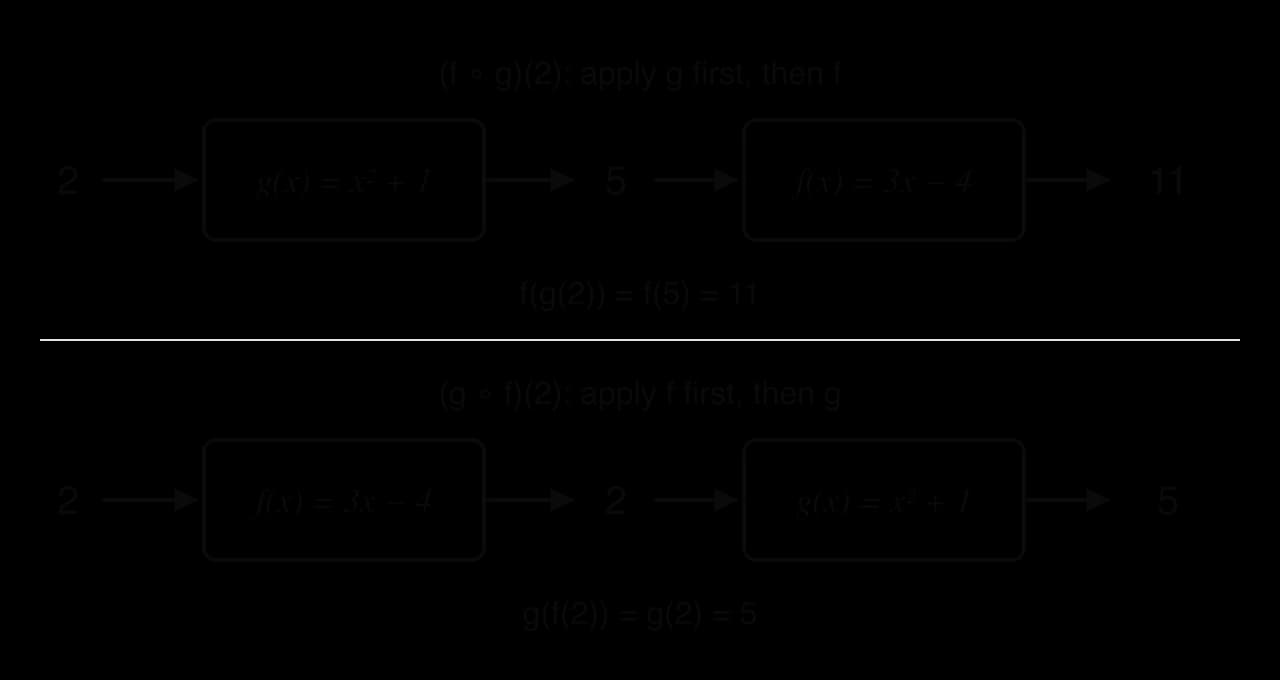
The notation (f ∘ g)(x)
When is applied first and is applied to the result, the combined function is written and read " composed with " or "
The notation reads from right to left, which surprises many students. In , the function closest to acts on first, in the same way that in
To find a value of a composite, work from the inside out: evaluate the inner function, then put that number into the outer function. To find an expression, replace every in the outer function's rule by the whole expression for the inner function, in brackets.
Why the order matters
For most pairs of functions, and are different functions, as the example shows: and
There are special pairs that do commute. Two functions that both multiply by a constant, such as and , give in either order, and two functions that both add a constant commute as well. A function and its inverse always commute, which is the basis of the inverse work later. These cases are exceptions, and in general the order is assumed to change the result unless a calculation shows otherwise.
Composing a function with itself
A function can be composed with itself. The composite applies the same rule twice, so . For
Repeated composition describes processes that repeat a step. If a population model says next year's population is , then the population two years later is given by composing that rule with itself. This is the same idea as a recursive sequence, where each term is a function of the one before. Some textbooks write for
Decomposing a function
It is often useful to work in reverse and split a complicated function into simpler stages. The function doubles , adds 5 and then takes the square root. One way to write it is
Spotting the inner and outer functions is the skill behind subtopic 2.8, Transformations of graphs, where is applied to followed by adding 3, and behind the chain rule for differentiating composite functions in subtopic 5.9.
Domain and range of a composite function
A composite only works for an input when two conditions hold: must be in the domain of , so that exists, and the output
The range of is the set of outputs that gives when its inputs are restricted to the values actually produces. This is usually smaller than the full range of . The safest method is to find the expression for the composite, then graph it with the GDC on its domain and read off the least and greatest values, as in subtopic 2.2.
Composite functions in context
In applied work, a composite function describes a process with stages, and the order of the stages has a meaning that can be checked against the real situation. Each function's input and output should be named with units, so that the output of the inner function is clearly the kind of quantity the outer function expects.
Tax and discounts: when the order changes the price
Value added tax (VAT) in the United Kingdom has a standard rate of 20%, in force since 4 January 2011. Suppose a shop sells an item whose price before VAT is pounds and a customer has a voucher worth £10. Two functions describe the two steps.
Applying VAT first and then the voucher gives . Applying the voucher first and then VAT gives
Price before VAT (£) | VAT then voucher, | Voucher then VAT, |
|---|---|---|
50 | 50.00 | 48.00 |
80 | 86.00 | 84.00 |
150 | 170.00 | 168.00 |
Hypothetical shop prices using the UK standard VAT rate of 20%, in force since 4 January 2011 (HM Revenue and Customs).
With a percentage discount instead of a fixed voucher the order stops mattering. A 15% discount is , and
because both steps multiply by a constant and multiplication of numbers can be done in either order. In context, a fixed amount off is worth more once VAT is added to it, whereas a percentage off removes the same fraction of the price whichever step comes first.
A pricing chain in a business
A small workshop makes wooden chairs. Its accountant models the cost of making one chair from the cost of materials (in dollars) as , which adds a share of labour and running costs, and sets the selling price at a 25% markup on the production cost, . The selling price as a function of the materials cost is the composite
 YouTube
Inverse functions and the identity function
An inverse function reverses the effect of a function: if takes 3 to 11, then takes 11 back to 3. Subtopic 2.2 showed that an inverse exists only for a one-to-one function, since a many-to-one function would need to send one output back to two different inputs. It also showed that the graph of
Composite functions give a precise way to describe "undoing". Applying and then returns every input unchanged, and so does applying and then . The function that leaves every input unchanged has its own name.
The composite gives for every in the domain of , since the input goes through
The inverse of a composite
To undo a chain of processes, the steps are undone in the reverse order, in the same way that putting on socks and then shoes is undone by removing the shoes first. For functions,
The VAT-then-voucher function is undone by first reversing the voucher (add 10) and then reversing the VAT (divide by 1.2).
A customer who paid £86 had an item priced at before VAT.
Finding an inverse function algebraically
A function sends to . Its inverse sends back to , so finding the inverse means solving
The method has four steps.
Write .
Swap and , so that the equation reads .
Rearrange to make
Steps 2 and 3 can be done in either order: making the subject first and swapping at the end gives the same result.
Rational functions
When appears in both the numerator and the denominator, the rearranging needs one extra move: multiply out the fraction, collect every term containing on one side, and factorise out.
Exponential and logarithmic functions
An exponential function and a logarithm undo each other: and for
Inverse functions in context
In a model, the inverse function answers the reverse question. If gives the size of a population after hours, then gives the time at which the population reaches a given size. The input and output swap their meanings and their units, and the domain of the inverse is the set of sizes the population actually reaches.
When the inverse keeps the variable names of the context, as in this example, the letters are not swapped: swapping would turn "time" into the name of a population. Swapping and is a convention for abstract functions written in ; in context, the inverse is found by making the input variable the subject.
Domain restriction
A many-to-one function has no inverse on its full domain. The function gives the same output for and
The cure is to keep only part of the domain, on which the function is one-to-one. For a quadratic, the graph rises on one side of its vertex and falls on the other, so either side alone passes the horizontal line test.
The natural place to cut is at a turning point, because that is where the graph changes from falling to rising or the other way round. Any interval that contains no turning point in its interior gives a one-to-one function. The largest such interval runs from the turning point to the end of the original domain, and it is the usual choice because it keeps as many inputs as possible.
The inverse on a restricted domain
With restricted to , the inverse is found in the usual way.
The sign reflects the two halves of the parabola. The restriction decides which sign to keep: the outputs of are the inputs of , which are all at least 3, so
Restricting to instead keeps the falling half and gives
The graph shows each point on the kept half of matched by the point on : the vertex
 YouTube
Self-inverse functions
Some functions undo themselves: applying them twice returns the original input. The function is the simplest example, since
Since the graph of is the reflection of the graph of in , a self-inverse function has a graph that is symmetrical about the line
Solving f(x) = f⁻¹(x)
The graphs of and are reflections of each other in . Any point where the graph of meets the line
For a decreasing function the graphs can also cross away from the line. The function has inverse
The intersections and are each other's reflections. Solving here gives only
The GDC method
Find an expression for algebraically.
Enter and
Some GDCs can draw an inverse directly (for example the DrawInv command on a TI-84 Plus CE), which is a useful check on an algebraic inverse but does not give an expression to intersect.
Inverses that do not exist in practice
In mathematics, every one-to-one function has an exact inverse. Real processes are often not so tidy, because information is lost, rounded or charged for along the way. Currency exchange is a clear case. A bureau de change sells foreign currency at one rate and buys it back at a less generous rate; the difference, called the spread, is how the bureau earns its money.
Suppose a bureau sells euros at €1.12 for each pound and buys them back at €1.22 for each pound (hypothetical rates). The outward exchange is (pounds to euros), and the return exchange is
A traveller who changes £500 into euros and immediately changes them back receives , losing about 8.2% of the money. The composite of the two real exchanges is not the identity function, so the return exchange is not the inverse of the outward one. The gap between and the identity measures the cost of the round trip.
Exam focus
Composite and inverse functions appear on Paper 1 as short questions of 4–7 marks and as parts of longer Paper 2 questions, often together with a model from subtopic 2.5 or 2.9. Typical shapes are: find or a value such as ; interpret a composite in context; find
The markscheme for an inverse gives a mark for swapping and at any stage, a mark for an attempt to make the variable the subject, and the last mark only for an answer in the form . For the domain or range of an inverse, examiners expect the swap: the domain of
Context questions often ask what a composite or an inverse means. A full answer names the input and the output with units, for example " is the selling price in dollars of a chair whose materials cost dollars". A one-word answer such as "price" does not show which function was applied first.
Practice questions
The functions and are defined for
Answers
;
Summary
A composite function applies one function to the output of another: , with applied first.
In general
Self-check
- To do:
I can evaluate by working from the inside out.
- To do:
I can find expressions for and