2.2 Functions, domain and range · IB Maths AI | Augment Education
2.2 Functions, domain and range
Recognise a function, use function notation, find and write domains and ranges (including domains that make sense in context), and use inverse functions as reflections in y = x to find values such as f⁻¹(10).
IB Mathematics: Applications and Interpretation
Part of 2 Functions
SL and HL
Key terms introduced here
Each is in the Maths AI glossary, with every other term in the subject.
A way of writing a set of real numbers between two endpoints, with [a,b] including both endpoints, ]a,b[ excluding both, and [a,b[ or ]a,b] including just one.
A pairing of the elements of one set (the inputs) with elements of another set (the outputs), often shown as a diagram of arrows from each input to its output.
A graph represents a function of x if and only if no vertical line meets the graph more than once.
to evaluate a function and to describe its input and output.
Determine the largest possible domain of a function, and an appropriate domain for a function used as a model in context.
Find the range of a function from its graph, using technology where appropriate.
Write a domain or range correctly with inequalities or interval notation, in the variable of the question.
Describe a function as a mathematical model, identifying its independent and dependent variables.
Explain an inverse function as the function that reverses the effect of another, and sketch its graph as a reflection in the line y=x.
Find a value of an inverse function, such as f−1(10), by solving f(x)=10, and interpret it in context.
State the domain and range of an inverse function, and explain why only one-to-one functions have inverses.
Introduction
A function is a rule that turns each input into exactly one output. Converting a temperature from Celsius to Fahrenheit, working out the price of an order from the number of items, and predicting the height of a thrown ball from the time since it was released are all functions: give the rule an input, and it returns one definite answer. Functions are the main tool for describing how one quantity depends on another, and every model in topic 2 is a function.
Each function comes with a set of allowed inputs (its domain) and a set of outputs it produces (its range). In a real context the domain carries meaning: time cannot be negative, a number of people must be a whole number, and no temperature is colder than absolute zero. Many functions can also be run backwards. An inverse function takes an output and returns the input that produced it, answering questions such as "what temperature gives a speed of sound of 340 m s⁻¹?".
What a function is
Mappings between sets
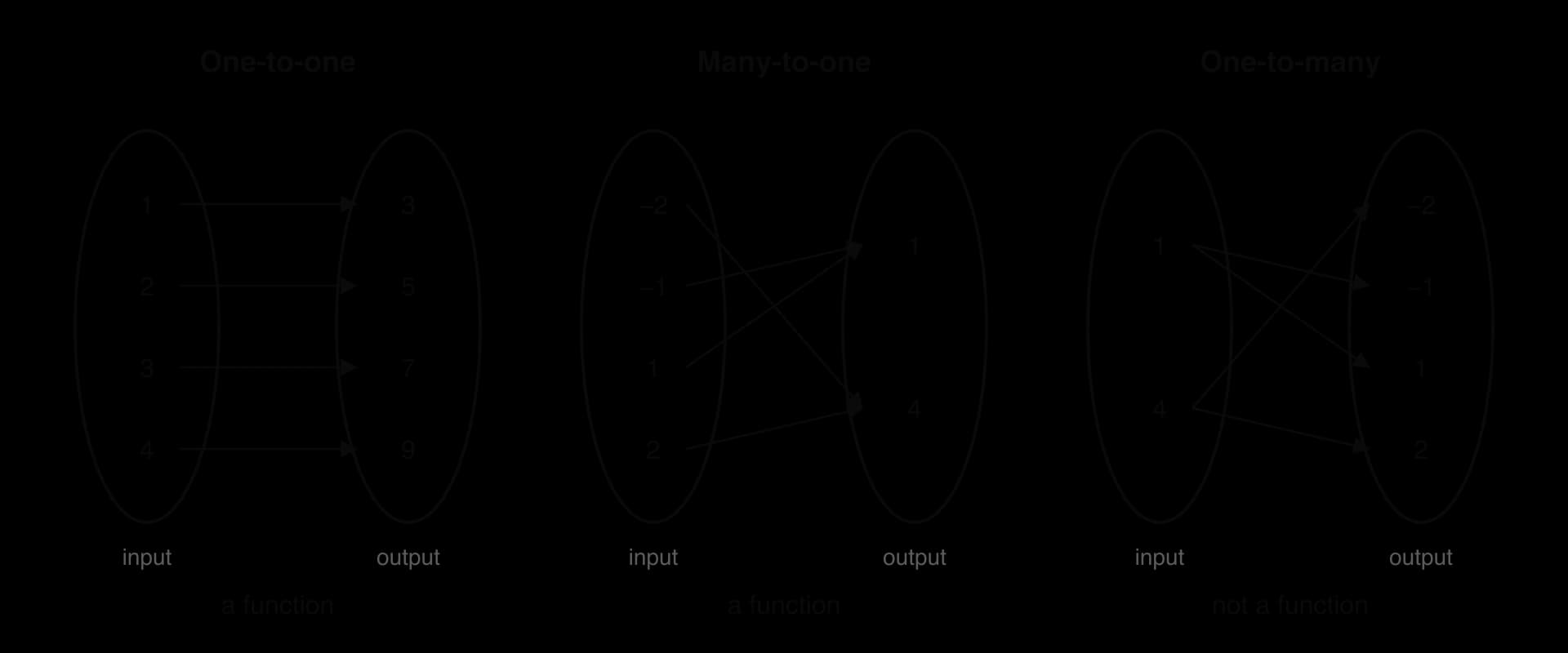
A relationship between two sets of numbers can be shown by a set of arrows from each input to the output it is paired with. Each input sits in one set, each output in another, and an arrow joins them.
Not every mapping is a function. For a function, each input must have exactly one output, so exactly one arrow leaves each input. Several inputs may share an output, but no input may have two.
A function sends each input to exactly one output. Shared outputs are allowed (many-to-one); an input with two outputs is not (one-to-many).
The three diagrams show the possible patterns. The first follows the rule x↦2x+1 and pairs each input with its own output. The second, "square the number", sends both −2 and 2 to 4: still a function, because each input has one output. The third, "the numbers whose square is the input", sends 4 to both −2 and 2, so an input has two outputs and the mapping is not a function.
The function x↦2x+1 is one-to-one: two different inputs can never give the same output, because doubling and adding 1 keeps different numbers apart. A one-to-one function can be run backwards without ambiguity, which matters for inverse functions.
Four ways to represent a function
The same function can be given as a rule in words, a formula, a table of values, a mapping diagram or a graph. A shop that charges $4.50 per T-shirt plus a $15 set-up fee could describe its prices in any of these ways: the formula C=4.5n+15, a price list, or a graph of cost against the number of shirts.
Representation
Example
Strength
Words
"$4.50 per shirt plus a $15 set-up fee"
easy to understand in context
Formula
C(n)=4.5n+15
exact; gives any value by substitution
Table
n=1,2,3: C=19.50,24.00,28.50
values read at a glance
Graph
points (1,19.5),(2,24),(3,28.5),…
shows the pattern and its features
The vertical line test
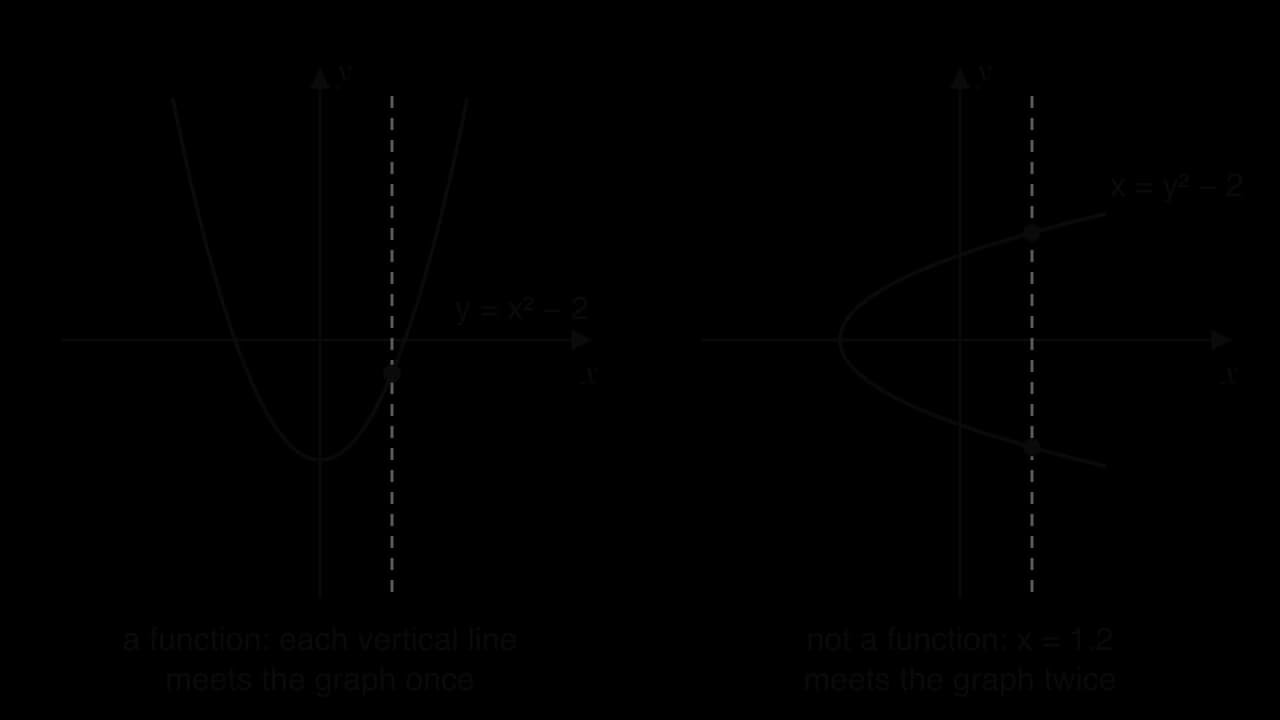
On a graph, each input x is a vertical line, and the outputs paired with it are the points where the graph meets that line. A graph represents a function exactly when no input has two outputs, which gives a quick visual test.
Every vertical line meets the parabola y = x² − 2 at most once, but the line x = 1.2 meets the sideways curve x = y² − 2 twice.
The sideways parabola fails the test because the input x=1.2 is paired with two outputs, y=3.2 and y=−3.2. A circle fails for the same reason. A vertical straight line x=k fails completely: one input is paired with every value of y, which is why vertical lines have no equation of the form y=mx+c (subtopic 2.1).
Function notation
A function is usually named by a letter, and its output for an input x is written f(x), read "f of x". The notation puts the input in brackets after the name of the function. It is not a multiplication: f(3) means "the output of f when the input is 3".
The letters can be chosen to fit the context, which makes a model easier to read. A velocity that depends on time is written v(t); the cost of n items is C(n); a height after t seconds is h(t). The letter in the brackets names the input variable, and every domain or answer about the input is then written with that letter.
The output depends on the input, so it is the other variable of the pair.
Function notation separates two different questions. "Find f(5)" gives the input and asks for the output: substitute. "Solve f(x)=5" gives the output and asks for the input: solve an equation. Mixing up the two is behind many errors with inverse functions.
Domain and range
The domain
Every function has a set of inputs it accepts. Some inputs make a formula meaningless, and some make no sense in the situation being described.
When no domain is stated, a function's domain is taken to be the largest possible domain: every real number for which the formula gives a real output. For most functions met in practice this is all real numbers, x∈R. Two operations restrict it:
division by zero: x−35 is undefined at x=3, so the domain is x∈R,x=3;
square roots of negative numbers: 2−x needs 2−x≥0, so the domain is x≤2
The logarithms of subtopic 1.5 add a third restriction, since logx and lnx need x>0. Functions that are not standard models, such as f(x)=x+x212, follow the same rules: find where the formula breaks down, and exclude those values. Here x=0 is excluded, so the domain is x∈R,x=0.
The range
Once the inputs are fixed, the outputs they produce form the range.
The range is easiest to see on a graph: it is the set of heights the graph reaches, read on the vertical axis. For f(x)=2−x, a square root is never negative, and as x decreases from 2 the output grows without limit, so the range is f(x)≥0. The graph of f, which ends at (2,0) and climbs steadily to the left, shows both facts.
f(x) = √(2 − x)
The graph stops at x = 2 (domain x ≤ 2) and never goes below the x-axis, but rises forever to the left (range f(x) ≥ 0).
The range depends on the domain. Over all real numbers, g(x)=x2 has range g(x)≥0; restricted to 1≤x≤3, its range is only 1≤g(x)≤9.
Finding a range from a graph
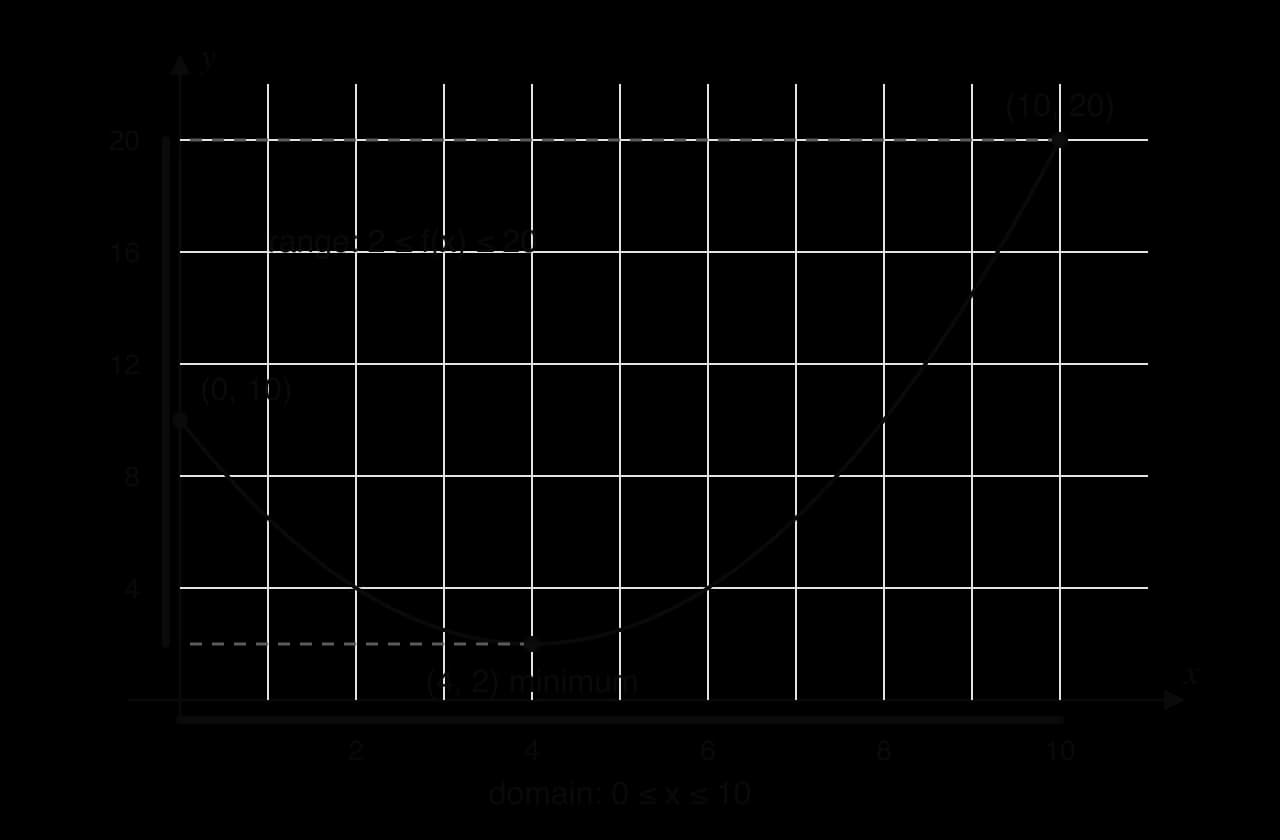
For a function on an interval, the smallest and largest outputs are not always at the ends of the interval. A curve can turn inside the domain, so its lowest or highest point may be a local minimum or local maximum in between. The safe method is to graph the function over its domain and look for every point where the graph is highest or lowest.
The domain is read along the x-axis and the range up the y-axis. The lowest output, 2, comes from the minimum inside the domain, not from either end.
For f(x)=0.5x2−4x+10 with 0≤x≤10, the end values are f(0)=10 and f(10)=20. Taking only these would suggest a range of 10≤f(x)≤20, which is wrong: the graph dips to a minimum at (4,2). The range is 2≤f(x)≤20.
Finding the range with the GDC
Enter the function with its domain. On a TI-84 Plus CE one way is to divide by the domain condition, Y1=(0.5X2−4X+10)/(X≥0 and X≤10); on a Casio fx-CG50, append the interval after a comma, Y1=0.5X2−4X+10,[0,10].
Choose a viewing window slightly wider than the domain, and use the table of values to choose the y range so that the whole curve is visible.
Use the minimum and maximum tools for any turning points inside the domain, and evaluate the function at both endpoints.
The range runs from the smallest of these values to the largest.
On paper, write the endpoint values and any turning point found, then the range as an inequality: "f(0)=10, f(10)=20, minimum f(4)=2, so 2≤f(x)≤20".
The graph of g shows the gap in the range: no horizontal line between y=2 and y=5 meets either piece. Such a gap is hard to spot from the formula alone, so a GDC graph is the usual first step in finding a range.
y = g(x), left piece
y = g(x), right piece
Each piece of g rises towards or away from the asymptote x = −2; the outputs between y = 2 and y = 5 are never reached.
Writing domains and ranges
A domain is written in the input variable and a range in the output, either with inequalities or in interval notation. The IB uses square brackets that point inwards for included endpoints and outwards for excluded ones.
Inequality
Interval notation
In words
2≤x≤5
[2,5]
2 to 5, both included
2<x<5
]2,5[
2 to 5, neither included
2≤x<5
[2,5[
2 included, 5 not
x≥2
[2,∞[
2 and everything greater
x<5
]−∞,5[
everything less than 5
x∈R
]−∞,∞[
all real numbers
g(x)≤2 or g(x)≥5
]−∞,2]∪[5,∞[
Infinity is never included, because it is not a number: its bracket always points outwards. Both styles are correct, and inequalities are the more common choice. The choice between ≤ and < matters. A value that the function actually reaches is included (≤); a value it approaches but never reaches is excluded (<).
YouTube
Khan Academy, “Domain and range of a function given a formula”: watch how the inputs that make a formula undefined set the domain, and how the range then follows.
The Khan Academy video finds the domain and range of functions given by formulas. It starts from the inputs that make each formula undefined, then reasons about which outputs can occur.
Functions as mathematical models
A function used to describe a real situation is a model. The independent variable is the quantity that is set or that passes (time, number of items, temperature), and the dependent variable is the quantity that responds. Once a situation is written as a function, its questions become questions about the function: a value, a maximum, a solution of an equation.
A model is a simplification. It keeps the features that matter and ignores others, so its predictions are approximate and only valid over a limited set of inputs. Choosing, fitting and testing models is the subject of subtopics 2.5 and 2.6, which develop the full modelling cycle.
Domains that make sense in context
The domain of a model comes from the situation, not only from the formula. The formula K=C+273.15, which converts a Celsius temperature into kelvin, accepts any real number. Physically, though, no temperature is colder than absolute zero, −273.15 °C, which is defined as 0 K. The model's domain is therefore C≥−273.15, and its range is K≥0.
The appropriate domain of a model (also called a reasonable domain) is the set of inputs for which the model describes the real situation. Typical restrictions are:
time from the start of the situation (t≥0) to its end (landing, emptying, the end of a ride);
whole numbers for things that are counted: people, items, trips (n∈Z, often n≥1);
non-negative lengths, masses and amounts;
limits set in the question (a maximum order, a speed limit, the capacity of a tank).
Discrete domains and cost functions
Some inputs can only be whole numbers. A function whose domain is a set of integers has a graph made of separate points, not a continuous curve, and its answers must be whole numbers rounded in the direction that makes sense.
For the T-shirt printer, the cost of n shirts is C(n)=4.5n+15, with domain n∈Z,n≥1. The fixed cost of $15 is paid once; each extra shirt adds $4.50, the gradient of the points. The graph is a row of points on a straight line, because 2.5 shirts cannot be ordered.
line through the points (for reference)
With a domain of whole numbers, the cost function's graph is the set of separate points; the line through them is only a guide, since 2.5 shirts cannot be ordered.
Inverse functions
Undoing a function
An inverse function reverses the effect of a function: it takes each output back to the input it came from. The conversion from Celsius to Fahrenheit, built in subtopic 2.1, is F(C)=1.8C+32: multiply by 1.8, then add 32. To convert back, the steps are undone in the reverse order: subtract 32, then divide by 1.8.
C=1.8F−32
Each function undoes the other. A temperature of 20 °C converts to 1.8×20+32=68 °F, and 1.868−32=20 returns the original 20 °C.
The notation f−1(x) is read "f inverse of x". The −1 is part of the name and does not mean a power, so f−1(x) and f(x)1 are different things.
Finding a value of an inverse
Since f−1 sends each output back to its input, finding f−1(10) means finding the input that gives output 10. That is the same as solving the equation f(x)=10.
f−1(10)=a⟺f(a)=10
No formula for f−1 is needed. The equation can be solved by hand when it is simple, or with the GDC: graph y=f(x) and y=10 and find the point of intersection, or use the equation solver. The answer is the x-coordinate.
The graph of an inverse: reflection in y = x
If f sends a to b, the point (a,b) is on the graph of f. The inverse sends b back to a, so (b,a) is on the graph of f−1. Swapping the coordinates of every point reflects the graph in the line y=x: the points (a,b) and (b,a) are mirror images in that line.
F = 1.8C + 32
C = (F − 32)/1.8
y = x
The Celsius-to-Fahrenheit line and its inverse are reflections of each other in y = x; they cross at (−40, −40), the one temperature that reads the same on both scales.
The point (20,68) on the conversion line becomes (68,20) on its inverse. The two lines meet on y=x at (−40,−40): −40 °C is the same temperature as −40 °F, the only reading that is identical on both scales. A point on the line of reflection is unchanged by the reflection.
Source: Wikipedia, "Fahrenheit", accessed 2025.
Where the graphs of a function and its inverse meet on the line y=x, the coordinates satisfy f(x)=x. Such points lie on both graphs and are invariant under the reflection. For a function that decreases, the two graphs can also cross at pairs of points away from y=x.
Sketching the graph of an inverse
To sketch y=f−1(x) from the graph of y=f(x):
Draw the line y=x (with equal scales on both axes, so that the reflection is not distorted).
Reflect the key points of f by swapping their coordinates: endpoints, intercepts and any labelled points. An intercept (0,c) becomes (c,0).
Mark any invariant points where the graph of f crosses y=x; the inverse passes through them too.
Join the reflected points with a curve of the mirror-image shape, over the domain of f−1 only.
y = f(x)
y = f⁻¹(x)
y = x
Reflecting f(x) = 0.1x³ + 1 (0 ≤ x ≤ 4) in y = x swaps every pair of coordinates; the graphs share the two invariant points where f crosses y = x.
The graph of f(x)=0.1x3+1, 0≤x≤4, crosses y=x twice, at about x=1.15 and x=2.42 (the solutions of 0.1x3+1=x). Its inverse passes through the same two points, and every other point is swapped: (0,1) becomes (1,0), and (3,3.7) becomes (3.7,3).
When an inverse exists
A function can be reversed only if every output came from exactly one input. If two inputs share an output, the inverse would have to send that output back to two places at once, and then it would not be a function. Only one-to-one functions have inverses. The graph gives a test for this, using horizontal lines in the way the vertical line test uses vertical ones.
The function f(x)=x2, x∈R, fails the test: the line y=9 meets the graph at x=3 and x=−3, so "f−1(9)" would have two values. Its reflection in y=x is the sideways parabola that failed the vertical line test, which is the same failure seen from the other side. Every non-horizontal straight line, every exponential function and every function that only rises (or only falls) over its domain passes the test.
y = x²
y = 0.5x + 2
The line y = 9 meets y = x² twice, so x² is many-to-one with no inverse on ℝ; y = 3 meets the straight line only once.
Domain and range of an inverse
Because the inverse swaps inputs and outputs, it swaps the domain and the range.
domain of f−1=range of frange of f−1=domain of f
For the stopping-distance model d(v)=0.2v+0.006v2, 0≤v≤130, the function only increases, so its range runs from d(0)=0 to d(130)=127.4: 0≤d≤127.4. The inverse d−1 accepts stopping distances from 0 to 127.4 m (its domain) and returns speeds from 0 to 130 km/h (its range). Asking for d−1(150) makes no sense: no speed in the model's domain gives a stopping distance of 150 m.
YouTube
Khan Academy, “Introduction to function inverses”: watch how an inverse maps each output of a function back to the input it came from.
The Khan Academy video introduces inverses as functions that map each output back to its input. If two inputs shared an output, that output would have to map back to both, which is the horizontal line test in words.
Exam focus
Functions, domains and ranges are examined on Paper 1 as short questions of 4–8 marks and as the first parts of Paper 2 modelling questions. The command terms are write down (a value or a feature read off directly), state (a domain or range without working), find (with working: substitution, a GDC graph or an equation), interpret (say what a value means in context) and explain. The recurring shapes are: the range of a function on a given domain; a value of an inverse such as f−1(70), found by solving f(x)=70, followed by its interpretation in context; the domain or range of an inverse; and an appropriate domain for a model such as a projectile from launch to landing, or a ride of a given length. Questions can use functions that are not among the standard models (a sum of a power and a fraction, for example); the domain is then the largest possible one unless the question states it, and a GDC graph then gives the range and other features.
A range or domain usually earns two marks: one for the correct endpoints and one for the correct inequality signs or interval notation, in the right variable. Values of an inverse earn a method mark for the equation f(x)=value and an accuracy mark for the answer.
The model is the standard linear approximation for the speed of sound in dry air near 0 °C (source: Wikipedia, "Speed of sound", accessed 2025).
Part (e) catches many candidates, who copy their range of v from part (b) instead of using the domain of v. Part (d) needs both quantities named with units: a bare "14.4" earns nothing.
Finding a value of an inverse is quicker with the GDC than with algebra. Writing f(x)=10 on the page, then the solution from the graph or solver, earns both marks; attempting a general formula for f−1 wastes time and, for many functions, is not possible by hand.
Practice questions
The function f is defined by f(x)=3x2−5. Write down the values of f(2) and f(−1). [2]
Write down the largest possible domain of g(x)=x+46. [1]
Find the domain and range of f(x)=x−3+2. [3]
State, with a reason, whether each of these represents y as a function of x: (a) {(2,3),(4,3),(6,5)}; (b) {(1,2),(1,5),(3,4)}
A taxi fare, in dollars, for a journey of d km is modelled by C(d)=3.5+1.8d. (a) FindC(12). (b) FindC−1(30)
A ball's height in metres t seconds after it is thrown is h(t)=−5t2+12t+2. (a) Find when it hits the ground. (b) State an appropriate domain for t
The graph of a one-to-one function f passes through (1,4) and (3,7). Write down two points on the graph of f−1, and the value of f−1(7)
The function h is defined by h(x)=x+1120+4 for 0≤x≤9
Explain why the function f(x)=x2+1, x∈R, does not have an inverse function. [2]
A water tank is emptied through a valve. The volume of water in the tank, in litres, t minutes after the valve is opened is V(t)=2000−25t. (a) State an appropriate domain for t and the range of V. (b) FindV−1(1200)
Answers
f(2)=3(4)−5=7; f(−1)=3(1)−5=−2.
x∈R,x=−4.
Domain x≥3 (the square root needs x−3≥0); range f(x)≥2.
(a) A function: each input has one output (3 is shared, which is allowed). (b) Not a function: the input 1 has two outputs, 2 and 5.
(a) C(12)=3.5+21.6=25.1, a fare of $25.10. (b) 3.5+1.8d=30, so d=14.7
(a) −5t2+12t+2=0 gives t=2.56 s (2.5565…; the negative root −0.156
(4,1) and (7,3); f−1(7)=3.
(a) h decreases: h(0)=124, h(9)=16, so 16≤h(x)≤124
f is many-to-one: for example f(2)=f(−2)=5, so the horizontal line y=5 meets the graph twice and f−1(5)
(a) The tank is empty when 2000−25t=0, at t=80: domain 0≤t≤80; range 0≤V(t)≤2000
Summary
A function assigns to each input exactly one output; a graph is a function of x if it passes the vertical line test.
Function notation f(x) names the output for input x; "find f(5)" means substitute, "solve f(x)=5" means find the input.
The domain is the set of allowed inputs (largest possible unless stated, usually R, excluding division by zero and square roots of negatives); the range is the set of outputs.
Find a range from the graph over the domain: check both endpoints and every turning point, using the GDC's minimum and maximum tools.
Write domains in the input variable and ranges in f(x) or y, with inequalities or interval notation ([a,b], ]a,b[); ≤
In context, the domain comes from the situation: t≥0 up to an end event, whole numbers for counted items, physical limits such as absolute zero.
An inverse function f−1 undoes f: if f(a)=b then f−1(b)=a
The graph of f−1 is the reflection of the graph of f in y=x; points on y=x
Only one-to-one functions (passing the horizontal line test) have inverses; the domain of f−1 is the range of f, and the range of f−1 is the domain of f.
Self-check
To do:
I can decide whether a mapping, a set of pairs or a graph represents a function, and justify my answer.
To do:
I can tell one-to-one and many-to-one functions apart from a mapping diagram or a graph.
To do:
I can evaluate f(a) for a number or an expression, keeping negative inputs in brackets.
To do:
I can identify the independent and dependent variables of a model.
To do:
I can find the largest possible domain of a function with a fraction or a square root.
To do:
I can find the range of a function on a given domain using a GDC graph, checking turning points as well as endpoints.
To do:
I can write a domain or range with the correct variable, the correct order and the correct strict or weak signs.
To do:
I can convert between inequalities and interval notation, including ranges in two pieces.
To do:
I can state an appropriate domain for a model in context and reject roots that make no sense.
To do:
I can round answers on a discrete domain in the direction the context requires.
To do:
I can find f−1(a) by solving f(x)=a, by hand or with my GDC, and interpret the answer with units.
To do:
I can sketch the graph of an inverse by reflecting key points in y=x and marking invariant points.
To do:
I can explain, using the horizontal line test, why a function does or does not have an inverse.
To do:
I can write down the domain and range of an inverse function from those of the function.
, for
x≤k
.
(a)
Write down the largest value of k for which g has an inverse.
[1]1 mark
Markscheme (a)
k=3A1
[1 mark]
(b)
Using this value of k, find g−1(x), stating its domain.
[4]4 marks
Markscheme (b)
g(x)=(x−3)2+2(A1)
x=(y−3)2+2⇒y=3±x−2
(c)
Find g−1(18).
[1]1 mark
Markscheme (c)
g−1(18)=3−16=−1
Question 2 · AI-00026HL only · 7 marks
Consider the functions f(x)=x−2, for x≥2, and g(x)=10−x2, for x∈R.
Sofia drives a hybrid car on a 350 km journey from Madrid to Valencia. When she drives at a constant speed of v km h−1, the fuel consumption of the car, in litres per 100 km, is modelled by
c(v)=0.0018v2−0.24v+13,40≤v≤130.
Fuel costs 1.92 euros (EUR) per litre. The cost, in EUR, of the fuel for the whole journey when the consumption is x litres per 100 km is K(x)=6.72x.
(a)
Find the fuel consumption when Sofia drives at 100 km h−1.
. It is also one-to-one, because its gradient is not zero.
(b) The input is the whole expression a+1.
f(a+1)=2(a+1)2−3(a+1)+4=2a2+4a+2−3a−3+4=2a2+a+3
(c) Set the output equal to 13 and solve.
2x2−3x+4=13⟹2x2−3x−9=0⟹(2x+3)(x−3)=0
So x=3 or x=−1.5. With a GDC, the polynomial root finder (coefficients 2, −3, −9) or the intersection of y=2x2−3x+4 with y=13 gives the same two values. Part (a) already showed f(3)=13: two inputs give the output 13, so f is many-to-one.
.
for
−6≤x≤6
. The graph has a
vertical asymptote
at
x=−2
and rises from left to right on each side of it.
On the left piece, g(−6)=3−−48=5, and the graph rises without limit as x approaches −2 from the left.
On the right piece, the graph comes up from very large negative values just to the right of x=−2 and reaches g(6)=3−88=2.
The range is g(x)≤2 or g(x)≥5. No output lies strictly between 2 and 5.
two separate pieces
upwards: range
f(x)≥−1
.
(b) The denominator is zero at x=3: domain x∈R,x=3. A fraction with numerator 5 can be any non-zero number but never 0: range g(x)=0 (that is, g(x)∈R,g(x)=0).
(c) There is no restriction: domain x∈R. Since x2≥0, the largest output is 7−0=7: range h(x)≤7.
A quick graph of each on the GDC confirms the ranges.
The GDC's polynomial root finder (coefficients −4.9, 18, 1.5) gives t=3.7549… and t=−0.0815…. Time after the throw cannot be negative, so the negative root is rejected. The ball lands after 3.75 s.
(c) The model applies from the throw to the landing: 0≤t≤3.75, or t∈[0,3.75].
(d) The GDC's maximum tool on the graph of y=h(t) gives the highest point at t=1.84, h=18.03…. The lowest height is 0, at landing. The range is 0≤h(t)≤18.0.
The number of shirts must be a whole number no greater than 52.2…, so the club can buy at most 52 shirts. Rounding up to 53 would cost 4.5×53+15=253.5, that is $253.50, over the budget.
.
0.006v2+0.2v−40=0
With the GDC, the intersection of y=0.2x+0.006x2 and y=40 for 0≤x≤130 is at x=66.666… (the root finder also gives −100, outside the domain). So d−1(40)=66.7.
(c) A car that needs 40 m to stop was travelling at about 66.7 km/h.
and the smallest at
x=12
.
k(3)=360+2=22,k(12)=1260+2=7
The range is 7≤k(x)≤22.
(b) Solve k(x)=8.
x60+2=8⟹x60=6⟹x=10
So k−1(8)=10. Check: k(10)=6+2=8. ✓
(c) The domain of k−1 is the range of k: 7≤x≤22. The range of k−1 is the domain of k: 3≤k−1(x)≤12.
or
v(40)=355.54
(M1)
Note: Award (M1) for substituting either endpoint of the domain.
307≤v(T)≤356 (307.06≤v(T)≤355.54) A1A1
Note: Award A1 for both correct endpoints, A1 for a correct inequality with weak signs in the correct order. Accept [307,356].
[3 marks]
(c) 331.3+0.606T=340(M1)
T=14.4 (14.3564…) A1
[2 marks]
(d) When the speed of sound is 340 m s⁻¹, the air temperature is 14.4 °C. A1
Note: The answer must refer to both the speed and the temperature, with units.
[1 mark]
(e) −40≤v−1(x)≤40A1
Note: Accept −40≤T≤40 or [−40,40]. Do not award for the answer to part (b).
[1 mark]
(f) −300 °C is below absolute zero (−273.15 °C), so no such temperature exists (it is also outside the domain of the model). R1
[1 mark]
Total [10 marks]
. [2]
and
interpret
it in context. [4]
. (c)
Find
the range of
h
on this domain. [6]
. [2]
. (a)
Find
the range of
h
. (b)
Find
h−1(28)
. (c)
Write down
the range of
h−1
. [6]
and
interpret
it in context. [5]
(14.72…): a fare of $30 pays for a journey of about 14.7 km.
is rejected). (b)
0≤t≤2.56
. (c) Maximum at
t=1.2
:
h(1.2)=9.2
; range
0≤h(t)≤9.2
.
. (b)
x+1120+4=28
gives
x+1=5
, so
h−1(28)=4
. (c)
0≤h−1(x)≤9
.
would need two values.
. (b)
2000−25t=1200
gives
V−1(1200)=32
: the tank holds 1200 litres 32 minutes after the valve is opened.
for values reached,
<
for values only approached.
, so
f−1(10)
is found by solving
f(x)=10
.
f−1(x)
is not
f(x)1
.
where
f(x)=x
are invariant.
(M1)
g−1(x)=3−x−2A1
x≥2A1
Note: Award A0 for the third mark if 3+x−2 or ± is given.
[4 marks]
A1
Note: Follow through from part (b) only if their answer lies in the domain x≤3.
[1 mark]
.
[1]1 mark
(c)
Find the largest possible domain of f∘g.
[2]2 marks
(d)
Find the range of f∘g.
[2]2 marks
.
[2]2 marks
(c)
Explain why K(x)=6.72x.
[1]1 mark
(d)
Find dvd((K∘c)(v)).
[2]2 marks
(e)
Find the speed at which Sofia should drive to minimize the cost of the fuel for the journey, and write down this minimum cost.
[3]3 marks
(f)
Sofia has budgeted 50 EUR for fuel. Find the range of speeds at which she can drive so that the fuel cost does not exceed her budget.
[3]3 marks
(g)
The function c has an inverse when its domain is restricted to 3200≤v≤130. Find an expression for c−1(x) for this restricted domain.
 YouTube
 YouTube