Notes on R2.4 The US Civil War (1840–1877)
The US Civil War (1861–1865) was fought between the United States government and eleven Southern states that tried to leave the Union to protect slavery. It was the deadliest war in American history, it ended slavery for about four million people, and the struggle that followed over the rights of freed people shaped American politics and race relations for the next century.

Slavery and the cotton economy, 1840–1861
In 1840 slavery was legal in thirteen of the twenty-six states, all of them in the South; the admission of Florida and Texas in 1845 made fifteen. The Northern states had abolished it, most of them gradually, between 1777 and 1804. The colonial origins of American slavery and the first campaigns against it belong to the history of colonial slavery in the Americas; the subject here is the slave system at its largest and most profitable, in the twenty years before the war.
The Cotton Kingdom
The cotton gin, patented by Eli Whitney in 1793, made it profitable to grow short-staple cotton across the inland South. At the same time the factories of the British Industrial Revolution created an almost unlimited demand for raw cotton. Planters and their enslaved workers moved west and south into Alabama, Mississippi, Louisiana, Arkansas and, after 1845, Texas, land taken from the Creek, Choctaw, Chickasaw and Cherokee nations by the Indian removals of the 1830s.
The chart of the cotton crop shows the result. Output rose from about 73,000 bales in 1800 to more than 2 million in 1850 and about 4.5 million in 1859, when the South grew about three-quarters of the cotton used by British mills. Raw cotton was the country’s most valuable export, more than half of all US exports by value in 1860. Northern banks, shipowners, insurers and textile mills also profited from it, so slavery was a national economic interest as well as a Southern one.
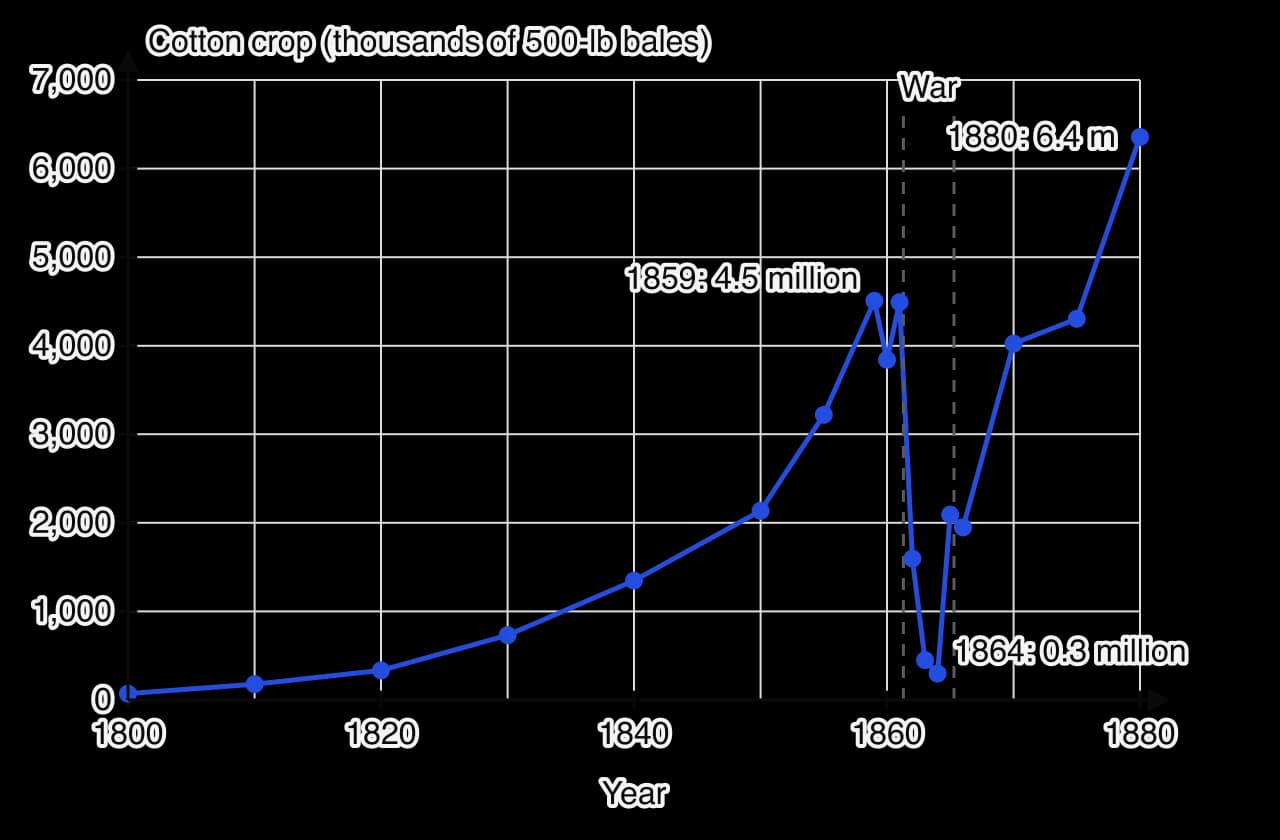
Enslaved people were themselves the South’s largest form of wealth. The 1860 census counted 3,953,760 enslaved people. Economic historians estimate their market value at about 3 billion dollars or more, more than the value of all the railways and factories in the United States. Because a young enslaved man could be sold for well over 1,000 dollars in the 1850s, a slaveholder’s wealth lay as much in the people he owned as in his land.
Slaveholders and Southern white society
Most white Southerners did not own slaves. In 1860 there were about 385,000 slaveholders in a white Southern population of about 8 million, so roughly one white family in four owned at least one enslaved person. Ownership was concentrated in the Deep South and among a small elite of planters.
Measure (1860) | Figure |
|---|---|
Enslaved people | 3,953,760 (about one-third of the population of the slave states) |
Slaveholders | About 385,000 |
White families owning slaves | About 26 per cent in all slave states; 49 per cent in Mississippi, 46 per cent in South Carolina |
Slaveholders owning fewer than 5 people | Nearly half |
Slaveholders owning fewer than 20 people | About 88 per cent |
"Planters" (owners of 20 or more) | About 12 per cent of slaveholders, holding about half of all enslaved people |
Data: US Census of 1860 (population and slave schedules), as compiled in standard summaries. Figures are rounded; the slave schedules list some large owners in more than one county, so the count of slaveholders is approximate.
The planters dominated Southern politics. They filled state legislatures, Congress and the officer corps, and they owned the best cotton land. Most white Southerners were yeoman farmers who worked their own land with their families. Yet many yeomen supported slavery: they hoped to buy slaves one day, they depended on planters for credit and access to cotton gins, and they shared a belief that slavery kept Black people subordinate and gave every white man a status above them.
The domestic slave trade
Congress banned the import of enslaved Africans from 1 January 1808, so the expansion of cotton was supplied by moving enslaved people within the United States. In the domestic slave trade about one million people were forced from the Upper South (Virginia, Maryland, Kentucky) to the cotton states between 1790 and 1860, either sold through traders or taken west by migrating owners. The historian Michael Tadman estimates that about two-thirds of these moves were sales.
Slave markets in Richmond, Charleston and above all New Orleans were among the largest businesses in the South. Traders marched people overland in chained groups called coffles or shipped them along the coast. Sale broke up families: children were sold away from parents and husbands from wives. The fear of sale was one of the most constant pressures in enslaved people’s lives, and it was a weapon owners used to enforce obedience.
Conditions of enslavement
About three-quarters of enslaved people worked in agriculture, most of them in cotton. On cotton plantations they usually worked in gangs under a white overseer or an enslaved "driver", from first light until dark, with longer hours at picking time. On the rice and sea-island cotton plantations of the Carolina and Georgia coast, the task system gave each worker a set amount of work for the day, after which time was their own. Others worked as house servants, artisans, or in towns, factories and mines, some of them hired out by their owners.
Solomon Northup, a free Black man from New York who was kidnapped in 1841 and enslaved on cotton and sugar plantations in Louisiana for twelve years, described how picking was measured.
The day’s work over in the field, the baskets are "toted," or in other words, carried to the gin-house, where the cotton is weighed. No matter how fatigued and weary he may be—no matter how much he longs for sleep and rest—a slave never approaches the gin-house with his basket of cotton but with fear. If it falls short in weight—if he has not performed the full task appointed him, he knows that he must suffer. And if he has exceeded it by ten or twenty pounds, in all probability his master will measure the next day’s task accordingly.
Solomon Northup, Twelve Years a Slave, memoir, 1853. Northup wrote after he regained his freedom in January 1853, with the help of a white editor, David Wilson, for a Northern public that Uncle Tom’s Cabin had made eager for accounts of slavery. Later research has confirmed many of his details about the people and plantations he named. The passage supports the argument that cotton output rose partly because owners kept raising each worker’s quota.
Food, clothing and housing were basic. Most enslaved families lived in one-room log cabins and received a weekly ration of cornmeal and salt pork, which many supplemented from garden plots, hunting and fishing. Punishment by whipping was common and legal, and enslaved women had no legal protection from sexual abuse by owners and overseers. Child mortality was far higher than among white Southerners.
Slave codes and patrols
Each slave state had slave codes, laws that defined enslaved people as property and controlled their lives. They could not legally marry, own property, testify against a white person, leave the plantation without a written pass, or gather without a white person present. After Nat Turner’s revolt of 1831, most Southern states made it a crime to teach an enslaved person to read. Armed slave patrols of local white men rode the roads at night to enforce these laws.
Adaptation and resistance
Enslaved people could not escape the system, but they shaped their lives within it. Historians call these strategies adaptation: building families, communities and a culture that gave life meaning and protected people from complete control. Adaptation and resistance overlapped, because every space that enslaved people kept for themselves limited the owners’ power.
Family. Marriages had no legal force and could be broken by sale, but most enslaved people lived in families, named children after relatives and kept ties across plantations. Herbert Gutman’s research in plantation records showed how strong these kinship networks were.
Religion. By the 1850s many enslaved people were Christians, often Baptist or Methodist. Alongside the services held by white preachers, who stressed obedience, they met secretly in the woods in what historians call the "invisible church", where preachers spoke of Moses and the deliverance of the Israelites from Egypt. Spirituals such as "Go Down, Moses" carried hopes of freedom.
Everyday resistance. Working slowly, breaking tools, pretending illness, stealing food and feigning ignorance were ways to limit exploitation without open revolt.
Running away. Most runaways hid nearby for days or weeks ("lying out"). A few thousand a year reached the free states or Canada, many helped by the Underground Railroad. Harriet Tubman, who escaped from Maryland in 1849, returned about thirteen times and led about seventy people to freedom.
Revolt. Large revolts were rare because white Southerners were armed and outnumbered enslaved people in most places. The bloodiest, led by Nat Turner in Southampton County, Virginia, in August 1831, killed about 55–60 white people before it was crushed; around a hundred or more Black people were killed in reprisals and trials. In 1841 enslaved people on the ship Creole took control and sailed to the British Bahamas, where most were freed.
The debate over slavery
Before 1830 most white Americans who criticised slavery favoured gradual emancipation, often combined with "colonisation", the removal of freed Black people to Africa through the American Colonization Society (founded 1816). From the 1830s a new generation demanded immediate abolition, and Southern leaders answered by defending slavery as a permanent good. The debate was conducted in newspapers, sermons, novels, petitions, Congress and the courts, and it made compromise steadily harder.
The abolitionists
Abolitionism in its radical form began with William Lloyd Garrison, a Boston printer who launched The Liberator on 1 January 1831. Its first issue promised that he would "not equivocate" or "retreat a single inch" and that he would "be heard". In 1833 Garrison helped found the American Anti-Slavery Society, which had about 1,300 local branches by 1838. Garrisonians argued that slavery was a sin, that the Constitution was a pro-slavery document, and that true abolitionists should refuse to vote under it; Garrison publicly burned a copy of the Constitution in 1854.
Black abolitionists were central to the movement. Frederick Douglass escaped from slavery in Maryland in 1838 and became its most famous speaker; his Narrative of the Life of Frederick Douglass (1845) sold about 30,000 copies in its first five years, and from 1847 he published his own newspaper, The North Star. Douglass broke with Garrison around 1851, arguing that the Constitution could be read as an anti-slavery document and that abolitionists should use politics. Sojourner Truth, formerly enslaved in New York, linked abolition and women’s rights. Free Black communities in Northern cities organised vigilance committees to protect fugitives.
What, to the American slave, is your 4th of July? I answer: a day that reveals to him, more than all other days in the year, the gross injustice and cruelty to which he is the constant victim. To him, your celebration is a sham; your boasted liberty, an unholy license; your national greatness, swelling vanity; your sounds of rejoicing are empty and heartless.
Frederick Douglass, speech to the Rochester Ladies’ Anti-Slavery Society, Rochester, New York, 5 July 1852. Douglass spoke the day after Independence Day to a sympathetic Northern audience, as a formerly enslaved man turning the nation’s founding ideals against it. The speech shows the main ideological argument of abolitionists: that slavery betrayed the Declaration of Independence’s claim that all men are created equal.
White women such as Angelina and Sarah Grimké, daughters of a South Carolina slaveholding family, wrote and lectured against slavery. Angelina’s husband Theodore Weld compiled American Slavery As It Is (1839) from advertisements and reports in Southern newspapers, letting slaveholders’ own words show the cruelty of the system. The book that reached the widest public was Harriet Beecher Stowe’s novel Uncle Tom’s Cabin (1852), written in response to the Fugitive Slave Act. It sold about 300,000 copies in the United States in its first year and was turned into popular stage plays. Formerly enslaved women also wrote: Harriet Jacobs’s Incidents in the Life of a Slave Girl (1861), published under the name Linda Brent, described the sexual exploitation enslaved women faced, a subject most male-authored narratives avoided.
The defence of slavery
As the abolitionist attack grew, Southern leaders stopped describing slavery as a "necessary evil" inherited from the past and began to defend it as a positive good. The most influential statement came from John C. Calhoun of South Carolina, vice-president under Andrew Jackson and later a senator, in a debate over abolitionist petitions.
But let me not be understood as admitting, even by implication, that the existing relations between the two races in the slaveholding States is an evil:—far otherwise; I hold it to be a good, as it has thus far proved itself to be to both, and will continue to prove so if not disturbed by the fell spirit of abolition.
John C. Calhoun, speech in the US Senate, 6 February 1837, known as "Slavery a Positive Good". Calhoun spoke to fellow senators while Northern petitions against slavery were flooding Congress, and he aimed to unite Southerners behind an uncompromising defence. Its value lies in showing the shift in Southern thinking: slavery was presented as beneficial to both races, so any criticism of it became an attack on the South itself.
Defenders of slavery used several kinds of argument. In 1858 Senator James Henry Hammond of South Carolina told the Senate that every society needed a "mud-sill" class to do its menial work, and that Northern wage workers were slaves in all but name; in the same speech he declared that "Cotton is king". George Fitzhugh’s Cannibals All! (1857) argued that enslaved people were better cared for than the "wage slaves" of Northern and British factories. Ministers cited the Bible, where slavery appears without condemnation, and the physician Josiah Nott and others promoted a false "science" of racial difference.
Type of argument | Against slavery | For slavery |
|---|---|---|
Ideological and political | Slavery contradicted the Declaration of Independence; the "Slave Power" threatened Northern liberties (Douglass, Republicans) | Slavery was a "positive good" and the basis of white equality and republican government (Calhoun, Hammond) |
Religious | Slavery was a sin that denied the humanity of people made in God’s image (Garrison, Weld, Northern churches) | The Bible accepted slavery; slaveholders brought Christianity to Africans (Southern ministers) |
Economic | Free labour was more productive and dignified; slavery kept the South backward (Free Soilers, Republicans) | Cotton made the nation rich; enslaved workers were better cared for than Northern "wage slaves" (Hammond, Fitzhugh) |
Legal and constitutional | Freedom was the normal condition and slavery existed only by local law; Congress could ban it in the territories | Enslaved people were property protected by the Fifth Amendment; the Constitution guaranteed the return of fugitives |
Racial | Black people were human beings with natural rights (although many white opponents of slavery still held racist views) | False "racial science" claimed Black people were inferior and suited to slavery (Nott) |
Slavery in law and politics
The debate reached Congress and the courts. In 1836 the House of Representatives adopted the gag rule, which automatically tabled anti-slavery petitions without discussion. Former president John Quincy Adams led an eight-year campaign against it as an attack on the right of petition, and it was repealed in 1844. The gag rule convinced many Northerners who were not abolitionists that slavery threatened white Americans’ freedoms too.
In Prigg v. Pennsylvania (1842) the Supreme Court ruled that a Pennsylvania law protecting Black residents from kidnappers was unconstitutional because the federal Fugitive Slave Act of 1793 overrode it, but it also said states did not have to help enforce the federal law. Several Northern states then passed personal liberty laws forbidding their officials to help catch fugitives. Southern demands for a stronger federal law led to the Fugitive Slave Act of 1850.
Abolitionism also entered party politics. The Liberty Party won only about 2 per cent of the vote in 1844, but its successor, the Free Soil Party, took about 10 per cent in 1848 with former president Martin Van Buren as its candidate. The national churches divided: the Methodists split in 1844 over whether a slaveholding bishop could serve, and Southern Baptists formed the Southern Baptist Convention in 1845 after their mission board refused to appoint slaveholders as missionaries. These splits broke one of the strongest bonds between the sections more than a decade before the Union itself divided.
Long-term causes: sectionalism, states’ rights and expansion
The United States in 1840 held together two societies with different labour systems inside one federal Constitution. The Constitution’s compromises on slavery, such as counting three-fifths of enslaved people for representation and requiring the return of fugitives, belong to the history of the early republic. What made the difference between the sections dangerous was that the country kept growing westward, so every new territory raised the question of which system would spread.
The Missouri Compromise, 1820
The first great sectional crisis came when Missouri applied to join the Union as a slave state in 1819, which would have given the slave states a majority in the Senate. The Missouri Compromise of 1820 admitted Missouri as a slave state and Maine as a free state, and banned slavery in the rest of the Louisiana Purchase north of latitude 36°30′. For thirty years this line was treated as an almost sacred settlement, which is why its repeal in 1854 caused such anger in the North. Thomas Jefferson, then in retirement, wrote that the crisis woke him "like a fire bell in the night".
The Nullification Crisis, 1832–1833
The second crisis was about the tariff, not directly about slavery. Northern manufacturers wanted high import duties to protect them from British competition; Southern planters, who sold cotton abroad and bought manufactured goods, saw tariffs as a tax on the South for the benefit of the North. In the Senate in January 1830 Robert Hayne of South Carolina defended the right of a state to resist federal law, and Daniel Webster of Massachusetts replied that the Constitution had been made by the people, not by the states, closing with the words "Liberty and Union, now and for ever, one and inseparable!" The chain of the Nullification Crisis shows how the dispute escalated.
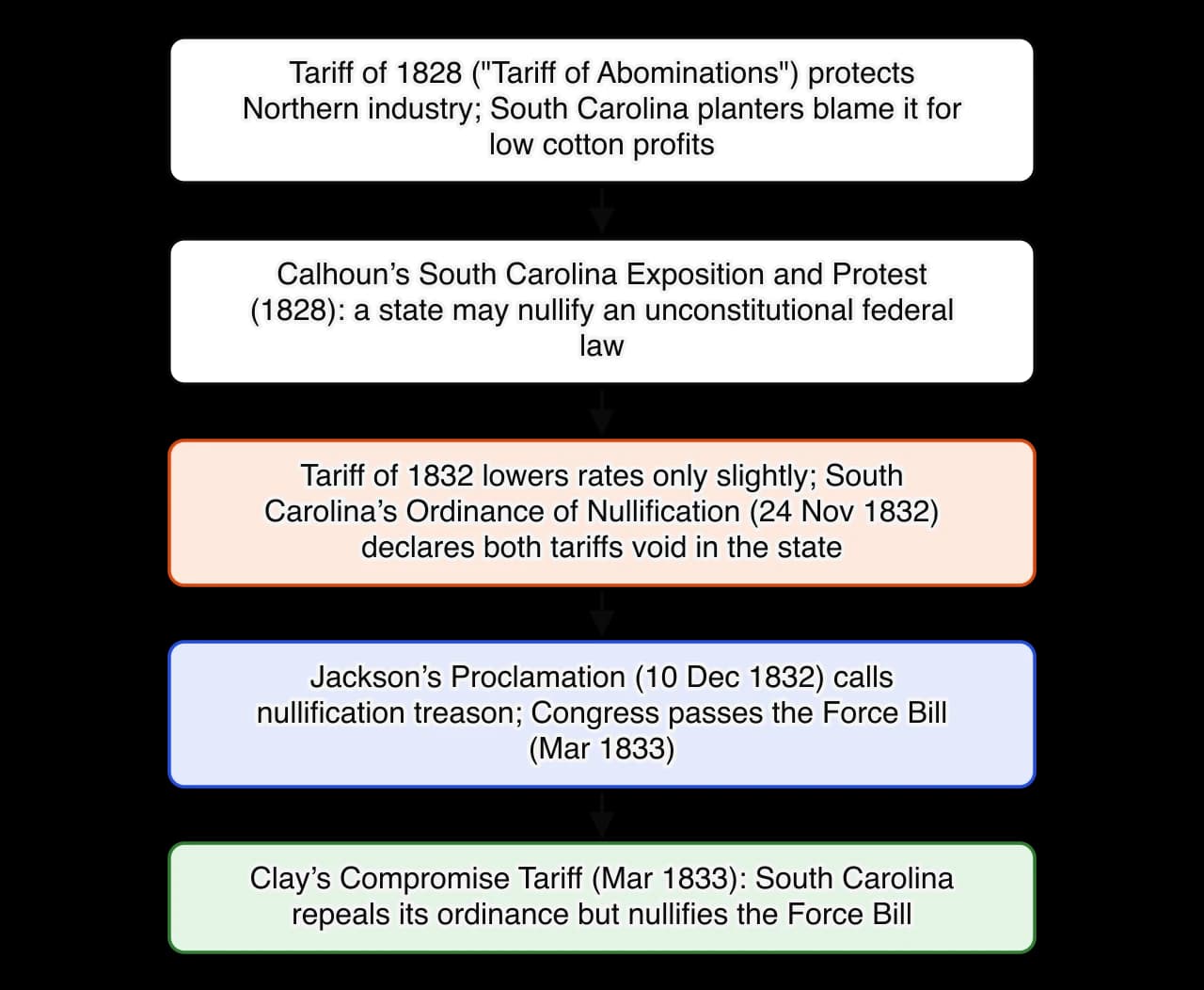
The crisis was settled by compromise: Henry Clay’s tariff of March 1833 lowered duties gradually over ten years, and South Carolina withdrew its ordinance. President Andrew Jackson, himself a Southern slaveholder, had declared that no state could leave the Union and that he would use force to collect the duties. Each side claimed it had won, but the crisis left a lasting legacy.
It gave South Carolina’s leaders a constitutional theory, state sovereignty, which they used again to justify secession in 1860.
Calhoun and others admitted privately that the tariff was partly a test case: if a Northern majority could impose a tariff, it could one day attack slavery.
It showed that a single state could defy the federal government and win concessions, which encouraged later threats of disunion.
It also showed the limits of Southern unity: no other state joined South Carolina in 1832, just as no other state was ready to secede during the crisis of 1850.
Southern leaders did not apply the doctrine consistently. When Northern states passed personal liberty laws, the same leaders demanded that federal power override them, and the Fugitive Slave Act of 1850 was one of the strongest uses of federal power over the states before the war. For this reason many historians argue that states’ rights was a means of defending slavery more than a principle in its own right.
Economic, social and cultural differences
By 1860 the free and slave states had grown apart in almost every way that could be measured. The table of the two sections compares them.
Feature, c. 1860 | Free states | Slave states |
|---|---|---|
Population | About 19 million, growing fast | About 12 million, of whom about 4 million were enslaved |
Labour | Free wage labour and family farms | Enslaved labour on plantations; white family farms |
Economy | Mixed farming, industry, commerce and finance; most of the nation’s manufacturing | Export agriculture: cotton, tobacco, sugar, rice; little industry |
Immigration | Most of the roughly 4 million immigrants of 1840–1860 (Irish, German) settled here | Few immigrants, who avoided competition with enslaved labour |
Transport | About two-thirds of the railway mileage, linked east to west | Fewer, shorter lines built mainly to carry cotton to ports |
Towns and education | Fast-growing cities; public schools in most states; high literacy | Mostly rural; few public schools; higher white illiteracy; enslaved people barred from learning to read |
Political interests | Tariffs, federal aid for roads and railways, free homesteads in the West | Low tariffs, limited federal government, protection of slavery in the territories |
Data: US Census of 1860; railway and immigration figures are approximate.
The difference in culture mattered as much as the economy. Many Northerners came to believe in what Eric Foner calls a free labour ideology: that a man should own the fruits of his work and be able to rise from wage-earner to independent farmer or businessman. Seen this way, slavery degraded work, kept the South backward and would close the West to free settlers. Many white Southerners, in turn, valued a code of honour that made submission to outsiders a disgrace, saw Northern society as a chaos of factories, immigrants and radical "isms" (abolitionism, feminism, socialism), and believed their society was more stable and humane.
These differences did not make war inevitable. The two economies also depended on each other: Northern mills spun Southern cotton, Northern ships carried it and Northern banks financed it. The differences became dangerous when they were tied to the question of who would control the West, and therefore the federal government.
Westward expansion and the Wilmot Proviso
In the 1840s the territory of the United States grew by about two-thirds. It annexed Texas, a slaveholding republic, in 1845, divided the Oregon Country with Britain in 1846, and in the Mexican–American War (1846–1848) took California and the Southwest. The diplomatic causes and the consequences of the war for Mexico belong to the history of independence and nation-building in Latin America; for the United States, its main consequence was to reopen the question of slavery in the territories.
In August 1846, a few months into the war, the Pennsylvania Democrat David Wilmot proposed that slavery should be banned in any territory taken from Mexico. The Wilmot Proviso passed the House, where the free states had a majority, several times, but was always blocked in the Senate. Unlike most questions of the 1840s, the vote divided Congress by section, not by party: Northern Democrats and Whigs voted for it, Southern Democrats and Whigs against.
The debate produced four competing answers to the territorial question, set out in the diagram. Calhoun argued in resolutions of February 1847 that enslaved people were property, which the Constitution protected in every territory, so Congress had no power to exclude slavery. Senator Lewis Cass of Michigan proposed popular sovereignty, which left the decision to the settlers of each territory. Others wanted to extend the Missouri Compromise line to the Pacific.
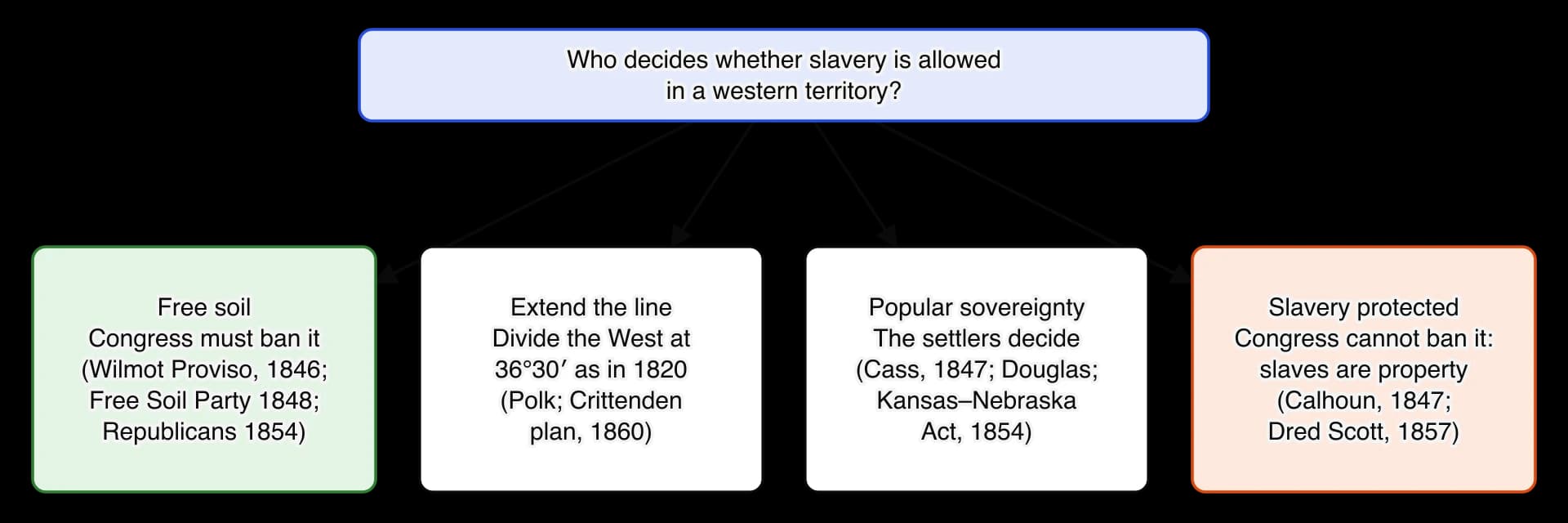
The Free Soil Party of 1848 united anti-slavery Whigs, Northern Democrats and members of the Liberty Party behind the slogan "Free soil, free speech, free labor, and free men". It wanted to keep slavery out of the West, not to abolish it in the South, and many of its voters wanted the West kept for white settlers. That combination of moral and self-interested arguments made opposition to the expansion of slavery far more popular than abolitionism.
Short-term causes: the crises of the 1850s
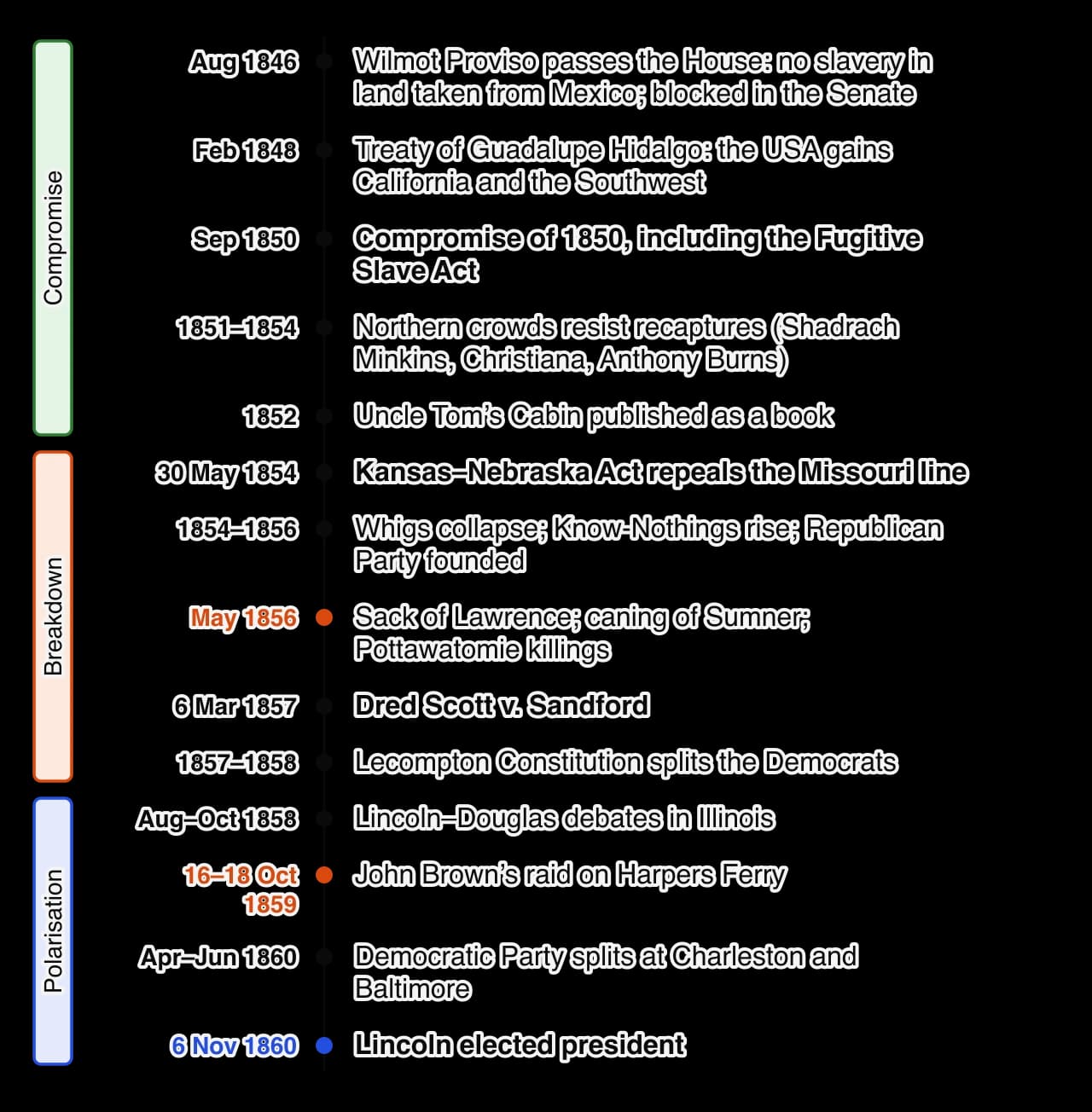
The vertical timeline of the 1850s shows how quickly the political system broke down once the territorial question was reopened. In 1850 Congress could still find a compromise; by 1860 none of the national institutions that had held the sections together, the parties, the churches and the Supreme Court, was trusted by both sides.
The Compromise of 1850
The gold rush of 1848–1849 brought about 100,000 settlers to California, which applied in 1849 to join the Union as a free state. That would have upset the balance of fifteen free and fifteen slave states in the Senate. Southern politicians threatened secession, and delegates from nine slave states met at the Nashville Convention in June 1850 to discuss their response. Henry Clay of Kentucky proposed a package of measures; after it failed as a single bill, Stephen A. Douglas of Illinois steered it through Congress as five separate laws in September 1850, signed by President Millard Fillmore.
Measure of the Compromise of 1850 | Who gained |
|---|---|
California admitted as a free state | North: free states gained a Senate majority (16 to 15) |
New Mexico and Utah organised as territories with no ban on slavery (popular sovereignty) | South, in principle: the Wilmot Proviso was dropped |
Texas gave up land claimed in New Mexico; the federal government took over 10 million dollars of Texas debt | Both: a boundary dispute that threatened violence was settled |
Slave trade (not slavery) abolished in the District of Columbia | North: an end to slave markets in the national capital |
A new, stronger Fugitive Slave Act | South: federal enforcement of the return of escaped slaves |
Contemporaries hailed the measures as a final settlement, and the Nashville Convention’s threat of secession faded. Yet the compromise rested on a truce, not on agreement: Northern and Southern congressmen voted for different parts of it, and very few voted for all five laws.
The Fugitive Slave Act and Northern resistance
The Fugitive Slave Act of 1850 did more than any other measure to bring slavery into Northern daily life. Accused fugitives could not testify or have a jury trial; the case was heard by a federal commissioner, who was paid 10 dollars if he sent the person south and only 5 dollars if he freed them; and ordinary citizens could be ordered to help capture fugitives, on pain of fines and prison. Free Black Northerners could be seized on the word of a slave catcher, and thousands fled to Canada.
Northern resistance was sometimes violent. In Boston in February 1851 Black activists rescued Shadrach Minkins from a courtroom and sent him to Canada. At Christiana, Pennsylvania, in September 1851 a Maryland slaveholder was killed when Black residents resisted his attempt to recapture men who had escaped from him. In May–June 1854 the federal government used troops and marines to return Anthony Burns from Boston to Virginia, at a cost of about 40,000 dollars, while thousands of Bostonians lined the streets in protest. Most fugitives were in fact returned, but each case convinced more Northerners that the "Slave Power" was reaching into their communities, and convinced Southerners that the North would not keep its side of the bargain.
The Kansas–Nebraska Act and Bleeding Kansas
In January 1854 Stephen Douglas introduced a bill to organise the land west of Missouri and Iowa as territories, partly so that a railway to the Pacific could run west from Chicago. To win Southern votes he agreed to repeal the Missouri Compromise line and let the settlers decide on slavery. The Kansas–Nebraska Act, signed on 30 May 1854, opened land that had been closed to slavery for thirty-four years. Northern opponents called it a betrayal of a sacred compact.
Kansas, next to slaveholding Missouri, became a battleground. Pro-slavery "Border Ruffians" crossed from Missouri to vote illegally in the territorial elections of 1855, producing a pro-slavery legislature at Lecompton; free-state settlers, many sponsored by the New England Emigrant Aid Company, set up a rival government at Topeka. On 21 May 1856 a pro-slavery posse sacked the free-state town of Lawrence. Three days later the abolitionist John Brown and his sons killed five pro-slavery settlers at Pottawatomie Creek. About 55 people died in the violence of Bleeding Kansas between 1855 and 1859.
The violence reached Congress. On 22 May 1856, two days after Senator Charles Sumner of Massachusetts gave a speech called "The Crime against Kansas" that insulted the South Carolina senator Andrew Butler, Butler’s relative, Congressman Preston Brooks, beat Sumner unconscious with a cane at his Senate desk. Sumner did not return to the Senate for three years. Southern admirers sent Brooks new canes; Northern newspapers presented the attack as Southern barbarism.
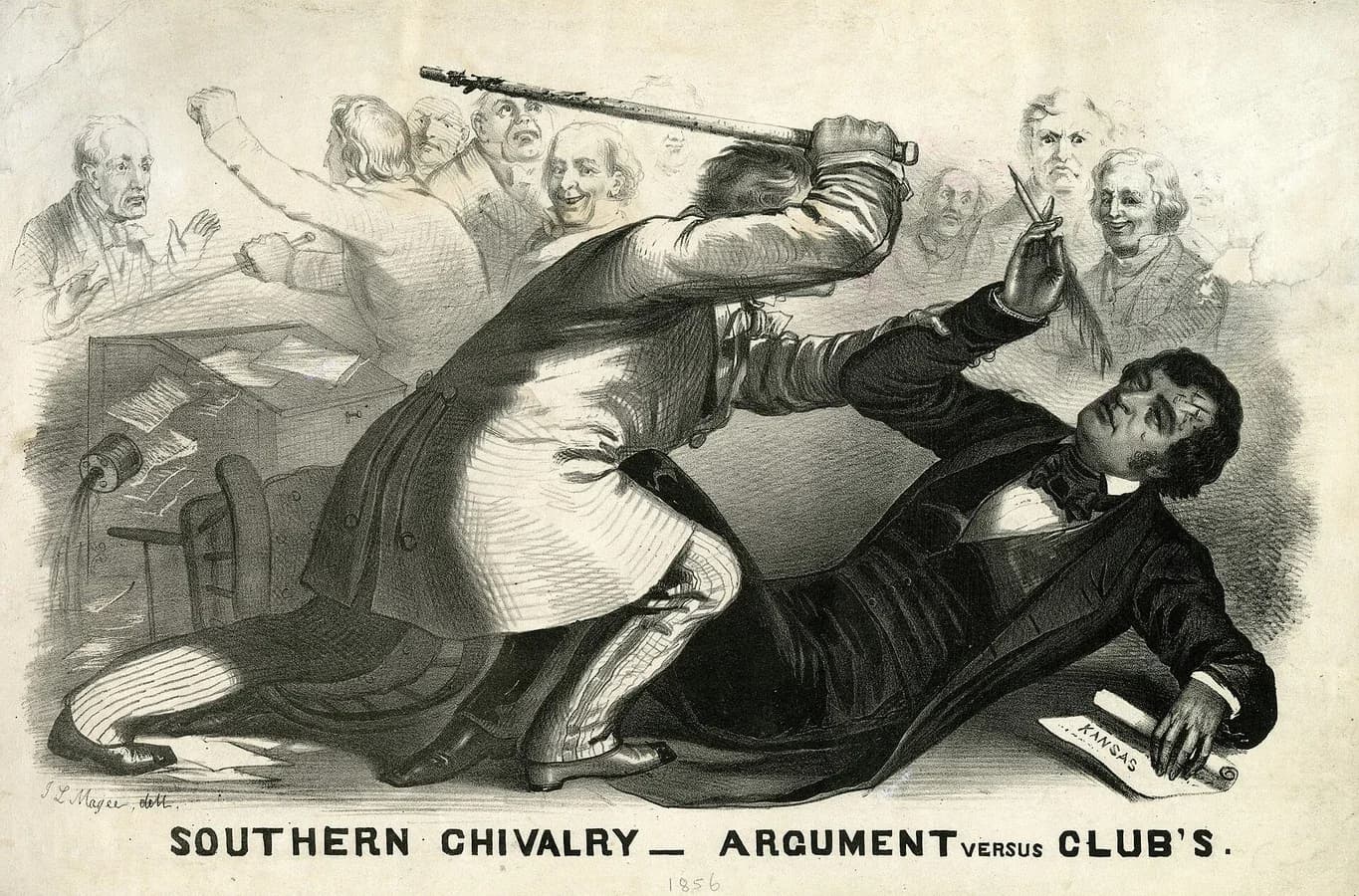
The lithograph of the caning shows how the same event was read in opposite ways in the two sections. For Northerners it proved that the Slave Power would silence free speech by force; for many Southerners Brooks had rightly punished an insult to his family and region.
The collapse of the second party system
Since the 1830s the Whig and Democratic parties had both had Northern and Southern wings, which forced politicians to seek votes in both sections. This second party system collapsed in the mid-1850s. The Whigs split over Kansas–Nebraska and disappeared after 1854. For a short time the anti-immigrant, anti-Catholic Know-Nothings (the American Party) attracted many former Whigs, but they too divided over slavery.
The new Republican Party, founded at meetings in Ripon, Wisconsin, and Jackson, Michigan, in 1854, brought together former Whigs, Free Soilers and anti-Nebraska Democrats on one central principle: no expansion of slavery into the territories. Its first presidential candidate, John C. Frémont, won eleven of the sixteen free states in 1856 without a single Southern vote. The Democrats, who won with James Buchanan, were now the only national party left.
The Dred Scott decision, 1857
Dred Scott was an enslaved man whose owner, an army surgeon, had taken him to live in the free state of Illinois and in the Wisconsin Territory, where the Missouri Compromise banned slavery. Scott sued for his freedom on the grounds that residence on free soil had made him free. On 6 March 1857, two days after Buchanan’s inauguration, the Supreme Court ruled against him by seven votes to two in Dred Scott v. Sandford.
Chief Justice Roger Taney of Maryland went much further than the case needed. He ruled that Black Americans, free or enslaved, could not be citizens of the United States and so could not sue in federal courts, writing that at the founding they had been regarded as having "no rights which the white man was bound to respect". He also ruled that Congress had no power to ban slavery in a territory, because that would deprive owners of property without due process, so the Missouri Compromise had been unconstitutional.
The Dred Scott decision delighted the South and appalled the North. It made the Republican programme unconstitutional and seemed to confirm the Slave Power conspiracy, since Buchanan had privately pressured a Northern justice to join the majority. It also damaged Douglas, because if Congress could not ban slavery in a territory, it was hard to see how a territorial legislature could.
The Lecompton Constitution
In 1857 a pro-slavery convention at Lecompton, elected in a vote that free-state settlers boycotted, wrote the Lecompton Constitution, which protected slavery, and arranged a vote in which settlers could not reject it outright. Buchanan urged Congress to admit Kansas under it. Douglas broke with the president, calling the process a fraud on popular sovereignty, and helped defeat it; when Kansans finally voted on it in August 1858, they rejected it overwhelmingly. The quarrel split the Democratic Party along sectional lines, two years before it formally divided.
The Lincoln–Douglas debates, 1858
Abraham Lincoln, an Illinois lawyer and former one-term Whig congressman, challenged Douglas for his Senate seat in 1858. Accepting the Republican nomination on 16 June 1858, he set out the stakes.
"A house divided against itself cannot stand." I believe this government cannot endure, permanently half slave and half free. I do not expect the Union to be dissolved - I do not expect the house to fall - but I do expect it will cease to be divided. It will become all one thing, or all the other.
Abraham Lincoln, speech to the Illinois Republican state convention, Springfield, 16 June 1858. Lincoln was a candidate addressing his own party, and the speech went on to claim that Douglas, Pierce, Buchanan and Taney had worked together to spread slavery. It shows the Republican belief that slavery had to be contained and put on the road to "ultimate extinction"; Southern readers took it as proof that a Republican president would attack slavery where it existed, although Lincoln repeatedly denied that he would.
In seven debates between August and October 1858, Douglas accused Lincoln of favouring racial equality, which Lincoln denied, while Lincoln pressed Douglas on how popular sovereignty could survive the Dred Scott decision. At Freeport on 27 August, Douglas answered that settlers could keep slavery out simply by refusing to pass the local laws needed to protect it. This Freeport Doctrine helped him keep his Senate seat, which the Illinois legislature gave him, but it cost him support in the South, where it was seen as a betrayal.
 YouTube
John Brown’s raid on Harpers Ferry, 1859
On 16 October 1859 John Brown, the Kansas guerrilla, led twenty-one men, five of them Black, in a raid on the federal arsenal at Harpers Ferry, Virginia. He hoped to seize weapons and spark a rising of enslaved people across the South. No rising came; within two days a force of US Marines commanded by Colonel Robert E. Lee captured him. Brown was convicted of treason against Virginia and hanged on 2 December 1859. On the day of his execution he handed a guard a note predicting that the "crimes of this guilty land" would be purged only with blood.
The reaction in each section mattered more than the raid. Many Northerners condemned the raid but admired Brown’s courage and dignity at his trial; bells tolled in Northern towns on the day he died, and the writer Ralph Waldo Emerson compared him to Christ. Papers seized from Brown showed that six prominent Northern abolitionists (the "Secret Six") had funded him. To white Southerners this confirmed their worst fear, that the North would encourage slave revolt, and Southern states strengthened their militias in the following year.
The election of 1860 and secession
A four-way election
The Democratic Party met at Charleston, South Carolina, in April 1860. Delegates from the Lower South demanded a platform promising federal protection for slavery in all the territories; when Northern delegates, loyal to Douglas, refused, the Southerners walked out. The party finally split at Baltimore in June: Northern Democrats nominated Douglas, and Southern Democrats nominated the vice-president, John C. Breckinridge of Kentucky. Former Whigs from the Upper South formed the Constitutional Union Party, which nominated John Bell of Tennessee on a programme of preserving the Union and avoiding the slavery question. The Republicans chose Lincoln, a moderate from a swing state, over the better-known William H. Seward of New York.
Candidate (party) | Popular vote | Share | Electoral votes | Where he won |
|---|---|---|---|---|
Abraham Lincoln (Republican) | 1,865,908 | 39.8% | 180 | Every free state except New Jersey, which he split with Douglas; not on the ballot in ten slave states |
Stephen A. Douglas (Northern Democrat) | 1,380,202 | 29.5% | 12 | Missouri and three electors in New Jersey |
John C. Breckinridge (Southern Democrat) | 848,019 | 18.1% | 72 | Eleven slave states, including the whole Lower South |
John Bell (Constitutional Union) | 590,901 | 12.6% | 39 | Virginia, Kentucky, Tennessee |
Data: official returns of the presidential election of 6 November 1860.
The election table shows why the result was so alarming to the South. Lincoln would have won the electoral college even if all his opponents had combined their votes, because he won majorities in the populous free states. For the first time a president had been elected by one section alone, on a programme of stopping the spread of slavery. White Southerners concluded that they had lost control of the federal government permanently, as new free states would join the Union from the West.
The secession of the Lower South
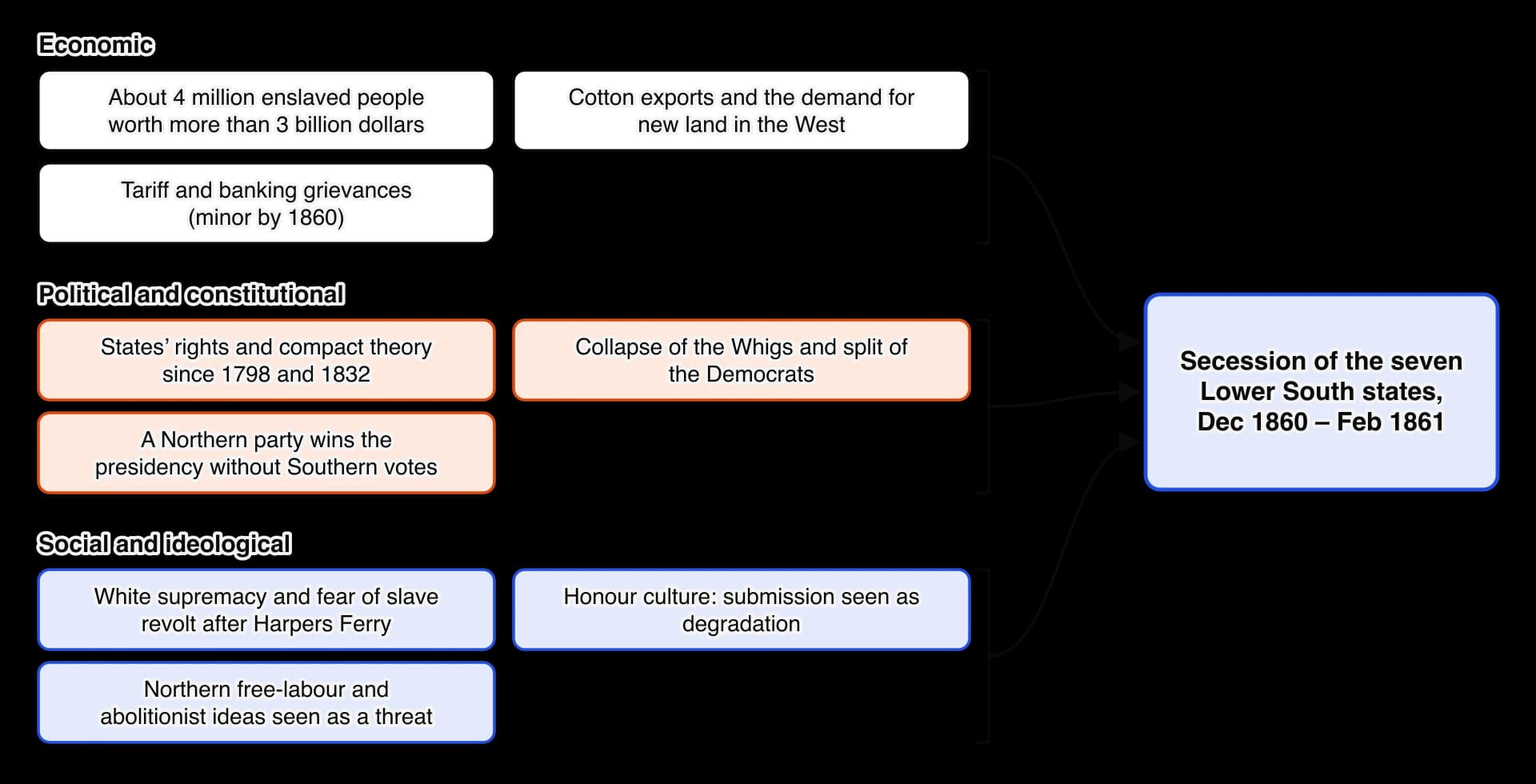
South Carolina’s convention voted unanimously to secede on 20 December 1860. By 1 February 1861 Mississippi, Florida, Alabama, Georgia, Louisiana and Texas had followed. These seven states had the highest proportions of enslaved people and slaveholding families in the country. In each, a convention elected for the purpose took the decision, and states sent "secession commissioners" to persuade the others; their speeches, studied by the historian Charles Dew, warned that a Republican government would lead to emancipation and racial equality.
Several states published declarations of their reasons. Mississippi’s was the most direct.
Our position is thoroughly identified with the institution of slavery-- the greatest material interest of the world. Its labor supplies the product which constitutes by far the largest and most important portions of commerce of the earth. … a blow at slavery is a blow at commerce and civilization. That blow has been long aimed at the institution, and was at the point of reaching its consummation. There was no choice left us but submission to the mandates of abolition, or a dissolution of the Union.
Mississippi secession convention, A Declaration of the Immediate Causes which Induce and Justify the Secession of the State of Mississippi from the Federal Union, January 1861. The convention wrote to justify its decision to its own citizens and the other slave states, so it presented secession as forced on Mississippi. Its value lies in showing that the men who took the decision placed slavery, and the cotton economy built on it, at the centre of their reasoning, while describing Lincoln’s moderate programme as "abolition".
Delegates from the seceded states met at Montgomery, Alabama, on 4 February 1861, adopted a provisional constitution for the Confederate States of America and chose Jefferson Davis of Mississippi, a former US senator and secretary of war, as president. The Confederate constitution closely copied the US Constitution, but it explicitly protected slavery, including in any future territories, and banned protective tariffs. In March the vice-president, Alexander Stephens, described racial slavery as the new nation’s foundation in his "Cornerstone Speech".
Attempts at compromise
The four months between the election and Lincoln’s inauguration saw the last attempts at compromise. Buchanan declared secession illegal but said he had no power to stop it. In December 1860 Senator John J. Crittenden of Kentucky proposed constitutional amendments that would have extended the 36°30′ line to the Pacific, protecting slavery south of it in all present and future territories, and guaranteed slavery in the states forever. Lincoln told Republicans to reject any extension of slavery, and the Crittenden Compromise failed. In March 1861 Congress passed the Corwin Amendment, which would have protected slavery in the states from federal interference; Lincoln did not oppose it, but the seceded states ignored it and it was never ratified.
The failure shows the limits of compromise in 1861. Lincoln could accept guarantees for slavery where it already existed, but not its expansion, which was the principle on which he had been elected. The Lower South, for its part, had not seceded to win concessions and showed little interest in returning on any terms.
Fort Sumter and the Upper South
Lincoln was inaugurated on 4 March 1861. His inaugural address repeated that he had no intention of interfering with slavery in the states, but insisted that the Union was perpetual and that he would "hold, occupy, and possess" federal property. It ended with an appeal to the South.
In your hands, my dissatisfied fellow-countrymen, and not in mine, is the momentous issue of civil war. The Government will not assail you. You can have no conflict without being yourselves the aggressors. You have no oath registered in heaven to destroy the Government, while I shall have the most solemn one to "preserve, protect, and defend it."
Abraham Lincoln, first inaugural address, Washington, 4 March 1861. Lincoln addressed the seceded states and, above all, the eight slave states of the Upper South that had not yet left the Union. By promising not to strike first, he placed responsibility for any war on the Confederacy, a position that helped unite Northern opinion when the war began.
Most federal forts in the seceded states had already been seized. Fort Sumter, in Charleston harbour, was still held by about 85 soldiers under Major Robert Anderson, who were running short of food. Lincoln informed South Carolina’s governor that he would send supplies only, not troops or weapons. Davis’s government decided to take the fort before the supplies arrived. Confederate batteries opened fire on 12 April 1861, and Anderson surrendered on 14 April. No one was killed in the bombardment.
On 15 April Lincoln called on the states for 75,000 militia volunteers to put down the rebellion. For the Upper South this meant choosing sides. Virginia’s convention voted to secede on 17 April, followed by Arkansas, North Carolina and Tennessee in May and June, bringing the Confederacy to eleven states. Richmond, Virginia, became its capital. The border states of Delaware, Maryland, Kentucky and Missouri, where slavery was legal but less central, stayed in the Union, partly through Lincoln’s careful handling and, in Maryland and Missouri, through military force. Western counties of Virginia, where few people owned slaves, broke away and joined the Union as West Virginia in 1863.
Campaigns and turning points of the war, 1861–1865
The two sides in 1861
Both sides expected a short war. The Union had far greater resources, but the Confederacy needed only to survive, while the Union had to conquer and hold a vast territory. The table of strengths and weaknesses compares the two sides at the start of the war.
Union | Confederacy | |
|---|---|---|
Population | About 22 million in the loyal states | About 9 million, of whom about 3.5 million were enslaved |
Industry and finance | About 90 per cent of the manufacturing of the states at war; nearly all firearms and iron; established banks and a working treasury | Little industry (the Tredegar Iron Works in Richmond was the main exception); wealth tied up in land and enslaved people |
Transport | About 70 per cent of the railway mileage; a navy and merchant fleet | Fewer railways, of different gauges, poorly connected; almost no navy |
Military strengths | Numbers; supply; naval power; control of the Ohio and upper Mississippi rivers | Fighting on the defensive and on interior lines; many able officers trained at West Point; soldiers defending their homes |
Weaknesses | Had to invade and occupy; divided opinion over war aims; weak generals in the East until 1864 | A states’ rights ideology that hampered central control; enslaved workers who might flee; dependence on cotton exports that a blockade could cut |
Strategy | The Anaconda Plan: blockade and control of the Mississippi; later, attacks on all fronts at once | Defend territory, wear down Northern will, win foreign recognition; occasional invasions of the North ("offensive-defensive") |
Data: approximate figures from the 1860 census, as summarised by James McPherson, Battle Cry of Freedom (1988).
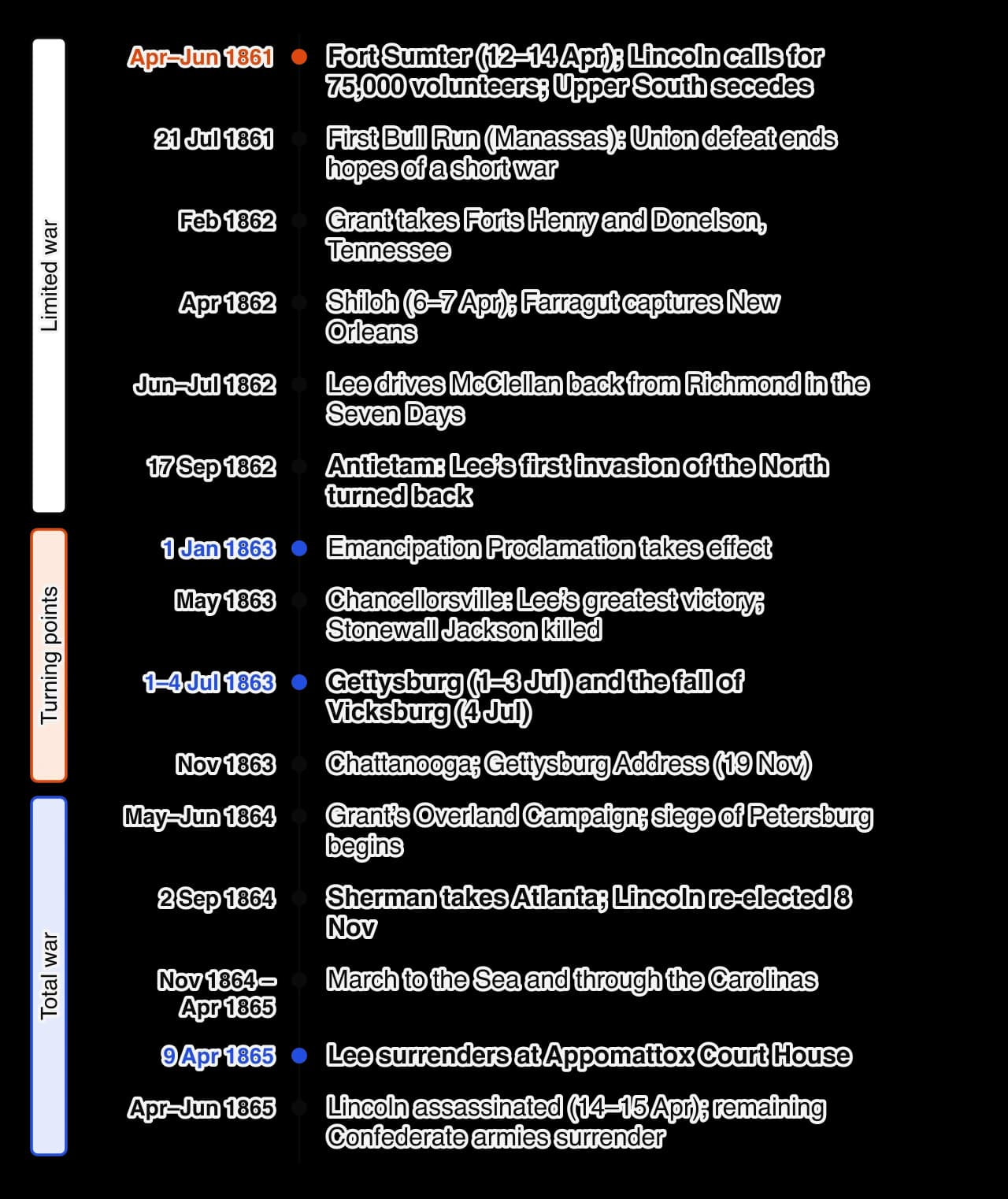
How these resources were mobilised, and why the Union’s advantages became decisive only slowly, is analysed as a question of what determines the outcome of a conflict. The narrative here sets out how the fighting developed in each phase of the war, shown in the vertical timeline of the campaigns.
1861–1862: a limited war
The first major battle, at Bull Run (Manassas) in northern Virginia on 21 July 1861, ended in a disorderly Union retreat and showed both sides that the war would be long. Lincoln gave command of the main eastern army, the Army of the Potomac, to George B. McClellan, a talented organiser who built and drilled a large army but was slow to use it. In the spring of 1862 McClellan landed on the Virginia peninsula and advanced to within a few miles of Richmond, but Robert E. Lee, who took command of the Army of Northern Virginia in June 1862, drove him back in the Seven Days battles.
In the West, Union forces did much better. Ulysses S. Grant captured Forts Henry and Donelson in Tennessee in February 1862, opening the Tennessee and Cumberland rivers to Union gunboats; his demand for "unconditional surrender" made him famous in the North. At Shiloh on 6–7 April 1862 he survived a surprise attack in a battle that killed or wounded about 23,000 men, more than all of America’s previous wars combined. Later that month Admiral David Farragut captured New Orleans, the largest city in the South.
Lee then took the offensive. After defeating a Union army at Second Bull Run in August 1862, he invaded Maryland, hoping to win a victory on Northern soil that would encourage foreign recognition and Northern war-weariness. On 17 September 1862, at Antietam Creek near Sharpsburg, McClellan stopped him in the bloodiest single day in American history, with about 23,000 casualties. Lee withdrew to Virginia. The battle was not a decisive military victory, because McClellan failed to pursue, but it had large political consequences: five days later Lincoln issued the preliminary Emancipation Proclamation.
1863: the turning points
The year began with Union failure in the East. Lee defeated the Union army at Fredericksburg in December 1862 and again, against odds of more than two to one, at Chancellorsville in May 1863, although his best corps commander, Thomas "Stonewall" Jackson, was mistakenly shot by his own men and died. Lee invaded the North a second time. At Gettysburg, Pennsylvania, on 1–3 July 1863 the Union army under George Meade held strong positions against three days of attacks, ending with the failed Confederate charge on the third day known as Pickett’s Charge. About 51,000 men were killed, wounded, captured or missing on both sides, and Lee never invaded the North again.
On 4 July 1863, after a siege of six weeks, Vicksburg surrendered to Grant with about 30,000 Confederate soldiers. Port Hudson, the last Confederate post on the Mississippi, fell five days later, so the Union controlled the whole river and the Confederacy was cut in two. In November Grant broke the siege of Chattanooga, Tennessee, opening the way into Georgia. At the dedication of the military cemetery at Gettysburg on 19 November, Lincoln described the war as a test of whether a nation "conceived in liberty" could survive, and called for "a new birth of freedom", linking the Union cause to the end of slavery.
1864–1865: total war and Confederate collapse
In March 1864 Lincoln made Grant general-in-chief of all Union armies. Grant’s plan was to attack everywhere at once so that the Confederacy could not move troops from one front to another. He accompanied Meade’s army into Virginia, where in the Overland Campaign (May–June 1864) battles at the Wilderness, Spotsylvania and Cold Harbor cost tens of thousands of casualties on both sides. Grant did not retreat after each battle as earlier commanders had done; he moved south around Lee’s flank, and in June began a siege of Petersburg, the railway centre that supplied Richmond, which lasted nine months.
In the West, William T. Sherman advanced from Chattanooga towards Atlanta, the Confederacy’s main railway junction in the Deep South, and took it on 2 September 1864. The news transformed Northern politics two months before the presidential election, and Lincoln won 55 per cent of the popular vote, including about three-quarters of the votes of soldiers. Sherman then marched to Savannah and north through the Carolinas, destroying railways, crops and property, while General Philip Sheridan laid waste to the Shenandoah Valley in Virginia, the "breadbasket" of Lee’s army.
By the spring of 1865 the Confederacy was collapsing. Desertion from Lee’s army rose sharply as soldiers’ families wrote of hunger. Lee abandoned Petersburg and Richmond on 2 April and surrendered at Appomattox Court House on 9 April 1865. Five days later, on 14 April, the actor John Wilkes Booth shot Lincoln at Ford’s Theatre in Washington; he died the next morning. Joseph E. Johnston surrendered the last large Confederate army in North Carolina on 26 April, and the remaining Confederate forces west of the Mississippi gave up in May and June. On 19 June 1865 Union troops arrived in Galveston, Texas, and announced the end of slavery there, a date now commemorated as Juneteenth.
Reasons for the Union victory
Explanations of the Union victory fall into four groups: the military and economic strengths and weaknesses of the two sides, the role of political and military leaders, emancipation and African American participation, and foreign relations. The Union’s resources, its finance and the Anaconda Plan are analysed elsewhere as a test case of what determines the outcome of a conflict; the emphasis here is on the leaders, on emancipation and on diplomacy, where the detail of the Civil War is richest.
Military and economic strengths and weaknesses
The Union’s material advantages grew during the war while the Confederacy’s shrank. Northern farms fed the Union armies and still exported grain to Europe; Northern factories produced more rifles each year; and the Union built or bought several hundred warships, so the blockade tightened every year. The Confederacy lost its most productive regions one by one, Tennessee in 1862, the Mississippi valley in 1863 and Georgia and the Shenandoah in 1864, while its railways wore out and could not be replaced. Its paper money lost almost all its value (prices in the Confederacy rose by roughly 9,000 per cent between 1861 and 1865, a commonly cited estimate), and the army had to seize food, horses and enslaved labourers from civilians, which turned many against the government.
Confederate weaknesses were political as well as material. Its constitution protected the sovereignty of the states, and governors such as Joseph Brown of Georgia and Zebulon Vance of North Carolina kept men and supplies for their own states and challenged conscription in court. In 1864 Davis asked Congress for powers to suspend the writ of habeas corpus more widely, and Vice-President Stephens publicly attacked him as a despot. Conscription, which the Confederacy introduced in April 1862, a year before the Union, bred class resentment, above all the "Twenty Negro Law" of October 1862 that exempted one white man on each plantation with twenty or more enslaved people. The Union had divisions of its own: its draft of March 1863, which let a man pay 300 dollars to avoid service, provoked the New York draft riots of July 1863. The historian Frank Owsley argued in State Rights in the Confederacy (1925) that quarrels over states’ rights fatally weakened the Confederacy, and David Donald later extended the argument in an essay titled "Died of Democracy" (1960).
The role of political and military leaders
Abraham Lincoln
Lincoln had almost no military experience, but he proved a skilful war leader. His first task was political: to keep a coalition of Republicans, War Democrats and border-state slaveholders behind a war for the Union. He kept Kentucky, Maryland and Missouri loyal by moving carefully on slavery at first, overruling generals who freed enslaved people in their districts in 1861 and 1862. He appointed Democrats as generals and rivals such as Seward, Salmon Chase and Edwin Stanton to his cabinet.
He also used the powers of the presidency more widely than any president before him. In April 1861 he suspended the writ of habeas corpus along the railway between Philadelphia and Washington, so that suspected Confederate sympathisers in Maryland could be held without trial. When Chief Justice Taney ruled in Ex parte Merryman (May 1861) that only Congress could suspend the writ, Lincoln ignored him, arguing that he could not let all the laws but one go unenforced to protect that one. About 13,000–15,000 civilians were arrested by the military during the war, and opponents such as the Ohio Democrat Clement Vallandigham, a leader of the anti-war Copperheads, were tried by military courts.
Lincoln’s handling of slavery shows his political method. In August 1862 the New York editor Horace Greeley published an open letter accusing him of failing to act against slavery. Lincoln, who had already drafted the Emancipation Proclamation and was waiting for a military victory to announce it, replied in a public letter.
My paramount object in this struggle is to save the Union, and is not either to save or to destroy slavery. If I could save the Union without freeing any slave I would do it, and if I could save it by freeing all the slaves I would do it; and if I could save it by freeing some and leaving others alone I would also do that. What I do about slavery, and the colored race, I do because I believe it helps to save the Union.
Abraham Lincoln, public letter to Horace Greeley, dated 22 August 1862 and published in the National Intelligencer the next day. Lincoln wrote for the whole Northern public, including conservative and border-state voters who would not fight for abolition, and he closed the letter by restating his "personal wish that all men every where could be free". The letter shows that he presented emancipation as a measure to save the Union, which prepared opinion for the proclamation he issued a month later; it should not be read as proof that he was indifferent to slavery.
As a military leader, Lincoln grasped earlier than most of his generals that the Union should use its greater numbers to attack at several points at once, and that the aim was to destroy Confederate armies, not to capture Richmond. He removed McClellan in November 1862 and searched through several commanders before giving Grant command of all the Union armies in 1864. He also stood for re-election in 1864 in the middle of a war, and won it. In his Second Inaugural Address of 4 March 1865 he described slavery as the cause of the war and the war itself as a judgement on the whole nation for it, and called for a peace made "with malice toward none, with charity for all".
Jefferson Davis
Jefferson Davis had more military experience than Lincoln: he was a West Point graduate, a hero of the Mexican–American War and a former secretary of war. These qualities were in some ways a weakness. He tried to direct the war himself, quarrelled with able generals such as Joseph E. Johnston and P. G. T. Beauregard, and kept loyal but less able ones such as Braxton Bragg in command too long. He was a poor communicator who could not rally public opinion as Lincoln did. His strategy of defending as much territory as possible spread Confederate forces thinly. Yet he held a new and divided nation together for four years, and his trust in Lee was justified.
The generals
Lee was the Confederacy’s greatest asset: bold, skilful and trusted by his men, he won repeated victories against larger armies in Virginia between 1862 and 1863. His critics argue that his aggressive tactics, as at Gettysburg, cost men the Confederacy could not replace, and that his focus on Virginia neglected the West, where the war was being lost. On the Union side, Grant and Sherman were the decisive commanders: Grant combined persistence with a strategy that coordinated all the Union armies, and Sherman recognised that the Confederacy’s will and economy were as much targets as its armies. Admiral Farragut and the navy, often forgotten, made the blockade and the river war possible.
The Emancipation Proclamation and African American participation
The road to emancipation, 1861–1862
In 1861 the Union fought to restore the Union, not to end slavery, and Congress resolved in July 1861 that it had no intention of interfering with slavery in the states. The war itself changed this. Enslaved people began escaping to Union lines within weeks of Fort Sumter, and once General Benjamin Butler had refused to return them as "contraband of war", army officers and Congress had to decide what to do with them. Step by step, Congress moved against slavery as a war measure.
First Confiscation Act (6 August 1861): owners lost their claim to enslaved people used to support the Confederate war effort.
Abolition in the District of Columbia (16 April 1862): about 3,000 people freed, with compensation of up to 300 dollars each paid to loyal owners.
Ban on slavery in the federal territories (June 1862): the Republican programme of 1860, achieved once Southern members had left Congress.
Second Confiscation Act and Militia Act (17 July 1862): enslaved people of anyone supporting the rebellion who reached Union lines were declared free, and the president could employ Black men in the army.
Lincoln himself first tried a gradual, compensated emancipation in the border states, combined with voluntary colonisation of freed people abroad, a plan he urged on a delegation of free Black men in August 1862 and that they and most Black leaders rejected. When the border states refused his offers, he decided in July 1862 to use his powers as commander-in-chief. On the advice of his cabinet, he waited for a victory so that the measure would not look like an act of desperation, and issued the preliminary proclamation after Antietam, on 22 September 1862.
What the proclamation did
The Emancipation Proclamation came into force on 1 January 1863. It declared free all enslaved people in the areas still in rebellion, about 3.5 million people, and allowed Black men to serve in the army and navy. Its limits were deliberate. It did not apply to the border states, to Tennessee or to Union-occupied parts of Louisiana and Virginia, because Lincoln’s legal power to free enslaved people rested on military necessity in enemy territory. On the day it took effect it freed perhaps 20,000–50,000 people in areas already under Union control.
Its importance was in what followed. Every advance of the Union army now became an advance of freedom, and Union soldiers became, in effect, an army of liberation. It turned the war aims of the North from restoring the old Union to creating a new one without slavery, and made a negotiated peace that kept slavery almost impossible. Abroad, it made it politically very difficult for Britain or France to intervene on behalf of a slaveholding state. Because it was a war measure that courts might overturn after the war, Republicans pressed for a constitutional amendment; the Thirteenth Amendment, which abolished slavery everywhere in the United States, passed Congress on 31 January 1865 and was ratified on 6 December 1865.
African American soldiers and workers
About 179,000 Black men served in the Union army and about 19,000 in the navy, most of them formerly enslaved men from the South and the border states. Many white Northerners doubted at first that they would fight. Battles in 1863 changed that view: Black regiments attacked Confederate defences at Port Hudson, Louisiana, on 27 May, held off an assault at Milliken’s Bend on 7 June, and on 18 July the 54th Massachusetts Infantry led the failed assault on Fort Wagner, South Carolina, losing almost half the men who took part. Northern newspapers praised their courage, and in a public letter of August 1863 Lincoln reported that some of his most successful commanders believed emancipation and the use of Black troops were the heaviest blow yet dealt to the rebellion.
Black soldiers faced unequal pay until 1864, white officers, and the threat that captured Black soldiers would be enslaved or killed. The Confederacy’s refusal to treat captured Black soldiers as prisoners of war was a main reason why the exchange of prisoners between the two sides broke down in 1863, which left tens of thousands of men from both sides in overcrowded prison camps such as Andersonville in Georgia.
African American participation went far beyond the army. Perhaps 500,000 enslaved people escaped to Union lines during the war (an estimate, since many were never recorded). They worked as labourers, cooks, teamsters, nurses, scouts and spies, and their flight deprived the Confederacy of workers and food. By 1864 Confederate leaders themselves were debating whether to arm enslaved men. General Patrick Cleburne’s proposal of January 1864 to free and enlist them was suppressed, but on 13 March 1865, with Lee’s support, the Confederate Congress authorised the enlistment of Black soldiers. Very few were ever raised, and the debate showed how far the war had undermined the slave system the Confederacy was created to protect. W. E. B. Du Bois later called the mass flight of enslaved people to Union lines a "general strike" (the title of a chapter of Black Reconstruction, 1935), arguing that the enslaved had withdrawn their labour from the Confederacy and so helped to decide the war.
Foreign relations
Confederate leaders expected that Britain and France, which depended on Southern cotton, would recognise their independence and perhaps break the blockade, as France had helped the American colonists in 1778. The Union’s diplomats, led by Secretary of State Seward and the minister in London, Charles Francis Adams, worked to prevent this. The table of the main diplomatic crises shows how close Britain came to involvement and why it stayed out.
Date | Event | Significance |
|---|---|---|
May 1861 | Britain and France declare neutrality but recognise the Confederacy as a belligerent | Confederate ships could buy supplies in neutral ports, but there was no diplomatic recognition of the Confederacy |
Nov–Dec 1861 | Trent Affair: a Union warship stops a British mail ship and seizes the Confederate envoys James Mason and John Slidell | Britain sent troops to Canada and demanded their release; Lincoln and Seward freed them to avoid a second war |
1861–1865 | Lancashire "cotton famine": British mills run short of cotton; hundreds of thousands of workers lose work | The Confederate embargo backfired: Britain had large stocks from 1860, found cotton in India and Egypt, and needed Northern wheat |
Sep–Nov 1862 | British cabinet discusses mediation; Chancellor of the Exchequer Gladstone says the South has "made a nation" (7 Oct) | Antietam and the preliminary proclamation persuaded the government to wait; Britain rejected a French plan for joint mediation in November |
1862–1864 | Confederate cruisers built in Britain, such as the CSS Alabama, destroy Union merchant ships | Britain later paid the USA 15.5 million dollars in compensation (the Alabama claims, 1872) |
Sep 1863 | Britain detains two ironclad "Laird rams" being built for the Confederacy at Birkenhead | Adams warned that their release would mean war; the seizure ended serious Confederate hopes of British help |
1862–1867 | France invades Mexico and installs Maximilian as emperor (1864) | Napoleon III sympathised with the Confederacy but would not act without Britain; after 1865 US pressure helped force a French withdrawal |
Britain stayed neutral for several reasons. Its government saw little to gain from war with the United States, which could invade Canada and cut off grain supplies; it was unwilling to recognise the Confederacy unless the South had clearly won; and after 1863 British working-class and liberal opinion strongly opposed any support for a state founded on slavery. Foreign relations did not win the war for the Union, but Union diplomacy prevented the Confederacy from winning the outside help that had decided the War of Independence.
Weighing the reasons for the Union victory
Factor | How it contributed | Limits of the factor |
|---|---|---|
Economic and military strength | Allowed the Union to replace losses, tighten the blockade and fight on several fronts | Present from the start, yet the Union was losing in the East in 1862; it had to be mobilised and used well |
Political leadership | Lincoln held the coalition together, kept the border states, chose Grant and won re-election in 1864 | Lincoln’s re-election depended on Sherman’s victory at Atlanta; Davis held the Confederacy together for four years |
Military leadership | Grant and Sherman coordinated attacks and targeted the Confederate economy | Lee’s skill prolonged the war; Union generals in the East failed for two years |
Emancipation and Black participation | Weakened the Southern labour force and added about 200,000 soldiers and sailors; blocked foreign intervention | Black troops were used mainly from 1863–1864; their effect depended on Union advances |
Foreign relations | Kept Britain and France neutral, so the blockade held and the South fought alone | A negative factor: it explains why the Confederacy could not win more than why the Union did |
Confederate weaknesses | States’ rights disputes, inflation, desertion and class resentment weakened the war effort | Historians disagree on how far Confederate morale collapsed before military defeat |
The factors were connected. The Union’s strength made a long war likely to end in its favour, but only if Northern voters stayed willing to fight; Lincoln’s leadership and the victories of Grant and Sherman kept them willing in 1864; emancipation added soldiers, weakened the Southern economy and kept Europe out. Most historians therefore treat economic strength as a necessary condition of victory, and leadership, emancipation and military events as the factors that decided when and how the Union won.
The impact of the Civil War
The war’s consequences reached every part of American life. The diagram of the impact of the war groups them as political, economic and social and cultural. Many of them were not intended in 1861: the North went to war to restore the Union, and ended it having abolished slavery and greatly expanded the power of the federal government.
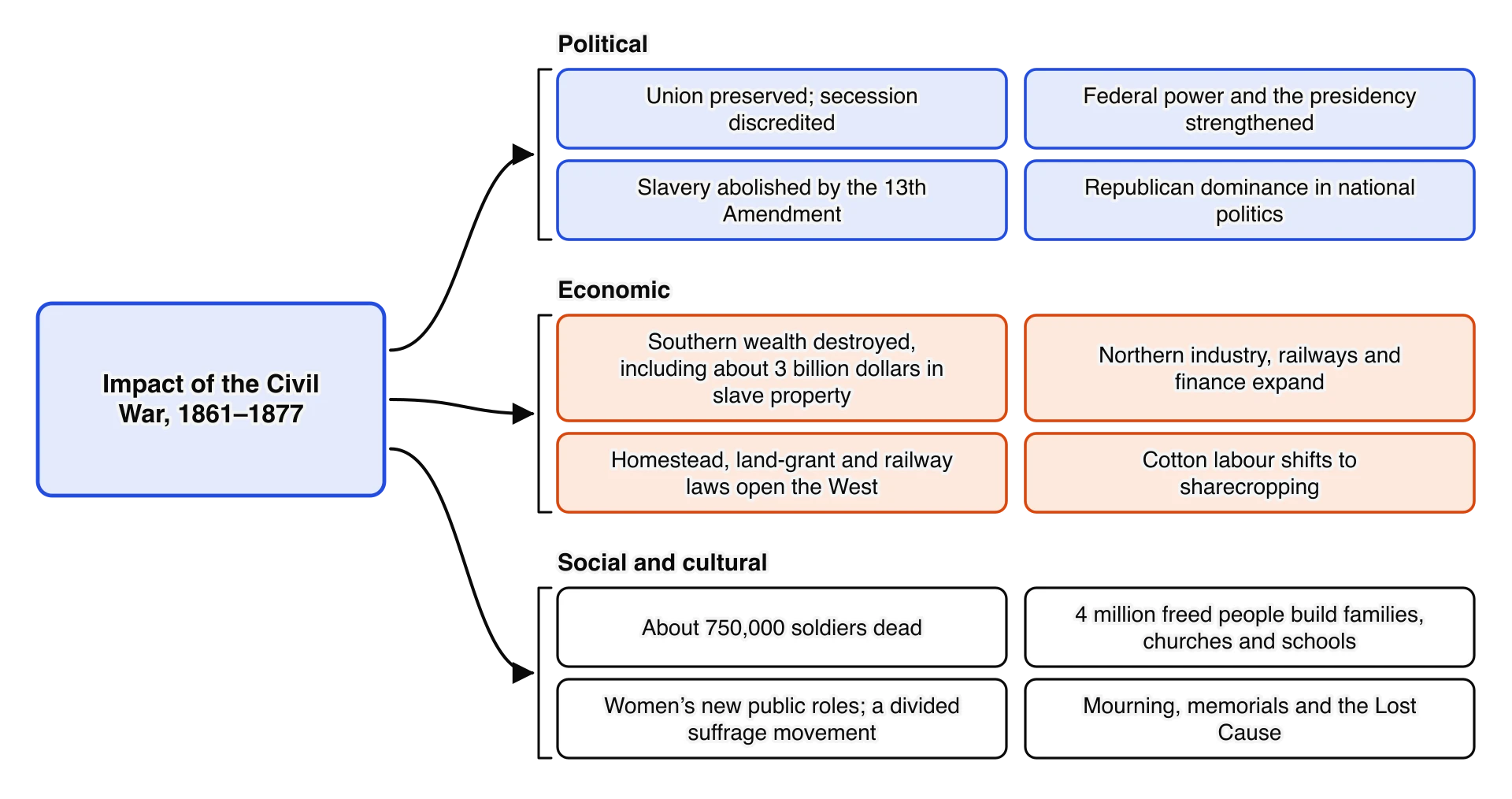
The human cost
For more than a century historians accepted a figure of about 620,000 soldiers’ deaths, roughly 360,000 Union and 260,000 Confederate. In 2011 the demographer J. David Hacker used census data to estimate the number at about 750,000 (within a range of about 650,000–850,000), because Confederate records were incomplete and many deaths after discharge were never counted. Even the lower figure is about 2 per cent of the population of 1860, equivalent to about 7 million deaths in the United States today. About two-thirds of the soldiers who died were killed by disease. Hundreds of thousands more returned without limbs or with lasting illness, and in 1866 Mississippi spent a fifth of its state budget on artificial limbs for veterans.
Political impact
The Union and the Constitution. The war settled that the United States was one nation from which no state could secede; the Supreme Court confirmed in Texas v. White (1869) that the Union was "indestructible". The Thirteenth, Fourteenth and Fifteenth Amendments, the first changes to the Constitution since 1804, abolished slavery, defined national citizenship and protected voting rights against racial discrimination.
Federal power. To fight the war the federal government created a national paper currency (greenbacks), a system of national banks (1863–1864), the first federal income tax and the first national conscription. Its spending rose more than twentyfold, and its debt reached about 2.7 billion dollars by 1866. Lincoln’s use of emergency powers set precedents for later wartime presidents.
Laws for development. With Southern opponents absent, Congress passed the Republican economic programme in 1862: the Homestead Act (160 acres of public land free to settlers who farmed it for five years), the Morrill Land-Grant College Act (public land to fund state colleges) and the Pacific Railway Act (the first transcontinental railway, completed in 1869). It also raised tariffs to protect Northern industry.
Party politics. The Republicans became the dominant national party, winning every presidential election but two between 1860 and 1908 and reminding Northern voters at every election that the Democrats had been the party of secession. The white South became solidly Democratic once Reconstruction ended.
Economic impact
The war devastated the Southern economy. Emancipation wiped out the largest form of Southern wealth, enslaved people valued at about 3 billion dollars, without compensation. Armies destroyed railways, bridges, barns, livestock and towns across Virginia, Tennessee, Georgia and the Carolinas, and Confederate money and bonds became worthless. The chart of the cotton crop shows that output did not regain its 1859 level until the late 1870s. The South remained the poorest region of the United States until the mid-twentieth century.
Cotton production recovered with a new system of labour. Planters had land but no money to pay wages; freed people wanted land but had none. The result, across much of the cotton South, was sharecropping: Black and poor white families farmed a plot of a planter’s land in return for a share, often half, of the crop. Many depended on local merchants for seed, tools and food on credit secured against the next crop, under the crop-lien system, and debt tied them to the land year after year.
In the North the war stimulated some industries, such as iron, wool, meat-packing and railway equipment, and created large fortunes for contractors and financiers. Charles and Mary Beard (1927) called the war a "Second American Revolution" that brought Northern industrial capitalism to power. Economic historians such as Thomas Cochran ("Did the Civil War Retard Industrialization?", 1961) replied that growth actually slowed during the war decade compared with the 1850s, because resources were diverted to fighting. Most now see the war’s lasting economic effects in its legislation, its national banking and currency system and the destruction of slavery, more than in wartime production.
Social and cultural impact
For about four million African Americans the war brought freedom, the most important social change in American history, whose meaning was fought over during Reconstruction. Freed people left plantations to find relatives sold away, legalised their marriages, founded independent churches and schools, and refused to work in gangs under overseers. Their actions are examined with Reconstruction.
The scale of death changed American culture. Drew Gilpin Faust (This Republic of Suffering, 2008) shows how the war transformed the way Americans dealt with death: families searched for bodies, embalming became common, and the federal government created national cemeteries for Union soldiers from 1862 and later reburied about 300,000 of them. Photographs of the dead at Antietam by Alexander Gardner, shown in Mathew Brady’s New York gallery in October 1862, brought the battlefield into civilian life for the first time. Remembering the dead became a public duty: Black residents of Charleston held one of the first ceremonies for Union dead in May 1865, and the Union veterans’ organisation, the Grand Army of the Republic, called for a national "Decoration Day", later Memorial Day, in 1868.
In the white South, Ladies’ Memorial Associations, veterans’ groups and writers such as the former Confederate general Jubal Early built the memory of the Lost Cause, which honoured Confederate soldiers and recast secession as a defence of states’ rights. By the 1880s and 1890s this memory had helped white Northerners and Southerners to reconcile with each other, at the cost of forgetting both slavery and the Black soldiers who had fought.
Experiences of women
About three million men served in the two armies, and women on both sides took on new work and new public roles. Their experiences differed greatly by section, class and race, and for most the changes did not last beyond the war. The table of women’s experiences compares the main groups.
Group | Experiences during the war | After the war |
|---|---|---|
Northern middle-class white women | Organised thousands of local aid societies; ran the US Sanitary Commission’s supply and fundraising work (its "sanitary fairs" raised millions of dollars); served as nurses and hospital administrators | Gained organising experience that fed later reform movements; most nursing jobs ended in 1865 |
Northern working-class white women | Took paid work in arsenals, uniform workshops and government offices; the Treasury hired its first women clerks in 1862 | Some kept clerical jobs; many war widows depended on small pensions |
Southern white women | Managed farms and plantations and controlled enslaved workers without men; many became refugees; poor women led bread riots in Richmond and other towns in 1863 | Led the memorial associations of the Lost Cause; most supported a return to the old social order |
Enslaved and freed Black women | Fled to Union lines with their children, often to crowded "contraband camps"; worked as cooks, laundresses and nurses for the army; some served as spies and scouts | Reunited families, legalised marriages and sought to work for their own households instead of in the fields; faced violence from white employers |
Some women broke the boundaries of their time more directly. Harriet Tubman scouted for the Union army in South Carolina and helped lead the Combahee River raid of 2 June 1863, which freed about 750 enslaved people. Dr Mary Edwards Walker served as a surgeon with the Union army, was captured and imprisoned, and in 1865 became the only woman to receive the Medal of Honor. Rose O’Neal Greenhow spied for the Confederacy in Washington and Elizabeth Van Lew for the Union in Richmond. Historians estimate that several hundred women disguised themselves as men and fought as soldiers.
The war also shaped the women’s rights movement. Elizabeth Cady Stanton and Susan B. Anthony suspended their campaign for women’s suffrage during the war and founded the Women’s Loyal National League in 1863, which collected about 400,000 signatures on petitions for a constitutional amendment to abolish slavery. They expected that women would be rewarded with the vote after the war. When the Fourteenth Amendment wrote the word "male" into the Constitution for the first time and the Fifteenth protected voting rights from discrimination by race but not by sex, the movement split in 1869. Stanton and Anthony’s National Woman Suffrage Association opposed the Fifteenth Amendment; Lucy Stone’s American Woman Suffrage Association supported it as a step forward for Black men.
Reconstruction, 1863–1877
Reconstruction raised three questions at once: on what terms the Confederate states would return to the Union, who would decide those terms (the president or Congress), and what freedom would mean for four million formerly enslaved people. The vertical timeline of Reconstruction shows its three phases. Reconstruction as a case of peacebuilding after a civil war, and the reconciliation between white Northerners and Southerners, are examined in the study of how peace is established; the focus here is on the plans, the amendments, the actions of freed people and the reasons for its failure.
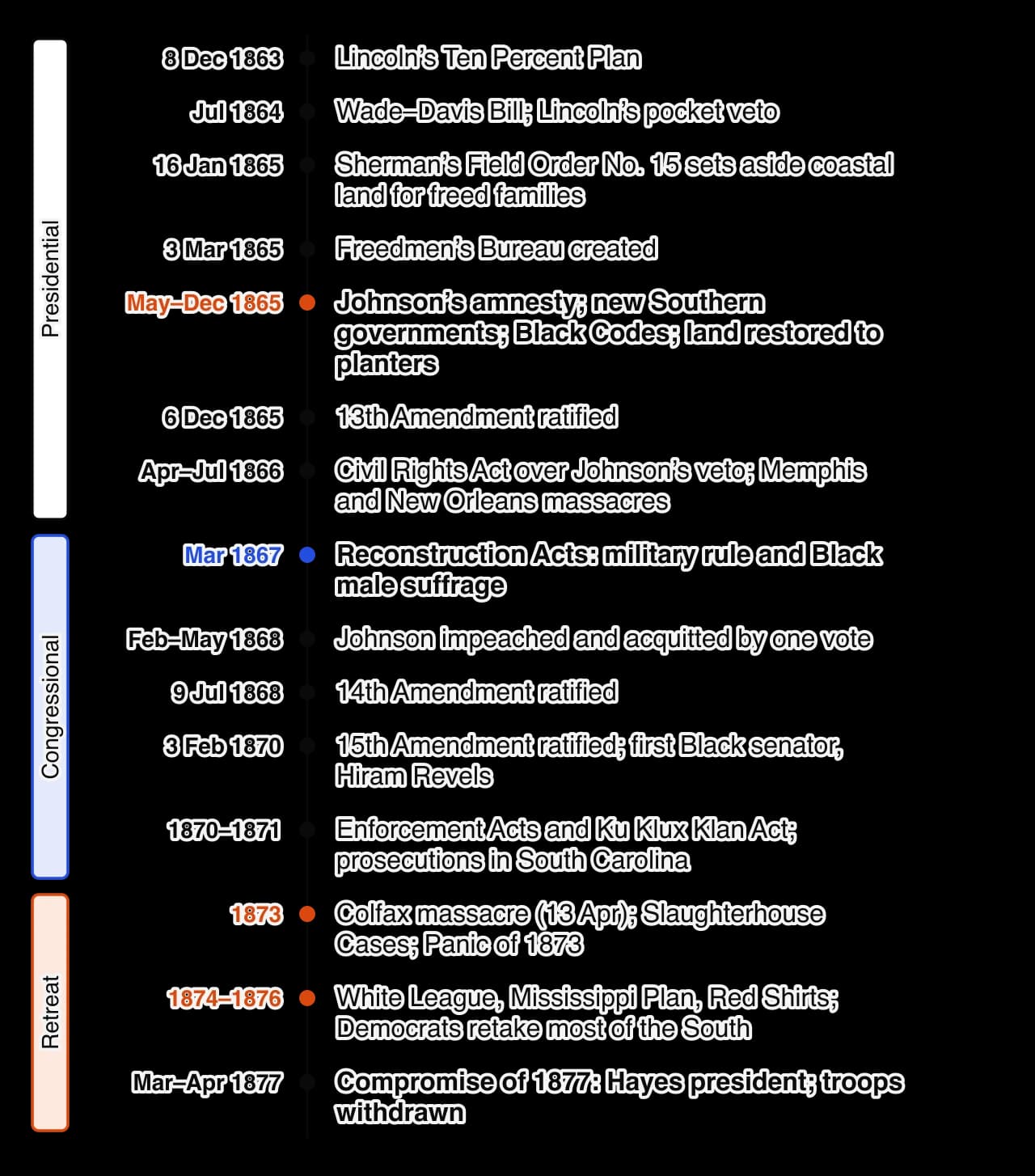
Wartime and Presidential Reconstruction
Reconstruction began during the war, as Union armies occupied parts of the South. The plans put forward between 1863 and 1867 differed above all in how many white Southerners had to be loyal before a state could return, and in what, if anything, they offered freed people.
Plan | Terms for readmission | Provisions for freed people | Outcome |
|---|---|---|---|
Lincoln’s Ten Percent Plan (Dec 1863) | A state could form a government once 10 per cent of its 1860 voters took an oath of loyalty and accepted emancipation; pardons for most Confederates | Emancipation only; Lincoln suggested the vote for educated Black men and soldiers, privately in 1864 and publicly in April 1865 | Governments formed in Louisiana, Arkansas and Tennessee; Congress refused to seat their representatives |
Wade–Davis Bill (Jul 1864) | A majority of white men must swear an "ironclad oath" that they had never supported the Confederacy | Abolition of slavery in state constitutions; no Black suffrage | Passed by Congress; Lincoln killed it by a pocket veto |
Johnson’s plan (May–Dec 1865) | Pardon for most Confederates who took an oath; wealthy planters and Confederate leaders to apply for individual pardons, which Johnson granted freely; states to abolish slavery and repudiate Confederate debts | None; Johnson opposed Black suffrage and returned confiscated land to its former owners | All former Confederate states had new governments by December 1865, many led by former Confederates |
Congressional plan (Reconstruction Acts, Mar 1867) | Military rule in five districts until each state wrote a new constitution with Black male suffrage and ratified the 14th Amendment | Black men voted and held office; the Freedmen’s Bureau, civil rights laws and federal troops protected them for a time | All the former Confederate states were readmitted between 1868 and 1870 |
Andrew Johnson, a Tennessee Democrat chosen as Lincoln’s running mate in 1864 to attract War Democrats, became president on 15 April 1865. A former tailor who resented the planter elite, he had denounced treason during the war, and Radical Republicans at first expected him to be harsh. Instead, he believed that the states had never legally left the Union, that Reconstruction was a matter for the president alone, and that the South should be governed by white men. He issued his amnesty proclamation on 29 May 1865 while Congress was not in session, and by the end of the year he had granted thousands of individual pardons to wealthy Confederates.
The Black Codes
The new Southern legislatures elected under Johnson’s plan passed laws to control the labour of freed people, beginning with Mississippi and South Carolina in November–December 1865. They recognised some rights, such as the right to marry and to own property, but they tried to force freed people back into plantation labour on terms close to slavery.
Every freedman, free Negro, and mulatto shall . . . have a lawful home or employment, and shall have a written evidence thereof … and if the laborer shall quit the service of the employer before expiration of his term of service without good cause, he shall forfeit his wages for that year, up to the time of quitting.
Mississippi, "An Act to confer Civil Rights on Freedmen, and for other purposes", sections 5 and 6, November 1865. The legislature, elected by white voters only, presented the law as granting rights to freed people, but its purpose was to make them sign yearly labour contracts and to punish anyone who left an employer. Read with the vagrancy law passed at the same time, under which unemployed freed people could be fined and hired out to whoever paid the fine, it shows how Southern governments tried to restore planters’ control of Black labour without legal slavery.
The Black Codes, together with the election of Confederate leaders to Congress, including the Confederate vice-president Alexander Stephens, convinced many Northern voters that Johnson’s policy was letting the South win the peace. When Congress met in December 1865, the Republican majority refused to seat the Southern members and set up a Joint Committee on Reconstruction.
Congressional Reconstruction
Congress first tried to work with Johnson. In early 1866 it passed a bill to extend the Freedmen’s Bureau and the Civil Rights Act, which defined everyone born in the United States (except untaxed Native Americans) as a citizen with equal rights to make contracts, sue, testify and own property. Johnson vetoed both, arguing that they gave Black people rights white people did not have and invaded the rights of the states. On 9 April 1866 Congress passed the Civil Rights Act over his veto, the first major law in American history enacted over a presidential veto.
To place these rights beyond the reach of future Congresses and courts, Congress passed the Fourteenth Amendment in June 1866. Its first section made all persons born or naturalised in the United States citizens and forbade any state to deny them "the equal protection of the laws" or to deprive them of life, liberty or property without due process. Other sections reduced the representation of any state that denied adult men the vote, and barred many former Confederate officials from office. Johnson urged the Southern states to reject it, and all except Tennessee did.
Violence in the South strengthened the Radicals. In May 1866 white mobs, including police, killed 46 Black people in Memphis and burned their homes, churches and schools; in July police and a white mob attacked a Black suffrage convention in New Orleans, killing at least 34 Black people and three white supporters. Johnson toured the North before the midterm elections of 1866, attacking Republican leaders in speeches that hurt his cause. The Republicans won more than two-thirds of both houses, enough to override any veto.
The Reconstruction Acts of March 1867 placed the ten unreconstructed states under military rule in five districts. To be readmitted, each had to hold elections in which Black men voted, write a new constitution guaranteeing Black male suffrage and ratify the Fourteenth Amendment. Congress also passed the Tenure of Office Act, which forbade the president to remove cabinet members without the Senate’s approval. When Johnson dismissed Secretary of War Edwin Stanton, an ally of the Radicals, the House impeached him on 24 February 1868. In May the Senate fell one vote short of the two-thirds majority needed to remove him; some moderate Republicans voted to acquit because they feared weakening the presidency and distrusted the radical who would have succeeded him.
Ulysses S. Grant won the presidency for the Republicans in 1868, helped by about 500,000 Black votes in the South. Congress then passed the Fifteenth Amendment, ratified on 3 February 1870, which forbade the federal government or any state to deny the vote "on account of race, color, or previous condition of servitude". It did not forbid literacy tests, poll taxes or property qualifications, which Southern states later used to remove Black voters.
The Reconstruction governments
Between 1868 and 1870 new state governments, elected by Black and white voters, took power across the South. Their supporters were freed people, who made up the large majority of Republican voters; white Southern Republicans, whom opponents called scalawags, many of them poorer upcountry farmers or former Whigs; and Northerners who had moved south, called carpetbaggers by their enemies, who claimed they had come only to plunder. The new governments created the first state-funded public school systems in the South, built hospitals and orphanages, rebuilt railways, abolished imprisonment for debt and made taxation fairer.
Black Southerners took part in government for the first time. Eric Foner’s research identified more than 1,500 Black officeholders, from sheriffs and justices of the peace to state legislators, and later counts suggest about 2,000. Sixteen Black men served in Congress during Reconstruction, including Hiram Revels and Blanche K. Bruce of Mississippi in the Senate. Black voters formed a majority in South Carolina, Mississippi and Louisiana, and in South Carolina Black members held a majority in the lower house of the legislature. Opponents attacked these governments as corrupt and incompetent; corruption existed, as it did in Northern cities in the same years, but historians now see the governments’ record as far better than their enemies claimed.
Actions taken by formerly enslaved people
Freed people did not wait for Washington to define their freedom. Their first acts were to test it: to leave the plantation, to travel, to refuse to be whipped, to choose their own names. Many then set out in search of family members who had been sold away; for decades after the war Black newspapers carried "Information Wanted" advertisements from parents looking for children and from husbands looking for wives. Thousands of couples registered their marriages with the Freedmen’s Bureau or the army as soon as they could.
Churches. Freed people left white-controlled congregations and built their own. Independent Black denominations such as the African Methodist Episcopal Church grew several times over in the decade after the war. Black churches became the centre of community life and of politics, and many ministers became political leaders.
Schools. Former slaves who had been forbidden to read made education one of their first demands. Communities raised money to build schools and pay teachers, alongside the Freedmen’s Bureau and Northern missionary societies such as the American Missionary Association. Colleges such as Fisk (1866), Howard (1867) and Hampton (1868) trained Black teachers. Census figures show illiteracy among Black and other non-white Americans falling from about 80 per cent in 1870 to 70 per cent in 1880 and 57 per cent in 1890.
Work and land. Freed people refused gang labour under overseers, withdrew many women and children from field work, and bargained over contracts. Most wanted land of their own. When that was denied, many accepted sharecropping as a compromise that at least let a family work its own plot without daily supervision.
Politics. Freed people organised mass meetings, state conventions and Union Leagues (Republican clubs) from 1865, petitioning for the vote and equal rights. Once enfranchised in 1867, the great majority of eligible Black men registered, and they voted in very high numbers despite threats.
The question of land shows both the hopes of freed people and the limits of federal support. On 16 January 1865 General Sherman issued Special Field Order No. 15, which set aside the coastal islands and abandoned rice lands of South Carolina, Georgia and Florida for freed families in plots of up to 40 acres; about 40,000 people settled there. In the autumn of 1865 Johnson ordered the land returned to its pardoned owners. The Freedmen’s Bureau commissioner, General Oliver O. Howard, went to Edisto Island in South Carolina to tell the freed people. A committee of three men wrote to him in reply.
General we want Homestead’s; we were promised Homestead’s by the government, If It does not carry out the promises Its agents made to us, If the government Haveing concluded to befriend Its late enemies and to neglect to observe the principles of common faith between Its self and us Its allies In the war you said was over, now takes away from them all right to the soil they stand upon … we are left In a more unpleasant condition than our former.
Henry Bram, Ishmael Moultrie and Yates Sampson, for the Committee of Freedmen on Edisto Island, letter to General O. O. Howard, October 1865 (original spelling; Freedmen and Southern Society Project). The writers had worked land promised to them as "allies" of the Union and wrote to a sympathetic official at the moment the promise was withdrawn. The letter shows that freed people saw land as the foundation of real freedom and understood the politics of their situation; it also records a turning point, since almost none received the land.
Southern resistance
White Southern resistance to Reconstruction took legal, economic and violent forms. The Black Codes were the first method, until Congress overrode them. Planters and merchants used economic pressure: they refused land, credit or work to Black people who voted Republican. Democratic newspapers attacked the Reconstruction governments as "Negro rule" and corrupt, arguments that persuaded many Northerners.
The most effective method was terror. The Ku Klux Klan was founded by Confederate veterans in Pulaski, Tennessee, in 1865–1866, and in 1867 the former Confederate general Nathan Bedford Forrest became its first national leader (Grand Wizard). From 1868 it acted as a military arm of the Democratic Party, whipping, burning out and murdering Black voters, Republican officials of both races, and teachers in Black schools; in Georgia and Louisiana it reduced the Republican vote in the 1868 election by intimidation. Congress replied with the Enforcement Acts of 1870–1871, including the Ku Klux Klan Act of April 1871, which made it a federal crime to conspire to deny citizens their rights. In October 1871 Grant suspended habeas corpus in nine counties of South Carolina, and federal prosecutions broke the first Klan by 1872.
Violence returned in more open forms after 1873. On Easter Sunday, 13 April 1873, at Colfax, Louisiana, an armed white force overran Black men defending the county courthouse after a disputed election and killed between about 60 and 150 of them, many after they had surrendered. In 1874 the White League in Louisiana and similar groups elsewhere operated openly as armed wings of the Democrats; in September 1874 the White League briefly overthrew the Republican state government in New Orleans until federal troops restored it. In Mississippi in 1875 Democrats used rifle clubs, riots and threats to keep Black voters from the polls, the "Mississippi Plan", and Grant refused the governor’s request for troops. In South Carolina in 1876 the Red Shirts followed the same method.
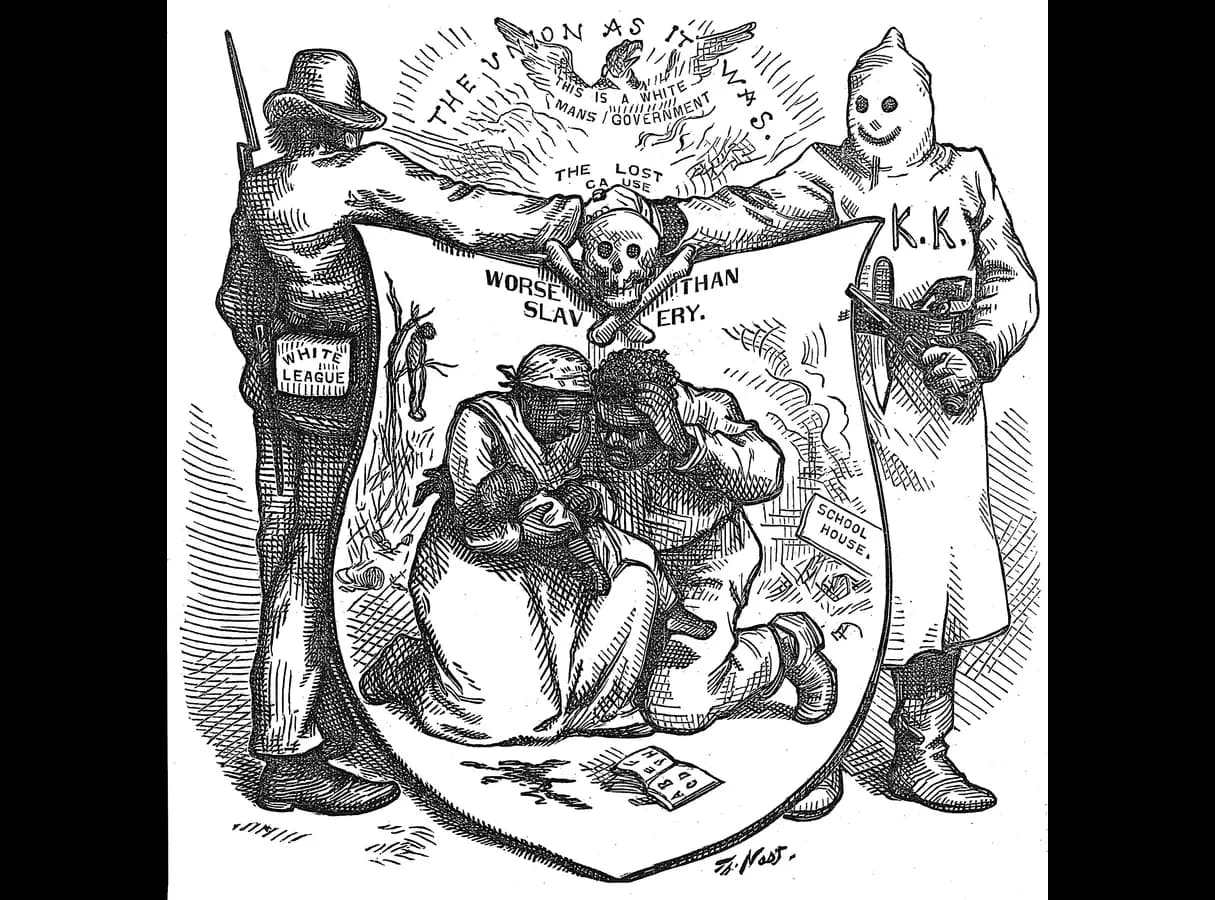
Nast’s cartoon of 1874 presents the Klan and the White League as one movement and the result for Black families as "worse than slavery". As a source it shows how Northern Republicans tried to keep public attention on Southern violence in the mid-1870s, and the fact that Democrats won the House of Representatives that year shows that the argument was losing its force.
The Northern retreat and the Compromise of 1877
Reconstruction also failed because the North lost interest in it. The Panic of 1873 began a depression that lasted until 1879, and voters’ attention turned to unemployment, currency and labour conflict. Scandals in the Grant administration, such as the Crédit Mobilier railway scandal (exposed in 1872) and the Whiskey Ring (1875), discredited federal intervention. In 1872 Liberal Republicans broke with Grant, calling for reconciliation with the South and an end to "bayonet rule". In the 1874 elections the Democrats won control of the House of Representatives for the first time since before the war.
The Supreme Court narrowed the new amendments. In the Slaughterhouse Cases (1873) it ruled that the Fourteenth Amendment protected only a narrow set of rights of national citizenship, leaving most civil rights to the states. In United States v. Cruikshank (1876), which arose from the Colfax massacre, it overturned the convictions of the attackers, ruling that the federal government could punish only violations of rights by states, not by private individuals. The Civil Rights Act of 1875, which banned racial discrimination in public places such as inns and railways, was rarely enforced and was struck down by the Court in 1883.
By 1876 Republicans controlled only South Carolina, Louisiana and Florida. The presidential election of 1876 between the Democrat Samuel J. Tilden of New York and the Republican Rutherford B. Hayes of Ohio produced a crisis. Tilden won the popular vote and had 184 undisputed electoral votes, one short of a majority; 20 electoral votes were disputed: the 19 of Florida, Louisiana and South Carolina, where both parties claimed victory amid fraud and intimidation, and one from Oregon. Congress appointed an Electoral Commission of fifteen members, which voted eight to seven, on party lines, to give all the disputed votes to Hayes. To prevent a Democratic filibuster, Republican and Southern Democratic leaders reached an informal understanding, the Compromise of 1877: Hayes would become president, federal troops would be withdrawn from the remaining Southern statehouses, and the South would receive federal help with internal improvements. Hayes was declared the winner on 2 March 1877, and in April 1877 he withdrew the troops guarding the Republican governments of South Carolina and Louisiana, which collapsed, and with them the last of the Reconstruction governments.
 YouTube
Successes and failures of Reconstruction
Whether Reconstruction succeeded depends on the aims it is measured against. Measured against the aim of restoring the Union, it succeeded; measured against the aim of securing equal citizenship for freed people, it largely failed in the short term, but left legal foundations that mattered later. The table weighs its results.
Area | Successes | Failures |
|---|---|---|
The Union | All eleven states readmitted by 1870; no renewed armed rebellion | Reconciliation between white Northerners and Southerners came at the expense of Black rights |
Constitution and law | 13th, 14th and 15th Amendments; Civil Rights Acts of 1866 and 1875; birthright citizenship | Narrowed by the Supreme Court (Slaughterhouse 1873, Cruikshank 1876, Civil Rights Cases 1883); left room for later disfranchisement |
Political rights | Black men voted and held office across the South; about 2,000 officeholders and 16 members of Congress | Ended by terror and fraud; after 1890 Southern states disfranchised almost all Black voters |
Economic life | Wage contracts and sharecropping replaced gang labour; some families bought land | No land redistribution; most freed people remained landless and many fell into debt peonage |
Education and community | Public school systems; Black churches, colleges and families strengthened | Schools were segregated and underfunded, more so once Democrats returned to power |
Protection from violence | Enforcement Acts broke the first Klan in 1871–1872 | Federal protection abandoned after 1873–1877; violence such as Colfax went unpunished |
Perspectives and debates
Few subjects in American history have been interpreted so differently, or have shown so clearly how historians’ own times shape their questions. Interpretations of slavery, of the causes of the war and of Reconstruction moved in step: when historians played down slavery as a cause, they also tended to describe slavery as mild and Reconstruction as a mistake, and the civil rights era of the 1950s and 1960s changed all three together.
What caused the war?
The debate over whether the war was "about slavery", and the origins of the Lost Cause view, are outlined in the study of why conflict emerges. The table sets out the wider range of interpretations a regional study needs.
Interpretation | Historians and works | Argument | Evidence stressed |
|---|---|---|---|
Slave Power (Northern, 19th century) | Henry Wilson, History of the Rise and Fall of the Slave Power in America (1872–1877) | A slaveholding conspiracy controlled the government and forced war on the North | Gag rule, Fugitive Slave Act, Kansas, Dred Scott |
Lost Cause (Southern, 19th century) | Edward Pollard (1866); Alexander Stephens, A Constitutional View of the Late War Between the States (1868–1870) | The South fought for states’ rights and constitutional liberty against Northern aggression | Compact theory; nullification; post-war memoirs (which contradict the secession documents) |
Economic (Progressive) | Charles and Mary Beard, The Rise of American Civilization (1927) | A clash between Northern industrial capitalism and Southern agrarian planters; slavery was secondary | Tariffs, banking, railway and homestead laws passed during the war |
Revisionist ("needless war") | Avery Craven, The Repressible Conflict (1939); James G. Randall, "The Blundering Generation" (1940) | The war was avoidable; extremists and incompetent politicians whipped up emotions | Abolitionist and fire-eater rhetoric; failed compromises |
Slavery and race | Allan Nevins, Ordeal of the Union (1947–1971); James McPherson, Battle Cry of Freedom (1988) | Slavery and the problem of race were the fundamental cause | Secession declarations; the centrality of the territorial question |
Ideology | Eric Foner, Free Soil, Free Labor, Free Men (1970) | Two incompatible ideologies: Republican free labour and Southern defence of slavery |
These views are not all exclusive. Holt explains why the political system failed in the 1850s, Foner why Northerners would not accept the expansion of slavery, and Freehling and Dew why the Lower South chose to leave. Most of them now place slavery at the centre in different ways: as the economic interest at stake, the moral issue that divided the churches and parties, and the racial order that secessionists defended. The Beards’ economic view and the revisionists’ "needless war" have few defenders today, but they raise questions that still matter: how far economic interest shaped politics, and whether better leadership could have avoided war in 1860–1861.
The nature of slavery
Historian | Work | Argument |
|---|---|---|
Ulrich B. Phillips | American Negro Slavery (1918) | Slavery was a paternalist, often unprofitable institution that "civilised" Africans; written from planters’ records and racist assumptions |
Kenneth Stampp | The Peculiar Institution (1956) | Slavery was harsh, profitable and resisted; enslaved people were "white men with black skins", denied the same rights |
Stanley Elkins | Slavery (1959) | The system was so total that it damaged enslaved people’s personalities, comparing it to concentration camps; widely criticised for denying agency |
John Blassingame; Eugene Genovese; Herbert Gutman | The Slave Community (1972); Roll, Jordan, Roll (1974); The Black Family in Slavery and Freedom (1976) | Enslaved people created a strong community, religion and family life; Genovese saw a negotiated paternalism in which the enslaved won space to resist |
Robert Fogel and Stanley Engerman | Time on the Cross (1974) | Slavery was profitable and efficient; material conditions were better than often claimed; heavily criticised for its sources and conclusions about treatment |
Deborah Gray White | Ar’n’t I a Woman? (1985) | Enslaved women faced a double burden of labour and sexual exploitation and built their own networks of support |
Edward Baptist; Sven Beckert | The Half Has Never Been Told (2014); Empire of Cotton (2014) | Slavery was central to American and world capitalism; Baptist argues torture drove rising picking rates. Economic historians such as Alan Olmstead and Paul Rhode dispute his evidence and argue improved cotton varieties explain most of the rise |
The debate turns on two questions: how profitable and dynamic slavery was, and how much room enslaved people had to shape their own lives. Since the 1970s historians have agreed that slavery was profitable and expanding in 1860, which makes the South’s determination to defend it easier to explain. They still disagree about how far violence or other factors explain its productivity, and about how to balance the brutality of the system with the agency of the enslaved.
Why the Union won
The main schools of thought on the Union victory, from Richard Current’s stress on Northern resources to Gary Gallagher’s on Confederate military defeat, are compared in the study of what determines the outcome of a conflict. Several further works matter for a regional study. Herman Hattaway and Archer Jones (How the North Won, 1983) argue that Union commanders learned to combine operations across a vast theatre and to target Confederate supply, while Confederate strategy could not overcome its disadvantages. James McPherson (Tried by War, 2008) presents Lincoln as an effective commander-in-chief who understood strategy better than most of his generals. Stephanie McCurry (Confederate Reckoning, 2010) argues that the Confederacy was undermined from within by the two groups it excluded from its politics, white women and enslaved people, whose protests and flight weakened the state as it tried to mobilise for war.
Reconstruction: tragedy, betrayal or unfinished revolution?
The interpretation of Reconstruction has changed more than any other part of the period. In the early twentieth century the Dunning School, led by William A. Dunning (Reconstruction, Political and Economic, 1907), described it as a tragic era of corrupt carpetbaggers and ignorant freedmen imposed on a defeated South. This view, shaped by the racism of its authors, reached a mass audience through the film The Birth of a Nation (1915), which glorified the Klan, and was used to justify segregation and disfranchisement.
W. E. B. Du Bois challenged it in Black Reconstruction in America (1935), presenting Reconstruction as a democratic experiment led by Black workers and destroyed by an alliance of planters and Northern capital. His summary of the period in the book’s opening chapter, that "the slave went free; stood a brief moment in the sun; then moved back again toward slavery", became one of its best-known judgements. His work was largely ignored by white historians until the civil rights era, when revisionists such as Kenneth Stampp (The Era of Reconstruction, 1965) showed that the Reconstruction governments had been more honest and constructive than the Dunning School claimed, and that the failure was in doing too little, not too much.
Historian | Work | Main argument |
|---|---|---|
William A. Dunning | Reconstruction, Political and Economic (1907) | A corrupt "tragic era" forced on the white South; now rejected as racist |
W. E. B. Du Bois | Black Reconstruction in America (1935) | A democratic experiment by Black workers, crushed by planters and Northern capital |
Kenneth Stampp | The Era of Reconstruction (1965) | Reconstruction’s governments achieved much; its failure was its timidity |
Eric Foner | Reconstruction: America’s Unfinished Revolution (1988) | A real but incomplete revolution, defeated by violence and Northern retreat; the amendments were its lasting legacy |
Heather Cox Richardson | The Death of Reconstruction (2001) | Northern Republicans turned against Reconstruction as they came to see freed people’s demands through fears of labour radicalism after 1871 |
Steven Hahn | A Nation under Our Feet (2003) | Freed people built a grassroots political movement through kinship, churches and Union Leagues, continuing traditions from slavery |
Gregory Downs | After Appomattox (2015) | Rights depended on the presence of the army; when the occupation of the South was ended, the rights could not be defended |
Recent historians agree that Reconstruction failed, but differ on why: Foner and Downs stress white Southern violence and the withdrawal of federal force, Richardson stresses Northern class attitudes, and Hahn shifts attention from Washington to the political action of freed people themselves. The emphasis on Southern resistance and on Northern retreat can be weighed: violence defeated Reconstruction state by state, but it could do so only because the North was no longer willing to stop it.
Applying the ideas in exam questions
The questions that follow are written in the style of Paper 3. They cover the causes of the war, the outcome, the impact of the war on women and Reconstruction, and use both types of claim: a factor claim and a claim about effects.
Paper 3: the causes of the war
Paper 3: the outcome of the war
Paper 3: the impact of the war on women
Paper 3: Reconstruction
Self-check
- To do:
I can explain the economic importance of cotton and slavery to the South and the nation, with figures from the 1860 census.
- To do:
I can describe the conditions of enslavement, including work, the slave codes and the domestic slave trade.
- To do:
I can explain the forms of adaptation and resistance among enslaved people, from family and religion to flight and revolt.
- To do:
I can outline the arguments for and against slavery (ideological, religious, economic, legal and racial) and their political impact.
- To do:
I can explain the Missouri Compromise, the Nullification Crisis and the doctrine of states’ rights as long-term causes.
- To do:
I can compare the economic, social and cultural differences between North and South and explain free labour ideology.
- To do:
I can explain the four positions on slavery in the territories and the significance of the Wilmot Proviso.
- To do:
I can explain the terms and effects of the Compromise of 1850 and the Fugitive Slave Act.
- To do:
I can explain how the Kansas–Nebraska Act, Bleeding Kansas, Dred Scott and Harpers Ferry deepened the crisis.
- To do:
I can explain the result of the 1860 election and why it led to secession in two waves.
- To do:
I can compare the strengths and weaknesses of the Union and the Confederacy and outline the main campaigns.