FS5 Protest and change
How second-wave feminism in the United States and the Tunisian revolution challenged authority, what they changed and where they fell short, and how this focused study is studied and examined.
- IB History
- SL and HL
What FS5 covers
From the subject guide: what you need to know and be able to do.
Focused study: two paired examples, assessed through sources in paper 1.
2 subtopics in Protest and change
Each one has its own page once something is published for it.
- FS5.1Feminism in the USA (1960–1979)notes
- FS5.2Revolution in Tunisia (1989–2015)notes
An overview of FS5 Protest and change
Protest and change is a focused study of how organised protest challenges those in power and what it can achieve. Its two examples are second-wave feminism in the United States (1960–1979), a reform movement inside a liberal democracy, and the revolution in Tunisia (1989–2015), which overthrew the authoritarian regime of Zine El Abidine Ben Ali in January 2011 and began the Arab Spring.
Two examples, three questions
The two examples are studied through the same three key questions, as the diagram of the focused study shows: why protest emerged, how it challenged authority, and what it changed.
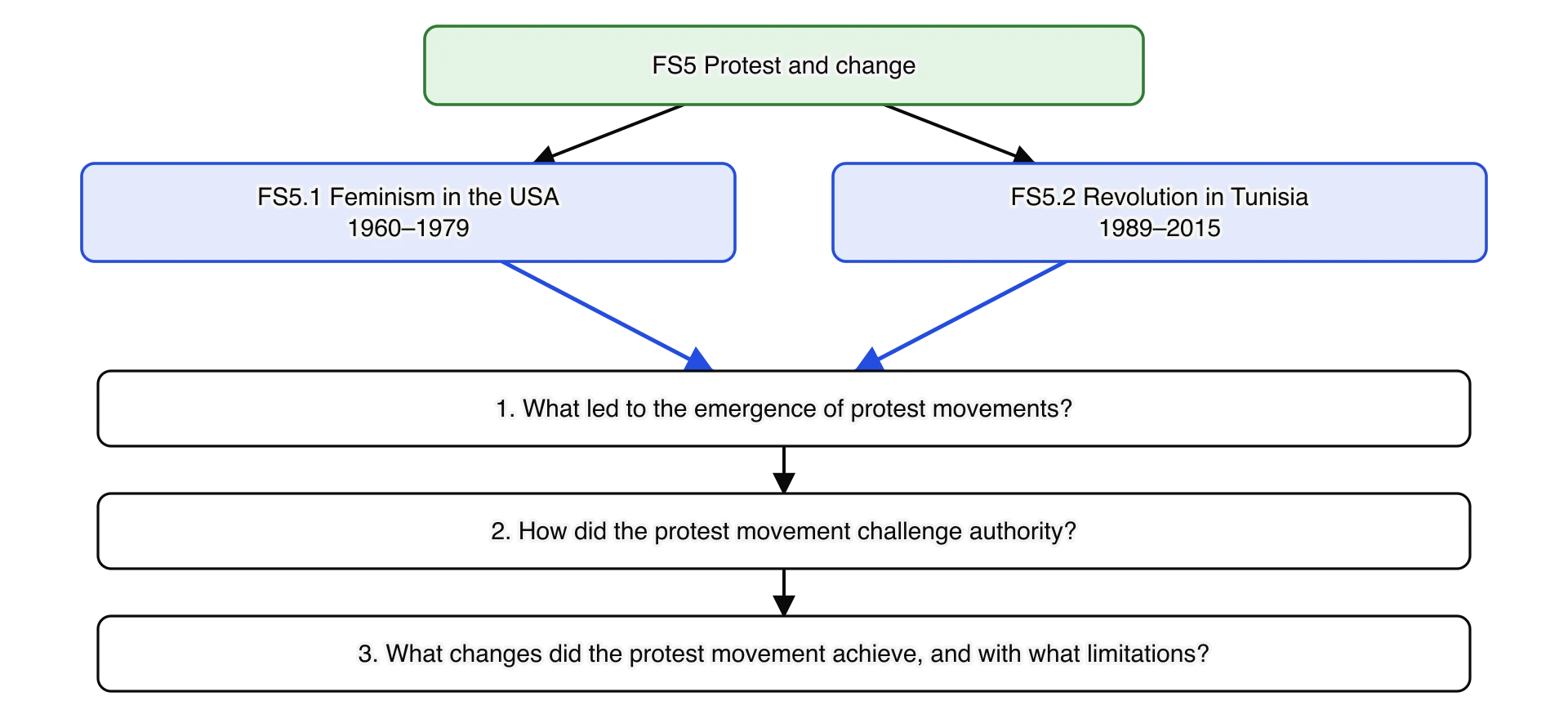
The table of the key questions summarises what each example covers under each question.
Key question | FS5.1 Feminism in the USA (1960–1979) | FS5.2 Revolution in Tunisia (1989–2015) |
|---|---|---|
What led to the emergence of protest movements? | Reactions to the post-war ideal of domesticity and the reality of women's low-paid work; changing access to contraception, including the pill (1960); early feminist writing, above all The Feminine Mystique (1963) | Repression and censorship under Ben Ali; failed economic reform, poverty in the interior and youth unemployment; corruption; the spread of revolutionary ideas |
How did the protest movement challenge authority? | Protest and activism, from lobbying and lawsuits to consciousness-raising and direct action; the National Organization for Women, the National Women's Political Caucus and the women's liberation groups; the mass media | The protests that followed Mohamed Bouazizi's self-immolation in December 2010 and forced Ben Ali to flee on 14 January 2011; the parties Ennahda and Nidaa Tounes; social media and satellite television |
What changes did the protest movement achieve, and with what limitations? | Political and legal change, including Title IX (1972) and Roe v. Wade (1973); economic change in equal pay and employment rights; the experiences of African American and working-class women; the failure of the Equal Rights Amendment | The fall of Ben Ali and the constitution of January 2014; youth radicalisation and the terrorist attacks of 2015; the role and status of women |
Big ideas that run through the focused study
Both movements grew from a gap between promise and reality. American women were told that home and family would fulfil them, while millions worked in low-paid, segregated jobs. Tunisians lived under a regime that claimed economic success while the interior stayed poor and graduates could not find work. Grievances alone do not explain why protest began when it did, so the study weighs long-term grievance against new ideas, new means of communication and particular triggers.
The two movements challenged very different kinds of authority. Feminists in the United States worked inside a democracy, through courts, Congress, elections and the press as well as through street protest. Tunisian protesters faced a police state in which open opposition was dangerous, and they brought down the ruler within four weeks. Both examples raise the question of how much weight to give the media: television and magazines spread feminist ideas but also trivialised them, and historians disagree about how important social media were in Tunisia compared with trade unions, lawyers and satellite television.
Judging success is the third big idea, and the key question itself asks about limitations. American feminism changed law on employment, education, credit and reproduction, but the Equal Rights Amendment was never ratified and a conservative backlash grew. Tunisia adopted a democratic constitution in 2014, the most successful outcome of the Arab Spring by 2015 (it was replaced under President Kais Saied in 2022), yet unemployment continued and jihadist groups grew. In both, the gains were shared unequally: Black and working-class American women argued that the movement did not speak for them, and Tunisian women won constitutional guarantees while inequalities in inheritance and work remained.
The study also links the two examples through the role and status of women. Comparing a reform movement in the United States with a revolution in North Africa shows how the same demands for equality took different forms in different societies.
How the focused study is studied and examined
All students, at SL and HL, study one of five focused studies: Climate and innovation, Independence and identity, Political and economic transitions, Conflict and displacement, or Protest and change. Each has two examples, and both must be studied in full, in about 50 teaching hours.
The focused study is assessed by Paper 1 (1 hour 15 minutes, 24 marks; 30 per cent of the SL grade and 20 per cent of the HL grade), the same paper at SL and HL. Each session the material is on one example only, so either the United States or Tunisia may appear. The paper gives an inquiry question ("To what extent …?") and three sources (A, B and C), then three questions with fixed wording: how the content of Sources A and B can be used to answer the inquiry question (6 marks), how the context of Source C influences how it can be used (6 marks), and how the perspectives in all three sources can be used (12 marks).
Carry on with FS5 in Augment
With a free account, Augment remembers where you stopped and what you have practiced.