Notes on TS4.3 How were popular movements challenged?
Popular movements set out to change who held power, who had rights and how society was ordered, so they always met opposition. How a movement was challenged, and how it responded, often decided whether it succeeded, how long it took and what kind of change it achieved.
Opposition to popular movements: sources, forms and responses
A popular movement is a sustained, organised effort by large numbers of ordinary people to bring about, or to resist, political, social or economic change, mostly through action outside the normal institutions of government. Because its demands threatened somebody, every movement created opponents. Planters and merchants stood to lose property if slavery ended; British rule in India depended on Indian cooperation that the national movement withdrew; white southerners in the United States stood to lose a racial order that gave them political and social power.
Opposition came from four main sources. The first was the state, which controlled the law, the police and the army, and decided which reforms were passed. The second was organised force, used by the state or by private groups and counter-movements. The third was the movement itself, whose members often disagreed. The fourth was the wider culture, where long-held ideas about race, gender, religion and the nation shaped what most people thought was natural or right.
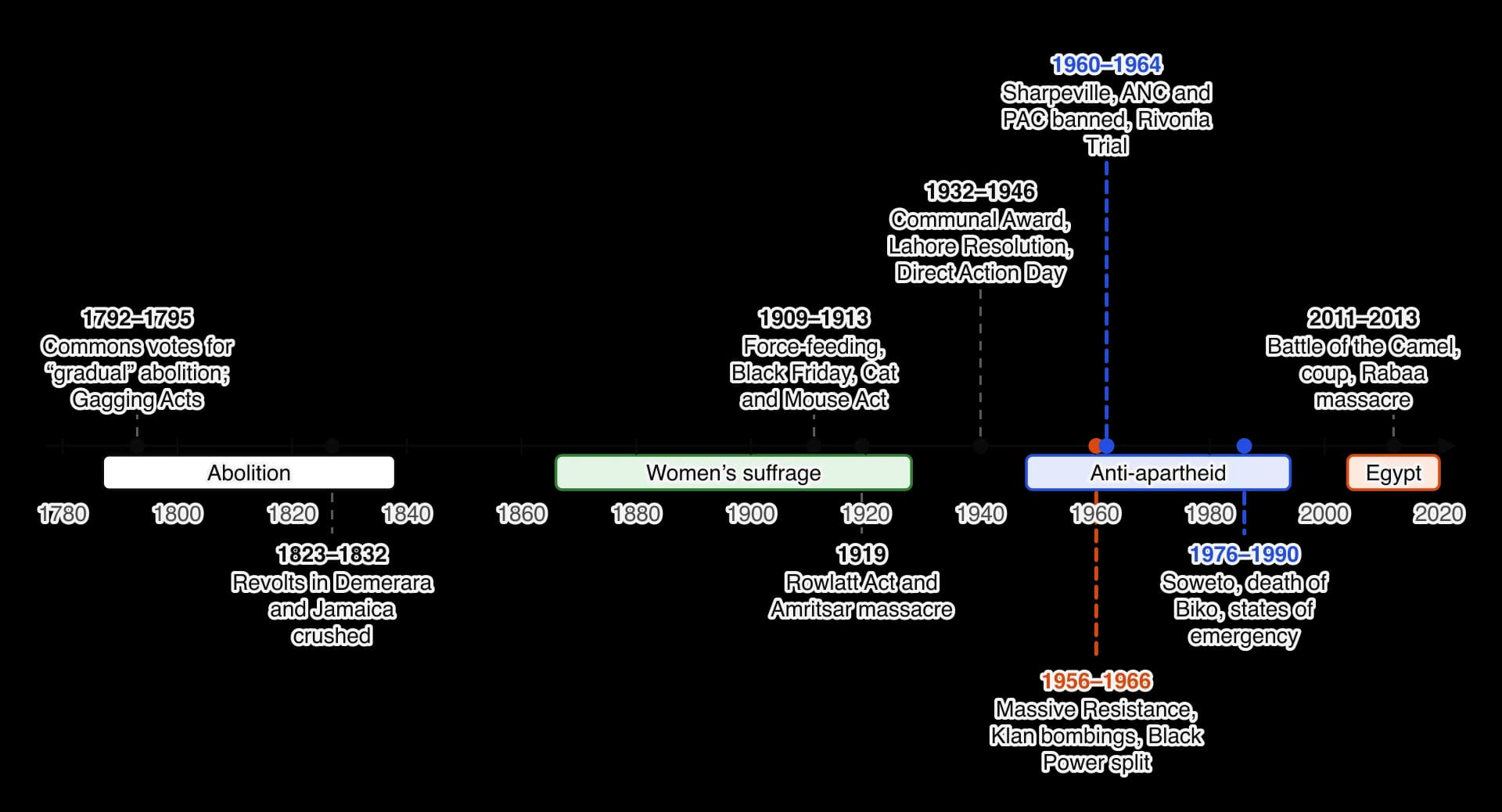
The timeline of challenges to the core movements shows that opposition was not limited to authoritarian states. Britain had an elected parliament when it suppressed radical societies in the 1790s and force-fed suffragettes in 1909–1914, and the United States was a democracy when southern states defied the Supreme Court in the 1950s. Liberal states usually preferred law, delay and policing. Authoritarian and colonial states, such as apartheid South Africa, British India and Mubarak’s Egypt, used force more readily and faced fewer limits from courts, elections or a free press.
How movements responded
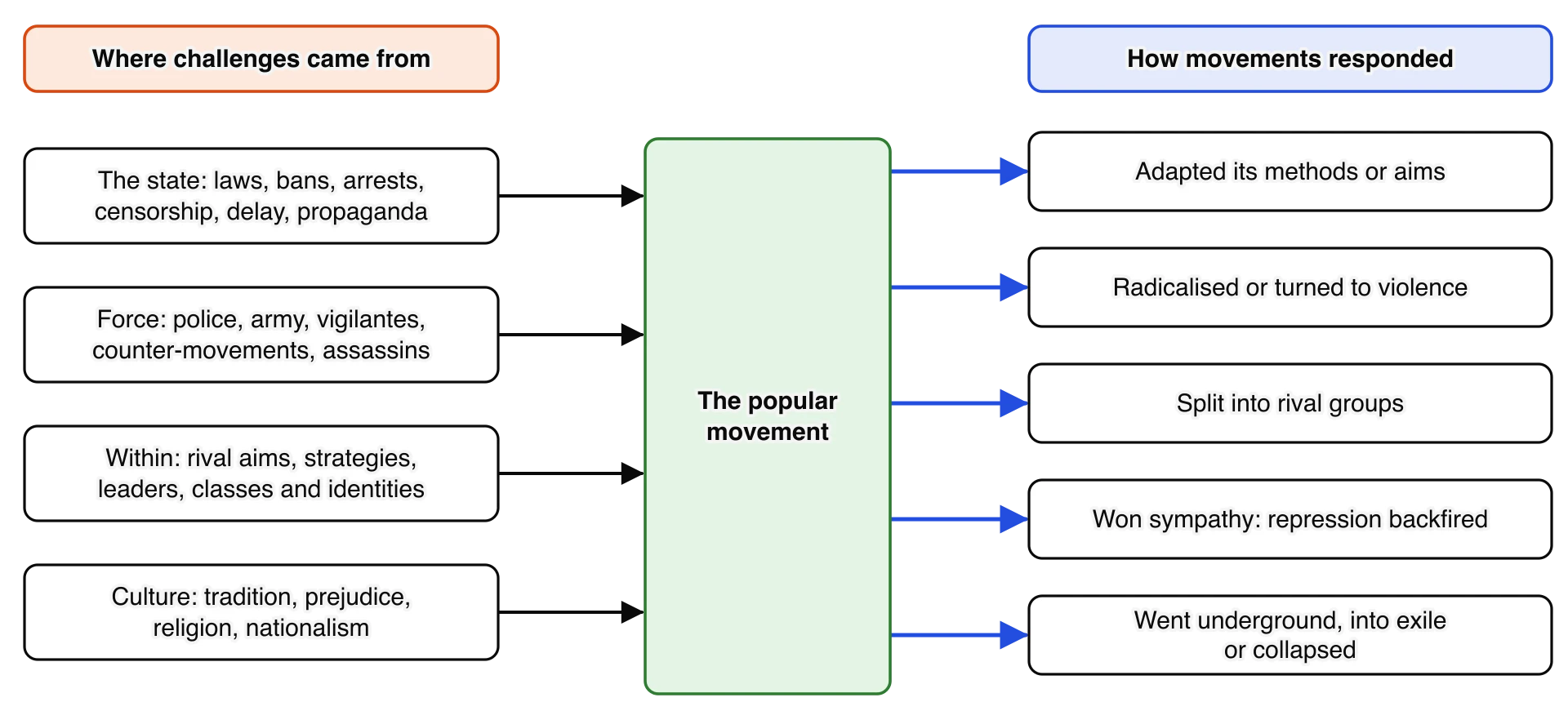
The same challenge could have very different effects. The diagram of challenges and responses links the four sources of opposition to the five main ways in which movements responded. A ban might drive a movement underground and into exile, as happened to the African National Congress (ANC) in 1960, or it might turn its leaders into martyrs and widen its support. Violence might frighten supporters away or win the sympathy of people who had previously been indifferent.
Social scientists use the term repression for actions by authorities that raise the cost of taking part in a movement: arrests, bans, surveillance, violence and threats. When repression produces more support for a movement instead of less, it is said to backfire. The Australian social scientist Brian Martin, in Justice Ignited (2007), argues that repression is most likely to backfire when the attack is seen as unjust and out of proportion, when the victims are clearly non-violent, and when news of it reaches an audience able to act.
Political opposition
Political opposition means the use of the political and legal system against a movement. Its tools were laws that banned organisations, meetings or publications; arrests and trials; surveillance by police and intelligence services; censorship; propaganda that presented the movement as dangerous, foreign or immoral; and, in parliamentary systems, the simple power to delay, amend or vote down reform. Governments also used concessions, offering limited reforms to win over moderates and isolate radicals.
Abolitionism: the West India interest and the fear of revolution
The British campaign against the slave trade, launched by the Society for Effecting the Abolition of the Slave Trade in 1787, faced one of the strongest lobbies in Parliament. The West India interest, the planters, merchants, bankers and shipowners whose wealth came from Caribbean sugar, met through the Society of West India Planters and Merchants. Dozens of MPs had financial links to the colonies, and supporters of the trade argued that it was vital to the navy, the ports of Liverpool and Bristol, and the national revenue.
The lobby’s most effective weapon was delay. When William Wilberforce, the evangelical MP who led the campaign in Parliament, first moved for abolition in April 1791, the Commons rejected the motion by 163 votes to 88. In April 1792 Henry Dundas, a senior minister, proposed an amendment adding the word "gradually"; the Commons voted for gradual abolition by 1796, but the House of Lords, where the slave trade had powerful defenders such as the Duke of Clarence, delayed the measure and it lapsed. The trade was not abolished until 1807.
The international context made the delay possible. The French Revolution (from 1789) and the revolt of the enslaved in Saint-Domingue (from August 1791) allowed opponents to present abolition as the first step to revolution and slave rebellion. William Pitt’s government, at war with France from 1793, suspended habeas corpus in 1794 and passed the Treason and Seditious Meetings Acts in 1795, known as the Gagging Acts. These laws were aimed at radical reformers, not at the abolitionists, but they made mass petitioning and public meetings suspect. The abolition society barely met between 1797 and 1804.
Women’s suffrage: delay, procedure and the "Cat and Mouse" Act
The British women’s suffrage movement faced a Parliament elected by men and governments that could kill a bill without a direct vote. Herbert Asquith, Liberal prime minister from 1908 to 1916, opposed women’s suffrage personally, and many Liberals feared that giving the vote to propertied women would help the Conservatives. Many Conservatives feared the opposite if the vote went to working women. Private members’ bills therefore passed early stages and then died for lack of government time.
Date | Measure | Result in the House of Commons |
|---|---|---|
20 May 1867 | John Stuart Mill’s amendment to the Reform Bill to include women | Defeated, 196 votes to 73 |
12 July 1910 | First Conciliation Bill (vote for women householders), second reading | Passed, 299 to 189; then refused further time by the government |
5 May 1911 | Second Conciliation Bill, second reading | Passed, 255 to 88; overtaken by Asquith’s plan for a manhood suffrage bill |
28 March 1912 | Third Conciliation Bill, second reading | Defeated, 222 to 208, after the WSPU’s window-smashing campaign |
January 1913 | Women’s amendments to the government’s Franchise Bill | The Speaker ruled that they would change the bill so much that it must be withdrawn |
Data: Hansard (House of Commons debates), 1867–1913.
The table of Commons votes shows that by 1910 a majority of MPs supported some form of women’s suffrage in principle, yet no bill became law. The obstacle was the government’s control of parliamentary time and its fear of the electoral consequences, which turned majority support into a series of defeats by procedure.
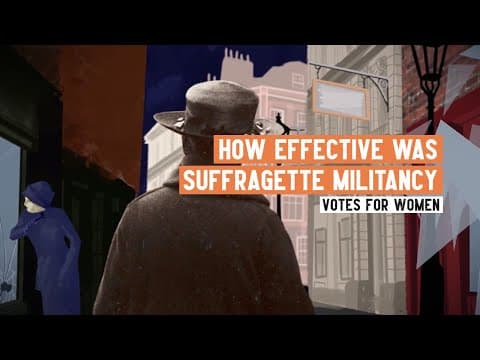
From 1909 the state also used the prisons. Suffragettes of the Women’s Social and Political Union (WSPU), the militant organisation founded by Emmeline Pankhurst in 1903, demanded to be treated as political prisoners and went on hunger strike. The government responded with force-feeding, first used at Winson Green prison in Birmingham in September 1909: women were held down and fed through a tube in the nose or mouth. When this caused public criticism, Parliament passed the Prisoners (Temporary Discharge for Ill-Health) Act in April 1913, the Cat and Mouse Act. Hunger strikers were released when they became weak and re-arrested when they had recovered. In 1912–1913 police raided the WSPU’s offices, its leaders were tried for conspiracy, and its newspaper The Suffragette was printed with difficulty.
 YouTube
The Indian national movement: law, bans and divide and rule
The British Raj had wide legal powers that did not depend on Indian consent. Press laws such as the Indian Press Act of 1910 allowed the government to demand deposits from newspapers and seize them for "seditious" writing. The Rowlatt Act of March 1919 extended wartime emergency powers, allowing detention without trial and trials without juries for political cases; protests against it led to the Amritsar massacre of April 1919. During the civil disobedience campaigns the government arrested on a mass scale: about 60,000 people were imprisoned by the end of 1930, Congress was declared illegal in January 1932, and after the Quit India resolution of 8 August 1942 the whole Congress leadership was arrested the next morning and the party banned until 1945. Estimates of the number arrested in 1942–1943 range from about 60,000 to more than 90,000.
The Raj also used concessions and representation to divide its opponents, a strategy called divide and rule. The Morley–Minto reforms of 1909 created separate electorates for Muslims, in which Muslim voters chose Muslim representatives. In August 1932 the British prime minister Ramsay MacDonald announced the Communal Award, which extended separate electorates to the "Depressed Classes" (the groups then called untouchables, now known as Dalits). Gandhi, in prison, began a fast against it, arguing that it would permanently separate the Depressed Classes from Hindu society. The result, the Poona Pact, is discussed under divisions within the movement.
Historians disagree about how deliberate this was. Nationalist historians such as Bipan Chandra present separate electorates as a conscious policy to weaken Indian nationalism. Others argue that the British responded to real divisions that Indian politicians themselves expressed, and that British policy hardened identities that already existed rather than creating them. The debate matters because it shapes how Partition in 1947 is explained.
The US civil rights movement: Massive Resistance and the FBI
After the Supreme Court’s decision in Brown v. Board of Education (1954) ordered the end of segregated schools, southern politicians organised Massive Resistance, a campaign to block desegregation by every legal and political means. In March 1956, 19 senators and 82 representatives from the former Confederate states signed the Declaration of Constitutional Principles, known as the Southern Manifesto.
We regard the decisions of the Supreme Court in the school cases as a clear abuse of judicial power. … We commend the motives of those States which have declared the intention to resist forced integration by any lawful means.
Declaration of Constitutional Principles (the Southern Manifesto), read in Congress on 12 March 1956. Written by elected representatives for their white voters, it presents resistance as a defence of the Constitution and states’ rights, not of segregation as such. Its value lies in showing how political opposition used the language of law and constitutional principle, which gave defiance a respectable form.
Massive Resistance had popular organisations behind it. The White Citizens’ Councils, founded in Mississippi in July 1954, recruited business and professional men who used economic pressure, such as sacking Black employees or refusing them credit, against anyone who supported integration. In September 1957 Governor Orval Faubus of Arkansas used the state National Guard to stop nine Black students entering Central High School in Little Rock, and President Eisenhower sent federal troops to enforce the court order. State governments found other ways to resist. Virginia’s Prince Edward County closed its public schools from 1959 to 1964 rather than integrate them. Alabama banned the NAACP from operating in the state from 1956 to 1964 after the organisation refused to hand over its membership lists. In the 1963–1964 school year, almost ten years after Brown, only about 1.2 per cent of Black pupils in the eleven former Confederate states attended school with white pupils. In Congress, southern senators used the filibuster, unlimited debate, to block civil rights bills; the Civil Rights Act of 1964 passed only after the Senate voted on 10 June 1964 to end a filibuster that had lasted 60 working days.
The federal government itself watched the movement. Under J. Edgar Hoover, the Federal Bureau of Investigation (FBI) ran COINTELPRO (Counterintelligence Program, 1956–1971), a series of secret operations to monitor, discredit and disrupt organisations it regarded as subversive. Attorney General Robert Kennedy authorised wiretaps on Martin Luther King Jr. in October 1963, and in 1964 the FBI sent King an anonymous letter that he read as urging him to kill himself. From 1967 COINTELPRO targeted Black Power groups, especially the Black Panther Party.
Egypt, 2011–2013: emergency law, propaganda and the army
Hosni Mubarak, president of Egypt from 1981, ruled under an emergency law that had been in force almost continuously since 1967. It allowed arrest without charge, banned unlicensed gatherings and gave state security courts wide powers. When protests began on 25 January 2011, the regime combined force with control of information. State television described the protesters as foreign agents and showed calm streets while Tahrir Square filled. On 27–28 January the government shut down almost all internet access and mobile messaging in Egypt for about five days, an action without precedent at the time.
After Mubarak resigned on 11 February 2011, the Supreme Council of the Armed Forces (SCAF) took power and became the movement’s main political opponent. It kept the emergency law, tried about 12,000 civilians before military courts in 2011, according to Human Rights Watch, and presented further protests as a threat to stability. After the coup of 3 July 2013, a protest law (November 2013) made police permission compulsory for demonstrations, and thousands of activists, secular and Islamist, were imprisoned.
Violent opposition
Violent opposition is the use of physical force against a movement: police and troops firing on or beating crowds, the torture and killing of activists, assassinations, and attacks by vigilantes and paramilitary groups. It came from the state, from private groups tolerated or encouraged by the state, and occasionally from rival movements. Violence was the most direct challenge a movement could face, because it threatened the lives of its members and the willingness of ordinary people to join it.
Violence was not confined to the twentieth century or to dictatorships. On 16 August 1819 cavalry charged a peaceful crowd of about 60,000 people demanding parliamentary reform at St Peter’s Field in Manchester, killing about 18 people in what became known as the Peterloo Massacre. Parliament then passed the Six Acts, restricting meetings and the radical press. The reform movement went quiet for a decade, but Peterloo became a lasting symbol for later campaigners, an early example of violence that defeated a movement in the short term while strengthening its cause in the long term.
Violence against the enslaved: Demerara and Jamaica
The harshest violence in the history of British abolitionism fell not on the campaigners in Britain but on enslaved people in the colonies who took freedom into their own hands. In August 1823 thousands of enslaved people in Demerara (in present-day Guyana) rose, believing that their masters were hiding reforms ordered from London. The revolt was suppressed by troops and militia. Estimates of the enslaved people killed in the fighting and its aftermath range from about 200 to 500, and 27 were executed after trials. The English missionary John Smith, sentenced to death by a court martial for his alleged part in the rising, died in prison in February 1824 before news of his royal reprieve arrived. In Jamaica the Baptist War of December 1831–January 1832, led by the Baptist deacon Samuel Sharpe, involved tens of thousands of enslaved people; about 200 were killed in the fighting and more than 300 executed afterwards, while planters’ vigilantes of the Colonial Church Union burned Baptist and Methodist chapels.
This repression had two effects. In the short term it confirmed the planters’ warning that talk of freedom caused rebellion. In the longer term, missionaries’ reports of the executions and chapel-burnings outraged religious opinion in Britain, and the Jamaican rising persuaded many in Parliament that slavery could no longer be maintained safely. The Slavery Abolition Act followed in 1833.
Violence against non-violent movements in Britain and India
The suffragettes met violence both from the police and from crowds. On 18 November 1910, known as Black Friday, about 300 women marched to Parliament after Asquith shelved the first Conciliation Bill. For six hours police and some bystanders beat them, threw them to the ground and assaulted them sexually; 115 women and four men were arrested. A memorandum compiled from the women’s statements by the Conciliation Committee recorded the assaults, and the Home Secretary, Winston Churchill, rejected calls for a public inquiry. Suffragettes later argued that Black Friday persuaded many of them that peaceful protest would be met with brutality anyway, which helped push the WSPU towards attacks on property from 1912.
In India, colonial violence repeatedly met non-violent protest. On 13 April 1919 at the Jallianwala Bagh in Amritsar, troops under Brigadier-General Reginald Dyer fired without warning into an unarmed crowd in an enclosed garden; the official Hunter Committee counted 379 dead, while an inquiry by the Indian National Congress estimated about 1,000. Why the massacre fed the growth of the national movement belongs to the story of its emergence; as a form of opposition, its significance is that Dyer intended it to terrify the Punjab into obedience and achieved the opposite. In April 1930 troops fired on a crowd at the Qissa Khwani Bazaar in Peshawar; some soldiers of the Garhwal Rifles refused to fire and were court-martialled.
The clearest case of violence that backfired came during the civil disobedience campaign of 1930. On 21 May 1930, after Gandhi’s arrest, about 2,500 volunteers led by the poet and nationalist Sarojini Naidu marched on the government salt works at Dharasana in Gujarat. Police armed with lathis (steel-tipped bamboo staves) beat them down in rows as they advanced. The American journalist Webb Miller of the United Press witnessed the attack.
Suddenly, at a word of command, scores of native police rushed upon the advancing marchers and rained blows on their heads with their steel-shod lathis.
Webb Miller, United Press news dispatch from Dharasana, 21–22 May 1930. Miller was a foreign reporter with no stake in Indian politics, which gave his account credibility abroad, although the British authorities tried to stop his report being sent and later published lower casualty figures. His dispatch went on to describe marchers who did not raise a hand to defend themselves. Carried by newspapers across the world, it presented British rule as violence against unresisting people, the image Gandhi’s strategy was designed to produce.

The chain of backfire shows why Dharasana damaged the Raj more than the marchers. Every link was present: disciplined non-violence, violent repression, a foreign witness, and an audience in Britain and the United States whose opinion the British government could not ignore. The Gandhi–Irwin Pact of March 1931, which released prisoners and brought Gandhi to the Round Table Conference in London, followed within a year.
Terror and police violence in the American South
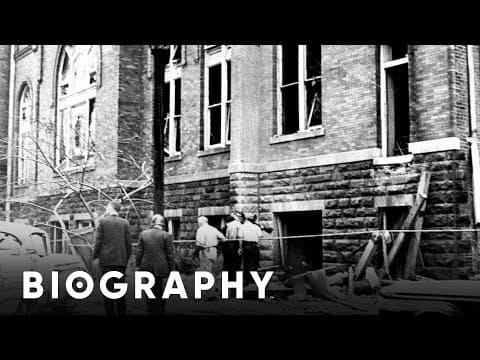
In the United States the most dangerous violence came from white supremacists, often protected by local police and juries. The Ku Klux Klan and similar groups bombed so many Black homes and churches in Birmingham, Alabama, from the late 1940s onwards that the city was nicknamed "Bombingham". On 15 September 1963 a Klan bomb at the 16th Street Baptist Church killed four girls: Addie Mae Collins, Cynthia Wesley, Carole Robertson and Denise McNair. Medgar Evers, the NAACP’s field secretary in Mississippi, was shot dead outside his home in Jackson on 12 June 1963. During Freedom Summer, three civil rights workers, James Chaney, Andrew Goodman and Michael Schwerner, were murdered near Philadelphia, Mississippi, on 21 June 1964 by Klansmen working with the local sheriff’s office.
 YouTube
Local police used force openly. In Birmingham in May 1963 the commissioner of public safety, Eugene "Bull" Connor, turned police dogs and fire hoses on demonstrators, many of them schoolchildren. On 7 March 1965, "Bloody Sunday", Alabama state troopers and a sheriff’s posse attacked marchers with clubs and tear gas on the Edmund Pettus Bridge in Selma. How the movement chose and staged these campaigns belongs to its methods; as challenges, they show both the danger and the limits of violent opposition. Television pictures from Birmingham and Selma shocked national opinion, and President Lyndon Johnson sent the Voting Rights Bill to Congress within days of Selma.
Southern violence was most effective where it was hidden. In rural Mississippi, beatings, arson and economic reprisals (sacking from jobs, eviction from land) kept Black voter registration very low for years, because they happened away from cameras and were rarely punished. The movement’s best-known leader was himself killed: Martin Luther King Jr. was assassinated in Memphis on 4 April 1968, and riots followed in more than 100 cities. Before 1964, killers of civil rights activists were almost never convicted by all-white juries; Byron De La Beckwith, who killed Medgar Evers, was not convicted until 1994.
Violence and counter-revolution in Egypt
During the eighteen days of the Egyptian Revolution (25 January–11 February 2011), the police and the Central Security Forces fired tear gas, rubber bullets and live ammunition at protesters. A fact-finding committee appointed by the Egyptian government reported in April 2011 that at least 846 people had been killed and more than 6,000 injured. On 2 February men on horses and camels, many of them hired supporters of the ruling party known as baltagiyya ("thugs"), charged into Tahrir Square in the "Battle of the Camel". The attack failed, and the protesters’ defence of the square increased their support.
Violence against the movement continued after Mubarak fell. On 9 October 2011, at Maspero in Cairo, soldiers attacked a march of mainly Coptic Christian protesters, and 28 people were killed. After the army removed President Mohamed Morsi on 3 July 2013, security forces dispersed the sit-in of his supporters at Rabaa al-Adawiya Square on 14 August 2013. Human Rights Watch counted at least 817 deaths that day at Rabaa alone, probably more than 1,000, and concluded in its report All According to Plan (2014) that the killings were planned at a high level and probably amounted to crimes against humanity. The Rabaa massacre ended mass street protest in Egypt for years.
Two other cases show violence ending a movement, at least for a time. In Poland, the government of General Wojciech Jaruzelski declared martial law on 13 December 1981, interned thousands of activists and banned the independent trade union Solidarity; it survived underground and returned to negotiate the end of communist rule in 1989. In China, the army cleared Tiananmen Square and the streets around it on 3–4 June 1989, killing several hundred people at least, with some estimates in the thousands. No outside power could force concessions, the state controlled the media, and the democracy movement was destroyed inside China.
Violence did not always end a movement even when it struck at its leaders. In Argentina, the Mothers of the Plaza de Mayo (Madres de Plaza de Mayo) began in April 1977 to walk each week in front of the presidential palace in Buenos Aires to demand news of their children, who had been "disappeared" by the military junta. In December 1977, after a naval officer, Alfredo Astiz, had infiltrated the group by posing as the brother of a missing man, security forces abducted a dozen people linked to it, including the founder Azucena Villaflor and two French nuns; they were murdered. The Mothers kept marching, and their persistence helped keep the fate of the disappeared before Argentine and international opinion until the junta fell in 1983.
Event | Official or state figure | Other estimates | Why the figures differ |
|---|---|---|---|
Amritsar, 13 April 1919 | 379 killed (Hunter Committee, 1920) | About 1,000 (Congress inquiry) | No count was made at the time; the authorities had reasons to minimise it |
Dharasana, 21 May 1930 | About 170 injured, "only three or four" seriously (government statement) | 320 injured, 2 dead (Webb Miller) | Rival accounts from the government and an eyewitness reporter |
Sharpeville, 21 March 1960 | 69 killed | Same; about 180 wounded | The figure was established at the inquest and is accepted |
Soweto and after, June 1976–February 1977 | 176 killed in the first days (police) | 575 by February 1977 (Cillié Commission); some estimates higher | Different periods counted; deaths in other townships added later |
Egypt, 25 January–11 February 2011 | At least 846 killed (government fact-finding committee) | Similar or higher (human rights groups) | Unrecorded deaths in prisons and provinces |
Rabaa al-Adawiya, 14 August 2013 | About 600–650 (Egyptian official bodies) | At least 817, probably over 1,000 (Human Rights Watch) | The state treated the dead as armed opponents; access was restricted |
Data: Hunter Committee report (1920); Webb Miller and Government of Bombay statements (May 1930); Cillié Commission (1980); Egyptian fact-finding committee (April 2011); Human Rights Watch, All According to Plan (2014).
Did violent opposition work?
The core cases suggest that violence was most effective against a movement when four conditions held: the regime was willing to kill on a large scale; it controlled the media or could keep the violence out of sight; the army stayed loyal; and no outside power could or would put pressure on it. Tiananmen Square in 1989 and Rabaa in 2013 met all four. Violence was least effective, and often backfired, where it was used against visibly non-violent protesters in front of cameras, by a government that depended on the opinion of voters or allies, as at Dharasana, Birmingham and Selma.
Movements also responded by changing their methods. After Sharpeville and the banning of the ANC in 1960, Nelson Mandela and other leaders concluded that non-violence had been met with bullets and formed an armed wing in 1961. Violent opposition therefore did not only weaken movements; it could also radicalise them, which in turn gave governments new arguments for repression.
Divisions within the movement
Popular movements were coalitions. They brought together people who shared one goal but differed in their wider aims, their methods, their social class, their race, religion or caste, and their loyalty to particular leaders. As long as the common enemy was clear, these differences could be managed. They became serious when a movement had to choose a strategy, respond to repression or decide what to accept from a government.
Kind of division | What was at stake | Examples from the core cases |
|---|---|---|
Aims | How much change, and how fast | Gradual against immediate abolition; dominion status against complete independence; integration against Black Power |
Methods | Law and persuasion against direct action or violence | NUWSS against WSPU; ANC non-violence before 1961; SCLC against SNCC |
Leadership | Who controlled the movement and its money | The Pankhursts and the WSPU splits of 1907 and 1912; Gandhi against Subhas Chandra Bose (1939) |
Class | Whose interests the movement served | Middle-class suffrage leaders and working-class suffragists in the north of England |
Race, religion and caste | Who belonged, and who spoke for whom | Congress against the Muslim League; Gandhi against Ambedkar; non-racialism against Africanism in South Africa |
Ideology after victory | What kind of state to build | Secular revolutionaries against the Muslim Brotherhood in Egypt, 2011–2013 |
Abolitionism: gradual or immediate?
The early abolitionists deliberately attacked only the slave trade, not slavery itself, because they believed that ending the trade was achievable and would force planters to treat enslaved people better. After 1807 the same caution continued. The Anti-Slavery Society, founded in 1823 by leaders including Thomas Fowell Buxton and Wilberforce, aimed at "amelioration" and gradual emancipation. In 1824 the Leicester Quaker Elizabeth Heyrick published the pamphlet Immediate, Not Gradual Abolition, which attacked gradualism as "the very master-piece of satanic policy" and called for an immediate boycott of slave-grown sugar.
Heyrick’s demand divided the movement, and also showed a second division, over the role of women. Wilberforce disapproved of women organising politically, yet women’s anti-slavery societies were among the most radical parts of the movement. In 1830 the Female Society for Birmingham, of which Heyrick was treasurer, threatened to withdraw its funding unless the national society dropped gradualism, and the society adopted immediate emancipation that year. In 1831 younger activists formed the Agency Committee to send paid lecturers round the country, against the wishes of some older leaders. This division ended in a stronger movement, because the immediatists won and their mass campaign helped pass the Slavery Abolition Act of 1833.
Chartism: moral force and physical force
Chartism, the British working-class campaign for the six points of the People’s Charter (1838), shows divisions and state opposition working together. Its leaders disagreed about methods. "Moral force" Chartists such as William Lovett of the London Working Men’s Association relied on education, petitions and peaceful pressure; "physical force" Chartists, whose best-known voice was Feargus O’Connor, editor of the Northern Star, used the threat of force in their speeches, and a minority acted on it. On 4 November 1839 several thousand armed Chartists marched on Newport in Wales; soldiers fired on them at the Westgate Hotel, killing about 20, and the leader John Frost was sentenced to death, a sentence commuted to transportation to Australia.
The state used the division. It could present the whole movement as a threat to order, arrest hundreds of activists in 1839–1840 and 1842, and refuse the national petitions of 1839, 1842 and 1848 without serious debate. Before the final mass meeting at Kennington Common in London on 10 April 1848, the government moved troops into the capital and enrolled tens of thousands of special constables, and the petition was then mocked in Parliament for containing false signatures. Chartism declined after 1848, although five of its six points later became law.
Women’s suffrage: suffragists, suffragettes and the WSPU splits
The British women’s suffrage movement was divided over methods from 1903. The National Union of Women’s Suffrage Societies (NUWSS), led by Millicent Fawcett, used petitions, lobbying, meetings and processions and by 1914 was far larger than the WSPU. The WSPU’s militancy, which moved from heckling and arrests to window-smashing in 1912 and arson and bombs in 1913–1914, alarmed many suffragists, who believed it gave the government an excuse to refuse reform.
The WSPU also divided internally, mainly because Emmeline and Christabel Pankhurst ran it as an autocracy. In 1907 Teresa Billington-Greig and Charlotte Despard left to form the Women’s Freedom League, which wanted a democratic constitution and used non-violent civil disobedience such as refusing to pay taxes or fill in the 1911 census. In 1912 Emmeline and Frederick Pethick-Lawrence, who had financed the WSPU and edited its newspaper, were expelled after they questioned the escalation of violence. In 1914 Sylvia Pankhurst was expelled for working with the labour movement in the East End of London through her East London Federation.
Class divided the movement too. In One Hand Tied Behind Us (1978), Jill Liddington and Jill Norris showed that thousands of working-class women in the Lancashire cotton towns campaigned for the vote through trade unions and the Labour Party, as "radical suffragists", and were often ignored by the London leaderships. In 1912 the NUWSS formed an Election Fighting Fund to support Labour candidates, a sign that the movement was shifting its alliances. When war broke out in August 1914, the WSPU suspended militancy and supported the war, while the NUWSS split in 1915 over whether to support the war at all.
These divisions had mixed effects. They weakened the movement’s ability to present one demand to Parliament and allowed opponents to blame all suffragists for militant violence. They also meant that by 1914 women’s suffrage had organisations reaching every class and political party, which made it harder to dismiss.
The Indian national movement: moderates, extremists, communities and caste
The Indian National Congress, founded in 1885, was divided almost from the start. The "moderates", led by figures such as Gopal Krishna Gokhale, sought reform within the empire through petitions and loyal constitutional pressure. The "extremists", led by Bal Gangadhar Tilak, demanded swaraj (self-rule) and supported boycott after the partition of Bengal in 1905. The two sides split at the Congress session at Surat in December 1907, and the government took the chance to imprison Tilak in 1908. The two wings did not reunite until 1916.
Leadership and method divided Congress again in the 1930s. Subhas Chandra Bose, who wanted a more radical, socialist and if necessary violent struggle, was elected Congress president in 1938 and re-elected in 1939 against Gandhi’s preferred candidate. Gandhi’s supporters on the working committee refused to cooperate with him, and Bose resigned in April 1939, later leading the Indian National Army against the British with Japanese support.
Not every group in Indian society joined the movement. The rulers of the princely states, which covered about two-fifths of India’s territory, generally supported the British, who protected their thrones, and the British used them as a conservative counterweight to Congress in the federal plan of the Government of India Act of 1935. The deepest divisions, however, were religious and caste divisions. In 1932 Gandhi fasted against the Communal Award’s separate electorates for the Depressed Classes. Their leader, B. R. Ambedkar, a lawyer and economist born into an "untouchable" Mahar family, believed that only separate electorates would protect them from caste Hindus. Under pressure from Gandhi’s fast, Ambedkar signed the Poona Pact on 24 September 1932, which gave the Depressed Classes 148 reserved seats in a joint electorate instead of separate electorates. Ambedkar later wrote that he had accepted it under duress, and the dispute left lasting mistrust between the Dalit movement and Congress.
The All-India Muslim League, founded in 1906, became the main voice of Muslims who feared that a Congress-led India would be dominated by Hindus. After it performed poorly in the 1937 provincial elections, Congress refused to share power with it in the United Provinces, and Muhammad Ali Jinnah, its leader, built it into a mass party. At Lahore in March 1940 the League resolved that the Muslim-majority areas in the north-west and east of India should be grouped into "Independent States", the demand later called Pakistan. While Congress leaders were in prison after 1942, the League cooperated with the British and grew. Its call for Direct Action Day on 16 August 1946 led to communal killing in Calcutta in which about 4,000 people died, and the violence spread. Independence in August 1947 came with the partition of India, accompanied by violence in which estimates of the dead range from about 200,000 to two million and about 12–15 million people were displaced.
The US civil rights movement: organisations, generations and Black Power
The civil rights movement was made up of organisations with different methods and cultures. The NAACP, founded in 1909, preferred lawsuits and lobbying. Martin Luther King Jr.’s Southern Christian Leadership Conference (SCLC, 1957) organised mass campaigns led by Black ministers. The Student Nonviolent Coordinating Committee (SNCC, 1960) was younger and more democratic, and worked for years in rural communities. SNCC activists resented what they called King’s habit of arriving for a campaign, attracting the cameras and leaving; SCLC leaders saw SNCC as undisciplined. The tensions showed in Albany, Georgia (1961–1962), and in Selma in March 1965, when King turned the second march back at the bridge without telling SNCC.
The rejection by the Democratic Party of the Mississippi Freedom Democratic Party’s challenge at its 1964 convention, and the violence of Freedom Summer, convinced many in SNCC that integration and non-violence had failed. On 16 June 1966, during the Meredith March in Mississippi, SNCC’s chairman Stokely Carmichael called for Black Power, a call for Black self-reliance, pride and, where necessary, self-defence. The NAACP’s Roy Wilkins condemned the slogan, King refused to use it, and SNCC expelled its white members in December 1966. Malcolm X, the Nation of Islam’s best-known minister until 1964, had already rejected integration and non-violence; he was assassinated in February 1965 by members of the Nation of Islam after his break with it, an example of division within a movement ending in violence.
Egypt, 2011–2013: from unity in Tahrir to polarisation
The eighteen days of 2011 united very different groups: secular and leftist youth movements such as the April 6 Youth Movement, labour activists, liberals, the Muslim Brotherhood and many people with no political affiliation. Once Mubarak fell, their aims divided them. Islamists supported the army’s constitutional amendments in the referendum of March 2011 (77 per cent voted yes), and the youth movements opposed them. In the parliamentary elections of 2011–2012, the Brotherhood’s Freedom and Justice Party and the Salafist Nour Party together won about seven in ten seats, and Mohamed Morsi of the Brotherhood won the presidency with 51.7 per cent of the vote in June 2012.
Morsi’s constitutional declaration of 22 November 2012, which placed his decisions beyond the courts until a new constitution was passed, turned the secular revolutionaries against him. In 2013 the Tamarod ("rebellion") campaign collected signatures for early elections and called mass protests for 30 June 2013. The army, led by General Abdel Fattah el-Sisi, used the protests to justify removing Morsi on 3 July. Many secular activists who had fought the army in 2011 supported the coup, and were themselves imprisoned once the army had dealt with the Brotherhood. Division within the revolutionary movement thus allowed the old regime’s most powerful institution to return to power.
The resilience of traditional ideas
The fourth challenge was the hardest to see and often the hardest to overcome. The resilience of traditional ideas means the way long-established beliefs, values and habits of thought survived, adapted and continued to shape behaviour despite a movement’s arguments, and sometimes despite its legal victories. These ideas included beliefs about race, gender and caste; religious teaching; loyalty to the nation, the empire or the existing order; respect for property; and the assumption that the way things had always been was natural.
Traditional ideas mattered in three ways. They gave political and violent opposition its popular support, since governments could resist a movement more easily when most voters agreed with them. They shaped divisions within movements, because members brought the assumptions of their society with them. And they limited what legal victories achieved, because changing a law did not change how employers, neighbours, police officers or families behaved.
Race and property: the defence of slavery
Defenders of slavery drew on two powerful sets of ideas. The first was racial hierarchy. Writers such as Edward Long, a Jamaican planter whose History of Jamaica (1774) described Africans as a separate and inferior species, gave slavery a pseudo-scientific justification that many Britons accepted. The second was the sanctity of property, a central value of eighteenth-century British law and politics. Enslaved people were legally property, and many MPs who disliked slavery still believed that the state could not take property without compensation.
The second idea shaped the final settlement. The Slavery Abolition Act of 1833 paid £20 million to slave owners, about 40 per cent of the government’s annual spending, and obliged most formerly enslaved people to work for their former owners as "apprentices" until 1838. The effects of these terms on the people freed belong to the impact of the movement; as a challenge, they show that abolitionists won emancipation only by accepting the principle that slave owners, not the enslaved, deserved compensation.
Separate spheres: the case against votes for women
The strongest argument against women’s suffrage was the ideology of separate spheres: the belief that men and women had different natures and different duties, so that public life, politics and war belonged to men, and the home, children and moral influence to women. Many women shared this belief. In June 1889 the novelist Mary (Mrs Humphry) Ward and more than a hundred other women, many of them married to prominent men, published "An Appeal Against Female Suffrage" in the monthly review The Nineteenth Century.
To men belong the struggle of debate and legislation in Parliament … But we believe that the emancipating process has now reached the limits fixed by the physical constitution of women, and by the fundamental difference which must always exist between their main occupations and those of men.
"An Appeal Against Female Suffrage", The Nineteenth Century, June 1889, signed by Mary Ward and 103 other women. Its authors were educated women who supported women’s work in education and local government, so the appeal cannot be dismissed as men defending their privileges. It shows how traditional ideas about gender were held by women as well as men, and how anti-suffragists accepted some change while drawing a line at Parliament.
In 1908 Ward helped found the Women’s National Anti-Suffrage League, which merged in 1910 with the men’s league to form the National League for Opposing Woman Suffrage, led by Lord Curzon and Lord Cromer, both former imperial administrators. Anti-suffragists argued that women lacked the experience of war and empire needed to vote on them, and that women’s influence was greater when they stood above party politics. Some clergy and religious writers cited the Bible’s teaching on the headship of the husband in marriage, and medical writers added claims that women were physically and mentally unsuited to politics; after the window-smashing of March 1912, the bacteriologist Sir Almroth Wright wrote to The Times that militancy was a product of female hysteria.
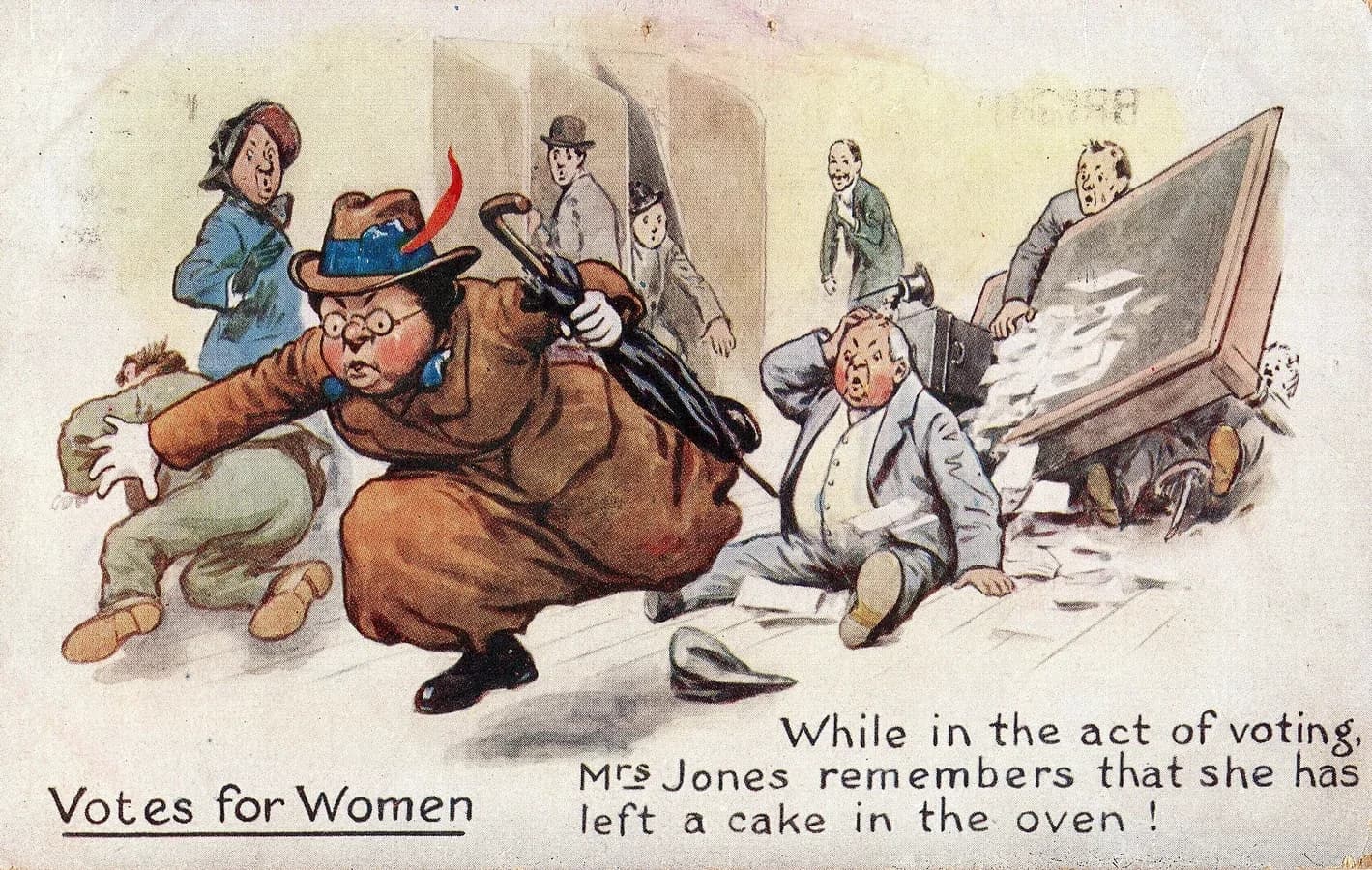
The anti-suffrage postcard shows the same ideas in popular form. Commercial publishers sold thousands of comic postcards mocking suffragists as ugly, aggressive or neglectful wives and mothers, which suggests that the ideas had a market. Separate spheres did not disappear when women won the vote. The 1918 Act gave the vote only to women over 30 who met a property qualification, because many MPs still feared a female majority in the electorate, and full equality with men came only in 1928.
Caste, religion and empire in India
Indian nationalists challenged British rule, but traditional hierarchies within Indian society challenged the national movement. The caste system ranked people by birth, and Dalits suffered untouchability: exclusion from temples, wells, schools and contact with higher castes. Gandhi campaigned against untouchability and called Dalits "Harijans" ("children of God"), but defended the varna (caste) order in its ideal form. Ambedkar rejected this as paternalism and argued, in Annihilation of Caste (1936), that caste would never be abolished without rejecting the Hindu scriptures that justified it. Many orthodox Hindus opposed even Gandhi’s modest reforms.
Religious identities also hardened. Hindu nationalist organisations such as the Hindu Mahasabha (founded 1915) and the Rashtriya Swayamsevak Sangh (RSS, 1925) presented India as a Hindu nation, which confirmed the fears of the Muslim League. Communal riots, which had become frequent by the 1920s, showed that religious loyalty could override shared opposition to the British.
On the British side, the idea that Britain had a duty and a right to rule India was deeply held. Winston Churchill led Conservative opposition to the Government of India Act of 1935, which gave Indians limited self-government in the provinces. In a speech in February 1931 he described Gandhi as a "seditious Middle Temple lawyer" posing as a fakir and striding "half-naked" up the steps of the viceroy’s palace to negotiate as an equal. The image expressed a view, held by many in Britain, that Indians were not yet fit to govern themselves.
White supremacy, states’ rights and anti-communism in the United States
The civil rights movement challenged a racial order supported by most southern whites and tolerated by many northerners. Southern politicians defended segregation through the idea of states’ rights, which presented resistance to federal law as a defence of local self-government. On 14 January 1963 George Wallace, newly elected governor of Alabama, promised in his inaugural address "segregation now, segregation tomorrow, segregation forever". Wallace won about 13.5 per cent of the national vote as a third-party candidate in the presidential election of 1968, including five southern states.
Anti-communism was a second traditional idea used against the movement. Segregationists claimed that civil rights activists were communists or communist dupes; billboards in the South showed King at the Highlander Folk School under the heading "Martin Luther King at Communist Training School", and the FBI justified its surveillance of King by his links with a former Communist Party member, Stanley Levison. In the Cold War, this charge carried weight with many white Americans who had no strong view on segregation.
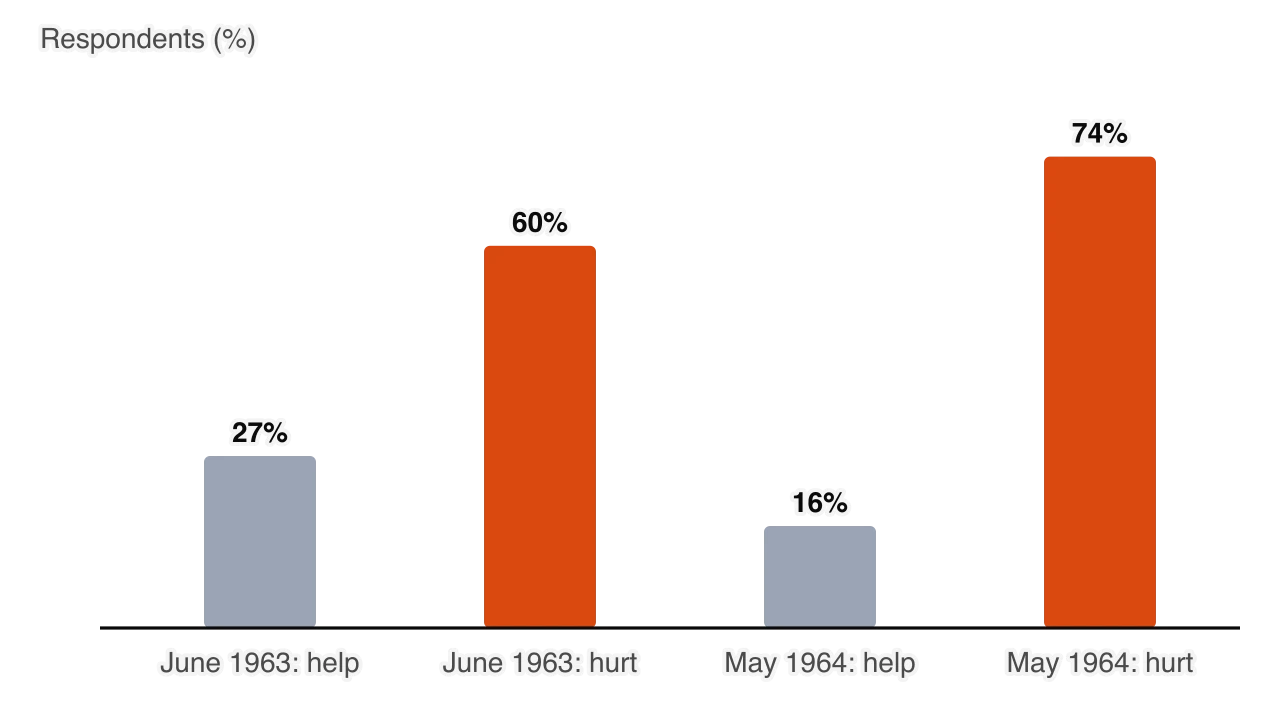
The Gallup polls of 1963–1964 show that even outside the South, a large majority of Americans believed that mass demonstrations harmed the cause of equal rights. After the urban riots of 1965–1968 in Watts, Newark and Detroit, white opinion turned further against the movement in what contemporaries called the white backlash. Richard Nixon won the presidency in 1968 promising "law and order", and resistance moved north, as campaigns against open housing in Chicago in 1966 and against school busing in Boston in 1974–1976 showed.
Patriarchy, religion and the army in Egypt
In Egypt, traditional ideas shaped the challenges to the revolution in several ways. Women took a leading part in the protests of 2011, but on 9 March 2011 soldiers detained women protesters and subjected several of them to so-called "virginity tests"; one of them, Samira Ibrahim, took the army to court, and a civilian court ordered a halt to the practice in December 2011. Mob sexual assaults on women in and around Tahrir Square became frequent in 2012–2013, and some politicians and preachers blamed the women for being there. These attacks drew on patriarchal ideas that a respectable woman’s place was not in public protest.
Religious conservatism and nationalism mattered too. Many Egyptians voted for Islamist parties in 2011–2012 because they promised to apply Islamic values in public life, which alarmed secular activists and Coptic Christians. Many others looked to the army as the guardian of the nation, a belief rooted in the Free Officers’ revolution of 1952 and the army’s role under Nasser, Sadat and Mubarak. The army used this belief to present the coup of July 2013 as the will of the people. Critics call the network of military, security and bureaucratic interests that survived the revolution the deep state.
Case study: how the anti-apartheid movement was challenged, 1948–1994
Apartheid ("separateness" in Afrikaans) was the system of racial segregation and white minority rule introduced by the National Party after its election victory in 1948. The movement against it, led above all by the African National Congress (ANC, founded 1912), faced every form of challenge for more than four decades. The case shows how the four lines of challenge worked together, and how a movement could survive the near destruction of its organisation inside the country.
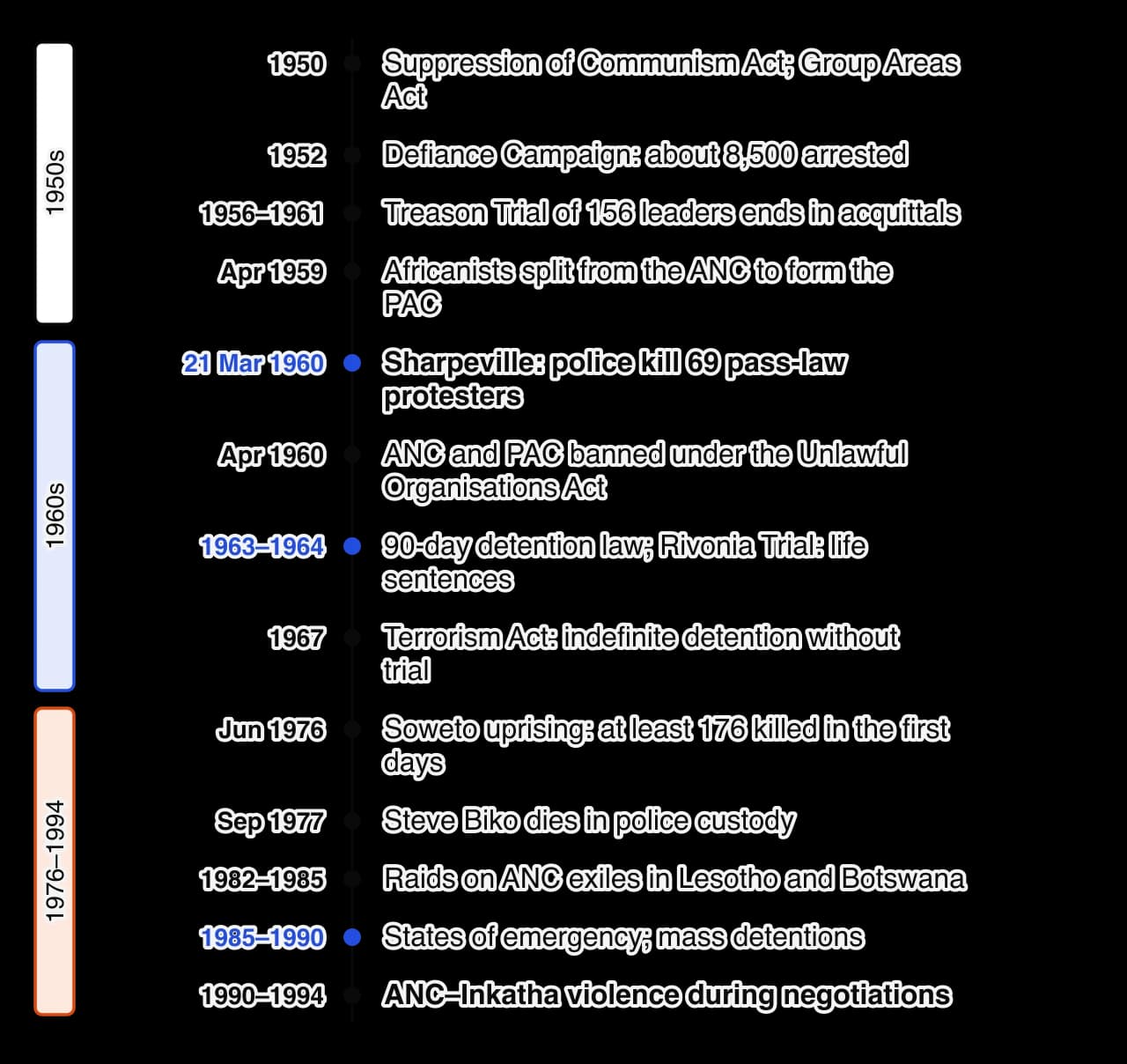
The timeline of repression shows a pattern of escalation. Each time the movement found a new form of resistance, the state answered with new laws and greater force, and each wave of repression led the movement to change again.
Political opposition: the legal machinery of repression, 1950–1964
The National Party built its legal weapons early. The Suppression of Communism Act of 1950 banned the Communist Party of South Africa and defined communism so widely that it covered almost any campaign for political, social or economic change by unlawful means, or any attempt to encourage hostility between the white and Black populations. Under it the Minister of Justice could issue banning orders on individuals without trial: a banned person could be confined to a district, forbidden to meet more than one person at a time, barred from publishing, and could not be quoted in the press.
When the ANC and its allies launched the Defiance Campaign against unjust laws in June 1952, about 8,500 volunteers were arrested for deliberately breaking apartheid laws. The government responded with the Public Safety Act and the Criminal Law Amendment Act of 1953, which allowed it to declare states of emergency and imposed heavy penalties, including flogging, on anyone who broke a law in protest. Civil disobedience became far more costly. In December 1956 police arrested 156 leaders of the Congress Alliance, including Nelson Mandela, Walter Sisulu and Chief Albert Luthuli, the ANC’s president, and charged them with high treason. The Treason Trial lasted until March 1961 and ended with every defendant acquitted, but it kept the movement’s leaders tied up in court for more than four years.
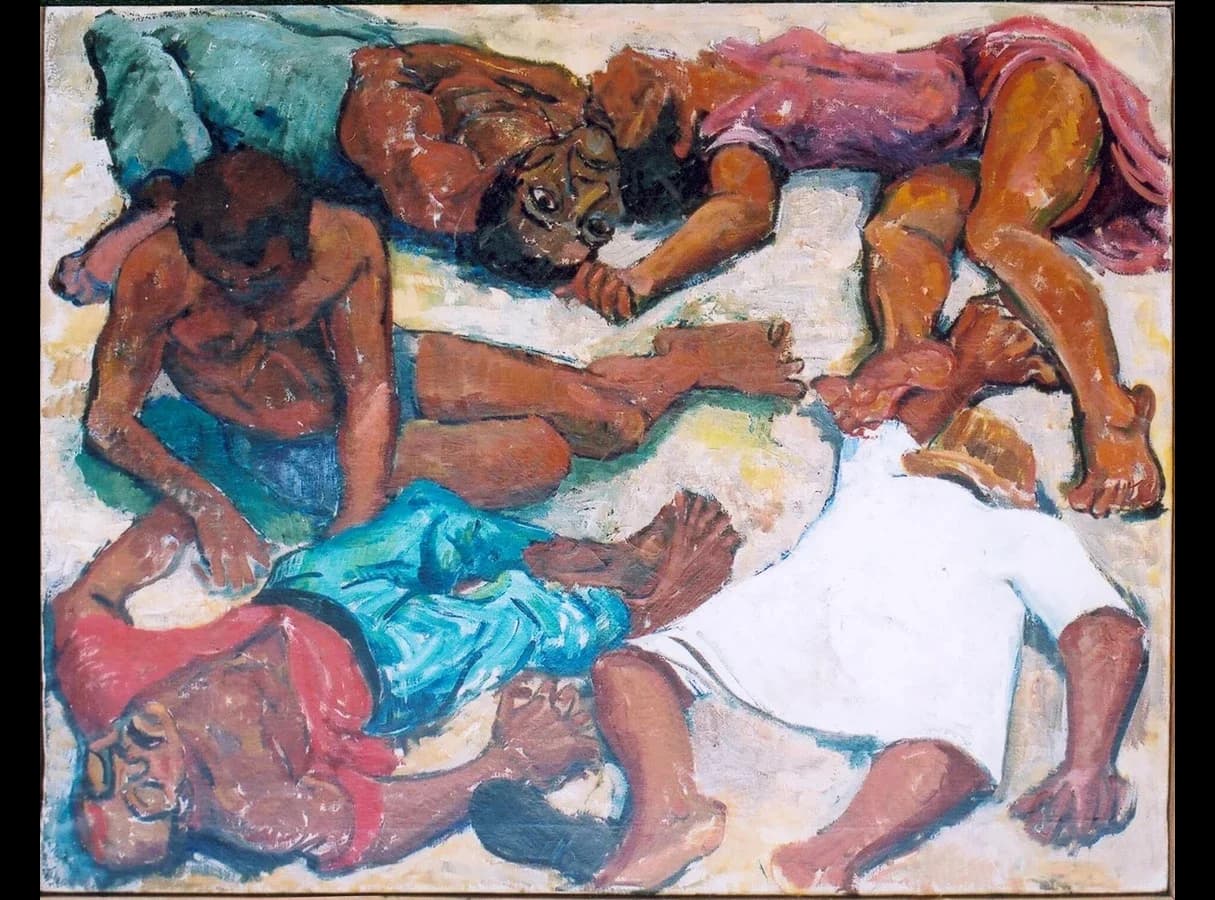
The crisis of 1960 transformed the struggle. On 21 March 1960 police at Sharpeville, south of Johannesburg, opened fire on a crowd protesting against the pass laws at a campaign called by the Pan Africanist Congress (PAC). They killed 69 people, many shot in the back as they fled. The government declared a state of emergency, detained thousands of people and, on 8 April 1960, banned the ANC and the PAC under the Unlawful Organisations Act. Legal, open opposition by Black South Africans had become impossible.
The ANC’s leaders concluded that peaceful protest had reached its limit and formed an armed wing, Umkhonto we Sizwe ("Spear of the Nation"), which began a sabotage campaign on 16 December 1961. The state responded with still wider powers. The General Law Amendment Act of 1963 allowed the police to detain suspects for 90 days without trial, renewable indefinitely, and in July 1963 police raided Liliesleaf Farm at Rivonia, near Johannesburg, capturing much of the underground leadership. At the end of the Rivonia Trial in June 1964, Mandela, Sisulu, Govan Mbeki and five others were sentenced to life imprisonment; the seven Black prisoners were sent to Robben Island, while Denis Goldberg, who was white, served his sentence in Pretoria. Oliver Tambo, who had left the country in 1960, led the ANC in exile.
By the mid-1960s, political opposition had achieved its immediate aim. The ANC and PAC had no effective organisation inside South Africa, their leaders were in prison or exile, and Black political activity was at its lowest point since 1912. The Terrorism Act of 1967 allowed indefinite detention without trial, with no right of access to lawyers or family. For almost a decade, internal resistance was largely silenced.
Violent opposition: Soweto, deaths in detention and the security state, 1976–1990
Resistance revived in the 1970s from a new direction. On 16 June 1976 police opened fire on thousands of school students in Soweto who were marching against a decree that half of their secondary teaching be given in Afrikaans. The uprising spread across the country; the government’s Cillié Commission later counted 575 deaths by February 1977, most of them caused by the police. Thousands of young people left the country, many to join Umkhonto we Sizwe in camps in Angola and Tanzania.
Detention without trial was accompanied by torture and deaths in custody. The most widely known case was that of Steve Biko, the founder of the Black Consciousness Movement, who died on 12 September 1977 from brain injuries suffered while held by the security police in Port Elizabeth; he had been driven naked in the back of a police vehicle to Pretoria shortly before he died. The Minister of Justice, Jimmy Kruger, said that Biko’s death "leaves me cold". On 19 October 1977 the government banned 18 or 19 Black Consciousness organisations (sources differ on the count) and The World, the largest newspaper read by Black South Africans.
From 1978, under Prime Minister (later State President) P. W. Botha, the government claimed that South Africa faced a "total onslaught" directed from Moscow and answered it with a "total strategy" that combined limited reform with military and police force. The security police ran a covert unit at Vlakplaas, near Pretoria, which kidnapped and killed opponents. The army raided ANC exiles in neighbouring states: in Maseru, Lesotho, in December 1982 and in Gaborone, Botswana, in June 1985. Ruth First, a leading activist and writer, was killed by a parcel bomb in Maputo in August 1982.
When a new wave of internal resistance, organised by the United Democratic Front and the trade unions, made the townships "ungovernable" in 1984–1986, the government declared a partial state of emergency in July 1985 and a national one in June 1986, renewed each year until 1990. Tens of thousands of people, many of them children, were detained without trial, and the emergency regulations banned journalists from filming or reporting unrest. By this stage political and violent opposition were used together as parts of one security system.
The Truth and Reconciliation Commission (TRC), set up by the democratic government in 1995 to investigate gross human rights violations from 1960 to 1994, reached a clear conclusion about where most of the violence came from.
The predominant portion of gross violations of human rights was committed by the former state through its security and law-enforcement agencies. Moreover, the South African state in the period from the late 1970s to early 1990s became involved in activities of a criminal nature … the extra-judicial killings of political opponents and others, inside and outside South Africa. In pursuit of these unlawful activities, the state acted in collusion with certain other political groupings, most notably the Inkatha Freedom Party (IFP).
Truth and Reconciliation Commission of South Africa, Report, volume 5, chapter 6 ("Findings and conclusions"), 1998. The commission heard more than 21,000 statements from victims and thousands of applications for amnesty from perpetrators, so its findings rest on a very wide base of evidence. It was created by the government that the ANC led, and the ANC and the former National Party both challenged parts of the report; the commission also found the ANC and Inkatha responsible for gross violations, which supports its claim to even-handedness.
Divisions within the movement: Africanism, Black Consciousness and Inkatha
Opponents of apartheid disagreed deeply about who should lead the struggle and what kind of nation it was fighting for. The ANC’s Freedom Charter of 1955 declared that South Africa "belongs to all who live in it, black and white", and the ANC worked in the Congress Alliance with organisations of Indian, Coloured and white democrats, including communists. Africanists inside the ANC rejected this non-racialism, arguing that Africans must liberate themselves and that white communists were steering the movement. In April 1959 they broke away to form the Pan Africanist Congress (PAC) under Robert Sobukwe.
The split had immediate consequences. The PAC launched its anti-pass campaign ten days before the ANC’s planned campaign, partly to outflank its rival, and it was the PAC’s protest that ended at Sharpeville. In exile, the two organisations competed for funds and recognition from African states and the Soviet Union and China, and their armed wings (Umkhonto we Sizwe and the PAC’s Poqo) never cooperated. The Black Consciousness Movement of the 1970s, inspired by Biko, insisted that Black people must free themselves psychologically and politically without white liberal leadership; it inspired the generation of 1976, but many of its members later joined the ANC.
The most violent division was between the ANC and its allies and the Inkatha movement of Mangosuthu Buthelezi, the chief minister of the KwaZulu "homeland". Inkatha, revived by Buthelezi in 1975, opposed apartheid in words but rejected the armed struggle and international sanctions, and drew on Zulu identity and the authority of chiefs. From the mid-1980s conflict between Inkatha and supporters of the UDF and ANC turned parts of Natal into a war zone. After the ANC was unbanned in February 1990 the violence spread to the townships around Johannesburg; monitoring groups recorded more than 3,000 deaths a year from political violence in the early 1990s. At Boipatong in June 1992, 45 people were killed by men from an Inkatha-supporting hostel, and the ANC broke off negotiations for several months.
The TRC found that elements of the security forces had armed, trained and protected Inkatha members, the so-called "third force", so this division was partly manufactured by the state. Yet it also had real roots in disputes over land, ethnicity, the authority of chiefs and the competition for power after apartheid. The case shows how a regime could deepen divisions that already existed within a movement.
Traditional ideas: Afrikaner nationalism, theology and anti-communism
Apartheid rested on beliefs that most white South Africans held deeply. Afrikaner nationalism, shaped by memories of the Great Trek and the South African War of 1899–1902, saw the Afrikaners as a small nation that must defend its survival. The Dutch Reformed Church taught for decades that God had created separate peoples who should develop separately, a theology that gave apartheid moral authority for many believers. In 1982 the World Alliance of Reformed Churches declared apartheid a heresy and suspended the main white Dutch Reformed Church, which began to withdraw its biblical justification only in the later 1980s.
The National Party had won in 1948 partly through the swart gevaar ("black danger"), the fear that Black majority rule would destroy white society. This fear, combined with the Cold War, linked traditional ideas to political opposition abroad. Because the ANC worked with the South African Communist Party and received arms from the Soviet bloc, Western governments that disliked apartheid still saw the ANC as a threat. The US government under Ronald Reagan followed a policy of "constructive engagement" with Pretoria until Congress overrode his veto to pass the Comprehensive Anti-Apartheid Act in 1986. At the Commonwealth summit in Vancouver in October 1987, Margaret Thatcher answered a question about an ANC threat against British companies by saying that it showed "what a typical terrorist organisation it is". Mandela himself remained on a US terrorism watch list until 2008.
These ideas mattered because they allowed the regime to present its repression to white voters and Western governments as a defence of civilisation, Christianity and the West. They explain why the state could keep the support of the white electorate in every election until the referendum of March 1992, when about 69 per cent of white voters approved negotiations.
How the movement survived
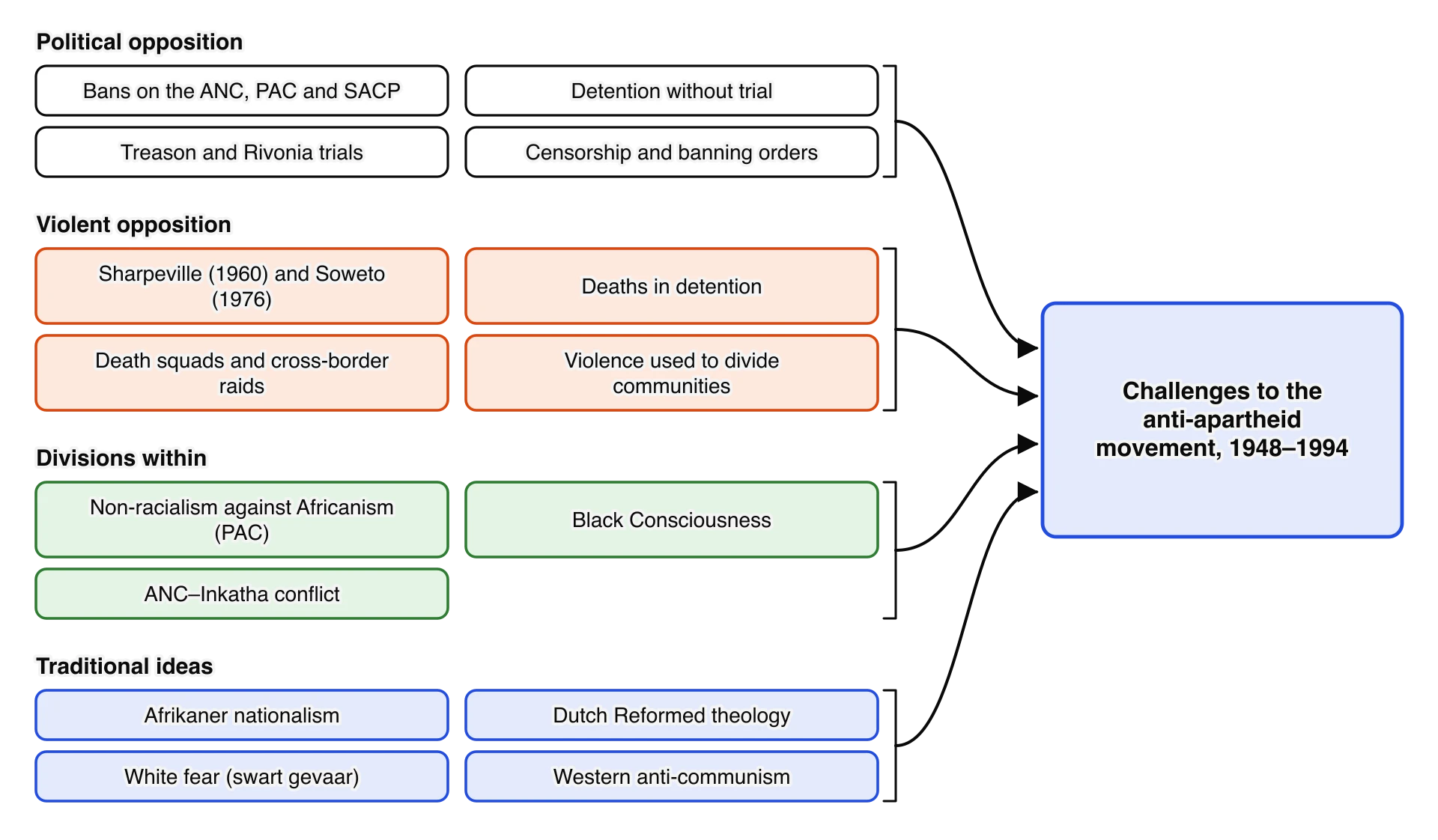
The diagram of the four lines of challenge shows why the struggle was so long: the state’s repression was reinforced by the divisions among its opponents and by the beliefs that held white voters and Western governments to the regime. The movement survived because it adapted to each challenge. In exile, Tambo held the ANC together for thirty years and built the international anti-apartheid movement, which turned Sharpeville, Soweto and Biko’s death into international scandals: the UN Security Council imposed a mandatory arms embargo in November 1977, weeks after Biko died. On Robben Island, political prisoners organised education and debate. Inside the country, when parties were banned, resistance moved into trade unions, churches, student groups and civic associations that the state found harder to ban.
Repression did not destroy the movement, although it came close. It destroyed the ANC’s internal organisation in the 1960s and delayed change by decades. Yet by the late 1980s the costs of repression, international sanctions and economic decline, together with the end of the Cold War, persuaded the government of F. W. de Klerk to unban the ANC and release Mandela in February 1990. Even then, the challenges did not stop: the assassination of the popular communist leader Chris Hani in April 1993 by a white right-wing extremist nearly derailed the transition before the election of 27 April 1994.
Comparing the challenges across the core cases
The comparative table of the six core movements sets out the main challenges each faced under the four headings of political opposition, violent opposition, divisions and traditional ideas, and how each responded. Reading across a row shows how the challenges combined in one case; reading down a column shows how one kind of challenge varied between regions and periods.
Movement | Political opposition | Violent opposition | Divisions within | Traditional ideas | Most serious challenge and response |
|---|---|---|---|---|---|
British abolitionism (Europe and the Caribbean, 1787–1838) | West India interest; Lords’ delay; Gagging Acts (1795) | Mostly against the enslaved: Demerara (1823), Jamaica (1831–1832) | Gradual against immediate; role of women | Racial hierarchy; sanctity of property | Vested interests and war-time fear of revolution; the movement waited, then revived and won with compensation |
British women’s suffrage (Europe, 1866–1928) | Asquith; loss of bills by procedure; Cat and Mouse Act | Black Friday (1910); force-feeding | NUWSS against WSPU; WSPU splits; class | Separate spheres; women anti-suffragists | Government control of Parliament; partial victory in 1918 after war changed the political context |
Indian national movement (Asia, 1885–1947) | Press laws; Rowlatt Act; mass arrests; bans; separate electorates | Amritsar (1919); Dharasana (1930); Quit India repression (1942) | Moderates and extremists; Gandhi and Bose; Congress and League; caste | Caste; communal identity; imperial paternalism | Religious division, deepened by British policy; independence came with Partition |
US civil rights (Americas, 1954–1968) | Massive Resistance; filibusters; state bans on the NAACP; COINTELPRO | Klan bombings and murders; Birmingham and Selma police | NAACP, SCLC and SNCC; integration against Black Power | White supremacy; states’ rights; anti-communism; backlash | Southern resistance, overcome by federal law after repression backfired; backlash limited later gains |
Which challenge mattered most?
No single challenge was decisive in every case, and the comparison suggests three conclusions. First, the kind of state mattered. In Britain and the United States, the most serious challenge was political: control of Parliament, Congress and the southern state governments by people who opposed change. Violence there was real but limited by courts, elections and a free press, and when it was exposed it often backfired. In colonial India, apartheid South Africa and authoritarian Egypt, violent and political opposition merged, and the state could ban organisations and kill protesters with few internal limits.
Second, divisions were most damaging at turning points: when a movement had to choose a strategy or decide what to do with victory. The divisions of Egypt’s revolutionaries in 2012–2013 allowed the army to return, and those between Congress and the Muslim League turned independence into partition. By contrast, the WSPU splits and the dispute between gradual and immediate abolitionists did not stop either movement winning its main goal, and in the case of abolition the radicals’ victory made the movement stronger.
Third, traditional ideas were the most lasting challenge. They supplied the votes and public sympathy behind political opposition, and they outlived legal victories: separate spheres limited women’s votes until 1928, caste survived the abolition of untouchability, and the white backlash slowed integration in the United States after 1965. Changing a society’s beliefs took far longer than changing its laws or its government.
Perspectives and debates
Did repression strengthen or weaken popular movements?
Social scientists and historians disagree about whether repression usually helps or harms the movements it targets. Doug McAdam, in Political Process and the Development of Black Insurgency, 1930–1970 (1982), argues that the civil rights movement succeeded partly because southern white violence, when it was filmed and reported, forced the federal government to intervene. Campaigns such as Birmingham and Selma were planned with this in mind. Brian Martin’s work on backfire generalises the point: unjust violence against non-violent protesters tends to provoke outrage, but only if the attackers cannot hide, justify or downplay what they did.
Others stress the limits of this view. Erica Chenoweth and Maria Stephan, in Why Civil Resistance Works (2011), found that non-violent campaigns between 1900 and 2006 succeeded about twice as often as violent ones, but that many were defeated by repression, especially when the security forces stayed loyal. Tiananmen Square in 1989, the crushing of the Egyptian revolution after 2013 and the near destruction of the ANC inside South Africa in the 1960s show that a state willing to use enough force could defeat a movement for years or decades. A balanced view is that repression backfired under particular conditions (non-violent victims, a visible attack, an audience that could act) and worked when those conditions were absent.
Militancy and opposition in the suffrage campaign
Historians of women’s suffrage disagree about whether militancy provoked opposition or overcame it. Martin Pugh, in The March of the Women (2000), argues that the WSPU’s violence after 1912 lost the cause support in Parliament and gave Asquith a reason to refuse reform, so that the government’s opposition was strengthened by the militants. June Purvis, in her biography Emmeline Pankhurst (2002), argues that militancy kept the issue in the public eye and that the government’s refusal came before the escalation, not because of it. The vote of March 1912 is evidence for both: it was lost after the window-smashing, but by a narrow margin, and some MPs who changed sides had other reasons, such as Irish Nationalist concern for the Home Rule Bill.
Who divided the Indian national movement?
The debate about Partition is in part a debate about divisions within the national movement. Indian nationalist historians, such as Bipan Chandra in India’s Struggle for Independence (1988), stress British divide and rule and the growth of communalism, which Congress failed to defeat. Ayesha Jalal, in The Sole Spokesman (1985), argues that Jinnah used the demand for Pakistan as a bargaining position to win Muslims an equal share of power in a united India, and that Congress leaders’ unwillingness to accept a weak centre helped make partition happen. British historians have stressed the speed and confusion of the British withdrawal under Mountbatten in 1947. Each perspective places responsibility for the divisions differently: on the colonial state, on Congress or on the League.
Debate | One perspective | Another perspective | Evidence each stresses |
|---|---|---|---|
Did repression help or harm movements? | It backfired and won sympathy (McAdam, Martin) | It often worked when the state was willing and able to use force (Chenoweth and Stephan) | Dharasana, Birmingham, Selma; against Tiananmen, Rabaa, the ANC in the 1960s |
Did WSPU militancy strengthen opposition? | Yes: it alienated MPs and the public (Pugh) | No: the government was already opposed; militancy kept the issue alive (Purvis) | The 1912 Conciliation Bill vote; the pre-1912 refusals |
Who divided the Indian movement? | British divide and rule and communalism (Chandra) | Jinnah’s strategy and Congress’s refusal to share power (Jalal) | Separate electorates, 1909 and 1932; the 1937 ministries; the Cabinet Mission of 1946 |
Was the 2013 coup the end of the revolution? | A counter-revolution by the "deep state" using popular discontent | A popular correction of an Islamist government that had betrayed the revolution | The Tamarod petitions and 30 June protests; Rabaa; the repression that followed |
Weighing these perspectives means asking what each explains best. The backfire argument explains the success of movements that faced democratic or semi-democratic states; the repression argument explains the defeats under regimes that could act without restraint. Arguments about divisions are strongest when they show how internal disagreements and outside pressure interacted, since almost every division within a movement was encouraged by its opponents and every opponent exploited divisions it found.
Applying the ideas in exam questions
Section A: perspectives
Section B Part A: divisions within a movement
Section B Part A: political opposition
Section B Part B: violent opposition
Section B Part B: traditional ideas and political opposition
Self-check
- To do:
I can define a popular movement, a counter-movement, repression and backfire, and explain the four main sources of challenge.
- To do:
I can explain how the West India interest, the war with France and the Gagging Acts delayed the abolition of the slave trade.
- To do:
I can explain how the Asquith government used parliamentary procedure, force-feeding and the Cat and Mouse Act against the suffrage movement.
- To do:
I can explain how the Raj used press laws, the Rowlatt Act, mass arrests, bans and separate electorates against the national movement.
- To do:
I can explain Massive Resistance, the Southern Manifesto, the filibuster and COINTELPRO as political opposition to the civil rights movement.
- To do:
I can explain how the Mubarak regime and then SCAF used emergency law, state media, the internet shutdown and military trials in Egypt.
- To do:
I can describe examples of violent opposition (Peterloo, Black Friday, Amritsar, Dharasana, Klan violence, Birmingham and Selma, the eighteen days, Rabaa) and give contested death tolls with their sources.
- To do:
I can explain the conditions under which repression backfired and when it succeeded, using Dharasana, Selma, Tiananmen Square and Rabaa.
- To do:
I can explain the main divisions in each core movement: gradual against immediate abolition, NUWSS against WSPU and the WSPU splits, moderates and extremists, Gandhi and Bose, Congress and the League, Gandhi and Ambedkar, SCLC, SNCC and Black Power, and Egypt’s secular and Islamist revolutionaries.
- To do:
I can explain how traditional ideas (racial hierarchy, property, separate spheres, caste, communal identity, imperial paternalism, states’ rights, anti-communism, patriarchy and trust in the army) challenged movements before and after their legal victories.