Explain the political and social changes popular movements achieved since 1750, how women and marginalised groups experienced them, and how far the changes lasted.
Each is in the History glossary, with every other term in the subject.
The Native American rights organisation founded in Minneapolis in 1968, which used protests and occupations to press for treaty rights and against discrimination.
A section of a constitution, or a separate law, that lists the rights of citizens and protects them against the government; South Africa's Bill of Rights forms chapter 2 of its 1996 Constitution.
South African government policies, made law in 2003, that encourage businesses to increase Black ownership, management and employment in order to reduce the economic inequality left by apartheid.
The civil rights movement of Mexican Americans in the 1960s and 1970s, which campaigned for farm workers' rights, bilingual education, political representation and pride in Mexican American identity.
The ending of slavery with payments to slave owners for the loss of the people they owned, as in the British colonies in 1834; the enslaved themselves received nothing.
The constitution of the Republic of India, in force from 26 January 1950, which introduced universal adult suffrage, guaranteed fundamental rights and abolished untouchability.
A popular movement is judged in the end by what it changed. Between 1807 and 1833 the British anti-slavery movement persuaded Parliament to abolish first the slave trade and then slavery itself in the British colonies, freeing about 800,000 people. Yet the same law paid £20 million in compensation to slave owners and nothing to the people they had enslaved, which shows why historians ask both what a movement achieved and for whom.
With a free account, Augment remembers where you stopped and what you have practiced.
The British law of 2 July 1928 that gave women the vote on the same terms as men, from the age of 21.
The US law of 11 April 1968 that banned discrimination on grounds of race, religion or national origin in the sale and rental of housing.
A measure of income inequality from 0 (everyone has the same income) to 1 (one person has all the income).
The series of Indian laws passed in 1955–1956 that reformed Hindu family law, giving Hindu women rights to divorce and to inherit property.
The US law that ended the system of immigration quotas based on national origin, which had favoured immigrants from northern and western Europe since 1924.
Work under a contract that binds a worker to an employer for a fixed number of years, usually in return for passage overseas, wages and housing; Indian indentured workers were sent to British plantation colonies from 1838 to 1917.
The rising of poor Black Jamaicans led by Paul Bogle in October 1865, suppressed by Governor Eyre under martial law with hundreds of killings and executions.
The British law of November 1918 that allowed women aged 21 and over to stand for election to the House of Commons.
The first women's rights convention in the United States, held in Seneca Falls, New York, in July 1848 and organised by Elizabeth Cady Stanton and Lucretia Mott.
The British law of 1919 that stated that sex or marriage should not disqualify anyone from public office or the professions, opening the law, juries and the magistracy to women.
The British law of 1846 that began to equalise the duties on colonial and foreign sugar, ending the protection that British Caribbean sugar had enjoyed.
The right of every adult citizen to vote, without conditions of property, income, education, sex, race or religion.
The Royal Navy force that patrolled the coast of West Africa from 1808 to intercept slave ships after Britain abolished its slave trade.
A popular movement is a sustained, organised campaign by large numbers of ordinary people to change (or to defend) the political, social or economic order, mainly through action outside the formal institutions of government. Its impact is the difference it made: the changes that followed and can be traced back, at least in part, to its actions.
Measuring that difference is difficult. Movements rarely achieved exactly what they demanded, and the changes that followed them also had other causes. Historians therefore break the question down.
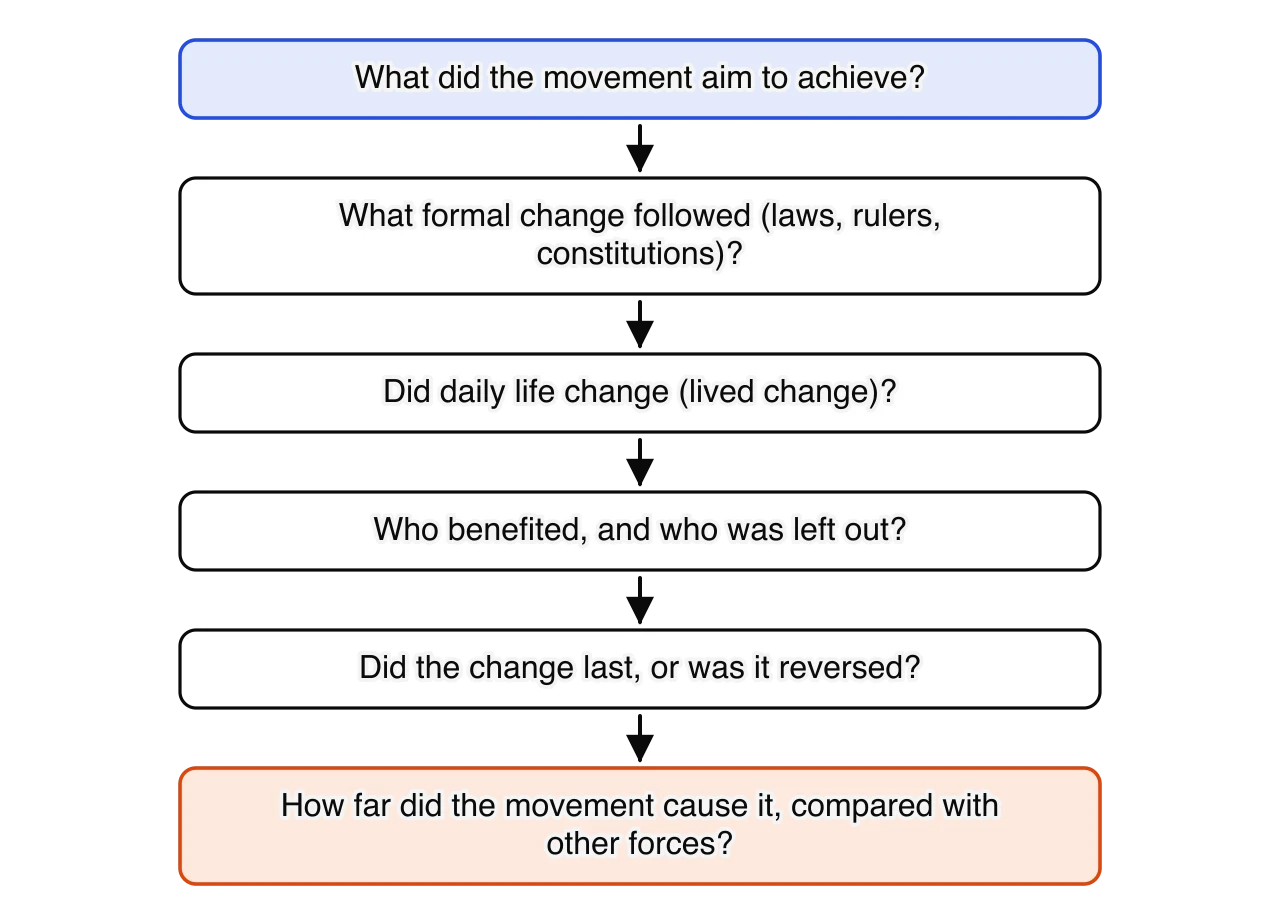
The six questions for judging impact move from the movement’s own aims to the changes that followed and then to the question of causation. The first questions measure change. The last asks whether the movement caused it, since war, economic pressure or a decision by people in power may have mattered as much.
The most useful distinction is between formal change, a change in laws, institutions, official policies or rulers, and lived change, a change in people’s everyday experience. Popular movements usually achieved formal change first, because a law or a new government is a single, visible target. Lived change depended on whether the law was enforced, whether people had the money and power to use their new rights, and whether attitudes changed with the law.
The gap between the two is a theme of every core case. The Voting Rights Act of 1965 changed the law across the American South overnight, and Black voter registration in Mississippi rose from under 7 per cent in 1964 to about 60 per cent by 1967. The Constitution of India abolished untouchability in 1950, but discrimination against Dalits continued in villages, temples and marriage for generations.
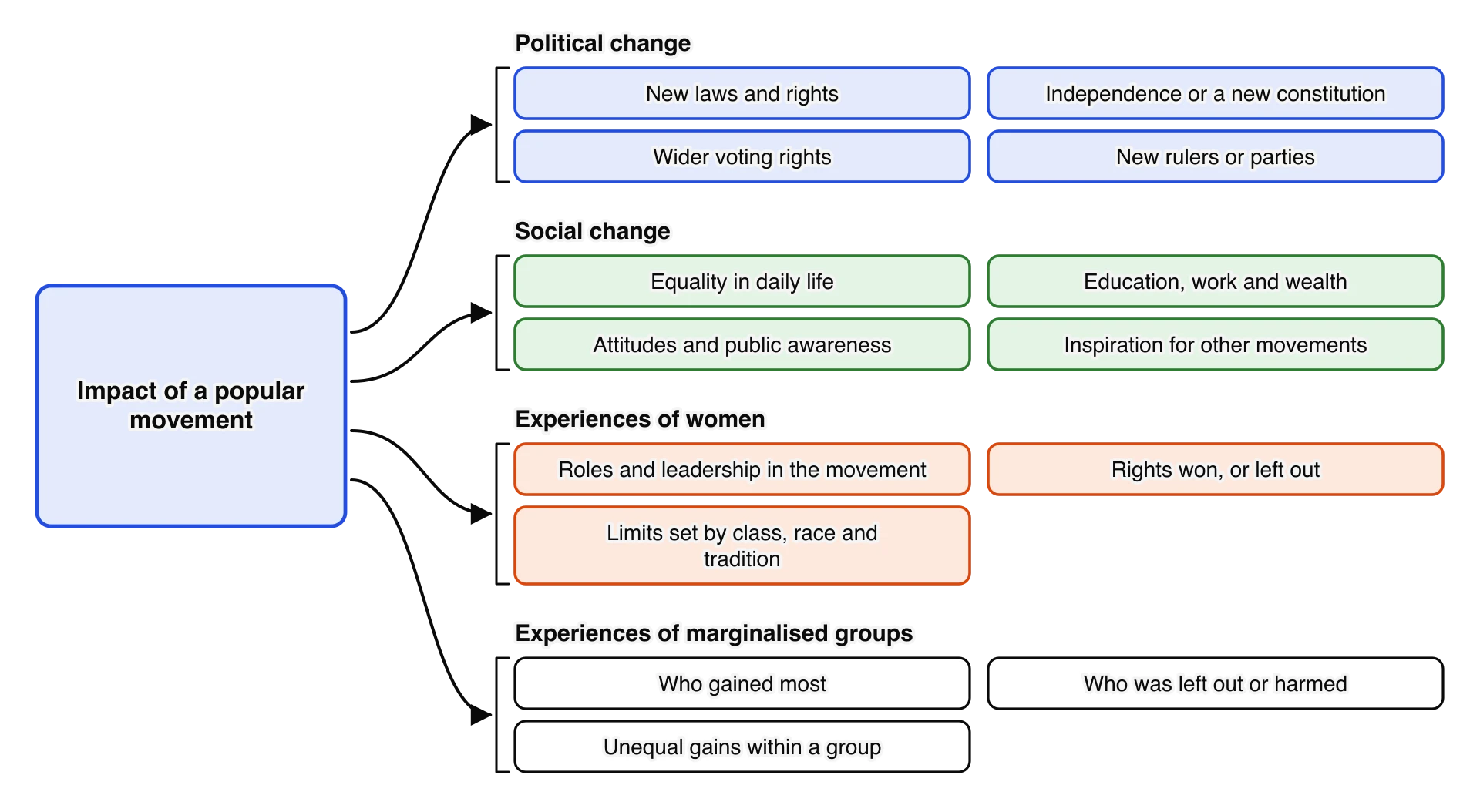
The diagram of the four kinds of impact separates political change (who holds power and what the law says) from social change (how people live together, work and see one another). The other two ask for whom the change happened. Women and marginalised groups were often active in movements whose leaders and gains were dominated by men or by the better-off members of a group.
The four overlap. A law such as Title VII of the Civil Rights Act of 1964 was a political change; the jobs it opened to Black workers and to women were a social change; and its effect on a Black woman in Mississippi depended on both her race and her sex. This overlap is called intersectionality: the way that different forms of disadvantage combine.
A change that follows a movement was not necessarily caused by it. British women won the vote in 1918 after a fifty-year campaign, but also after a war that forced Parliament to rewrite the electoral law for returning soldiers. India became independent in 1947 after three mass campaigns led by Congress, but also after the Second World War had left Britain exhausted and indebted. In each case historians weigh the movement against other causes.
Most changes came from the interaction of pressure from below with decisions from above. Movements made a problem impossible to ignore and created allies inside government; politicians, judges and generals then decided what form the change would take. That is why the terms of the change (compensation, a property qualification, partition, the army’s role in Egypt) often reflected the interests of those in power as much as the demands of the movement.
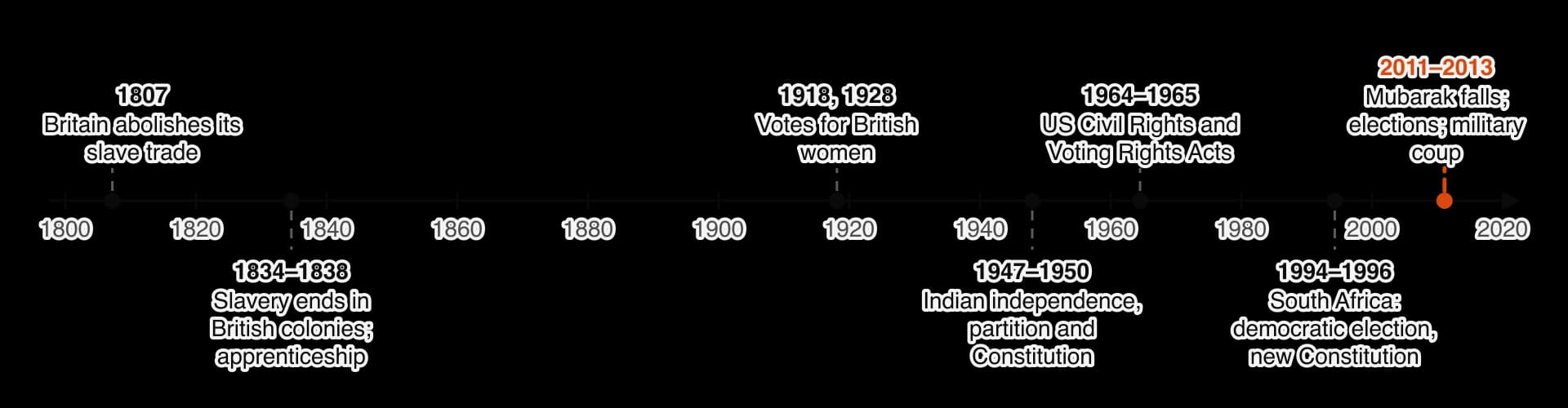
The timeline of the six core movements’ main outcomes shows how different the movements were in time and place, from the 1780s to 2011. It also shows that a movement’s greatest achievement usually came at the end of a long campaign: twenty years for the abolition of the slave trade, more than fifty for women’s suffrage, over sixty for Indian independence and more than forty for the end of apartheid.
Political change is change in who holds power, who may take part in politics and what the law allows. The core movements produced four kinds: new laws that ended a practice or protected a right, the extension of the vote, the creation of new states and constitutions, and the overthrow of a ruler. The kinds often came together: South Africa’s election of 1994 extended the vote, changed the government and led to a new constitution.
The British anti-slavery movement won two of the most important laws of the nineteenth century. The Slave Trade Act of 1807 banned British ships from carrying enslaved Africans, and the Slavery Abolition Act of 1833 ended slavery in most of the British colonies from 1 August 1834. How far these laws changed the lives of the enslaved depended on the terms attached to them, above all compensation and apprenticeship.
The US civil rights movement produced the most important federal civil rights laws since Reconstruction. The Civil Rights Act of 1964, signed by President Lyndon Johnson on 2 July 1964, banned segregation in public places such as hotels, restaurants and theatres (Title II), allowed the government to cut federal funds from segregated programmes, including schools (Title VI), and banned discrimination in employment on grounds of race, colour, religion, sex or national origin (Title VII). The Voting Rights Act of 6 August 1965 suspended literacy tests and sent federal officials to register voters in counties where few Black people were registered.
The laws followed the movement’s campaigns closely. President John F. Kennedy sent a civil rights bill to Congress in June 1963 after television showed police dogs and fire hoses turned on children in Birmingham, Alabama. The Voting Rights Act followed the Selma marches of March 1965, when state troopers beat marchers on the Edmund Pettus Bridge. Without the movement there would have been no political pressure to overcome the southern senators who had blocked civil rights laws for decades.
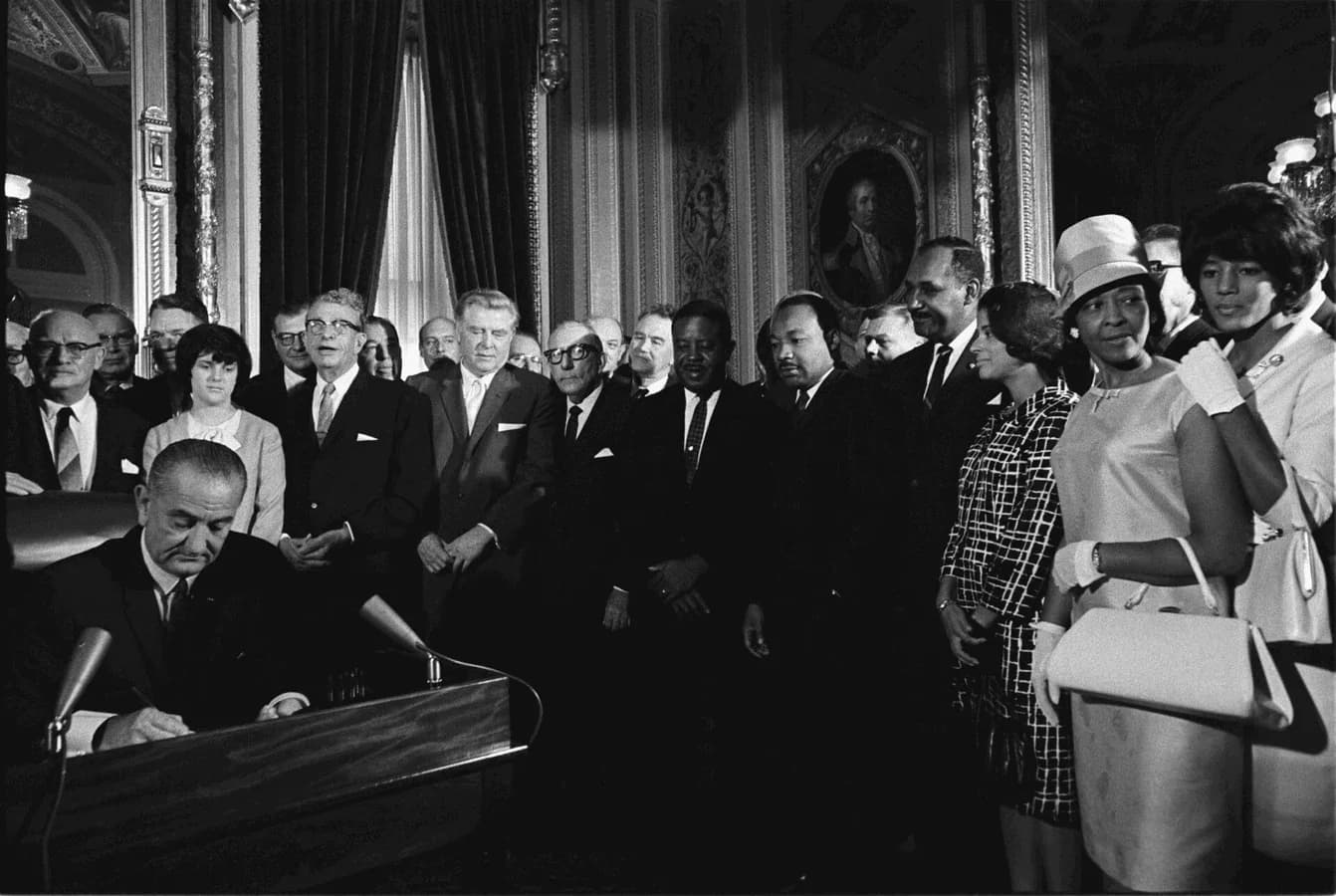
The photograph of the signing of the Voting Rights Act shows the partnership that produced the law. Johnson, a southern Democrat who had spent years in the Senate, used his skill with Congress to pass it; the civil rights leaders behind him had created the crisis that made it possible. A third law, the Fair Housing Act of 11 April 1968, banned discrimination in the sale and rental of housing; it passed a week after the assassination of Martin Luther King Jr. on 4 April 1968.
The impact of the Voting Rights Act on southern politics was rapid. In Mississippi, Black voter registration rose from about 7 per cent of the eligible population in 1964 to about 60 per cent in 1967. Black voters then elected Black officials, first in local government and later in state legislatures and Congress.
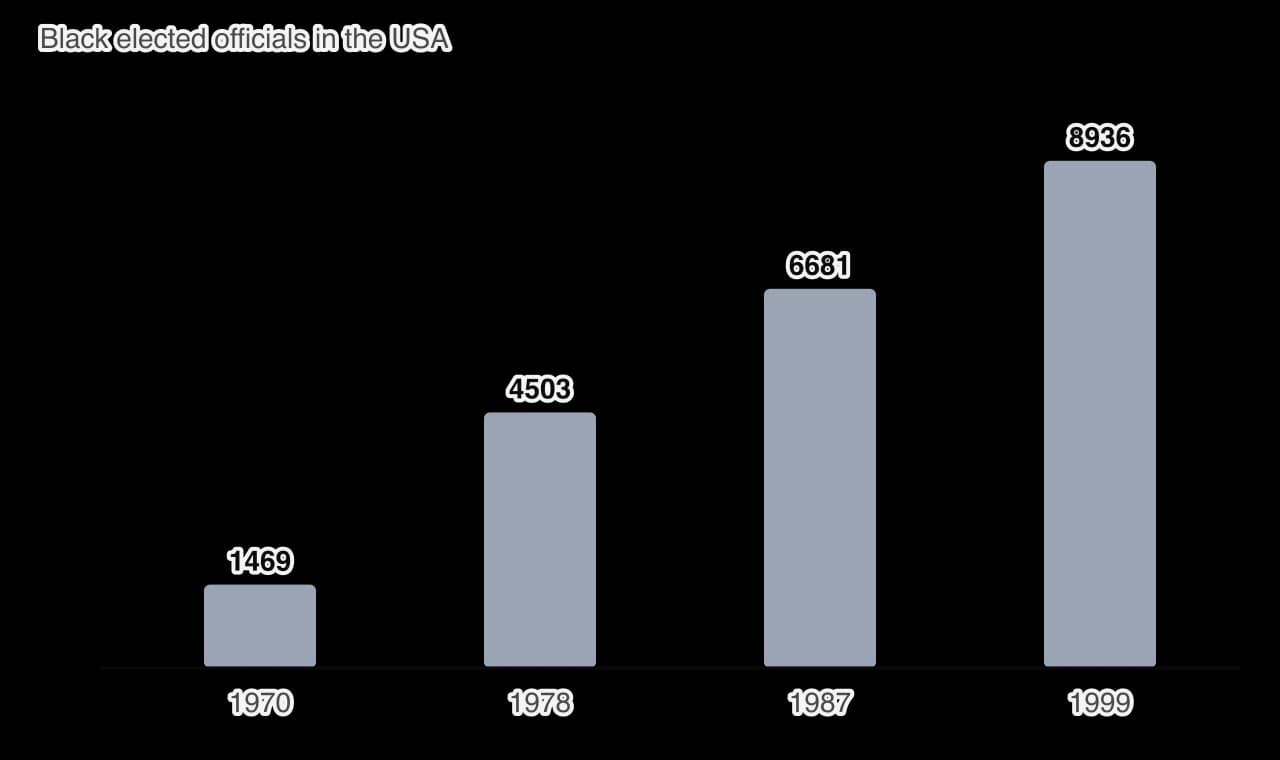
The chart of Black elected officials shows the growth of Black political representation after 1965. In 1970 there were 1,469 Black elected officials in the whole country; by 1999 there were 8,936. Even so, they held only a small share of the more than half a million elected offices in the United States, and most represented districts with a Black majority.
Extending the vote was the central aim of the British women’s suffrage movement. The Representation of the People Act 1918, passed on 6 February 1918, gave the vote to all men over 21 and to women over 30 who met a property qualification or were married to a man who did. About 8.4 million women gained the vote, about 40 per cent of the new electorate.
The 1918 Act was a compromise. Parliament set the age limit at 30 so that women would not form a majority of voters after the deaths of the war, and the property qualification excluded many working-class women, including many of the young women who had worked in munitions factories. The Parliament (Qualification of Women) Act 1918, passed in November 1918, allowed women over 21 to stand for Parliament, so for ten years a woman of 25 could be an MP but could not vote.
The Equal Franchise Act 1928, passed on 2 July 1928, gave women the vote on the same terms as men, at 21. A Conservative government passed it, with little opposition, after Emmeline Pankhurst had joined the Conservative Party; she died in June 1928, weeks before it became law. By then the argument against women voting had largely collapsed, which suggests that the movement had changed political opinion even among its former opponents.
 YouTube
Winning the vote did not bring equal representation. Constance Markievicz, elected for Sinn Féin in December 1918, refused to take her seat, so the first woman to sit in the House of Commons was Nancy Astor, elected at a by-election in Plymouth in November 1919. The Sex Disqualification (Removal) Act 1919 opened the legal profession, juries and the magistracy to women, but the number of women MPs stayed very small for seventy years.
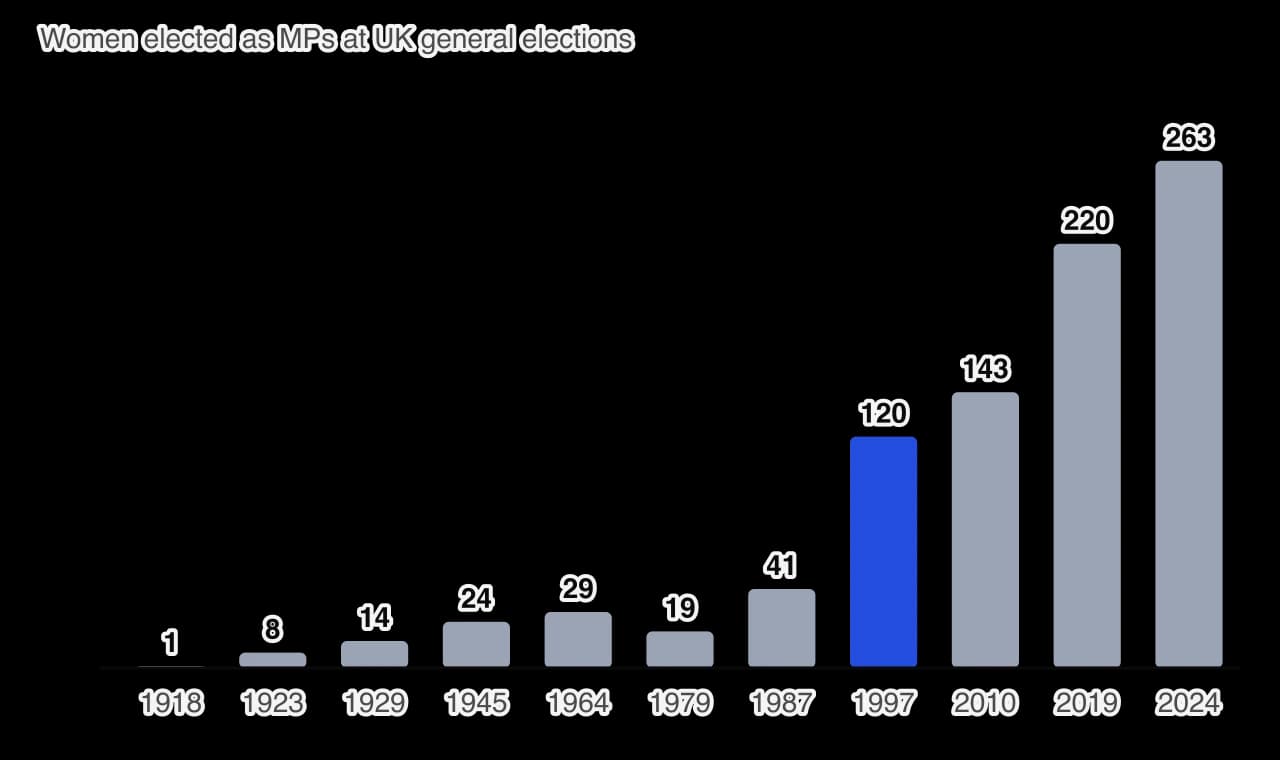
The chart of women MPs shows how slowly political representation followed the vote. Women made up more than half of the electorate from 1929, but they held fewer than 5 per cent of seats in the House of Commons until 1987. Representation grew only when parties changed how they chose candidates, as Labour did with all-women shortlists before the 1997 election.
The Indian national movement achieved the end of British rule. India and Pakistan became independent on 15 August 1947 under the Indian Independence Act, passed by the British Parliament in July 1947. The Constitution of India, drafted by a Constituent Assembly whose drafting committee was chaired by B. R. Ambedkar, came into force on 26 January 1950, the anniversary of the Congress’s 1930 declaration of purna swaraj (complete independence).
The Constitution turned many of the movement’s demands into law. It made India a republic with a parliamentary government, guaranteed fundamental rights, and introduced universal adult suffrage, the right of every citizen over 21 to vote regardless of sex, caste, religion, property or education. About 173 million people were entitled to vote in the first general election of 1951–1952, which made it the largest democratic election held anywhere up to that time.
Independence came with partition. The British plan of 3 June 1947 divided British India into two states, India and Pakistan, after the Muslim League had demanded a separate homeland. The violence that accompanied partition killed between about 200,000 and 2 million people (estimates vary widely because no reliable count was made) and displaced about 12–15 million. For many people in Punjab and Bengal, the political change of 1947 meant the loss of home, land and family.
South Africa’s political change came through negotiation. After Nelson Mandela’s release on 11 February 1990, the ANC and the National Party government negotiated an interim constitution, and on 27 April 1994 South Africans of all races voted together for the first time. The ANC won 62.6 per cent of the vote and Mandela became president on 10 May 1994. The Constitution of 1996, drafted by the elected Constitutional Assembly, included a Bill of Rights that banned discrimination on grounds that included race, gender, sex, pregnancy, marital status, ethnic or social origin, colour, sexual orientation, age, disability, religion, conscience, belief, culture, language and birth. The interim constitution of 1993 had already made South Africa the first country to ban discrimination on grounds of sexual orientation in its constitution, which extended the movement’s idea of equal rights to groups it had not originally campaigned for.
We have, at last, achieved our political emancipation. We pledge ourselves to liberate all our people from the continuing bondage of poverty, deprivation, suffering, gender and other discrimination.
Nelson Mandela, Inaugural address as President of South Africa, Pretoria, 10 May 1994. Mandela spoke to South Africans and to the foreign leaders gathered at the Union Buildings, and his speech celebrated reconciliation. As a source, it shows that the movement’s leaders saw 1994 as a political victory that had not yet become a social one: the distinction between "political emancipation" and the "continuing bondage of poverty" is Mandela’s own.
The Egyptian revolution of 2011 achieved its first demand quickly. After eighteen days of mass protest, centred on Tahrir Square in Cairo, Hosni Mubarak resigned on 11 February 2011 and handed power to the Supreme Council of the Armed Forces (SCAF), a body of senior generals. Egypt then held its freest elections in its history: the Muslim Brotherhood’s Freedom and Justice Party won the largest share of seats in the parliamentary elections of 2011–2012, and its candidate, Mohamed Morsi, won the presidential election of June 2012 with about 52 per cent of the vote. The fall of Mubarak, weeks after that of Ben Ali in Tunisia, also encouraged uprisings in Libya, Yemen, Bahrain and Syria in February and March 2011, most of which ended in repression or civil war.
The political change was reversed within two and a half years. Morsi’s rule divided the country, and after mass protests against him the army removed him on 3 July 2013. The general who led the coup, Abdel Fattah el-Sisi, was elected president in May 2014, and his government banned the Muslim Brotherhood, restricted protest and imprisoned tens of thousands of opponents. Mubarak himself was sentenced to life imprisonment in 2012, but the verdict was overturned, and in 2017 he was acquitted of responsibility for the killing of protesters.
Egypt shows that removing a ruler is not the same as changing a political system. The army, the security services and the courts, which some Egyptians called the deep state, survived the revolution intact, and the army was the only organised force able to take power when the elected government fell. The army’s survival set a limit on what the movement could change.
Most of the political changes won by the core movements lasted. Slavery was never restored in the British colonies, British women never lost the vote, India has remained an independent democracy (with the exception of the Emergency of 1975–1977) and South Africa has held regular competitive elections since 1994. Egypt is the exception among the core cases: by 2014 the main political gains of 2011 had been lost.
Even lasting changes could be weakened later. In Shelby County v. Holder (25 June 2013), the US Supreme Court struck down the formula that decided which states needed federal approval before changing their voting rules, and several states then introduced stricter voter identification laws. This shows that the impact of a movement depended on later political struggles as well as on the moment of victory.
Social change is change in how people live together: equality in daily life, access to education, work, land and wealth, relations between groups, and the attitudes that shape them. It was harder for movements to achieve than political change, for three reasons. Laws had to be enforced by officials who often opposed them; economic inequality built up over generations could not be removed by a vote; and attitudes changed more slowly than laws.
The Constitution of India attacked the caste system directly. Article 17 abolished untouchability and forbade its practice "in any form", and the Constitution reserved seats in Parliament and the state assemblies, and places in government service, for the Scheduled Castes and Scheduled Tribes. B. R. Ambedkar, the chair of the drafting committee and himself a Dalit, warned the Constituent Assembly that political equality would not by itself bring social equality.
On the 26th of January 1950, we are going to enter into a life of contradictions. In politics we will have equality and in social and economic life we will have inequality. In politics we will be recognizing the principle of one man one vote and one vote one value. In our social and economic life, we shall, by reason of our social and economic structure, continue to deny the principle of one man one value.
B. R. Ambedkar, speech to the Constituent Assembly of India, 25 November 1949. Ambedkar spoke the day before the Assembly adopted the Constitution he had steered through it, and he went on to warn that those who suffered from inequality might "blow up" the new democracy if the contradiction lasted. His perspective was that of a Dalit leader who had clashed with Gandhi and Congress over how to represent the untouchable castes, so he was well placed to see how little independence had changed for them.
Ambedkar’s warning proved accurate. Reservations created a Dalit middle class of officials, teachers and politicians, and by the 1990s Dalit-led parties such as the Bahujan Samaj Party had won power in Uttar Pradesh, India’s largest state. But most Dalits remained landless labourers, inter-caste marriage remained rare, and violence against Dalits who challenged caste customs continued. Ambedkar himself left Hinduism and converted to Buddhism with hundreds of thousands of his followers in October 1956, a few weeks before his death, because he had concluded that caste could not be reformed from within the religion.
The civil rights movement destroyed legal segregation in the South within a decade. Signs marking "white" and "colored" facilities came down after 1964, and the threat of losing federal funds under Title VI forced southern school boards to desegregate. Southern schools, which had been almost entirely segregated in 1964, were by the early 1970s among the least segregated in the country, especially after the Supreme Court approved busing to achieve integration in Swann v. Charlotte-Mecklenburg Board of Education (1971).
Economic change was more limited. The proportion of Black Americans living in poverty fell from about 55 per cent in 1959 to about 32 per cent in 1969, helped by the growing economy, new job opportunities and federal anti-poverty programmes, but it remained about three times the rate for white Americans. In northern cities, where segregation came from housing patterns and unequal schools rather than law, the civil rights laws had much less effect. In Milliken v. Bradley (1974) the Supreme Court ruled against busing pupils between city and suburban school districts, which left many urban schools segregated in practice.
These limits divided the movement after 1965. Leaders of Black Power, such as Stokely Carmichael of SNCC, argued that legal equality meant little without economic and political power for Black communities, and King’s last campaign, the Poor People’s Campaign of 1968, turned to jobs, wages and housing. The uprisings in Watts (1965), Detroit and Newark (1967) and more than a hundred cities after King’s assassination showed the anger of northern Black communities whose lives the laws of 1964–1965 had barely changed.
The end of apartheid brought rapid change in some areas of social life. Pass laws, segregated residential areas and job reservation had already been repealed between 1979 and 1991, and after 1994 the government extended electricity, piped water, housing and social grants to millions of poor households. Black South Africans entered universities, the civil service and business in large numbers, and a Black middle class grew quickly, helped by Black Economic Empowerment policies from 2003.
Other inequalities proved lasting. White South Africans continued to own most commercial farmland, and the land reform programme, which in 1994 aimed to transfer 30 per cent of white-owned farmland within five years, transferred far less (commonly cited estimates put it below 10 per cent by the late 2010s). Unemployment among young Black South Africans remained very high, and World Bank measurements placed South Africa among the most unequal societies in the world, with a Gini coefficient of about 0.63 in 2014.
South Africa also tried to change relations between groups through the Truth and Reconciliation Commission (TRC), chaired by Archbishop Desmond Tutu, which sat from 1996 to 1998. It heard statements from more than 21,000 victims of human rights violations and offered amnesty to perpetrators who made full disclosure of politically motivated crimes. Its public hearings, broadcast on radio and television, made the violence of apartheid known to white South Africans who had ignored or denied it.
The TRC divided opinion. Supporters saw it as a way of establishing the truth and avoiding revenge; critics, including many victims’ families, objected that perpetrators went free while victims received only small reparations, years late. The political scientist Mahmood Mamdani argued that by focusing on individual acts of violence, the TRC left out the millions of ordinary people who had suffered from forced removals and pass laws, and the white South Africans who had benefited from them.
Some of the deepest social changes were in attitudes. After 1833 slavery was seen in Britain as a moral wrong, not merely an economic system; after the 1960s open defence of segregation became unacceptable in American national politics; and after 1994 apartheid was treated around the world as a symbol of injustice. Such changes are hard to measure, but they explain why the formal gains of the core movements were not reversed, except in Egypt.
Movements also changed society by teaching other movements what was possible. Methods and ideas passed between regions and generations, often through individuals who took part in more than one campaign.
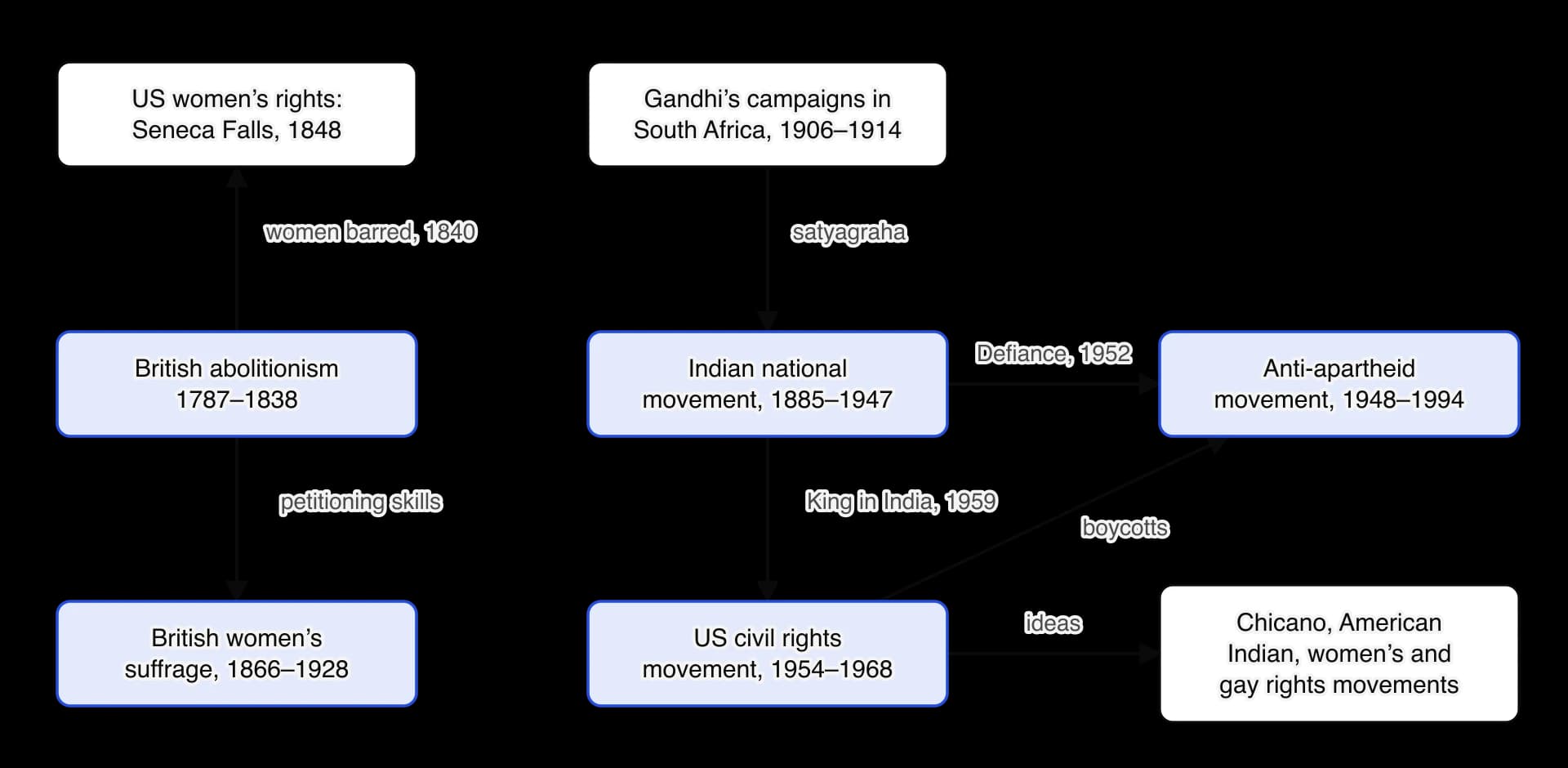
The diagram of influences between movements shows how methods travelled. Gandhi developed satyagraha in South Africa between 1906 and 1914 and used it in India from 1917; Martin Luther King Jr. studied Gandhi’s ideas and visited India in 1959; and the ANC’s Defiance Campaign of 1952 drew on the passive resistance of Indian South Africans. The US civil rights movement in turn became the model for the Chicano and American Indian movements, the women’s liberation movement and the gay rights movement of the late 1960s and 1970s.
Women took part in every core movement, often in very large numbers, but their experience of those movements differed from men’s in two ways. They were usually kept from the most visible leadership roles, even when they did much of the organising, and the rights the movement won for its main constituency did not always extend to them. Participation in one movement also led many women to demand rights for themselves.
In the British anti-slavery campaign, women could not vote, sit in Parliament or, in most cases, speak at public meetings, so they worked through ladies’ anti-slavery associations, the first of which was founded in Birmingham in 1825. They organised the boycott of slave-grown sugar, collected signatures and raised money. In 1824 the Leicester Quaker Elizabeth Heyrick published Immediate, Not Gradual Abolition, which challenged the cautious approach of the male leadership, and in 1833 a single petition signed by about 187,000 women was presented to Parliament.
In India, Gandhi’s methods of non-violent mass protest made room for women on a scale that earlier politics had not. Sarojini Naidu, a poet who became president of Congress in 1925, led the raid on the Dharasana salt works in May 1930 after Gandhi’s arrest. Thousands of women picketed liquor and foreign-cloth shops during the Civil Disobedience campaign of 1930–1932, and in August 1942 Aruna Asaf Ali raised the Congress flag in Bombay at the start of the Quit India movement, then led the underground resistance while male leaders were in prison.
In the US civil rights movement, women such as Ella Baker, who helped to found the Student Nonviolent Coordinating Committee (SNCC) in 1960, Diane Nash, who led the Nashville sit-ins and kept the Freedom Rides going in 1961, and Fannie Lou Hamer, a sharecropper from Mississippi, did much of the organising at local level. Hamer was evicted from the plantation where she worked after she tried to register to vote in 1962, and she was beaten in a Mississippi jail in 1963. In August 1964 she told the Credentials Committee of the Democratic National Convention why the Mississippi Freedom Democratic Party should be seated instead of the all-white official delegation.
All of this is on account of we want to register, to become first-class citizens. And if the Freedom Democratic Party is not seated now, I question America. Is this America, the land of the free and the home of the brave, where we have to sleep with our telephones off the hooks because our lives be threatened daily, because we want to live as decent human beings, in America?
Fannie Lou Hamer, testimony before the Credentials Committee, Democratic National Convention, Atlantic City, 22 August 1964. Hamer spoke to persuade the committee, but her words reached the whole country when the television networks broadcast them that evening. As a source, it shows the experience of a poor rural Black woman, a voice rarely heard in national politics, and it shows the movement using personal testimony to expose the gap between American ideals and southern reality.
In South Africa, the Federation of South African Women (FEDSAW), founded in 1954, adopted a Women’s Charter that demanded equal rights for women of all races. On 9 August 1956 about 20,000 women marched to the Union Buildings in Pretoria to protest against the extension of the pass laws to African women, led by Lilian Ngoyi, Helen Joseph, Rahima Moosa and Sophia Williams. In Egypt, the 25-year-old activist Asmaa Mahfouz posted a video on 18 January 2011 calling on Egyptians to join her in Tahrir Square on 25 January, and women took part in the occupation of the square in large numbers.
The women’s suffrage movement was the one core movement whose main aim was a right for women. Its impact on women’s political rights was direct but staged (1918, 1928), and its effect on women’s social and economic position was slower. A marriage bar forced women teachers and civil servants to resign when they married until 1944 and 1946 respectively, and the Equal Pay Act was not passed until 1970.
Women gained most from other movements where the new state wrote equal rights into its founding law. The Constitution of India gave women the vote on the same terms as men from 1950, at once, whereas British women waited ten years after their first partial victory in 1918 for equal terms. The Hindu Code Bills of 1955–1956 gave Hindu women the right to divorce and to inherit property, although Ambedkar had resigned from the government in 1951 when the earlier version of the bill was blocked by conservative opposition. In South Africa, the Constitution of 1996 banned discrimination on grounds of sex, gender and pregnancy, and women held about a quarter of the seats in the first democratic Parliament of 1994, largely because the ANC set a quota of 30 per cent women on its candidate list. Women who had led the struggle, such as Albertina Sisulu, entered Parliament, and Frene Ginwala became its first Speaker.
In the United States, the word "sex" was added to Title VII of the Civil Rights Act of 1964 by Howard Smith, a Virginia congressman who opposed the bill, but women’s groups then used it to challenge discrimination at work. In Egypt, the Constitution of 2014 committed the state to equality between women and men, and quotas raised the share of women in parliament from about 2 per cent in 2012 to about 15 per cent after the elections of 2015.
Women’s experience of the core movements also shows their limits. Within the US civil rights movement, women did much of the work but rarely spoke from the platform: no woman gave a major speech at the March on Washington in August 1963. In November 1965 two SNCC activists, Casey Hayden and Mary King, circulated "Sex and Caste", a memo comparing the position of women in the movement to that of Black people in society, which became one of the founding documents of the women’s liberation movement.
Class and race divided the gains. The property qualification of 1918 excluded many working-class women; Indian suffragettes such as Sophia Duleep Singh campaigned in Britain, but women in India had to campaign separately for the vote, which provincial legislatures granted only to small numbers of propertied women in the 1920s. In Egypt, women who had been prominent in Tahrir Square faced sexual harassment and assault in the square and abuse by soldiers after the army took power, and the army’s return to power in 2013 ended most independent women’s activism.
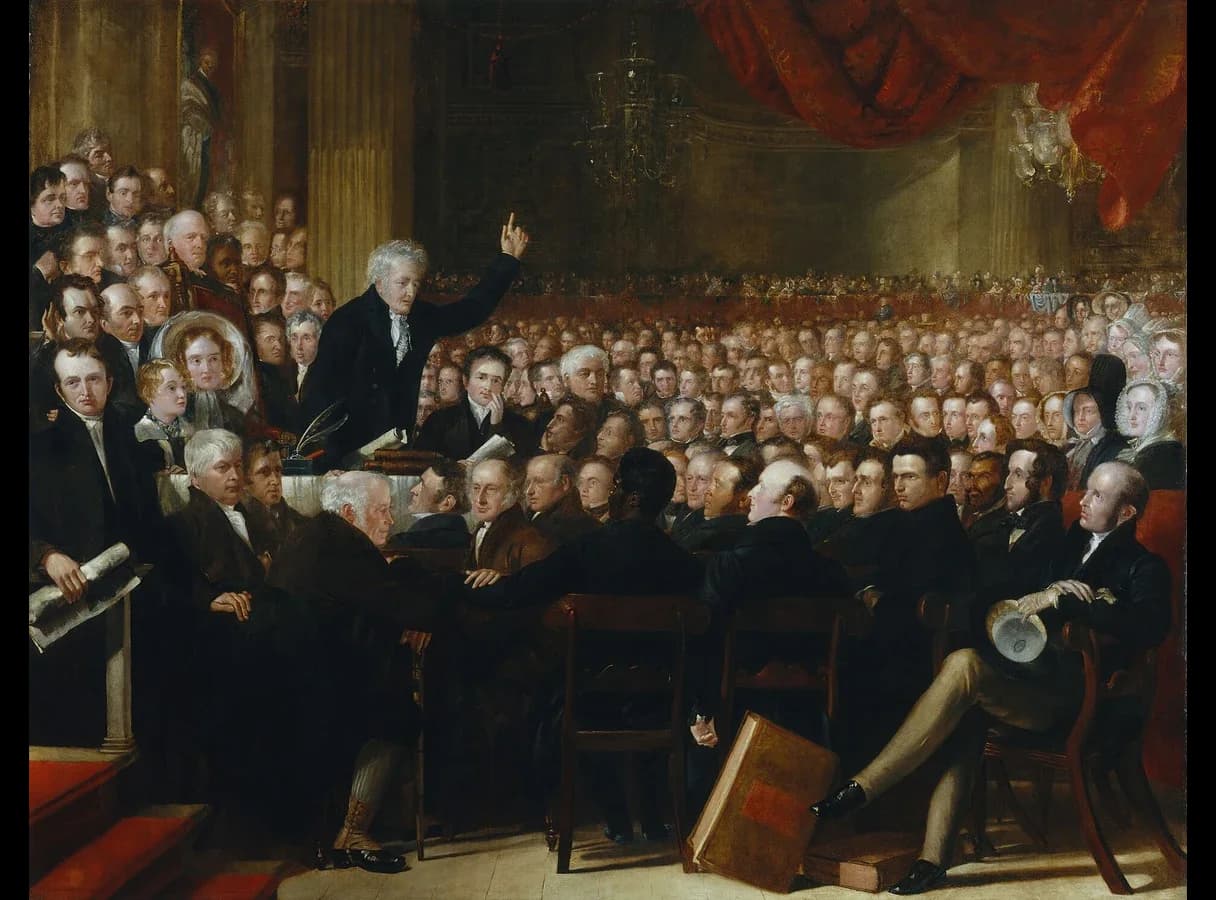
Haydon’s painting of the World Anti-Slavery Convention of 1840 records an exclusion that had a long-term impact. The convention refused to seat the women delegates sent by American anti-slavery societies, among them Lucretia Mott, and made them sit in a separate gallery. Mott and Elizabeth Cady Stanton, who had come to London with her husband, a delegate, resolved there to hold a meeting on women’s rights. Eight years later they organised the Seneca Falls Convention (July 1848), which began the organised movement for women’s rights in the United States.
Movement | Women’s roles in the movement | What women gained | Limits |
|---|---|---|---|
British abolition (Europe) | Ladies’ associations from 1825; sugar boycott; petition of about 187,000 women (1833); Heyrick’s pamphlet (1824) | Experience of organising and petitioning that later fed into women’s suffrage | No role in Parliament; excluded from the 1840 convention |
British women’s suffrage (Europe) | The whole movement: NUWSS, WSPU, Women’s Freedom League | Vote over 30 (1918) and at 21 (1928); right to stand for Parliament; entry to professions (1919) | Property qualification; few women MPs before 1987; marriage bar; unequal pay until the 1970s |
Indian national movement (Asia) | Salt March and Civil Disobedience; Quit India; leaders such as Naidu and Asaf Ali | Equal vote from 1950; Hindu Code Bills (1955–1956) | Patriarchal family law in practice; partition violence against women |
US civil rights (Americas) | Local organisers: Baker, Nash, Hamer, Rosa Parks | "Sex" in Title VII (1964); the movement’s methods taken up by women’s liberation | Excluded from leadership and platforms; "Sex and Caste" memo (1965) |
Anti-apartheid (Africa and the Middle East) | FEDSAW and the Women’s Charter (1954); march of 9 August 1956 | Equality in the 1996 Constitution; about a quarter of MPs in 1994 | High levels of gender-based violence; poverty among rural women |
Egypt 2011 (Africa and the Middle East) | Mahfouz’s video; mass participation in Tahrir Square | Equality article in the 2014 Constitution; quotas in parliament | Harassment and assault; abuse by soldiers; activism restricted after 2013 |
The table of women in the six core movements suggests a pattern. Women gained most where a movement created a new constitution that wrote equality into law (India, South Africa) or where women’s rights were the movement’s own aim (Britain). They gained least where a movement’s gains were reversed (Egypt) or where its leaders treated women’s rights as a separate issue to be dealt with later.
A marginalised group is a group pushed to the edges of a society’s political, economic and social life, with less power, wealth and protection than others, usually because of race, ethnicity, caste, religion, class, sex, sexuality or disability. Popular movements often spoke for marginalised groups, but the impact of a movement on such groups was rarely uniform. Three questions help: did the movement’s gains reach the whole group, or mainly its better-off members? Were some marginalised groups left out of the gains, or harmed by the changes? And did the movement’s example help other marginalised groups to organise?
The groups for whom movements campaigned did not gain equally. In the United States, the Civil Rights Act and affirmative action opened universities, professions and government jobs to educated Black Americans, and the Black middle class grew rapidly after 1965. Poor Black Americans in northern cities and the rural South gained the vote and access to public facilities but saw much less change in their incomes, housing and schools. In India, reservations benefited Dalits who could reach secondary school and university; the poorest, landless Dalits saw much less change.
South Africa shows the same pattern. Inequality between racial groups narrowed after 1994 as Black South Africans moved into skilled and professional jobs, but inequality within the Black majority rose sharply, so that the gap between a new Black elite and the rural and township poor became one of the main divisions in South African society.
Some marginalised groups were excluded from a movement’s gains or harmed by the settlement that ended it. After the abolition of slavery, planters in Trinidad, British Guiana and Mauritius brought in indentured labour from India, and the indentured workers lived under contracts and penal laws that critics compared to slavery. The partition of India in 1947 made refugees of millions of Hindus, Sikhs and Muslims, and the Muslims who stayed in India became a minority whose loyalty was often questioned. The Adivasi peoples of central India gained reserved seats but lost land to dams, mines and forest laws after independence.
In South Africa, the new democracy proved hostile to many African migrants. In May 2008 attacks on foreign nationals in townships around Johannesburg and elsewhere killed 62 people and displaced tens of thousands. In Egypt, Coptic Christians, about a tenth of the population, had joined Muslims in Tahrir Square, but sectarian attacks on churches increased after 2011, and on 9 October 2011 soldiers killed 28 people, most of them Copts, during a protest at the Maspero television building in Cairo. Egypt’s Nubians, displaced from their villages when the Aswan High Dam was built in the 1960s, won a promise in the 2014 Constitution that the state would work to return them to their lands within ten years, but the promise was not fulfilled.
The US civil rights movement had its widest impact on other marginalised groups in the United States. The Immigration and Nationality Act of 1965, passed in the same reforming climate as the civil rights laws, ended the quotas based on national origin that had favoured immigrants from northern Europe since 1924. Mexican American activists built the Chicano movement in the late 1960s; the American Indian Movement, founded in Minneapolis in 1968, used occupations and protests to press treaty rights; and the Stonewall riots in New York in June 1969 helped to launch the gay liberation movement.
The British abolition movement also had a lasting effect on marginalised people beyond its original aims. It made the formerly enslaved people of the Caribbean British subjects with legal rights that they could use against planters and officials, and it created a model of the mass petition and the consumer boycott that later British campaigns, from the Anti-Corn Law League to women’s suffrage, adopted.
The British anti-slavery movement was one of the first modern popular movements. From the founding of the Society for Effecting the Abolition of the Slave Trade in May 1787 it used petitions, public meetings, a consumer boycott, pamphlets and images to win public opinion, and it relied on allies in Parliament, above all William Wilberforce, to turn opinion into law. Its impact can be traced in all four areas: the laws of 1807 and 1833, the lives of the people it freed, the women who campaigned for it, and the marginalised groups who gained or lost from the settlement.

The movement’s first aim was to end the British slave trade, since its leaders believed that slavery itself would decline if planters could no longer buy new captives. The Slave Trade Act received royal assent on 25 March 1807. No slave ship could leave a British port after 1 May 1807, and no enslaved African could be landed in a British colony after 1 March 1808. British ships had carried more enslaved Africans across the Atlantic in the eighteenth century than those of any other nation, so the Act removed the largest single carrier from the trade.
The Act changed British policy as well as British trade. From 1808 the Royal Navy’s West Africa Squadron patrolled the coast of West Africa to intercept slave ships, and Britain used treaties and pressure to persuade other states to ban the trade. Commonly cited estimates are that the squadron freed about 150,000 Africans from slave ships between 1808 and 1860. Many of them were settled in Sierra Leone as "liberated Africans", where they were often apprenticed to employers or recruited into the army, so even rescue did not always bring full freedom.
The limits of the 1807 Act were great. Slavery continued in the British colonies, and the planters, no longer able to buy new captives, worked the enslaved population harder. The Atlantic trade continued under other flags: millions more Africans were carried to Brazil and Cuba before the trade finally ended in the 1860s. By the 1820s abolitionists had concluded that slavery would not die out by itself, and in 1823 they founded the Anti-Slavery Society to campaign for its abolition.
The second phase of the campaign combined pressure from Britain with resistance in the colonies. The risings of the enslaved in Barbados (1816), Demerara (1823) and above all Jamaica (December 1831 to January 1832), where tens of thousands joined the rising known as the Baptist War, convinced many in Parliament that slavery could only be kept by force. The Great Reform Act of 1832 then produced a House of Commons with fewer MPs connected to West Indian interests and more who had promised their voters to end slavery. In 1833 abolitionists presented petitions with about 1.5 million signatures.
The Slavery Abolition Act received royal assent on 28 August 1833 and came into force on 1 August 1834. Its central clause declared slavery at an end.
… all and every the Persons who on the said First Day of August One thousand eight hundred and thirty-four shall be holden in Slavery within any such British Colony as aforesaid shall upon and from and after the said First Day of August One thousand eight hundred and thirty-four become and be to all Intents and Purposes free and discharged of and from all Manner of Slavery, and shall be absolutely and for ever manumitted …
Slavery Abolition Act 1833, section XII, Parliament of the United Kingdom, 28 August 1833. The legal language makes the freedom sound complete, but the clause begins by making it "subject to the Obligations imposed by this Act … upon such apprenticed Labourers", which shows that the freedom it granted was conditional. As a source, it records exactly what Parliament conceded and on what terms.
The terms of the Act were the result of compromise with the planters and their allies, the West India interest. Three of them shaped the impact of abolition.
Compensation. The government paid £20 million to slave owners for the loss of their "property", about 40 per cent of its annual spending. The enslaved received nothing. The money was borrowed, and the British Treasury finished repaying the loans only in 2015.
Apprenticeship. All freed people over the age of six had to work without pay for their former owners for up to 45 hours a week, for up to six years for field workers and four years for domestic workers. Only children under six were freed outright.
Exclusions. The Act applied to the Caribbean colonies, the Cape and Mauritius, but not to the territories of the East India Company, Ceylon or St Helena, where slavery was ended by later laws.
The compensated emancipation of 1833 was the price the movement paid for winning a parliamentary majority quickly. Leading abolitionists accepted it reluctantly, judging that Parliament would not end slavery without it. Compensation records studied by the Legacies of British Slavery project at University College London since 2009 show that a large share of the money went to absentee owners, merchants and bankers living in Britain, and that some of it was invested in railways, businesses and country houses.
 YouTube
Apprenticeship began badly. On 1 August 1834 crowds of apprentices in Port of Spain, Trinidad, protested against having to work unpaid for years more. Antigua and Bermuda chose full freedom at once in 1834, and their economies continued to function, which undermined the planters’ argument that apprenticeship was necessary.
Abolitionists soon found that apprentices were flogged, imprisoned and made to work on treadmills on the orders of planters and local magistrates. The Quaker campaigner Joseph Sturge toured the Caribbean in 1836–1837 and brought back James Williams, a young Jamaican apprentice, whose Narrative of Events since the First of August, 1834 (1837) described punishments little different from those of slavery. A new national campaign in Britain, with fresh petitions and meetings, led the colonial assemblies to end apprenticeship early, on 1 August 1838.
The campaign against apprenticeship shows that the movement’s impact did not end in 1833. Abolitionists kept watching how the law worked, and public pressure in Britain, combined with the resistance of the apprentices themselves, shortened a compromise that Parliament had intended to last until 1840.
Full freedom changed the lives of about 800,000 people. Freed people could move, marry, worship and bring up their children without an owner’s permission, and many left the plantations. In Jamaica, Baptist missionaries such as William Knibb helped former slaves to buy land and build "free villages", and a class of small farmers grew up who sold produce in local markets. Freed people built chapels and schools, and the formal legal status of slavery, with its whippings and sales of family members, was gone.
Other things continued. Planters kept most of the good land and the local political power: high property qualifications meant that very few freed people could vote for the colonial assemblies. Wages on the plantations were low, and planters used rents for cottages and provision grounds to force labourers to stay. After the Sugar Duties Act of 1846 removed the protection that British colonial sugar had enjoyed against cheaper foreign sugar, many plantations failed and wages fell further.
Planters also looked for new sources of controlled labour. From the 1830s to 1917 they brought hundreds of thousands of indentured workers from India to Mauritius (from 1834), British Guiana (from 1838), Trinidad and Jamaica on contracts of five years, under penal laws that punished absence from work with prison. The historian Hugh Tinker called the system A New System of Slavery (1974); other historians stress that, unlike slaves, indentured workers had contracts, wages and, in principle, the right to return home.
The tensions of the post-emancipation Caribbean broke out in the Morant Bay rebellion in Jamaica in October 1865. After a court case over land, the Baptist deacon Paul Bogle led a protest that became a rising in which eighteen people, including white officials, were killed. Governor Edward Eyre declared martial law, and more than 400 Black Jamaicans were killed by troops or executed after courts martial; George William Gordon, a mixed-race member of the Assembly, was hanged. The Jamaican Assembly then gave up its powers, and Jamaica became a Crown colony ruled directly from London in 1866, which ended the elected assembly that freed people might one day have controlled.
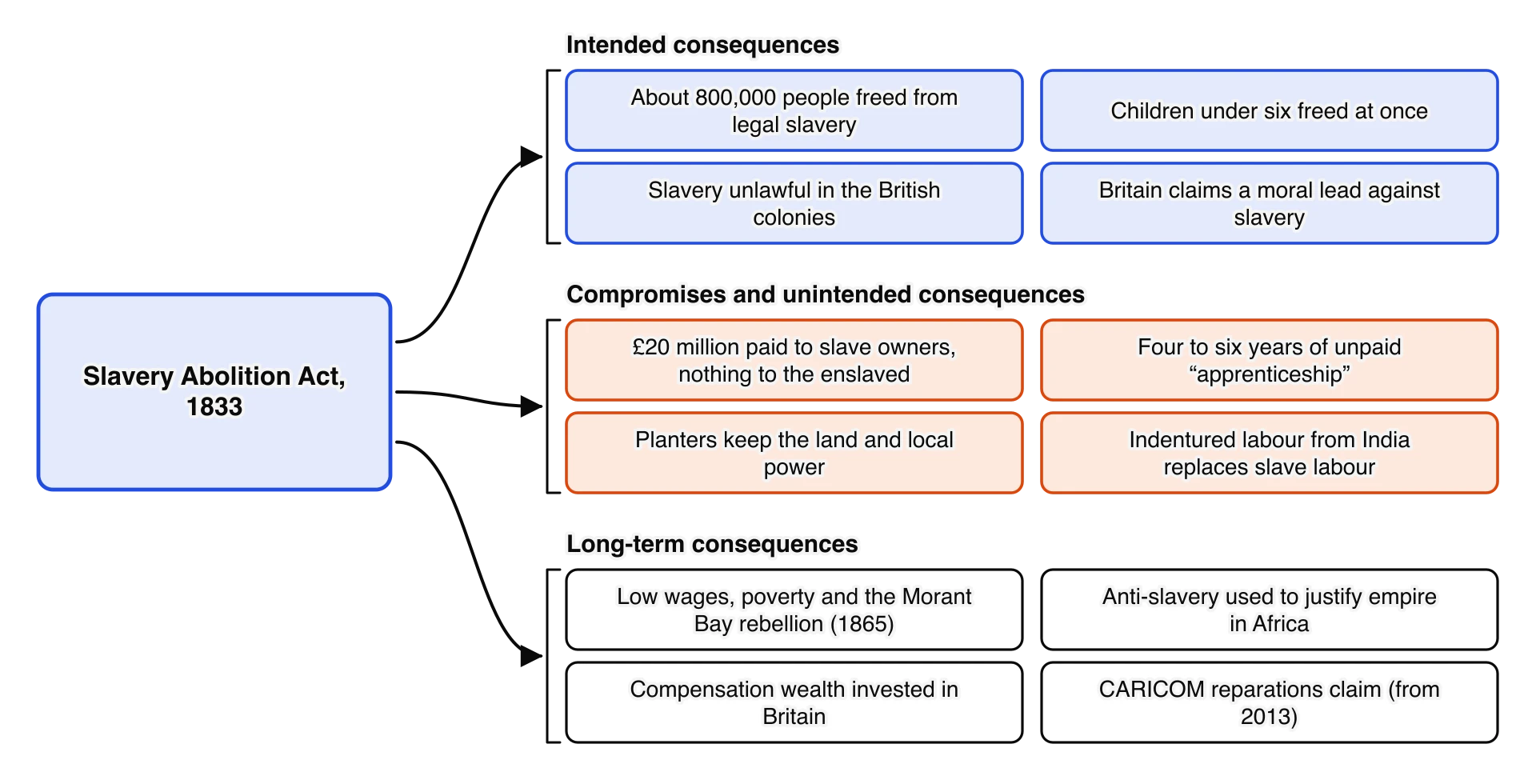
The diagram of the consequences of the 1833 Act separates what the movement intended from the compromises and long-term effects that followed. The ending of legal slavery was permanent and complete. The compromises, compensation and apprenticeship, protected the planters’ wealth and power, and the long-term consequences show that freedom without land, votes or fair wages left the formerly enslaved poor and politically excluded for generations.
Abolition also changed Britain. It became a source of national pride: Victorian Britons celebrated the end of slavery as proof of British moral leadership, and the historian Christopher Leslie Brown, in Moral Capital (2006), argues that anti-slavery gave Britain a sense of virtue after the loss of the American colonies. British governments later used the suppression of the slave trade to justify expansion in Africa, including the annexation of Lagos in 1861 and the conquests of the late nineteenth century.
The memory of abolition has been contested since. The bicentenary of the 1807 Act in 2007 led to criticism that British commemoration celebrated Wilberforce and Parliament while neglecting the resistance of the enslaved and Britain’s profits from slavery. Since 2013 the Caribbean Community (CARICOM) Reparations Commission has called on Britain and other European states to pay reparations for slavery and its consequences, and the publication of the compensation records has led some British families and institutions to acknowledge their links to slavery.
British abolition shows all four kinds of impact. Women abolitionists in Britain gained experience of organising and petitioning, but they were excluded from Parliament and, in 1840, from the floor of the movement’s own international convention. Enslaved women were among the most exploited workers on the plantations and were given less attention by the campaign than male abolitionists; one exception was The History of Mary Prince (1831), the first account of the life of a Black woman published in Britain, which the Anti-Slavery Society used as evidence of the brutality of slavery. Among marginalised groups, the formerly enslaved gained legal freedom but not equality, while the indentured labourers brought in to replace them experienced a new form of unfree labour that the movement had not anticipated.
British abolition shows the typical shape of a popular movement’s impact. The movement won lasting legal change, but only by accepting compromises that reflected the power of its opponents, and the people it spoke for experienced the change through those compromises. It also shows that impact continued long after the movement’s main victory: in the campaign against apprenticeship, in the women’s rights movement it helped to inspire, in the use of anti-slavery to justify empire and in debates about reparations two centuries later.
Comparing the six core movements shows which kinds of impact were common to all of them and which depended on the movement’s aims, its relationship with the state and the period in which it acted. The table of the core cases sets out the evidence for each line of inquiry.
Movement (region) | Political change | Social change | Women | Marginalised groups |
|---|---|---|---|---|
British abolitionism, 1787–1838 (Europe; Caribbean) | Slave Trade Act (1807); Slavery Abolition Act (1833); apprenticeship ended (1838) | About 800,000 freed; free villages; low wages and planter power continued | Ladies’ associations; petition of about 187,000 women; excluded in 1840 | Owners compensated, enslaved not; Indian indentured labour; Morant Bay (1865) |
British women’s suffrage, 1866–1928 (Europe) | Votes for women over 30 (1918) and at 21 (1928); women MPs from 1919 | Professions opened (1919); marriage bar until the 1940s; equal pay only from 1970 | The movement’s own aim; class and age limits in 1918 | Working-class women gained later; colonial women campaigned separately |
Indian national movement, 1885–1947 (Asia) | Independence (1947); Constitution (1950); universal adult suffrage | Untouchability abolished in law; reservations; caste inequality persisted | Equal vote from 1950; Hindu Code Bills (1955–1956) | Partition refugees; Muslims in India; Dalits and Adivasis gained unequally |
US civil rights, 1954–1968 (Americas) | Civil Rights Act (1964); Voting Rights Act (1965); Fair Housing Act (1968) | End of legal segregation in the South; northern segregation and poverty gaps remained | "Sex" in Title VII; sexism in the movement fed women’s liberation | Black middle class grew; Chicano, American Indian and gay rights movements followed |
Anti-apartheid, 1948–1994 (Africa and the Middle East) | Democratic election (1994); Constitution and Bill of Rights (1996) | Services extended; TRC (1996–1998); land and wealth inequality remained | Equality in the Constitution; about a quarter of MPs in 1994 | Inequality within the Black majority grew; xenophobic attacks on migrants (2008) |
Egyptian revolution, 2011 (Africa and the Middle East) | Mubarak removed (2011); free elections (2011–2012); military coup (2013) | Little lasting change; repression returned under el-Sisi | Prominent in Tahrir; harassment; equality article and quotas | Copts attacked (Maspero, 2011); promises to Nubians unfulfilled |
Every core movement achieved a formal political change, and in five of the six cases that change lasted. In every case, too, the change came through a combination of popular pressure and decisions made by people in power: Parliament in 1807, 1833 and 1918, the British government and the Muslim League in 1947, Johnson and Congress in 1964–1965, the National Party government of F. W. de Klerk in 1990–1994, and the Egyptian army in 2011.
Every movement also left social and economic inequalities that the formal change did not remove. Freed people in the Caribbean, Dalits in India, poor Black Americans and poor Black South Africans gained legal rights but remained poorer than the groups who had held power. The pattern suggests that popular movements were much better at changing laws than at redistributing land, wealth and opportunity.
The comparison suggests three conditions for lasting change. First, the change was written into law and institutions that later governments found hard to undo: a constitution (India, South Africa), an Act of Parliament (Britain) or federal law enforced by courts (the United States). Second, the movement or its allies controlled, or came to control, the state: Congress in India and the ANC in South Africa formed the new governments. Third, the change had support beyond the movement itself, so that reversing it would have been politically costly.
Egypt lacked all three. The 2012 Constitution was replaced within two years; the army, not the movement, controlled the state; and Egyptian society was deeply divided between Islamists and their opponents, so many former protesters supported the coup of 2013. Comparing Egypt with South Africa shows that the strength of a movement’s organisation after its victory mattered as much as its strength in protest.
The most important debate about impact is whether movements caused the changes that followed them, or whether economic interests, wars and decisions by elites mattered more. Historians have argued this question for each core movement.
For British abolition, the debate between Eric Williams (Capitalism and Slavery, 1944) and Seymour Drescher (Econocide, 1977) over whether slavery was still profitable, which explains why the movement emerged when it did, also decides how much credit the movement deserves for the Acts of 1807 and 1833. If Williams was right that slavery was declining, Parliament ended a system that no longer paid and the campaigners took credit for an economic change; if Drescher was right that it was still expanding, abolition was an economic sacrifice that only public pressure can explain. Most historians now accept Drescher’s evidence on profitability, but the terms of 1833, with £20 million for the owners, show that Parliament ended slavery in a way that protected the interests the campaign had attacked. Historians of the Caribbean add that the Jamaican rising of 1831–1832 forced the pace as much as the petitions did.
For women’s suffrage, Martin Pugh, in The March of the Women (2000), argues that the constitutional suffragists had won much of the argument before 1914, that suffragette militancy hardened opposition, and that the 1918 Act came because the war forced Parliament to reform the franchise for soldiers. June Purvis, the biographer of Emmeline Pankhurst (2002), defends the WSPU, arguing that militancy kept the issue at the centre of politics and that Parliament would not otherwise have included women in the wartime reform.
For India, historians of the "Cambridge School", such as Anil Seal in The Emergence of Indian Nationalism (1968), presented Indian politics as competition between elites for the favour of the Raj, and stressed British decisions in explaining the transfer of power. Indian historians such as Bipan Chandra (India’s Struggle for Independence, 1988) and Sumit Sarkar (Modern India, 1885–1947, 1983) argue that mass movements made British rule impossible to sustain, while also recognising that the Second World War had left Britain without the will or money to hold India by force.
For the United States, Michael Klarman (From Jim Crow to Civil Rights, 2004) argues that the Supreme Court’s Brown decision did little to desegregate schools directly, and that change came because violent southern resistance to the movement, shown on television, turned northern opinion and Congress in favour of civil rights laws. Charles Payne (I’ve Got the Light of Freedom, 1995) shows how long years of grassroots organising, much of it by local women, built the movement in Mississippi, and argues that a focus on national leaders and laws hides where change was made.
For Egypt, the sociologist Asef Bayat (Revolution without Revolutionaries, 2017) argues that the uprisings of 2011 were revolutionary in their mass mobilisation but reformist in their aims: the protesters demanded that existing institutions reform themselves rather than seizing the state, which left the army in control. Bayat, borrowing a term coined by the historian Timothy Garton Ash for the revolutions of 1989, calls such movements "refolutions"; in his view their limited impact followed from this strategy.
Historian | Movement | Argument about impact | Evidence stressed |
|---|---|---|---|
Eric Williams (1944) | British abolition | Abolition followed the decline of slavery’s profits | Falling sugar profits; rise of industrial capitalism |
Seymour Drescher (1977) | British abolition | Abolition was an economic sacrifice forced by public opinion | Trade and production data showing slavery still expanding in 1807 |
Martin Pugh (2000) | Women’s suffrage | Constitutional pressure and the war won the vote; militancy hindered it | Parliamentary votes before 1914; wartime franchise reform |
June Purvis (2002) | Women’s suffrage | Militancy kept the issue alive and forced the government’s hand | WSPU campaign; Pankhurst’s papers |
Anil Seal (1968) | Indian national movement | Elite politics and British decisions shaped events | Competition among educated Indian elites; British policy |
Bipan Chandra (1988) | Indian national movement | Mass movements made British rule unsustainable | Non-cooperation, Civil Disobedience, Quit India |
Michael Klarman (2004) | US civil rights | Backlash to the movement, seen on television, produced the laws | Birmingham (1963) and Selma (1965) followed by legislation |
Charles Payne (1995) | US civil rights | Change was built by local organising, often by women | Grassroots campaigns in Mississippi |
Asef Bayat (2017) | Egypt 2011 | A reformist "refolution" left the old state in place | Protesters’ aims; the army’s role after 11 February 2011 |
The historians in the table of views can be weighed by asking what kind of change each explains. Arguments that stress elites, wars and economics are strongest on the timing and terms of change, such as why women’s suffrage came in 1918 with an age limit, or why Britain left India in 1947. Arguments that stress popular movements are strongest on why change happened at all: no Parliament would have abolished slavery in 1833, and no Congress would have passed the Voting Rights Act in 1965, without the pressure of a mass movement.
A second debate concerns the time frame. Jacquelyn Dowd Hall, in an article on "The Long Civil Rights Movement" in the Journal of American History (2005), argues that the classic story of a movement that began at Montgomery in 1955 and triumphed in 1965 hides both its deeper roots in the 1930s and 1940s and the economic aims it failed to achieve. On this view of a long civil rights movement, the civil rights laws were a partial victory in a much longer and unfinished struggle.
South Africa’s settlement has been judged in similar ways. Supporters of the negotiated transition and the TRC stress that South Africa avoided civil war and built a lasting democracy; critics such as Mahmood Mamdani argue that reconciliation between victims and perpetrators of violence left the beneficiaries of apartheid with their wealth intact. Judgements of impact therefore depend on the measure chosen: political democracy or social and economic equality.
I can define a popular movement and explain how historians measure its impact against its aims.
I can distinguish between formal change and lived change, with examples from at least three core movements.
I can explain why a change that followed a movement was not necessarily caused by it, and weigh the movement against other causes.
I can describe the political changes won by each core movement, with precise dates and terms (1807, 1833, 1918, 1928, 1947, 1950, 1964, 1965, 1994, 1996, 2011).
I can explain the compromises attached to political change: compensation and apprenticeship, the property qualification of 1918, partition.
I can explain why Egypt’s political change was reversed in 2013 and compare it with South Africa’s lasting transition.
I can explain the gap between legal equality and social inequality in India, the United States and South Africa, using Ambedkar’s warning and Mandela’s inaugural address.
I can explain how movements influenced one another across regions.
I can describe women’s roles in each core movement and judge what women gained and where their gains were limited.
I can define a marginalised group and explain how movements’ gains were shared unequally within groups, and who was left out or harmed.
I can use the case study of British abolition to analyse political and social change and the experiences of women and marginalised groups, including apprenticeship, indentured labour and Morant Bay.
I can outline the debates between Williams and Drescher, Pugh and Purvis, Seal and Chandra, Klarman and Payne, and Bayat’s view of Egypt, and weigh them.
I can compare the impact of movements from different regions in a structured, argument-led paragraph.