How the enslaved of Saint-Domingue won their freedom and founded Haiti (c. 1780–1825): causes, the struggle for independence, and the making of a new identity.
Each is in the History glossary, with every other term in the subject.
Haitians who had been free before the general emancipation of 1793, many of them of mixed descent, literate and property-owning.
The use of naval or military forces to stop goods and people entering or leaving an enemy's ports or territory, in order to weaken its economy and war effort.
An enslaved person in Saint-Domingue who had been born in Africa; most were field labourers.
The labour system in Saint-Domingue, especially under Toussaint Louverture, in which free cultivators were bound to plantations and supervised by army officers to keep exports flowing.
A system in which enslaved people are the legal property of their owners, can be bought, sold and inherited, and pass their status on to their children.
An official sent from revolutionary France with special powers to govern a colony and carry out the laws of the Assembly, above the governor.
The lobby of colonial planters formed in Paris in 1789 to defend slavery and oppose equal rights for free people of colour.
The code of laws issued by Henri Christophe in northern Haiti in 1812, which among other things enforced plantation labour.
The Haitian Revolution was the only successful revolt of enslaved people in modern history that ended slavery and founded an independent state. Between 1791 and 1804 the enslaved majority of the French colony of Saint-Domingue destroyed the plantation system, forced France to abolish slavery and defeated an army sent by Napoleon, creating Haiti, the second independent state in the Americas after the United States.
With a free account, Augment remembers where you stopped and what you have practiced.
The French royal edict of 1685 that defined slavery in the French colonies, making enslaved people the property of their owners and setting rules and punishments that were seldom enforced in their favour.
The Haitian law of 1826 under President Boyer that tried to bind rural workers to plantations and punish vagrancy.
Jean Casimir's term for the way of life rural Haitians built after independence, based on family land and food crops, in rejection of plantation labour.
A person born in a colony, as opposed to one born in Africa or Europe, and the mixed cultures and languages that grew up in such colonies, such as Kreyòl in Saint-Domingue.
The name given to former slaves who worked on plantations after emancipation in Saint-Domingue; legally free, they were bound to their estates by labour regulations.
A formal statement that a territory has separated from the state that ruled it and become a sovereign state.
The statement of principles adopted by the French National Assembly on 26 August 1789, declaring that men are born and remain free and equal in rights.
The burden Haiti carried after 1825 of paying both the indemnity to France and loans, with interest, taken from French banks to pay it.
The French rule that colonies could trade only with France and in French ships, giving French merchants a protected market at the colonists' expense.
Free people of African or mixed descent in the French colonies; legally free and often property owners, but barred from many offices and professions by colonial regulations.
A member of the rich white elite of Saint-Domingue: planters, merchants and royal officials, many of whom lived in France.
Fighting by small, mobile, irregular groups using ambushes, raids and sabotage, relying on local support and avoiding pitched battles with a stronger regular army.
The army of black and coloured Haitians led by Jean-Jacques Dessalines from 1803, which defeated the French and won independence.
The decree of the French National Convention of 4 February 1794 that abolished slavery in all French colonies and made all men living there French citizens.
The French army sent by Napoleon under General Charles Leclerc (1801–1803) to restore French authority in Saint-Domingue; its defeat led to Haitian independence.
The spirits served in Vodou, honoured through song, drumming, dance and possession.
The flight of enslaved people from their owners, either for a short time (petit marronnage) or permanently to free communities in remote areas (grand marronnage).
Haitians freed from slavery by the revolution; the great majority of the population, mostly rural and Kreyòl-speaking.
A poorer white colonist in Saint-Domingue, such as an artisan, shopkeeper, overseer or sailor, whose status depended above all on being white.
A French society founded in 1788 that campaigned for the abolition of the slave trade, equal rights for free people of colour and the gradual end of slavery.
A religion that developed among the enslaved in Saint-Domingue, combining West and Central African traditions with elements of Catholicism and centred on the service of spirits (lwa).
The war of 1799–1800 between Toussaint Louverture and André Rigaud for control of Saint-Domingue, which deepened divisions between black and coloured people.
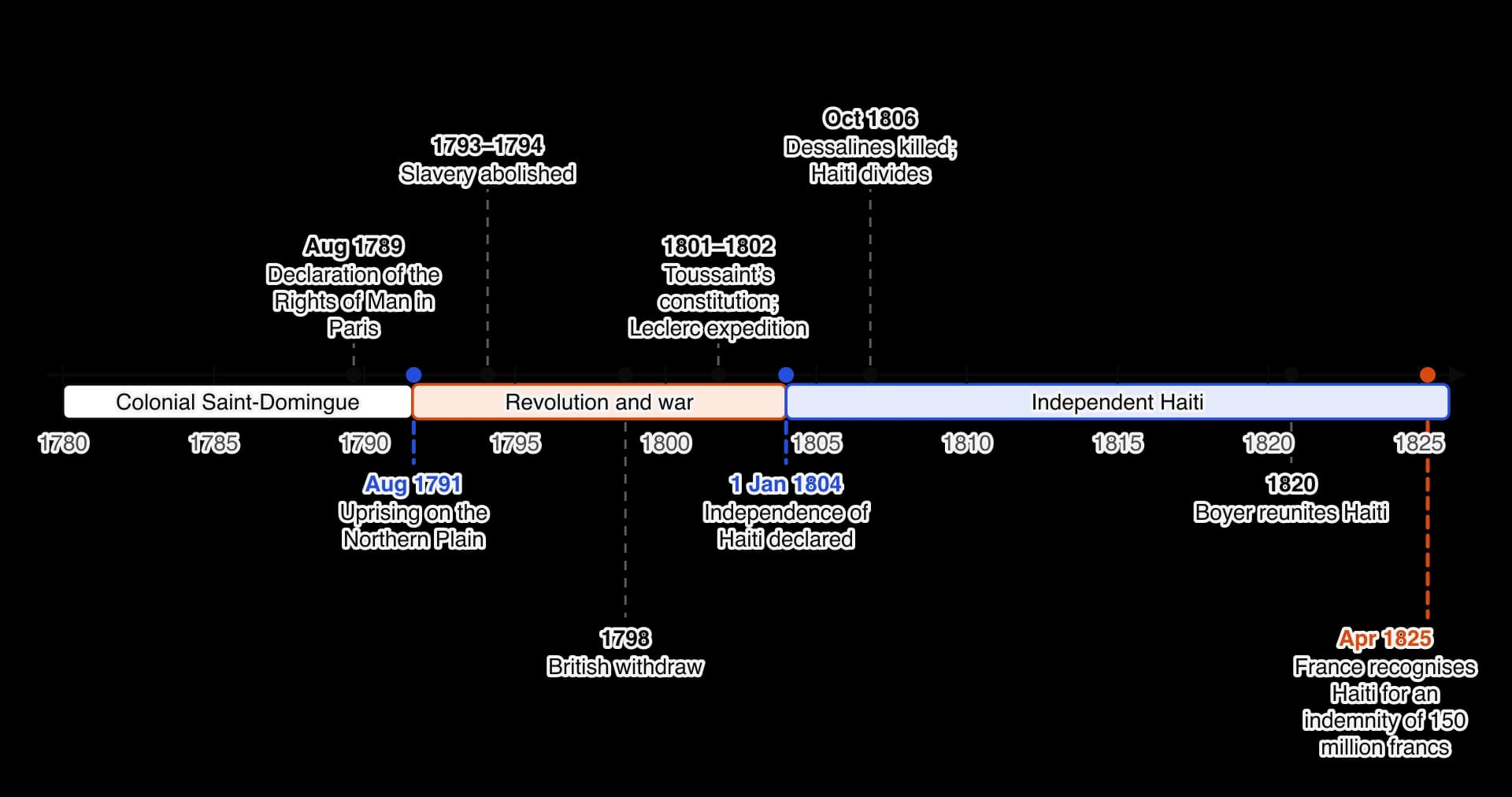
The timeline of the revolution shows three phases. Until 1791 Saint-Domingue was a prosperous slave colony; from 1791 to 1804 it was the scene of revolution and almost continuous war; after 1804 it was the independent state of Haiti, whose first two decades were shaped by internal division and the search for recognition.
The movement that ended in independence did not begin as a demand for a separate state. It began in 1791 as a struggle by enslaved people for freedom, alongside a struggle by free people of colour for equal rights and by white planters for self-government. Independence became the goal only in 1802–1803, when France seemed ready to restore slavery. The causes therefore lie in the colony’s society, in the long history of resistance by the enslaved, and in the effects of the French Revolution.
Spain claimed the whole island of Hispaniola after Columbus landed there in 1492, but French buccaneers and settlers occupied its western part in the seventeenth century. Spain accepted French possession of the western third in the Treaty of Ryswick (1697). The French colony of Saint-Domingue was divided into three provinces, the North, the West and the South. Cap-Français (known as Le Cap) in the North was its main port and commercial centre; Port-au-Prince in the West became the seat of government in 1770. The eastern two-thirds of the island remained the Spanish colony of Santo Domingo.
By the 1780s Saint-Domingue was the most profitable colony in the world. Its roughly 8,000 plantations produced sugar on the plains and coffee in the mountains, together with indigo and cotton. Historians commonly estimate that it supplied about 40 per cent of the sugar and 60 per cent of the coffee consumed in Europe. Under the system of the exclusif, the colony was meant to trade only with France, so its produce passed through Bordeaux, Nantes and Marseille and enriched French merchants, shipowners and the royal treasury.
This wealth rested on chattel slavery. Sugar was grown and processed on large estates by gangs of enslaved workers under drivers, and in the harvest the mills ran day and night. Deaths outnumbered births on many sugar estates, so planters relied on the transatlantic slave trade to replace the dead and expand production. In the late 1780s French ships landed about 30,000–40,000 captives a year in the colony. As a result, about two-thirds of the enslaved population in 1789 had been born in Africa, many of them in West Central Africa (the region of the Kingdom of Kongo) and the Bight of Benin.
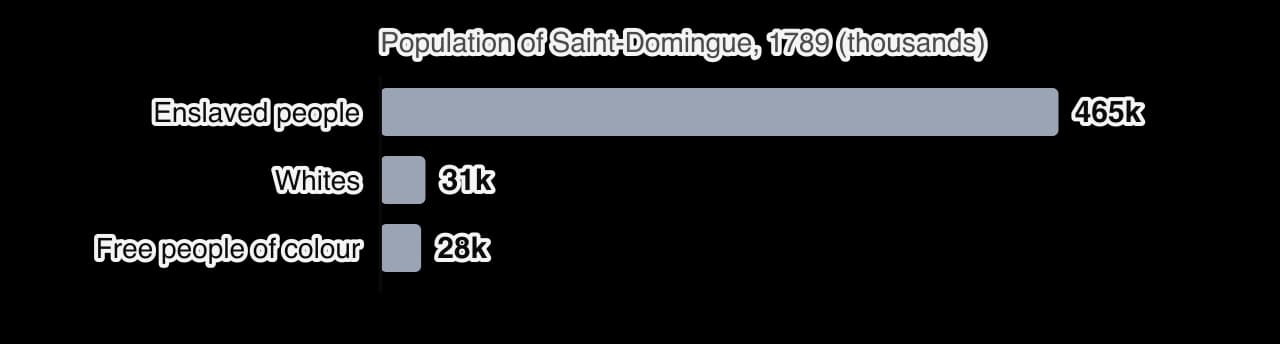
The population figures show how small the free population was. In 1789 the enslaved outnumbered the free by about eight to one, and in the plantation districts of the Northern Plain the proportion was far higher. Colonists lived with a constant fear of revolt, which helps explain the harshness of colonial law and punishment.
Free society in Saint-Domingue was divided by wealth and by colour. The grands blancs were the rich white planters, merchants and royal officials; many plantation owners lived in France and left their estates to managers. The petits blancs were poorer whites: artisans, shopkeepers, overseers, clerks and sailors. They had little property, and their claim to status depended on being white, which made many of them the fiercest defenders of racial distinctions.
The gens de couleur libres (free people of colour) were legally free people of African or mixed African and European descent. Many were the children of white fathers and enslaved mothers, freed by their fathers; others had bought their freedom or been freed for service. By 1789 they were almost as numerous as the whites, and many were wealthy planters, especially in the West and South, owning land and enslaved people. Julien Raimond, an indigo planter of mixed descent from the South, is an example: he travelled to France in the 1780s to lobby for equal rights for men like himself.
From the 1760s colonial regulations pushed free people of colour down. They were barred from practising law and medicine and from holding public office, were forbidden to wear certain clothes, and from 1773 could not take the family names of white people. They had to serve in the colonial militia and the rural police, whose tasks included hunting runaways. Several hundred of them served in a French force at the siege of Savannah in Georgia in 1779, during the American War of Independence, and returned with military experience and a sharper sense of the injustice of their position.
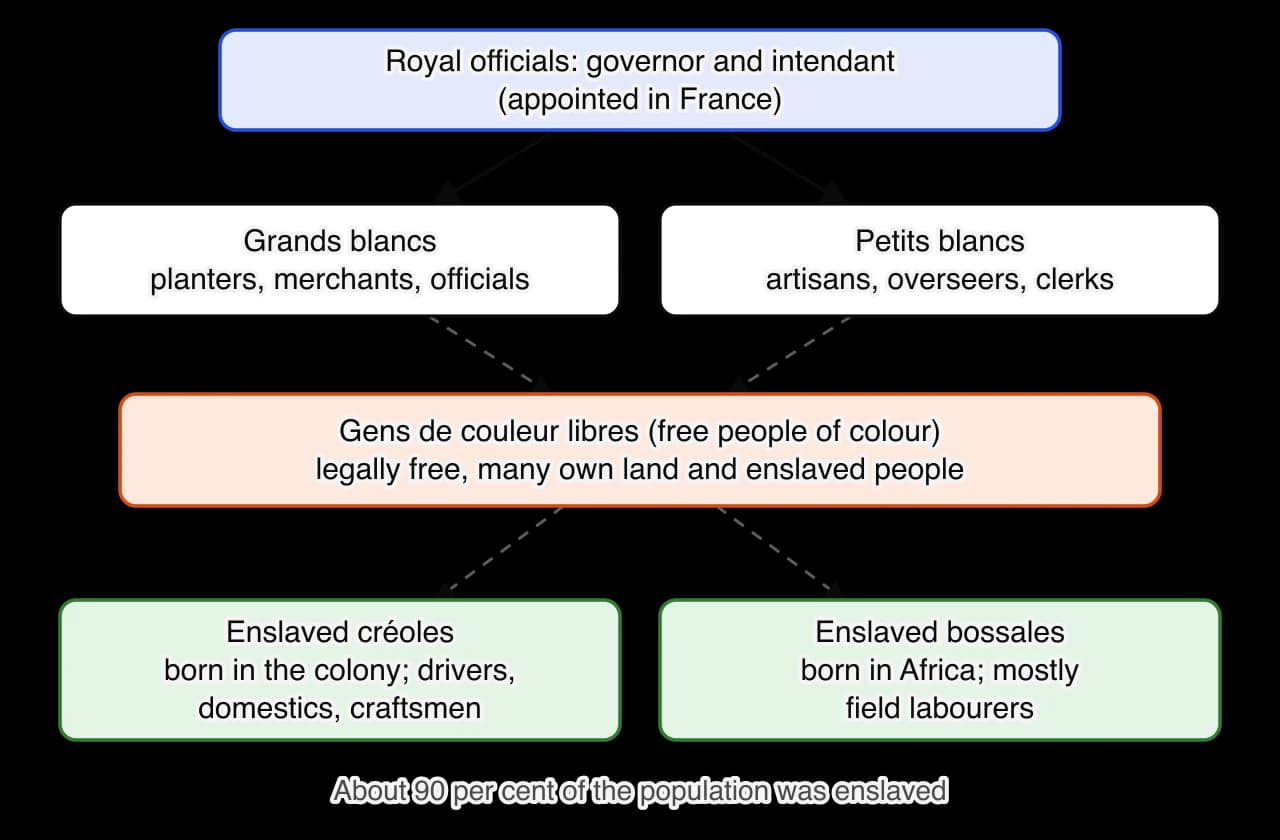
The diagram of colonial society shows a further division within the enslaved majority. Créoles, born in the colony, spoke Kreyòl, the Creole language of the colony, and filled most of the skilled and supervisory posts: drivers (commandeurs), coachmen, artisans and domestic servants. Bossales, born in Africa, were mostly field labourers. These elite slaves, who could move between plantations and knew how the colony worked, would provide many of the leaders of 1791.
Slavery in the French colonies was governed by the Code Noir, a royal edict of 1685 issued under Louis XIV. It declared enslaved people to be movable property, obliged masters to baptise them as Catholics, forbade them to carry weapons or gather in groups, and set punishments for those who ran away: branding and the cutting of ears for a first absence of a month, hamstringing for a second, death for a third. It also placed limits on masters, forbidding them to torture or mutilate the enslaved and ordering them to provide food and clothing.
The protective articles were rarely enforced. Colonial courts seldom punished masters for cruelty, and when the royal government did try to protect the enslaved, planters resisted. In 1788 a coffee planter named Nicolas Le Jeune tortured two enslaved women to death; enslaved witnesses testified against him, but the court acquitted him under pressure from other planters. The case showed that the law could not restrain planter violence.
The colony was governed by two royal officials appointed in France: a governor, who commanded the troops, and an intendant, who ran finance and justice. Planters had no elected assembly before 1789 and resented both royal control and the exclusif. Their wish for self-government would become a cause of conflict once the French Revolution began.
Enslaved people resisted slavery throughout the colonial period. Most resistance was small-scale and hidden: working slowly, damaging tools, pretending to be ill, stealing food, or keeping African languages, beliefs and family ties alive. Such acts did not threaten the colony directly, but they show that the enslaved never accepted their condition.
Flight, or maroonage, was the most common open form of resistance. Historians distinguish petit marronnage, short absences of days or weeks to visit family, escape punishment or bargain with a master, from grand marronnage, permanent escape to free communities in the mountains and forests. The best known of these communities was Le Maniel, in the Bahoruco mountains near the Spanish border, which resisted French expeditions for decades; in 1785 colonial officials negotiated with its leaders instead of trying again to destroy it.
The most famous maroon leader was François Mackandal, an African-born man who had lost an arm in a sugar mill and fled to the hills in the 1750s. Colonists accused him of organising a network that poisoned planters, their families and livestock across the Northern Plain. He was captured and burned alive at Le Cap in January 1758. According to legend he escaped the flames, and his name became a word for a magical charm. Historians still debate how far a real poisoning conspiracy existed and how far planters blamed deaths from disease on poison; either way, the Mackandal affair shows how deeply colonists feared organised resistance.
Vodou developed in the colony from the religions brought by enslaved Africans, especially the Fon and Yoruba traditions of the Bight of Benin and the traditions of West Central Africa, combined with elements of Catholicism. Its followers served spirits (lwa) through song, drumming, dance and possession, led by priests and priestesses. Because ceremonies brought together people from different plantations and different African origins, Vodou created networks of trust and communication that the authorities could not easily see or control. Colonial laws banned night gatherings for this reason.
The uprising of August 1791 was planned. According to later testimony, on 14 August 1791 about 200 drivers and other elite slaves from plantations across the Northern Plain met on the Lenormand de Mézy plantation to agree a date and a plan. Haitian tradition links this meeting to a Vodou ceremony in a wood called Bois Caïman, held during a storm and led by Dutty Boukman, a driver and coachman, and a priestess. An animal was sacrificed and those present swore to fight.
The ceremony is a founding story of the Haitian nation, but its details are uncertain. The earliest detailed account was written by Antoine Dalmas, a white doctor who fled the colony, in 1793–1794 and published in 1814; he wrote for a French audience and described the ceremony as a savage pact. Later Haitian historians added details, such as the name of the priestess (Cécile Fatiman) and the words of Boukman’s prayer, that are not found in contemporary sources. The historian David Geggus, in an article of 1991 and in Haitian Revolutionary Studies (2002), questions whether the planning meeting and the ceremony were the same event and on what date the ceremony took place, while accepting that religious ritual played a part in mobilising the rebels.
Whatever happened at Bois Caïman, the evidence shows that the organisation of the uprising drew on three things built up under slavery: the authority of drivers and other elite slaves, the networks of Vodou, and a tradition of resistance that maroons like Mackandal had kept alive. Later accounts have used the ceremony in different ways. For many Haitians it stands for the birth of the nation; since the late twentieth century some foreign evangelical preachers have described it as a "pact with the devil" to explain Haiti’s poverty, a claim that historians reject as both unsupported and prejudiced.
The revolution that began in France in 1789 reached Saint-Domingue quickly. In August 1789 the National Assembly in Paris adopted the Declaration of the Rights of Man and of the Citizen, whose first article set out a principle that, if applied to the colonies, would destroy both slavery and racial discrimination.
Men are born and remain free and equal in rights. Social distinctions may be founded only upon the general good.
National Assembly of France, Declaration of the Rights of Man and of the Citizen, Article 1, 26 August 1789 (translation from the Avalon Project, Yale Law School). The deputies wrote with France in mind, and most did not intend the article to free enslaved people in the colonies. Its value as a source is that its universal wording could be used by anyone excluded from it, which is exactly what free people of colour and later the enslaved did.
Every group in the colony read the revolution in its own way. Wealthy white planters saw a chance to win self-government and free trade. In Paris their lobby, the Club Massiac, worked to keep the question of slavery and racial equality out of the National Assembly. Against them stood the Société des Amis des Noirs (Society of the Friends of the Blacks), founded in February 1788 by Jacques-Pierre Brissot, with members such as the Marquis de Condorcet and the Abbé Grégoire. It campaigned for the abolition of the slave trade and equal rights for free people of colour, and for the gradual, not immediate, end of slavery.
In the colony, white colonists formed their own assemblies. The most radical, the General Assembly of the French Part of Saint-Domingue, met at Saint-Marc in 1790 and claimed the right to make the colony’s laws, which royal officials and the Provincial Assembly of the North at Le Cap opposed. Whites fought each other, and both sides refused to share power with free people of colour. In March 1790 the National Assembly left colonial matters largely to the colonists, with instructions so vague that each side read them as it wished.
Free people of colour living in France, led by Julien Raimond and Vincent Ogé, a merchant from the North, demanded that the Assembly apply the Rights of Man to them. When Paris did not act, Ogé returned secretly to Saint-Domingue and in October 1790, with Jean-Baptiste Chavannes, took up arms with a few hundred men to force the colonial authorities to grant free men of colour the vote. Ogé did not call for the end of slavery. His small force was defeated; he and Chavannes fled to Spanish territory, were handed back and in February 1791 were broken on the wheel and executed at Le Cap.
The execution of Ogé shocked opinion in Paris. On 15 May 1791 the National Assembly granted political rights to free men of colour born of two free parents, a group of only a few hundred men. Even this concession enraged white colonists, who threatened to break with France, and the Assembly revoked it on 24 September 1791. By then the colony was already in flames. Only on 4 April 1792 did a new law give full political rights to all free people of colour, a measure intended to unite the free population of every colour against the uprising of the enslaved.
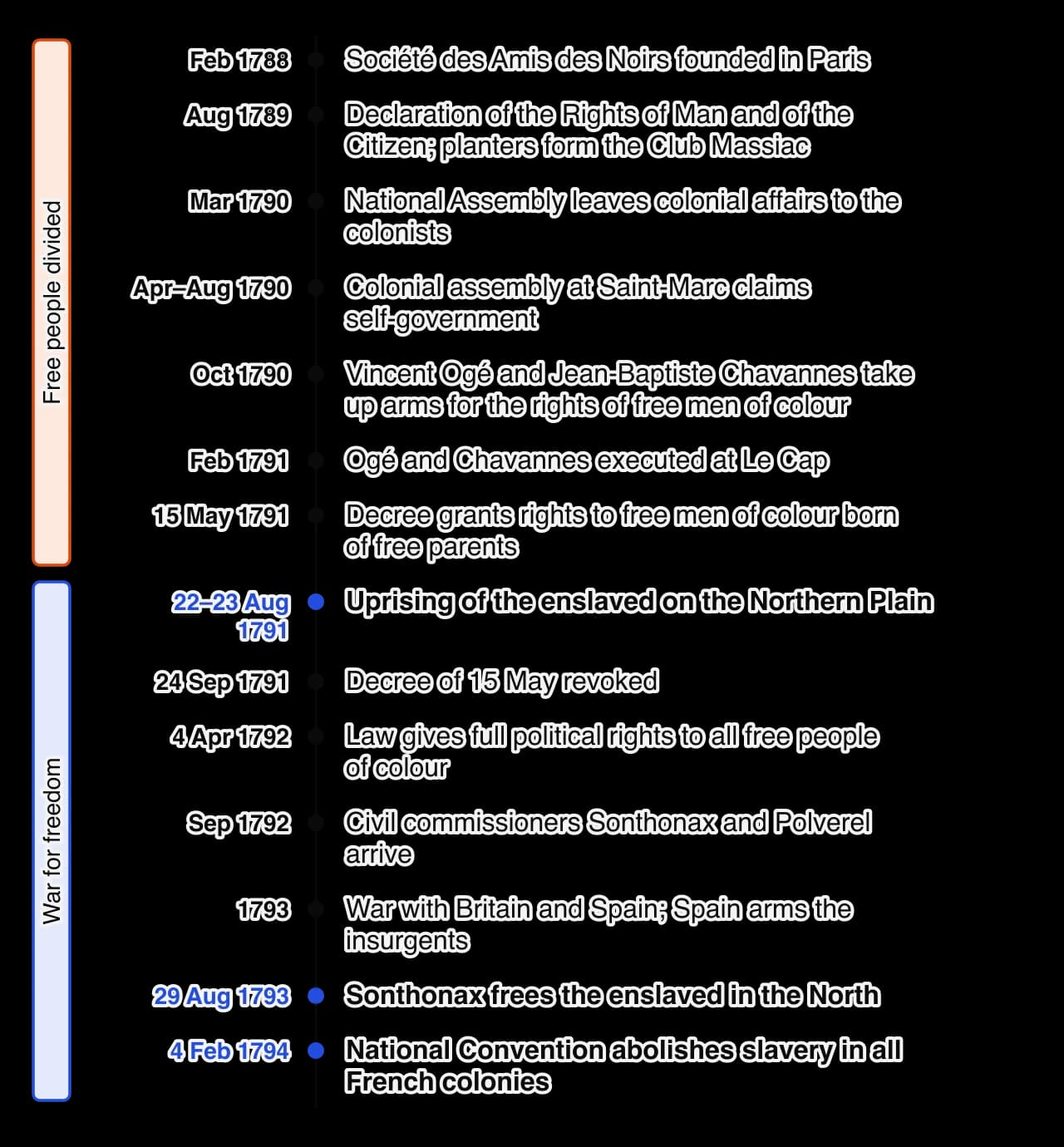
The vertical timeline of 1788–1794 shows how the debate over the rights of free people of colour came first and how the abolition of slavery came only after the uprising of the enslaved. Paris moved from refusing rights to free people of colour, to granting them, and finally, in 1794, to abolishing slavery itself, each time under pressure from events in the colony.
Toussaint Louverture later explained the origins of the uprising as the result of white colonists’ selfish reading of the French Revolution.
[The whites in St. Domingue] wanted to escape from their arbitrary government, but they did not intend the revolution to destroy either the prejudices that debased the men of color or the slavery of the blacks, whom they held in dependency by the strongest law. In their opinion, the benefits of the French regeneration were only for them.
Toussaint Louverture, letter to the Minister of the Marine, 13 April 1799 (translation in George Tyson, ed., Toussaint L’Ouverture, 1973). Written when Toussaint was commander-in-chief and needed the French government’s trust, the letter presents the black insurgents as victims who turned to Spain only because white colonists denied them the benefits of liberty. It is valuable as a view of the revolution’s causes from its most important black leader, but it was written eight years after the uprising, by a man who had not been one of its original organisers, and with the purpose of defending black loyalty to France.
On the night of 22–23 August 1791 enslaved people rose on plantations across the Northern Plain around Le Cap. Within weeks tens of thousands had joined, and planters and officials counted more than 1,000 plantations burned. The causes worked over different timescales.
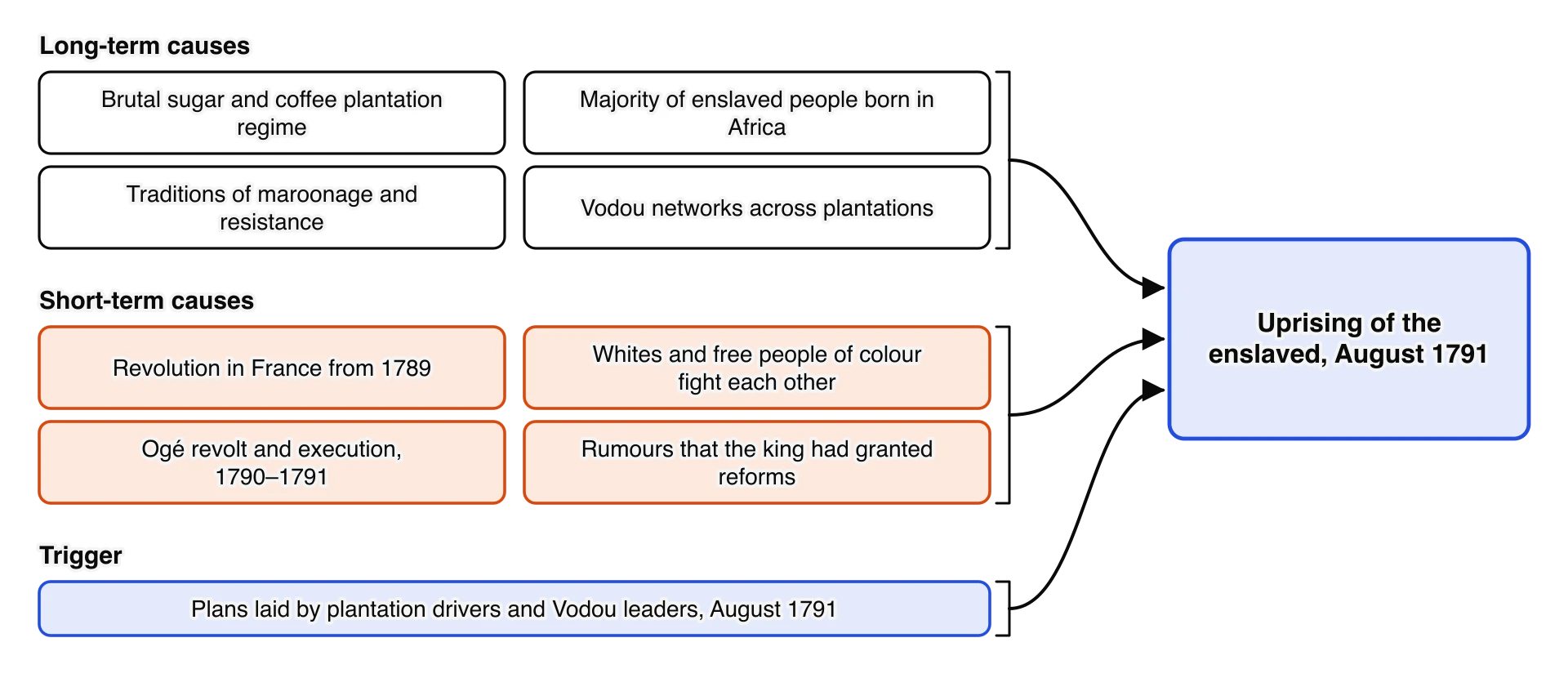
The long-term causes lay in the colony itself. The plantation regime was exceptionally deadly, the enslaved were overwhelmingly African-born and recently enslaved, and maroonage and Vodou had created traditions and networks of resistance. Many African-born men had experience of war before their enslavement: the historian John Thornton, in an article of 1993 titled "I Am the Subject of the King of Congo", argues that veterans of the civil wars of the Kingdom of Kongo brought military skills and political ideas, including loyalty to a just king, that shaped how the insurgents fought and what they claimed.
The short-term causes came from the French Revolution. The quarrels of 1789–1791 divided the free population, weakened royal authority and drew troops into conflicts between whites and free people of colour. News and rumours from France travelled through ports and households: enslaved domestics heard their owners argue about the Rights of Man. A rumour spread that the king had granted the enslaved three free days a week and the abolition of the whip, and that the planters were refusing to apply the reform. Several insurgent leaders later claimed to be fighting for the king against the planters.
The trigger was the decision of plantation drivers and religious leaders to strike in August 1791, when the colony’s whites were divided and the new colonial assembly was about to meet at Le Cap. The planning meeting of 14 August and the timing of the rising show that it was a deliberate political act, not a spontaneous explosion.
 YouTube
Independence was achieved in two stages. Between 1791 and 1794 the enslaved won their freedom, and France, at war and desperate for soldiers, turned that freedom into law. Between 1794 and 1804 black and coloured generals took control of the colony, first in the name of the French Republic and then, when France tried to reverse emancipation, against it.
The insurgents of August 1791 killed planters and overseers, burned cane fields and mills, and set up armed camps in the hills around the Northern Plain. White militias answered with mass executions of prisoners and suspected rebels. Boukman was killed in battle in November 1791 and his head displayed in Le Cap. Leadership passed to Jean-François and Georges Biassou, two former slaves who styled themselves generals. Among Biassou’s officers was a literate, freed former coachman from the Bréda plantation, Toussaint, who took the name Louverture ("the opening") in 1793.
The early aims of the insurgent leaders were more limited than the outcome. In December 1791 Jean-François and Biassou offered to help return the rebels to the plantations if the colonial authorities freed a few hundred of their leaders and improved conditions for the rest. The colonial assembly refused to negotiate with rebel slaves. Its refusal pushed the leaders towards demands for general freedom, and the mass of insurgents, who had not fought to return to the plantations, would not have accepted such a deal anyway.
In September 1792 two civil commissioners, Léger-Félicité Sonthonax and Étienne Polverel, arrived from France with about 6,000 troops to enforce the law of 4 April 1792 on the rights of free people of colour and restore order. Sonthonax was a Jacobin lawyer and a supporter of the Amis des Noirs. The commissioners dissolved the colonial assembly, deported white colonists who resisted, and relied on free men of colour as allies and officers.
In 1793 the war in Europe spread to the Caribbean. France went to war with Britain in February and with Spain in March 1793. Spain, which held Santo Domingo, recruited the black insurgent armies as allies, giving Jean-François, Biassou and Toussaint titles, uniforms and supplies. In September 1793 British troops landed at Jérémie and the Môle Saint-Nicolas, invited by white planters who hoped that Britain, which still kept slavery in Jamaica, would protect their property.
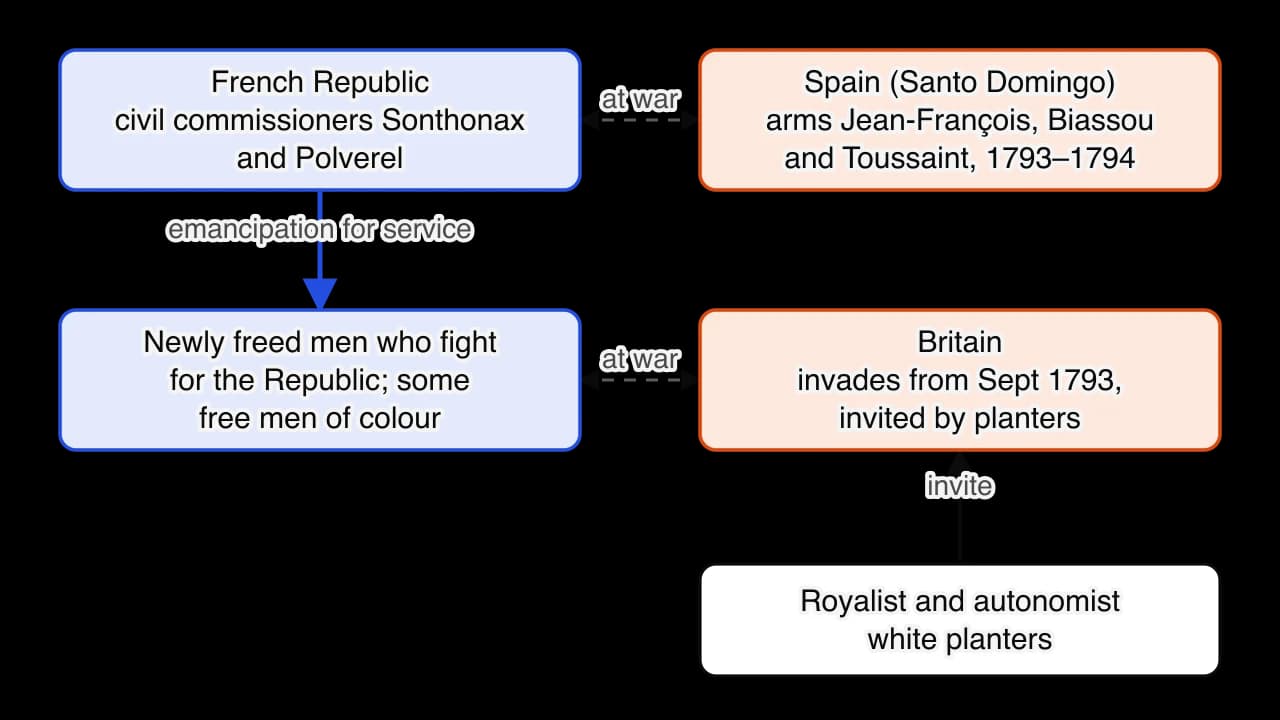
The diagram of the sides in 1793–1794 shows why the commissioners turned to emancipation. They faced two foreign powers and most of the white colonists, with only a small French army that disease was rapidly destroying. The enslaved and the insurgents were the only force large enough to save the colony for France, and they would fight only for freedom.
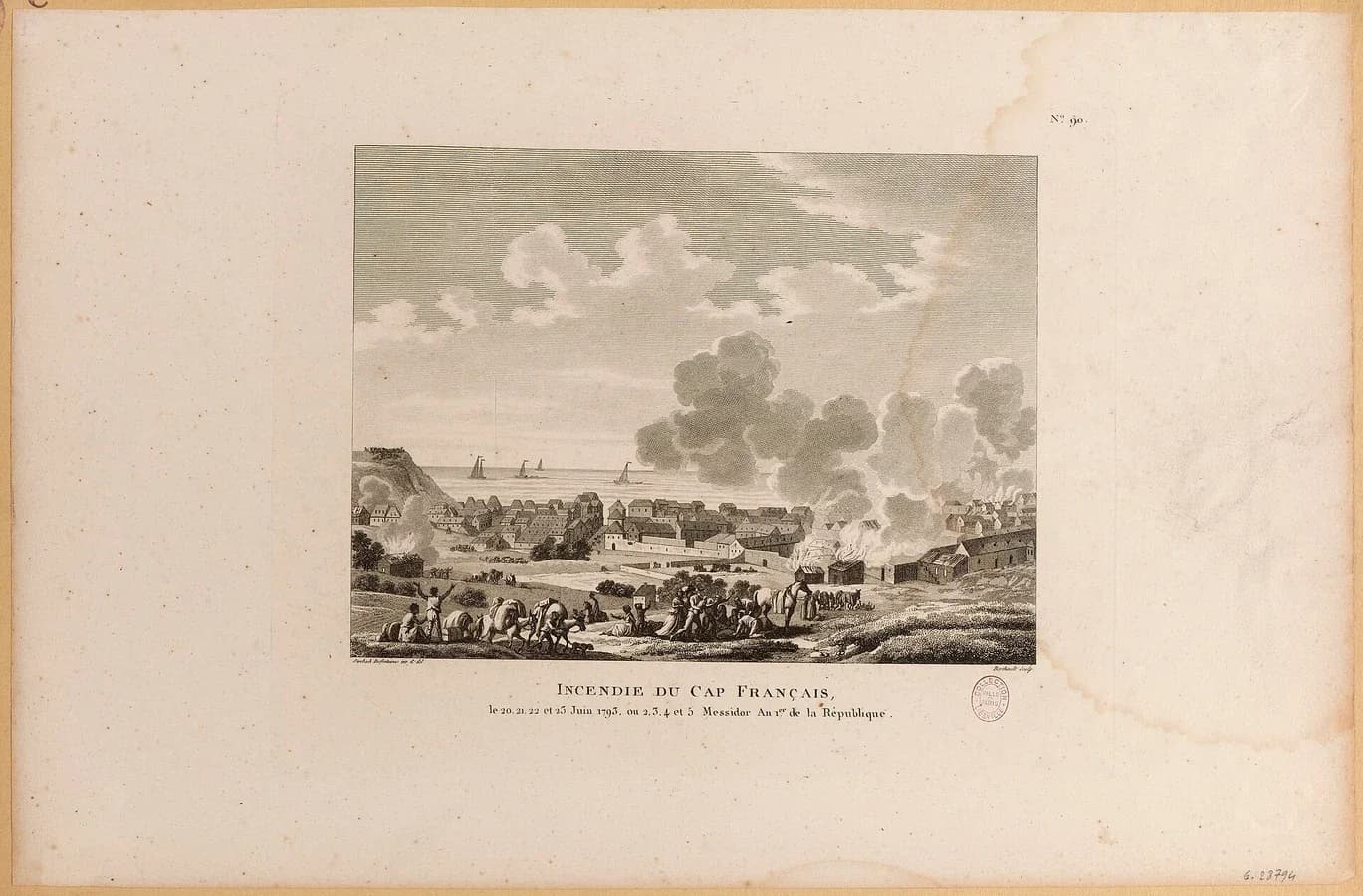
The crisis came in June 1793, when a new governor, François-Thomas Galbaud, led sailors and white colonists against the commissioners in Le Cap. On 21 June Sonthonax and Polverel promised freedom to insurgents who would fight for the Republic. Thousands entered the city, Galbaud’s forces were defeated, and much of Le Cap burned. Thousands of white refugees fled to the United States.
Freedom for soldiers alone could not hold. On 29 August 1793 Sonthonax proclaimed the general emancipation of all enslaved people in the North; Polverel extended it to the West and South in September and October. The freed people were declared French citizens but had to remain on the plantations and work for wages, paid as a share of the crop. White colonists accused Sonthonax of acting under duress. In November 1793 he replied in a printed broadside posted across the colony.
I declare that I will support until death the civil rights and the independence of those with mixed blood, of Africans and the descendants of Africans, and that if I were to be pounded into mortar I would never be so low as to retract the proclamation of August 29.
Léger-Félicité Sonthonax, broadside "In the name of the Republic", 5 November 1793 (translated by Mitchell Abidor, Marxists Internet Archive). Sonthonax wrote to reassure the freed people and the free people of colour that emancipation would not be reversed, at a time when British agents and white colonists were spreading rumours that he had been recalled. "Independence" here means personal freedom, not national independence. The broadside shows how fragile emancipation seemed in its first months.
On the same day as Sonthonax’s proclamation, Toussaint, still fighting for Spain, issued his own appeal from his camp at Turel. It shows that black leaders were competing with the French commissioners to be seen as the true champions of freedom.
Brothers and Friends: I am Toussaint L’Ouverture. My name is perhaps known to you. I have undertaken to avenge you. I want liberty and equality to reign throughout St. Domingue. I am working toward that end. Come and join me, brothers, and combat by our side for the same cause.
Toussaint Louverture, proclamation from the camp at Turel, 29 August 1793 (translation in George Tyson, ed., Toussaint L’Ouverture, 1973). Toussaint was then an officer in the service of Spain, a monarchy that kept slavery, yet he used the republican language of "liberty and equality". The proclamation is evidence that he already saw general freedom as his cause and wanted to lead it himself, not receive it from the French.
Sonthonax sent three deputies elected in the North to Paris: Jean-Baptiste Belley, a former slave born in Africa, Jean-Baptiste Mills, a free man of colour, and Louis-Pierre Dufay, a white official. They took their seats in the National Convention on 3 February 1794. The next day, 16 Pluviôse Year II in the revolutionary calendar, the Convention abolished slavery by acclamation.
The National Convention declares slavery abolished throughout all the colonies: consequently, it decrees that all men, without distinction of color, domiciliated in the colonies, are French citizens, and entitled to the enjoyment of all the rights secured by the Constitution.
National Convention, decree of 16 Pluviôse Year II (4 February 1794), English translation. The decree turned emancipation in Saint-Domingue into French law and extended it to Guadeloupe and French Guiana. It came after the enslaved had freed themselves by force and after the commissioners had acted, and at a time when France needed black soldiers against Britain. This makes it strong evidence that abolition was won in the colonies and confirmed in Paris, and weak evidence for the view that the French Revolution simply granted freedom.
In May 1794 Toussaint left the Spanish service and joined the French Republic, bringing several thousand well-trained soldiers with him. His reasons are debated. He had quarrelled with Jean-François and Biassou, Spain continued to treat the plantations as slave property, and the French governor, Étienne Laveaux, offered him command. Some historians, including C. L. R. James, argue that news of the abolition decree of February 1794 decided him; others, including David Geggus, point out that he seems to have changed sides before reliable news of the decree arrived, so ambition and calculation mattered at least as much as principle.
Over the next four years Toussaint won control of most of the colony. Spain made peace with France in the Treaty of Basel (July 1795) and ceded Santo Domingo, although France did not take possession at once. The British held the coastal towns of the West, including Port-au-Prince, but lost thousands of soldiers to yellow fever and malaria. In 1798 the British commander, Thomas Maitland, negotiated a withdrawal with Toussaint directly, and the two men agreed terms for trade. In 1799 the United States, under President John Adams, also allowed trade with the parts of the colony under Toussaint’s control.
Toussaint also removed his French rivals. In March 1796 he rescued Laveaux from a coup by officers of colour in Le Cap and was made lieutenant governor. In 1797 he arranged for Sonthonax, who had returned as a commissioner, to be sent back to France, and in October 1798 he forced out the agent of the Directory, Gabriel de Hédouville, who had tried to limit his power.
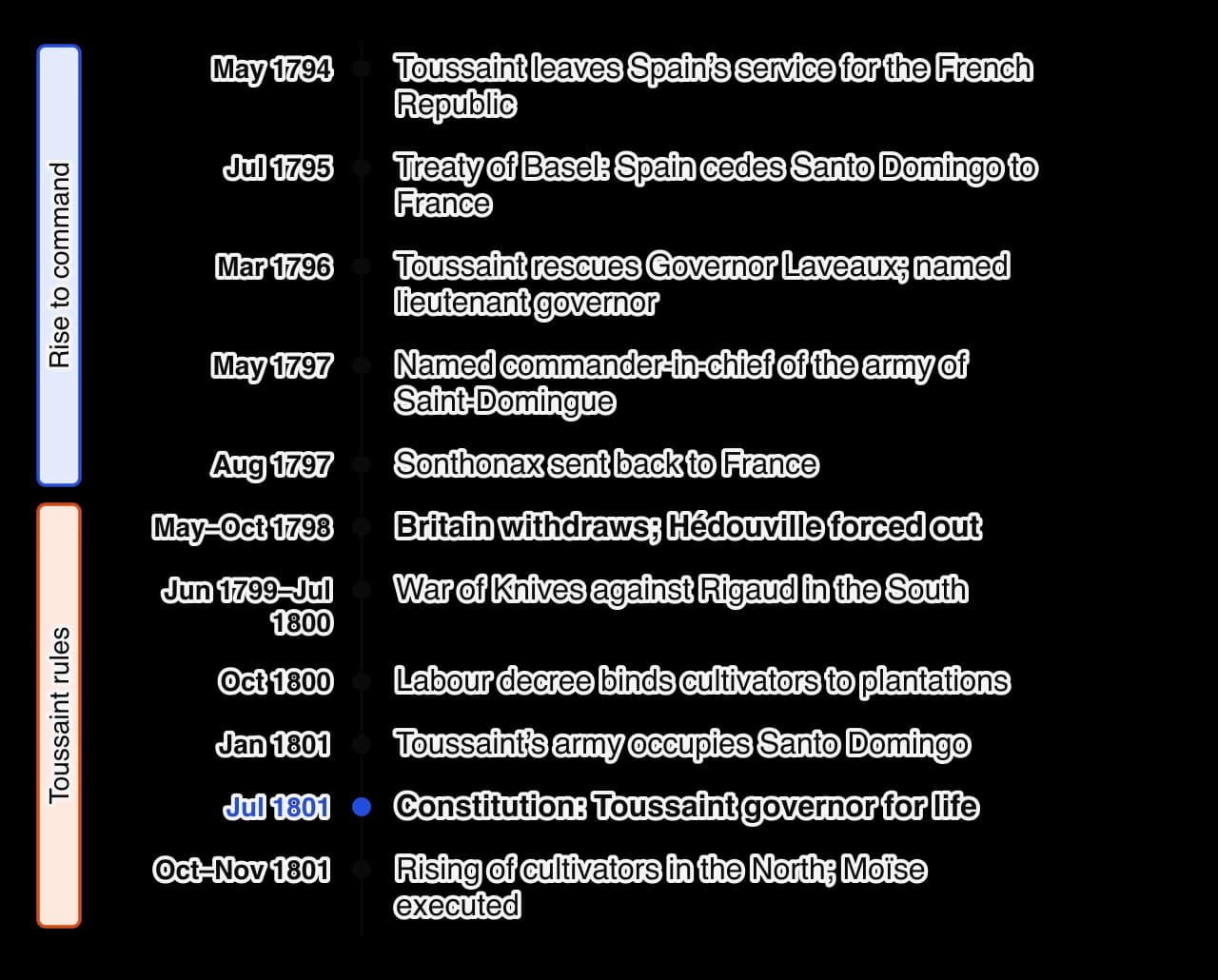
The last rival was André Rigaud, a general of colour who controlled the South in the name of the Republic. Their conflict, known as the War of Knives (June 1799 to July 1800), was a struggle for power between two commanders of the French Republic, but it was fought along lines of colour. Rigaud drew his support from the free people of colour of the South; Toussaint’s army was mostly black. Toussaint’s general Jean-Jacques Dessalines led the campaign, and after the siege of Jacmel the South was conquered and Rigaud left for France. Many of Rigaud’s supporters were killed during and after the war, by some estimates several thousand, leaving a bitter memory between black and coloured Haitians.
By 1800 Toussaint governed the colony. His central problem was economic. Without sugar and coffee exports the colony could not pay for its army or trade for weapons, and he believed that France would respect freedom only if the colony stayed productive. He therefore kept the plantations as large units, invited white planters who had fled to return, leased estates to his officers, and obliged the freed people, now called cultivators, to stay and work on them for a share of the crop. Historians call this system of military control over plantation labour caporalisme agraire ("militarised agriculture").
Considering that when an officer . . . or a soldier deviates from his duty he is delivered over to a court-martial to be tried and punished according to the laws of the Republic . . . The overseers, drivers and field-negroes, as subject to constant labour, and equally subordinate to their superiors, shall be punished in like manner, in case of failure in their respective duties.
Toussaint Louverture, regulation on agricultural labour, 12 October 1800 (contemporary English translation, in George Tyson, ed., Toussaint L’Ouverture, 1973). Issued after the War of Knives, the regulation treats plantation workers like soldiers under military discipline and forbids them to leave their estates without permission. It shows the continuity between slavery and the new labour regime as well as the change: the whip was banned and workers were paid, but most former slaves could not choose where or how to work.
Many cultivators wanted something different: land of their own, on which to grow food for their families and markets. In October 1801 cultivators in the North rose, killing some white planters. Toussaint blamed his nephew, General Moïse, who was popular with the cultivators and critical of the return of the planters, and had him executed. The rising showed the gap between Toussaint’s vision of freedom and that of many former slaves.
In January 1801 Toussaint occupied Santo Domingo, against the orders of the French government, and abolished slavery there. In July 1801 he proclaimed a constitution that made him governor for life. Napoleon Bonaparte, who had seized power in France in November 1799 as First Consul, saw these acts as defiance. When preliminary peace with Britain in October 1801 freed the French navy, he sent an expedition under his brother-in-law, General Charles Leclerc, to restore French authority.
Leclerc landed in early February 1802 with the first of several fleets; by the end of the war about 31,000 French soldiers had been landed, besides thousands of sailors, and estimates that include the navy run higher. His secret instructions were to win over or disarm the black generals and then deport them. Henri Christophe burned Le Cap rather than surrender it, and Dessalines’ troops, commanded inside the fort by Louis Daure Lamartinière, held Crête-à-Pierrot against a much larger French force for about three weeks in March before breaking out. In April and May the leading generals, Christophe and Dessalines and then Toussaint himself, submitted in return for keeping their ranks. On 7 June 1802 Toussaint was seized at a meeting he had been invited to by a French general, deported to France and imprisoned at Fort de Joux in the Jura mountains, where he died on 7 April 1803. According to a famous tradition, he warned his captors that they had cut down only the trunk of the tree of liberty, which would grow again from its many deep roots; the exact words are uncertain.
Napoleon’s intentions towards slavery in Saint-Domingue are still debated, but his actions elsewhere were clear. A law of 20 May 1802 kept slavery in the colonies returned to France by Britain, such as Martinique, where it had never been abolished. In Guadeloupe, French troops under General Antoine Richepanse crushed resistance led by Louis Delgrès and restored slavery in July 1802. When the news reached Saint-Domingue in the summer, it convinced many black and coloured officers serving Leclerc that the same fate awaited them.
Resistance had never stopped among the cultivators and in the mountains, where leaders such as Sans-Souci and Macaya fought on after the generals submitted, using guerrilla warfare from bases the French could not reach. In October 1802 the generals changed sides: Alexandre Pétion and Augustin Clervaux first, then Christophe and Dessalines. Leclerc was losing men to yellow fever by the thousand. In a letter to Napoleon that autumn he argued that only a war of extermination could hold the colony, calling for the killing of all black people in the mountains apart from young children, of half of those in the plains, and of every officer of colour. He died of yellow fever on 2 November 1802. His successor, the Vicomte de Rochambeau, waged a war of terror that included mass drownings and the use of attack dogs brought from Cuba.
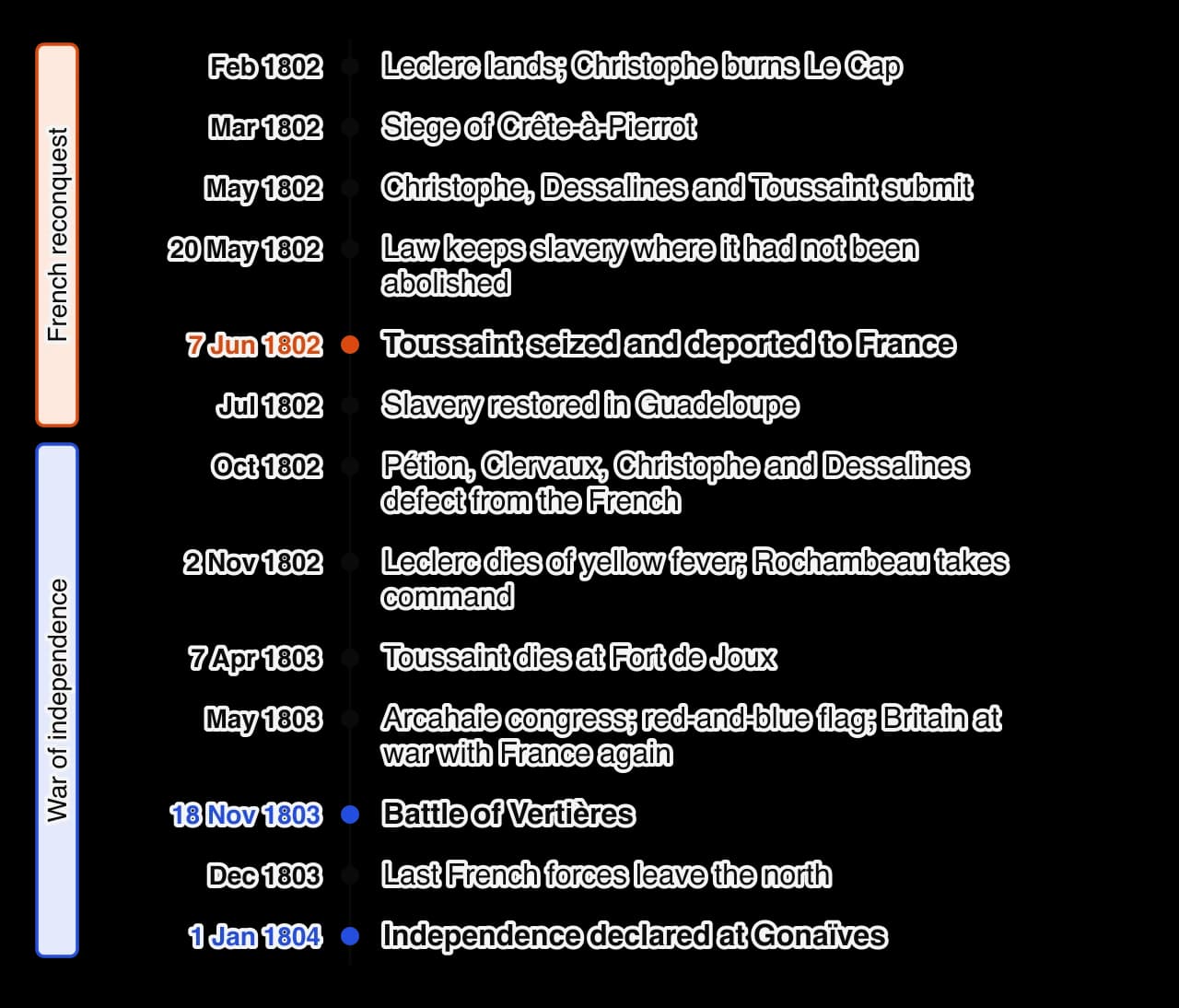
The vertical timeline of 1802–1804 shows how quickly the French position collapsed once the officers defected. In May 1803, at a congress at Arcahaie, the black and coloured commanders recognised Dessalines as commander-in-chief of what they called the Indigenous Army. Dessalines tore the white band out of the French tricolour to make a red-and-blue flag, a symbol of union between black and coloured Haitians against the whites. In the same month Britain went to war with France again, and its navy’s blockade cut off French reinforcements and supplies.
The decisive battle came on 18 November 1803 at Vertières, outside Le Cap, where the Indigenous Army stormed the French fortifications; the officer François Capois, known as Capois-La-Mort, became a national hero for his courage in the attack. Rochambeau surrendered, and the last French troops left the north of the colony by early December, most of them as prisoners of the British. Tens of thousands of French soldiers and sailors had died, the great majority of them from disease.
Toussaint was born enslaved on the Bréda plantation in the North, probably in the early 1740s. He learned to read and write, worked as a coachman and livestock keeper, and was free by 1776. As a free man he rented a small coffee estate worked by enslaved people. He joined the uprising in its early weeks and rose through his skill as a soldier, his discipline and his talent for negotiation.
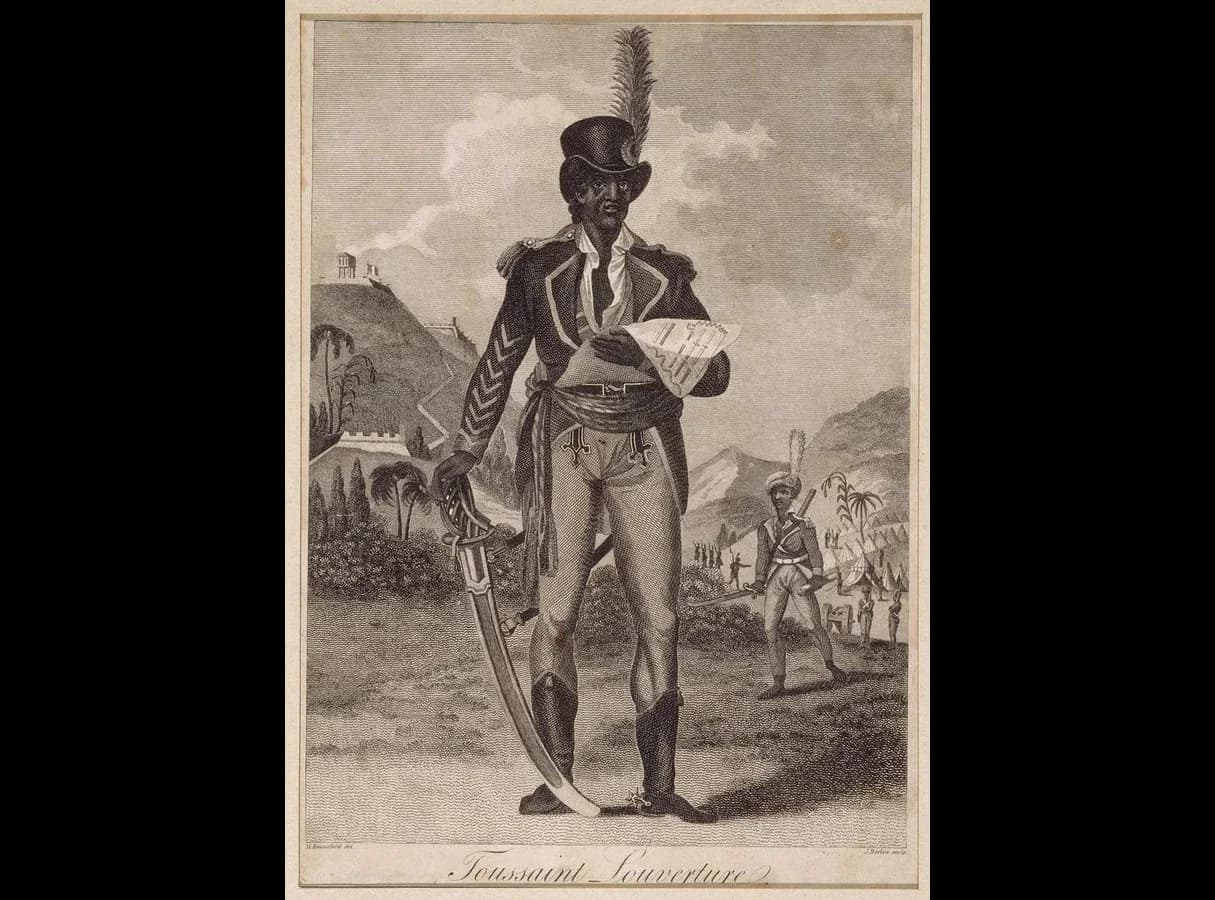
Toussaint’s achievement was to turn the insurgent bands into a disciplined army, defeat Spain and Britain, and make himself the indispensable ruler of the colony while defending emancipation. His methods were those of a statesman as much as a revolutionary: he negotiated with Britain and the United States, protected white planters whose skills and capital he wanted, and kept former slaves at work by force. His aim was autonomy within the French Republic, with emancipation guaranteed. Whether he would eventually have sought independence is debated; he never declared it, and when Leclerc arrived he fought, then submitted, then tried to negotiate.
His removal in 1802 had consequences he had not intended. With Toussaint gone, leadership passed to men like Dessalines who had less faith in France, and his deportation became proof that France could not be trusted. In this sense his capture helped make independence possible, and his reputation abroad grew after his death. In 1802 the English poet William Wordsworth wrote a sonnet addressed to him in prison, which ends with these lines.
Thou hast great allies;
Thy friends are exultations, agonies,
And love, and man’s unconquerable mind.
William Wordsworth, "To Toussaint L’Ouverture", sonnet first published, signed only with initials, in the Morning Post, London, 2 February 1803 (text as in his Poems, in Two Volumes, 1807). Wordsworth wrote as a British supporter of liberty who had turned against Napoleon, so he presents Toussaint as a tragic hero of freedom destroyed by tyranny. The poem shows how Toussaint’s image was used abroad, in a debate about Napoleon and slavery, more than what Toussaint himself achieved.
Dessalines was born enslaved in the North and worked as a field labourer; for a time he was owned by a free black planter whose surname he took. He joined the uprising in 1791 and became Toussaint’s most effective general, leading the brutal campaign in the War of Knives and the defence of Crête-à-Pierrot. He submitted to Leclerc in 1802 and, for a time, helped the French hunt down rebels who refused to lay down their arms, before defecting in October 1802.
Dessalines’ role was decisive in the final war. He united black and coloured commanders at Arcahaie, organised the Indigenous Army and led it to victory at Vertières. Unlike Toussaint, he made a complete break with France: he declared independence, renamed the country, and in 1804 ordered the killing of most of the French whites who remained, in the massacres of February to April 1804. He was proclaimed governor-general for life and then, in 1804, emperor as Jacques I. In October 1806 he was assassinated by officers who opposed his land policies and his rule.
Toussaint Louverture | Jean-Jacques Dessalines | |
|---|---|---|
Origins | Born enslaved; a literate coachman, free by 1776, a small property and slave owner | Born enslaved; a field labourer; free only through the revolution |
Main achievement | Built the army; defeated Spain and Britain; governed the colony, 1798–1802 | Led the war of independence, 1802–1803; founded the state of Haiti |
Aim | Freedom and autonomy within the French Republic | Complete independence from France |
Attitude to whites and France | Courted white planters, Britain and the United States; loyal to France in words | Treated France as the enemy; ordered the killing of most remaining French whites in 1804 |
Labour policy | Bound cultivators to plantations under military discipline | Kept forced plantation labour; tried to take back land claimed by the anciens libres |
Reputation | Admired abroad as a statesman and martyr; criticised for authoritarian rule | National hero in Haiti; long portrayed in Western accounts as a bloodthirsty tyrant |
The comparison of the two leaders shows a difference of aims and circumstances more than of character. Toussaint built the military and political power that made independence possible, but tried to use it to secure freedom within the French empire. Dessalines completed the break with France when Napoleon’s policy made compromise impossible. Neither could have succeeded without the mass of former slaves who fought, often without or against their generals, in 1802.
The revolution created a new political community out of people who had been divided by origin, status and colour: African-born and creole former slaves, free people of colour, and a few whites who stayed. Its founding documents tried to define who belonged and on what terms. They agreed on one point, that slavery must never return, but they disagreed on the place of France, of whites and of the plantation.
In 1801 Toussaint called a Central Assembly of ten deputies, seven of them white and three of mixed descent, most of them landowners, to draft a constitution for the colony. He proclaimed it in July 1801 and sent it to Napoleon for approval after it had already come into force. Its first articles set out the status of the colony and of its people.
Article 1. The entire extent of Saint-Domingue, and Samana, Tortuga, Gonave, the Cayemites, Ile-a-Vache, the Saone and other adjacent islands, form the territory of one colony, that is part of the French Empire, but is subject to particular laws.
Article 3. There can be no slaves on this territory; servitude has been forever abolished. All men are born, live and die there free and French.
Constitution of the French Colony of Saint-Domingue, proclaimed by Toussaint Louverture, July 1801 (translated by Mitch Abidor, Marxists Internet Archive). The constitution claims both loyalty and self-rule: Saint-Domingue remains "part of the French Empire" but governs itself by "particular laws". Article 3 makes the abolition of slavery permanent, which no French law could then guarantee.
Other articles show the limits of the freedom it promised. Catholicism was made the only publicly practised religion (Article 6), which pushed Vodou underground. Articles 14 to 17 described the colony as "essentially agricultural", called each plantation a "manufactory" whose owner was the "father" of the cultivators, declared that cultivators changing their place of work would bring "the ruin of farming", and allowed the import of new workers, which many read as a return of the slave trade under another name. Article 28 named Toussaint governor for life, and Article 30 gave him the right to choose his successor in secret.
On 1 January 1804, at Gonaïves, Dessalines and his generals declared the independence of the former colony and gave it a new name, Haiti, from Ayiti, the name the Taíno, the island’s original inhabitants, had used. By naming the state after the people the Spanish had destroyed, and calling their army the Indigenous Army, the founders presented themselves as avengers of the Taíno as well as of the enslaved. The proclamation was written by Dessalines’ secretary, Louis Boisrond-Tonnerre, and addressed to the people of Haiti.
It is not enough to have expelled the barbarians who have bloodied our land for two centuries . . . We must, with one last act of national authority, forever assure the empire of liberty in the country of our birth; we must take any hope of re-enslaving us away from the inhuman government that for so long kept us in the most humiliating torpor. In the end we must live independent or die.
Jean-Jacques Dessalines (written by Louis Boisrond-Tonnerre), "The Commander in Chief to the People of Haiti", Gonaïves, 1 January 1804 (translated by Laurent Dubois and John D. Garrigus, Slave Revolution in the Caribbean, 1789–1804, 2006). The only known printed copy of the original French pamphlet was found by the historian Julia Gaffield in the UK National Archives in 2010; British officials had also sent a contemporary English translation to London. The text defines Haitian identity against France and against slavery; it was written to rally a population exhausted by war and to warn foreign powers that Haiti would not be reconquered.
Between February and April 1804 Dessalines ordered the killing of most of the French whites who remained in Haiti, with exceptions for some groups, such as doctors, priests, and some Polish and German soldiers who had deserted the French army. Estimates of the dead range from about 3,000 to 5,000. Dessalines presented the killings as just vengeance for the crimes of slavery and of Rochambeau’s war, and as a way of removing people who might help a French reconquest.
The massacres shaped how the outside world saw Haiti for more than a century. Newspapers and writers in Europe and the United States used them to present the new state as savage and to argue that the enslaved could not be trusted with freedom, while saying far less about the violence of slavery and of the French war. Historians today describe the killings as a mass atrocity and also explain them in their context: the war of extermination waged by Leclerc and Rochambeau, the fear of reconquest, and Dessalines’ aim of making the break with France irreversible.
In May 1805 Dessalines, now Emperor Jacques I, issued a constitution that defined Haitian identity more sharply than any earlier document. It abolished slavery for ever (Article 2), declared all citizens brothers and equal before the law, and gave the emperor almost unlimited power.
12. No whiteman of whatever nation he may be, shall put his foot on this territory with the title of master or proprietor, neither shall he in future acquire any property therein.
14. All acception of colour among the children of one and the same family, of whom the chief magistrate is the father, being necessarily to cease, the Haytians shall hence forward be known only by the generic appellation of Blacks.
Imperial Constitution of Haiti, 20 May 1805, Articles 12 and 14 (contemporary English translation printed in the New York Evening Post, July 1805). Article 13 made exceptions for white women naturalised as Haitians and their children, and for the Germans and Poles who had been naturalised. Article 14 turned "black" from a racial description into a political identity open to all citizens, including people of mixed descent and the naturalised whites, as a way of ending divisions of colour. Article 12 made sure that the planter class could never return.
Constitution of 1801 | Declaration of Independence, 1804 | Imperial Constitution of 1805 | |
|---|---|---|---|
Author | Central Assembly chosen by Toussaint (seven white and three mixed-descent deputies) | Boisrond-Tonnerre for Dessalines and the generals | Dessalines and his generals |
Status of the country | A French colony governed by its own laws | An independent state named Haiti | The Empire of Haiti, independent and indivisible |
Slavery | Abolished for ever (Article 3) | Never to return: "Independence or death" | Abolished for ever (Article 2) |
France and whites | Loyalty to France; white planters protected | Hatred of France; French barred from Haitian soil | No white man may own property (Article 12), with exceptions |
Identity | "Free and French" | Natives of Haiti, avengers of the Taíno and of the enslaved | All Haitians "known only by the generic appellation of Blacks" (Article 14) |
Labour | Cultivators bound to plantations | Not addressed | Agriculture honoured; forced plantation labour continued in practice |
The comparison of the three founding texts shows Haitian identity changing from loyalty to France to its opposite in four years. What stayed the same was the commitment to freedom from slavery and, in practice, the belief of the new rulers that the plantation economy had to be kept going by compulsion.
Independence did not remove the divisions of colonial society. Haitians distinguished the anciens libres ("the formerly free"), people who had been free before 1793, many of them of mixed descent, from the nouveaux libres ("the newly free"), the former slaves who made up the great majority. The anciens libres were more often literate, French-speaking, Catholic and property-owning, and many claimed the estates of their former white fathers or of departed colonists. The nouveaux libres were mostly rural, spoke Kreyòl and practised Vodou. Colour and class overlapped without being the same: there were rich black generals and poor people of colour.
Land was the main point of conflict. The state seized the estates of the French, but who would hold them? Dessalines ordered a check of land titles in 1805–1806, aiming to recover for the state estates that anciens libres claimed through inheritance from white fathers. This policy, and his authoritarian rule, united many officers of both colours against him, and he was ambushed and killed at Pont-Rouge, outside Port-au-Prince, on 17 October 1806.
After Dessalines’ death Haiti split. Henri Christophe, a black general from the North, created the State of Haiti in the north in 1807 and made himself King Henry I in 1811. Alexandre Pétion, a general of colour educated in France, led a republic in the south and west from 1807 until his death in 1818.
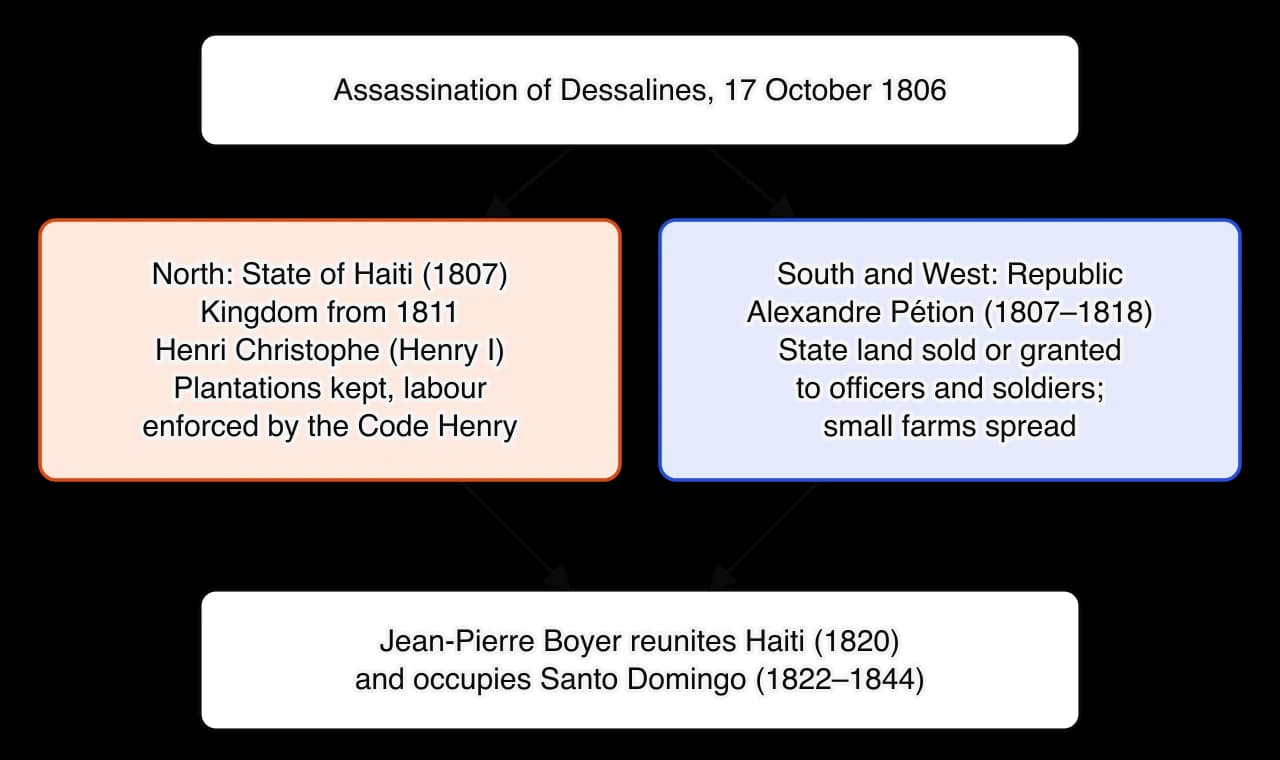
The diagram of the divided state shows two answers to the question of what freedom meant. Christophe kept the large plantations and enforced labour through the Code Henry (1812). His kingdom produced more for export, built schools, and constructed the palace of Sans-Souci and the great Citadelle Laferrière, a fortress built to resist any French invasion, with the forced labour of thousands of workers. Pétion sold or granted state land to officers and soldiers in small plots from 1809, which let many former slaves become independent peasant farmers but reduced exports and state revenue. The writer Baron de Vastey, Christophe’s secretary, published The Colonial System Unveiled (1814), one of the first critiques of colonialism by a formerly colonised writer.
 YouTube
Many rural Haitians resisted any return to the plantation. They moved onto unused land, grew food crops for local markets in family plots known as lakou compounds, and avoided wage labour on the estates. The Haitian historian Jean Casimir, in The Haitians: A Decolonial History (2020, English translation), calls this the "counter-plantation" system: a way of life built by the former enslaved to secure their own freedom, against the plans of their own rulers as well as of the French.
After Christophe died in 1820, Jean-Pierre Boyer, Pétion’s successor, reunited Haiti. In 1822 he occupied Santo Domingo, the eastern part of the island, and abolished slavery there; Haiti ruled the whole island until 1844. Boyer’s Code Rural (1826) tried to bind cultivators to the plantations again, requiring permits to travel and punishing "vagrancy", but the state was too weak to enforce it widely.
Haiti also defined itself as a refuge. Pétion’s Constitution of 1816 (Article 44) declared that any person of African or Indigenous descent who came to live in Haiti would be recognised as Haitian. In 1815–1816 Pétion gave refuge, weapons and money to Simón Bolívar, the leader of independence in Spanish South America, asking in return that he free the enslaved in the lands he liberated. In 1824–1825 Boyer encouraged free African Americans to settle in Haiti, and several thousand came.
The slaveholding powers refused to treat Haiti as an equal. The United States, whose Southern states feared the example of a successful slave revolt, banned trade with Haiti in 1806 and did not recognise it until 1862, during the Civil War. Britain traded with Haiti but delayed formal recognition. The Vatican refused to send bishops until a concordat in 1860, leaving the Haitian Church without recognised leadership for decades. Simón Bolívar did not invite Haiti to the Congress of Panama of 1826. The historian Julia Gaffield, in Haitian Connections in the Atlantic World (2015), shows that Haiti was never completely isolated, since merchants of many nations traded there, but that the lack of recognition left it insecure and vulnerable to pressure.
France never gave up its claim to Saint-Domingue after 1804, and former colonists in France demanded compensation for the land and enslaved people they had lost. Haitian governments feared a new invasion. Pétion had offered to pay an indemnity for lost property in return for recognition, and Boyer’s envoys negotiated with France in 1824 without agreement. In July 1825 Baron de Mackau arrived at Port-au-Prince with a squadron of French warships and presented a royal ordinance.
Article 2. The present inhabitants of the French part of Saint-Domingue shall pay into the general Deposit and Consignment Fund of France, in five equal instalments, year by year, the first falling due on 31 December 1825, the sum of one hundred and fifty million francs, intended to compensate the former colonists who claim an indemnity.
Article 3. On these conditions we grant, by the present ordinance, to the present inhabitants of the French part of Saint-Domingue the full and entire independence of their government.
Ordinance of Charles X, King of France, 17 April 1825 (translated from the French text). Article 1 opened Haitian ports to all nations but halved the customs duties for French ships. The ordinance does not mention slavery, yet the property for which the colonists were to be compensated included the enslaved people who had worked their estates; the sum was calculated from the estimated annual revenue of their plantations and town property in 1789. Its wording, in which France "grants" independence on conditions, presents Haitian freedom as a gift from the king, not as something Haitians had won in war.
Boyer accepted the terms on 11 July 1825, under the threat of the warships and in the hope that recognition would bring security and trade. To pay the first instalment of 30 million francs, Haiti borrowed that sum from a French bank, on terms that left it with less than the full amount after the bank’s charges. Haiti now owed both the indemnity to the French state and the loan, with interest, to French bankers, an arrangement later called the double debt.
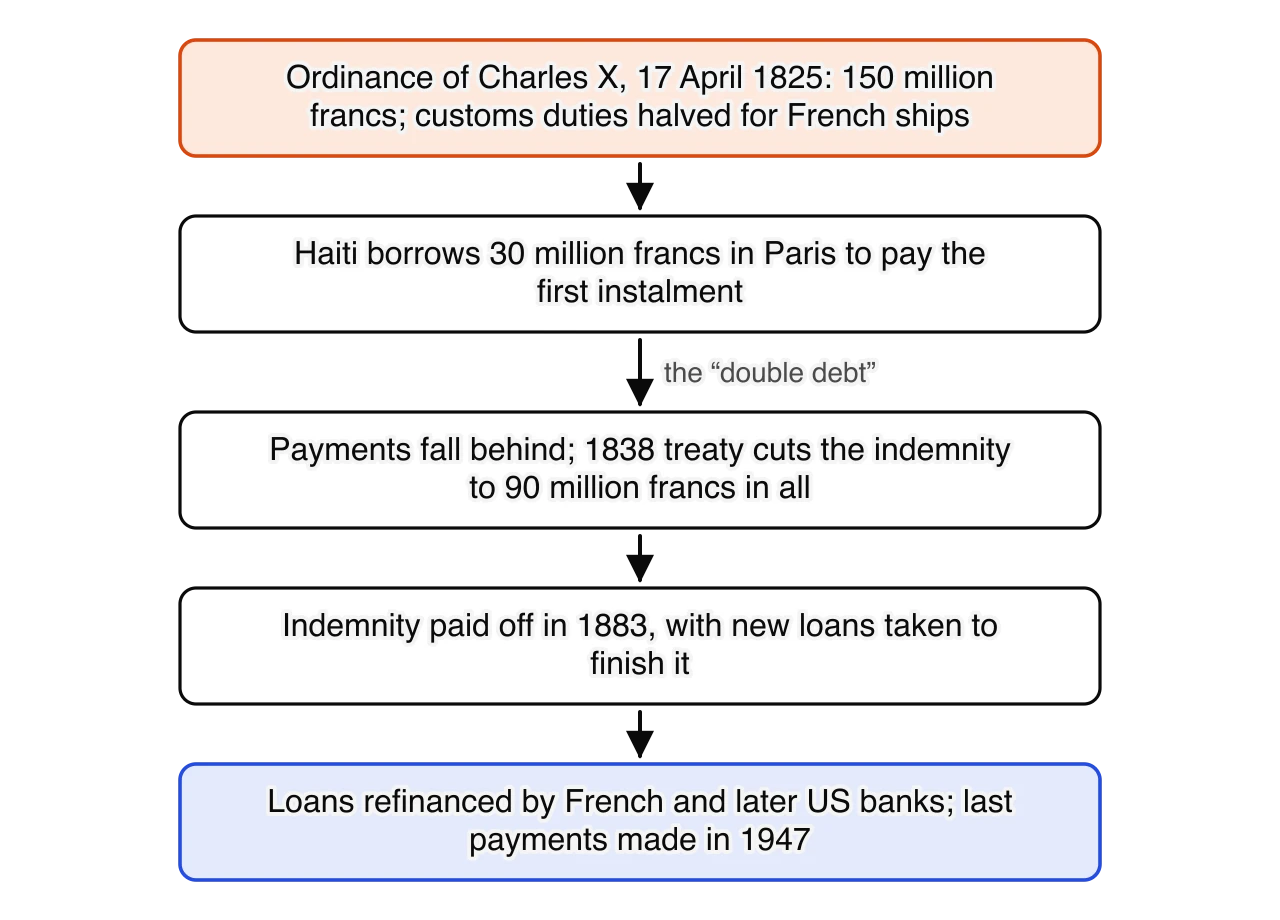
The chain of the independence debt shows how a single payment demand became a long-term burden. Haiti fell behind on the payments almost at once. A treaty of 1838 reduced the total indemnity to 90 million francs and gave France’s full recognition without conditions. Haiti finished paying the indemnity itself in 1883, but it had taken new loans from French banks to do so, and those were refinanced in turn; in the early twentieth century American banks gained a growing hold over Haiti’s national bank, and during the United States occupation of Haiti (1915–1934) a large share of state revenue went to foreign creditors. The last of the loans connected with the indemnity was paid off in 1947.
The consequences for Haiti were economic and political. The payments took a large share of government revenue for decades, money that was not spent on schools, roads or other development. To raise it, governments taxed coffee exports, which fell on the peasant farmers who grew most of the coffee, and the need to pay foreign creditors made Haitian governments dependent on foreign banks and states. In 2022 The New York Times, in its series "The Ransom", worked with economists to estimate that the indemnity and the loans linked to it cost Haiti between 21 and 115 billion US dollars in lost economic growth over two centuries; the authors stressed that such counterfactual estimates are uncertain.
The indemnity also shaped Haitian identity and memory. For many Haitians it is a symbol of how the world made the first black republic pay for its freedom: former slaves compensated their former owners, while the formerly enslaved received nothing. In 2003 President Jean-Bertrand Aristide demanded that France pay about 21 billion US dollars in reparations; the French government rejected the claim. On the bicentenary of the ordinance in April 2025, President Emmanuel Macron announced a joint commission of French and Haitian historians to study the debt and its effects, but he did not offer reparations.
People at the time saw the revolution in very different ways, and the sources they left reflect their positions. White planters and officials, such as Antoine Dalmas and the colonial lawyer Moreau de Saint-Méry, described the colony before 1791 as a world of order and wealth, and Dalmas presented the insurgents as savages stirred up by outsiders; their accounts are rich in detail about the plantation world but silent on what the enslaved thought. French commanders such as Leclerc wrote to justify themselves to Napoleon. British observers like Marcus Rainsford and poets like Wordsworth used the revolution in British debates about slavery and Napoleon. Slaveholders in the United States, Cuba and Jamaica feared that its example would spread.
The voices of the enslaved majority are hardest to hear. Most could not write, and what survives comes from their leaders’ proclamations and letters, from interrogations recorded by their enemies, and from later Haitian histories, such as those of Thomas Madiou (1847–1848) and Beaubrun Ardouin (1853–1860), which drew on oral tradition. Historians therefore read colonial sources "against the grain", asking what they show unintentionally about the people they describe.
For much of the nineteenth and twentieth centuries the Haitian Revolution was left out of Western accounts of the "Age of Revolutions", which focused on the United States and France. The Haitian anthropologist Michel-Rolph Trouillot, in Silencing the Past (1995), argues that the revolution was "unthinkable even as it happened": Europeans and white Americans could not imagine that enslaved Africans were capable of planning and winning a revolution, so they explained it away as the work of outside agitators, as chaos or as a story of disease. Later historians then repeated those silences by leaving Haiti out of their narratives. Since the 1990s historians have placed the revolution at the centre of the history of human rights and abolition.
Historian and work | Interpretation | Evidence stressed |
|---|---|---|
C. L. R. James, The Black Jacobins (1938) | A Marxist account: the revolution was a revolution of the masses, driven by the French Revolution’s ideas and led by Toussaint, a tragic hero who lost touch with the people | The links between events in Paris and Saint-Domingue; Toussaint’s letters; the class struggle of the enslaved |
Carolyn Fick, The Making of Haiti: The Saint Domingue Revolution from Below (1990) | History from below: the enslaved masses, maroons and Vodou shaped it, often against their own leaders | Maroonage; popular resistance in the South; the cultivators’ opposition to plantation labour |
John Thornton, "I Am the Subject of the King of Congo" (1993) | African political and military experience, especially from the Kongo civil wars, shaped how the insurgents fought and what they claimed | The African origins of the enslaved; royalist language among insurgents |
Michel-Rolph Trouillot, Silencing the Past (1995) | The revolution was unthinkable to contemporaries and silenced in Western history | How archives, narratives and historians produced silences |
David Geggus, Haitian Revolutionary Studies (2002) | A careful empirical account: the revolution had many causes and actors; some traditions, such as the details of Bois Caïman, rest on weak evidence | Plantation records, colonial correspondence, demographic data |
Laurent Dubois, Avengers of the New World (2004) | The revolution was central to the history of universal rights: the enslaved forced France to extend its principles to them | The 1793–1794 abolition; the voices of the insurgents and the newly free |
Philippe Girard, Toussaint Louverture: A Revolutionary Life (2016) | Toussaint was a pragmatic and ambitious politician who aimed at power and autonomy, not independence, and was willing to compromise with planters and France | Toussaint’s correspondence and business dealings; his slave ownership before 1791 |
Jean Casimir, The Haitians: A Decolonial History (2020, English translation) | The real revolution was the creation by ordinary Haitians of a way of life outside the plantation, against their own elite as well as the colonisers | Peasant land use, the lakou, Kreyòl culture and the counter-plantation |
The interpretations in the table can be grouped around two debates. The first is about causes and agency: how far the revolution was an extension of the French Revolution (James’s starting point) and how far the creation of the enslaved themselves, drawing on African and Caribbean traditions (Fick, Thornton, Casimir). Most historians now combine the two, as Dubois does, arguing that the enslaved used the opportunities and the language of the French Revolution for their own purposes. The second debate is about leadership: whether Toussaint was a visionary liberator (James) or a calculating politician (Girard), and whether the leaders or the masses made the revolution (Fick).
Each interpretation reflects its time and its sources. James wrote in 1938, as an anti-colonial activist from Trinidad, to show that colonised peoples could make their own history; he worked mainly in French archives, which say little about the enslaved in their own words. Fick and Casimir use evidence of popular resistance that earlier historians ignored. Geggus and Girard work closely with archives and are sceptical of heroic traditions. A strong argument uses these differences to explain why historians disagree, instead of treating one view as simply right.
In the style of IB Paper 1. Focused study 2: Independence and identity. The Haitian Revolution (circa 1780–1825). Using the three provided sources on the Haitian Revolution and considering the overarching inquiry question of "To what extent was Toussaint Louverture responsible for the achievement of Haitian independence?", respond to the following three questions.
Source A: Toussaint Louverture, commander-in-chief of the army of Saint-Domingue, in a letter to the Directory, the government of France (November 1797), translated by C. L. R. James in The Black Jacobins (1938).
Do they think that men who have been able to enjoy the blessing of liberty will calmly see it snatched away? They supported their chains only so long as they did not know any condition of life more happy than that of slavery. But to-day when they have left it, if they had a thousand lives they would sacrifice them all rather than be forced into slavery again . . . France will not revoke her principles, she will not withdraw from us the greatest of her benefits . . . But if, to re-establish slavery in San Domingo, this was done, then I declare to you it would be to attempt the impossible: we have known how to face dangers to obtain our liberty, we shall know how to brave death to maintain it.
Source B: Philippe Girard, a historian, in his biography Toussaint Louverture: A Revolutionary Life (2016). Adapted summary. Girard presents Toussaint as a pragmatic and ambitious leader who aimed at power and autonomy for Saint-Domingue within the French empire, not at independence. He built the army, defeated Spain and Britain and governed the colony, but he courted white planters, maintained forced labour and, when Leclerc landed in 1802, negotiated and submitted. In Girard’s account, independence was won after Toussaint’s deportation, when the restoration of slavery in Guadeloupe pushed his former officers, led by Dessalines, to break with France.
Source C: Jean-Jacques Dessalines, commander-in-chief of the Indigenous Army, in the proclamation "The Commander in Chief to the People of Haiti", written by his secretary Louis Boisrond-Tonnerre, Gonaïves, 1 January 1804, translated by Laurent Dubois and John D. Garrigus in Slave Revolution in the Caribbean, 1789–1804 (2006).
We have dared to be free, let us be thus by ourselves and for ourselves. . . . What people fought for us? What people wanted to gather the fruits of our labor? And what dishonorable absurdity to conquer in order to be enslaved. . . . Peace to our neighbors; but let this be our cry: . . . Eternal hatred of France!
Inquiry question: "To what extent did the 1825 indemnity shape Haiti’s new identity?" Use the extract from the Ordinance of Charles X of 17 April 1825 (Articles II and III), quoted with the account of the independence debt.
Inquiry question: "To what extent was the abolition of slavery in Saint-Domingue in 1793–1794 the result of the actions of the enslaved?" Use the broadside of Léger-Félicité Sonthonax (5 November 1793) and the proclamation of Toussaint Louverture from the camp at Turel (29 August 1793), both quoted with the account of the war for freedom.
I can describe the economy of Saint-Domingue in the 1780s and explain why it depended on slavery and the slave trade.
I can explain the divisions between grands blancs, petits blancs, free people of colour and the enslaved, and between créoles and bossales.
I can explain what the Code Noir and the exclusif were and how colonial government worked.
I can describe forms of resistance, including maroonage, Mackandal and Vodou, and explain the evidence and debate about Bois Caïman.
I can explain how the French Revolution affected the colony, including the Amis des Noirs, the Club Massiac, the Ogé revolt and the decrees of 1791–1792.
I can weigh the long-term, short-term and immediate causes of the August 1791 uprising.
I can explain how and why slavery was abolished in 1793–1794, including the role of Sonthonax and the decree of 16 Pluviôse.
I can outline Toussaint Louverture’s rise from 1794 to 1801 and explain his labour policy and its critics.
I can explain why the Leclerc expedition failed and how the war of independence was won in 1802–1803.
I can compare the roles of Toussaint Louverture and Jean-Jacques Dessalines and reach a judgement on each.
I can compare the Constitution of 1801, the Declaration of Independence of 1804 and the Constitution of 1805 as statements of identity.
I can explain the continuing inequalities after independence: anciens and nouveaux libres, land, forced labour and the divided state.
I can explain the terms and consequences of the 1825 indemnity and the debate over its long-term effects.
I can outline the views of James, Fick, Thornton, Trouillot, Geggus, Dubois, Girard and Casimir and explain why they differ.
I can use the content, context and perspectives of sources on the revolution to answer an inquiry question.