FS2 Independence and identity
How enslaved and colonised peoples in Haiti and Kenya won independence and tried to build new national identities, and how this focused study is studied and examined.
- IB History
- SL and HL
What FS2 covers
From the subject guide: what you need to know and be able to do.
Focused study: two paired examples, assessed through sources in paper 1.
2 subtopics in Independence and identity
Each one has its own page once something is published for it.
- FS2.1The Haitian Revolution (circa 1780–1825)notes
- FS2.2Kenyan independence (1945–1978)notes
Key terms introduced here
Each is in the History glossary, with every other term in the subject.
- Haitian Revolution
The revolution of 1791–1804 in the French colony of Saint-Domingue, in which enslaved people destroyed slavery and created the independent state of Haiti on 1 January 1804; the only successful slave revolution in history.
- Plantation
A large agricultural estate producing one cash crop for export, such as sugar, tobacco, coffee or cloves, with a large, closely controlled labour force, which in the Americas and Zanzibar was mostly enslaved.
- Settler colony
A colony in which Europeans settled permanently, owned land and claimed political power, such as Kenya, Southern Rhodesia or Algeria.
An overview of FS2 Independence and identity
Independence and identity is a focused study of how colonised peoples won independence from European rule and then tried to build a new nation. Its two examples are the Haitian Revolution (c. 1780–1825), in which the enslaved majority of the French colony of Saint-Domingue destroyed slavery and founded Haiti, and Kenyan independence from Britain (1945–1978), won after the Mau Mau Uprising and constitutional negotiation and followed by the rule of Jomo Kenyatta.
Two examples, three questions
The examples lie about 150 years apart, but they are studied through the same three key questions, as the diagram of the focused study shows. The questions follow the life of an independence movement from its origins, through the struggle for independence, to the first years of the new state.
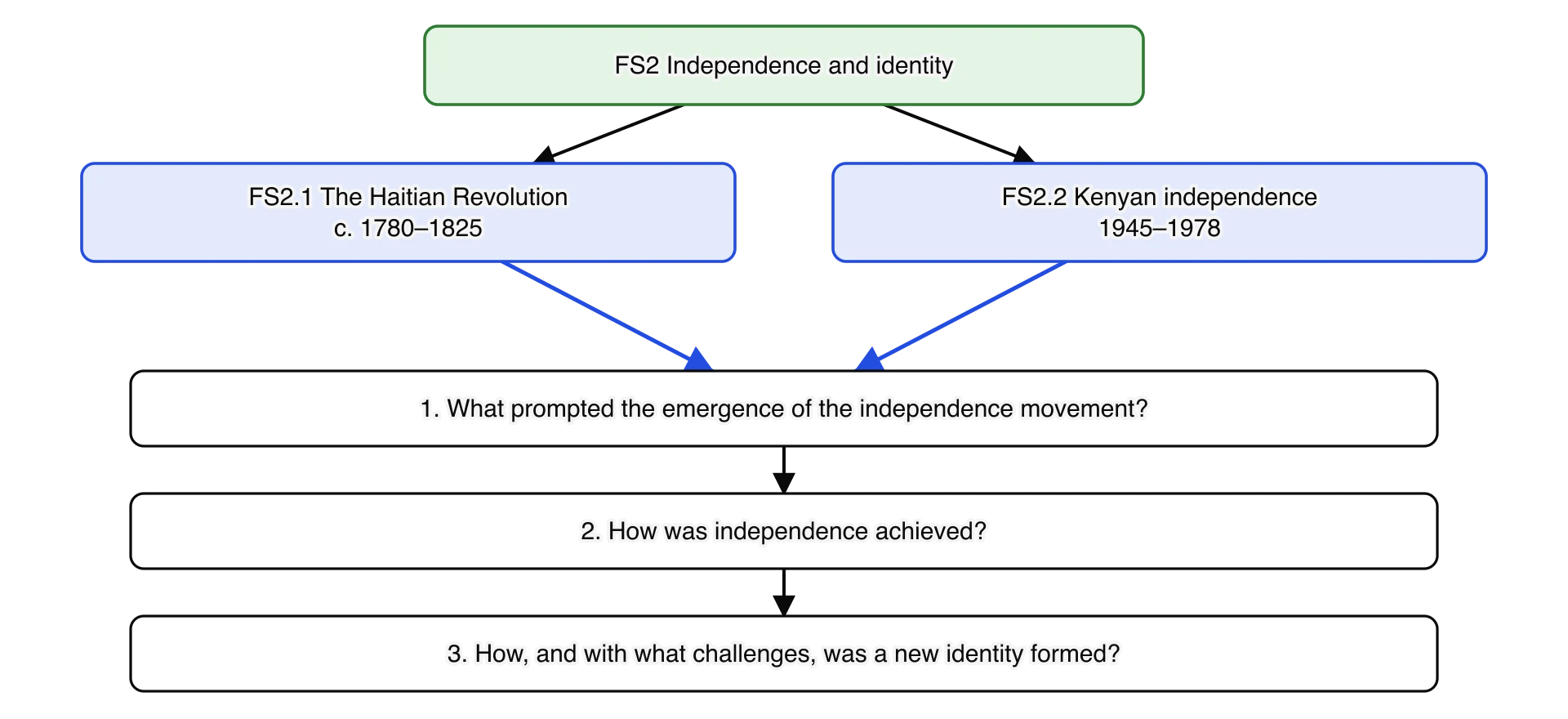
The table of the key questions summarises what each example covers under each question.
Key question | FS2.1 The Haitian Revolution (c. 1780–1825) | FS2.2 Kenyan independence (1945–1978) |
|---|---|---|
What prompted the emergence of the independence movement? | French colonial rule over the most profitable plantation colony in the world; resistance by enslaved people through maroonage and the networks of Vodou; the influence of the French Revolution and its language of rights | British rule over a settler colony, with land taken for European farms, passes and a colour bar; the peaceful pressure of the Kenya African Union, which won almost nothing; the effects of the Second World War |
How was independence achieved? | The uprising of August 1791 and the abolition of slavery in 1793–1794; the struggle of 1794–1804 against Britain, Spain and Napoleon's army; the roles of Toussaint Louverture and Jean-Jacques Dessalines | The Mau Mau Uprising (1952–1960) and the state of emergency; the Lancaster House conferences (1960–1962), self-government and multi-party politics (1960–1963); the role of Jomo Kenyatta |
How, and with what challenges, was a new identity formed? | The constitution of 1801 and the Declaration of Independence of 1804; continuing divisions of colour, class and land; French recognition in 1825 in return for an indemnity of 150 million francs | The independence constitution of 1963 and the move to a one-party state by 1969; education, Harambee, Swahili and cultural diversity; land reform through purchase |
Big ideas that run through the focused study
Both colonies were built on land and forced labour. Saint-Domingue's wealth came from hundreds of thousands of enslaved Africans on sugar and coffee plantations; Kenya's settler economy rested on land taken from Africans and on their labour. In both, the grievances that drove the independence movement were economic and social as much as political, and they did not disappear with independence.
Independence came through a mix of armed struggle and politics. The enslaved of Saint-Domingue won their freedom by force, and France abolished slavery partly because it needed them as soldiers. In Kenya the British defeated the forest fighters by 1956, yet the methods of the Emergency made colonial rule impossible to defend, and independence was finally negotiated in London. Weighing violence against negotiation, and local action against outside events such as the French Revolution or British decline after 1945, is a central debate in both examples.
Both studies end with the problem of identity. Haiti defined itself against slavery and France, but inherited colonial divisions of colour and land and was isolated by the slaveholding powers, and the independence debt burdened it for more than a century. Kenya's government promoted national unity through Harambee, Swahili and national symbols, while ethnic patronage, one-party rule and land reform that favoured those who could pay showed the limits of that unity. Each country also produced a founding leader whose legacy is contested: Toussaint and Dessalines in Haiti, Kenyatta in Kenya.
Perspectives are especially important because the voices of the enslaved and of Mau Mau fighters were rarely written down at the time, while colonial officials, planters and settlers left a large record. Memory matters too: the Haitian Revolution was long left out of Western accounts of the Age of Revolutions, and Kenyans have argued since 1963 about how Mau Mau should be remembered.
How the focused study is studied and examined
Every student, at SL and HL, takes one of five focused studies: Climate and innovation, Independence and identity, Political and economic transitions, Conflict and displacement, or Protest and change. Each has two examples, and both must be studied in full, in about 50 teaching hours. The focused study is the part of IB History that builds skill in working with sources.
It is assessed by Paper 1 (1 hour 15 minutes, 24 marks; 30 per cent of the SL grade and 20 per cent of the HL grade), the same paper at SL and HL. Each session the paper sets material on one of the two examples only, so either Haiti or Kenya may appear. It gives an inquiry question ("To what extent …?") and three primary or secondary sources, followed by three questions that do not change: how the content of Sources A and B can be used to answer the inquiry question (6 marks), how the context of Source C influences how it can be used (6 marks), and how the perspectives in all three sources can be used (12 marks).
Carry on with FS2 in Augment
With a free account, Augment remembers where you stopped and what you have practiced.