Evaluate the power of international organisations, governments, NGOs and TNCs over diets and health, examine gender roles in food and health, and explain what makes famine severe, using Sudan since 2023.
Each is in the Geography glossary, with every other term in the subject.
Large-scale commercial farming and the businesses linked to it, including firms that supply seeds, agrochemicals and machinery and those that trade, process, manufacture and sell food.
A situation in which a country, region or community relies on aid to meet basic needs over a long period, so that its own production, markets and institutions are weakened or fail to develop.
A payment of money from a government or aid agency directly to poor or vulnerable households, given either unconditionally or on conditions such as school attendance or clinic visits.
A theory that live, round-the-clock television and online news coverage of a crisis influences governments’ decisions, for example by creating public pressure to send aid.
An arrangement in which a buyer, usually a company, agrees in advance to purchase a farmer’s produce at an agreed price, quantity and quality, often supplying inputs and advice in return.
A decline in the willingness of governments and the public to give aid, usually during a long or repeated crisis, which leads to falling funds even when needs remain high.
A theory, set out by Amartya Sen in 1981, that famines happen when groups of people lose their ability to obtain food through production, wages, trade or transfers, not only when total food supply falls.
Describe the roles of the World Food Programme, the Food and Agriculture Organization and the World Health Organization in combating food insecurity and disease.
Explain how governments and NGOs influence food security and health, with named policies and organisations.
Evaluate the power of international organisations, governments, NGOs and foundations, including whose priorities they serve and at what scale.
Explain how TNCs, through agribusiness, supermarkets and the media, shape food consumption habits.
Examine gender roles in food production and acquisition, and explain the disparities in health between women and men.
Distinguish famine from food insecurity, using the Integrated Food Security Phase Classification.
Explain how governance, the power of the media and access to international aid affect the severity of famine.
Analyse the issues affecting a famine-stricken country, Sudan, and evaluate the responses to it.
What people eat and how healthy they are depend partly on their own choices, but many of the decisions that shape diets and health are made by others. Governments set food prices and health budgets, international organisations deliver food and vaccines, transnational corporations decide what is grown, processed, advertised and sold, and households decide who eats first. These groups are the stakeholders in food and health, and they hold very different amounts of power.
Power is the central key concept for stakeholders in food and health: the ability of a stakeholder to change outcomes for other people, at scales from the household to the globe. It is closely linked to place. The same organisation can be powerful in one place and powerless in another, as the World Food Programme found when armed groups blocked its convoys in Darfur in 2024.
74 exam-style questions on this subtopic, written in the style of the IB papers. The first has its markscheme open. Counted on
Examine why global patterns of undernutrition and overnutrition do not simply reflect differences in national income.
10 marks
Marks should be allocated according to the markbands.
Undernutrition includes stunting (low height for age), wasting (low weight for height), underweight and micronutrient deficiencies. Overnutrition is excess energy intake leading to overweight (BMI 25 or more) and obesity (BMI 30 or more). The expected relationship is that undernutrition falls and overnutrition rises as national income rises. The question asks why the real global patterns depart from this, so the best answers will acknowledge the general relationship and then examine the exceptions.
Possible applied themes (AO2) demonstrating knowledge and understanding (AO1):
The general relationship holds broadly: the highest rates of stunting and undernourishment are in low-income countries of sub-Saharan Africa and South Asia, and overweight is most common in high- and upper-middle-income countries.
The double burden of malnutrition: many middle-income countries have high undernutrition and rising obesity at the same time, sometimes in the same household (eg India, with a high rate of child stunting alongside rapidly rising diabetes; Egypt; Mexico).
Inequality within countries means national income is a poor guide; in high-income countries such as the USA and the UK, obesity is more common among lower-income groups, who rely on cheap, energy-dense processed food.
Culture and diet: Japan is a high-income country with very low adult obesity (around 4–5%), linked to a traditional diet of fish, rice and vegetables, smaller portions and social norms; Pacific Island states such as Nauru and Tonga, which are not wealthy, have some of the highest adult obesity rates in the world after a shift to imported fatty meat and processed food.
Government policy and governance: countries that invest in public health, women's education and sanitation can cut stunting faster than income growth alone would predict (eg Peru roughly halved child stunting between 2008 and 2016).
With a free account, Augment remembers where you stopped and what you have practiced.
An extreme food crisis in an area where at least 20% of households face an extreme lack of food, over 30% of children are acutely malnourished and over two people per 10,000 die each day (IPC Phase 5).
Food provided free or at reduced cost to people or countries that cannot produce or buy enough, given either in kind as food or as cash or vouchers to buy it.
The United Nations agency, founded in 1945 and based in Rome, that leads international efforts against hunger by collecting food data, giving early warning and technical advice, and setting food standards.
Any activity that promotes a food or drink product to consumers, including advertising, sponsorship, packaging, price promotions, social-media content and product placement.
Simple nutrition information, such as warning symbols or traffic-light colours, printed on the front of food packaging to show consumers which products are high in sugar, salt, fat or calories.
The difference between women and men farmers in access to land, credit, inputs, technology, advice and markets, and the resulting difference in their yields and incomes.
The adaptation of a global product, service or brand to local cultures, tastes, religions and regulations so that it sells in many different places.
Short-term assistance given in an emergency such as a war, disaster or famine to save lives and relieve suffering, including food, water, shelter, medical care and protection.
A standardised five-phase scale, from Minimal (Phase 1) to Catastrophe or Famine (Phase 5), used by governments and agencies to classify the severity of food insecurity and malnutrition.
A legally binding agreement, revised in 2005, under which states must detect, assess and report to the WHO any public health event that could spread across borders, and respond to it proportionately.
The way food is shared among members of the same household, which can be unequal by gender, age or status, so that some members are undernourished even when the household has enough food.
The shortfall in the number of women and girls in a population compared with the number expected if they had received the same nutrition, health care and survival chances as men and boys.
Public policies and programmes that protect people from poverty and from shocks such as illness, drought or price rises, for example pensions, school meals, food rations and cash transfers.
A tax on sugar-sweetened drinks or high-sugar foods that aims to reduce sugar consumption and related diseases by raising prices and encouraging manufacturers to cut sugar content.
An industrially manufactured food or drink made mainly from substances extracted from foods and from additives, such as soft drinks, packaged snacks and instant noodles, as defined by the NOVA classification.
A situation in which all people can use the quality health services they need, from prevention to treatment and rehabilitation, without suffering financial hardship from paying for them.
The United Nations agency, founded in 1961 and based in Rome, that provides emergency food assistance, logistics for humanitarian operations, school meals and resilience programmes for people facing hunger.
The United Nations agency, founded in 1948 and based in Geneva, that directs and coordinates international health work, sets health standards and guidelines, and supports countries in controlling disease.
A stakeholder is any person, group or organisation that affects, or is affected by, a decision or an issue. In food and health they act at every scale: UN agencies, foundations and TNCs globally; governments and national NGOs nationally; local authorities, clinics, traders and, in wars, armed groups locally; and parents within each household.
Power over food and health takes several forms. Financial power comes from controlling money: donor governments fund most humanitarian work, and a few firms earn most of the profits in global food chains. Regulatory power belongs mainly to governments, which can tax, ban, label and subsidise. Knowledge power belongs to bodies that collect data and set standards, such as the FAO and the WHO. Physical control over territory, roads and food stores can matter most of all in a war.
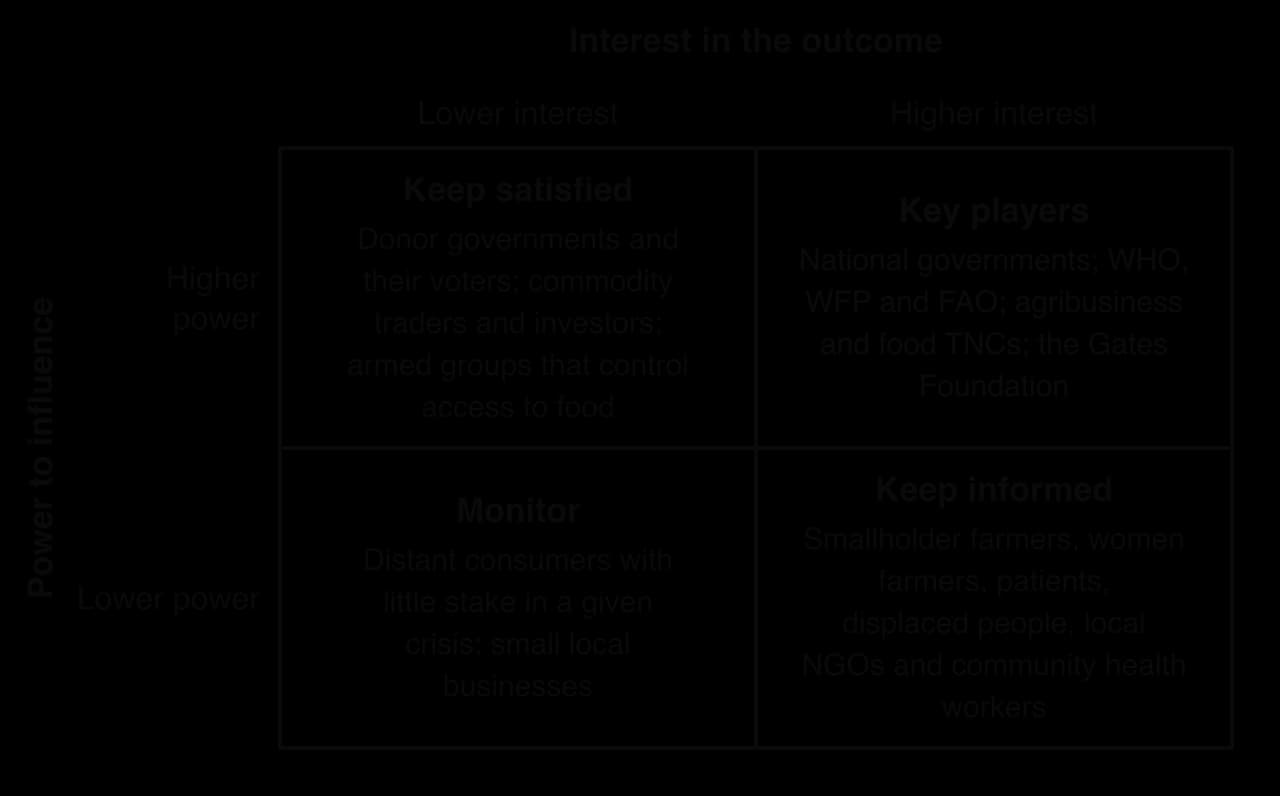
Geographers often map stakeholders on a power–interest matrix. Stakeholders with high power and high interest, such as national governments and the large UN agencies, are the key players whose decisions shape outcomes. Those with high interest but little power, such as smallholder farmers and patients, are affected by decisions they rarely make.
The matrix is a simplification, because stakeholders can move between cells: media coverage can give the victims of a famine a voice, and organised groups of farmers or patients can gain power through campaigns and courts.
Three United Nations agencies lead global action on food and health. Their work is divided by function: the World Food Programme delivers food, the Food and Agriculture Organization supports food production and collects data, and the World Health Organization sets health policy and coordinates disease control.
The World Food Programme was founded in 1961 and is based in Rome. It is the world’s largest humanitarian organisation, and in 2023 it supported more than 152 million people in over 120 countries and territories. It received the Nobel Peace Prize in 2020.
The WFP has four main roles:
Emergency food assistance: food aid in kind (cereals, pulses, oil and fortified foods), and increasingly cash or vouchers, for people affected by conflict, disasters and economic shocks. About two-thirds of its life-saving food assistance goes to people in places affected by armed conflict.
Logistics for the whole humanitarian system: it runs the UN Humanitarian Air Service (UNHAS), which flies aid workers to remote areas, and manages supply chains, warehouses and trucks for other agencies.
School meals: it is the leading provider of school meals in low-income countries, which improve nutrition and keep children, especially girls, in school.
Resilience: programmes that help communities prepare for droughts and floods.
Food aid is one part of humanitarian aid, the wider short-term help given to save lives and reduce suffering in emergencies, which also includes shelter, water, medical care and protection. Humanitarian aid differs from long-term development aid, which aims to reduce poverty over years or decades.
The WFP’s power is limited because it has no regular budget of its own. Almost all of its income comes from voluntary donations by governments, so it depends on donors’ priorities. Funding reached a record US$14.1 billion in 2022, against needs of US$21.4 billion, then fell to US$8.3 billion in 2023, forcing ration cuts in several countries, and in early 2025 the United States, its largest donor, halted many of the grants it funded.
Sources: Wikipedia, "World Food Programme" and "Famine in Sudan (2024–present)", citing WFP annual reports, 2026.
The Food and Agriculture Organization of the United Nations was founded in Quebec City on 16 October 1945, a date now marked each year as World Food Day. Based in Rome, it has 194 members and works in over 130 countries. Its role is mainly long-term and technical rather than emergency relief.
Data and monitoring: the FAO publishes food balance sheets, the annual State of Food Security and Nutrition in the World report (with the WFP, IFAD, UNICEF and WHO) and the estimates of undernourishment used to track food security worldwide.
Early warning: its Global Information and Early Warning System (GIEWS) monitors harvests and food prices, and its Desert Locust Watch tracked the swarms that damaged crops in East Africa in 2019–2021.
Technical support: advice on crops, irrigation, soils, fisheries and livestock disease.
Standards: with the WHO it created the Codex Alimentarius Commission in 1961, which sets international food safety standards used in trade.
The FAO also developed the scale now used to judge how severe a food crisis is, first used in Somalia in 2004.
The World Health Organization was established on 7 April 1948 and is based in Geneva. It is governed by the World Health Assembly of its member states, which meets each May.
The WHO’s main functions are:
Surveillance and rules for disease control: the International Health Regulations, revised in 2005 after the SARS outbreak and in force since 2007, legally bind 196 states to report outbreaks that could spread internationally.
Disease campaigns: the smallpox eradication campaign, intensified from 1967, ended when the disease was certified eradicated in December 1979 and declared eradicated by the World Health Assembly in May 1980, the first human disease eliminated by human effort. The Global Polio Eradication Initiative, launched in 1988, has cut cases by 99%.
Guidelines and standards: on nutrition (such as limiting free sugars), air quality and essential medicines.
Treaties: the Framework Convention on Tobacco Control, adopted in 2003 and in force since 2005, was the first treaty negotiated under the WHO; with the International Code of Marketing of Breast-milk Substitutes (1981), it shows the WHO using international law against harmful marketing.
The WHO’s power is advisory more than executive. It cannot force a state to act, and most of its budget is voluntary money earmarked by donors for particular diseases. In 2020–21 its largest contributors were Germany, the Gates Foundation, the United States, France, the United Kingdom and the European Commission. The United States announced its withdrawal on 20 January 2025 and formally left the WHO on 22 January 2026, removing a major source of funds and expertise.
The three agencies differ in what they do, how they are funded and where their power runs out.
WFP | FAO | WHO | |
|---|---|---|---|
Founded and base | 1961, Rome | 1945, Rome | 1948, Geneva |
Main role | Emergency food assistance, logistics, school meals, resilience | Data, early warning, technical advice to farmers, food standards | Health rules (IHR), surveillance, disease campaigns, guidelines, treaties |
Timescale | Mainly short-term relief | Mainly long-term development | Both: emergencies and long-term health systems |
Funding | Almost entirely voluntary donations from governments | Assessed member contributions plus voluntary funds | Small assessed budget; most funds voluntary and earmarked by donors |
Main limit on power | Donor funding and access through conflict zones | Advice only; governments decide policy | Cannot enforce; depends on states reporting outbreaks |
Example | Food and digital cash for people in besieged El Fasher, Sudan, 2025 | Desert Locust Watch, East Africa, 2019–2021 | Smallpox eradication, declared 1980 |
UNICEF leads on child nutrition and supplies ready-to-use therapeutic food, an energy-dense paste used to treat severely malnourished children at home. IFAD lends to smallholder farmers and the World Bank funds agriculture, health systems and social protection. Two public–private partnerships, Gavi, the Vaccine Alliance (2000), which has helped immunise more than 1 billion children since its founding, and the Global Fund to Fight AIDS, Tuberculosis and Malaria (2002), channel billions of dollars a year into vaccines and treatment.
National governments hold more power over food and health than any other stakeholder, because they can make laws, raise taxes and spend public money across a whole country. They can reduce hunger and disease on a large scale, and they can also cause or worsen them.
India runs the world’s largest food subsidy programme. Under the Public Distribution System (PDS), the state-owned Food Corporation of India buys grain, mainly wheat and rice from surplus states such as Punjab and Haryana, stores it and sends it to about 550,000 fair price shops (ration shops), where card holders buy it at subsidised prices.
The National Food Security Act of 2013 turned this into a legal right: up to 75% of the rural population and 50% of the urban population are entitled to 5 kg of grain per person per month, and the poorest Antyodaya households to 35 kg per household.
The PDS shows both the strengths and the weaknesses of government action. It protects hundreds of millions of people from price spikes, but it has suffered large "leakages", grain diverted before it reaches households: estimates for the whole country rose from 24% of allocated grain in 1999–2000 to 54% in 2004–05, before reforms such as computerised records and wider coverage cut them in many states. It also concentrates on cereals rather than a varied diet.
Sources: Wikipedia, "Public distribution system (India)" and "National Food Security Act, 2013", citing the Government of India, 2026.
Social protection is the set of public policies that protect people against poverty and shocks, including pensions, unemployment benefits, school meals and cash transfers. Such policies are often called a social safety net, because they catch households before they fall into destitution.
A cash transfer gives money directly to poor households rather than food. Mexico’s programme, begun as Progresa in 1997 and later called Oportunidades and Prospera, became a model for the world. It is a conditional cash transfer: families are paid if children attend school and family members visit health clinics, and the money goes to mothers, who are more likely to spend it on children’s food and health. Similar schemes now run in many countries.
Cash costs less to deliver than food, supports local traders and lets families choose, but it works only where markets function; under a blockade it may simply raise prices.
Governments also try to change what people eat. A sugar tax raises the price of sugary drinks or foods to reduce consumption and encourage manufacturers to cut sugar.
The United Kingdom’s Soft Drinks Industry Levy came into effect on 6 April 2018. It charges producers 18p per litre on drinks with more than 5 g of sugar per 100 ml and 24p per litre above 8 g. Because the tax was announced two years in advance, many manufacturers reformulated their drinks to fall below the thresholds.
A 2024 study led by the University of Cambridge found that, in the 11 months after the levy began, daily sugar intake from drinks fell by an average of 3.0 g for children and 5.2 g for adults.
Mexico introduced a tax of 1 peso per litre on sugary drinks in January 2014. Sales of taxed drinks fell by 6% in 2014, and in December 2014 they were 12% lower than in the same month of the two previous years, and the tax is one response to Mexico’s rapid nutrition transition. The way it was passed shows the power of corporations: in September 2013 soft drink companies ran a media campaign against the tax, arguing that it would not reduce obesity and would cost jobs in the sugar-cane industry.
Sources: Wikipedia, "Sugary drink tax", citing HM Revenue and Customs, the University of Cambridge (2024) and Colchero et al. (BMJ, 2016), 2026.
Governments decide how much to spend on health and who can use the health system. Universal health coverage (UHC) means that everyone can use the health services they need, from prevention to treatment, without suffering financial hardship. It is SDG target 3.8 within the Sustainable Development Goals.
Thailand is a well-known example of a middle-income country that achieved near-universal coverage. Its universal coverage scheme, introduced in 2002, covers all Thai nationals who are not in the civil service or social security schemes, and the World Bank reports that 99.5% of the population has health protection. Rural areas still have fewer doctors and hospitals than the cities, so being covered does not guarantee equal access to care.
Government action can also create hunger. Wars and blockades destroy farms and markets, failed states cannot deliver services, and governments sometimes deny that a crisis exists, as Sudan’s did in 2024. In such cases the government, normally the stakeholder with the most power to help, becomes an obstacle to the response.
A non-governmental organisation (NGO) is a non-profit group that works independently of government. In food and health, NGOs range from large international charities to small community groups, and they are part of civil society.
NGO | Base and founding | Role in food and health |
|---|---|---|
Médecins Sans Frontières (MSF, Doctors Without Borders) | France, 1971 | Emergency medical care in conflicts and epidemics; over 67,000 staff in more than 75 countries (2024); about 98% privately funded |
Oxfam | United Kingdom, 1942 | Water, sanitation and food in emergencies; campaigns on hunger and inequality |
Save the Children | United Kingdom, 1919 | Child nutrition and health; emergency response; advocacy |
Action Against Hunger | France, 1979 | Treatment and prevention of acute malnutrition |
BRAC | Bangladesh, 1972 | Community health care through paramedics (from 1972), microfinance, education; works in all 64 districts of Bangladesh and in other countries; about 70% of its 90,000 staff are women |
NGOs have clear strengths. Their staff often live in the communities they serve, so they can reach people that governments neglect, and they can act quickly; MSF’s private funding lets it act independently of governments. NGOs also give a voice to people with little power: Oxfam described the 2011 Somalia famine as "a preventable disaster" and accused several European governments of "wilful neglect".
They also have limits. Most depend on short-term grants. They cannot match the scale of a national health system, and many NGOs in one place can duplicate each other’s work. Critics also ask to whom NGOs are accountable: their donors, often in high-income countries, or the people they serve.
Philanthropic foundations have become some of the most powerful stakeholders in global health. The Gates Foundation, launched in 2000 and holding about US$91 billion in assets at the end of 2025, provided US$4.1 billion for development in 2019 and was the WHO’s second-largest contributor in 2020. It contributed US$1.55 billion to Gavi between 2016 and 2020, and has given more than US$6.6 billion to global health programmes.
This money has saved many lives through vaccines and malaria control, but it gives one private organisation great influence over which diseases receive attention. Critics point to too much deference to the founders’ views and a preference for technical solutions over slower investment in public health systems. Unlike a government, a foundation is not elected.
Sources: Wikipedia, "Médecins Sans Frontières", "BRAC (organisation)" and "Gates Foundation", citing their annual reports and the OECD, 2026.
Each type of stakeholder has a different mix of power, reach and accountability. Their effectiveness depends on the scale of the problem, the place and the political situation.
Stakeholder | Strengths | Limitations | Works best when… |
|---|---|---|---|
International organisations (WFP, FAO, WHO) | Global reach, expertise, data, logistics, legitimacy of the UN | Depend on voluntary funds and on permission from governments and armed groups; cannot enforce | States cooperate and donors fund the appeal |
National governments | Laws, taxes and budgets for a whole country; long-term systems such as the PDS or UHC | Corruption, leakages, competing priorities; may cause the crisis | The state is stable and accountable to its citizens |
NGOs | Local presence, speed, trust, advocacy for people without power | Small scale, short-term funding, duplication, accountability to donors | They work with local communities and fill gaps the state leaves |
Foundations | Large, flexible funds; can take risks on new technology | Not elected; can steer global priorities towards their own interests | Their money supports national health systems rather than bypassing them |
One recurring debate is between vertical programmes, which target a single disease with their own staff, budgets and supplies (smallpox eradication, polio campaigns, many HIV and malaria programmes), and horizontal programmes, which strengthen the whole health system (primary care clinics, training nurses, drug supply chains). Vertical programmes produce fast, measurable results that donors can report; horizontal programmes are slower and harder to measure but build a system that can deal with many diseases, including new ones.
The Ebola epidemic in West Africa in 2014–2016 showed the cost of weak health systems: Guinea, Liberia and Sierra Leone could not detect and contain a new disease quickly. An internal WHO review pointed to underfunding and the lack of "core capacity" in national health systems as the main weaknesses.
Much of the money for food and health programmes in low-income countries comes from outside donors, so donors’ priorities can outweigh local needs. Donors may prefer visible emergencies to chronic hunger. Donor fatigue sets in when long crises lose public attention and funding falls, as happened when the WFP’s funding dropped by about 40% between 2022 and 2023.
Long-term aid can also create aid dependency, a situation in which a country or community relies on aid for basic needs and its own institutions and markets do not develop. Imported food aid can lower local grain prices and farmers’ incomes, and NGO-run services can weaken the incentive for governments to build their own, so many agencies now buy food locally or give cash.
The gap between who pays and who is affected remains wide, which is why equity is central to evaluating any stakeholder’s role.
A transnational corporation (TNC) is a company that operates in more than one country. In the global food system a small number of TNCs control key stages of the supply chain, from seeds to supermarket shelves, and spend heavily on advertising. Their decisions shape what farmers grow, what food costs and what people choose to eat.
Agribusiness is the business of agriculture as an industry: the production, processing, trade and sale of food and farm inputs by large commercial firms. It includes firms that may never own a farm, such as seed companies, grain traders and food manufacturers.
Power in agribusiness is concentrated at a few points in the chain:
Seeds and agrochemicals: Bayer completed its purchase of Monsanto, the leading producer of genetically modified seed, on 7 June 2018, in a deal announced at US$66 billion. With Corteva and Syngenta, a handful of firms supply a large share of the world’s commercial seed and pesticides.
Grain trading: four firms, Archer Daniels Midland, Bunge, Cargill and Louis Dreyfus, known as the "ABCD" traders, dominate world trade in agricultural commodities. Louis Dreyfus alone handles about 10% of world agricultural trade flows.
Processing, manufacturing and retail: meat processors such as JBS and Tyson, manufacturers such as Nestlé, PepsiCo, Coca-Cola and Unilever, retailers such as Walmart, Tesco and Carrefour, and fast-food chains such as McDonald’s and KFC decide what reaches consumers.
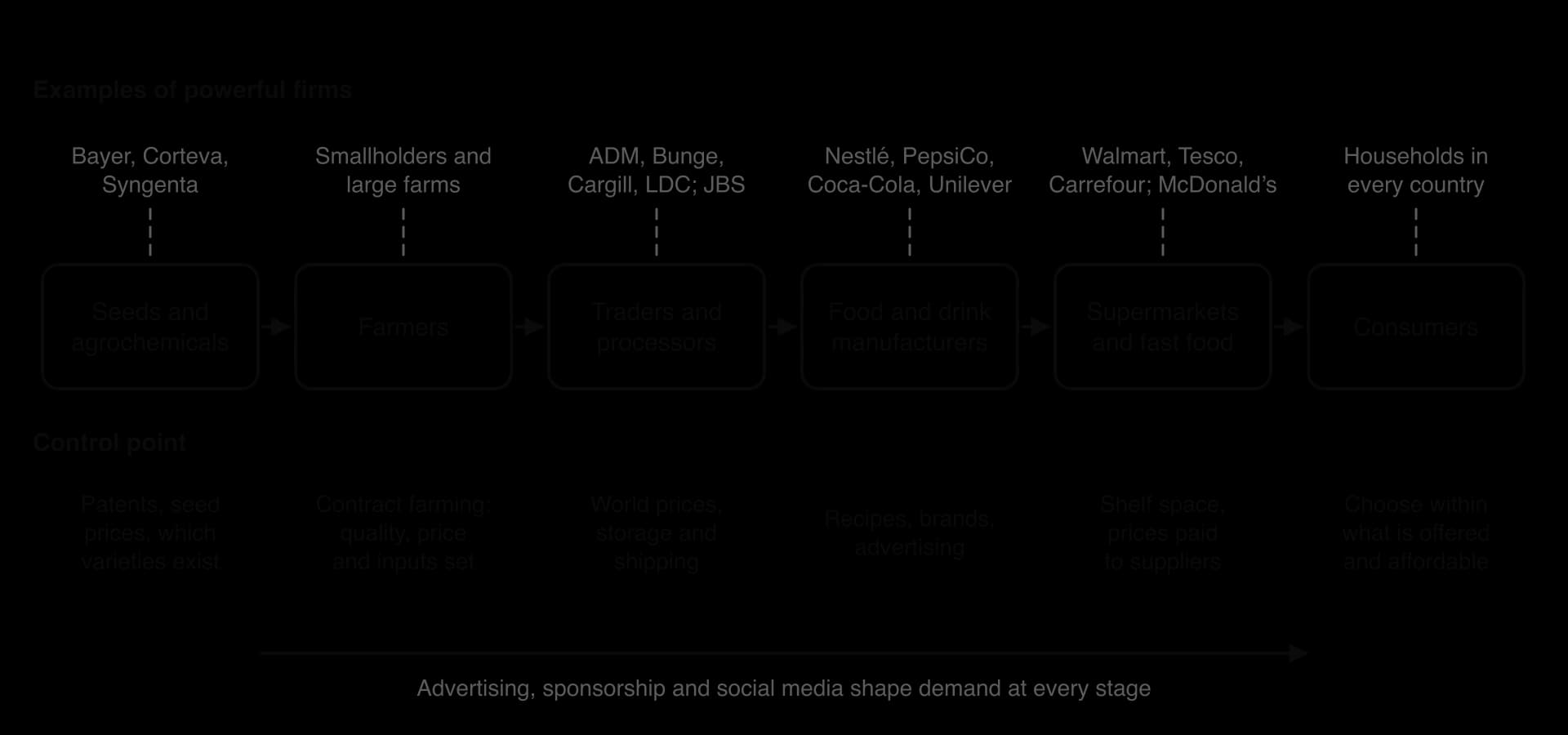
Many of these firms grow by vertical integration, owning or controlling several stages of the chain, from feed mills to farms to processing plants. Their size lets them set prices for their suppliers and achieve economies of scale that small firms cannot match.
Agribusinesses often source crops and livestock through contract farming. A company agrees in advance to buy a farmer’s produce, usually at a set price and quality, and often supplies seed, fertiliser, credit and advice in return. Much of the poultry industry in the United States is organised this way, and contract schemes for vegetables, tea, sugar cane and poultry are spreading across Africa, Asia and Latin America.
For smallholders, a contract can mean a guaranteed market, inputs and a stable income, but it can also lock them into one buyer and shift the risks of crop failure onto the farmer. The balance depends on how the contract is written and whether farmers are organised enough to bargain.
Since the 1990s supermarkets have spread rapidly through Latin America, South-east Asia, China, India and South Africa. Rising incomes, women working outside the home, refrigerators and cars encouraged the change. Sales of processed foods have grown much faster than fresh food sales, which links the spread of supermarkets to the shift in diets described by the nutrition transition.
Supermarkets also change farming. They want large, steady volumes of produce of uniform quality, so they tend to buy from larger farms, cooperatives or specialised wholesalers. Small farmers who cannot meet these standards can lose their market.
Food marketing includes advertising on television and online, sponsorship of sport and events, packaging, in-store promotion, social-media influencers and product placement. Most of the money is spent on a narrow range of products: soft drinks, snacks, confectionery, breakfast cereals and fast food.
Many of these products are ultra-processed foods. Under the NOVA classification, developed by Brazilian researchers and widely used since 2009, ultra-processed foods are industrial formulations made mostly from substances extracted from foods (sugar, oils, starches, protein isolates) and additives such as emulsifiers, colourings and flavourings. Examples include soft drinks, packaged snacks, instant noodles, mass-produced bread and many ready meals. They are cheap, convenient, long-lasting and designed to be highly palatable.
Advertising to children is especially controversial, because children cannot easily tell advertising from information and develop food preferences that last into adulthood. Sponsorship links sugary drinks and fast food to sport, and marketing increasingly targets middle-income countries.
Food TNCs adapt their products to local tastes, religions and incomes, a strategy called glocalisation. Nestlé’s Maggi instant noodles in India are sold in a vegetarian masala flavour, and before a temporary food-safety ban in 2015 the brand held about 90% of India’s instant-noodle market, making a packaged, processed food part of everyday eating for millions of households. Food firms also sell single-serve sachets and small packs in lower-income markets so that households with little cash can afford them. These strategies help TNCs reach new customers while spreading branded processed food into very different food cultures.
Sources: Wikipedia, "Maggi", citing the Food Safety and Standards Authority of India and Nestlé India, 2026.
The best-known case of food marketing causing harm involves infant formula. From the 1970s, campaigners accused Nestlé and other firms of aggressive marketing of formula as a substitute for breast milk in low-income countries, such as free samples of formula given to hospitals and maternity wards. Where clean water was scarce, bottle-feeding could cause diarrhoea and malnutrition in babies.
A consumer boycott of Nestlé began in the United States on 4 July 1977 and spread to Europe. In 1981 the World Health Assembly adopted the International Code of Marketing of Breast-milk Substitutes, which restricts the promotion of formula. The boycott became a model for consumer action against a TNC, and 84 countries have since enacted laws implementing all or many of the Code’s provisions.
Sources: Wikipedia, "1977 Nestlé boycott" and "International Code of Marketing of Breast-milk Substitutes", citing WHO and IBFAN, 2026.
Chile has one of the world’s highest rates of overweight: a 2010 national survey found more than 60% of the population overweight or obese. Its Law 20,606 on the nutritional composition of foods and their advertising was passed in 2012 and came fully into force on 27 June 2016. It requires black, stop-sign-shaped warnings on the front of packets of foods high in sugar, salt, saturated fat or calories, bans the sale of these foods in schools and limits their advertising to children under 14.
Chile’s law is an example of front-of-pack labelling, which puts simple nutrition information on the front of the packet where shoppers see it first. Many countries, including Mexico, Brazil, Colombia and Canada, studied Chile’s standards when designing their own labelling rules.
Sources: Wikipedia, "Food labelling and advertising law (Chile)", citing the Chilean Ministry of Health, 2026.
TNCs are often presented as the cause of poor diets, but their influence has positive as well as negative effects.
Positive effects | Negative effects |
|---|---|
Cheaper calories through economies of scale and trade, helping reduce hunger | Marketing of ultra-processed foods and sugary drinks, contributing to obesity and NCDs |
Food fortification, such as iodised salt, and safer food through higher hygiene standards | Concentrated power over seed, grain and retail prices, squeezing farmers’ incomes |
Jobs, investment, technology and new markets for farmers | Small farmers excluded from supermarket supply chains; risks shifted onto contract farmers |
Year-round choice and convenience, valued especially by working households | Lobbying against public health measures such as sugar taxes and warning labels |
The power of TNCs is greatest where regulation is weakest. In Chile, the United Kingdom and Mexico, governments have used taxes and labels to limit corporate influence on diets, but such policies are harder to pass in countries where food firms are major employers, exporters or political donors. Consumers also have some power, as the Nestlé boycott showed. The influence of TNCs on what people eat is therefore real but conditional: it depends on how much power governments and citizens choose to use.
Gender roles are the behaviours, tasks and responsibilities that a society expects of women and men. They are learned rather than biological, and they vary between places and over time. In food and health they decide who grows food, who controls land and income, who cooks and eats, and who seeks health care. Power within the household is the smallest scale at which geographers study power.
Women do a large share of the world’s farm work. On average women made up 37.8% of all agricultural workers in 2021, and more than half in 22 countries, most of them in Africa. In sub-Saharan Africa about 60% of working women are employed in agrifood systems. Women are more likely than men to be unpaid family workers and to grow food for the household rather than cash crops.
Women farmers usually have less access than men to the resources that raise yields: land titles, credit, fertiliser, improved seed, irrigation, machinery, extension advice, markets and digital technology. This difference is called the gender gap in agriculture. In many places customary law passes land to sons, and banks lend only against land titles.
Closing the gap would have large effects. The FAO estimates that closing the gender gaps in agrifood systems could produce a one-off increase of nearly US$1 trillion, about 1% of global GDP, and reduce the number of food-insecure people by about 45 million. Since the COVID-19 pandemic, the gap between women’s and men’s food insecurity has grown to 4.3 percentage points, with rural women worst affected.
Sources: FAO, The status of women in agrifood systems (2023), and FAO Director-General’s launch statement, 2023; Wikipedia, "Gender roles in agriculture", citing FAO, 2026.
In most societies women are mainly responsible for buying, preparing and serving food, and for collecting water and fuel. These tasks take many hours a day where water and wood are far away. Responsibility for food does not always bring control over it: men often control cash income and decide on large purchases.
Intra-household food allocation describes how food is divided among the members of a household. Studies in parts of South Asia and sub-Saharan Africa have found that, when food is short, women and girls may eat last or eat less, while men and boys, seen as earners, are given more and better food such as meat and eggs.
National indicators such as calories per person can therefore show a household as food-secure while some of its members are not. Policies that pay money to women, such as Mexico’s conditional cash transfers, aim to increase women’s control over food.
Health differs between women and men for both biological and social reasons. On average, women live longer than men in almost every country, but they spend more years in ill health. The health-adjusted life expectancy (HALE) adjusts life expectancy for years lived with illness and disability, so the gap between life expectancy and HALE shows the years spent in poor health.
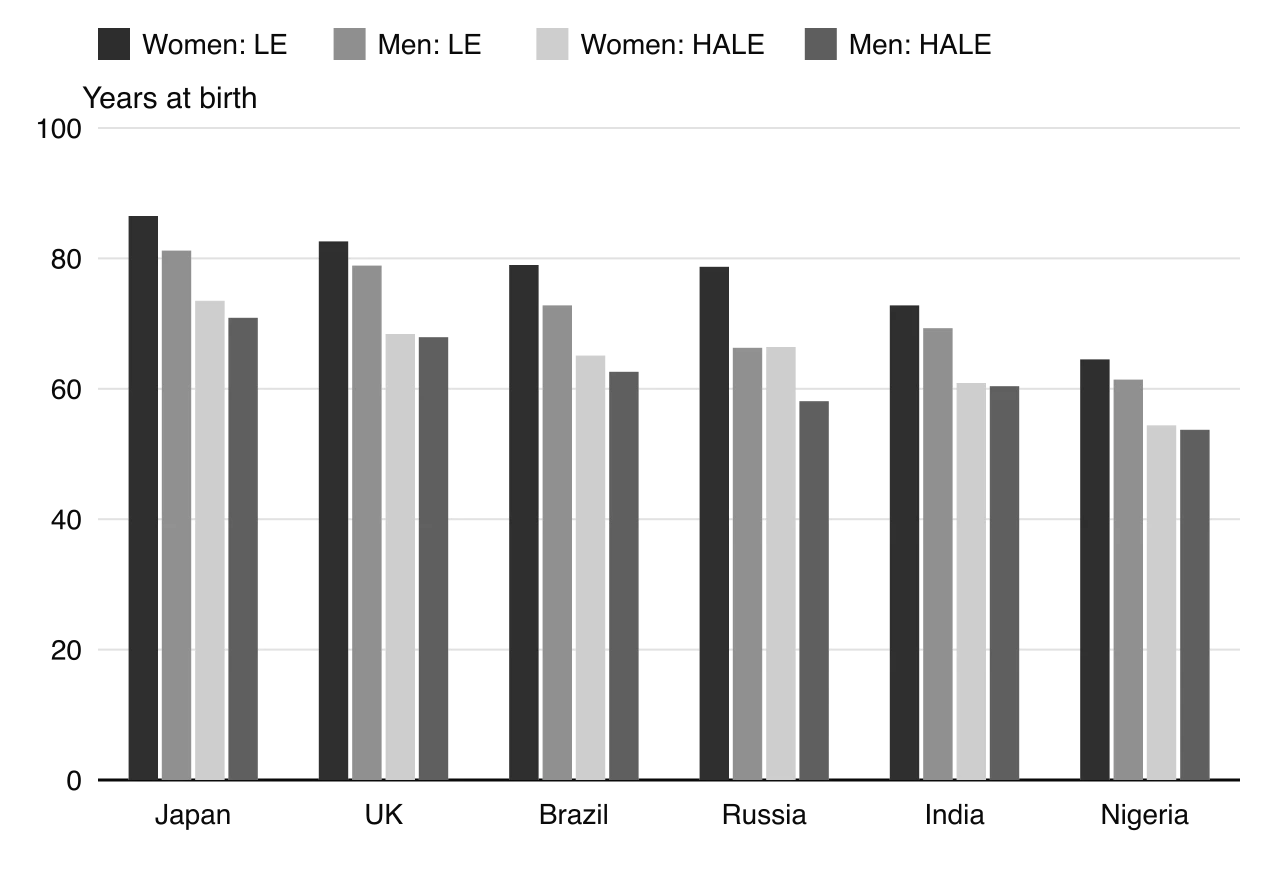
The chart shows two patterns. First, women’s advantage in life expectancy is largest in Russia (78.7 years against 66.3 for men in 2023), where men’s death rates from cardiovascular disease, injuries and alcohol are high. It is small in India and Nigeria, where maternal deaths and unequal access to food and care reduce women’s advantage. Second, the gap between life expectancy and HALE is larger for women: in Japan women can expect 13.0 years in less than full health and men 10.3.
Maternal deaths: the maternal mortality ratio was about 197 deaths per 100,000 live births worldwide in 2023, but about 993 in Nigeria, compared with 80 in India and 8 in the United Kingdom.
Anaemia: 30.7% of women aged 15–49 worldwide had anaemia in 2023, a result of iron deficiency, blood loss in menstruation and childbirth, poor diets and infections such as malaria.
Unequal care for girls: in societies with a strong preference for sons, girls may be fed less, vaccinated later and taken to clinics less often when ill.
Gender-based violence: treated by the WHO as a major public health problem.
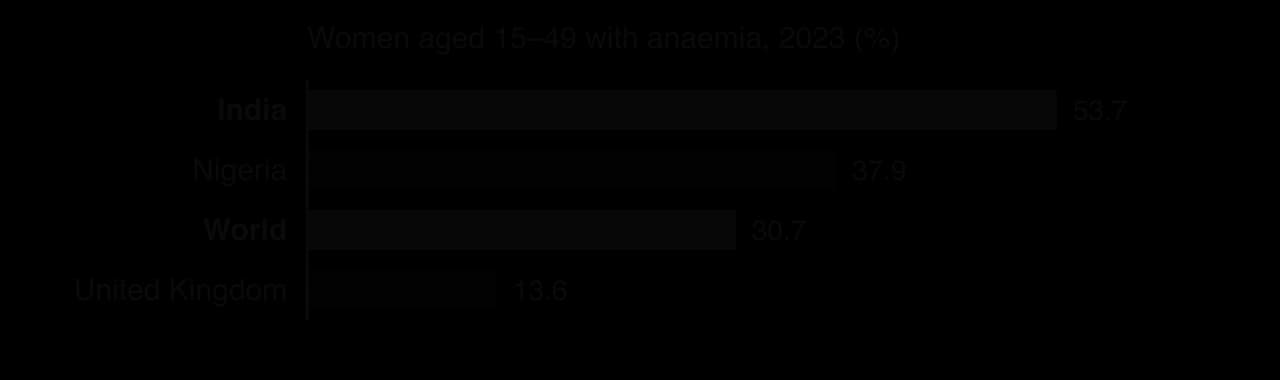
Anaemia is a form of micronutrient deficiency, and India’s very high rate, despite its large food subsidy system, shows that providing enough calories does not guarantee a healthy diet. The PDS supplies mostly cereals, while iron-rich foods cost more.
The most extreme result of gender inequality in health is a shortfall of women. The economist Amartya Sen wrote in 1990 that more than 100 million women were "missing": the number of women who would be alive if girls and women had received the same care, food and medical attention as boys and men. Later estimates range from about 90 to 101 million, concentrated in China and India, with smaller numbers in the Middle East and North Africa. The missing women result from sex-selective abortion, female infanticide in the past, and the neglect of girls’ nutrition and health care.
The sex ratio at birth is one way to measure the problem. Without sex selection, about 105 boys are born for every 100 girls. The World Bank reports that China’s ratio was 1.178 boys per girl in 2005, falling to 1.103 by 2024, and India’s 1.096 in 2010, falling to 1.071 by 2024. Both still exceed the natural level, although the gap has narrowed.
Sources: World Bank, World Development Indicators (SP.POP.BRTH.MF), 2026; WHO Global Health Observatory, 2026; Wikipedia, "Missing women", citing Sen (1990) and Klasen and Wink (2003), 2026.
Men face their own gendered risks: they smoke and drink more in most countries, work in more dangerous jobs and visit doctors later in an illness, which explains much of their shorter life expectancy. Women make up most nurses, midwives and unpaid carers, but men hold most senior posts in health systems. Educating girls is one of the strongest influences on child health: a mother with more schooling is more likely to have her children vaccinated and to recognise danger signs early, which lowers the infant mortality rate.
Gender interacts with other factors. Income, place, caste, ethnicity and age all shape outcomes alongside gender. Some programmes have narrowed gaps quickly: the fall in China’s and India’s sex ratios at birth since the 2000s, and the fall in Bangladesh’s maternal mortality ratio from about 523 deaths per 100,000 live births in 2000 to 115 in 2023, show that change is possible within a generation. Others, such as unequal land rights, change slowly because they are written into law and custom.
A famine is the most extreme form of food insecurity: a crisis in which a large share of people in an area cannot get enough food, acute malnutrition is widespread and people are dying from starvation and related disease. Many food crises are serious without being famines, so the word is reserved for situations that meet agreed criteria.
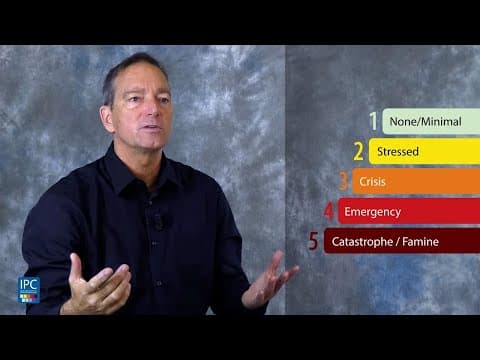
The Integrated Food Security Phase Classification (IPC) is a five-phase scale used by governments, UN agencies and NGOs to classify how severe a food crisis is, using common standards so that crises in different places can be compared. It was first developed in 2004 in Somalia by the FAO’s Food Security Analysis Unit.
Phase | Name | Typical household situation |
|---|---|---|
1 | Minimal | Households can meet their essential food and non-food needs without unusual strategies |
2 | Stressed | Food consumption is just adequate, but households cannot afford some essential non-food spending without stress |
3 | Crisis | Food consumption gaps and above-usual acute malnutrition, or needs met only by selling livelihood assets such as livestock or tools |
4 | Emergency | Large food consumption gaps, very high acute malnutrition and excess deaths, or extreme loss of livelihood assets |
5 | Catastrophe / Famine | An extreme lack of food; starvation, death and destitution are evident. An area is classified as Famine when the three famine thresholds are met |
An area is classified as being in famine only when all three thresholds are met at the same time: at least 20% of households face extreme food gaps, acute malnutrition among children exceeds 30%, and the crude death rate exceeds two per 10,000 people per day. Households can be in Phase 5 (Catastrophe) even where the area as a whole is not in famine. The final decision on famine is made by an independent Famine Review Committee of experts.
 YouTube
Famines rarely have a single cause. Geographers usually explain them as a trigger acting on existing vulnerability. The trigger may be a drought, a crop failure, a sudden rise in food prices or the outbreak of war. Vulnerability comes from poverty, rain-fed farming or herding, weak markets, displacement, poor health and weak government.
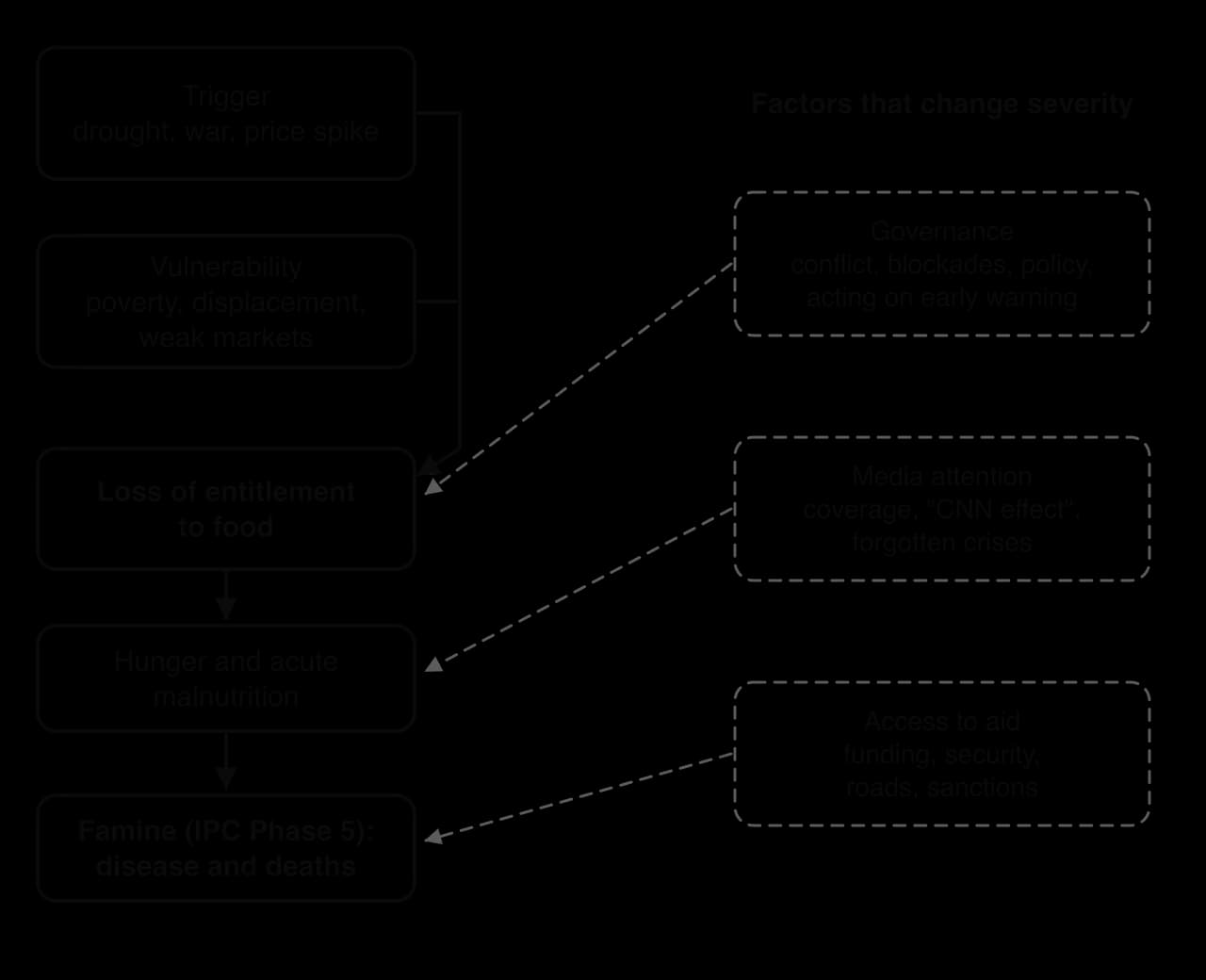
Until the 1980s, most explanations of famine assumed that it was caused by a fall in the amount of food available, the "food availability decline" view. In Poverty and Famines (1981), the economist Amartya Sen argued that famines occur when people lose their entitlement to food: their ability to command food through what they grow, what they earn, what they can trade or what they receive from the state or others. People starve when their wages, crops or animals can no longer be exchanged for enough food, even if food is available in the market. This idea is the entitlement approach.
The Bengal famine of 1943, in British India, is the classic example. Between about 800,000 and 3.8 million people died. Wartime spending caused rapid inflation, rice prices rose far faster than wages, and the loss of rice imports from Burma after the Japanese invasion and the British "boat denial" policy along the coast cut supplies and livelihoods. Workers in war industries were protected by priority distribution schemes, while landless rural labourers, fishers and artisans lost their entitlement and starved.
Sources: Wikipedia, "Bengal famine of 1943", citing the Famine Inquiry Commission (1945) and Sen (1981), 2026.
Sen also observed that no major famine has occurred in a functioning democracy with a free press, because governments that face elections and criticism have strong incentives to act on early signs of starvation. In the early 1980s Botswana, a democracy, avoided famine despite a large fall in food production, while Ethiopia and Sudan, under military rule, suffered mass famines.
Strengths | Limitations |
|---|---|
Explains why famines can occur when national food supplies are adequate (Bengal 1943) | Underplays real shortages, where crops fail across a whole region |
Explains why some groups starve and others do not: it focuses on access, not just supply | Focuses on markets and incomes; gives less weight to war, sieges and deliberate starvation |
Points to practical responses, such as cash transfers and public works | Says less about disease, which kills most famine victims |
Links famine to politics, democracy and the media | Some modern famines occur in places with elections but no effective state |
Modern famines are increasingly caused by armed conflict. In Sudan in 2024, Gaza in 2025 and Somalia in 2011, armed forces or militias blocked food, destroyed farms and markets, or prevented aid from reaching civilians. The UN Security Council recognised this in Resolution 2417 (2018), which condemns the starvation of civilians as a method of warfare. The entitlement approach still applies, because people lose access to food, but power and violence explain why they lose it.
Three groups of factors decide whether a crisis becomes a famine and how many people die: governance, the power of the media, and access to international aid.
Governance is the way power is used to make and carry out decisions. Its effect on famine operates in several ways:
Conflict, sieges and blockades: warring parties can cut supply routes, loot food stores and attack farmers. In Ethiopia in 1983–85, the military government restricted food supplies to rebel-held areas in the north as part of its counter-insurgency strategy.
Policy failure and corruption: price controls, forced resettlement or exporting grain from hungry areas can worsen a crisis, as when food was shipped out of Wollo to Addis Ababa during Ethiopia’s 1973 famine.
Acting on early warning: famine can be predicted months in advance. The early warning system run by FEWS NET (the Famine Early Warning Systems Network, created by USAID in 1985) monitors rainfall, harvests, prices and nutrition. It can only prevent famine if governments and donors act on its warnings.
The media can decide whether the world notices a famine. On 23 October 1984 a BBC news crew led by the reporter Michael Buerk broadcast the first television report from the famine in northern Ethiopia, describing "a biblical famine in the 20th century". The report was rebroadcast around the world, donations flooded in, and the Live Aid concerts of 13 July 1985 followed. Between 300,000 and 1.2 million people died in the famine, which affected 7.75 million people.
The influence of television news on government decisions is called the CNN effect, after the US news channel whose live satellite coverage of the 1991 Gulf War made it famous. The idea is that live images of suffering create public pressure that pushes politicians to act.
The media’s power works in both directions. Crises with few dramatic images or little access for journalists, often called "forgotten crises", receive less attention and less funding. The famine in Sudan from 2024 is an example: the scale of need was far greater than the coverage it received. Governments and armed groups can also restrict journalists or spread misinformation.
 YouTube
Even when warnings are clear and the world is watching, aid may not reach the people who need it. Access depends on:
Funding: humanitarian appeals are rarely fully funded. By September 2011, only 63% of the UN’s US$2.5 billion appeal for the Horn of Africa had been financed; Sudan’s 2024 humanitarian plan had received less than half of its US$2.7 billion target by September 2024.
Security: aid workers are attacked and convoys are looted. In June 2023, looters emptied WFP warehouses in El Obeid, Sudan, of food meant for 4.4 million people.
Permission and politics: governments and armed groups can block or tax aid. Sanctions and counter-terrorism laws in donor countries can prevent agencies working in areas held by groups on terrorist lists.
Logistics: roads, fuel and airstrips are needed to move bulk food; rainy seasons can cut roads for months.
In southern Somalia in 2010–2012, failed rains in two seasons caused crop failures and livestock deaths, and cereal prices rose to record levels. FEWS NET warned of the crisis as early as August 2010, and in June 2011 described it as "the most severe food security emergency in the world today". The UN declared famine in Bakool and Lower Shabelle on 20 July 2011.
These areas were controlled by al-Shabaab, which banned several Western agencies, while US rules to stop aid benefiting the group cut US aid spending in Somalia from US$150 million to US$13 million in a year.
A study by the FAO and FEWS NET in 2013 estimated that nearly 260,000 people died between 2010 and 2012, half of them children under five, and that about half of the deaths occurred before famine was declared. An FAO official told the BBC that "responding only when the famine is declared is very very ineffective".
Sources: Wikipedia, "2011 East Africa drought", citing FEWS NET and the UN, 2026; BBC News, "Somalia famine ‘killed 260,000 people’", 2 May 2013.
On 22 August 2025 the IPC confirmed famine in Gaza Governorate, the first famine it had confirmed outside Africa, with more than half a million people in famine conditions. UN agencies linked it to the war between Israel and Hamas and to restrictions on the entry of food and aid; Israeli officials disputed the scale of the crisis and blamed Hamas for diverting aid. On 19 December 2025 the IPC reported that famine had ended, after a ceasefire allowed food deliveries to increase.
Sources: Wikipedia, "Gaza Strip famine", citing the IPC and OCHA, 2026.
Sudan is a low-income country in north-east Africa with about 50.4 million people in 2024 and a gross national income (GNI) per capita of about US$710 (Atlas method). Most rural people depend on rain-fed farming and herding, and Darfur and Kordofan have suffered conflict and food crises for decades, including the Darfur famine of 1984–85 and the Darfur war from 2003. The famine that developed from 2024 was caused mainly by war rather than drought, which makes it a clear example of how governance, the media and access to aid decide the severity of a famine.
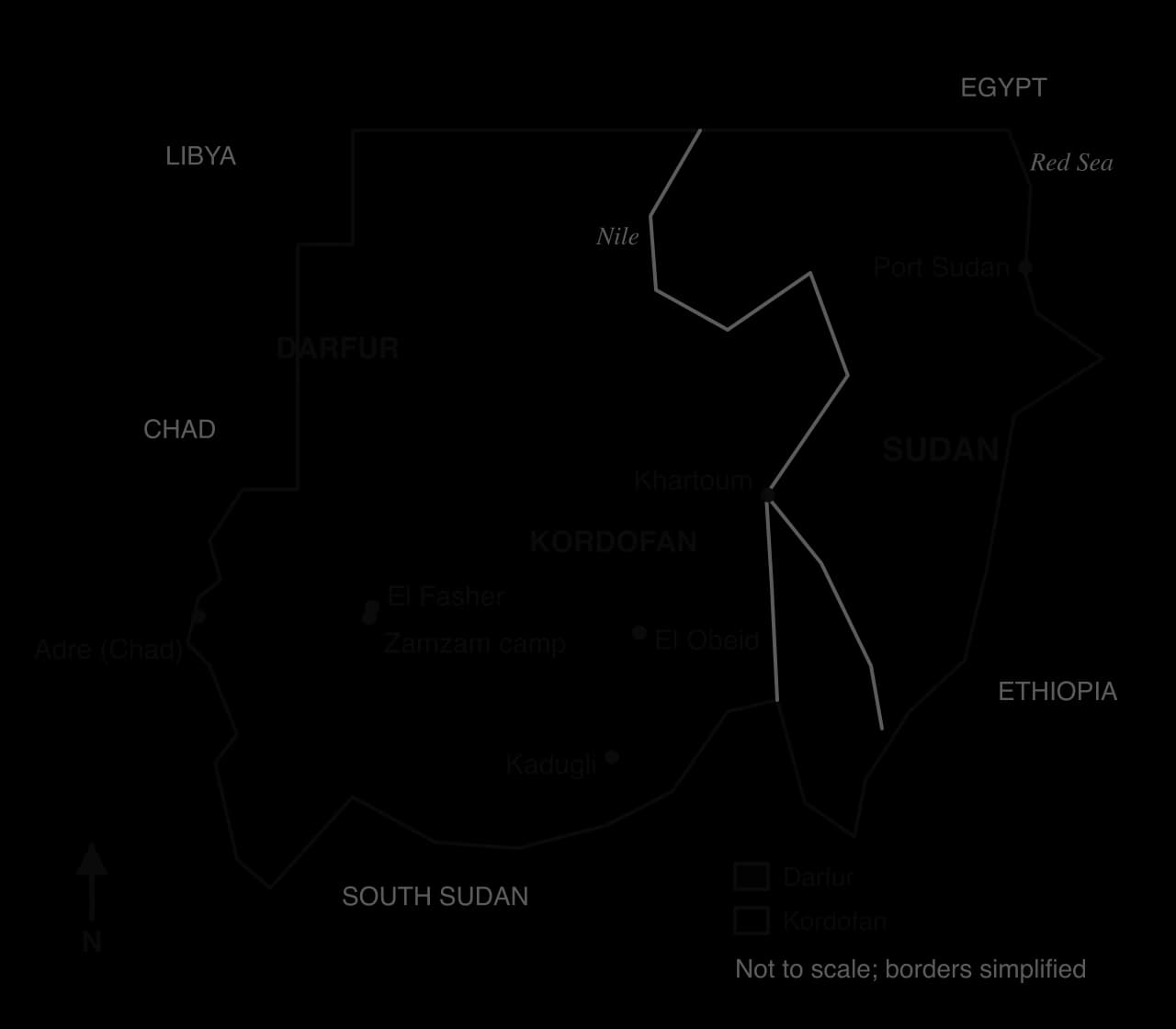
On 15 April 2023 fighting broke out between the Sudanese Armed Forces (SAF), led by General Abdel Fattah al-Burhan, and the Rapid Support Forces (RSF), a paramilitary group led by General Mohamed Hamdan Dagalo, after a power struggle within the transitional government formed after the 2021 coup. The war spread from Khartoum to Darfur, Kordofan and Gezira, Sudan’s main irrigated farming region. By November 2025 nearly 12 million people had been forced from their homes, inside Sudan and across its borders, making it one of the largest displacement crises in the world.
The war damaged every part of the food system. Markets and food-processing plants were destroyed, farmers could not reach their fields, and the 2023 cereal harvest fell to roughly half of its normal volume, with production in Darfur and Kordofan about 80% below average. Food prices rose by as much as 300% in some regions. In Sen’s terms, millions of people lost their entitlement to food at once: they could not grow it, earn wages to buy it or receive transfers.
Displaced people were the most vulnerable. Zamzam camp, 15 km south of El Fasher, set up in 2004 during the Darfur war, grew to about 500,000 people, who could not safely leave the camp to find work or food.
Both armed forces restricted food. Human rights groups reported that the RSF looted cities and destroyed harvests, while the SAF blocked food shipments into areas held by the RSF. In June 2024, UN experts said that both sides were deliberately withholding food and contributing to the starvation of civilians. Yale’s Humanitarian Research Lab identified 41 farming communities in North Darfur attacked between March and June 2024, ahead of the RSF siege of El Fasher, which lasted until the city fell on 26 October 2025.
The national government also limited the response. In September 2024 the agriculture minister denied that there was famine and accused aid agencies of trying to open borders to smuggle weapons to the RSF. On 23 December 2024, the day before the IPC confirmed famine in more areas, the government suspended its participation in the IPC, accusing it of "unreliable reports". In this case the stakeholders with formal authority over Sudan’s territory were obstacles to ending the famine.
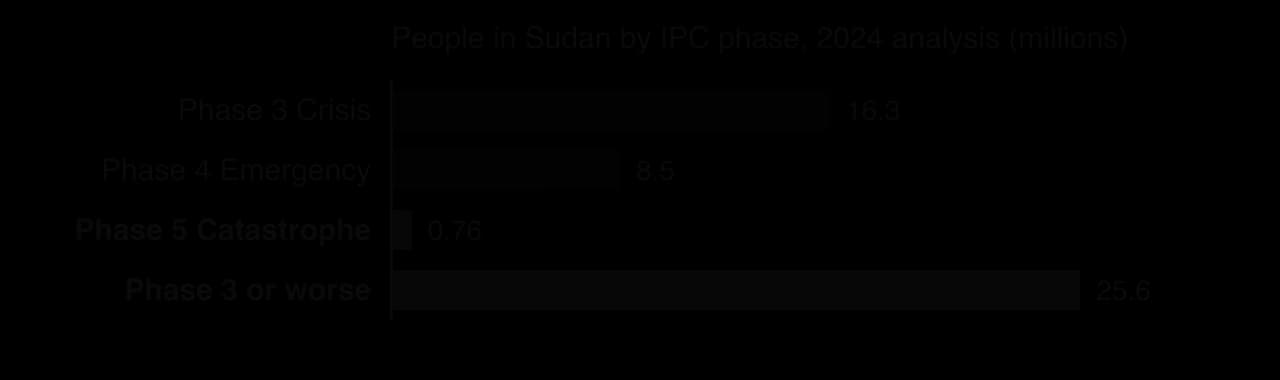
In the IPC analysis of April–May 2024, 25.6 million people, about half of Sudan’s population, were in Crisis (Phase 3) or worse, including 8.5 million in Emergency and 755,000 in Catastrophe.
Date | Finding |
|---|---|
18 June 2024 | 25.6 million people in acute food insecurity (IPC Phase 3 or worse); 755,000 in Phase 5 |
1 August 2024 | The Famine Review Committee confirms famine (IPC Phase 5) in Zamzam camp, with plausible famine in the nearby Abu Shouk and Al Salam camps |
24 December 2024 | Famine confirmed in Abu Shouk and Al Salam camps and parts of the Western Nuba Mountains (South Kordofan); the government rejects the findings |
13 April 2025 | The RSF seizes Zamzam camp; its remaining residents, about 400,000, flee again, many to Tawila |
May 2025 | Famine confirmed in at least ten areas; nearly 4 million children under five acutely malnourished, more than 770,000 at high risk of death |
September 2025 | WFP: 24.6 million people in acute hunger; 2 million facing famine or the risk of it |
November 2025 | The Famine Review Committee finds famine in El Fasher and Kadugli; 20 more areas at risk; about 375,000 people in famine in Darfur and Kordofan |
The famine received far less coverage than the scale of need suggested. In 2024 US officials described Sudan as "the world’s most severe humanitarian crisis" while noting the relatively low media attention it received. Fighting kept journalists out of Darfur and Kordofan, and without the public pressure of a CNN effect, donors felt less urgency to fund the appeal.
Aid reached only a fraction of the people in need. On 1 June 2023 the WFP’s warehouses in El Obeid were looted of food for 4.4 million people, and by July 2023 more than 50 aid warehouses had been looted and over 200 vehicles stolen. The first WFP convoy reached Zamzam on 23 November 2024, almost four months after famine had been declared there.
Funding was also short. By September 2024 the humanitarian plan for Sudan had received less than half of its US$2.7 billion target, and in mid-2024 the WFP cut daily rations by close to 20% because only 19% of its funding target had been met.
In early 2025 the United States froze much of its foreign aid; the WFP reported that 80% of emergency food kitchens had closed because of the cuts, and both MSF and the WFP suspended work at Zamzam. Some access improved: the Adre crossing from Chad reopened in 2024, and in May 2025 the WFP reached a record 5 million people, including digital cash for 250,000 people in besieged El Fasher.
Group | Impacts |
|---|---|
Children under five | About 3.6 million acutely malnourished in 2024 and nearly 4 million by May 2025; a severely malnourished child is about twelve times more likely to die from diseases such as diarrhoea and cholera |
Women and female-headed households | Female-headed households were about three times more likely to be food insecure than those headed by men; severe hunger among them rose from 14% in 2024 to 25.9% in early 2025 |
Displaced people in camps | Famine confirmed first in Zamzam, Abu Shouk and Al Salam camps; attacks forced camp residents to flee again |
Refugees in neighbouring countries | Children died of acute malnutrition in camps in Chad |
Malnutrition weakened immunity, so diseases such as measles, malaria and cholera spread rapidly, and most deaths came from disease combined with hunger. The full death toll is unknown because surveys were impossible in many areas; the Sudan Doctors Union’s estimate of 522,000 child deaths (January 2025) could not be independently checked.
Key concept | How Sudan shows it |
|---|---|
Place | Famine was concentrated in Darfur and Kordofan, remote regions with long histories of conflict, while Khartoum and Gezira improved once fighting eased in 2025 |
Process | War acted on vulnerability (poverty, displacement, rain-fed farming) and destroyed entitlements through lost harvests, price rises and blocked transfers |
Power | Armed groups controlled access to food, the government blocked data and donors decided how much aid was available; the people affected had almost no power |
Possibility | Safe aid corridors, community kitchens, cash transfers and accountability for starvation as a weapon, all depending on a ceasefire |
Sudan supports Sen’s view that famine is about access rather than total supply: Jebel Marra, a fertile, comparatively productive area held by a neutral armed group, could not send its food to markets because of fighting and insecurity. It also shows the limits of the entitlement approach, because the loss of entitlement was caused deliberately by armed groups, and only political power, not markets, could restore it.
Explain why famine was confirmed first in displacement camps rather than in rural villages.
Examine the relative importance of governance and funding in limiting the humanitarian response in Sudan.
To what extent does the Sudan famine support Sen’s entitlement approach?
Sources: Wikipedia, "Famine in Sudan (2024–present)", "Sudanese civil war (2023–present)", "Siege of El Fasher", "Zamzam refugee camp" and "Integrated Food Security Phase Classification", citing the IPC, WFP, UN OCHA and Yale Humanitarian Research Lab, 2026; World Bank, World Development Indicators, 2026.
Questions on stakeholders in food and health appear in Paper 1 as a 10-mark structured question on a stimulus, such as a table of health indicators by sex or a map of food insecurity, and as 10-mark extended questions.
The table shows life expectancy and health-adjusted life expectancy (HALE) at birth for women and men in four countries in 2023.
Country | Women: life expectancy (years) | Men: life expectancy (years) | Women: HALE (years) | Men: HALE (years) |
|---|---|---|---|---|
Japan | 86.5 | 81.2 | 73.5 | 70.9 |
Brazil | 79.0 | 72.8 | 65.1 | 62.6 |
Russia | 78.7 | 66.3 | 66.4 | 58.1 |
Nigeria | 64.5 | 61.4 | 54.4 | 53.7 |
Sources: WHO Global Health Observatory, 2023 estimates (accessed 2026).
Extended questions often ask you to examine the severity of famine, evaluate the roles of stakeholders or discuss the influence of TNCs on diets, for example: "To what extent do TNCs have more influence than governments on food consumption habits?" Each needs named stakeholders, a located case and a judgment.
Stakeholders in food and health range from global UN agencies to households, and their power comes from money, regulation, knowledge and control of territory.
The WFP delivers emergency food, logistics and school meals; the FAO collects data, gives early warning and technical advice; the WHO sets health rules and guidelines. All three depend on voluntary funding and on permission from governments.
Governments have the most power at national scale, through subsidies such as India’s PDS, cash transfers such as Mexico’s, sugar taxes such as the UK’s levy of 2018 and universal health coverage such as Thailand’s, but they can also cause food insecurity.
NGOs and foundations bring local presence, speed and large funds, but they raise questions of scale, accountability, donor priorities and aid dependency.
TNCs shape diets through concentrated control of seeds, grain trading, manufacturing and retail, and through marketing of ultra-processed foods; regulation such as Chile’s 2016 labelling law can limit their influence.
Gender roles affect access to land, inputs and income, the sharing of food in the household and health outcomes; women live longer but spend more years in ill health, and some populations have millions of missing women.
Famine is IPC Phase 5 for an area. It develops when a trigger acts on vulnerability and people lose their entitlement to food; governance, the media and access to aid decide its severity.
In Sudan since 2023, war, looting, blocked aid, government denial, low media attention and funding gaps turned a conflict into famine in Darfur and Kordofan.
I can describe the roles of the WFP, the FAO and the WHO, with an example of each.
I can explain how governments and NGOs reduce or cause food insecurity and disease, using named policies.
I can evaluate the power of different stakeholders, including vertical and horizontal programmes and aid dependency.
I can explain how agribusiness, supermarkets and the media shape what people eat, with named firms.
I can examine gender roles in food production, food sharing and health, with data.
I can define famine using the IPC scale and explain Sen’s entitlement approach.
I can explain how governance, the media and access to aid affect the severity of famine.
I can analyse the Sudan famine with dates, figures and stakeholders.
Conflict and political instability can produce severe undernutrition regardless of past income (eg Yemen and Syria).
Physical factors (drought, soil, disease environment) affect utilization: diarrhoeal disease from poor sanitation causes undernutrition even where food is available.
Good answers may be well structured (AO4) and may additionally offer a critical evaluation (AO3) which weighs income against other factors, recognizing that income sets the context but culture, policy, inequality and environment explain the anomalies. Another approach might be to consider scale, showing that national income patterns conceal disparities between regions and social groups. Responses may also note the role of TNCs and trade in spreading processed foods to lower-income places faster than incomes rise (power).
For 5–6 marks, expect some weakly-evidenced outlining of patterns of undernutrition and/or overnutrition with some reference to income.
For 7–8 marks, expect a structured account which includes:
either well-evidenced explanation of several reasons why the patterns depart from income levels, with located examples
or a discursive conclusion (or ongoing evaluation) grounded in geographical concepts and/or perspectives.
For 9–10 marks, expect both of these traits.
NB. Maximum [6] if only undernutrition or only overnutrition is considered.
Marks | Level descriptor |
|---|---|
0 | The response does not reach a standard described by the descriptors below. |
1–2 | Too brief, lists unconnected information, not focused on the question and lacks structure. Knowledge is very general, with large gaps or errors; examples or case studies are missing or only listed. No analysis; terminology is missing or used incorrectly. |
3–4 | Too general, lacks detail, not focused on the question and largely unstructured. Outlines examples, statistics and facts, both relevant and irrelevant, with links to the question only listed. Basic terminology is used, with errors or inconsistently. No critical evaluation of evidence; any conclusion is irrelevant. |
5–6 | Partially addresses the question, with a narrow argument, an unsubstantiated conclusion and limited evaluation. Describes relevant supporting evidence (examples, case studies) and outlines links to the question. The argument repeats one point or covers only part of the question. Other perspectives, or strengths and weaknesses of evidence, are listed. |
7–8 | Addresses the whole question; the analysis is evaluated and the conclusion is relevant but lacks balance. Relevant evidence is described correctly and covers all the main points. The argument is clear but one-sided or unbalanced. Complex terminology is used correctly but not consistently. Other perspectives, or strengths and weaknesses of evidence, are described. |
9–10 | In-depth and specific to the question (topic and command term). Correct, relevant examples, statistics and detail are integrated and their link to the question explained. The argument is balanced, explaining complexity, exceptions and comparisons. Evaluation of evidence and perspectives is well developed, and the conclusion is balanced and aligned with the evidence. Logically structured and easy to follow. |
Examine the relative importance of food availability and food access in explaining global patterns of food insecurity.
10 marks
To what extent is the nutrition transition an inevitable consequence of economic development?
10 marks