4 Water
An overview of the Water topic: how the water cycle works as a system, how societies secure, use, farm and pollute water, how the four subtopics connect, and what HL students add.
- IB Environmental Systems and Societies
- SL and HL
What 4 covers
From the subject guide: what you need to know and be able to do.
The water cycle, access to water, food from aquatic systems and water pollution.
4 subtopics in Water
Each one has its own page once something is published for it.
- 4.1Water systemsnotes
- 4.2Water access, use and securitynotes
- 4.3Aquatic food production systemsnotes
- 4.4Water pollutionnotes
An overview of 4 Water
The Water topic studies the hydrosphere as a natural system and the ways human societies depend on it and change it. It follows water from the global hydrological cycle to the taps, fields, fisheries and sewers of human societies, and back into rivers, lakes and the sea.
Water links almost every other part of the course. It carries energy and nutrients through ecosystems, shapes climate and biomes, supports food production on land and at sea, and moves pollutants from where they are released to where they cause harm. Access to safe water is also one of the clearest measures of inequality between and within societies.
Questions the topic asks
How does water move between the oceans, atmosphere, land and living things, and how do human activities alter those flows and stores?
Why do some societies have secure water supplies while others face scarcity and stress, and how can water be shared fairly and used sustainably?
How are fish and other aquatic foods produced, and to what extent can fisheries and aquaculture be sustainable?
Where does water pollution come from, how is it measured, and how can it be prevented, reduced or cleaned up?
How do the perspectives and values of different groups shape decisions about water?
The four subtopics
Subtopic | What it covers |
|---|---|
4.1 Water systems | The hydrological cycle as a system of stores, transfers and transformations driven by solar radiation and gravity; human changes to flows and stores, including flash floods; water budgets and sustainable abstraction from lakes and aquifers (case study: the Aral Sea). HL: the properties of water, the oceans as a carbon sink, stratification, upwelling and thermohaline circulation. |
4.2 Water access, use and security | Water security; social, cultural, economic and political factors in access; uses of water; increasing supply; physical and economic water scarcity; conserving water in homes and food production; a named country’s strategy, Singapore (case study: Cape Town’s “Day Zero” crisis). HL: water stress, the freshwater planetary boundary, governance, transboundary disputes, water footprints, citizen science, industrial supply and its impacts, inequitable access to water and sanitation. |
4.3 Aquatic food production systems | Producers of aquatic food webs; rising demand and destructive fishing; fishery collapse; maximum sustainable yield and the yield–effort curve; climate change and acidification; policy, marine protected areas and aquaculture (case study: the northern cod collapse). HL: productivity and stratification, stock assessment, the risks of harvesting at MSY, recovery through cooperation, EEZs and the high seas, the ethics of hunting marine mammals. |
4.4 Water pollution | Sources and impacts of water pollution; plastics in the oceans; water quality and biochemical oxygen demand; eutrophication, its impacts and its management at three levels (case study: the Baltic Sea). HL: further pollutants, harmful algal blooms, dead zones, sewage treatment, indicator species and biotic indices, water quality indices, standards, and citizen action. |
How the subtopics connect
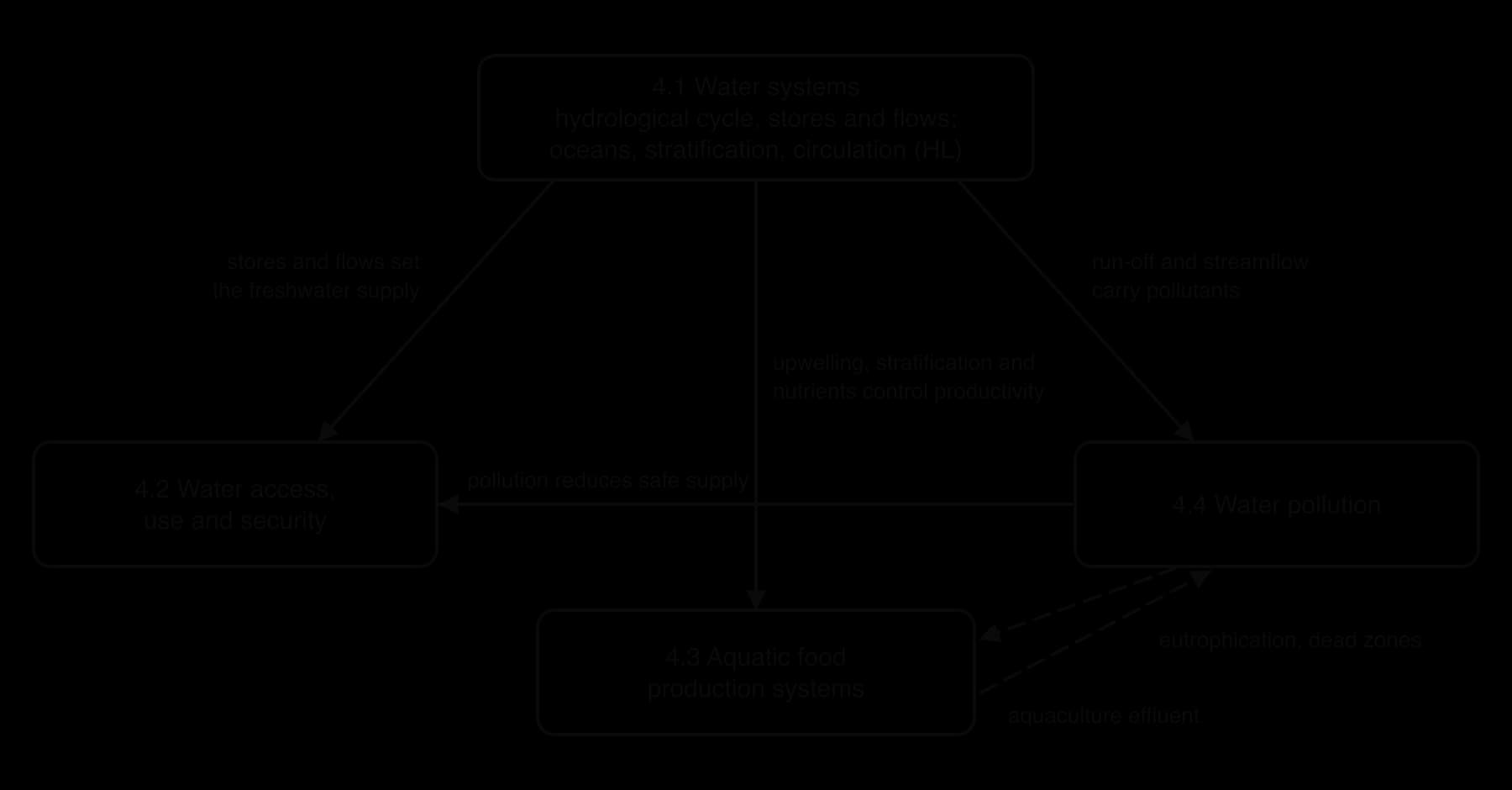
Water systems come first because the other three subtopics depend on them. The stores and flows of the water cycle set how much fresh water a region can use (water security); the mixing, stratification and upwelling of water bodies control how productive lakes and seas are (aquatic food); and the same flows of run-off and streamflow carry pollutants into rivers, lakes and the sea (pollution).
The subtopics also feed back into each other. Pollution reduces the amount of safe water and so worsens water stress; nutrient pollution and the effluent from fish farms cause eutrophication and dead zones that damage fisheries; and over-abstraction of rivers concentrates pollutants and shrinks lakes, as the Aral Sea shows.
 YouTube
Perspectives, systems and sustainability in the Water topic
Systems
Every subtopic uses systems diagrams. A lake or aquifer is modelled with a water budget of inputs and outputs; a fishery with inputs of recruitment and growth and an output of catch; a polluted lake with the positive feedback loop of eutrophication. Each model shows where a human activity changes a flow, and so where management can act.
Perspectives
Water problems are rarely only technical. A technocentric response to scarcity is to build dams, desalination plants and water transfers; an anthropocentric response is to manage demand through pricing, licences and efficiency; an ecocentric response is to leave water in rivers and wetlands and to restore the ecosystems that regulate supply. Fishing communities, governments, farmers, conservationists and Indigenous peoples often see the same lake, river or fishery in very different ways.
Sustainability
Water use is sustainable only when abstraction stays within the rate at which stores are replenished, when fish catches stay within what stocks can replace, and when pollutants are released no faster than water bodies can absorb them. Sustainable Development Goals 6 (clean water and sanitation) and 14 (life below water) set targets for the topic, and freshwater change is one of the planetary boundaries. Questions of environmental justice run through all four subtopics: who has safe water, who eats the fish, and who lives downstream of the pollution.
Links to other topics
Foundation: systems, steady states, feedback and tipping points; perspectives; sustainability, footprints and planetary boundaries.
Ecology: the water cycle beside the carbon and nitrogen cycles; productivity and energy flow in aquatic food webs; ENSO and climate.
Biodiversity and conservation: invasive species and biodiversity loss in lakes and seas; marine protected areas as conservation.
Land: water in soils, irrigation, salinisation and fertiliser run-off from farmland.
Atmosphere and climate change: the oceans as a heat store and carbon sink, sea-level rise, droughts and floods, and the possible weakening of ocean circulation.
Natural resources: water as a renewable resource that can be overused, and hydroelectric power.
Human populations and urban systems: rising demand from growing cities, urban run-off and flood risk.
How SL and HL differ
SL and HL students study the same core content in all four subtopics: the water cycle and water budgets, water security and scarcity, fisheries and aquaculture, and water pollution and eutrophication, each with its own case study. HL students study everything SL students do, and each subtopic then adds sections marked “(HL only)”:
Subtopic | What the HL-only sections add |
|---|---|
4.1 Water systems | The properties of water; the oceans as a carbon sink; stratification and the thermocline; upwelling; thermohaline circulation and the conveyor belt. |
4.2 Water access, use and security | Water stress and the 1,700 m³ per person threshold; the freshwater planetary boundary; governance and transboundary disputes; water footprints; citizen science; industrial supply and its impacts; inequitable access to water and sanitation. |
4.3 Aquatic food production systems | Productivity and nutrient mixing; measuring fish stocks; the risks of harvesting at maximum sustainable yield; recovery through cooperation; EEZs and the high seas; the ethics of hunting seals, whales and dolphins. |
4.4 Water pollution | Further pollutants; harmful algal blooms; dead zones; sewage treatment; indicator species and biotic indices; water quality indices; drinking-water standards; citizen action. |
HL students also apply the three HL lenses to water. Environmental law appears in water-sharing treaties, the UN Convention on the Law of the Sea, the high seas treaty and drinking-water standards. Environmental economics appears in water pricing, the valuation of ecosystem services such as clean water and fisheries, and the costs of pollution and who should pay them. Environmental ethics appears in the right to water, the duties owed to downstream communities and future generations, and the debate over hunting marine mammals.
Assessment
The Water topic is examined in both external papers, and water investigations are popular choices for the internal assessment.
Paper 1 gives an unseen case study, often a river basin, lake, coastal sea or city with water data. Typical questions ask students to construct or complete a systems diagram, calculate a water budget, a percentage change or a rate, interpret graphs of water levels or fish catches, explain the causes of scarcity or pollution, and evaluate a management strategy for the place from several perspectives.
Paper 2 Section A asks short-answer and data-based questions: defining flows and terms, drawing the hydrological cycle or the eutrophication feedback loop, calculating BOD or a water budget, interpreting a yield–effort curve, and outlining conservation or pollution-management strategies.
Paper 2 Section B essays often combine water with other topics, such as food security, climate change or urban growth. The final, markband-assessed part rewards named examples, linked systems reasoning, balanced perspectives and a supported judgement; HL answers are also expected to draw on the HL lenses.
The internal assessment often uses water: measuring water quality along a river, comparing biotic indices above and below an outfall, or analysing database records of rainfall, river flow or fish catches.
Flashcards for 4
The official decks for this part of the syllabus.
- 4.1 Water systems215 cards
- 4.2 Water access, use and security258 cards
- 4.3 Aquatic food production systems277 cards
- 4.4 Water pollution293 cards
Carry on with 4 in Augment
With a free account, Augment remembers where you stopped and what you have practiced.