7 Natural resources
An overview of natural resources: how societies value, use and secure resources and energy, how waste is managed, and what HL students add.
- IB Environmental Systems and Societies
- SL and HL
What 7 covers
From the subject guide: what you need to know and be able to do.
How we use and manage natural resources, energy sources and waste.
3 subtopics in Natural resources
Each one has its own page once something is published for it.
- 7.1Natural resources—uses and managementnotes
- 7.2Energy sources—uses and managementnotes
- 7.3Solid wastenotes
An overview of 7 Natural resources
Natural resources is the study of the materials and energy that human societies take from the Earth, how they are used and valued, and what happens to them once they become waste. It brings together ecology, economics, technology and politics, because every resource decision affects both natural systems and the people who depend on them.
Global use of materials rose from about 30 billion tonnes in 1970 to about 106 billion tonnes a year in the early 2020s. Whether that growth can continue, and how its benefits and costs are shared, are among the most important questions for sustainability.
Sources: UNEP International Resource Panel, Global Resources Outlook 2024 (2024).
Questions the topic asks
What counts as a natural resource, and how can it be used without running down the natural capital that produces it?
Why do different people place different values on the same forest, river or mineral deposit, and why do those values change over time?
How do societies secure enough food, water, energy and minerals, and why are some far more secure than others?
Which energy sources can meet growing demand sustainably, and what are the hidden costs of each, including renewable ones?
How much waste do societies produce, where does it go, and how can it be reduced or turned back into a resource?
How do governments, businesses, communities and international agreements shape the way resources are used?
The subtopics
Subtopic | What it covers |
|---|---|
7.1 Natural resources: uses and management | Natural capital and natural income, ecosystem services, renewable and non-renewable resources, the values of natural capital and how they change, sustainable management, resource security and the factors behind resource choices; a case study of phosphate mining on Nauru |
7.2 Energy sources: uses and management | Renewable and non-renewable energy sources, rising global demand, the sustainability of different sources, the energy choices of contrasting countries (Iceland and Saudi Arabia), energy storage for intermittent renewables, energy conservation and efficiency; a case study of Germany’s Energiewende |
7.3 Solid waste | Types and sources of waste, the composition of solid domestic waste, how waste varies between societies, its impacts near and far, including the waste trade, biodegradability and half-lives, preventative and restorative strategies, the waste hierarchy, disposal options, policies that promote sustainable management and the circular economy applied to products; a case study of China’s National Sword ban and the plastic waste trade |
How the subtopics connect
The three subtopics follow resources through society. Natural capital is extracted or harvested; part of it becomes energy and part becomes materials, food and goods; and everything eventually leaves the economy as waste, as solid waste, as emissions to the air and water, or as heat. The more of that waste is reused, recycled or composted, the less new natural capital has to be taken.
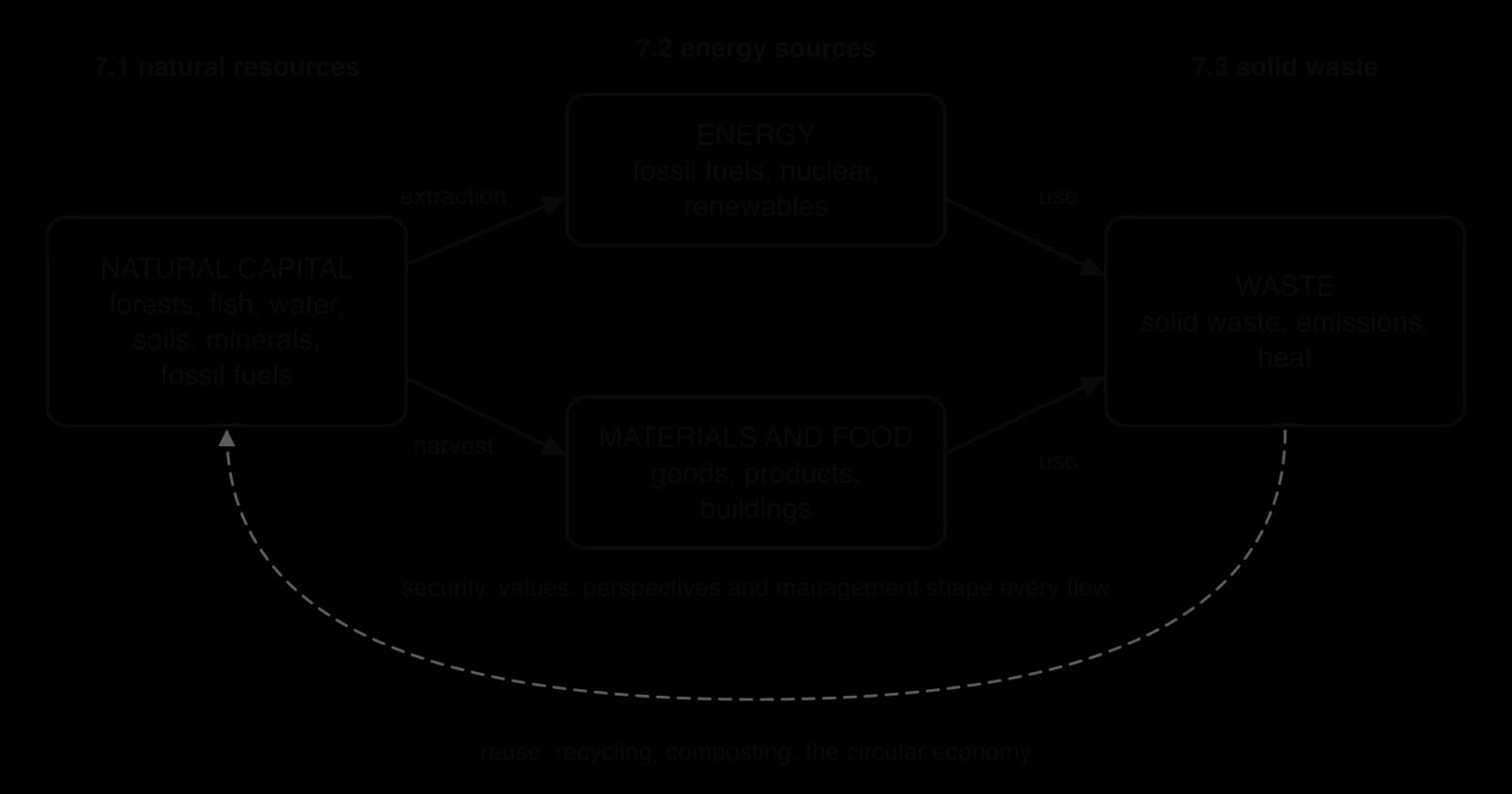
Seen as a system, the economy is an open system with inputs of resources and outputs of waste. Ideas about natural capital apply throughout: energy sources are natural capital whose renewability and value change over time, and waste becomes pollution when it is released faster than ecosystems can absorb it. Resource security links all three: energy security is one form of resource security, and a society that recycles its waste depends less on imports.
Links to perspectives, systems and sustainability
Perspectives. Calling nature “capital” or “resources” reflects an anthropocentric view that is contested by ecocentric and many Indigenous worldviews. Technocentric responses, such as desalination, recycling technology or nuclear power, are weighed against changing consumption.
Systems. Resources are storages and their use is a flow; sustainable use keeps flows out of a storage no larger than flows into it. Supply chains and trade connect resource systems across the world, so a shock in one place spreads to others.
Sustainability. The topic applies the two conditions for sustainable use (harvest no faster than regeneration, release wastes no faster than they can be absorbed), the circular economy, the SDGs on energy (SDG 7) and responsible consumption (SDG 12) and the planetary boundaries.
The topic also draws on the rest of the course. Water security and aquatic food systems belong to the water topic; soils and agriculture to the land topic; the emissions from energy use drive climate change; and cities concentrate both resource demand and waste. Fisheries, forests and aquifers are all examples of renewable natural capital met elsewhere in the course.
 YouTube
How SL and HL differ
SL and HL students study the same core content in all three subtopics: natural capital and income, ecosystem services, resource types and values, sustainable management and resource security (7.1); energy sources, demand, sustainability, energy choices, storage, conservation and efficiency (7.2); and solid waste, its impacts, strategies and the circular economy (7.3).
HL students study additional, HL-only understandings in two of the three subtopics:
7.1: management and intervention strategies; the SDGs as a framework; environmental impact assessment, baseline studies and public participation; unsustainable use of renewable resources; short-term economic interests; resource insecurity and the geopolitics of oil and critical minerals; routes to resource security; and the effects of globalisation.
7.2: energy security; the finite reserves of coal, oil and gas and the factors affecting how long they last; nuclear power; and the mining, pollution and political tensions behind large-scale battery storage.
7.3: no HL-only understandings; SL and HL study the same content.
The three HL lenses apply across the topic. Environmental law appears in EIAs, mining and planning laws, international agreements on waste such as the Basel Convention, and court cases over resource projects. Environmental economics appears in the valuation of ecosystem services, taxes and subsidies on resources, discounting and short-termism, and the debate between growth and degrowth. Environmental ethics appears in questions of intrinsic value, intergenerational equity and environmental justice, for example who bears the costs of mining or receives exported waste.
Assessment
The topic is examined in Paper 1 and Paper 2 at both levels, and it is a common source of internal assessment investigations.
Paper 1 (unseen case study): resource booklets often describe a place that depends on a resource, such as a mine, a fishery, a dam or an energy project, with data on production, prices, emissions, access to water or food, or waste. Typical questions ask students to calculate percentage changes or rates, describe trends, explain impacts and evaluate a management strategy for that place.
Paper 2 Section A: short-answer and data-based questions on definitions (natural capital, natural income, renewable resources, resource security), classifications of resources and values, ecosystem services, energy sources and waste disposal options.
Paper 2 Section B: structured essays that ask students to evaluate the sustainability of resource or energy use, discuss the factors and perspectives behind a country’s choices, or judge the effectiveness of waste strategies. HL essays are expected to bring in legal, economic and ethical angles where relevant.
Common investigation topics include surveys of the values a community places on local ecosystem services, school waste audits and comparisons of resource or energy use between countries using secondary data.
Flashcards for 7
The official decks for this part of the syllabus.
- 7.1 Natural resources—uses and management231 cards
- 7.2 Energy sources—uses and management263 cards
- 7.3 Solid waste221 cards
Carry on with 7 in Augment
With a free account, Augment remembers where you stopped and what you have practiced.